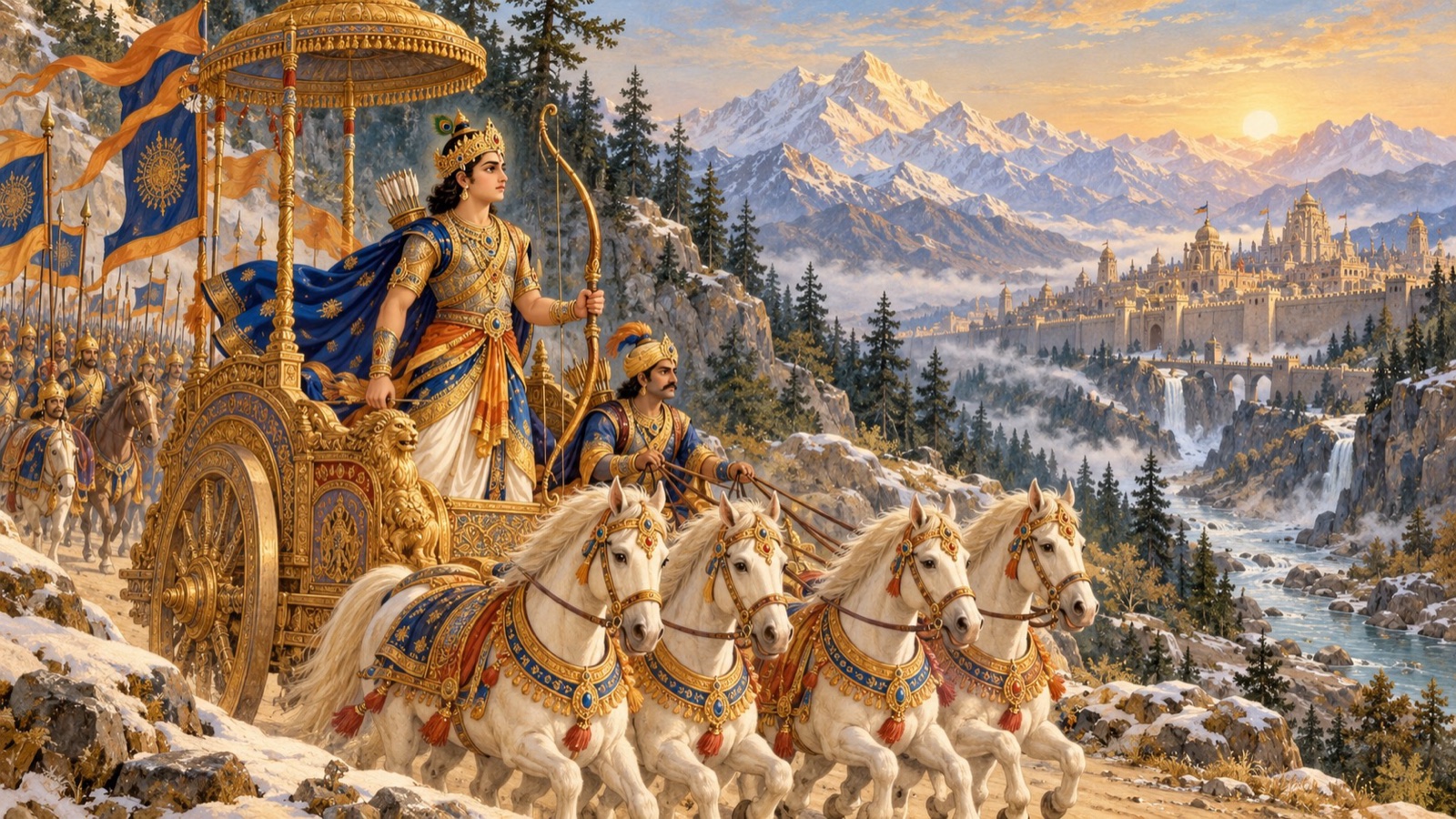
Grief and resolve upon his face, the young king Dhruva mounts his victorious chariot and rides toward the Himalayan city of the Yakshas, to answer the killing of his beloved brother.
Om Namo Bhagavate Vasudevaya.
Om Namo Bhagavate Vasudevaya.
Om Namo Bhagavate Vasudevaya.
Welcome to Srimad Bhagavatam Wisdom, a devotional journey through the sacred histories and teachings of the Srimad Bhagavat Mahapurana. Having received the Lord’s vision and an imperishable boon, Dhruva returned home, was crowned king, and ruled in righteousness. This tenth chapter turns from grace to grief. Dhruva’s younger brother Uttama, still unmarried, is slain by a Yaksha while hunting in the Himalayas, and his mother Suruchi perishes searching for him. Overcome with sorrow and anger, Dhruva mounts his chariot and marches against the city of the Yakshas to avenge his brother; he blows his conch at their gates, and a fierce battle begins. Yet even here, amid arrows and illusion, the chapter keeps its devotional heart, closing as the sages appear to bless the young king in the Name of the Lord. It is a chapter about grief, righteous anger, and the protection that the Holy Name affords even on the field of battle.
Chapter Information
- Scripture: Śrīmad Bhāgavata Mahāpurāṇa
- Canto: 4 (Book Four)
- Chapter: 10 (Discourse 10)
- Chapter title: Uttama’s Death and Dhruva’s March Against the Yakshas
- Principal speaker: The sage Maitreya, continuing his discourse to Vidura (with the words of the sages quoted within)
- Principal listener: Vidura
- Main setting: The kingdom of Dhruva, and the valley of the Himalayas where Alakapuri, the city of the Yakshas, stands
- Central subject: The death of Uttama, Dhruva’s grief and march, the blowing of his conch, and the battle with the Yakshas
- Principal verse range: Canto 4, Chapter 10, verses 1–30
- Primary edition: Gita Press Śrīmad Bhāgavata Mahāpurāṇa
Context from the Previous Chapter
Chapter 9 was the reward of Dhruva’s austerity: the Lord appeared before him, touched his cheek with the conch to loosen his praise, granted him an imperishable abode above the seven sages, and Dhruva returned home to a repentant father and was enthroned as king. Maitreya briefly recounts that Dhruva married and had sons and ruled well; and then the narrative turns to the sorrow that came upon his house.
The Death of Uttama
Dhruva’s younger brother Uttama, the son of Suruchi and still unmarried, went out one day to hunt in the Himalayas. There he was slain by a powerful Yaksha. His mother Suruchi, who had once spoken so proudly, set out into the same mountains in search of her lost son, and there she too met her end.
उत्तमस्त्वकृतोद्वाहो मृगयायां बलीयसा । हत: पुण्यजनेनाद्रौ तन्मातास्य गतिं गता ॥ ३ ॥
uttamas tv akṛtodvāho mṛgayāyāṁ balīyasā hataḥ puṇya-janenādrau tan-mātāsya gatiṁ gatā
Meaning: Uttama, still unmarried, went hunting and was slain by a powerful Yaksha in the mountains; and his mother Suruchi, searching for him, met the same fate. (Canto 4, Chapter 10, verse 3)
Dhruva Marches to Avenge His Brother
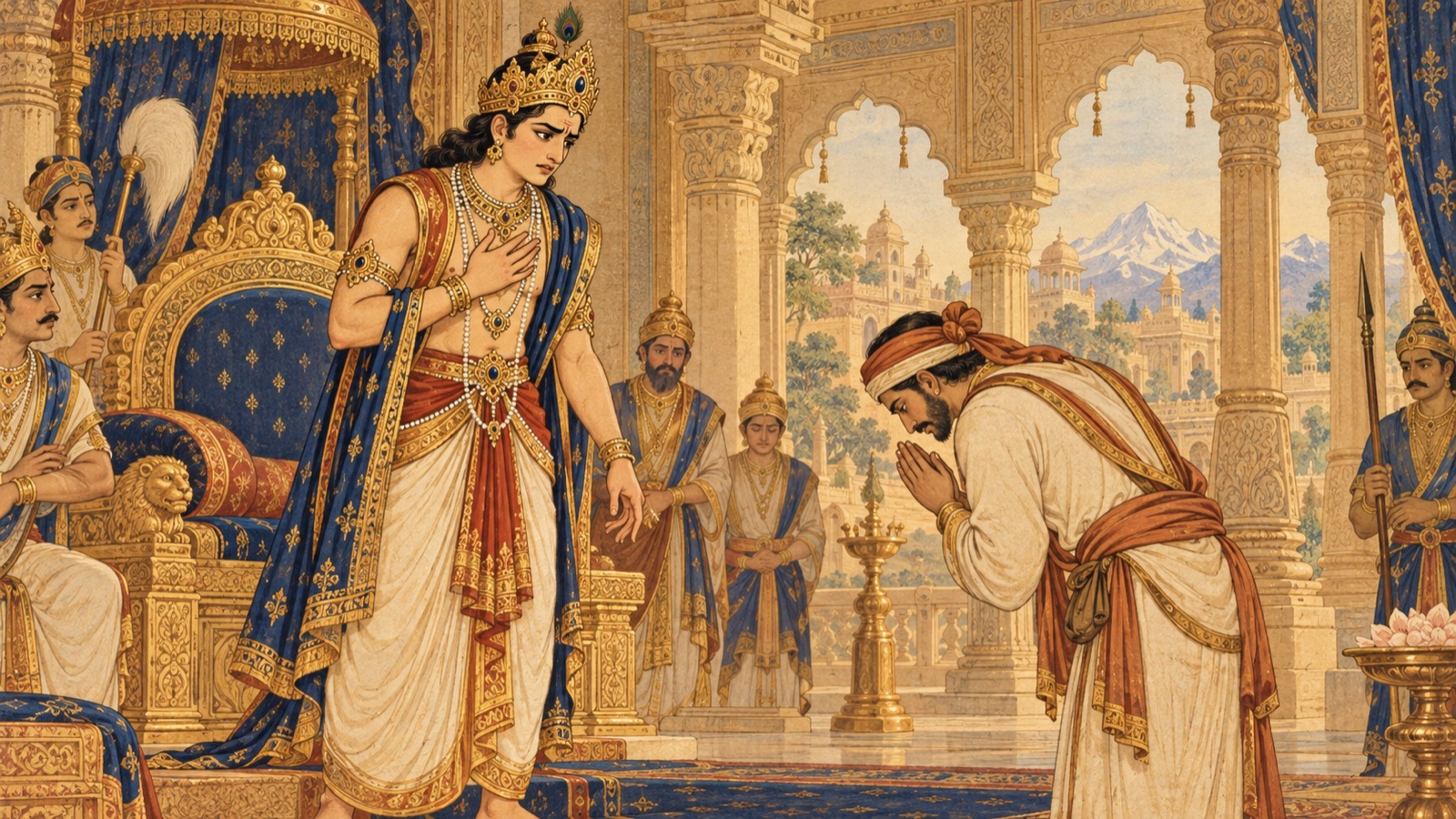
When the news of his brother’s killing reached him, Dhruva was pierced through with grief and anger together. Mounting his victorious chariot, he set out for the abode of the Yakshas, Alakapuri, in the valley of the Himalayas — a city guarded by the followers of Lord Shiva.
ध्रुवो भ्रातृवधं श्रुत्वा कोपामर्षशुचार्पित: । जैत्रं स्यन्दनमास्थाय गत: पुण्यजनालयम् ॥ ४ ॥
dhruvo bhrātṛ-vadhaṁ śrutvā kopāmarṣa-śucārpitaḥ jaitraṁ syandanam āsthāya gataḥ puṇya-janālayam
Meaning: Hearing of his brother’s killing, Dhruva, overwhelmed with sorrow and anger, mounted his victorious chariot and went to the city of the Yakshas. (Canto 4, Chapter 10, verse 4)
It can seem troubling that a soul who has beheld the Lord’s own form should still burn with grief and wrath. Yet Dhruva was never merely a solitary ascetic; the Lord had set him upon a throne, and for a king devotion is lived out through the duty to shield his family and his people from those who would harm them. His sorrow and anger, then, are not a lapse from surrender but its natural working through a king’s dharma. The chapter does not leave the matter there, however: when Dhruva’s own bow later meets its limit against the Yakshas’ illusions, the sages will remind him that his true strength was never his arm but the Name of the Lord — so that righteous action, in the end, is drawn back toward surrender (verses 4, 28-30).
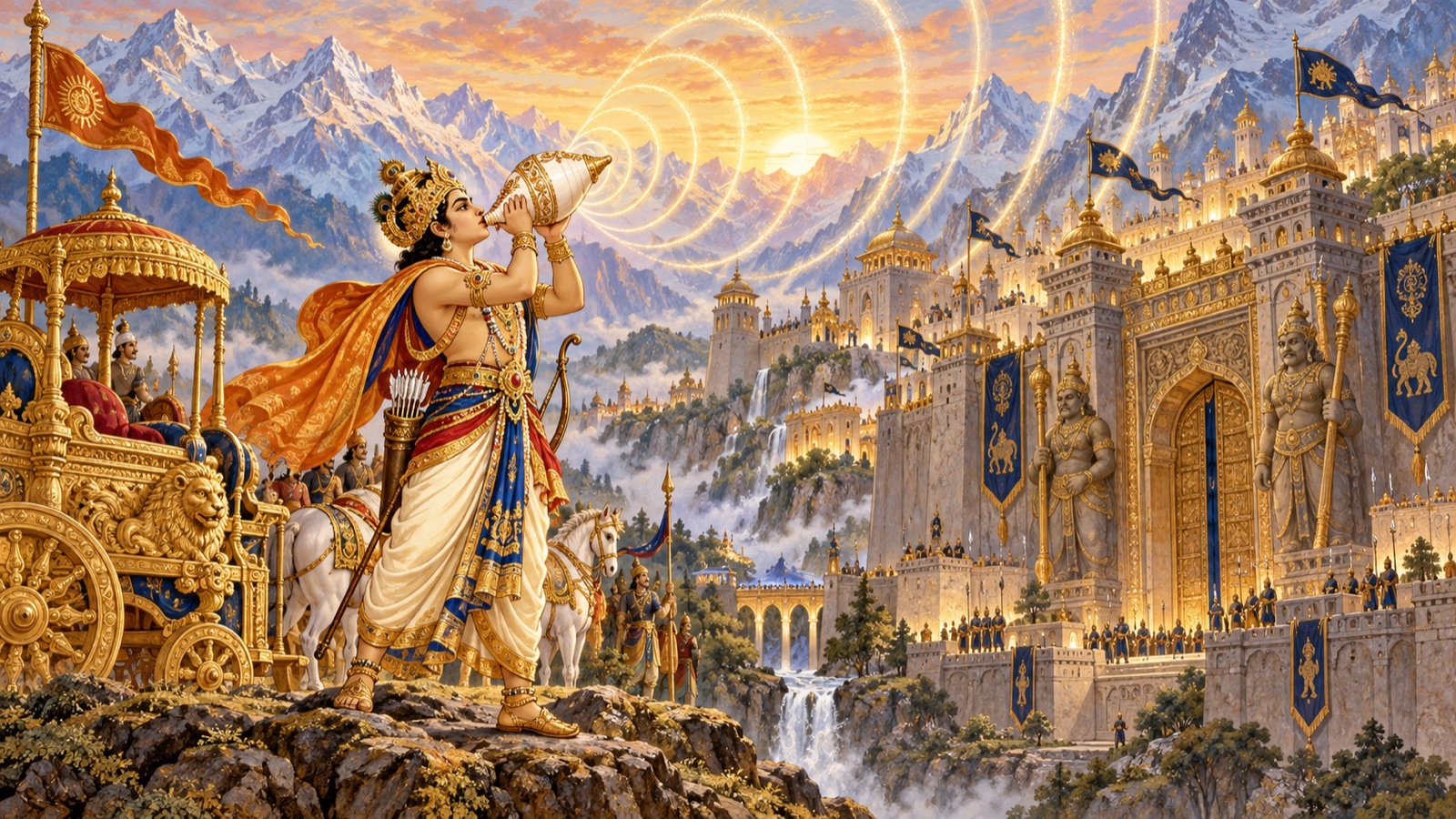
Reaching the city, the mighty-armed Dhruva blew his conch, and its blast rang through the sky and all the quarters, so that the wives of the Yakshas were struck with terror.
दध्मौ शङ्खं बृहद्बाहु: खं दिशश्चानुनादयन् । येनोद्विग्नदृश: क्षत्तरुपदेव्योऽत्रसन्भृशम् ॥ ६ ॥
dadhmau śaṅkhaṁ bṛhad-bāhuḥ khaṁ diśaś cānunādayan yenodvigna-dṛśaḥ kṣattar upadevyo ’trasan bhṛśam
Meaning: The mighty-armed Dhruva blew his conch, making sky and quarters resound, so that the wives of the Yakshas, their eyes wide with dread, were sorely frightened. (Canto 4, Chapter 10, verse 6)
The Battle Begins
Roused by the challenge, the Yaksha warriors poured out of their city and fell upon Dhruva, raining weapons upon him from every side. For a moment the young king was so covered by the incessant shower of arrows and darts that he could not be seen — like a mountain veiled by a downpour of rain.
औत्तानपादि: स तदा शस्त्रवर्षेण भूरिणा । न एवादृश्यताच्छन्न आसारेण यथा गिरि: ॥ १३ ॥
auttānapādiḥ sa tadā śastra-varṣeṇa bhūriṇā na evādṛśyatācchanna āsāreṇa yathā giriḥ
Meaning: Then Dhruva, the son of Uttanapada, was so covered by the thick rain of weapons that he could not be seen — as a mountain is hidden by a downpour. (Canto 4, Chapter 10, verse 13)
But the young king stood firm. Drawing his bow, he loosed sharp arrows that pierced the shields and bodies of the demons, as the thunderbolts of heaven split the mountains.
तस्य ते चापनिर्मुक्ता भित्त्वा वर्माणि रक्षसाम् । कायानाविविशुस्तिग्मा गिरीनशनयो यथा ॥ १७ ॥
tasya te cāpa-nirmuktā bhittvā varmāṇi rakṣasām kāyān āviviśus tigmā girīn aśanayo yathā
Meaning: The sharp arrows loosed from his bow pierced the shields and bodies of the demons, as thunderbolts split the mountains. (Canto 4, Chapter 10, verse 17)
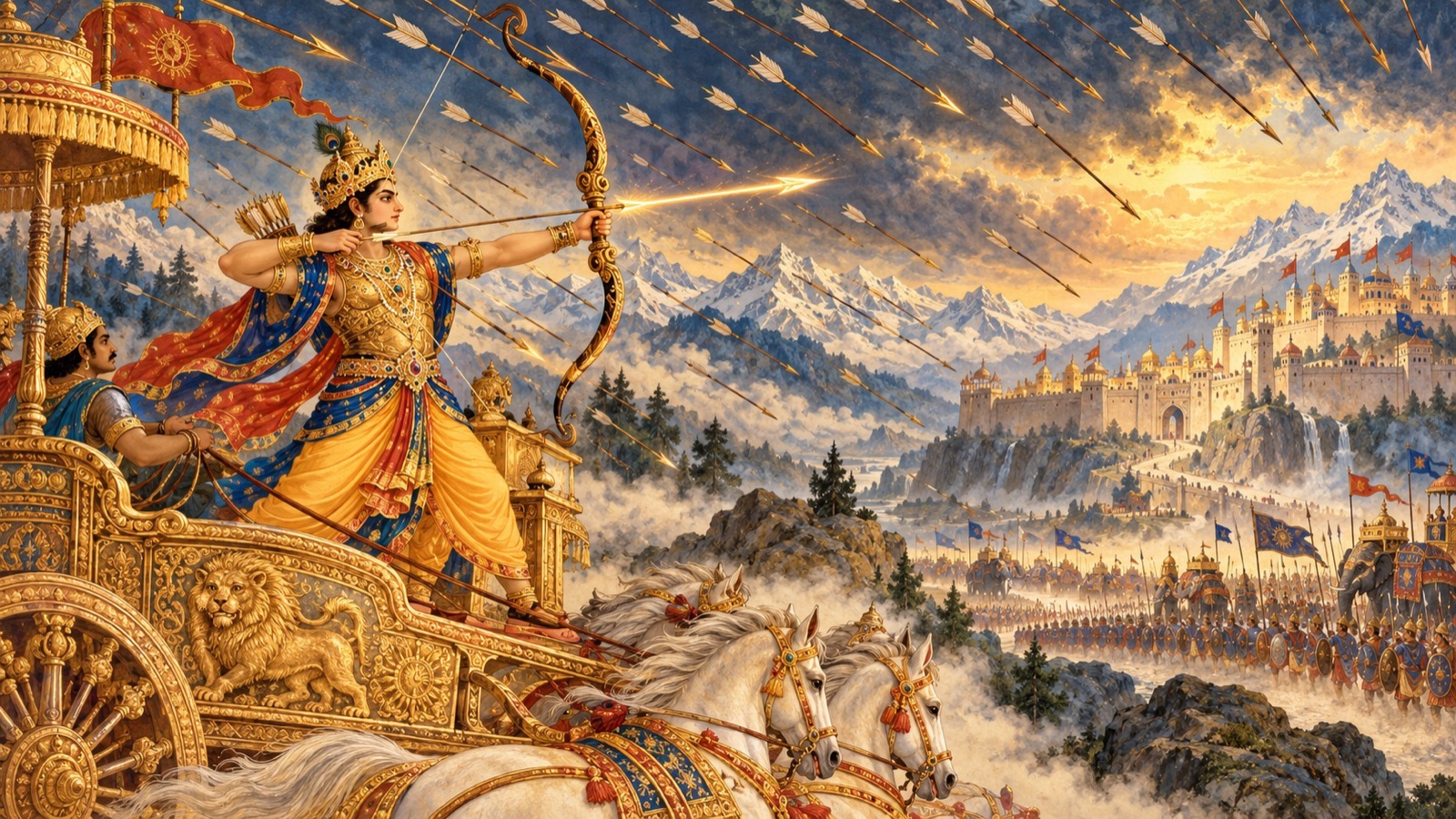
Yet not all of the Yakshas’ resistance was made of steel and arrow. When Dhruva looked toward the silent city, wary of what tricks his mystic foes might still hold in reserve, a tremendous roar arose as though the ocean itself had risen into the sky, and a whirling dust storm swept over him from every direction. In a moment thunderclouds massed overhead, lightning flashed, and a foul rain fell where clean rain should have; boulders and hailstones followed, then serpents breathing fire, maddened elephants, lions and tigers, and at last a roaring, storm-tossed sea, as if the very dissolution of the world had come upon the battlefield. None of it was real — the Yakshas, being masters of illusion, conjure exactly such horrors to unsettle the unwary — yet even Dhruva’s mind, for a moment, grew perplexed by the display (verses 21-29).
The Sages’ Benediction
As the deceptive warfare grew, the great sages, watching over the righteous, appeared to Dhruva to steady and bless him. They invoked upon him the protection of the Supreme Lord — He who wields the Sharnga bow and removes the distress of all who bow to Him — and reminded the young king that the Lord’s very Name, merely spoken and heard, carries the soul safely across the insurmountable ocean of death.
मुनय ऊचु: औत्तानपाद भगवांस्तव शार्ङ्गधन्वा देव: क्षिणोत्ववनतार्तिहरो विपक्षान् । यन्नामधेयमभिधाय निशम्य चाद्धा लोकोऽञ्जसा तरति दुस्तरमङ्ग मृत्युम् ॥ ३० ॥
munaya ūcuḥ auttānapāda bhagavāṁs tava śārṅgadhanvā devaḥ kṣiṇotv avanatārti-haro vipakṣān yan-nāmadheyam abhidhāya niśamya cāddhā loko ’ñjasā tarati dustaram aṅga mṛtyum
Meaning: The sages said: O son of Uttanapada, may the Lord who wields the Sharnga bow, the remover of the distress of the surrendered, destroy your foes — He whose Name, once uttered and heard, carries the world safely across insurmountable death. (Canto 4, Chapter 10, verse 30)
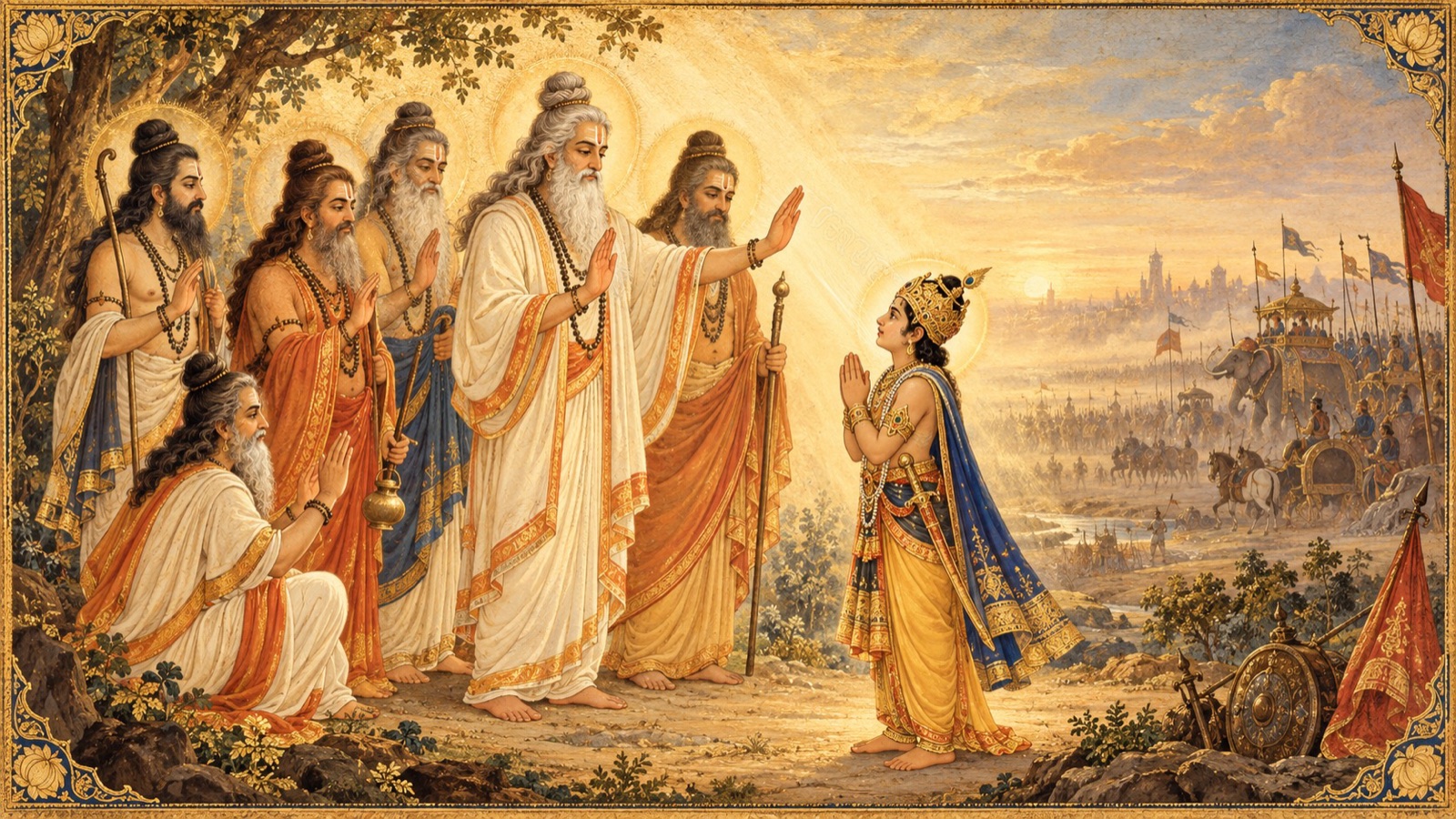
With that blessing invoked in the Name of the Lord, the tenth discourse closes, its battle poised — and the way opened for the intervention that the next chapter will bring, when Dhruva’s grandfather Svayambhuva Manu comes to counsel him toward peace.
Principal Teachings of This Chapter
1. Even the blessed meet sorrow. Dhruva, who had seen the Lord face to face, is not spared the grief of his brother’s death. Devotion does not exempt us from loss; it gives us a refuge within it (verse 3).
2. Grief and anger are natural, but they are not the last word. Dhruva’s sorrow and wrath are told honestly, without disguise. The chapter neither condemns his feeling nor lets it stand as the final teaching — for the sages soon lift his gaze higher (verses 4-6).
3. Steadfastness stands firm under the heaviest assault. Buried under a rain of weapons, Dhruva remains unmoved, “like a mountain in a downpour.” The soul anchored in the Lord is not overwhelmed by what falls upon it (verse 13).
4. Illusion is the enemy’s true weapon. When force fails, the Yakshas turn to deception and magic. So too in the inner life, the subtlest assaults come not as open blows but as bewildering illusions (verses 26-28).
5. The Holy Name is the surest protection. The sages’ blessing rests not on Dhruva’s strength but on the Name of the Lord, which “once uttered and heard, carries one across death.” Our real shelter, in every battle, is that Name (verse 30).
A Devotional Reflection
It can be startling that a chapter so full of grief and warfare belongs to the life of Dhruva, the very emblem of childlike devotion. Yet the Bhagavatam does not hide from us that even those who have seen the Lord must still walk through sorrow. Dhruva loses his brother and his stepmother in a single stroke, and his response is achingly human — sorrow and anger rising together, and the impulse to set things right by force. The scripture neither scolds him nor glorifies his wrath; it simply tells the truth of a grieving heart, and then, gently, sends the sages to turn his eyes back toward the Lord. There is comfort in this honesty. Our own griefs and angers are not disqualifications from the devotional path; they are the very places where we most need the Name. And the sages’ word to Dhruva is the word to us: that the Lord’s Name, merely spoken and heard, carries us across what we could never cross by our own strength — including the death of those we love, and the storms of feeling that death stirs up.
A Daily Devotional Practice
Today, take the sages’ blessing as your own. Whenever a wave of grief, anger, or fear rises in you — as it rose in Dhruva — meet it not by acting at once, but by pausing to speak and hear the Name of the Lord: “Om Namo Bhagavate Vasudevaya.” Say it aloud if you can, so that, like the sages’ benediction, it is both uttered and heard. Let the Name be the first shield you reach for when something falls upon you like a shower of weapons. In doing so you learn what Dhruva learned on the battlefield — that steadiness comes not from overpowering the trouble, but from standing, like a mountain in the rain, in the shelter of the Lord.
Conclusion
The tenth discourse of Book Four turns from grace to grief. Dhruva’s unmarried brother Uttama falls to a Yaksha’s blow during a hunt in the Himalayas, and his mother Suruchi meets the same end while searching for him. Pierced by sorrow and anger, Dhruva mounts his victorious chariot and marches upon Alakapuri, the city of the Yakshas, blowing his conch until its blast frightens the whole city. A fierce battle follows: buried for a moment under a rain of weapons like a mountain in a downpour, Dhruva stands firm and looses arrows that split the ranks of the demons. When the Yakshas turn to illusory warfare, the great sages appear to steady the young king, blessing him in the Name of the Lord who wields the Sharnga bow and carries the soul across the ocean of death. So the chapter closes with its battle poised and its true refuge named — the Holy Name — as the way opens for Manu’s coming intervention.
May the divine wisdom of Srimad Bhagavatam awaken pure devotion within our hearts.
Om Namo Bhagavate Vasudevaya.
Jay Shree Madhav.
References and Attribution
- Primary edition: Gita Press, Śrīmad Bhāgavata Mahāpurāṇa (English, complete), Book Four, Discourse 10.
- Series: Srimad Bhagavatam Wisdom · Biswa Sanatan Dharma Seva Trust.
- Presented following the spiritual guidance and recommendation of Pandit Dr. Shri Kashinath Mishra.
This is an original, faithful retelling in the writer’s own words, with brief quoted verses shown in Devanāgarī and transliteration and their meanings given as summaries. It is not a reproduction of any single publisher’s continuous translation or commentary. No affiliation with or endorsement by any publisher is implied.
Jay Shree Madhav