Srimad Bhagavatam Canto 10 Chapter 21 — Krishna's Flute Song
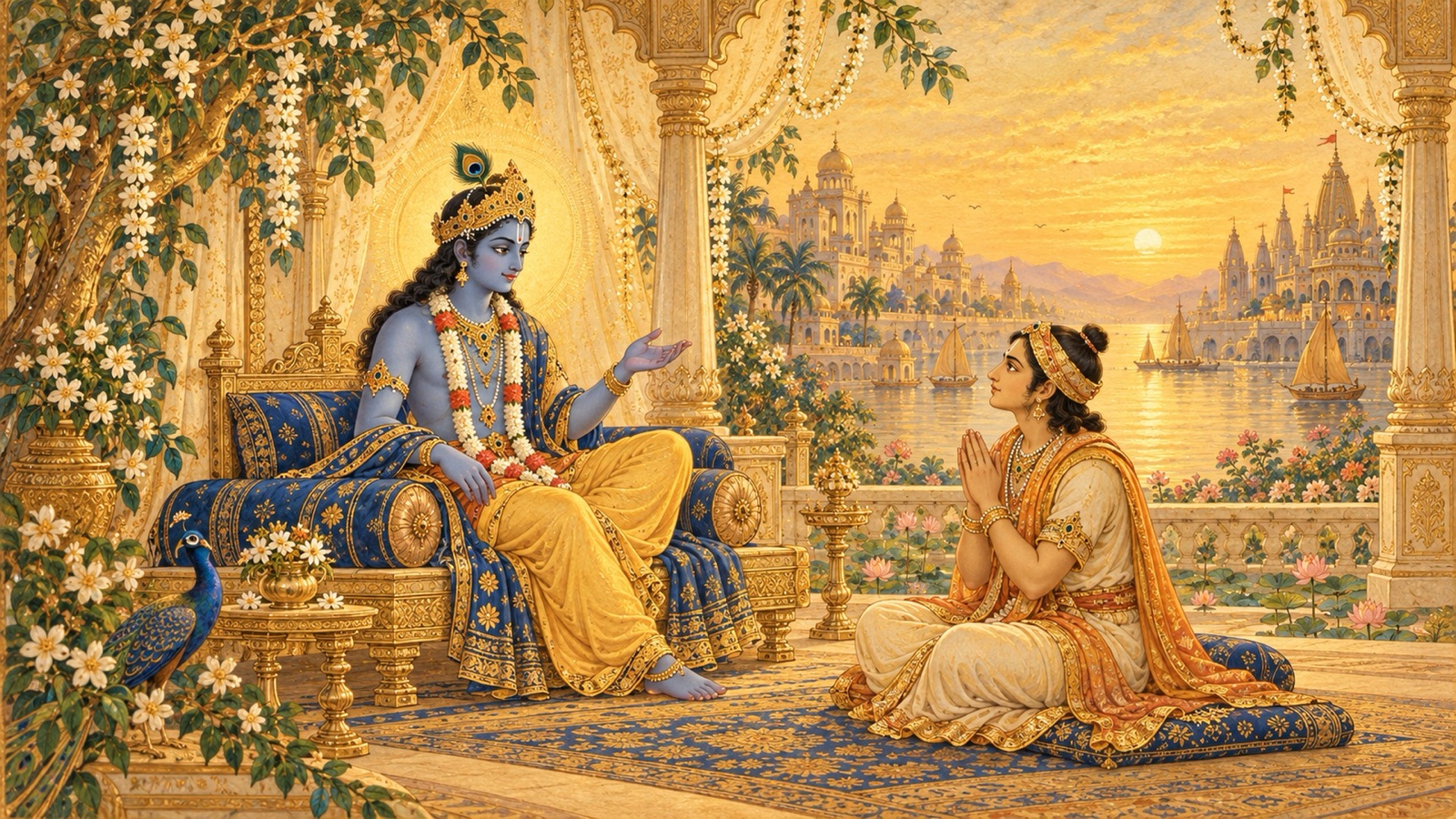
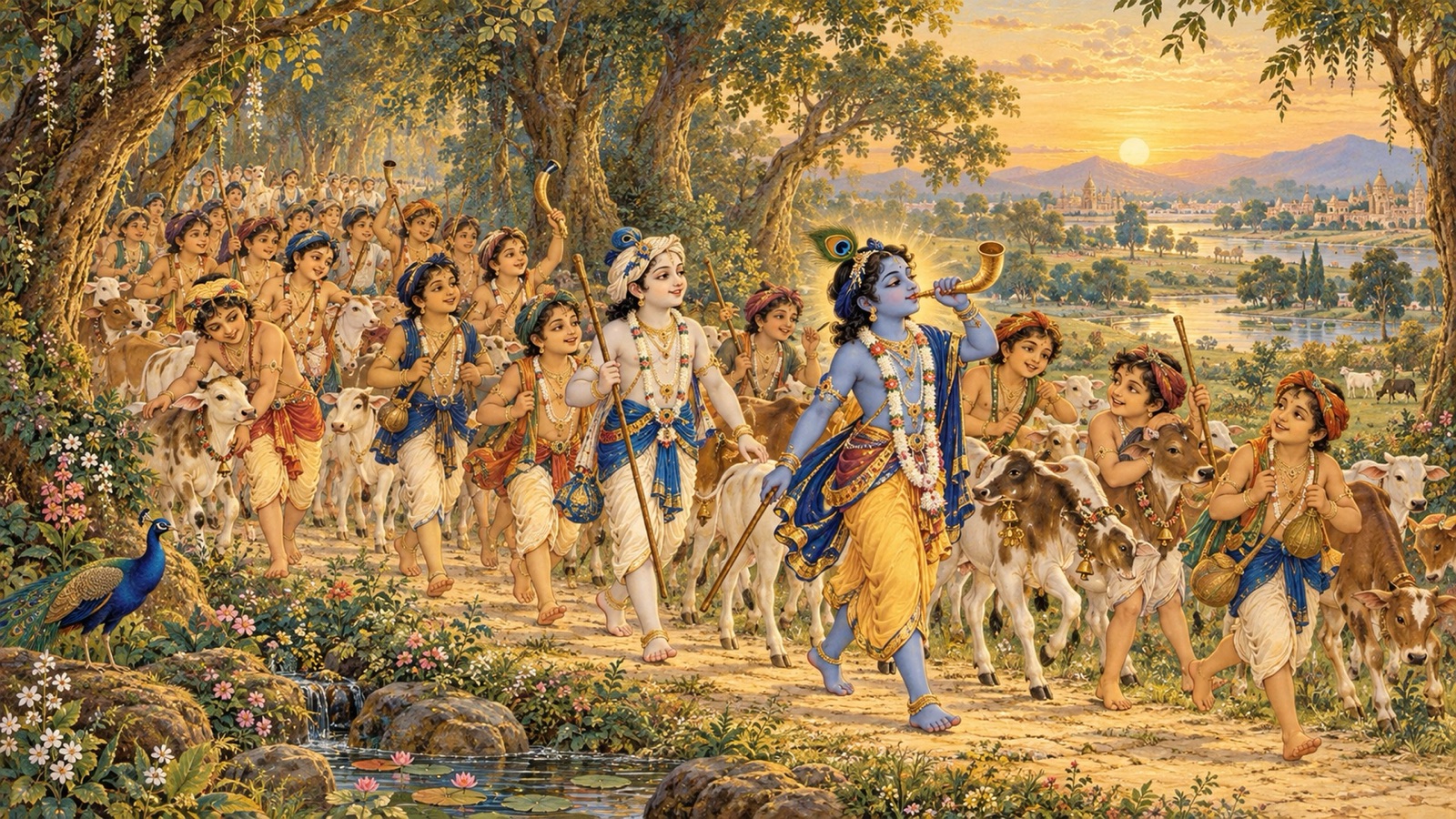
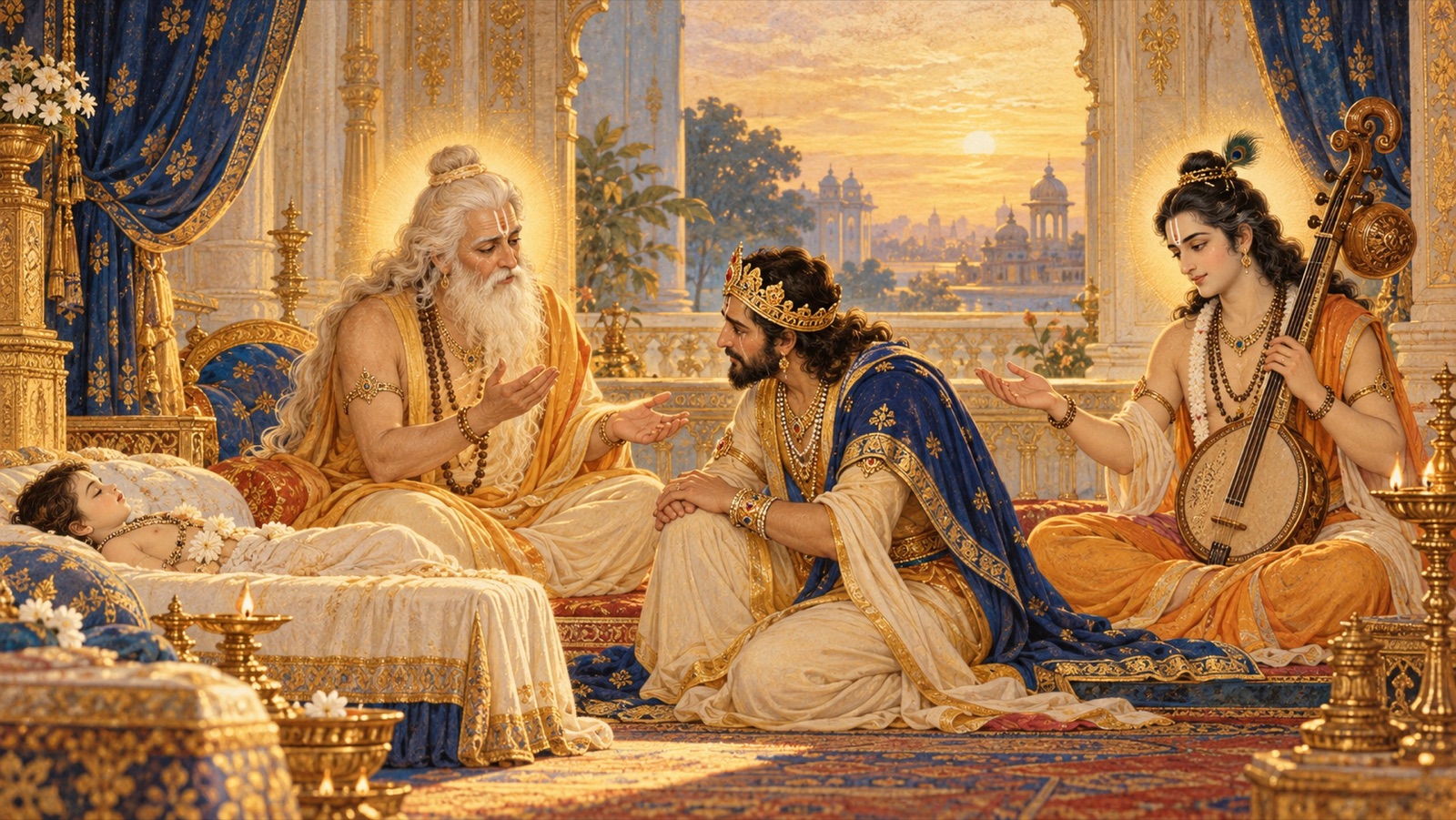
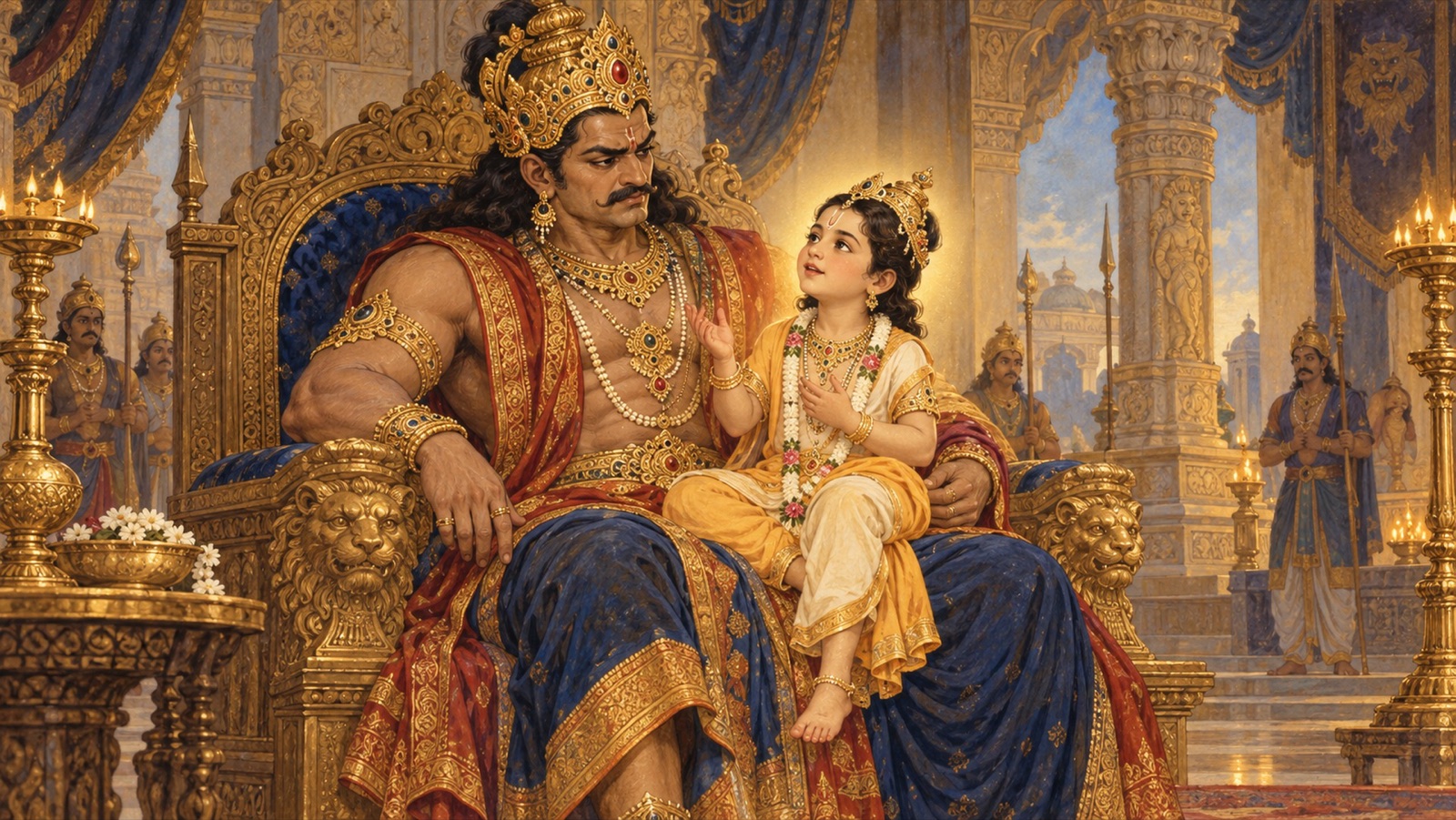
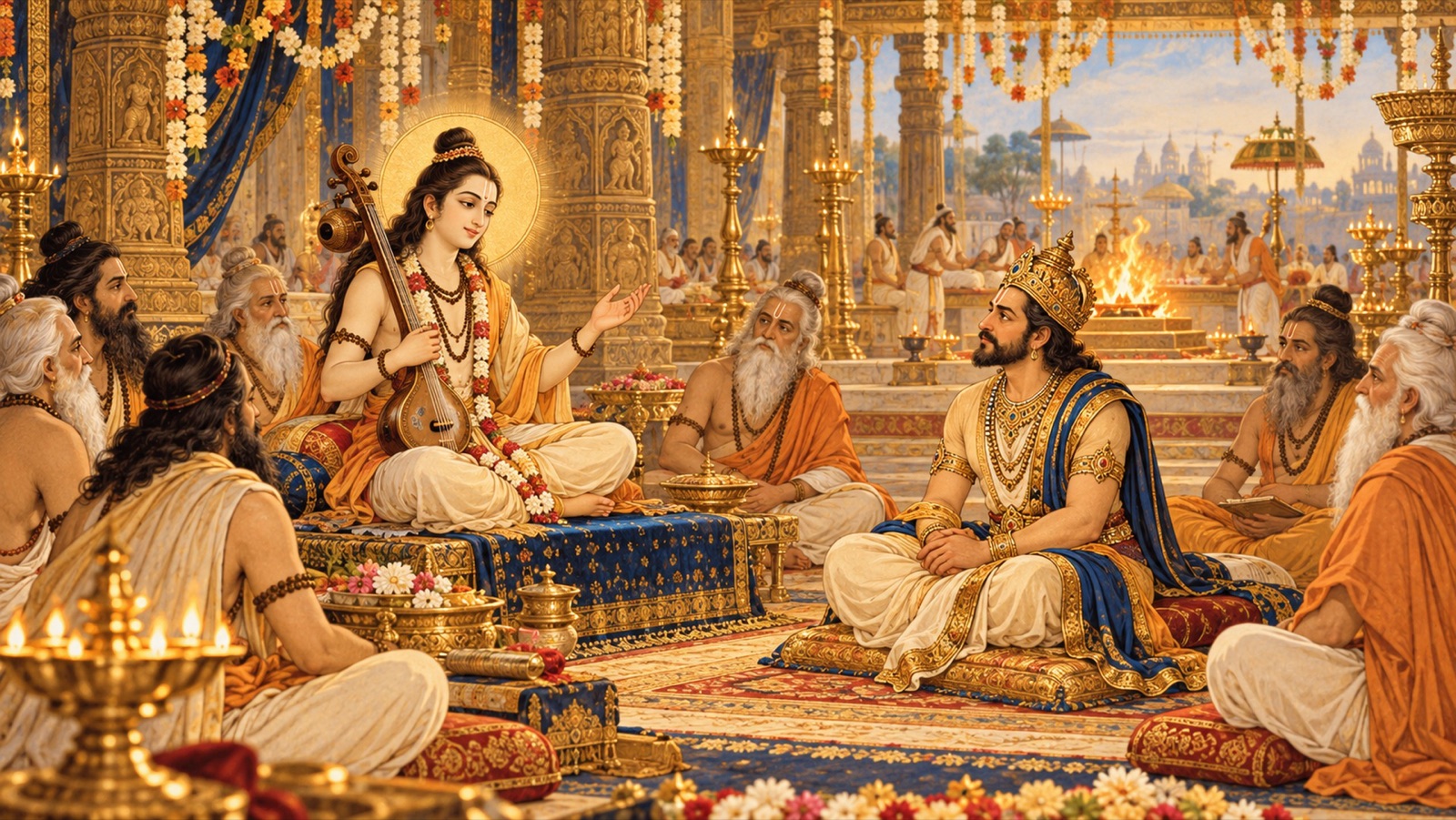
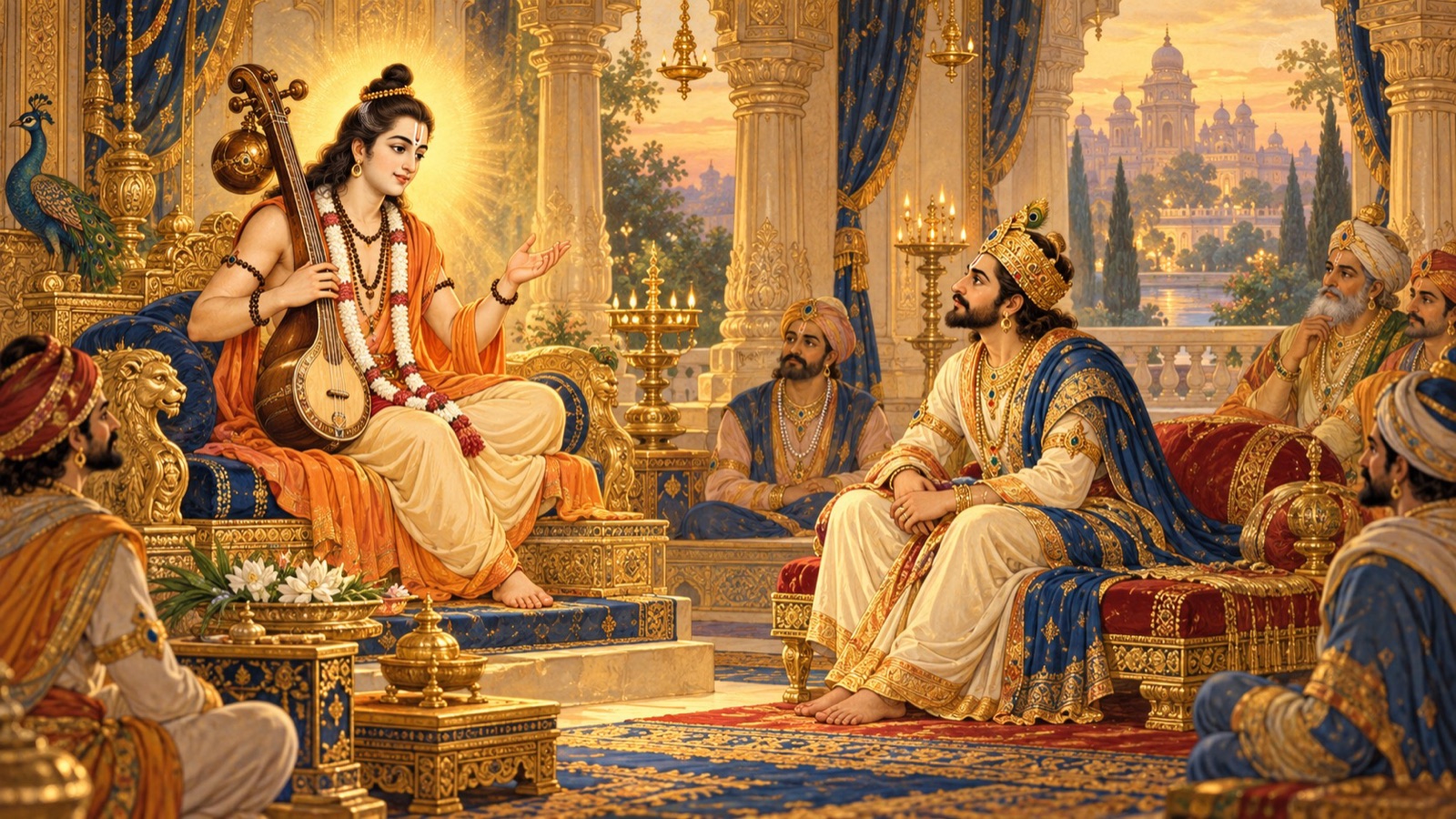
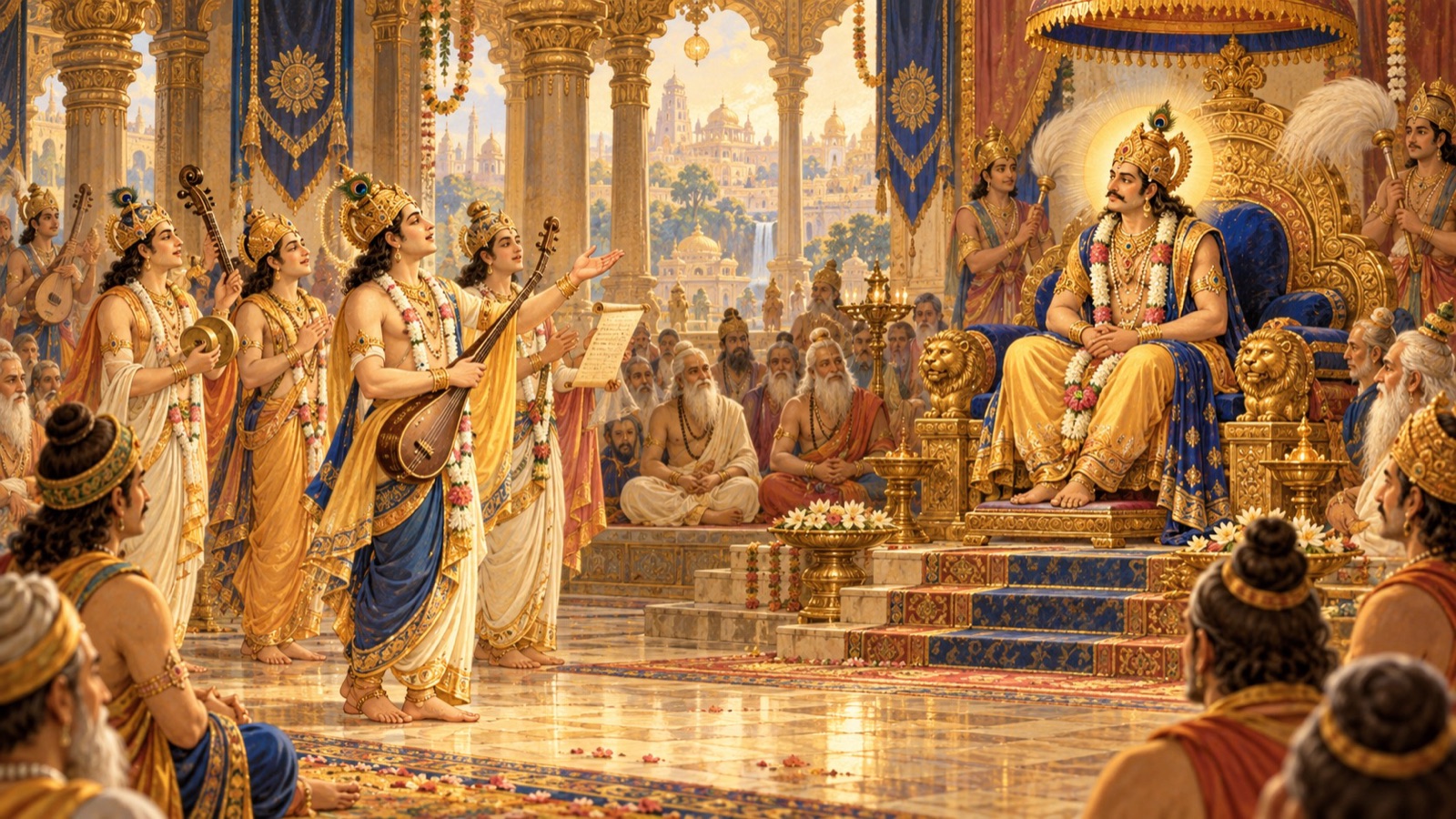
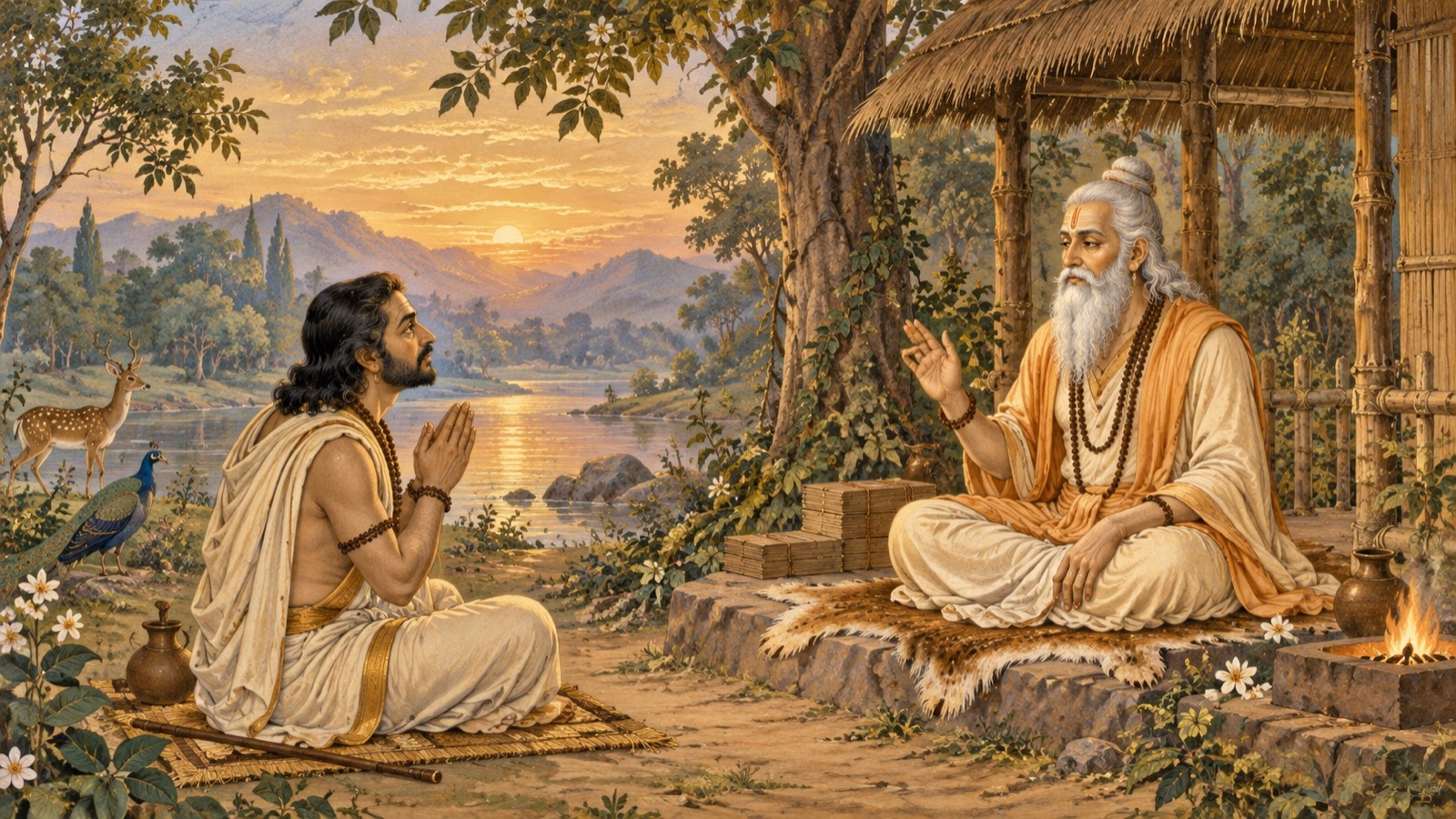
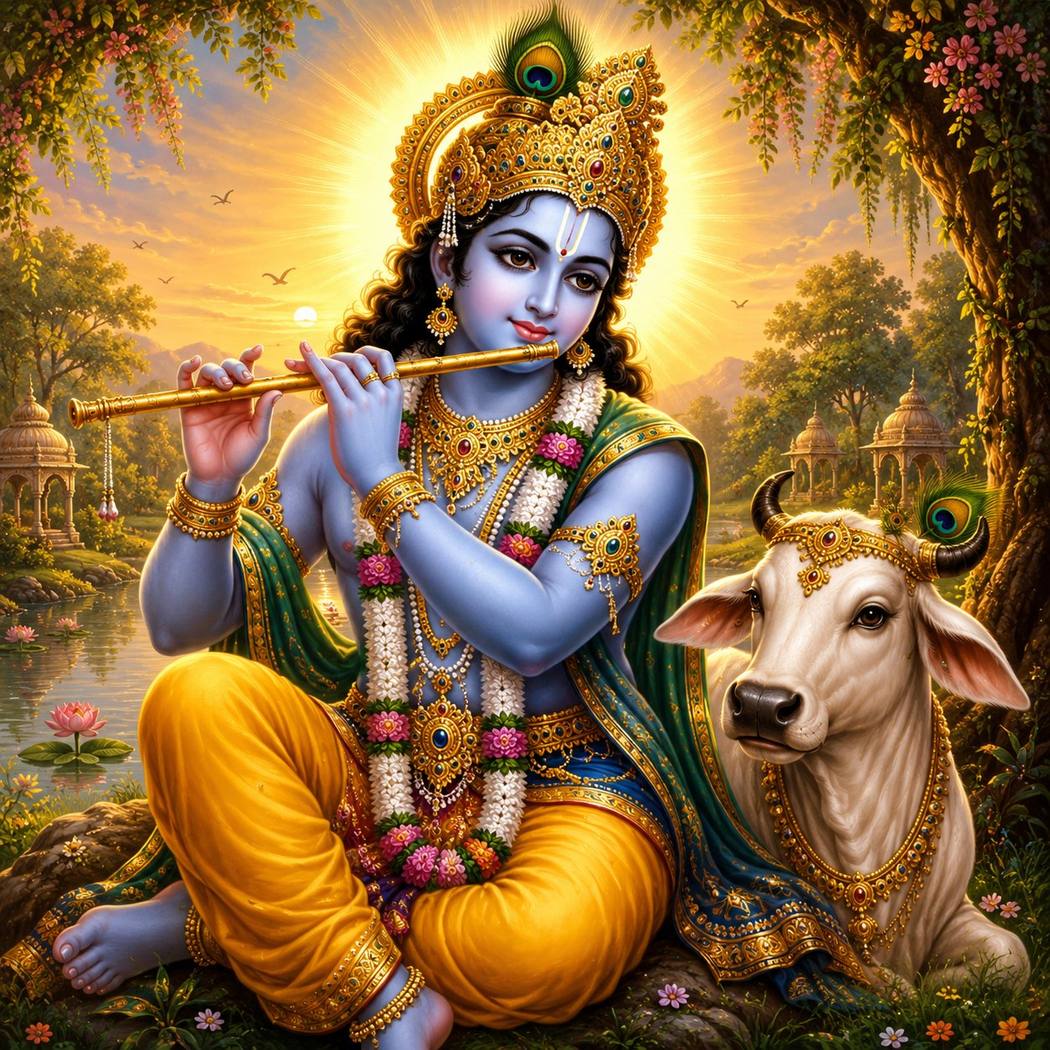
Krishna plays His flute in the autumn forest of Vrindavana, and the Gopis sing of how deer, rivers, cows and sages are all enchanted by its music.
Continue the Reading →Evidence-led articles on the Bhavishya Malika — the end of Kali Yuga, the advent of Lord Kalki, and the documented signs of the turning age. Verses cited verbatim; events dated and sourced.

Krishna plays His flute in the autumn forest of Vrindavana, and the Gopis sing of how deer, rivers, cows and sages are all enchanted by its music.
Continue the Reading →
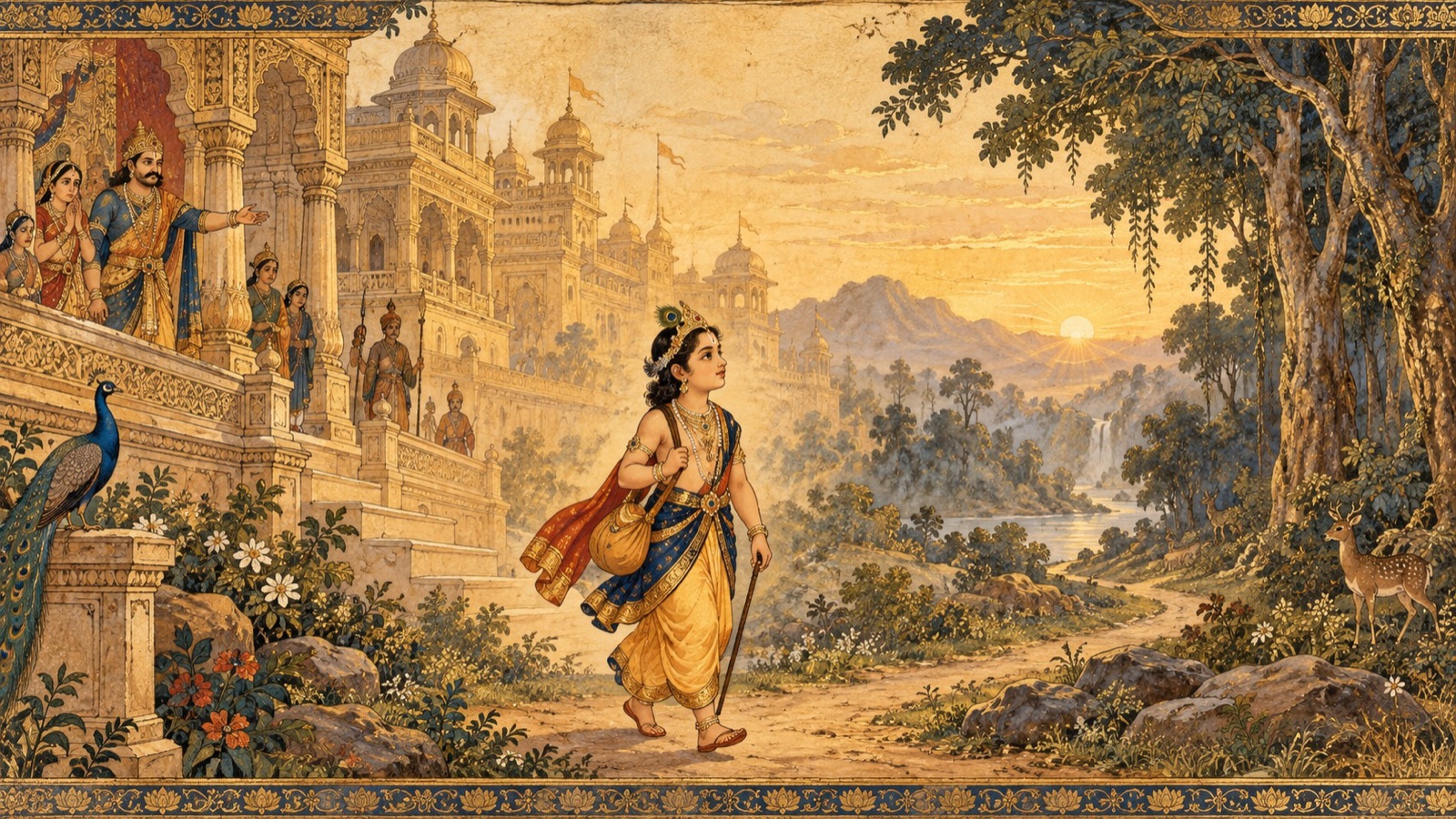
Sukadeva describes the rains and the autumn that follows in Vrindavana, finding in every sign of nature a teaching on bhakti, while Krishna and Balarama tend the herds.
Continue the Reading →
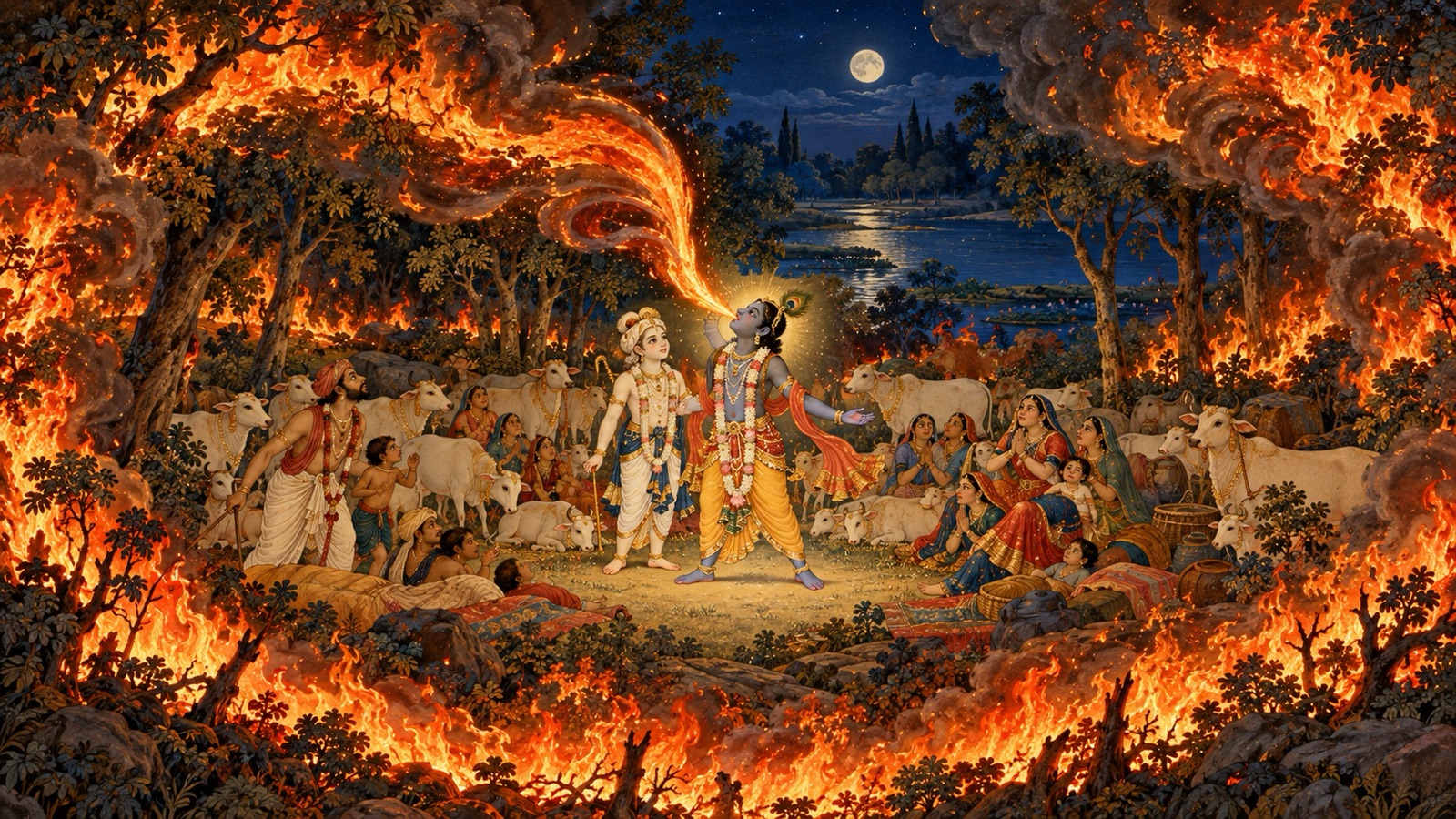
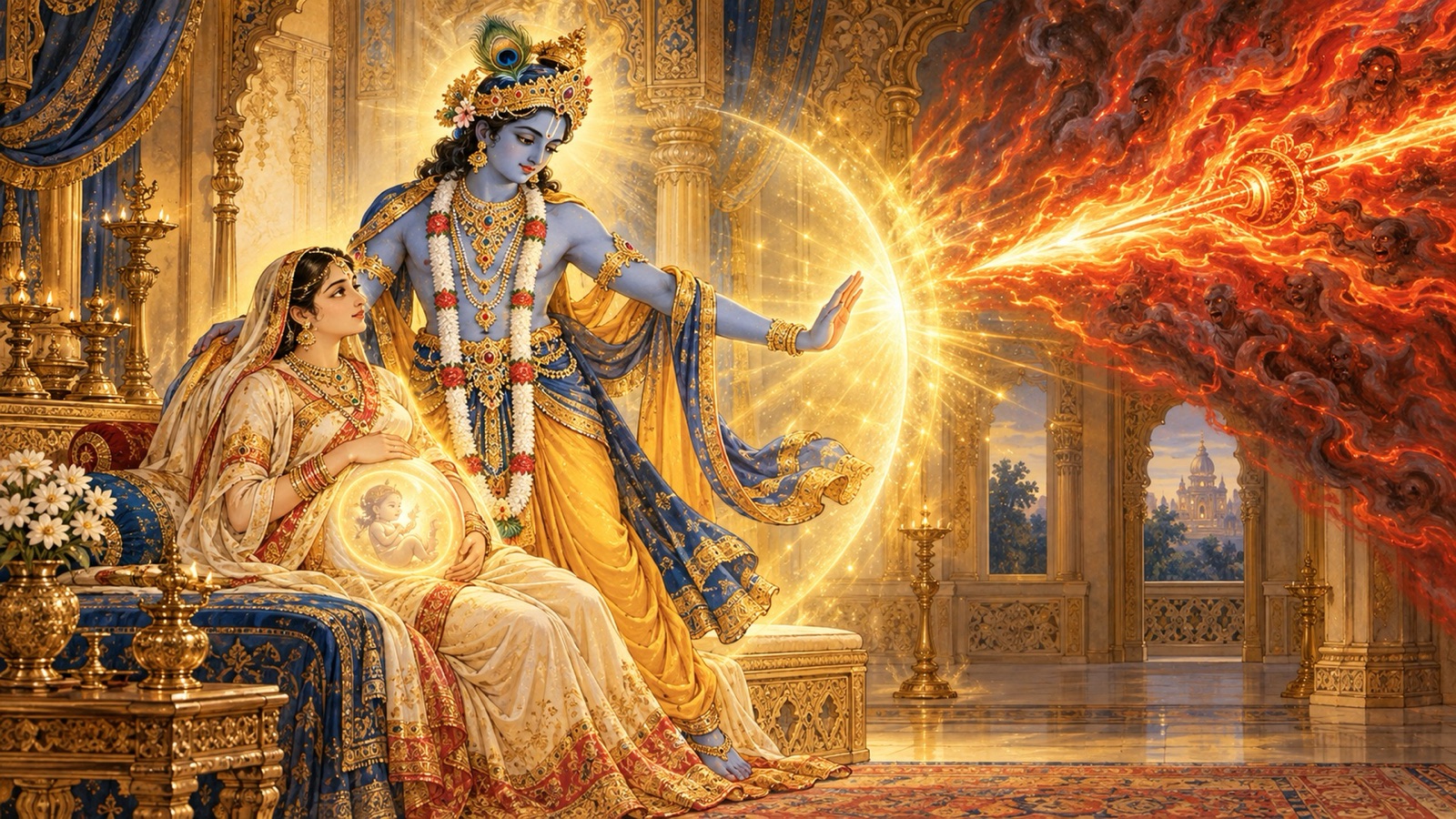
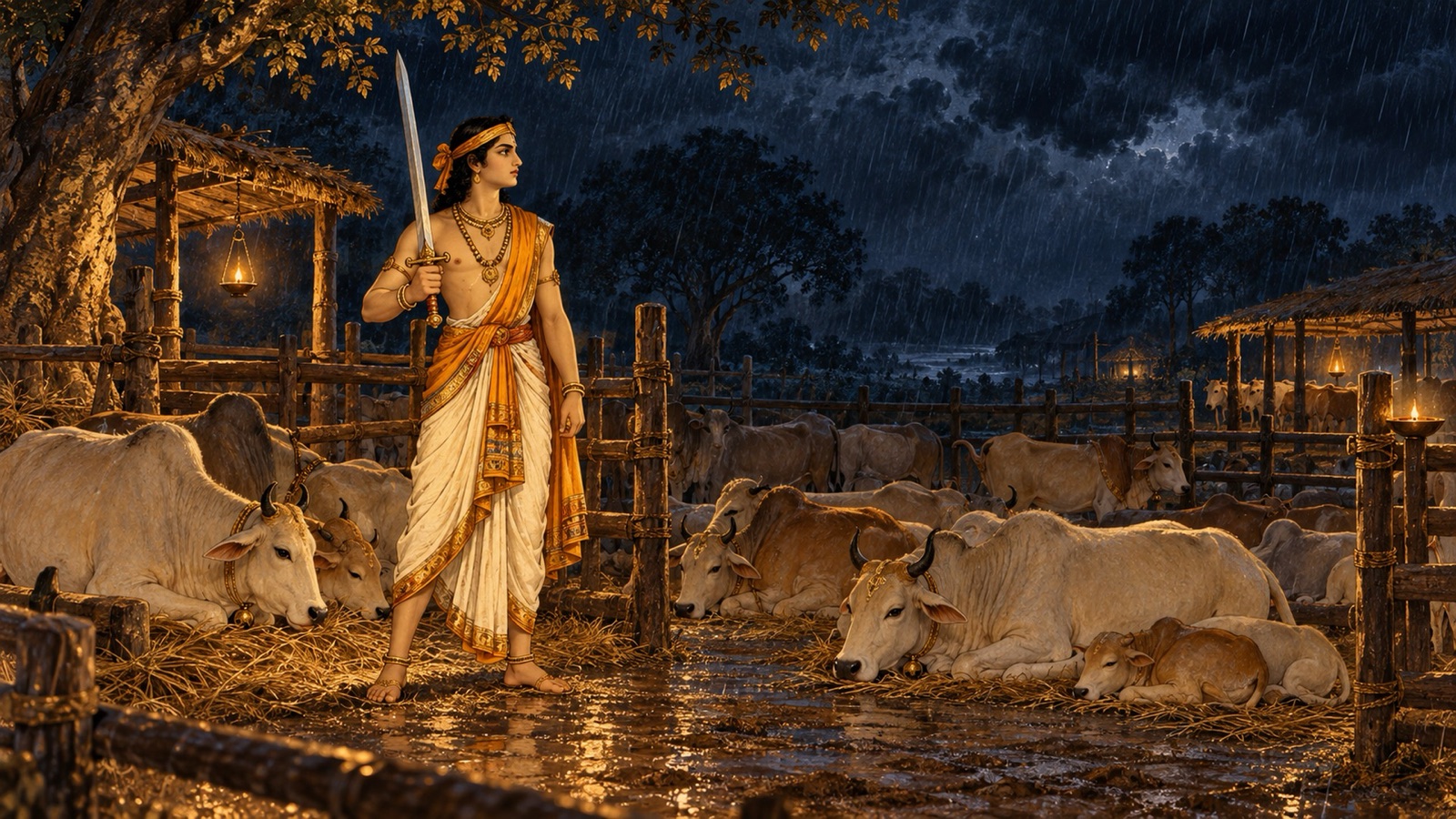
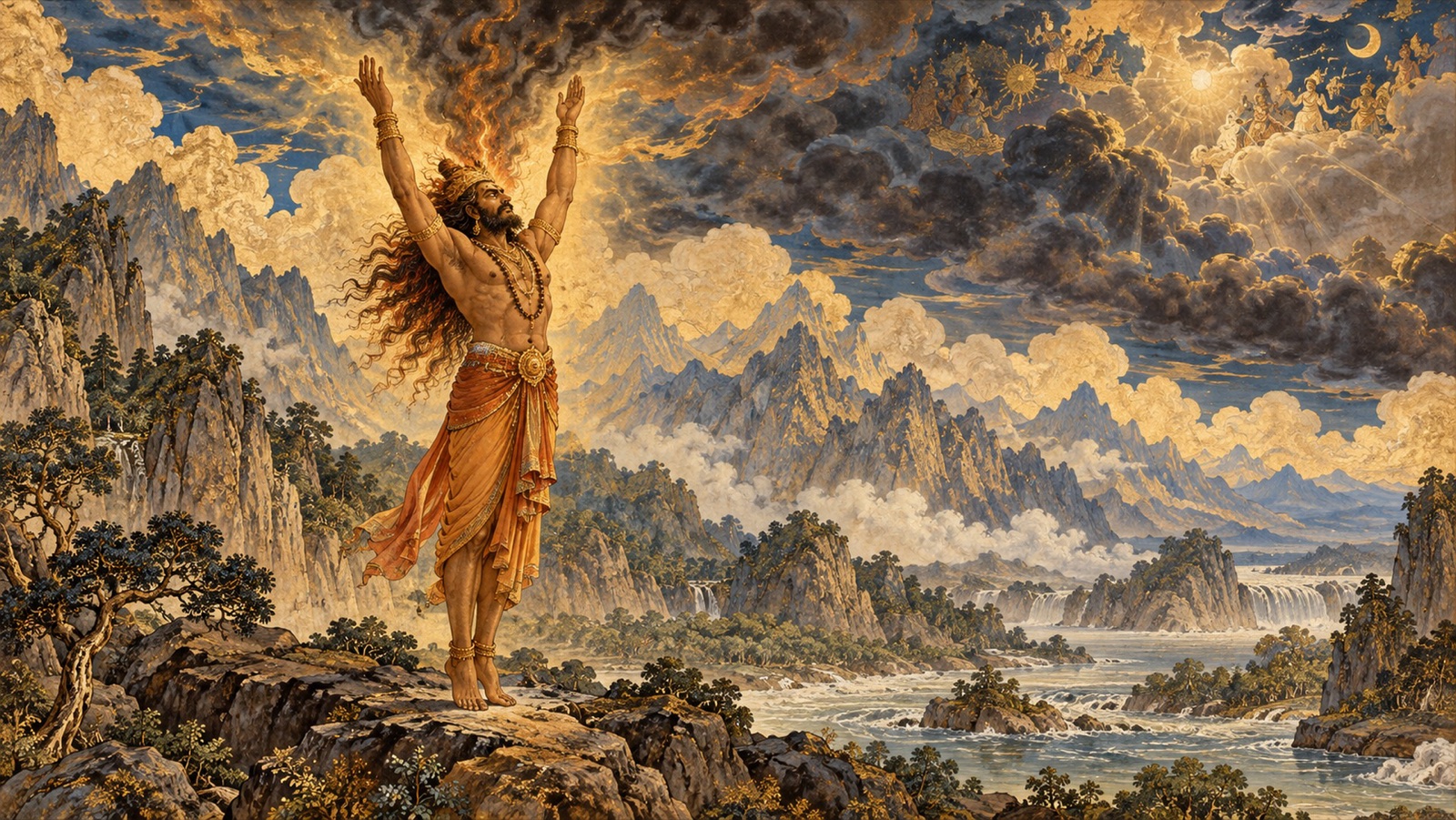
When a sudden wildfire traps the cowherds of Vraja, Krishna asks them only to close their eyes, then drinks the terrible blaze to save them all.
Continue the Reading →
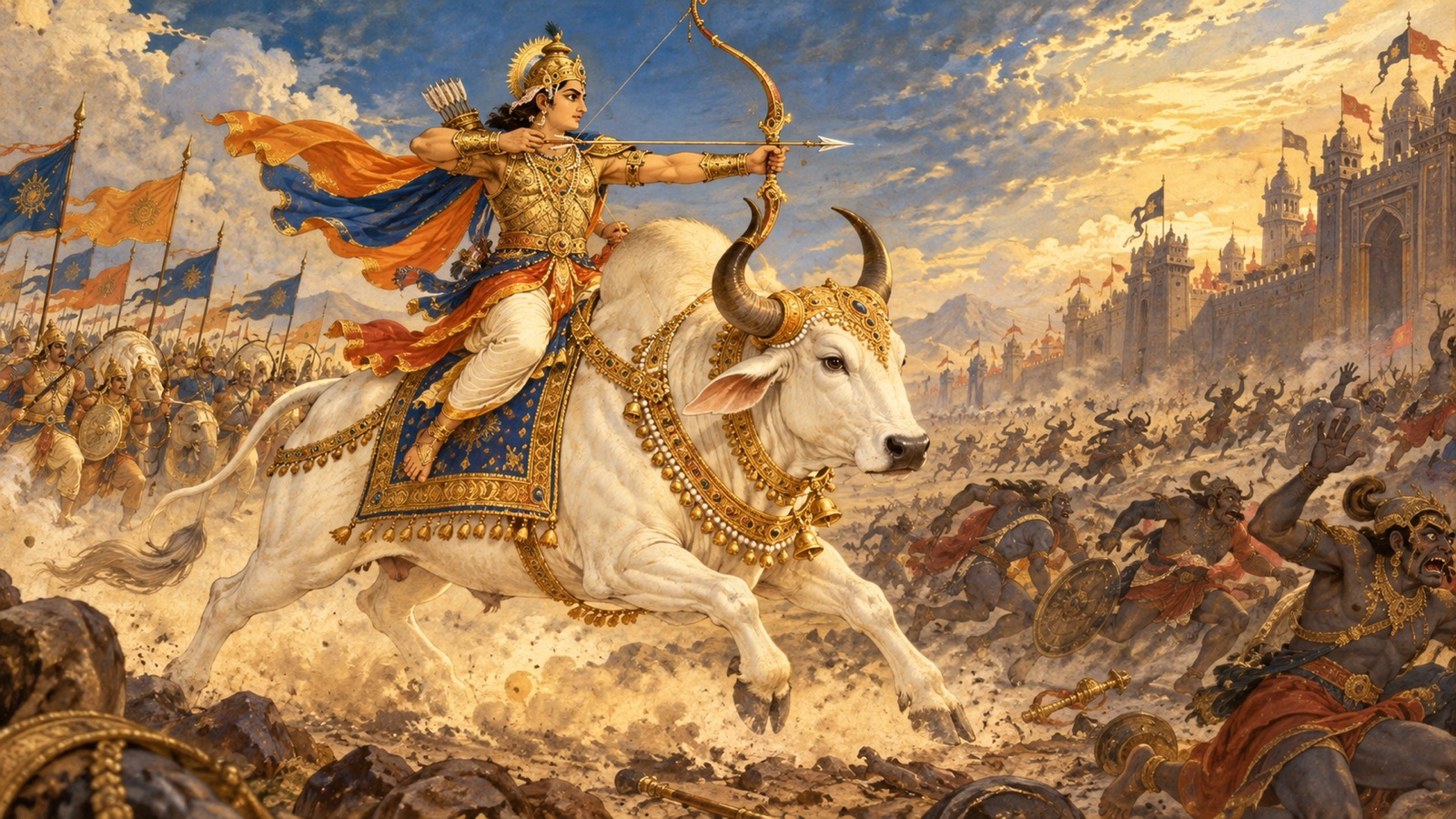
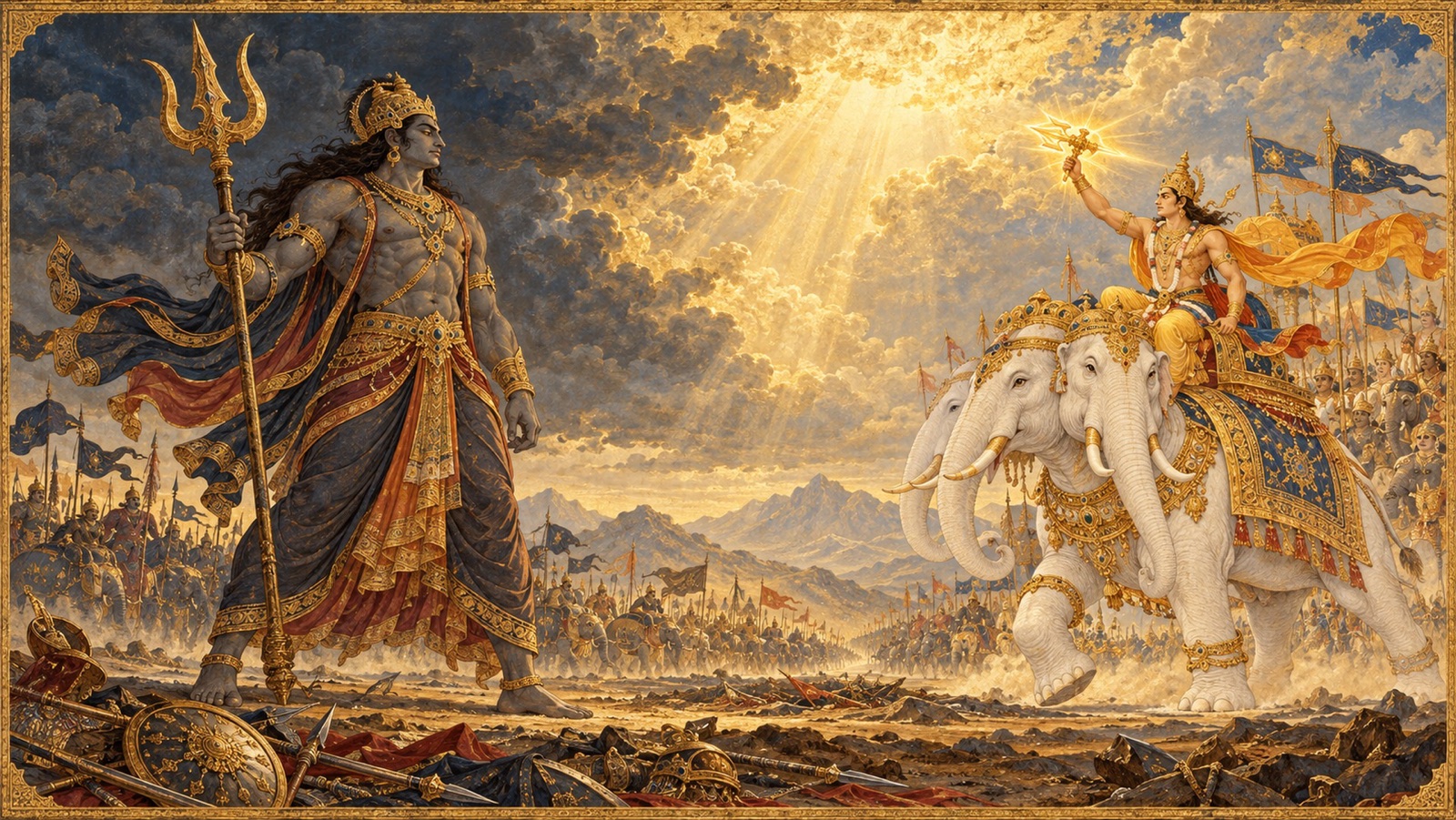
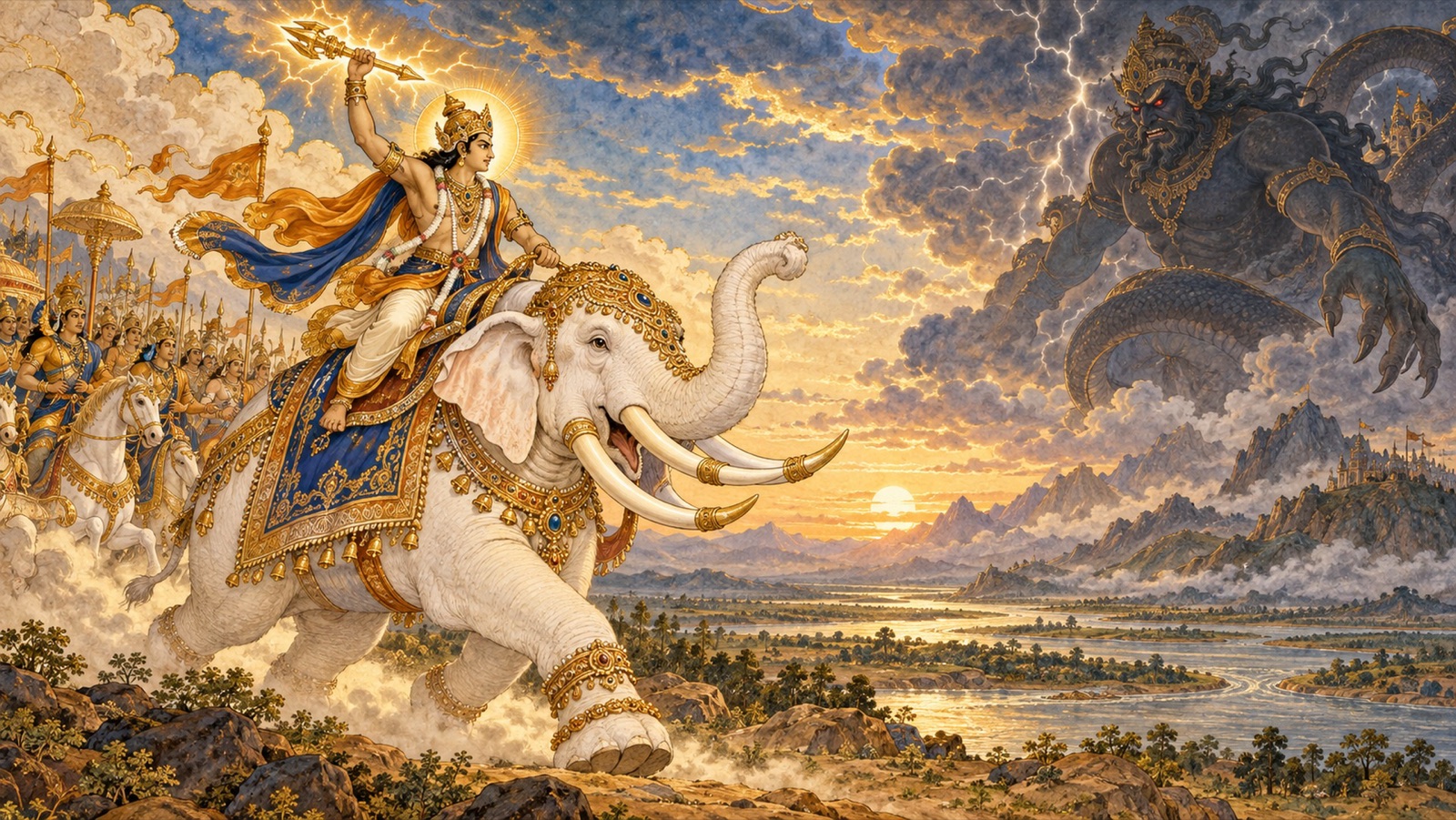
Disguised as a cowherd boy, the demon Pralamba carries Balarama into the sky to kidnap Him — and is struck down by a single radiant blow.
Continue the Reading →
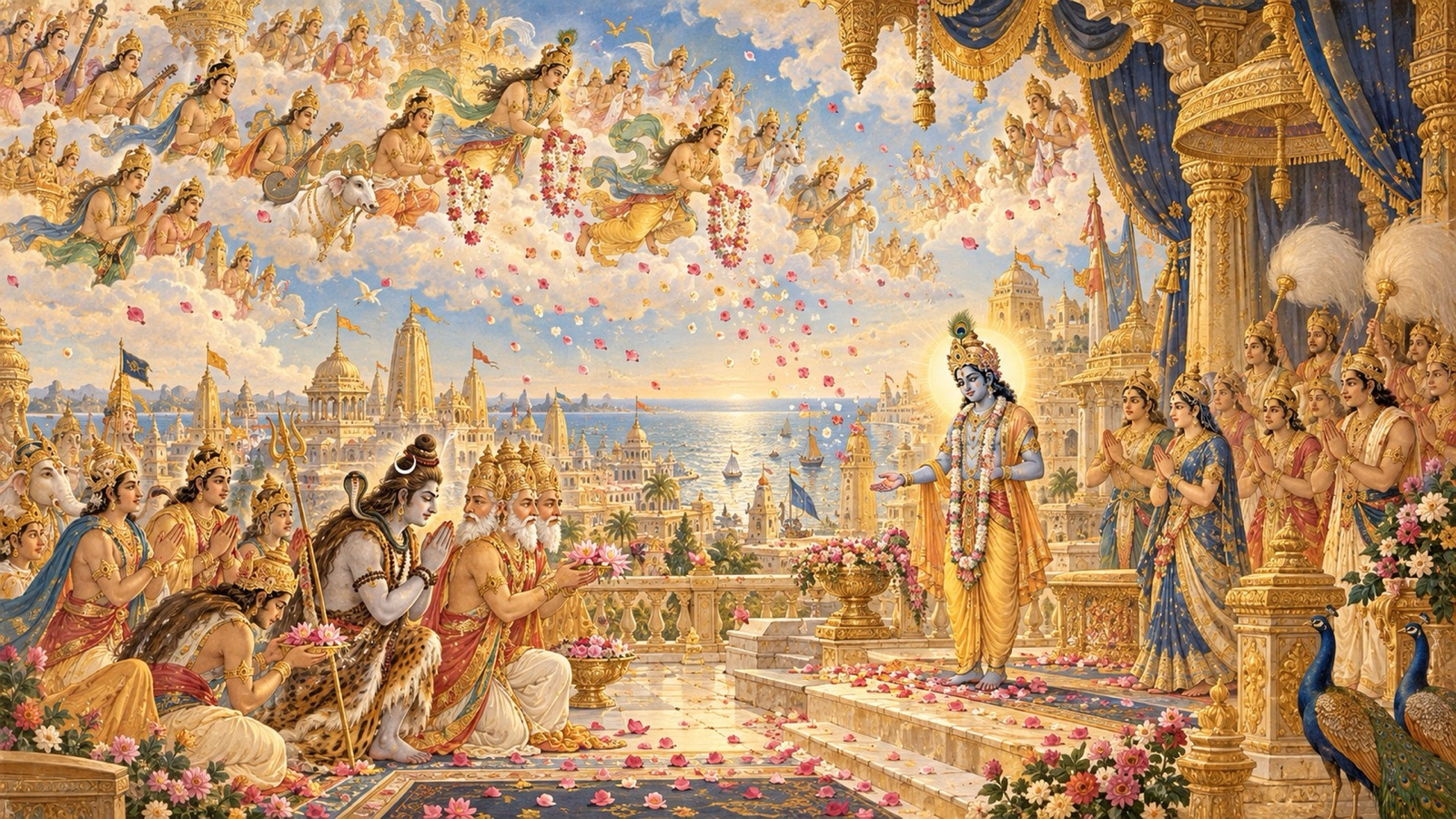
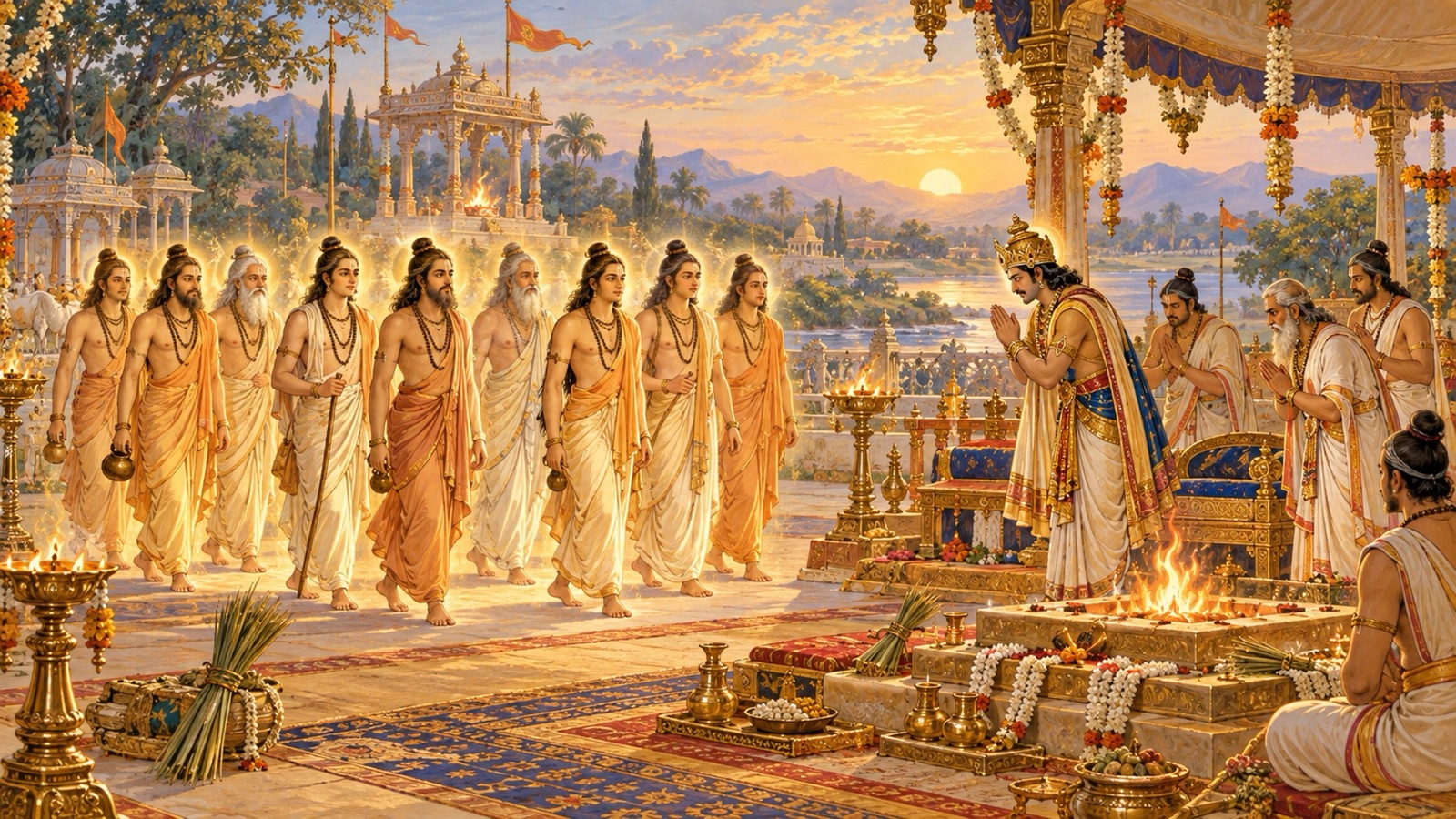
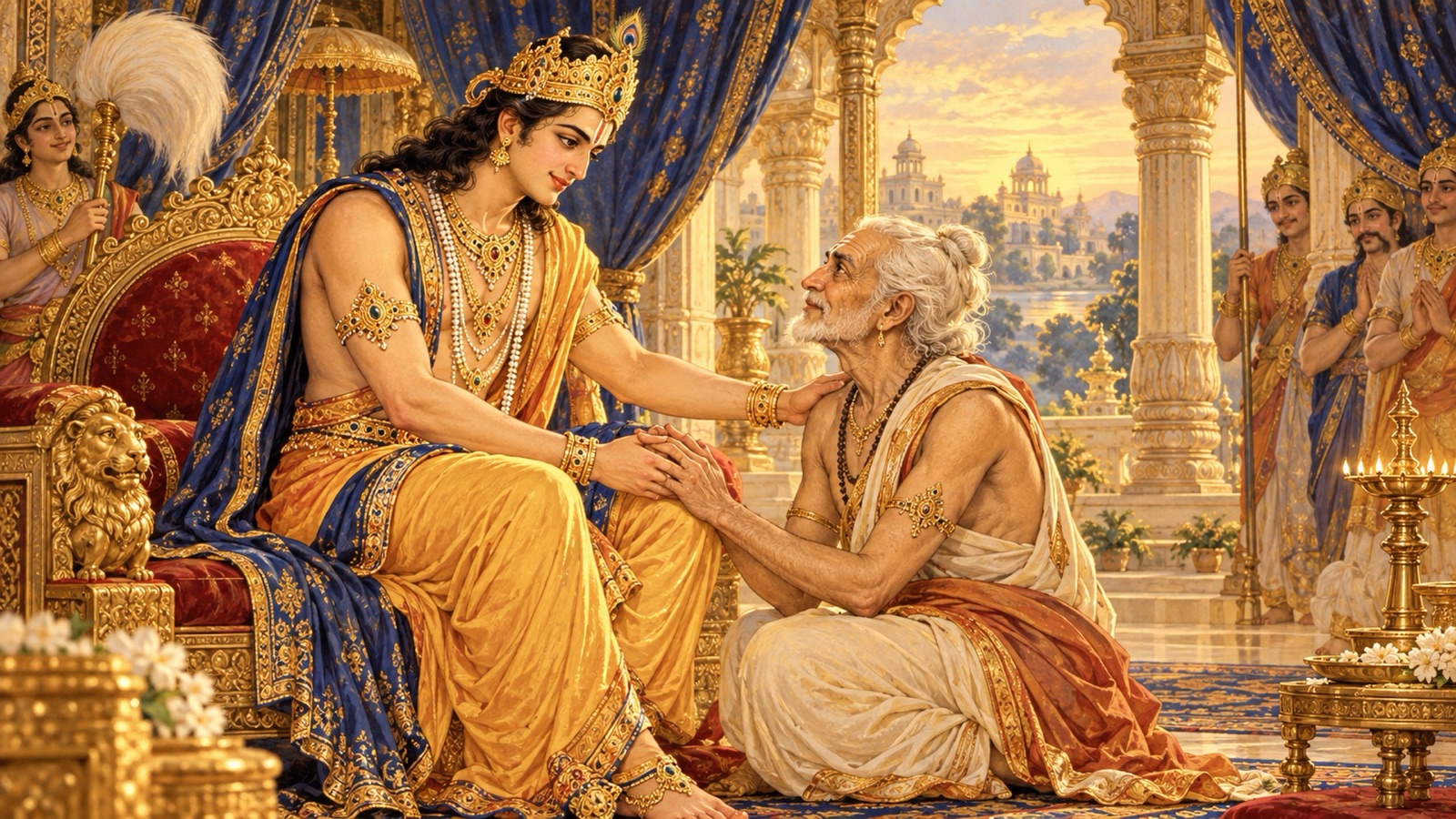
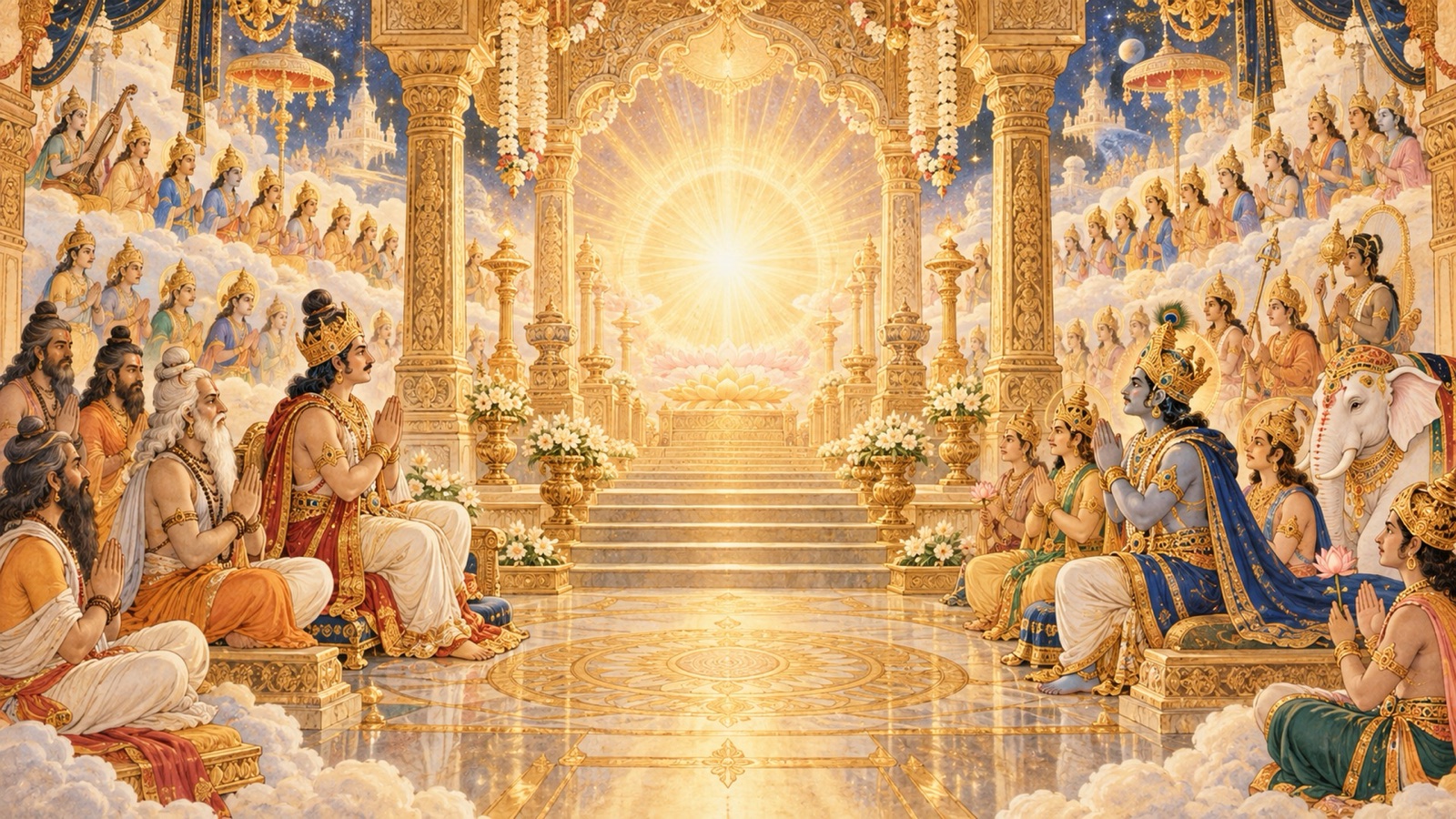
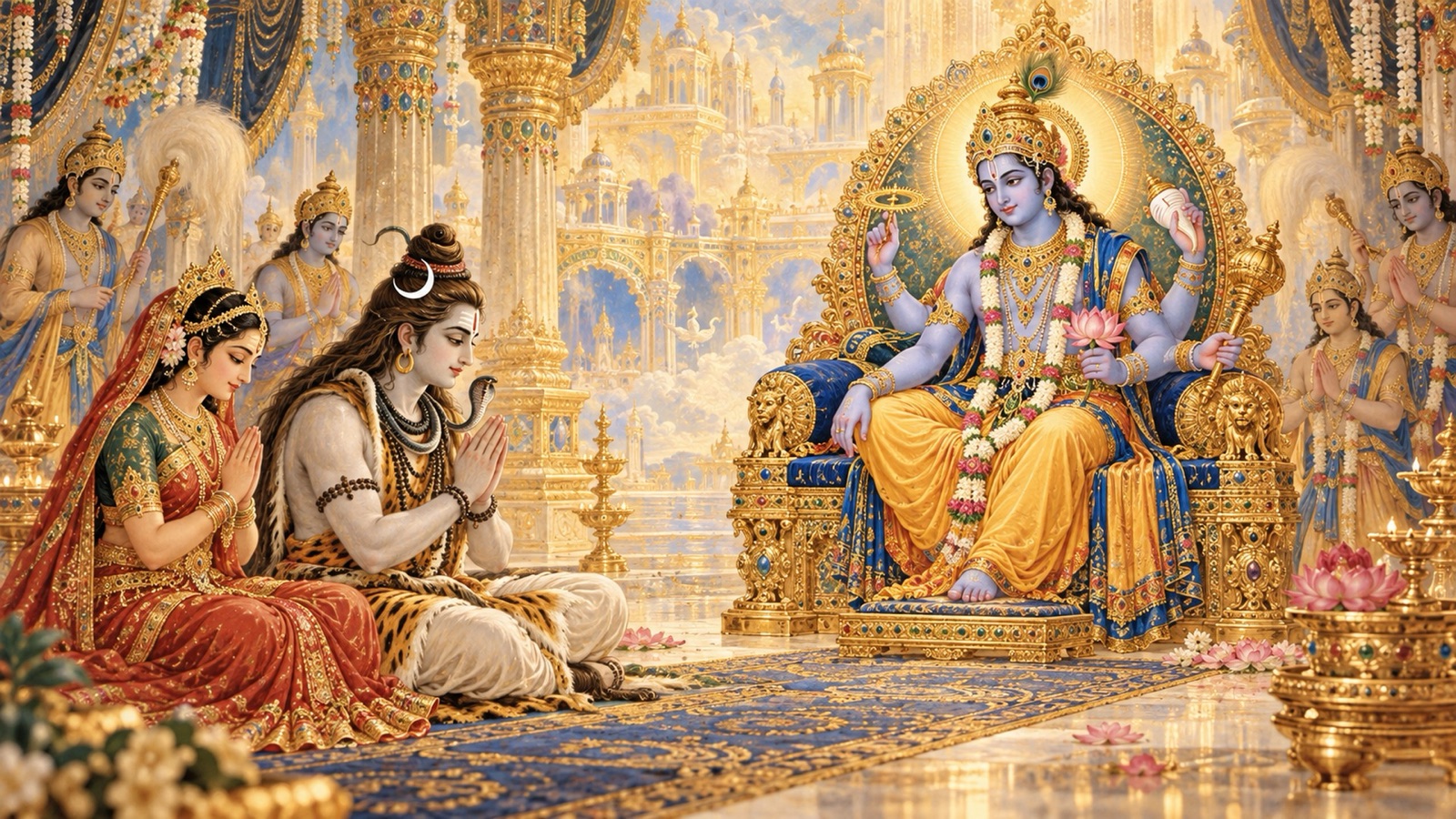
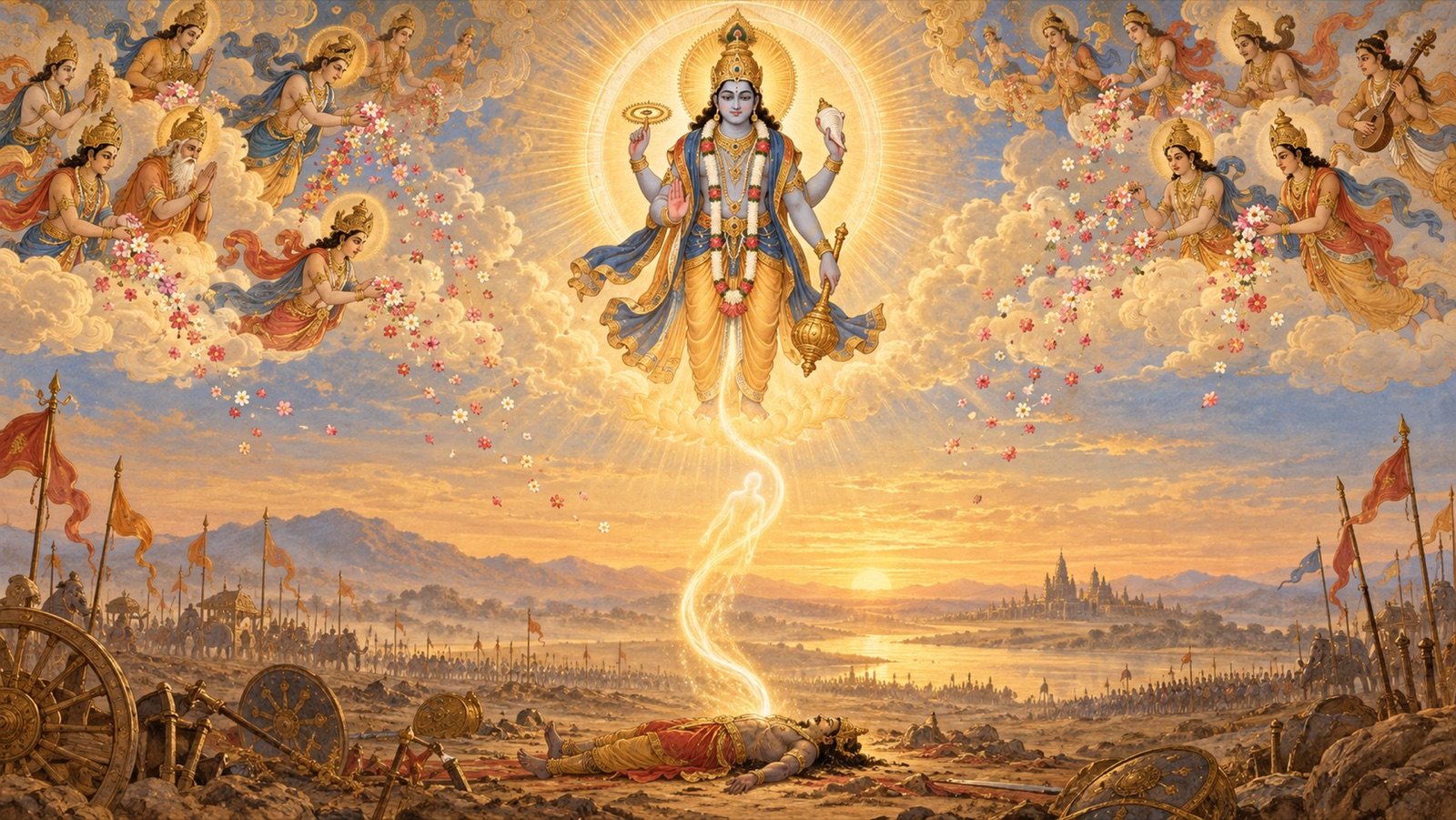
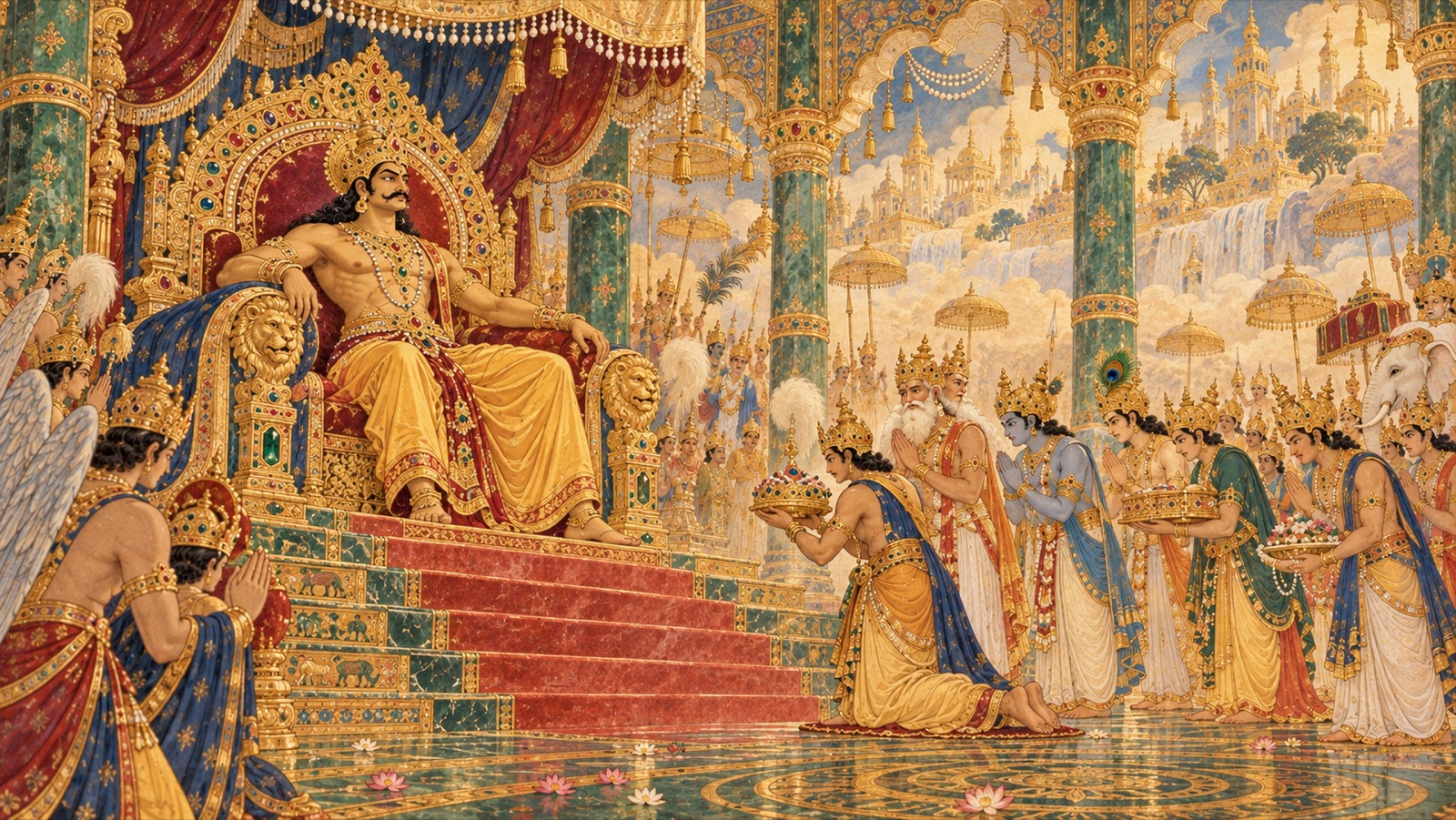
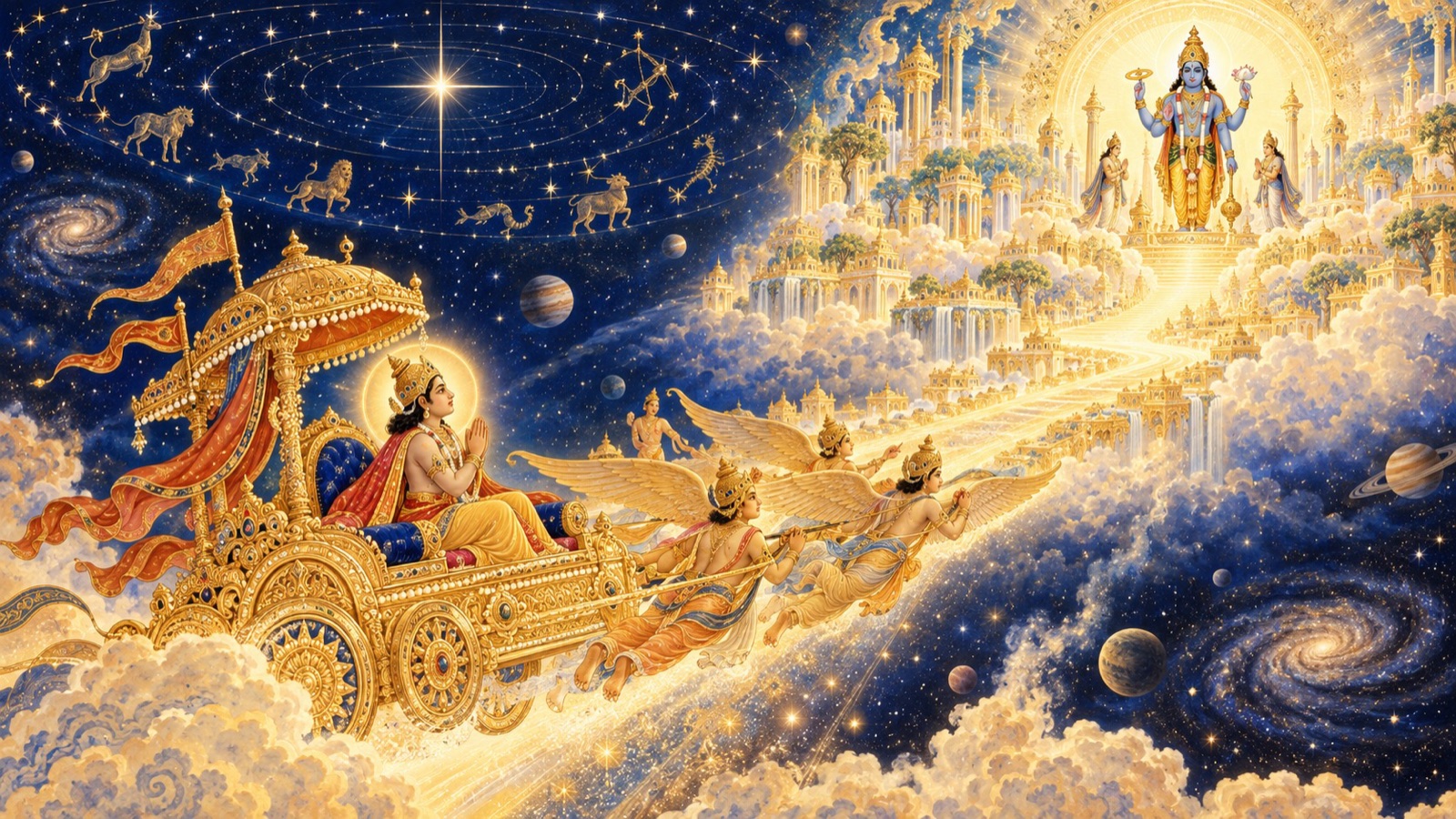
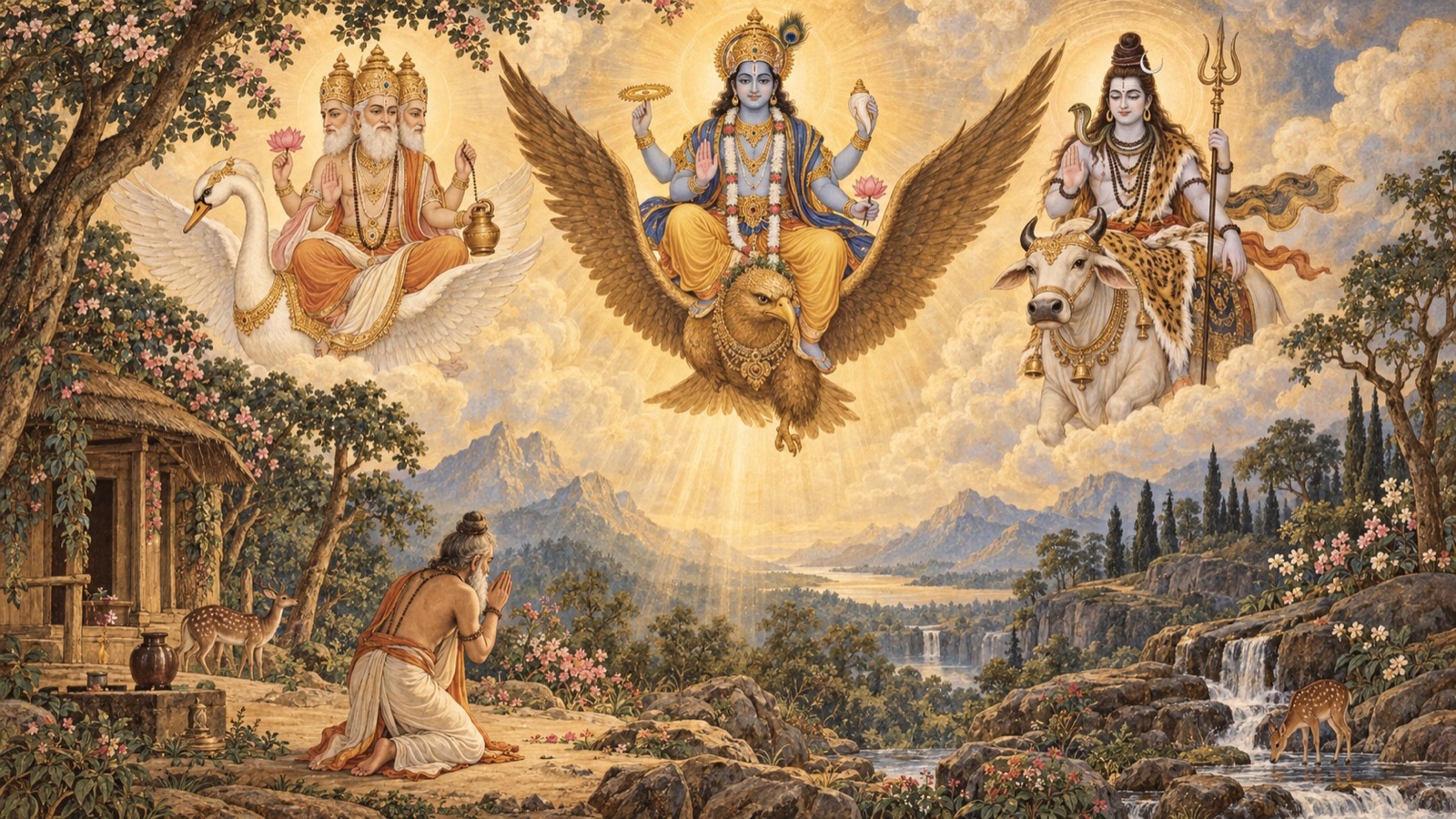
Brahma, Shiva and the gods gather with flowers to witness Sri Krishna's return to His own eternal abode. Sukadeva Gosvami teaches King Parikshit that the Lord's disappearance is His own Maya, not an ending. A faithful, devotional retelling with verified verses.
Continue the Reading →
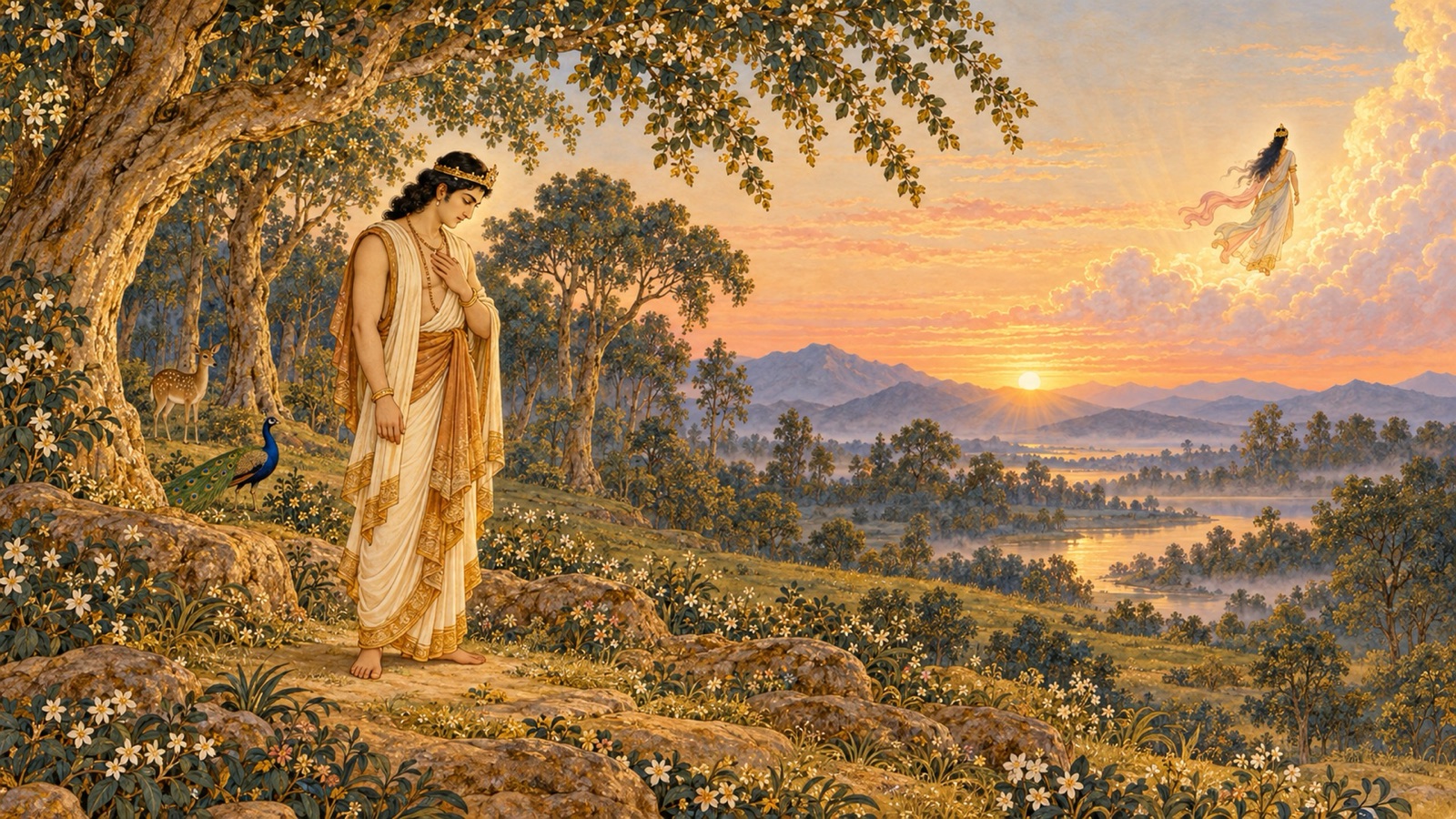
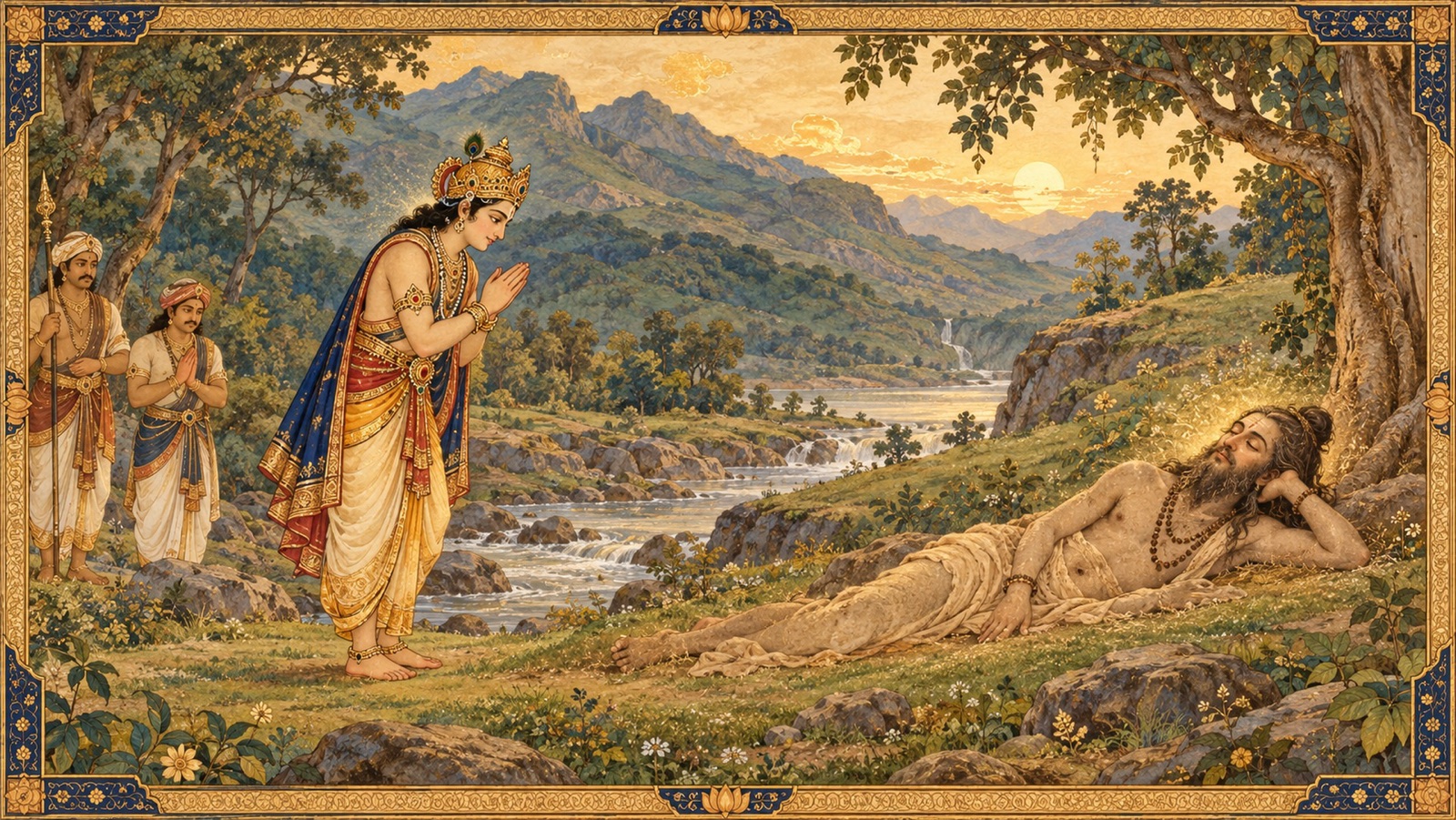
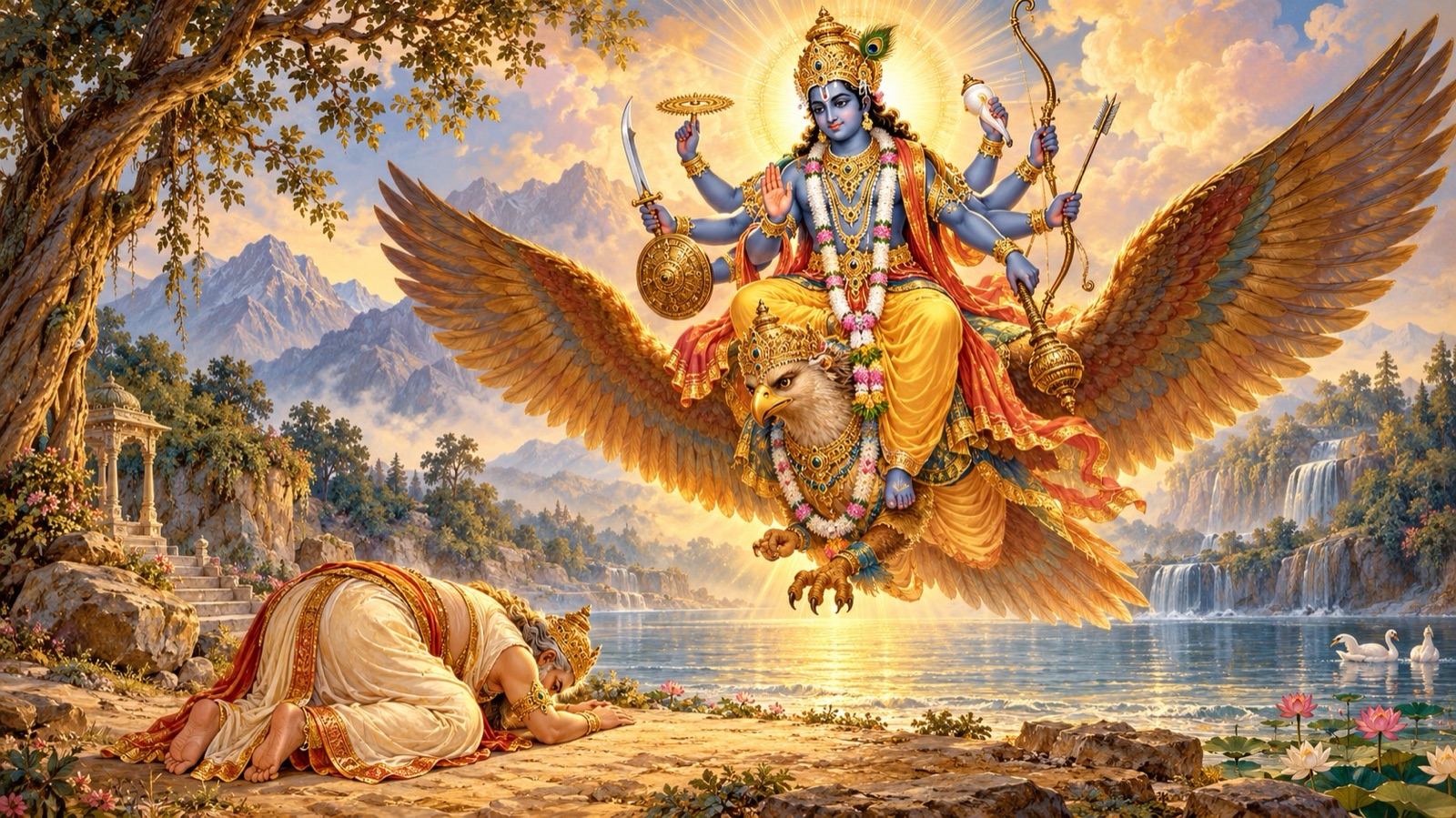
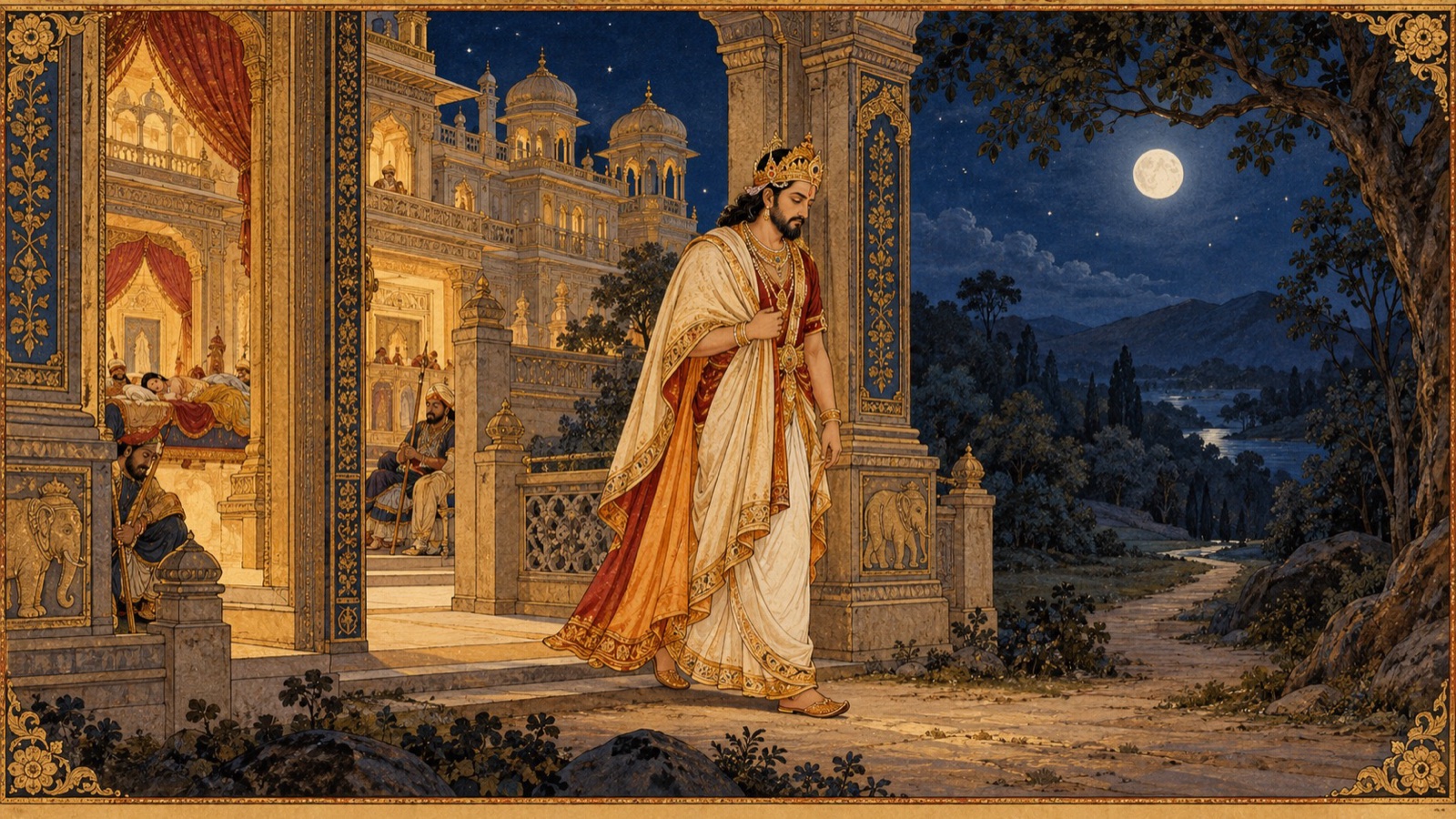
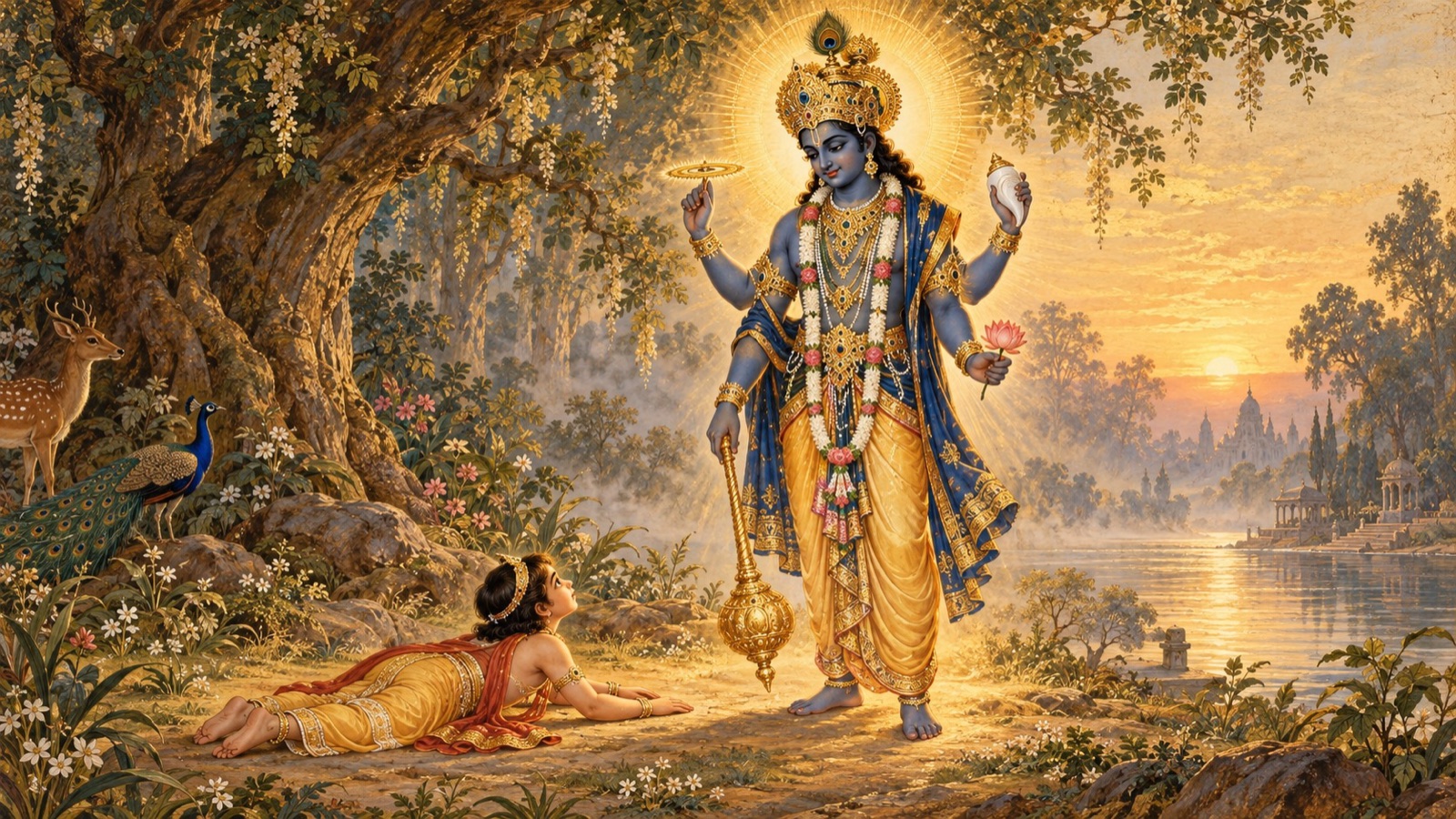
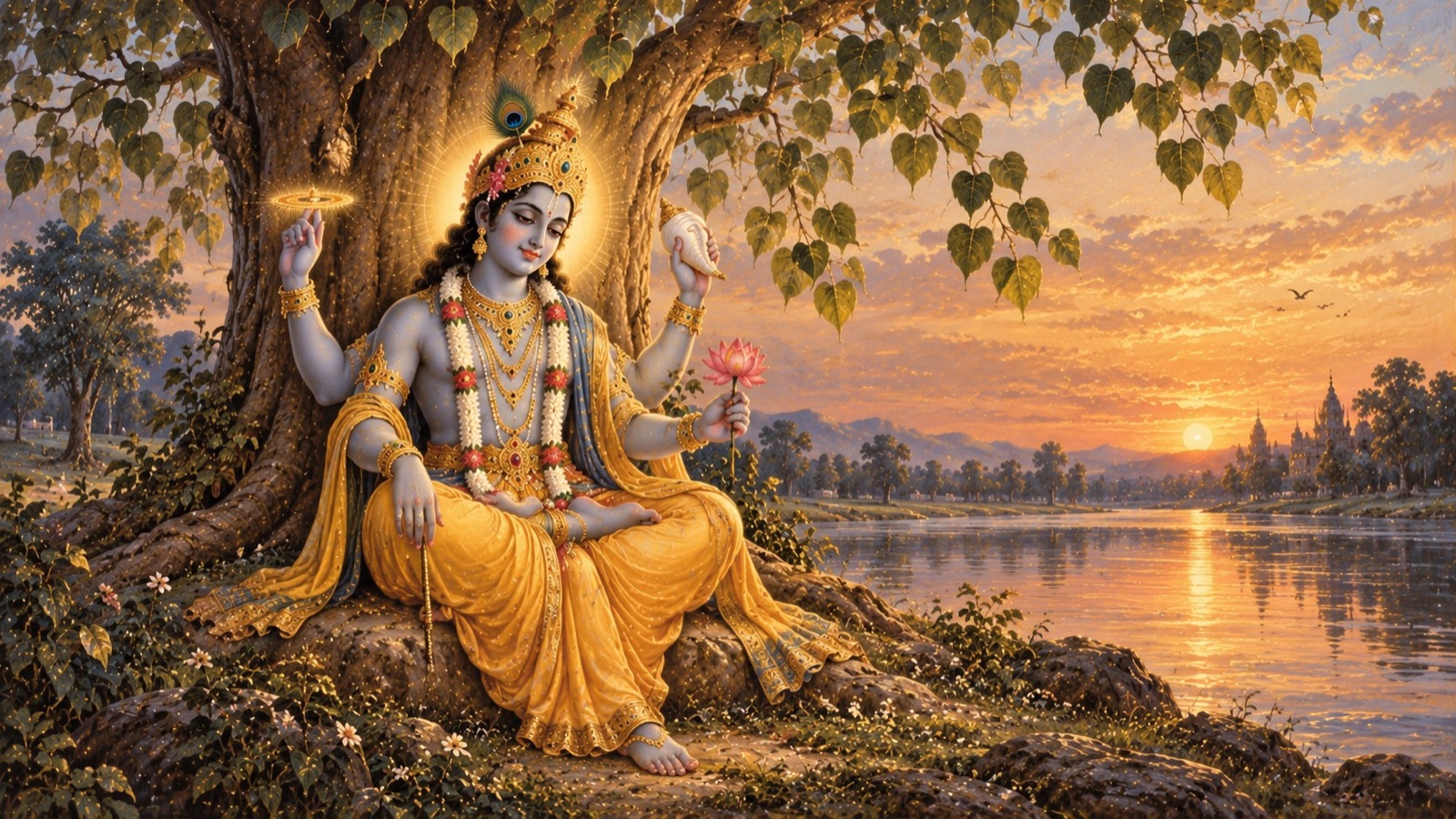
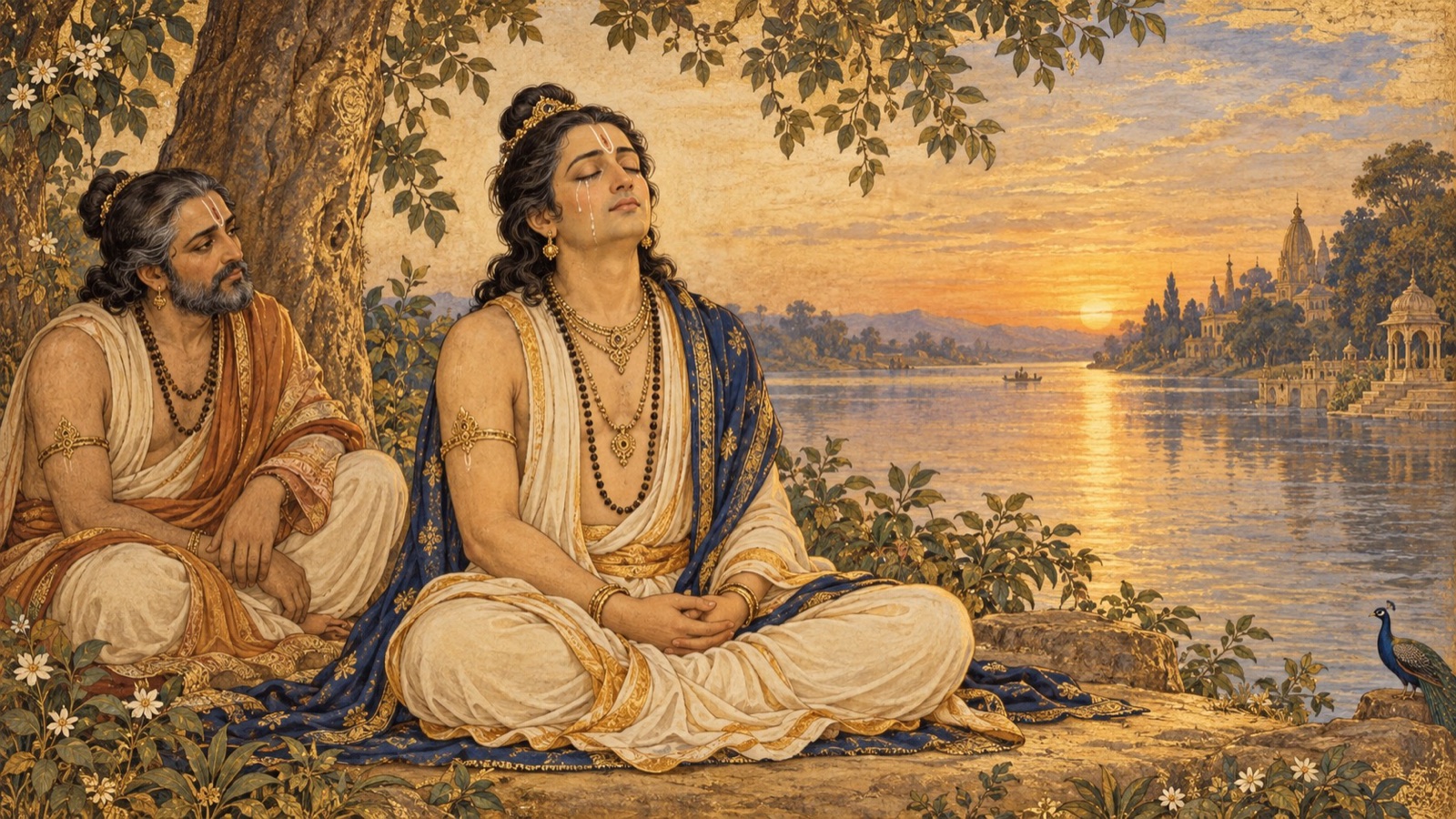
At Prabhasa, an ancient curse comes to fulfilment and the Yadu clan meets its end. Balarama departs in yoga, and Krishna, seated beneath a pippala tree, blesses the hunter Jara and sends His last words to Daruka. A faithful, devotional retelling with verified verses.
Continue the Reading →
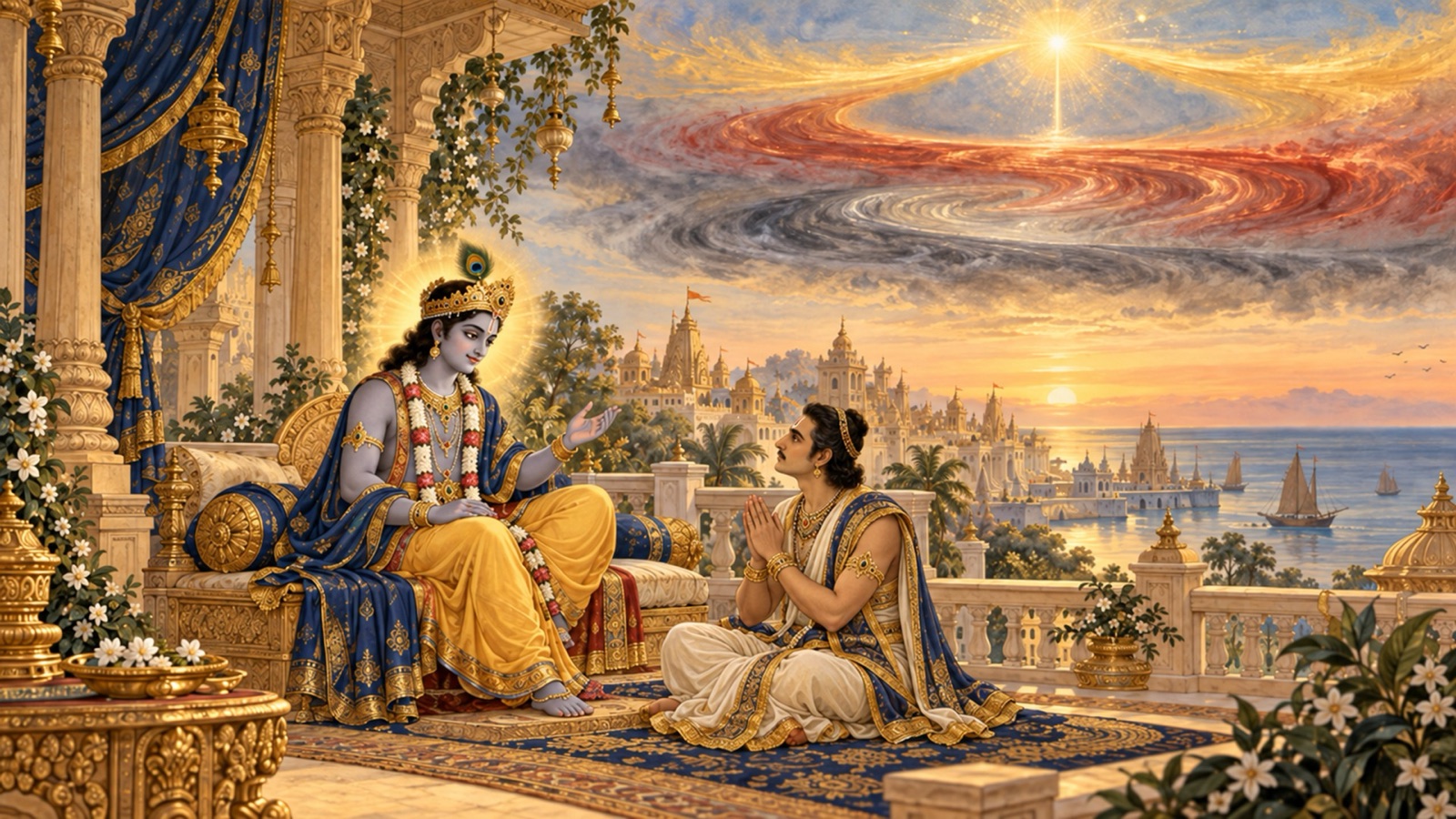
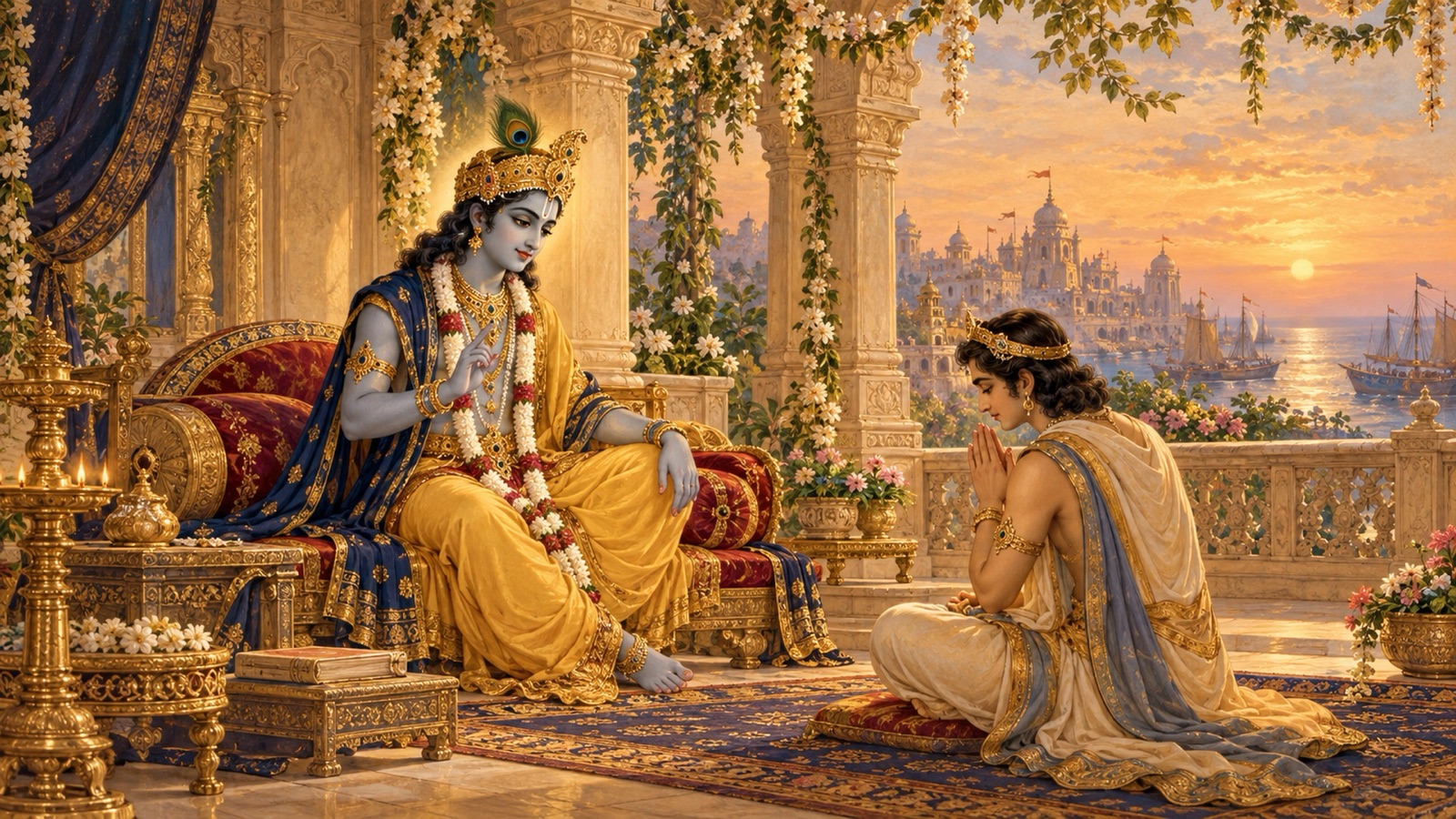
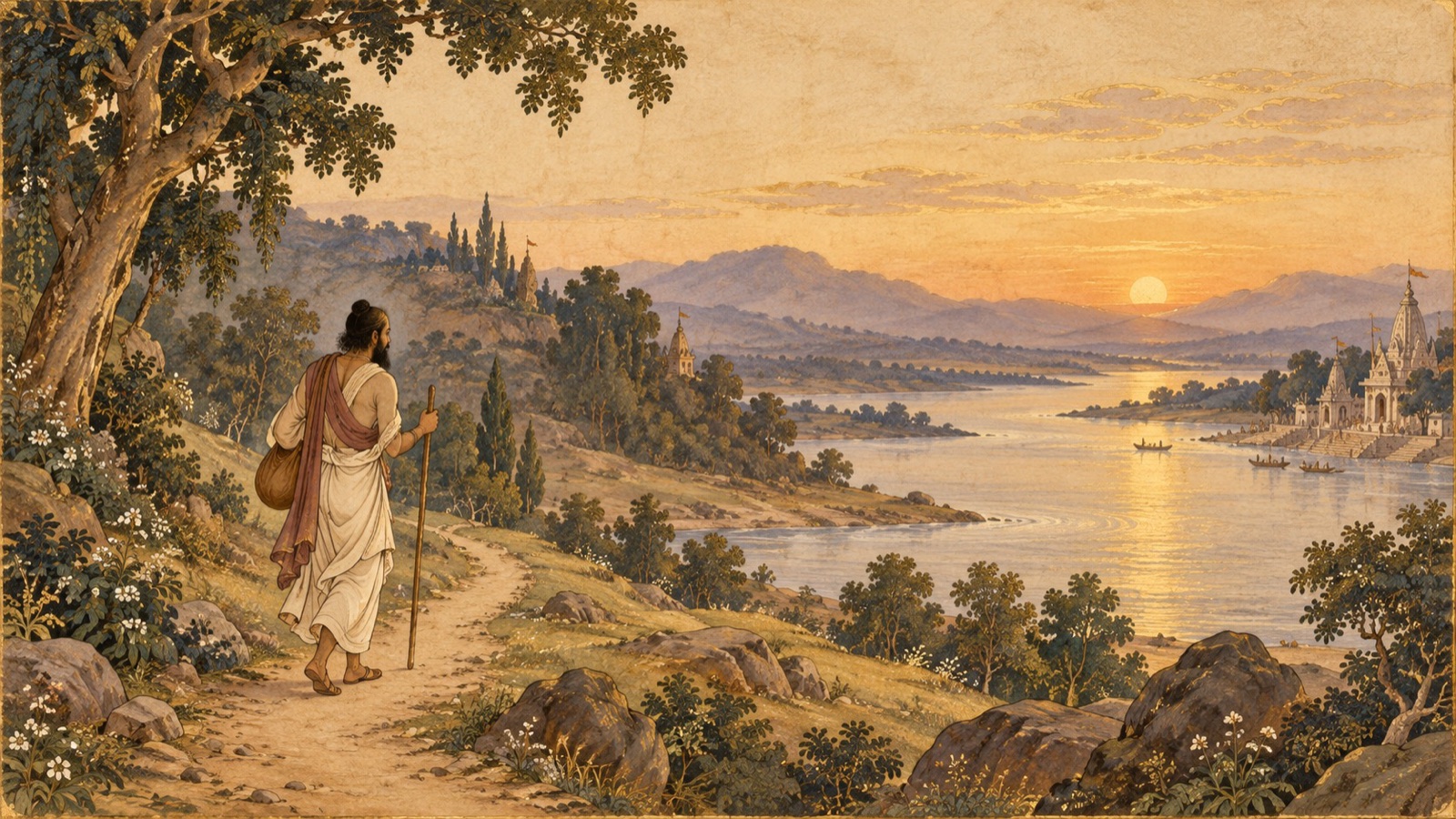
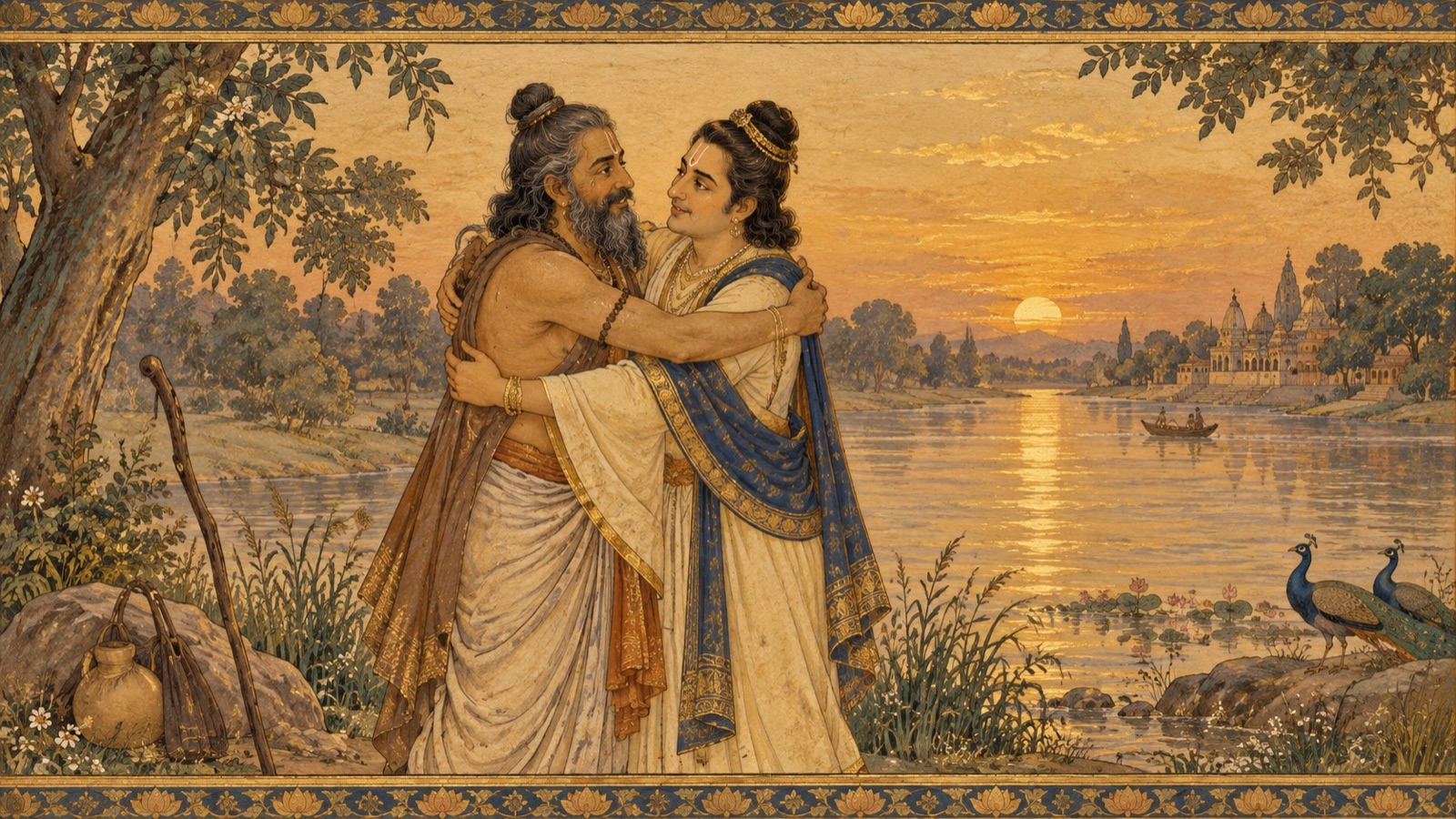
Lord Krishna closes the Uddhava-gita with the easiest of all paths — seeing Himself in every being and bowing before all creation — then sends Uddhava to the forest of Badarikashrama. A faithful, devotional retelling with verified verses.
Continue the Reading →
Lord Krishna teaches Uddhava to see the one Self in all beings, reveals the dream and reflection as images of this world's unreality, and shows that even the highest knowledge rests safely only in devotion to Him. A faithful, devotional retelling with verified verses.
Continue the Reading →
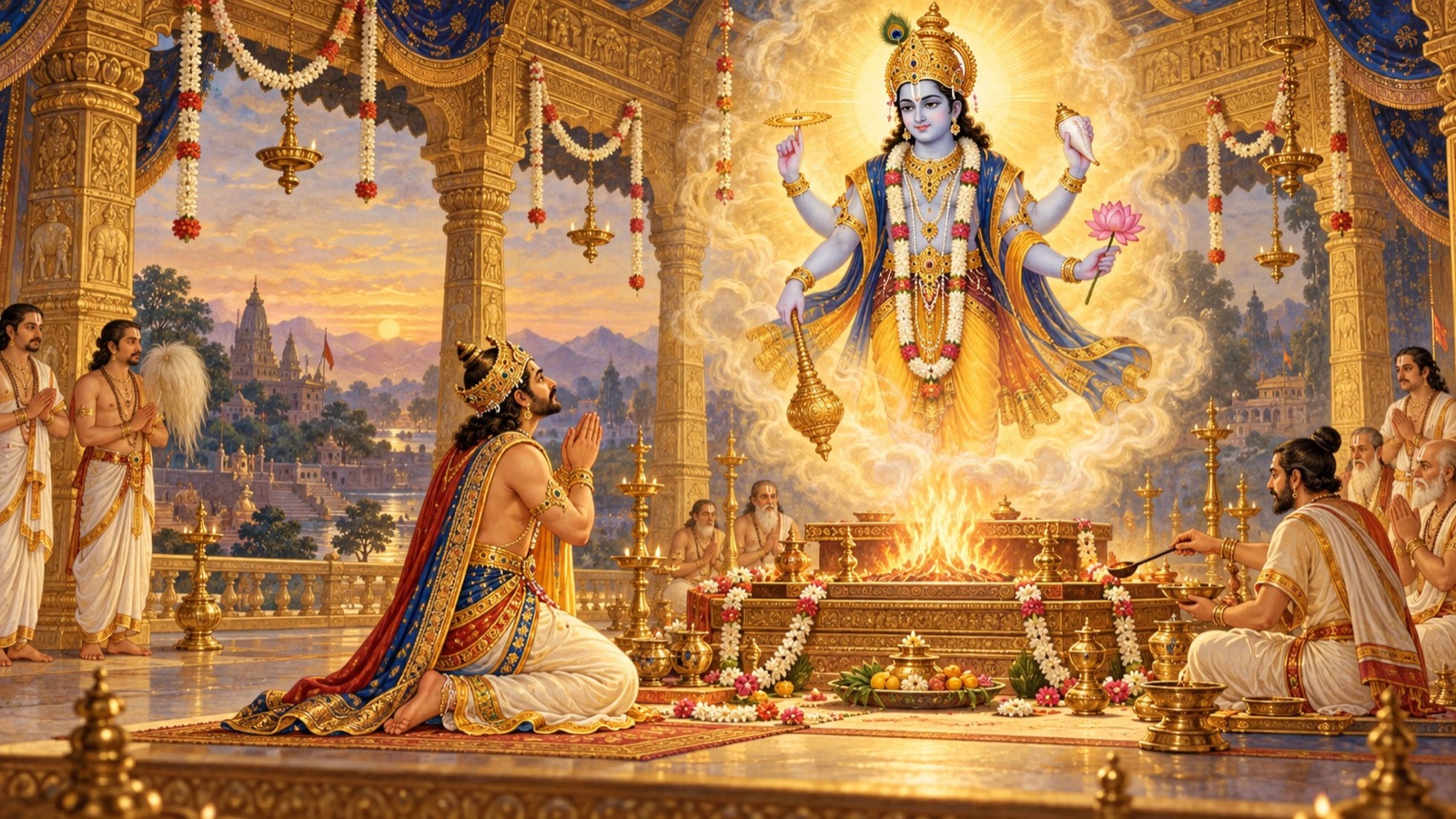
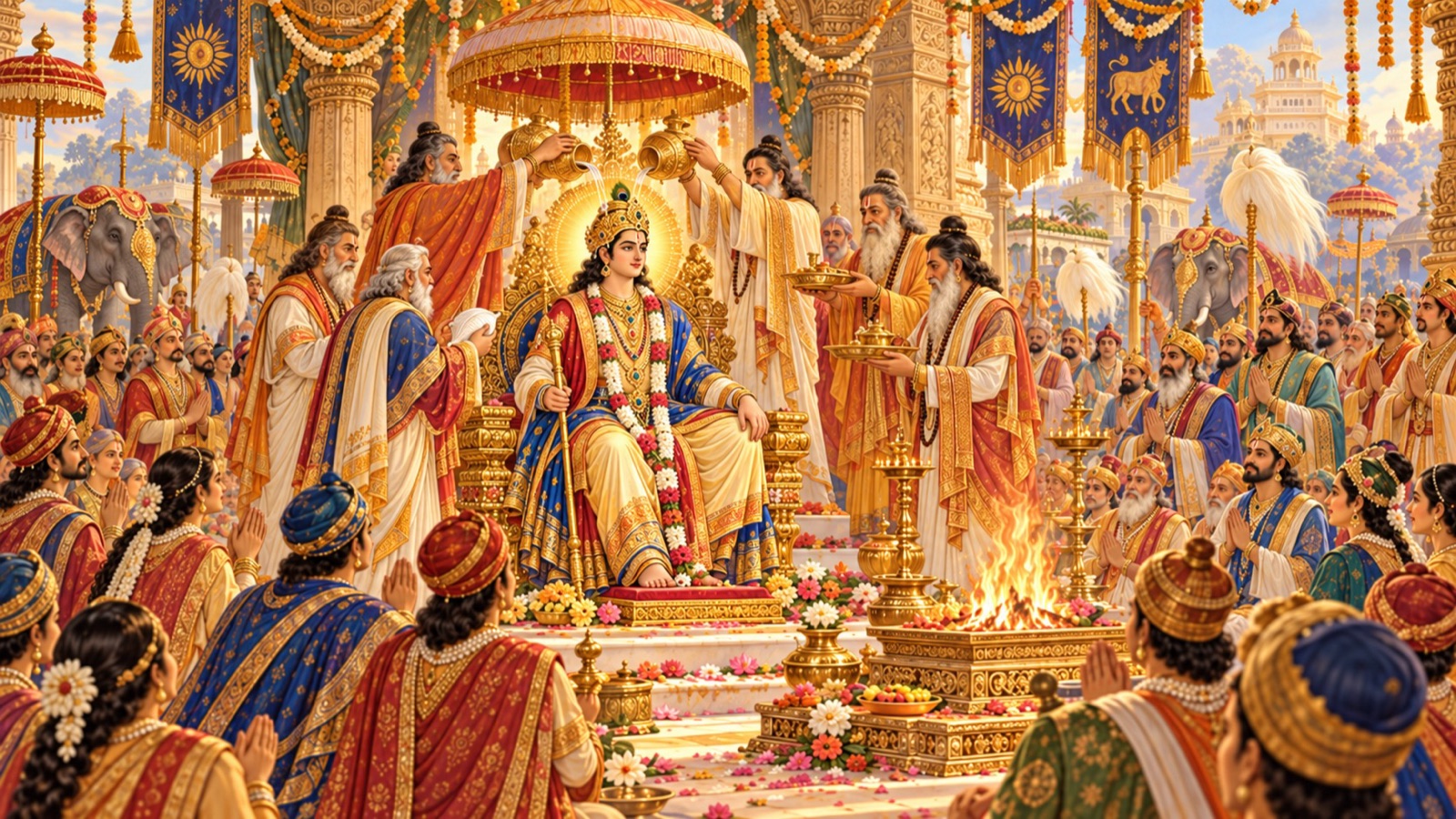
Uddhava asks Sri Krishna how to worship Him, and the Lord teaches the whole path of kriya-yoga — purification, inviting His presence into a sacred image, bathing and adorning Him, the sacred fire, and the devotee's surrender. A faithful, devotional retelling with verified verses.
Continue the Reading →
Lord Krishna sings to Uddhava the song of King Pururava, undone by infatuation with the celestial Urvashi and freed through honest grief, and crowns it with His teaching on why the company of saints alone heals the heart. A faithful, devotional retelling with verified verses.
Continue the Reading →
Lord Krishna shows Uddhava how sattva, rajas and tamas shape every corner of embodied life, and reveals how devotion alone carries the soul beyond the three modes to Him. A faithful, devotional retelling with verified verses.
Continue the Reading →
Lord Krishna unfolds for Uddhava the ancient Sankhya of creation and dissolution — how Prakriti and Purusha, the gunas, the cosmic egg and the three worlds arise, and how the Self alone remains when all is withdrawn. A faithful, devotional retelling with verified verses.
Continue the Reading →
Lord Krishna tells Uddhava how a rich, miserly brahmana of Avanti lost everything, was cast off by his own household, and became a wandering mendicant who sang that the mind alone is the true cause of every joy and sorrow. A faithful, devotional retelling with verified verses.
Continue the Reading →
Uddhava asks why the sages count the fundamental principles of creation so differently. Lord Krishna reconciles every count, then reveals how Purusha and Prakriti, though eternally distinct, seem to merge, and how the soul quietly passes from body to body. A faithful, devotional retelling with verified verses.
Continue the Reading →
Lord Krishna teaches Uddhava why purity, impurity, virtue and fault are declared by scriptural law rather than fixed in things, why the Vedas sweeten their deeper truth with promises of heaven, and reveals the Vedas as His own sacred, self-revealing sound. A faithful, devotional retelling with verified verses.
Continue the Reading →
Lord Krishna answers Uddhava's question on the Veda's injunctions by teaching the three paths of knowledge, action and devotion, comparing the human body to a rare boat crossing the ocean of birth and death, and revealing why loving devotion to Him surpasses even knowledge and detachment. A faithful, devotional retelling with verified verses.
Continue the Reading →
Lord Krishna teaches Uddhava the stepping-stones that give rise to devotion, recalls Bhishma's teaching to Yudhishthira, and defines the twelve Yamas, the twelve Niyamas and every virtue a sincere heart could ask about. A faithful, devotional retelling with verified verses.
Continue the Reading →
Lord Krishna teaches Uddhava the forest-dweller's austerities, the true inward marks of a sannyasi, and the householder-devotee's simple duty — all crowned by devotion offered to the Lord alone. A faithful, devotional retelling with verified verses.
Continue the Reading →
Uddhava begs the Lord not to let the sacred path of duty vanish, and Sri Krishna traces the four Varnas and four Asramas to His own cosmic form, revealing the one dharma of nonviolence and truth that binds every soul and the devotion that duty, rightly offered, engenders. A faithful, devotional retelling with verified verses.
Continue the Reading →
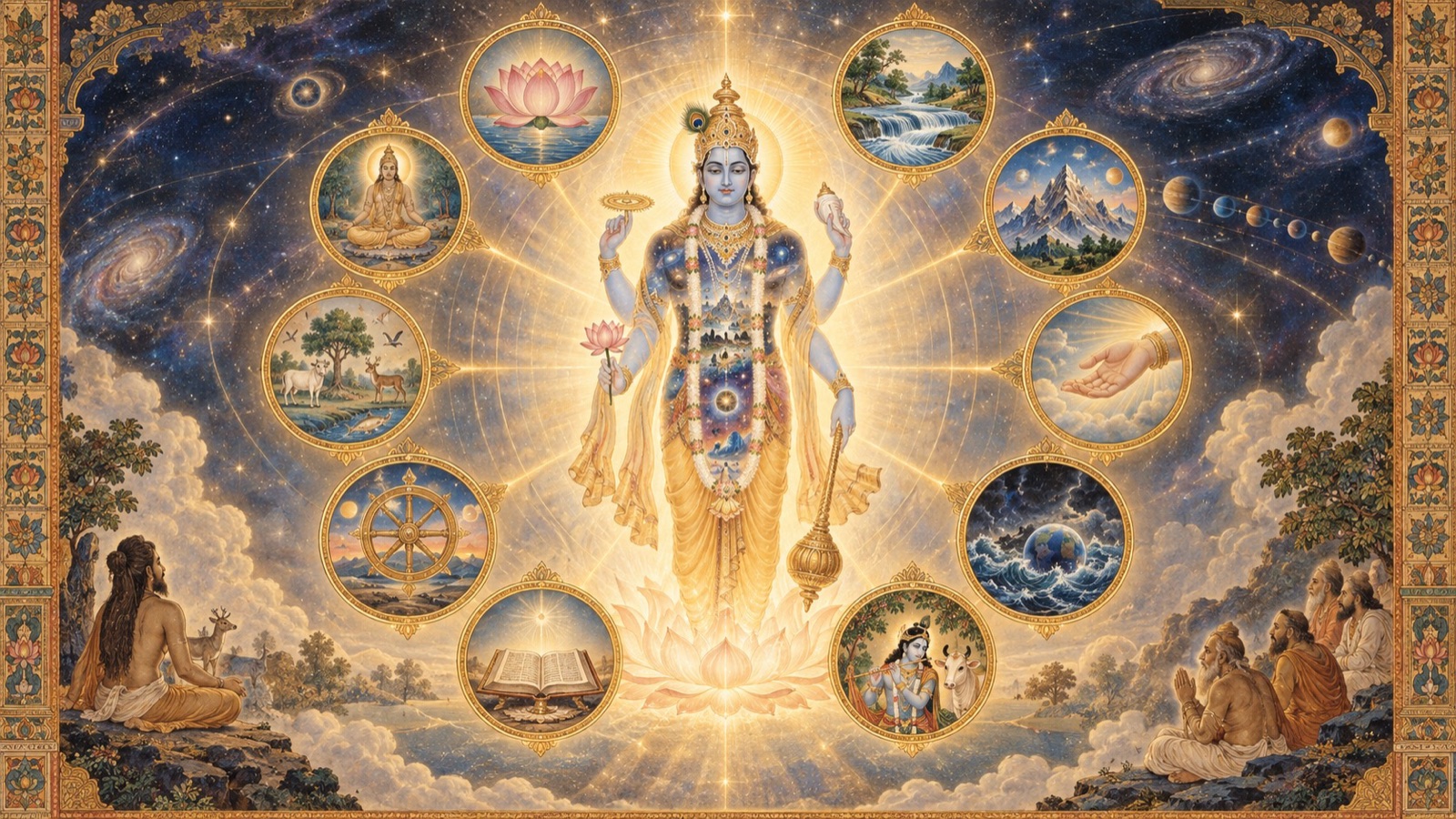
Lord Krishna answers Uddhava's longing to know His hidden glories, revealing Himself through the Ganga and the Himalaya, Om and the Vedas, the gods and the sages, and His own devotee Uddhava — then calls him to master speech, mind, breath and senses. A faithful, devotional retelling with verified verses.
Continue the Reading →
Lord Krishna names the eighteen mystic perfections (Siddhis) for Uddhava, explains the meditation that unlocks each one, and teaches that for the devotee seeking Him alone, every Siddhi is an obstacle, not the goal. A faithful, devotional retelling with verified verses.
Continue the Reading →
Lord Krishna tells Uddhava that devotion alone is complete in itself above every other path, reveals its power to burn away sin, its signs of a melting heart, and the full science of meditation on His own gracious form within the lotus of the heart. A faithful, devotional retelling with verified verses.
Continue the Reading →
The Yadu genealogy reaches its true purpose — Sura's daughter Pritha and the sun-god's boon, Vasudeva's many wives and sons, and the declaration that the eighth son of Vasudeva and Devaki is Lord Hari Himself, come to lift the earth's burden and heal the ears of all who hear His glory. A faithful devotional retelling with verified verses.
Continue the Reading →
The final chapter of the entire Bhagavatam: Suta Gosvami gives the extent of the eighteen Puranas, proclaims the supreme glory of the Bhagavata as the cream of the Upanishads, offers the great meditation on the disciplic succession, and closes with a bow to Sri Hari. A faithful, verse-verified retelling and fitting close to the series.
Continue the Reading →
As the great narration nears its close, Suta Gosvami looks back over the whole Bhagavatam — book by book, from Pariksit to Krishna to the dissolution of the world — glorifies the sanctifying power of the Lord's name, and offers reverent salutations to Vishnu and to Suka. A faithful, verse-verified retelling.
Continue the Reading →
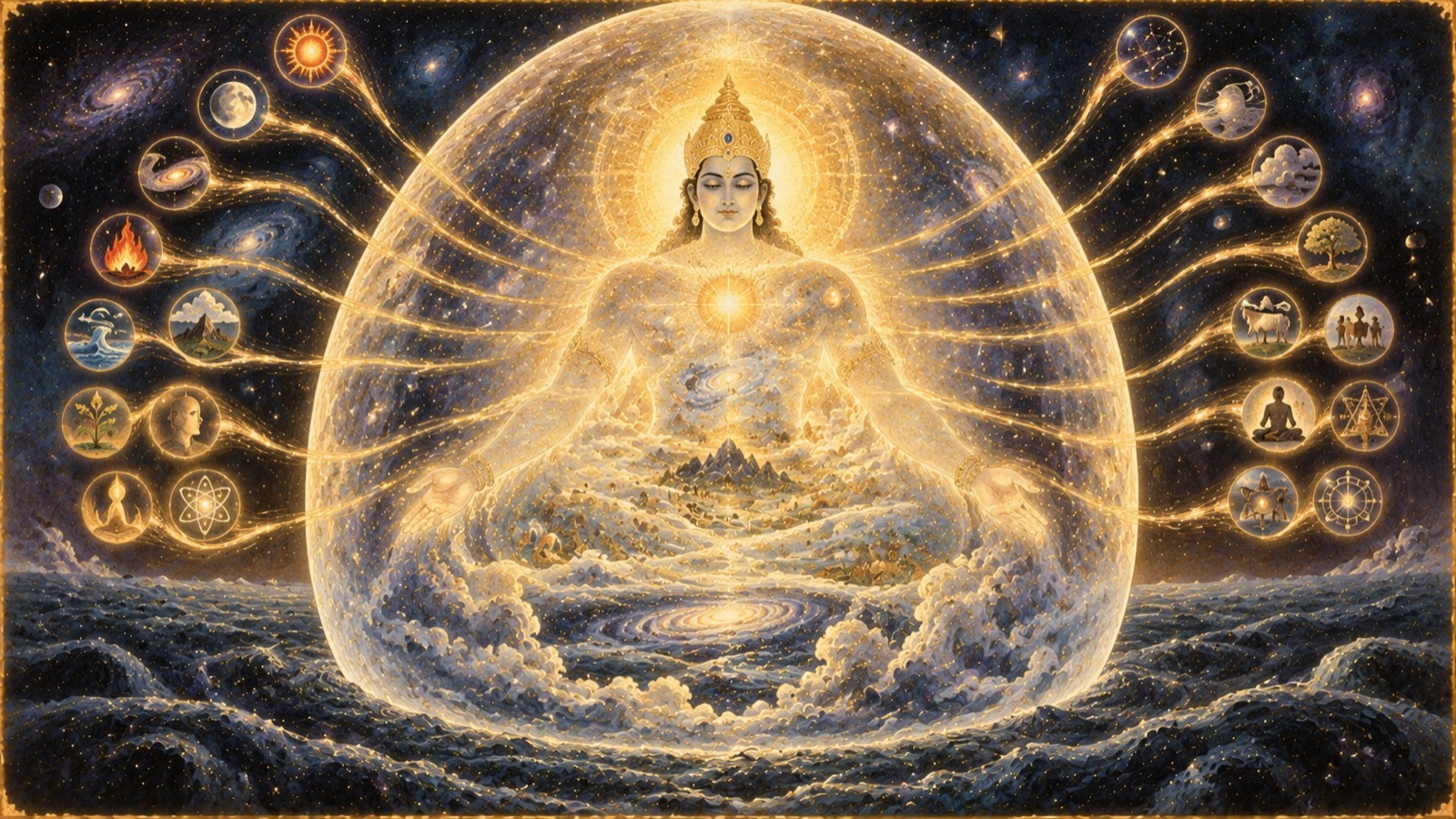
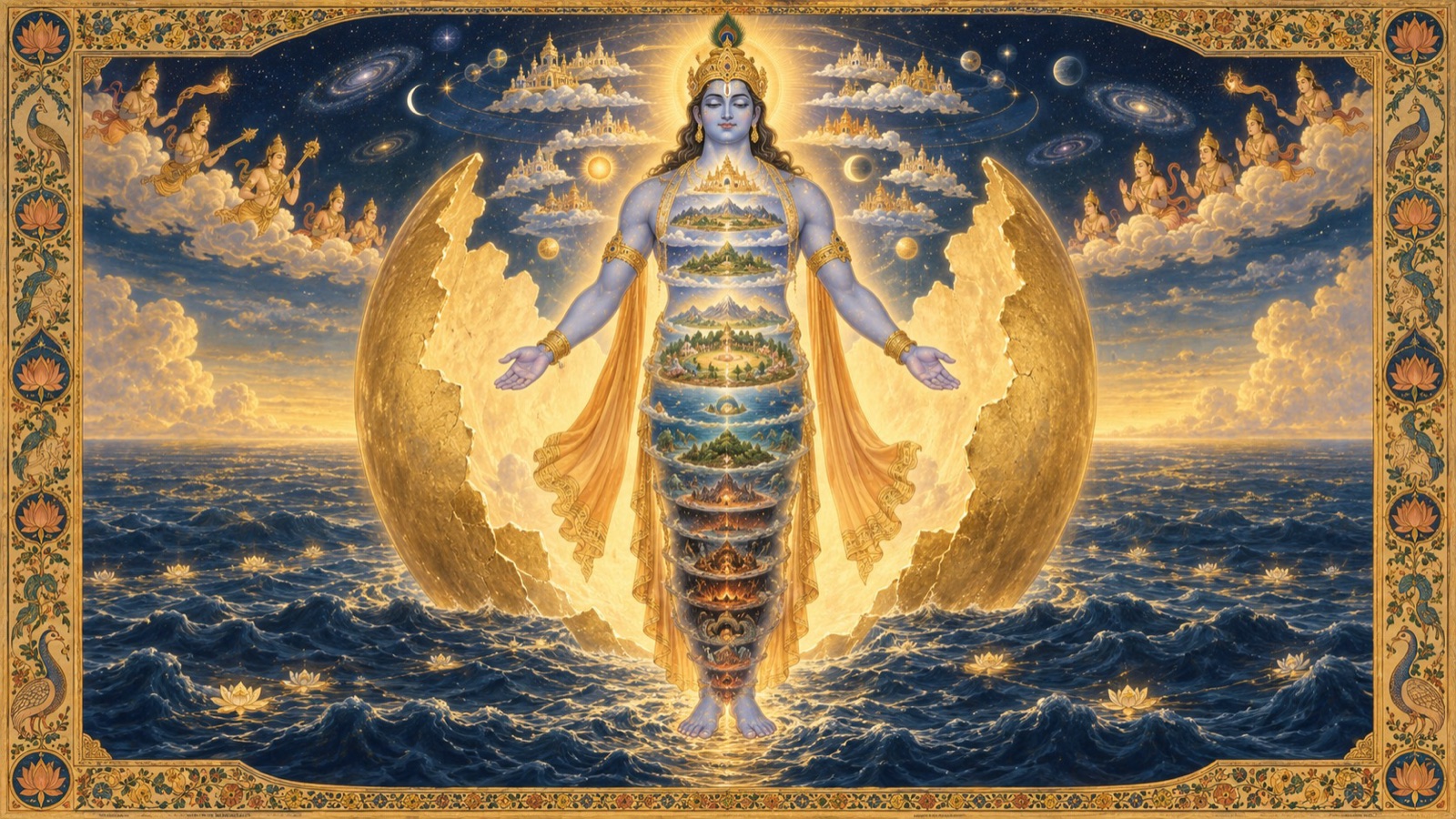
Suta Gosvami reveals the Cosmic Person whose body is the universe, unfolds the Lord's meditative worship-form in which every emblem is a living principle of reality, and describes the glory of the Sun-god — none other than Sri Hari — coursing through the twelve months with His sacred retinue. A faithful, verse-verified retelling.
Continue the Reading →
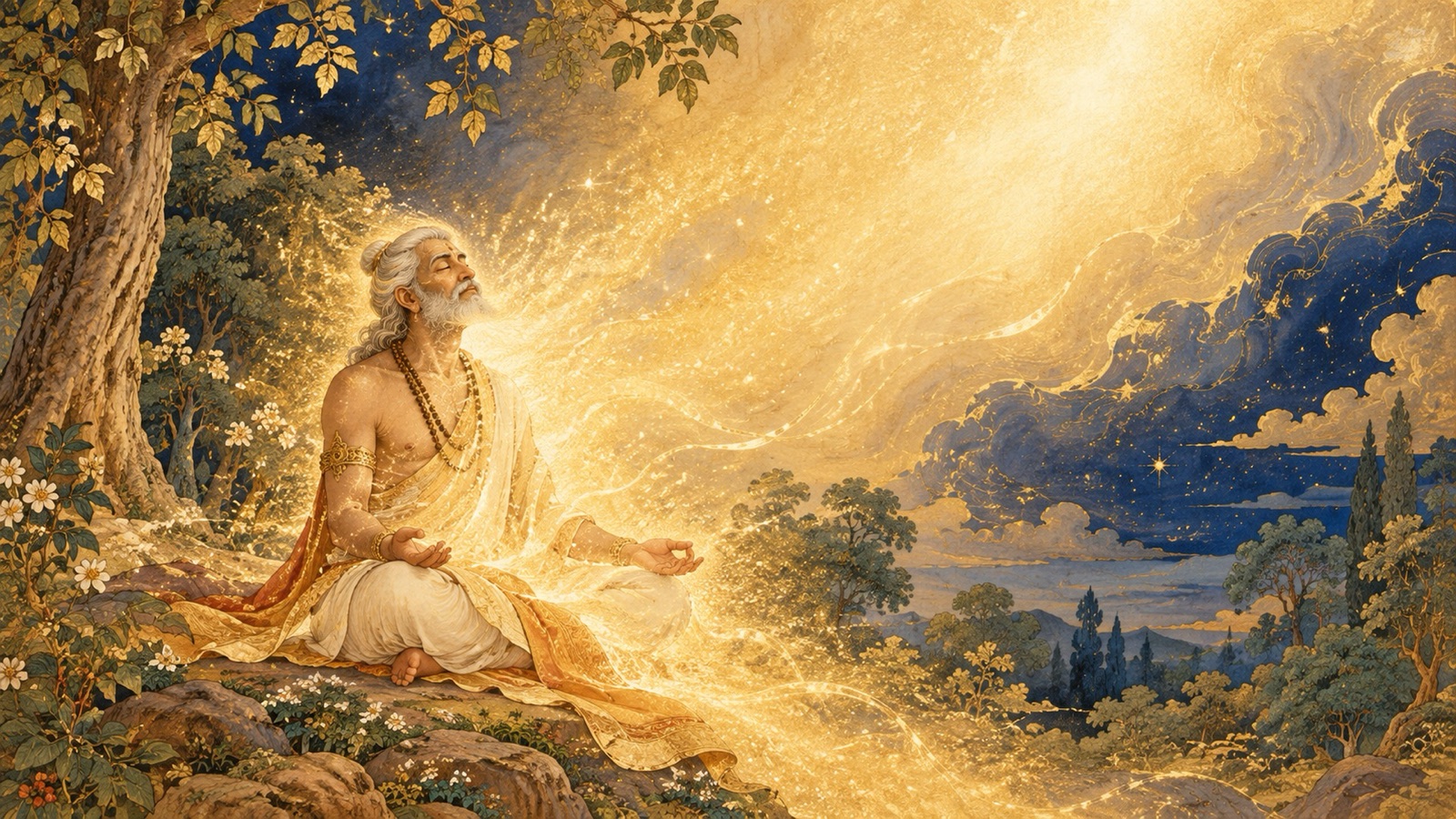
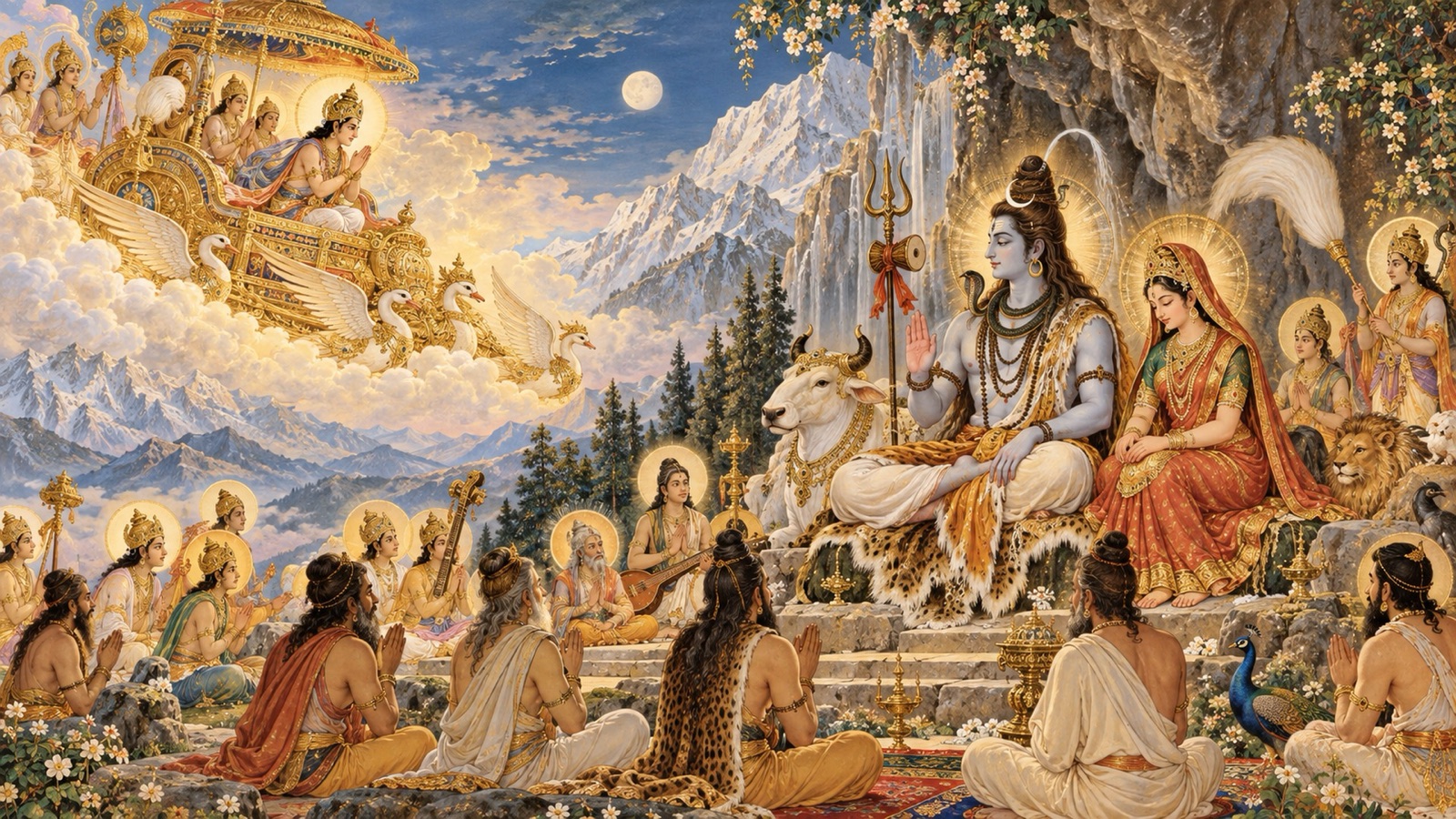
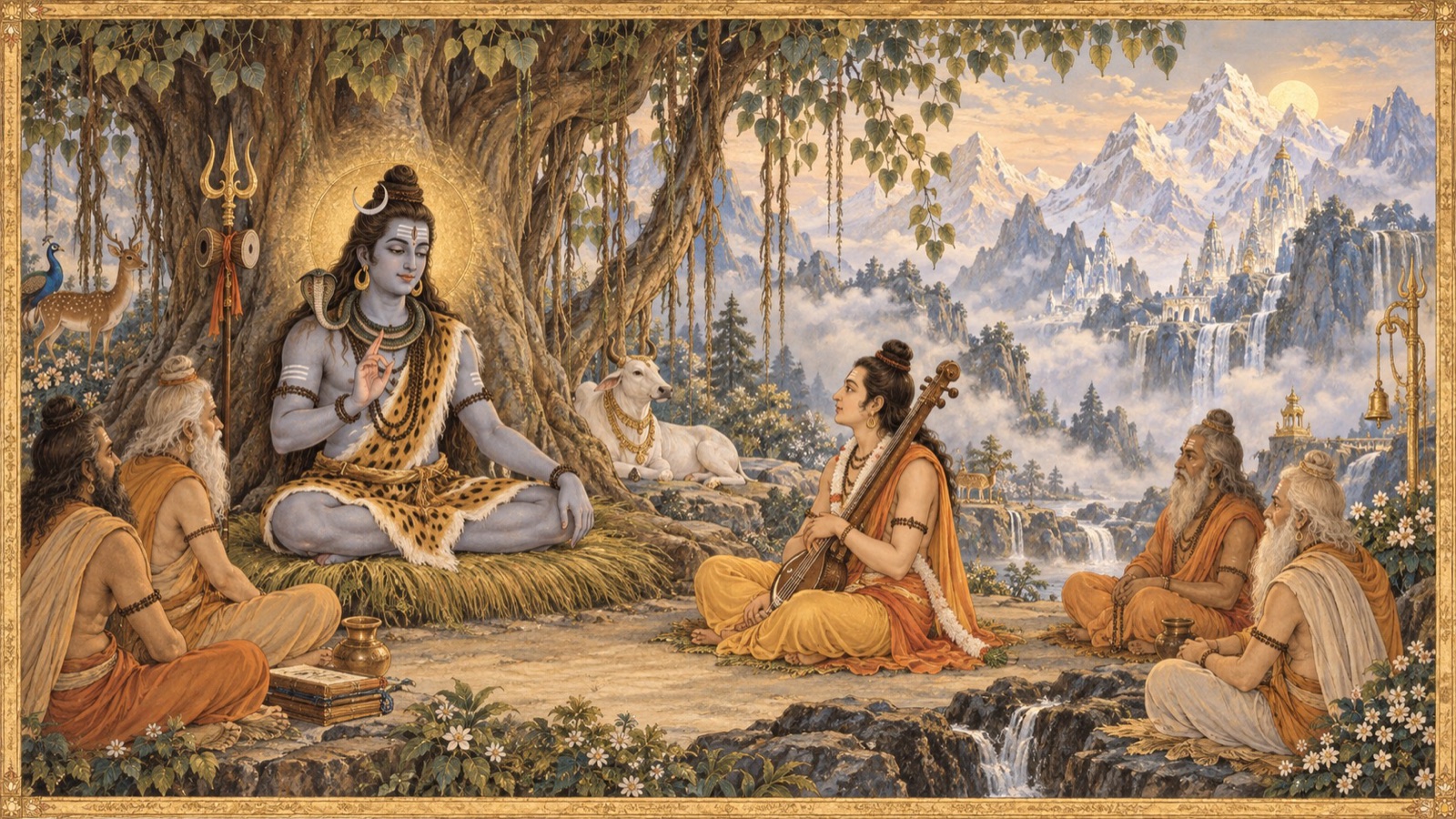
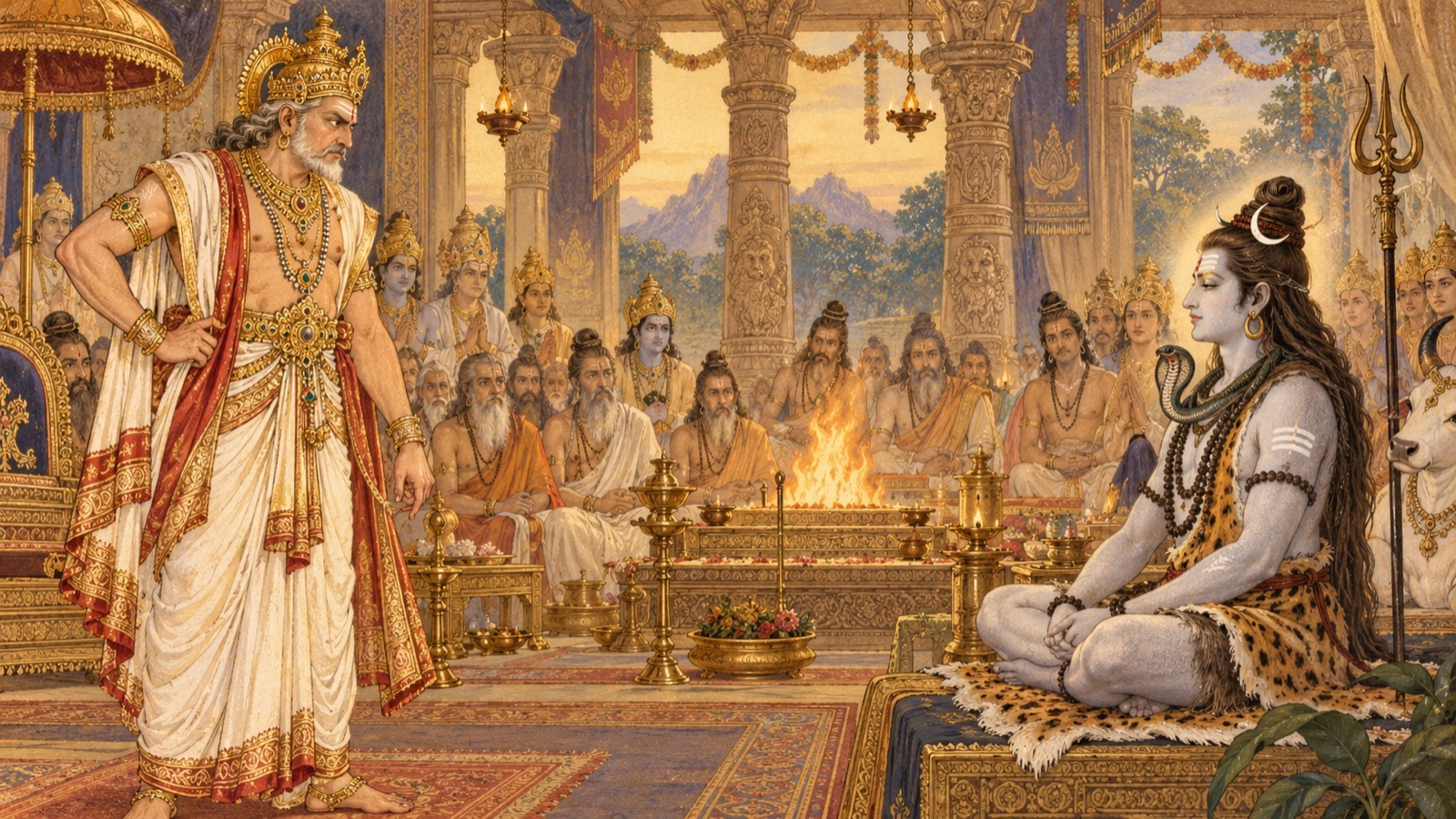
Journeying with the Goddess Uma, Lord Shiva beholds Markandeya absorbed in trance, rouses him, and praises the glory of pure-hearted saints who purify by a single sight. Offered any boon, the sage asks only for unfailing devotion to the Lord, His devotees, and Shiva. A faithful, devotional retelling with verified verses.
Continue the Reading →
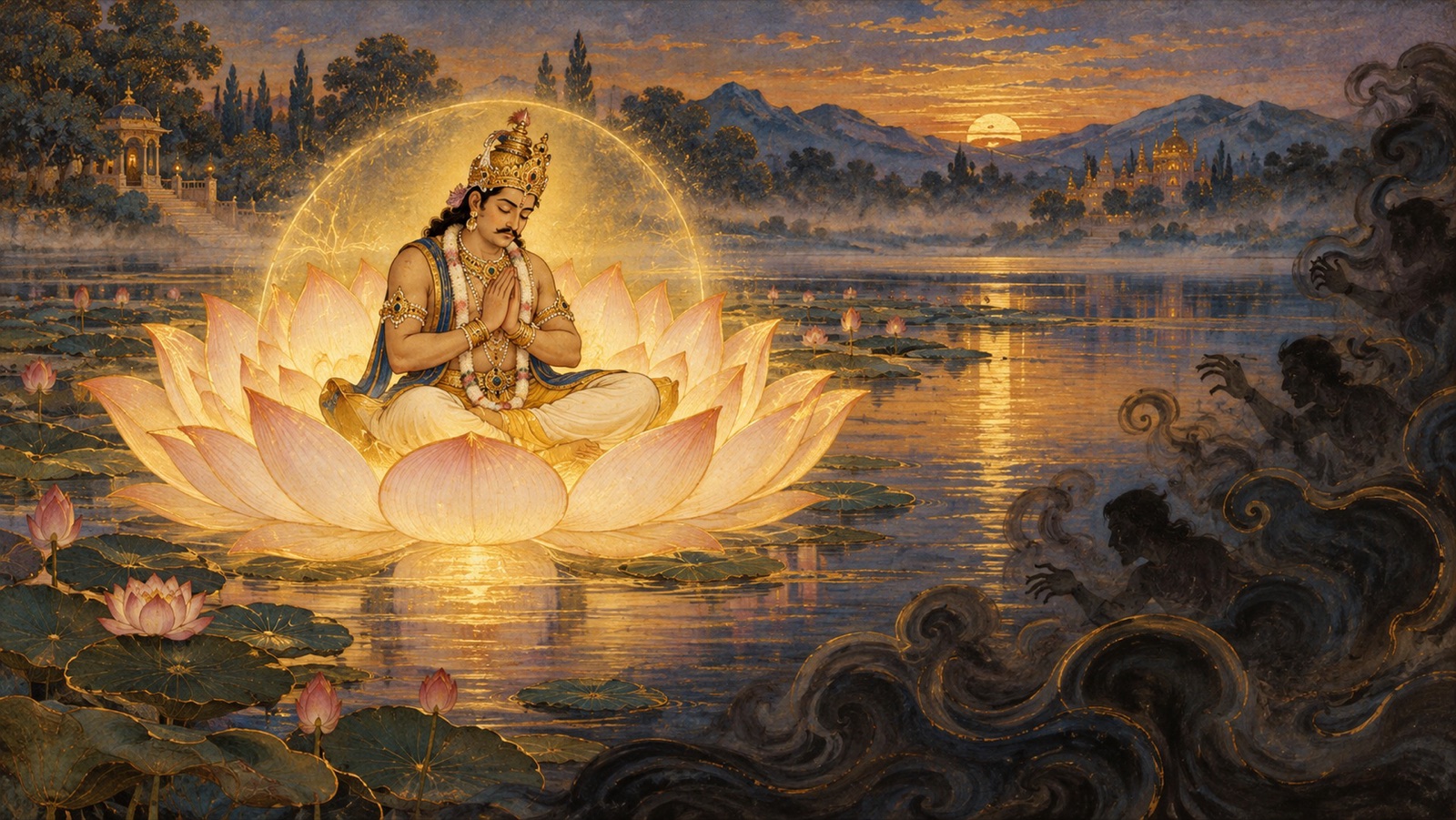
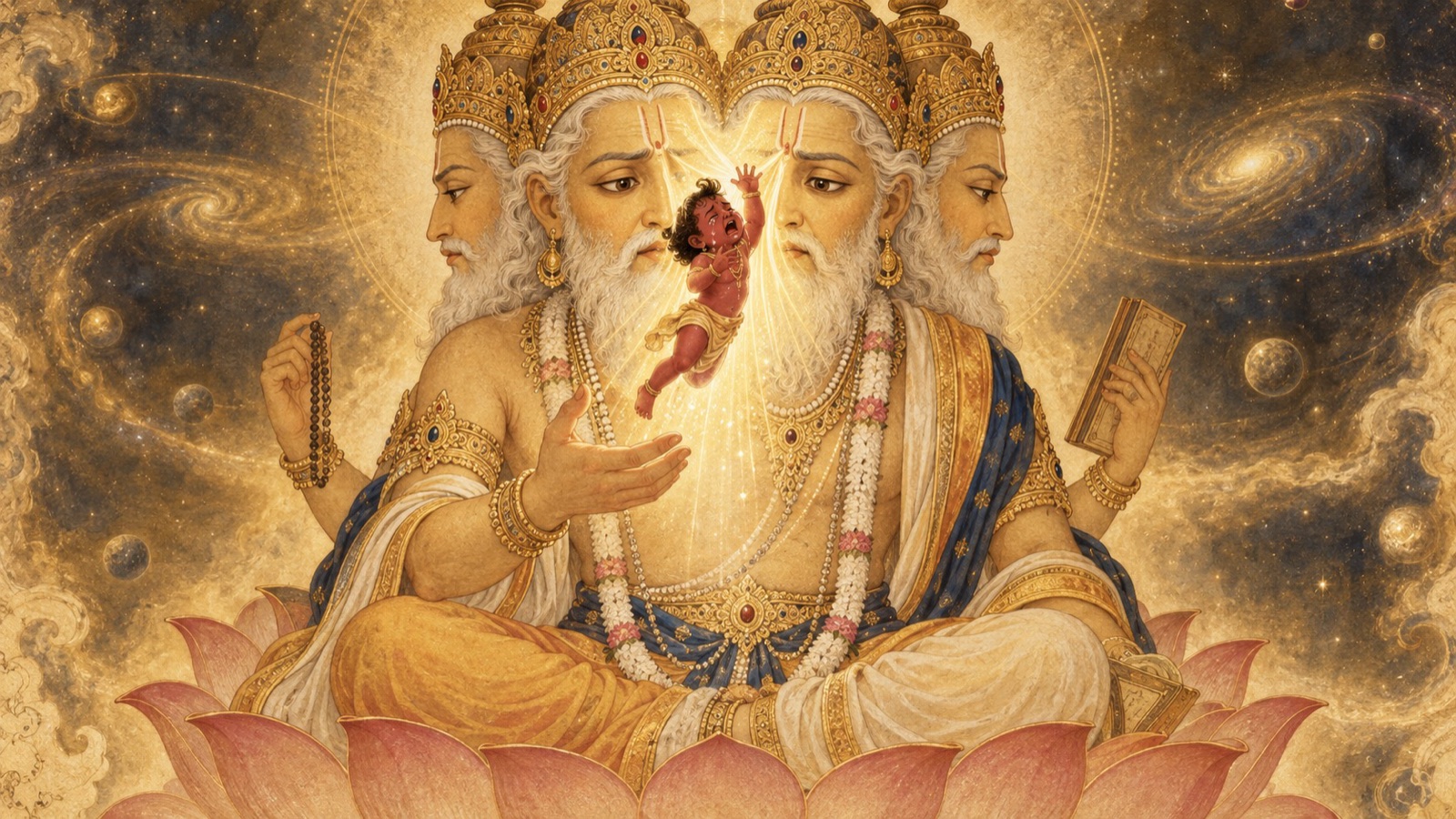
Granted any boon, the sage Markandeya asks only to behold the Lord's Maya. The Lord answers by leading him through a cosmic deluge in which he drifts alone for ages, then shows Himself as a radiant infant on a banyan leaf, within whose body the whole universe is held. A faithful, devotional retelling with verified verses.
Continue the Reading →
Suta answers Saunaka's question about the long-lived sage Markandeya: how he conquered death through lifelong austerity and worship of Sri Hari, how Indra's test through the god of love failed against a soul absorbed in God, and how the Lord appeared as Nara and Narayana to bless His devotee. A faithful, devotional retelling with verified verses.
Continue the Reading →
Suta Gosvami traces how the Atharva Veda was carried down through faithful disciples, names the six sages who preserved the Puranas, unfolds the ten marks by which a true Purana is known, and names the eighteen great Puranas — among them the Bhagavata itself. A faithful, devotional retelling with verified verses.
Continue the Reading →
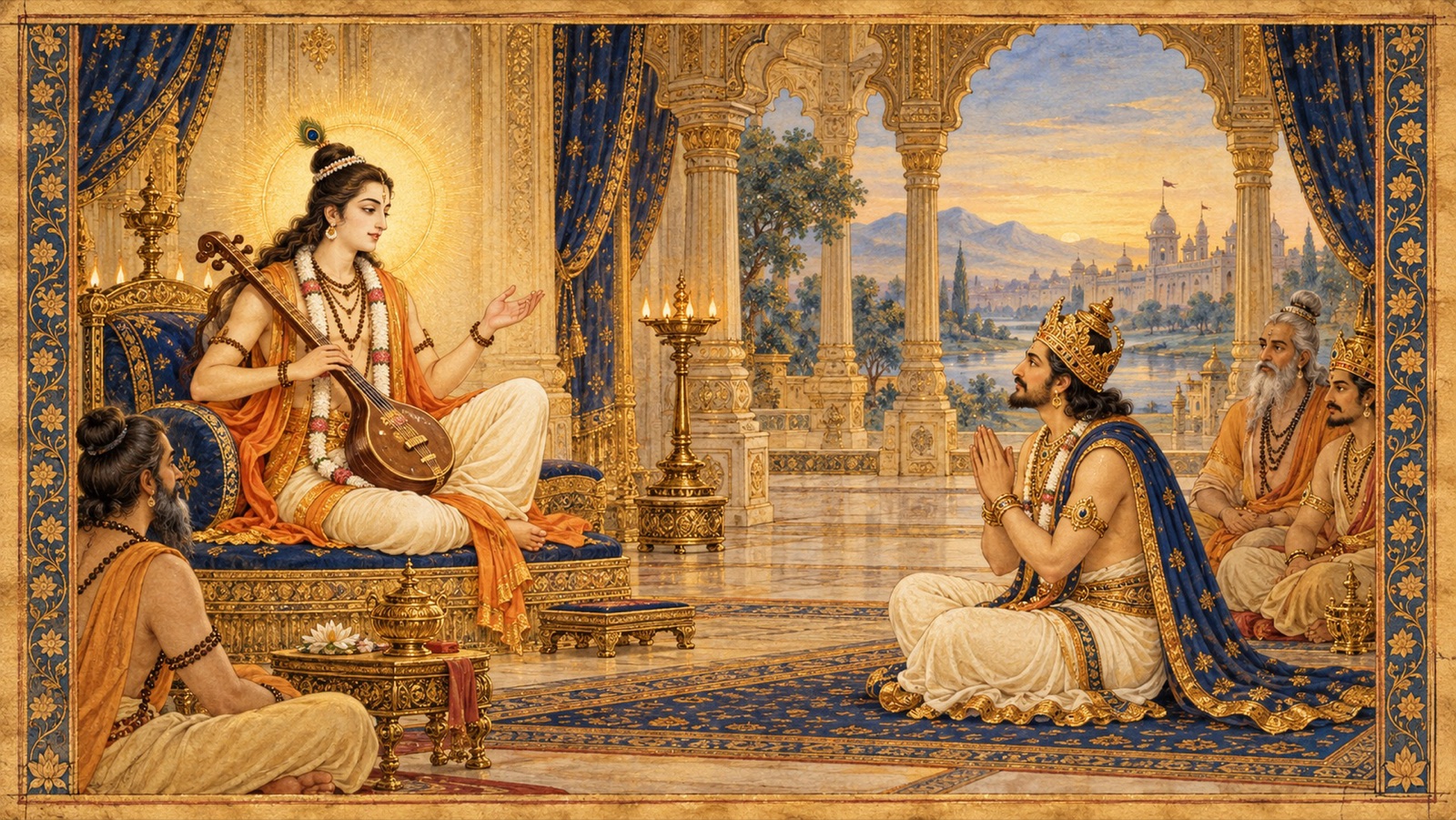
King Parikshit merges his soul in Brahman even as Taksaka's poison consumes his body; Brihaspati stills Janamejaya's grief with the truth that each being reaps its own karma; and from the sacred syllable OM the one eternal Veda unfolds and is divided by Vedavyasa into its branches. A faithful, devotional retelling with verified verses.
Continue the Reading →
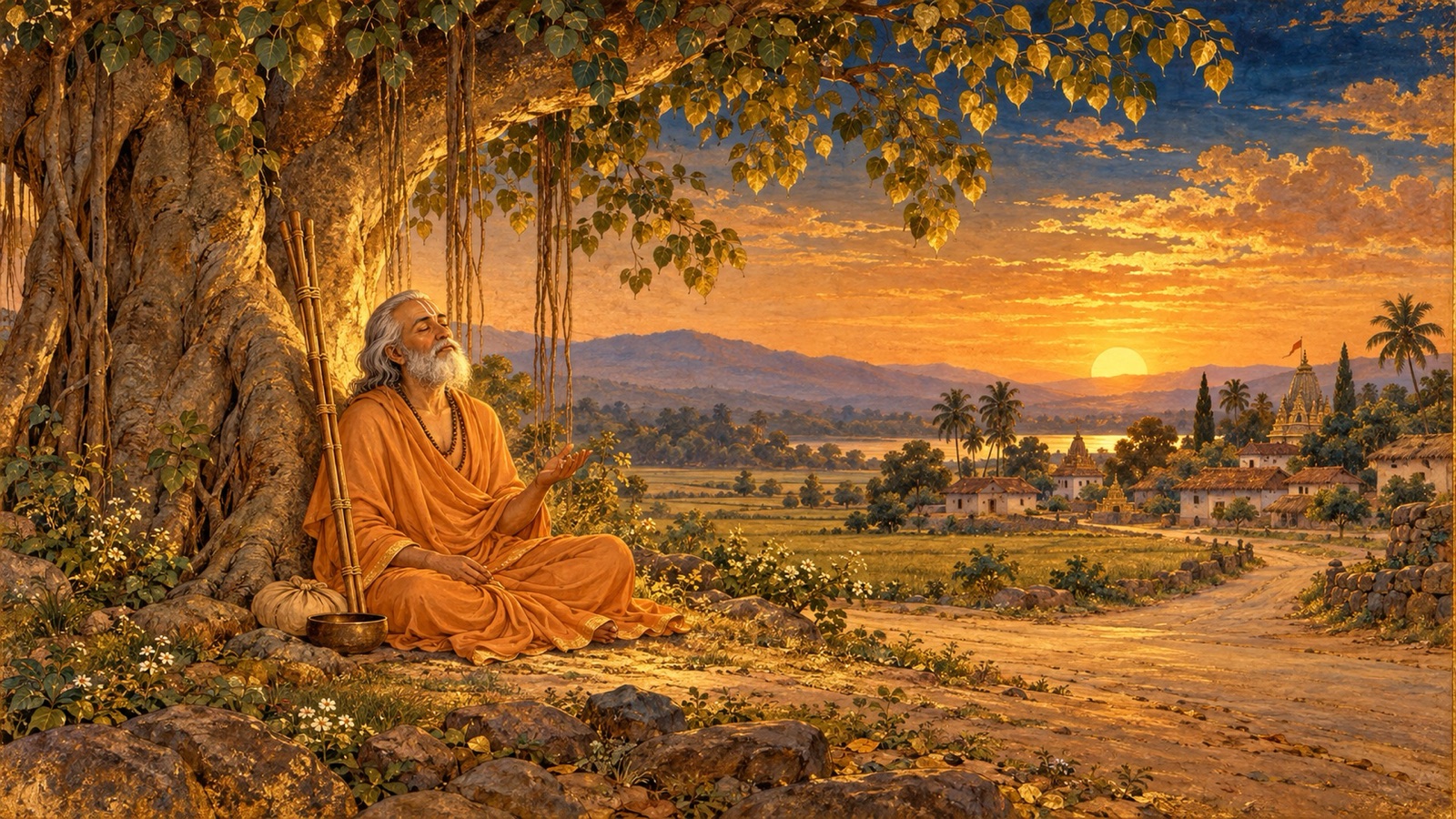
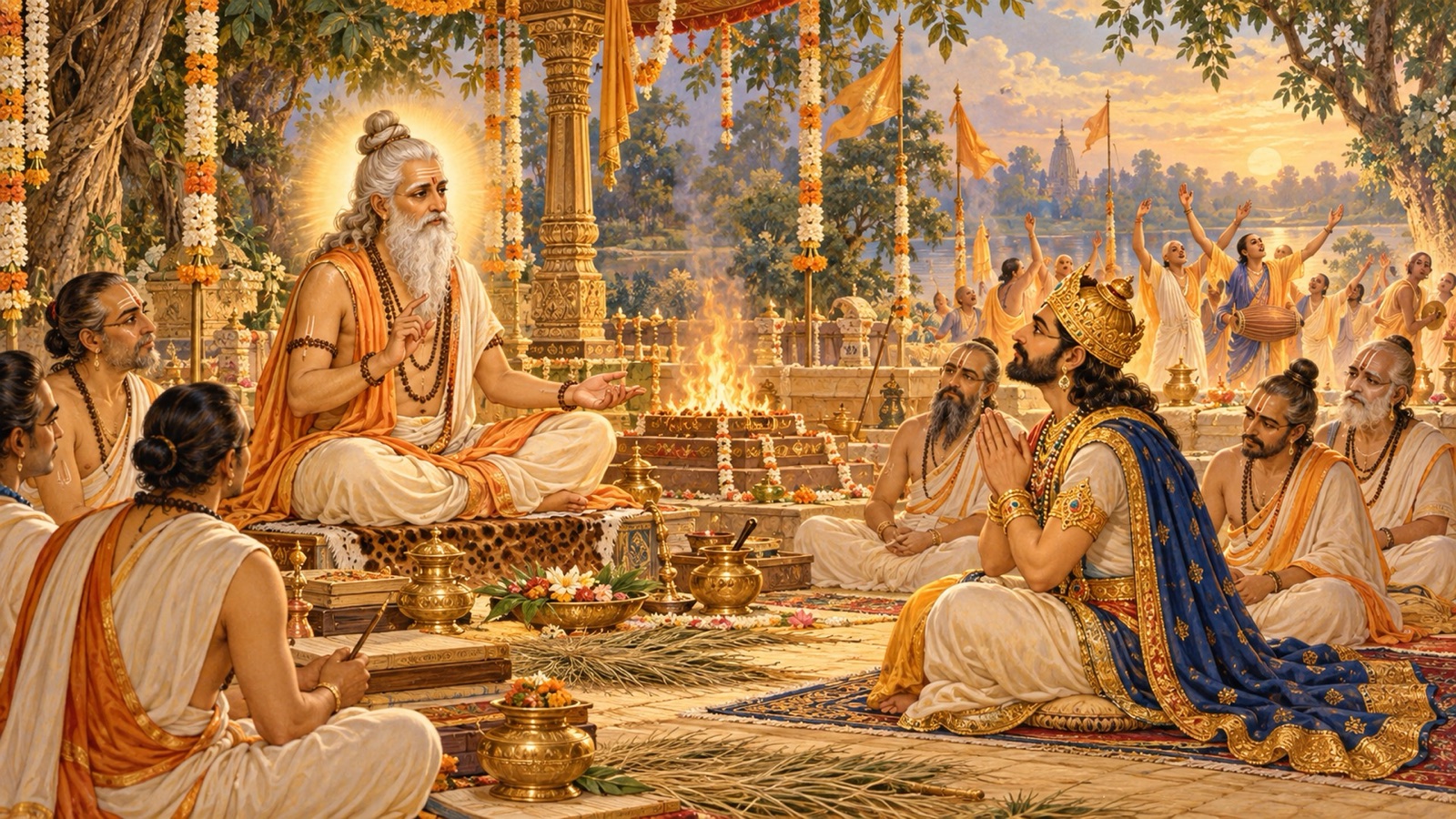
At the very brink of death, Sukadeva Gosvami gives King Parikshit his final teaching: the Self is unborn and undying, distinct from the body as fire from firewood, and the serpent's fangs can touch the body but never the soul fixed in the knowledge 'I am Brahma.' A faithful, devotional retelling with verified verses.
Continue the Reading →
Sukadeva Gosvami unfolds the four kinds of pralaya — the constant, the occasional, the elemental, and the everlasting dissolution — and reveals that against the ocean of birth and death there is one unfailing boat: the nectar of the Lord's own story. A faithful, devotional retelling with verified verses.
Continue the Reading →
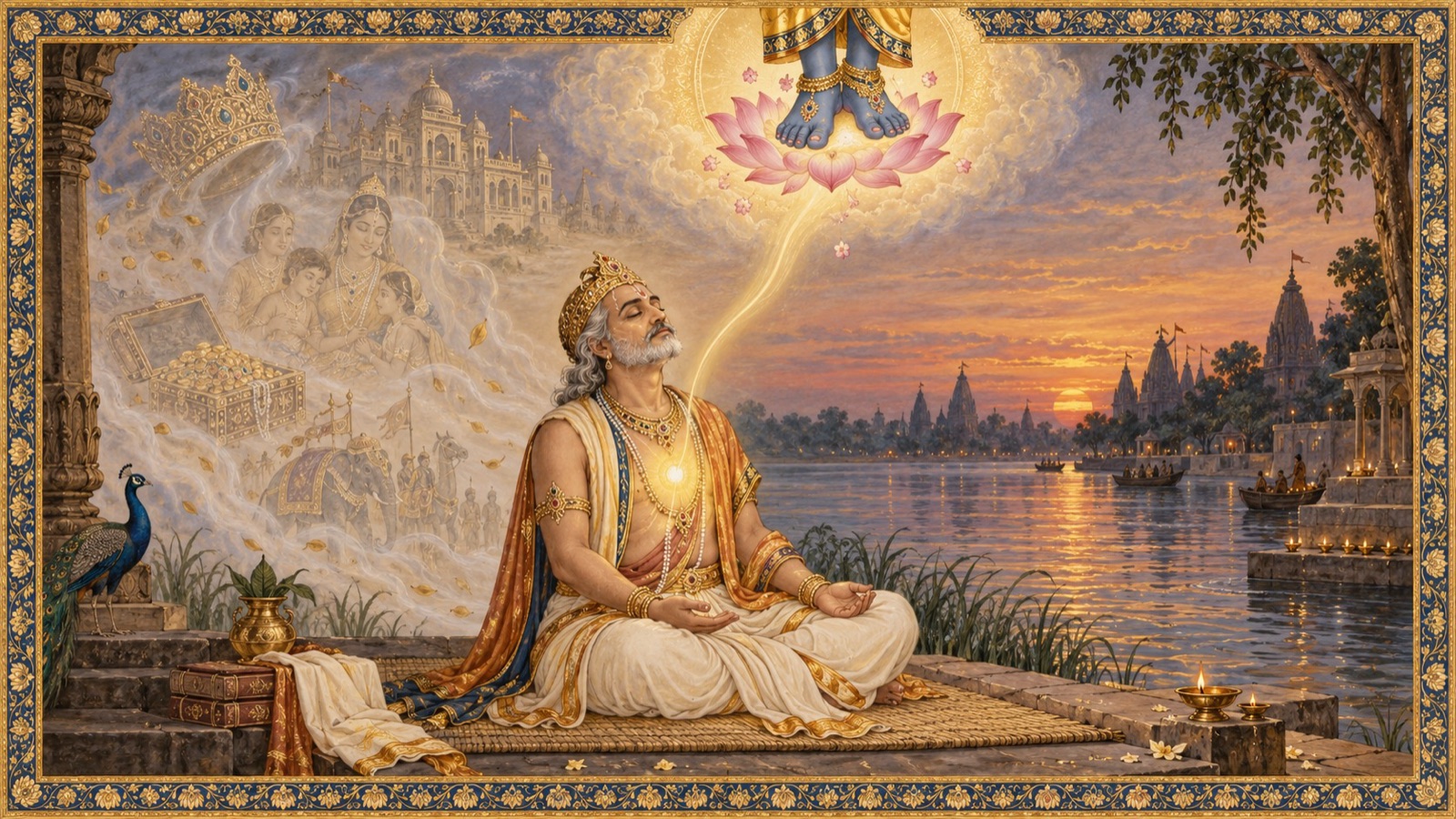
Mother Earth laughs at the kings who scramble to conquer her, mere playthings of Death. From this sobering vision Sukadeva Gosvami traces the turning of the four ages and reveals the one great mercy hidden in the age of Kali: that by merely chanting the names of Sri Krishna, the soul crosses beyond all bondage. A faithful, devotional retelling with verified verses.
Continue the Reading →
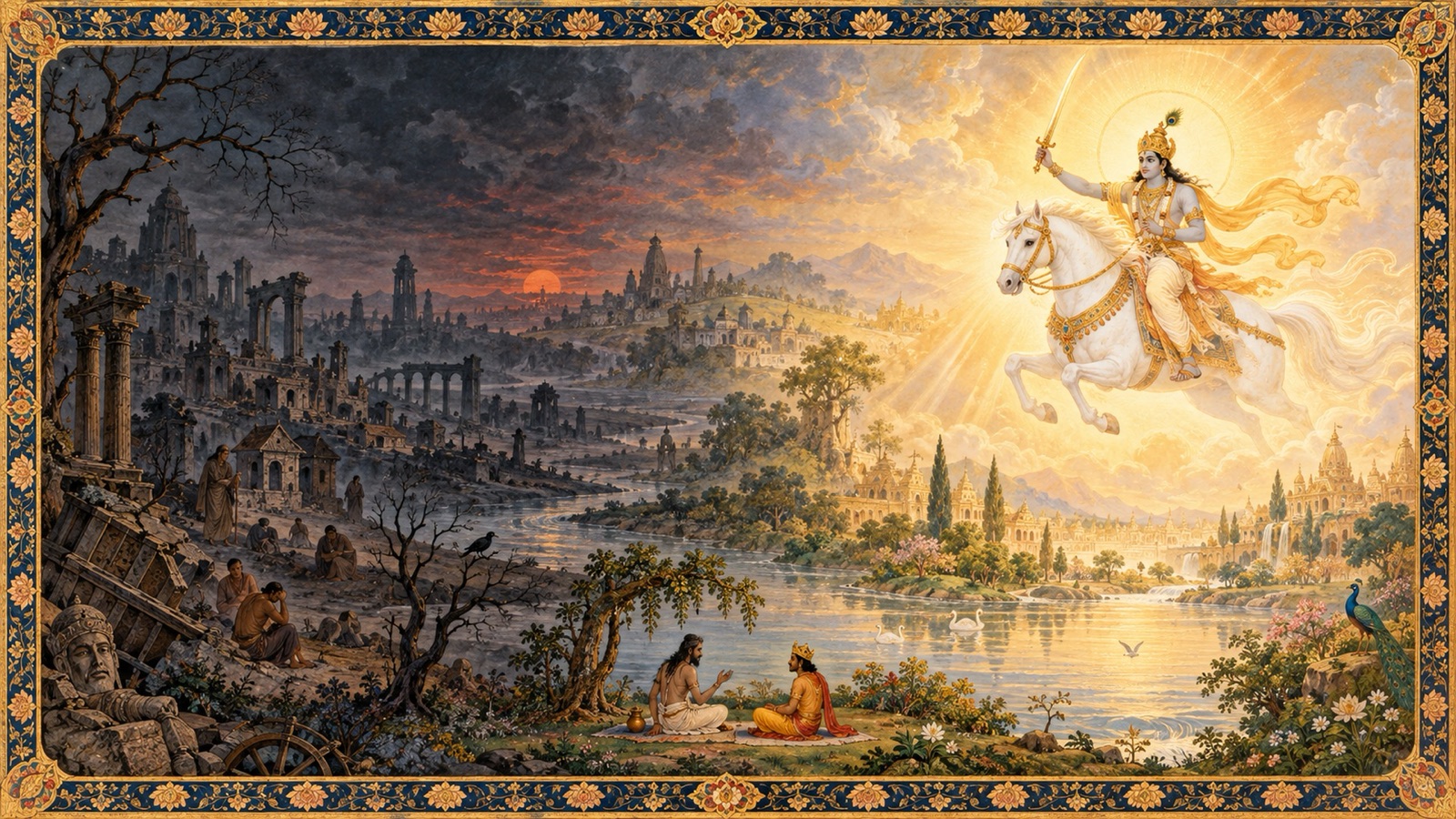
Sukadeva Gosvami lays bare, symptom by symptom, how virtue fades in the age of Kali — wealth becoming the measure of worth and might the arbiter of justice — until the Lord descends as Kalki to cleanse the earth and restore the golden age of Satya-yuga. A faithful, devotional retelling with verified verses.
Continue the Reading →
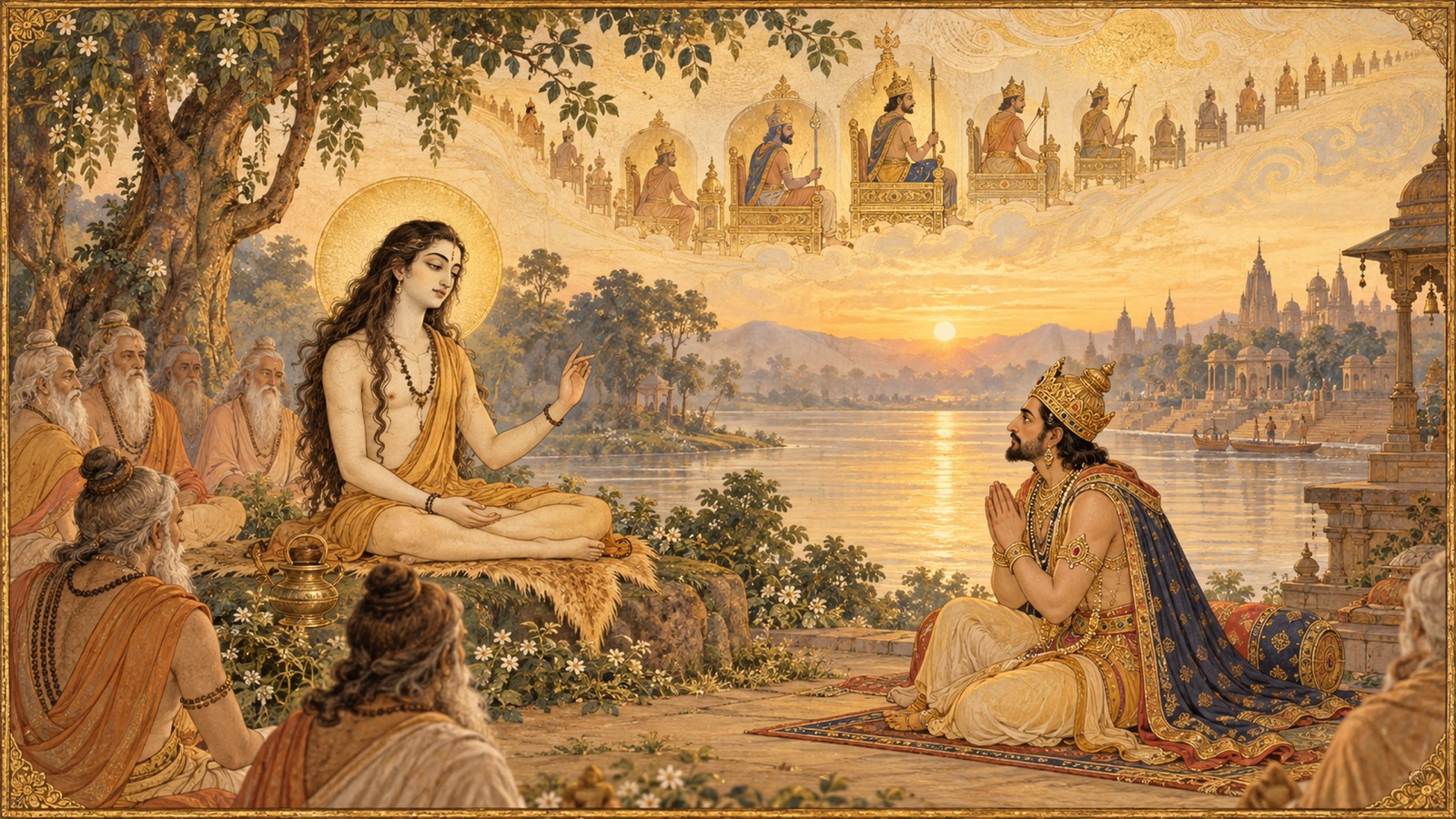
After Sri Krishna departs for His own abode, King Parikshit asks who will rule the earth. Sukadeva Gosvami unrolls a prophetic genealogy of the dynasties of Kali — the Pradyotanas, Shishunagas, Nandas, Mauryas, Shungas, Kanvas, Andhras and more — ending with an unflinching portrait of the mleccha kings of the deepening age. A faithful, devotional retelling with verified verses.
Continue the Reading →
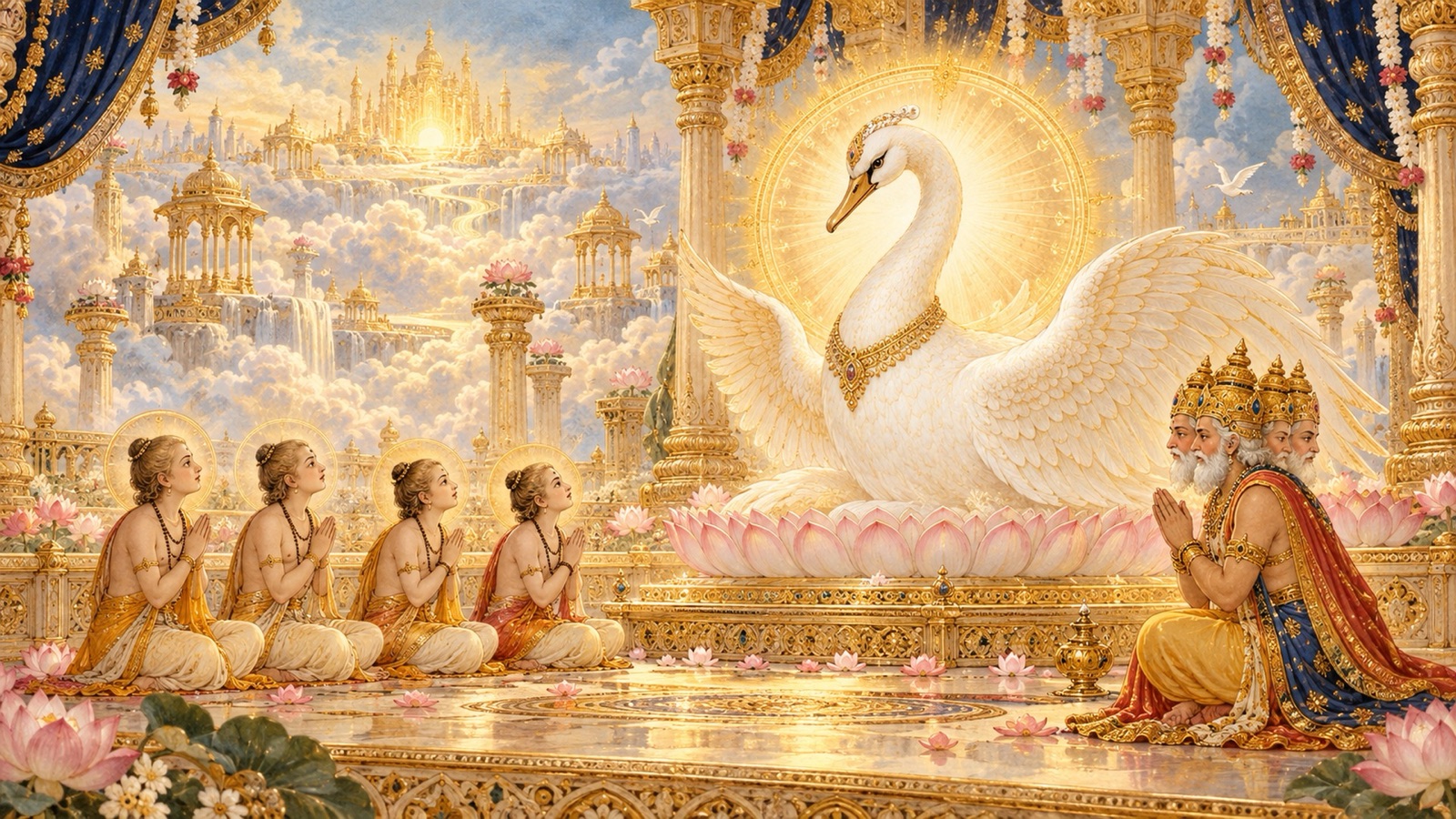
Lord Krishna teaches Uddhava to master the modes of nature by cultivating goodness, and relates how He appeared as a radiant Swan to teach Sanaka and his brothers the Self as the witness of all states. A faithful, devotional retelling with verified verses.
Continue the Reading →
Lord Krishna reveals that holy company wins Him above all disciplines, recalls how the Gopis reached Him through pure love, and calls Uddhava to take refuge in Him alone and be free of all fear. A faithful, devotional retelling with verified verses.
Continue the Reading →
Lord Krishna answers Uddhava on bondage and freedom, gives the timeless image of two birds on one tree, describes the true saint, and unfolds the many forms of loving devotion. A faithful, devotional retelling with verified verses.
Continue the Reading →
Lord Krishna teaches Uddhava to act without desire, to know the soul as distinct from the body, and to see the emptiness of both earthly and heavenly enjoyments — for even heaven ends in a fall. A faithful, devotional retelling with verified verses.
Continue the Reading →
The wandering ascetic completes his teaching, telling King Yadu of his last seven gurus and of the body itself as a teacher, and honours the rare gift of human birth. A faithful, devotional retelling with verified verses.
Continue the Reading →
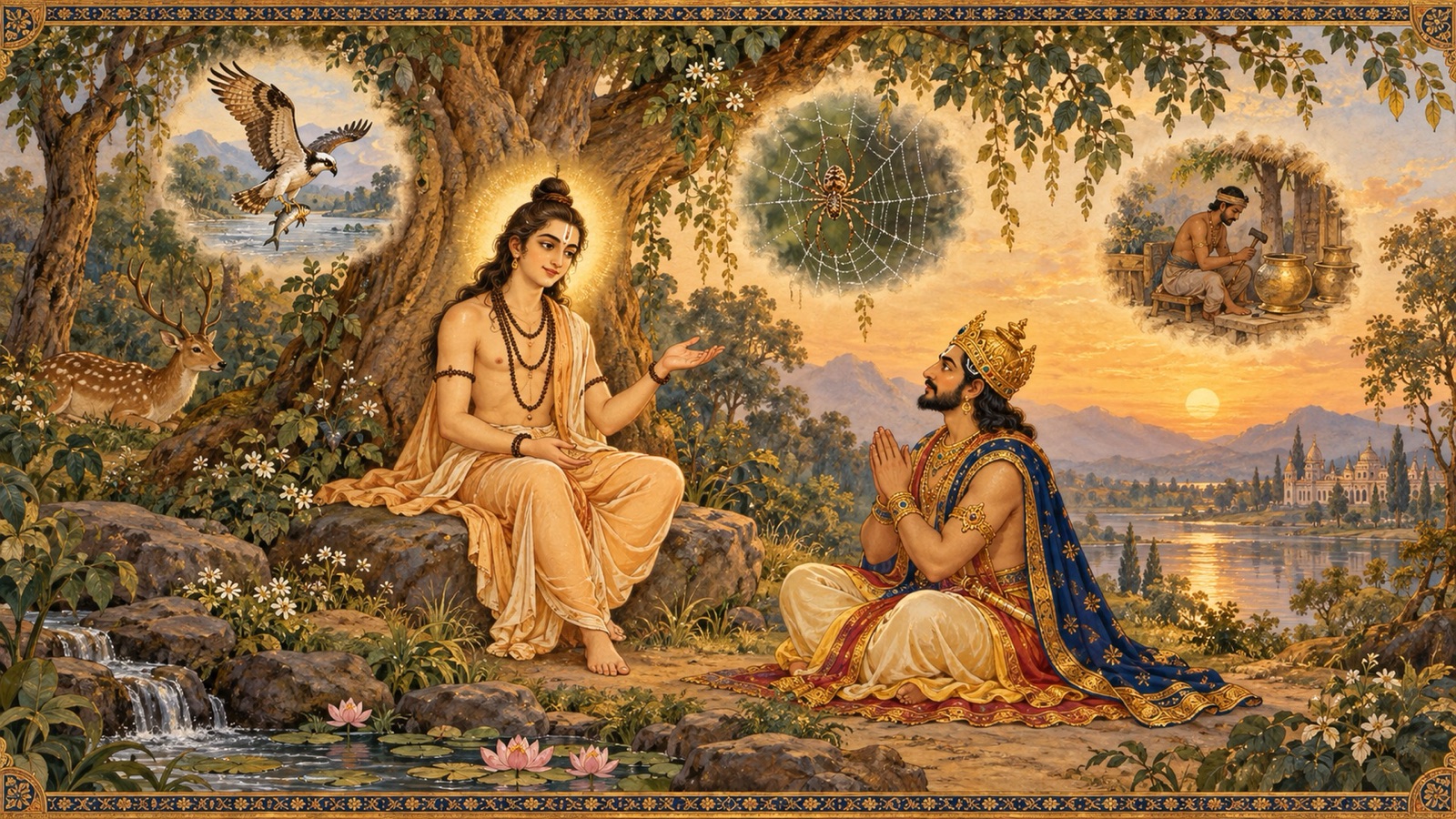
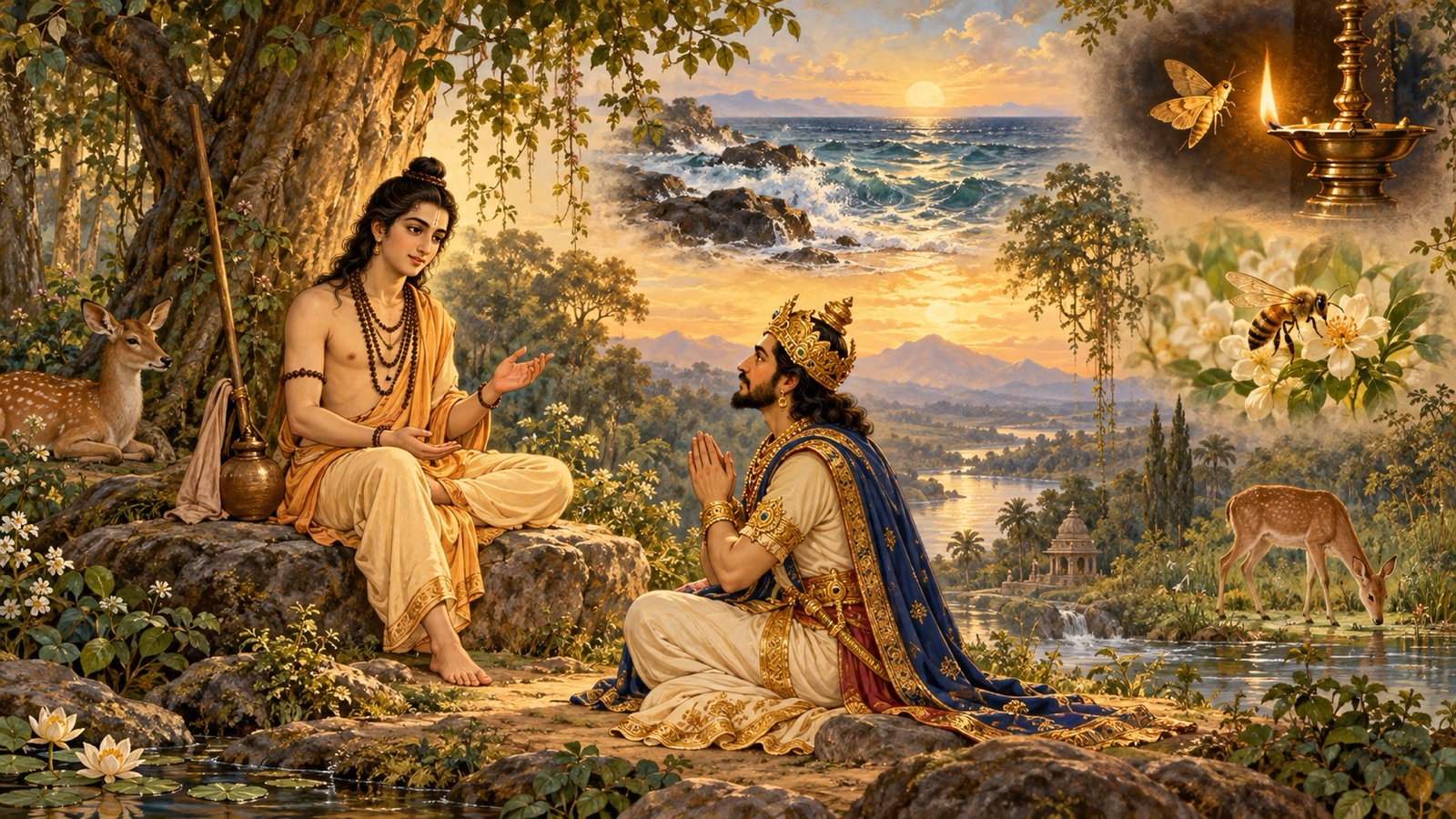
The wandering ascetic tells King Yadu what he learned from nine more teachers — the python, sea, moth, bee, elephant, honey-gatherer, deer and fish — and relates the awakening of Pingala the courtesan. A faithful, devotional retelling with verified verses.
Continue the Reading →
Sri Krishna calls Uddhava to renunciation and equal vision, and relates the legend of King Yadu and a wandering ascetic who found twenty-four teachers in the world — from the earth to the dove. A faithful, devotional retelling with verified verses.
Continue the Reading →
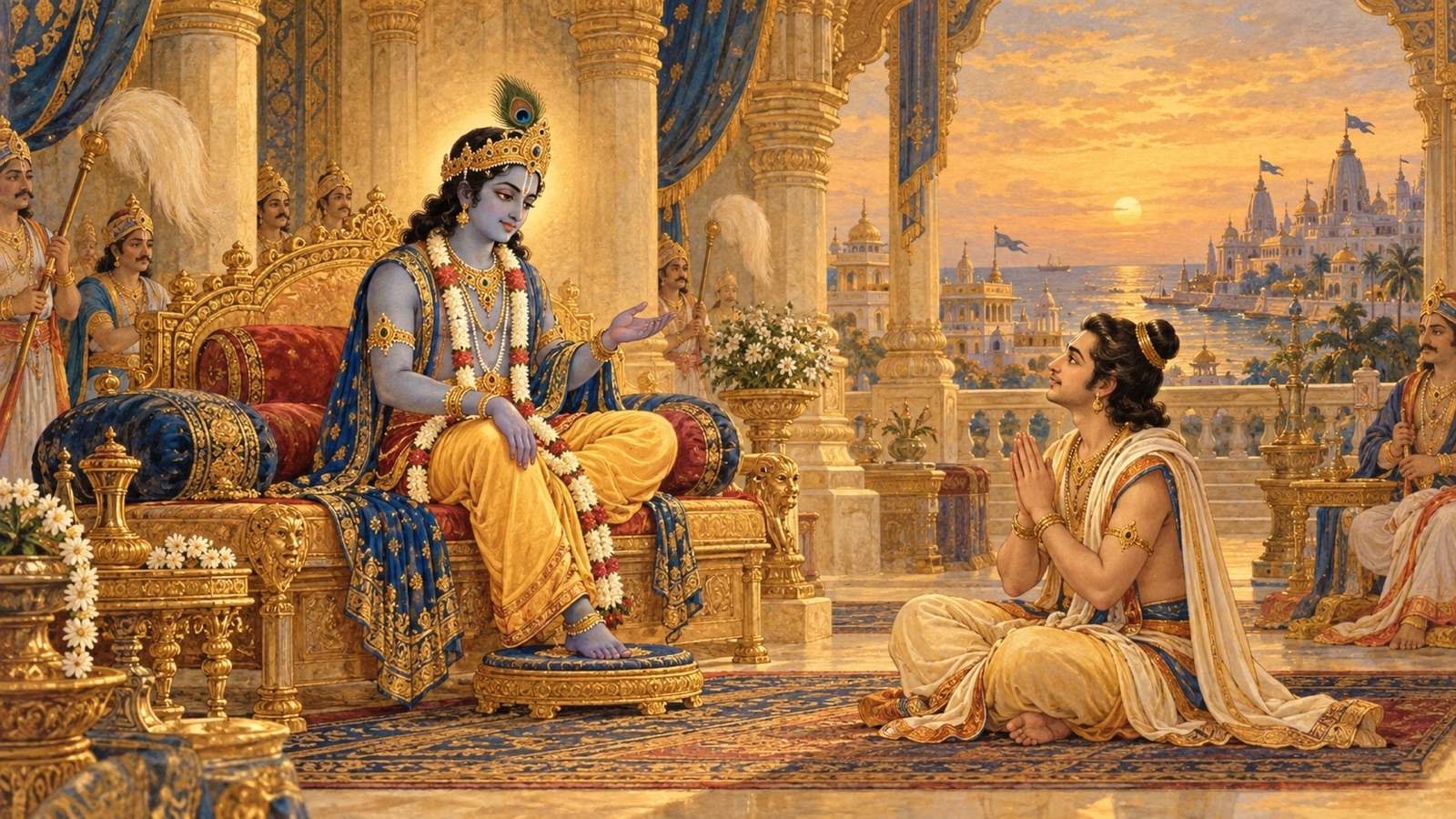
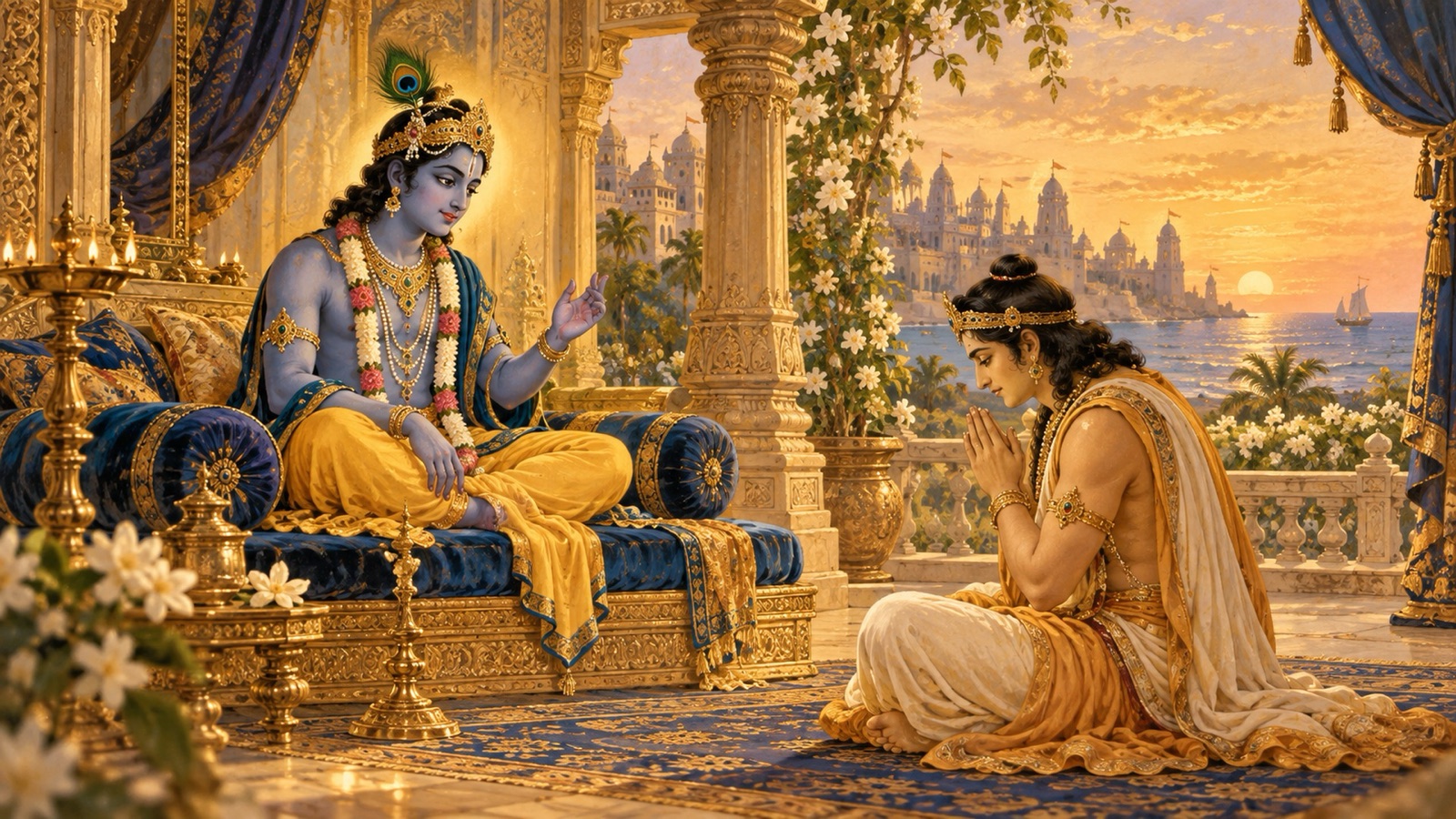
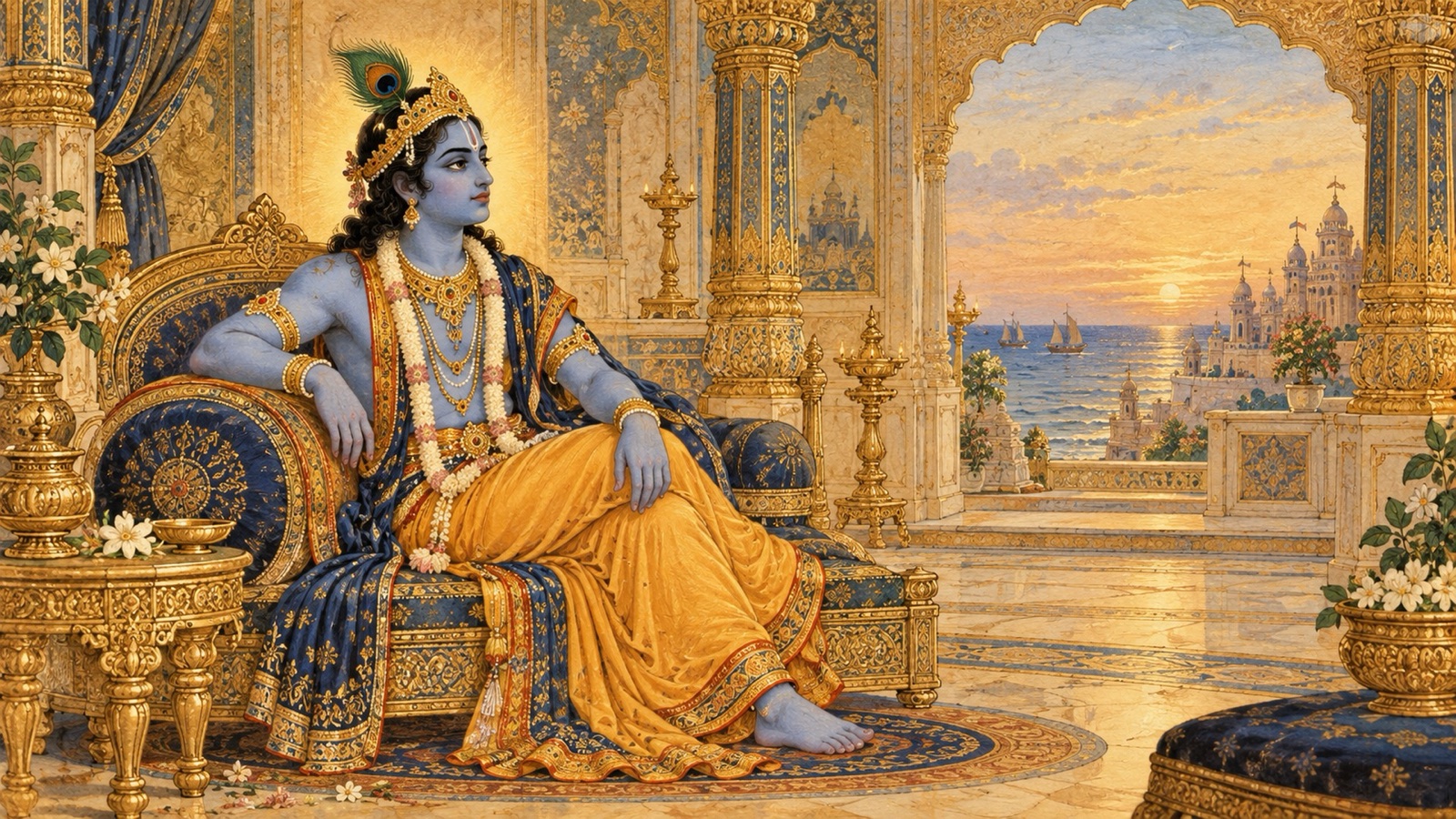
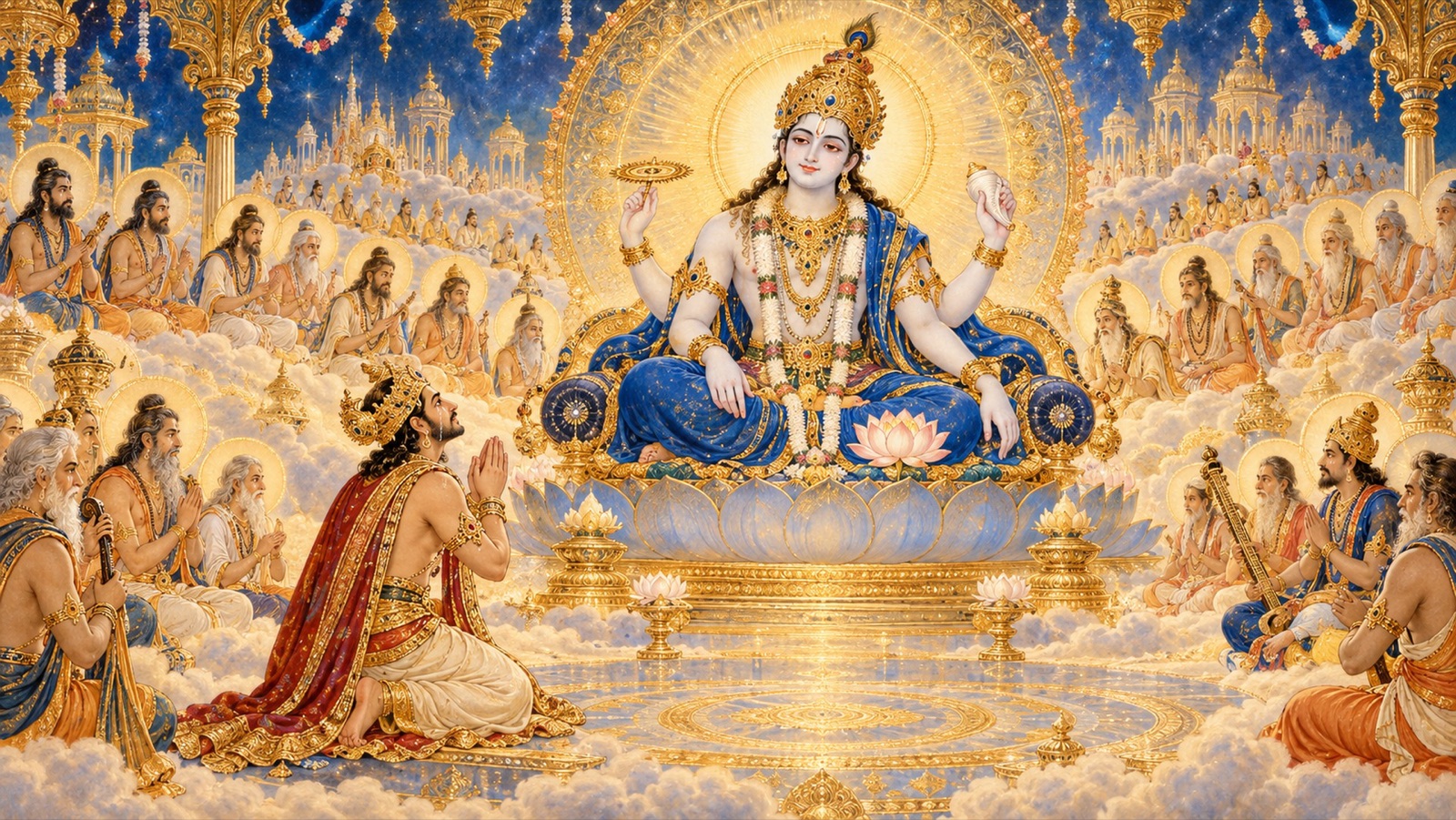
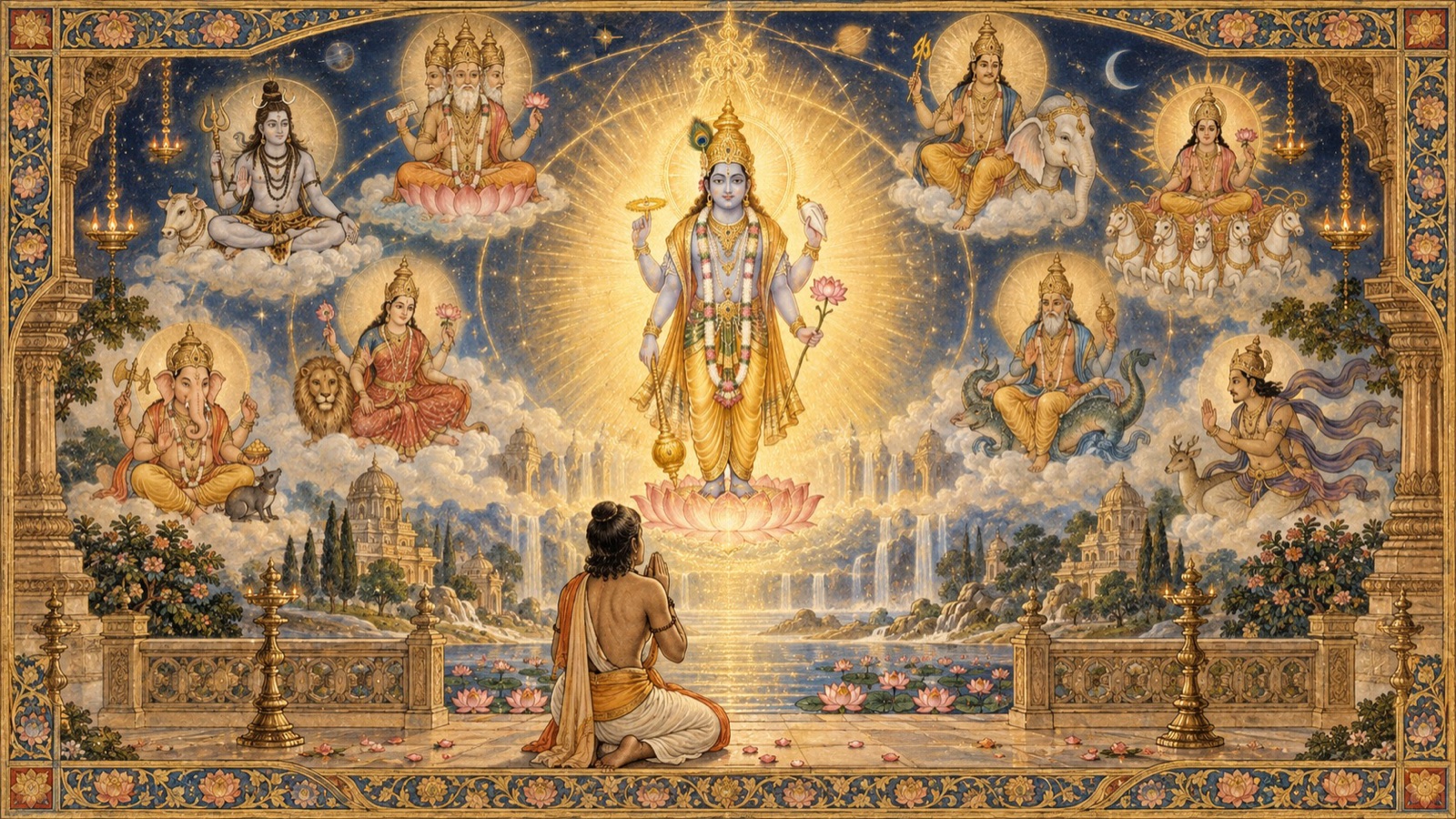
The gods, led by Brahma and Lord Siva, descend on Dwaraka to praise Sri Krishna and ask that He return to His transcendent realm; the Lord consents, sends the Yadus to Prabhasa, and Uddhava approaches Him in love. A faithful, devotional retelling with verified verses.
Continue the Reading →
The sages Chamasa and Karabhajana reveal the fate of those who neglect the Lord and the forms in which He is worshipped across the four ages — crowned by the glory of chanting His holy names in the age of Kali. A faithful, devotional retelling with verified verses.
Continue the Reading →
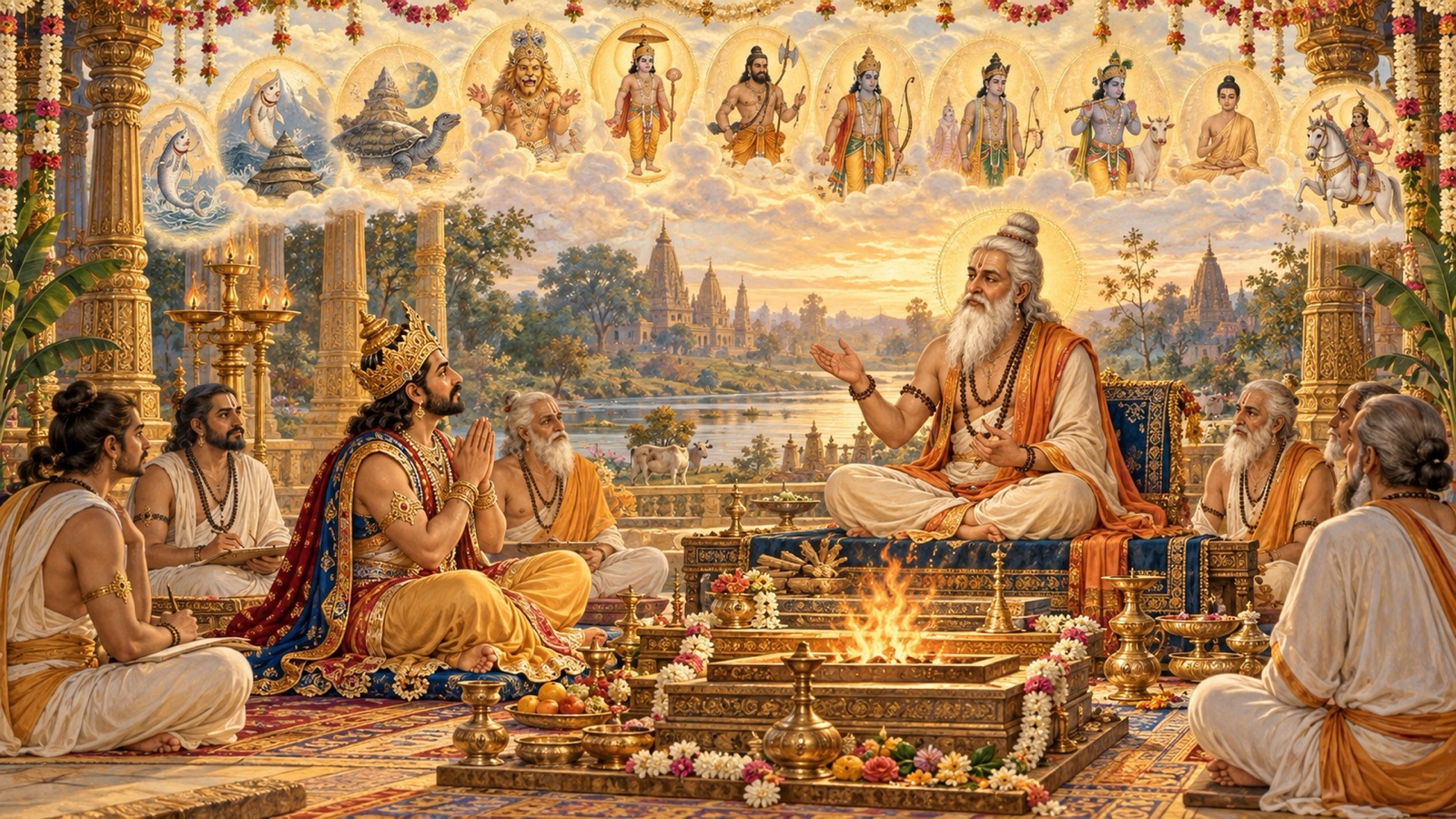
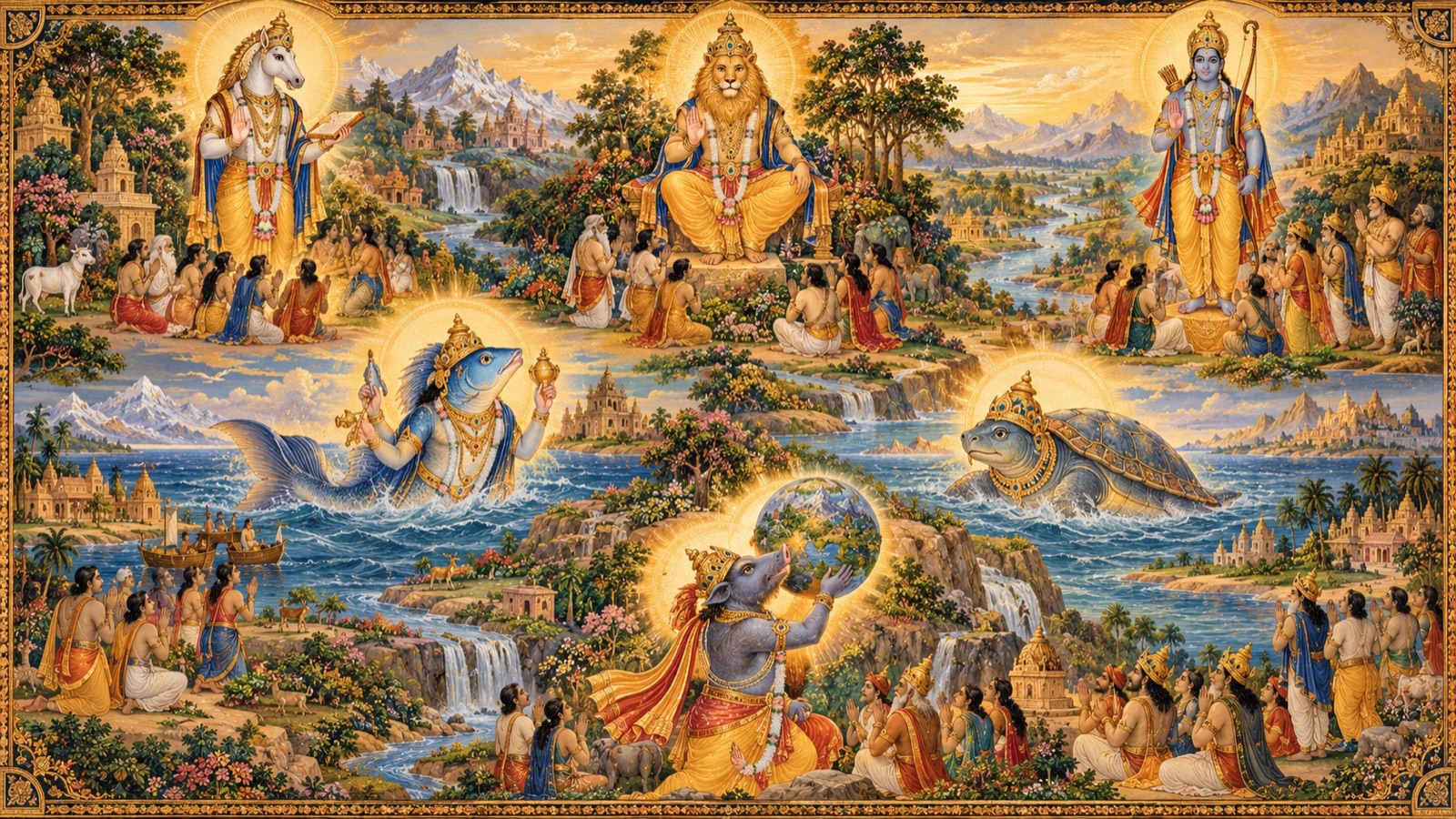
At King Nimi's sacrifice, the sage Drumila offers a radiant remembrance of the Lord's incarnations — the cosmic Person, Nara and Narayana, the Fish, Tortoise, Boar and Man-Lion, Rama and the descent in the Yadu race. A faithful, devotional retelling with verified verses.
Continue the Reading →
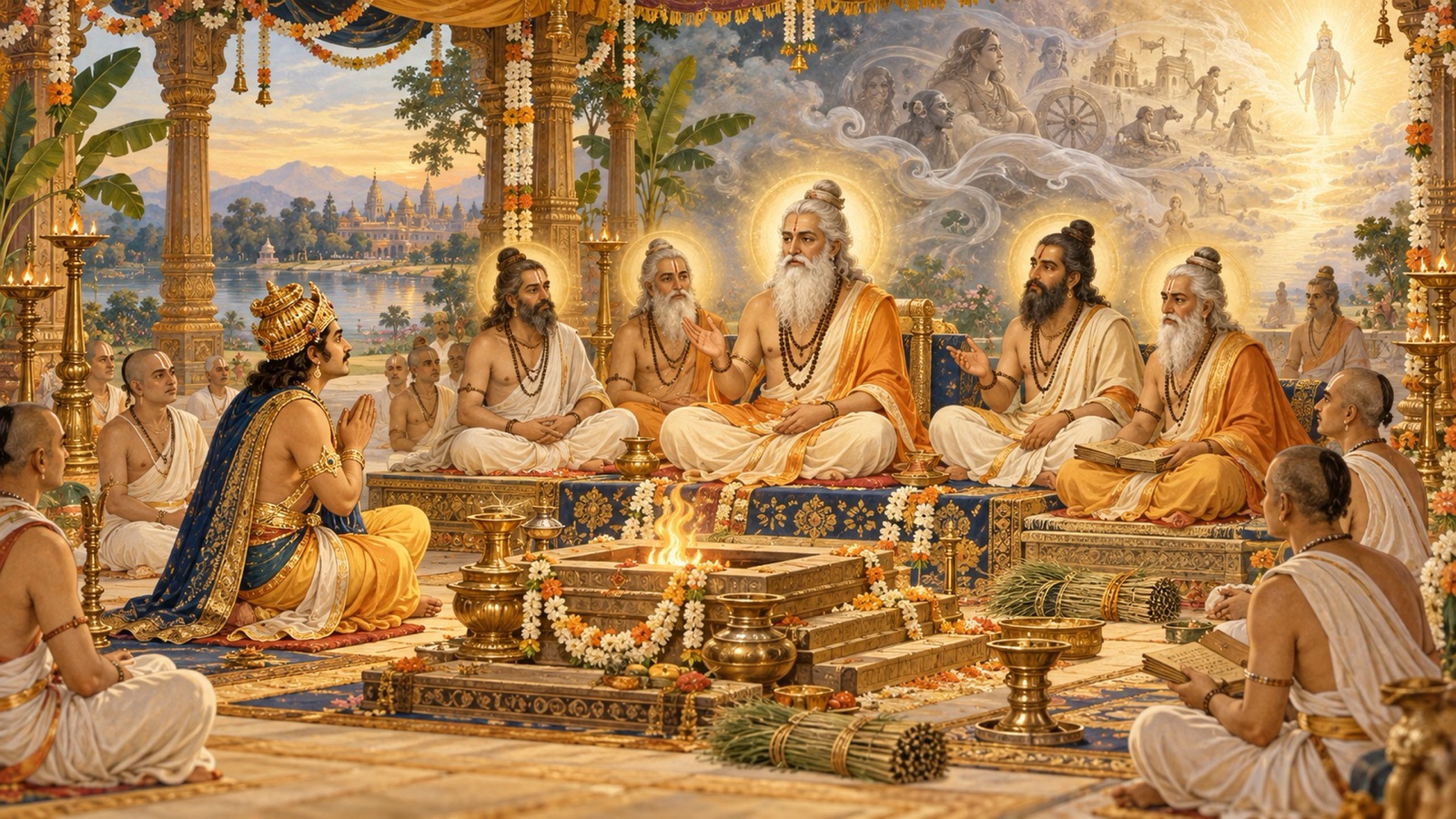
At King Nimi's sacrifice, four of the nine Yogendras reveal the nature of the Lord's deluding energy, the shelter of a true teacher, the imperishable Self, and the loving worship that carries the soul across Maya. A faithful, devotional retelling with verified verses.
Continue the Reading →
Narada recalls an ancient dialogue: the enlightened King Nimi asks nine perfected sages the way to everlasting good, and the sage Kavi reveals bhagavata-dharma — the loving service of the Lord that dissolves all fear. A faithful, devotional retelling with verified verses.
Continue the Reading →
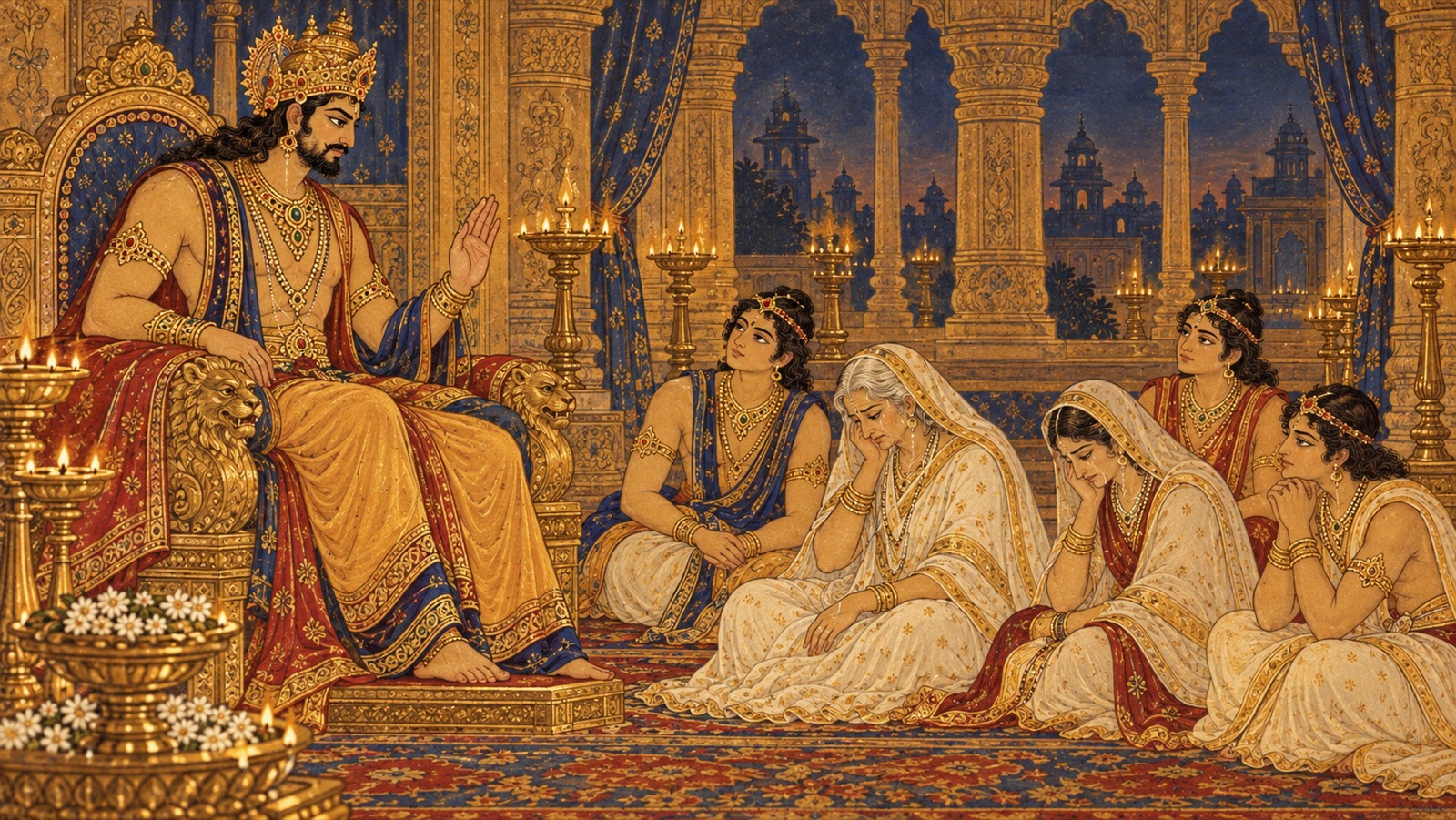
As Book Eleven opens, Lord Sri Krishna's mission on earth is complete. He quietly resolves to withdraw His own mighty dynasty and return to His eternal abode — and He allows the curse of the sages upon the mischievous Yadava youths to become the instrument of that divine will. A faithful, devotional retelling with verified verses.
Continue the Reading →
Sukadeva tells why Kaliya hid in the Yamuna, and Krishna, rising to the joy of Vraja, drinks up a midnight forest fire to save His people.
Continue the Reading →
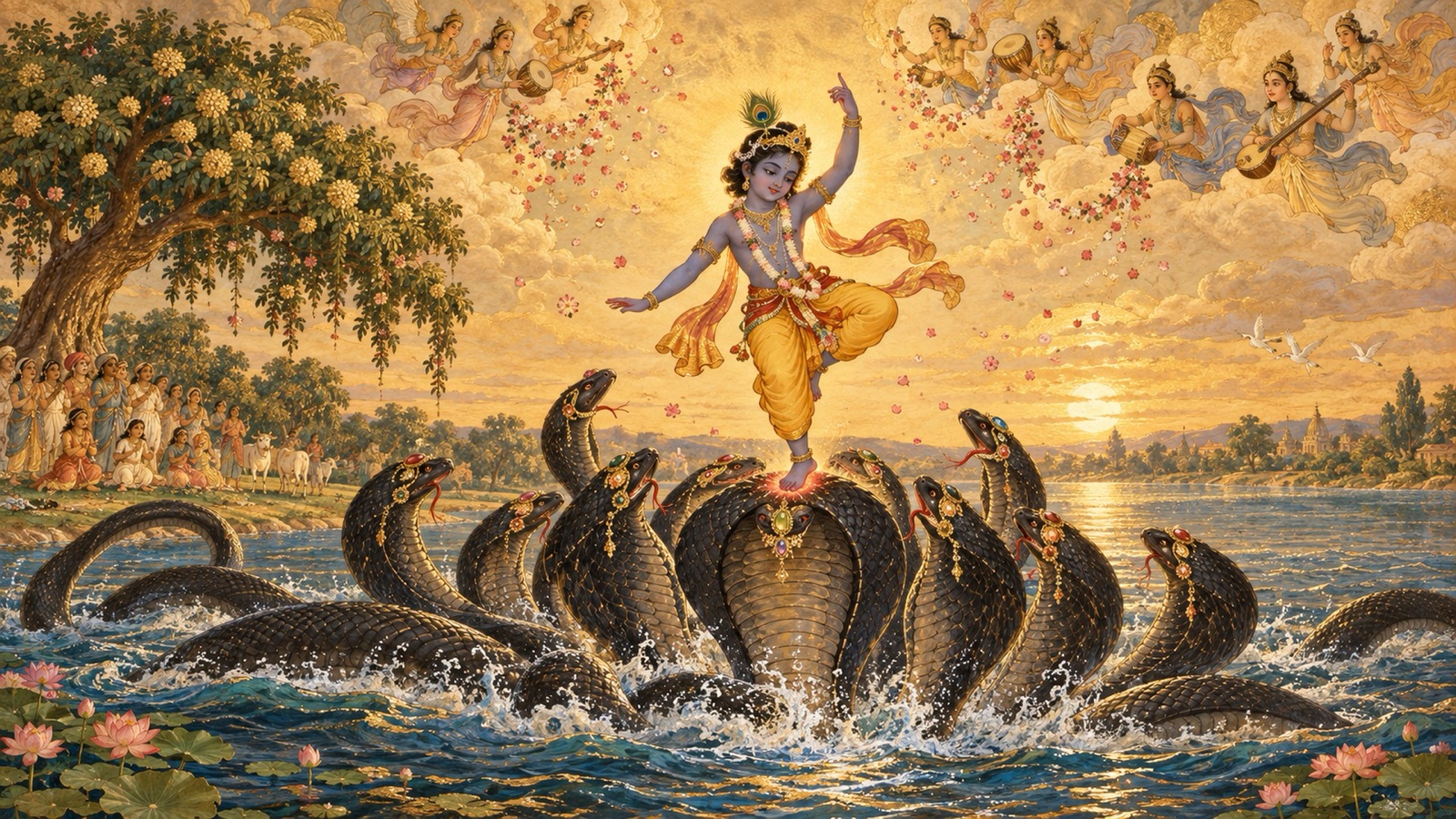
Krishna dances upon the hundred hoods of the serpent Kaliya to purify the Yamuna, sparing him at his wives' prayer and healing the river.
Continue the Reading →
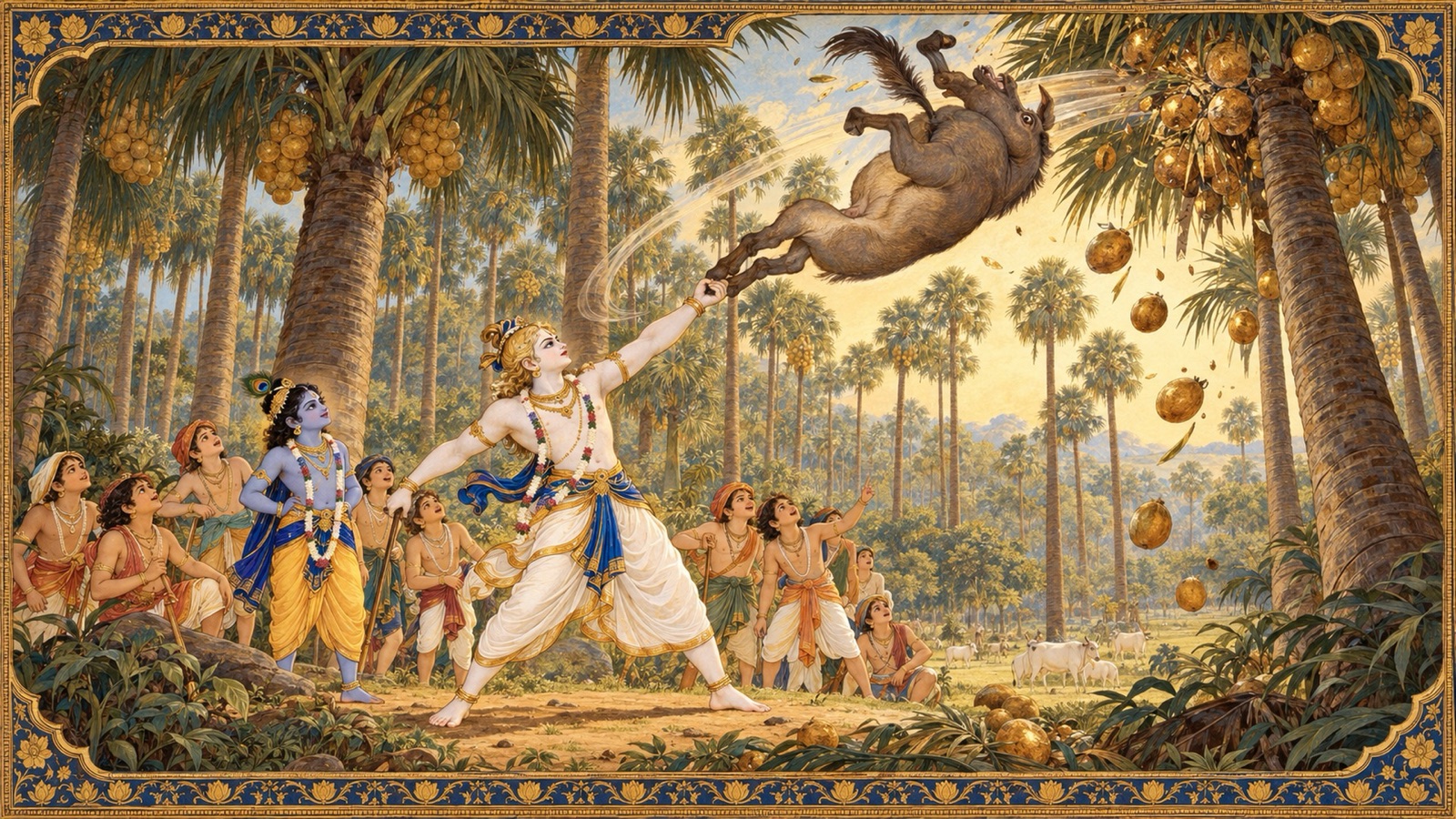
Balarama frees the Talavana by slaying the ass-demon Dhenuka, and Krishna revives the cows and boys poisoned by the Yamuna with a single glance.
Continue the Reading →
The humbled creator offers one of scripture's most beloved hymns, exalting loving devotion and the boundless fortune of the cowherds of Vraja.
Continue the Reading →
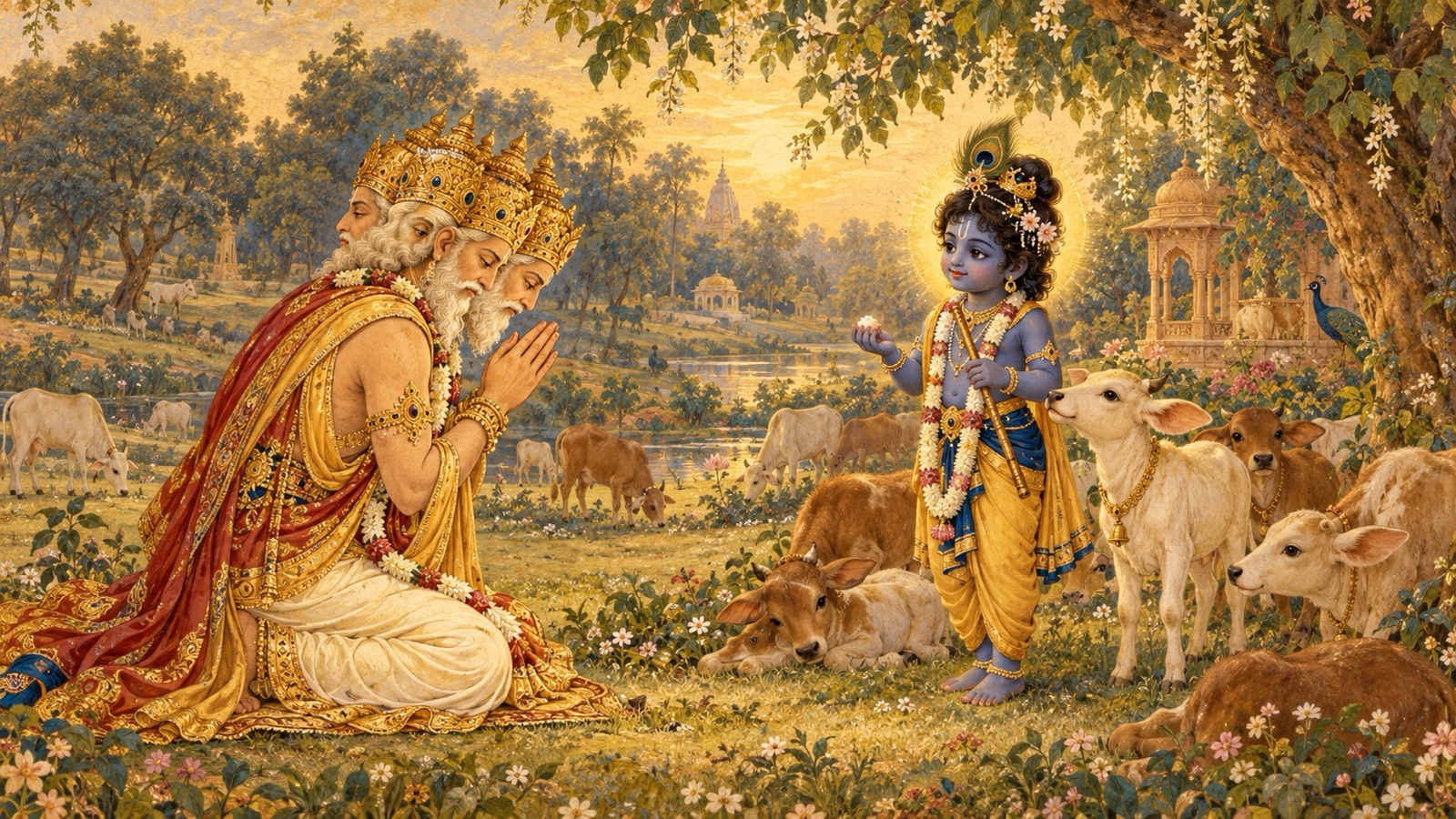
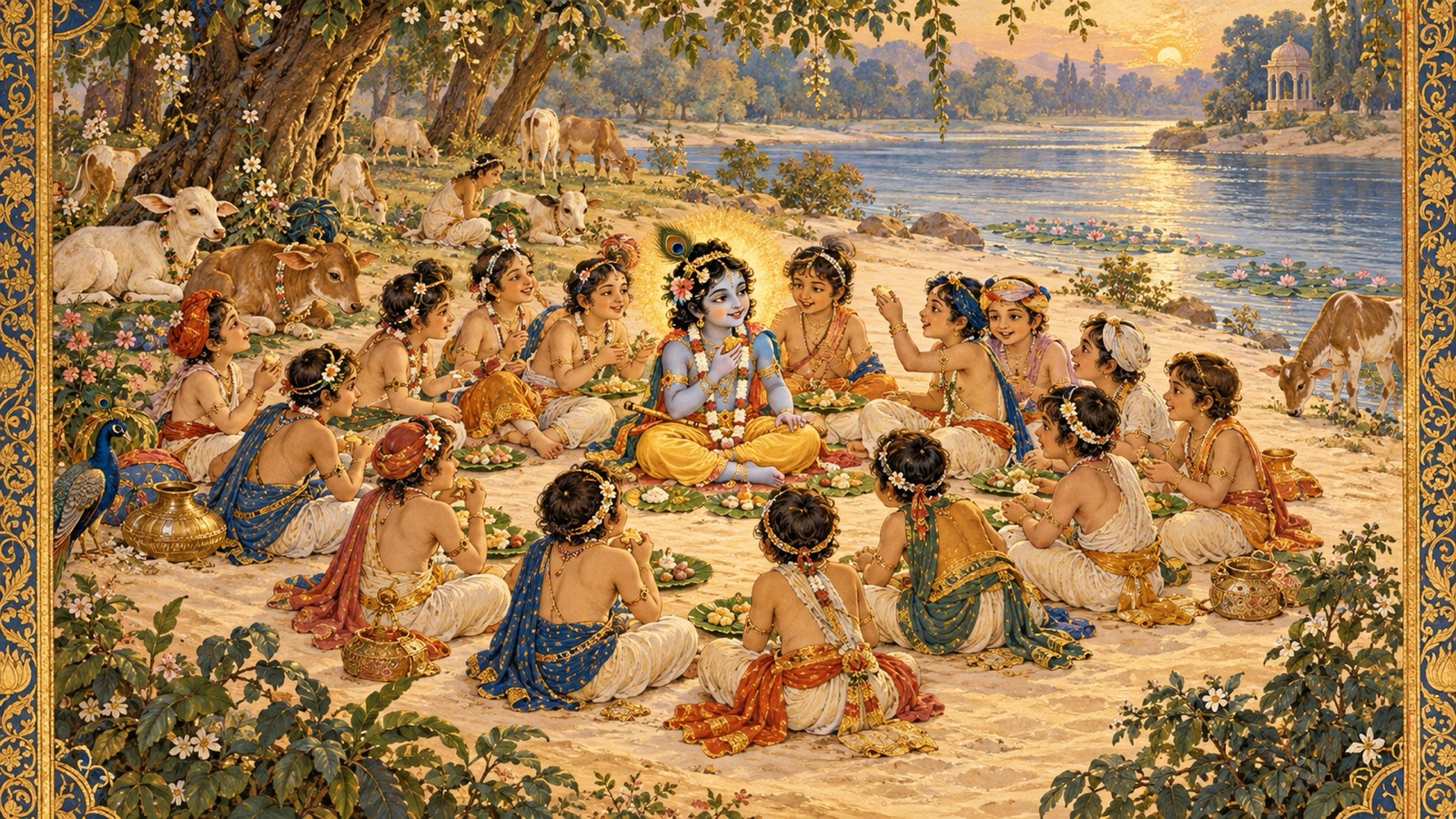
When Brahma hides the cowherd boys and calves, Krishna becomes them all for a year, and the bewildered creator falls at the little cowherd's feet.
Continue the Reading →
The demon Aghasura swallows Krishna's friends as a giant python; the Lord enters to save them, destroys the demon, and grants even him liberation.
Continue the Reading →
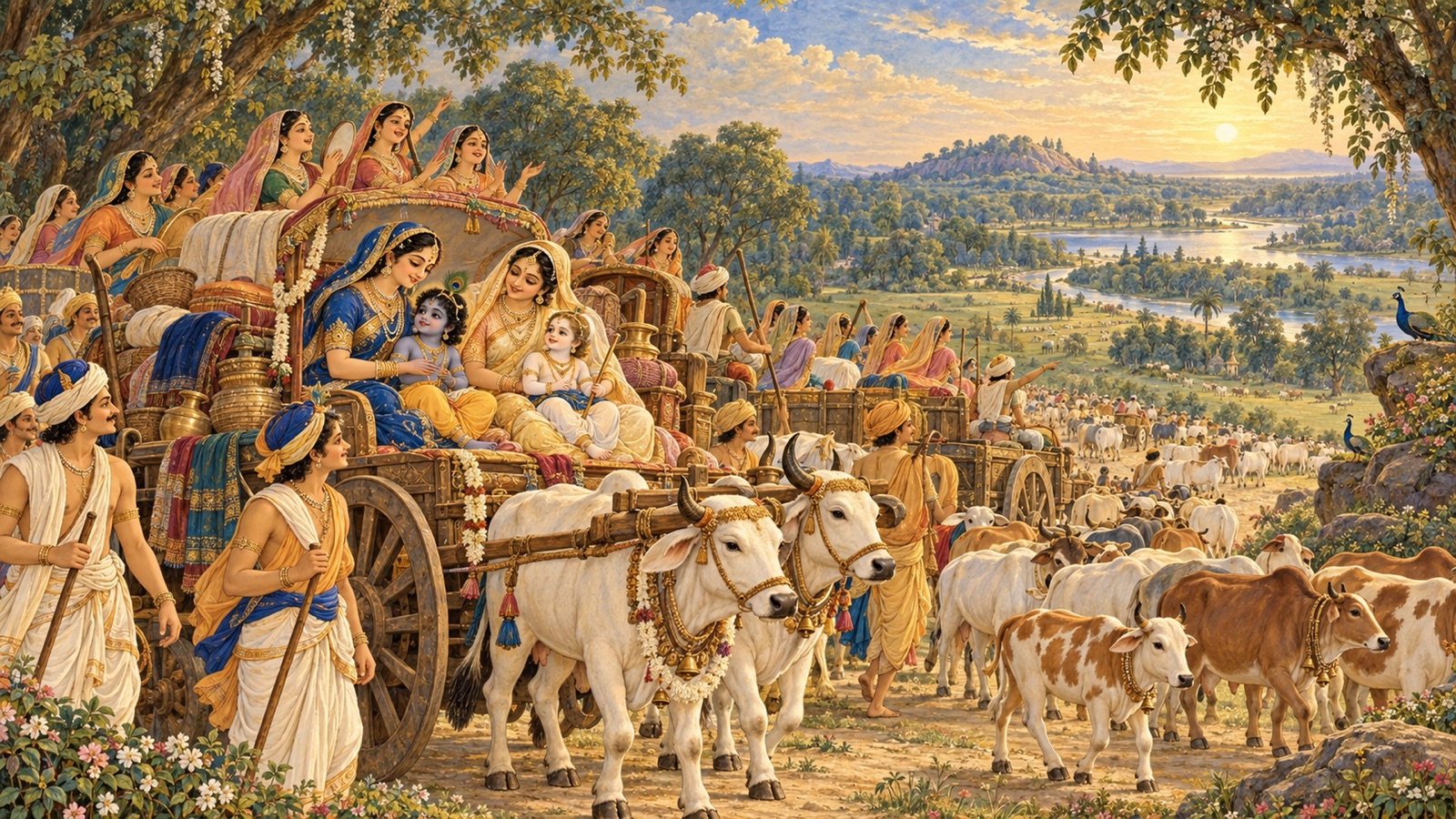
Krishna is freed from the mortar, all Vraja moves to Vrindavana, and the child slays the demons Vatsasura and Bakasura who come to destroy Him.
Continue the Reading →
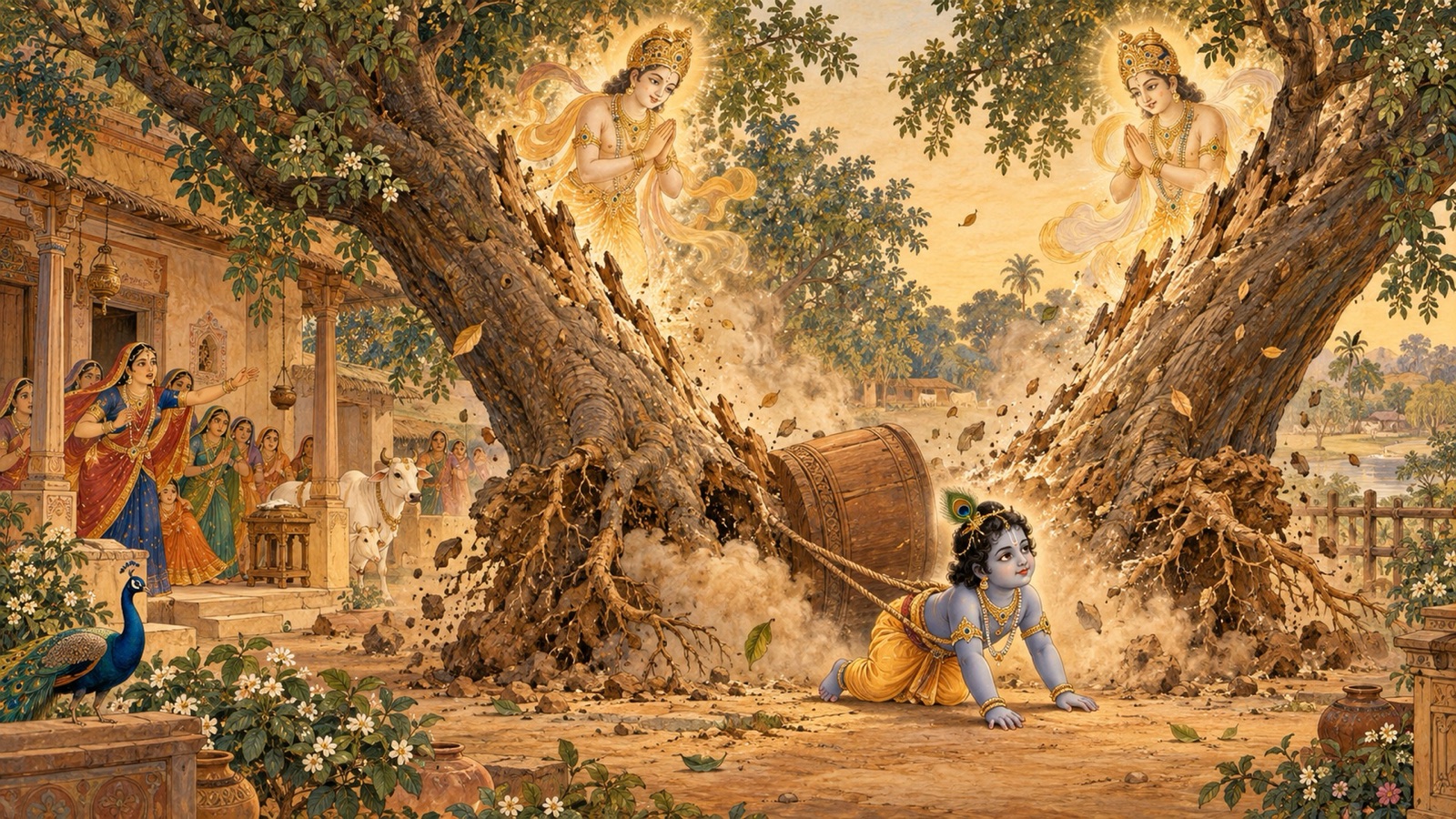
Bound to the mortar, the child Krishna uproots the twin arjuna trees and frees Kubera's two proud sons, cursed by Narada as a hidden blessing.
Continue the Reading →
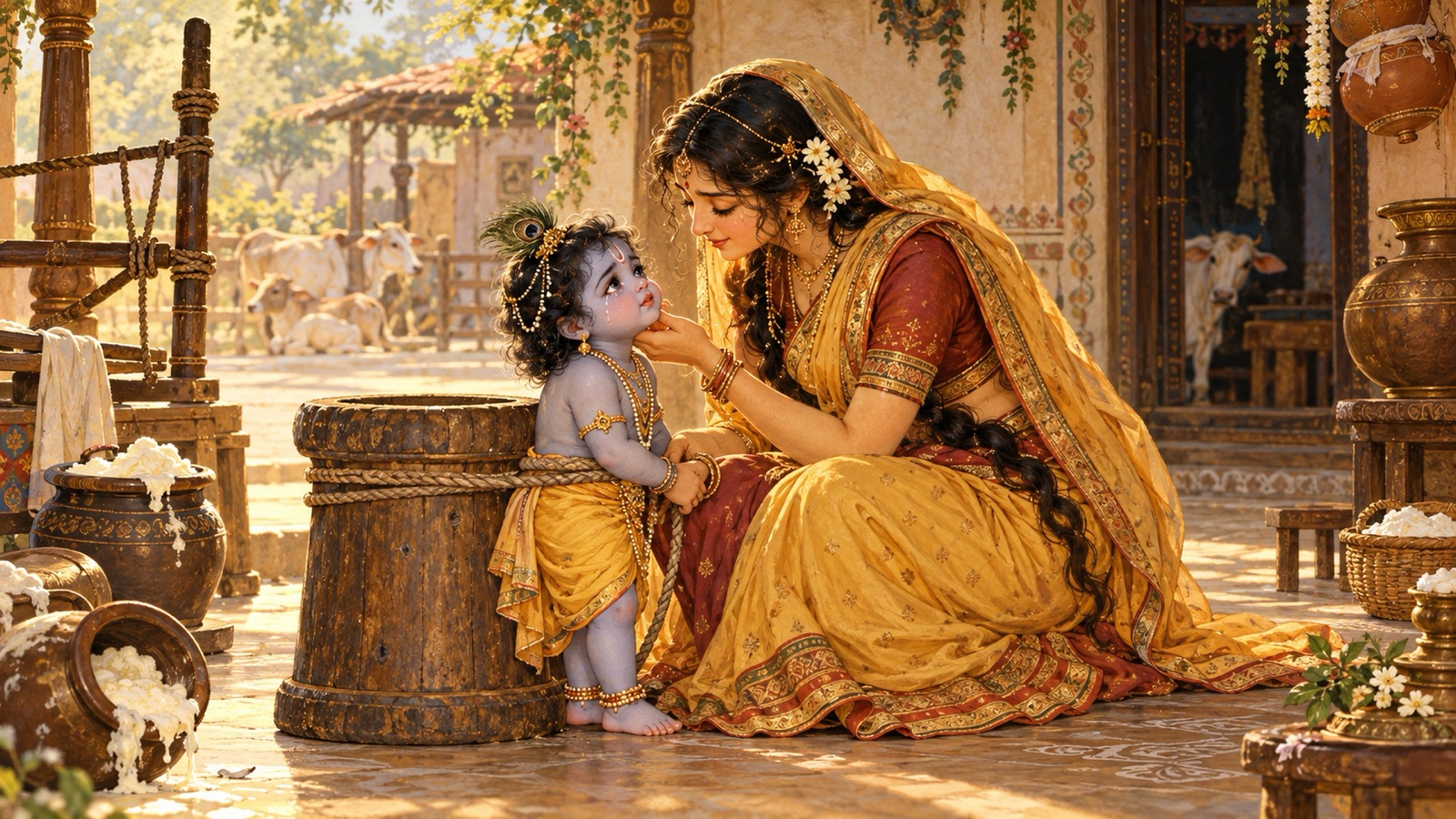
The Damodara pastime: the Lord of all worlds allows Himself to be bound by a mother's love, teaching that devotion conquers what power cannot.
Continue the Reading →
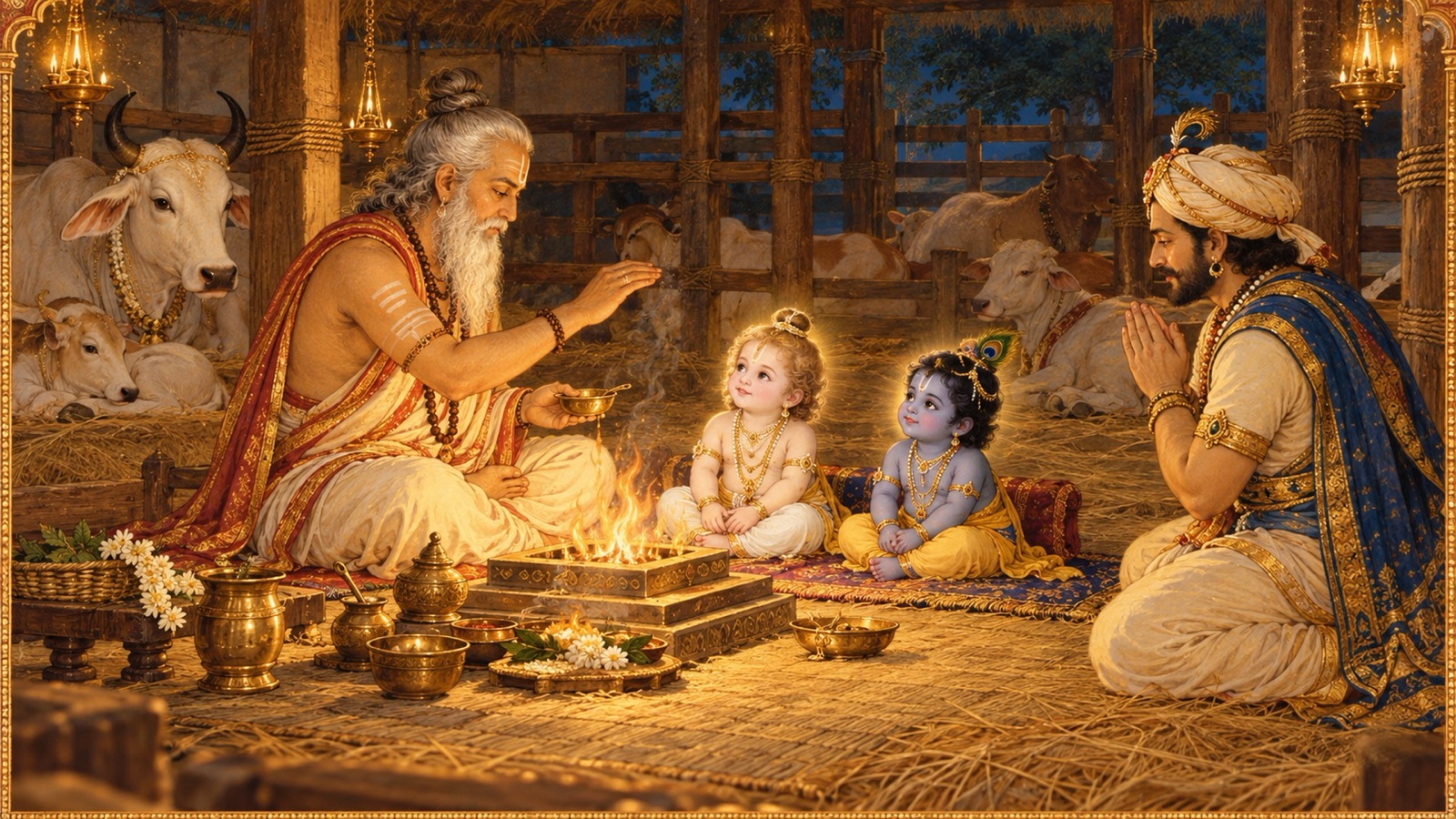
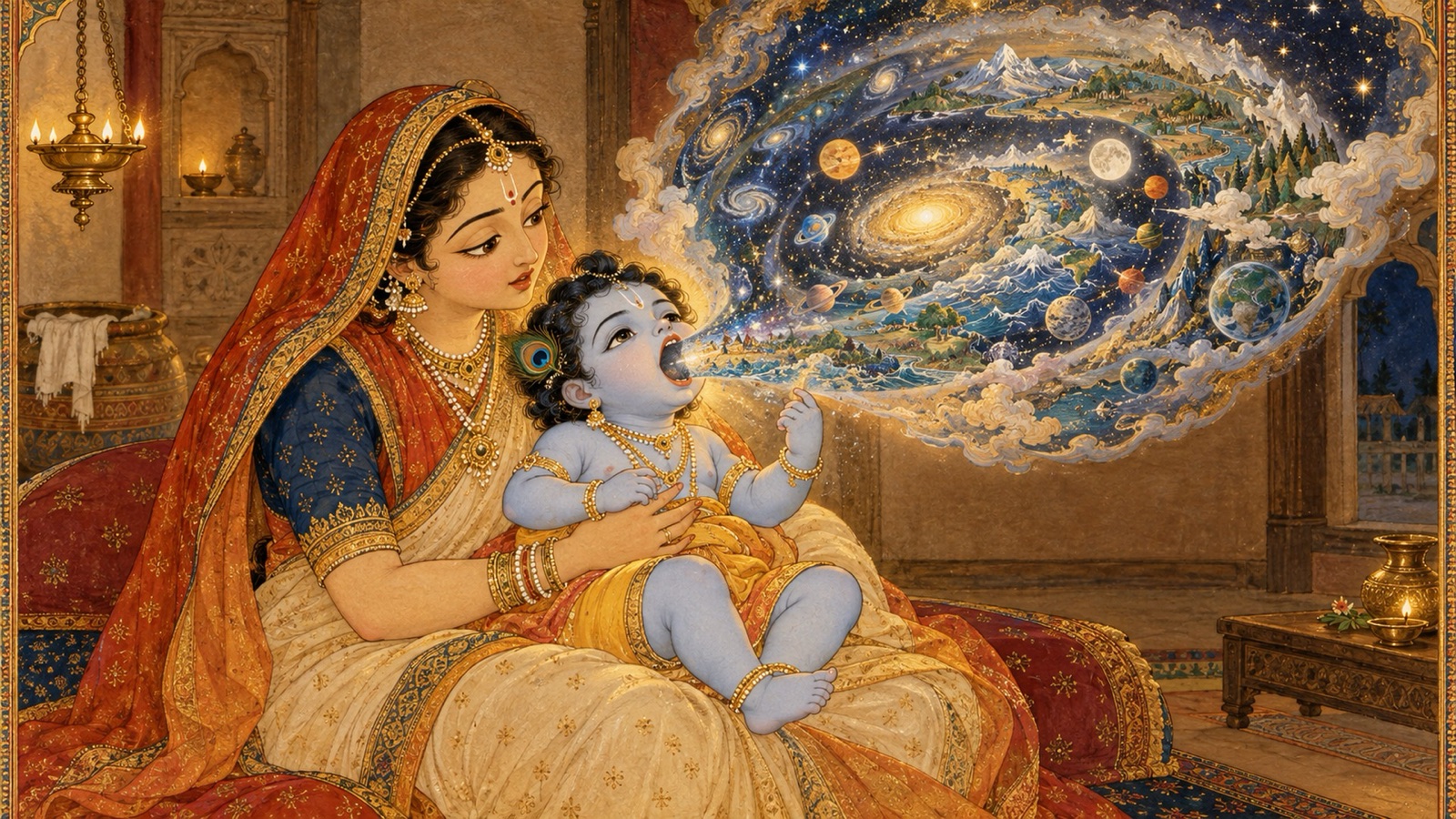
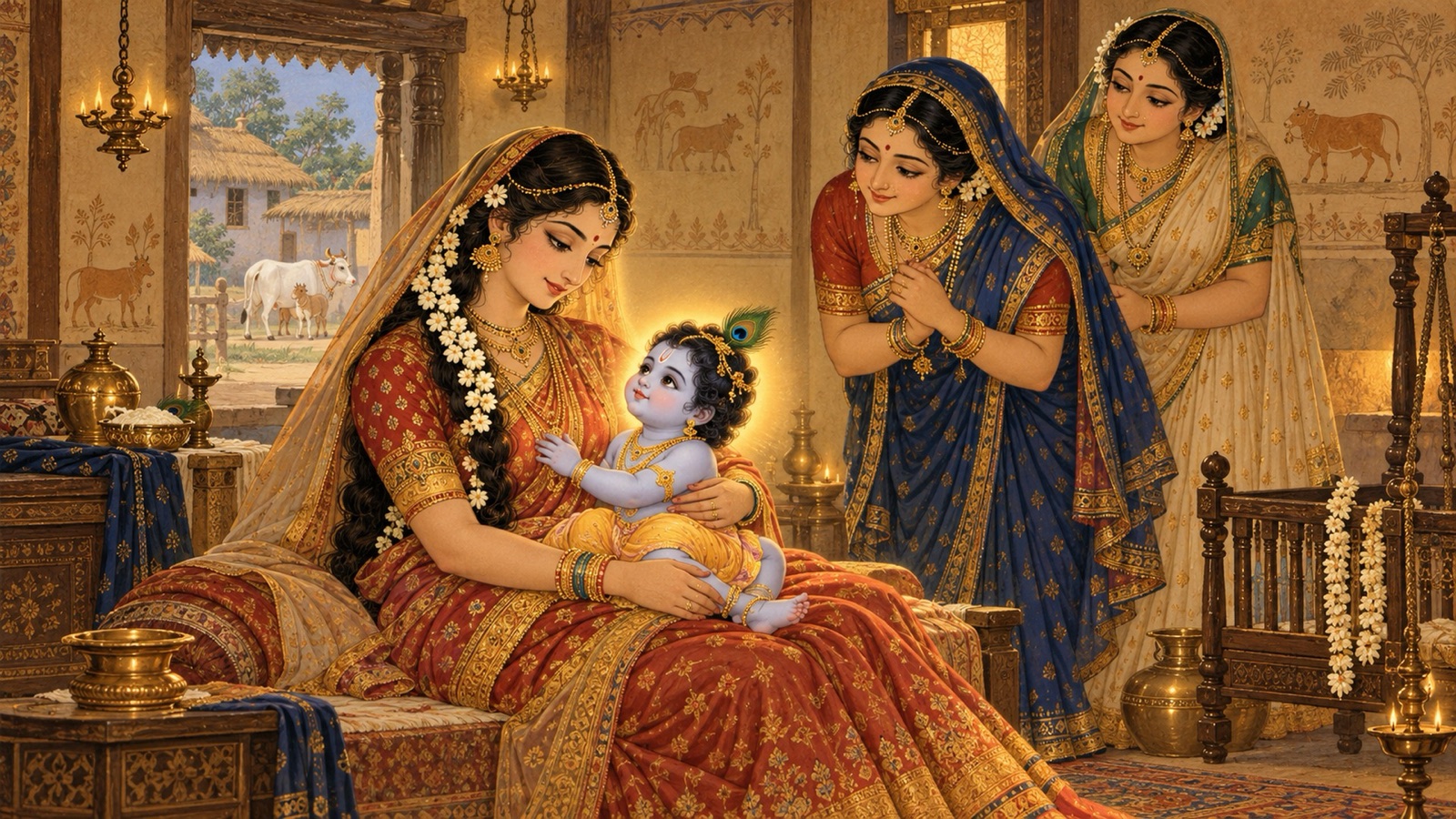
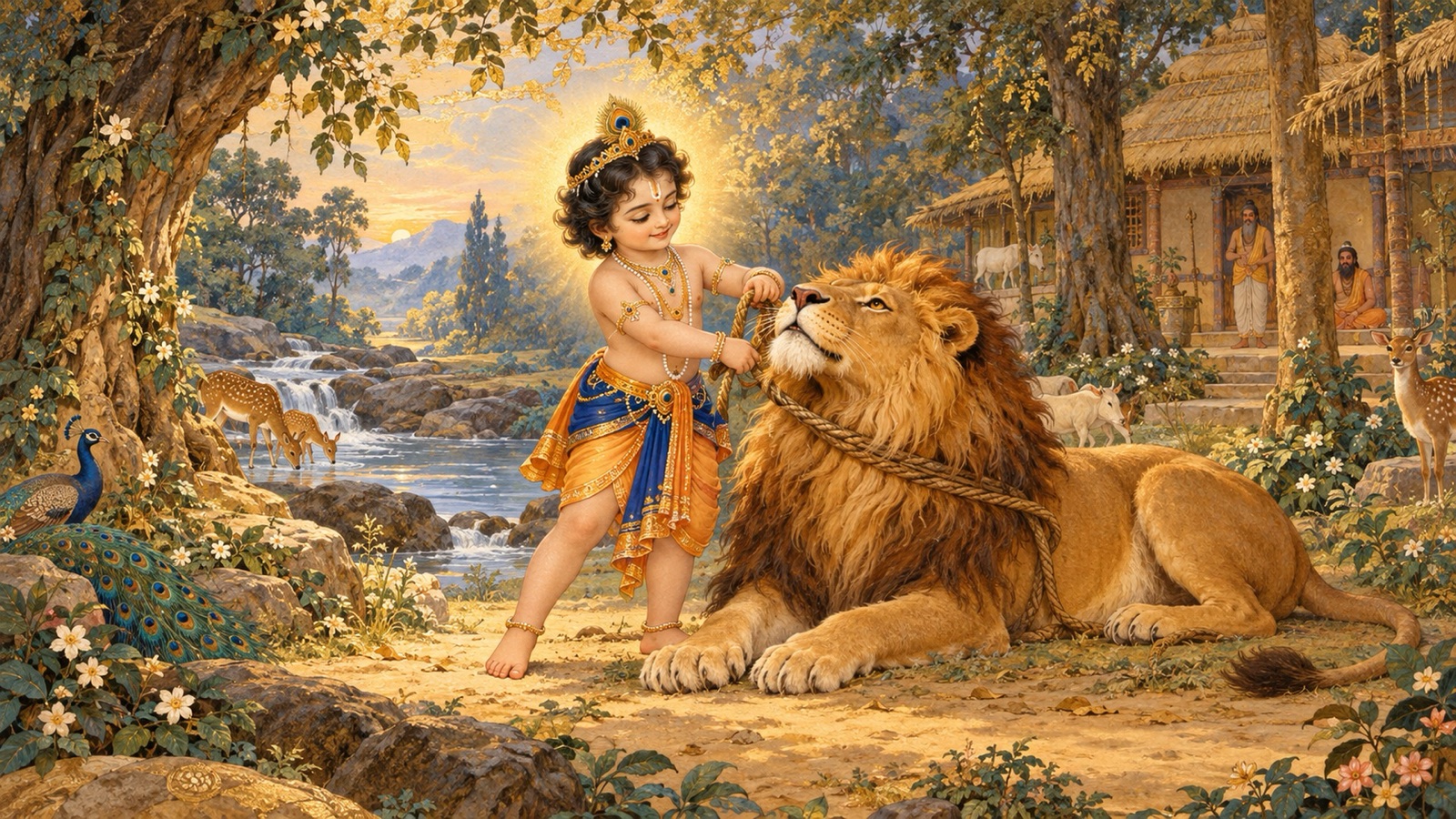
The sage Garga secretly names Balarama and Krishna and unveils the boy's countless names and glory; the two Boys crawl and play and steal butter through all Vraja; and when the child accused of eating earth opens His mouth, His mother Yasoda beholds the whole universe within it — a faithful, devotional retelling with verified verses.
Continue the Reading →
King Parikshit longs for more of the Lord's childhood pastimes; Sukadeva relates how the infant Krishna overturned a heavy cart, how the whirlwind-demon Trinavarta swept Him into the sky yet fell lifeless while the child returned unharmed, and how the mother Yasoda beheld the whole universe within His yawning mouth — a faithful, devotional retelling with verified verses.
Continue the Reading →
Sent by Kamsa in the guise of a lovely woman, the child-killing Putana takes the infant Lord upon her lap with murder in her heart; yet the very Lord she means to kill draws out her life along with her poison, and, because she gave Him her breast, she attains the destiny of the saints — a faithful, devotional retelling with verified verses.
Continue the Reading →
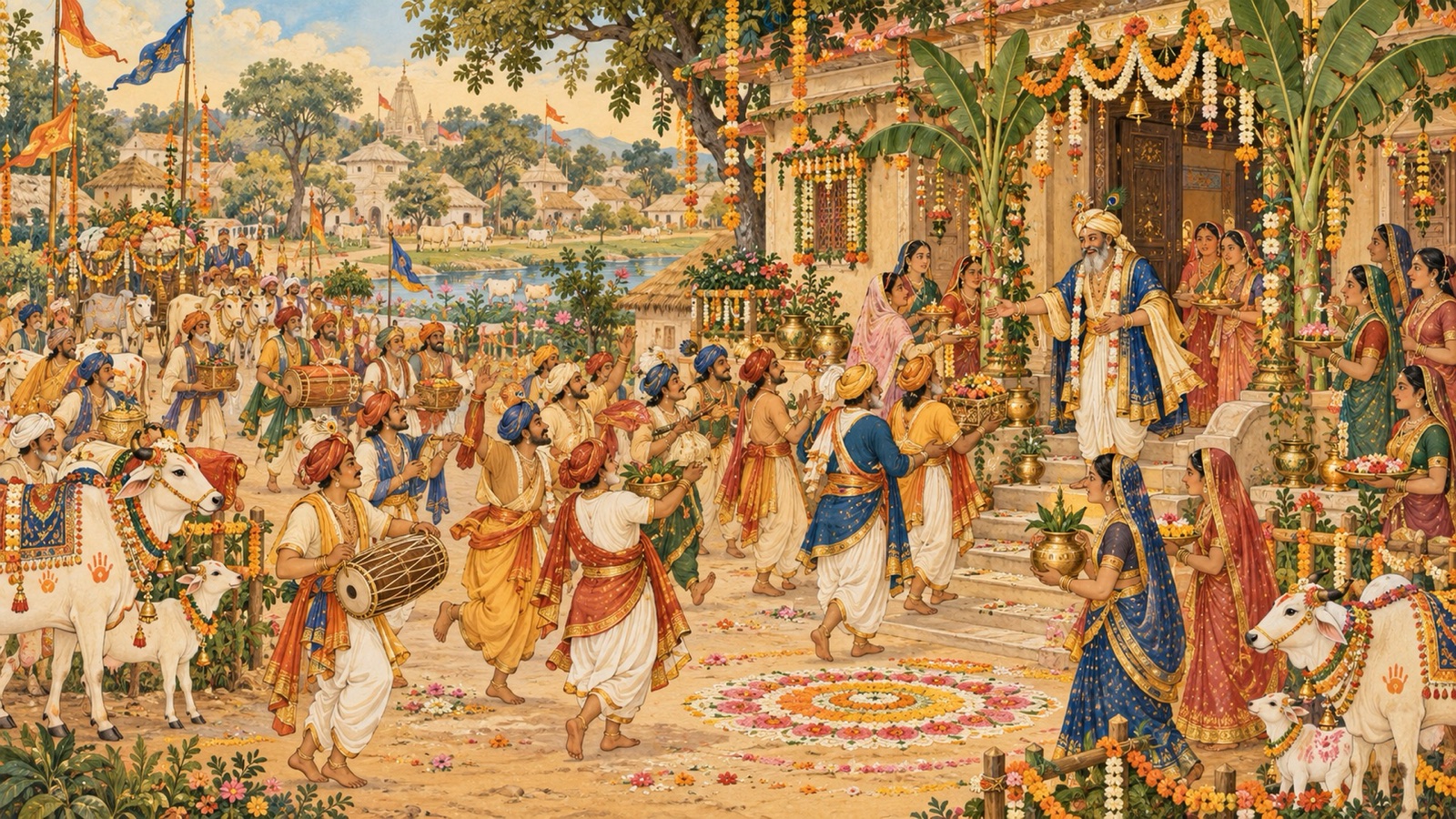
Nanda celebrates Krishna's birth with sacred rites and boundless charity as all Vraja rejoices; with the Lord's coming his village becomes the abode of fortune; and travelling to Mathura, Nanda meets his dear friend Vasudeva for a tender talk of their sons and of destiny — a faithful, devotional retelling with verified verses.
Continue the Reading →
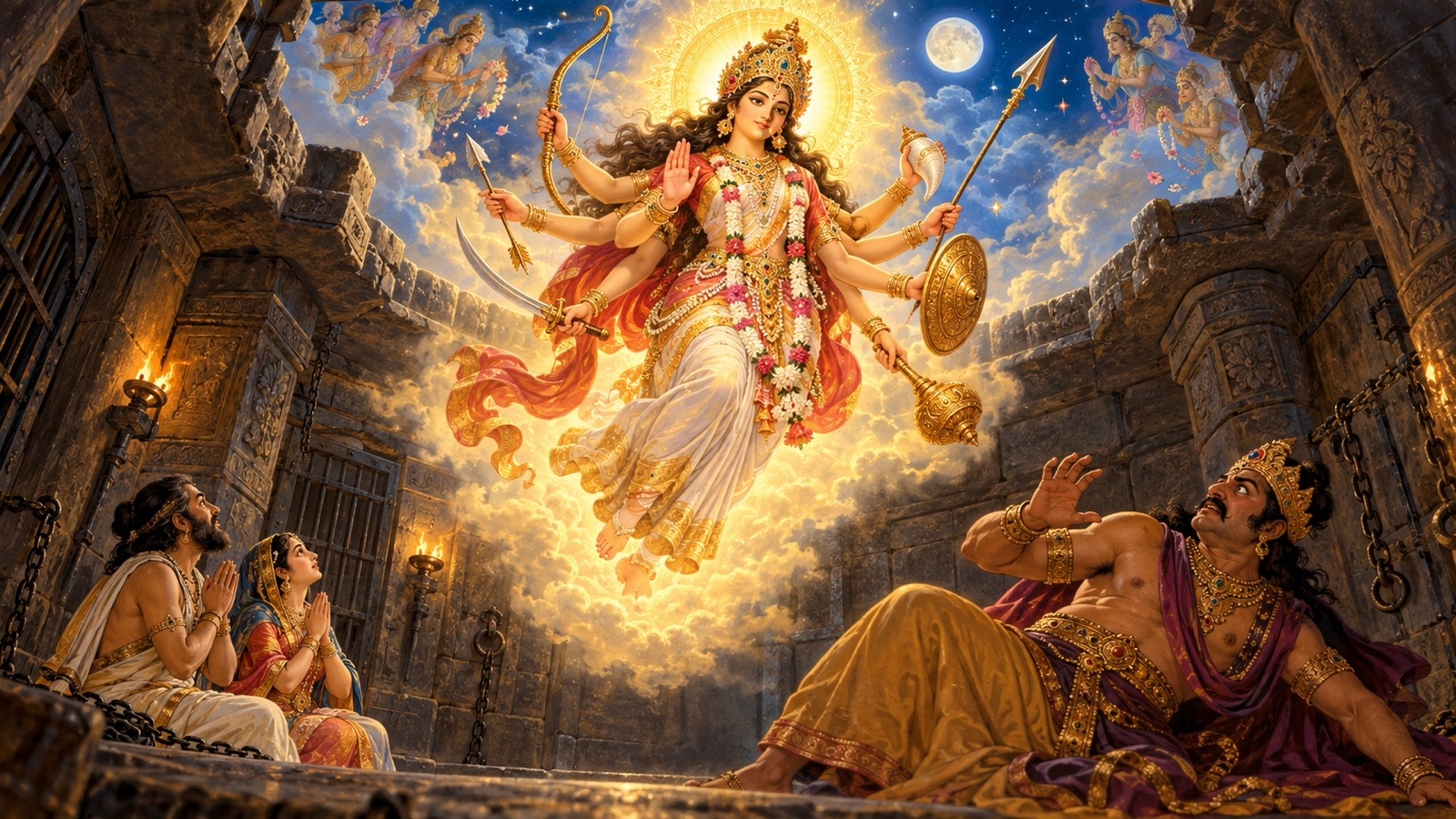
The child slips from Kamsa's grasp and rises as an eight-armed goddess who proclaims that his destroyer is already born; the tyrant repents and teaches the eternal self, then his demon counsellors turn him back to cruelty against the saintly — a faithful, devotional retelling with verified verses.
Continue the Reading →
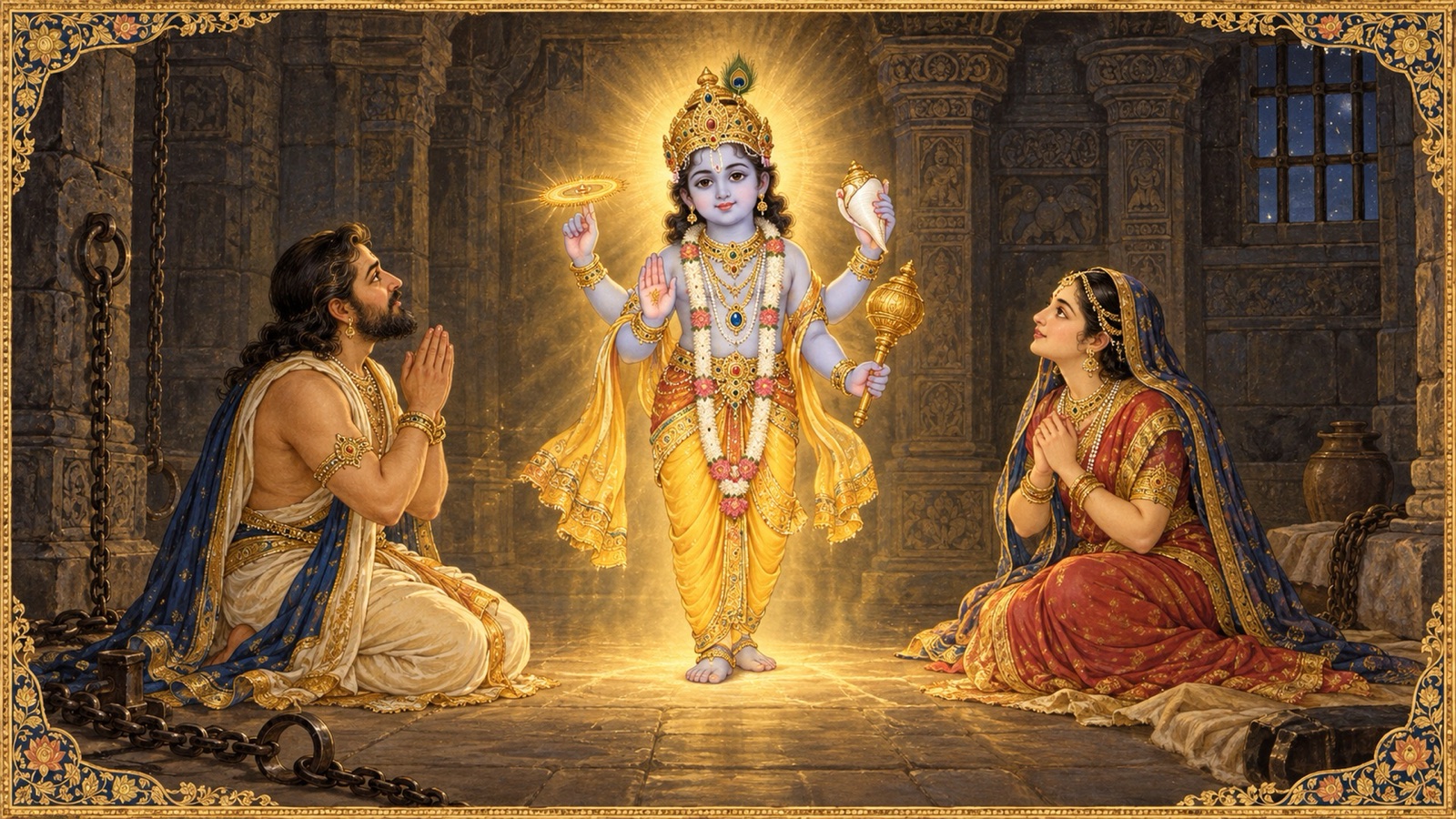
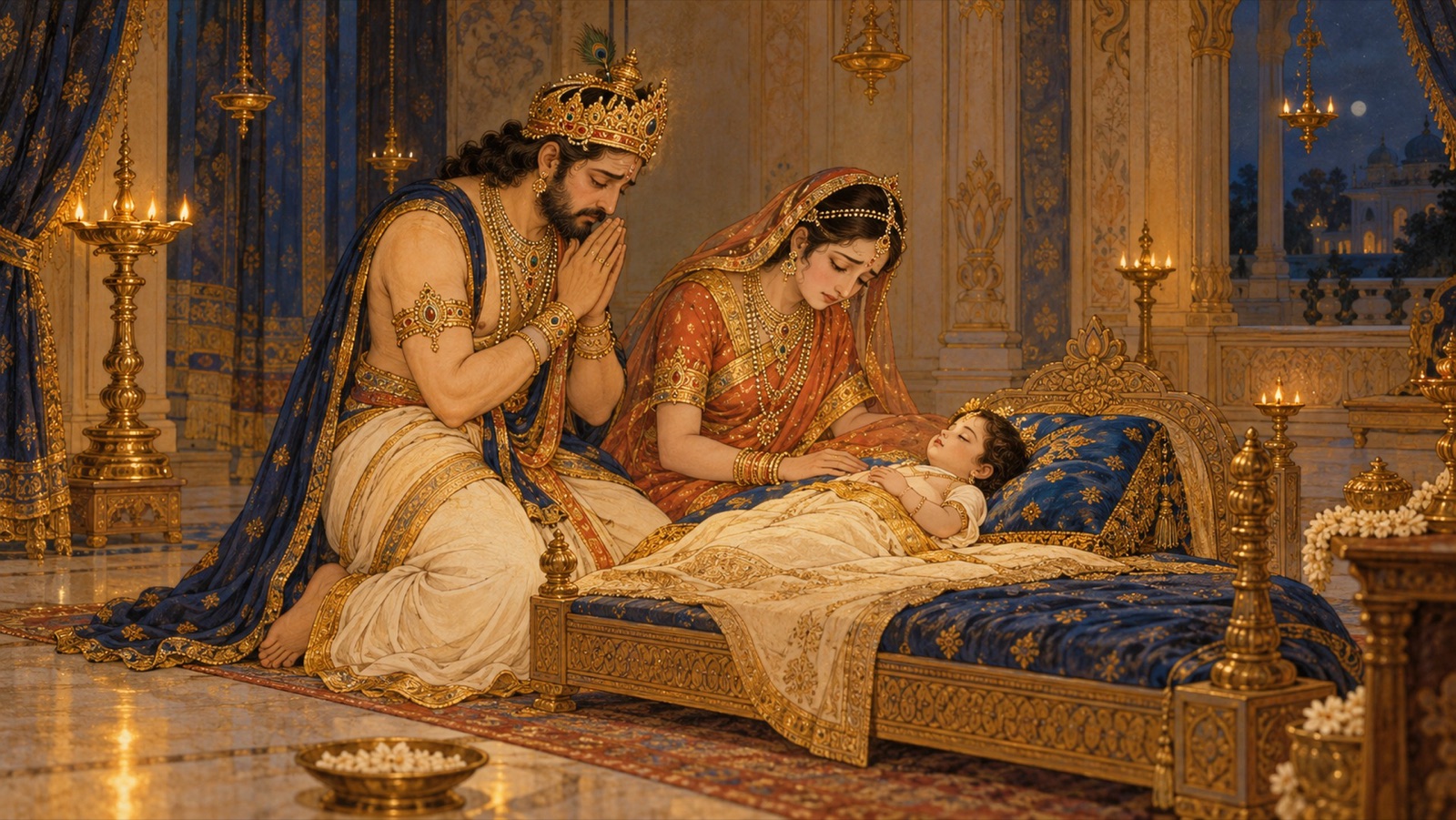
At the darkest hour of midnight the Supreme Lord appears before Vasudeva and Devaki in His four-armed form; both parents glorify Him, the Lord recalls His former descents, and, becoming an infant, He is carried across the parting Yamuna to Gokula sheltered by the hoods of Shesha — a faithful, devotional retelling with verified verses.
Continue the Reading →
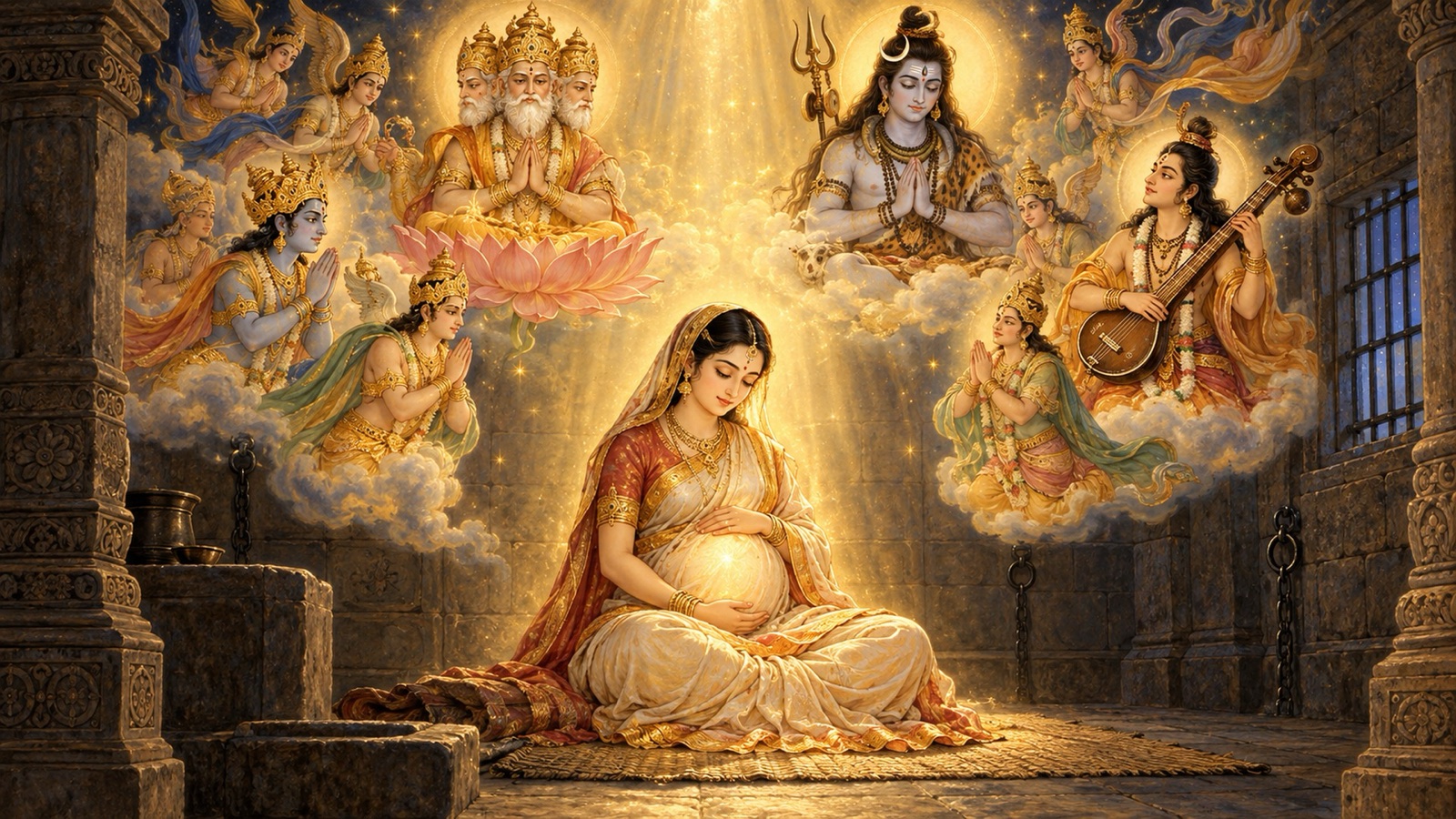
As the Supreme Lord takes His place within Devaki's womb, Kamsa's persecution scatters the Yadus, the child Ananta is transferred to Rohini as Balarama, and Brahma, Shiva, Narada and all the gods descend to sing the celebrated Garbha-stuti, taking refuge in the Lord as truth itself — a faithful, devotional retelling with verified verses.
Continue the Reading →
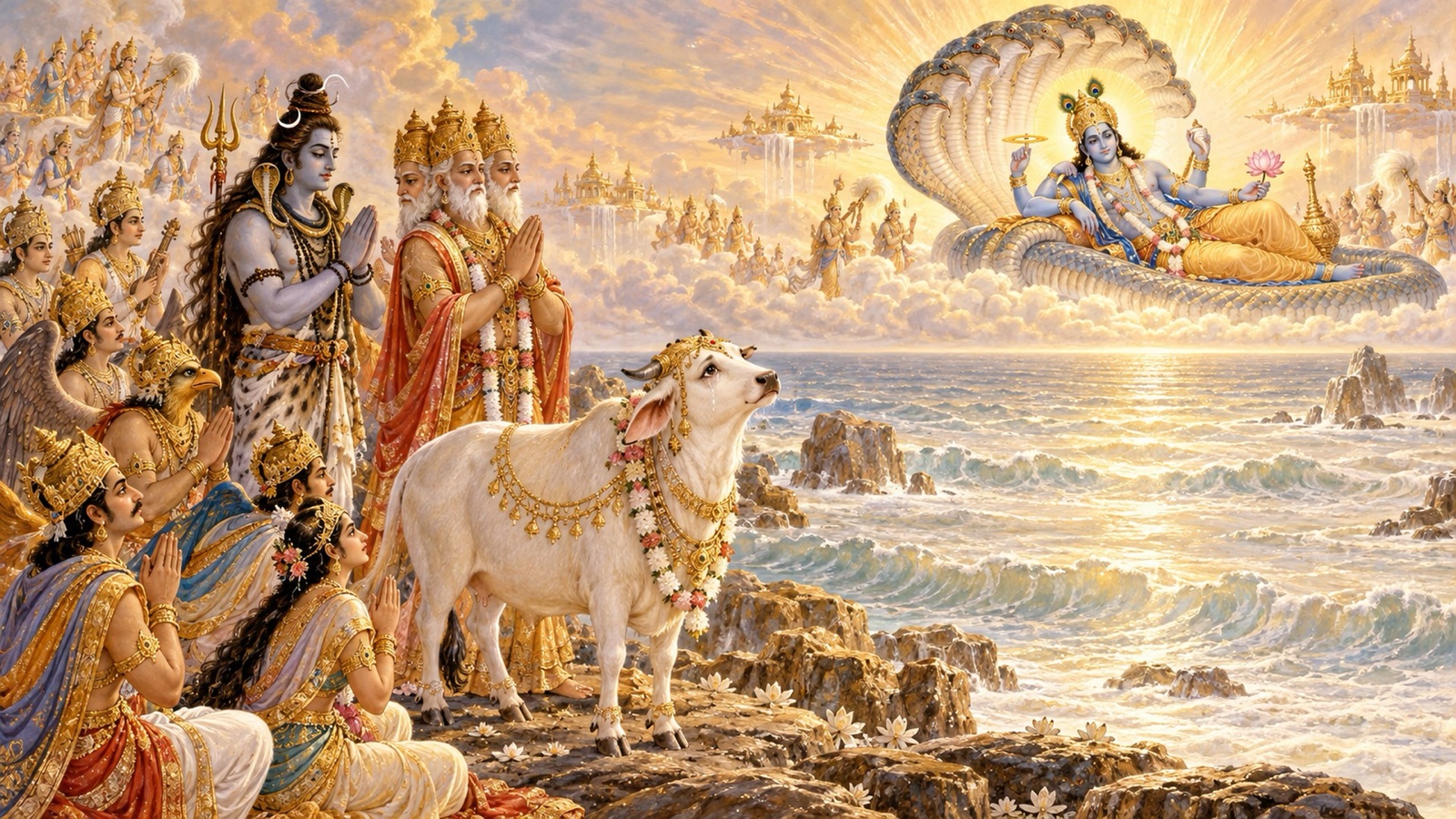
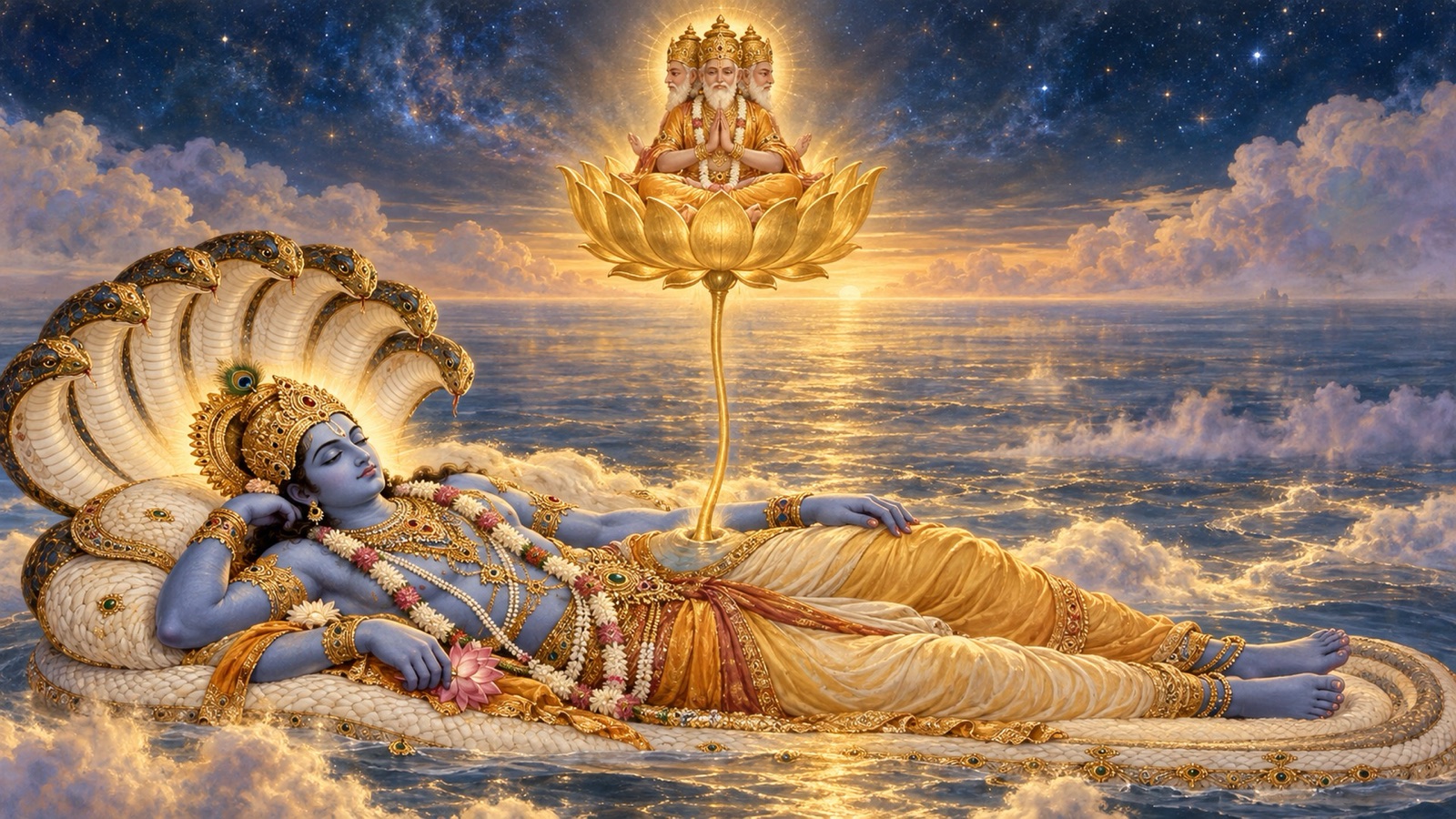
The Tenth Canto begins: Mother Earth, oppressed by tyrant kings, appeals to the gods; at the Ocean of Milk the Lord promises to descend in the house of Vasudeva. The wedding of Vasudeva and Devaki, the heavenly omen that the eighth child will slay Kamsa, Vasudeva's teaching on death and the soul, and Kamsa's imprisonment of the couple — a faithful, devotional retelling with verified verses.
Continue the Reading →
The lines of Yayati's elder sons unfold — the eastern kingdoms of Anga, the sage Rsyasringa who ended a drought, the adoption of Karna, and above all the glorious line of Yadu, in which the Supreme Lord Himself would descend as Sri Krishna, and merely to hear of which frees one from all sins. A faithful devotional retelling with verified verses.
Continue the Reading →
The great lines of Ajamidha — the Panchalas, the Kurus and the kings of Magadha — flower into the heroes of the Mahabharata: King Kuru, the yogi Devapi of Kalapagrama, Bhishma the great devotee, Vyasa a ray of Sri Hari, the five Pandavas, and the unborn Parikshit rescued by the power of Krishna. A faithful devotional retelling with verified verses.
Continue the Reading →
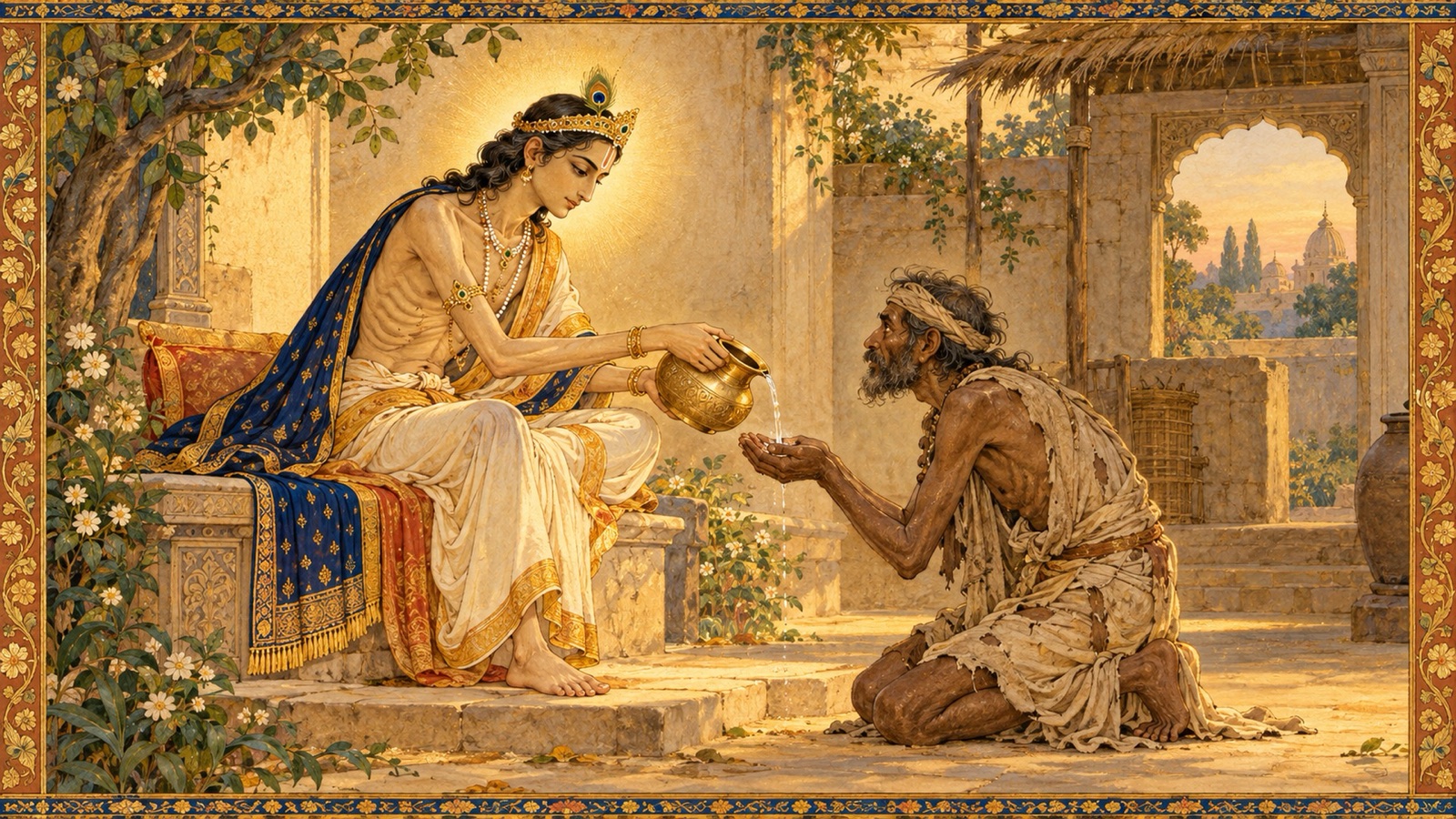
The line of Bharata enshrines the immortal story of King Rantideva, who endured forty-eight days without food or water and gave each portion away to a brahmana, a Sudra, a man with dogs, and finally his last water to a dying outcaste — praying only to bear the suffering of all beings. A faithful devotional retelling with verified verses.
Continue the Reading →
The line of Puru leads to Dushmanta and Shakuntala, whose son Bharata — born with a ray of Sri Hari and giving this land its name — becomes a universal monarch of unmatched glory, overcomes Maya through his sacrifices, and finally withdraws, seeing all sovereignty as unreal. A faithful devotional retelling with verified verses.
Continue the Reading →
After a thousand years of pleasure that left him unsated, King Yayati awakens through the parable of the goat, speaks the timeless truth that desire only blazes higher like fire fed with ghee, returns his son's youth, renounces the world, and attains absorption into Lord Vasudeva — as Devayani too is liberated. A faithful devotional retelling with verified verses.
Continue the Reading →
King Yayati marries Devayani and Sarmishtha, is cursed with premature old age by Sukracharya, and seeks to exchange his age for a son's youth. His four elder sons refuse, but his youngest, Puru, out of pure devotion gladly accepts his father's old age. A faithful devotional retelling with verified verses.
Continue the Reading →
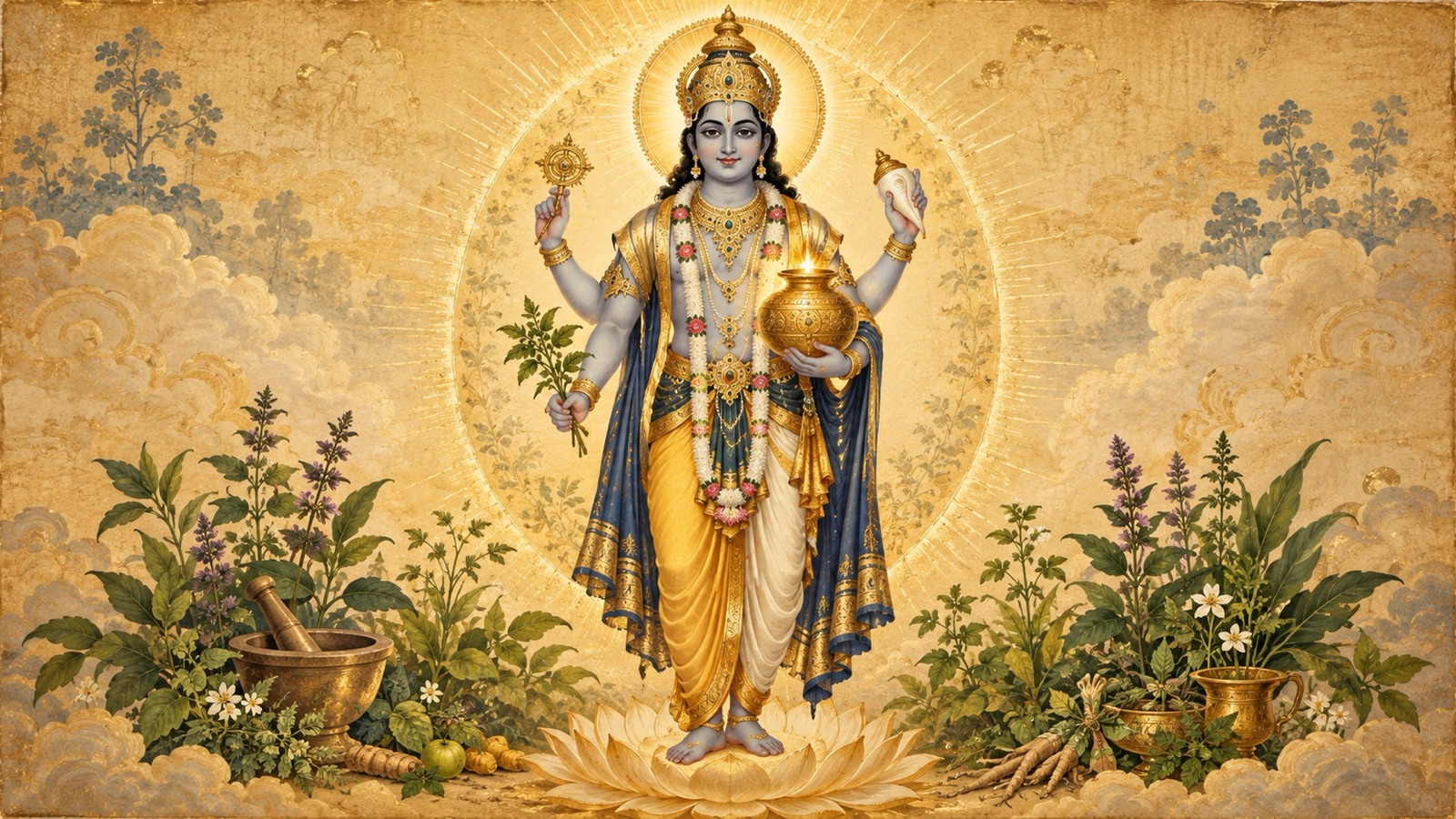
The lunar dynasty branches through the sons of Ayu. Among the kings of Kasi appears Lord Dhanvantari, the divine physician and founder of Ayurveda, whose remembrance destroys suffering; King Alarka reigns sixty-six thousand years; and King Raji, who served the gods, is contrasted with his grasping sons. A faithful devotional retelling with verified verses.
Continue the Reading →
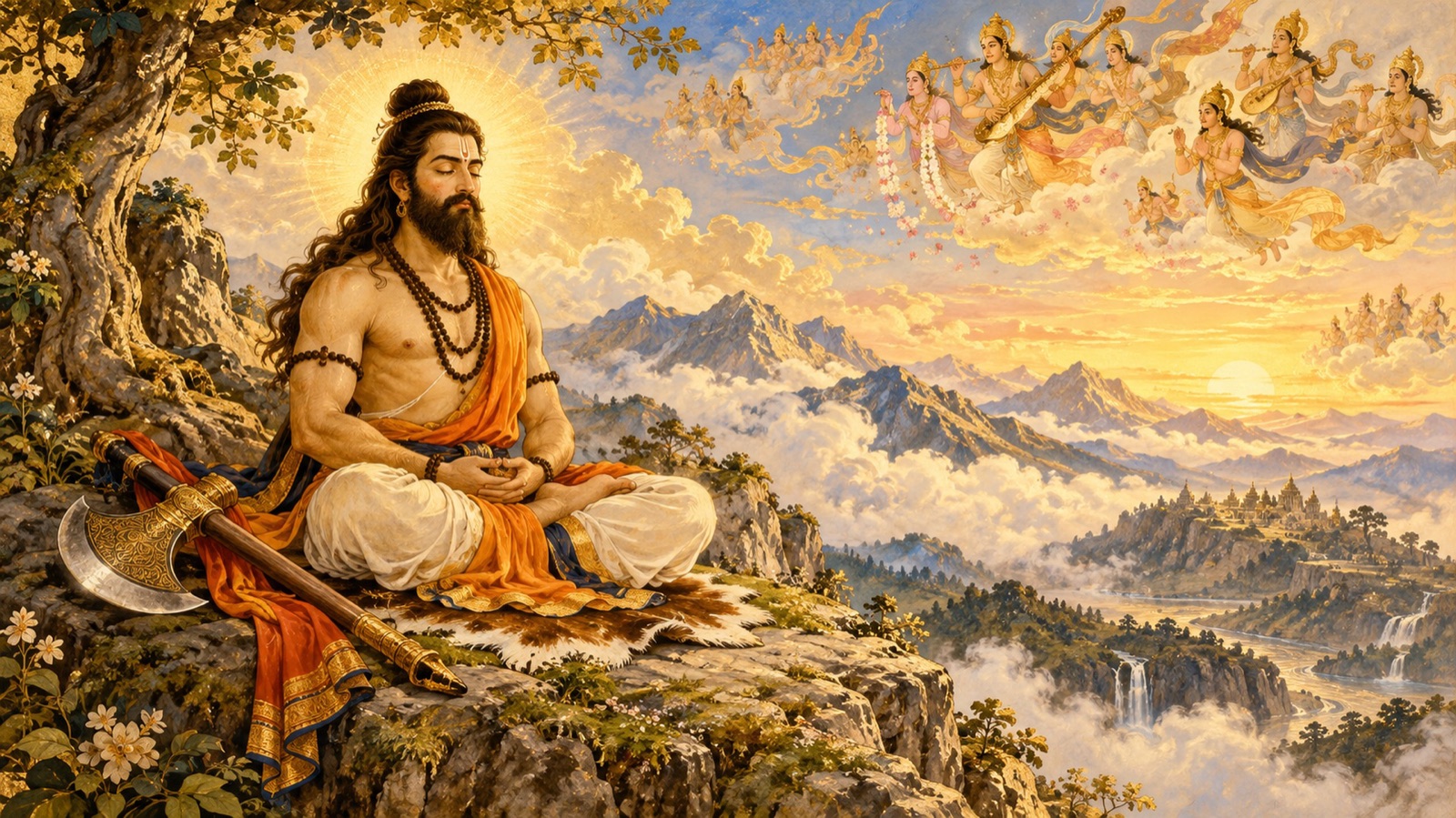
Parashurama obeys his father and gains a boon of restoration; but the sons of Kartavirya Arjuna murder the sage Jamadagni, and Parashurama clears the earth of tyrant kings twenty-one times. Jamadagni is restored among the seven sages, and Parashurama at last lays down his axe on Mount Mahendra. A faithful devotional retelling with verified verses.
Continue the Reading →
Lord Parashurama, a partial incarnation of Vishnu, is born in the line of Bhrgu. When the proud, thousand-armed King Kartavirya Arjuna steals the sacred cow of plenty from the sage Jamadagni, Parashurama pursues and destroys the tyrant and restores the cow. A faithful devotional retelling with verified verses.
Continue the Reading →
The lunar dynasty opens with Soma the moon-god, the birth of Budha, and the poignant love of King Pururava for the celestial nymph Urvasi. Enchanted and then bereft, Pururava turns his longing at last toward the sacred, discovering the churning of the holy fire. A faithful devotional retelling with verified verses.
Continue the Reading →
King Nimi and his preceptor Vasishtha curse one another to lose their bodies; offered life again, Nimi chooses to remain bodiless, dwelling in the blinking of every creature's eyes. From his churned body comes Janaka, founder of Mithila; from that line, Sita appears from a plough. A faithful devotional retelling with verified verses.
Continue the Reading →
The solar dynasty of Ikshvaku flows on from Kusa, the son of Lord Rama: the yoga-teacher Hiranyanabha who taught Yajnavalkya, the perfected yogi Maru of Kalapagrama who will one day revive the line, the warrior Brihadbala, and the kings to come, down to Sumitra. A faithful devotional retelling with verified verses.
Continue the Reading →
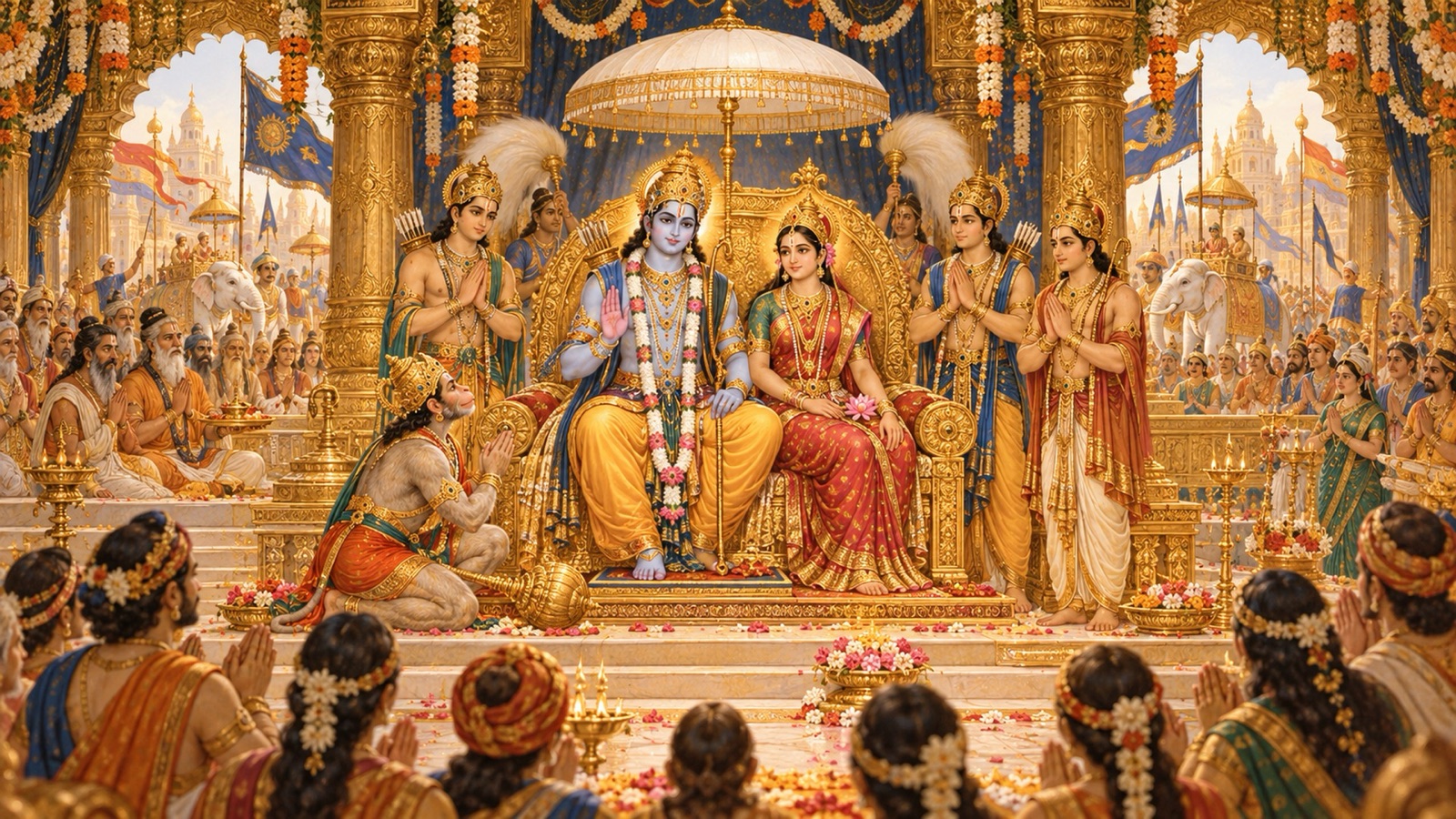
Lord Ramachandra gives away the whole earth in charity, parts with Sita to honour His people's doubts, sees the birth of Kusa and Lava at Valmiki's hermitage, and at last returns to His eternal realm. Whoever hears His story with a gentle heart is freed from karma. A faithful devotional retelling with verified verses.
Continue the Reading →
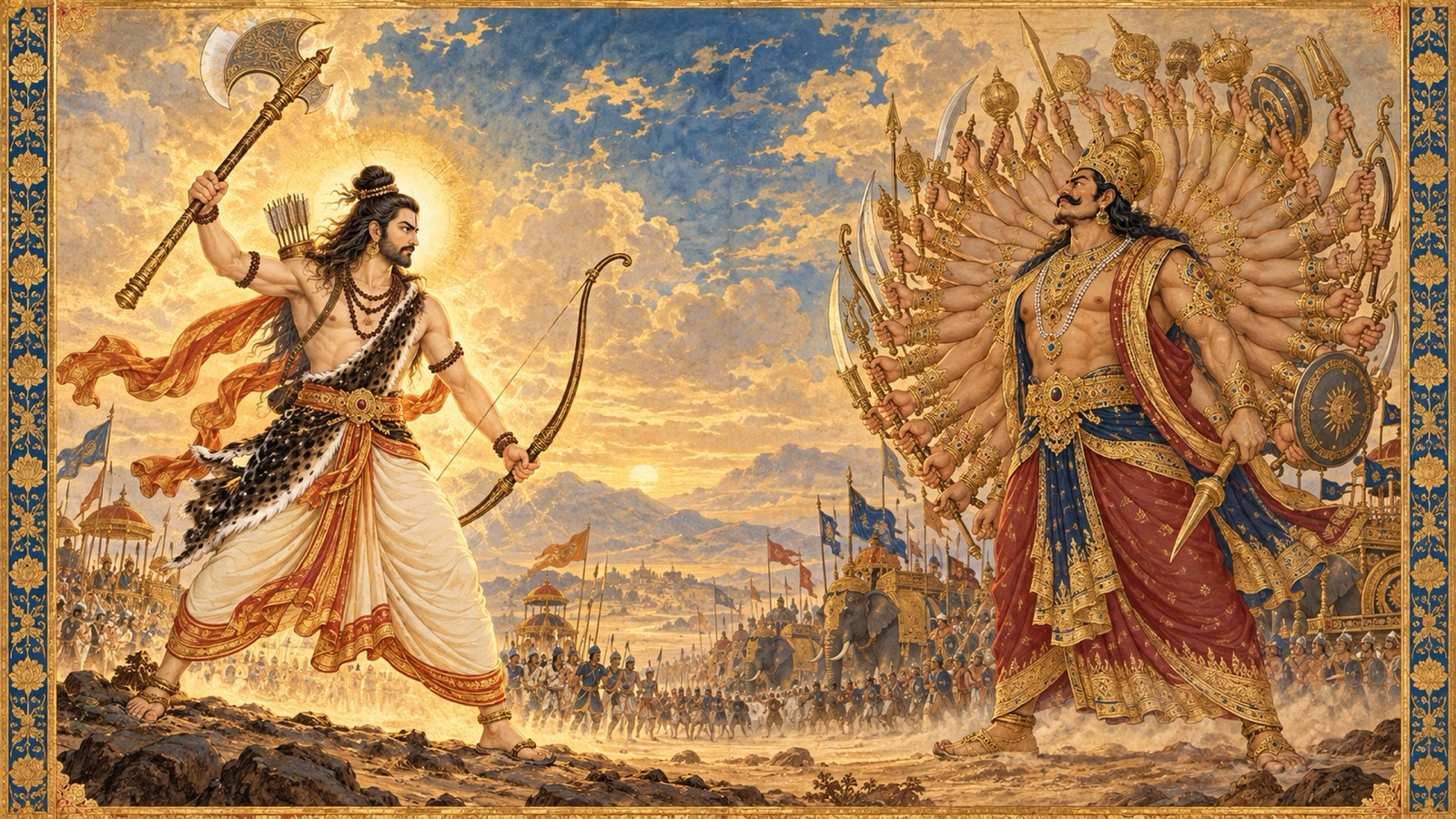
The Supreme Lord descends as the son of Dasaratha: He breaks the bow of Siva to win Sita, gives up His throne for His father's word, bridges the ocean, destroys the tyrant Ravana, and returns to establish the perfect reign of Rama-rajya. A faithful devotional retelling with verified verses.
Continue the Reading →
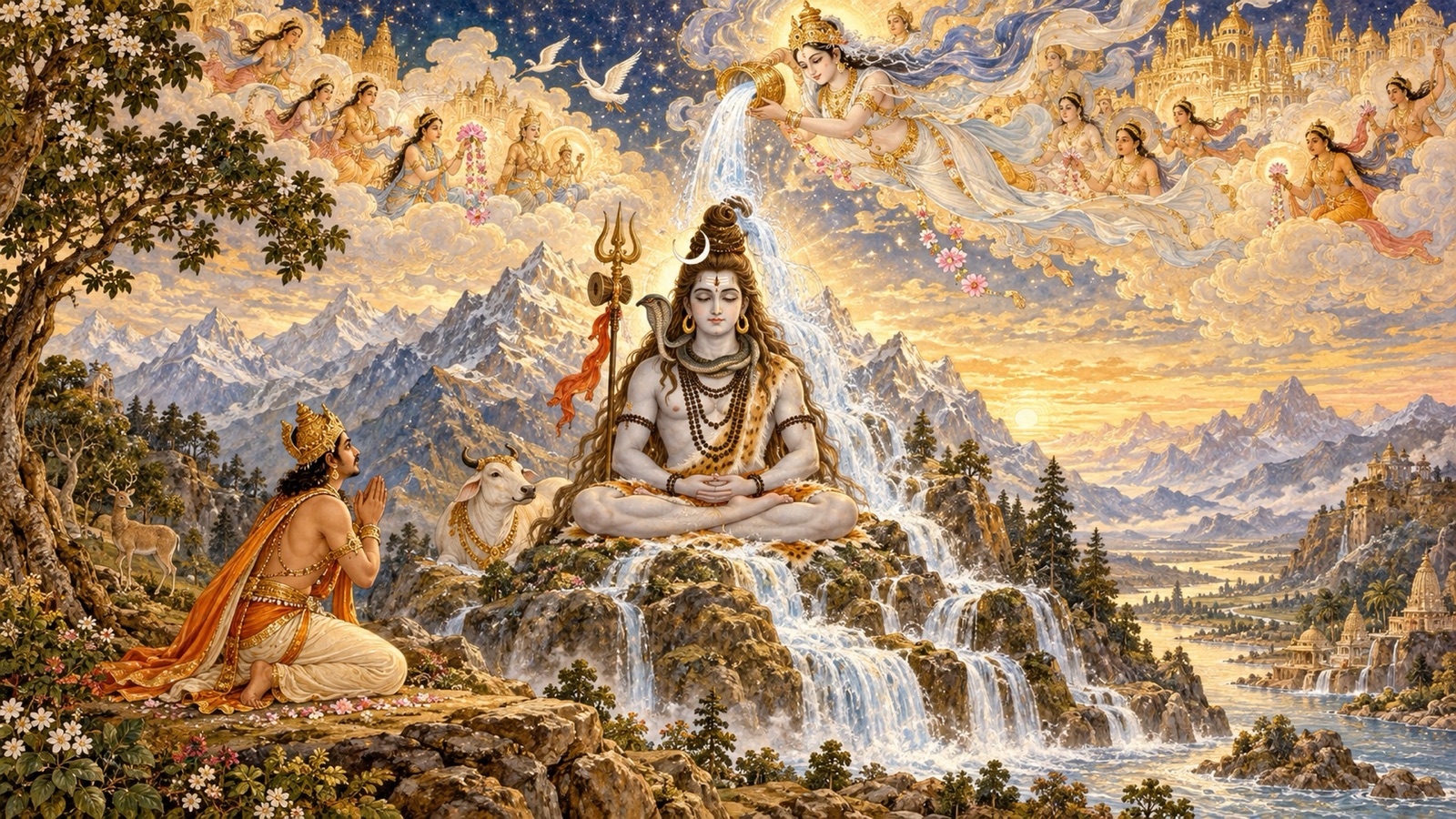
After three generations of penance, King Bhagiratha brings the holy Ganga down from heaven, and Lord Siva bears her mighty fall upon his head. Her sacred waters redeem the ashes of Sagara's sons; and King Khatwanga, given only one hour to live, turns wholly to the Lord and attains the supreme goal. A faithful devotional retelling with verified verses.
Continue the Reading →
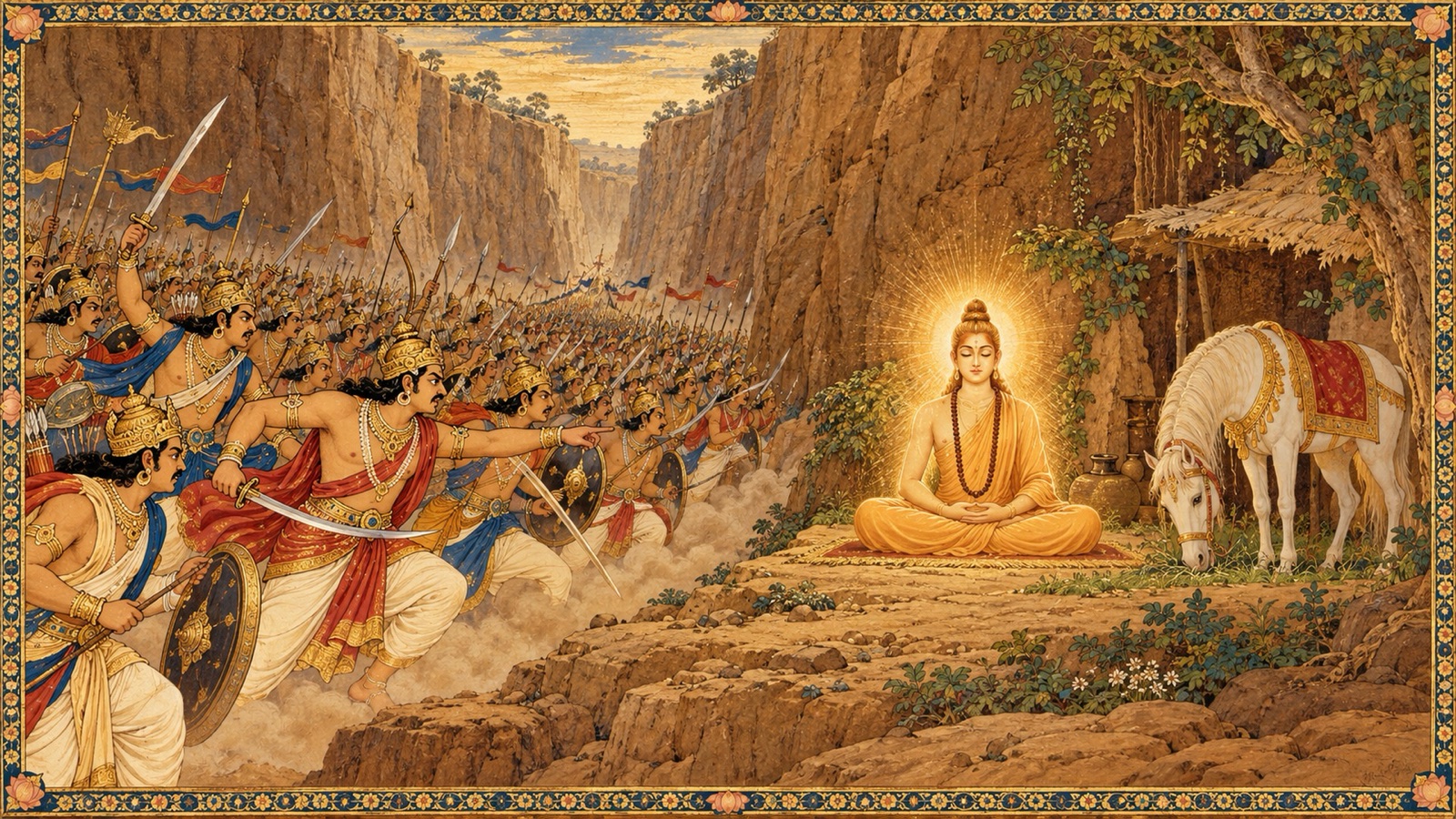
Born with poison yet raised to greatness, Emperor Sagara gives his name to the ocean. His sixty thousand proud sons, digging through the earth for a lost horse, offend the divine sage Kapila and are reduced to ashes by their own fire — while the humble Amsuman wins the Lord's grace. A faithful, devotional retelling with verified verses.
Continue the Reading →
The solar line descends from Mandhata: Purukutsa serves the serpents by Vishnu's power, Trisanku is fixed among the stars, and King Hariscandra, bound by a vow to Varuna and love for his son Rohita, is drawn into an ordeal that reveals the liberating power of unbending truth. A faithful, devotional retelling with verified verses.
Continue the Reading →
The early solar dynasty of Ikshvaku unfolds: Vikukshi loses his birthright, Puranjaya rides Indra himself as a bull to conquer the demons, the emperor Mandhata is born by destiny, and the ascetic Saubhari falls through a single desire before finding liberation. A faithful, devotional retelling with verified verses.
Continue the Reading →
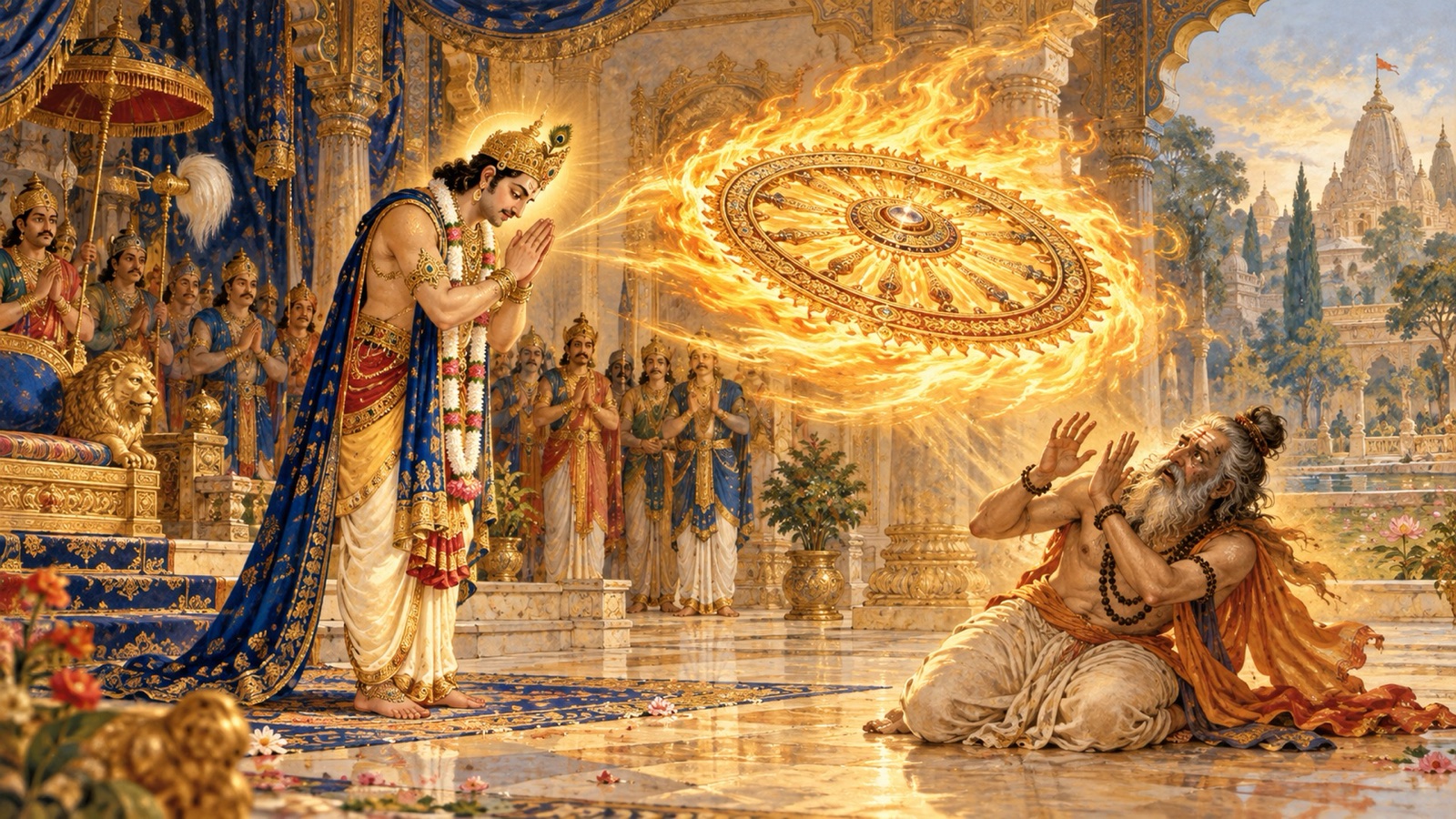
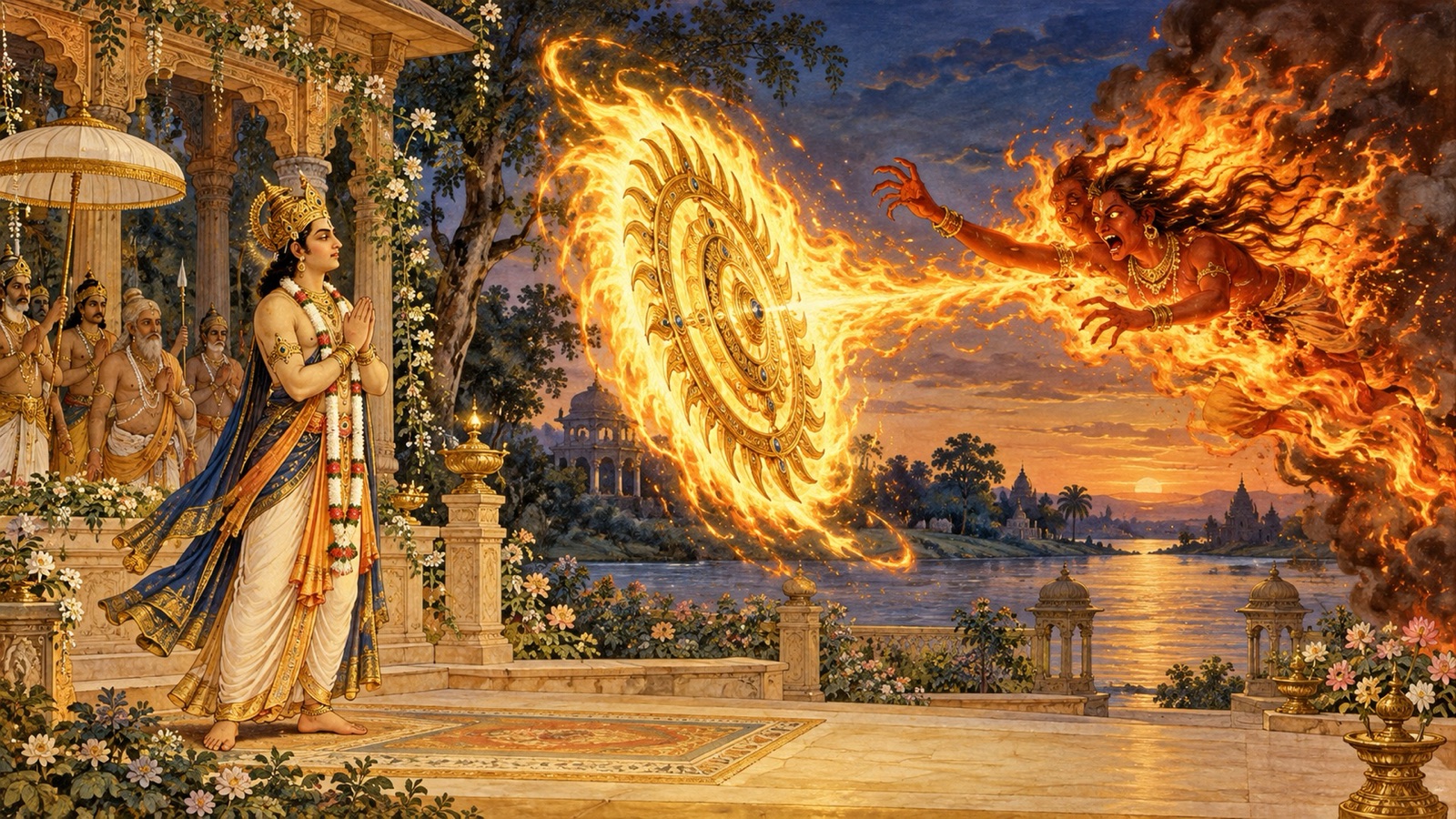
King Ambarisha prays to the Sudarsana discus to spare the very sage who wronged him; the discus relents, Durvasa praises the devotee, and after a year quietly spent on water alone, the king attains final liberation in Lord Vasudeva. A faithful, devotional retelling with verified verses.
Continue the Reading →
The truthfulness of Nabhaga, the exemplary devotion of King Ambarisha, his Dwadasi vow, the fiery curse of Durvasa turned back by the Sudarsana discus, and the Lord's declaration that He is bound by love to His devotees. A faithful, devotional retelling with verified verses.
Continue the Reading →
The beloved story of Sukanya and the sage Cyavana — her innocent mistake, her steadfast devotion, and the miraculous restoration of his youth — followed by King Kakudmi's journey to Brahmaloka and the marriage of Revati to Lord Balarama. A faithful, devotional retelling with verified verses.
Continue the Reading →
Book Nine continues with the lines descended from Vaivaswata Manu's sons — the prince Prshadhra, who lost his rank yet won the Lord; the youthful renunciant Kavi; the emperor Marutta's unequalled golden sacrifice; and the house of Trnabindu that built Vaisali. A faithful, devotional retelling with verified verses.
Continue the Reading →
Book Nine of the Bhagavatam begins with the royal line of Vaivaswata Manu, traced from Lord Narayana Himself, and the extraordinary story of Sudyumna — born the daughter Ila, transformed into a prince, father of Pururava. A faithful, devotional retelling with verified verses.
Continue the Reading →
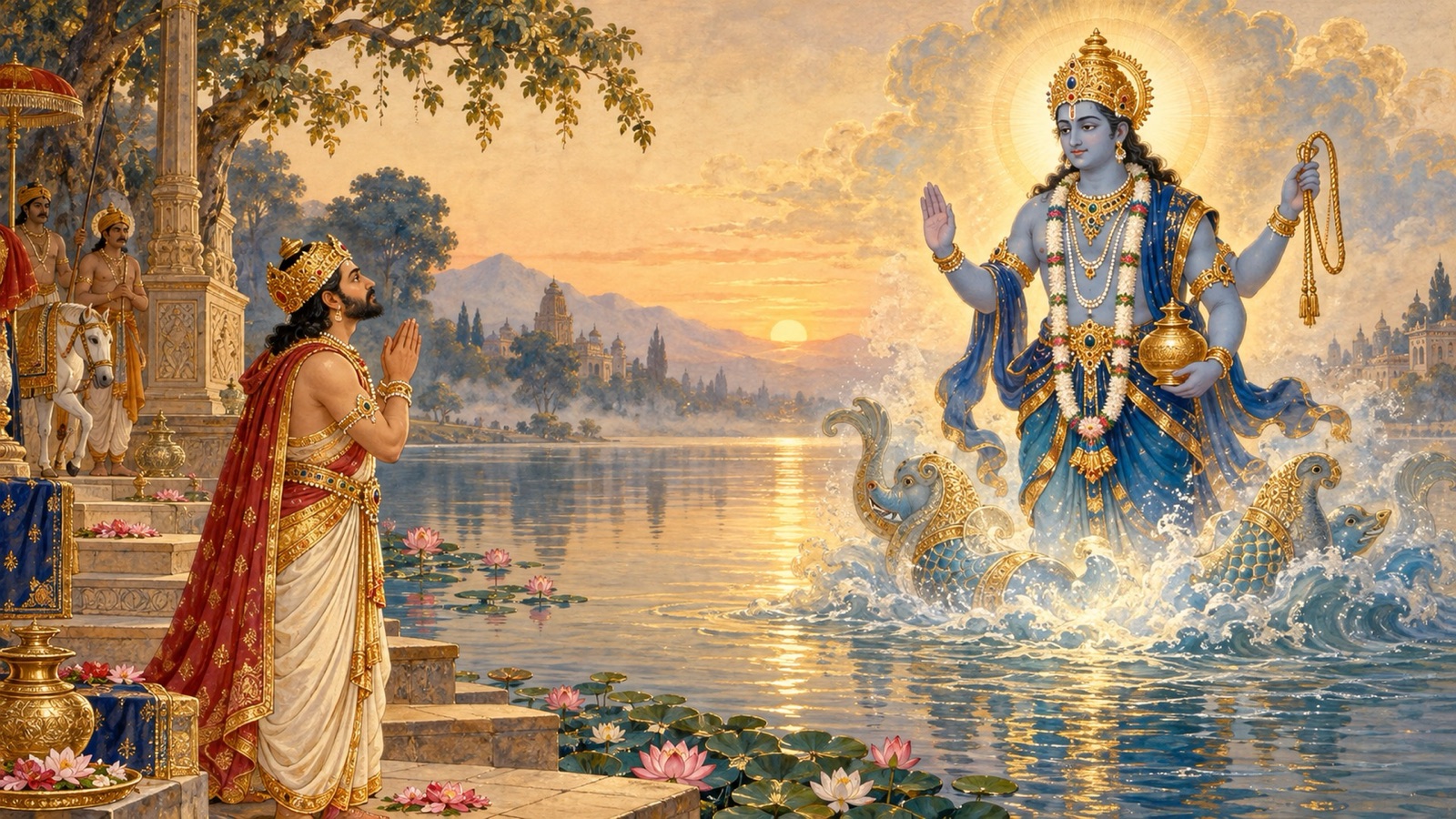
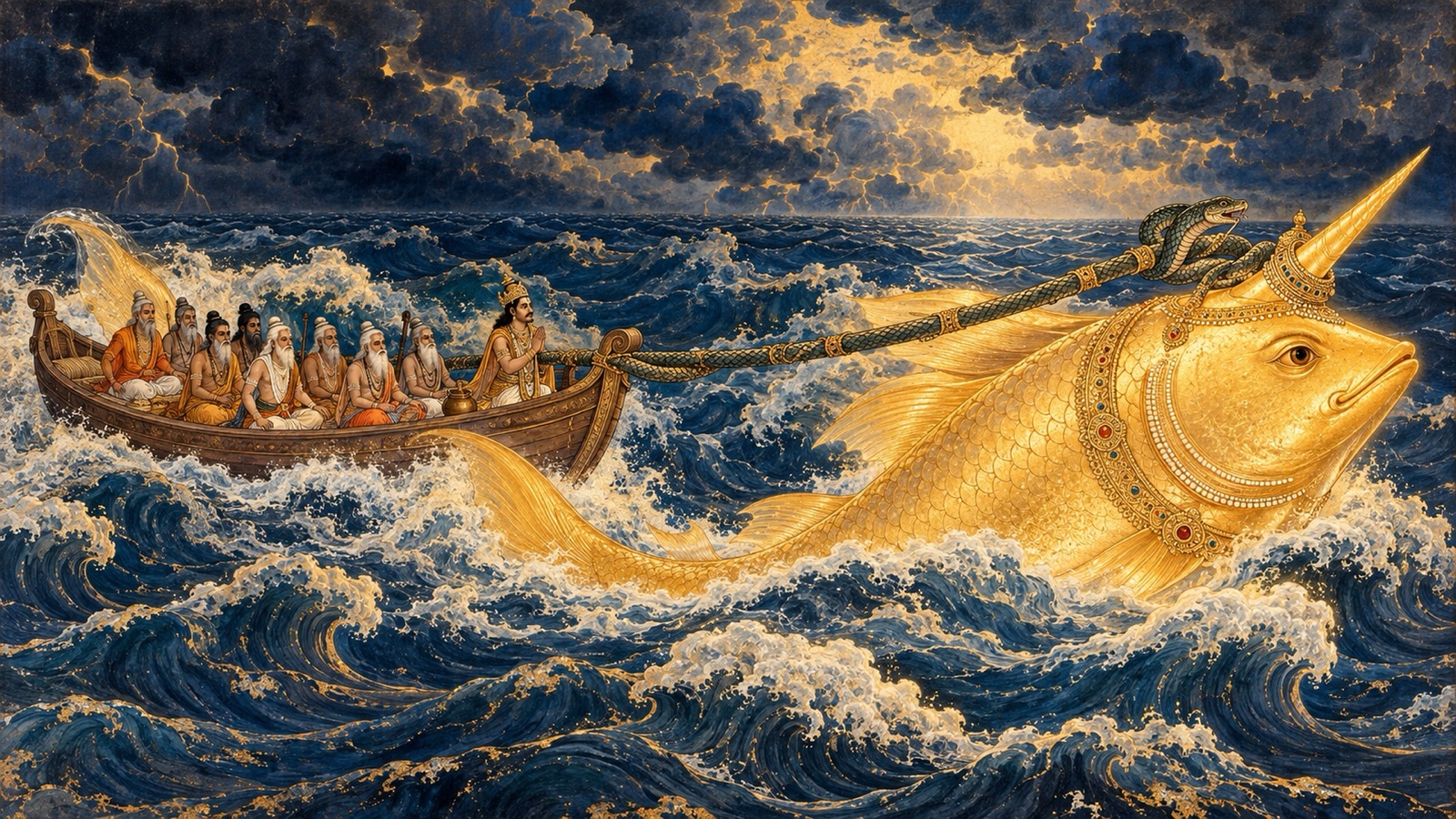
When Hayagriva steals the Vedas, the Lord descends as the divine Fish; He meets the compassionate sage Satyavrata, grows beyond every vessel, tows the boat through the deluge tied to His horn, imparts eternal wisdom, and restores the Vedas. A faithful, devotional retelling with verified verses.
Continue the Reading →
Freed from bondage, Bali praises a grace never won even by the guardians of the worlds and enters Sutala; Prahlada marvels at the Lord's kindness, Sukracarya completes the sacrifice, and the divine Dwarf, made Upendra, restores heaven to Indra. A faithful, devotional retelling with verified verses.
Continue the Reading →
Bound and stripped of the three worlds, Bali offers his own head for the Lord's third step, fearing only dishonour. The Lord reveals the secret of His grace — that He strips His dearest devotees of wealth out of love — and grants Bali the realm of Sutala. A faithful, devotional retelling with verified verses.
Continue the Reading →
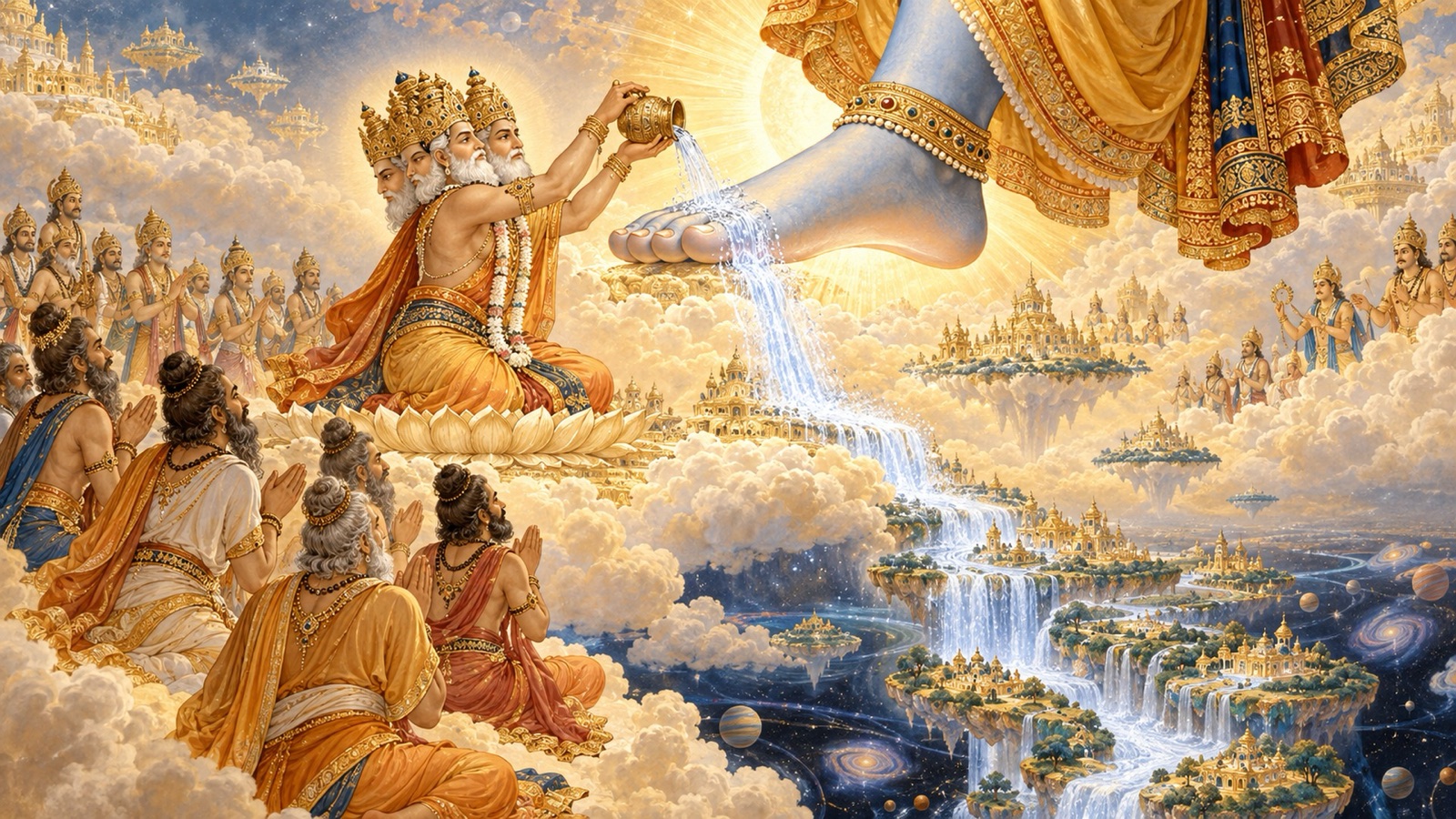
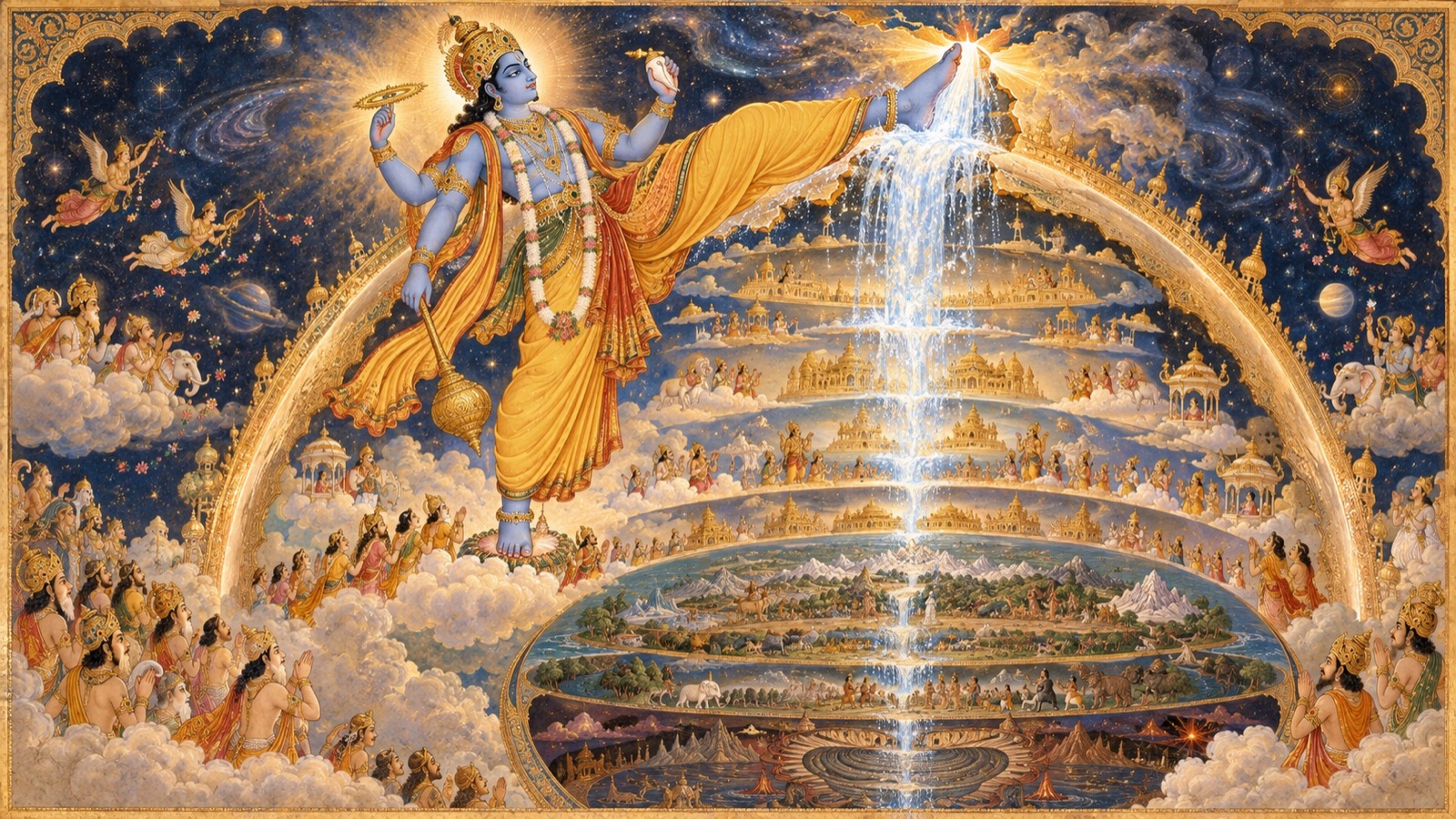
Brahma worships the Lord's foot at the summit of creation and the sacred Ganga is born; the demons rise in fury, Bali restrains them before the power of Time, and Garuda binds the great king with the cords of Varuna. A faithful, devotional retelling with verified verses.
Continue the Reading →
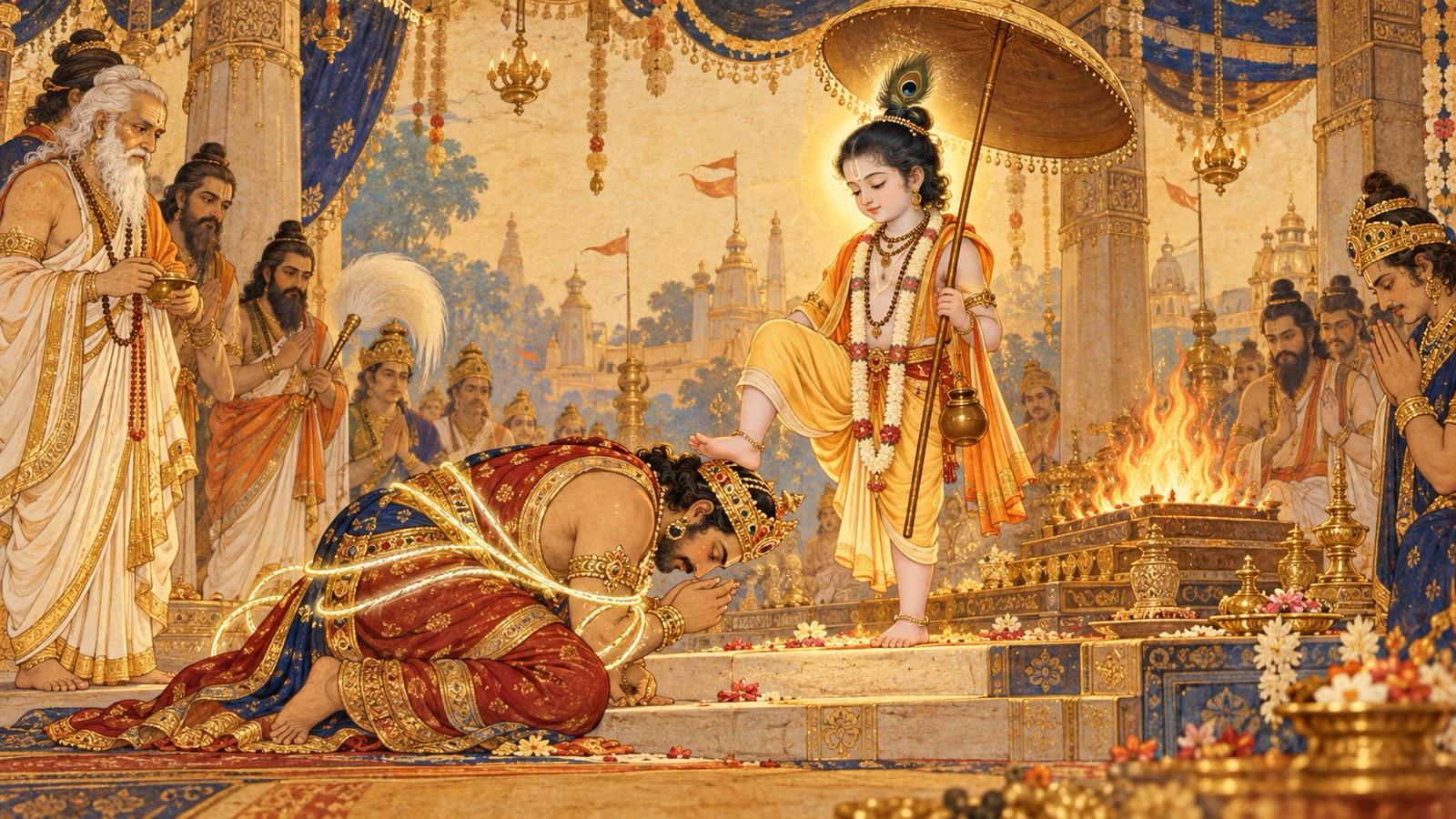
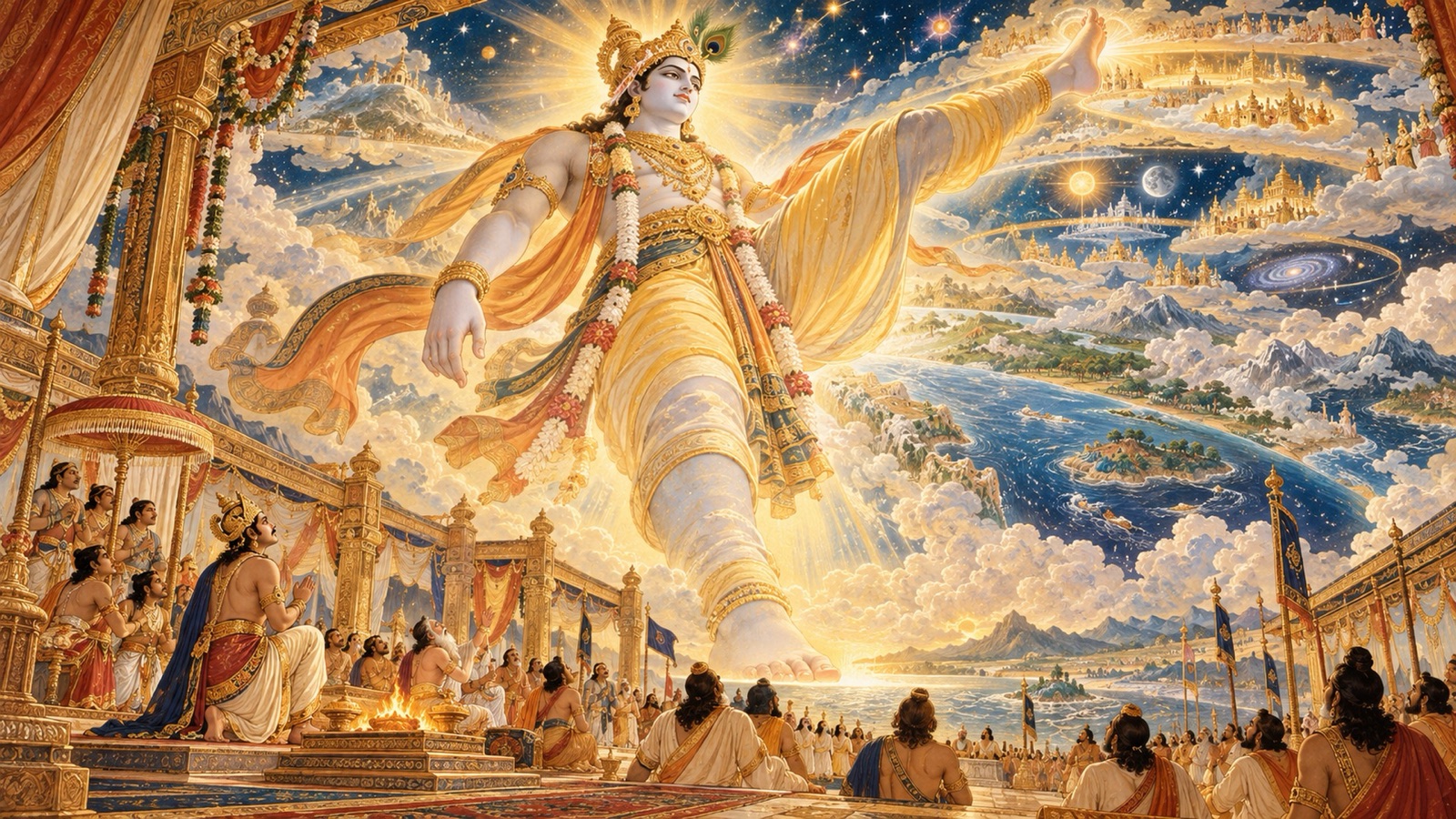
Rather than break his promise, Bali chooses truth over his kingdom, gives the land despite his teacher's curse, and washes the Lord's feet — as the little Dwarf grows into the cosmic form and strides across the three worlds. A faithful, devotional retelling with verified verses.
Continue the Reading →
The Lord of all the worlds asks Bali for only three paces of land, teaches the priceless value of contentment, and receives the king's pledge — even as Sukracarya recognises the Dwarf as Vishnu and warns of the cost. A faithful, devotional retelling with verified verses.
Continue the Reading →
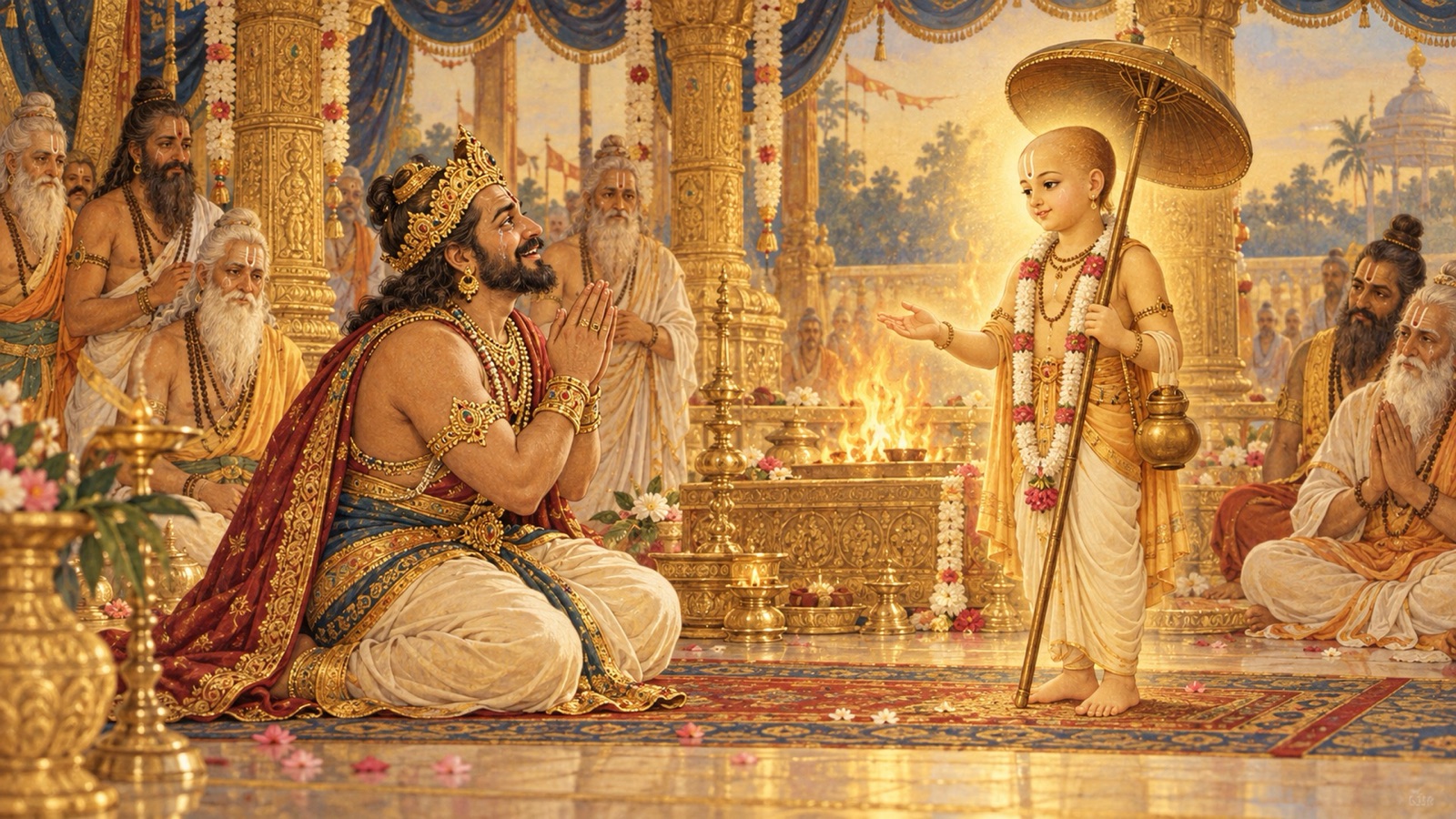
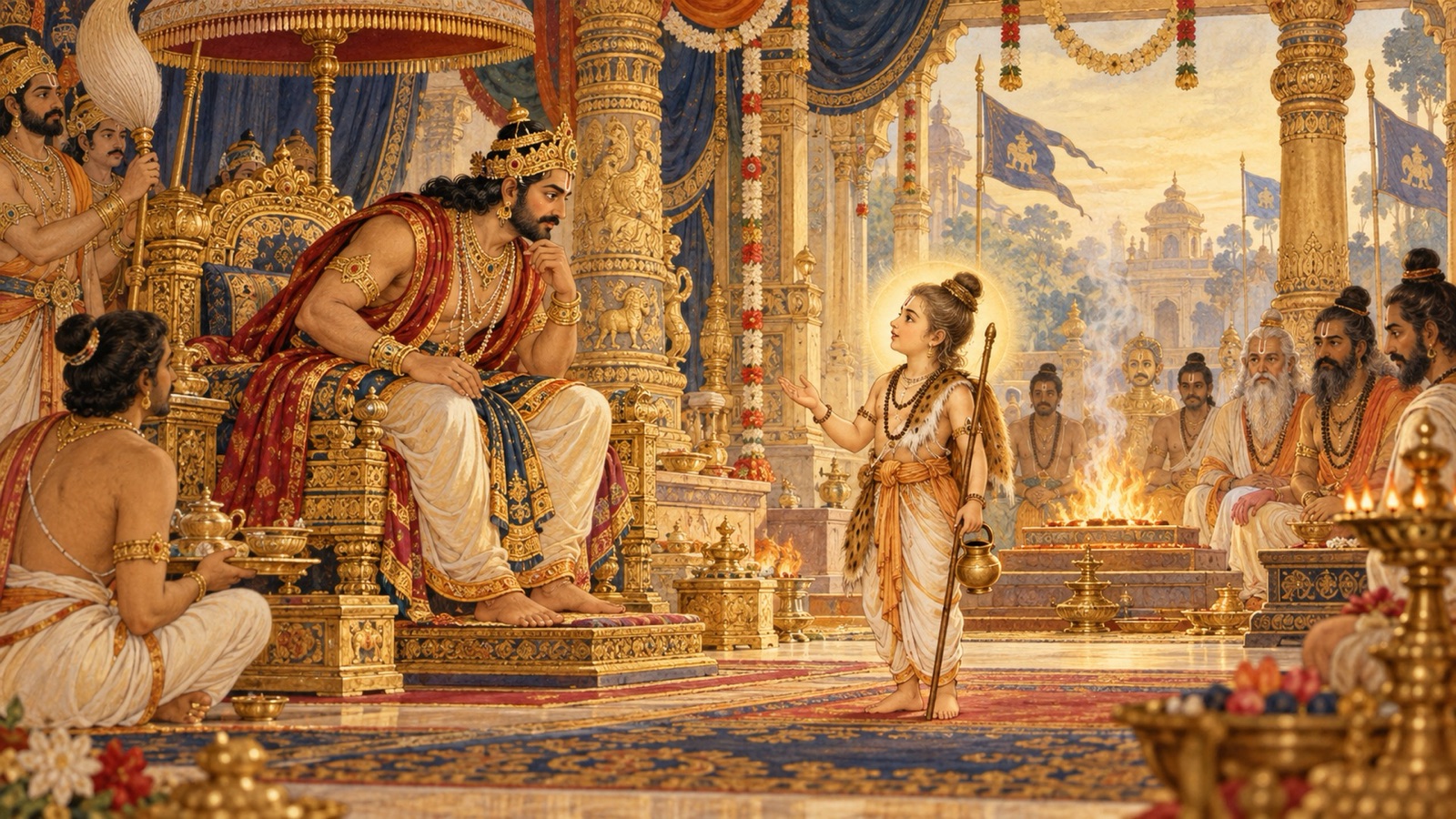
The Supreme Lord is born to Aditi as the divine Dwarf, takes the form of a small brahmana boy, and walks to Bali's sacrifice, where the mighty demon king welcomes Him and offers Him whatever He desires. A faithful, devotional retelling with verified verses.
Continue the Reading →
After twelve days of devotion, the Supreme Lord appears before Aditi and, moved by a mother's love, agrees to be born as her own son. A faithful, devotional retelling with verified verses.
Continue the Reading →
Bereft of heaven, Aditi is counselled by the sage Kashyapa not to seek worldly power but to worship the Supreme Lord through the sacred Payovrata vow of pure devotion. A faithful, devotional retelling with verified verses.
Continue the Reading →
Revived by his preceptors and empowered by sacrifice, the demon king Bali marches upon heaven; the gods withdraw on Brihaspati's counsel, and Bali conquers the three worlds. A faithful, devotional retelling with verified verses.
Continue the Reading →
Sukadeva reveals how the Manus, sages, Indras, and gods govern the universe under the command of the Supreme Person, who Himself works through countless forms in every age. A faithful, devotional retelling with verified verses.
Continue the Reading →
Sukadeva unveils the present and future Manvantaras — the coming Manus, sages, gods, and Indras — and in every age a descent of the Lord, with Bali destined to rule as Indra. A faithful, devotional retelling with verified verses.
Continue the Reading →
Lord Siva comes to Vaikuntha, offers a profound prayer to Vishnu, and asks to behold His enchanting form — only to be momentarily overcome by the Lord's Maya. A faithful, devotional retelling with verified verses.
Continue the Reading →
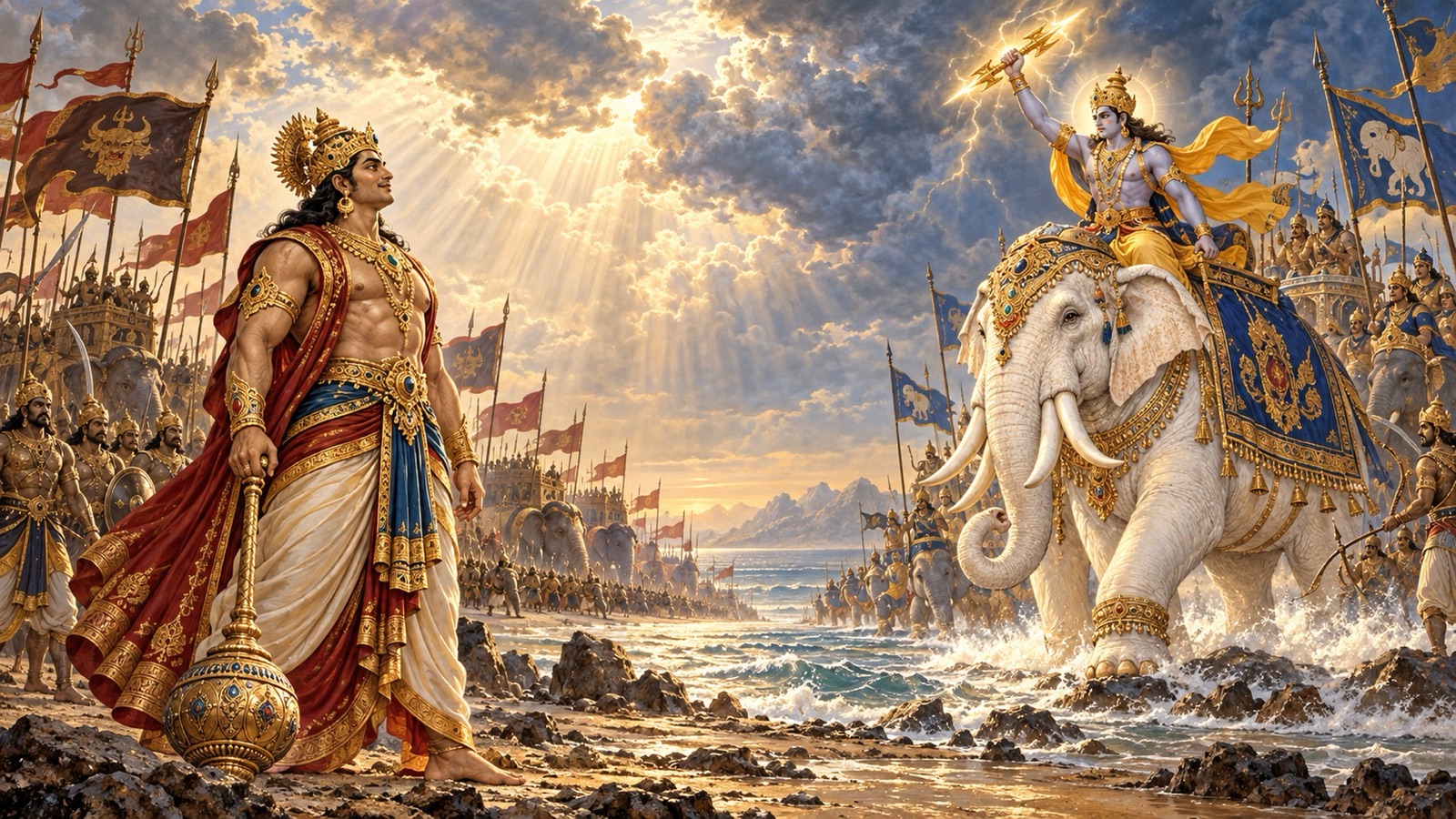
Indra defeats Bali and the demon generals, Namuci falls to the foam of the sea, and Narada halts the war — yet the vanquished Bali, seeing all as the turns of Time, feels no sorrow. A faithful, devotional retelling with verified verses.
Continue the Reading →
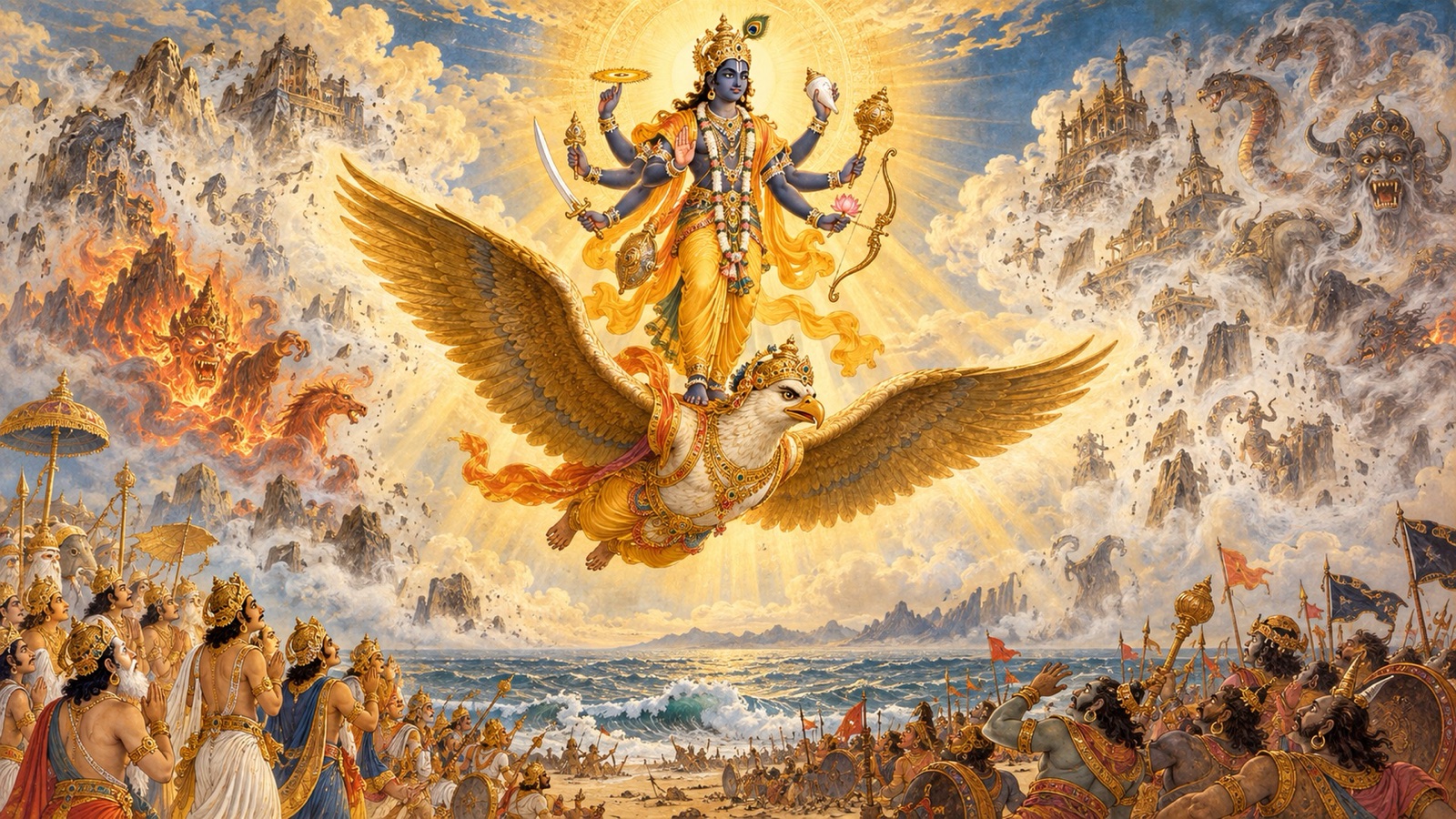
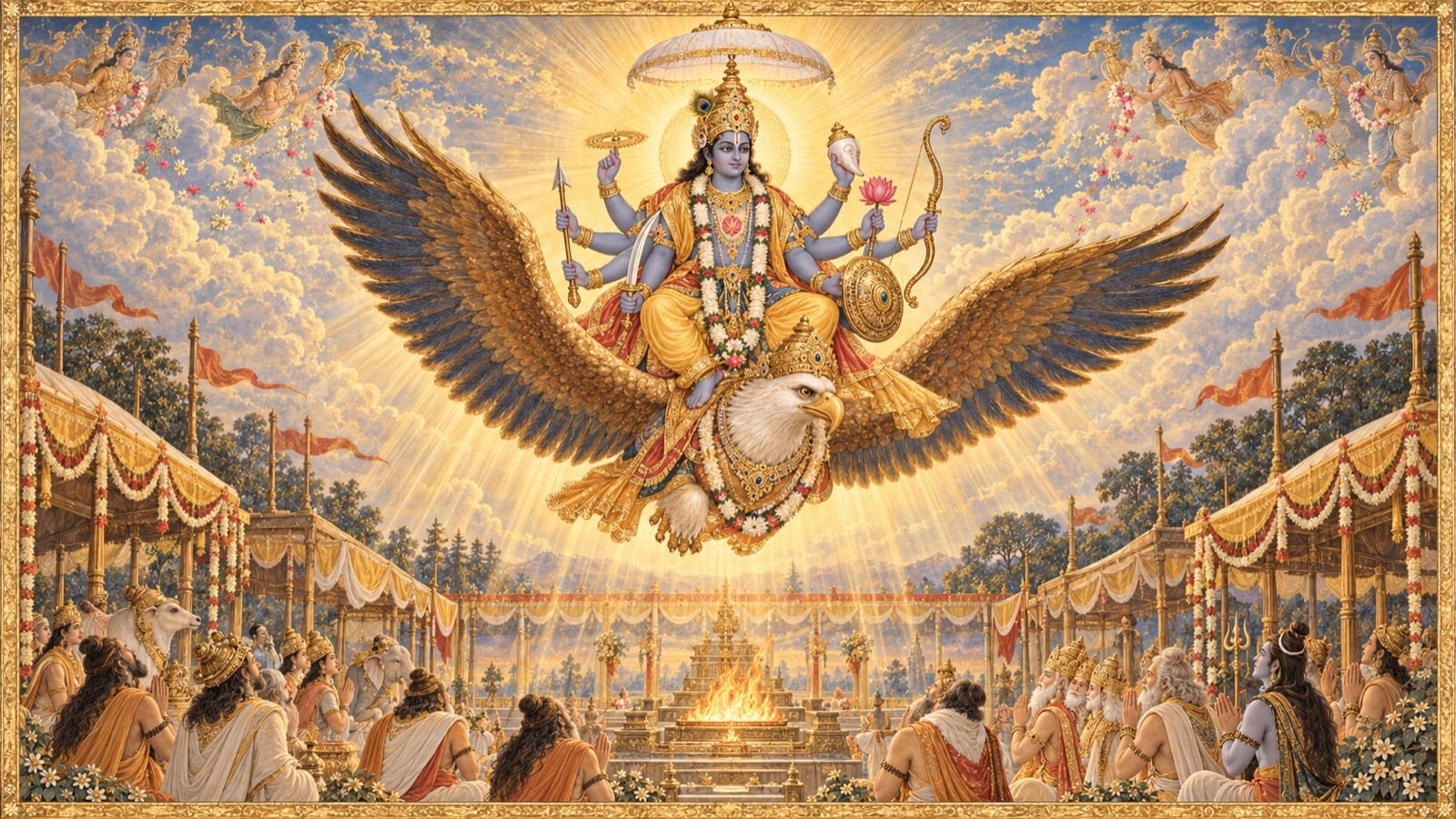
Robbed of the nectar, the demons make war on the gods and conjure terrifying illusions — until the gods remember the Lord, who appears on Garuda and dispels them like a dream. A faithful, devotional retelling with verified verses.
Continue the Reading →
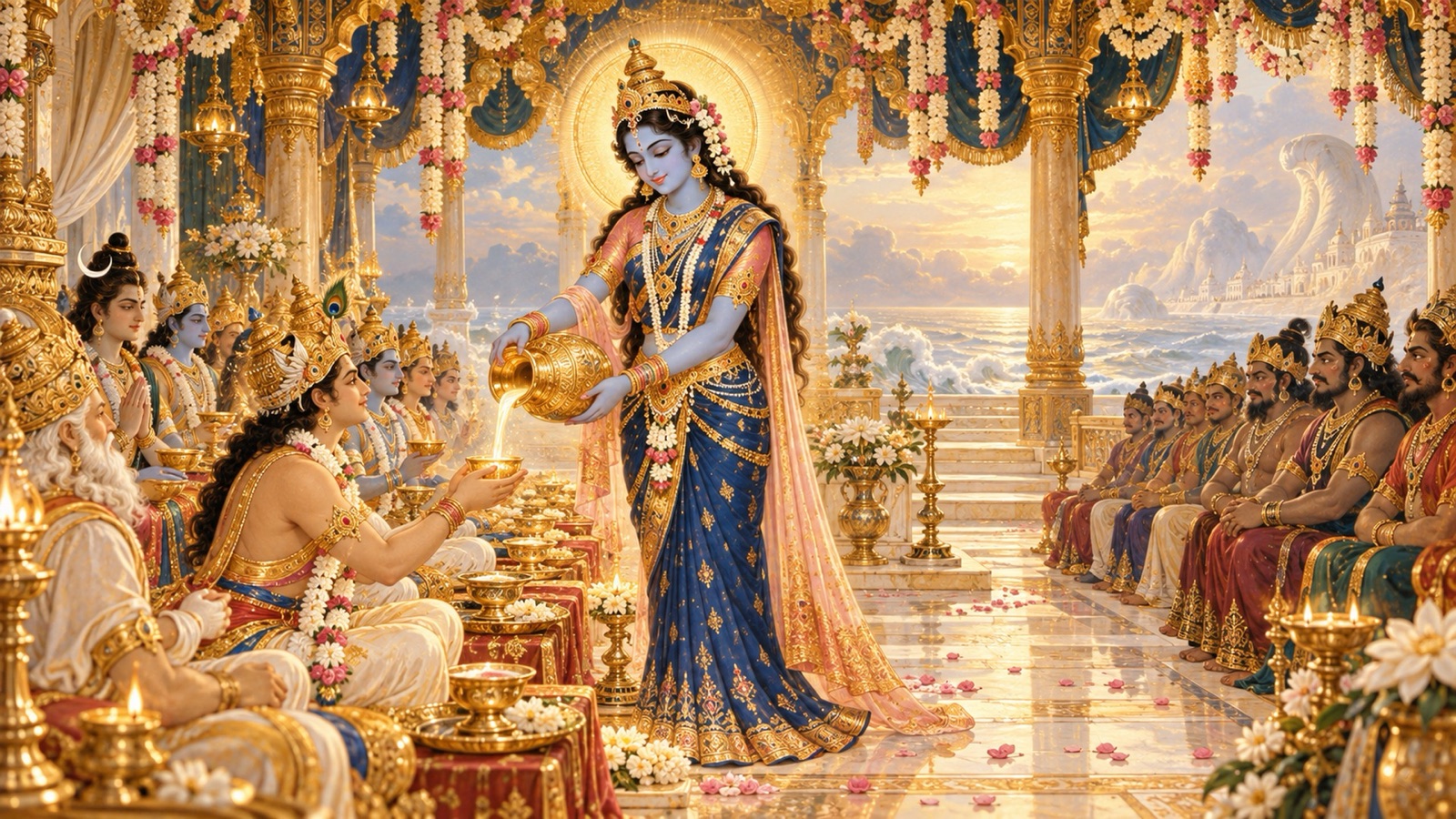
The Lord assumes His wondrous enchanting form to resolve the demons' quarrel over the nectar, delivering it to the gods who took shelter at His feet. A faithful, devotional retelling with verified verses.
Continue the Reading →
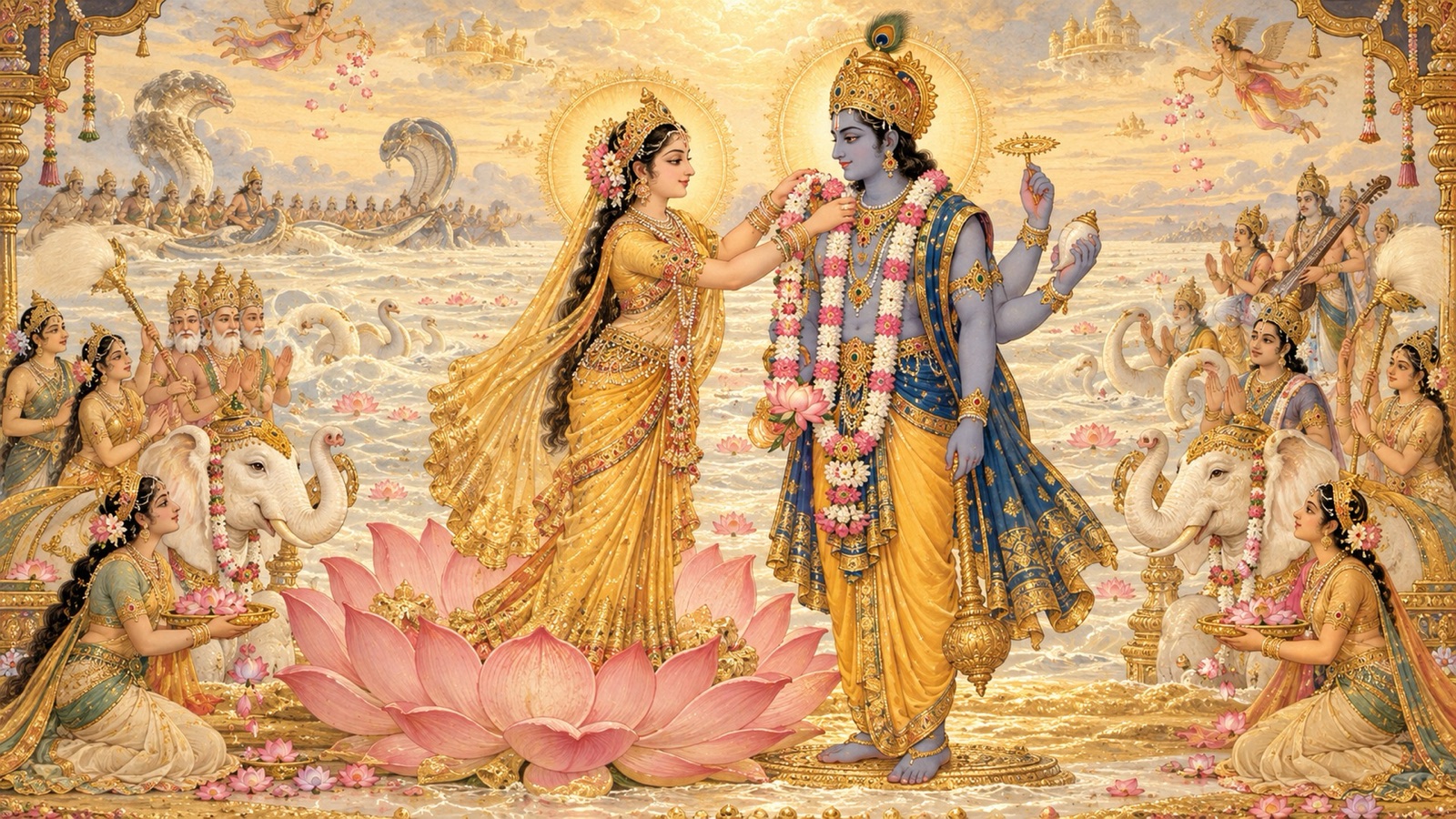
From the churned Ocean of Milk rise the divine treasures and Goddess Lakshmi herself, who searches all creation and chooses Lord Vishnu alone. A faithful, devotional retelling with verified verses.
Continue the Reading →
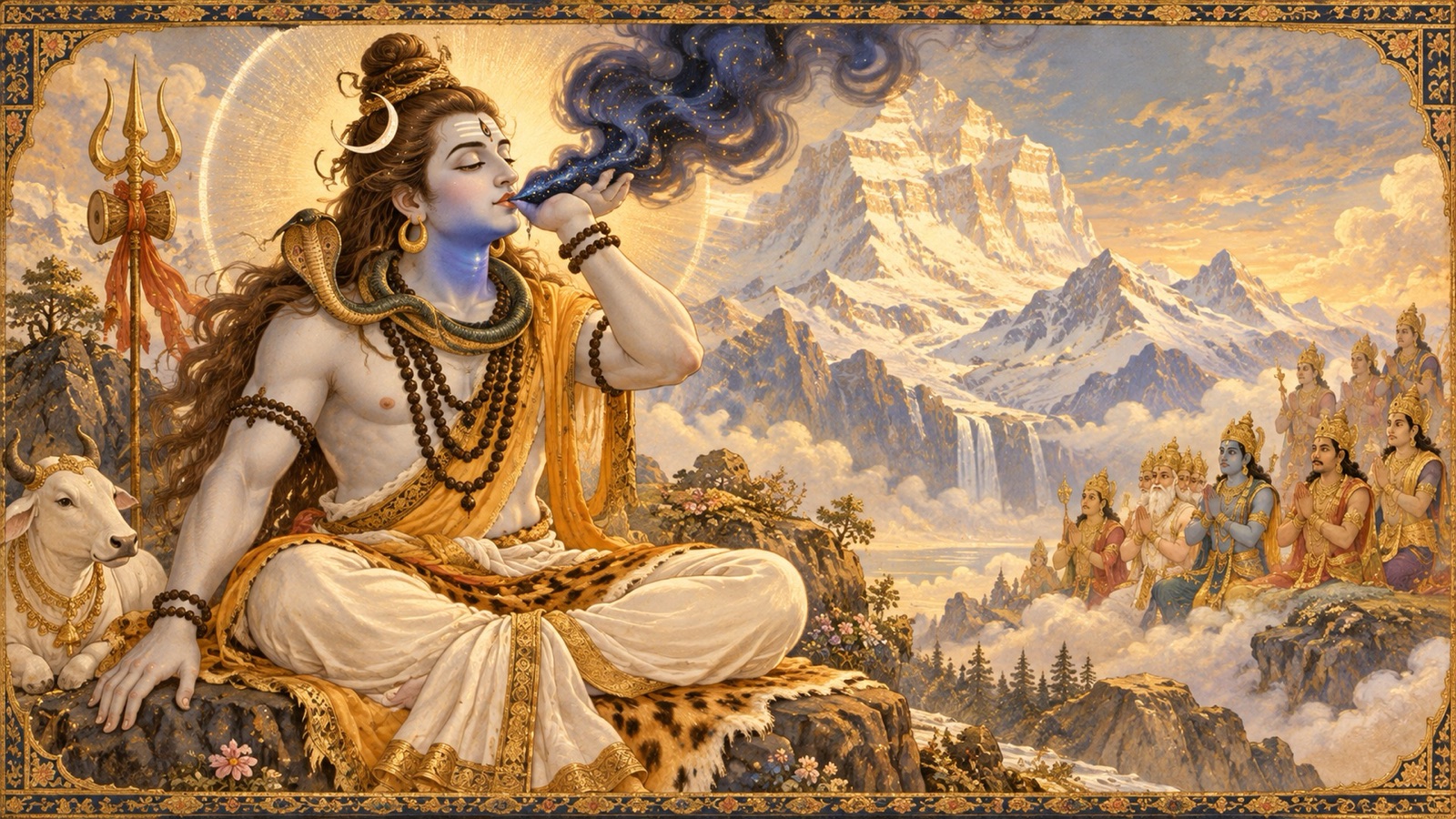
The churning of the Ocean of Milk begins, the Lord sustains it as the divine Tortoise, and when a world-destroying poison rises, Lord Siva drinks it out of pure compassion. A faithful, devotional retelling with verified verses.
Continue the Reading →
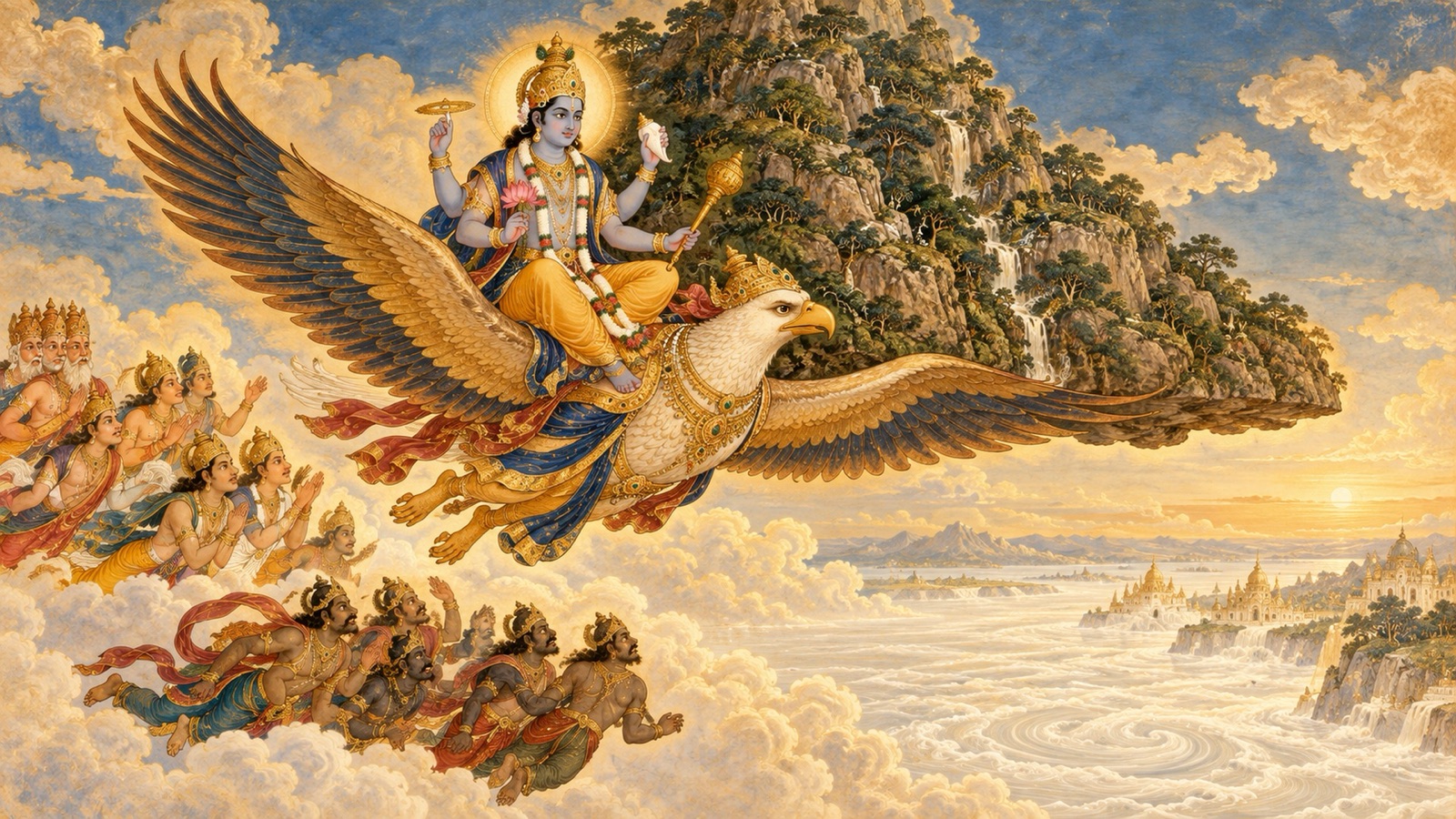
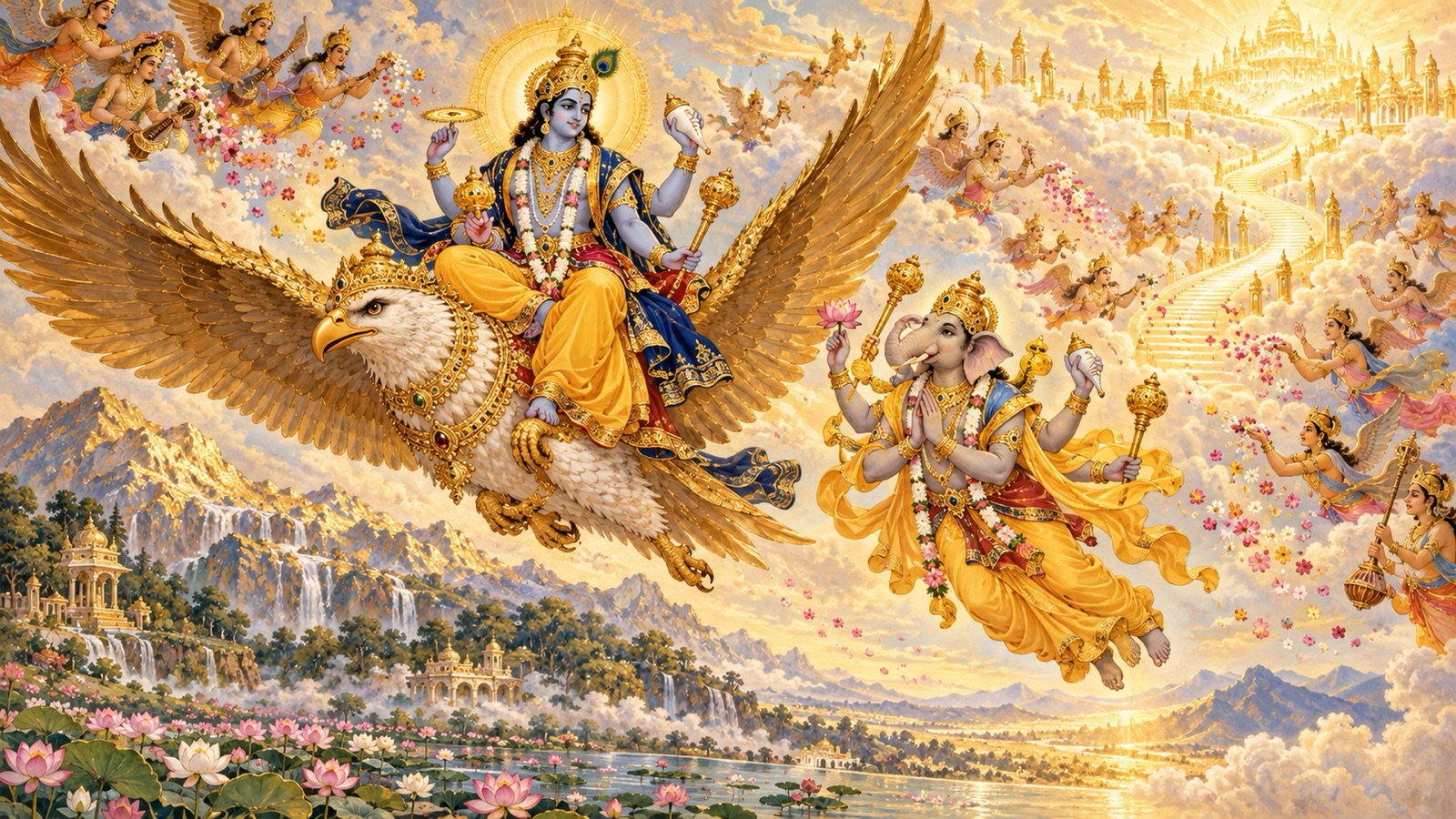
The Lord appears radiant as a thousand suns, plans the churning of the Ocean of Milk with Mount Mandara and Vasuki, and carries the fallen mountain to the sea upon Garuda. A faithful, devotional retelling with verified verses.
Continue the Reading →
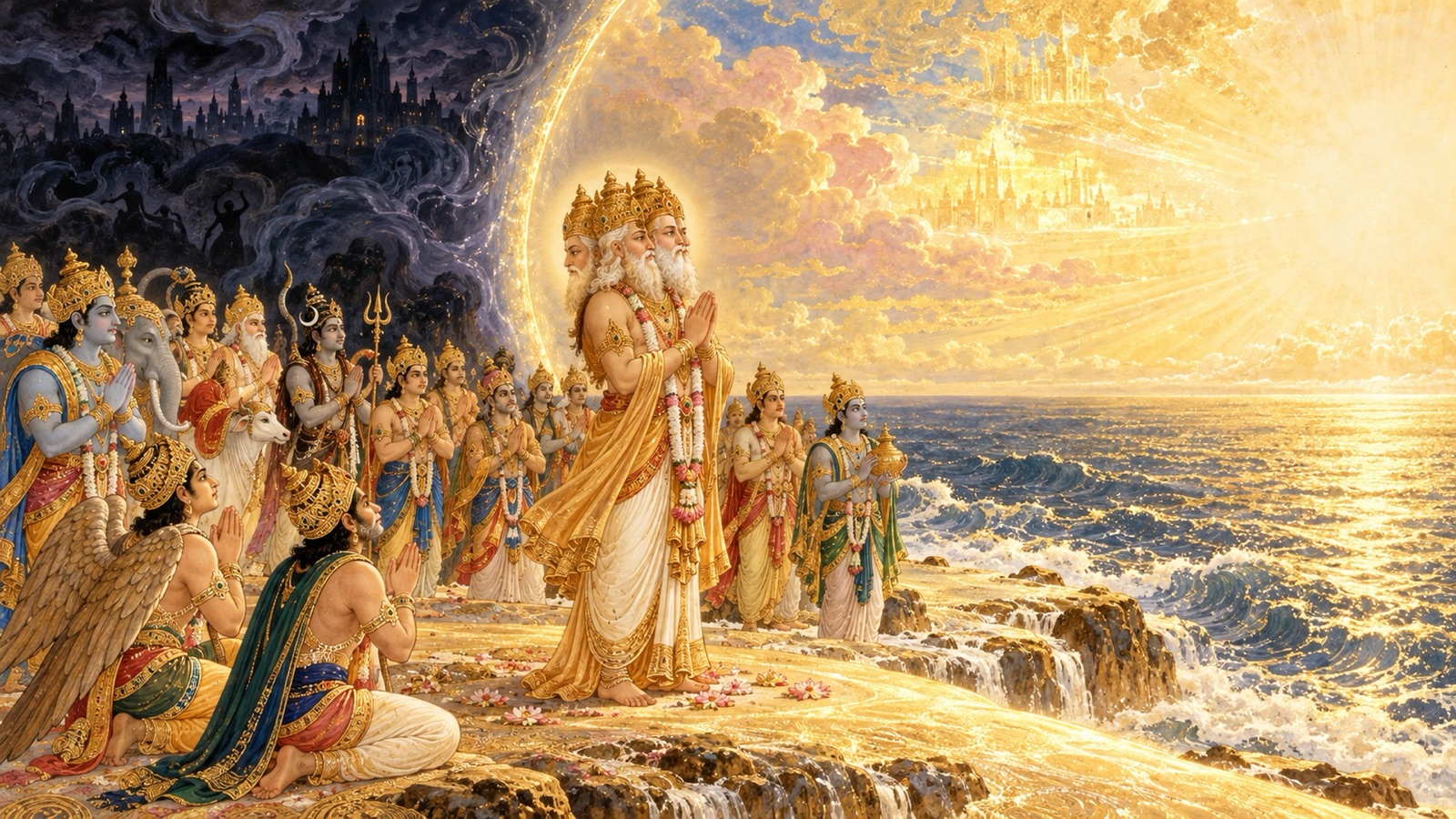
Ruined by Durvasa's curse and defeated by the demons, the gods take refuge in Brahma, who leads them to the shore beyond illusion and offers a majestic hymn to the Lord. A faithful, devotional retelling with verified verses.
Continue the Reading →
The alligator is revealed as the redeemed Gandharva Huhu and the elephant as the devoted King Indradyumna. Touched by the Lord, Gajendra attains a divine form and ascends to Vaikuntha. A faithful, devotional retelling with verified verses.
Continue the Reading →
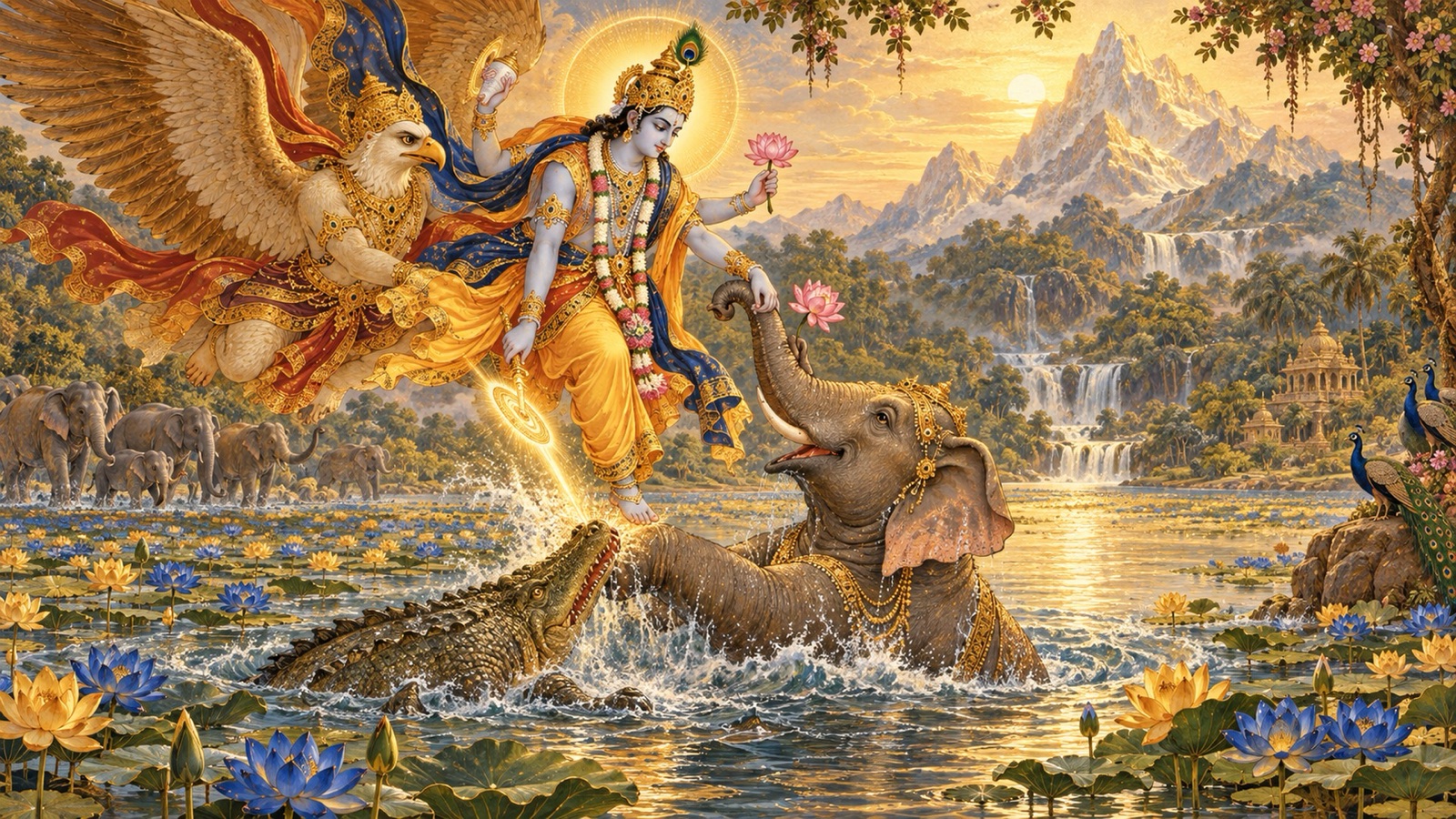
From the depths of the lake, the dying elephant king recites the immortal hymn of surrender to the formless Supreme Lord — and Sri Hari descends on Garuda to lift him from death. A faithful, devotional retelling with verified verses.
Continue the Reading →
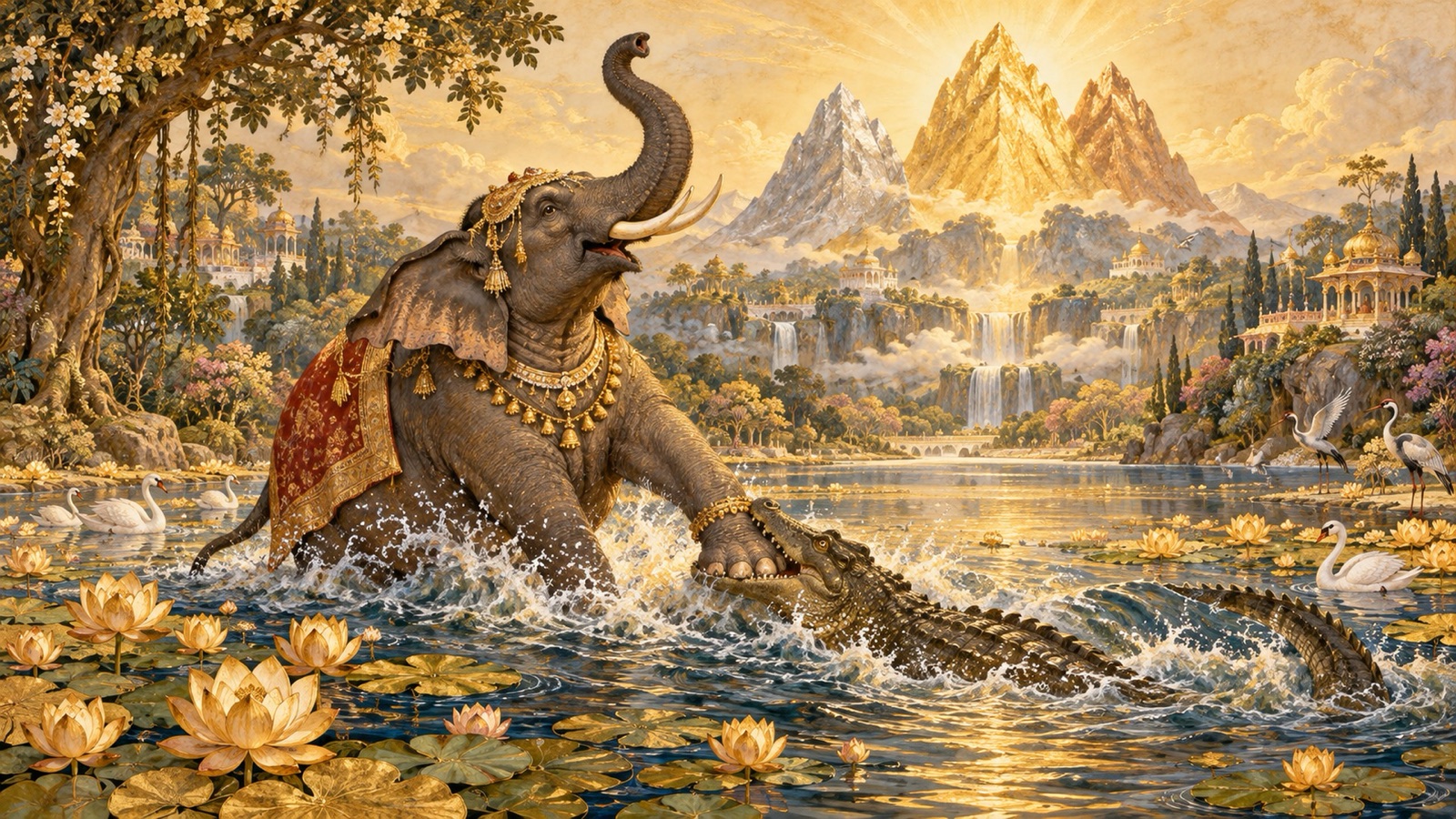
In Varuna's golden-lotus lake the mightiest of elephants is seized by an alligator, and after a long, hopeless struggle he resolves to seek shelter in the Supreme Lord. A faithful, devotional retelling with verified verses.
Continue the Reading →
The Eighth Canto opens as Sukadeva describes the Manvantaras — the great cosmic ages — and the Lord's descent as Yajna, Vibhu, Satyasena, and Sri Hari in each age to protect the world. A faithful, devotional retelling with verified verses.
Continue the Reading →
The Sixth Canto closes with the Pumsavana vow, a gentle manual of household devotion to Lord Vishnu and Goddess Lakshmi, worshipped not out of His need but out of love. A faithful retelling with verified verses.
Continue the Reading →
A grieving mother's vow of vengeance against Indra is overturned by the grace of Lord Vishnu; her forty-nine sons rise as the radiant Maruts and become Indra's own brothers. A faithful retelling with verified verses.
Continue the Reading →
A thoughtless remark before Lord Siva and Parvati brings Citraketu a curse, which he accepts without anger or fear; Lord Siva praises the devotee, revealing how Citraketu became Vritra. A faithful retelling with verified verses.
Continue the Reading →
The departed prince teaches that family ties are passing roles; Citraketu beholds Lord Sankarshana, his sins dissolved by the sight, and the Lord reveals Himself as the Self of all. A faithful retelling with verified verses.
Continue the Reading →
The sages Angira and Narada turn Citraketu's grief into wisdom, teaching that beings are joined and parted by Time, that every possession is sorrow, and that the soul is deathless. A faithful retelling with verified verses.
Continue the Reading →
An emperor who rules the whole earth is undone by one empty cradle; his longed-for son is granted and then taken by death. A faithful retelling with verified verses.
Continue the Reading →
Victory brings Indra no peace; haunted by the sin of slaying a Brahmana, he takes refuge in the Lord and is purified through the horse-sacrifice and the holy Name. A faithful retelling with verified verses.
Continue the Reading →
Even as he dies, Vritra teaches Indra that the Lord alone, as Time, grants victory and defeat; and when the thunderbolt falls, his soul merges into the Lord. A faithful retelling with verified verses.
Continue the Reading →
Facing the thunderbolt of Indra, the demon Vritra pours out one of the purest prayers of surrender in the Bhagavata, asking for nothing but the endless service of the Lord. A faithful retelling with verified verses.
Continue the Reading →
The sage Dadhici surrenders his very body, the thunderbolt is forged from his bones, and Indra rides to war with Vritra on the bank of the Narmada. A faithful retelling with verified verses.
Continue the Reading →
Narada gathers the whole path of right conduct — non-violence, contentment, meditation, and mastery of the inner enemies — and then unveils the secret hidden in plain sight: that Sri Krishna, seated among the Pandavas as friend and kinsman, is the Supreme Brahman Himself. The glorious close of the Seventh Canto, retold faithfully with verified verses.
Continue the Reading →
Yudhishthira asks how a householder bound to home can reach God. Narada answers that a home, too, can be a temple — by performing every duty as an offering to the Lord, keeping the company of saints, cherishing even animals as one's own children, and worshipping the Lord present within all beings. A faithful, devotional retelling with verified verses.
Continue the Reading →
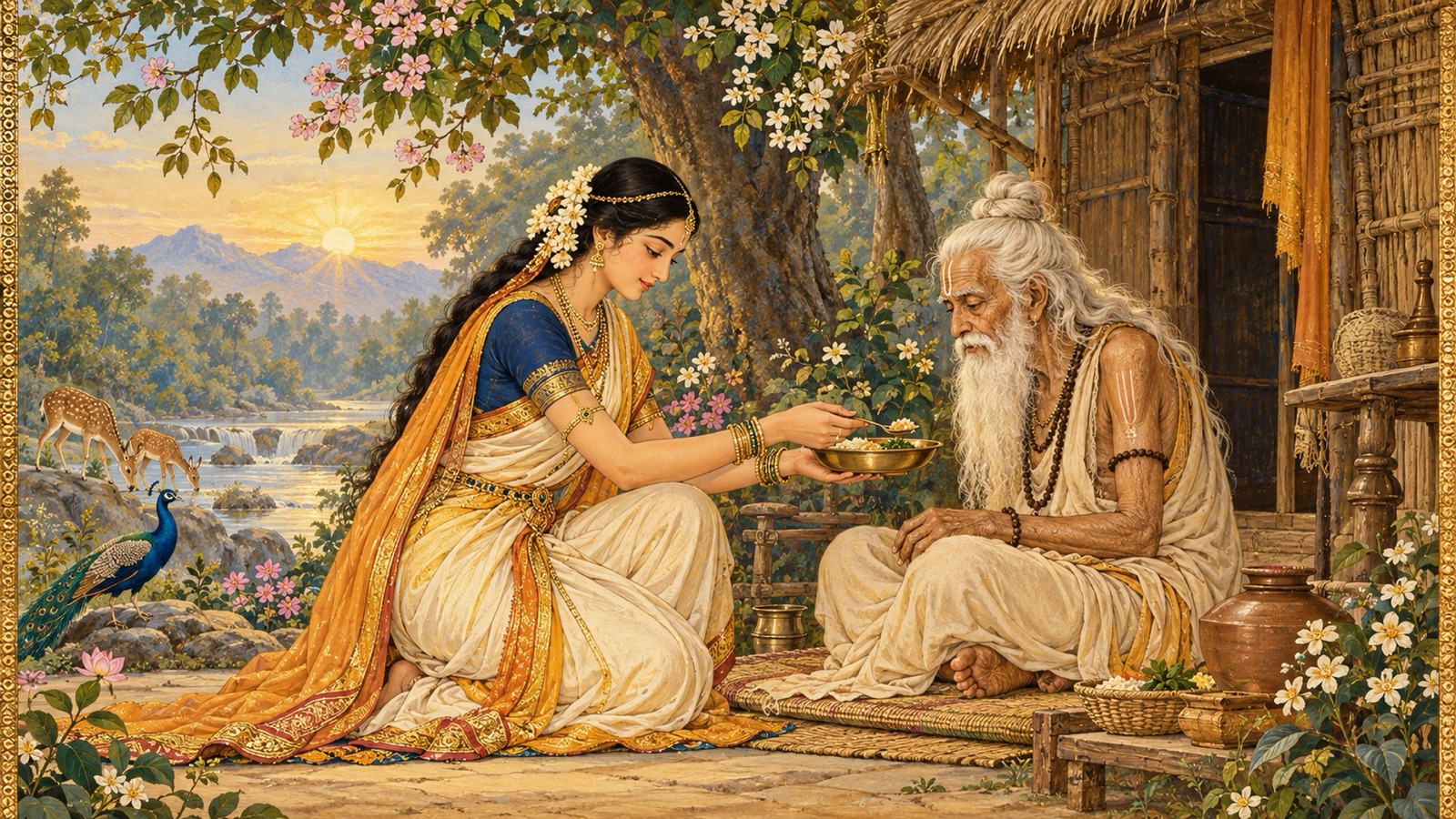
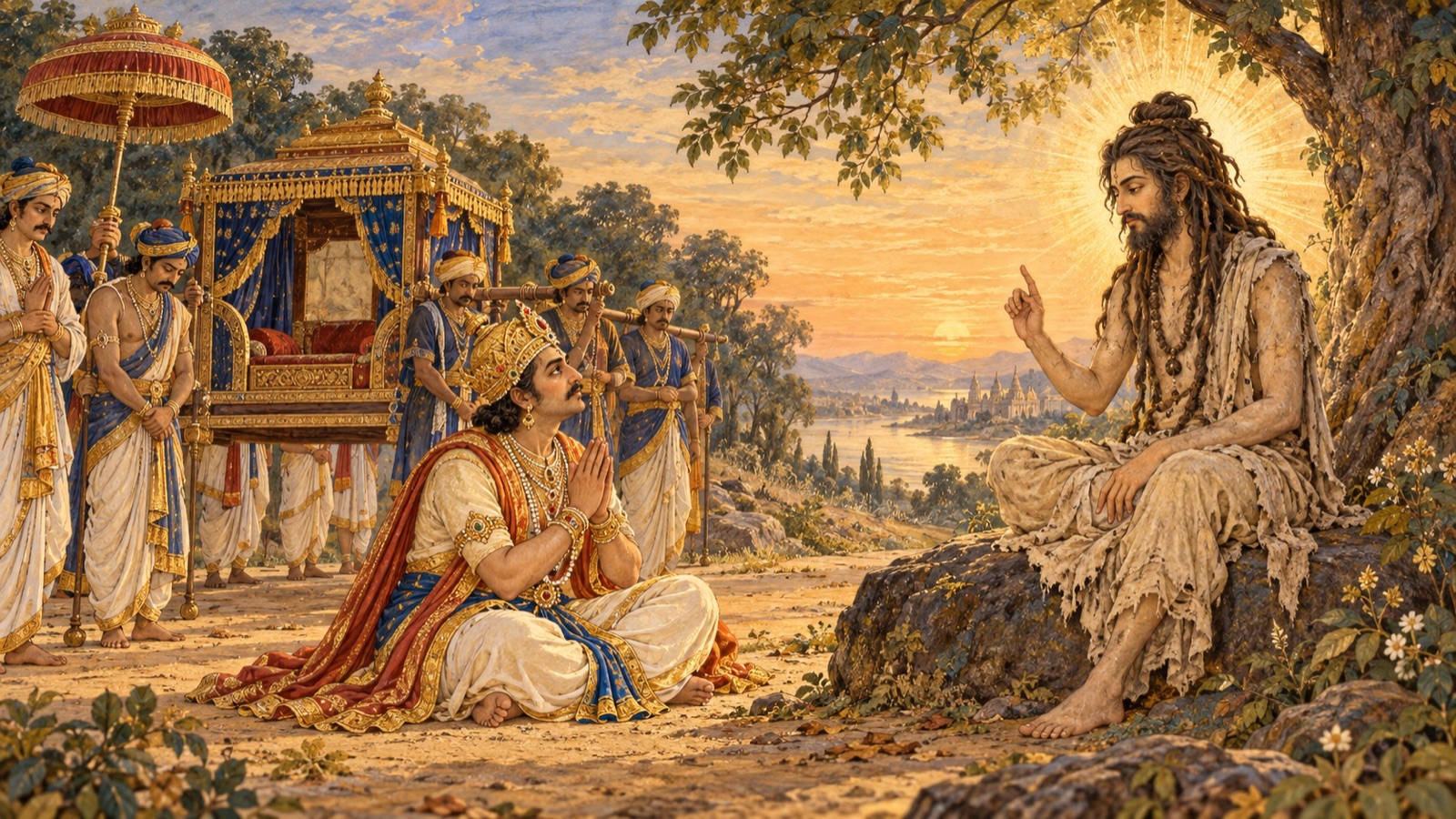
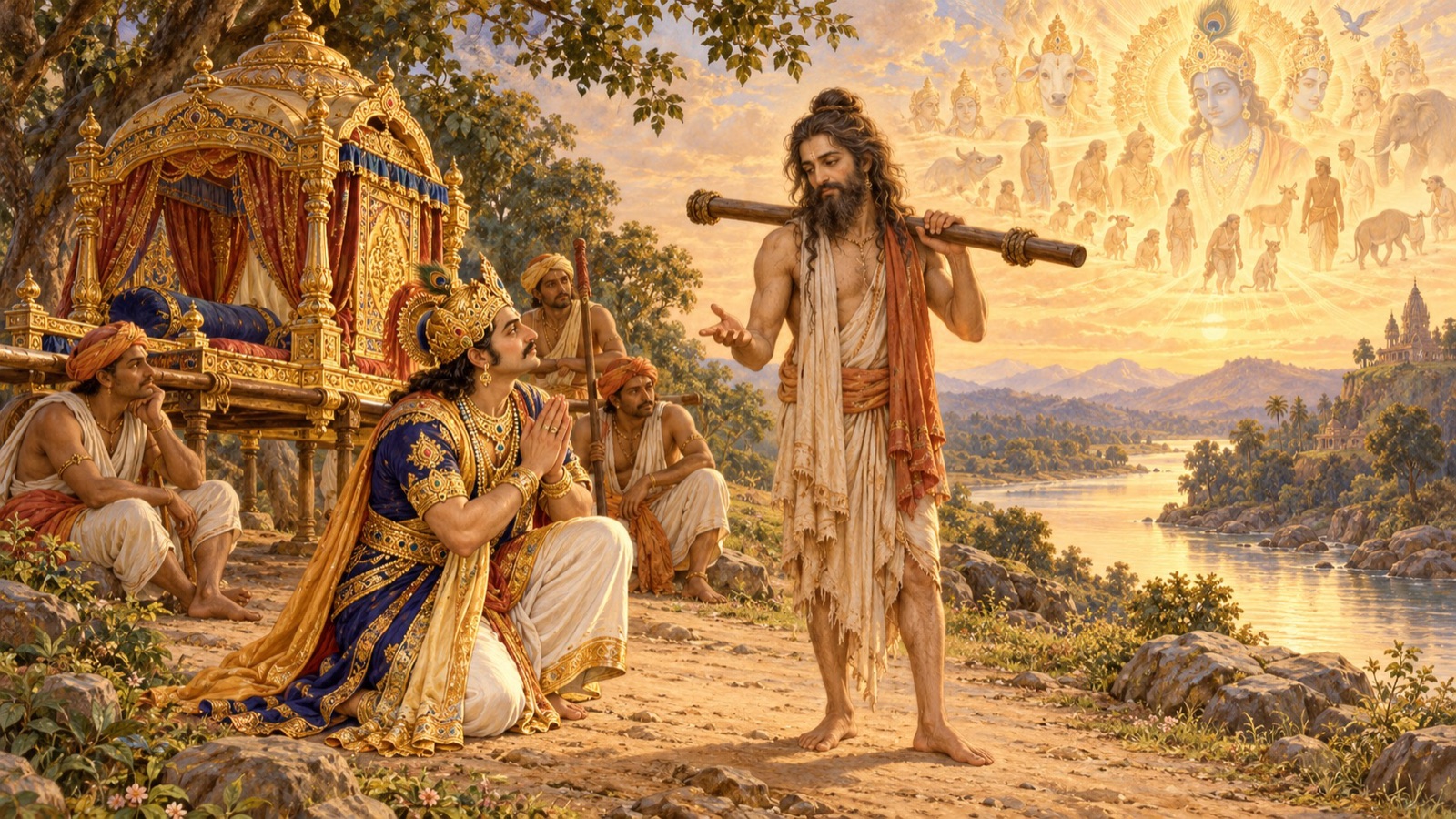
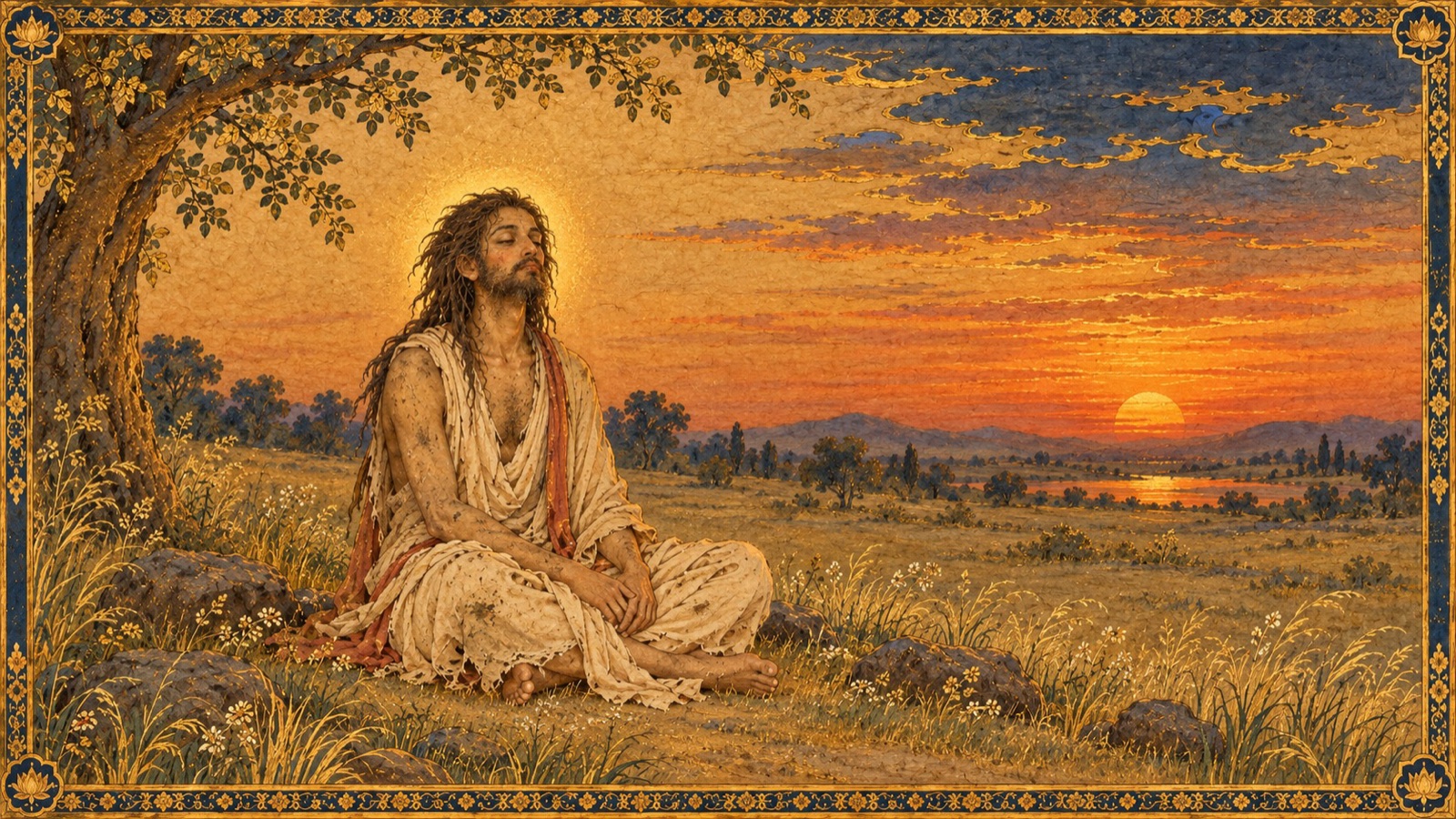
Narada describes the wandering renunciant devoted to Narayana, then tells how the devotee-king Prahlada met a dust-covered saint who owned nothing yet possessed perfect peace. The saint's teaching on the futility of greed and the bliss of the Self — learned from the bee and the python — is one of the Bhagavatam's great lessons in contentment. A faithful, devotional retelling with verified verses.
Continue the Reading →
Narada describes the disciplined life of the celibate student, the vigilant mastery of desire, and the austere path of the forest-dweller — teaching that whatever stage of life one enters, the goal is the same: to see the Lord present within the fire, the teacher, the self, and all beings. A faithful, devotional retelling with verified verses.
Continue the Reading →
Moved by Prahlada's example, Yudhishthira asks how a human being should live. Narada answers with one of scripture's clearest maps of sanatana-dharma — the thirty virtues that belong to every soul, the duties and qualities of the four orders, and the truth that character outweighs birth. A faithful, devotional retelling with verified verses.
Continue the Reading →
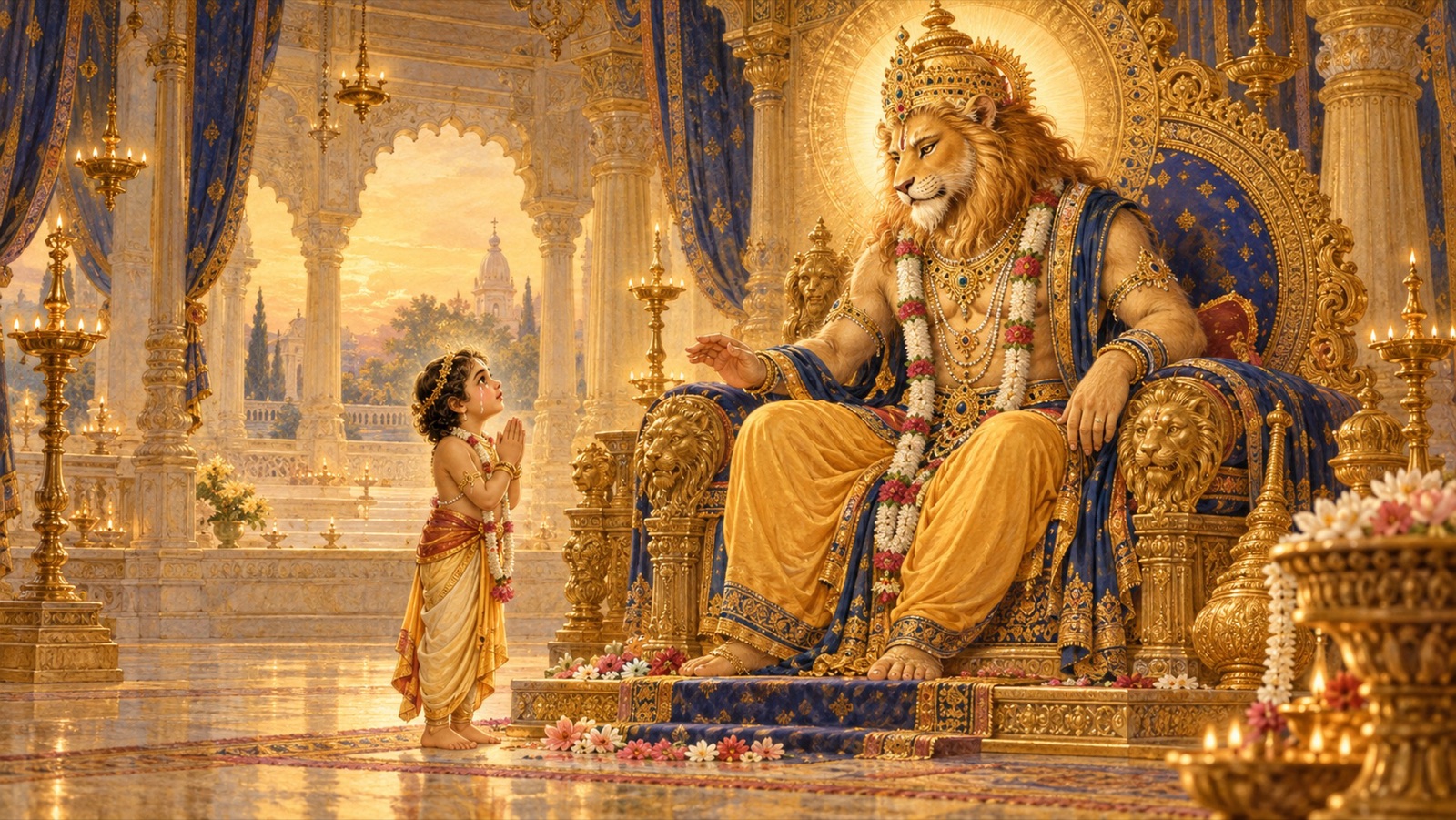
Offered any boon by the Lord, the child Prahlada declines every worldly gift, asking only that desire never again take root in his heart — then prays for his father's forgiveness. The Lord names him the model of all devotees and crowns him a righteous king. A faithful, devotional retelling with verified verses.
Continue the Reading →
When the gods dare not approach the wrathful Lord, the child Prahlada bows at His feet and is lifted up by His own hand. His prayer — that devotion alone wins God, that he fears nothing for himself, and that he cannot be saved while others wander lost — is one of the great prayers of the Bhagavatam. A faithful, devotional retelling with verified verses.
Continue the Reading →
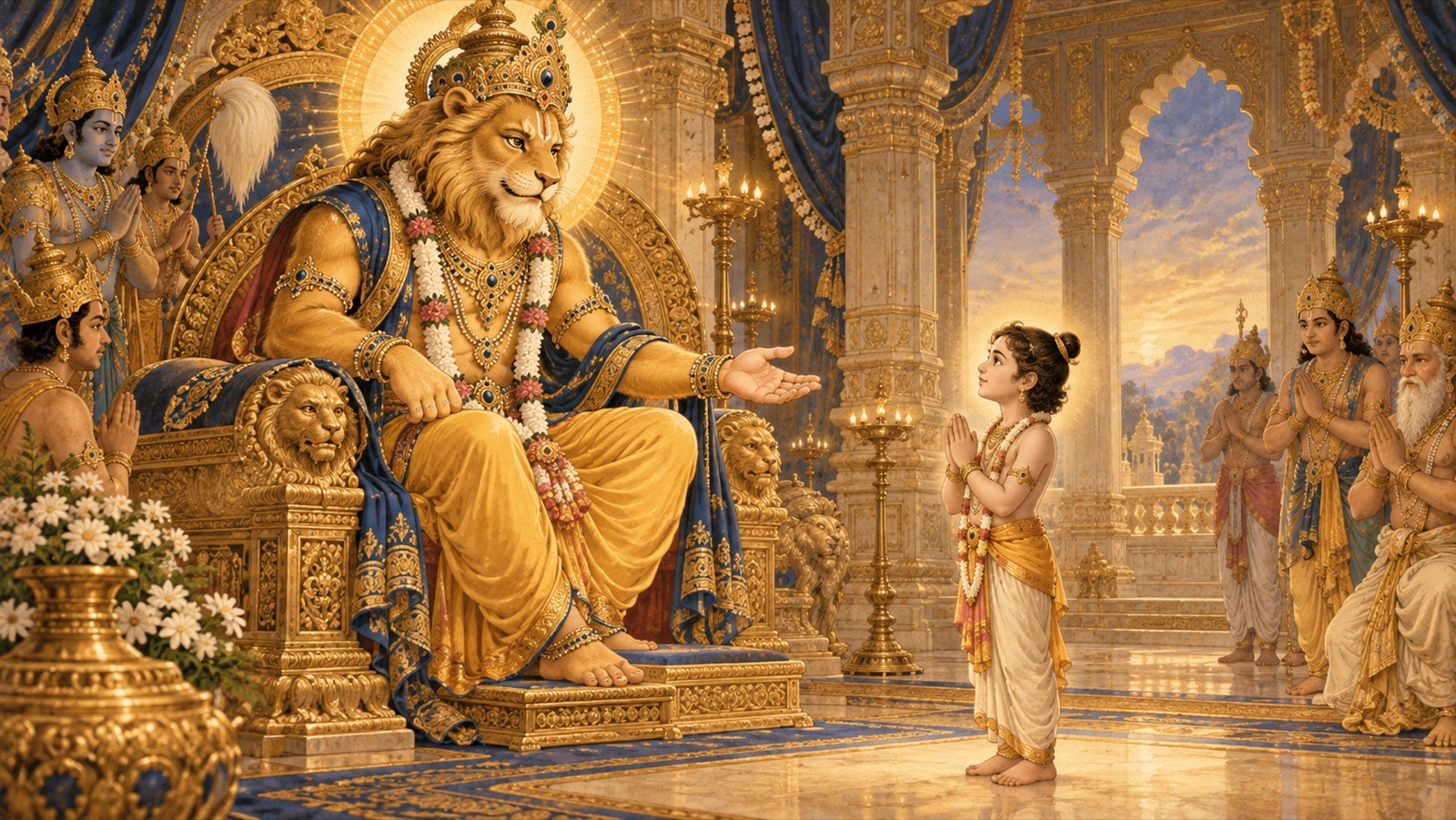
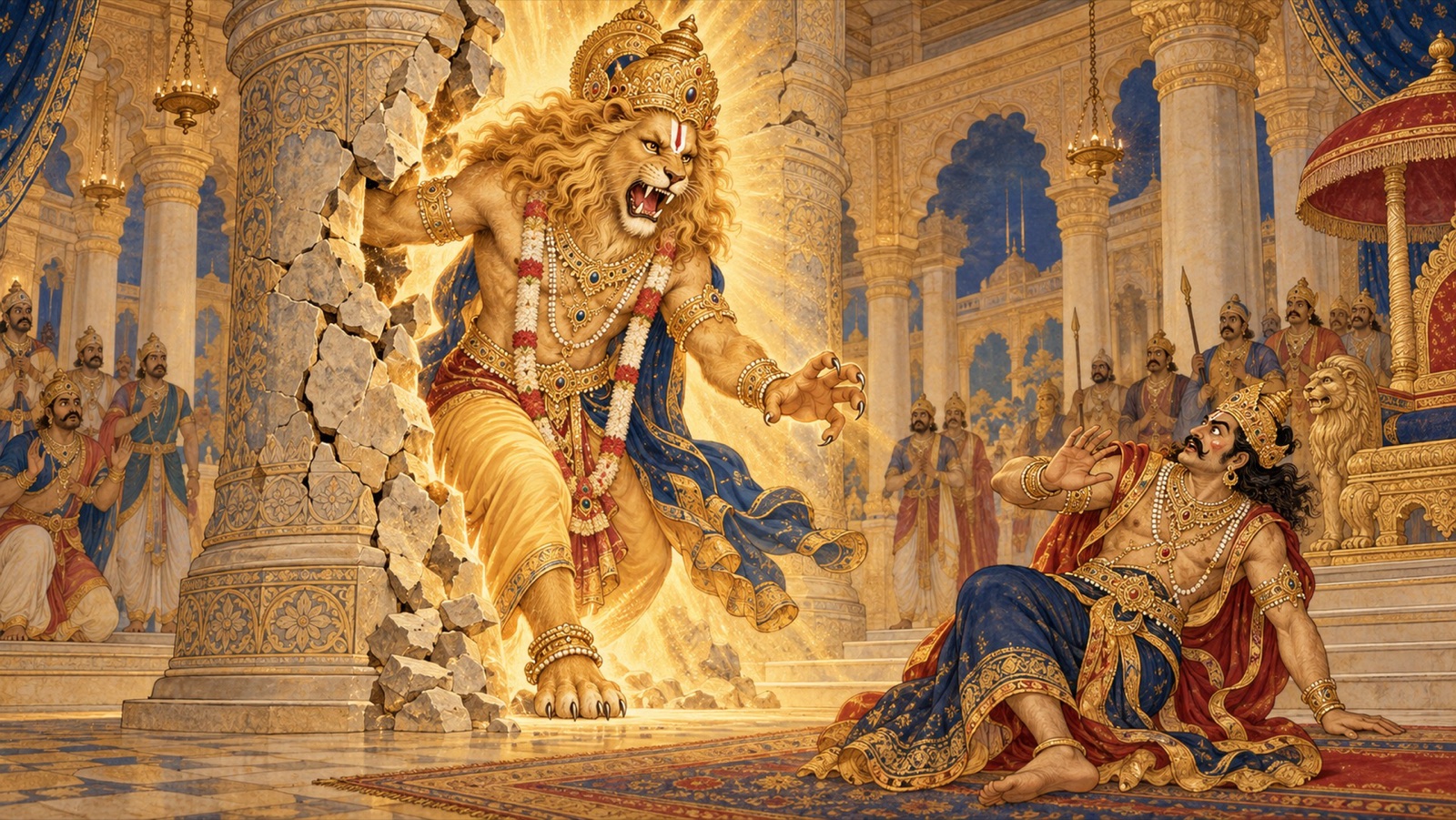
The climax of Prahlada's story: when Hiranyakasipu mocks the presence of God and strikes a pillar, the Lord bursts forth in His wondrous Man-Lion form, fulfils every clause of an unbreakable boon, protects His devotee, and the gods offer prayers of gratitude. A faithful, dignified retelling with verified verses.
Continue the Reading →
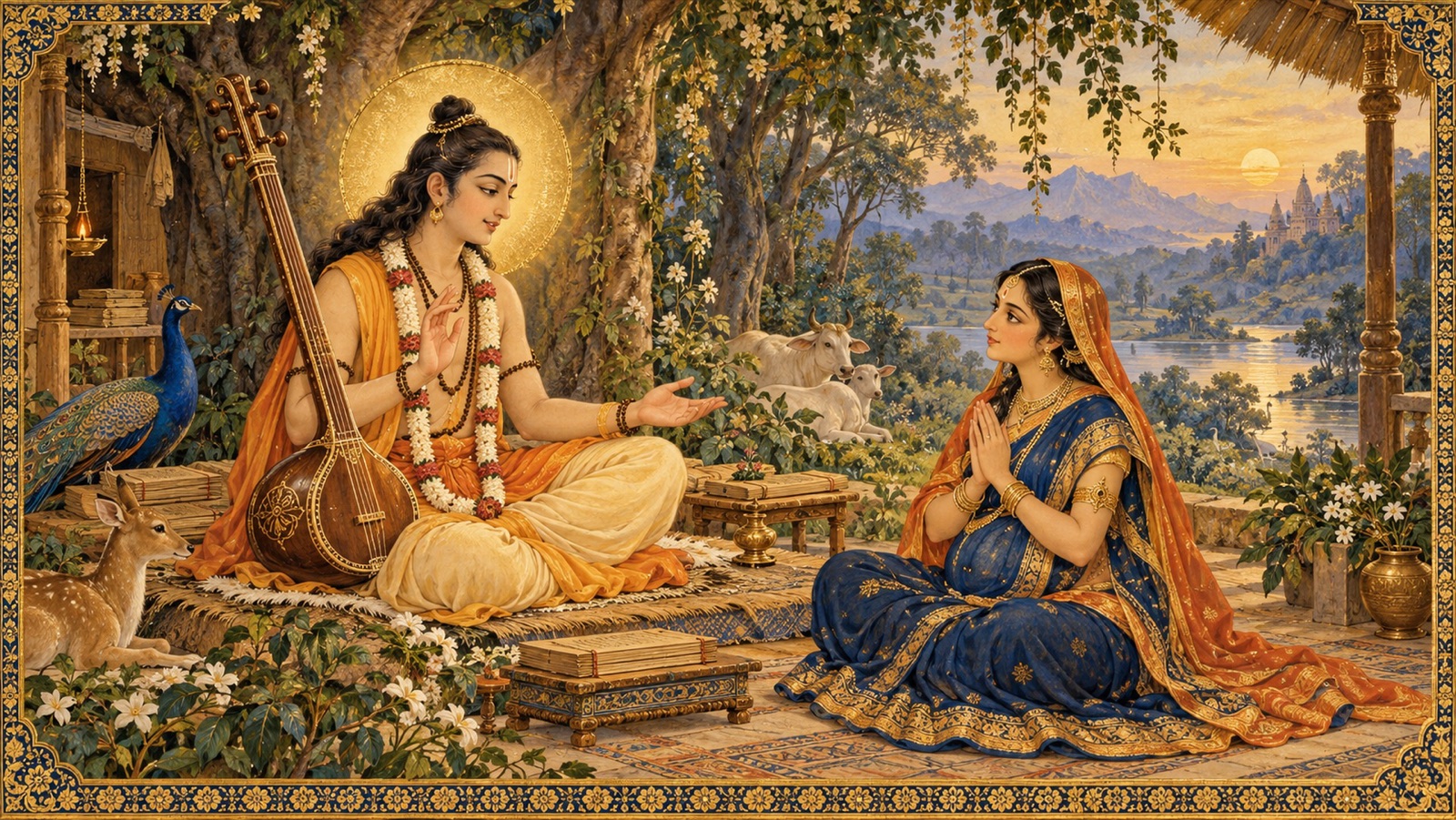
Prahlada answers how he received wisdom as an infant: the sage Narada rescued his pregnant mother, sheltered her, and taught her the science of the soul — and the unborn child heard every word. A faithful, devotional retelling with verified verses on the eternal soul and pure devotion open to all.
Continue the Reading →
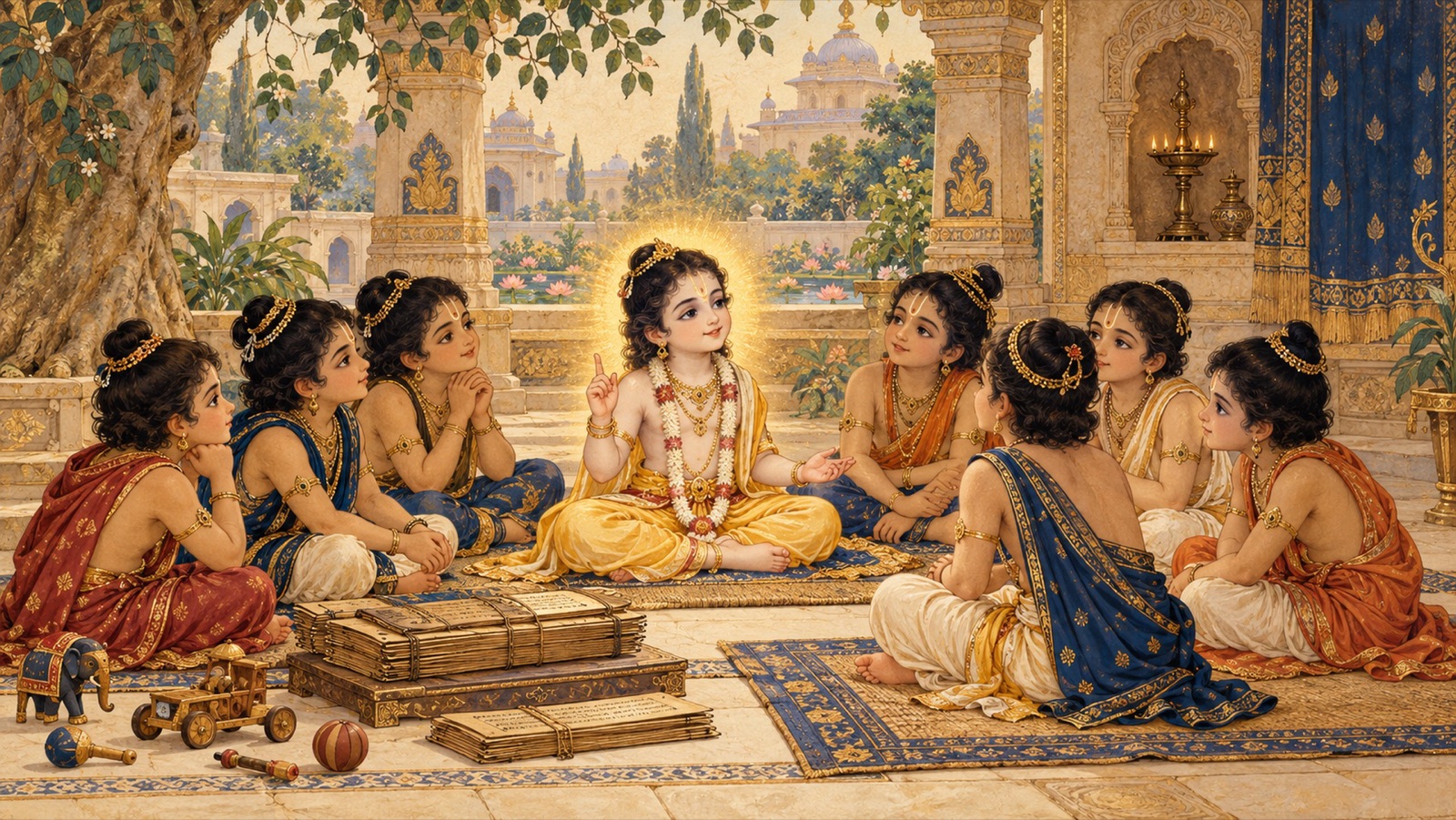
In the demons' own schoolroom, the child Prahlada teaches his companions to begin devotion in their very childhood, to see the emptiness of chasing pleasure and wealth, and to take refuge in Lord Narayana while showing compassion to all beings. A faithful, devotional retelling with verified verses, including the celebrated verse 'kaumara acaret prajno'.
Continue the Reading →
Sent to the demons' teachers, the saintly child Prahlada declares that the highest good is to take refuge in Sri Hari and teaches the celebrated nine forms of loving devotion — while his enraged father Hiranyakasipu tries, and fails, to take his life by spear, poison, fire, and flood. A faithful, devotional retelling with verified verses.
Continue the Reading →
Armored in Brahma's boon, Hiranyakasipu conquers the three worlds and seizes the throne of Indra, yet finds no contentment — while the oppressed worlds cry to Lord Vishnu, who promises deliverance, and the saintly Prahlada is born in the demon's own house. A faithful, devotional retelling with verified verses.
Continue the Reading →
Determined to conquer death, Hiranyakasipu performs an austerity so fierce it scorches the worlds and drives the gods to Brahma for refuge — then asks the Creator for a cleverly worded boon of near-immortality that seems to seal off every door through which death might enter. A faithful, devotional retelling with verified verses.
Continue the Reading →
After Hiranyaksa's death, the demon king Hiranyakasipu swears vengeance and ravages the earth — yet consoles his grieving mother Diti with a sublime teaching on the deathless soul and the ancient legend of King Suyajna and Yama the child. A faithful, devotional retelling with verified verses.
Continue the Reading →
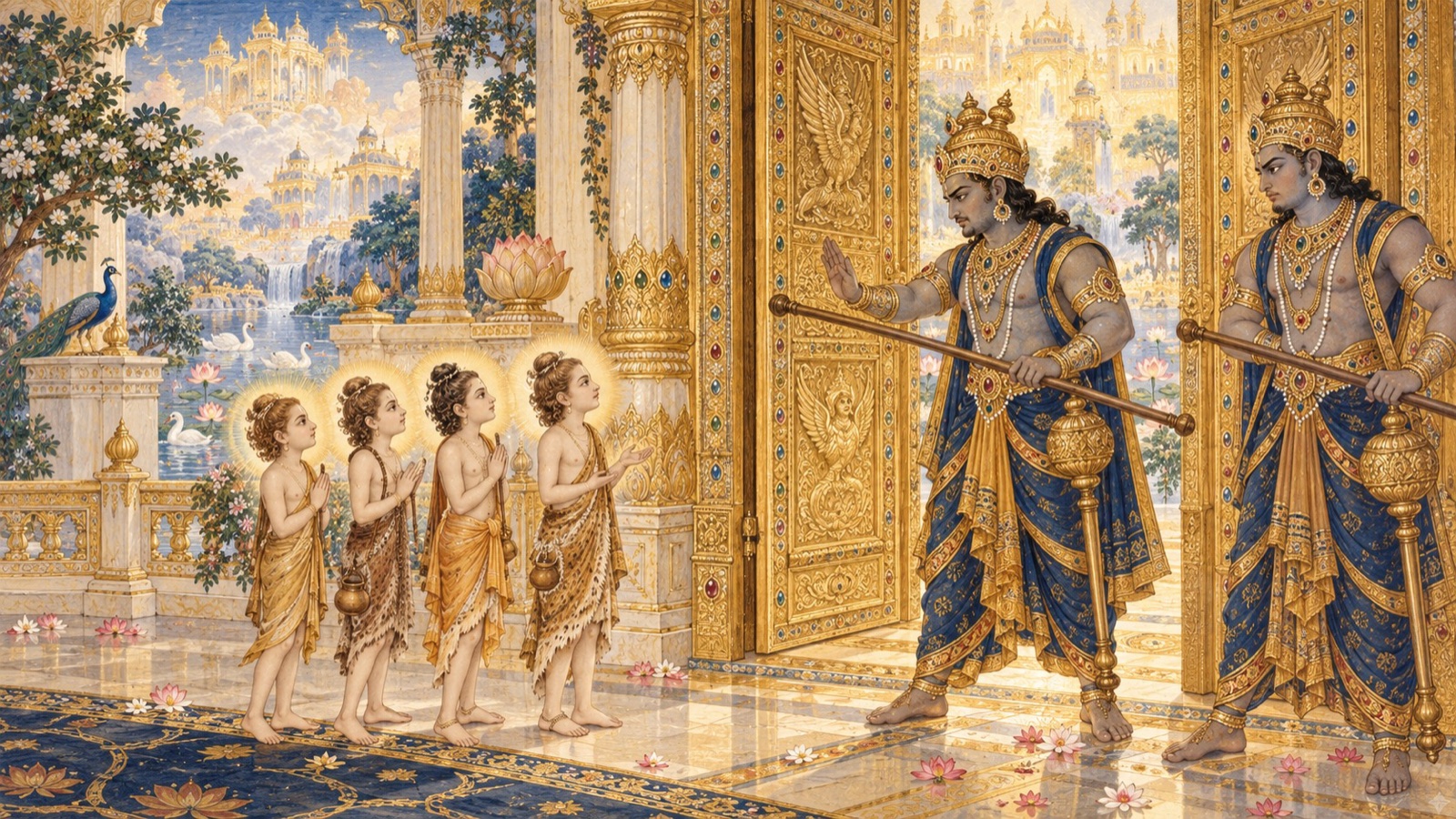
The Seventh Canto opens with King Parikshit's honest doubt: if God is equal to all, why does He slay demons for the gods? Sukadeva's luminous reply, Narada's secret of the mind fixed on the Lord, and the story of the Vaikuntha gatekeepers Jaya and Vijaya — a faithful, devotional retelling with verified verses.
Continue the Reading →
The colossal demon Vritra rises from a grieving father's sacrifice and swallows the weapons of the gods, who at last surrender to Lord Narayana; the Lord reveals the path of victory through the sage Dadhici's sacrifice. A faithful retelling with verified verses.
Continue the Reading →
The Narayana-kavaca, the armour of the Lord's names and forms, calls upon each of Vishnu's incarnations to guard the devotee in water, land, and air, through every hour and danger. A faithful retelling with verified verses.
Continue the Reading →
A single lapse of respect topples the king of heaven; the gods, defeated by the demons, are counselled by Brahma to seek the sage Visvarupa, whose prayer to Vishnu restores their fortune. A faithful retelling with verified verses.
Continue the Reading →
Daksha's sixty daughters become the mothers of gods and demons, birds and beasts, herbs and serpents — and in the line of Aditi, Narayana Himself descends. A faithful retelling with verified verses.
Continue the Reading →
Narada's riddles turn Daksha's ten thousand and then a thousand sons toward liberation; the grieving father curses the sage, who accepts it with a single serene word. A faithful retelling with verified verses.
Continue the Reading →
The moon-god calms the fiery Pracetas, Daksha the Pracetasa is born, and by the confidential Hamsa-guhya hymn he worships the unseen Supreme — who appears on Garuda to bless him with progeny. A faithful retelling with verified verses.
Continue the Reading →
When his messengers return defeated, Yama the lord of death delights, meditates on the feet of the Lord, and reveals the deepest teaching: the twelve knowers of dharma, the supremacy of devotion through the holy name, and the inviolability of the Lord's devotees. A faithful retelling with verified verses.
Continue the Reading →
The servants of Lord Vishnu expound the unmatched purifying power of the divine name, free Ajamila from Yama's noose, and — after his repentance and tapas at Haridwar — he ascends to the Lord's supreme abode. A faithful, devotional retelling with verified verses.
Continue the Reading →
Canto Six opens with King Parikshit's question about escaping hell and Sukadeva's answer: pure devotion and the holy name purify beyond all ritual. A faithful, devotional retelling of the story of Ajamila, whose dying cry of 'Narayana' brought the servants of Vishnu to his side — with verified verses.
Continue the Reading →
In the final chapter of Book Five, Sri Suka answers King Parikshit on why the destinies of souls differ, describes the southern realm where the glorious Yama judges the departed with exact and compassionate justice, names the twenty-eight regions of reckoning and the deeds that lead to each, and reveals that the whole universe is the gross form of the Lord Narayana — beyond which His devotees are wholly carried. A faithful, verse-checked retelling.
Continue the Reading →
Far below Patala, Lord Ananta (Sankarsana) bears the whole earth like a mustard seed upon a single one of His thousand serpent-hoods. Dark-blue and gentle-eyed, worshipped by the serpent-lords, He restrains the Rudra of dissolution and enters the hearts of all who hear of Him. In the court of Brahma, the sage Narada sings that His very name saves even the fallen. A faithful, verse-checked retelling of the twenty-fifth chapter of Book Five.
Continue the Reading →
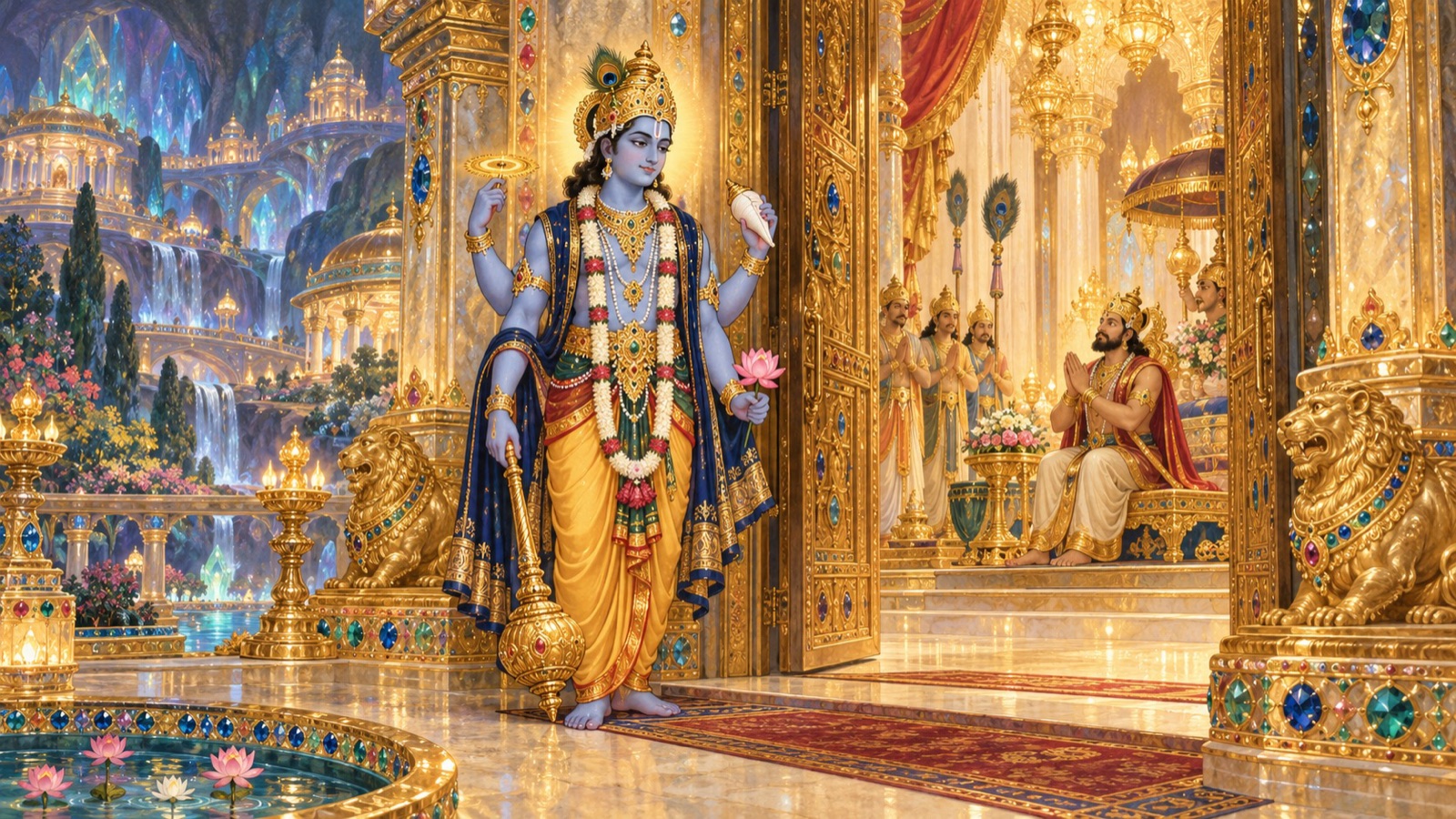
Sri Sukadeva leads King Parikshit downward — to the shadow-planet Rahu, held at bay by the Lord's Sudarsana disc, and through the seven luminous subterranean worlds. At their heart is Sutala, where the Supreme Lord Narayana Himself stands guard, mace in hand, at the door of the great devotee King Bali. A faithful, verse-checked retelling of the twenty-fourth chapter of Book Five.
Continue the Reading →
Far above the seven seers, the steadfast Dhruva shines as the fixed pole of the sky, around whom the planets and stars revolve like oxen at a threshing post. The wise behold the whole starry host as the Sisumara — the dolphin-like form of Lord Vasudeva — with the gods and planets on its limbs, and greet it each evening with a cleansing prayer. A faithful, verse-checked retelling of the twenty-third chapter of Book Five.
Continue the Reading →
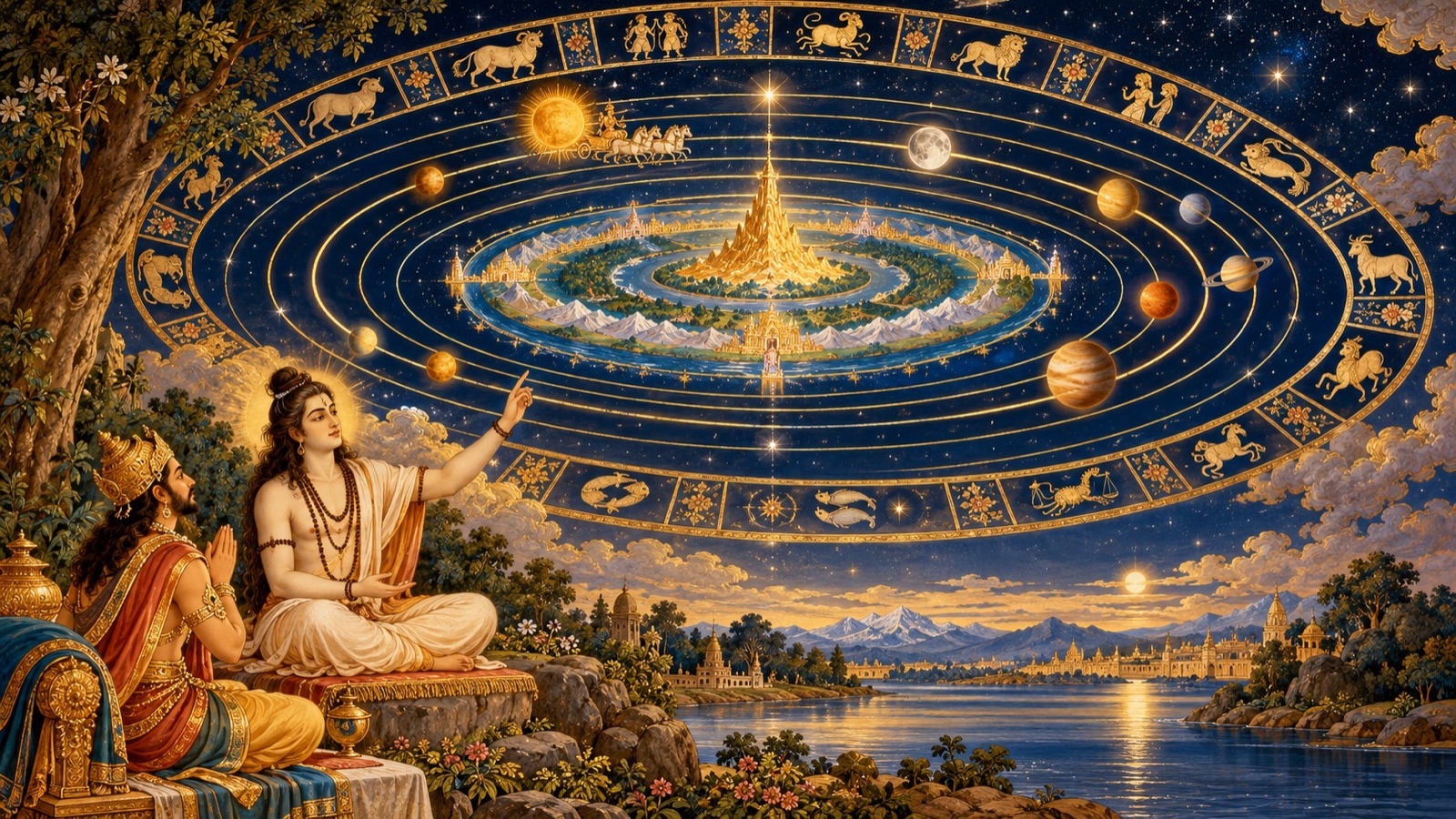
Answering King Parikshit's wondering question about the sun's seeming and true motion, Sri Suka unfolds the whole order of the heavens: the Lord Narayana dividing His body into the months and seasons, the moon pouring out its nectar upon every creature, the constellations and planets keeping their appointed rounds, and the seven sages circling the supreme abode of Lord Vishnu. A faithful, verse-checked retelling of the twenty-second chapter of Book Five.
Continue the Reading →
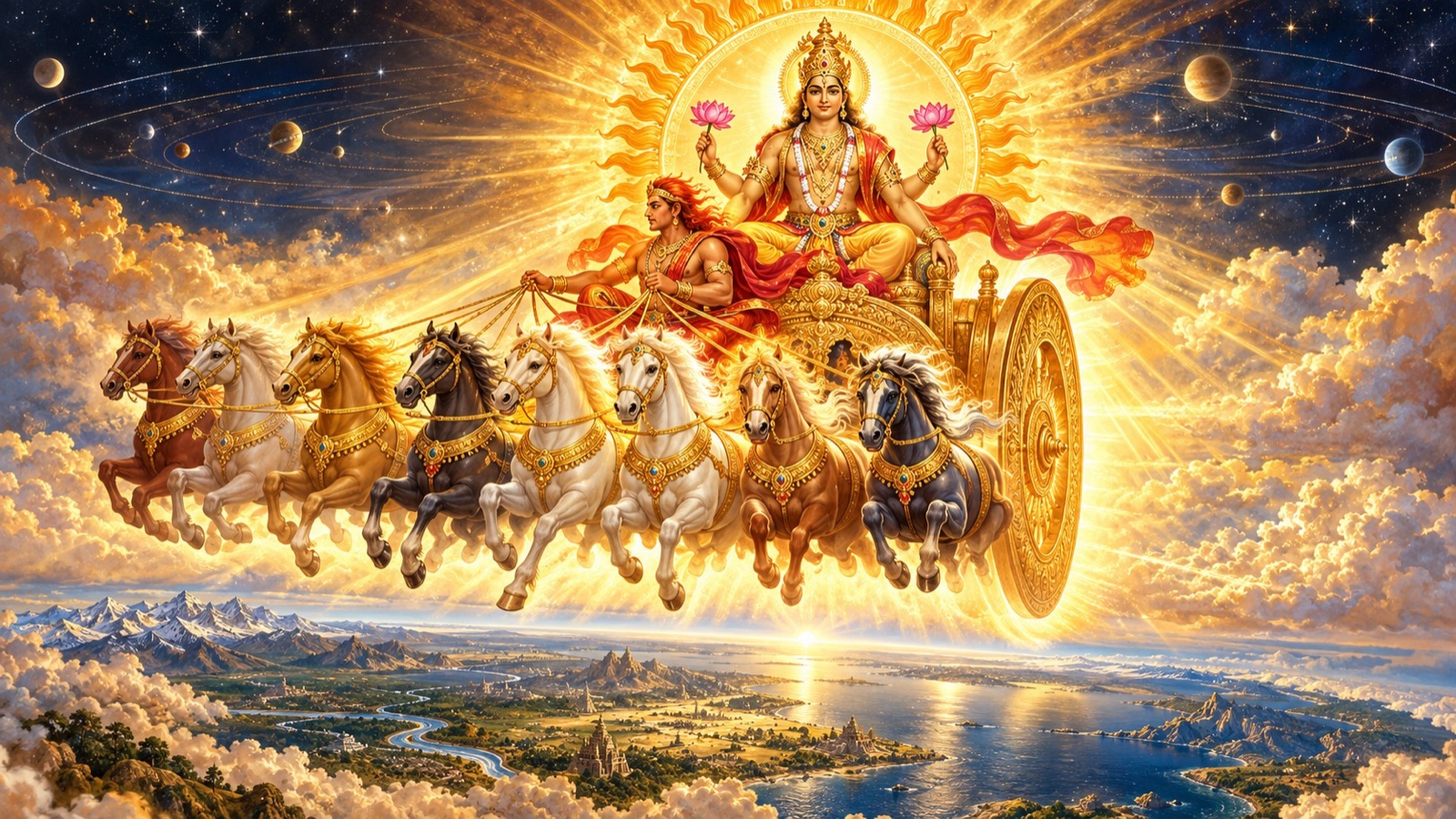
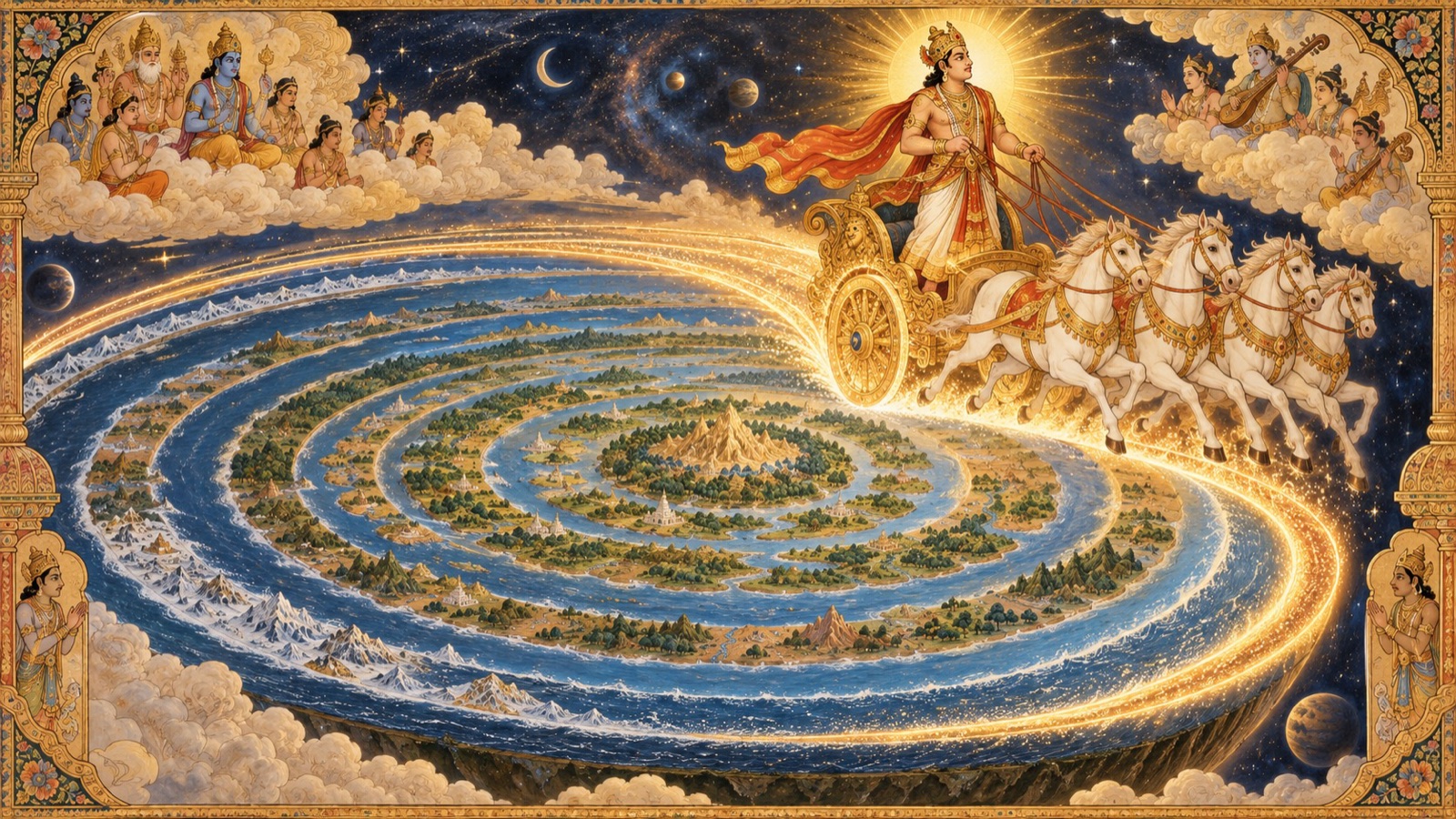
Sri Suka lifts our gaze to the heavens, revealing the glorious sun set at the centre of the sky, the four cities of the guardians upon Manasottara, and the marvellous chariot of the sun-god — its single wheel the year, drawn by seven Vedic horses, guided by Aruna and praised by sixty thousand thumb-sized Valakhilya sages. A faithful, verse-checked retelling of the twenty-first chapter of Book Five.
Continue the Reading →
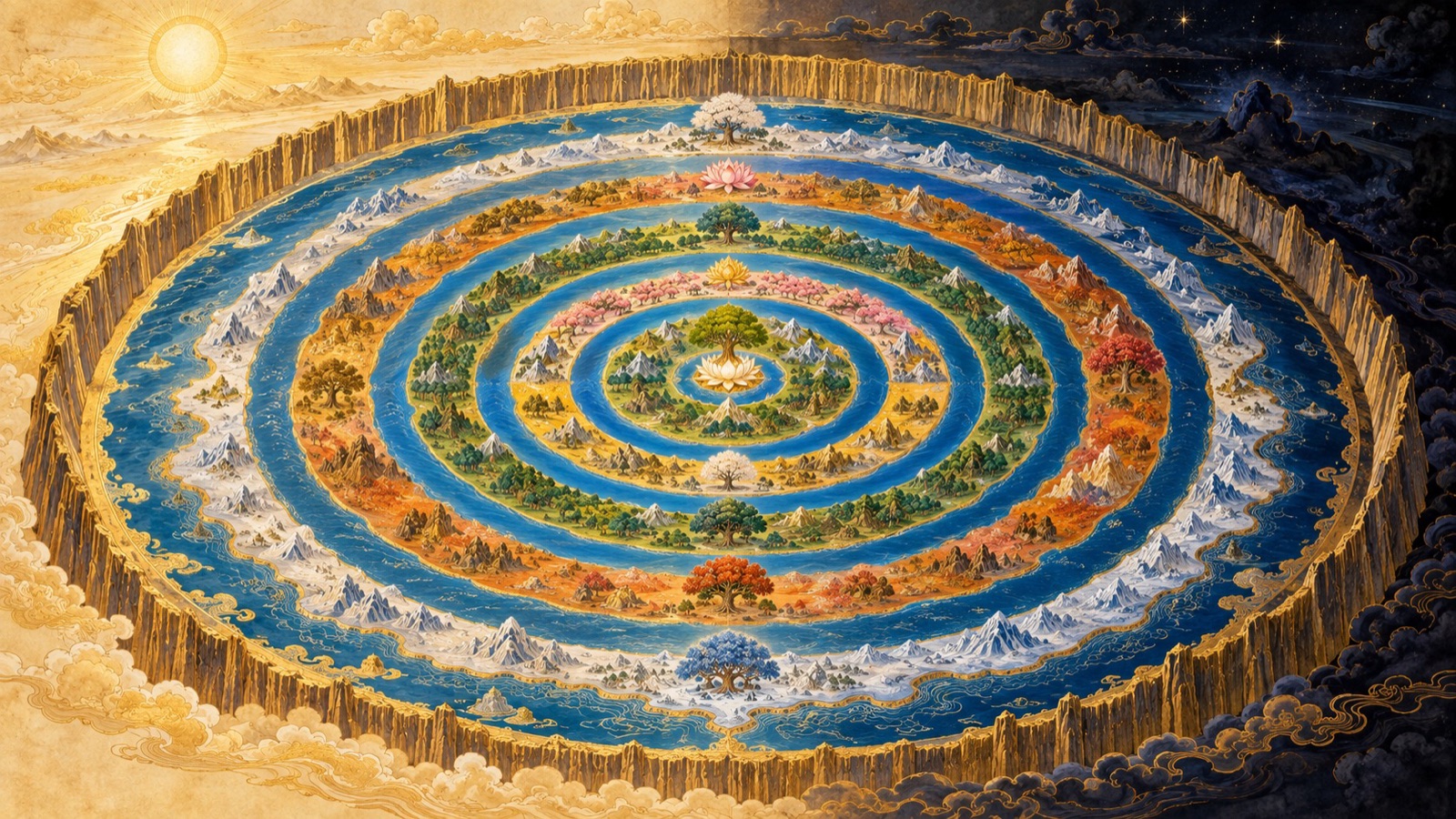
Sri Suka carries us outward across the six great Dvipas beyond Jambudvipa — Plaksa, Salmala, Kusa, Krauñca, Saka and Puskara — each ringed by its own ocean and crowned by a mighty tree, and in every one the peoples worship the one Lord as the sun, the moon, the fire, the waters, the life-breath and Brahma. Beyond them rises Lokaloka, where the four elephants uphold the globe and the Lord dwells with Vishvaksena. A faithful, verse-checked retelling of the twentieth chapter of Book Five.
Continue the Reading →
In Kimpurusha-varsha, Sri Hanuman worships Lord Rama with a hymn of pure love; in Bharata-varsha, the Lord as Nara-Narayana performs endless austerities and the sage Narada adores Him. Sri Suka unveils the sacred mountains and rivers of Bharata and the wonder that even the gods long for a human birth in this land, where a single moment offered to the Lord wins His fearless abode. A faithful, verse-checked retelling of the nineteenth chapter of Book Five.
Continue the Reading →
In region after region of the earth the Lord dwells in a beloved divine form, adored by its foremost devotee. This eighteenth chapter of Book Five gathers six radiant hymns — Bhadrasrava to Hayagriva, Prahlada to Nrsimha, Lakshmi to Pradyumna, Manu to Matsya, Aryama to Kurma, and Mother Earth to Varaha. A faithful, verse-checked retelling.
Continue the Reading →
The holy Ganga springs from the lotus-foot of the Lord as He strides across the cosmos, is borne with love upon Dhruva's head and the seers' matted locks, divides upon Mount Meru into the Sita, Alakananda, Cakshu and Bhadra, and blesses the lands of the world; and in Ilavrita, Lord Shiva pours out a hymn of surrender to Lord Sankarsana. A faithful, verse-checked retelling of the seventeenth chapter of Book Five.
Continue the Reading →
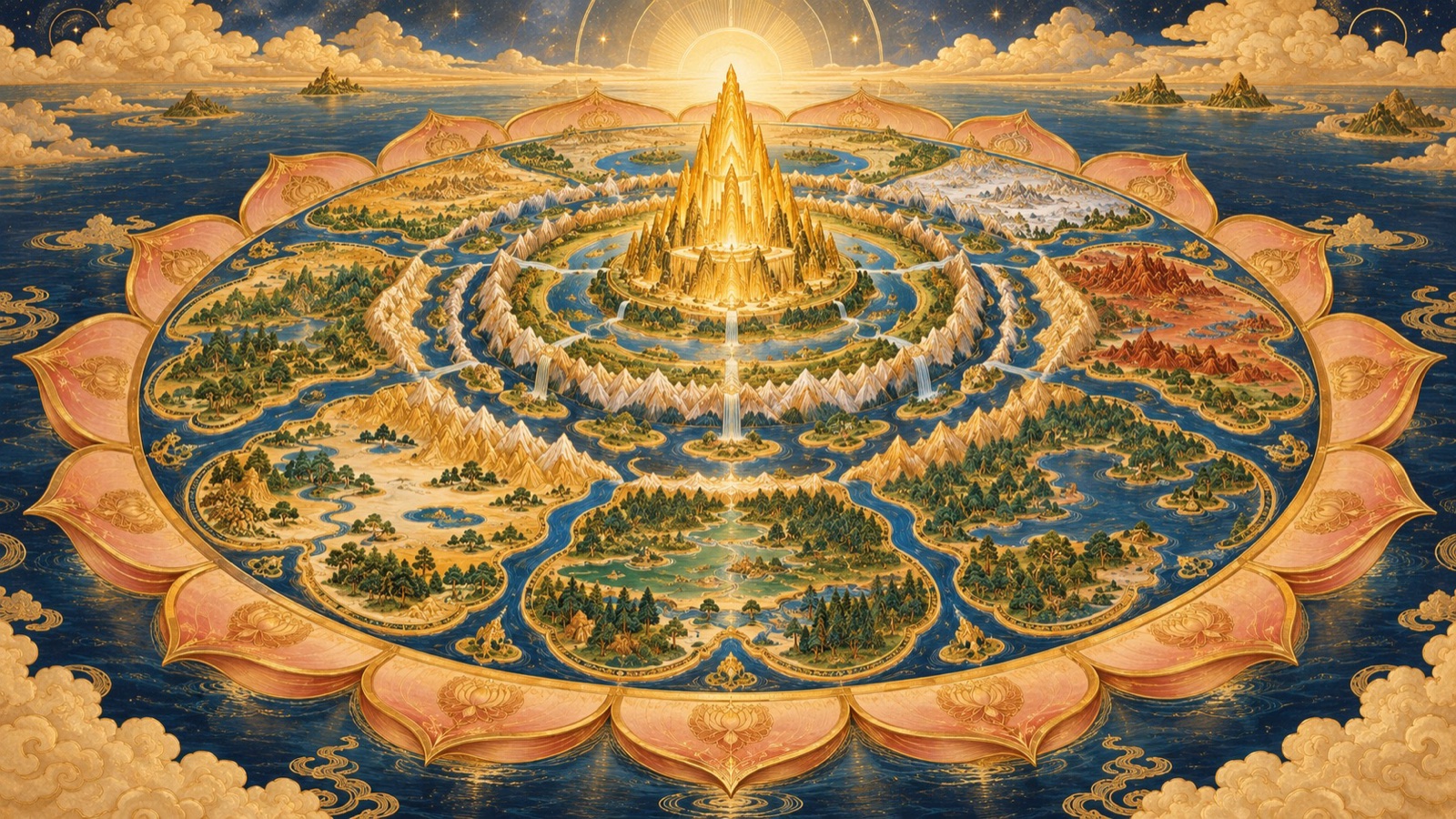
In answer to King Parikshit, the sage Sukadeva unfolds a vision of the terrestrial world as the visible form of the Lord: Jambudvipa shaped like a lotus, golden Meru rising at its centre as the seed-cup, the ranges that divide its nine realms, the four great trees with their rivers of nectar whose banks turn to gold, and the golden city of Brahma upon the summit. A faithful, verse-checked retelling of the sixteenth chapter of Book Five.
Continue the Reading →
The fifteenth chapter of Book Five follows the sacred royal line that sprang from Emperor Bharata — from his son Sumati down to Viraja — and lingers upon King Gaya, a very ray of Lord Vishnu. Ruling the whole earth without a trace of pride and offering his every act in loving service, Gaya's devotion was so pure that the Lord Himself came in person to accept his sacrifice. A faithful, verse-checked retelling of the fifteenth chapter of Book Five.
Continue the Reading →
Sri Suka unfolds Jada Bharata's great allegory for King Parikshit: worldly life as a fearful forest where the soul wanders like a merchant, the senses lie in wait as robbers, family act as wolves and jackals, wealth is a mirage, and the wheel of time turns as the discus of Lord Vishnu. It closes in glory with the royal sage Bharata, who crossed beyond the forest through pure devotion. A faithful, verse-checked retelling of the fourteenth chapter of Book Five.
Continue the Reading →
In one of the most searching parables in all the scripture, the sage Jada Bharata pictures worldly existence as a vast forest through which the soul wanders as a lost merchant — robbed by the senses, deceived by mirages and phantom cities, stung when he reaches for sweetness. Then the sage lifts the parable into hope: take up the sword of wisdom whetted by devotion and cross to the far shore. His words root out King Rahugana's every doubt. A faithful, verse-checked retelling of the thirteenth chapter of Book Five.
Continue the Reading →
Humbled at last, King Rahugana bows before the sage he had wronged and begs to be taught. In reply, Jada Bharata shows that king and bearer alike are but transformations of earth, that all worldly distinctions are mere names upon a creation of Maya, and that pure Consciousness — whom the wise call Vasudeva — alone is real, reached only through the dust of the feet of great devotees. Then he reveals he was once King Bharata. A faithful, verse-checked retelling of the twelfth chapter of Book Five.
Continue the Reading →
Still bearing the palanquin, the sage Jada Bharata unfolds for the humbled King Rahugana the great secret of the mind — how, driven by the three modes of nature, it becomes the root of bondage and of liberation; how the Lord Vasudeva dwells within every heart as the silent witness; and how the mind's illusion is slain by worship of the Lord and the Guru. A faithful, verse-checked retelling of the eleventh chapter of Book Five.
Continue the Reading →
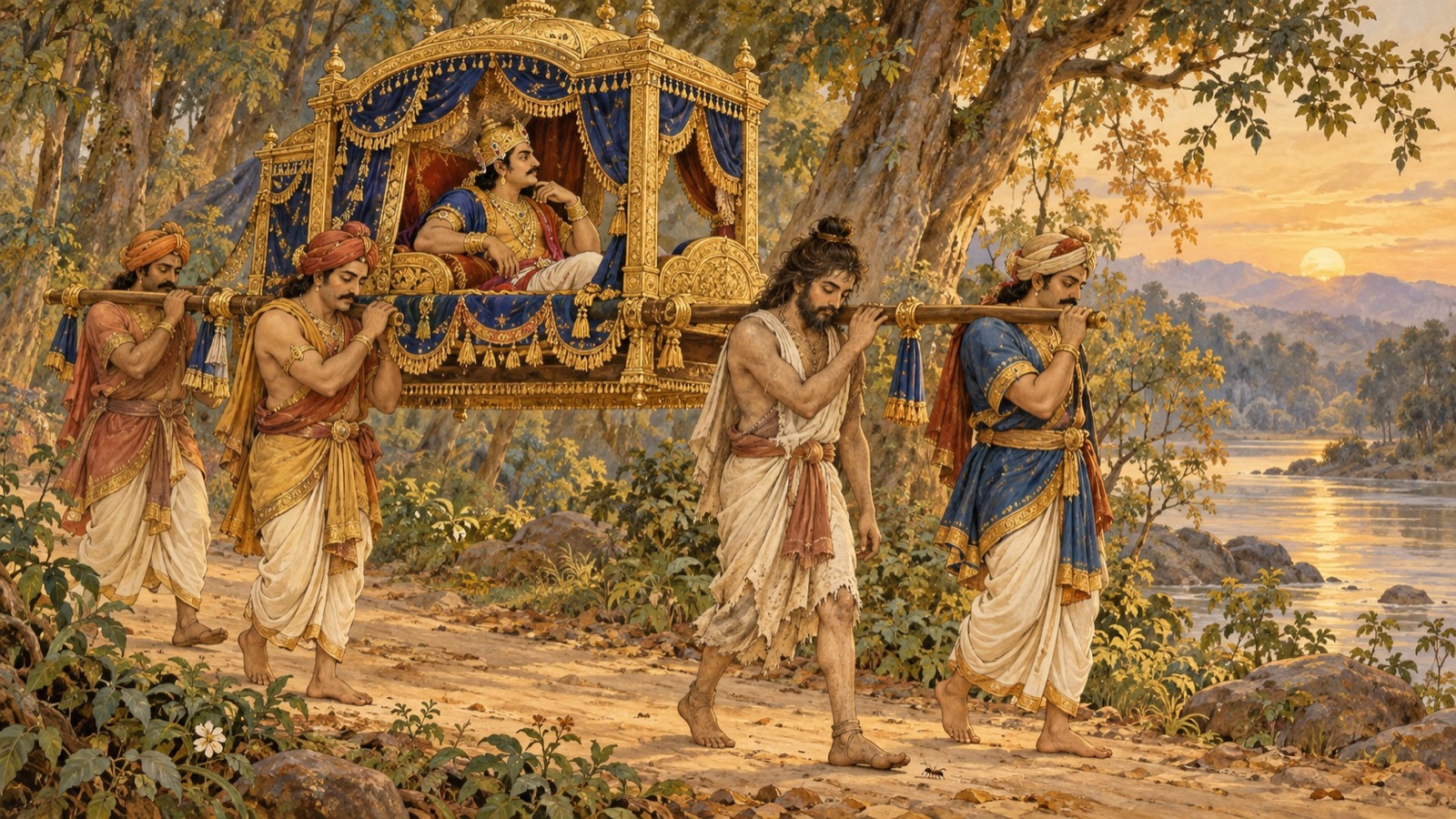
Pressed into service as a palanquin-bearer for King Rahugana, the silent sage Jada Bharata walks slowly, unwilling to harm the smallest creature, and bears the king's mockery with perfect calm. Then, in a teaching of rare depth, he reveals that all burdens belong to the perishable body while the Self within is deathless and free — moving the proud king to bow at his feet. A faithful, verse-checked retelling of the tenth chapter of Book Five.
Continue the Reading →
Sukadeva tells of Bharata's third and final birth in a holy Brahmana family. Remembering all his past lives and dreading attachment, he hid his perfected wisdom behind the mask of a dull, deaf madman, bearing mockery and hardship with unbroken equanimity. When a band of robbers seized him to be sacrificed, the Lord's own protective power rose in the form of the Goddess to save him. A faithful, verse-checked retelling of the ninth chapter of Book Five.
Continue the Reading →
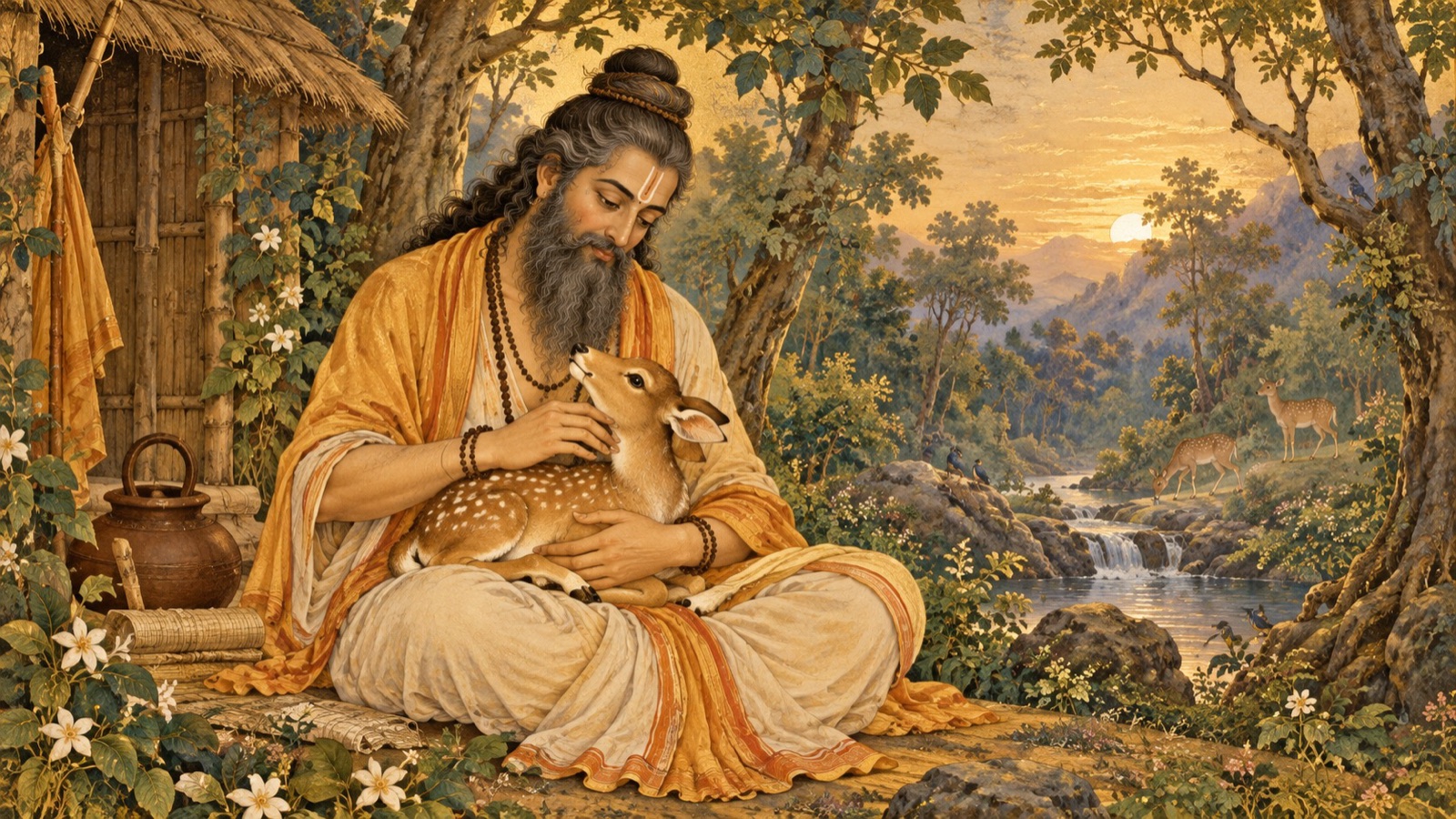
Sukadeva tells one of the most tender stories in the Bhagavatam: how the great devotee Bharata, who had renounced kingdom and sons, rescued a motherless fawn out of compassion and grew so attached to it that his spiritual practice fell away. Thinking of the deer at the hour of death, he was reborn as a deer — yet kept the memory of his past life, repented, and turned again toward the Lord. A faithful, verse-checked retelling of the eighth chapter of Book Five.
Continue the Reading →
Sukadeva tells how Emperor Bharata, son of Lord Rsabhadeva, ruled the whole earth as a saint upon a throne, surrendering the fruit of every sacrifice to Lord Vasudeva. When his duty was fulfilled he renounced the kingdom, retired to the hermitage of Pulaha by the Gandaki, and worshipped the Supreme Person with a love so overwhelming that he wept and forgot even the worship itself. A faithful, verse-checked retelling of the seventh chapter of Book Five.
Continue the Reading →
Answering King Parikshit, Sukadeva explains why Lord Rsabhadeva refused the mystic powers that came unsought, warns that the restless mind can never be blindly trusted, and tells how the Lord gave up His body while wandering the southern forests. He sings the glory of Bharatavarsa and Priyavrata's line, and reveals the blessing of hearing this sacred story. A faithful, verse-checked retelling of the sixth chapter of Book Five.
Continue the Reading →
In one of the Bhagavata's most treasured discourses, Lord Rsabhadeva teaches His hundred sons that the human body is not for pleasure but for austerity and devotion; He reveals how the soul is bound and freed, honors the selfless devotee, commands them to revere every being as His abode, and then renounces His throne to wander the earth as an ascetic. A faithful, verse-checked retelling of the fifth chapter of Book Five.
Continue the Reading →
Born with the marks of Godhead, Lord Rsabhadeva humbles Indra's envy with a smile, is named 'the foremost,' fathers a hundred sons led by Bharata, and reigns as the Supreme Lord ruling like a mortal to teach the world by His own example. A faithful, verse-checked retelling of the fourth chapter of Book Five.
Continue the Reading →
The childless King Nabhi and Queen Merudevi worship Lord Vishnu for a worthy son. Moved by love, the Lord appears at the sacrifice, accepts the priests' humble hymn, and — finding none equal to Himself — promises to descend in person, appearing as Lord Rsabhadeva in Merudevi's womb. A tender, verse-checked retelling of the third chapter of Book Five.
Continue the Reading →
A dutiful king of Jambudwipa prays for a worthy heir and is answered in an unexpected way: Brahma sends down the celestial nymph Purvacitti. Captured by a single glance, Agnidhra is swept into desire, fathers the nine sons who become the rulers of Jambudwipa, and yet is never satisfied. A tender, verse-checked retelling of the second chapter of Book Five.
Continue the Reading →
In the final chapter of the Fourth Canto, Narada teaches the Pracetas that a life is worthwhile only in serving the Lord — and that by worshipping Him, as by watering a tree's root, everything is nourished. Illumined, they renounce all to attain Him. A faithful, devotional retelling with verified verses.
Continue the Reading →
After ten thousand years of austerity, the Supreme Lord appears to the Pracetas and grants a boon. They declare a moment's company of His devotees worth more than heaven or liberation, and, returning home, marry Marisha, the foster-daughter of the trees. A faithful, devotional retelling with verified verses.
Continue the Reading →
King Prachinabarhi confesses he cannot grasp the parable, so Narada unveils it: Puranjana is the soul, the city the body, the friend the Lord within. The mind carries the soul from life to life; the one remedy is to worship Sri Hari with the whole being. A faithful, devotional retelling with verified verses.
Continue the Reading →
Puranjana dies clinging to his family, not the Lord, and is reborn a woman. Grieving beside her husband's pyre, she is met by her forgotten friend — the Lord within — who unveils the allegory and awakens the soul to the memory it had lost. A faithful, devotional retelling with verified verses.
Continue the Reading →
In Narada's parable, Puranjana grows entangled in his household while the years slip by. Kalakanya (old age) allies with fear and fever, and Chandavega (the passing years) lays siege to the city of nine gates — a picture of the siege of time on every body. A faithful, devotional retelling with verified verses.
Continue the Reading →
In Narada's parable, Puranjana is seized by a passion for the hunt and rides out, neglecting his queen. He returns to find her angry, and pacifies her with tender words — a mirror of the soul caught in a restless cycle of craving, neglect, and appeasement. A faithful, devotional retelling with verified verses.
Continue the Reading →
To awaken King Prachinabarhi, the sage Narada begins the parable of Puranjana — the soul who wanders into a city of nine gates (the body), meets a beautiful queen (the senses), and is captivated, forgetting his unknown friend, the Lord within. A faithful, devotional retelling with verified verses.
Continue the Reading →
The ten Pracetas set out to perform austerities and meet Lord Shiva, who, pleased by their sincerity, teaches them the Rudra-gita — a beautiful hymn to the Supreme Lord, the fearless refuge in whom even the destroyer takes shelter. A faithful, devotional retelling with verified verses.
Continue the Reading →
Having ruled long and righteously, King Prithu retires with his queen Archi to the forest, practises the highest austerity to please the Lord, and departs to His supreme abode. His faithful queen follows him in devotion. A faithful, devotional retelling with verified verses.
Continue the Reading →
The four eternally youthful Kumaras arrive at King Prithu's assembly. The great king rises, worships them, and humbly asks to be taught. They impart the highest wisdom: that the soul's whole welfare lies in unattached love for the Supreme. A faithful, devotional retelling with verified verses.
Continue the Reading →
Returning in glory to his festive capital, King Prithu teaches his subjects that a ruler's power is a sacred trust for service, and that the worship of the Lord with mind, speech, body, and honest work is the highest good of every soul. A faithful, devotional retelling with verified verses.
Continue the Reading →
The Supreme Lord appears in Prithu's sacrificial hall with the repentant Indra, teaches the highest wisdom, and offers any boon. Prithu refuses even liberation and asks only for ten thousand ears to hear the Lord's glory forever. A faithful, devotional retelling with verified verses.
Continue the Reading →
In devotion, King Prithu undertakes a hundred horse-sacrifices. Jealous Indra steals the sacrificial horse in disguise; Prithu's son recovers it, and the sages recall the king to his identity as a portion of the Lord, reconciling him with Indra. A faithful, devotional retelling with verified verses.
Continue the Reading →
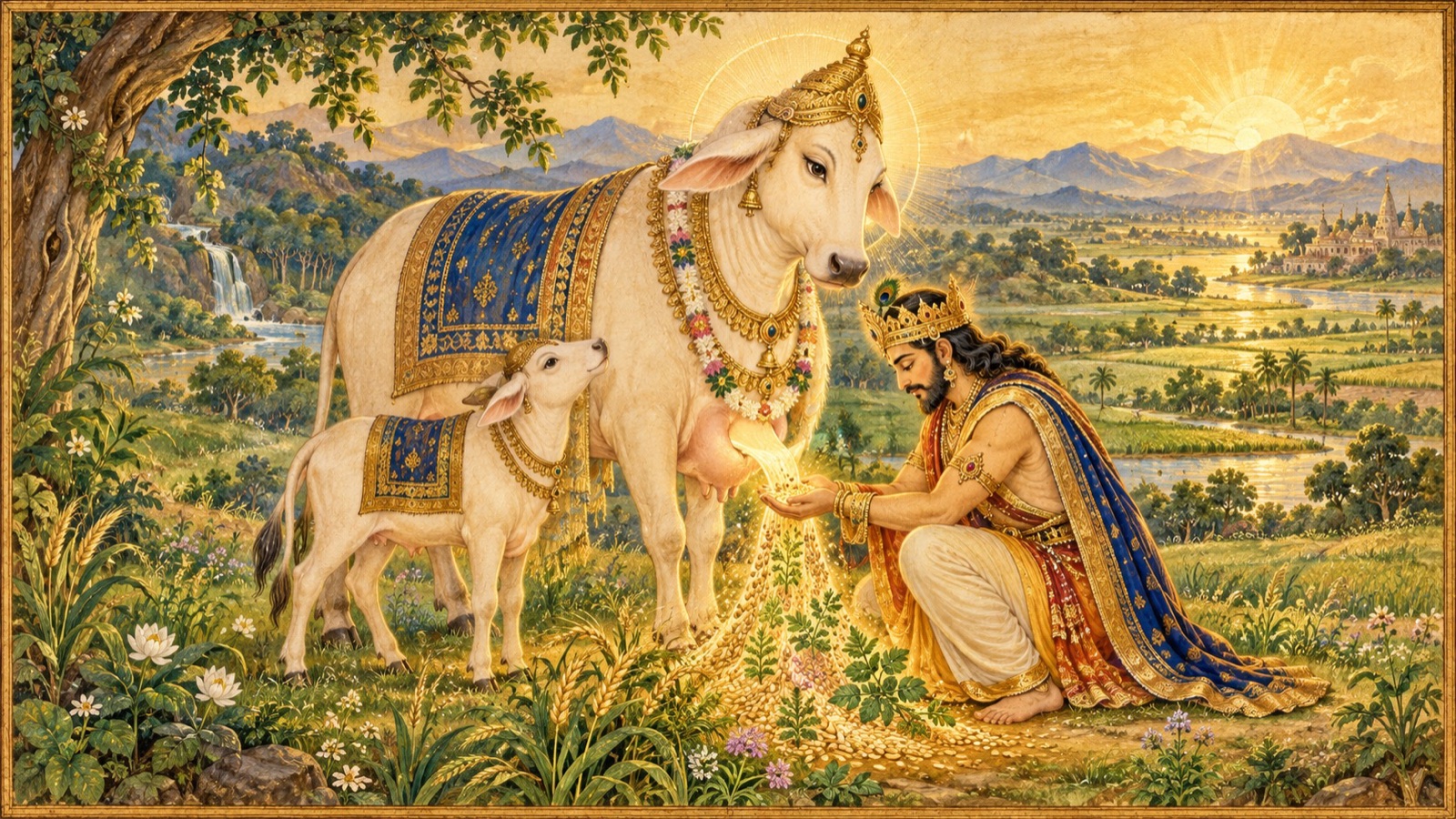
The Earth counsels King Prithu to draw her bounty not by force but by right arrangement. Making Manu the calf and his cupped hands the pail, he milks the grains for all beings, and plenty returns to a world that had known famine. A faithful, devotional retelling with verified verses.
Continue the Reading →
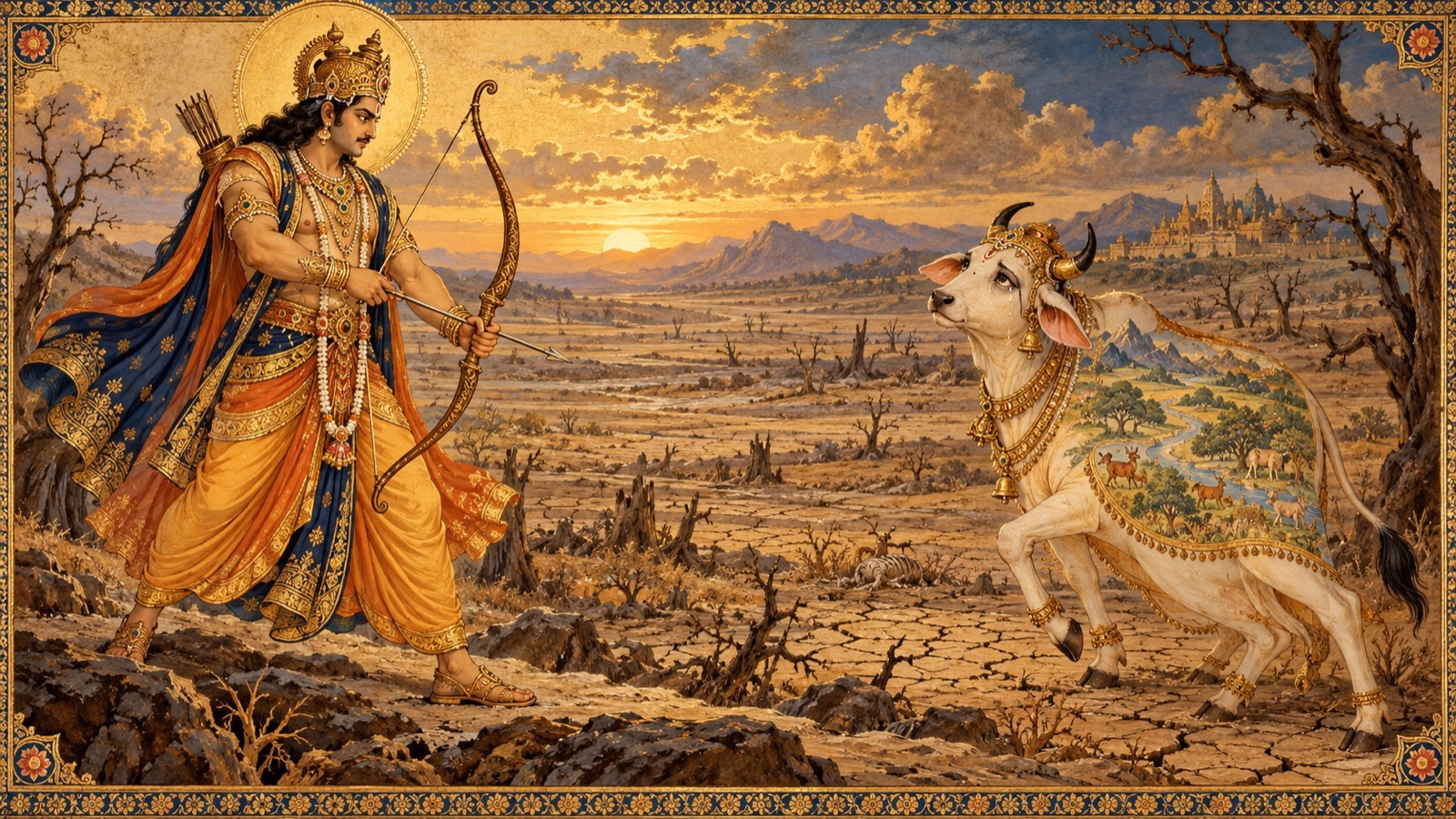
Famine grips the land, for the Earth has withheld her bounty. For his starving people, King Prithu takes up his bow; the Earth flees as a cow, then turns, submits, and prays to him. A chapter of fierce compassion and the wisdom of the Earth. A faithful, devotional retelling with verified verses.
Continue the Reading →
Urged by the sages, the celestial bards glorify King Prithu — as the foremost upholder of dharma, a protector tolerant as the earth, and the very Lord descended in a portion of His power. Through it all, the emperor listens with humility. A faithful, devotional retelling with verified verses.
Continue the Reading →
From the churning of Vena's arms descends a radiant couple — King Prithu, a partial descent of Vishnu, and Queen Archi, a portion of Lakshmi. Prithu is crowned emperor and equipped by the demigods to protect the world. A faithful, devotional retelling with verified verses.
Continue the Reading →
Enthroned to protect a leaderless people, the proud Vena forbids all sacrifice and demands to be worshipped in place of the Lord. The sages appeal in vain, end his reign for the world's welfare, and churn his body — drawing good even out of disaster. A faithful, devotional retelling with verified verses.
Continue the Reading →
Maitreya traces the line of Dhruva down to the saintly King Anga, who is given a wicked son, Vena. Worn down by grief, Anga finds a hard freedom and slips away into renunciation by night. A faithful, devotional retelling with verified verses.
Continue the Reading →
Kubera offers Dhruva a boon, and the humble king asks only for unwavering remembrance of the Lord. After a long reign, he ascends in a celestial chariot, sets his foot on death, remembers his mother, and reaches the imperishable abode of Vishnu. A faithful, devotional retelling with verified verses.
Continue the Reading →
As Dhruva's weapon slays even the innocent, his grandfather Svayambhuva Manu comes with the sages and teaches that vengeance is not the path of the Lord's devotees. Moved, Dhruva lays down his anger and withdraws. A faithful, devotional retelling with verified verses.
Continue the Reading →
Dhruva's brother Uttama is slain by a Yaksha in the Himalayas. Overcome with grief and anger, Dhruva marches on Alakapuri and battle begins; as the Yakshas turn to illusion, the sages bless him in the Name of the Lord. A faithful, devotional retelling with verified verses.
Continue the Reading →
The Lord appears before the child Dhruva, touches his cheek with the conch to loosen his praise, and grants him an imperishable abode above the seven sages. Dhruva returns home to a repentant father and is enthroned as king. A faithful, devotional retelling with verified verses.
Continue the Reading →
Wounded by his stepmother's words, the child Dhruva is guided by his mother Suniti and the sage Narada to seek the Supreme Lord. He receives the twelve-syllable mantra and departs alone for the forest. A faithful, devotional retelling with verified verses.
Continue the Reading →
Called from the edge of lifelong renunciation to rule the earth, the devotee-king Priyavrata governed the world without attachment, carved its seven oceans with his blazing chariot, divided its islands among his sons, and at last laid the empire down to return to the path of devotion. A faithful, verse-checked retelling of the opening chapter of Book Five.
Continue the Reading →
Pleased by Brahma's prayer, Lord Shiva restores Daksha to life and heals the gods; the sacrifice begins again, and the Supreme Lord Sri Hari appears in person to complete it. A faithful, devotional retelling with verified verses.
Continue the Reading →
After the storm, the worsted gods turn to Brahma, who leads them to Kailasa to appease Lord Shiva. They find him serene, and Brahma prays for the erring and for the wrecked sacrifice to be restored. A faithful, devotional retelling with verified verses.
Continue the Reading →
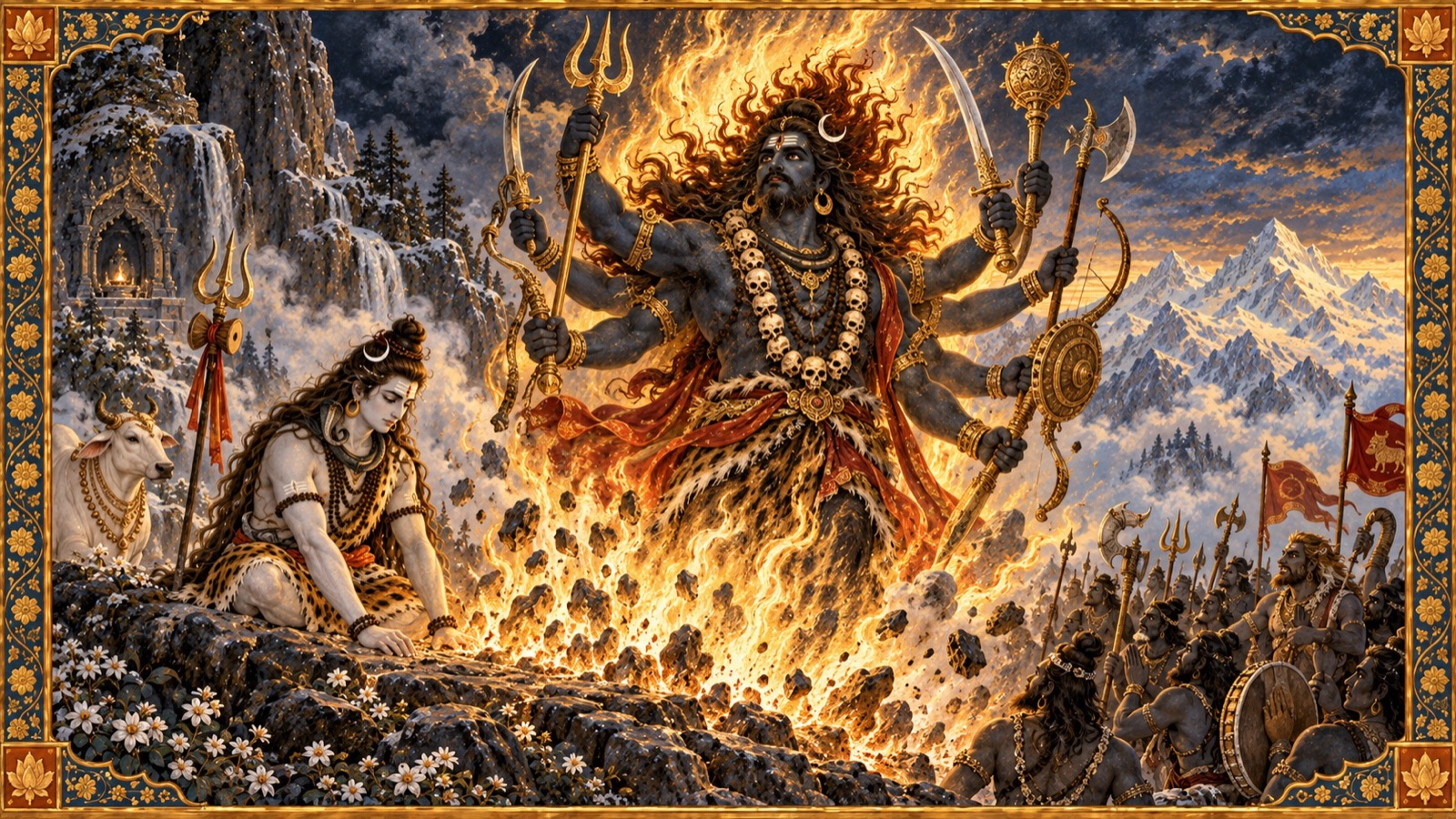
Hearing of Sati's death, Lord Shiva's grief turns to boundless wrath; from a lock of his hair springs the towering Virabhadra, who leads the hosts of Rudra and wrecks Daksha's sacrifice. A faithful, devotional retelling with verified verses.
Continue the Reading →
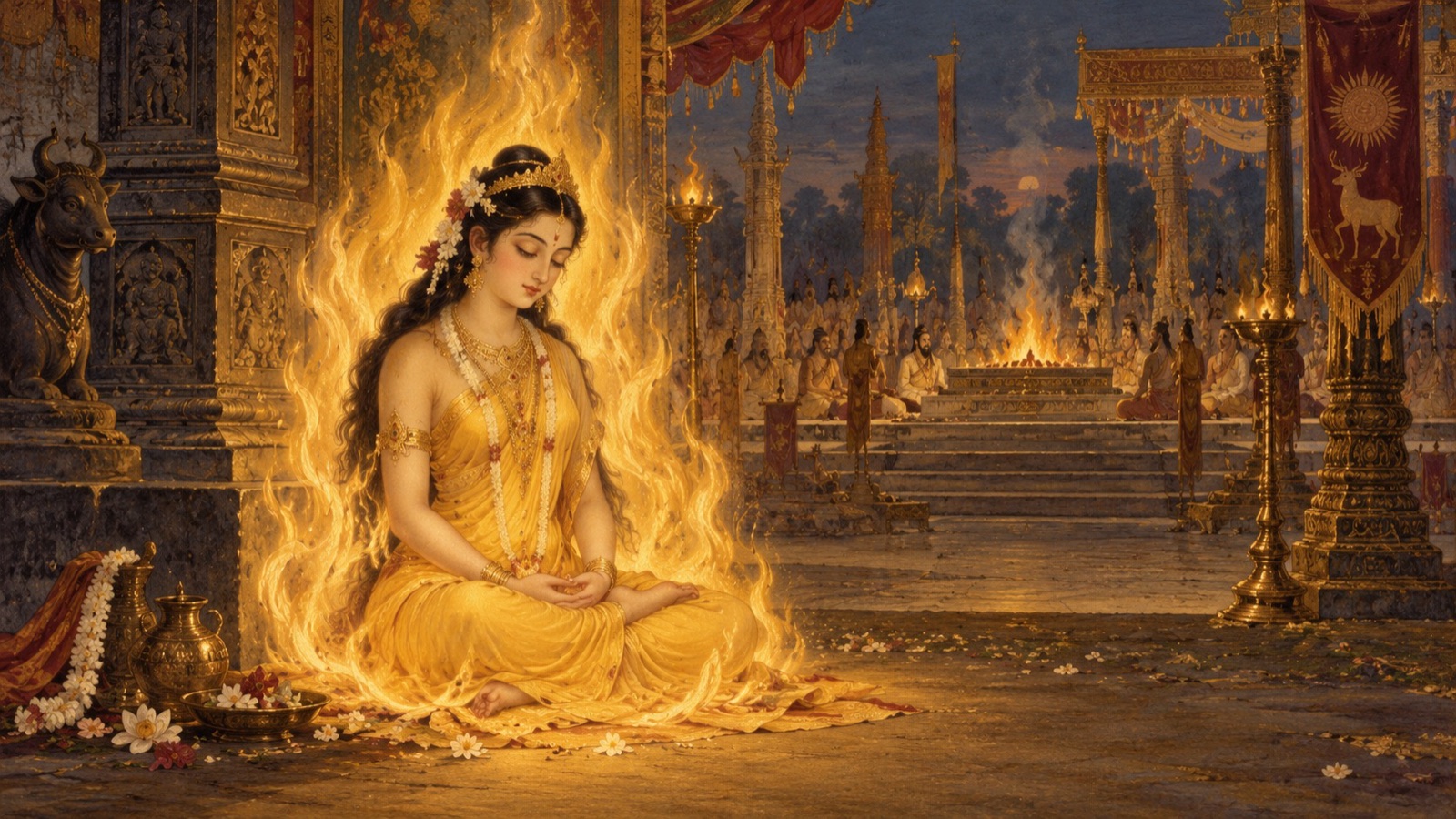
Against Lord Shiva's warning, Sati goes to Daksha's sacrifice, finds no offering set aside for her lord, rebukes her father before the assembly, and gives up her body in the fire of yoga. A faithful, devotional retelling with verified verses.
Continue the Reading →
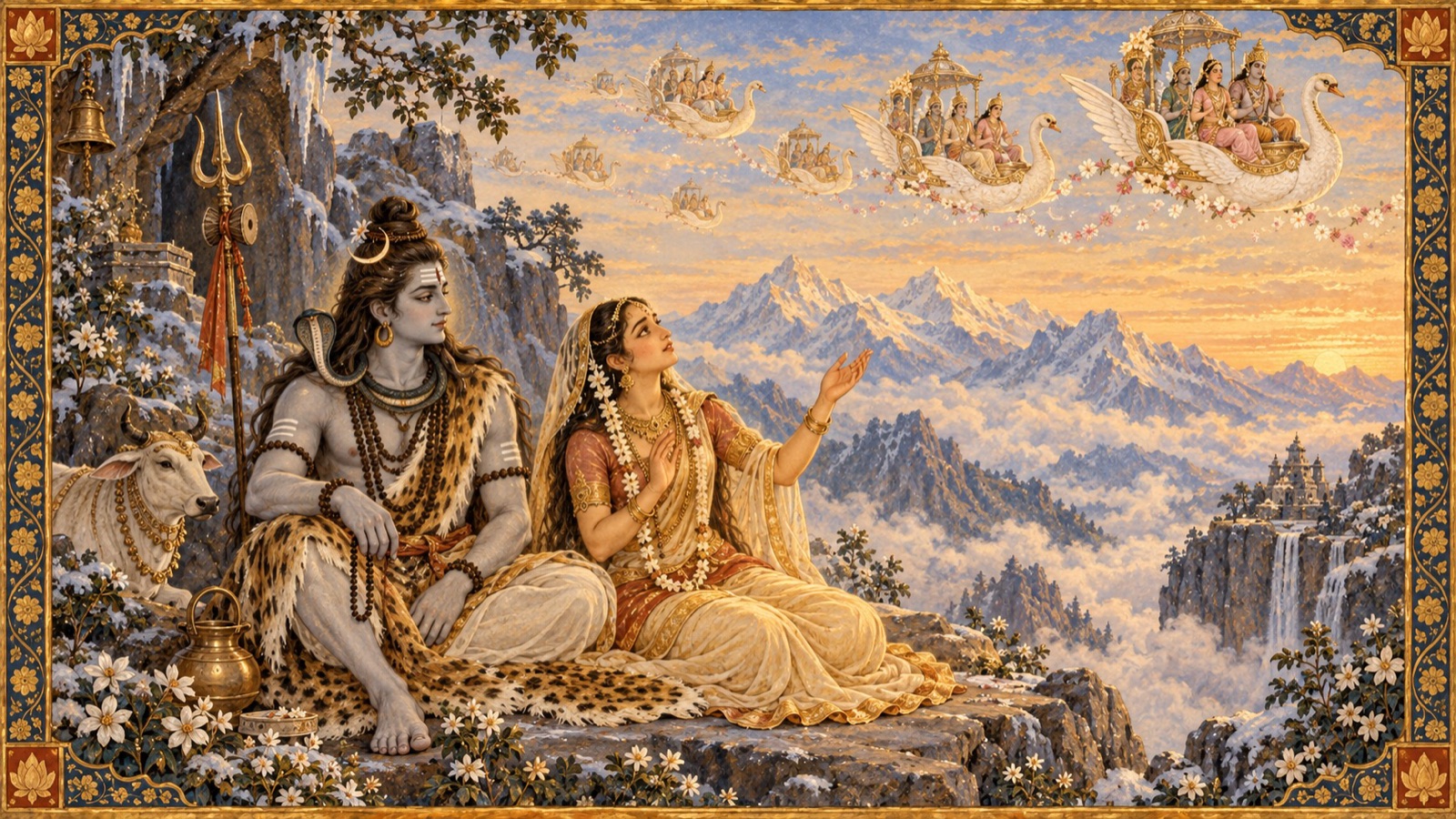
Sati sees the goddesses fly past to her father Daksha's sacrifice and pleads to go; Lord Shiva warns her that a relative's contempt is the deepest of wounds. A faithful, devotional retelling with verified verses.
Continue the Reading →
In a great assembly of the gods, wounded pride turns Daksha against his son-in-law Lord Shiva. A faithful, devotional retelling of the reviling, Daksha's curse, the counter-curses of Nandishvara and Bhrgu, and Shiva's silent departure — a searching study of the cost of taking offense, with verified verses.
Continue the Reading →
Book Four opens with the great river of lineage flowing from Swayambhuva Manu's three daughters — the birth of Lord Yajna, the descent of the three gods to sage Atri's hermitage, the appearance of Nara and Narayana, and the first shadow of Sati's story. A faithful, devotional retelling with verified verses.
Continue the Reading →
In the thirty-third and final chapter of the Third Canto, Devahuti's ignorance is torn asunder, and she pours out a hymn of praise recognizing her son Kapila as Lord Visnu Himself. Kapila departs with a final blessing, and Devahuti walks the path of devotion and Yoga he taught her until she attains liberation at the sacred spot known as Siddhapada — her mortal body transformed into a holy river. A faithful, restrained retelling of Canto 3, Chapter 33, with verified verses, full discrepancy notes, and the closing of Canto 3.
Continue the Reading →
In the penultimate chapter of the Third Canto's Kapila-Gita, Lord Kapila maps the soul's two roads after death — the 'Bright Path' to the Supreme Person and Brahmaloka, and the 'Dark Path' back to earth through the realm of the manes — before declaring that devotion to Lord Vasudeva alone calls forth dispassion and knowledge swiftly, without the risk of return. A faithful, restrained retelling of Canto 3, Chapter 32 with verified verses and full discrepancy notes.
Continue the Reading →
In the Kapila-Gita, Lord Kapila tells His mother Devahuti how the soul enters the womb by the force of Karma, grows month by month within it, awakens to the memory of hundreds of past lives, and prays with joined palms for release — a prayer whose hard-won wisdom is lost again in the very trauma of birth. A faithful, tasteful retelling of Canto 3, Chapter 31 with verified verses and full discrepancy notes.
Continue the Reading →
Deep in the Kapila-Gita, Lord Kapila warns His mother Devahuti that the soul who mistakes body, spouse, children, house and wealth for permanent realities is carried by Time through old age, neglect, death, a fearsome road to Yama's abode, and the tortures of hell — until, purified, it is reborn as a human being. A faithful, restrained retelling of Canto 3, Chapter 30 with verified verses and full discrepancy notes.
Continue the Reading →
Devahuti asks Lord Kapila to explain devotion and the nature of all-powerful Time. Kapila's answer unfolds the three Guna-coloured grades of devotion, the one unqualified Bhaktiyoga that flows unconditionally toward the Lord, a stern warning against worship without equal vision, a graded hierarchy of life culminating in the pure devotee, and the revelation that Time itself — before whom wind, sun, and even Death bow — is none other than the Lord. A faithful, devotional retelling of Canto 3, Chapter 29 with verified verses, a transparent primary-source gap disclosure, and full discrepancy notes.
Continue the Reading →
In the Kapila-Gita's most practical chapter, Lord Kapila gives His mother Devahuti a graded manual for meditation: ethical foundation, posture, breath-control likened to gold purified by fire, and an extraordinarily detailed meditation on the Lord's form — feet, navel, arms and smiling face — culminating in the mind's dissolution like an extinguished flame. A faithful, devotional retelling of Canto 3, Chapter 28 with verified verses and full discrepancy notes.
Continue the Reading →
Deep in the Kapila-Gita, Lord Kapila teaches His mother Devahuti that the Spirit, like the sun reflected in water, remains forever untouched by the body's pleasures and pains. He describes the God-realized devotee, explains the ego as a reflection of a reflection, and then Devahuti presses back with a sharp philosophical objection: if Matter and Spirit are co-eternal, how can the soul ever truly be free? Kapila's answer — devotion consuming Prakrti's hold like fire consuming its own kindling stick — closes with a final warning against attachment even to the miraculous powers of advanced yoga. A faithful, devotional retelling of Canto 3, Chapter 27 with verified verses and full discrepancy notes.
Continue the Reading →
Devahuti asks her divine son a single question — what are Prakriti and Purusa? — and Lord Kapila's answer unfolds the entire Sankhya architecture of creation: the twenty-four categories and Time as the twenty-fifth, the birth of the Mahat-tattva and the threefold ego, the sequential evolution of the five subtle elements into the gross elements and senses, and the formation of the cosmic egg and the vast Cosmic Being — whose every organ and deity fail to rouse Him until the Inner Controller alone enters the heart. A faithful, devotional retelling of Canto 3, Chapter 26 with verified verses, structured evolution tables, and full discrepancy notes.
Continue the Reading →
With Kardama departed into the forest, Lord Kapila remains with His mother Devahuti at Bindusarovara. Her honest confession of spiritual exhaustion draws from Him the opening of the celebrated Kapila-Gita: a discourse on Yoga as contemplation beyond joy and sorrow, the transforming fellowship of saints, and a definition of motiveless devotion so exalted it is declared superior to liberation itself. A faithful, devotional retelling of Canto 3, Chapter 25 with verified verses and full discrepancy notes.
Continue the Reading →
A long-awaited promise is finally kept: Lord Vishnu manifests through the sage Kardama and his wife Devahuti "even as fire appears through firewood," while the heavens mark the moment with music and falling flowers. Brahma arrives to confirm the descent, arranges the marriage of Kardama's nine daughters to the great sages, and reveals to Devahuti that her son is the Supreme Lord Himself, known as Kapila. In the chapter's emotional center, Kardama recognizes his own child as God, offers a hymn of wonder and surrender, and departs into a life of renunciation that ends in union with the Infinite. A faithful, devotional retelling of Canto 3, Chapter 24 with verified verses and full discrepancy notes.
Continue the Reading →
Moved by years of Devahuti's silent, devoted service, the sage Kardama conjures a wondrous aerial mansion by his yogic power, sends her to a sacred lake where she is transformed and adorned as if newly born, and carries her through the heavenly pleasure-gardens for what feels, to the devoted couple, no longer than a single hour. Nine daughters are born of their union — and then, as Kardama prepares to leave for the forest, Devahuti's honest, aching appeal closes the chapter. A faithful, devotional retelling with verified verses and full discrepancy notes.
Continue the Reading →
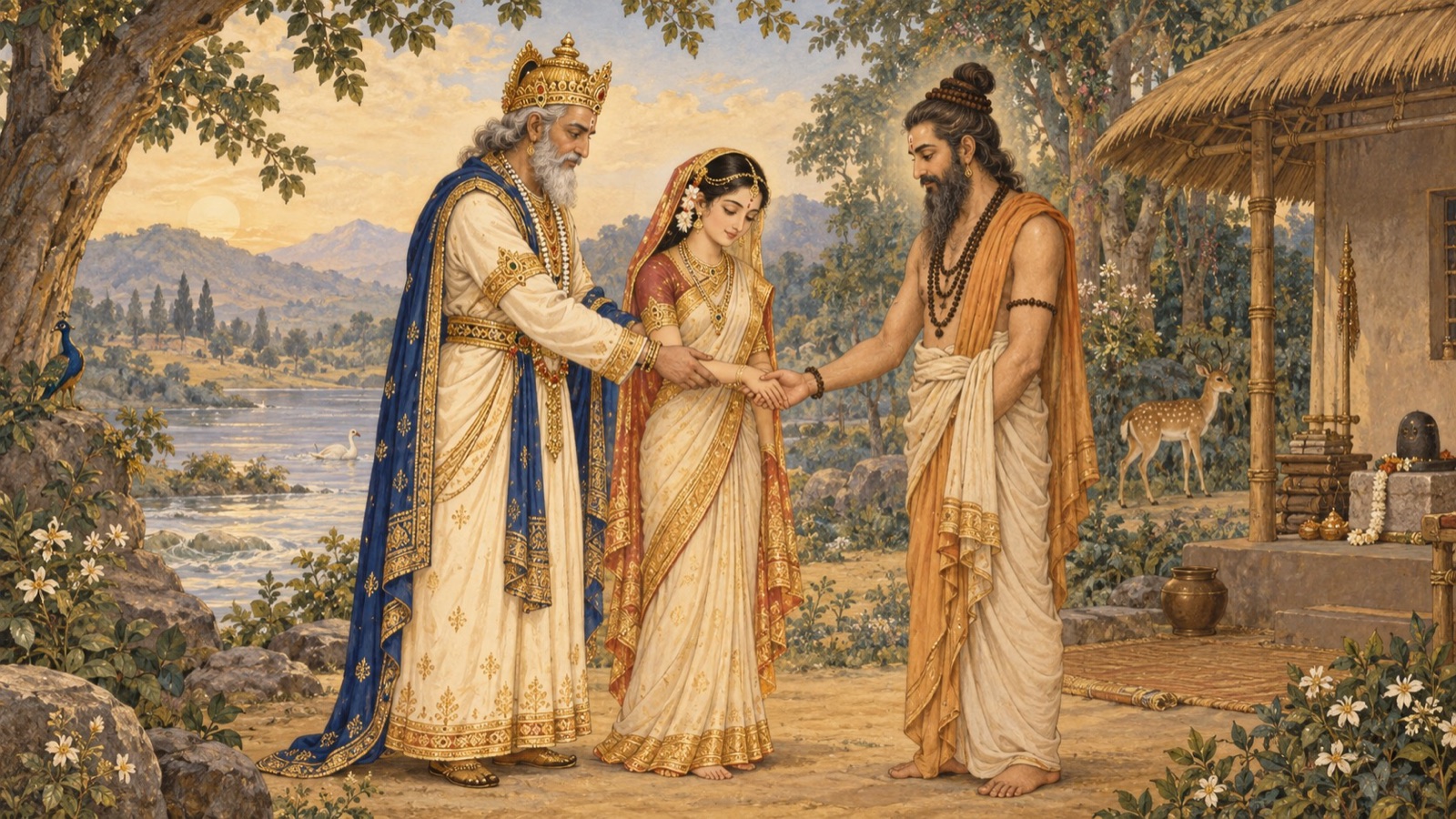
Emperor Swayambhuva Manu formally offers his daughter Devahuti's hand to the sage Kardama, who has already won her heart through his character alone. Kardama accepts on one condition rooted in a promise from Lord Hari Himself, the wedding is blessed by both royal and ascetic households, and the couple's journey home carries the seed of Lord Kapila's coming birth. A faithful, devotional retelling with verified verses and full discrepancy notes.
Continue the Reading →
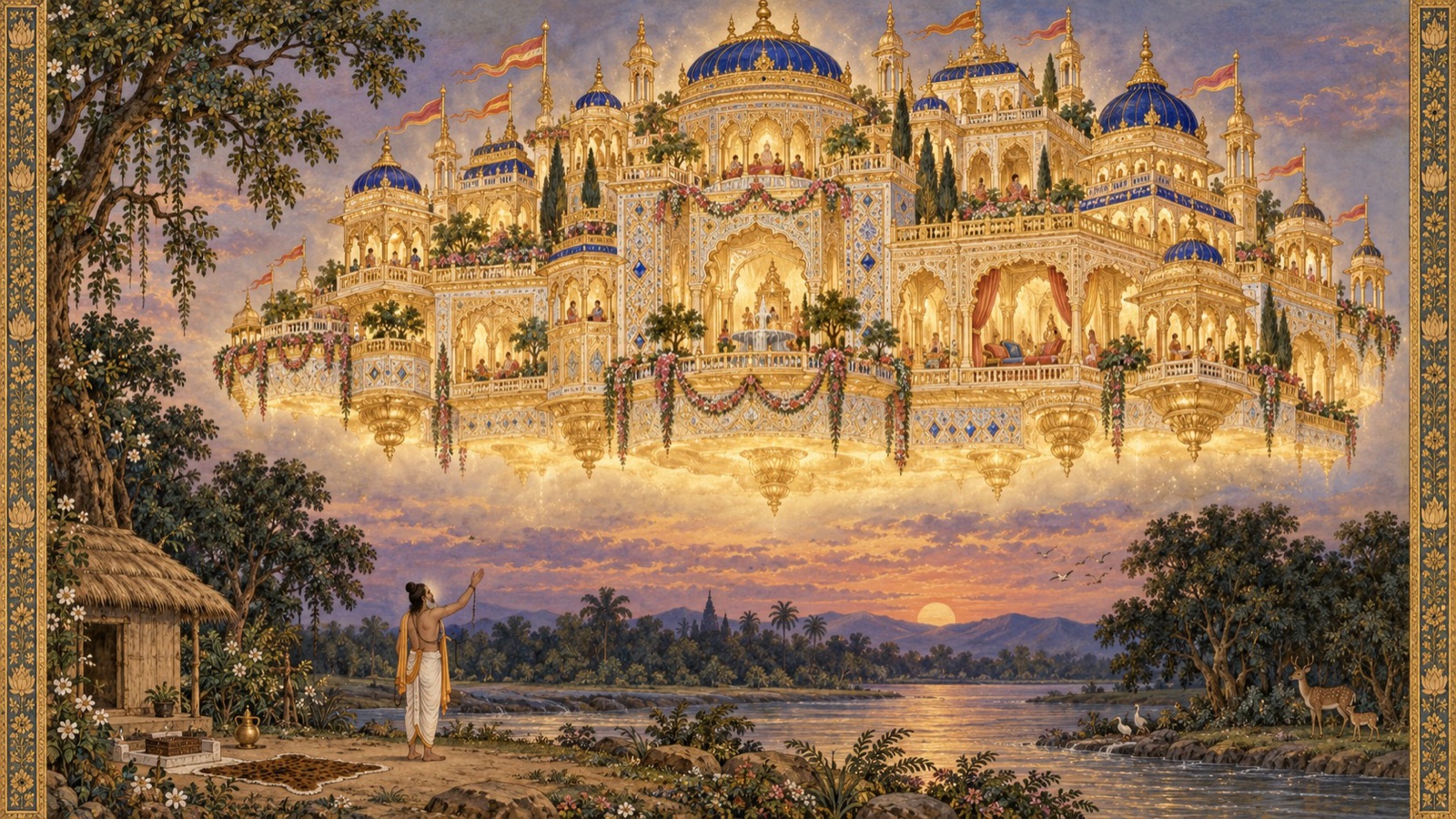
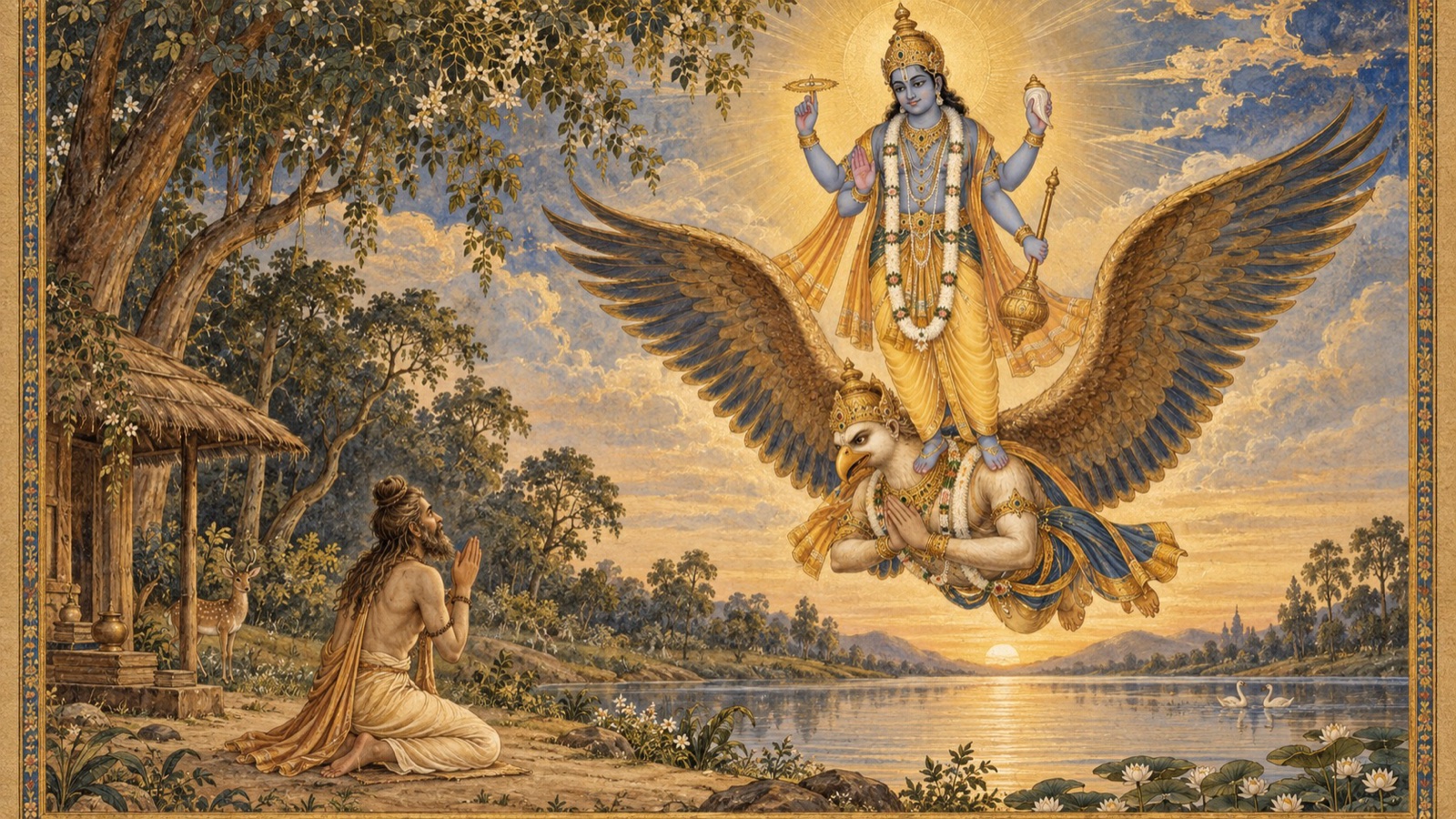
After ten thousand years of silent penance on the bank of the Sarasvati, the sage Kardama beholds the Lord Himself, standing on Garuda's shoulders. Moved by his prayer, the Lord promises him Devahuti — daughter of Emperor Svayambhuva Manu — as his bride, nine daughters, and final liberation, and even the coming birth of the great sage Kapila. The chapter closes as Manu himself arrives at the hermitage with his daughter, exactly as foretold. A faithful, devotional retelling with verified verses, Sanskrit quotations, and full discrepancy notes.
Continue the Reading →
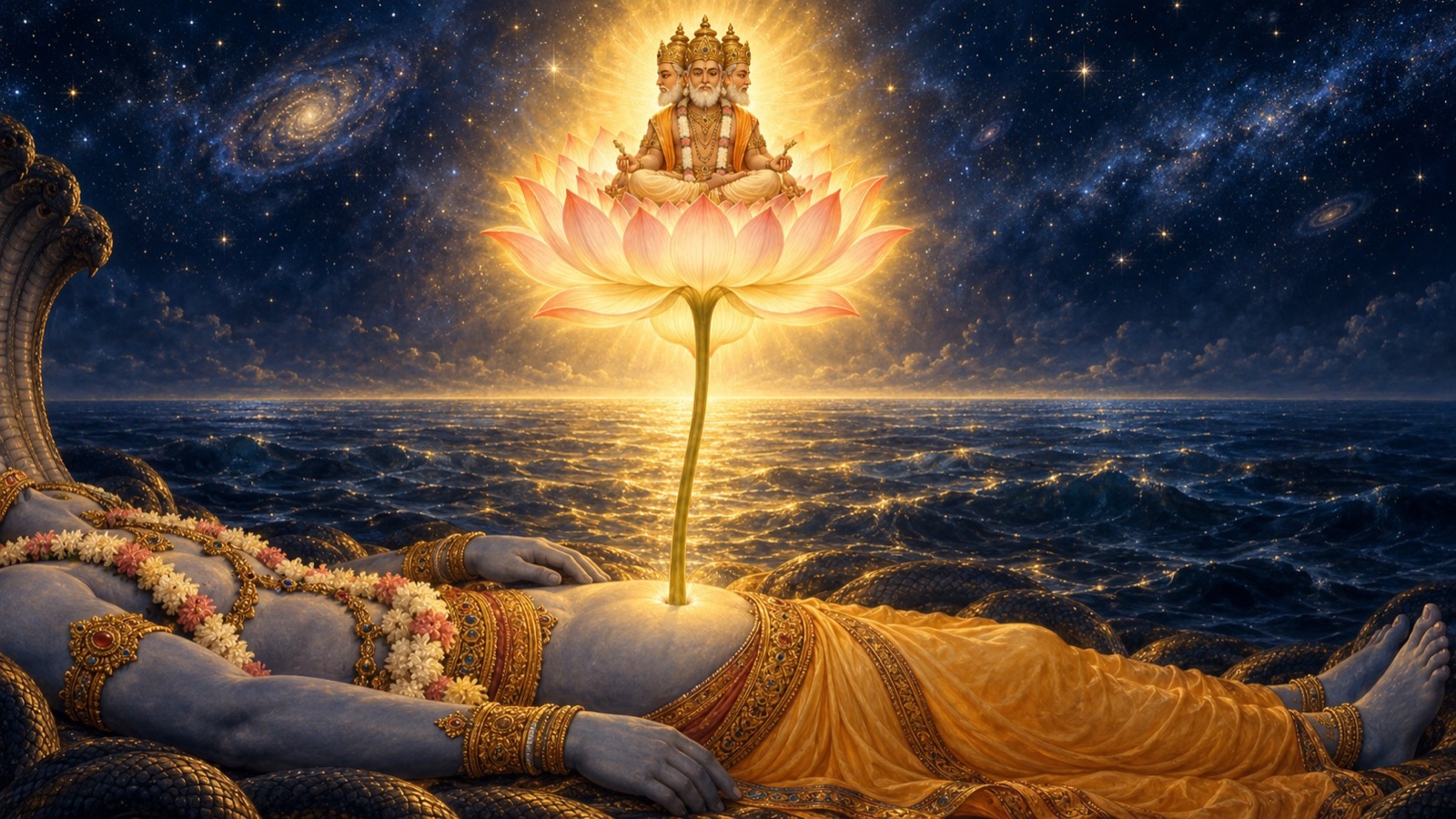
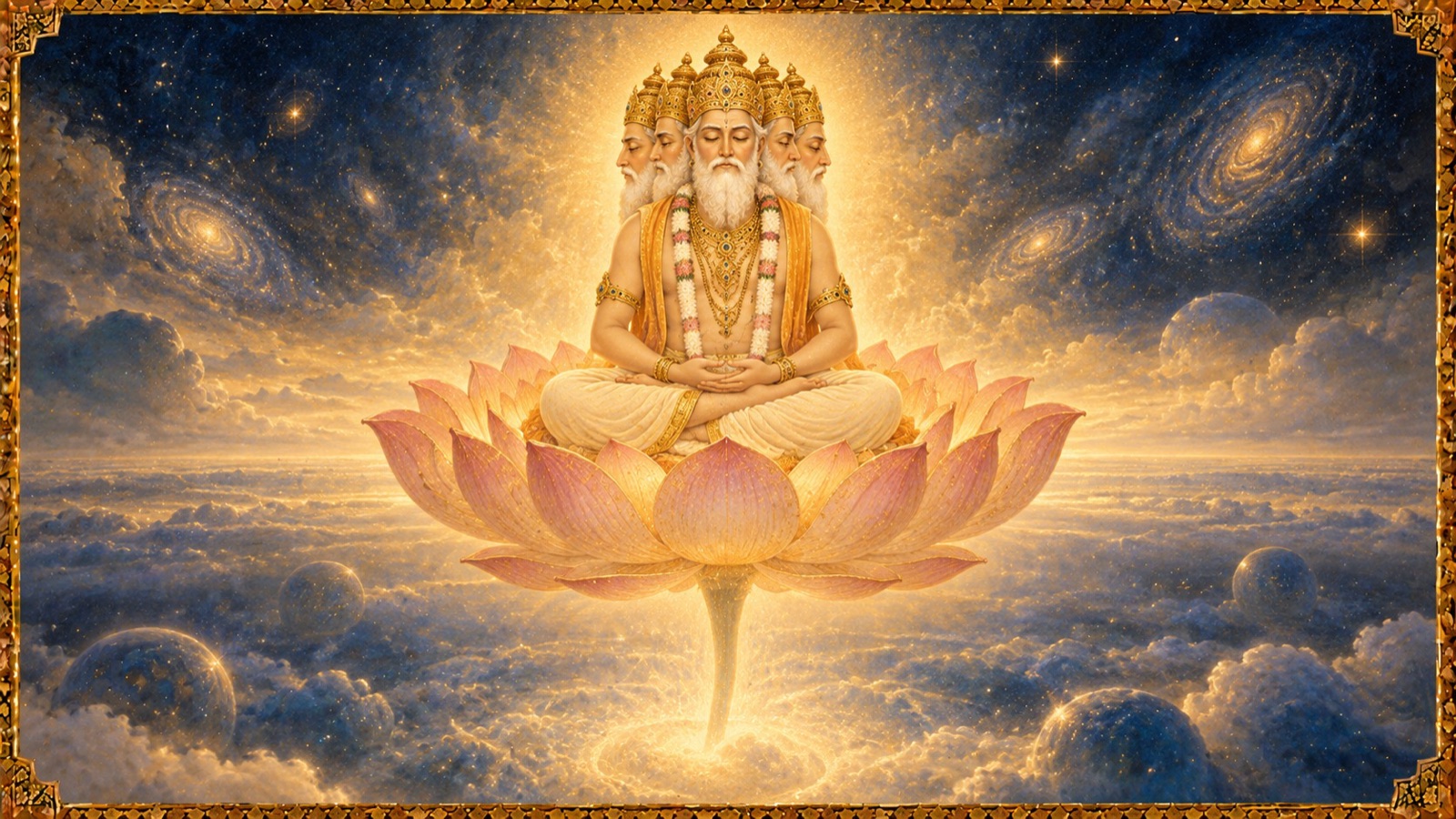
Maitreya tells Vidura how Brahma, born from the lotus of the Lord's own navel, evolved every order of living being out of his own body and passing states of mind — Nescience, the Yakshas and Rakshasas, the gods, the demons, the evening twilight, the Gandharvas and Apsaras, the Bhutas and Pisacas, the ancestors, the Siddhas, the Kimpurusas and Kinnaras, serpents and Nagas — culminating in the Manus and the Rishis, to whom Brahma gives a living portion of himself. A faithful, devotional retelling of Canto 3, Chapter 20 with verified verses.
Continue the Reading →
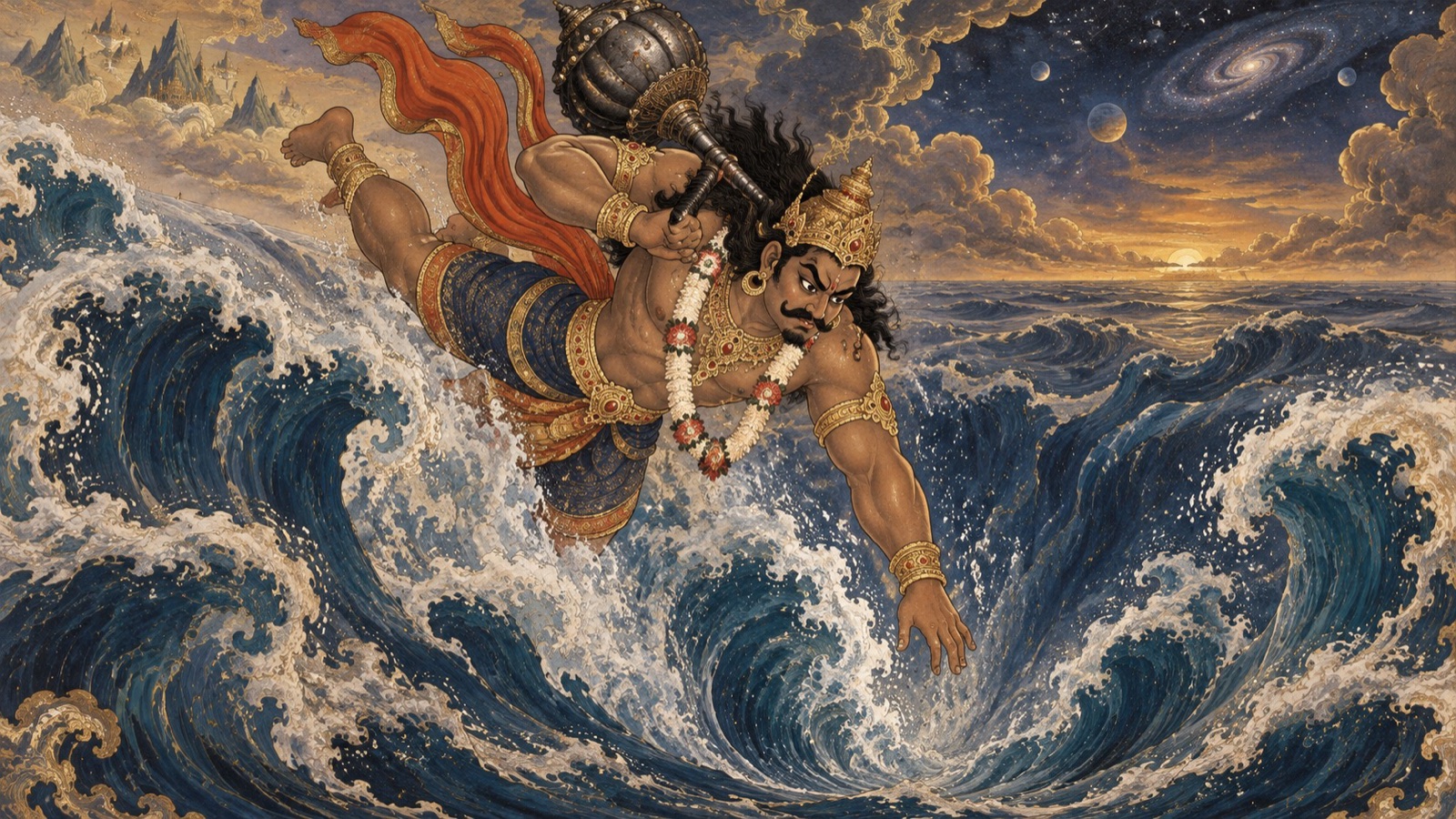
The divine Boar and the demon Hiranyaksa bring their long duel to its close: a mace lost and honored rather than exploited, a storm of illusion dispersed by the Sudarsana discus, and a death so serene that the watching sages call it blessed — the Lord's own eternal attendant returning home at last. A faithful, restrained retelling of Canto 3, Chapter 19 with verified verses.
Continue the Reading →
Maitreya continues his narration to Vidura: the demon Hiranyaksa, scornful of Varuna's counsel, tracks the divine Boar to the depths of the ocean, where taunts give way to a hard-fought mace duel, and Brahma himself arrives to plead that the Lord end the fight before the dreaded hour of twilight. A faithful, tasteful, devotional retelling of Canto 3's eighteenth chapter, with verified verses, Sanskrit quotations, and full discrepancy notes.
Continue the Reading →
The two fallen gatekeepers of Vaikuntha are born as Diti's twin sons amid a night of terrible omens. Hiranyakasipu grows invincible through Brahma's boon and conquers the three worlds; his brother Hiranyaksa, finding no opponent even in heaven, dives into the cosmic ocean and mockingly challenges Varuna — who declines, and instead points the arrogant demon toward the one Lord who can truly meet him. A faithful, devotional retelling with verified verses, Sanskrit quotations, and full discrepancy notes.
Continue the Reading →
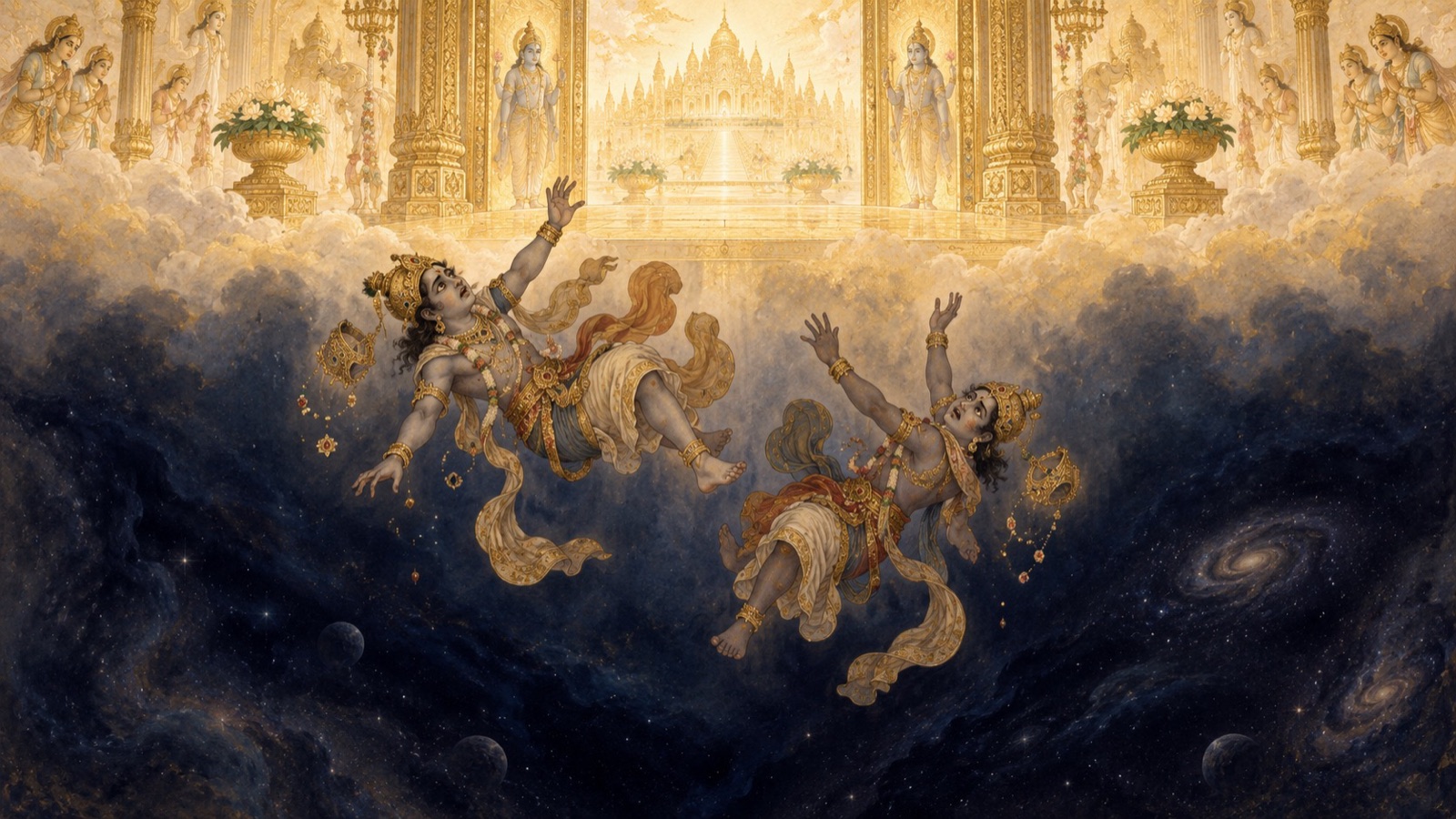
Brahma narrates how the Lord of Vaikuntha received the sages' curse against His own doorkeepers with joy, declared their offence His own, and only then revealed that the curse itself had been ordained by Himself from the start. The sages insist He is the Deity of all, not the Brahmanas alone; the Lord bids Jaya and Vijaya farewell, recalling an earlier curse by Lakshmi; and the two fall at last toward the womb of Diti amid a great outcry from the watching heavens. A faithful, devotional retelling of Canto 3, Chapter 16 with verified verses.
Continue the Reading →
Brahma tells the anxious gods an old story: how the four Kumara sages, wandering freely through six gates of Vaikuntha, were stopped at the seventh by the doorkeepers Jaya and Vijaya — and how their curse, spoken for the doorkeepers' own good, brought the Lord Himself at once to the gate. A faithful, devotional retelling of Canto 3's fifteenth chapter — with verified verses, Sanskrit quotations, and complete discrepancy notes.
Continue the Reading →
Vidura asks Maitreya about the Lord's encounter with the demon Hiranyaksa, and receives the story of that demon's own conception: Diti's desire-driven plea to her husband Kasyapa at an inauspicious hour, his counsel on marriage and the danger of the moment, his eventual yielding, and the twin prophecy that follows — two wicked sons, and a devotee grandson besides. A faithful, tasteful, devotional retelling of Canto 3's fourteenth chapter, with verified verses, Sanskrit quotations, and full discrepancy notes.
Continue the Reading →
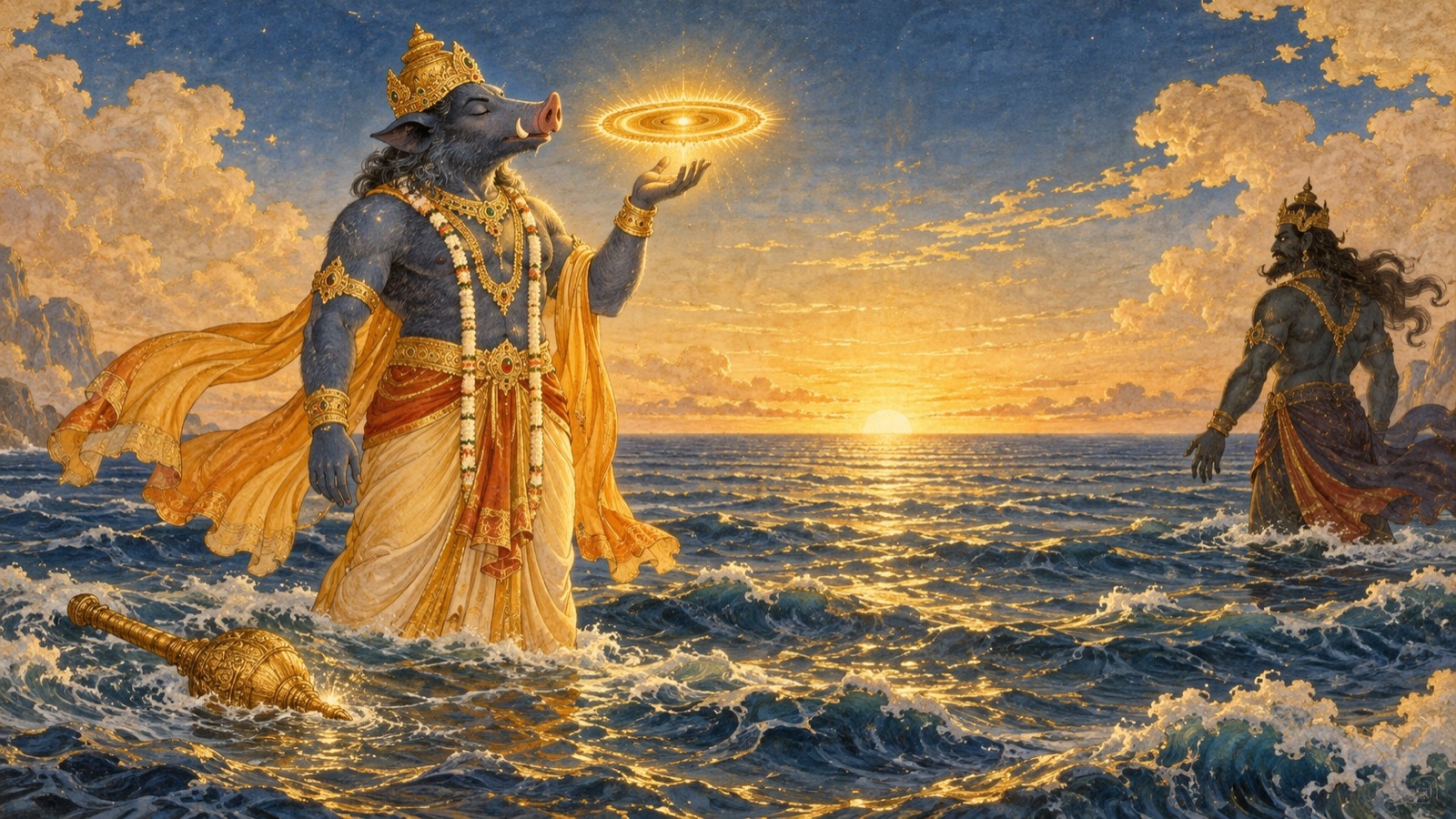
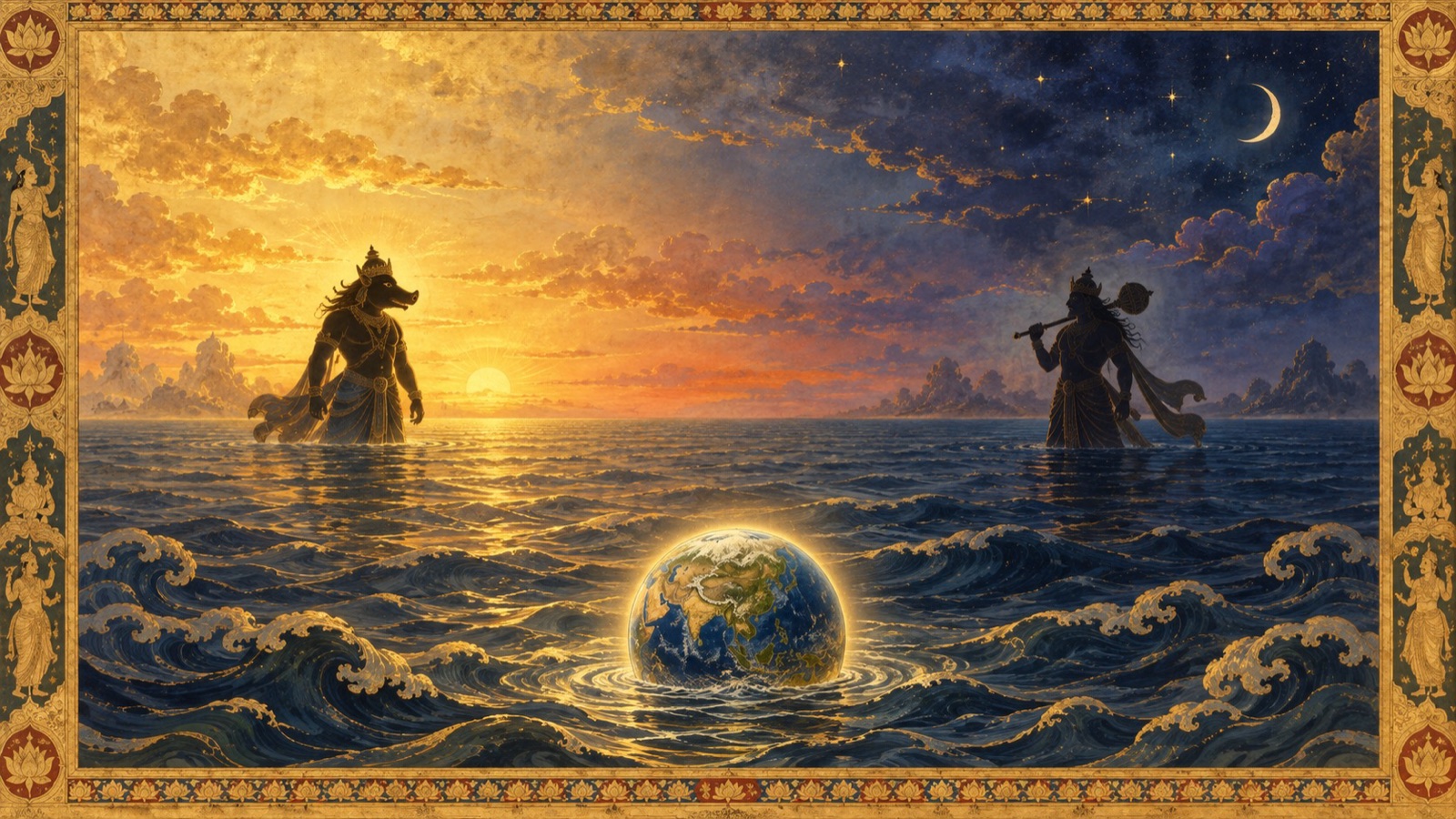
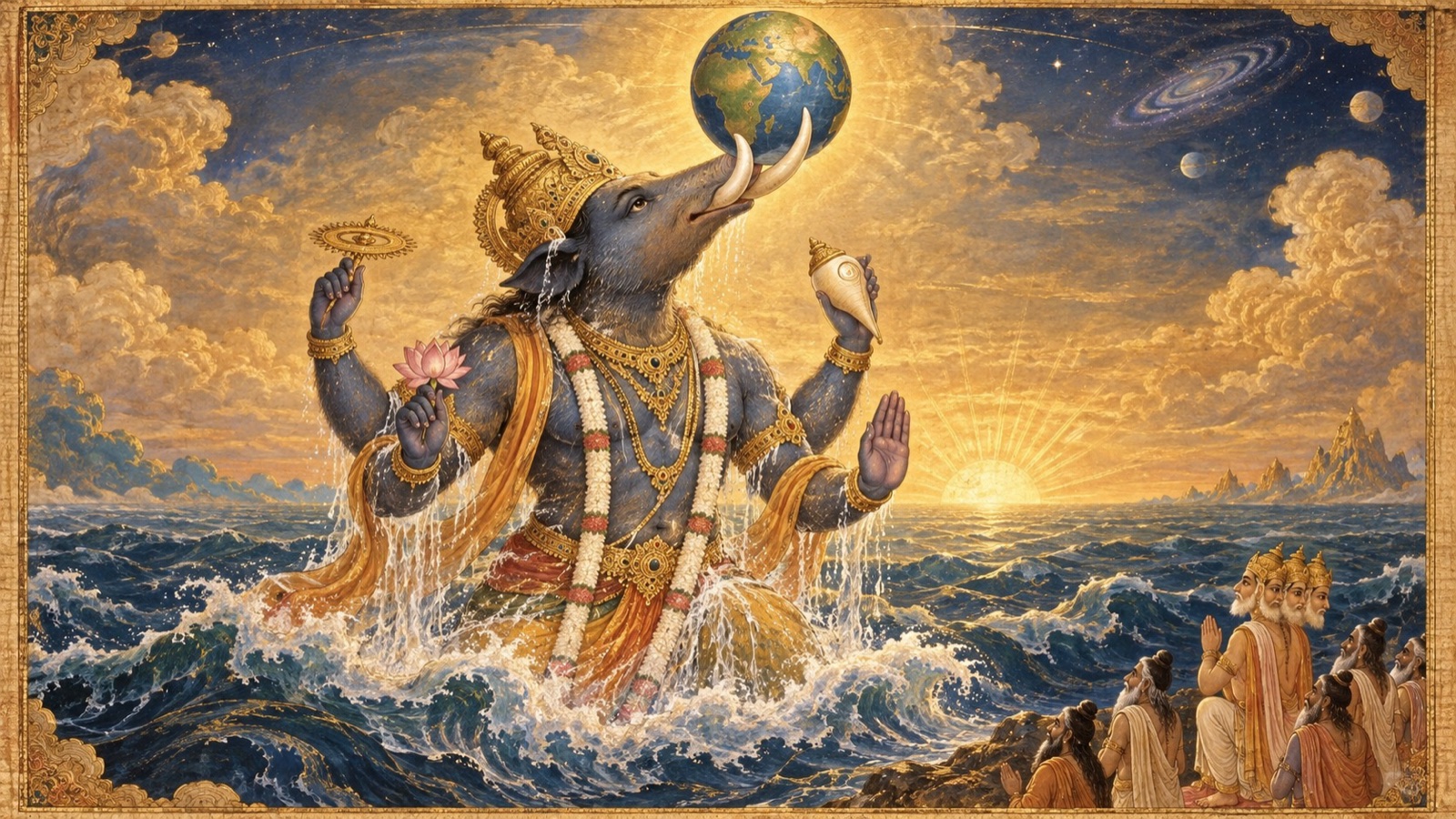
When the newly-created earth sinks into the cosmic ocean and Brahma finds himself powerless to save her, the Lord answers with action: a tiny boar from Brahma's own nostril, growing instantly to the size of a mountain, diving into the fathomless waters, slaying the demon Hiranyaksa, and lifting the world itself upon His tusks — while the sages extol Him as the living embodiment of sacrifice. A faithful, devotional retelling with verified verses, Sanskrit quotations, and full discrepancy notes.
Continue the Reading →
Maitreya tells Vidura the difficult, deeply human story of how Brahma actually built creation: an unwanted first harvest of ignorance, four sons who chose renunciation, the tearful birth of Rudra from suppressed anger, ten more sons springing from his own body, a painful lapse honestly corrected, and finally the birth of Svayambhuva Manu and Satarupa's five children who filled the universe. A faithful, devotional retelling of Canto 3, Chapter 12 with verified verses.
Continue the Reading →
Maitreya answers Vidura's question about the scale of cosmic time — building, unit by unit, from the indivisible Paramanu through the human calendar, the four Yugas, a day and night of Brahma, the fourteen Manvantaras, the great dissolution, and the two Parardhas of Brahma's own life, before revealing that this entire measureless scale is, to the Lord Himself, no more than the twinkling of an eye. A faithful, devotional retelling of Canto 3's eleventh chapter — with a full time-units table, verified verses, Sanskrit quotations, and complete discrepancy notes.
Continue the Reading →
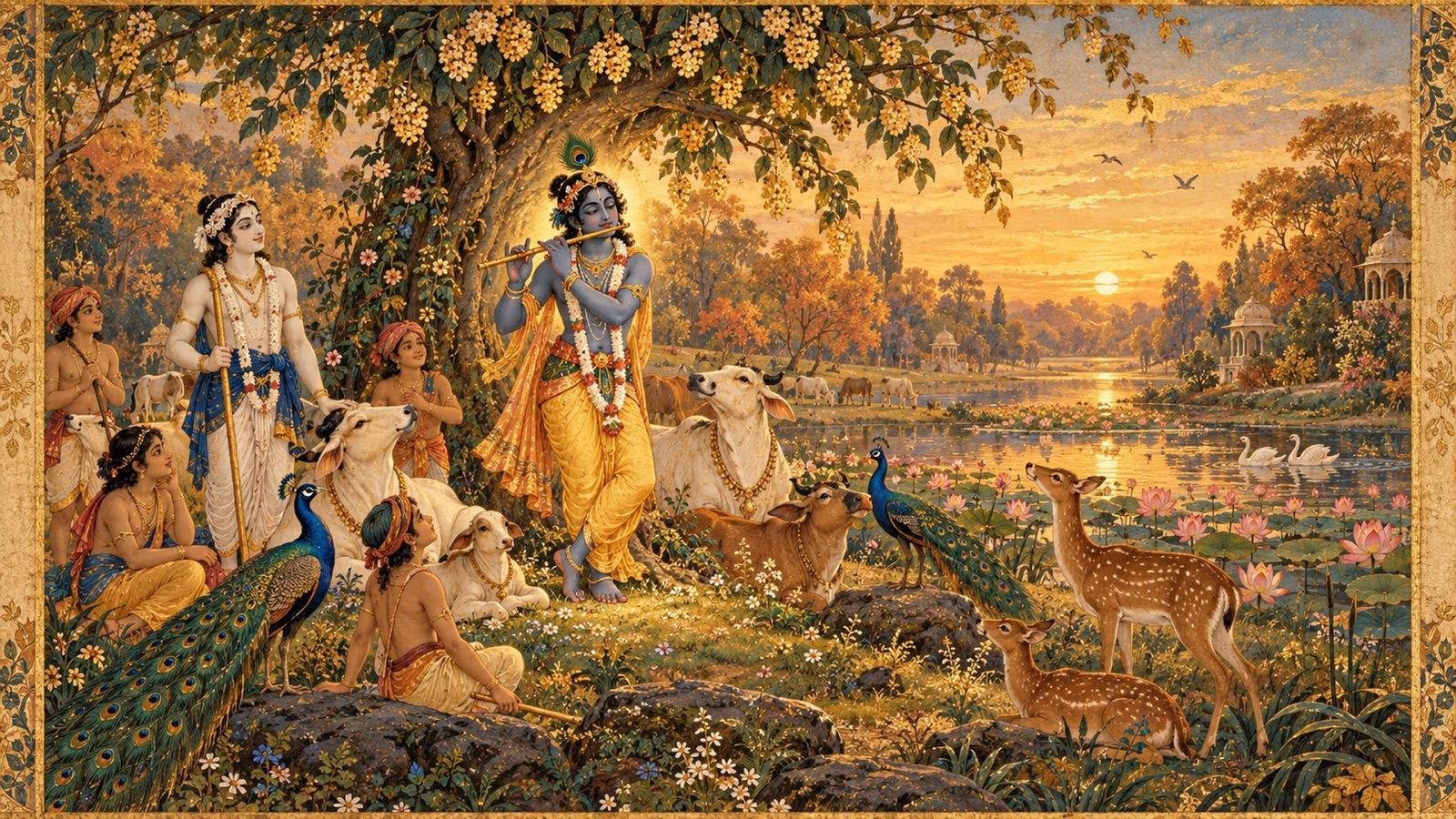
Vidura asks the sage Maitreya how many kinds of beings Brahma brought into existence, and receives one of the Bhagavatam's great structural passages in reply: Brahma's hundred years of penance and the discovery of the lotus, the Lord's potency of Time, the six streams of creation proceeding from Prakrti, and the three further streams — plants, animals and humans — culminating in the eightfold creation of the heavenly beings. A faithful, devotional retelling of Canto 3's tenth chapter — with verified verses, Sanskrit quotations, and full discrepancy notes.
Continue the Reading →
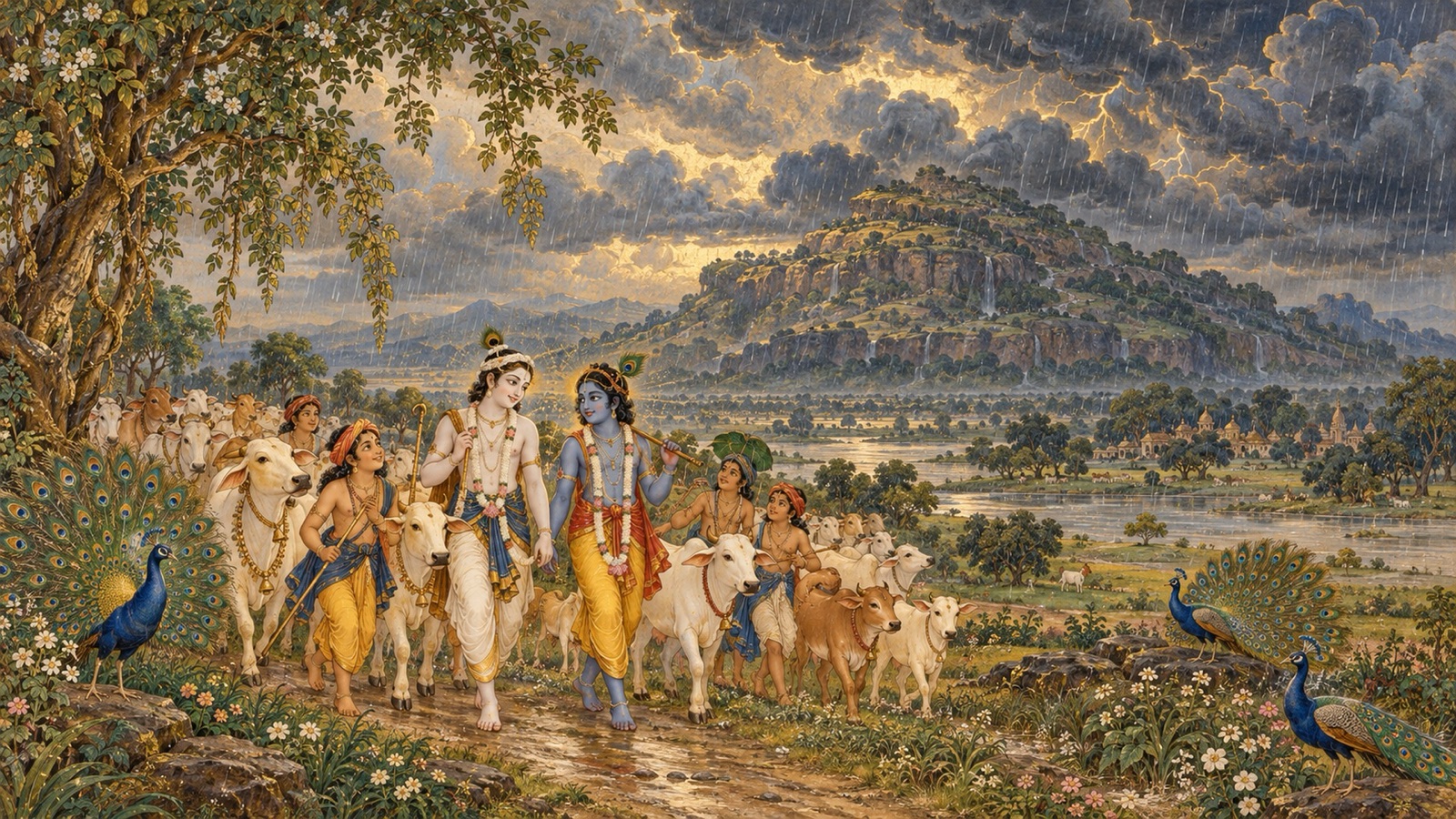
Newly born on the lotus that has sprung from the navel of the sleeping Lord, Brahma looks upon his Father for the first time and pours out one of the Bhagavatam's most personal hymns of praise — confessing his own long ignorance, meditating on devotion, Time, and the Lord's yogic sleep, and pleading for the vision to create. The Lord answers with reassurance and teaching before withdrawing His form. A faithful, devotional retelling with verified verses, Sanskrit quotations, and full discrepancy notes.
Continue the Reading →
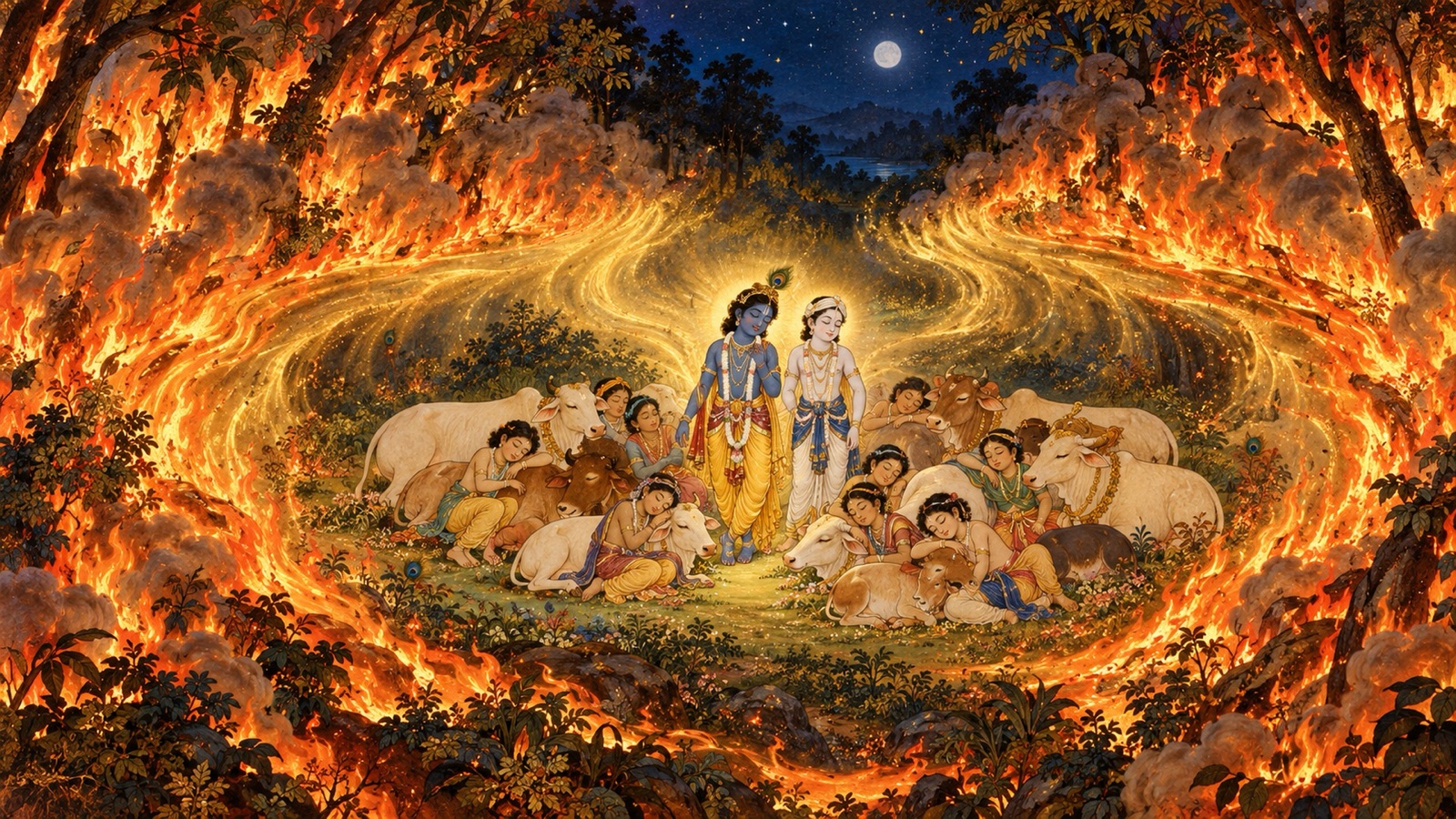
Maitreya begins his long-awaited discourse to Vidura with the story of creation itself: a lotus springs from the navel of the sleeping Lord Narayana, the self-born Brahma appears within it, searches in vain for his own origin, and after a hundred years of meditation beholds the Lord's full splendour on the serpent Sesa. A faithful, devotional retelling of Canto 3, Chapter 8 with verified verses.
Continue the Reading →
Vidura asks Maitreya how the pure, unqualified, self-satisfied Lord can appear touched by Maya and play. Maitreya's answer — the dream of a severed head, the moon trembling in water — resolves the doubt, and Vidura goes on to ask forty further questions that outline nearly the whole of the Bhagavatam still to come. A faithful, devotional retelling of Canto 3's seventh chapter — with verified verses, Sanskrit quotations, and full discrepancy notes.
Continue the Reading →
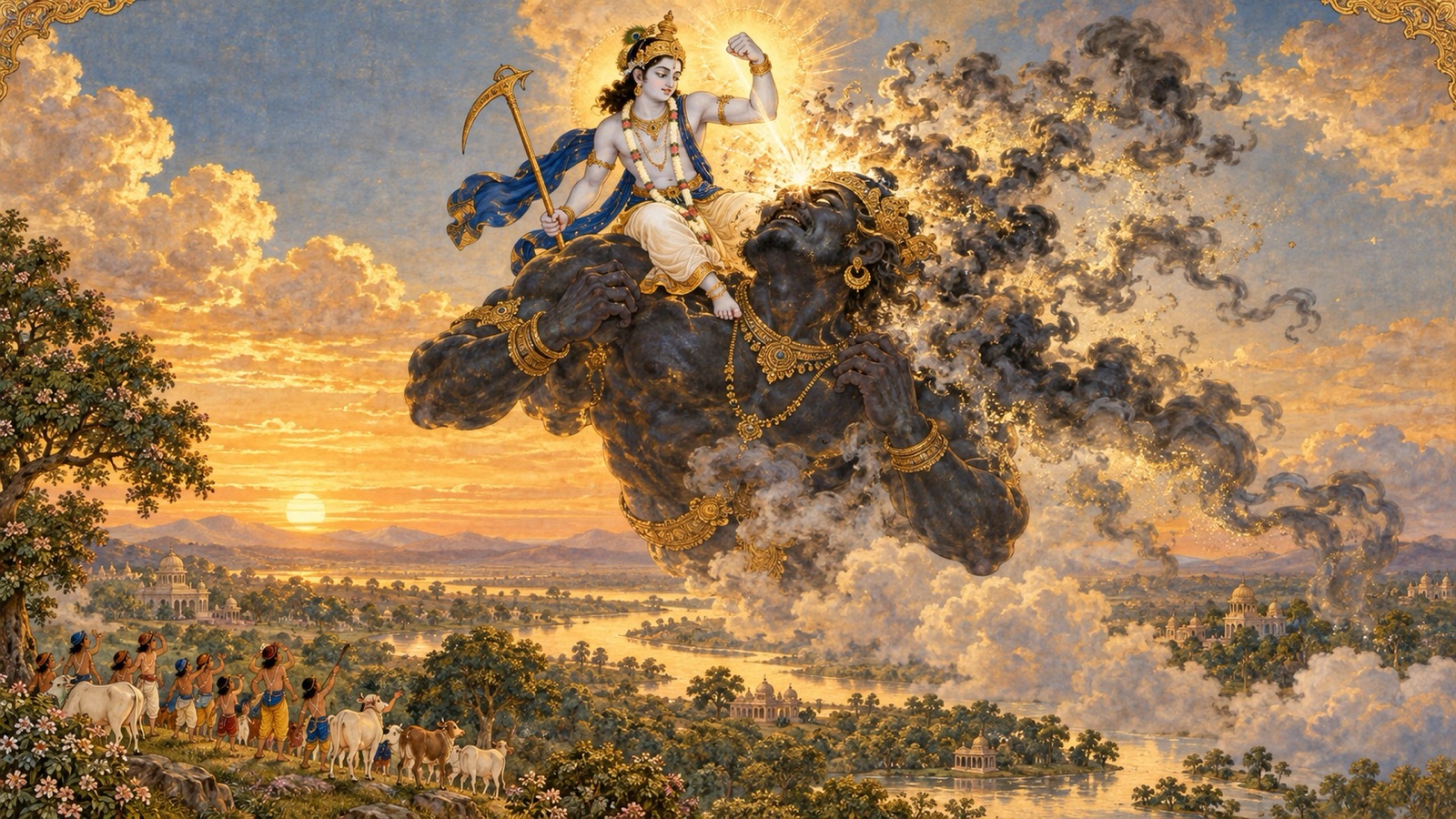
The sage Maitreya narrates one of the Bhagavatam's most extraordinary cosmological passages to Vidura: the Lord assumes the potency of Time, enters twenty-three disconnected categories of creation, and draws them into the effulgent Cosmic Body — the universal form from which the senses, their presiding deities, the three worlds, and the four varnas all emanate. A faithful, devotional retelling of Canto 3's sixth chapter — with verified verses, Sanskrit quotations, and full discrepancy notes.
Continue the Reading →
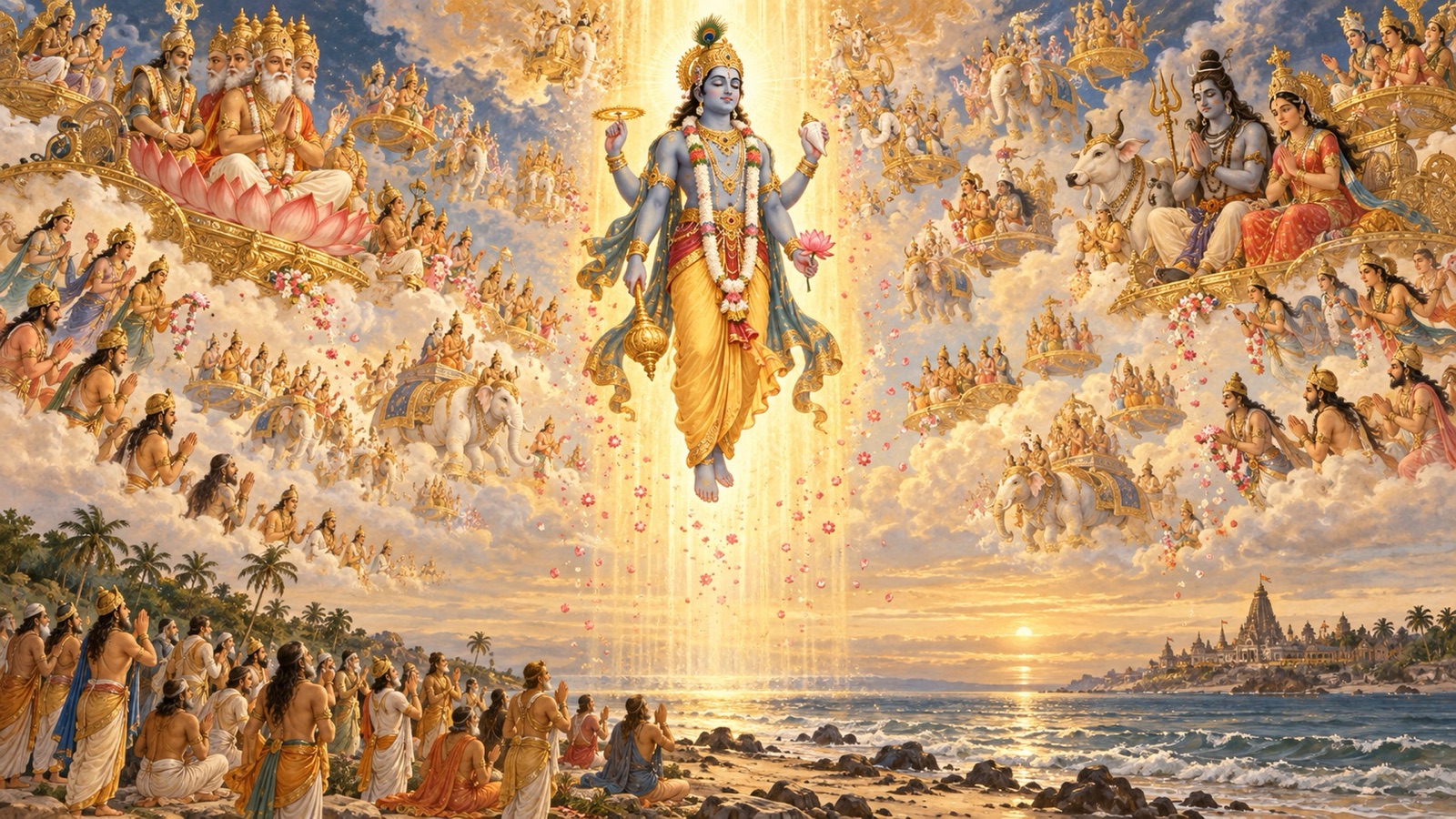
At Haridwara, where the celestial Ganga descends into the plains, Vidura asks the sage Maitreya how a suffering soul finds lasting happiness — and receives in reply the Bhagavatam's foundational account of creation: the Lord alone before creation, Maya, the Purusa, the Mahat-tattva, the threefold ego, the five elements, and the newly-formed deities' prayer for creative grace. A faithful, devotional retelling with verified verses, Sanskrit quotations, and full discrepancy notes.
Continue the Reading →
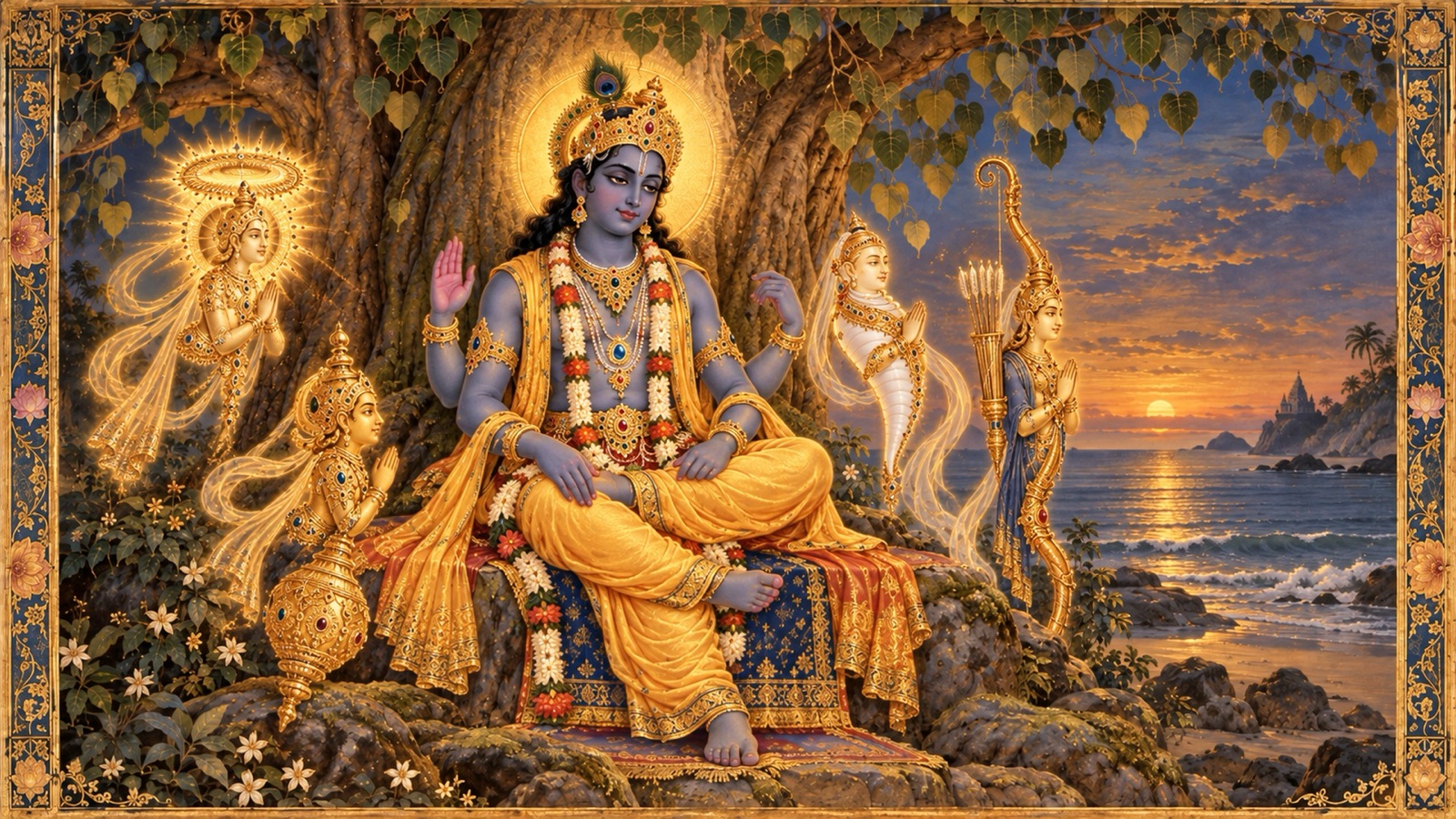
The Yadu dynasty's destruction is complete, and Uddhava recounts his final, tender audience with the Lord beneath a peepul tree on the Saraswati's bank. A faithful, devotional retelling of Canto 3, Chapter 4 — the Lord's last teaching, Uddhava's humble direction of Vidura to the sage Maitreya, and Vidura's journey onward to the Ganga — with verified verses.
Continue the Reading →
In twenty-eight swift verses, Uddhava carries Vidura from Kamsa's death and the rescue of sixteen thousand princesses through the thunder of the Mahabharata war to the first quiet shadow of the Yadu dynasty's end. A faithful, devotional retelling of Canto 3's third chapter — with verified verses, Sanskrit quotations, and full discrepancy notes.
Continue the Reading →
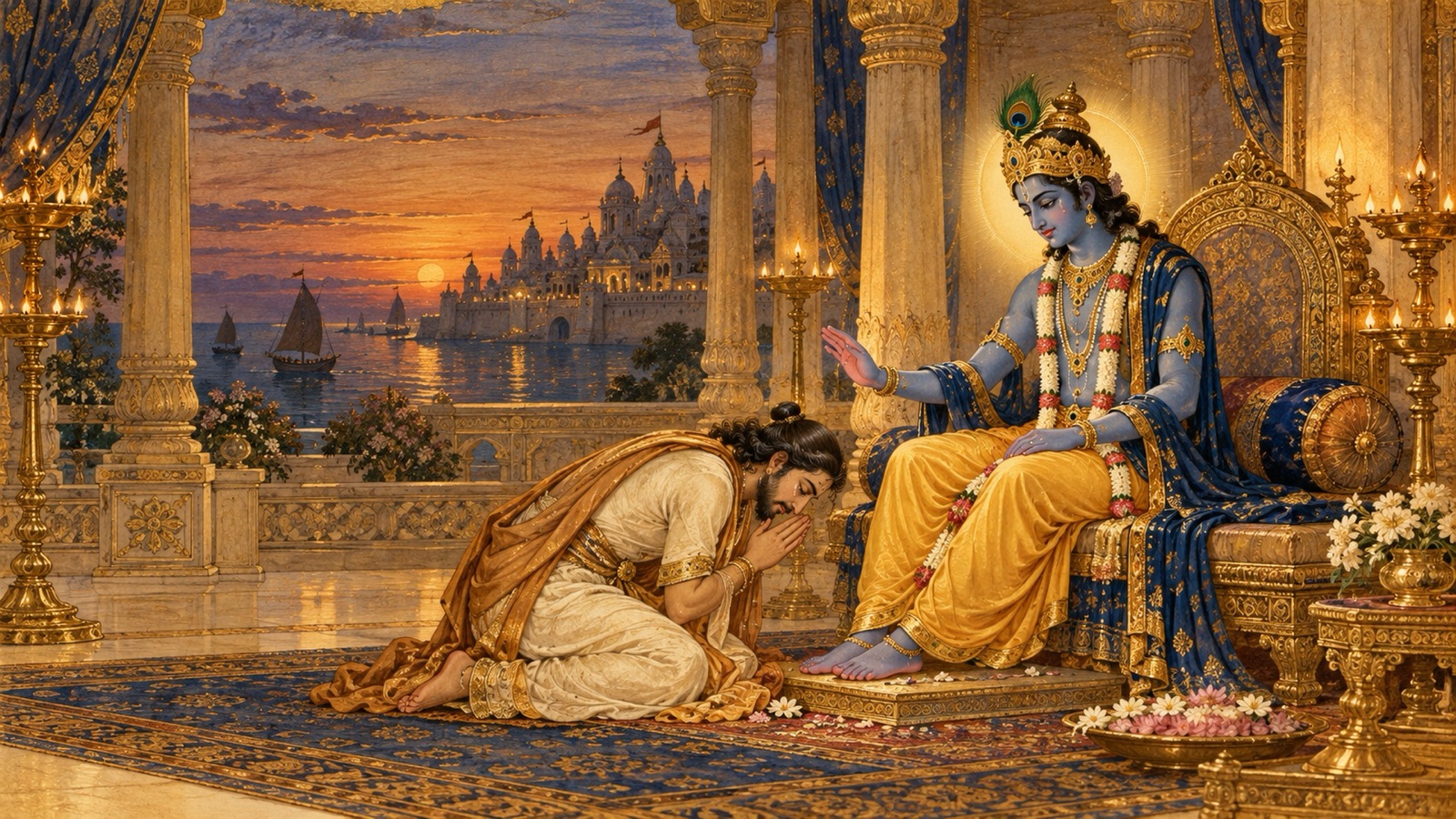
Asked for news of Krishna, the devotee Uddhava is struck speechless with love for nearly an hour. A faithful, devotional retelling of Canto 3's second chapter — Uddhava's wondering lament on a world that failed to recognize God, and his tender summary of Krishna's birth, Vraja childhood, Kaliya-daman, Govardhana, and the rasa dance — with verified verses.
Continue the Reading →
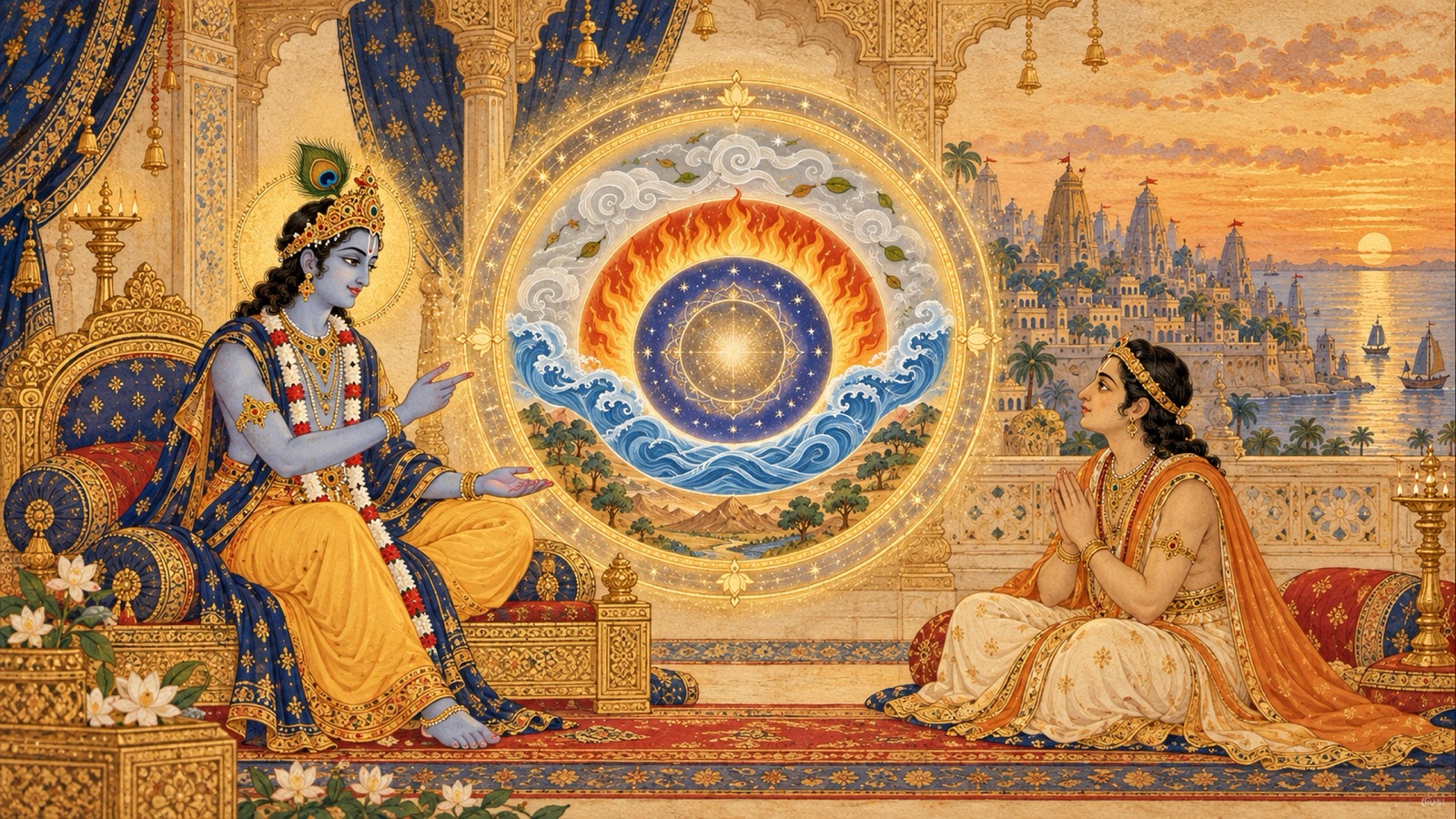
Banished from Hastinapura for speaking the truth, Vidura spends years on pilgrimage before meeting his fellow devotee Uddhava on the bank of the Yamuna. A faithful, devotional retelling of Canto 3's opening chapter — the fall of the Kuru house, Vidura's counsel and exile, his pilgrim's vow, and his loving roll-call of questions after the Yadu and Pandava families — with verified verses.
Continue the Reading →
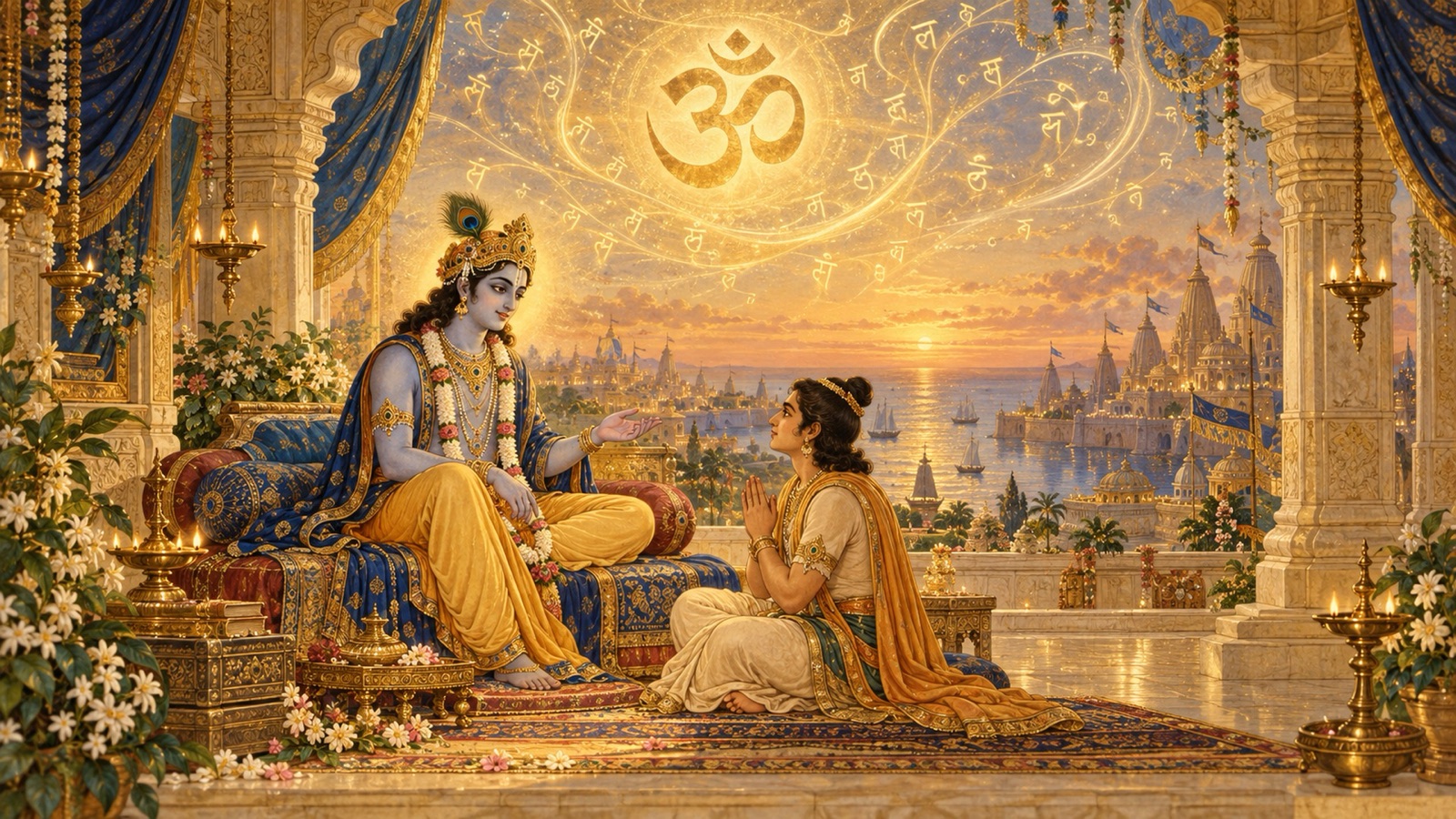
Sukadeva Gosvami names the ten topics that structure the entire Bhagavata Purana — Sarga, Visarga, Sthana, Posana, Utis, Manvantaras, Isanukathas, Nirodha, Mukti, and Asraya — then shows how the Cosmic Being, alone in the primordial waters, manifested every sense and limb of the universe. This final chapter of Canto 2 closes with Saunaka's question about Vidura, opening the way to Canto 3. A faithful, devotional retelling with verified verses.
Continue the Reading →
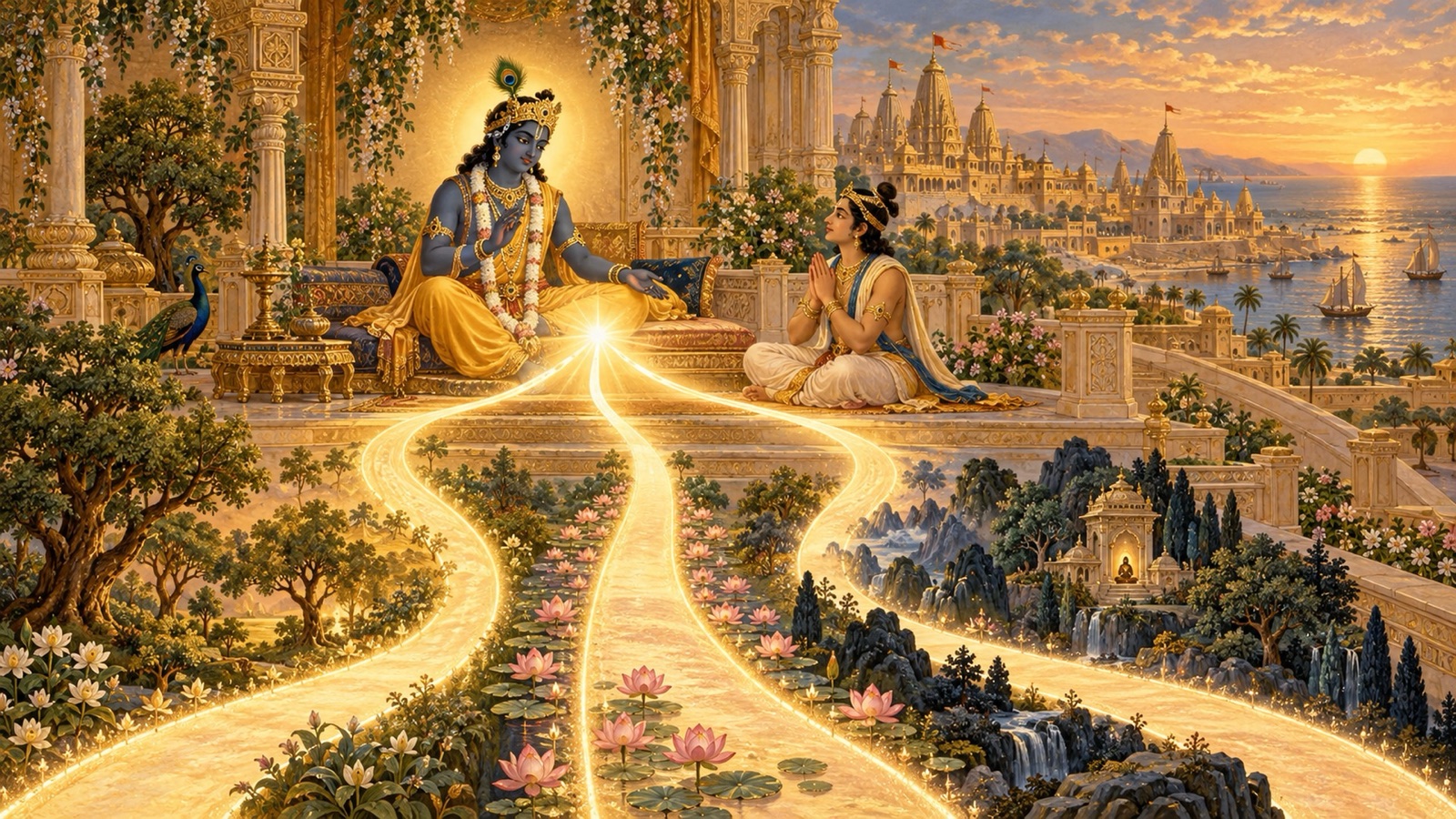
Brahma performs a thousand-celestial-year penance on the strength of a single unseen word, beholds the Lord's own transcendent Abode, and receives the Chatuh-shloki Bhagavatam — four verses so complete that the entire scripture is traditionally understood as their unfolding. A faithful, devotional retelling with verified verses.
Continue the Reading →
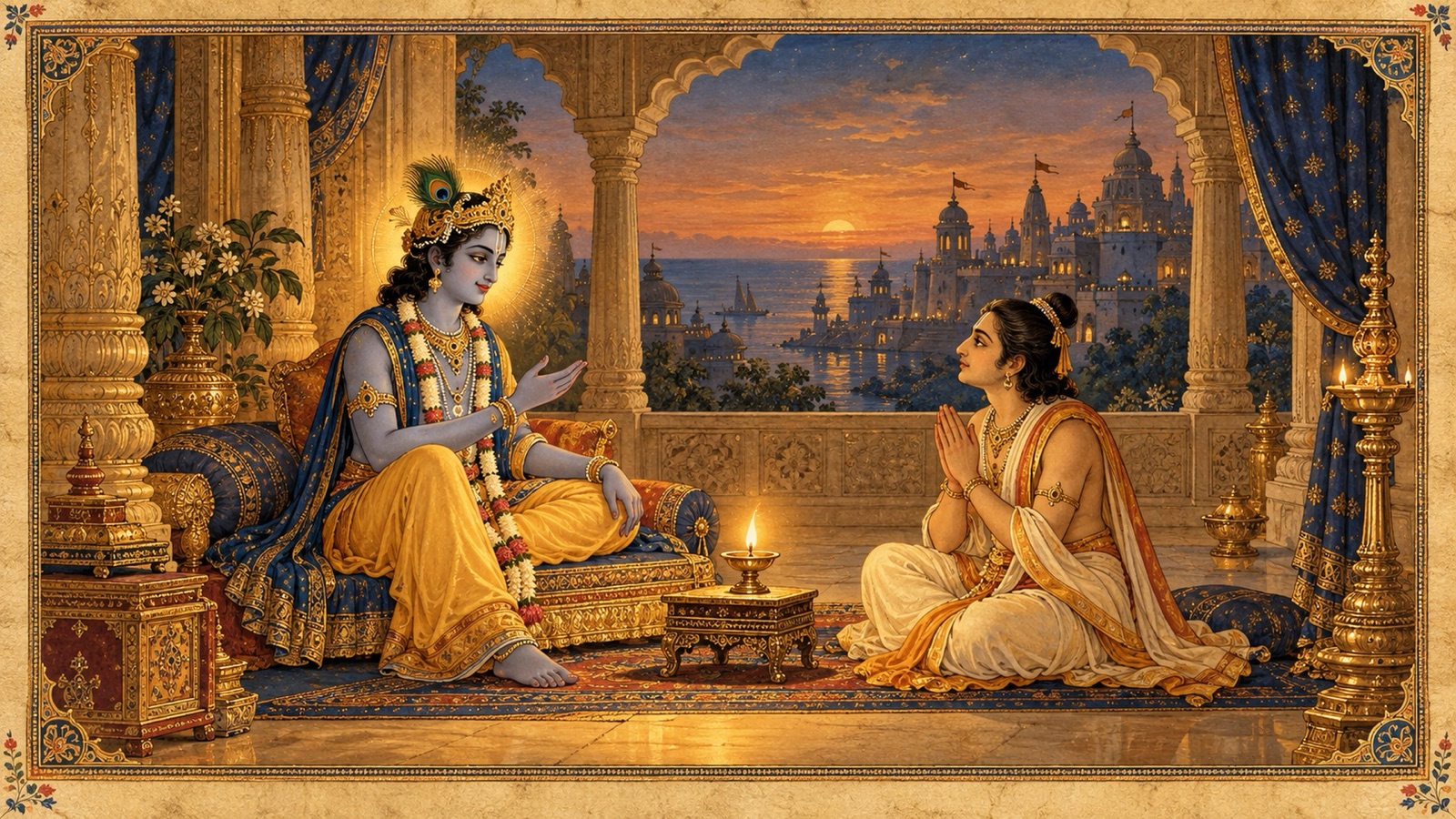
With seven days left to live, King Parikshit pours out every question in his heart to the sage Suka — about the Bhagavata's origin, the soul and the Cosmic Being, the Kalpas and time, the Yugas and the Lord's incarnations, duty, Yoga, the Vedas, and the mystery of bondage and liberation. A faithful, devotional retelling with verified verses.
Continue the Reading →
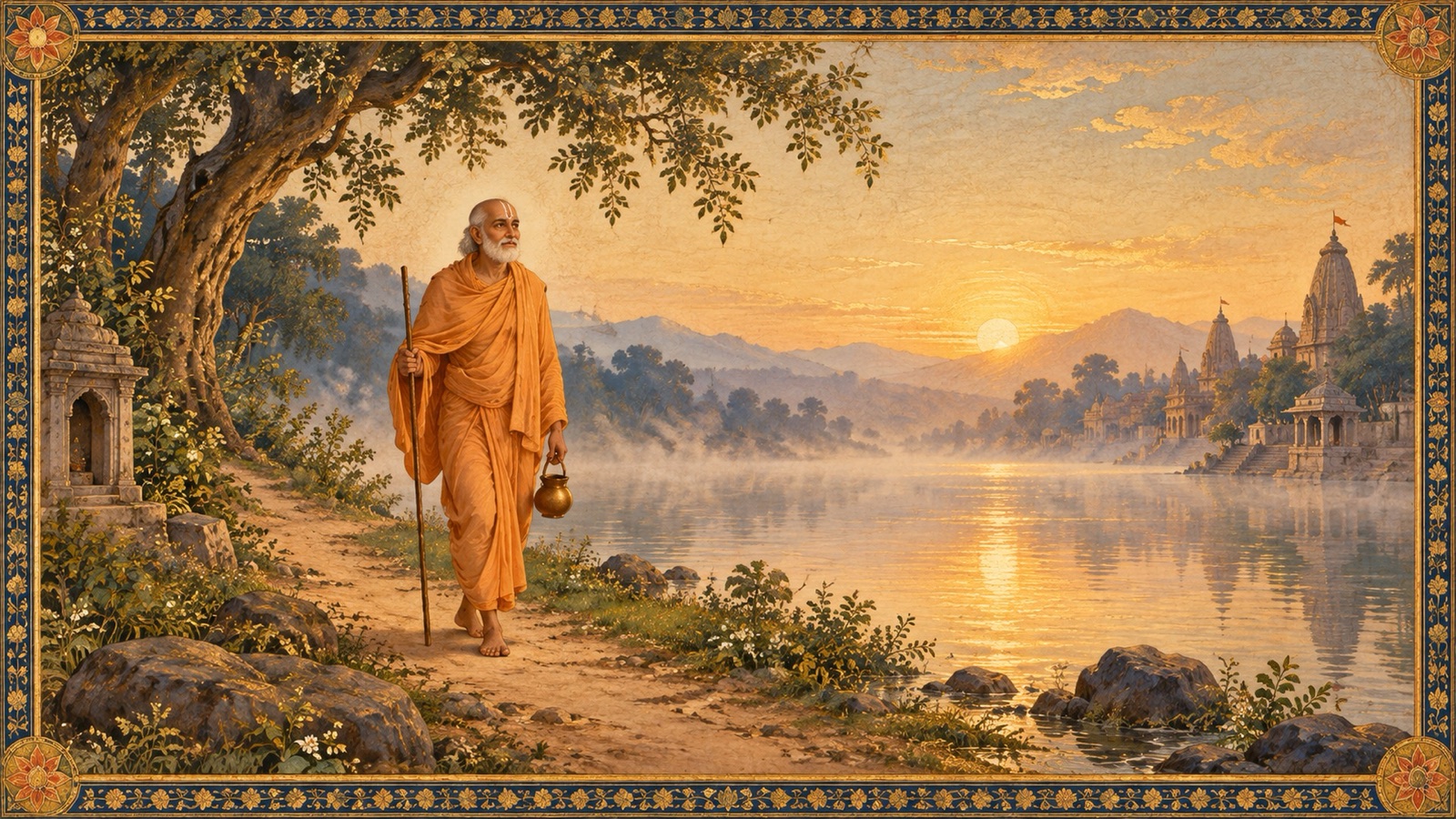
Brahma recounts, for the sage Narada, the sweeping roll-call of the Lord's incarnations across the ages — Varaha, Kapila, Dattatreya, the Kumaras, Dhruva, Prthu, Matsya, Kurma, Narasimha, Vamana, Rama, Krishna and Balarama, Vyasa, Buddha, and the Kalki still to come — and closes with a meditation on the Lord's unfathomable nature. A faithful, devotional retelling with verified verses.
Continue the Reading →
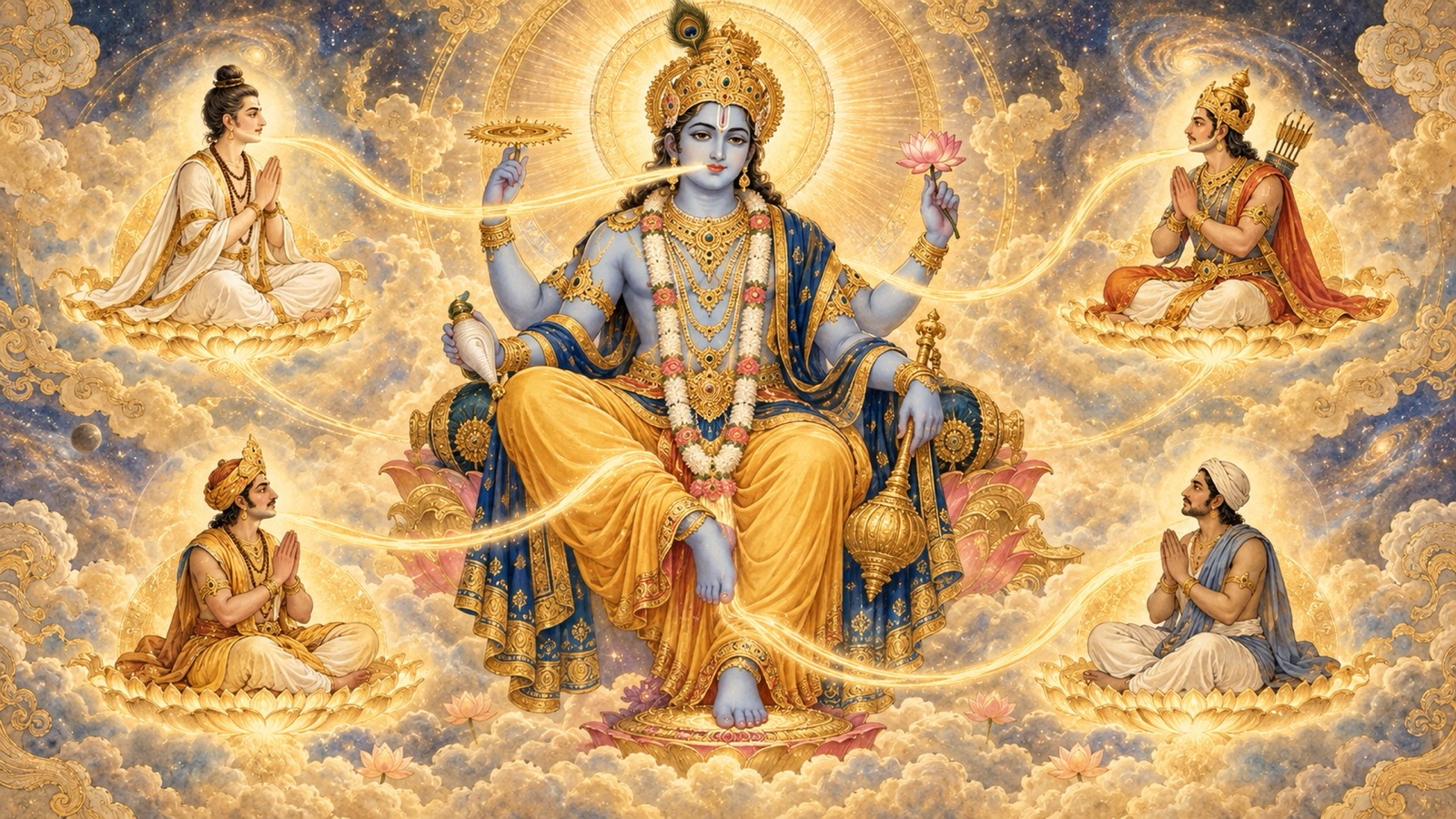
Brahma continues his reply to Narada, tracing how the mouth, eyes, limbs, and every faculty of the Cosmic Being give birth to the deities and elements of creation — then offers one of scripture's most humbling confessions: even he, Veda personified and master of Yoga, cannot fully know the Lord. A faithful, devotional retelling with verified verses.
Continue the Reading →
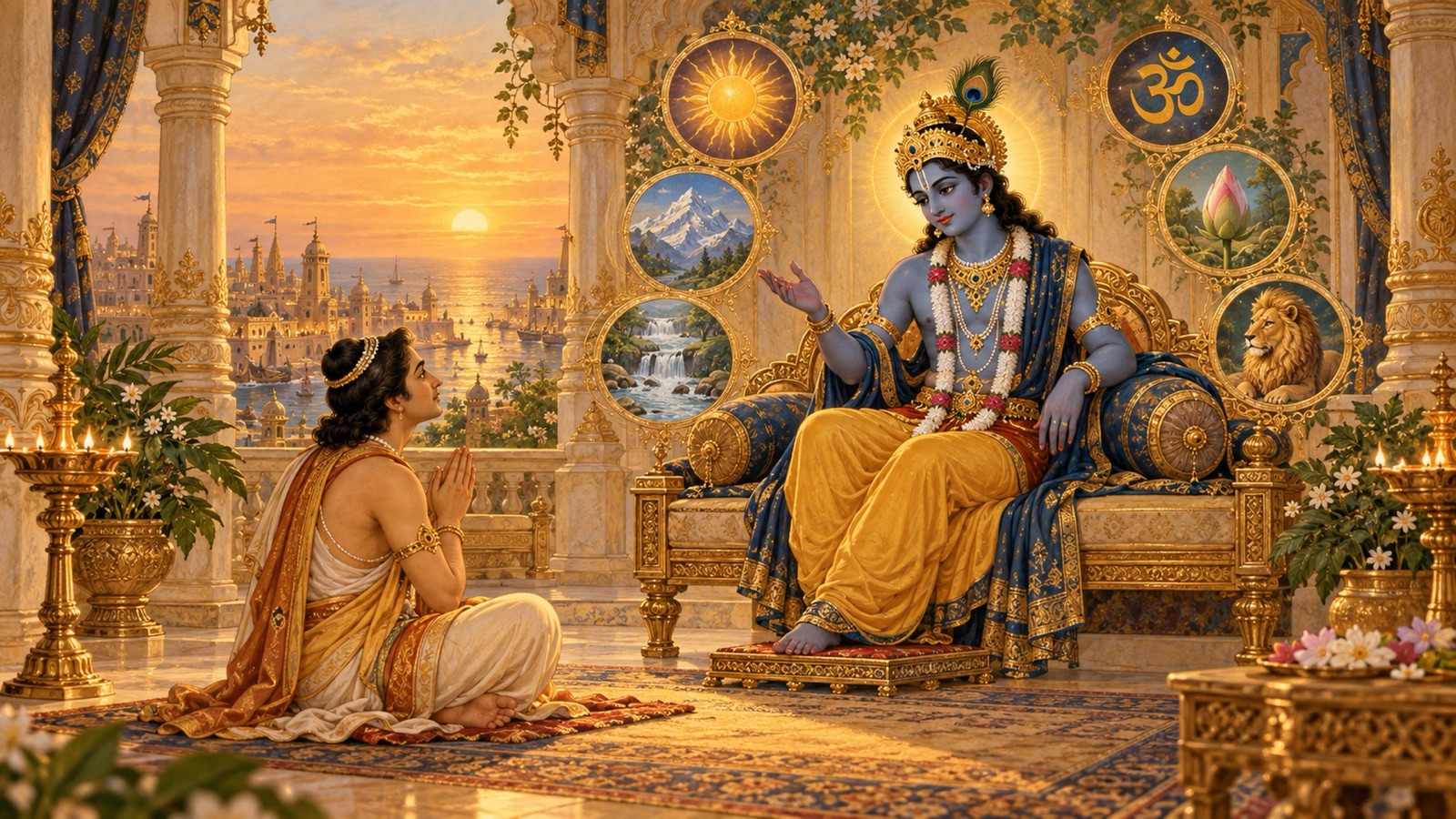
Brahma answers Narada's question about the universe with a humbling confession — he only seems to create — and traces the whole cosmos unfolding from the Lord: the three Gunas, Mahat and ego, the five elements, the senses and their gods, the Cosmic Egg, and the Virat Purusha who holds all fourteen worlds. A faithful, devotional retelling with verified verses.
Continue the Reading →
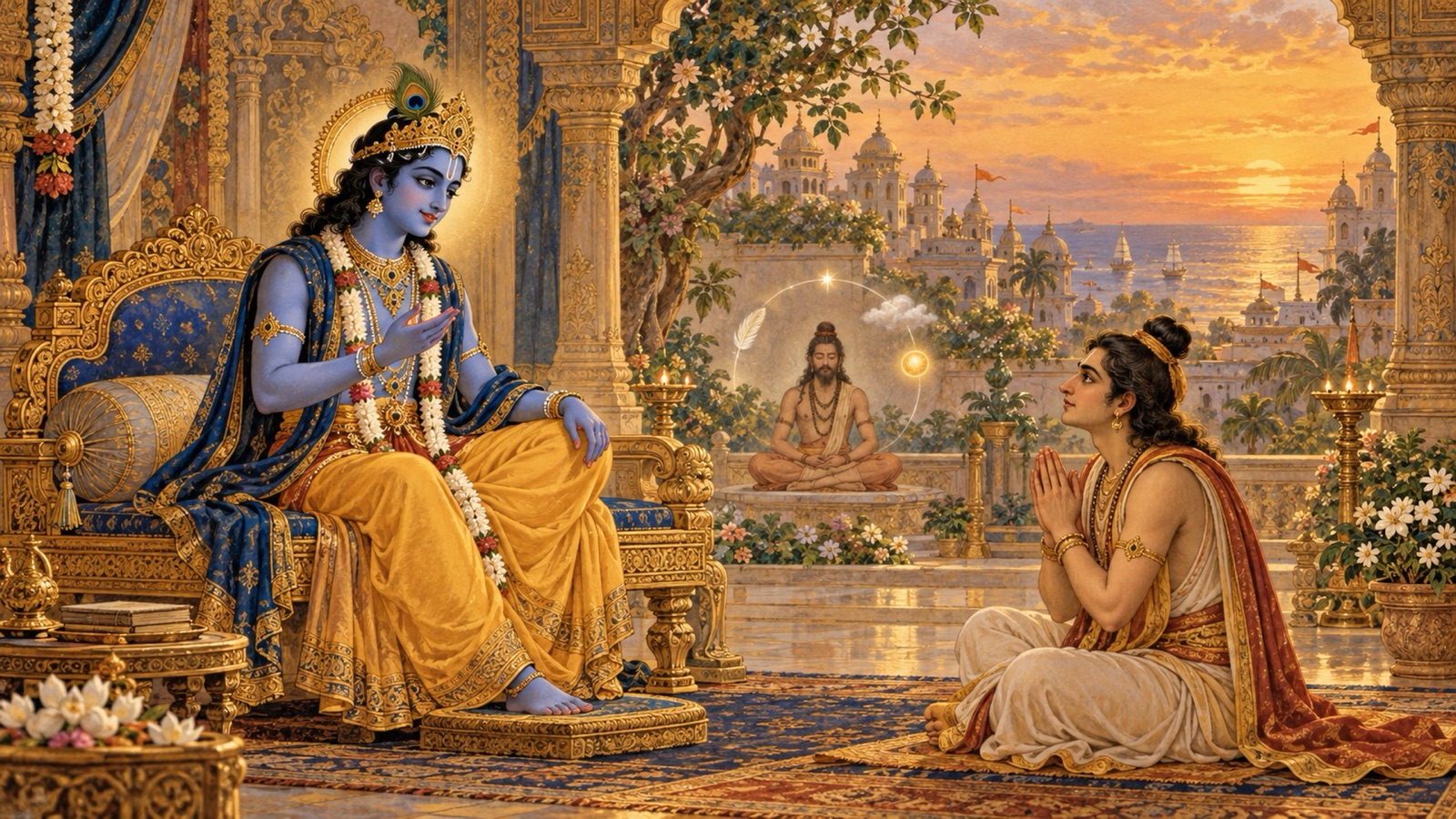
Having heard Sukadeva's teaching, King Parikshit lets go of every attachment and asks how the Lord creates, sustains, and destroys the universe. Sukadeva's answer begins not with cosmology but with a thirteen-verse prayer of obeisance to the Supreme Person. A faithful, devotional retelling with verified verses.
Continue the Reading →
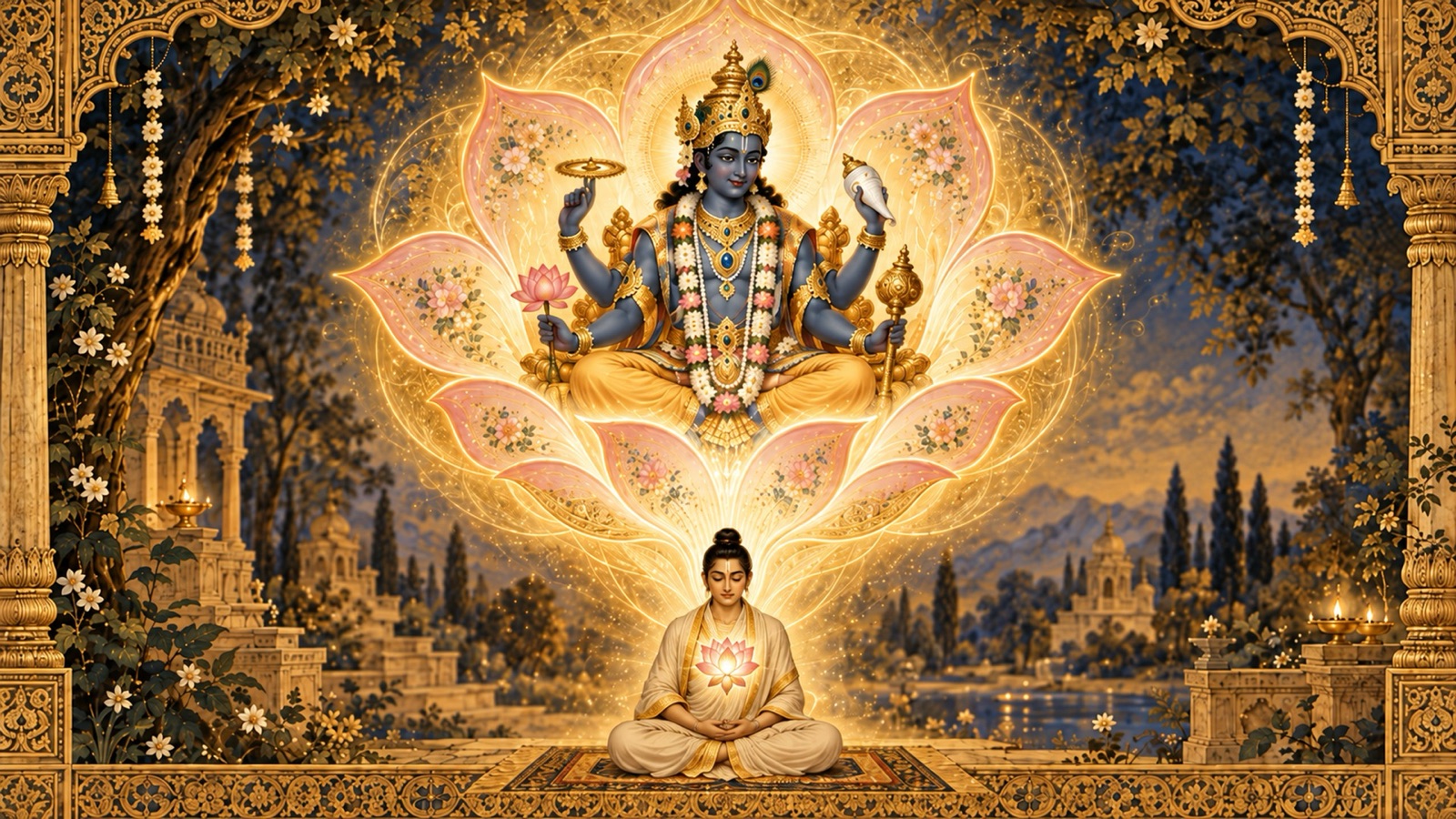
Sukadeva closes his answer to Parikshit, then surveys the deities traditionally worshipped for specific worldly desires — only to show that devotion to the Supreme Person surpasses them all. Saunaka asks Suta to continue, and the chapter ends with the Bhagavatam's stirring verses on hearing, chanting, and remembering the Lord's name. A faithful, devotional retelling with verified verses.
Continue the Reading →
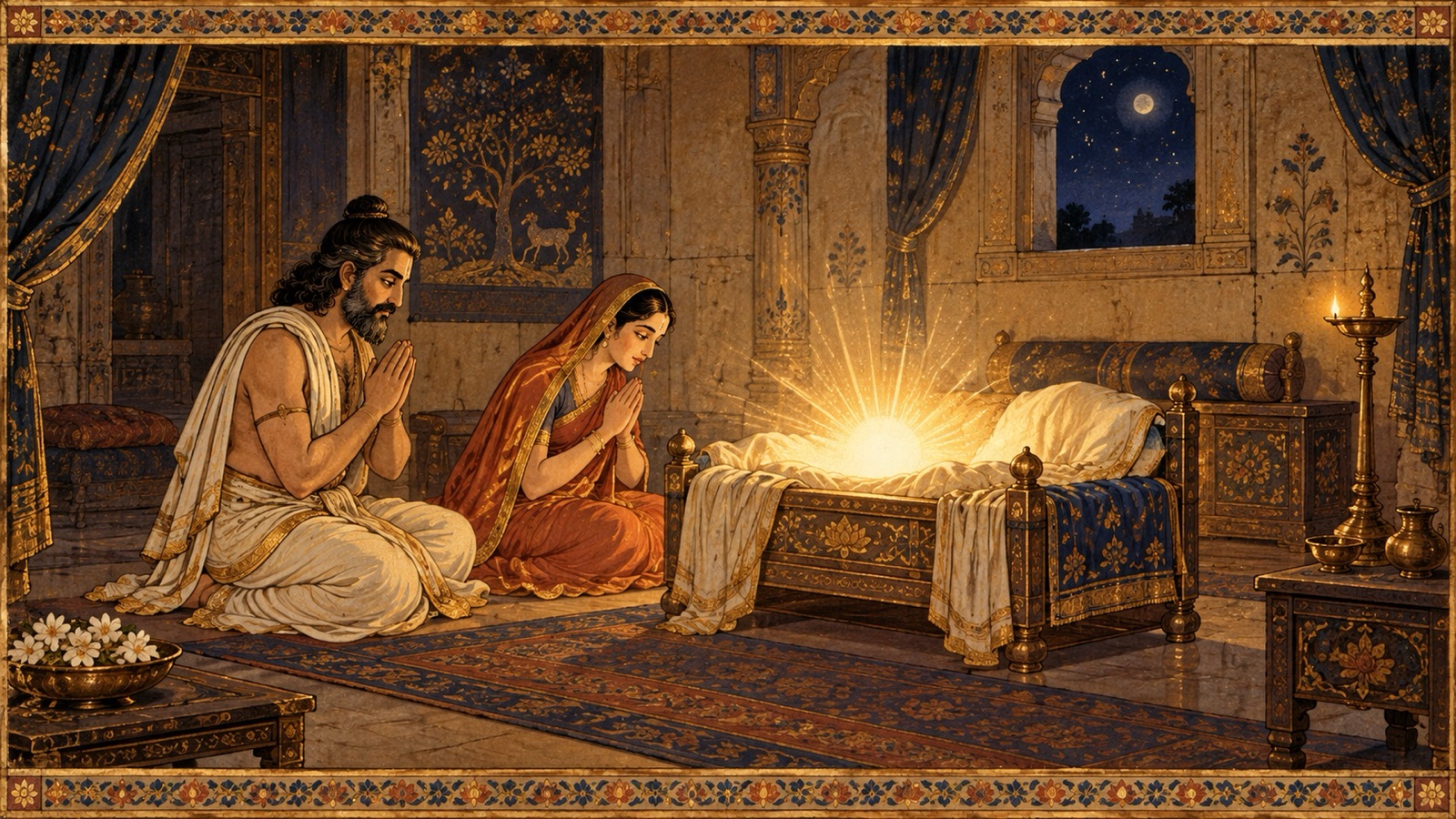
Sukadeva's discourse continues: Brahma's forgotten knowledge restored, the Lord's intimate four-armed form meditated on in the heart, the precise yogic technique of consciously leaving the body, and the two eternal paths, Kramamukti and Sadyomukti. A faithful, devotional retelling with verified verses.
Continue the Reading →

Sukadeva's promised answer begins: the supreme value of hearing about the Lord, a step-by-step path of meditation, and the majestic Virat Purusha, the universe described as the Lord's own body. A faithful, devotional retelling with verified verses.
Continue the Reading →
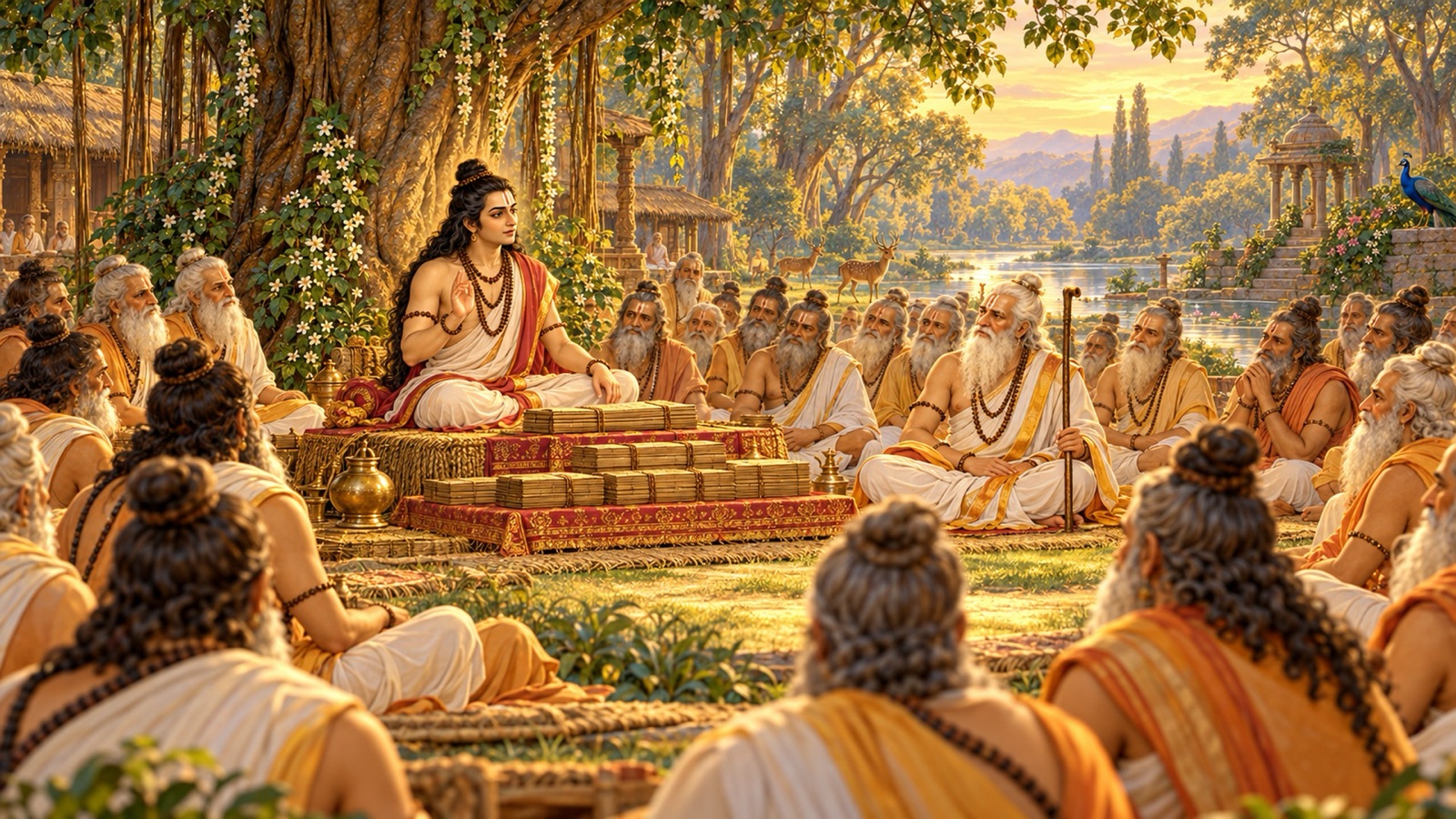
King Parikshit turns a curse into a doorway to God, vowing to fast till death on the Ganga bank. Then the young sage Sukadeva Goswami arrives. A faithful, devotional retelling with verified verses.
Continue the Reading →
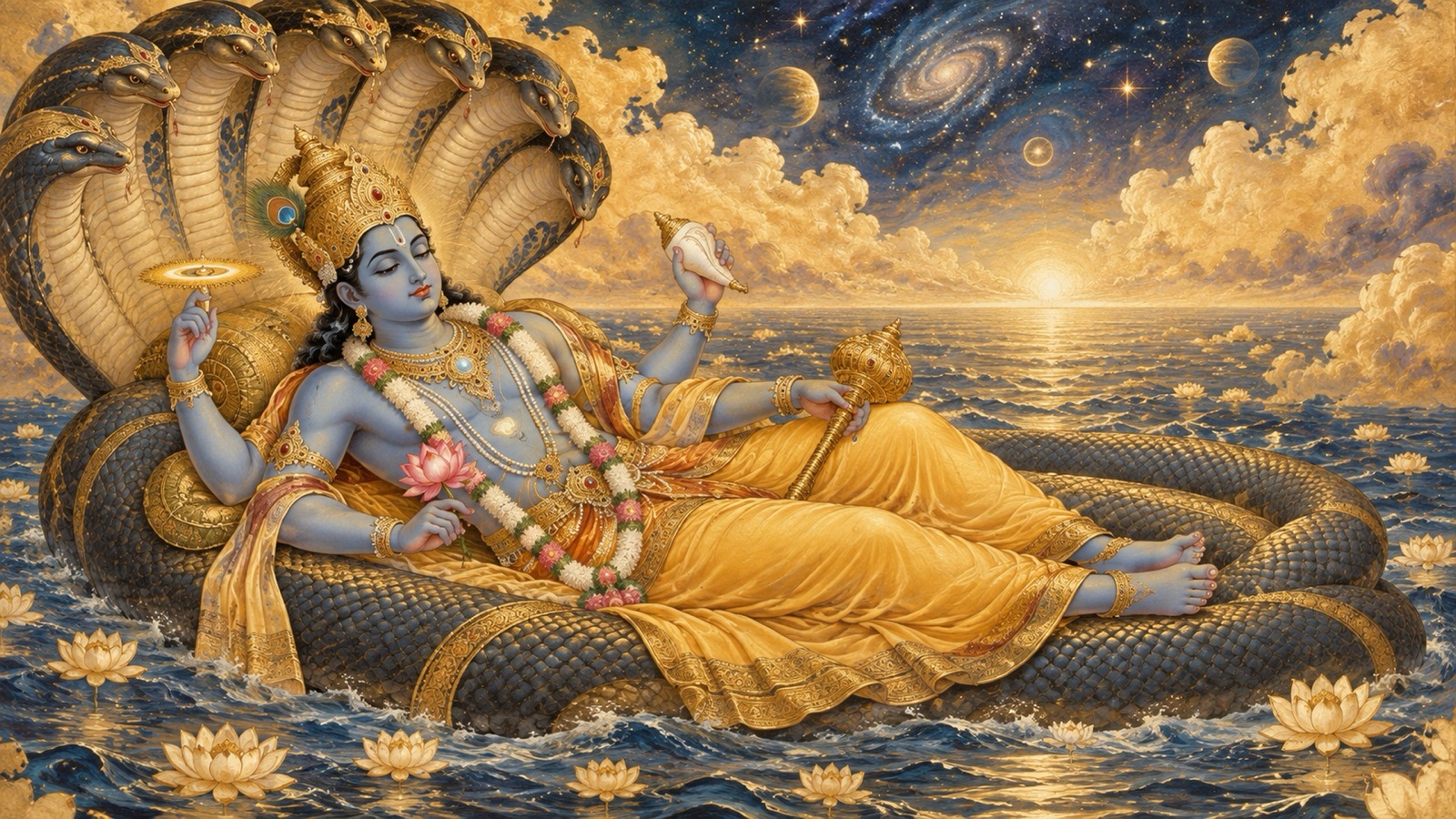
A youthful sage's rash curse seals the death of the righteous king Pariksit, yet his father Samika answers with forgiveness. A faithful, devotional retelling with verified verses.
Continue the Reading →
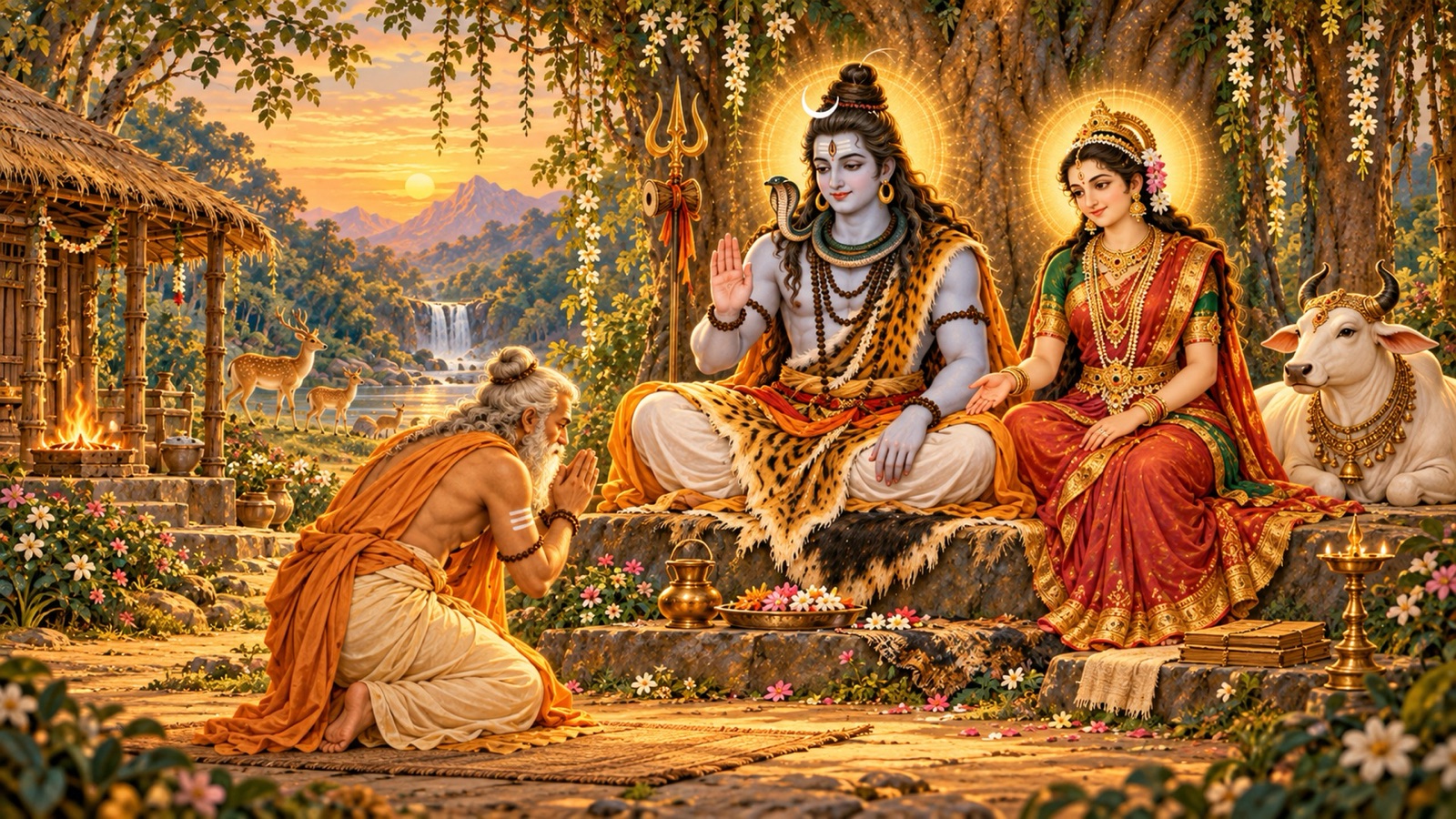
Emperor Parikshit meets the spirit of the age, protects Dharma and Mother Earth, and shows how mercy completes justice. Srimad Bhagavatam Canto 1, Chapter 17.
Continue the Reading →

The devotee-king Parīkṣit defends dharma while Dharma and Mother Earth remember the departed Lord Kṛṣṇa. A faithful retelling of Srimad Bhagavatam 1.16.
Continue the Reading →
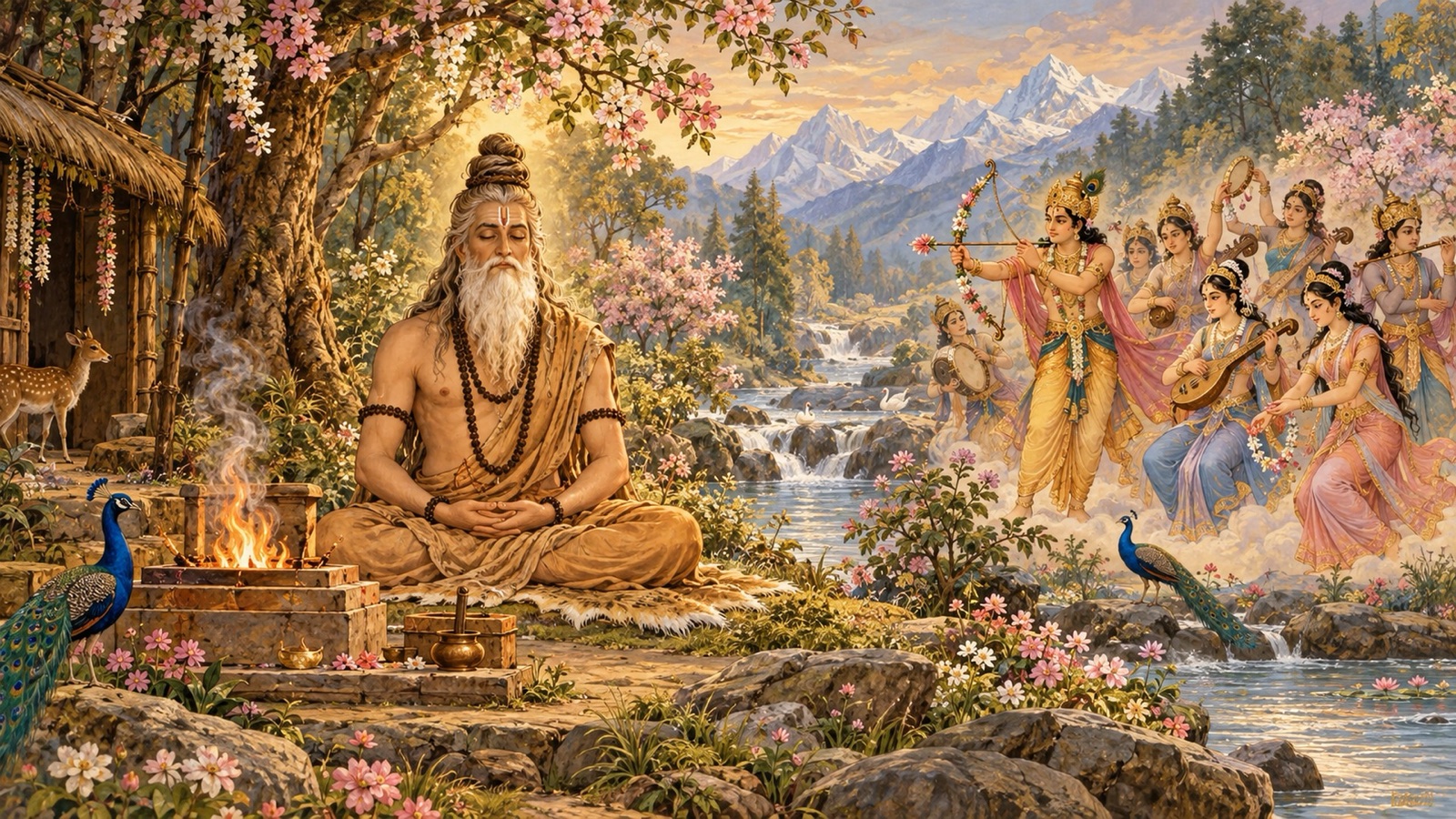
Arjuna confesses that every victory was Krishna's gift, Yudhishthira enthrones Parikshit, and the Pandavas walk north on the great departure. A faithful devotional retelling with verified verses.
Continue the Reading →
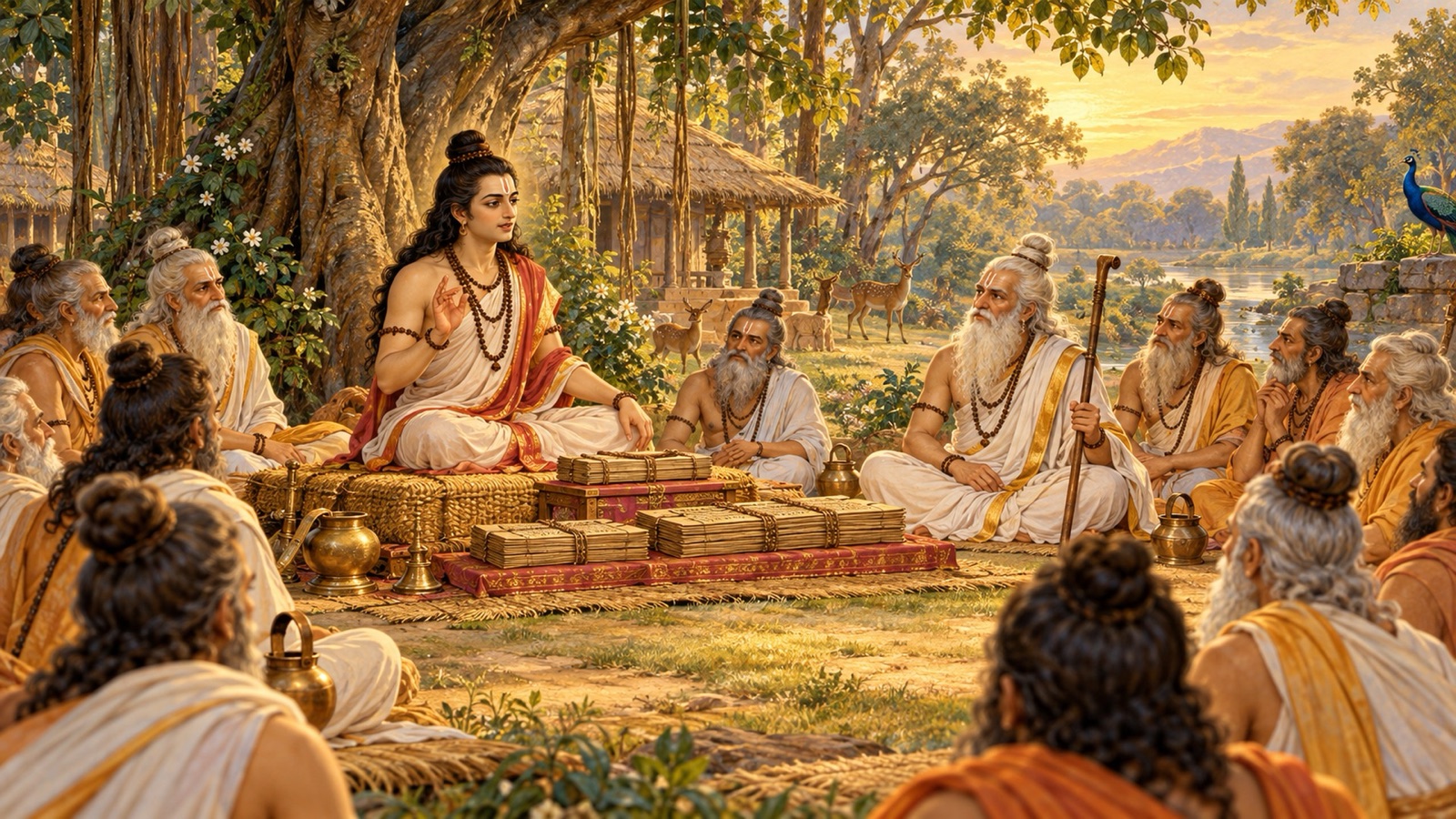
As the age of Kali nears, dreadful portents warn King Yudhishthira that Sri Krishna is about to withdraw from the world, and Arjuna returns crestfallen from Dwaraka. A faithful, devotional retelling with verified verses.
Continue the Reading →
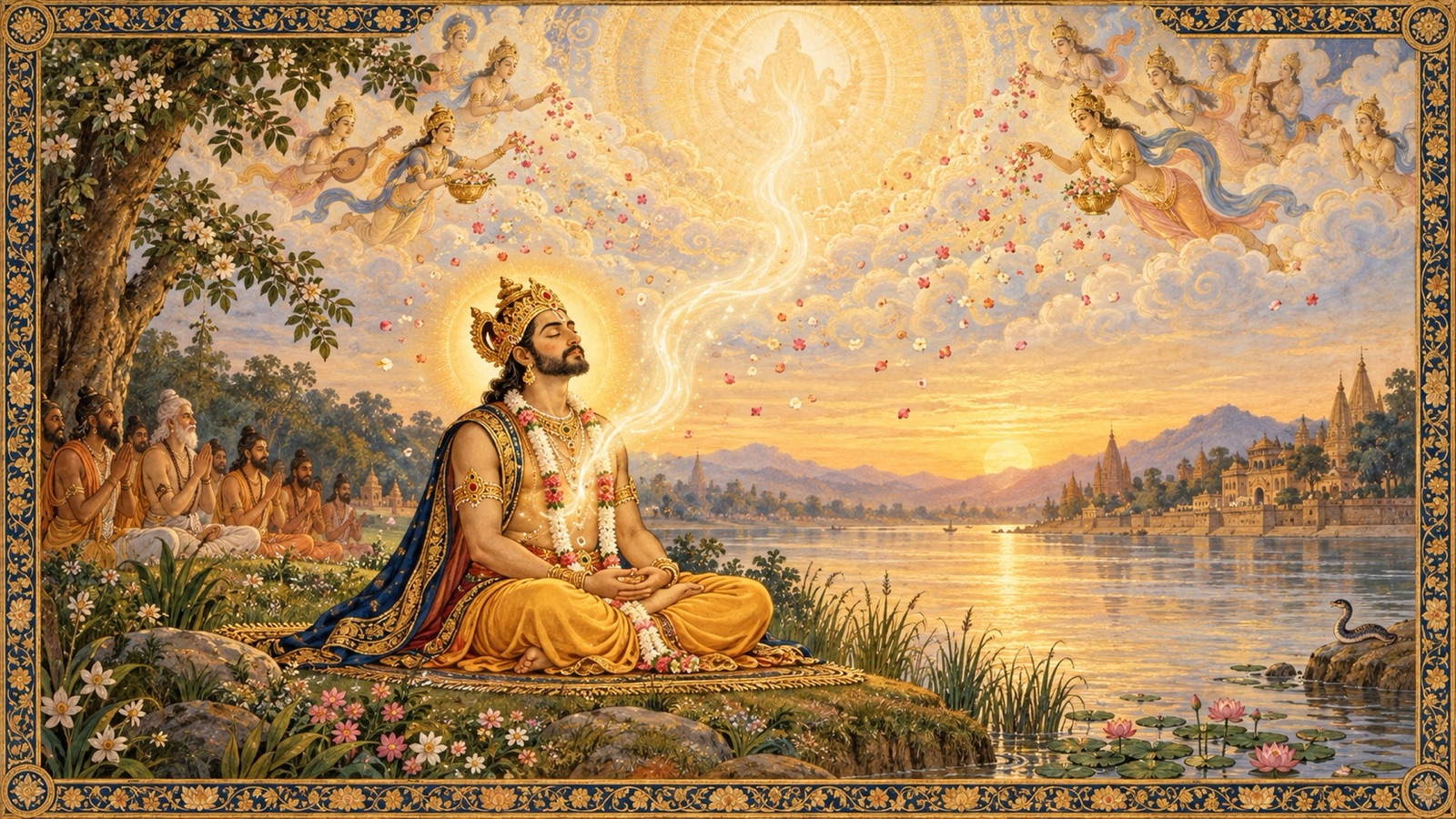
The pilgrim Vidura wakes his blind brother Dhritarashtra to renounce and walk toward God, and Narada teaches that all union and parting rest in the Lord's hand. A faithful devotional retelling with verified verses.
Continue the Reading →
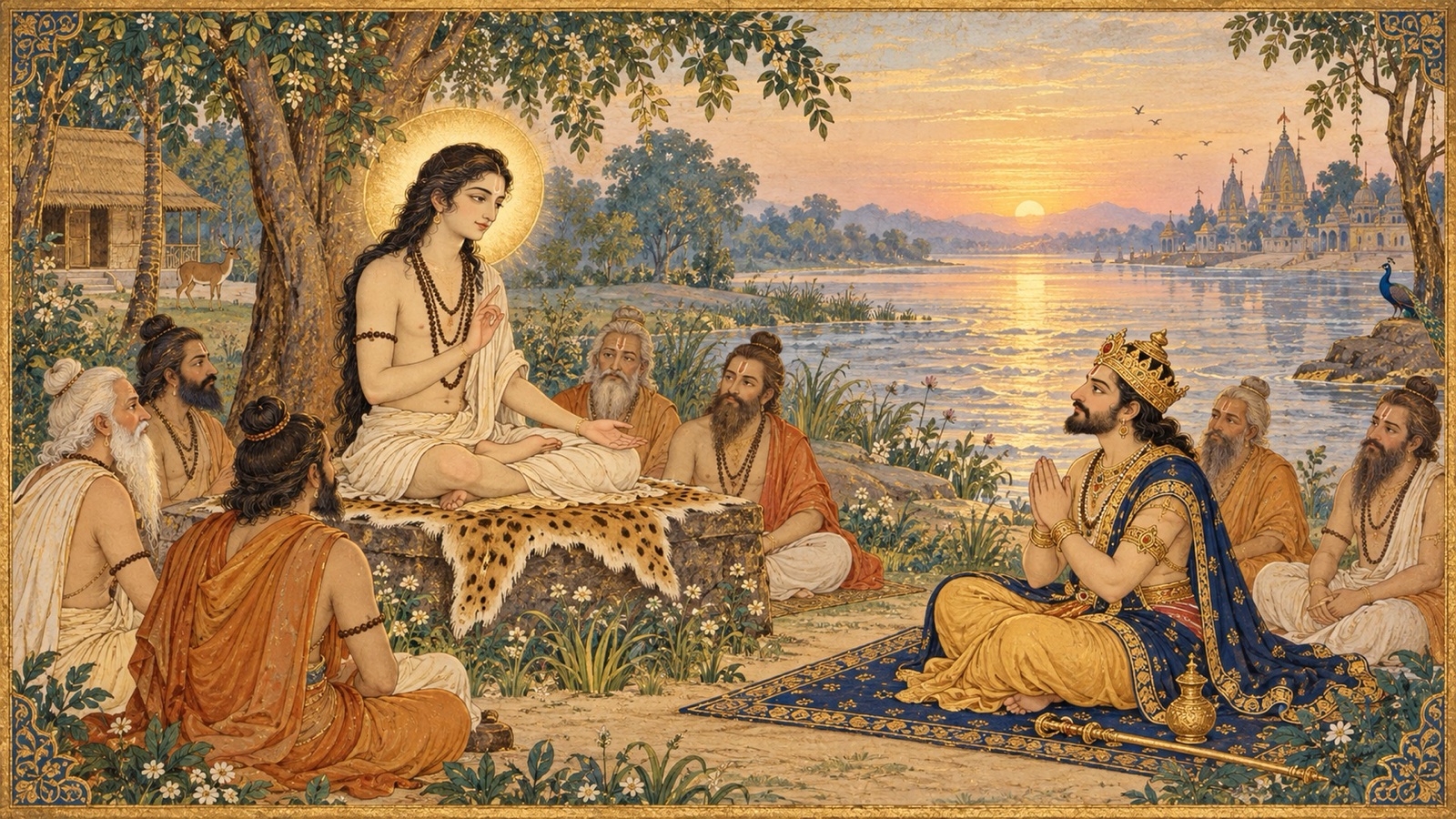
The child saved in the womb beholds the Lord, is born to continue Pandu's line, and is named Vishnurata and Parikshit. A faithful devotional retelling with verified verses.
Continue the Reading →
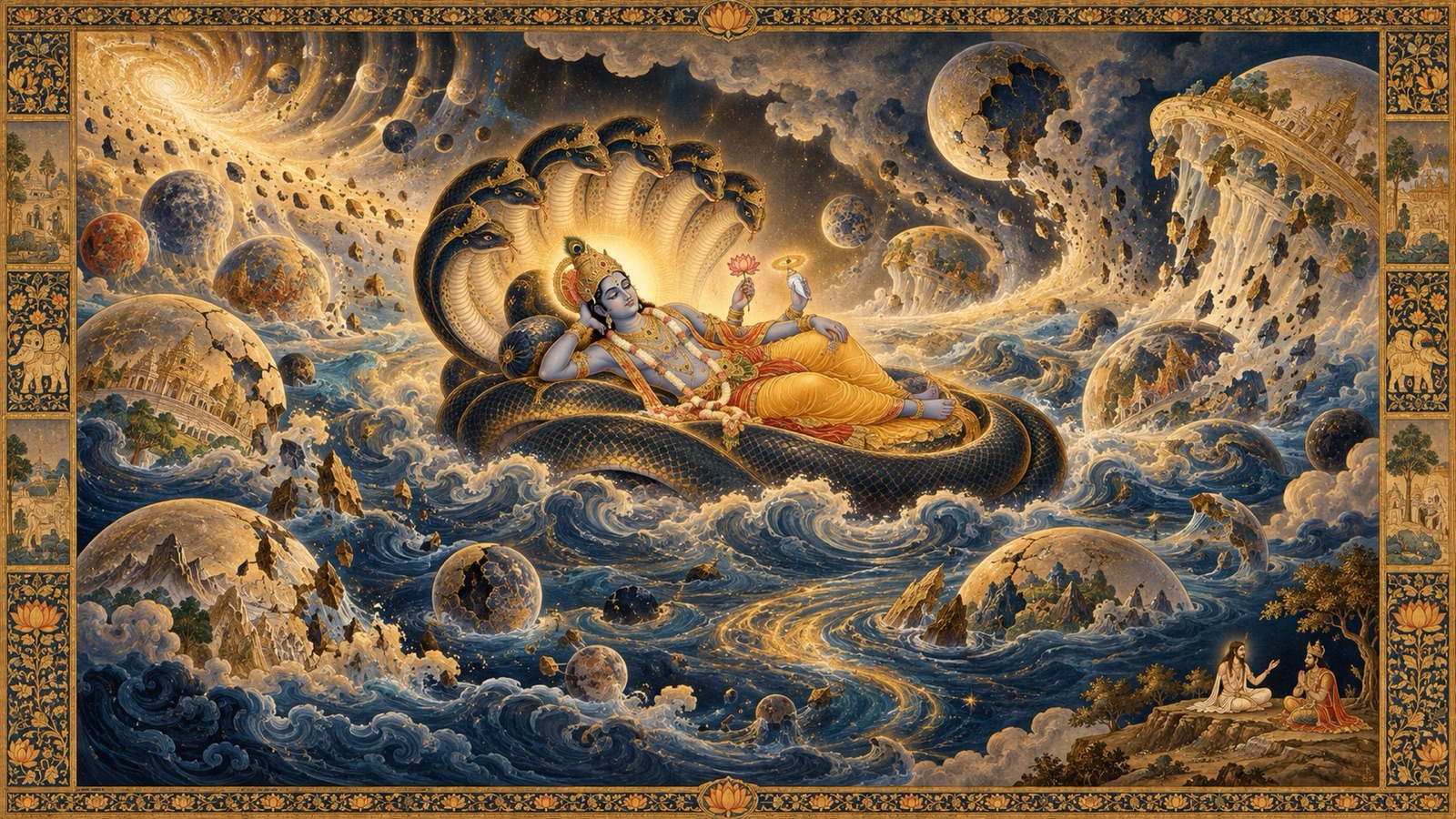
The conch is heard and all Dwaraka pours forth to greet its returning Lord. A faithful, devotional retelling with verified verses of Krishna's homecoming.
Continue the Reading →
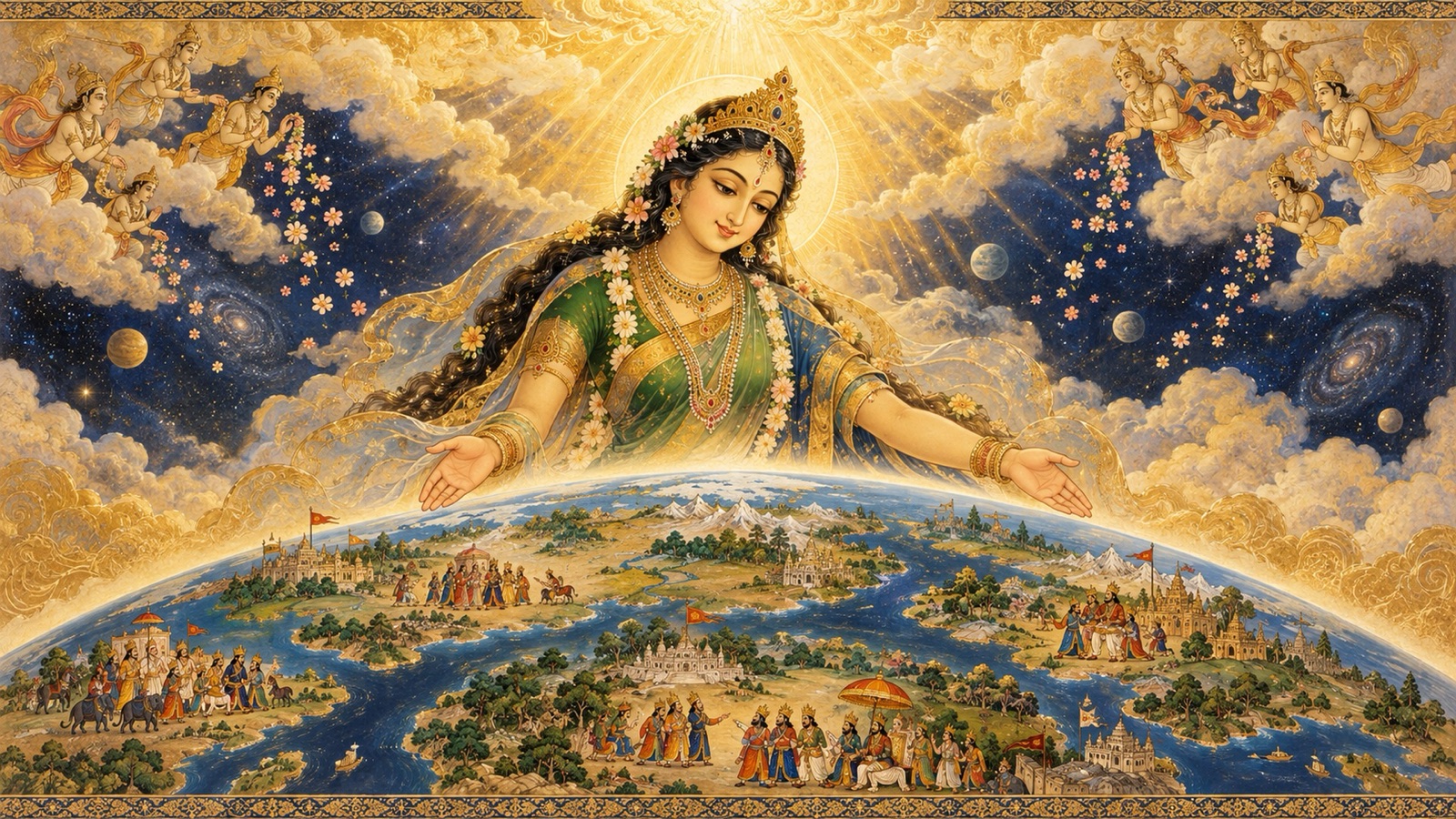
Sri Krishna takes His leave of Hastinapura amid flowers and grief, and journeys home to Dwaraka. A faithful, devotional retelling with verified verses.
Read the article →
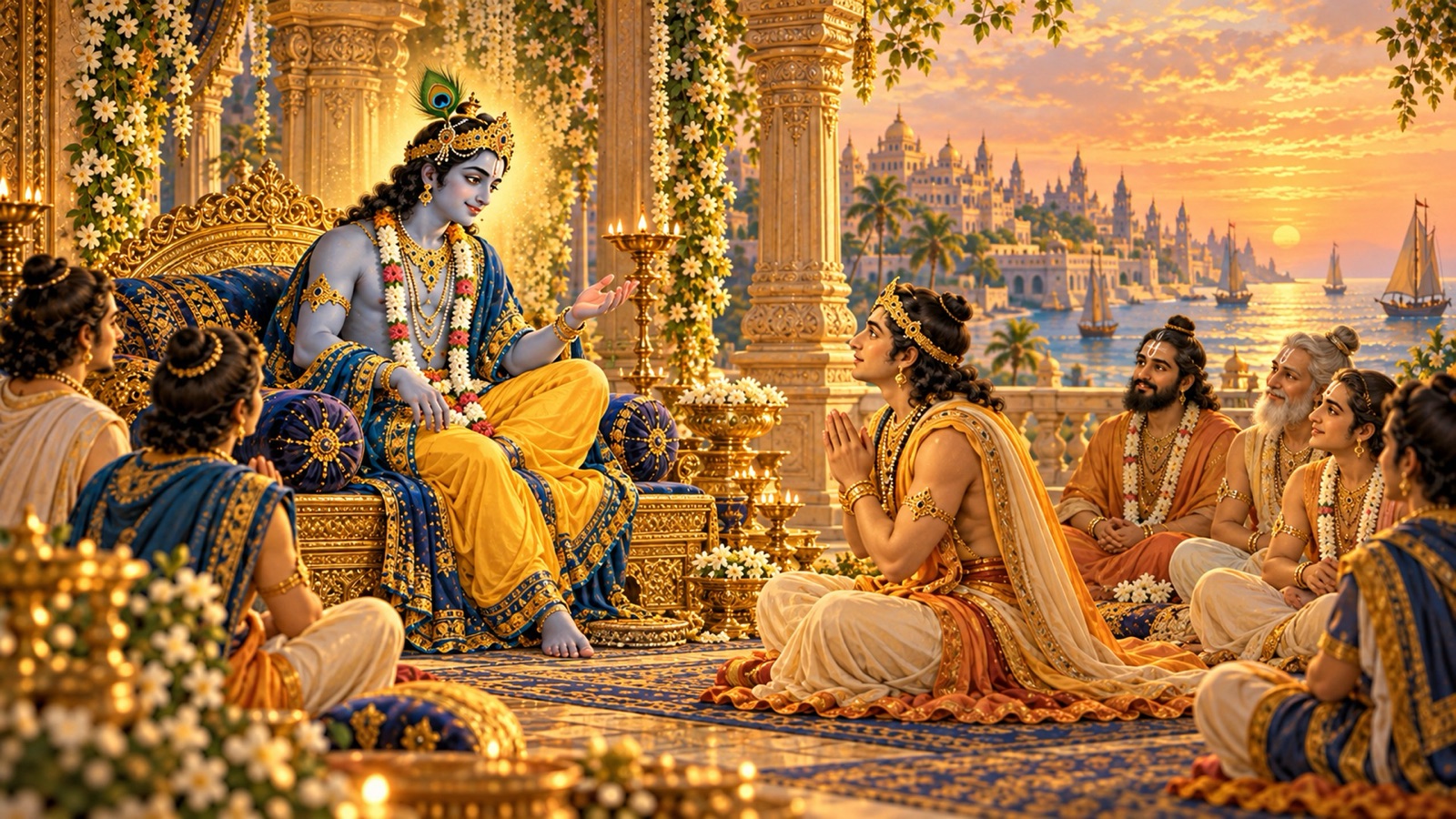
On his bed of arrows at Kurukshetra, Bhishma instructs Yudhishthira in Dharma and, gazing on Sri Krishna, gives up his body in a luminous prayer. A faithful retelling with verified verses.
Read the article →
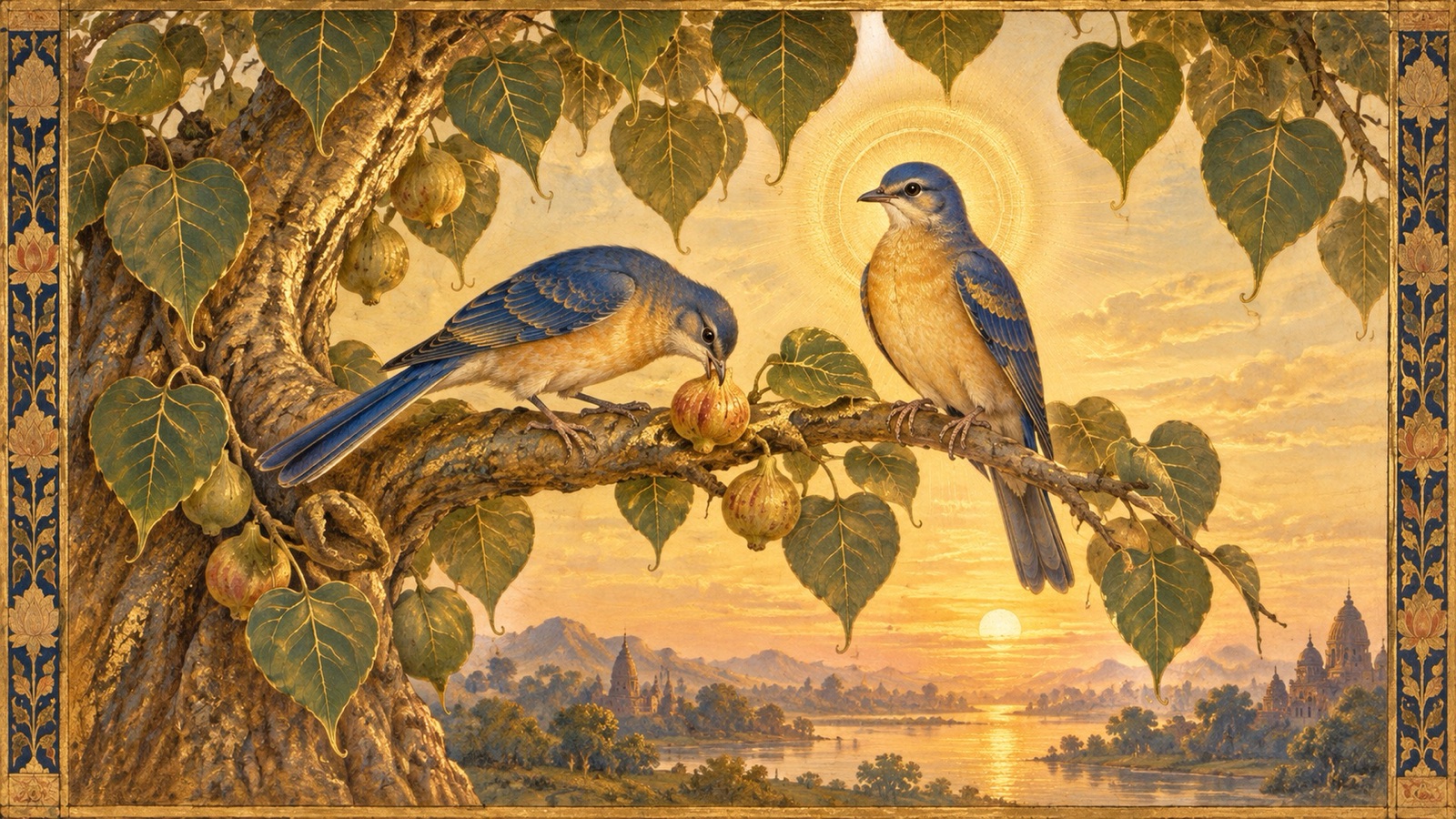
The Lord shields the child Parikshit in the womb and Queen Kunti prays for adversity so she may never forget Him. A faithful, devotional retelling with verified verses.
Read the article →
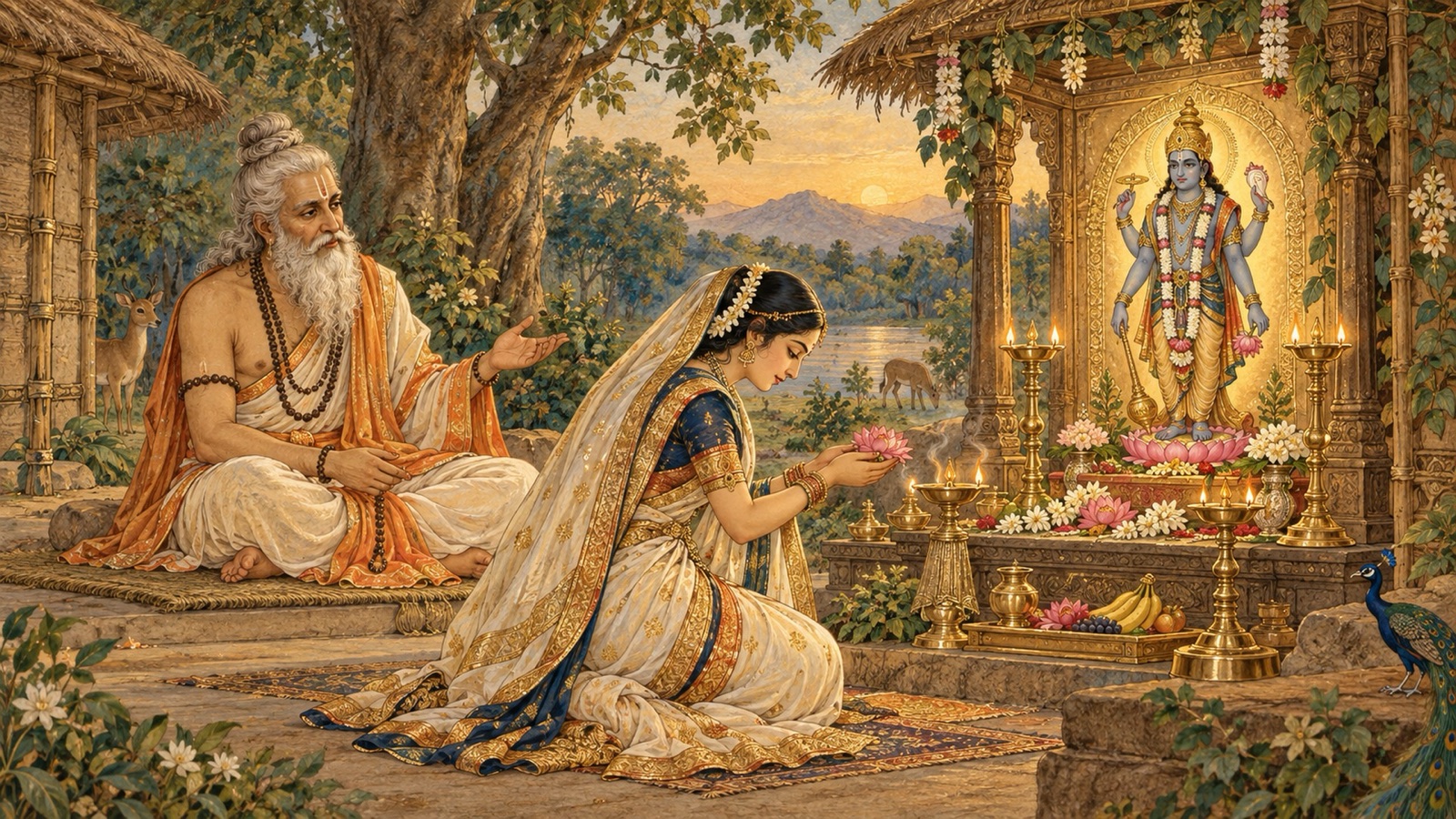
The tender life-story of the sage Narada: a fatherless child, a vision of Sri Hari granted and withdrawn, and the vina-song that delights a weary world. A faithful devotional retelling.
Read the article →
Narada names the one thing missing from Vyasa's great work and recalls how, as a servant-boy, hearing Krishna's glories carried him to the Lord. A faithful, verified retelling.
Read the article →
Even the compiler of the Vedas felt his heart unsatisfied. A faithful, devotional retelling of Vyasa's discontent and the coming of Narada, with verified verses.
Read the article →The blessed Suta unfolds the Lord's descents, from the Primal Person to Kalki, and reveals the great truth: Sri Krishna is the Supreme Lord Himself. A faithful devotional retelling with verified verses.
Read the article →
Suta Goswami answers the sages: loving devotion to the Lord, offered without motive, is the highest dharma. A faithful, devotional retelling with verified verses.
Read the article →
Vyasa gives the Bhagavata to the world; Arjuna captures Ashwatthama; Draupadi shows mercy and Krishna reconciles justice. A faithful devotional retelling with verified verses.
Read the article →
Enter Naimisaranya, where Shaunaka and the sages question the blessed Suta and the whole Bhagavata begins. A faithful, devotional retelling with verified verses.
Read the article →
The Malika predicts most people will fail to recognize the Lord in their midst — and names, centuries in advance, exactly which modern comfort fails right when it's needed most.
Read the article →
The Malika doesn't gesture at "many will perish." It counts — down to three or four devotees per village, and exactly 99,996 souls preserved as seed.
Read the article →
The Bhavishya Malika says Kali Yuga alone gets three incarnations. Two are already accepted historical fact — which is exactly what makes the third worth taking seriously.
Read the article →
Among every nation the Panchasakha could have named six centuries ago, the scripture names Russia specifically — twice, independently, converging on one year still ahead of us.
Read the article →
Every article on this site closes with the same three words. Here is what they actually mean, in the Malika's own verses — and the specific numbers it gives for who is recognized.
Read the article →
Not a vague golden-age slogan. The scripture names who is already born to help, what completes before the count ends, and what the dawn itself looks like.
Read the article →
A tree the Malika calls the Lord's own body. Four verses tie its breaking branch to Lord Jagannath's departure — and in March 2018, the branch broke.
Read the article →
A 600-year-old warning that fakes would come first, in a specific number. In August 2025, multiple men publicly claimed the title.
Read the article →
Not Kali Yuga anymore. Not yet Satya Yuga. The Malika names the corridor between the two — and why it is the hardest age in the cycle to read correctly.
Read the article →
Two of the oldest scriptures in Sanatana Dharma name the village a thousand years before the Malika ever existed to confirm it.
Read the article →
Long before the Panchasakha wrote a word, a sage-astrologer had already done the arithmetic — and named who arrives when it completes. The transit it points to has already occurred.
Read the article →
A text composed under a god's own direction, revered as His Divine Voice — and deliberately withheld for six centuries. The scripture explains why, in its own verses.
Read the article →
A million pilgrims watch Puri's chariots every year. In 2024 an idol fell in front of all of them — and the temple complex behind the festival has not gone quiet since.
Read the article →
The Malika names which tree blooms in the wrong month, which bird sings at the wrong hour. The dated record now matches, one item at a time.
Read the article →
Not storms or wars. The Malika's oddest predictions are about biology itself refusing to behave — and several are already dated news events.
Read the article →
A verse names diseases medicine cannot cure, under one specific planetary marker. That marker has a confirmed date — and it has already fallen.
Read the article →
Not anonymous mystics — five named saints with recorded birth years and villages, who each signed their own books and independently converged on the same 5,000-year count.
Read the article →
Centuries before the steam engine or the telegraph, the tradition described roads of iron, birds of iron, and speech crossing the world in an instant — and named the day their equipment would fail.
Read the article →
Not "the age is changing," in the abstract. A dated, externally sourced ledger — a fruit inside a fruit, idols weeping, a week of 7,000 tremors — logged one by one.
Read the article →
Four separate Malika texts, written centuries apart, name the same astronomical marker for Kalki's arrival. It fell due on 29 March 2025.
Read the article →
Each yuga has its own name of power. The scriptures converge on the reserved name of this age — the first name Radha Rani ever spoke to the Lord.
Read the article →
Not gold, not rank, not influence. In the crossing between two ages, the Malika says righteousness is the only wealth that protects.
Read the article →
A name for every moment of life — and one name for all of them. The Ṣoḍaśanāma Stotram recited daily in Tri-Sandhya, with translation.
Read the article →
A vulture on the Aruna Stambha. Lightning on the temple. A falling idol at Rath Yatra. The Malika named these signs six centuries ago — and the last eight years delivered them, on the record.
Read the article →
Manusmriti, Nirnay Sindhu, Garga Samhita and the Bhavishya Malika converge on one number — and 5,124 years have now passed. The full scriptural case, verse by verse.
Read the article →The evidence is still arriving. Follow along — or ask your own question in the Q&A App, which searches 200+ recorded sessions of Pandit Dr. Shri Kashinath Mishra.