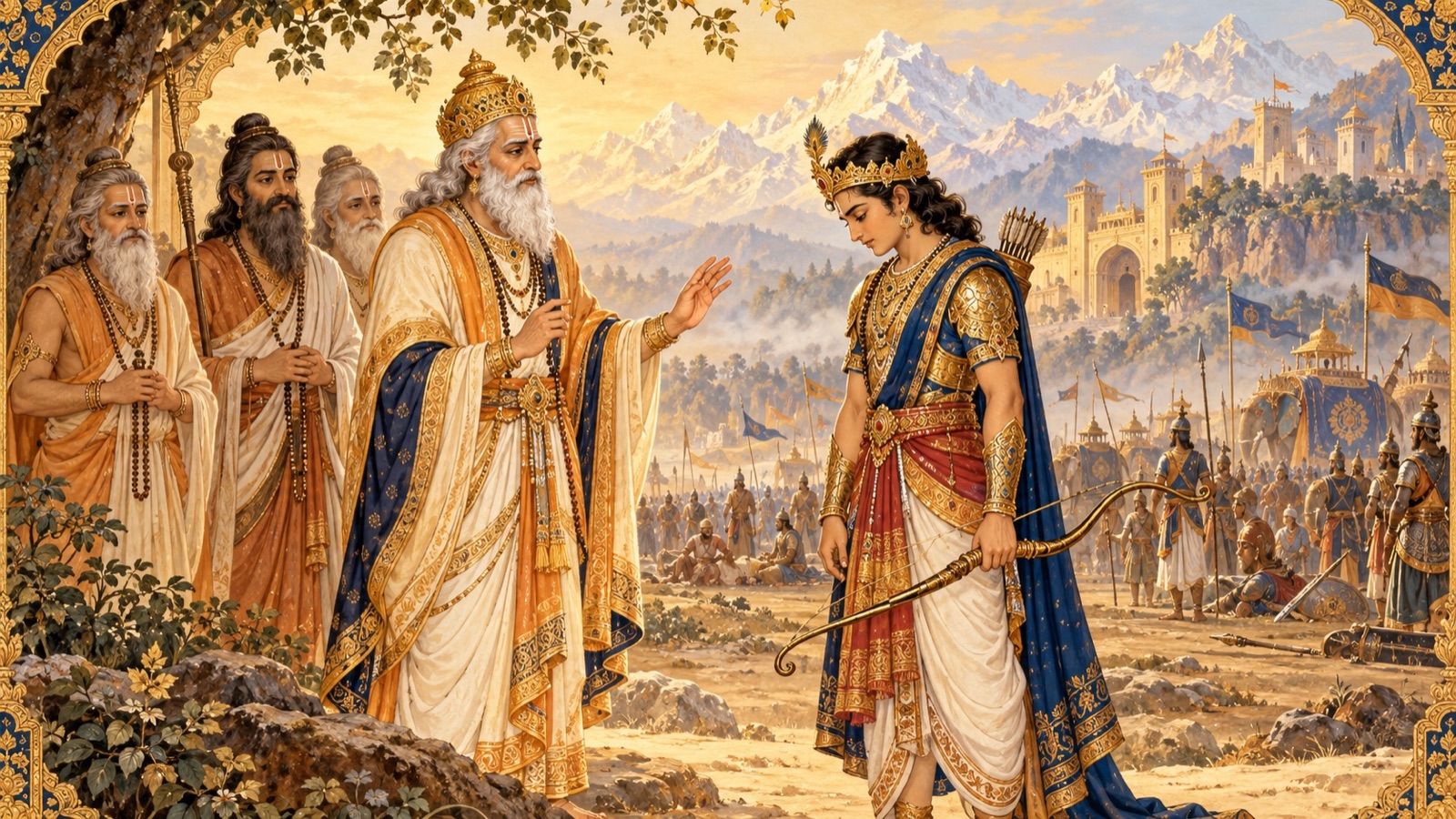
Amid the smoke of battle, the venerable Svayambhuva Manu, surrounded by sages, lays a gentle hand upon his grandson and turns the young king’s heart from vengeance back toward the peace of a devotee.
Om Namo Bhagavate Vasudevaya.
Om Namo Bhagavate Vasudevaya.
Om Namo Bhagavate Vasudevaya.
Welcome to Srimad Bhagavatam Wisdom, a devotional journey through the sacred histories and teachings of the Srimad Bhagavat Mahapurana. In the previous chapter, the grief-stricken Dhruva marched upon the city of the Yakshas to avenge his slain brother, and a fierce battle raged, until the sages appeared to bless him in the Name of the Lord. This eleventh chapter is the turning of that wrath toward peace. As the battle grows and innocent lives are lost, Dhruva’s grandfather, Svayambhuva Manu, comes with the sages and speaks to him — gently, as an elder who loves him — reminding him that vengeance and slaughter are not the path of those who follow the Lord of the senses, that the body he grieves and the bodies he strikes are alike impermanent, and that his true glory lies in devotion, not conquest. Moved by this wise and tender counsel, Dhruva relents, lays down his anger, and withdraws his forces. It is the chapter where a devotee’s grief is healed by humility, and a warrior becomes a saint again.
Chapter Information
- Scripture: Śrīmad Bhāgavata Mahāpurāṇa
- Canto: 4 (Book Four)
- Chapter: 11 (Discourse 11)
- Chapter title: Svayambhuva Manu Persuades Dhruva to Cease Fighting
- Principal speaker: The sage Maitreya, continuing his discourse to Vidura (with the words of Svayambhuva Manu quoted within)
- Principal listener: Vidura
- Main setting: The battlefield before Alakapuri, the city of the Yakshas
- Central subject: Manu’s compassionate intervention, his teaching on non-violence, impermanence, and devotion, and Dhruva’s reconciliation
- Principal verse range: Canto 4, Chapter 11, verses 1–35
- Primary edition: Gita Press Śrīmad Bhāgavata Mahāpurāṇa
Context from the Previous Chapter
Chapter 10 told of the death of Dhruva’s brother Uttama at the hands of a Yaksha and of Dhruva’s grief-driven march upon Alakapuri. As the battle raged and the Yakshas turned to illusory warfare, the great sages appeared to steady the young king and bless him in the Name of the Lord. This eleventh chapter opens as Dhruva, hearing their words, takes up a mighty weapon — and the fighting intensifies once more.
The Weapon and the Slaughter
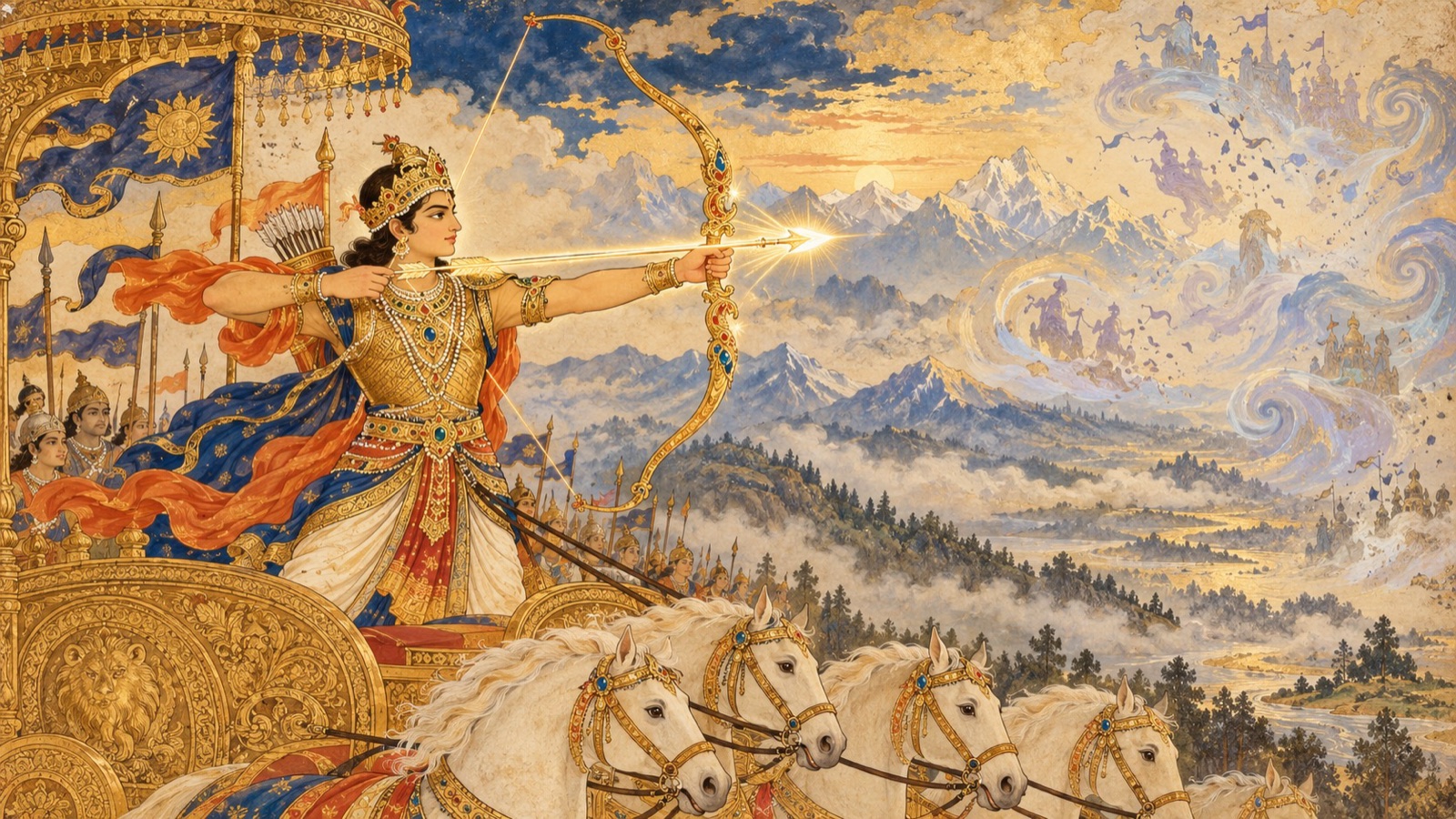
Hearing the sages speak, Dhruva touched his bow and fixed to it the great weapon fashioned by Narayana himself. Loosed against the illusions of the Yakshas, it scattered their magic and rained arrows upon their ranks.
मैत्रेय उवाच निशम्य गदतामेवमृषीणां धनुषि ध्रुव: । सन्दधेऽस्त्रमुपस्पृश्य यन्नारायणनिर्मितम् ॥ १ ॥
maitreya uvāca niśamya gadatām evam ṛṣīṇāṁ dhanuṣi dhruvaḥ sandadhe ’stram upaspṛśya yan nārāyaṇa-nirmitam
Meaning: Maitreya said: Hearing the sages speak thus, Dhruva touched his bow and fixed upon it the weapon fashioned by Narayana. (Canto 4, Chapter 11, verse 1)
The Grandfather’s Compassion
The weapon wrought great havoc, and many of the Yakshas — some of them innocent of Uttama’s death — were slain. Seeing this, and moved by compassion for those who had done no wrong, Dhruva’s grandfather Svayambhuva Manu came to the battlefield with the sages and spoke to him.
तान् हन्यमानानभिवीक्ष्य गुह्यका- ननागसश्चित्ररथेन भूरिश: । औत्तानपादिं कृपया पितामहो मनुर्जगादोपगत: सहर्षिभि: ॥ ६ ॥
tān hanyamānān abhivīkṣya guhyakān anāgasaś citra-rathena bhūriśaḥ auttānapādiṁ kṛpayā pitāmaho manur jagādopagataḥ saharṣibhiḥ
Meaning: Seeing the innocent Guhyakas being slain in great numbers by Dhruva’s wondrous chariot, the grandfather Manu, out of compassion, approached with the sages and spoke to the son of Uttanapada. (Canto 4, Chapter 11, verse 6)
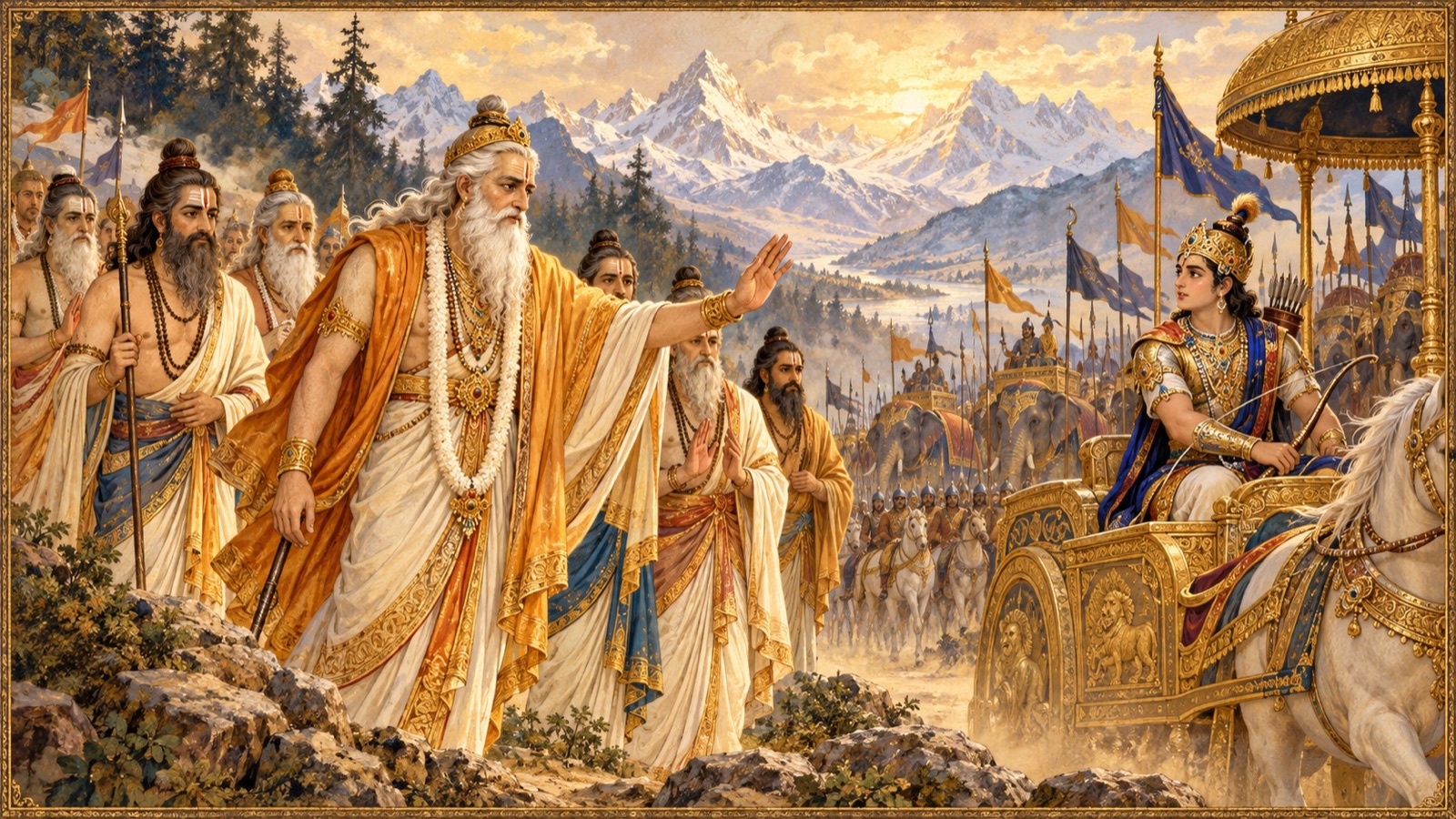
Manu began tenderly. He praised Dhruva’s devotion and told him that anger such as this only leads the soul into darkness; enough had been done. Then he spoke the heart of his counsel, naming the very disposition a servant of the Lord must never fall into: mistaking this body for the self, and, like a beast, falling upon the bodies of others.
नायं मार्गो हि साधूनां हृषीकेशानुवर्तिनाम् । यदात्मानं पराग्गृह्य पशुवद्भूतवैशसम् ॥ १० ॥
nāyaṁ mārgo hi sādhūnāṁ hṛṣīkeśānuvartinām yad ātmānaṁ parāg gṛhya paśuvad bhūta-vaiśasam
Meaning: This is not the path of the saints who follow Hrishikesha, the Lord of the senses — to take the body for the self and, like animals, to slaughter the bodies of others. (Canto 4, Chapter 11, verse 10)
Manu then named the very quality that marks such a servant of Hrishikesha, and that pleases the Lord Himself. Tolerance, mercy, friendship, and an equal eye toward every embodied being — extended alike to kin, to stranger, and to the very offender Dhruva sought to punish — are what deeply satisfy the Lord who dwells as the Self within all. Where Dhruva’s arrows had drawn a hard line between his own and his enemy, Manu asks him to erase it, and to meet friend and foe with the same open heart.
तितिक्षया करुणया मैत्र्या चाखिलजन्तुषु । समत्वेन च सर्वात्मा भगवान् सम्प्रसीदति ॥ १३ ॥
titikṣayā karuṇayā maitryā cākhila-jantuṣu samatvena ca sarvātmā bhagavān samprasīdati
Meaning: By tolerance, mercy, friendship, and equanimity toward every living being, the Supersoul dwelling in all hearts, the Personality of Godhead, becomes truly pleased. (Canto 4, Chapter 11, verse 13)
The Teaching of Manu
Manu unfolded a wide and healing wisdom. He reminded Dhruva that the Supreme Lord alone is the true doer behind all seeming causes; that the Yaksha who killed Uttama was but an instrument of destiny, as was Uttama’s own past; that grief, blame, and revenge bind the soul to the body’s illusions. A single Yaksha had killed his brother, yet Dhruva was destroying a whole people — a disproportion born of grief, not of justice. The wise, said Manu, do not repay injury with injury; they see the one Lord in all, and rest their hearts in Him.
Manu went further still, unfolding the deepest reason no one can rightly be named Uttama’s killer. The Supreme Lord Himself never lifts a weapon; He remains apart, yet by His mere impetus the whole of material nature is set into motion, one cause producing another, much as scattered iron is drawn to obey a magnet it never touches (verse 17). In His feature as eternal time, He alone is the real taker of every life — without beginning, though He is the origin of all things, and never exhausted, though everything else is exhausted through Him — while He Himself is never born and never dies (verses 18–19). Every creature is brought forth by a father and undone by death, but death itself is only His impartial hand, favoring no one and resenting no one, each soul simply reaping what its own past deeds have sown (verse 20). Seen this way, neither the Yaksha nor Dhruva’s own grief could rightly claim to be the true cause of anything.
And he showed Dhruva the one way beyond all this sorrow: to turn his devotion wholly toward the infinite, all-blissful Lord who dwells within, until the tightly-tied cord of false selfhood at last comes undone.
त्वं प्रत्यगात्मनि तदा भगवत्यनन्त आनन्दमात्र उपपन्नसमस्तशक्तौ । भक्तिं विधाय परमां शनकैरविद्या- ग्रन्थिं विभेत्स्यसि ममाहमिति प्ररूढम् ॥ ३० ॥
tvaṁ pratyag-ātmani tadā bhagavaty ananta ānanda-mātra upapanna-samasta-śaktau bhaktiṁ vidhāya paramāṁ śanakair avidyā- granthiṁ vibhetsyasi mamāham iti prarūḍham
Meaning: When you offer supreme devotion to the indwelling, infinite Lord, who is pure bliss and endowed with all powers, you will gradually cut the tightly bound knot of ignorance — the deep-rooted sense of “I” and “mine.” (Canto 4, Chapter 11, verse 30)
Dhruva Relents
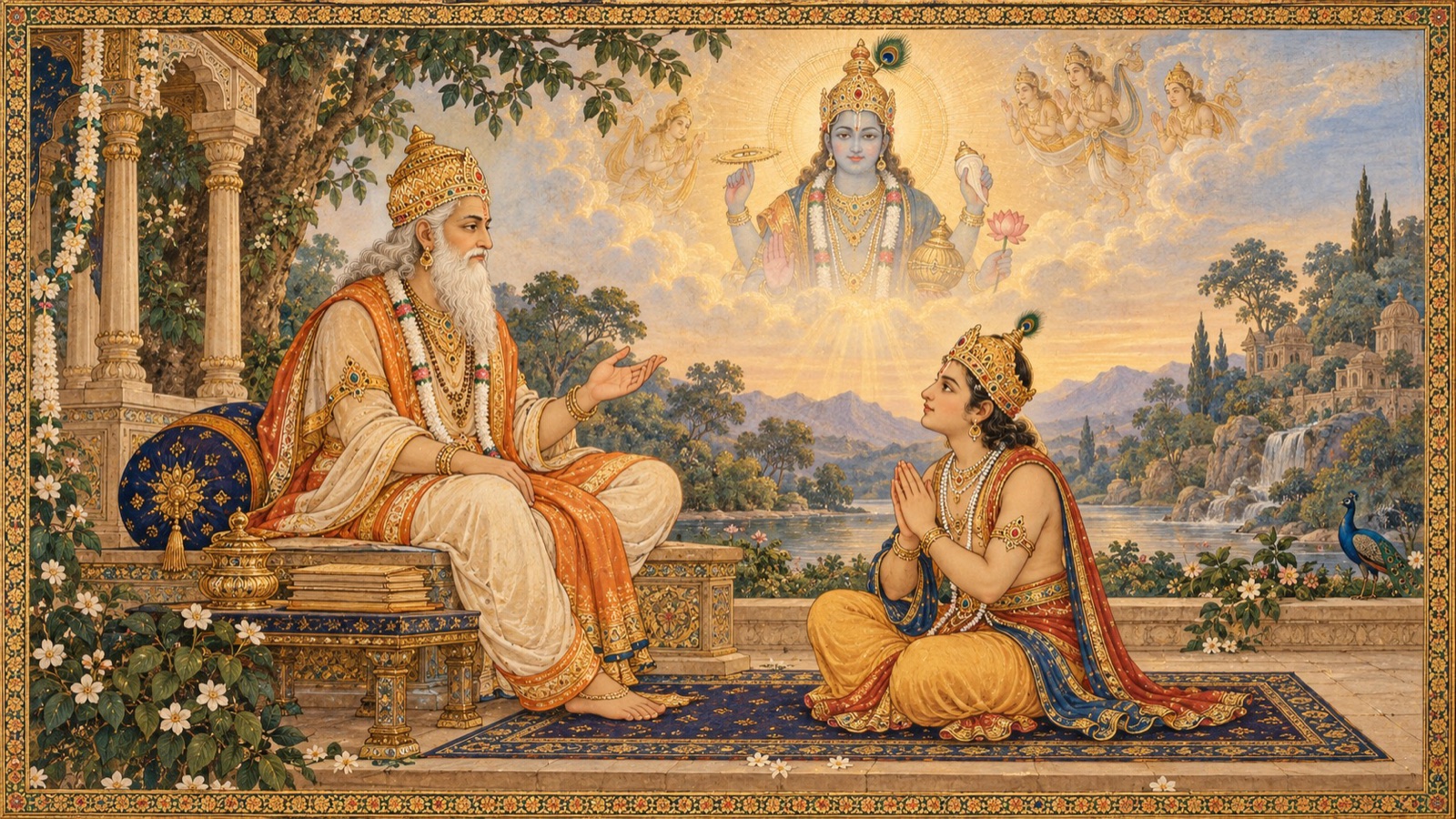
Manu’s words fell upon a heart that, for all its grief, was still a devotee’s. Dhruva took his grandfather’s counsel to heart, released his anger, and ceased the fighting, withdrawing his forces from the field. Having thus instructed his grandson, Svayambhuva Manu received Dhruva’s reverent obeisances and returned, with the sages, to his own abode.
एवं स्वायम्भुव: पौत्रमनुशास्य मनुर्ध्रुवम् । तेनाभिवन्दित: साकमृषिभि: स्वपुरं ययौ ॥ ३५ ॥
evaṁ svāyambhuvaḥ pautram anuśāsya manur dhruvam tenābhivanditaḥ sākam ṛṣibhiḥ sva-puraṁ yayau
Meaning: Thus Svayambhuva Manu, having instructed his grandson Dhruva, was reverently saluted by him, and returned with the sages to his own abode. (Canto 4, Chapter 11, verse 35)
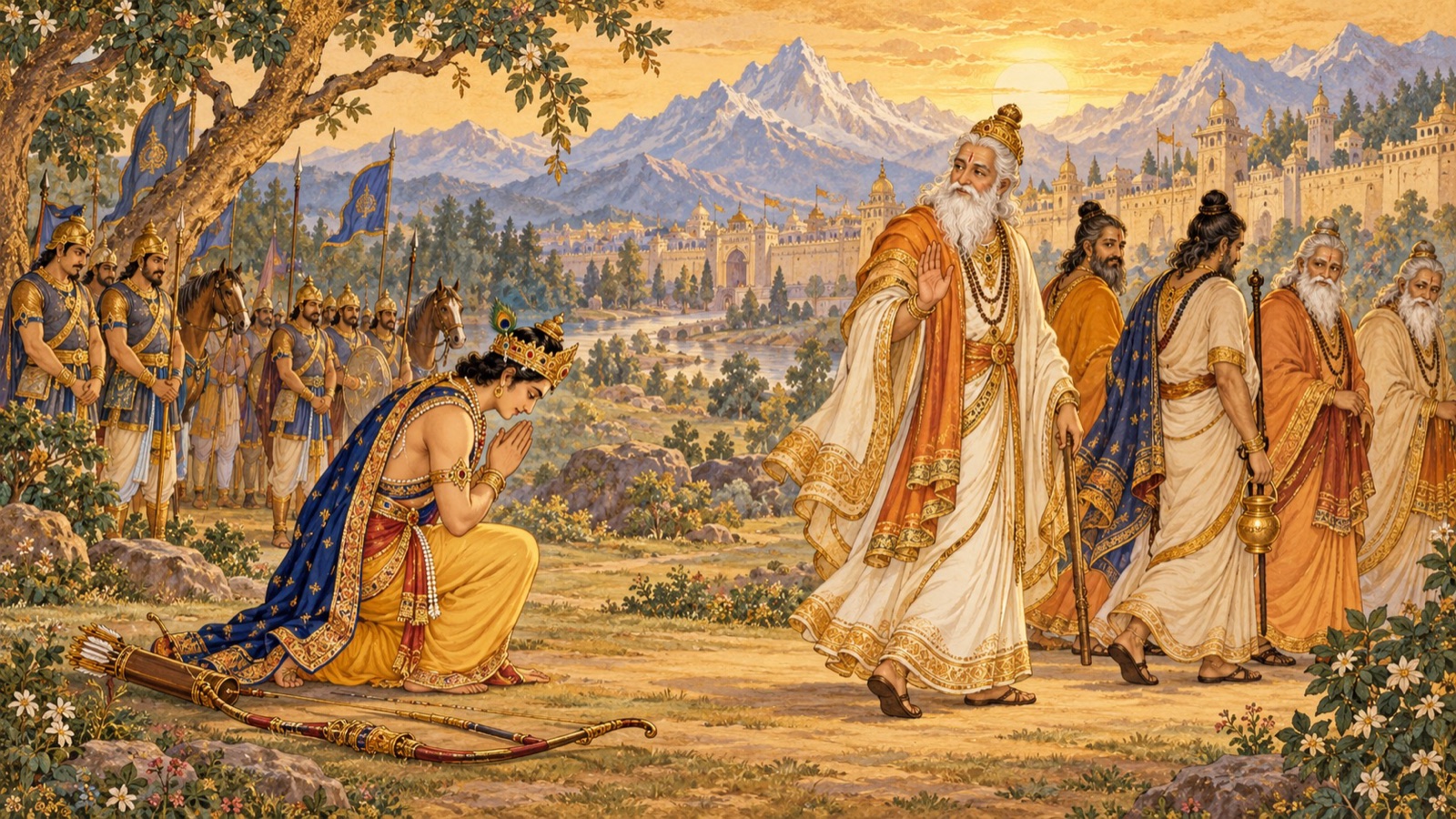
So the eleventh discourse closes not in triumph but in humility — the young king’s wrath quieted, the battle ended, and his heart turned again toward the Lord, ready for the grace that the next chapter will bring.
Principal Teachings of This Chapter
1. Grief must not become injustice. Dhruva punished a whole people for the crime of one, and Manu names the disproportion for what it is: only a single Yaksha bore true guilt, and it does not befit a family that knows the law of dharma to cut down the innocent alongside the guilty. Sorrow can distort our sense of justice; the wise learn to feel their grief fully without letting it rule their hand, whatever fortunate destiny may in the end await them (verses 6-11).
2. The path of the devotee is not the path of the beast. To take the body for the self and slay others’ bodies is, Manu says, the way of animals, not of saints who follow the Lord of the senses. Devotion asks us to see beyond the body — in ourselves and in our enemies (verse 10).
3. Equanimity toward all is what pleases the Lord. Tolerance, mercy, friendship, and the same open eye toward every being — friend and offender alike — are the marks of a true devotee, and it is this disposition, not any conquest, that truly satisfies the Lord who dwells within all (verse 13).
4. All beings act within the Lord’s design. Neither the Yaksha nor Dhruva himself is finally the doer of a killing. The Supreme Lord, working through eternal time, merely sets the wheel of material nature turning — He alone is the true taker of every life, though Himself never born and never dying, favoring no one and resenting no one, each soul reaping only the fruit of its own past deeds. Seeing this dissolves the fever of blame and revenge (verses 12-24, especially 17-20).
5. Devotion cuts the knot of ego. The deepest bondage is the sense of “I” and “mine”; and the surest blade to cut it is not force but supreme devotion to the infinite Lord (verse 30).
6. True strength is the humility to be corrected. Dhruva, a victorious warrior, lays down his anger at the word of his elder and bows. To accept wise counsel and change course is a greater victory than any won in battle (verse 35).
A Devotional Reflection
There is a special beauty in watching Dhruva be corrected. This is the same soul who, as a child, stared down the discouragement of Narada and the terror of a shaken universe with unbreakable resolve. That resolve was his glory — and here it very nearly became his flaw, as grief bent his firmness into fury. What saves him is not a greater force but a gentler one: the loving word of his grandfather, and his own willingness to hear it. How often our strengths, unguarded, curdle into our faults — our conviction into stubbornness, our love into possessiveness, our sense of justice into vengeance. And how often what we need in such a moment is not to be defeated but to be counseled — and to have the humility to listen. Manu does not shame Dhruva; he reminds him who he is. The whole chapter turns on the young king’s readiness to receive that reminder and lay down his bow. It asks us gently: when grief or anger has bent our best qualities into something harmful, will we too be humble enough to be turned back toward the Lord?
A Daily Devotional Practice
Today, practice the humility that ends a war. Call to mind some grievance you have been carrying — a wrong done to you or to someone you love — and, rather than rehearsing it, offer it to the Lord with the words “Om Namo Bhagavate Vasudevaya.” As you do, hear Manu’s counsel as spoken to you: that the one Lord stands behind all things, that revenge only binds the soul, and that your true peace lies in devotion, not in settling the score. If there is a small step of reconciliation you can take — a hard word withheld, a gesture of forgiveness offered — take it today as Dhruva withdrew his forces. In laying down even one weapon of the heart, you follow the young king from wrath back to the peace of a devotee.
Conclusion
The eleventh discourse of Book Four turns Dhruva’s wrath toward peace. As his Narayana weapon wrought havoc among the Yakshas, and even the innocent were slain, his grandfather Svayambhuva Manu came with the sages, moved by compassion, and counseled him. Vengeance and slaughter, Manu taught, are not the path of the saints who follow the Lord of the senses; even the Yaksha who struck down Uttama was carried on a current of destiny far greater than himself; grief must not become injustice; the Lord alone, working through eternal time, is the impartial cause behind every death; and the knot of ego is cut not by force but by supreme devotion to the infinite Lord. Moved by this wise and tender wisdom, Dhruva released his anger, ceased the fighting, and withdrew his forces, bowing to his grandfather, who then returned with the sages to his abode. So the chapter closes in humility rather than triumph, the young king’s heart turned again toward the Lord — and ready for the grace that awaits him.
May the divine wisdom of Srimad Bhagavatam awaken pure devotion within our hearts.
Om Namo Bhagavate Vasudevaya.
Jay Shree Madhav.
References and Attribution
- Primary edition: Gita Press, Śrīmad Bhāgavata Mahāpurāṇa (English, complete), Book Four, Discourse 11.
- Series: Srimad Bhagavatam Wisdom · Biswa Sanatan Dharma Seva Trust.
- Presented following the spiritual guidance and recommendation of Pandit Dr. Shri Kashinath Mishra.
This is an original, faithful retelling in the writer’s own words, with brief quoted verses shown in Devanāgarī and transliteration and their meanings given as summaries. It is not a reproduction of any single publisher’s continuous translation or commentary. No affiliation with or endorsement by any publisher is implied.
Jay Shree Madhav