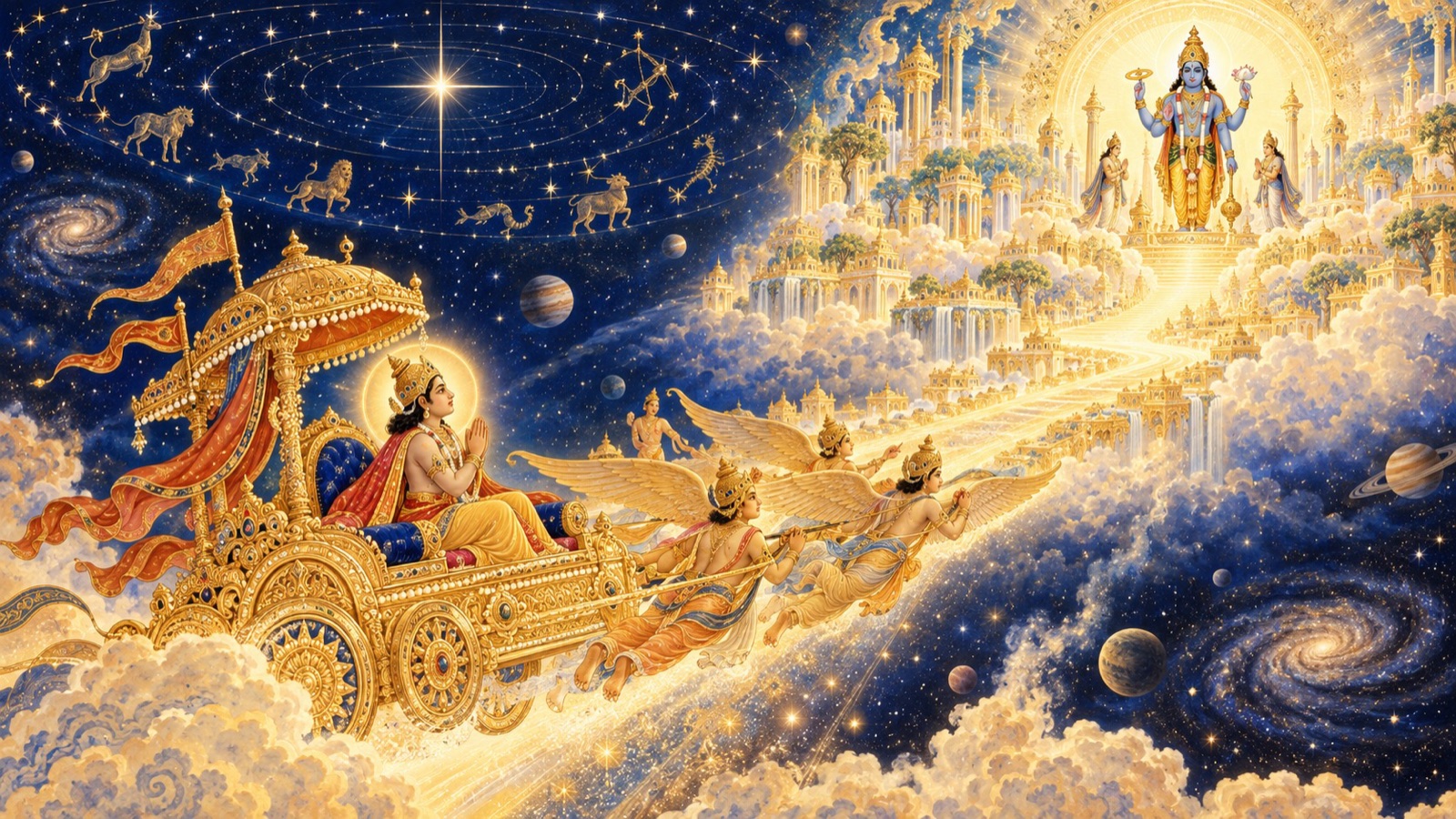
The boon given to a child in the forest is fulfilled at last: seated in a radiant celestial chariot, Dhruva rises past the stars and the sages toward the eternal abode of Lord Vishnu.
Om Namo Bhagavate Vasudevaya.
Om Namo Bhagavate Vasudevaya.
Om Namo Bhagavate Vasudevaya.
Welcome to Srimad Bhagavatam Wisdom, a devotional journey through the sacred histories and teachings of the Srimad Bhagavat Mahapurana. In the previous chapter, Dhruva’s grief-born wrath was gently turned to peace by the counsel of his grandfather Svayambhuva Manu, and the young king laid down his anger and withdrew from battle. This twelfth chapter brings the whole story of Dhruva to its shining fulfilment. Pleased that Dhruva’s anger has subsided, Kubera, the lord of wealth, appears and offers him a boon — and the humble king asks not for riches but for unwavering remembrance of the Lord. Then, after a long and righteous reign, Dhruva relinquishes his throne and, at the end of his earthly life, ascends bodily in a radiant celestial chariot to the eternal abode of Lord Vishnu — the imperishable station promised to him as a child in the forest. It is a chapter about the reward of pure devotion, the tenderness that even heaven cannot make him forget, and the crowning of a life given wholly to God.
Chapter Information
- Scripture: Śrīmad Bhāgavata Mahāpurāṇa
- Canto: 4 (Book Four)
- Chapter: 12 (Discourse 12)
- Chapter title: Kubera’s Boon and Dhruva’s Ascent to the Abode of Lord Vishnu
- Principal speaker: The sage Maitreya, continuing his discourse to Vidura (with the words of Kubera and the Lord’s messengers quoted within)
- Principal listener: Vidura
- Main setting: The kingdom of Dhruva, and the path of ascent to the abode of Lord Vishnu
- Central subject: Kubera’s boon, Dhruva’s righteous reign, and his bodily ascent to the eternal abode of the Lord
- Principal verse range: Canto 4, Chapter 12, verses 1–52
- Primary edition: Gita Press Śrīmad Bhāgavata Mahāpurāṇa
Context from the Previous Chapter
Chapter 11 told how Svayambhuva Manu came with the sages to the battlefield and counseled Dhruva that vengeance is not the devotee’s path, that all beings act within the Lord’s design, and that only devotion cuts the knot of ego. Moved, Dhruva laid down his anger and ceased the fighting. This twelfth chapter opens with the happy consequence of that peace, as Kubera, lord of the Yakshas whom Dhruva had fought, comes not in wrath but in favour.
Kubera’s Boon
Kubera, the lord of wealth, soon learned that the young king had renounced the killing and set aside his fury. Delighted, he journeyed there in person, honoured on every side by Charanas, Yakshas, and Kinnaras, and addressed Dhruva, who stood before him with folded hands.
मैत्रेय उवाच ध्रुवं निवृत्तं प्रतिबुद्ध्य वैशसा- दपेतमन्युं भगवान्धनेश्वर: । तत्रागतश्चारणयक्षकिन्नरै: संस्तूयमानो न्यवदत्कृताञ्जलिम् ॥ १ ॥
maitreya uvāca dhruvaṁ nivṛttaṁ pratibuddhya vaiśasād apeta-manyuṁ bhagavān dhaneśvaraḥ tatrāgataś cāraṇa-yakṣa-kinnaraiḥ saṁstūyamāno nyavadat kṛtāñjalim
Meaning: Maitreya said: Learning that Dhruva had turned back from slaughter and that his anger had subsided, Kubera, the lord of wealth, came there — glorified by the Charanas, Yakshas, and Kinnaras — and spoke to Dhruva, who stood with folded hands. (Canto 4, Chapter 12, verse 1)
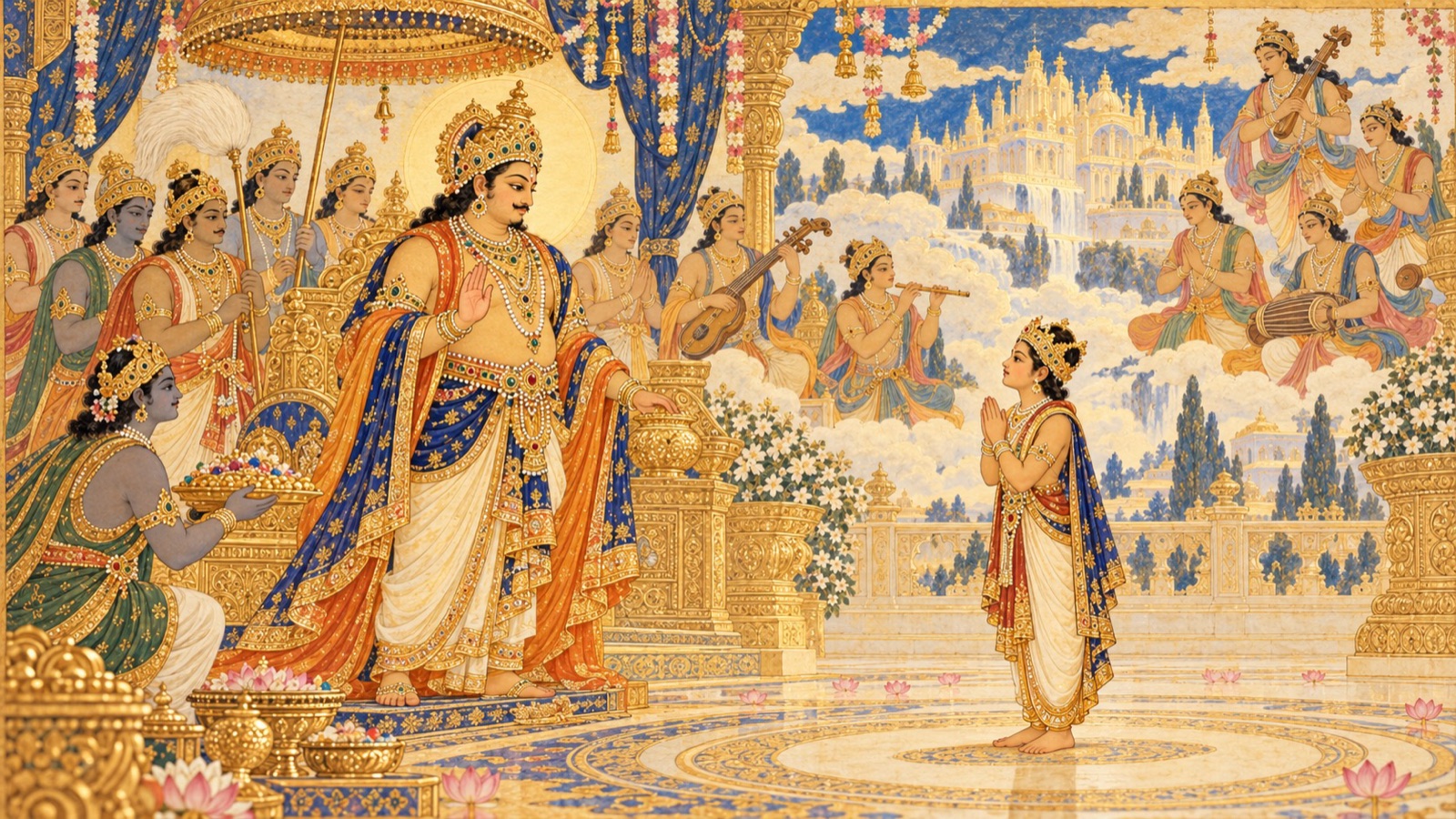
Kubera praised Dhruva for giving up his enmity: neither the Yakshas nor anyone else, he said, is ever truly the slayer or the slain, for the eternal time-feature of the Lord alone governs birth and death (verse 3). He went further, laying bare the very root of all such quarrel: to see oneself and another as separate “I” and “you” on the strength of the body is nothing but ignorance — as unreal as the shapes glimpsed in a dream — and it is this very delusion that keeps the soul turning through birth after birth.
अहं त्वमित्यपार्था धीरज्ञानात्पुरुषस्य हि । स्वाप्नीवाभात्यतद्ध्यानाद्यया बन्धविपर्ययौ ॥ ४ ॥
ahaṁ tvam ity apārthā dhīr ajñānāt puruṣasya hi svāpnīvābhāty atad-dhyānād yayā bandha-viparyayau
Meaning: To think “I am this body, and you are that one” is a delusion born of ignorance, as unreal as the shapes seen in a dream; and it is this very delusion that binds the soul to the wheel of birth and death. (Canto 4, Chapter 12, verse 4)
The remedy, Kubera said, is not speculation but engagement: fix the heart wholly on the one Lord, whose inconceivable potency governs this world though He is never touched by it, for only He can free the soul from that entanglement (verses 5-6). Then, well pleased with so wise a listener, he invited the king to ask for whatever boon he desired.
Dhruva Asks Only to Remember the Lord
The great devotee, wise of heart, did not ask for wealth or dominion or long life. Urged by the king of kings to name his desire, Dhruva asked for one thing only — unwavering remembrance of Sri Hari, by which the soul crosses, without effort, the insurmountable darkness of worldly existence.
मैत्रेय उवाच स राजराजेन वराय चोदितो ध्रुवो महाभागवतो महामति: । हरौ स वव्रेऽचलितां स्मृतिं यया तरत्ययत्नेन दुरत्ययं तम: ॥ ८ ॥
maitreya uvāca sa rāja-rājena varāya codito dhruvo mahā-bhāgavato mahā-matiḥ harau sa vavre ’calitāṁ smṛtiṁ yayā taraty ayatnena duratyayaṁ tamaḥ
Meaning: Maitreya said: Urged by Kubera, the king of kings, to ask a boon, the great devotee Dhruva, wise of heart, asked for unshakable remembrance of Sri Hari, by which one crosses without effort the insurmountable darkness. (Canto 4, Chapter 12, verse 8)
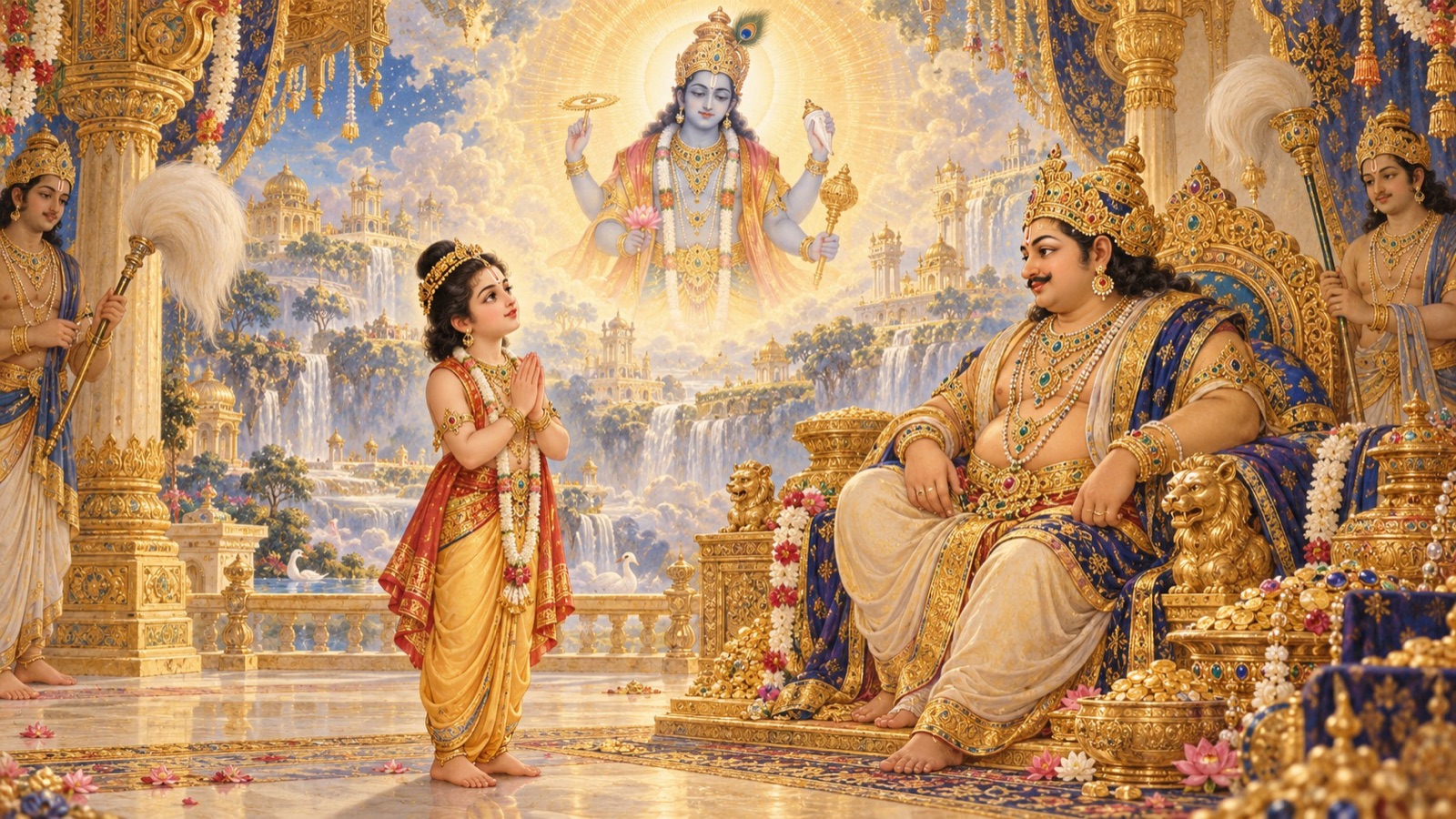
Delighted by so pure a request, Kubera granted it and departed for his own realm. Dhruva then returned to his capital and ruled the earth for many thousands of years, performing great sacrifices, honouring the Lord in all beings, and governing his people with justice and devotion, ever remembering that this life is fleeting and the Lord alone is the goal.
The Celestial Chariot
When his long reign was complete and he had passed his kingdom to his son and withdrawn to Badarikashrama for austerity, there came to him from the abode of the Lord two luminous, four-armed messengers, radiant and gracious. They greeted the king with love and told him that the Supreme Lord had sent for him — this excellent celestial chariot, sent by the Lord who is crowned among all whom choice hymns praise, had come to bear him home; and he was worthy to board it.
एतद्विमानप्रवरमुत्तमश्लोकमौलिना । उपस्थापितमायुष्मन्नधिरोढुं त्वमर्हसि ॥ २७ ॥
etad vimāna-pravaram uttamaśloka-maulinā upasthāpitam āyuṣmann adhiroḍhuṁ tvam arhasi
Meaning: (The Lord’s messengers said:) O long-lived one, this excellent celestial chariot has been sent by the Supreme Lord, the crown of all whom choice hymns praise; you are worthy to board it. (Canto 4, Chapter 12, verse 27)
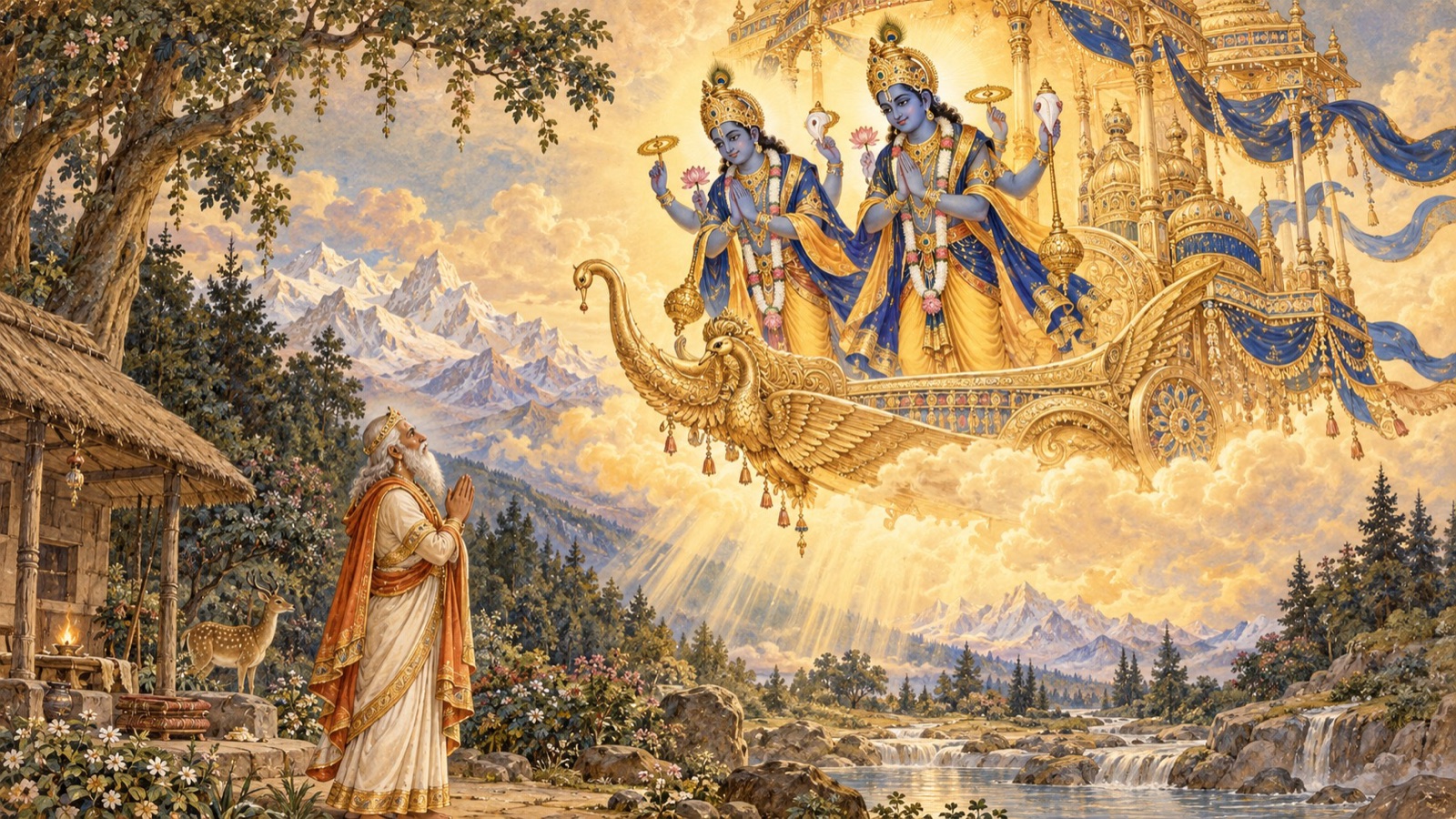
Having bathed and worshipped and taken leave, Dhruva prepared to ascend. As he did so, death personified drew near — but the fearless devotee, careless of death, set his foot upon its head and mounted the wondrous chariot, vast as a house.
तदोत्तानपद: पुत्रो ददर्शान्तकमागतम् । मृत्योर्मूर्ध्नि पदं दत्त्वा आरुरोहाद्भुतं गृहम् ॥ ३० ॥
tadottānapadaḥ putro dadarśāntakam āgatam mṛtyor mūrdhni padaṁ dattvā ārurohādbhutaṁ gṛham
Meaning: Then the son of Uttanapada saw death approach; setting his foot upon the head of death, he mounted the wondrous chariot, vast as a house. (Canto 4, Chapter 12, verse 30)
The Tenderness That Heaven Could Not Erase
Yet as the celestial chariot was about to rise, Dhruva remembered his mother, Suniti — she who had first turned his wounded heart toward the Lord. He thought within himself: how could he go alone to the divine abode and leave behind his poor, loving mother?
स च स्वर्लोकमारोक्ष्यन् सुनीतिं जननीं ध्रुव: । अन्वस्मरदगं हित्वा दीनां यास्ये त्रिविष्टपम् ॥ ३२ ॥
sa ca svarlokam ārokṣyan sunītiṁ jananīṁ dhruvaḥ anvasmarad agaṁ hitvā dīnāṁ yāsye tri-viṣṭapam
Meaning: As he was about to ascend to the higher world, Dhruva remembered his mother Suniti, thinking, “How shall I go to the divine abode, leaving behind my poor mother?” (Canto 4, Chapter 12, verse 32)
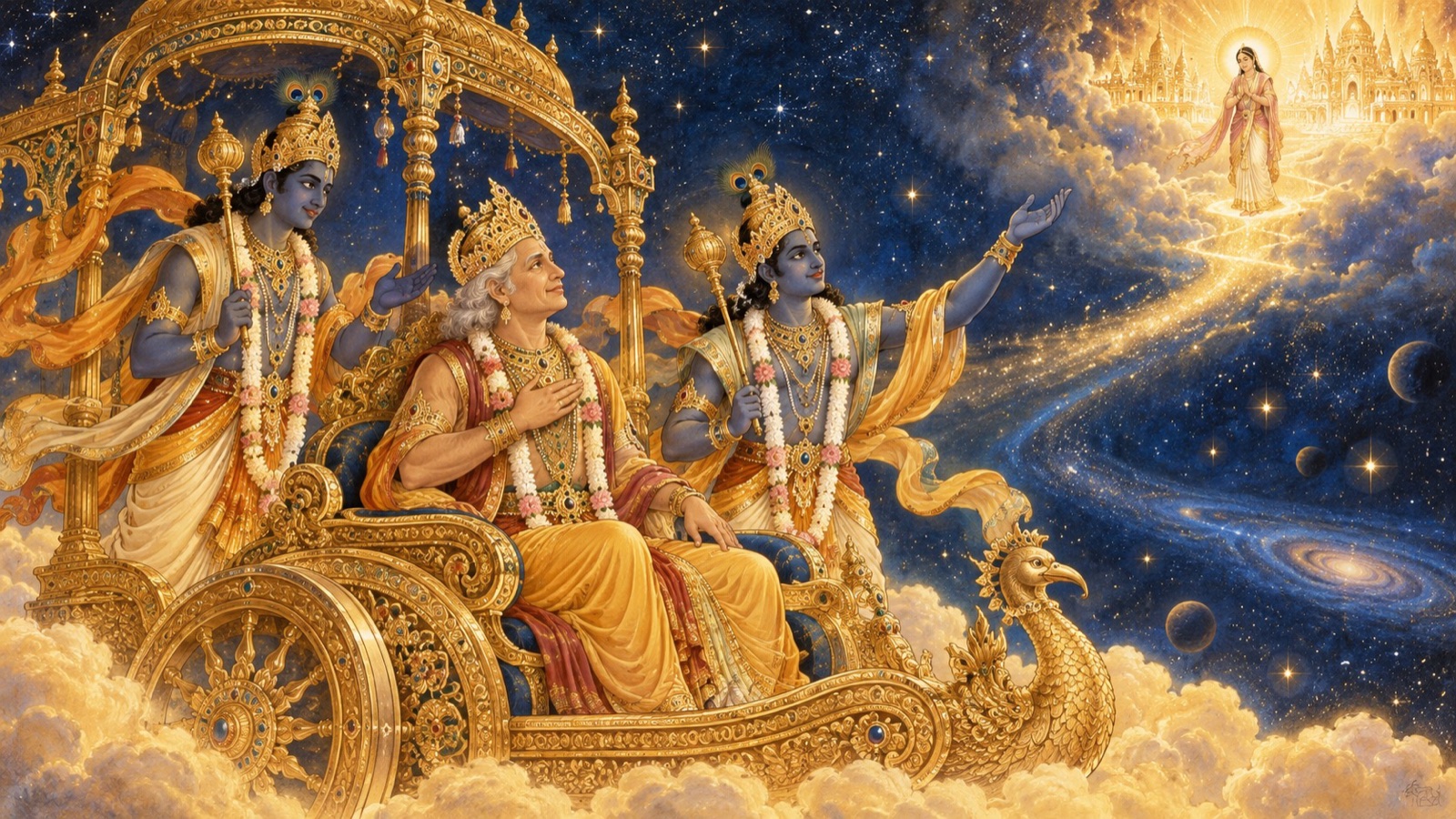
Reading his heart, the Lord’s messengers reassured him: his mother Suniti was even then going before him, borne on her own radiant path to the same eternal abode. Comforted, Dhruva ascended.
The Imperishable Abode
Passing beyond the three worlds and even beyond the region of the seven sages, borne by the divine chariot, Dhruva — the fixed one — at last reached the supreme, imperishable abode of Lord Vishnu, the polar station that shines undimmed while all the stars revolve around it.
त्रिलोकीं देवयानेन सोऽतिव्रज्य मुनीनपि । परस्ताद्यद् ध्रुवगतिर्विष्णो: पदमथाभ्यगात् ॥ ३५ ॥
tri-lokīṁ deva-yānena so ’tivrajya munīn api parastād yad dhruva-gatir viṣṇoḥ padam athābhyagāt
Meaning: Passing beyond the three worlds and even the sages by that divine chariot, Dhruva, the fixed one, reached the supreme abode of Vishnu. (Canto 4, Chapter 12, verse 35)
As Dhruva now stood at the threshold of that realm, Maitreya explained why it had opened to him at all.
यद्भ्राजमानं स्वरुचैव सर्वतो लोकास्त्रयो ह्यनु विभ्राजन्त एते । यन्नाव्रजञ्जन्तुषु येऽननुग्रहा व्रजन्ति भद्राणि चरन्ति येऽनिशम् ॥ ३६ ॥
yad bhrājamānaṁ sva-rucaiva sarvato lokās trayo hy anu vibhrājanta ete yan nāvrajañ jantuṣu ye ’nanugrahā vrajanti bhadrāṇi caranti ye ’niśam
Meaning: This self-luminous abode, whose own radiance is the very light that all three worlds reflect, opens to no one who withholds mercy from other living beings; it is reached only by those who labour, without pause, for the good of all. (Canto 4, Chapter 12, verse 36)
Kubera had once warned Dhruva against seeing “I” and “you” as separate and opposed; here that teaching completes itself. Only the soul who has outgrown such separateness — who is peaceful, who looks upon every being with an equal eye, and who delights in the welfare of all — can walk in friendship with the Lord’s own devotees and pass, without difficulty, to His imperishable feet (verse 37). Dhruva’s throne, his sacrifices, even his own austerities were never the true qualification for this journey; the mercy he bore toward every living creature was.
Watching Dhruva’s glory from afar, the sage Narada — his own spiritual master — took up his vina and, in the assembly of the Pracetas, sang three verses in his disciple’s praise.
य: पञ्चवर्षो गुरुदारवाक्शरै- र्भिन्नेन यातो हृदयेन दूयता । वनं मदादेशकरोऽजितं प्रभुं जिगाय तद्भक्तगुणै: पराजितम् ॥ ४२ ॥
yaḥ pañca-varṣo guru-dāra-vāk-śarair bhinnena yāto hṛdayena dūyatā vanaṁ mad-ādeśa-karo ’jitaṁ prabhuṁ jigāya tad-bhakta-guṇaiḥ parājitam
Meaning: He who, at only five years of age, went to the forest with a heart wounded by his stepmother’s harsh words, and there, following my direction, conquered the unconquerable Lord by the very qualities that are dear to His devotees. (Canto 4, Chapter 12, verse 42)
Simply by the strength of his devotion, Narada sang, the son of Suniti had reached a station that the followers of the Vedas, learned in ritual and scripture, could never attain (verse 41); no great king, he added, achieves in a lifetime of austerity what this child achieved in a mere six months (verse 43). Maitreya then closed his narration to Vidura with the promise that whoever hears with faith this sacred story of the boy who won the imperishable abode through devotion attains devotion himself, and is freed from all sin.
So the long history of Dhruva, begun in a child’s tears in a palace, ends at the still centre of the turning heavens — a soul fixed forever in the Lord.
Principal Teachings of This Chapter
1. Peace opens the door that war could not. When Dhruva gave up his anger, Kubera — the very lord of those he had fought — came to him in favour and blessing. Reconciliation draws grace that conflict never could (verse 1).
2. Behind “I” and “you” stands only the Lord. Kubera taught that to see oneself and another as separate, body-bound selves is the very ignorance that binds the soul to birth and death; only surrender to the one Lord cuts that knot away (verse 4).
3. Ask for the Lord, not for His gifts. Offered any boon, Dhruva asked only for unwavering remembrance of the Lord. The wisest prayer seeks not the things of the world but the One who is beyond it (verse 8).
4. Devotion is fearless before death. Dhruva set his foot upon the head of death itself. To one whose heart is fixed in the Lord, even death is not a terror but a threshold (verse 30).
5. Pure love does not forget its debts. At the very gate of heaven, Dhruva remembers the mother who first turned him to God. The highest attainment does not harden the heart; it keeps it tender (verse 32).
6. Mercy, not merit, opens the gate of Vaikuntha. The self-effulgent abode is closed to the learned, the mighty and even the liberated, and open only to the soul who is compassionate toward every living being (verses 36-37).
7. Devotion conquers what nothing else can. In half a year, a five-year-old accomplished what a lifetime of ritual and learning cannot; Narada sang that devotion alone conquers the Lord whom none can conquer (verse 42).
8. The promise of the Lord is never broken. The imperishable abode shown to a child in the forest is the very abode he now attains. What the Lord grants, He fulfils to the end (verse 35).
A Devotional Reflection
Of all the wonders in this chapter — Kubera’s blessing, the celestial chariot, the foot upon the head of death, the ascent past the stars — the one that lingers most is the smallest: that at the threshold of the eternal abode, with heaven itself waiting, Dhruva pauses to remember his mother. It would have been easy for the scripture to let him rise in unmixed glory. Instead it shows us a saint so great that he can set his foot on death, and a son so tender that he cannot bear to leave his mother behind. This is the shape of true devotion: it does not abolish love but perfects it. The same Dhruva who wanted nothing of the world but the Lord’s remembrance is the one whose first thought at heaven’s door is of the woman who once dried his tears and pointed him to God. His story tells us that the way to the highest is not through a hardening of the heart but through its deepening — that the soul which learns to love God learns, in that very love, to hold every earlier love more faithfully, and to carry it home.
A Daily Devotional Practice
Today, make Dhruva’s boon your own prayer. However full or empty your hands may feel, ask the Lord for the one gift Dhruva asked for — not for this or that outcome, but simply for the grace of unwavering remembrance, that you may not forget Him amid the day’s cares. Sit quietly, chant “Om Namo Bhagavate Vasudevaya,” and offer that single request: let me remember You. And in the spirit of Dhruva at heaven’s gate, bring to mind, with gratitude, one person who first turned your own heart toward the sacred — a parent, a teacher, a friend — and offer a prayer for them. In asking to remember God, and in remembering with love those who led you to Him, you walk Dhruva’s path from the palace to the pole star.
Conclusion
This twelfth discourse of Book Four carries Dhruva’s long story to its radiant close. Kubera, lord of wealth, seeks him out once his fury has cooled and offers him any boon he desires; yet the king turns from every worldly gift and chooses only the unbroken remembrance of the Lord. After a long and righteous reign, Dhruva withdraws to austerity, and there the Lord’s own luminous messengers come with a celestial chariot to bear him home. Careless of death, he sets his foot upon its head and mounts the wondrous vehicle; yet at heaven’s threshold he pauses, remembering his mother Suniti, and is reassured that she goes before him. Passing beyond the three worlds and the seven sages, Dhruva reaches the imperishable abode of Vishnu — the very station promised to him as a child. Narada sings his glory, and Maitreya promises that whoever hears this story with faith gains devotion and is freed from sin. So the boy who began in tears is fixed forever at the still centre of the turning heavens.
May the divine wisdom of Srimad Bhagavatam awaken pure devotion within our hearts.
Om Namo Bhagavate Vasudevaya.
Jay Shree Madhav.
References and Attribution
- Primary edition: Gita Press, Śrīmad Bhāgavata Mahāpurāṇa (English, complete), Book Four, Discourse 12.
- Series: Srimad Bhagavatam Wisdom · Biswa Sanatan Dharma Seva Trust.
- Presented following the spiritual guidance and recommendation of Pandit Dr. Shri Kashinath Mishra.
This is an original, faithful retelling in the writer’s own words, with brief quoted verses shown in Devanāgarī and transliteration and their meanings given as summaries. It is not a reproduction of any single publisher’s continuous translation or commentary. No affiliation with or endorsement by any publisher is implied.
Jay Shree Madhav