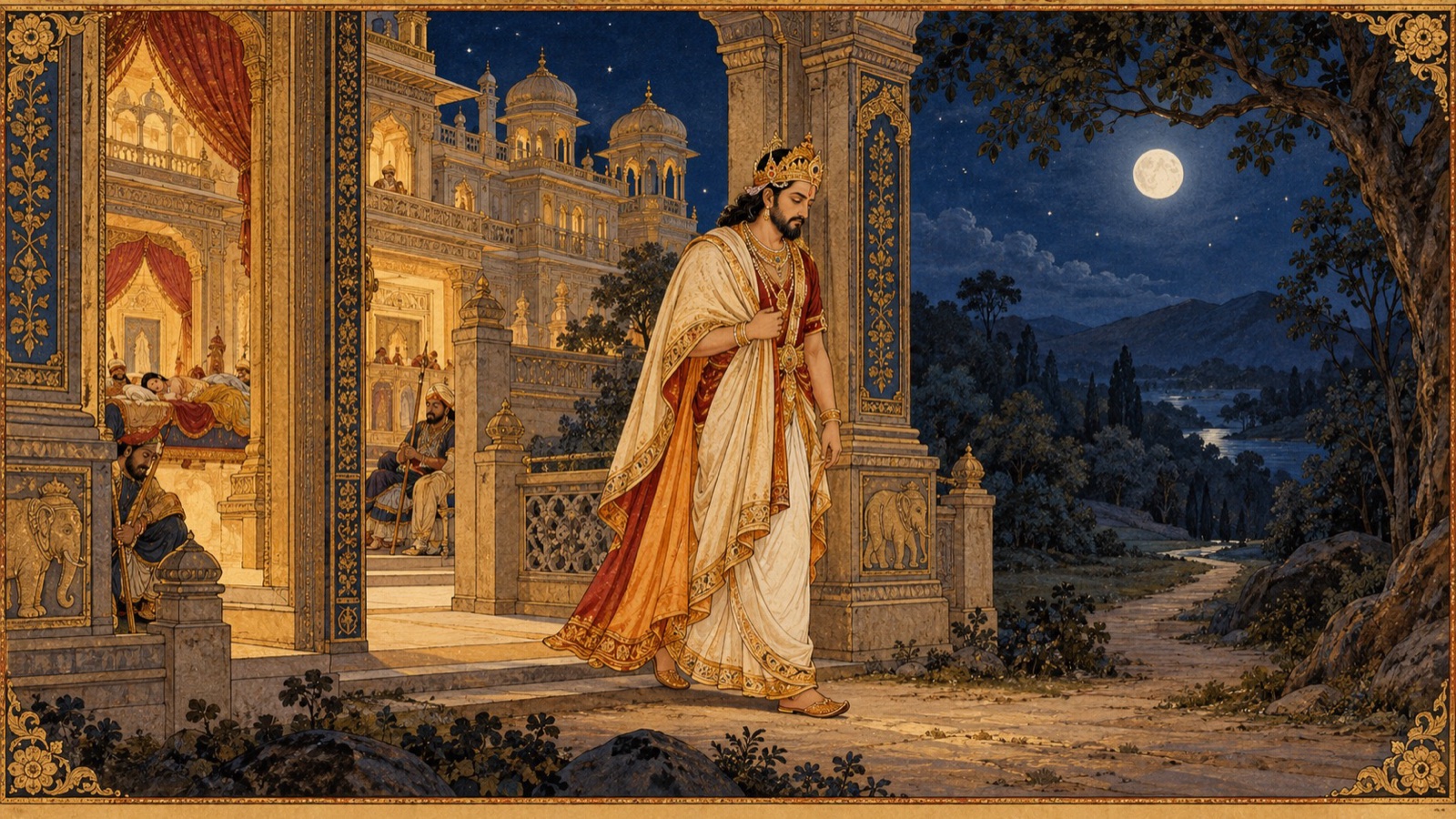
Heartbroken by his son’s cruelty and freed of every attachment, the saintly King Anga rises in the dead of night and slips away from his palace alone, leaving his throne and his sleeping household behind.
Om Namo Bhagavate Vasudevaya.
Om Namo Bhagavate Vasudevaya.
Om Namo Bhagavate Vasudevaya.
Welcome to Srimad Bhagavatam Wisdom, a devotional journey through the sacred histories and teachings of the Srimad Bhagavat Mahapurana. Having heard how Dhruva ascended in his own body to the Lord’s eternal abode, Vidura’s devotion for the Supreme grows deeper still, and he asks the sage Maitreya to continue the story of Dhruva’s line. This thirteenth chapter traces that royal family across several generations and then settles upon one poignant tale — the story of King Anga, a saintly and self-controlled ruler who, though righteous in every way, was cursed with a wicked son, Vena. It is a chapter about the mystery of a good man’s grief, the ache of a father whose child will not be corrected, and a renunciation born not of failure but of a strange, hard freedom. In Anga’s midnight departure the Bhagavatam quietly asks what truly binds us to the world, and what can loosen those bonds when nothing else will.
Chapter Information
- Scripture: Śrīmad Bhāgavata Mahāpurāṇa
- Canto: 4 (Book Four)
- Chapter: 13 (Discourse 13)
- Chapter title: Dhruva’s Posterity and the Story of King Anga
- Principal speaker: The sage Maitreya, continuing his discourse to Vidura (within the outer narration of Suta)
- Principal listener: Vidura
- Main setting: The royal line of Dhruva, and the kingdom of the saintly King Anga
- Central subject: The descendants of Dhruva, and the story of King Anga, his wicked son Vena, and his renunciation
- Principal verse range: Canto 4, Chapter 13, verses 1–49
- Primary edition: Gita Press Śrīmad Bhāgavata Mahāpurāṇa
Context from the Previous Chapter
Chapter 12 completed the story of Dhruva with his bodily ascent to the imperishable abode of Lord Vishnu, and Narada sang his glory. This thirteenth chapter opens as Vidura, his heart softened and his devotion deepened by that account, asks Maitreya to continue — and the sage takes up the tale of Dhruva’s descendants.
Vidura’s Deepened Devotion
Hearing the account of Dhruva’s ascent to the abode of the Lord, Vidura’s love for the transcendent Supreme grew all the deeper, and he began once more to question Maitreya, eager to hear how the line of that great devotee continued.
सूत उवाच निशम्य कौषारविणोपवर्णितं ध्रुवस्य वैकुण्ठपदाधिरोहणम् । प्ररूढभावो भगवत्यधोक्षजे प्रष्टुं पुनस्तं विदुर: प्रचक्रमे ॥ १ ॥
sūta uvāca niśamya kauṣāraviṇopavarṇitaṁ dhruvasya vaikuṇṭha-padādhirohaṇam prarūḍha-bhāvo bhagavaty adhokṣaje praṣṭuṁ punas taṁ viduraḥ pracakrame
Meaning: Suta said: Hearing Maitreya’s account of Dhruva’s ascent to the abode of Vaikuntha, Vidura — his devotion to the transcendent Lord deepened — began once more to question him. (Canto 4, Chapter 13, verse 1)
Maitreya then traced the descendants of Dhruva across the generations. Dhruva’s son Utkala was a soul so absorbed in the Self that he cared nothing for a throne and was taken by the world for a dullard; so the kingdom passed instead to his brother’s line, and from that line, through several generations of kings, there came in time the righteous ruler Anga.
The Riddle of a Wicked Son
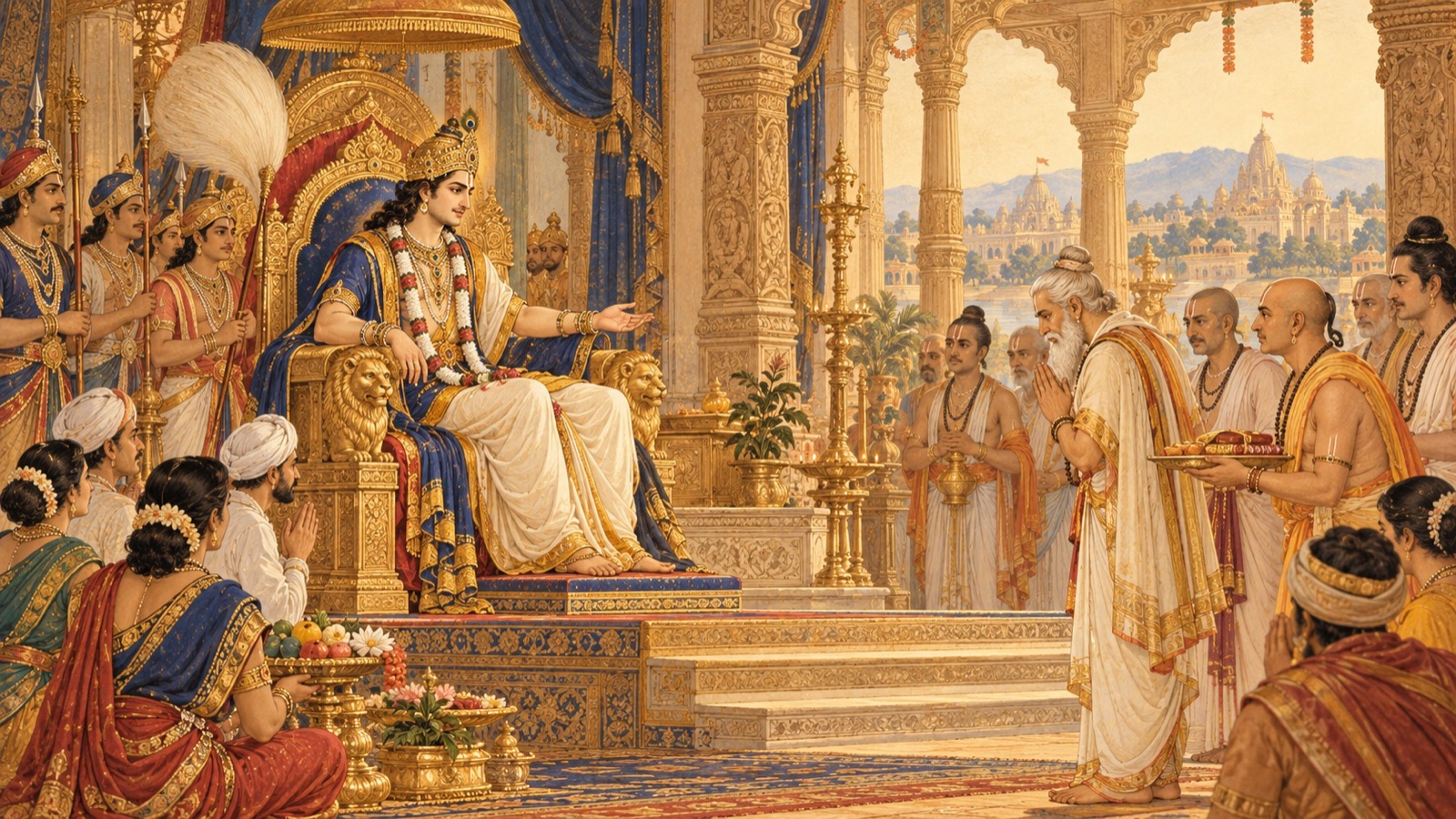
Maitreya first told the outcome in brief: that Anga’s son Vena would grow so wicked that the sages, provoked, would curse him to death; that lawlessness would follow; and that from the churning of Vena’s body the Lord would descend in part as King Prithu, the first great emperor. Hearing this, Vidura was puzzled: how could a king of such flawless virtue, so cherished by the brahmanas, ever have come to have so wicked a son that he grew disheartened and went away?
विदुर उवाच तस्य शीलनिधे: साधोर्ब्रह्मण्यस्य महात्मन: । राज्ञ: कथमभूद्दुष्टा प्रजा यद्विमना ययौ ॥ २१ ॥
vidura uvāca tasya śīla-nidheḥ sādhor brahmaṇyasya mahātmanaḥ rājñaḥ katham abhūd duṣṭā prajā yad-vimanā yayau
Meaning: Vidura asked: How did so saintly and high-souled a king — an ocean of good character, devoted to the brahmanas — come to have so wicked a child, on whose account, dispirited, he went away? (Canto 4, Chapter 13, verse 21)
The Sacrifice and the Birth of Vena
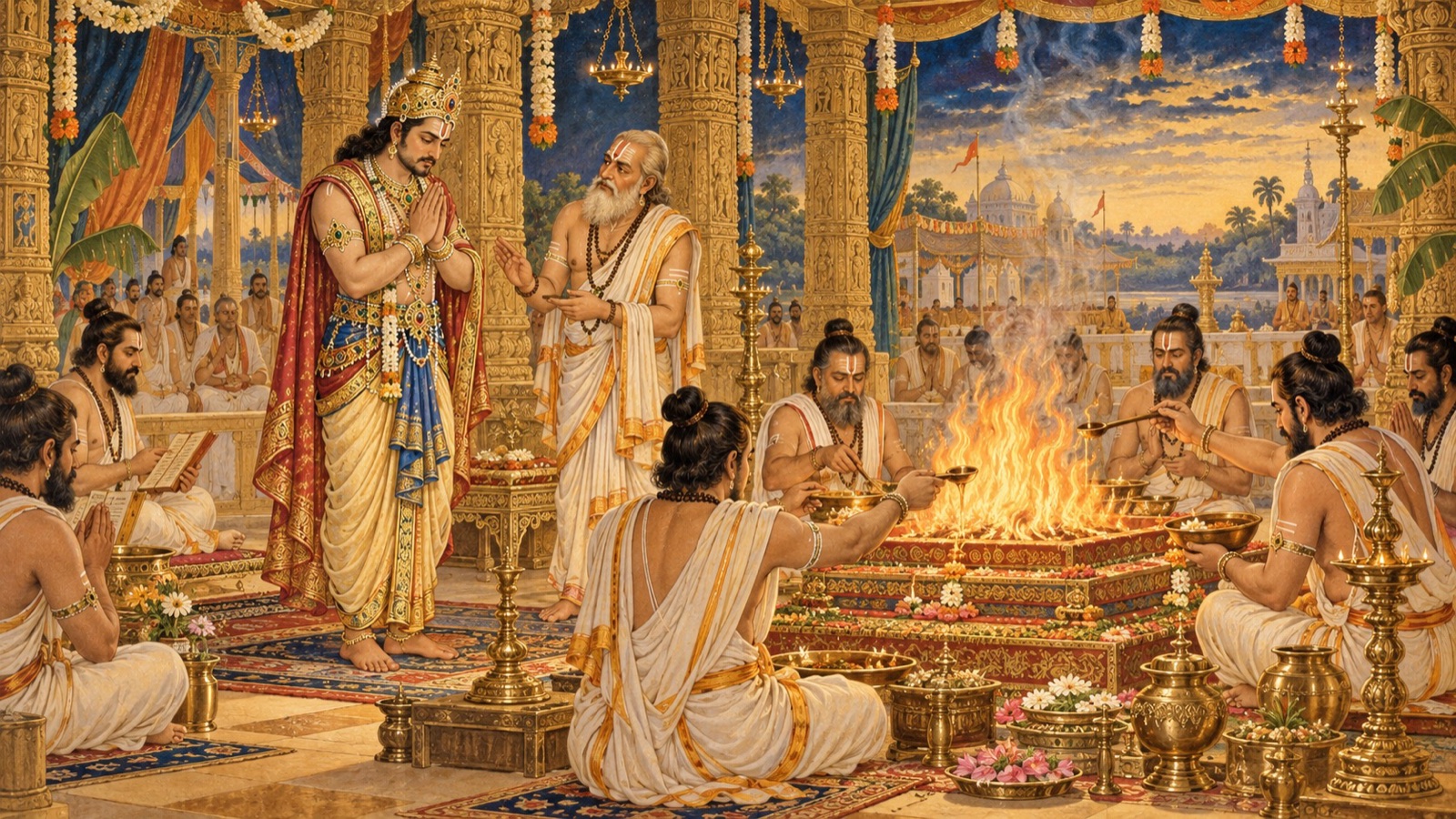
In answer, Maitreya unfolded the tale. King Anga, righteous but without an heir, once performed a great horse-sacrifice; yet the demigods did not come to accept their shares. The priests, questioned, explained that this was the fruit of the king’s own destiny — he was fated to be sonless in this life.
But the priests went further and named the deeper principle behind every sacrifice: it is Hari, the Lord of sacrifice, who alone is truly worshiped in any offering, and the demigods receive their share only because they accompany Him. Let the king worship the Lord directly for a son, they said, for the fruit any soul receives depends entirely on how the sacrifice is directed, not on which deity is invoked (verses 32–34).
तथा स्वभागधेयानि ग्रहीष्यन्ति दिवौकस: । यद्यज्ञपुरुष: साक्षादपत्याय हरिर्वृत: ॥ ३३ ॥
tathā sva-bhāgadheyāni grahīṣyanti divaukasaḥ yad yajña-puruṣaḥ sākṣād apatyāya harir vṛtaḥ
Meaning: Then, they said, the demigods themselves will accept their shares in the sacrifice — for it is Hari, the very enjoyer of all sacrifice, who has been invited here, directly, for the sake of a son. (Canto 4, Chapter 13, verse 33)
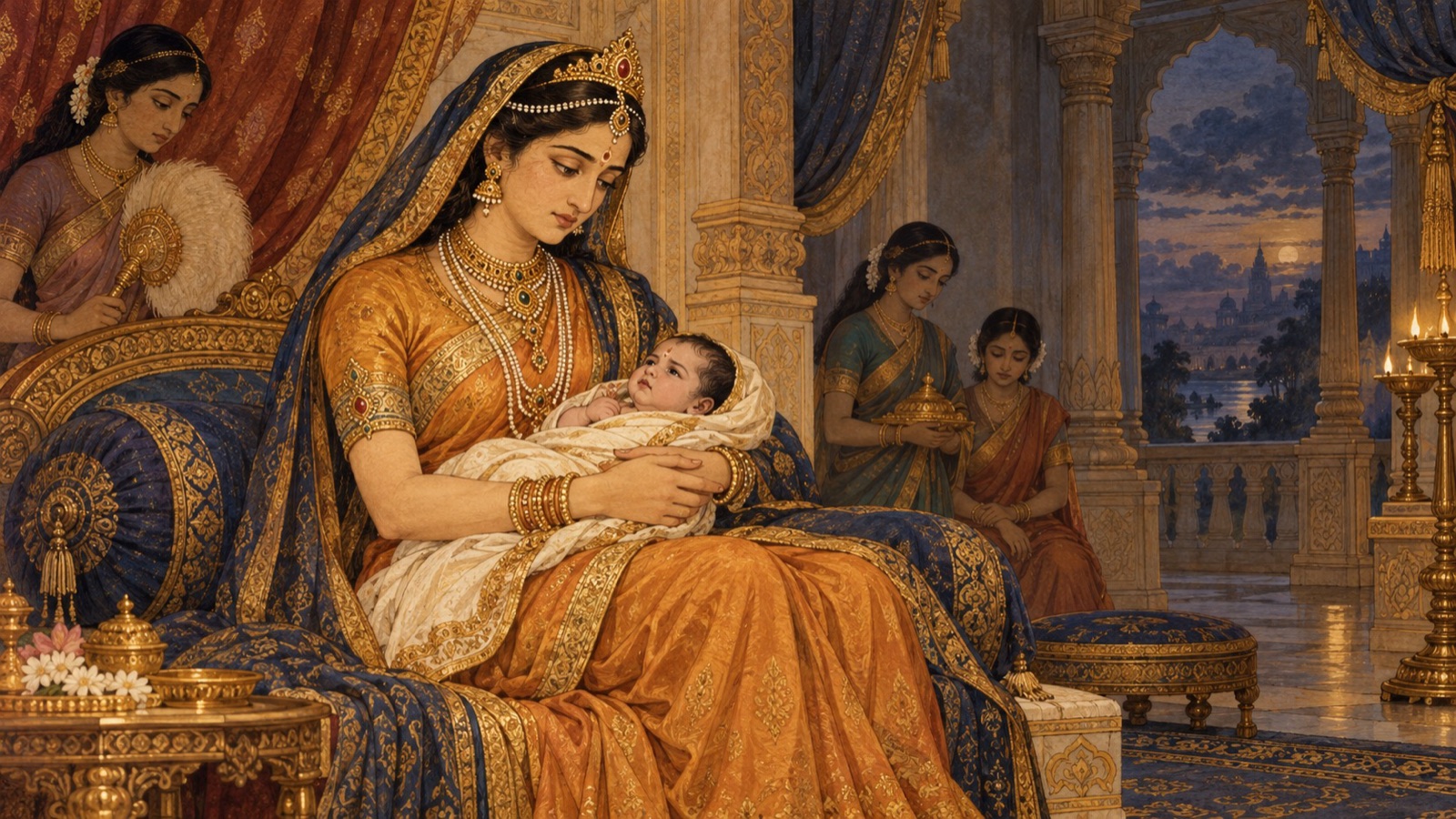
Moved by his longing, they performed a special rite for a son and gave to the king the sacred remnant to be eaten by his queen, Sunitha. In time she bore a son, Vena. But Sunitha was the daughter of Death himself, and through his mother’s line the boy inherited a hard and cruel nature.
As Vena grew, his cruelty showed itself early and without shame. He tormented his playmates and living creatures alike, and no correction could soften him. The whole kingdom came to dread the day this boy would rule.
The Freedom of a Broken Heart
There is a deeper reason, the tradition holds, why so devoted a king should receive so painful a son. King Anga’s own liberality — he offered the very first taste of the sacred food to his queen before touching it himself (verse 37) — marks him as no ordinary fruitive worshiper but a soul the Lord was already drawing toward Himself. For such a devotee, providence does not merely answer a prayer; it uses the very granting of that prayer to loosen what still binds him. A son born partly into the line of Death (verse 39) was not a divine oversight but the means by which a king too attached to his opulent household would, in time, be persuaded to leave it altogether and take shelter in the Lord alone (verses 46–47). What looks like misfortune falling on the pious is, seen rightly, the Lord’s own hand completing a devotee’s detachment.
The good king tried every means to guide his son, and every means failed. Worn down at last, Anga fell into a strange and searching sorrow, and out of it came an unexpected thought: that a bad son is, in a way, better than a good one — for a good son binds the heart ever more tightly to home, while a bad son wearies a man of that home of endless trouble until he longs to be free of it.
कदपत्यं वरं मन्ये सदपत्याच्छुचां पदात् । निर्विद्येत गृहान्मर्त्यो यत्क्लेशनिवहा गृहा: ॥ ४६ ॥
kad-apatyaṁ varaṁ manye sad-apatyāc chucāṁ padāt nirvidyeta gṛhān martyo yat-kleśa-nivahā gṛhāḥ
Meaning: (Anga reflected:) A bad son, I think, is better than a good one; for a good son binds the heart to home, while through a bad son a man grows weary of that abode of endless trouble and turns away. (Canto 4, Chapter 13, verse 46)
His mind now emptied of every attachment, and sleep gone from him, the king rose in the dead of night. Unseen by anyone, he left his palace of great fortune, abandoning even the sleeping mother of Vena, and went away into renunciation.
एवं स निर्विण्णमना नृपो गृहा- न्निशीथ उत्थाय महोदयोदयात् । अलब्धनिद्रोऽनुपलक्षितो नृभि- र्हित्वा गतो वेनसुवं प्रसुप्ताम् ॥ ४७ ॥
evaṁ sa nirviṇṇa-manā nṛpo gṛhān niśītha utthāya mahodayodayāt alabdha-nidro ’nupalakṣito nṛbhir hitvā gato vena-suvaṁ prasuptām
Meaning: Thus, his mind emptied of attachment and sleep gone from him, the king rose at midnight and, unnoticed by anyone, left his opulent palace, abandoning even the sleeping mother of Vena, and went away. (Canto 4, Chapter 13, verse 47)
The People’s Search
When it was known that their king had renounced everything and gone, the people — priests, ministers, friends, and citizens alike — were overcome with grief and searched for him across the whole earth, but in vain, as unskilled seekers search for the Self hidden within and cannot find it.
विज्ञाय निर्विद्य गतं पतिं प्रजा: पुरोहितामात्यसुहृद्गणादय: । विचिक्युरुर्व्यामतिशोककातरा यथा निगूढं पुरुषं कुयोगिन: ॥ ४८ ॥
vijñāya nirvidya gataṁ patiṁ prajāḥ purohitāmātya-suhṛd-gaṇādayaḥ vicikyur urvyām atiśoka-kātarā yathā nigūḍhaṁ puruṣaṁ kuyoginaḥ
Meaning: Learning that their king had gone away in renunciation, the people — priests, ministers, friends, and all — sought him everywhere on earth in deep grief, as inexpert mystics search in vain for the Self hidden within. (Canto 4, Chapter 13, verse 48)
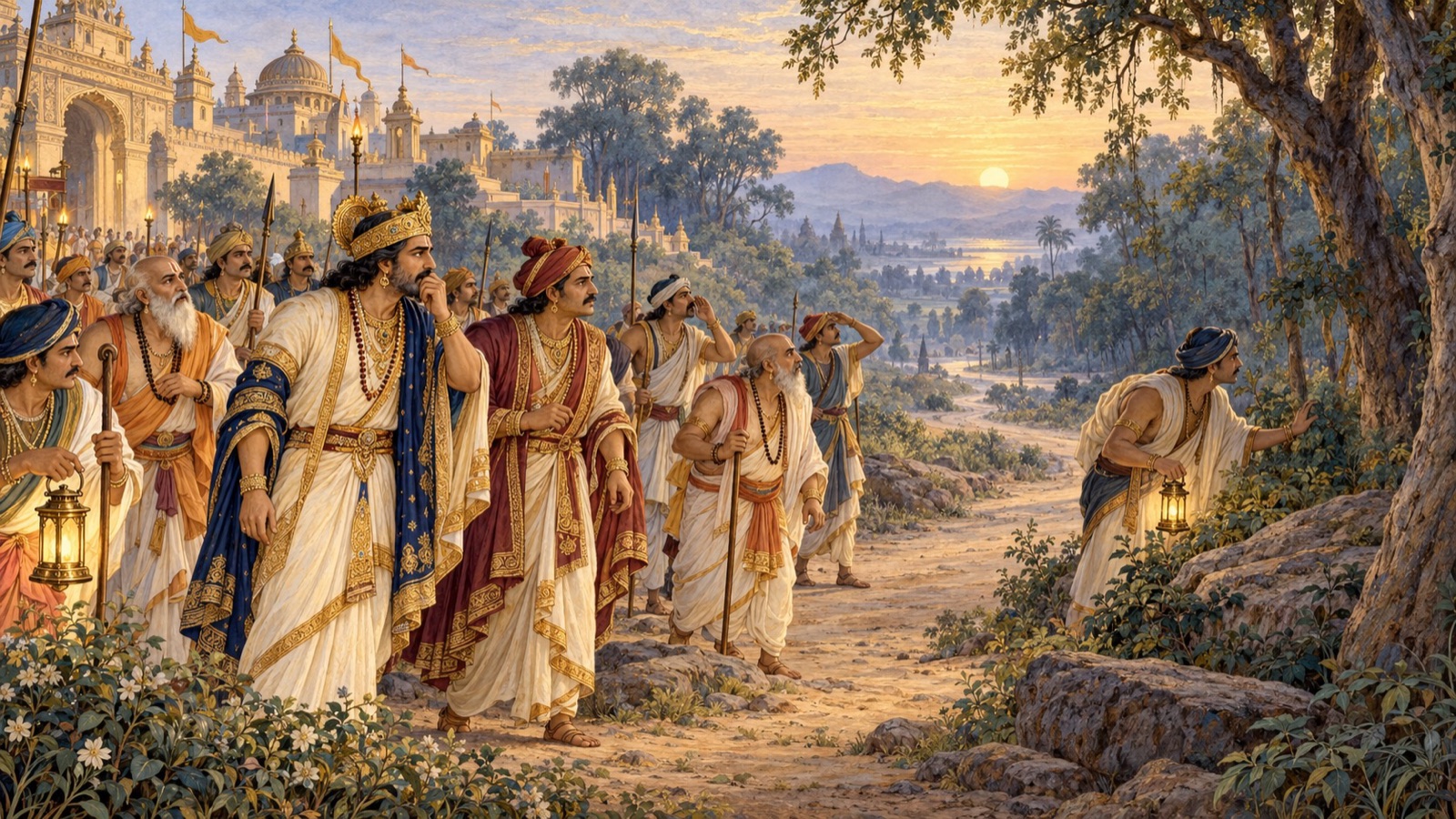
So the thirteenth discourse closes on an empty throne and a searching people — the saintly Anga vanished into the forest, and the wicked Vena left as the only heir, setting the stage for the dark tale the next chapter will tell.
Principal Teachings of This Chapter
1. Hearing of the Lord’s devotees deepens devotion. Vidura’s love for the Lord grows the more he hears of Dhruva. Sacred stories are not mere history; they kindle the very devotion they describe (verse 1).
2. Even a righteous life is not spared sorrow. Anga is faultless, yet he is given a heartbreaking son. The scripture refuses the easy idea that goodness always brings ease; it shows us grief inside a holy life (verse 21).
3. The Lord, not the demigods, is the true object of every offering. Hari alone is the real enjoyer of any sacrifice; the demigods share in it only because they follow Him. A soul’s worship, the priests teach Anga, bears fruit according to whom it truly reaches (verses 32-34).
4. Character can pass along hidden channels. Vena’s cruelty is traced to his mother’s line, that of Death. We are shaped by more than we see, and no upbringing alone can guarantee the heart (verses 39-40).
5. What binds us and what frees us are not always what we expect. The very prayer Anga’s liberality earns him (verse 37) becomes, once granted, the door to his detachment (verse 46) — sometimes it is our heaviest burden that finally teaches us to let go.
6. The world cannot restore what only God can give. The people search the whole earth for their vanished king and cannot find him — an image of the soul that seeks its peace everywhere but within. What we most need is not found by searching outside (verse 48).
A Devotional Reflection
There is a quiet, unsettling honesty in the story of King Anga. He does everything right — he is just, devout, self-controlled, beloved — and still his life delivers him a sorrow he cannot fix. We would like to believe that goodness is always rewarded with peace, that a righteous person will be spared the deepest griefs. The Bhagavatam does not comfort us with that fiction. Instead it shows a holy king undone by a wound that no virtue could prevent, and then, remarkably, it lets that very wound become his liberation. Anga’s strange conclusion — that a bad son may be better than a good one — is not bitterness; it is the dawning of detachment, the recognition that the things we cling to as our security are, in truth, “the abode of endless trouble.” Most of us are freed from our attachments slowly and gently. Some are freed by a grief that will not heal, which loosens our grip on the world when nothing softer could. The chapter does not glorify Anga’s pain, but it does something braver: it shows that even a heartbreak, offered up, can become a road that leads a soul away from the world and toward the Lord.
A Daily Devotional Practice
Today, look honestly at the one attachment or worry that weighs on you most — the very thing you would least like to lose or the trouble you cannot fix — and instead of clutching it or fleeing it, offer it quietly to the Lord with the words “Om Namo Bhagavate Vasudevaya.” As Anga discovered that his heaviest sorrow could loosen his grip on the world, ask that whatever you are holding too tightly may become, in the Lord’s hands, a means of turning your heart toward Him. And when you feel yourself searching outside for a peace you cannot find — as Anga’s people searched the earth for their vanished king — gently turn the search inward, remembering that the shelter you seek is nearer than all your seeking, seated already within your own heart.
Conclusion
The thirteenth discourse of Book Four turns from Dhruva’s glory to a gentler, sadder tale. His love deepened by hearing of Dhruva’s ascent, Vidura asks Maitreya to continue the story of the line, and the sage traces Dhruva’s descendants down to the saintly King Anga. Righteous but heirless, Anga performs a sacrifice for a son and is given Vena — but the boy, inheriting a cruel nature through his mother’s line, that of Death, grows so wicked that no correction can reach him. Worn down at last, Anga discovers an unlikely freedom in his own grief — a home turned wearisome no longer holds the heart — and in the dead of night he rises and slips quietly away into renunciation, unseen. His people search the whole earth for him in vain. So the chapter ends on an empty throne, with the wicked Vena the only heir — and a warning of the darkness the next chapter will bring.
May the divine wisdom of Srimad Bhagavatam awaken pure devotion within our hearts.
Om Namo Bhagavate Vasudevaya.
Jay Shree Madhav.
References and Attribution
- Primary edition: Gita Press, Śrīmad Bhāgavata Mahāpurāṇa (English, complete), Book Four, Discourse 13.
- Series: Srimad Bhagavatam Wisdom · Biswa Sanatan Dharma Seva Trust.
- Presented following the spiritual guidance and recommendation of Pandit Dr. Shri Kashinath Mishra.
This is an original, faithful retelling in the writer’s own words, with brief quoted verses shown in Devanāgarī and transliteration and their meanings given as summaries. It is not a reproduction of any single publisher’s continuous translation or commentary. No affiliation with or endorsement by any publisher is implied.
Jay Shree Madhav