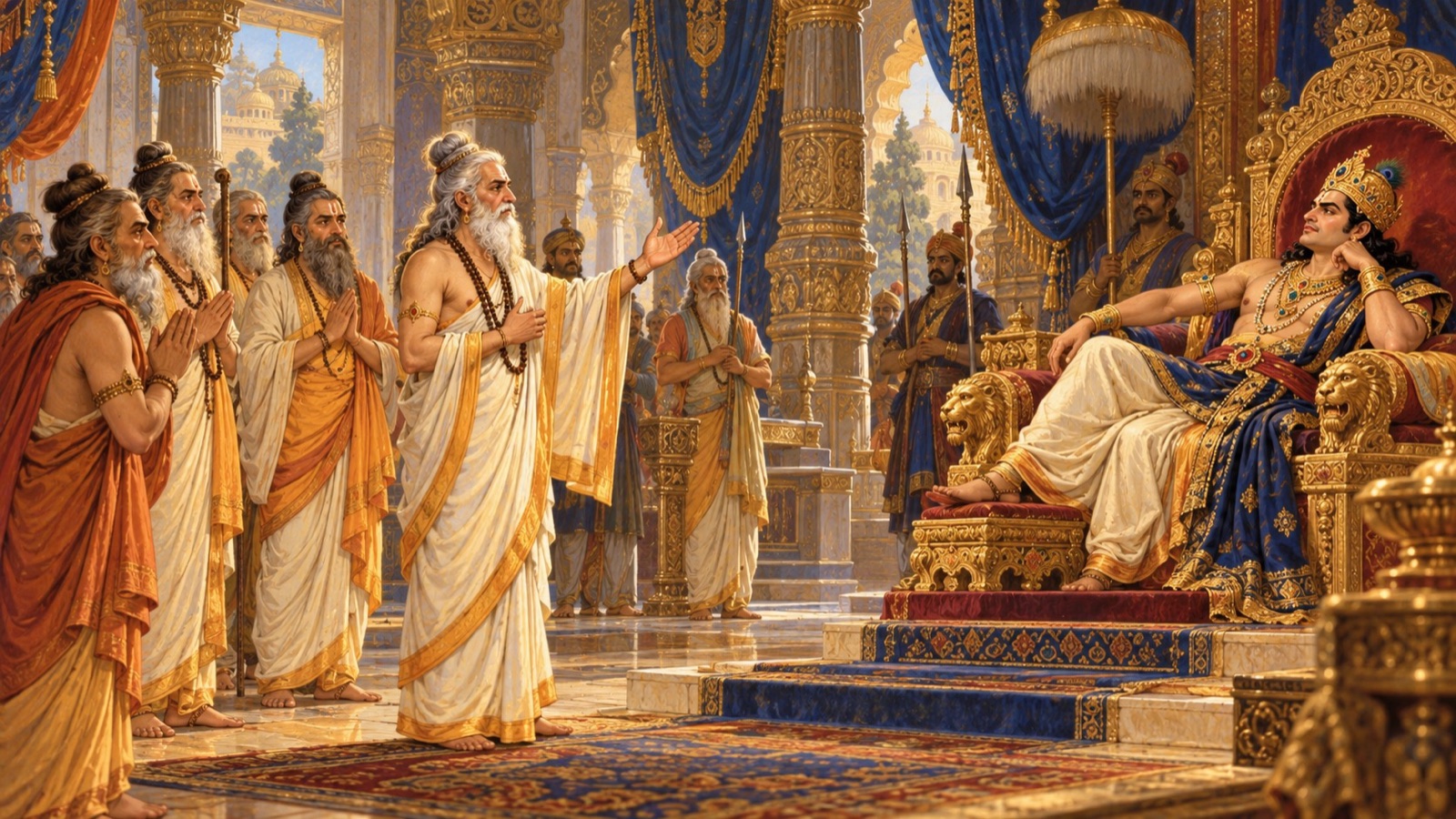
For the welfare of a suffering people, the great sages stand before the proud King Vena upon his throne, appealing to him to rule by righteousness and to honour the Lord of all sacrifice.
Om Namo Bhagavate Vasudevaya.
Om Namo Bhagavate Vasudevaya.
Om Namo Bhagavate Vasudevaya.
Welcome to Srimad Bhagavatam Wisdom, a devotional journey through the sacred histories and teachings of the Srimad Bhagavat Mahapurana. In the previous chapter, the saintly King Anga, worn down by the cruelty of his son, renounced his throne and slipped away into the forest by night, leaving the wicked Vena as the only heir. This fourteenth chapter tells the hard story of Vena’s reign. To spare the leaderless people from lawlessness, the sages install Vena as king; but he swells with pride, forbids all sacrifice, and declares that he alone is to be worshipped. The sages appeal to him again and again, patiently and in vain, until, for the welfare of the world, they bring his reign to its end. Then, seeking a worthy ruler in his place, they churn his lifeless body, and from it two beings arise — one dark, who carries away Vena’s sin, and, as the chapter turns toward its sequel, the promise of a radiant king to come. It is a sober chapter about the ruin that pride works in a soul, and the mercy that draws good even out of disaster.
Chapter Information
- Scripture: Śrīmad Bhāgavata Mahāpurāṇa
- Canto: 4 (Book Four)
- Chapter: 14 (Discourse 14)
- Chapter title: The Story of King Vena
- Principal speaker: The sage Maitreya, continuing his discourse to Vidura (with the words of the sages and of Vena quoted within)
- Principal listener: Vidura
- Main setting: The kingdom left leaderless after Anga’s departure
- Central subject: The misrule and pride of King Vena, the sages’ appeals, his death, and the churning of his body
- Principal verse range: Canto 4, Chapter 14, verses 1–46
- Primary edition: Gita Press Śrīmad Bhāgavata Mahāpurāṇa
Context from the Previous Chapter
Chapter 13 told how the saintly King Anga, unable to correct his wicked son Vena, found a hard freedom in his grief and renounced his kingdom, slipping away by night; and how his people searched the earth for him in vain. This fourteenth chapter opens in the leaderless land, where the sages must decide how to protect a people now exposed to lawlessness on every side.
The Lawless Land
Bhrigu and the other great sages, forever mindful of the world’s welfare, looked upon the land now that Anga was gone and grieved at what they found: a people with no one to restrain them, already turning upon one another like beasts.
मैत्रेय उवाच भृग्वादयस्ते मुनयो लोकानां क्षेमदर्शिन: । गोप्तर्यसति वै नृणां पश्यन्त: पशुसाम्यताम् ॥ १ ॥
maitreya uvāca bhṛgv-ādayas te munayo lokānāṁ kṣema-darśinaḥ goptary asati vai nṝṇāṁ paśyantaḥ paśu-sāmyatām
Meaning: Maitreya said: Bhrigu and the other sages, ever watchful for the welfare of the worlds, saw that in the absence of a protector the people were sinking to the level of beasts. (Canto 4, Chapter 14, verse 1)
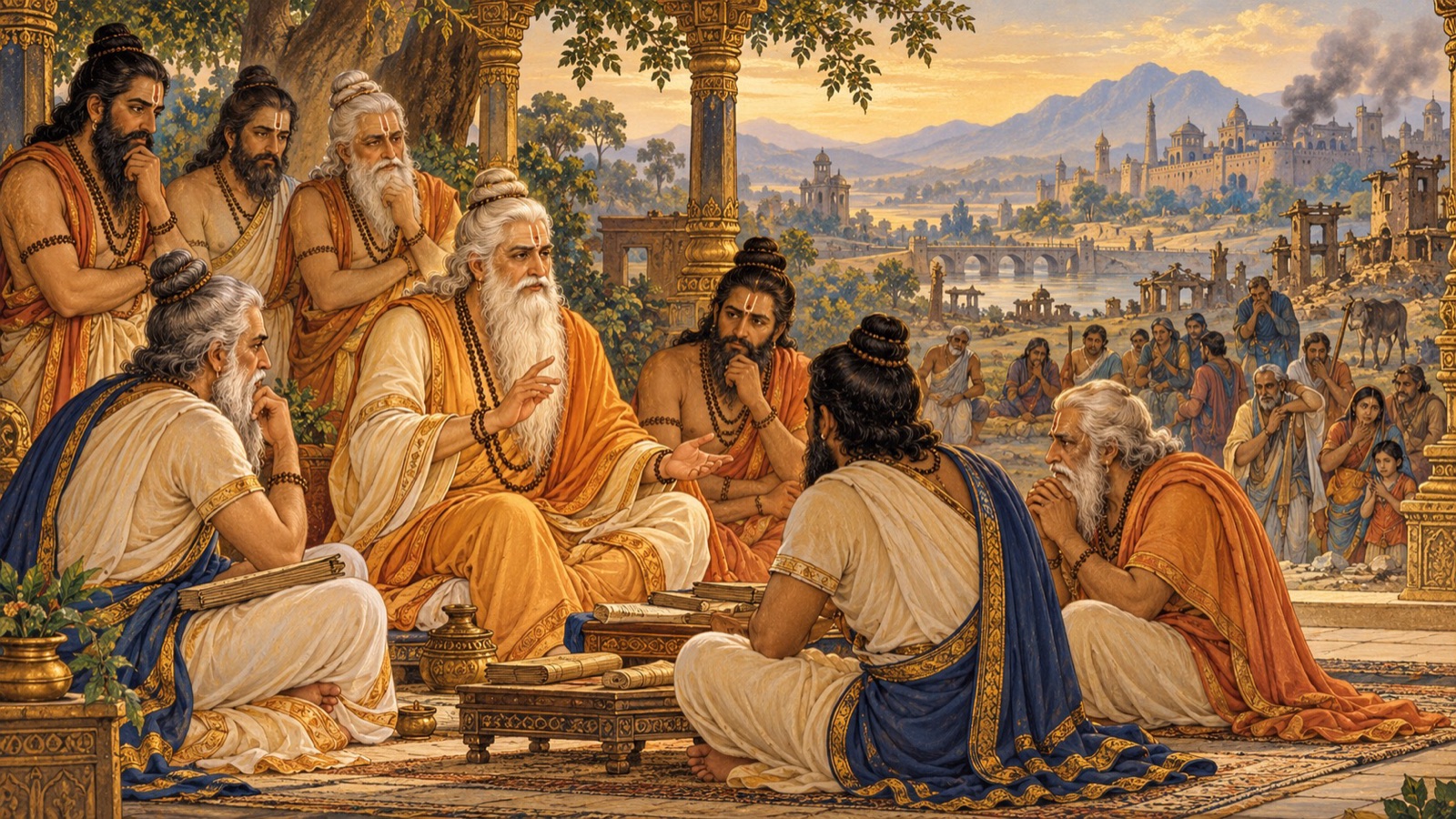
Consulting together, the sages perceived that the people were caught in danger from both directions at once — between the thieves and rogues who flourish without a king, and the ruin that misgovernment brings — as ants are trapped in a log that burns at both ends.
अहो उभयत: प्राप्तं लोकस्य व्यसनं महत् । दारुण्युभयतो दीप्ते इव तस्करपालयो: ॥ ८ ॥
aho ubhayataḥ prāptaṁ lokasya vyasanaṁ mahat dāruṇy ubhayato dīpte iva taskara-pālayoḥ
Meaning: (The sages said:) Alas, the people are caught in great danger from both sides — like ants in a log burning at both ends — between thieves on the one hand and the lack of a rightful ruler on the other. (Canto 4, Chapter 14, verse 8)
To meet the danger, the sages resolved to install a king, and, with his mother’s consent, they enthroned Vena — for despite his faults he had the strength to hold back the wicked. And indeed, at first, the mere dread of Vena’s power scattered the thieves and rogues, and the land grew quiet.
The Pride of Vena
But power in a proud heart soon showed its true face. Vena, drunk on his own strength, came to despise even the great and, mounting his chariot, thundered across the land like a rumbling cloud. He forbade all sacrifice, charity, and sacred observance throughout his realm, and proclaimed that no god was to be worshipped but himself, the king. The sages, grieved for the people and for the loss of dharma, came to him gently and appealed to his reason — reminding him that a king’s own welfare, and his people’s, rests upon honouring the Supreme Lord, the source of all, from whom every blessing flows.
तस्मिंस्तुष्टे किमप्राप्यं जगतामीश्वरेश्वरे । लोका: सपाला ह्येतस्मै हरन्ति बलिमादृता: ॥ २० ॥
tasmiṁs tuṣṭe kim aprāpyaṁ jagatām īśvareśvare lokāḥ sapālā hy etasmai haranti balim ādṛtāḥ
Meaning: (The sages counseled Vena:) When that Supreme Lord of all lords is pleased, what remains beyond reach? Even the rulers of all the worlds gladly bring Him their offerings. (Canto 4, Chapter 14, verse 20)
But Vena would not hear it. Mocking the sages as inexperienced children, he turned their own image back upon them: were they not, he asked, like an unchaste wife who deserts the husband who maintains her to run after some paramour — as though he, the king, and not the Lord they served, were their rightful husband? He went further still, declaring that the power of every god who can bless or curse dwells within a king’s own body, so that the king himself is the sum of all the gods.
विष्णुर्विरिञ्चो गिरिश इन्द्रो वायुर्यमो रवि: । पर्जन्यो धनद: सोम: क्षितिरग्निरपाम्पति: ॥ २६ ॥ एते चान्ये च विबुधा: प्रभवो वरशापयो: । देहे भवन्ति नृपते: सर्वदेवमयो नृप: ॥ २७ ॥
viṣṇur viriñco giriśa indro vāyur yamo raviḥ parjanyo dhanadaḥ somaḥ kṣitir agnir apāmpatiḥ
ete cānye ca vibudhāḥ prabhavo vara-śāpayoḥ dehe bhavanti nṛpateḥ sarva-devamayo nṛpaḥ
Meaning: (Vena declared:) Vishnu, Brahma, Shiva, Indra, and every other god able to bless or curse — all of them abide within a king’s body; therefore the king himself is the sum of every deity. (Canto 4, Chapter 14, verses 26–27)
There is a fragment of truth twisted into this claim, and it is worth pausing over. A king who rules by dharma does carry something of the demigods’ power, delegated to him so that he may protect the people in their name — he is a trustee of that power, not its source. Vena’s fall was to mistake the trust for the title: because a portion of divine power passed through him, he concluded that he was its origin and equal, and so worthy of the worship owed only to the Lord who lends that power to gods and kings alike. This is the error the whole chapter turns upon — not misrule alone, but the ancient confusion of the servant with the Master, the channel with the Fountain. However exalted his post, a devotee remains always the receiver of grace, never its source; the moment he forgets this and claims the glory for himself, as Vena did, his fall has already begun.
Again and again the sages reasoned with him; again and again he refused, his pride hardening with every word.
The End of a Reign
When every appeal had failed and Vena’s blasphemy grew unbearable, the sages who had at first striven only to save him could bear it no longer. “Kill him! Kill him!” they cried, for so dreadful a man, left on his throne, would soon turn the whole world to ashes — and worse than his cruelty to his subjects was his crime against the Lord himself, for who but the most unfortunate of men would blaspheme the very Vishnu by whose mercy every fortune is granted? So, for the welfare of all, and with grave and reluctant hearts, the sages ended Vena’s reign — not by any weapon, but by the sheer power of their sacred word. So the man who would be worshipped as a god was undone by the very pride that had lifted him up.
When the sages had returned to their hermitages, Vena’s mother, Sunitha, overcome with grief at her son’s death, preserved his lifeless body by mystic art and mantra.
ऋषिभि: स्वाश्रमपदं गते पुत्रकलेवरम् । सुनीथा पालयामास विद्यायोगेन शोचती ॥ ३५ ॥
ṛṣibhiḥ svāśrama-padaṁ gate putra-kalevaram sunīthā pālayām āsa vidyā-yogena śocatī
Meaning: When the sages had returned to their hermitages, Sunitha, grieving, preserved the body of her dead son by mystic art and mantra. (Canto 4, Chapter 14, verse 35)
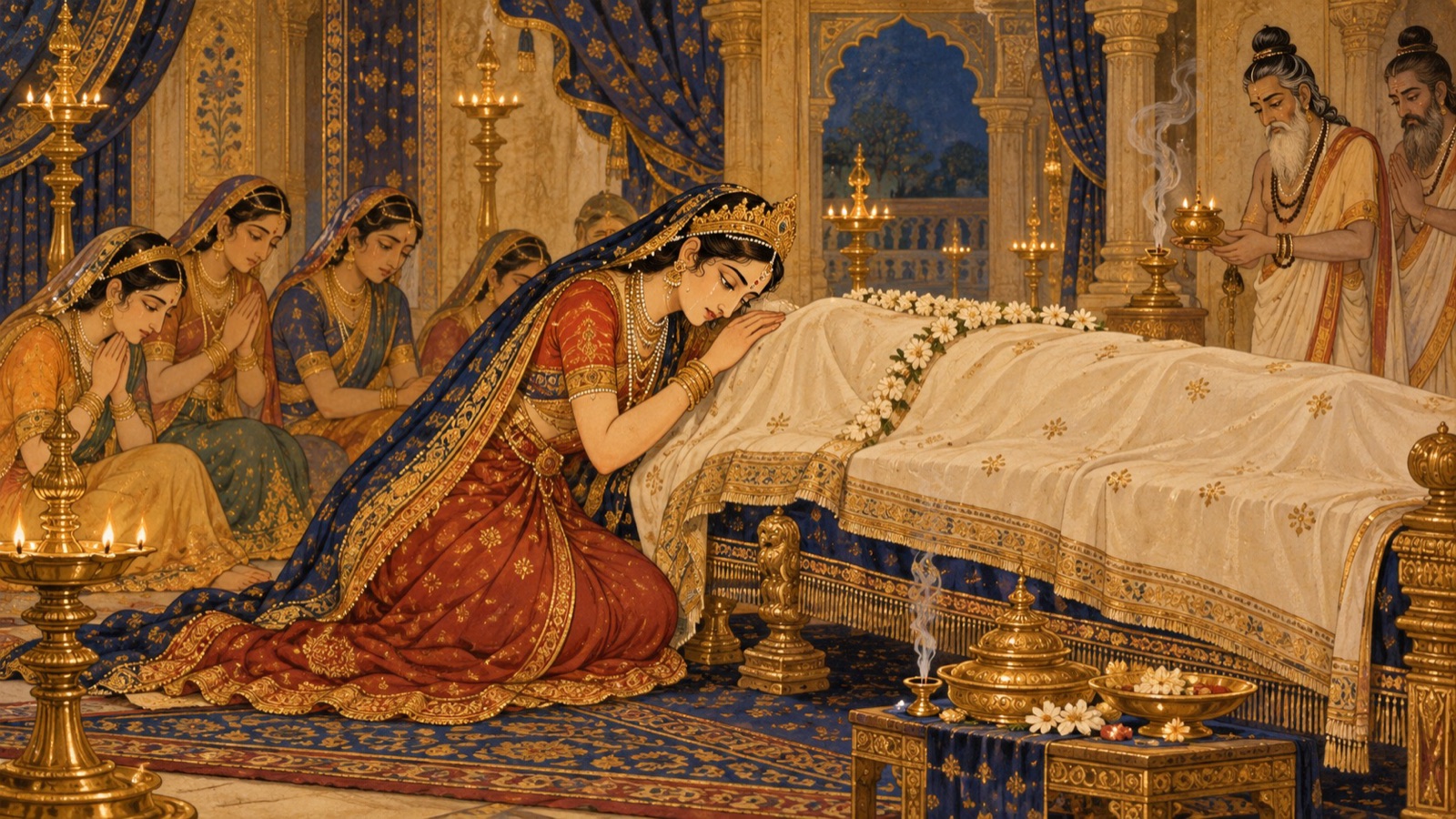
The Churning of Vena’s Body
Soon, however, the land was leaderless once more, and thieves and rogues rose again to plague the people. Seeing this, the sages returned, resolved to draw a worthy ruler from the very line that had failed. With Sunitha’s leave, and by a specific sacred method, they churned the thighs of Vena’s lifeless body — and from that churning there arose a short, dark, dwarfish man.
विनिश्चित्यैवमृषयो विपन्नस्य महीपते: । ममन्थुरूरुं तरसा तत्रासीद्बाहुको नर: ॥ ४३ ॥
viniścityaivam ṛṣayo vipannasya mahīpateḥ mamanthur ūruṁ tarasā tatrāsīd bāhuko naraḥ
Meaning: Having so resolved, the sages churned with force the thighs of the dead king; and there arose from them a dwarfish man. (Canto 4, Chapter 14, verse 43)
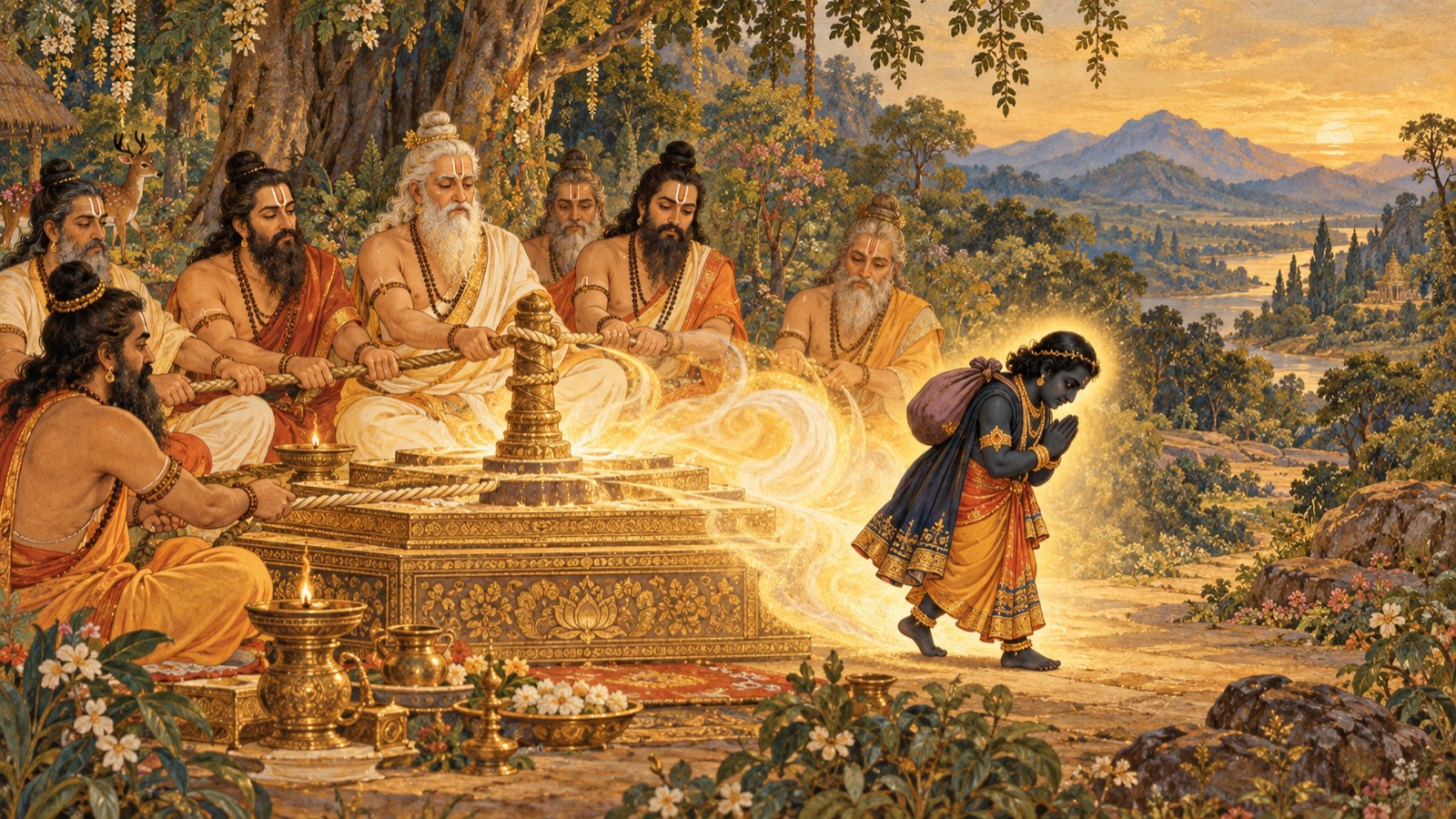
This dark, short-limbed being was, despite his fearsome form, utterly submissive: the instant he was born he bowed low and asked the sages what he should do. “Sit down” (niṣīda), they told him — and from that single word he was named Nishada. At that same moment of his birth he took upon himself all the accumulated sin of Vena, and so the king’s body was cleansed of its evil. From him descend the Naishadas, who dwell in the hills and forests.
तस्य वंश्यास्तु नैषादा गिरिकाननगोचरा: । येनाहरज्जायमानो वेनकल्मषमुल्बणम् ॥ ४६ ॥
tasya vaṁśyās tu naiṣādā giri-kānana-gocarāḥ yenāharaj jāyamāno vena-kalmaṣam ulbaṇam
Meaning: His descendants, the Naishadas, dwell in the hills and forests; for at his very birth this being took upon himself the grievous sin of Vena. (Canto 4, Chapter 14, verse 46)
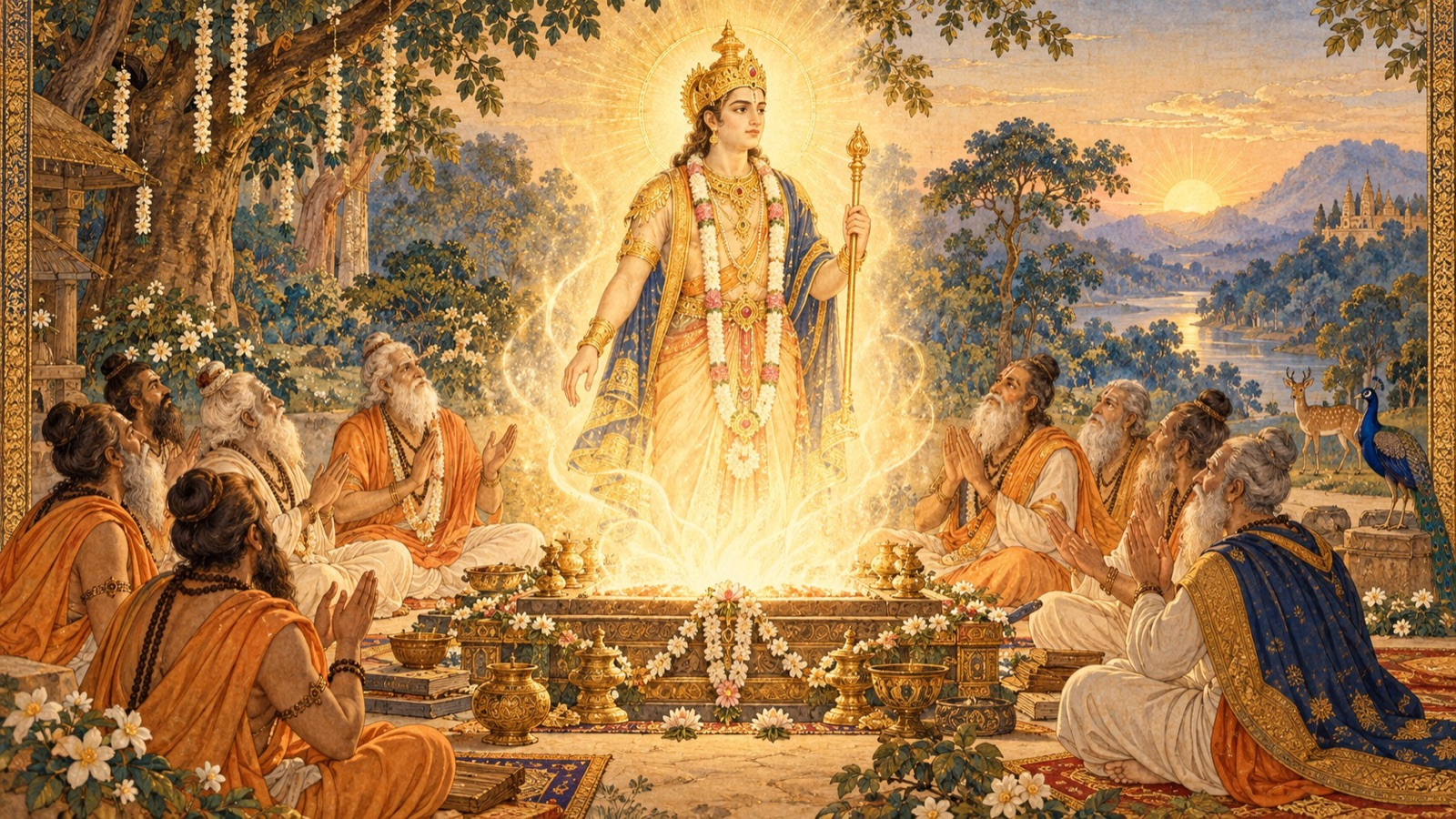
His sin thus borne away, Vena’s body was purified; and the sages, seeing this, prepared to churn the arms of the king, from which a radiant and worthy ruler would arise. So the fourteenth discourse closes on the threshold of that great descent — the coming of King Prithu, which the next chapter unfolds.
Principal Teachings of This Chapter
1. A society without righteous protection turns predatory. The sages’ first fear is that a leaderless people will sink “to the level of beasts.” Order rooted in dharma is not a cage but a shelter that keeps us human (verse 1).
2. Pride is the ruin of the powerful. Vena had real strength, enough to scatter the wicked; but pride turned that strength against the very Lord who gave it. He mistook the portion of divine power lent to him for protection as proof that he was himself the source of all the gods, and so demanded the worship due only to the Lord. What lifts us up can, ungoverned by humility, cast us down — the trustee who forgets he is only a trustee has already begun to fall (verses 15-30).
3. To forbid the worship of God is to cut off the source of every good. Vena banned sacrifice and set himself in the Lord’s place. The sages warn that when the Supreme is pleased nothing is unattainable — and, by implication, that to reject Him is to lose everything at the root (verse 20).
4. The wise correct with patience before they act with firmness. The sages appeal to Vena again and again, exhausting every gentler means, before at last, with grieving hearts, declaring that a man who blasphemes Vishnu himself can no longer be allowed to rule — and ending his reign by the sheer force of sacred sound, without lifting a single weapon. Genuine authority exhausts mercy before it turns to severity (verses 16-32).
5. The Lord draws good even out of disaster. From the ruin of Vena’s very body come both the removal of his sin — borne away by the submissive being named Nishada, whose name itself preserves the sages’ own words, “sit down” — and, soon, a righteous king. No fall is so complete that grace cannot bring some redemption out of it (verses 43-46).
A Devotional Reflection
The story of Vena is uncomfortable, and it is meant to be. Here is a man given real power and real opportunity, born of a sacrifice and enthroned by saints — and he squanders it all through a single, swelling fault: pride. What makes his tale so sobering is that Vena is not a mere monster; he is a cautionary mirror. His error was to take the strength that had been given him and to imagine it was his own, to be worshipped in place of its Giver. That temptation is not confined to kings. Whenever we take the gifts of our life — our talents, our position, even our devotion — and quietly begin to worship them, or ourselves through them, rather than the Lord who bestowed them, we walk a little way down Vena’s road. Yet the chapter does not end in unrelieved darkness. Even from the wreck of so ruined a life, the sages draw out first a cleansing and then the promise of a righteous king. The Lord’s mercy is such that no disaster is entirely without a door. The question the chapter leaves us is a searching one: will we hold the gifts we are given with the humility of Dhruva, who wanted only to remember the Lord — or with the pride of Vena, who wanted to be worshipped in His place?
A Daily Devotional Practice
Today, guard the gate where pride enters. Choose one gift in your life that you are tempted to take credit for — a skill, an achievement, a strength others admire — and consciously return it to its Giver. Hold it before the Lord and say, with a humble heart, “Om Namo Bhagavate Vasudevaya,” acknowledging that whatever good you have flows from Him and is meant for His service, not your own glory. Where Vena said “worship me,” let your day quietly say “I worship You.” And if you notice, even in small things, the wish to be praised in place of God, gently set it down. In returning your gifts to their source, you take the path of the humble devotee and turn away, one step, from the road of Vena.
Conclusion
The fourteenth discourse of Book Four traces the fall of a king who could not tell the gift from the Giver. Installed by the sages to shield a lawless people, Vena grows drunk on his own strength, halts every sacrifice, and claims for himself the worship due to the Lord alone — mistaking the power lent to him for power that was his own. Corrected again and again, and refusing every time, he at last blasphemes Vishnu so openly that the sages, with grieving hearts, silence his reign by the strength of sacred sound alone; his sorrowing mother then preserves his body. Seeking a worthy heir, the sages churn his lifeless form; from it arises the dark, submissive being Nishada, who carries away Vena’s sin, and then, as the body is purified, the promise of a radiant king to come. So the chapter closes on the threshold of King Prithu’s descent — showing that pride ruins even the powerful, yet the Lord’s mercy draws good even out of disaster.
May the divine wisdom of Srimad Bhagavatam awaken pure devotion within our hearts.
Om Namo Bhagavate Vasudevaya.
Jay Shree Madhav.
References and Attribution
- Primary edition: Gita Press, Śrīmad Bhāgavata Mahāpurāṇa (English, complete), Book Four, Discourse 14.
- Series: Srimad Bhagavatam Wisdom · Biswa Sanatan Dharma Seva Trust.
- Presented following the spiritual guidance and recommendation of Pandit Dr. Shri Kashinath Mishra.
This is an original, faithful retelling in the writer’s own words, with brief quoted verses shown in Devanāgarī and transliteration and their meanings given as summaries. It is not a reproduction of any single publisher’s continuous translation or commentary. No affiliation with or endorsement by any publisher is implied.
Jay Shree Madhav