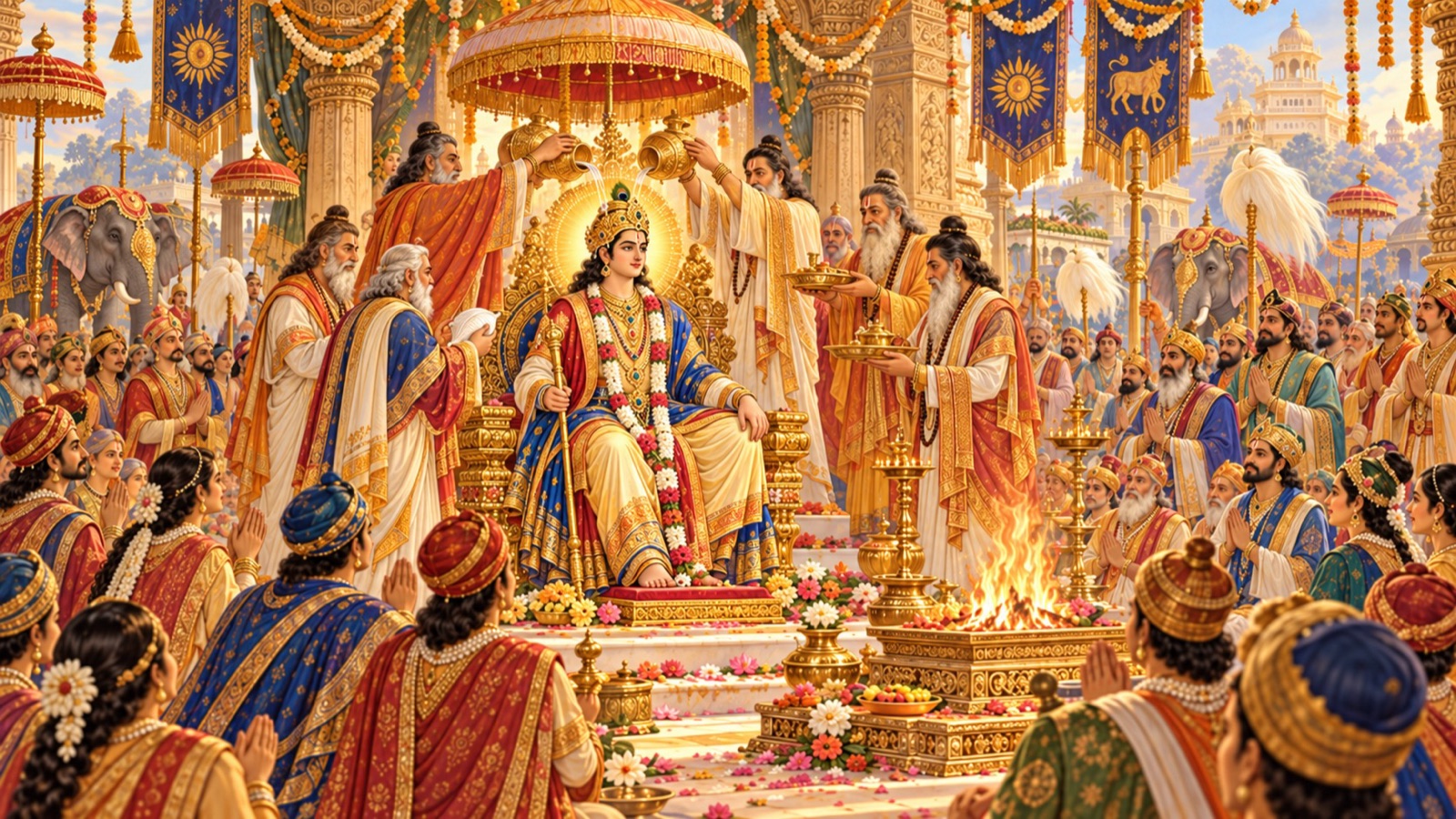
From the ruin of a tyrant’s line, the Lord sends a saviour: the radiant King Prithu, a partial descent of Sri Hari, is crowned emperor amid the joy of sages and people, the earth’s protection restored.
Om Namo Bhagavate Vasudevaya.
Om Namo Bhagavate Vasudevaya.
Om Namo Bhagavate Vasudevaya.
Welcome to Srimad Bhagavatam Wisdom, a devotional journey through the sacred histories and teachings of the Srimad Bhagavat Mahapurana. In the previous chapter, the proud King Vena was undone by his own blasphemy, and the sages, seeking a worthy ruler, churned his lifeless body — first drawing out a dark being who carried away his sin. This fifteenth chapter is the dawn after that long night. From the churning of Vena’s arms there arises a radiant couple: a glorious man, recognized by the sages as a partial descent of Lord Vishnu himself, and a beautiful woman, a portion of the goddess Lakshmi. The sages and people rejoice, knowing that a saviour has come to the troubled world; the man is named Prithu, the woman Archi, who will be his queen. With great ceremony Prithu is crowned the first emperor of the earth, the demigods themselves bestowing divine gifts upon him, and the celestial bards come forward to sing his praises. It is a chapter of relief and rejoicing — the descent of the Lord’s own power to protect the world.
Chapter Information
- Scripture: Śrīmad Bhāgavata Mahāpurāṇa
- Canto: 4 (Book Four)
- Chapter: 15 (Discourse 15)
- Chapter title: The Descent and Coronation of King Prithu
- Principal speaker: The sage Maitreya, continuing his discourse to Vidura (with the words of the sages quoted within)
- Principal listener: Vidura
- Main setting: The kingdom restored, and the coronation hall of King Prithu
- Central subject: The descent of King Prithu and Queen Archi, his recognition as an incarnation of Vishnu, and his coronation as emperor
- Principal verse range: Canto 4, Chapter 15, verses 1–26
- Primary edition: Gita Press Śrīmad Bhāgavata Mahāpurāṇa
Context from the Previous Chapter
Chapter 14 told of the misrule and end of King Vena, and of the churning of his body — from his thighs a dark being who carried away his sin, and then the purified body from which a worthy ruler was to come. This fifteenth chapter opens as the sages churn Vena’s arms, and the promised descent takes place.
The Radiant Descent
As the brahmanas churned the two arms of the sonless, purified body of the departed king, there arose from them a radiant couple — a glorious man and a beautiful woman.
मैत्रेय उवाच अथ तस्य पुनर्विप्रैरपुत्रस्य महीपते: । बाहुभ्यां मथ्यमानाभ्यां मिथुनं समपद्यत ॥ १ ॥
maitreya uvāca atha tasya punar viprair aputrasya mahīpateḥ bāhubhyāṁ mathyamānābhyāṁ mithunaṁ samapadyata
Meaning: Maitreya said: Then, as the priests continued their churning of the departed, sonless king’s two arms, a pair — one man and one woman — emerged. (Canto 4, Chapter 15, verse 1)
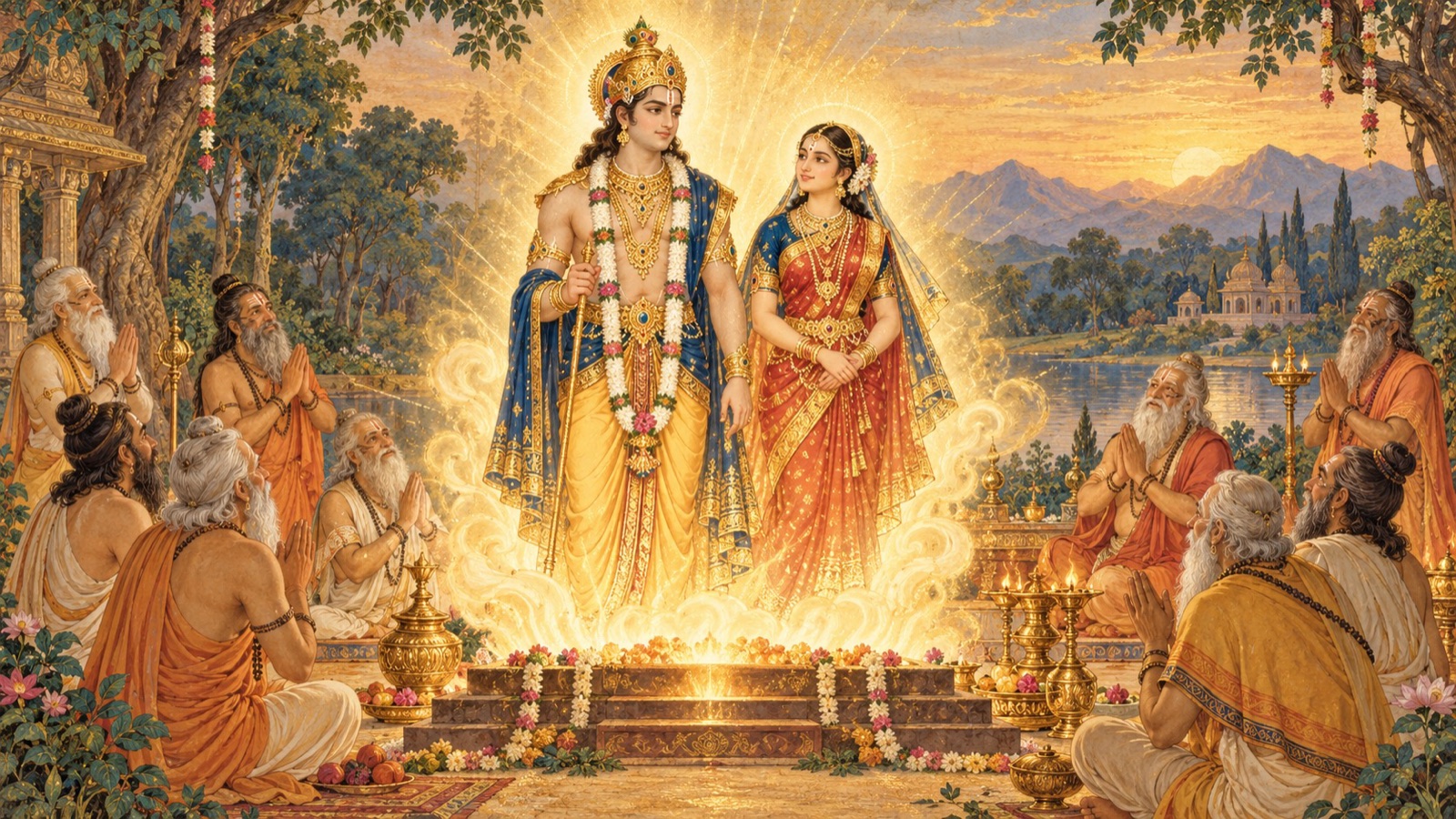
The sages, gazing upon the glorious man, knew him at once for what he was. This, they declared, is a partial manifestation of Lord Vishnu, come to protect the world; and this woman beside him is a portion of the goddess Lakshmi, ever inseparable from the Lord.
ऋषय ऊचु: एष विष्णोर्भगवत: कला भुवनपालिनी । इयं च लक्ष्म्या: सम्भूति: पुरुषस्यानपायिनी ॥ ३ ॥
ṛṣaya ūcuḥ eṣa viṣṇor bhagavataḥ kalā bhuvana-pālinī iyaṁ ca lakṣmyāḥ sambhūtiḥ puruṣasyānapāyinī
Meaning: The sages said: This male is a partial descent of Lord Vishnu, the protector of the world, and this female is a manifestation of Lakshmi, ever inseparable from the Lord. (Canto 4, Chapter 15, verse 3)
Prithu and Archi
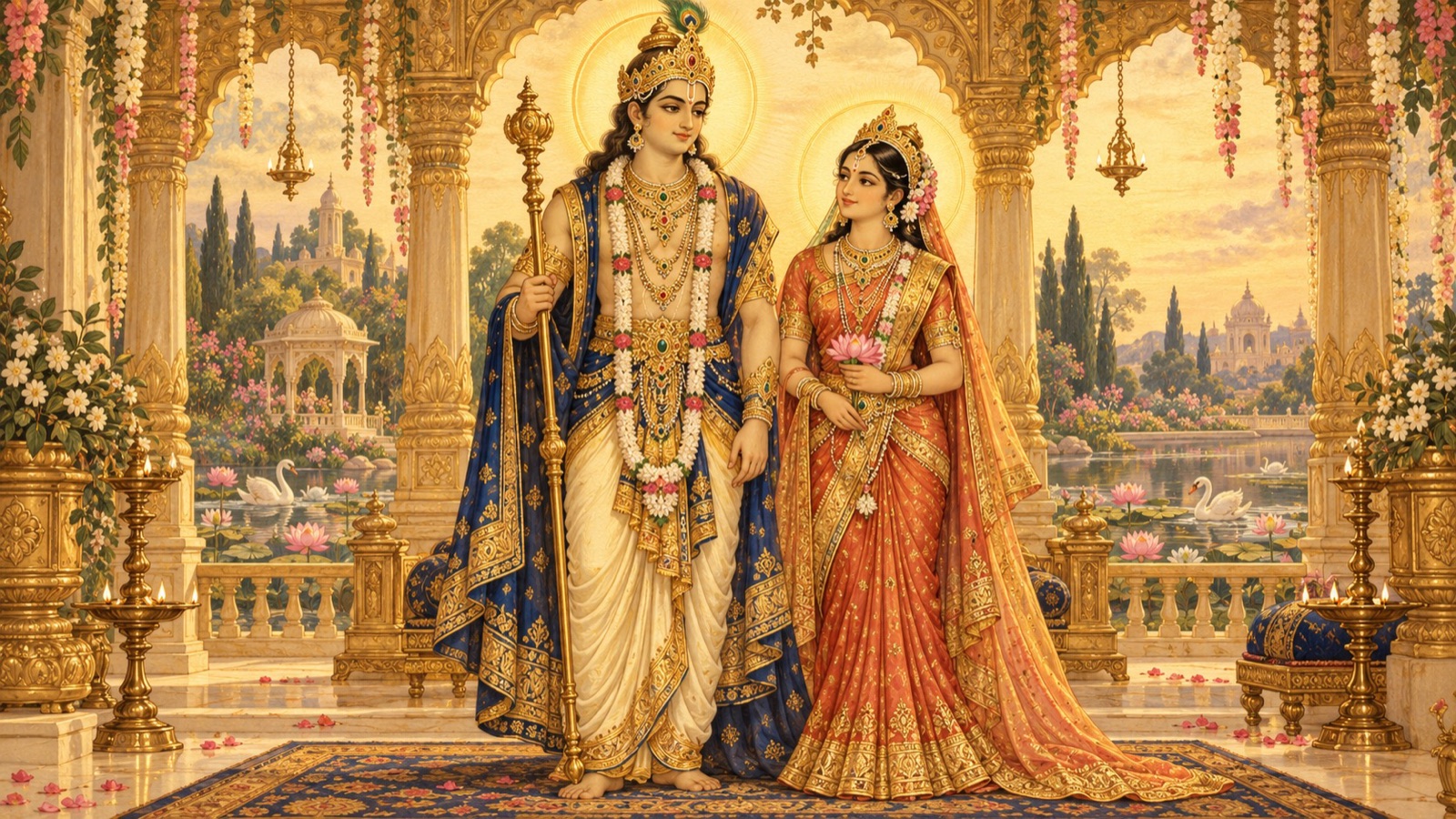
The sages named the glorious man Prithu, foretelling that he would be the foremost of kings and the first of emperors. And the lovely woman — whose very virtues adorned the ornaments she wore — they named Archi, declaring that she would become the queen and inseparable companion of Prithu.
इयं च सुदती देवी गुणभूषणभूषणा । अर्चिर्नाम वरारोहा पृथुमेवावरुन्धती ॥ ५ ॥
iyaṁ ca sudatī devī guṇa-bhūṣaṇa-bhūṣaṇā arcir nāma varārohā pṛthum evāvarundhatī
Meaning: This lovely goddess, whose virtues adorn even her ornaments, is named Archi; she will accept Prithu himself as her husband. (Canto 4, Chapter 15, verse 5)
Lord Brahma Confirms the Incarnation
All creation rejoiced: brahmanas and gandharvas sang Prithu’s praises, Siddhas showered flowers, celestial women danced, and conches and drums resounded as sages and forefathers descended from their own planets to witness the moment (verses 7-8). Then Lord Brahma, the guru of all the worlds, arrived with the chief demigods to see for himself what had appeared.
ब्रह्मा जगद्गुरुर्देवै: सहासृत्य सुरेश्वरै: । वैन्यस्य दक्षिणे हस्ते दृष्ट्वा चिह्नं गदाभृत: ॥ ९ ॥ पादयोररविन्दं च तं वै मेने हरे: कलाम् । यस्याप्रतिहतं चक्रमंश: स परमेष्ठिन: ॥ १० ॥
brahmā jagad-gurur devaiḥ sahāsṛtya sureśvaraiḥ vainyasya dakṣiṇe haste dṛṣṭvā cihnaṁ gadābhṛtaḥ
pādayor aravindaṁ ca taṁ vai mene hareḥ kalām yasyāpratihataṁ cakram aṁśaḥ sa parameṣṭhinaḥ
Meaning: Lord Brahma, guru of the universe, arrived with all the demigods and their chiefs; seeing on Prithu’s right hand the mark of Lord Vishnu’s discus, and on the soles of his feet the sign of the lotus, Brahma recognized in him a portion of the Supreme Lord. (Canto 4, Chapter 15, verses 9-10)
This small act of examination carries a large teaching. Brahma does not accept Prithu’s divinity merely on the sages’ word, or because a radiant couple had appeared under extraordinary circumstances — he looks for the specific marks scripture lays down for a true descent of the Lord: the discus on the palm, the lotus on the sole. Even the guru of the universe submits an apparent wonder to this test before the assembly moves to crown Prithu. This is a caution as much as a confirmation: exalted birth, popular acclaim, or a display of power are not, by themselves, proof of divinity, and one who claims to be an avatara without carrying the signs scripture requires is not made holy by the claim alone (verses 9-10).
The Coronation of the Emperor
Then, with great joy and ceremony, the sages, the brahmanas, and the assembled dignitaries crowned Prithu as the emperor of the earth, and all the guardians of the world came to honour him. The rivers, the seas, the mountains, and the directions brought their tribute; and the very demigods bestowed upon him their own divine gifts. Lord Brahma gave him a shield of spiritual knowledge; Sarasvati, a splendid necklace; Lord Vishnu himself, the Sudarshana disc; and the goddess Lakshmi, imperishable fortune.
ब्रह्मा ब्रह्ममयं वर्म भारती हारमुत्तमम् । हरि: सुदर्शनं चक्रं तत्पत्न्यव्याहतां श्रियम् ॥ १६ ॥
brahmā brahmamayaṁ varma bhāratī hāram uttamam hariḥ sudarśanaṁ cakraṁ tat-patny avyāhatāṁ śriyam
Meaning: Brahma gave King Prithu a shield of sacred knowledge; Sarasvati, a splendid necklace; Sri Hari, the Sudarshana disc; and His consort Lakshmi, imperishable fortune. (Canto 4, Chapter 15, verse 16)
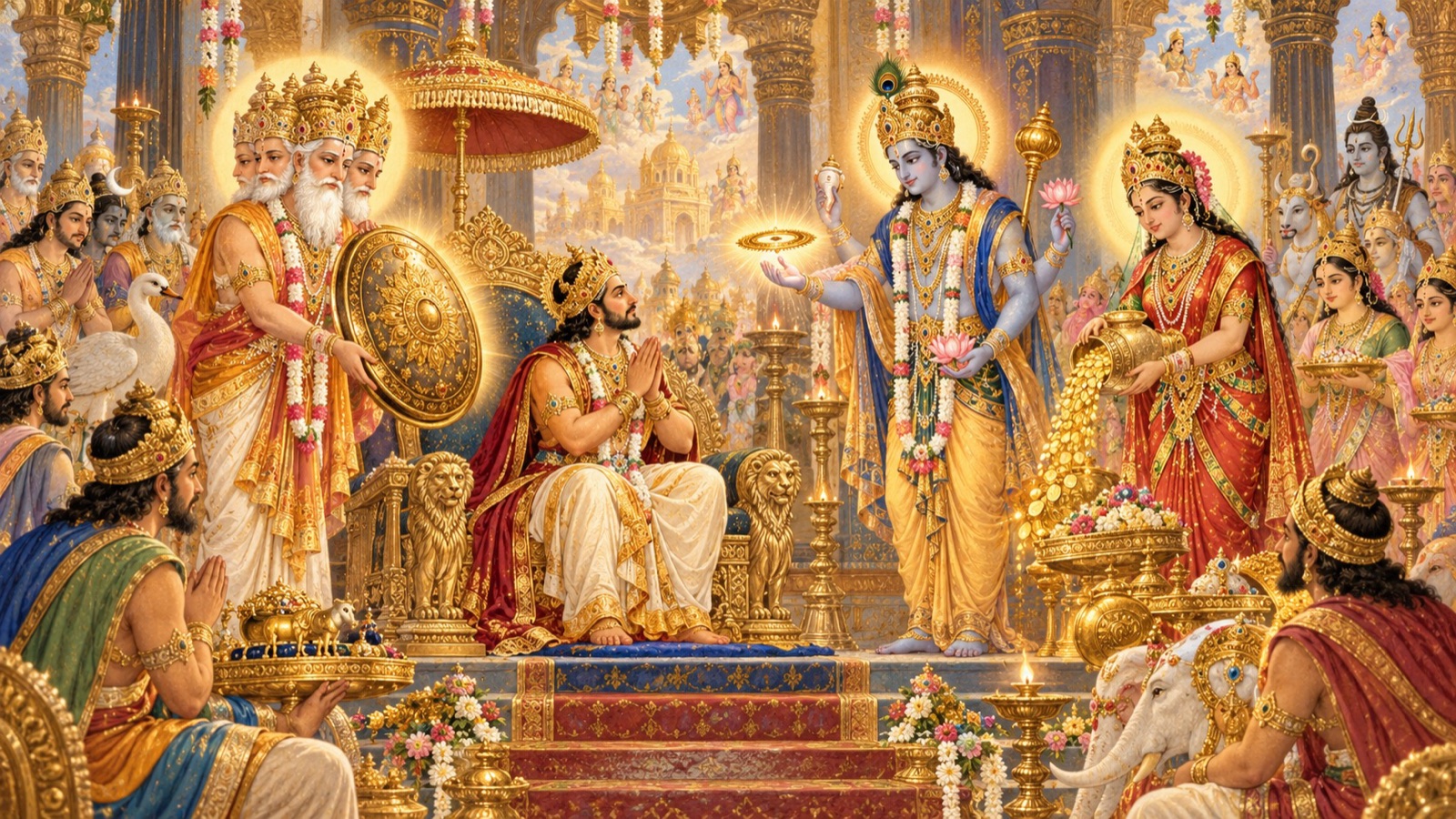
Thus equipped by the gods themselves, and endowed with a portion of the Lord’s own power, Prithu shone as a fit protector of the earth, and the hearts of his people, so long troubled, were filled with hope.
The Bards Come to Praise Him
As the newly crowned emperor sat in his glory, the celestial bards and reciters — the Suta, the Magadha, and the Vandin — came forward to glorify his virtues. Seeing them ready to sing his praises, the mighty Prithu, son of Vena, smiled, and in a voice deep as the rumbling of clouds, he spoke to them.
स्तावकांस्तानभिप्रेत्य पृथुर्वैन्य: प्रतापवान् । मेघनिर्ह्रादया वाचा प्रहसन्निदमब्रवीत् ॥ २१ ॥
stāvakāṁs tān abhipretya pṛthur vainyaḥ pratāpavān megha-nirhrādayā vācā prahasann idam abravīt
Meaning: Beholding the reciters gathered to glorify him, mighty Prithu, son of Vena, broke into a smile and answered them in tones as grave as thunder. (Canto 4, Chapter 15, verse 21)
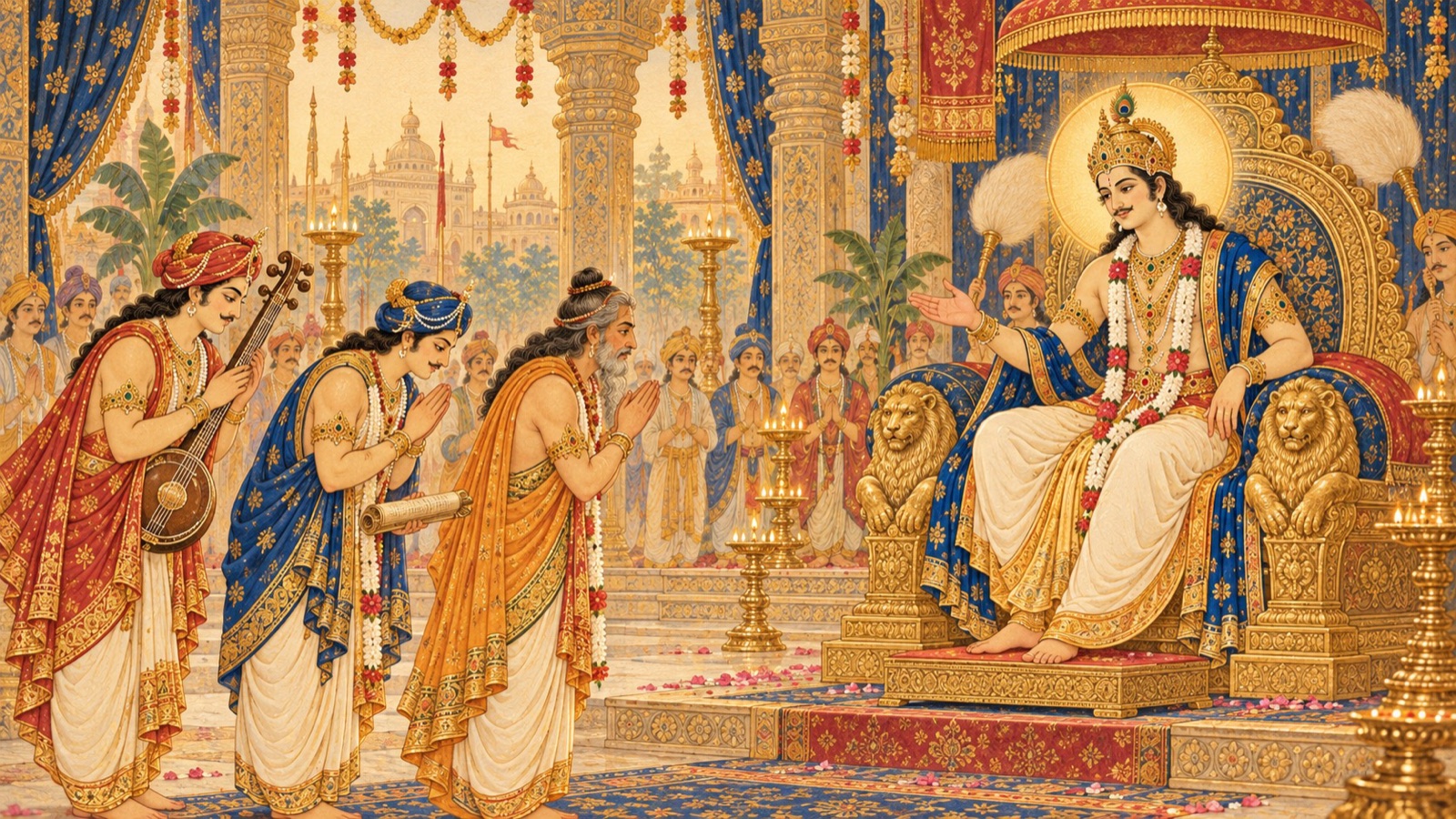
Prithu’s answer was itself a teaching. The noble qualities they described, he told the reciters, were not yet manifest in him, and such praise should wait for one who had truly earned it (verse 22); true devotees never lend the Lord’s own qualities to a man who does not actually possess them (verse 23). To let one’s followers glorify virtues one has not shown, he said, is a subtle deception, and the person who accepts it only insults himself, however sweet it sounds (verse 24). Just as an honourable person takes no pleasure in unjust blame, one who is genuinely great finds none in undeserved praise either (verse 25); freshly crowned, Prithu insisted he had as yet done nothing worth celebrating (verse 26). So the fifteenth discourse closes on the threshold of that glorification, which the next chapter will unfold — the words in which the bards, undeterred, go on to foretell and extol the greatness of the emperor Prithu.
Principal Teachings of This Chapter
1. The Lord descends to protect the world. When misrule had brought the earth to ruin, the Lord sent a portion of Himself as King Prithu. The Supreme does not abandon a suffering world; He comes, in due time, to restore it (verse 3).
2. Grace can arise from the very place of ruin. Prithu descends from the churned body of the wicked Vena. The Lord can bring forth His saviour even out of the wreckage left by pride (verses 1-3).
3. Divine power is given for divine service. Prithu is equipped by the gods with shield, disc, and fortune — not for his own aggrandizement but to protect the world. Every gift of strength is a trust for the good of others (verse 16).
4. The Lord and His fortune are inseparable. Prithu descends together with Archi, a portion of Lakshmi. Where the Lord’s power comes to serve the world, His grace and prosperity come with it (verses 3-5).
5. Divinity is verified, never merely asserted. Before the assembly accepts Prithu as an incarnation, Lord Brahma personally examines the discus-mark on his hand and the lotus-sign on his feet — proof drawn from scripture, not from acclaim or appearance. A wondrous birth or popular praise is not, by itself, evidence of divinity (verses 9-10).
6. True greatness refuses false praise. Newly crowned and divinely equipped, Prithu will not let his reciters glorify virtues he has not yet shown, calling such misplaced praise a quiet insult to the one who accepts it. Real nobility is measured not by the honours received but by the honesty that governs how they are received (verses 21-26).
A Devotional Reflection
There is a deep consolation in the way this chapter answers the darkness of the one before it. Chapter 14 left us with a ruined king and a frightened people; Chapter 15 answers with a descent of the Lord’s own power to set things right. This is the rhythm the Bhagavatam returns to again and again: that no matter how far a world or a soul has fallen, the Lord does not simply look on. In due season He comes — sometimes, as here, drawn out of the very ruin that pride has made. And when He comes, He comes equipped and accompanied: with the shield of knowledge, the disc of protection, and the goddess of fortune at His side, so that what was broken can truly be healed and not merely patched. What moves the heart most, though, is the note on which the chapter ends. Prithu, a descent of the Lord himself, crowned emperor and armed by the gods, refuses to be praised for virtues he has not yet demonstrated. The mightiest figure in the story is also the most humble. It is a quiet reminder that the truest greatness never trades on its own glory, and that even the Lord’s own descent teaches us, first of all, how to be humble.
A Daily Devotional Practice
Today, practice receiving well. Each of us is given gifts — abilities, opportunities, kindnesses — and, like Prithu, we can receive them either as trophies for ourselves or as a trust for the service of others. Bring to mind one gift or advantage you enjoy, and consciously dedicate it, with the words “Om Namo Bhagavate Vasudevaya,” not to your own honour but to the good of those around you and to the Lord’s service, as Prithu received the gods’ gifts to protect the world. And when praise comes your way, take a leaf from the humble emperor: receive it lightly, defer it gently, and turn it back toward the Lord from whom every good gift descends. In receiving with humility and giving in service, you walk in the spirit of the Lord’s own descent.
Conclusion
The fifteenth discourse of Book Four is the dawn after the night of Vena’s misrule. Out of the churned arms of the fallen king a glorious man and a beautiful woman appear, and Lord Brahma himself, examining the marks of the discus and the lotus on his hand and feet, confirms the man to be a partial descent of Lord Vishnu, and the woman a portion of the goddess Lakshmi. The man is named Prithu, foremost of kings, and the woman Archi, who is to be his queen. With great ceremony Prithu is crowned emperor of the earth; the guardians of the world honour him, and the demigods bestow divine gifts — Brahma a shield of sacred knowledge, Sri Hari the Sudarshana disc, and Lakshmi imperishable fortune — equipping him to protect the world. As the celestial bards come to sing his praises, the mighty emperor declines their words as premature flattery, insisting that praise belongs only to qualities actually shown. So the chapter closes on the threshold of that glorification, showing that the Lord’s descent is confirmed by scriptural evidence, not mere acclaim, and that His truest greatness begins in humility.
May the divine wisdom of Srimad Bhagavatam awaken pure devotion within our hearts.
Om Namo Bhagavate Vasudevaya.
Jay Shree Madhav.
References and Attribution
- Primary edition: Gita Press, Śrīmad Bhāgavata Mahāpurāṇa (English, complete), Book Four, Discourse 15.
- Series: Srimad Bhagavatam Wisdom · Biswa Sanatan Dharma Seva Trust.
- Presented following the spiritual guidance and recommendation of Pandit Dr. Shri Kashinath Mishra.
This is an original, faithful retelling in the writer’s own words, with brief quoted verses shown in Devanāgarī and transliteration and their meanings given as summaries. It is not a reproduction of any single publisher’s continuous translation or commentary. No affiliation with or endorsement by any publisher is implied.
Jay Shree Madhav