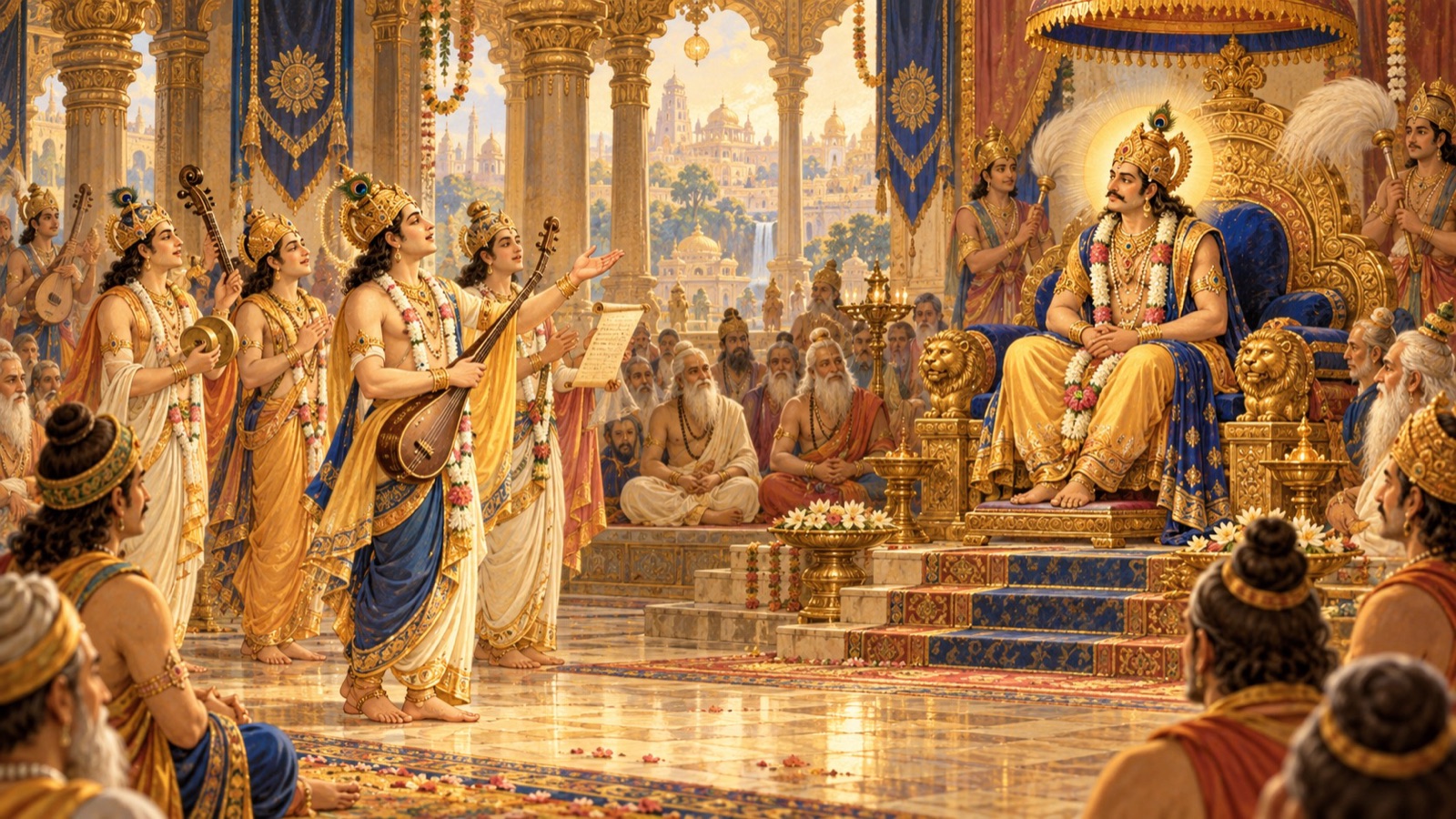
Urged by the sages, the celestial bards lift their voices before the enthroned King Prithu, foretelling the glory of his reign — while the emperor listens not with pride, but with humility.
Om Namo Bhagavate Vasudevaya.
Om Namo Bhagavate Vasudevaya.
Om Namo Bhagavate Vasudevaya.
Welcome to Srimad Bhagavatam Wisdom, a devotional journey through the sacred histories and teachings of the Srimad Bhagavat Mahapurana. In the previous chapter, King Prithu — a partial descent of Lord Vishnu — was crowned emperor of the earth and equipped by the gods, and when the celestial bards came to praise him, he humbly asked them to reserve their praise for deeds truly worthy of it. This sixteenth chapter is their song. Urged by the sages, and inspired to see with prophetic vision the greatness to come, the bards lift their voices and glorify Prithu — as the foremost upholder of dharma, as a protector tolerant as the earth, as the very Lord descended in a portion of His power to relieve the world’s distress, and as a father to his people. Through their praise the whole ideal of a righteous ruler is drawn for us; and through Prithu’s humble listening, the ideal of a soul who is honoured yet not lifted up. It is a chapter of praise that teaches, and of greatness that stays humble.
Chapter Information
- Scripture: Śrīmad Bhāgavata Mahāpurāṇa
- Canto: 4 (Book Four)
- Chapter: 16 (Discourse 16)
- Chapter title: The Glorification of King Prithu by the Bards
- Principal speaker: The sage Maitreya, continuing his discourse to Vidura (with the words of the bards quoted within)
- Principal listener: Vidura
- Main setting: The coronation assembly of King Prithu
- Central subject: The bards’ prophetic glorification of King Prithu’s virtues and reign, and Prithu’s humble reception of it
- Principal verse range: Canto 4, Chapter 16, verses 1–27
- Primary edition: Gita Press Śrīmad Bhāgavata Mahāpurāṇa
Context from the Previous Chapter
Chapter 15 told of the descent of King Prithu and Queen Archi, his recognition as a partial incarnation of Vishnu, and his coronation as emperor with divine gifts. When the celestial bards came forward to praise him, Prithu, with striking humility, asked them to reserve their praise for deeds worthy of it. This sixteenth chapter is the song they then offered — urged on by the sages, who taught them to praise the emperor’s coming glory.
The Bards Begin Their Song
Urged by the sages, the bards began, but first they confessed their own inadequacy before so great a subject. We are not able, they said, to describe your glory — you who, foremost of the divine, have descended by your own power; the deeds of you, born from Vena’s body, would bewilder even the lords of eloquence.
नालं वयं ते महिमानुवर्णने यो देववर्योऽवततार मायया । वेनाङ्गजातस्य च पौरुषाणि ते वाचस्पतीनामपि बभ्रमुर्धिय: ॥ २ ॥
nālaṁ vayaṁ te mahimānuvarṇane yo deva-varyo ’vatatāra māyayā venāṅga-jātasya ca pauruṣāṇi te vācas-patīnām api babhramur dhiyaḥ
Meaning: Foremost among the divine, you have taken this form by your own inconceivable potency; though born through the body of King Vena, your deeds are such that even the wisest of speakers would lose the thread of their own eloquence in trying to recount them. (Canto 4, Chapter 16, verse 2)
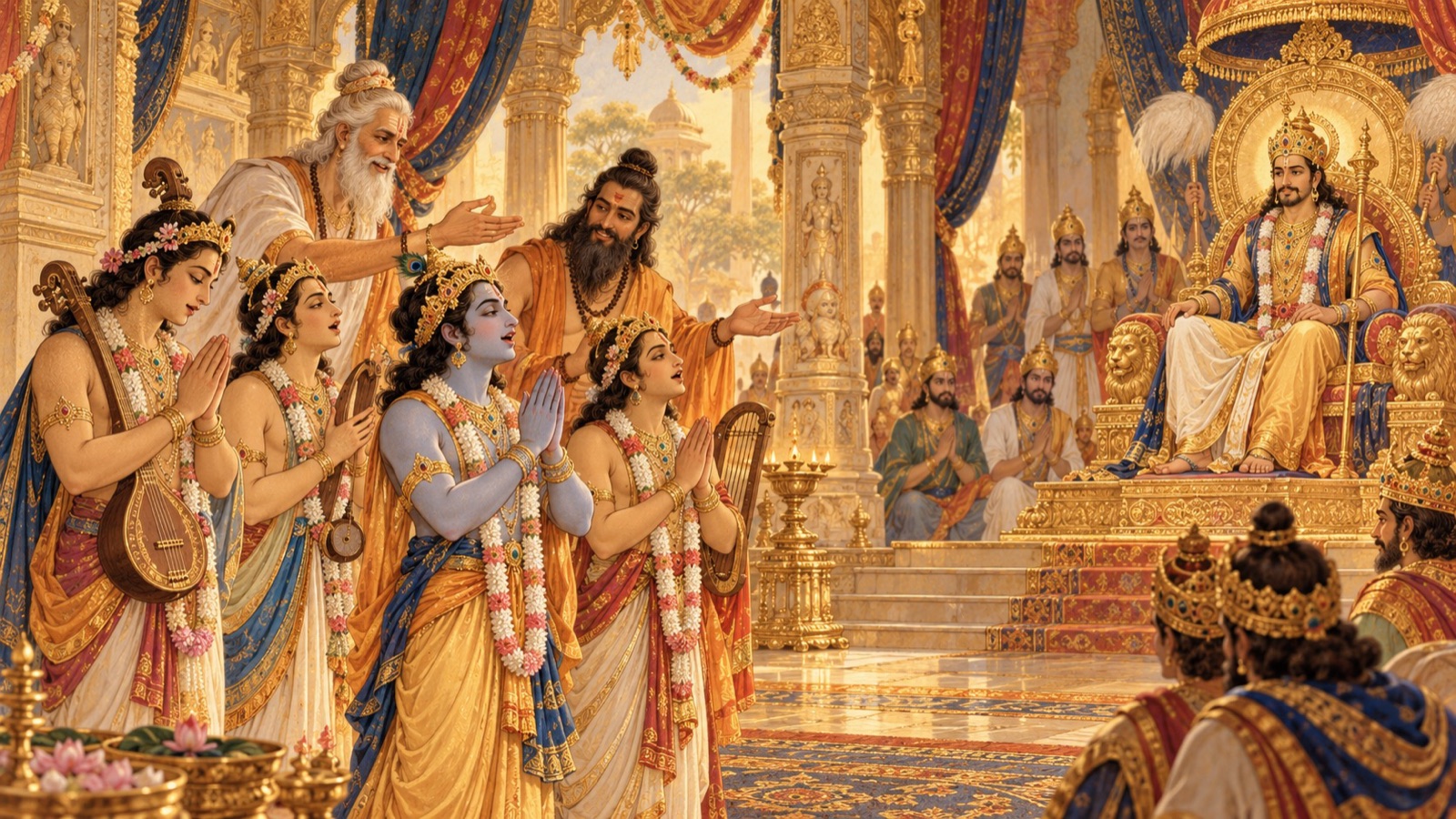
Then, seeing with prophetic vision the deeds that were to come, they foretold the greatness of his reign. This king, they sang, is the foremost of the upholders of dharma; he will lead the whole world in righteousness, guard the very boundaries of sacred law, and chastise those who would break them.
एष धर्मभृतां श्रेष्ठो लोकं धर्मेऽनुवर्तयन् । गोप्ता च धर्मसेतूनां शास्ता तत्परिपन्थिनाम् ॥ ४ ॥
eṣa dharma-bhṛtāṁ śreṣṭho lokaṁ dharme ’nuvartayan goptā ca dharma-setūnāṁ śāstā tat-paripanthinām
Meaning: Foremost among the guardians of righteousness, he will set the whole world upon the path of dharma, keep its sacred boundaries unbroken, and bring correction to those who would tear them down. (Canto 4, Chapter 16, verse 4)
The bards’ vision reached further still: this king, they sang, would sustain every being by manifesting himself through the departmental demigods, uphold the higher worlds through Vedic sacrifice, and nourish the earth with timely rain — taking, like the sun that returns the sea’s water as monsoon, only what he would give back to his citizens in their season of need. (verses 5-6)
The Compassion of a Protector
The bards went on to paint the tenderness of his rule. This king, they sang, will be so forbearing that he will patiently bear even the wrongs of those who trespass against him; ever compassionate to the suffering, he will be as tolerant and sustaining as the earth itself, which bears all who tread upon it.
तितिक्षत्यक्रमं वैन्य उपर्याक्रमतामपि । भूतानां करुण: शश्वदार्तानां क्षितिवृत्तिमान् ॥ ७ ॥
titikṣaty akramaṁ vainya upary ākramatām api bhūtānāṁ karuṇaḥ śaśvad ārtānāṁ kṣiti-vṛttimān
Meaning: Vena’s son will absorb without retaliation even the offenses of those who wrong him; his compassion for the suffering will never waver, and like the earth itself he will carry the weight of all who lean upon him. (Canto 4, Chapter 16, verse 7)
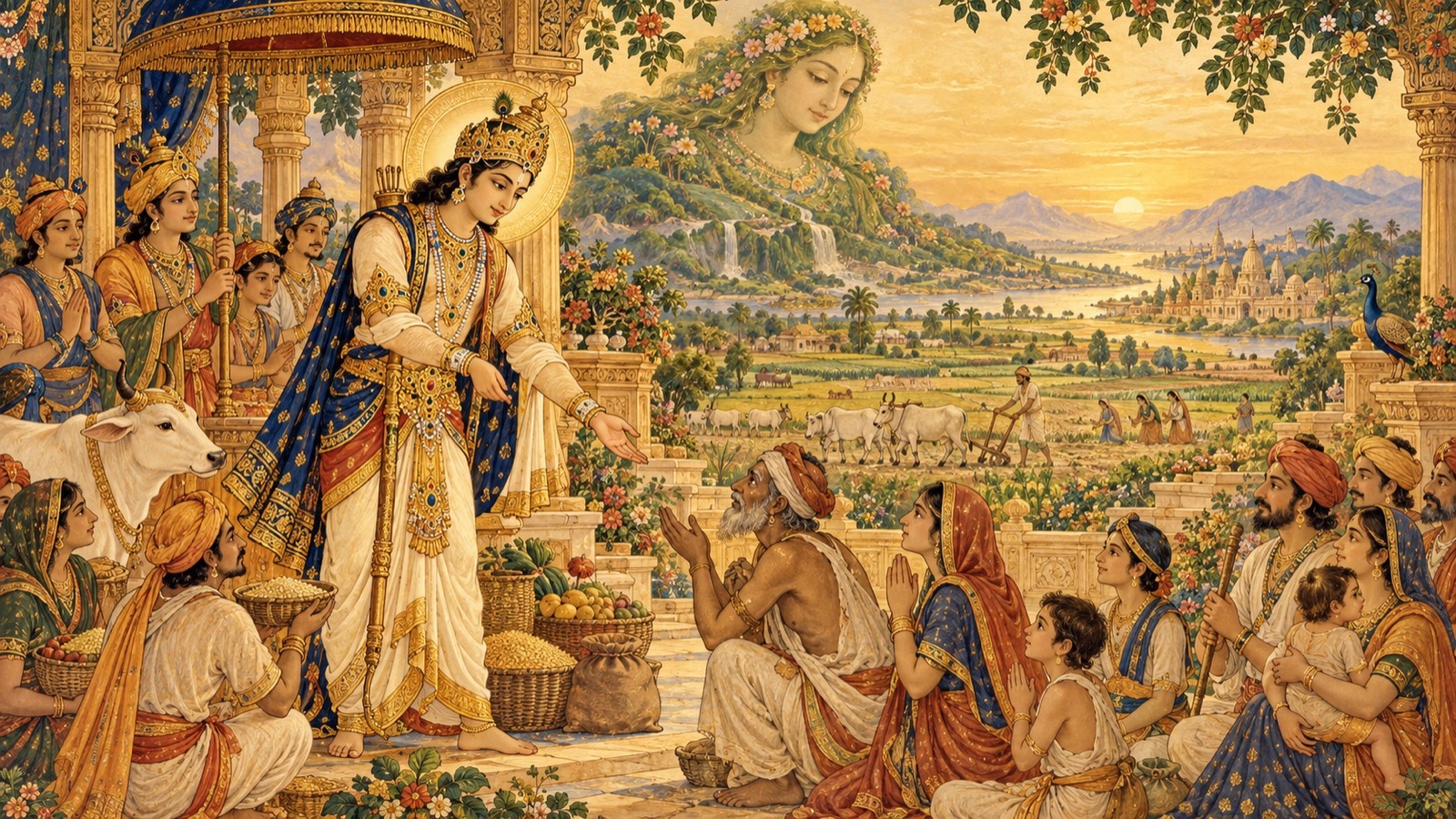
Should even Indra withhold the rains, the bards foretold, this king — himself a portion of the Godhead — would supply them and shield the earth from drought, precisely as the Lord Himself would one day lift Govardhana Hill to shelter Vrindavana’s cowherds from Indra’s flood. (verse 8)
They sang, too, of a whole catalogue of virtues: a moonlike face bringing peace to all who saw it, policies as unfathomable as the ocean that conceals Varuna, a nearness as unapproachable to enemies as fire itself, an impartial vision like the air that touches all yet clings to none, a justice so even-handed that he would punish even his own guilty son while sparing an innocent enemy’s, and a rule spreading like untroubled sunlight to the edge of the Arctic — so pleasing all his citizens that they would gladly embrace him as their own. (verses 9-15)
Yet beneath these royal virtues, the bards sang, lay a deeper character: firm in truth, he would honour the brahminical culture, serve those advanced in age and wisdom, and give shelter to every soul who came to him surrendered.
मातृभक्ति: परस्त्रीषु पत्न्यामर्ध इवात्मन: । प्रजासु पितृवत्स्निग्ध: किङ्करो ब्रह्मवादिनाम् ॥ १७ ॥
mātṛ-bhaktiḥ para-strīṣu patnyām ardha ivātmanaḥ prajāsu pitṛvat snigdhaḥ kiṅkaro brahma-vādinām
Meaning: Honouring every woman but his own wife as a mother, holding his wife as the very other half of himself, loving his citizens as a father loves his children, he would count himself, king though he was, the devoted servant of those who glorify the Lord. (Canto 4, Chapter 16, verse 17)
And he would hold every embodied being as dear as his own self, delighting his friends, keeping company with the liberated, and standing as a firm chastiser of the impious. (verses 16, 18)
The Lord Descended in Him
Rising higher, the bards revealed the deepest truth of who Prithu was. This king, they sang, is verily the Lord himself — master of the three worlds, the changeless Self, descended into the world by a portion of His own power; and in the light of his presence, the diversity that ignorance weaves is seen for the empty thing it is.
अयं तु साक्षाद्भगवांस्त्र्यधीश: कूटस्थ आत्मा कलयावतीर्ण: । यस्मिन्नविद्यारचितं निरर्थकं पश्यन्ति नानात्वमपि प्रतीतम् ॥ १९ ॥
ayaṁ tu sākṣād bhagavāṁs try-adhīśaḥ kūṭa-stha ātmā kalayāvatīrṇaḥ yasminn avidyā-racitaṁ nirarthakaṁ paśyanti nānātvam api pratītam
Meaning: This king is verily the Lord himself, master of the three worlds, the changeless Self, descended by a portion of His power; in whose light the diversity fashioned by ignorance is seen to be empty of meaning. (Canto 4, Chapter 16, verse 19)
Herein lies the deeper reason for such praise: a liberated soul such as this never forgets, even upon a throne, that he is but the eternal servant of the one Supreme Lord, and so the illusions of birth, body and possession that make ordinary souls quarrel over “mine” and “thine” simply do not bind him. Prithu did not cease to rule or to receive the honour paid him; rather, ruling and being honoured, he remained fixed in the knowledge of who he truly was. This, the bards imply, is the secret every descent of the Lord’s power carries: authority does not corrupt one who never forgets he only executes the Lord’s own arrangement.
The Glory of His Reign
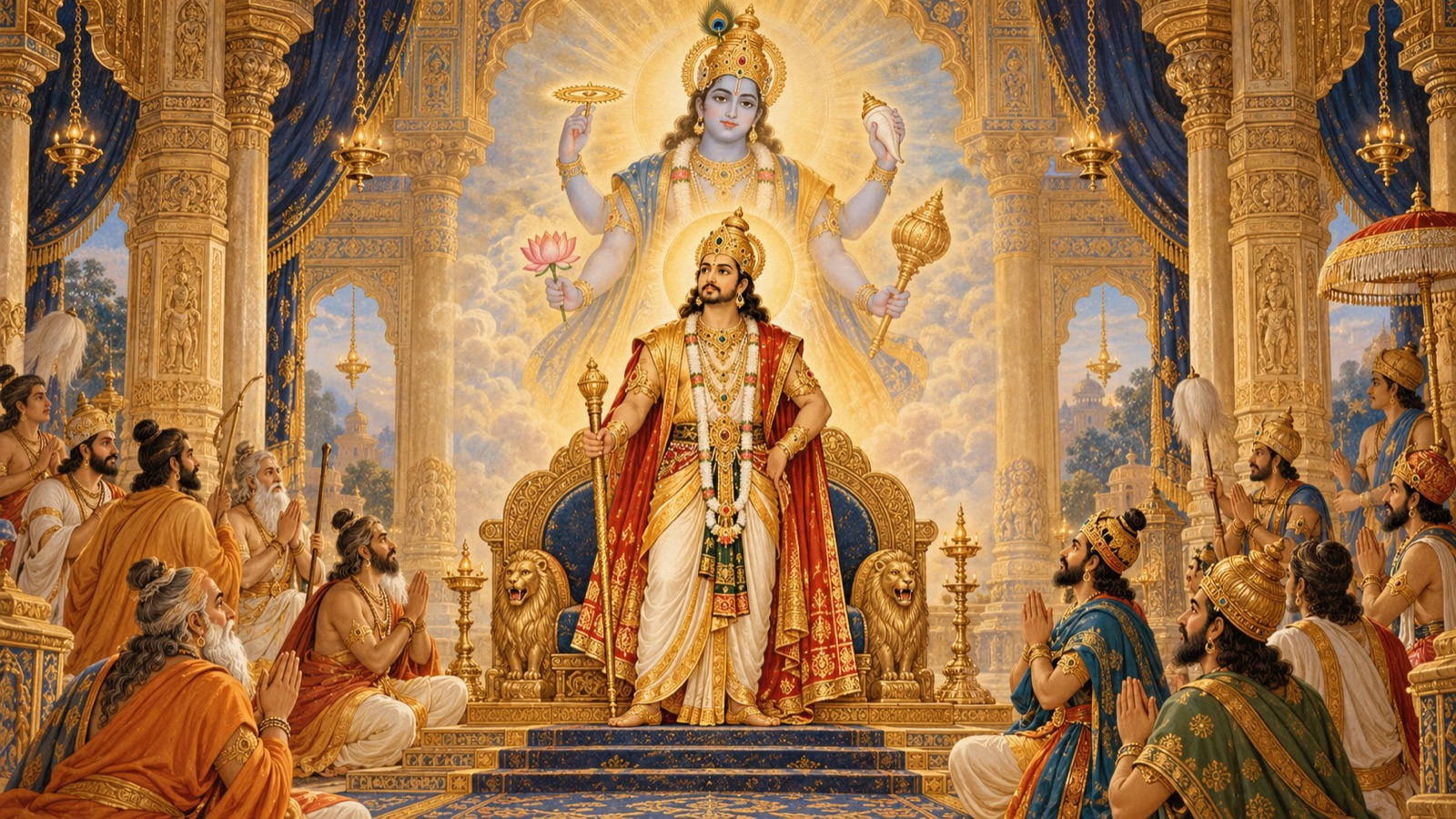
Journeying unrivalled across the earth on his victorious chariot, blazing like the sun in its unhindered orbit, and honoured even by kings and demigods whose queens would sing of him as though he bore Lord Vishnu’s own emblems, this king — the bards foretold — would in time bring about two events of lasting consequence: at the source of the sacred Sarasvati he would perform a hundred great horse-sacrifices, and in the last of these Indra himself, unable to bear such glory, would steal away the sacrificial horse; and in his own palace garden he would be blessed to meet Sanat-kumara, eldest of the four eternal sages, worshipping him with such devotion that he would receive the very instruction by which a soul tastes transcendental bliss. (verses 20-25)
At last they sang of the fullness of his coming reign. Conquering all the directions with his irresistible chariot, uprooting by his own power the sufferings of the world, and glorified by the lords of both gods and demons, this great-souled one would become the true lord of the earth, under whom order, plenty, and righteousness would flourish.
दिशो विजित्याप्रतिरुद्धचक्र: स्वतेजसोत्पाटितलोकशल्य: । सुरासुरेन्द्रैरुपगीयमान- महानुभावो भविता पतिर्भुव: ॥ २७ ॥
diśo vijityāpratiruddha-cakraḥ sva-tejasotpāṭita-loka-śalyaḥ surāsurendrair upagīyamāna- mahānubhāvo bhavitā patir bhuvaḥ
Meaning: Conquering all the directions with his irresistible chariot, uprooting the sufferings of the world by his own power, and glorified by the lords of gods and demons, this great-souled one will become the lord of the earth. (Canto 4, Chapter 16, verse 27)
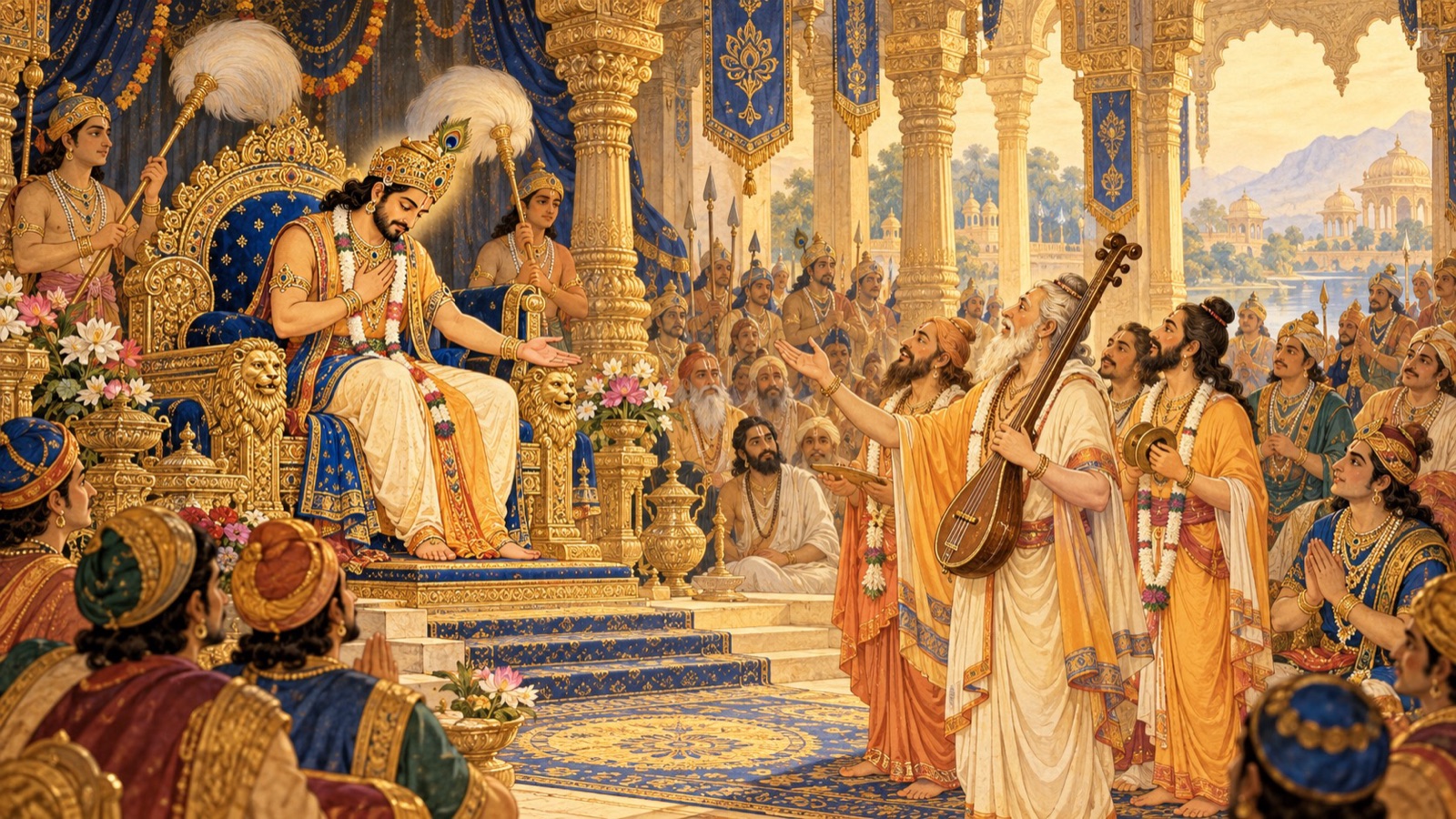
Through all this soaring praise, Prithu listened not with pride but with humility, honouring the bards for their devotion rather than glorying in their words; and the whole assembly, hearing the vision of his reign, looked forward in hope to the age of righteousness he would bring. So the sixteenth discourse closes — with the ideal of a ruler drawn in song, and the emperor who embodies it standing humble beneath his own praise.
Principal Teachings of This Chapter
1. True praise describes an ideal to live up to. The bards do not flatter Prithu; they hold up before him the very virtues a ruler ought to have. Rightly offered, praise is not empty applause but a calling to greatness (verses 4-8).
2. The mark of a protector is forbearance. Prithu is glorified above all for his patience and compassion — as tolerant as the earth, bearing even those who wrong him. Real strength shows itself not in harshness but in mercy (verse 7).
3. Authority is a fatherhood, not a possession. The bards foretell that Prithu will care for his people as a father for his children, and count himself their servant. Power rightly held is a form of love and service, not of ownership (verses 9-18).
4. The Lord himself stands behind righteous power. Prithu is praised as a descent of the Lord, empowered by a portion of the Supreme. All genuine goodness in a leader is, at its root, the Lord’s own goodness working through him (verse 19).
5. Greatness is safest in humble hands. The mightiest figure in the assembly receives the highest praise without being lifted up by it. Humility is the ground that keeps greatness from curdling into pride (verses 20-27).
A Devotional Reflection
This chapter offers us a gentle lesson in how to receive praise — one all the more striking because it is the Lord’s own descent who models it. Prithu is glorified in the highest terms imaginable: as the upholder of all dharma, as the compassionate earth-like protector, as the very Lord in a portion of His power. And he receives it all standing quietly humble, honouring the singers rather than swelling at the song. Set beside the story of Vena a few chapters back — the king who demanded to be worshipped — the contrast is deliberate and searching. Both were kings; both were praised or sought praise; but one grasped at glory and was ruined by it, while the other let glory pass through him back to its true source. That is the whole difference between pride and humility: not whether we are praised, but what we do with the praise. Do we keep it, feeding on it, as Vena did — or do we let it flow through us to the Lord, as Prithu did? The chapter suggests that greatness is not dangerous in itself; it becomes dangerous only when it forgets to be grateful. To be honoured and yet remain humble, to hold every gift as a trust and every praise as a calling — this is the quiet mastery the emperor teaches us.
A Daily Devotional Practice
Today, learn to let praise pass through you. When someone thanks or compliments you — for your work, your kindness, your help — practice receiving it as Prithu did: accept it graciously, honour the giver, but do not keep it for your own glory. Quietly, inwardly, pass it on with the words “Om Namo Bhagavate Vasudevaya,” offering the credit to the Lord from whom your every ability flows. And take the bards’ portrait of the ideal ruler as a mirror for your own small sphere of responsibility — your family, your work, your community: are you patient with those who wrong you, compassionate to the suffering, a servant rather than an owner of whatever you have been given to lead? In receiving praise humbly and holding responsibility as service, you follow the emperor who stayed humble beneath his own glory.
Conclusion
The sixteenth discourse of Book Four is the bards’ song in praise of King Prithu. Urged by the sages, and seeing with prophetic vision the greatness to come, the bards first confess that even the lords of eloquence could not fully describe him, and then glorify his reign — hailing him as dharma’s chief guardian, as a ruler as forbearing and sustaining as the earth, as a father devoted to his people’s welfare, and as the Supreme Lord himself present in a portion of His power to lift the world’s distress. They foretell that, conquering every direction and uprooting the world’s sufferings, he will become the true lord of the earth, glorified by gods and demons alike. Through it all, Prithu listens with humility, honouring the singers rather than taking pride. So the chapter draws for us the whole ideal of a righteous ruler, and shows, in Prithu, the deeper ideal of greatness that stays humble — the very opposite of the pride that ruined Vena.
May the divine wisdom of Srimad Bhagavatam awaken pure devotion within our hearts.
Om Namo Bhagavate Vasudevaya.
Jay Shree Madhav.
References and Attribution
- Primary edition: Gita Press, Śrīmad Bhāgavata Mahāpurāṇa (English, complete), Book Four, Discourse 16.
- Series: Srimad Bhagavatam Wisdom · Biswa Sanatan Dharma Seva Trust.
- Presented following the spiritual guidance and recommendation of Pandit Dr. Shri Kashinath Mishra.
This is an original, faithful retelling in the writer’s own words, with brief quoted verses shown in Devanāgarī and transliteration and their meanings given as summaries. It is not a reproduction of any single publisher’s continuous translation or commentary. No affiliation with or endorsement by any publisher is implied.
Jay Shree Madhav