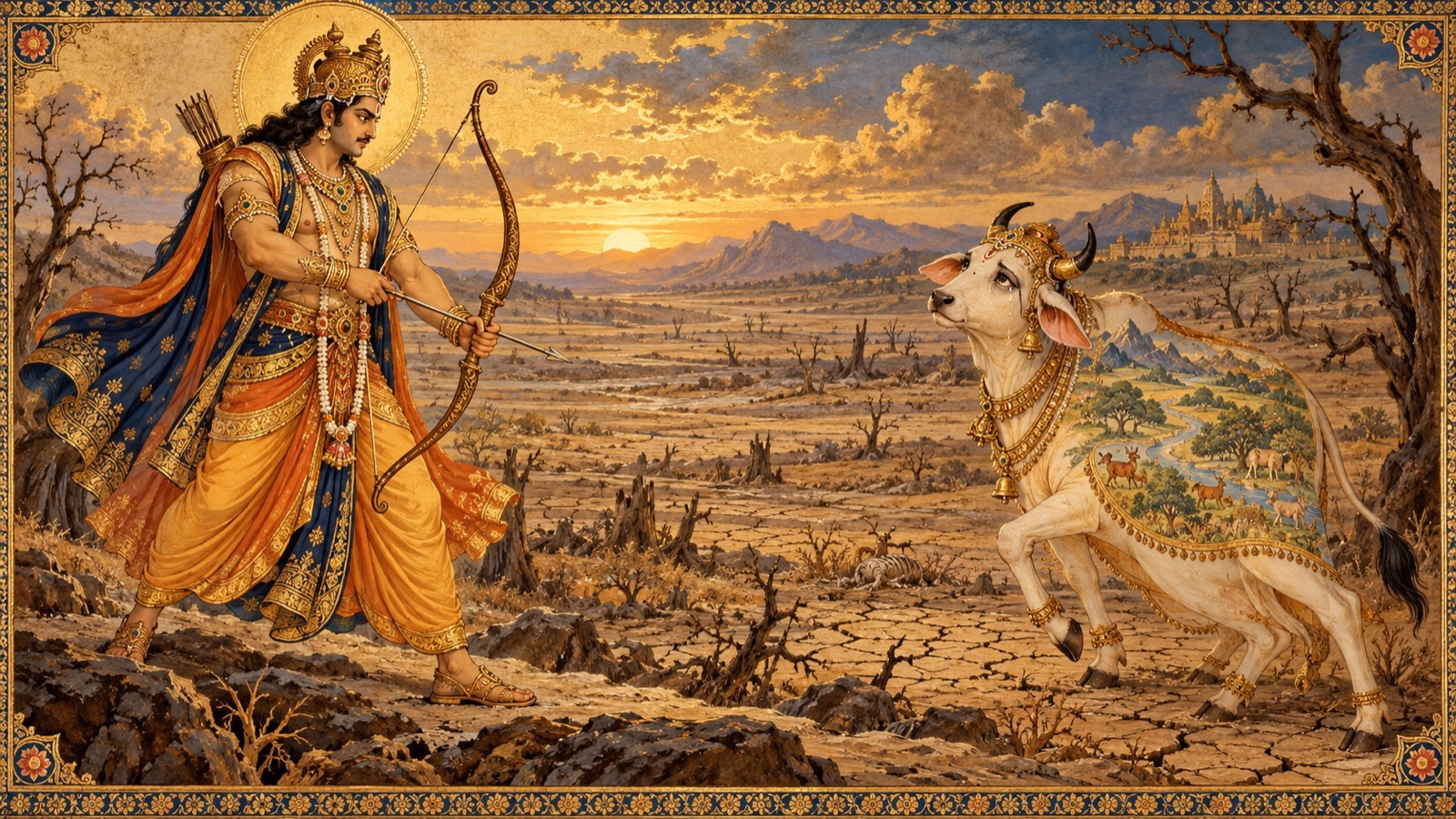
When famine grips his people and the Earth withholds her bounty, King Prithu takes up his bow — and the fleeing Goddess, cornered at last, turns to plead her case before him.
Om Namo Bhagavate Vasudevaya.
Om Namo Bhagavate Vasudevaya.
Om Namo Bhagavate Vasudevaya.
Welcome to Srimad Bhagavatam Wisdom, a devotional journey through the sacred histories and teachings of the Srimad Bhagavat Mahapurana. In the previous chapter, the celestial bards glorified the newly crowned King Prithu, and he received their praise with humility. This seventeenth chapter shows him taking up the hard, practical work of protecting his people. He finds the land barren and his subjects dying of famine, and learns that the Goddess Earth herself has withheld her bounty, locking away within herself the seeds of every herb and grain. Angered on behalf of the starving, Prithu takes up his bow to compel her; and the Earth, fleeing across the worlds in the form of a cow, at last turns to face him, submits, and offers a beautiful prayer — acknowledging his righteousness, confessing why she withdrew her gifts, and promising to yield her sustenance again if only she is given the proper means. It is a chapter about a ruler’s fierce compassion for the hungry, and about the wisdom of the Earth, who yields her wealth not to force alone but to right arrangement.
Chapter Information
- Scripture: Śrīmad Bhāgavata Mahāpurāṇa
- Canto: 4 (Book Four)
- Chapter: 17 (Discourse 17)
- Chapter title: King Prithu’s Anger at the Earth, and Her Prayer of Submission to Him
- Principal speaker: The sage Maitreya, continuing his discourse to Vidura (with the words of Prithu and the Goddess Earth quoted within)
- Principal listener: Vidura
- Main setting: The kingdom of Prithu, stricken by famine
- Central subject: The famine, Prithu’s anger with the Earth, her flight as a cow, and her prayer and submission to him
- Principal verse range: Canto 4, Chapter 17, verses 1–36
- Primary edition: Gita Press Śrīmad Bhāgavata Mahāpurāṇa
Context from the Previous Chapter
Chapter 16 was the bards’ prophetic glorification of King Prithu, which he received with humility rather than pride. This seventeenth chapter turns from praise to action: Prithu, having honoured his ministers and assumed his royal duties, is confronted with a suffering people and must act to protect them — the very role the bards had foretold he would fulfil. Hearing this much from Maitreya, Vidura pressed eagerly for more: how could the Earth take the form of a cow, and how did Prithu — who had himself received transcendental knowledge from the great sage Sanat-kumara — come to milk her? It is to satisfy this eagerness that Maitreya now takes up the story that follows.
The Cry of the Starving
As the celestial bards finished their glorification, Prithu had honoured every rank of his people in turn — priests, ministers, and commonfolk alike — with fitting gifts, and all had gone away well satisfied. It was soon after this, his coronation completed and the brahmanas’ charge to shepherd his people laid upon him, that a terrible famine fell upon the land, for the earth would yield no grain. The people, their bodies wasted with hunger, came before the king and appealed to him.
मैत्रेय उवाच यदाभिषिक्त: पृथुरङ्ग विप्रै- रामन्त्रितो जनतायाश्च पाल: । प्रजा निरन्ने क्षितिपृष्ठ एत्य क्षुत्क्षामदेहा: पतिमभ्यवोचन् ॥ ९ ॥
maitreya uvāca yadābhiṣiktaḥ pṛthur aṅga viprair āmantrito janatāyāś ca pālaḥ prajā niranne kṣiti-pṛṣṭha etya kṣut-kṣāma-dehāḥ patim abhyavocan
Meaning: Maitreya said: When Prithu had been crowned and charged by the brahmanas to protect the people, the citizens, their bodies wasted with hunger and finding no food upon the earth, came to him and spoke. (Canto 4, Chapter 17, verse 9)
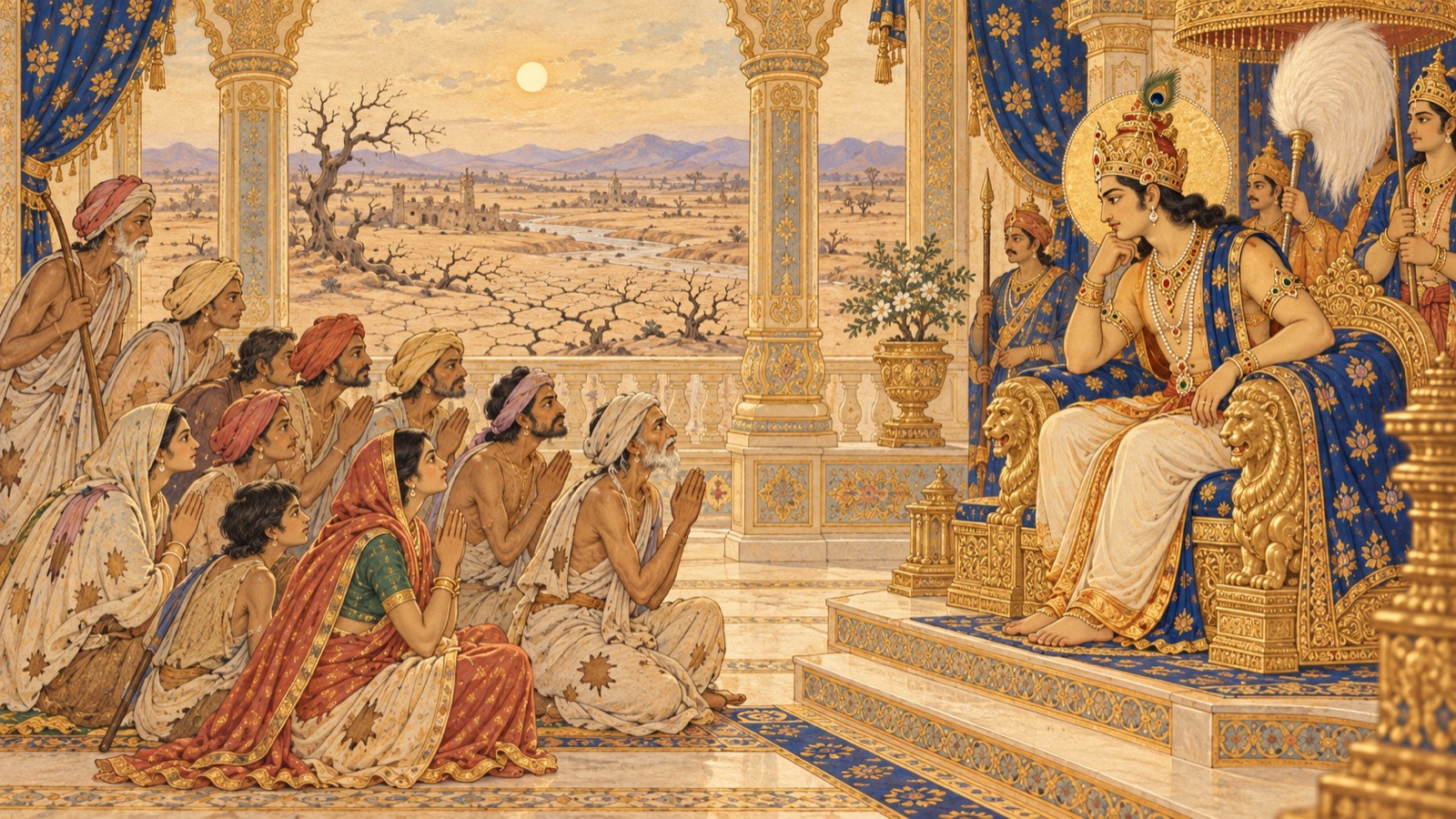
They begged the king, as their appointed protector, to save them, for hunger was consuming them like a fire. Prithu heard their cry, and, after long reflection, understood the cause: the Goddess Earth had withheld her bounty, drawing back into herself the seeds of every plant, so that nothing would grow.
The King’s Anger
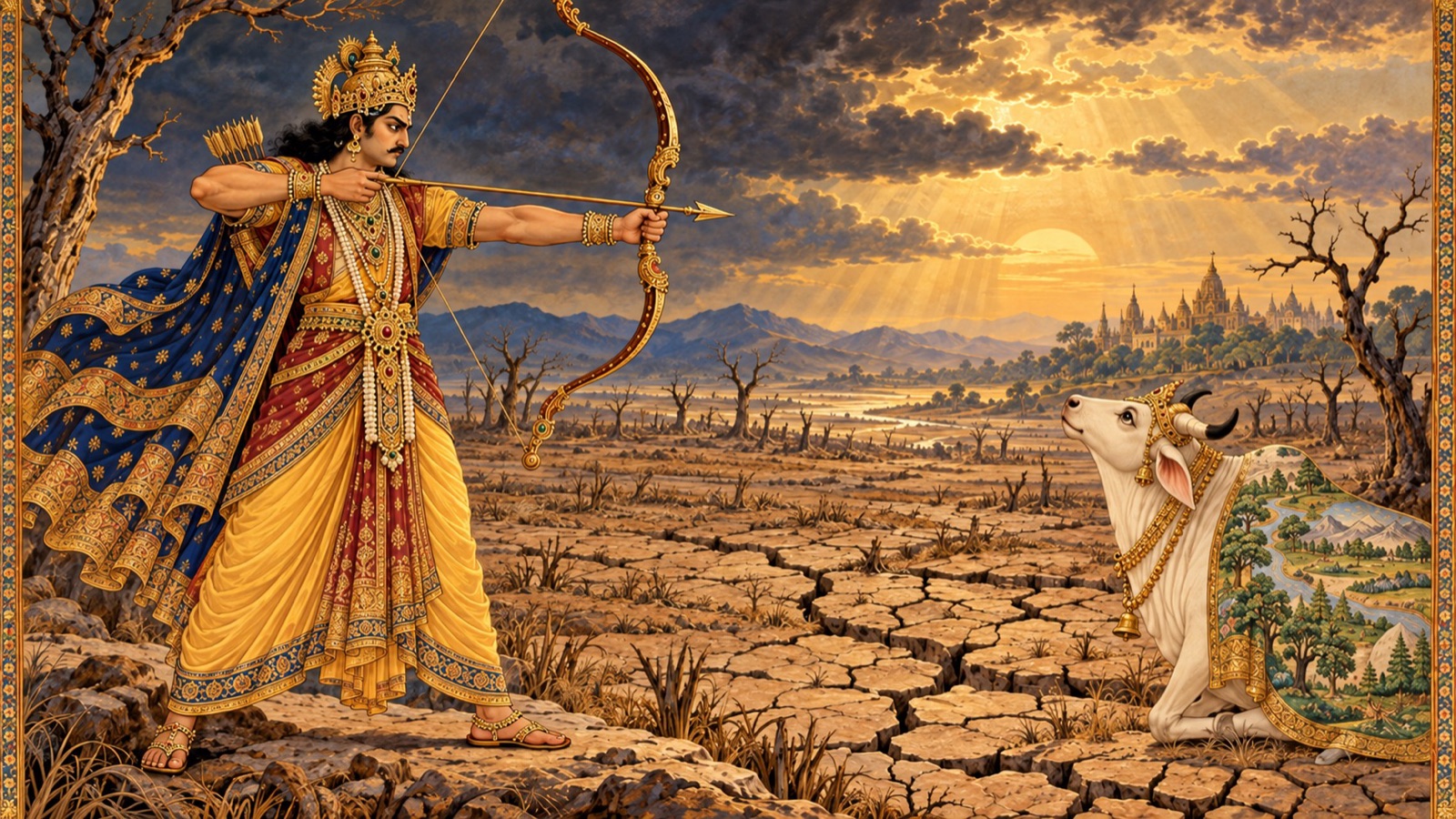
For the sake of his starving people, Prithu grew angry with the Earth for withholding her bounty. Resolved to compel her, he took up his great bow and fitted an arrow to it, exactly like Lord Shiva, who takes up his bow to destroy the world in his fury.
The Earth Flees as a Cow
Seeing the king’s bow bent toward her, the Goddess Earth was overcome with terror. She took the form of a cow and fled, running in fear across the heavens and every direction; his eyes red with rage, Prithu strung his arrow and chased her wherever she went, and in all the worlds she found no refuge from him.
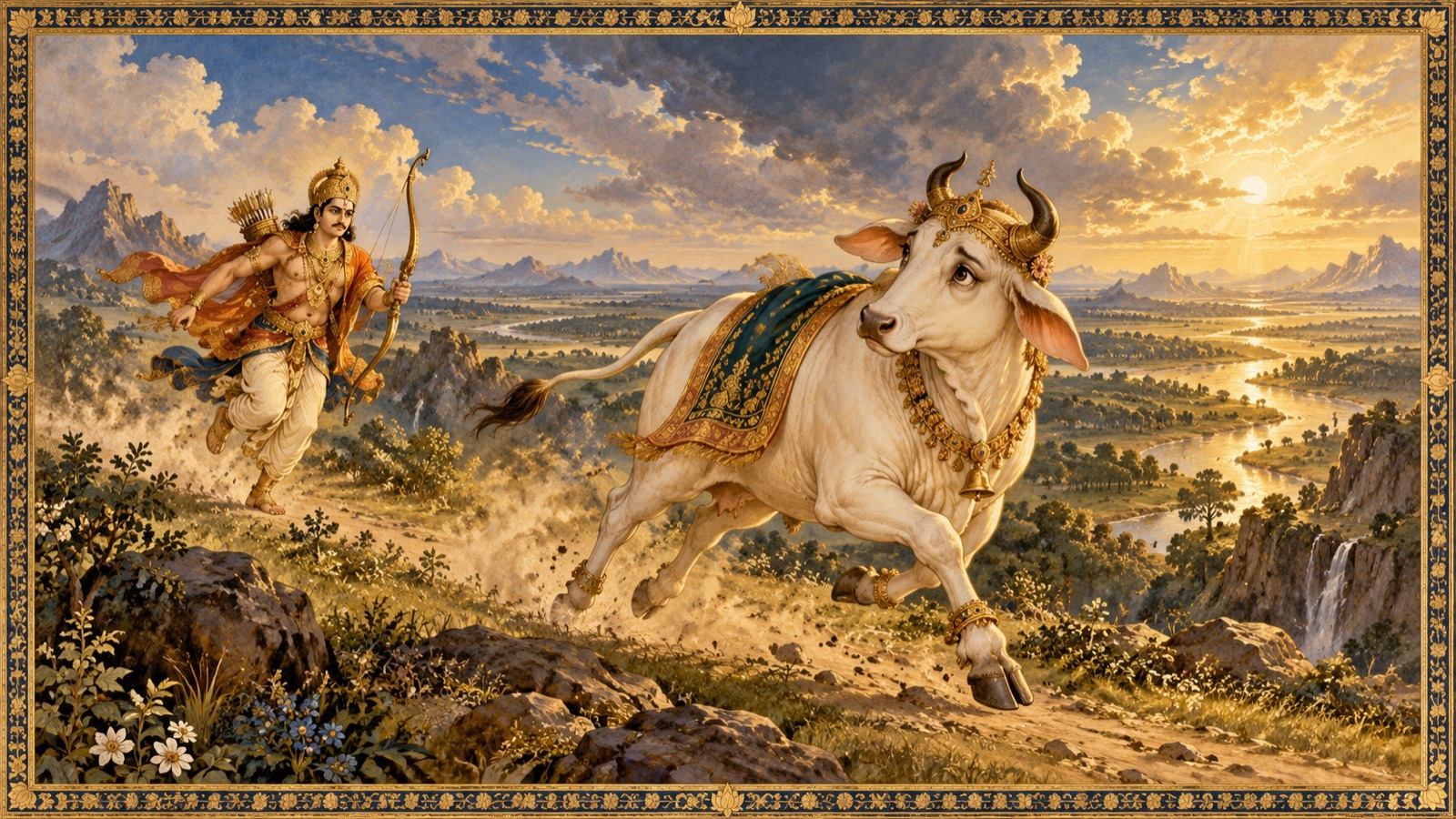
Cornered at last, the trembling cow turned back and pleaded for her life. She was innocent of any wrong, she said, only a poor woman seeking shelter — how could the very knower of dharma, sworn to protect the surrendered, wish to slay her? Even a sinful woman, she reminded him, does not deserve a raised hand; and besides, she was like a great vessel bearing up the whole world, so that if he broke her to pieces, he and his subjects alike would have nowhere left to stand (verses 18-21).
Prithu was unmoved by her plea.
पृथुरुवाच वसुधे त्वां वधिष्यामि मच्छासनपराङ्मुखीम् । भागं बर्हिषि या वृङ्क्ते न तनोति च नो वसु ॥ २२ ॥
pṛthur uvāca vasudhe tvāṁ vadhiṣyāmi mac-chāsana-parāṅ-mukhīm bhāgaṁ barhiṣi yā vṛṅkte na tanoti ca no vasu
Meaning: Prithu said: O Earth, I shall strike you down — you who turn from my command, who take your share at the sacrifice yet yield us no produce. (Canto 4, Chapter 17, verse 22)
He rebuked her further: that, dull of wit, she defied him and would not release the seeds of herbs and grains created of old by Brahma and now locked away within her.
त्वं खल्वोषधिबीजानि प्राक् सृष्टानि स्वयम्भुवा । न मुञ्चस्यात्मरुद्धानि मामवज्ञाय मन्दधी: ॥ २४ ॥
tvaṁ khalv oṣadhi-bījāni prāk sṛṣṭāni svayambhuvā na muñcasy ātma-ruddhāni mām avajñāya manda-dhīḥ
Meaning: Dull of wit, you defy me and will not release the seeds of herbs and grains, created of old by Brahma and now locked within yourself. (Canto 4, Chapter 17, verse 24)
Nor did his rebuke end there: he vowed to cut her to pieces with his arrows and feed her flesh to his starving citizens, declaring that anyone — however protected by rank or form — who hoards for personal gain and shows no compassion for suffering beings may justly be struck down by a king, and such a killing is no true killing at all; and he had no need of her help besides, for he could sustain every living being by his own God-given power (verses 25-27). At this his fury reached its height, his whole being blazing like Yamaraja, the lord of death himself, and the Earth, trembling before him, at last surrendered completely and folded her hands to pray.
The Earth’s Prayer
At last, finding no escape and no protector but the very king she had wronged, the trembling cow-Earth turned to face Prithu, and, recognizing in him the power of the Supreme Lord himself, she folded her heart in humility and began to pray. She bowed to the supreme Person, the ordainer, who through His own powers — of substance, action, agency, and consciousness — sets in motion the creation and dissolution of the world, unfurling His power and withdrawing it at will.
सर्गादि योऽस्यानुरुणद्धि शक्तिभि- र्द्रव्यक्रियाकारकचेतनात्मभि: । तस्मै समुन्नद्धनिरुद्धशक्तये नम: परस्मै पुरुषाय वेधसे ॥ ३३ ॥
sargādi yo ’syānuruṇaddhi śaktibhir dravya-kriyā-kāraka-cetanātmabhiḥ tasmai samunnaddha-niruddha-śaktaye namaḥ parasmai puruṣāya vedhase
Meaning: (The Earth prayed:) To Him who, through His powers of substance, action, agency, and consciousness, governs the creation and dissolution of this world, whose power is now unfurled and now withdrawn — to that supreme Person, the ordainer, I bow. (Canto 4, Chapter 17, verse 33)
She recalled, too, a deeper wonder from her own history with Him. Ages before, when she lay drowned in the cosmic waters, this same Lord had descended as the mighty Boar and lifted her up on his tusks, so that His very name was sung ever after as Dharadhara, Bearer of the Earth — yet now, in the form of this hero-king, He stood ready to cut her to pieces with His arrows. To eyes clouded by matter this looks like sheer contradiction, rescuer turned destroyer; but the Earth understood that no single act of the Lord, or of one He empowers, ever stands alone. Each is a thread in one unbroken, benevolent design, so that even His seeming severity is only another face of the very providence that once lifted her from the deep (verses 34-35).
She confessed that beings such as herself, their minds bewildered by the play of the Lord’s own qualities, cannot fathom the doings of the mighty, and she bowed to those whose deeds spread abroad a heroic glory.
नूनं जनैरीहितमीश्वराणा- मस्मद्विधैस्तद्गुणसर्गमायया । न ज्ञायते मोहितचित्तवर्त्मभि- स्तेभ्यो नमो वीरयशस्करेभ्य: ॥ ३६ ॥
nūnaṁ janair īhitam īśvarāṇām asmad-vidhais tad-guṇa-sarga-māyayā na jñāyate mohita-citta-vartmabhis tebhyo namo vīra-yaśas-karebhyaḥ
Meaning: Truly, beings like me, our minds bewildered by the play of the Lord’s qualities, cannot understand the doings of the mighty; to those whose deeds spread abroad a heroic glory, I offer my salutations. (Canto 4, Chapter 17, verse 36)
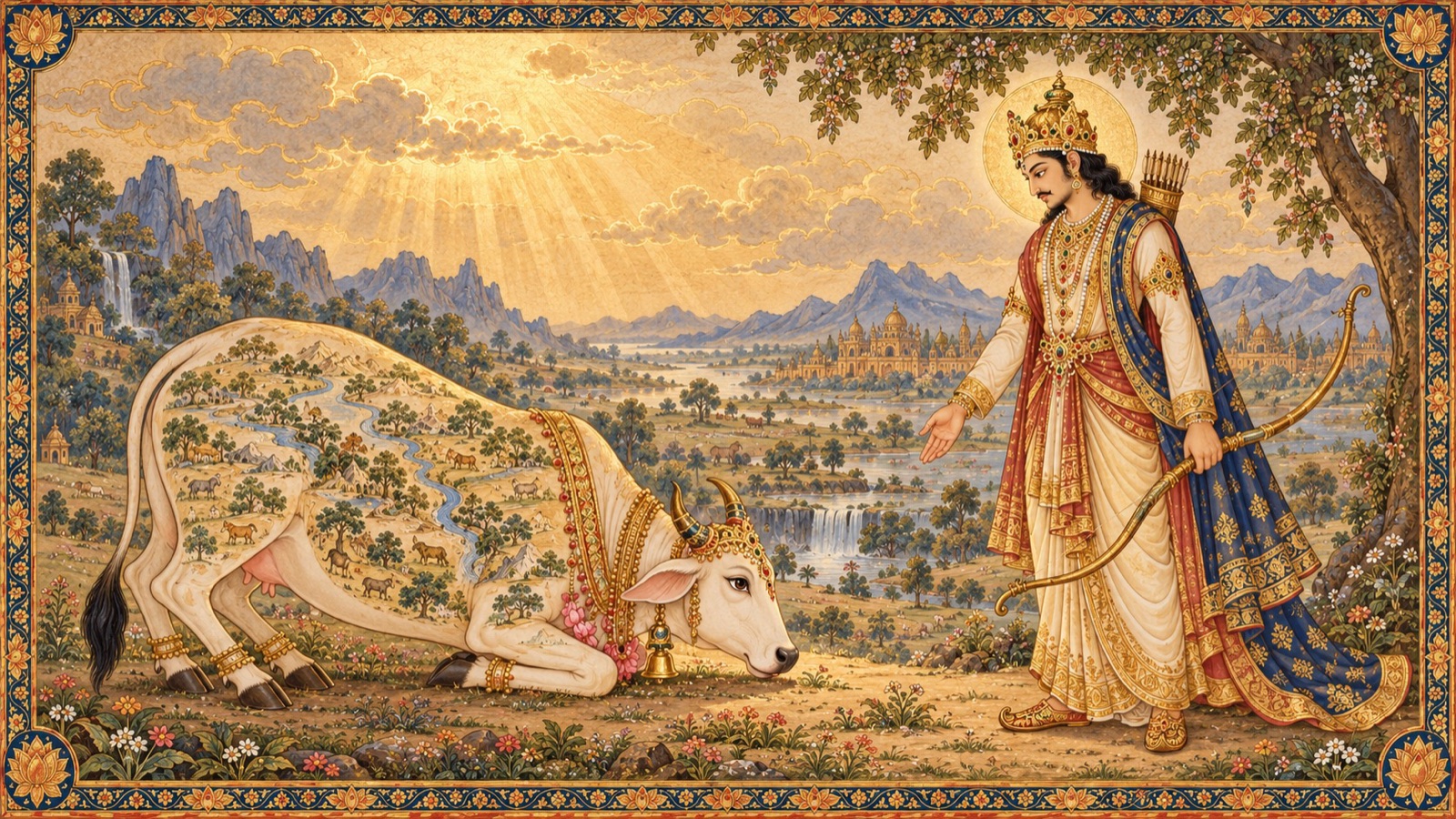
Having thus glorified him, the Earth prepared to lay her case before the king — to confess why she had withheld her gifts, and to offer to yield her wealth once more if only she were given the proper means. So the seventeenth discourse closes on the threshold of that reconciliation, which the next chapter will complete, when Prithu learns to draw the Earth’s bounty not by force but by right arrangement.
Principal Teachings of This Chapter
1. A true ruler’s anger is roused for the suffering, not for himself. Prithu’s wrath rises not at an insult to his pride but at the hunger of his people. Righteous anger is the servant of compassion, never of ego (verses 9-22).
2. Provision withheld is a summons to responsibility. The famine is not blind misfortune; the Earth has withdrawn her bounty for a reason. When the flow of blessings stops, it may be a call to examine how they are being used (verse 24).
3. Even the Earth submits to righteous authority. The Goddess Earth flees the king’s power, pleads for mercy, and still finds no refuge until she bows to him completely. Rightful, God-empowered authority is not to be defied (verses 14-28).
4. The wise turn to prayer when they can no longer flee. Cornered, the Earth does not despair but praises the Lord she sees in the king. When escape fails, surrender and prayer open the only true way forward (verses 33-36).
5. The mightiest deeds are beyond our understanding. The Earth confesses that beings bewildered by Maya cannot fathom the doings of the Lord’s empowered ones. Humility before what we cannot comprehend is itself a form of wisdom (verse 36).
A Devotional Reflection
It can be startling to see the gentle, humble Prithu of the last chapter take up his bow in anger here. But the two portraits belong together, and their union is the whole point. The same king who would not accept undeserved praise will not accept the undeserved suffering of his people either; his humility toward himself and his fierceness on their behalf spring from one root — a heart that is not centred on itself. This is the shape of holy anger, so rare and so easily counterfeited. Most of our anger flares for our own sake: our slighted pride, our thwarted will. Prithu’s flares for the hungry, and the moment the Earth submits and offers a way forward, his bow is ready to be lowered. There is a further beauty in how the chapter ends. The Earth is not simply overpowered; she is brought to prayer, and in her prayer she confesses that the deeds of the Lord’s empowered ones are beyond her understanding. Sometimes we, too, meet a force in our lives we cannot flee or fathom — and the chapter quietly counsels that the wise response is not endless running, but the turning of the heart to praise, trusting that what we cannot understand is nonetheless in righteous hands.
A Daily Devotional Practice
Today, examine your anger and your abundance. First, notice the next time anger rises in you, and ask gently: is this for myself, or for someone who is suffering? Let Prithu’s example draw your fire away from your own wounded pride and toward genuine compassion for others’ needs. Second, consider the “bounty” entrusted to you — your time, means, or gifts — and ask whether, like the Earth, you have been locking any of it away when it was meant to be shared; then release a little of it today in service, offering the act to the Lord with the words “Om Namo Bhagavate Vasudevaya.” And when you meet something in your life you can neither escape nor understand, take the Earth’s counsel: stop running, turn, and pray, trusting the deeds you cannot fathom to the righteous hands that hold them.
Conclusion
The seventeenth discourse of Book Four shows King Prithu taking up the hard work of protecting his people. A grievous famine falls upon the land: mother Earth has drawn back her wealth, sealing away the seed of every herb and grain inside herself, and the starving people come to their king for help. For their sake Prithu grows angry, takes up his bow, and pursues her when she flees in the form of a cow across all the worlds. Cornered, she first pleads for mercy, but Prithu, unmoved, presses his rebuke and threatens to destroy her outright, until, blazing like death itself, he breaks her resistance completely. At last she turns fully to him, and, recognizing in him the power of the Supreme Lord, she bows and offers a beautiful prayer of submission, confessing that beings like her cannot fathom the deeds of the mighty — even when, as with His own rescue and now His threatened destruction of her, those deeds seem to contradict themselves. So the chapter closes on the threshold of reconciliation, as the Earth prepares to explain herself and offer her wealth again — teaching that a ruler’s anger is holy only when it is roused for the suffering, and that even the Earth yields her bounty to right arrangement, not to force alone.
May the divine wisdom of Srimad Bhagavatam awaken pure devotion within our hearts.
Om Namo Bhagavate Vasudevaya.
Jay Shree Madhav.
References and Attribution
- Primary edition: Gita Press, Śrīmad Bhāgavata Mahāpurāṇa (English, complete), Book Four, Discourse 17.
- Series: Srimad Bhagavatam Wisdom · Biswa Sanatan Dharma Seva Trust.
- Presented following the spiritual guidance and recommendation of Pandit Dr. Shri Kashinath Mishra.
This is an original, faithful retelling in the writer’s own words, with brief quoted verses shown in Devanāgarī and transliteration and their meanings given as summaries. It is not a reproduction of any single publisher’s continuous translation or commentary. No affiliation with or endorsement by any publisher is implied.
Jay Shree Madhav