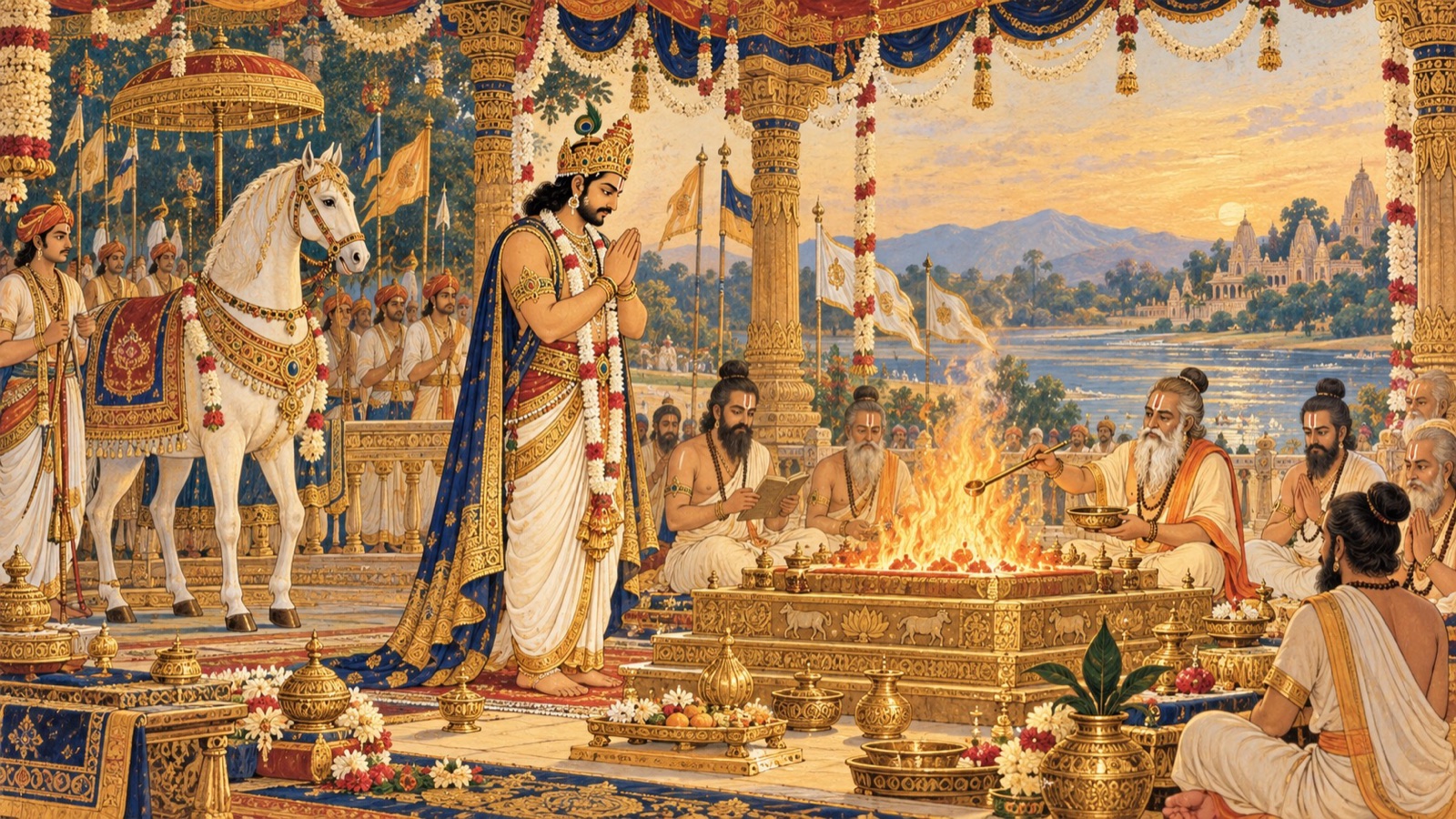
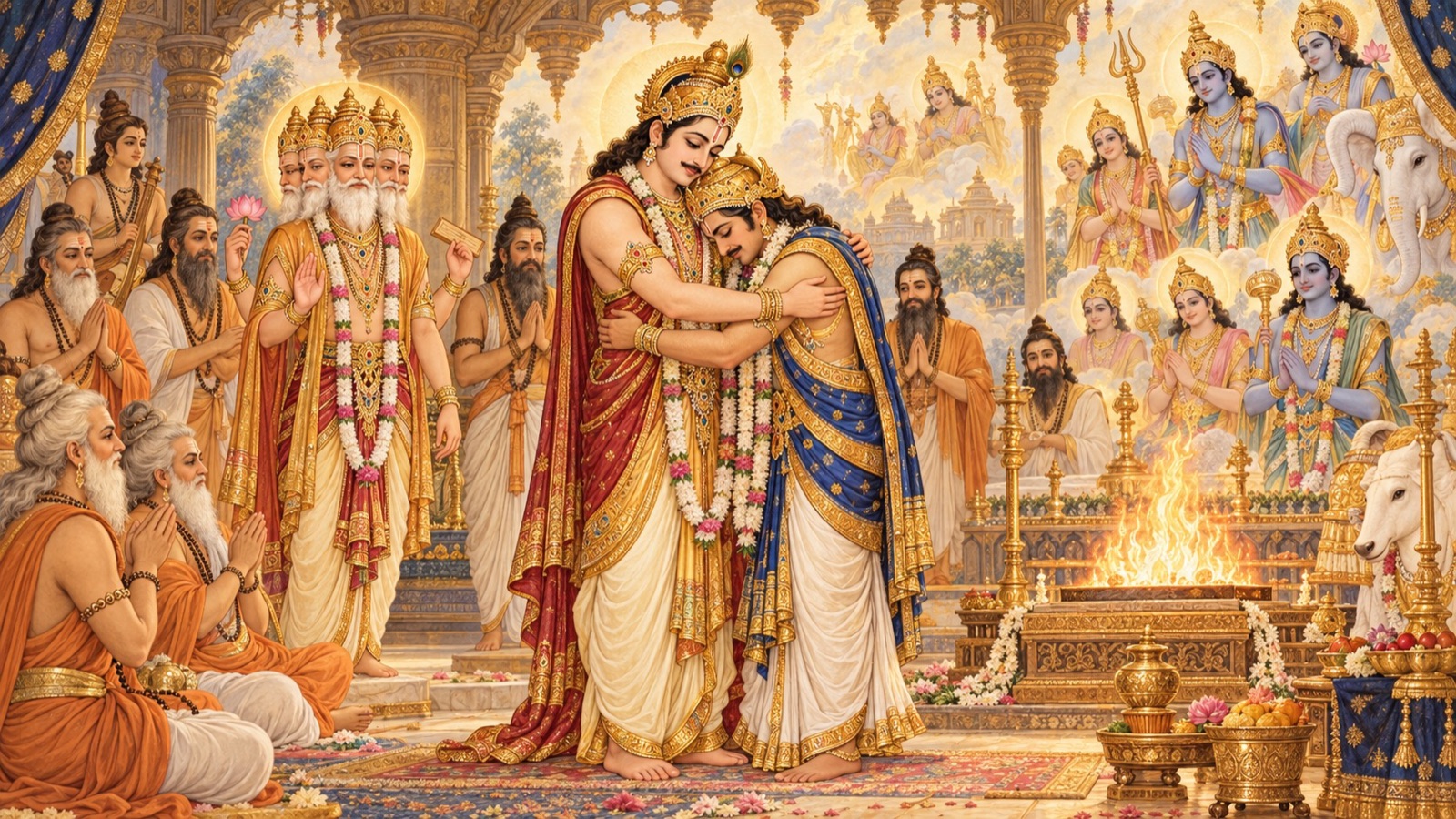
In devotion to the Lord of all sacrifice, King Prithu undertakes a hundred horse-sacrifices, offering into the sacred fire amid the chanting of the priests and the glory of a prosperous realm.
Om Namo Bhagavate Vasudevaya.
Om Namo Bhagavate Vasudevaya.
Om Namo Bhagavate Vasudevaya.
Welcome to Srimad Bhagavatam Wisdom, a devotional journey through the sacred histories and teachings of the Srimad Bhagavat Mahapurana. In the previous chapter, King Prithu drew abundance from the Earth by wisdom and right arrangement, and plenty returned to the world under his just rule. This nineteenth chapter shows the king turning his prosperous realm to the worship of the Lord. In devotion, Prithu undertakes a hundred horse-sacrifices; but as the great rites near their completion, Indra, the king of heaven, grows jealous of Prithu’s rising glory and, again and again, steals the sacrificial horse in disguise to obstruct the final offering — even scattering false garbs of asceticism to cover his thefts. Prithu’s heroic son Vijitashva pursues and recovers the horse each time; and when anger begins to rise, the sages intervene, reminding Prithu that he is a portion of the Lord himself, descended to protect dharma. At their word he stays his hand, is reconciled with Indra, and completes his sacrifices with the sacred concluding bath, blessed by the pleased demigods. It is a chapter about steady devotion amid obstruction, and the wisdom that chooses peace over the pride of a perfect score.
Chapter Information
- Scripture: Śrīmad Bhāgavata Mahāpurāṇa
- Canto: 4 (Book Four)
- Chapter: 19 (Discourse 19)
- Chapter title: King Prithu Performs a Hundred Horse-Sacrifices
- Principal speaker: The sage Maitreya, continuing his discourse to Vidura (with the words of the sages quoted within)
- Principal listener: Vidura
- Main setting: The sacrificial arena of King Prithu in Brahmavarta, on the bank of the Sarasvati
- Central subject: Prithu’s hundred horse-sacrifices, Indra’s obstruction, and the sages’ intervention and reconciliation
- Principal verse range: Canto 4, Chapter 19, verses 1–42
- Primary edition: Gita Press Śrīmad Bhāgavata Mahāpurāṇa
Context from the Previous Chapter
Chapter 18 told how King Prithu, heeding the Goddess Earth’s counsel, levelled the land and milked from her the grains that feed all beings, so that plenty returned to the world and civilization flowered. This nineteenth chapter shows the fruit of that prosperity turned to worship, as the king undertakes a great series of sacrifices to the Lord.
The Hundred Horse-Sacrifices
In the holy land of Brahmavarta, the field of Manu on the bank of the eastward-flowing Sarasvati, King Prithu was consecrated to perform a hundred horse-sacrifices in devotion to the Lord.
मैत्रेय उवाच अथादीक्षत राजा तु हयमेधशतेन स: । ब्रह्मावर्ते मनो: क्षेत्रे यत्र प्राची सरस्वती ॥ १ ॥
maitreya uvāca athādīkṣata rājā tu hayamedha-śatena saḥ brahmāvarte manoḥ kṣetre yatra prācī sarasvatī
Meaning: Maitreya said: Then the king was consecrated to perform a hundred horse-sacrifices in Brahmavarta, the field of Manu, where the Sarasvati flows eastward. (Canto 4, Chapter 19, verse 1)
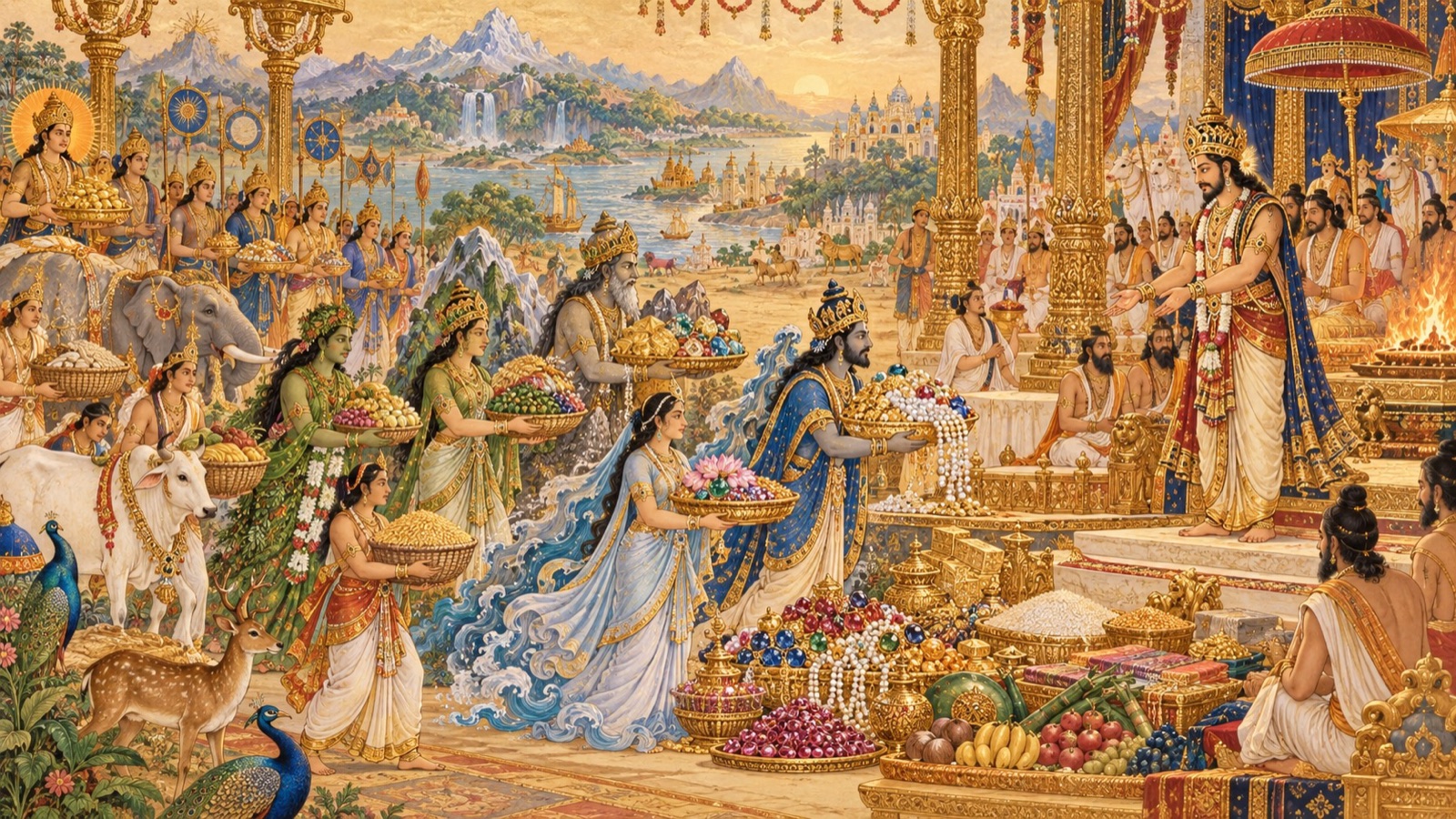
To bless this undertaking, the Lord of every sacrifice did not remain distant: Vishnu Himself became directly present in that arena, the Self seated within every heart, the proprietor of all the worlds and the true enjoyer of every rite offered anywhere. Brahma and Shiva came with Him, together with the ruling powers of every plane and their followers; the sages Kapila, Narada and Dattatreya, the mystic masters headed by Sanaka Kumara, and hosts from Gandharvaloka and Siddhaloka accompanied and praised Him as He appeared.
यत्र यज्ञपति: साक्षाद्भगवान् हरिरीश्वर: । अन्वभूयत सर्वात्मा सर्वलोकगुरु: प्रभु: ॥ ३ ॥
yatra yajña-patiḥ sākṣād bhagavān harir īśvaraḥ anvabhūyata sarvātmā sarva-loka-guruḥ prabhuḥ
Meaning: There, the true Lord of every sacrifice, the Supreme Personality Himself, the supreme controller, became directly manifest — the innermost Self of all beings, the teacher of every world. (Canto 4, Chapter 19, verses 3-6)
So great was the splendour of these rites, and so overflowing the realm’s prosperity, that the oceans and mountains and all the worlds brought their tribute — heaps of jewels, foods of every kind, and gifts without number — to honour the king and his sacrifice (verses 7–9).
Indra’s Jealousy
But the glory of Prithu’s worship stirred an unworthy fear in the heart of Indra, the king of heaven. Foreseeing that Prithu, by his hundred sacrifices, would come to equal or exceed his own celebrated deeds, Indra — himself called the lord of a hundred sacrifices — could not bear the great festival of Prithu’s devotion.
तदभिप्रेत्य भगवान् कर्मातिशयमात्मन: । शतक्रतुर्न ममृषे पृथोर्यज्ञमहोत्सवम् ॥ २ ॥
tad abhipretya bhagavān karmātiśayam ātmanaḥ śata-kratur na mamṛṣe pṛthor yajña-mahotsavam
Meaning: Foreseeing that Prithu would surpass his own deeds, Indra, lord of a hundred sacrifices, could not bear the great sacrificial festival of Prithu. (Canto 4, Chapter 19, verse 2)
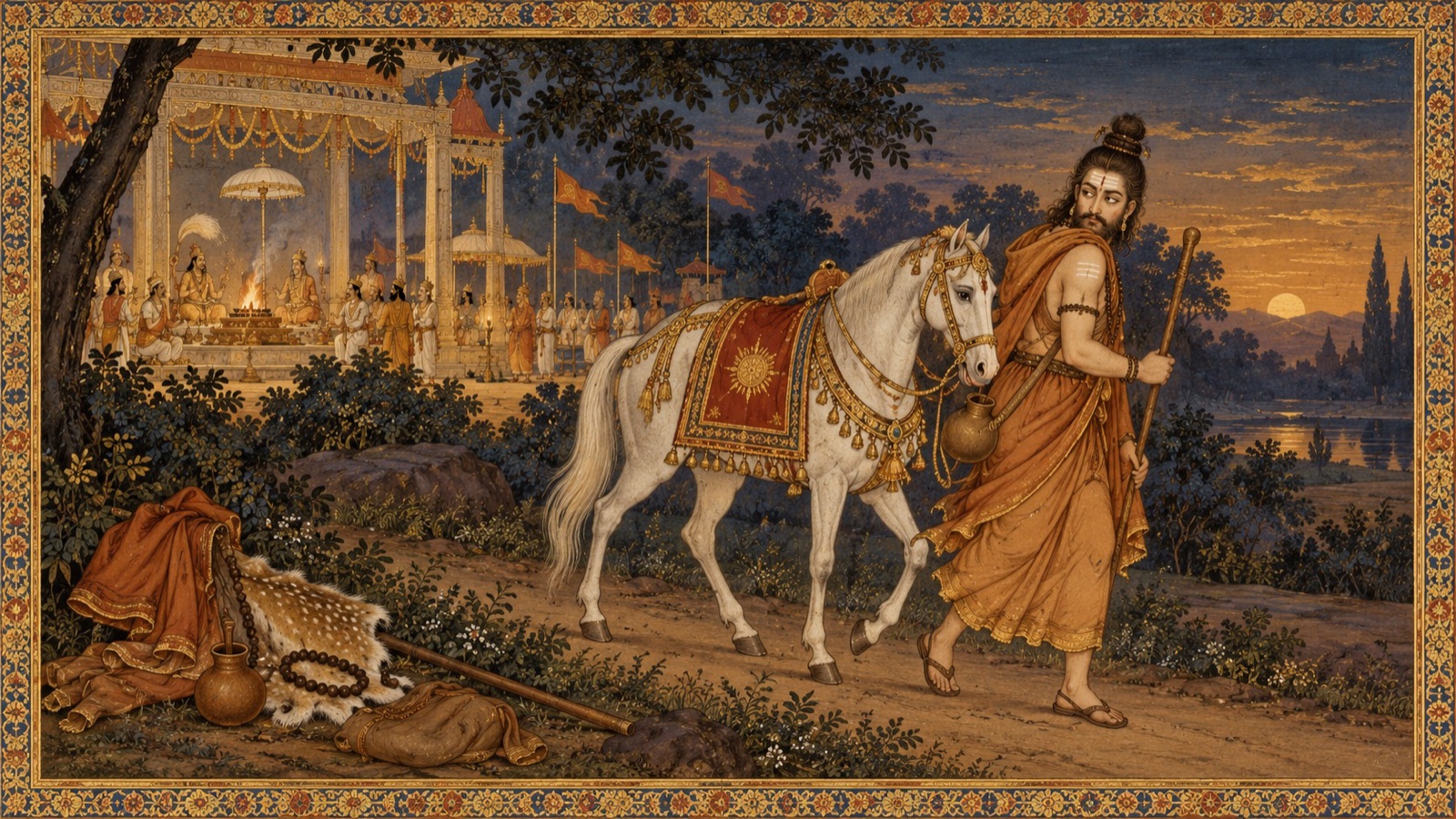
To obstruct the final rite, Indra descended in secret, in the guise of an ascetic, and carried off the sacrificial horse. And to cover his thefts he scattered abroad false and heretical garbs of renunciation — deceptive appearances of holiness under which the weak-minded would later be led astray.
The King’s Son Recovers the Horse
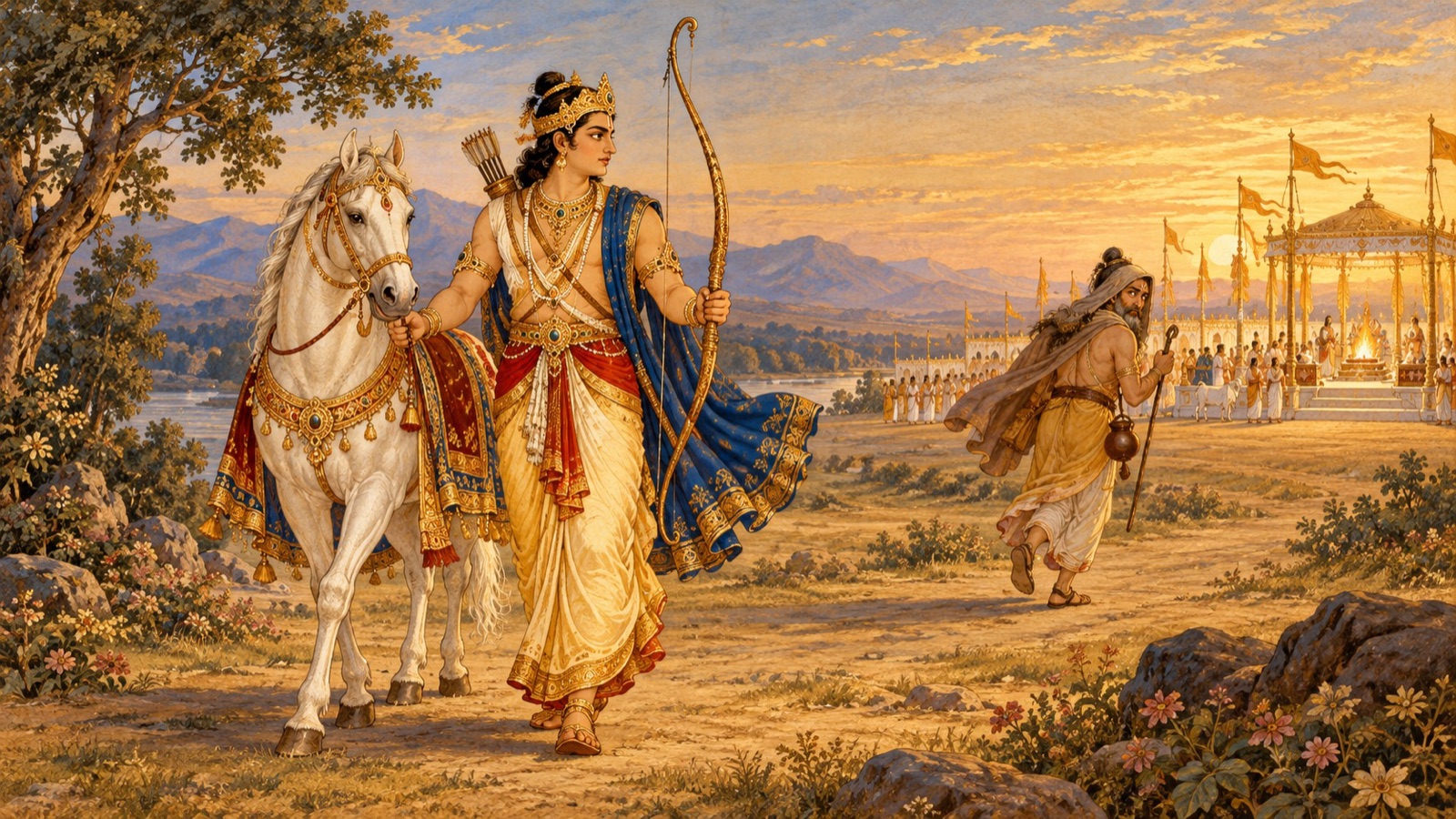
Each time the horse was stolen, Prithu’s heroic son, Vijitashva, gave chase, overtook the disguised Indra, and brought the horse back to his father’s sacrificial arena. So the recovered horse was returned again and again; but the false garb of the pretended ascetic, which Indra had introduced, was thereafter taken up by those of little understanding.
वीरश्चाश्वमुपादाय पितृयज्ञमथाव्रजत् । तदवद्यं हरे रूपं जगृहुर्ज्ञानदुर्बला: ॥ २२ ॥
vīraś cāśvam upādāya pitṛ-yajñam athāvrajat tad avadyaṁ hare rūpaṁ jagṛhur jñāna-durbalāḥ
Meaning: The heroic son took back the horse and returned to his father’s sacrifice; and the deceptive garb that Indra had assumed was thereafter taken up by the weak-minded. (Canto 4, Chapter 19, verse 22)
The Sages’ Intervention
As Indra’s obstruction persisted, the officiating priests grew indignant and prepared to invoke his destruction, and Prithu himself, provoked, made ready to take up his bow against the king of heaven. But the sages restrained him. They reminded Prithu of who he truly was — not merely a wronged king, but the Lord himself descended to restore the dharma that Vena’s misdeeds had ruined, in a manner fitting this age; born of Vena’s very body, he was a portion of Vishnu.
भवान् परित्रातुमिहावतीर्णो धर्मं जनानां समयानुरूपम् । वेनापचारादवलुप्तमद्य तद्देहतो विष्णुकलासि वैन्य ॥ ३७ ॥
bhavān paritrātum ihāvatīrṇo dharmaṁ janānāṁ samayānurūpam venāpacārād avaluptam adya tad-dehato viṣṇu-kalāsi vainya
Meaning: (The sages said:) You have descended here to rescue the dharma of the people, suited to the age, which was destroyed by Vena’s misdeeds; from his very body, O son of Vena, you are come, a portion of Vishnu. (Canto 4, Chapter 19, verse 37)
They counselled him not to be drawn into enmity with Indra, but to let the matter rest. Brahma himself intervened, staying the completion of the hundredth sacrifice, so that Prithu, content with ninety-nine, might be reconciled with Indra rather than provoke a war in heaven. At their word the great king mastered his anger and made peace with Indra.
Brahma’s counsel here is more than a plea for calm; it carries a specific teaching. He reminds Prithu that he and Indra are alike portions of the one Supreme Personality, so that anger between them is a quarrel within a single family (verse 33). He adds that a reversal met at providence’s hand should not be forced right by our own struggling, for the harder we strive to undo what providence has arranged, the deeper we sink into the darkest region of material anxiety (verse 34). And he warns that whatever a great person does, the world will imitate (verse 36): were Prithu’s rites to end in Indra’s death, it is that pattern — not the pattern of forgiveness — that people would carry forward. To stop at ninety-nine, then, is not a lesser victory but the deeper protection of dharma an incarnation exists to provide.
The Sacrifices Completed
So the great series of sacrifices was brought to its close in peace. Having taken the sacred avabhritha bath that crowns a great rite, Prithu of mighty deeds received the blessings of the boon-giving demigods, who were well satisfied by his devotion.
कृतावभृथस्नानाय पृथवे भूरिकर्मणे । वरान्ददुस्ते वरदा ये तद्बर्हिषि तर्पिता: ॥ ४० ॥
kṛtāvabhṛtha-snānāya pṛthave bhūri-karmaṇe varān dadus te varadā ye tad-barhiṣi tarpitāḥ
Meaning: To Prithu of mighty deeds, having taken the sacred concluding bath, the boon-giving demigods, well satisfied at his sacrifice, gave their blessings. (Canto 4, Chapter 19, verse 40)
The great sages and brahmanas praised the king, telling him how all classes of beings — from the world of the ancestors and the heavens, sages and common folk alike — had come at his invitation and been satisfied by his honour and charity. So the nineteenth discourse closes on a note of peace and completion, poised for the great grace the next chapter will bring, when the Lord himself appears in Prithu’s sacrificial hall.
Principal Teachings of This Chapter
1. Prosperity is best offered back in worship. Prithu turns the abundance of his realm not to indulgence but to a great series of sacrifices to the Lord. Wealth is safest and holiest when it is returned, in gratitude, to its Giver (verse 1).
2. Even the exalted can fall to jealousy. Indra, king of heaven, cannot bear another’s rising glory and stoops to theft and deception. Envy is no respecter of rank; it can corrupt even the high (verse 2).
3. False holiness is a real danger. The heretical garbs Indra scattered to cover his thefts became a lasting snare for the weak-minded. The counterfeit of renunciation deceives; true religion is known by its substance, not its costume (verse 22).
4. Remember who you are, and stay your hand. The sages recall Prithu to his identity as a portion of the Lord, and he masters his anger rather than wage war. Knowing our true self and calling restrains us from lesser conflicts (verse 37).
5. Peace is worth more than a perfect score. Prithu lets his hundredth sacrifice go and is reconciled with Indra. To choose harmony over the pride of completion is a greater victory than any rite (verses 37-40).
A Devotional Reflection
The most instructive turn in this chapter is the one that never quite happens: the war that Prithu does not wage. Here is a king in the right — wronged, obstructed, provoked by the pettiness of heaven’s own ruler — and every worldly instinct says he should press on, crush the thief, and complete his hundred to claim a glory even Indra could not match. And the sages say: no. They do not deny that he has been wronged; they simply remind him who he is, and ask him to let it go. There is a hard and beautiful wisdom here. So much of our own strife comes not from being in the wrong but from being in the right and refusing to yield an inch of it. We would rather win than have peace; we would rather complete our hundredth sacrifice than forgive the one who stole from us. Prithu shows another way. Recalled to his deeper identity — that he is here to protect dharma, not to defend his own record — he stops one short of a perfect score, embraces the very one who wronged him, and finds a peace worth more than any completed rite. The chapter quietly asks whether we, too, might set down some hard-earned right for the sake of a greater harmony.
A Daily Devotional Practice
Today, practice stopping one short. Think of some conflict in which you are genuinely in the right — a debt owed you, an apology deserved, a point you could press to victory — and consider whether pressing it to the very end is worth what it would cost in peace. In the spirit of Prithu reconciled with Indra, choose one such matter and deliberately let it rest: forgive the small offence, release the last demand, embrace the one who wronged you. As you do, offer the surrender to the Lord with the words “Om Namo Bhagavate Vasudevaya,” remembering that you, like Prithu, are here not to defend your own record but to serve a higher dharma. In choosing peace over the pride of a perfect score, you follow the king who mastered his anger at the sages’ word.
Conclusion
The nineteenth discourse of Book Four shows King Prithu turning his prosperous realm to the worship of the Lord through a hundred horse-sacrifices in holy Brahmavarta. So great is his glory that all the worlds bring their tribute — but Indra, king of heaven, grows jealous and, again and again, steals the sacrificial horse in disguise, scattering false garbs of asceticism to cover his thefts. Prithu’s heroic son Vijitashva recovers the horse each time; and when priests and king alike grow angry, the sages intervene, recalling Prithu to his true identity as a portion of the Lord, descended to protect dharma. At their word, and by Brahma’s intervention, Prithu stays his hand, lets his hundredth sacrifice go, and is reconciled with the repentant Indra. The great rites are completed in peace with the sacred concluding bath, and the pleased demigods bestow their blessings. So the chapter shows a devotion that holds firm through obstruction, and a wisdom that would rather make peace than claim a perfect score — a note on which it poises us for the appearance of the Lord in the next chapter.
May the divine wisdom of Srimad Bhagavatam awaken pure devotion within our hearts.
Om Namo Bhagavate Vasudevaya.
Jay Shree Madhav.
References and Attribution
- Primary edition: Gita Press, Śrīmad Bhāgavata Mahāpurāṇa (English, complete), Book Four, Discourse 19.
- Series: Srimad Bhagavatam Wisdom · Biswa Sanatan Dharma Seva Trust.
- Presented following the spiritual guidance and recommendation of Pandit Dr. Shri Kashinath Mishra.
This is an original, faithful retelling in the writer’s own words, with brief quoted verses shown in Devanāgarī and transliteration and their meanings given as summaries. It is not a reproduction of any single publisher’s continuous translation or commentary. No affiliation with or endorsement by any publisher is implied.
Jay Shree Madhav