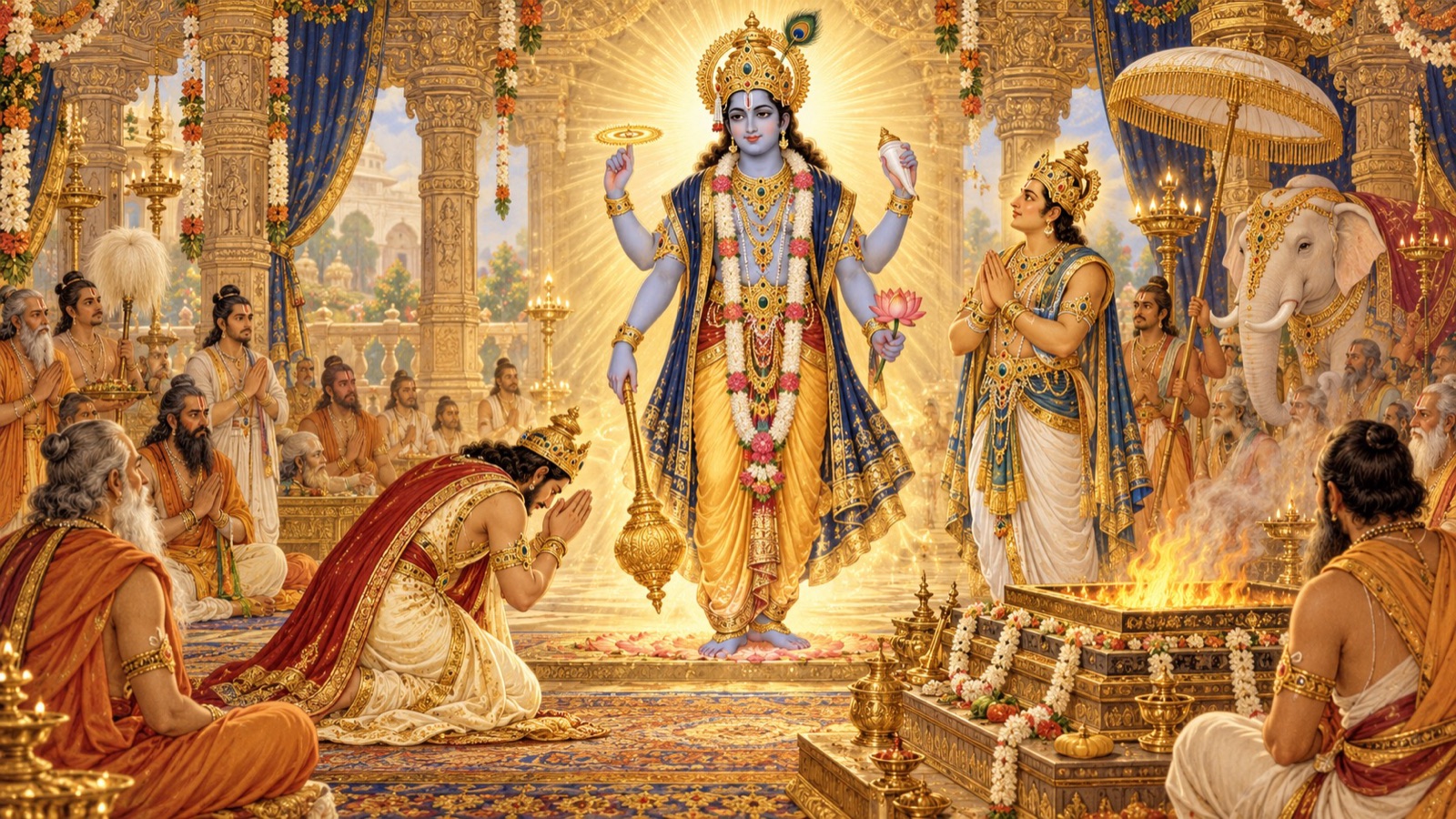
The sacrificial fire gives way to something greater: Sri Hari Himself steps into King Prithu’s hall, the once-defiant Indra now walking humbly at His side.
Om Namo Bhagavate Vasudevaya.
Om Namo Bhagavate Vasudevaya.
Om Namo Bhagavate Vasudevaya.
Welcome to Srimad Bhagavatam Wisdom, a devotional journey through the sacred histories and teachings of the Srimad Bhagavat Mahapurana. In the previous chapter, King Prithu undertook a hundred horse-sacrifices, endured Indra’s jealous obstruction, and, at the sages’ word, chose reconciliation over conflict. This twentieth chapter is the crown of that devotion. Well pleased with His servant, the Supreme Lord Sri Hari descends into Prithu’s sacrificial hall, bringing the repentant Indra with Him. Before any pardon is asked, the Lord instructs the king in the nature of the pure soul and in a ruler’s true duty to protect his people, and only then counsels him to forgive Indra fully. Offered any boon in return, Prithu turns down every treasure of this world and the next — even the liberation that ends rebirth — and asks instead for ten thousand ears with which to keep hearing the Lord’s glory from the mouths of the devoted. Moved, the Lord blesses him and prepares to depart. It is a chapter about the reward of pure devotion, the wisdom that forgives, and a prayer that wants nothing but God.
Chapter Information
- Scripture: Śrīmad Bhāgavata Mahāpurāṇa
- Canto: 4 (Book Four)
- Chapter: 20 (Discourse 20)
- Chapter title: The Lord Appears in King Prithu’s Sacrificial Hall
- Principal speaker: The sage Maitreya, continuing his discourse to Vidura (with the words of the Lord and of Prithu quoted within)
- Principal listener: Vidura
- Main setting: The sacrificial hall of King Prithu
- Central subject: The appearance of Lord Vishnu, His teaching and counsel to forgive Indra, and Prithu’s prayer for pure devotion
- Principal verse range: Canto 4, Chapter 20, verses 1–38
- Primary edition: Gita Press Śrīmad Bhāgavata Mahāpurāṇa
Context from the Previous Chapter
Chapter 19 told how King Prithu’s hundred horse-sacrifices were obstructed by a jealous Indra, and how the sages recalled Prithu to his identity as a portion of the Lord, so that he stayed his hand and was reconciled with the repentant Indra. This twentieth chapter opens as the Lord himself, satisfied by Prithu’s devotion, appears in the sacrificial hall — bringing Indra with Him.
The Lord Appears
Well pleased by the sacrifices, the all-pervading Lord of Vaikuntha — the Lord and enjoyer of all sacrifice — appeared in person in the hall, and Indra came with Him, ready to make amends. And the Lord began to speak.
मैत्रेय उवाच भगवानपि वैकुण्ठः साकं मघवता विभुः । यज्ञैर्यज्ञपतिस्तुष्टो यज्ञभुक् तमभाषत ॥ १ ॥
maitreya uvāca bhagavān api vaikuṇṭhaḥ sākaṁ maghavatā vibhuḥ yajñair yajña-patis tuṣṭo yajña-bhuk tam abhāṣata
Meaning: Maitreya said: The all-pervading Lord of Vaikuntha, the Lord and enjoyer of all sacrifice, well pleased by the sacrifices, appeared together with Indra and spoke to Prithu. (Canto 4, Chapter 20, verse 1)
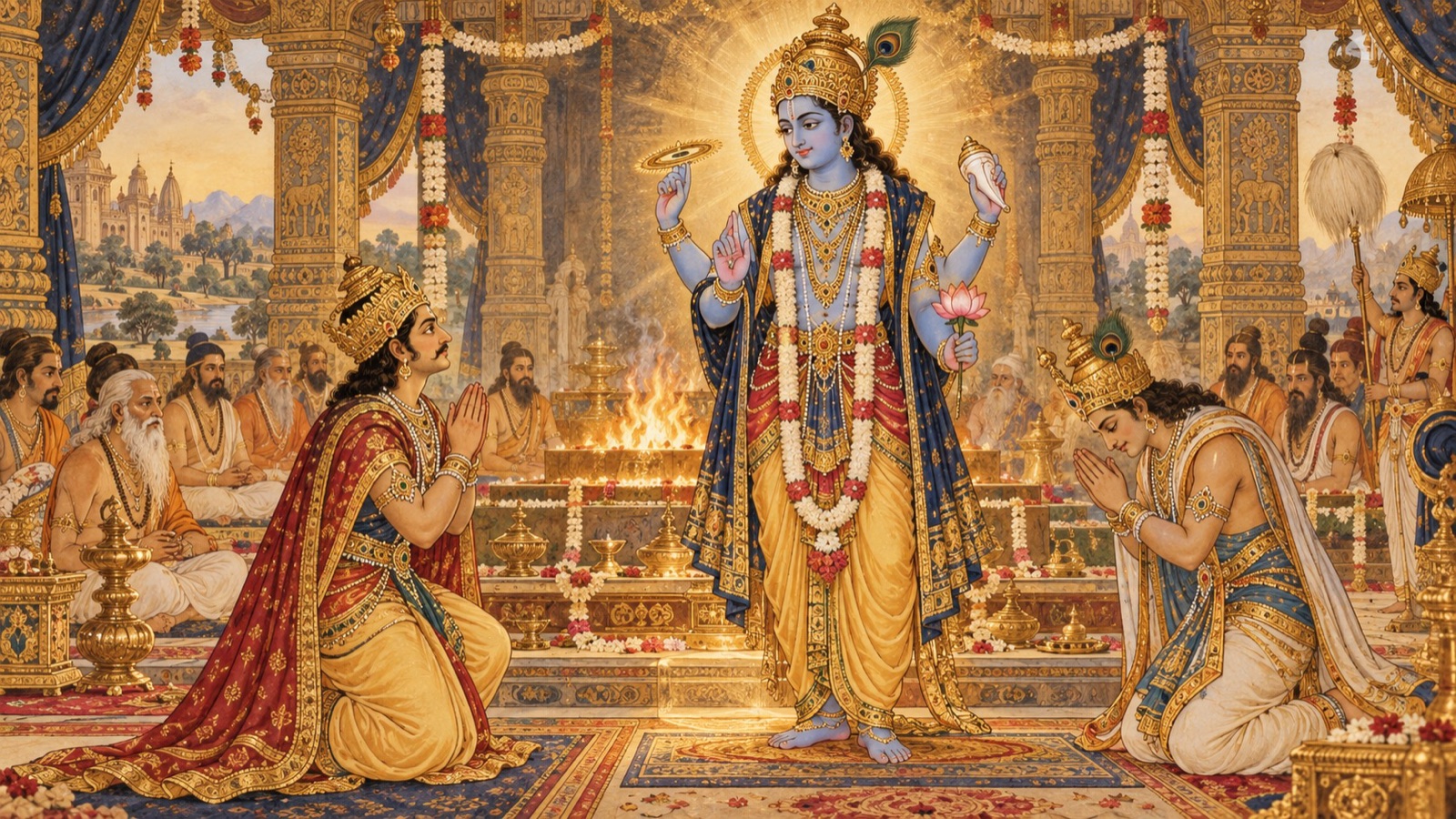
The Lord counselled the king with the highest wisdom. He explained that Indra’s obstruction, and even the false garbs of religion he had scattered, had unfolded within a larger divine design, and that a wise devotee bears no grudge; he asked Prithu to forgive Indra as a brother (verses 2-4).
He then turned to the deepest teaching of all: the nature of the self. The soul, He said, is one, pure and self-luminous, standing free of the material modes even while dwelling amid them — the unseen witness of every action, distinct from the very sense of “I” that binds the embodied being to its body. Full knowledge, He added, means knowing both this position of the self and His own position as the Lord of all selves (verses 5-8).
एक: शुद्ध: स्वयंज्योतिर्निर्गुणोऽसौ गुणाश्रय: । सर्वगोऽनावृत: साक्षी निरात्मात्मात्मन: पर: ॥ ७ ॥
ekaḥ śuddhaḥ svayaṁ-jyotir nirguṇo ‘sau guṇāśrayaḥ sarva-go ‘nāvṛtaḥ sākṣī nirātmātmātmanaḥ paraḥ
Meaning: The Lord said: The self is one, pure, self-luminous and all-pervading; it is not covered by the modes of nature even while moving among them, but stands apart as their silent witness, beyond the very notion of selfhood that clings to the embodied being. (Canto 4, Chapter 20, verse 7)
From this understanding of the self, the Lord drew out a devotee’s true equanimity — a mind that stays fixed and unmoved by the body’s pleasure and pain, because it knows itself to be other than the body (verses 9-12). He then turned that same equanimity toward Prithu’s office as king: a ruler’s whole purpose, He said, is to shield the citizens, not merely to rule or tax them. One who protects earns a sixth share of his people’s merit in the life to come; one who taxes without protecting instead inherits their sin (verses 13-15).
श्रेय: प्रजापालनमेव राज्ञो यत्साम्पराये सुकृतात् षष्ठमंशम् । हर्तान्यथा हृतपुण्य: प्रजाना- मरक्षिता करहारोऽघमत्ति ॥ १४ ॥
śreyaḥ prajā-pālanam eva rājño yat sāmparāye sukṛtāt ṣaṣṭham aṁśam hartānyathā hṛta-puṇyaḥ prajānām arakṣitā kara-hāro ‘gham atti
Meaning: The Lord said: A king’s true welfare lies only in protecting his citizens, for by this he earns a sixth share of their virtue in the life to come; but a ruler who collects tribute without giving protection instead takes on the reactions of their sin. (Canto 4, Chapter 20, verse 14)
The Boon Offered
Then the Lord, bound not by ritual but by the king’s own virtue and character, offered Prithu whatever boon he might desire — and told him a secret dearer than any gift: that He is not easily attained by sacrifices, austerities, or yoga, but is won by the one whose mind is even and steady in all conditions.
वरं च मत्कञ्चन मानवेन्द्र वृणीष्व तेऽहं गुणशीलयन्त्रित: । नाहं मखैर्वै सुलभस्तपोभि- र्योगेन वा यत्समचित्तवर्ती ॥ १६ ॥
varaṁ ca mat kañcana mānavendra vṛṇīṣva te ’haṁ guṇa-śīla-yantritaḥ nāhaṁ makhair vai sulabhas tapobhir yogena vā yat sama-citta-vartī
Meaning: (The Lord said:) Ask of Me some boon, O king of men, for I am bound by your virtue and character. I am not easily won by sacrifices, austerities, or yoga — I am attained by one who is even-minded in all conditions. (Canto 4, Chapter 20, verse 16)
Prithu’s Prayer
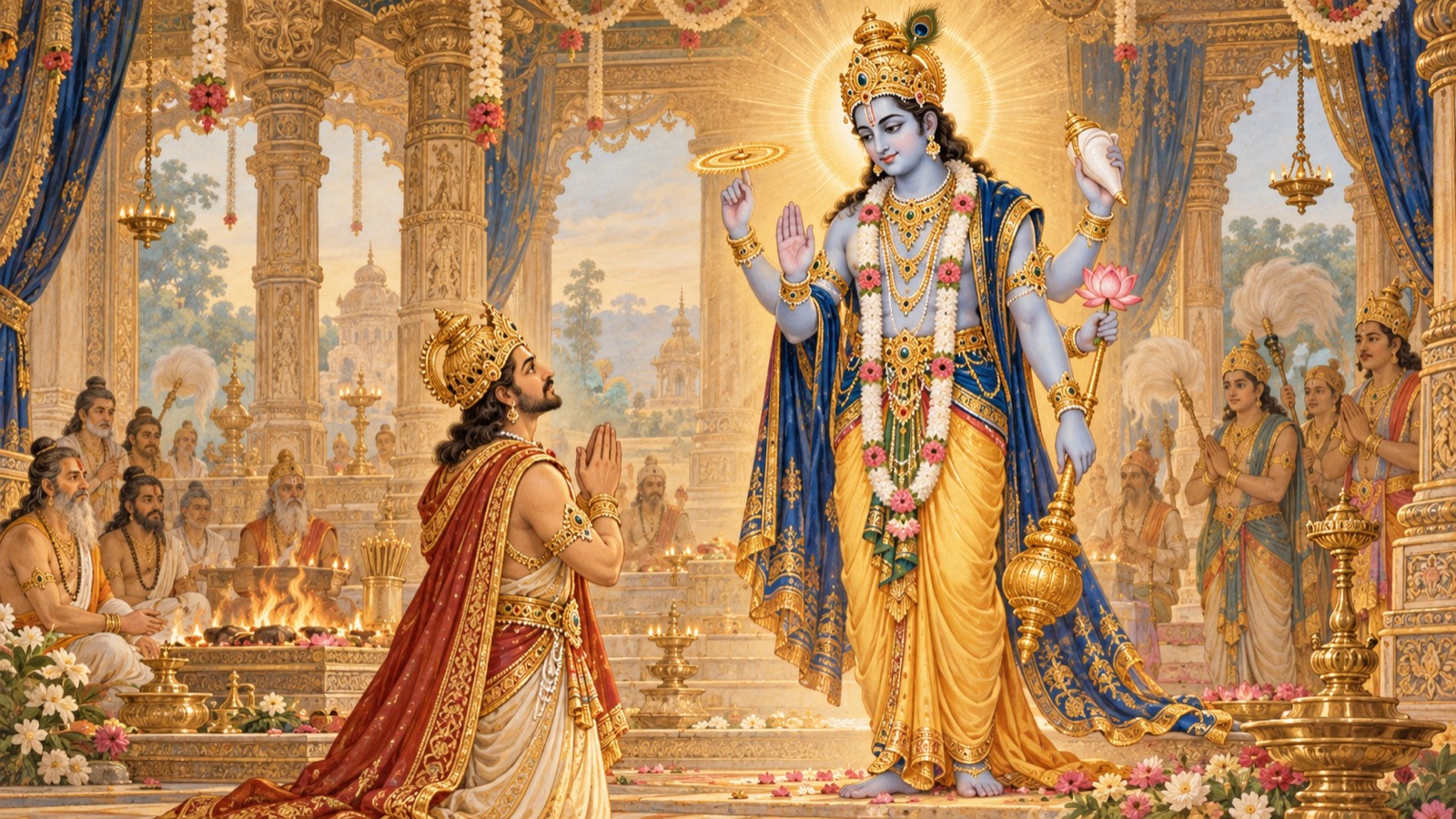
Now came the heart of the chapter. Offered anything at all by the very Lord of liberation, Prithu did not ask for wealth, or heaven, or power, or even release from the world. He said that a wise man should be ashamed to ask such things of the Giver of all — things that even the beings in hell possess. Instead he made a prayer of pure love: that he did not desire even liberation if it held no taste of the nectar of the Lord’s lotus feet, which flows from the hearts and mouths of the greatest devotees; and he begged, in place of every other boon, for ten thousand ears with which to go on hearing that nectar forever.
न कामये नाथ तदप्यहं क्वचिन् न यत्र युष्मच्चरणाम्बुजासव: । महत्तमान्तर्हृदयान्मुखच्युतो विधत्स्व कर्णायुतमेष मे वर: ॥ २४ ॥
na kāmaye nātha tad apy ahaṁ kvacin na yatra yuṣmac-caraṇāmbujāsavaḥ mahattamāntar-hṛdayān mukha-cyuto vidhatsva karṇāyutam eṣa me varaḥ
Meaning: (Prithu prayed:) O Lord, I do not desire even that liberation in which there is no taste of the nectar of Your lotus feet, flowing from the hearts and mouths of the greatest devotees. Grant me ten thousand ears to hear it — this alone is the boon I ask. (Canto 4, Chapter 20, verse 24)
Such hearing, he said, is no small thing: when the sweetness of the Lord’s feet travels on the breath of a great soul’s words, it can wake even the most forgetful heart to a truth it thought lost — so in that one company he wanted for nothing further.
स उत्तमश्लोक महन्मुखच्युतो भवत्पदाम्भोजसुधा कणानिल: । स्मृतिं पुनर्विस्मृततत्त्ववर्त्मनां कुयोगिनां नो वितरत्यलं वरै: ॥ २५ ॥
sa uttamaśloka mahan-mukha-cyuto bhavat-padāmbhoja-sudhā kaṇānilaḥ smṛtiṁ punar vismṛta-tattva-vartmanāṁ kuyoginaṁ no vitaraty alaṁ varaiḥ
Meaning: O Lord of sublime renown, the breeze carrying the nectar-particles of Your lotus feet from the mouths of great souls restores the memory of the truth even to fallen seekers who have forgotten the path — enough, then, of other boons! (Canto 4, Chapter 20, verse 25)
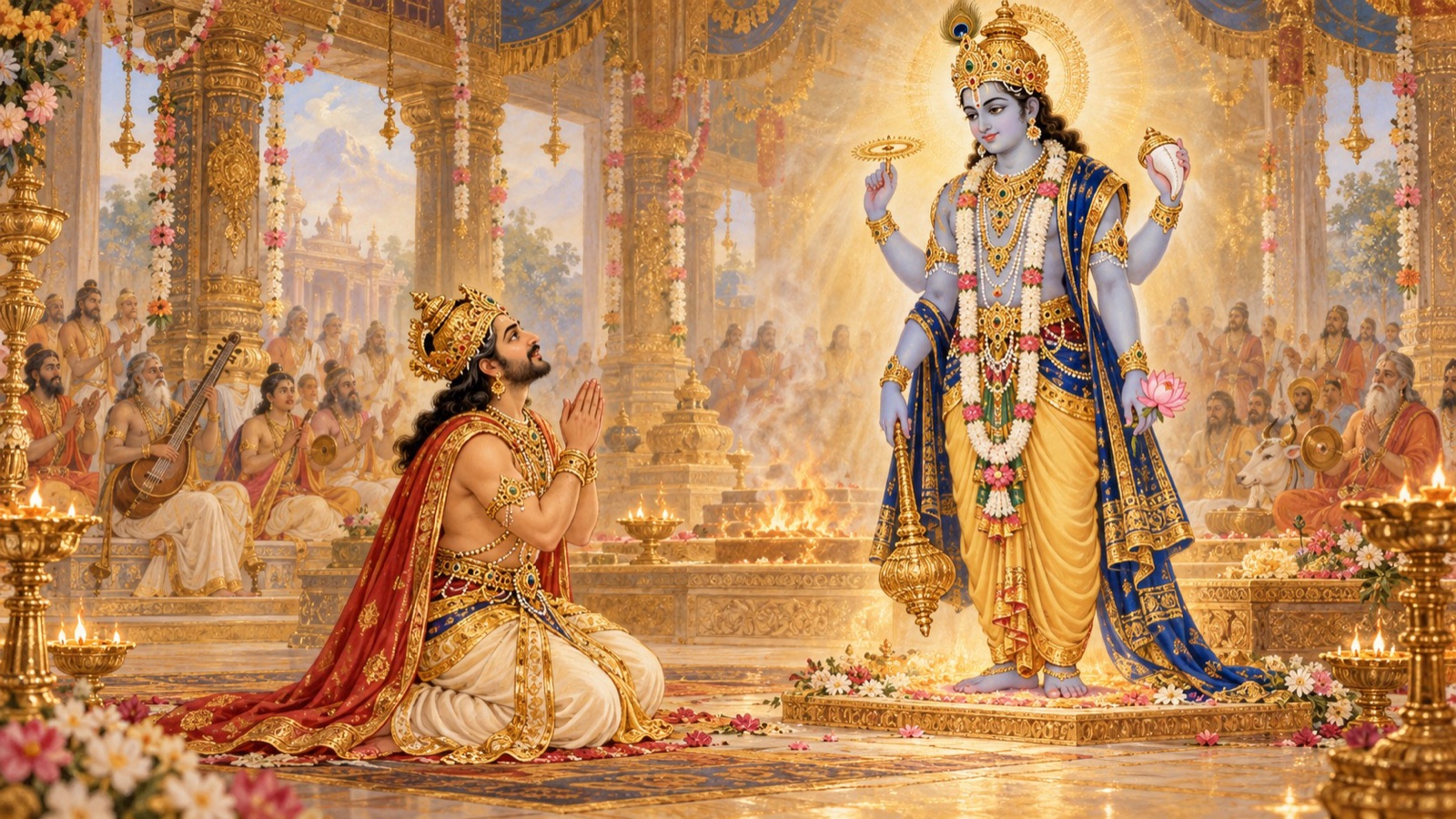
Here lies the chapter’s deepest turn. Offered any benediction at all, Prithu deliberately sets aside even oneness with the Lord — the very liberation that ends rebirth altogether — because, he says, that dissolution carries no taste of loving exchange with Him (verse 23). To a soul still entangled in matter, merging into the Lord looks like the highest prize; but to one who has tasted devotion, an absorption that erases the relationship of servant and Lord is no gain at all, since it forecloses the very hearing, remembering and serving he craves. This is why, further on in his prayer, Prithu asks the Lord simply to act toward him as a father acts toward his child — arranging whatever is best — rather than let him choose even his own liberation (verse 31). Relationship with the Lord, the chapter teaches, outranks even the end of rebirth.
Prithu went on to pray that his devotion to the Lord and to the Lord’s devotees might never fail, and that his mind might rest forever at those lotus feet. It is a prayer that asks for nothing but God himself, and the endless hearing of His glory.
The Lord’s Blessing and Departure
The Lord was moved by the meaningful, selfless words of the royal sage. Praising his prayer, and honoured and worshipped by Prithu, the infallible Lord blessed him, and then made up His mind to depart.
मैत्रेय उवाच इति वैन्यस्य राजर्षे: प्रतिनन्द्यार्थवद्वच: । पूजितोऽनुगृहीत्वैनं गन्तुं चक्रेऽच्युतो मतिम् ॥ ३४ ॥
maitreya uvāca iti vainyasya rājarṣeḥ pratinandyārthavad vacaḥ pūjito ’nugṛhītvainaṁ gantuṁ cakre ’cyuto matim
Meaning: Maitreya said: Thus praising the meaningful words of the royal sage Prithu, the infallible Lord, worshipped by him and having blessed him, made up His mind to depart. (Canto 4, Chapter 20, verse 34)
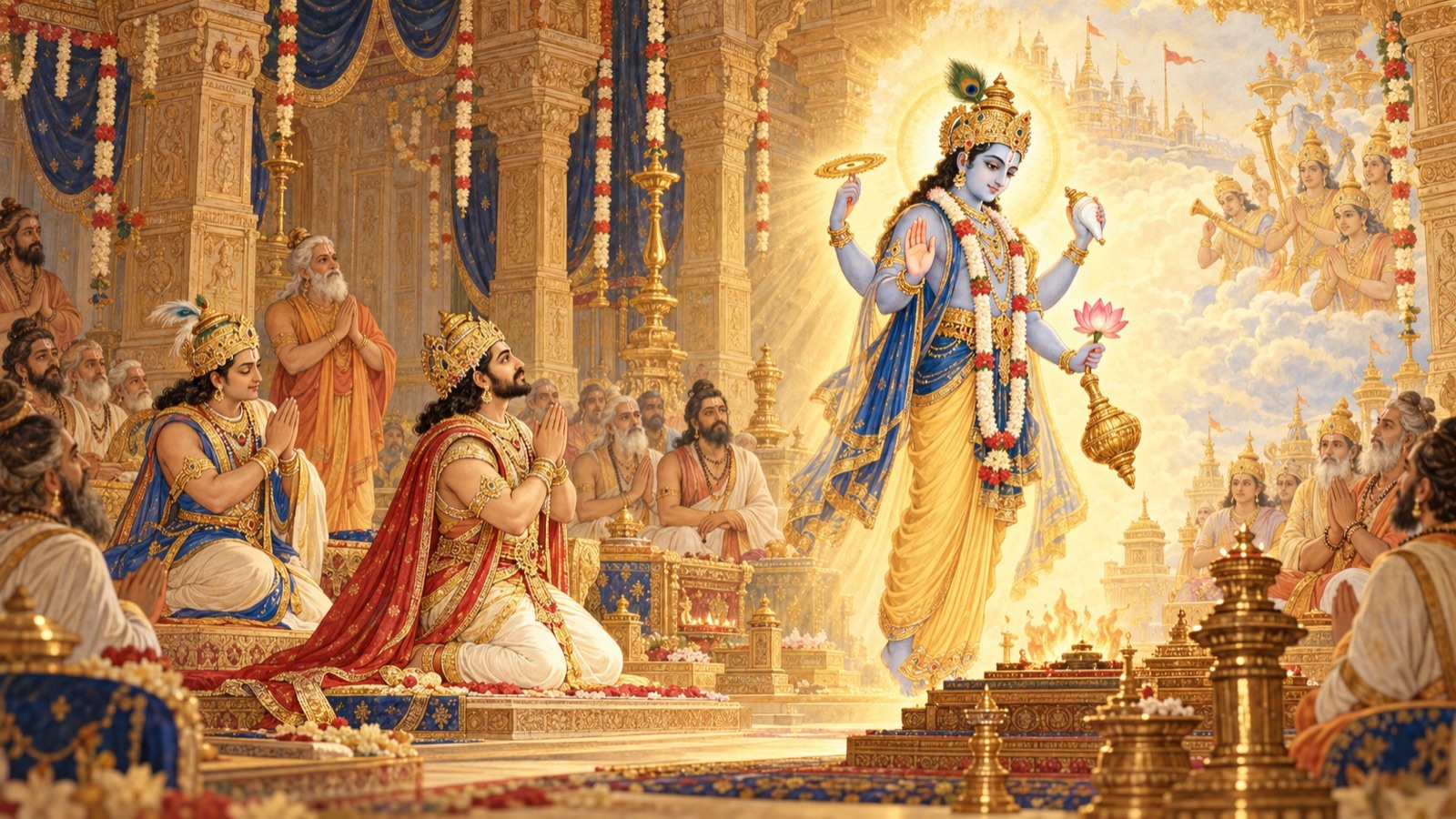
Prithu, his heart overflowing, gazed upon the departing Lord with folded hands and eyes full of love, wholly reconciled now with Indra and with all. So the twentieth discourse closes at the summit of Prithu’s devotion — the Lord seen face to face, His wisdom received, and a prayer offered that wanted nothing in all the worlds but Him.
Principal Teachings of This Chapter
1. Even our obstacles unfold within a divine design. The Lord shows Prithu that Indra’s very interference had its place in a larger plan. What opposes us is not outside God’s ordering; seeing this frees us from grievance (verses 2-4).
2. The self is pure and untouched by matter. The Lord teaches that the soul is one, self-luminous and free of the modes of nature even while dwelling among them — the silent witness within, not the body it inhabits (verses 5-8).
3. A king’s duty is to protect, not merely to rule. The Lord tells Prithu plainly that a ruler who shields his citizens shares their merit, while one who taxes without protecting inherits their sin. Authority exists to serve, not merely to command (verses 13-15).
4. The Lord is won by even-mindedness, not by ritual alone. He tells Prithu that sacrifices, austerities, and yoga do not, by themselves, attain Him — He is won by a mind that stays even in all conditions. Devotion is an inward steadiness, not merely an outward performance (verse 16).
5. Ask for God, not for God’s gifts. Offered any boon, Prithu is ashamed to ask for things that even the fallen possess. The highest prayer seeks not the treasures of the world but the Treasure who gives them (verse 23).
6. To hear the Lord’s glories is the sweetest boon of all. Prithu asks for ten thousand ears to go on hearing the nectar of the Lord’s feet from the mouths of devotees. The company of the holy and the hearing of the Lord’s story is itself the goal, not a means to some further reward (verses 24-25).
7. Loving relationship outranks even liberation. Prithu refuses the very dissolution that ends rebirth, because it would end his hearing and serving too. For a devotee, nearness to the Lord matters more than release from the world (verses 23, 29, 31).
8. Selfless love draws the Lord’s own delight. It is Prithu’s asking for nothing that most pleases the Lord. Nothing wins His heart like a devotion that wants only Him (verse 34).
A Devotional Reflection
At the centre of this chapter stands a prayer so pure it can reorder our whole sense of what to want. The Lord of all offers Prithu anything — and Prithu, in effect, asks for more of the Lord: not release from the world, not the heavens, but simply ten thousand ears, so that he might never stop hearing the glories of God from the mouths of those who love Him. It is worth sitting with how strange and beautiful this is. We come to God, most of us, with a list — of needs met, troubles removed, even of spiritual attainments gained. Prithu shows a love that has travelled past the list entirely, to the point where the only thing left to want is the Beloved himself, and the endless savouring of His story. And notice what most pleases the Lord: not Prithu’s hundred sacrifices, not his conquests or his justice, but this one selfless prayer. The heart of God is won, it seems, not by what we accomplish for Him but by how purely we want Him. The chapter gently examines our own prayers. When we are offered, in the quiet of our hearts, whatever we would ask — do we reach for the gifts, or for the Giver? Prithu’s ten thousand ears are a picture of the soul that has found that God himself, heard and remembered and loved, is the only boon worth asking for.
A Daily Devotional Practice
Today, pray Prithu’s prayer in your own words. Sit quietly, and imagine the Lord offering you, sincerely, whatever you would ask. Notice what first comes to mind — and then, gently, set it down, and ask instead for what Prithu asked: not for this or that gift, but for a heart that never tires of hearing and remembering the Lord. Take a few minutes to actually hear His glory — read or recall a passage of His story, or softly chant “Om Namo Bhagavate Vasudevaya,” letting it be, for you, one of Prithu’s ten thousand ears. And in the spirit of the Lord’s counsel to forgive Indra, release any grievance you are still holding, trusting that even what has opposed you has its place in a design larger than you can see. In wanting the Giver more than the gifts, you pray the prayer that most delights the Lord.
Conclusion
This twentieth discourse crowns King Prithu’s devotion. In answer to his hundred sacrifices, the Lord of Vaikuntha manifests directly in the sacrificial hall, Indra walking beside Him in repentance. Before pardon is even asked, the Lord instructs the king in the deepest truths — that the self is pure and untouched by matter, that a ruler’s whole purpose is to shield his people rather than merely tax them, and that even-minded devotion, not ceremony, is what truly wins Him. He then places before Prithu every benediction in creation. Rather than reach for power, heaven, or even the liberation that ends rebirth, the king asks for nothing but ten thousand ears, that he might never stop hearing the Lord’s own glory from the lips of the devoted. Touched by a love that seeks nothing for itself, the Lord grants His blessing and turns to depart, while Prithu, every grievance now dissolved, watches Him go with a heart full past speech. The chapter’s lesson stands clear: relationship with the Lord outweighs any prize this world or the next can offer, and it is such selfless longing, more than any rite, that draws His deepest favor.
May the divine wisdom of Srimad Bhagavatam awaken pure devotion within our hearts.
Om Namo Bhagavate Vasudevaya.
Jay Shree Madhav.
References and Attribution
- Primary edition: Gita Press, Śrīmad Bhāgavata Mahāpurāṇa (English, complete), Book Four, Discourse 20.
- Series: Srimad Bhagavatam Wisdom · Biswa Sanatan Dharma Seva Trust.
- Presented following the spiritual guidance and recommendation of Pandit Dr. Shri Kashinath Mishra.
This is an original, faithful retelling in the writer’s own words, with brief quoted verses shown in Devanāgarī and transliteration and their meanings given as summaries. It is not a reproduction of any single publisher’s continuous translation or commentary. No affiliation with or endorsement by any publisher is implied.
Jay Shree Madhav