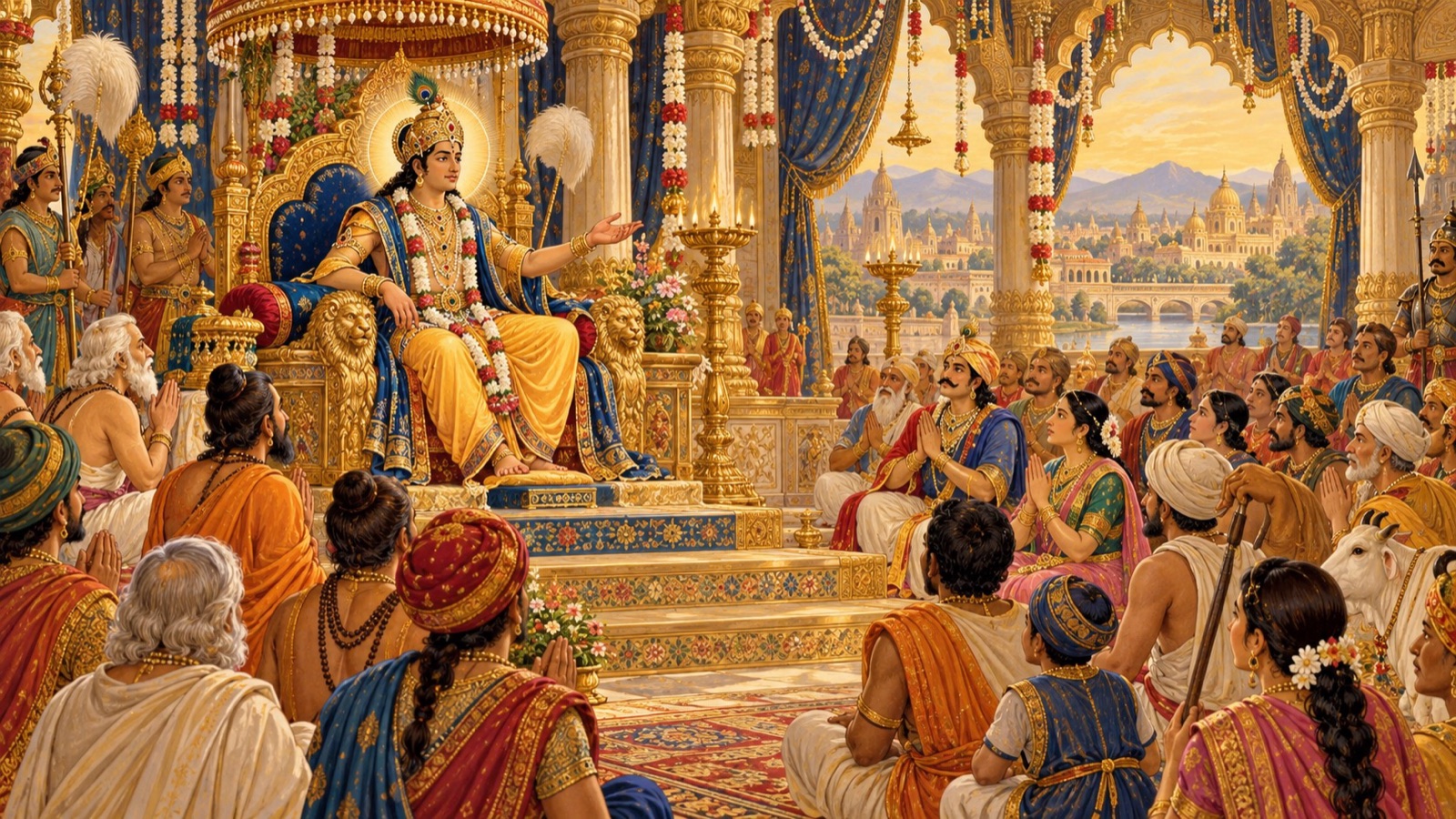
From his throne in the festive capital, King Prithu addresses his assembled people with grave and beautiful counsel — teaching that rule is a sacred trust, and that loving devotion to the Lord is the one duty binding every soul.
Om Namo Bhagavate Vasudevaya.
Om Namo Bhagavate Vasudevaya.
Om Namo Bhagavate Vasudevaya.
Welcome to Srimad Bhagavatam Wisdom, a devotional journey through the sacred histories and teachings of the Srimad Bhagavat Mahapurana. In the previous chapter, the Supreme Lord appeared in King Prithu’s sacrificial hall, and Prithu offered a prayer so selfless that he asked only to hear the Lord’s glories forever. This twenty-first chapter shows the fruit of that devotion poured out for others. Returning in glory to his festive capital, Prithu gathers his subjects and addresses them with grave and beautiful counsel. He teaches that a ruler’s power is not for his own enjoyment but is a sacred trust to protect and serve the people; that the highest duty of every soul, of whatever station, is the loving worship of the Supreme Lord; and that the taste for serving the Lord’s feet purifies the heart of the impurity of countless lives. The people, moved to the depths, honour him as a father and protector. It is a chapter about power held as service, and about a king who uses his own greatness to point his people toward God.
Chapter Information
- Scripture: Śrīmad Bhāgavata Mahāpurāṇa
- Canto: 4 (Book Four)
- Chapter: 21 (Discourse 21)
- Chapter title: King Prithu’s Teaching to His Subjects
- Principal speaker: The sage Maitreya, continuing his discourse to Vidura (with the words of King Prithu quoted within)
- Principal listener: Vidura
- Main setting: The festive capital city of King Prithu
- Central subject: Prithu’s return in glory and his instruction to his subjects on righteous rule and devotion to the Lord
- Principal verse range: Canto 4, Chapter 21, verses 1–52
- Primary edition: Gita Press Śrīmad Bhāgavata Mahāpurāṇa
Context from the Previous Chapter
Chapter 20 was the crown of Prithu’s devotion: the Lord appeared in his sacrificial hall, taught him the highest wisdom, and Prithu asked only for the endless hearing of the Lord’s glories. This twenty-first chapter shows him carrying that devotion home, returning to his capital and turning to the care and instruction of his people.
The Adorned Capital
As King Prithu entered his city, it was adorned on every side to welcome him — hung with pearls and flower-garlands and fine cloth, spanned by golden archways, and filled everywhere with clouds of the most fragrant incense.
मैत्रेय उवाच मौक्तिकैः कुसुमस्रग्भिर्दुकूलैः स्वर्णतोरणैः । महासुरभिभिर्धूपैर्मण्डितं तत्र तत्र वै ॥ १ ॥
maitreya uvāca mauktikaiḥ kusuma-sragbhir dukūlaiḥ svarṇa-toraṇaiḥ mahā-surabhibhir dhūpair maṇḍitaṁ tatra tatra vai
Meaning: Maitreya said: As the king entered, the city was adorned on every side with pearls, flower-garlands, fine cloth, golden archways, and clouds of most fragrant incense. (Canto 4, Chapter 21, verse 1)
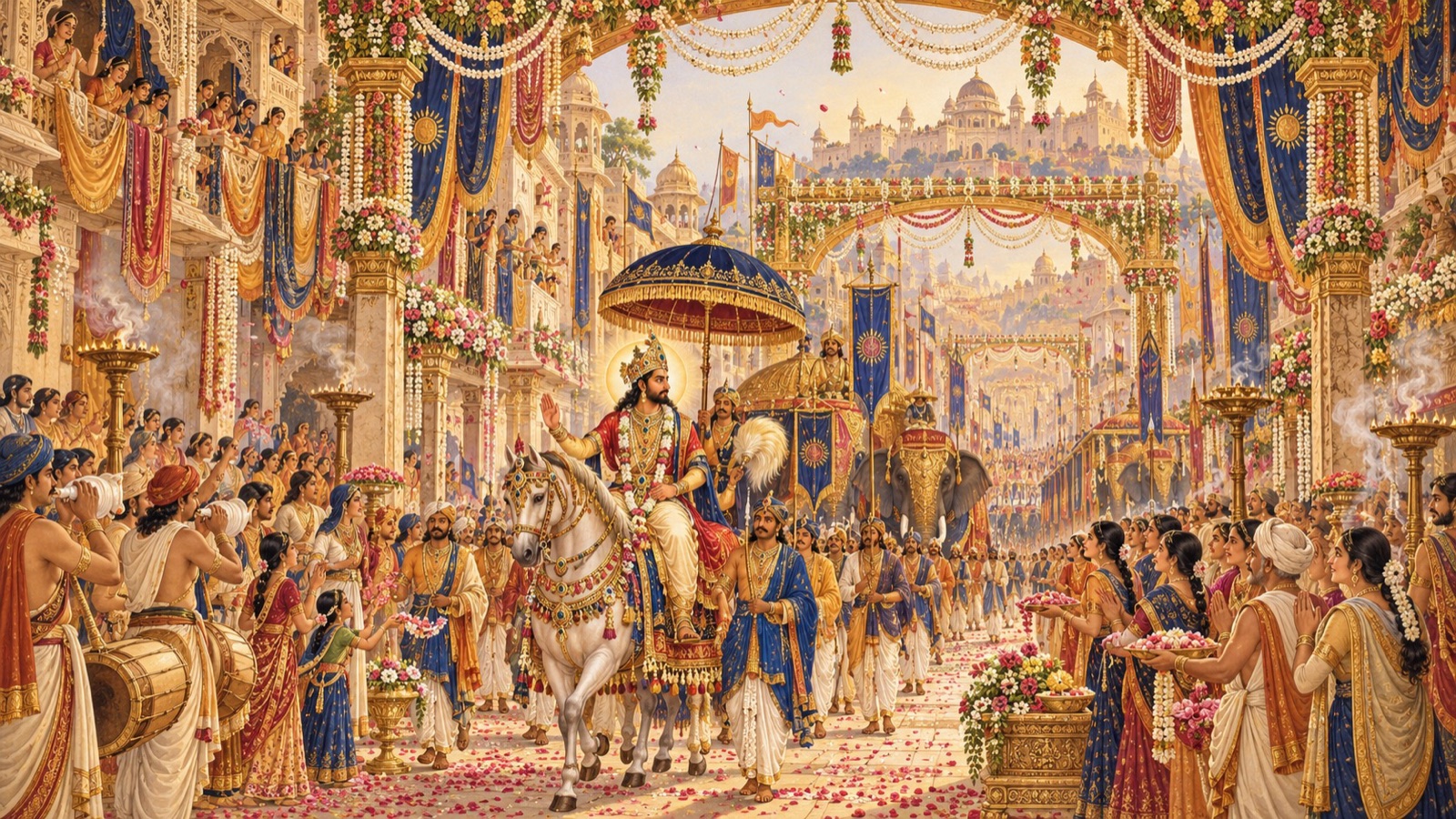
The whole city rejoiced to receive its king, and the citizens honoured him with every mark of love. In the midst of that celebration, Prithu, seated in his glory, turned to instruct his people for their lasting good.
The King’s Beautiful Counsel
Prithu’s speech was beautiful and richly figured, smooth and polished, deep and unfaltering. He spoke, as it were, for the benefit of all who heard, expressing out of his own realization the truth he wished to give them.
चारु चित्रपदं श्लक्ष्णं मृष्टं गूढमविक्लवम् । सर्वेषामुपकारार्थं तदा अनुवदन्निव ॥ २० ॥
cāru citra-padaṁ ślakṣṇaṁ mṛṣṭaṁ gūḍham aviklavam sarveṣām upakārārthaṁ tadā anuvadann iva
Meaning: His speech was beautiful and richly figured, smooth, polished, deep, and unfaltering; he spoke, as it were, for the benefit of all, expressing his own realization of the truth. (Canto 4, Chapter 21, verse 20)
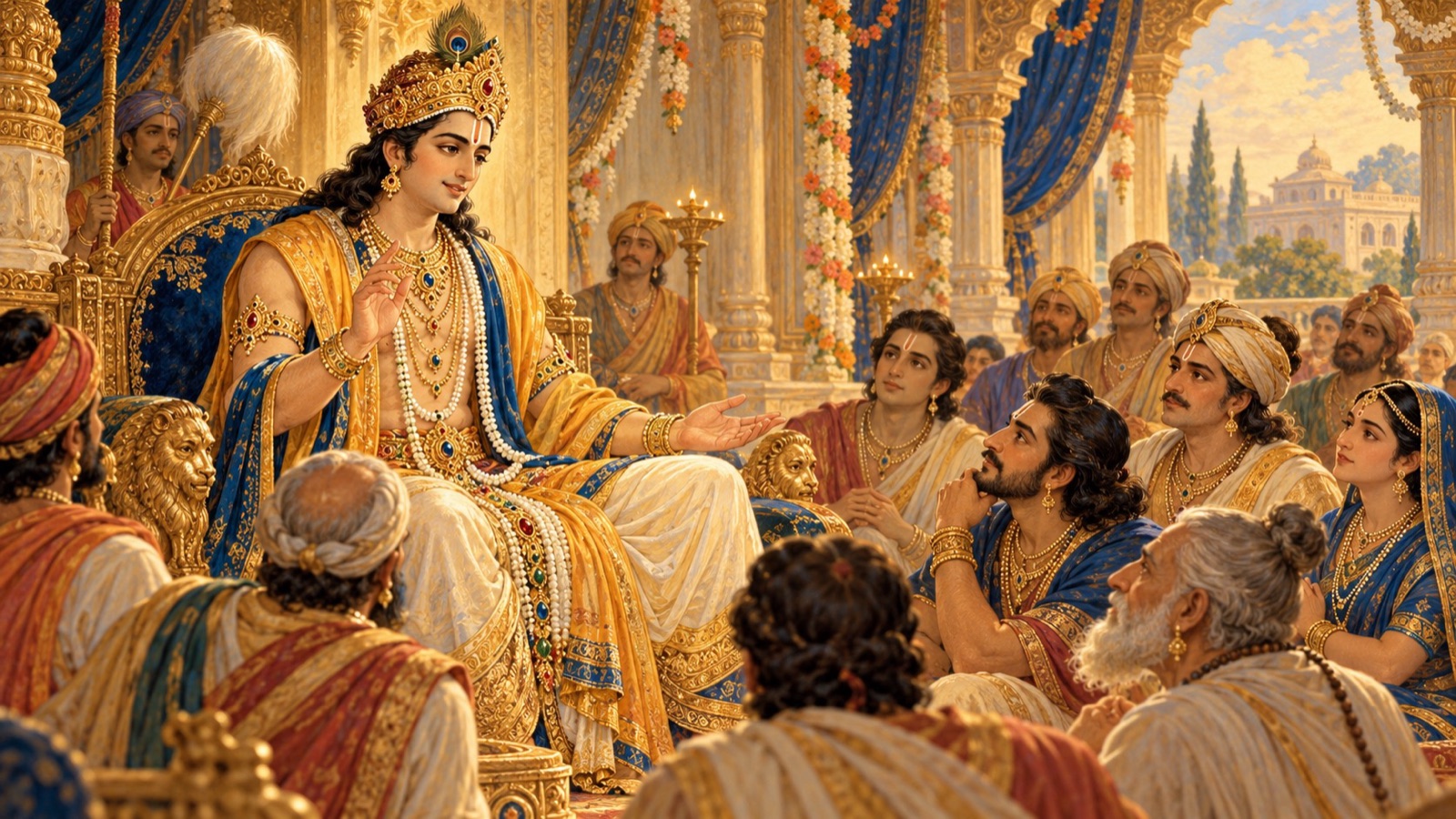
Then he set out the plain constitution of his own office, in his own words.
अहं दण्डधरो राजा प्रजानामिह योजित: । रक्षिता वृत्तिद: स्वेषु सेतुषु स्थापिता पृथक् ॥ २२ ॥
ahaṁ daṇḍa-dharo rājā prajānām iha yojitaḥ rakṣitā vṛttidaḥ sveṣu setuṣu sthāpitā pṛthak
Meaning: By the Lord’s grace I have been set upon this throne, rod of rule in hand — appointed to guard the citizens, to secure their livelihood, and to keep each one in the place fixed for him by Vedic order. (Canto 4, Chapter 21, verse 22)
A king’s authority, he continued, is no license for his own enjoyment, but a sacred trust: he is appointed by the Lord to guard his people and secure their livelihood, and he can fulfil that charge only by the Lord’s own pleasure — never by his power alone (verses 21–23). A ruler who governs faithfully shares in the merit of his citizens’ good deeds; but one who neglects to teach them their duties while still exacting taxes and tribute shares in their sin, for after death the fruit of any act is shared alike by its doer, its director, and its supporter (verses 24, 26). And he urged his subjects, too, to righteous living, to reverence for the brahmanas and the wise, and to detachment from the fleeting pleasures of the senses.
The Heart of the Teaching
Then Prithu came to the heart of his counsel: the loving worship of the Supreme Lord as the highest good of every soul. The taste for serving the Lord’s feet, he taught — growing day by day in the devout — swiftly destroys the impurity of mind piled up through countless births, just as the sacred river sprung from the Lord’s own toe washes all clean.
यत्पादसेवाभिरुचिस्तपस्विना- मशेषजन्मोपचितं मलं धिय: । सद्य: क्षिणोत्यन्वहमेधती सती यथा पदाङ्गुष्ठविनि:सृता सरित् ॥ ३१ ॥
yat-pāda-sevābhirucis tapasvinām aśeṣa-janmopacitaṁ malaṁ dhiyaḥ sadyaḥ kṣiṇoty anvaham edhatī satī yathā pad-aṅguṣṭha-viniḥsṛtā sarit
Meaning: The taste for serving His feet, growing day by day in the devout, quickly destroys the impurity of mind accumulated through countless births, as the sacred river sprung from the Lord’s toe cleanses all. (Canto 4, Chapter 21, verse 31)
Therefore, he urged them all, whatever their station, to worship that one Lord with all their faculties — mind, speech, and body — and with their own honest works, guilelessly; for His lotus feet fulfil every worthy desire, so that each may attain the fulfilment proper to his own duty.
तमेव यूयं भजतात्मवृत्तिभि- र्मनोवच:कायगुणै: स्वकर्मभि: । अमायिन: कामदुघाङ्घ्रिपङ्कजं यथाधिकारावसितार्थसिद्धय: ॥ ३३ ॥
tam eva yūyaṁ bhajatātma-vṛttibhir mano-vacaḥ-kāya-guṇaiḥ sva-karmabhiḥ amāyinaḥ kāma-dughāṅghri-paṅkajaṁ yathādhikārāvasitārtha-siddhayaḥ
Meaning: Worship Him alone, with all your faculties — mind, speech, and body — and with your own works, guilelessly; His lotus feet fulfil every desire, so that you attain the fulfilment proper to your own station. (Canto 4, Chapter 21, verse 33)
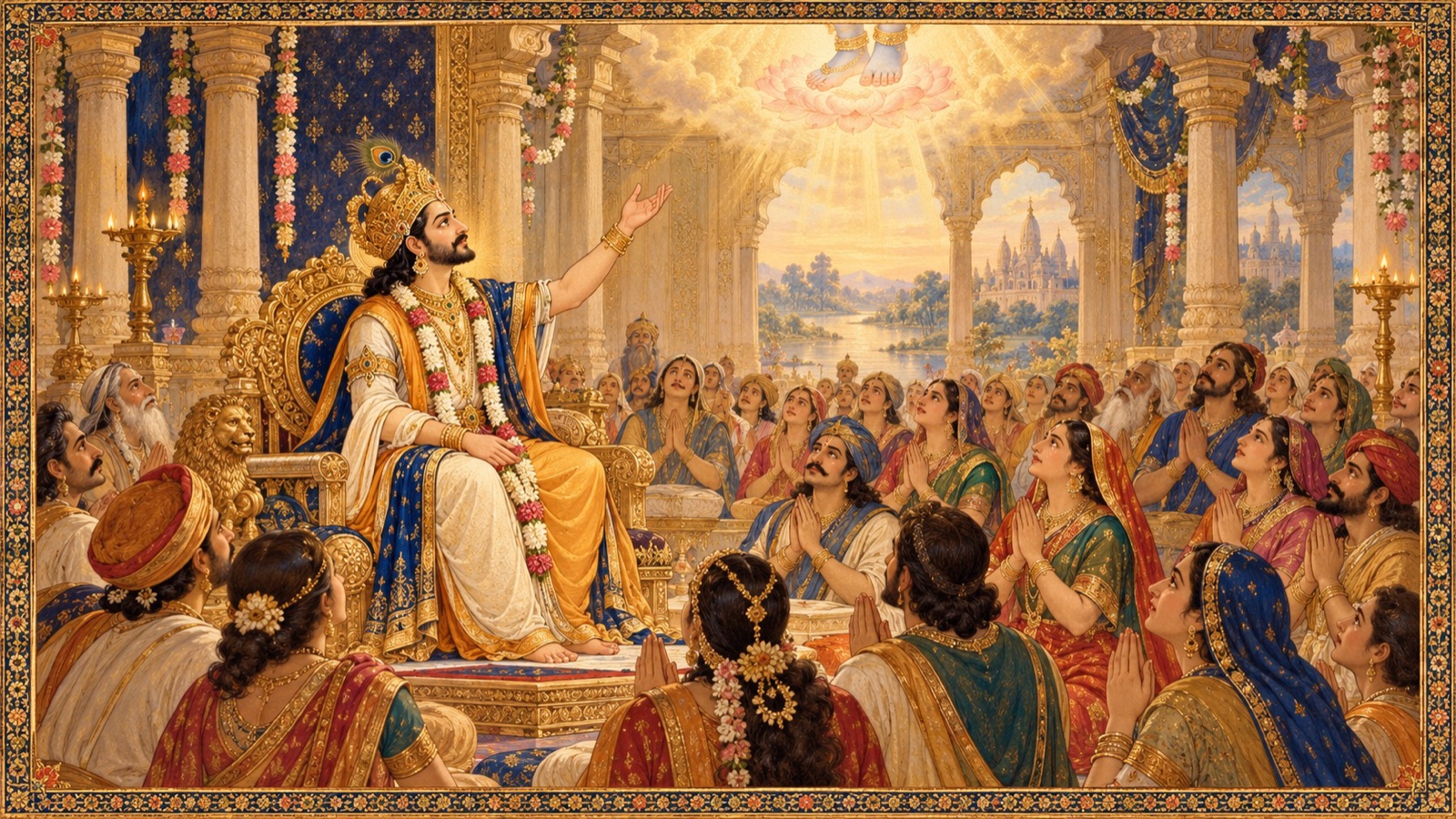
Reverence for the Brahmanas and Vaishnavas
Prithu went further still. Whatever sacrifice is offered in a demigod’s name, he explained, ultimately reaches and satisfies the one Supreme Lord, who alone is the master and enjoyer of every sacrifice (verses 34–36). Yet he warned that even a righteous king must never let his power fall upon the brahmanas and the Vaishnavas, whose tolerance, penance, and learning place them beyond the reach of royal authority (verse 37). His reasoning rests on more than royal caution — he grounds it in the Lord’s own conduct. Even the Supreme Personality of Godhead, ancient and self-sufficient, needing nothing from anyone, won His imperishable fortune and world-purifying fame by bowing at the feet of the brahmanas.
ब्रह्मण्यदेव: पुरुष: पुरातनो नित्यं हरिर्यच्चरणाभिवन्दनात् । अवाप लक्ष्मीमनपायिनीं यशो जगत्पवित्रं च महत्तमाग्रणी: ॥ ३८ ॥
brahmaṇya-devaḥ puruṣaḥ purātano nityaṁ harir yac-caraṇābhivandanāt avāpa lakṣmīm anapāyinīṁ yaśo jagat-pavitraṁ ca mahattamāgraṇīḥ
Meaning: The Supreme Person, eternal and foremost among the great, gained His own imperishable glory and universe-purifying fame only by bowing in worship at the feet of the brahmanas. (Canto 4, Chapter 21, verse 38)
If the Lord Himself is glorified through reverence for His devotees, Prithu reasons, then no one — however powerful — stands above that same duty. A life spent serving the brahmanas and Vaishnavas, he adds, clears the heart faster than any fire sacrifice, for it carries the offering to the Lord through the mouths of His living devotees rather than through flame alone (verses 40–41).
The King’s Humble Prayer
For all his greatness, Prithu closed not with a boast but with a humble prayer for the good of others and for grace upon himself. Prosperity, he said, naturally seeks out one whose only riches are virtue itself — honest character, a grateful heart, and respect shown to elders and teachers. And he prayed that the community of the brahmanas and the cows, and Janardana — the Lord himself — with all His associates, might be gracious to him.
गुणायनं शीलधनं कृतज्ञं वृद्धाश्रयं संवृणतेऽनु सम्पद: । प्रसीदतां ब्रह्मकुलं गवां च जनार्दन: सानुचरश्च मह्यम् ॥ ४४ ॥
guṇāyanaṁ śīla-dhanaṁ kṛta-jñaṁ vṛddhāśrayaṁ saṁvṛṇate ’nu sampadaḥ prasīdatāṁ brahma-kulaṁ gavāṁ ca janārdanaḥ sānucaraś ca mahyam
Meaning: (Prithu prayed:) Prosperity of itself attends the man who is a home of virtues, whose wealth is good character, who is grateful and shelters his elders; may the community of brahmanas and cows, and Janardana with His associates, be gracious to me. (Canto 4, Chapter 21, verse 44)
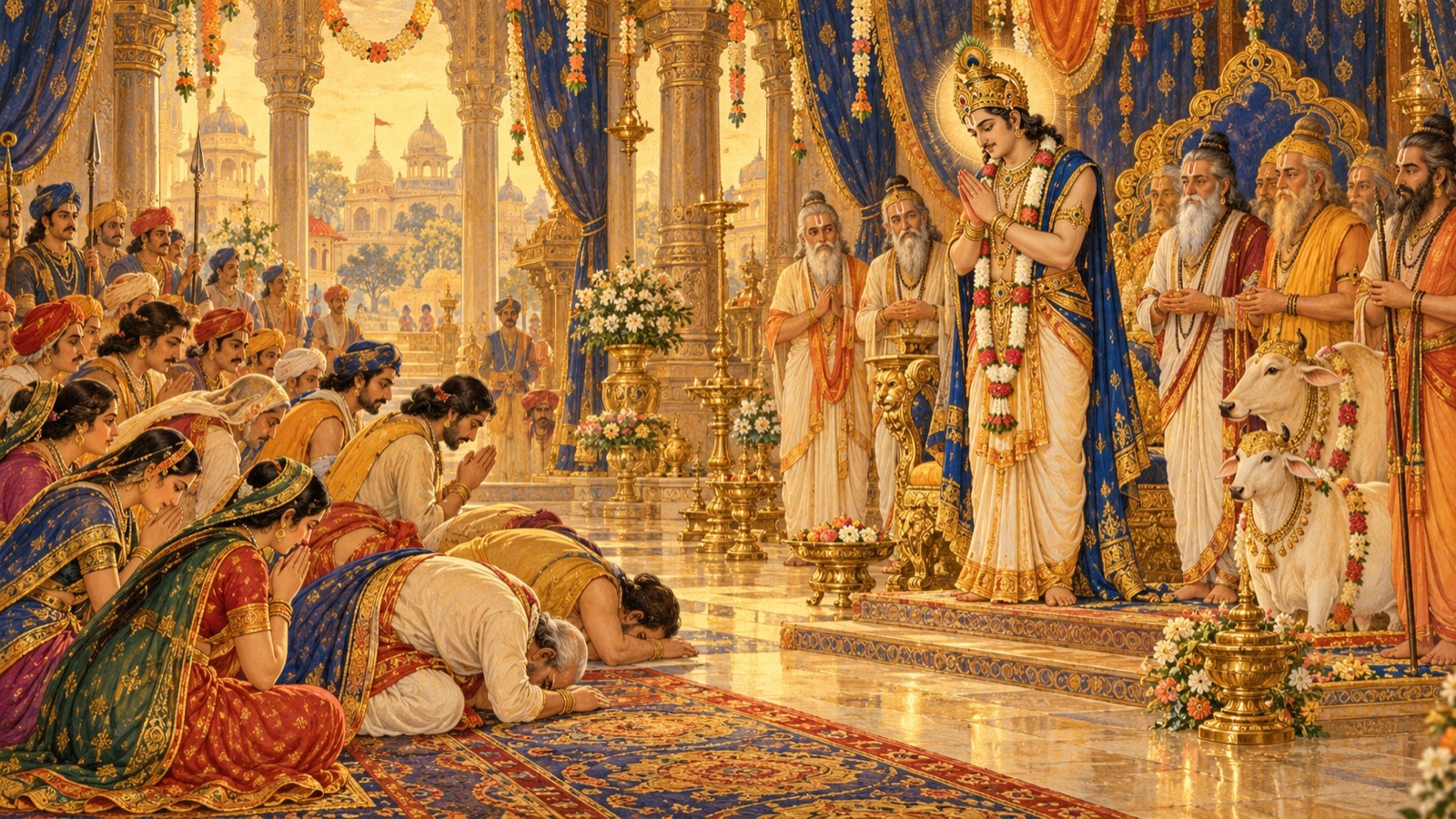
The people, moved to the depths by his wisdom and his humility, honoured him as a father and a protector, and blessed him in return. So the twenty-first discourse closes with a realm not only prosperous but instructed — its king having used his own greatness to turn every heart toward God — and poised for the visit of the great sages that the next chapter will bring.
Principal Teachings of This Chapter
1. Authority is a sacred trust, not a personal possession. Prithu teaches that a king’s power is given for the protection and service of his people, not for his own enjoyment. All authority is a charge to be answered for, not a prize to be spent (verses 21-23).
2. The ruler shares in the deeds of the ruled. A king who serves his citizens with real care shares in the fruit of their good deeds; a king who merely collects revenue without instructing them shares their sin instead. Responsibility binds us to the good and ill of those in our care (verses 24, 26).
3. The worship of the Lord is the highest good of every station. Whatever our place in life, Prithu says, our supreme duty is to worship the Lord with mind, speech, body, and honest work. Devotion is not the calling of a few but the fulfilment of all (verse 33).
4. Service to the Lord purifies the heart of countless lives. The taste for serving the Lord’s feet washes away the impurity of many births, like the sacred river from His toe. What we could never cleanse by our own effort, His service cleanses in us (verse 31).
5. Even the Lord bows to His own devotees. The eternal Supreme Person won His own imperishable glory by worshipping the feet of the brahmanas. If God finds His own fame this way, no one lesser stands above the duty to honour genuine saints (verse 38).
6. True greatness ends in humility and blessing. For all his power, Prithu closes by praying for the good of the brahmanas and cows and by seeking the Lord’s grace. Real greatness bends, at the last, into service and prayer (verse 44).
A Devotional Reflection
What is most striking about King Prithu’s teaching is the direction in which he points his own greatness. A lesser ruler, returning in triumph to an adorned city, might have used the moment to magnify himself. Prithu uses it to magnify the Lord. He has power, glory, and the love of his people entirely in his hands — and he spends all of it turning their eyes away from himself and toward God. This is the true test of any greatness we are given: not what we accumulate through it, but what we point people toward with it. Prithu teaches that his very throne is a trust, that his power is for service, and that the highest thing he can do for his people is not to enrich them but to lead them to the worship of the Lord. And notice how the chapter ends: not with the king exalted above his people, but bowed in humble prayer for the brahmanas and the cows and for the Lord’s grace upon himself. The arc of the chapter is the arc of a rightly-held greatness — power received, spent in service, and returned in humility. It asks us, whatever small authority or influence we hold, to hold it the same way: as a trust, for the service of others, and as a means of pointing every heart, including our own, back toward God.
A Daily Devotional Practice
Today, hold your own authority as a trust. In whatever sphere you have influence — over children, coworkers, a household, a community — consciously ask not “what can I gain from this?” but “whom am I here to serve?” Take one concrete act of service in that sphere today, and offer it to the Lord with the words “Om Namo Bhagavate Vasudevaya,” as Prithu offered his rule. Then, in the spirit of his central teaching, dedicate some ordinary work of your day — your job, a chore, a duty — to the Lord, doing it honestly and guilelessly as an act of worship, so that your daily labour itself becomes, as Prithu taught, a way of serving His lotus feet. In holding your responsibilities as service and your work as worship, you follow the king who used his greatness to turn every heart toward God.
Conclusion
The twenty-first discourse of Book Four shows King Prithu pouring the fruit of his own devotion into the welfare of his people. Home again in his flower-hung capital, he stands before the full assembly and speaks at length on the duties of rule. Kingship, he explains, is a charge answerable to the Lord and never a license for self-indulgence; a ruler stands accountable for the good or the harm that comes to those he governs; and every soul, whatever its station, is called to the loving worship of the Supreme Lord with mind, speech, body, and honest work — a service that purifies the heart of the burden of countless lives. He adds, too, that even the Lord Himself rose to eternal glory by bowing at the feet of the brahmanas, so that reverence for genuine saints is never beneath anyone, however great. For all his own greatness, Prithu ends not in pride but bowed low, seeking the goodwill of the twice-born and the cows and the mercy of Janardana upon himself. The people honour him as a father and protector. So the chapter teaches power held as service and greatness spent in pointing others to God — and readies us for the sages’ visit in the chapter to come.
May the divine wisdom of Srimad Bhagavatam awaken pure devotion within our hearts.
Om Namo Bhagavate Vasudevaya.
Jay Shree Madhav.
References and Attribution
- Primary edition: Gita Press, Śrīmad Bhāgavata Mahāpurāṇa (English, complete), Book Four, Discourse 21.
- Series: Srimad Bhagavatam Wisdom · Biswa Sanatan Dharma Seva Trust.
- Presented following the spiritual guidance and recommendation of Pandit Dr. Shri Kashinath Mishra.
This is an original, faithful retelling in the writer’s own words, with brief quoted verses shown in Devanāgarī and transliteration and their meanings given as summaries. It is not a reproduction of any single publisher’s continuous translation or commentary. No affiliation with or endorsement by any publisher is implied.
Jay Shree Madhav