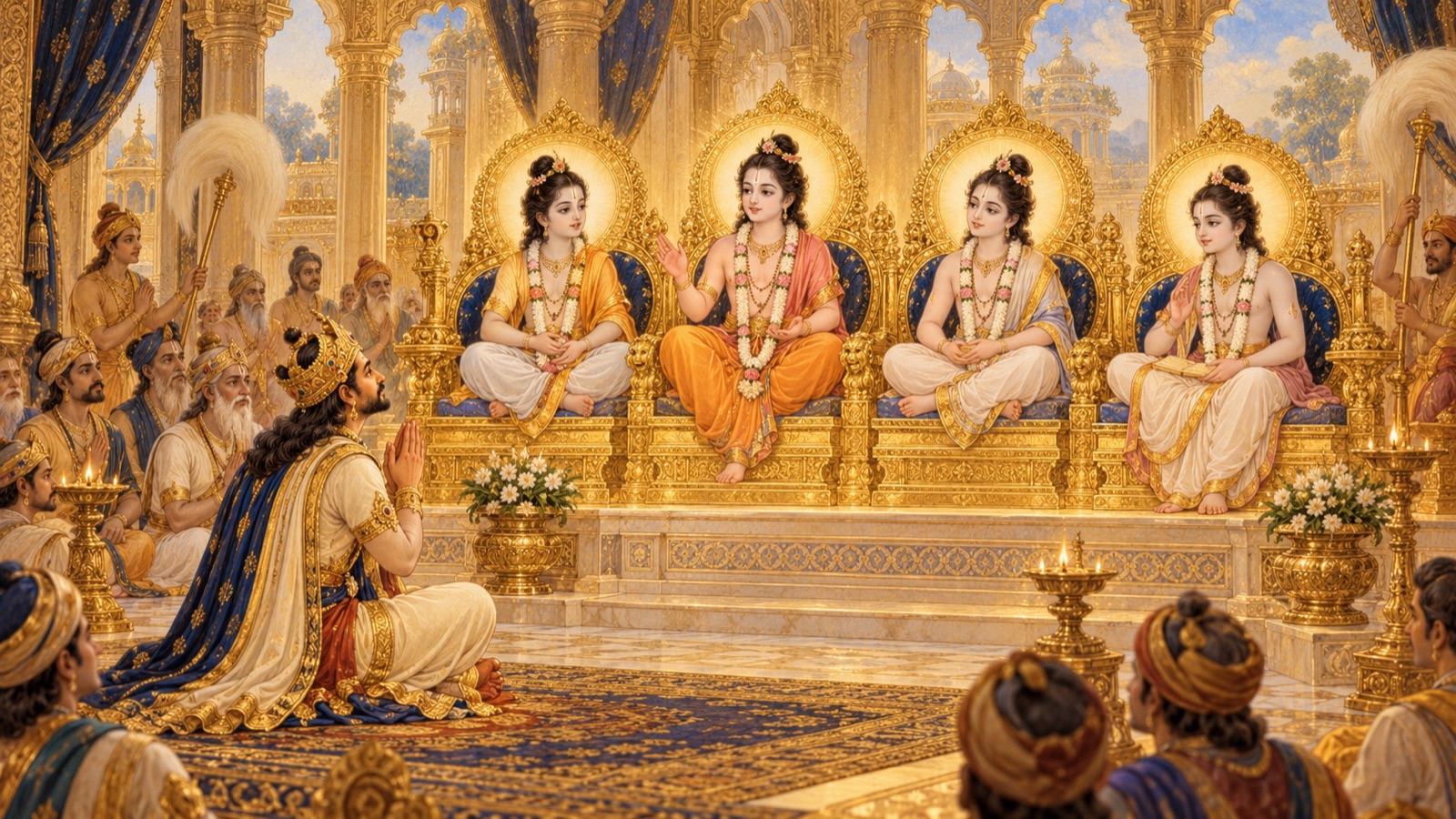
Seated on golden thrones and shining like sacred fires, the four eternally youthful sages — Sanaka and his brothers — impart the highest wisdom to King Prithu, who receives it bowed in reverence.
Om Namo Bhagavate Vasudevaya.
Om Namo Bhagavate Vasudevaya.
Om Namo Bhagavate Vasudevaya.
Welcome to Srimad Bhagavatam Wisdom, a devotional journey through the sacred histories and teachings of the Srimad Bhagavat Mahapurana. In the previous chapter, King Prithu taught his subjects that rule is a sacred trust and that the worship of the Lord is the highest good of every soul. This twenty-second chapter shows the great teacher himself become a humble student. As the people are still extolling his virtues, the four eternally youthful sages — Sanaka, Sanandana, Sanatana, and Sanatkumara, the mind-born sons of Brahma — descend and arrive at his assembly. Prithu rises at once and receives them with the utmost reverence, worshipping them and seating them on thrones of gold. Pleased by his humility, the Kumaras impart to him profound wisdom on the soul, on detachment, and on devotion to the Supreme Lord as the true purpose of a king’s — and every soul’s — life. Prithu receives it all with deep gratitude, and lives out its truth thereafter, unattached amid all his opulence, like the sun. It is a chapter about the humility of the great before the wise, and the teaching that the soul’s whole welfare lies in loving the Lord.
Chapter Information
- Scripture: Śrīmad Bhāgavata Mahāpurāṇa
- Canto: 4 (Book Four)
- Chapter: 22 (Discourse 22)
- Chapter title: The Four Kumaras Instruct King Prithu
- Principal speaker: The sage Maitreya, continuing his discourse to Vidura (with the words of Prithu and the four Kumaras quoted within)
- Principal listener: Vidura
- Main setting: The assembly of King Prithu
- Central subject: The arrival of the four Kumaras, Prithu’s reverent reception, and their instruction on the soul, detachment, and devotion
- Principal verse range: Canto 4, Chapter 22, verses 1–63
- Primary edition: Gita Press Śrīmad Bhāgavata Mahāpurāṇa
Context from the Previous Chapter
Chapter 21 closed with King Prithu instructing his subjects that a ruler holds his power only in trust for those he serves, and that no duty outranks devotion to the Lord. This twenty-second chapter turns the tables: the great teacher becomes a student, as the four Kumaras arrive to instruct him — and his greatness is shown most of all in the humility with which he receives them.
The Four Sages Arrive
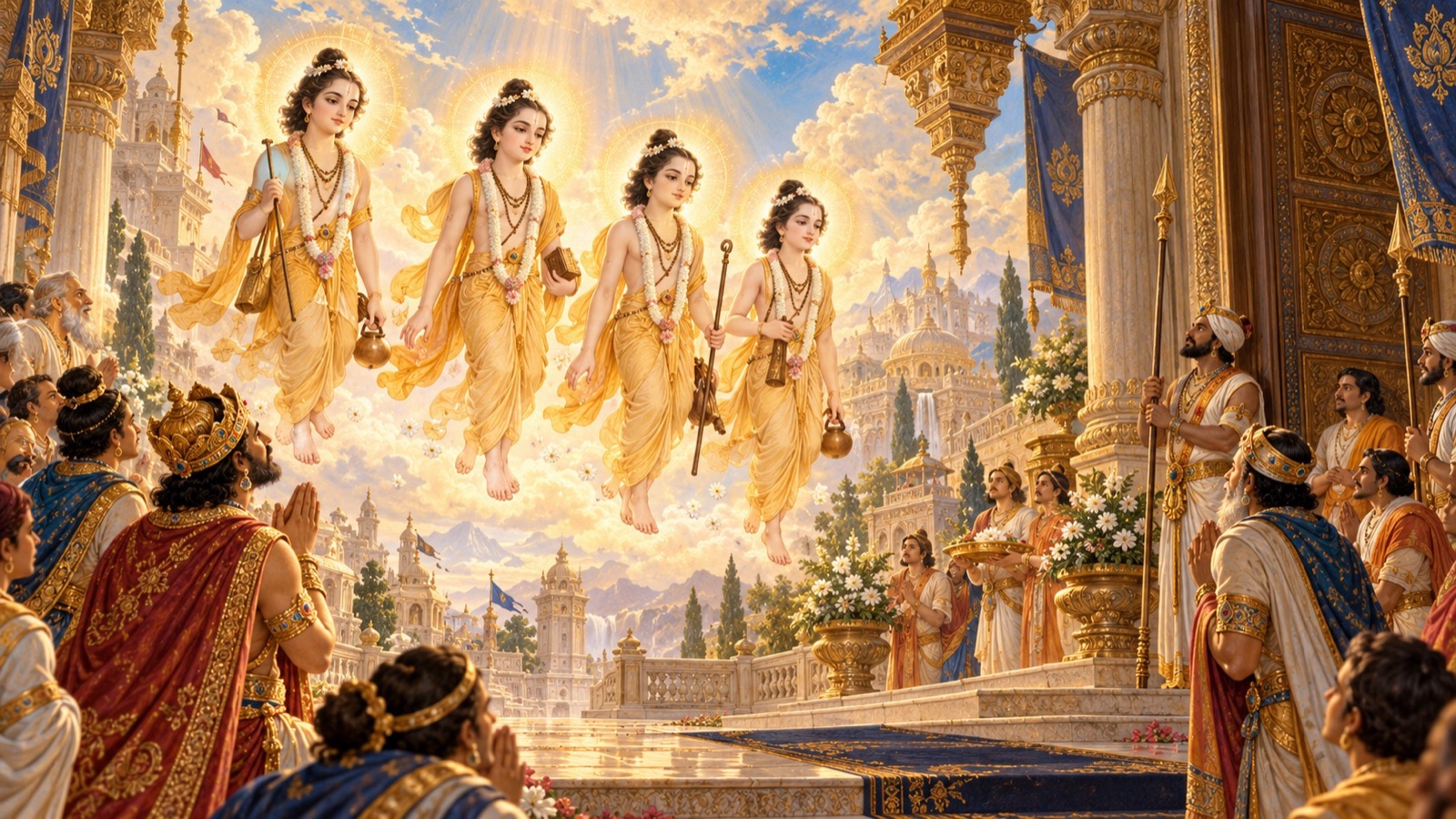
While the people were still extolling Prithu of mighty prowess, four sages, brilliant as the sun, arrived at his assembly — the eternally youthful mind-born sons of Brahma, Sanaka and his three brothers, wandering freely through the worlds.
मैत्रेय उवाच जनेषु प्रगृणत्स्वेवं पृथुं पृथुलविक्रमम् । तत्रोपजग्मुर्मुनयश्चत्वार: सूर्यवर्चस: ॥ १ ॥
maitreya uvāca janeṣu pragṛṇatsv evaṁ pṛthuṁ pṛthula-vikramam tatropajagmur munayaś catvāraḥ sūrya-varcasaḥ
Meaning: Maitreya said: Even as the citizens went on singing of Prithu’s great valor, four sages radiant as the sun descended and arrived before him. (Canto 4, Chapter 22, verse 1)
The King’s Reverent Reception
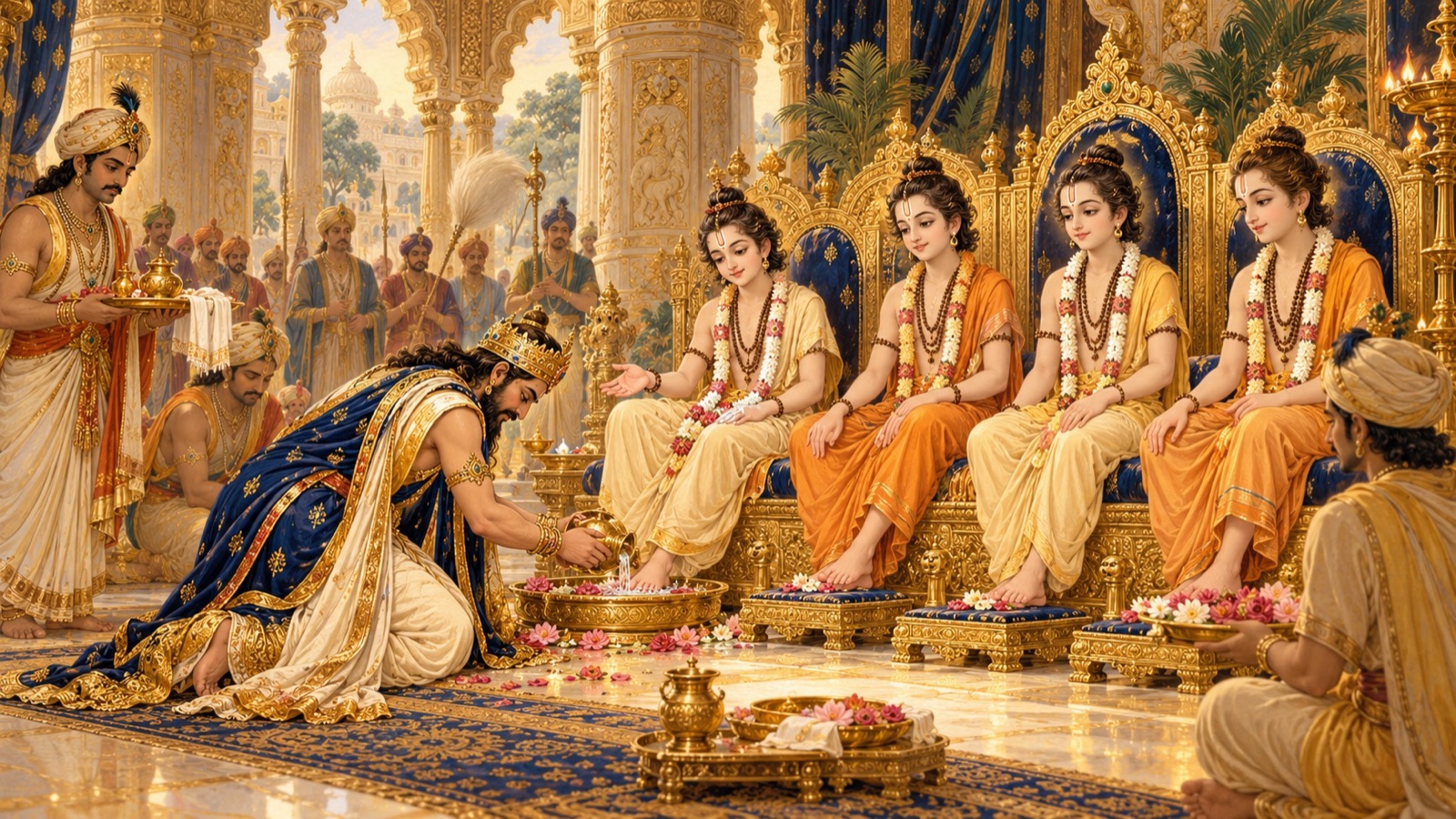
Recognizing at once who they were, Prithu rose from his throne, and, with all his court, went forward to receive them, bowing low and worshipping them with reverence, water for their feet, and every honour. When the four great sages — elders even of Lord Shiva — were seated on thrones of gold, shining there like sacred fires upon their altars, the king, filled with faith and self-restraint, gladly addressed them, grateful beyond words for the fortune of their coming.
हाटकासन आसीनान् स्वधिष्ण्येष्विव पावकान् । श्रद्धासंयमसंयुक्त: प्रीत: प्राह भवाग्रजान् ॥ ६ ॥
hāṭakāsana āsīnān sva-dhiṣṇyeṣv iva pāvakān śraddhā-saṁyama-saṁyuktaḥ prītaḥ prāha bhavāgrajān
Meaning: When they were seated on golden thrones, shining like sacred fires on their altars, Prithu, filled with faith and self-restraint, gladly addressed those elders of Lord Shiva. (Canto 4, Chapter 22, verse 6)
He confessed his good fortune that such rare and holy visitors had come to his door, and humbly asked them to instruct him in the surest path to the soul’s welfare, so that he might not waste the great trust of his life (verses 7–9). Even a household of modest means, he said, is glorified the moment it offers water and a seat to such guests, while the grandest home that never opens its door to a devotee of the Lord is no better than a den where venomous serpents live (verses 10–11).
The Teaching of the Kumaras
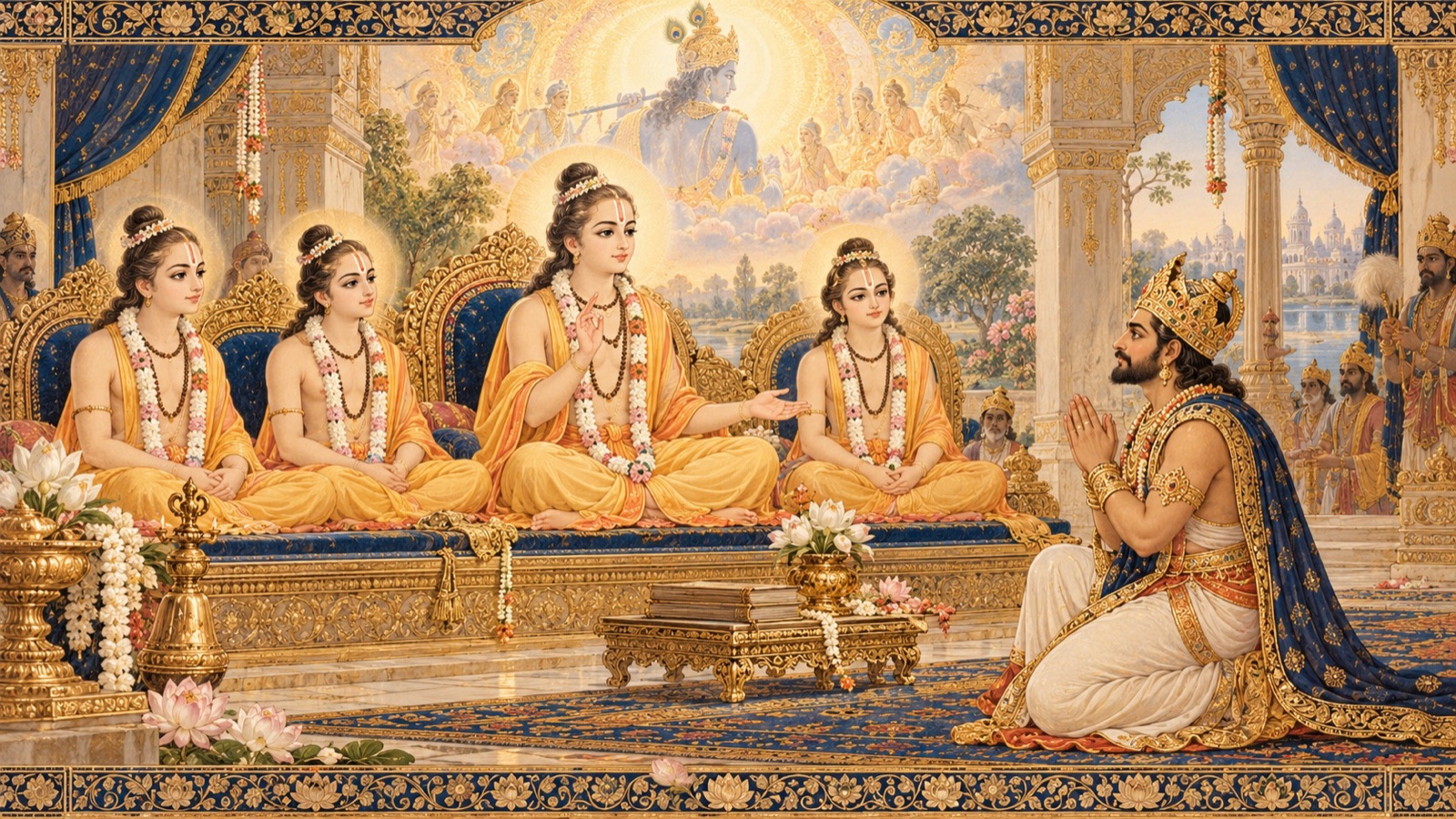
The eldest of the Kumaras, Sanat-kumara, replied with the highest wisdom, teaching that the whole aim of the scriptures, when carefully considered, comes down to one sure thing: firm, unattached love for the Self — the Self that is distinct from the body — for Brahman, the attributeless Supreme.
शास्त्रेष्वियानेव सुनिश्चितो नृणां क्षेमस्य सध्र्यग्विमृशेषु हेतु: । असङ्ग आत्मव्यतिरिक्त आत्मनि दृढा रतिर्ब्रह्मणि निर्गुणे च या ॥ २१ ॥
śāstreṣv iyān eva suniścito nṛṇāṁ kṣemasya sadhryag-vimṛśeṣu hetuḥ asaṅga ātma-vyatirikta ātmani dṛḍhā ratir brahmaṇi nirguṇe ca yā
Meaning: (The sages taught:) In all the scriptures, this alone is declared, on careful reflection, the sure cause of a person’s welfare — firm, unattached love for the Self, distinct from the body, for Brahman, the attributeless Supreme. (Canto 4, Chapter 22, verse 21)
They taught the way of detachment: that attachment to the body and to sense-pleasure binds the soul, while dispassion, self-knowledge, and above all loving devotion to the Lord set it free. And they named the deepest folly of all — that there is no greater failure of a person’s own true self-interest than to hold anything whatever dearer than his own self-realization.
नात: परतरो लोके पुंस: स्वार्थव्यतिक्रम: । यदध्यन्यस्य प्रेयस्त्वमात्मन: स्वव्यतिक्रमात् ॥ ३२ ॥
nātaḥ parataro loke puṁsaḥ svārtha-vyatikramaḥ yad-adhy anyasya preyastvam ātmanaḥ sva-vyatikramāt
Meaning: There is no greater failure of one’s own self-interest in this world than to hold anything else dearer than one’s own self-realization. (Canto 4, Chapter 22, verse 32)
The sages went further, warning that a life spent chasing money and sense-pleasure drags the soul down toward the very stillness of trees and stones, while a life aimed rightly can still cross the ocean of ignorance. Of the four aims of human life — religious duty, wealth, regulated pleasure, and liberation — they told Prithu that liberation alone deserves to be taken seriously, for the other three are seized by death in the end; whatever fortune or heaven a man wins by his own effort is still dissolved, sooner or later, by the very Lord who granted it (verses 33–36).
They then explained that the Supreme Personality of Godhead sits within the heart of every being, moving or unmoving, beside the individual soul itself — two companions sharing one dwelling. But this nearness, they cautioned, is not oneness: a soul that mistakes itself for the Supreme is like a man who mistakes a rope for a snake in the dark, and once that confusion is cleared away by right understanding, nothing remains to be done but to surrender to the Lord, who is always beyond the reach of matter (verses 37–38).
Here the Kumaras revealed why loving devotion succeeds where other paths struggle. The pull of the senses flows on like the waves of a river, and the philosopher or the yogi who merely tries to dam it back is eventually swept away, for suppressing a desire is not the same as being free of it. The devotee, by contrast, is not asked to fight the current at all: loving service to the Lord floods the heart with a sweeter longing, and the lesser currents are simply overwhelmed and lost within it (verse 39). So the surest way across the ocean of ignorance, infested as it is with the sharks of birth and death, is not the exhausting labour of the ascetic but a boat already at hand — the worshippable lotus feet of the Lord, which carry to safety anyone who will simply climb aboard.
कृच्छ्रो महानिह भवार्णवमप्लवेशां षड्वर्गनक्रमसुखेन तितीर्षन्ति । तत्त्वं हरेर्भगवतो भजनीयमङ्घ्रिं कृत्वोडुपं व्यसनमुत्तर दुस्तरार्णम् ॥ ४० ॥
kṛcchro mahān iha bhavārṇavam aplaveśāṁ ṣaḍ-varga-nakram asukhena titīrṣanti tat tvaṁ harer bhagavato bhajanīyam aṅghriṁ kṛtvoḍupaṁ vyasanam uttara dustarārṇam
Meaning: This ocean of material existence is very hard to cross, and it is full of dangerous sharks. Rather than struggle against it unaided, simply make a boat of the worshippable lotus feet of the Lord and cross over with ease. (Canto 4, Chapter 22, verse 40)
Deeply moved, Prithu bowed before Sanat-kumara and recalled that Lord Vishnu himself had once promised this very meeting would come to pass; now, he said, he had nothing left to offer in return except everything he possessed — his life, his family, his throne, and his treasury, which he freely laid at the sages’ feet (verses 41–44). He added that only one schooled in the wisdom of the Vedas is truly fit to rule, since king and commoner alike live by the mercy of such Vedic teachers and must be guided by them; no gift of his, he confessed, could ever repay teachers who had given such treasure freely (verses 45–47). Delighted, the four sages blessed the king, praised his character before the whole assembly, and rose again into the sky exactly as they had come (verses 48–49).
Prithu Lives the Teaching
Prithu did not merely admire the wisdom of the Kumaras; he lived it. His freedom was not a natural gift but the very discipline the sages had shown him: he offered the fruit of every action to the Supreme, keeping nothing back as his own, and in that constant offering he stood — though a householder ruling a vast empire — in the same inward renunciation as one who has left the world entirely (verses 50–51). It was this, and not any withdrawal from his duties, that let him rule, provide, and enjoy his empire’s full opulence without the ego that ordinarily comes with possession. Though he dwelt at home amid the full splendour of an entire empire, he never grew attached to the objects of the senses; free of ego, he remained untouched by his own opulence, like the sun — which lights and warms all things yet is stained by none.
गृहेषु वर्तमानोऽपि स साम्राज्यश्रियान्वित: । नासज्जतेन्द्रियार्थेषु निरहंमतिरर्कवत् ॥ ५२ ॥
gṛheṣu vartamāno ’pi sa sāmrājya-śriyānvitaḥ nāsajjatendriyārtheṣu niraham-matir arkavat
Meaning: Though he dwelt at home amid the splendour of an entire empire, Prithu, free of ego, never grew attached to the objects of the senses — untouched, like the sun. (Canto 4, Chapter 22, verse 52)
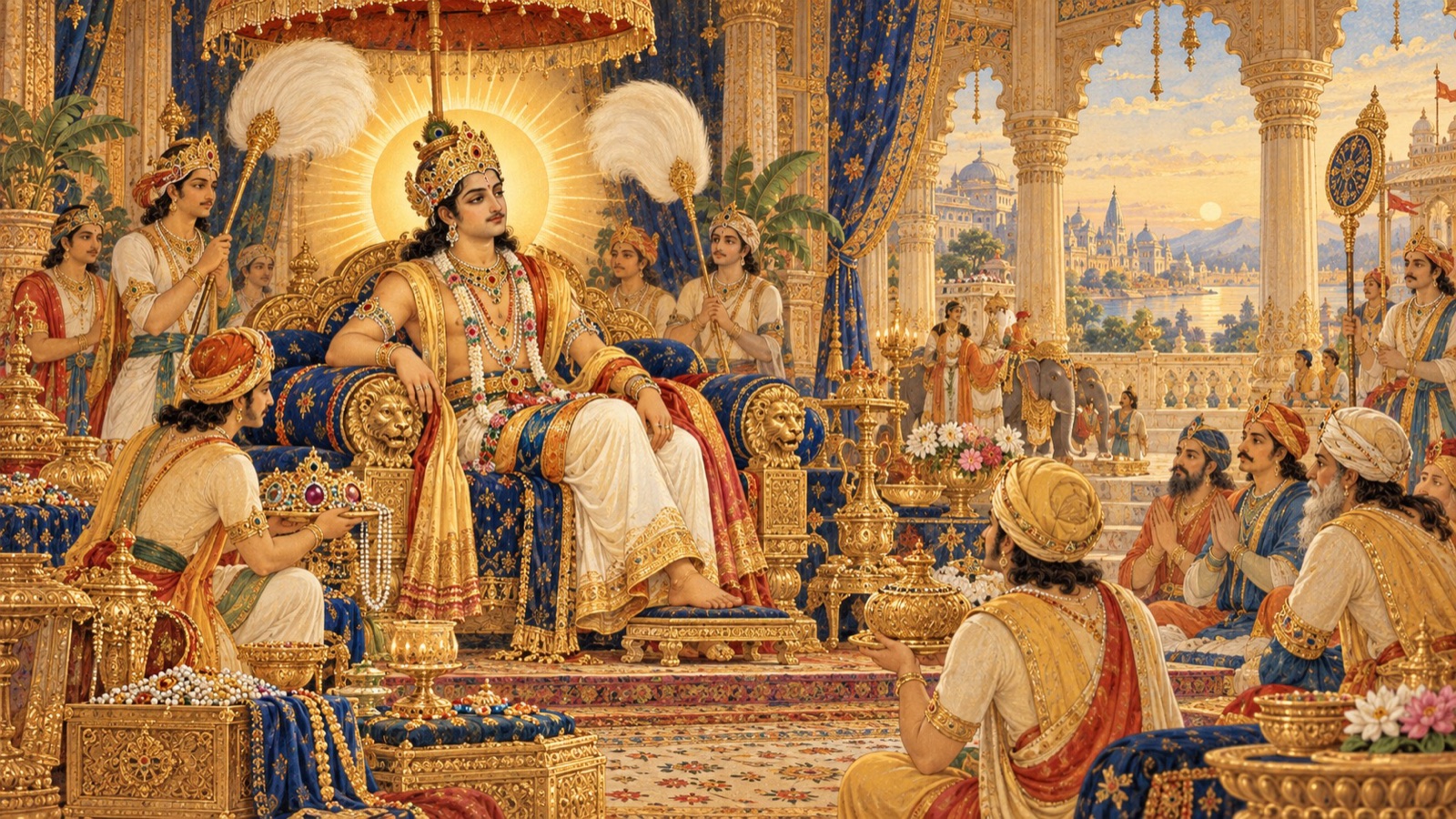
He ruled righteously, worshipped the Lord, and cared for his people, and yet his heart rested always beyond the reach of what it possessed. So the twenty-second discourse closes with a king who is both the master of an empire and the humble disciple of the wise — and whose true wealth is the detachment and devotion the Kumaras taught him. It readies us for the next chapter, where Prithu, in the fullness of time, will turn from the world altogether to seek the Lord.
Principal Teachings of This Chapter
1. The truly great remain humble before the wise. Prithu, an emperor and himself a great teacher, rises to worship the four sages and asks to be taught. Greatness is proven not by refusing to learn but by the humility to receive wisdom (verses 6-11).
2. The whole welfare of the soul lies in one thing. The Kumaras distil all the scriptures to a single point: firm, unattached love for the Self and for Brahman, the attributeless Supreme. The many teachings converge on the one thing needful (verse 21).
3. There is no worse mistake than neglecting self-realization. To hold anything dearer than the soul’s true good is, the sages say, the greatest failure of self-interest. We ruin ourselves not by wanting too much but by wanting the wrong things more (verse 32).
4. Of the four goals of life, liberation alone is worth taking seriously. Religion, wealth and regulated pleasure are all seized by death in the end; only liberation is not (verses 34-36).
5. Devotion does not fight desire — it overwhelms it with something sweeter. The jnani and the yogi struggle against the waves of the senses and are often swept away; the devotee simply floods the heart with a greater love, and the lesser currents are lost within it. This is why the Kumaras call the Lord’s lotus feet the readiest boat across the ocean of ignorance (verses 39-40).
6. True renunciation is offering the fruit of action to the Lord, not fleeing action itself. Prithu remained a ruling emperor yet lived as inwardly free as a renunciant, because he dedicated every result to the Supreme rather than claiming it as his own (verses 50-52).
A Devotional Reflection
There is a quiet greatness in watching a king who has just taught his whole people become, in the very next scene, a student on his knees. Prithu has power, wisdom, and the adoration of a realm — and the moment four holy sages arrive, he rises, bows, washes their feet, and asks to be taught. This is the humility that keeps greatness from curdling into pride: the knowledge that however much we have learned, there is always someone wiser, and that the highest use of what we know is to keep learning. And the teaching he receives cuts to the very centre of a devotional life. The Kumaras do not give him a hundred rules; they give him one thing — that the soul’s whole welfare lies in unattached love for the Supreme — and one warning: that nothing ruins us so surely as valuing anything else above our own realization of God. Most of us do not reject God outright; we simply, quietly, keep finding other things more urgent, more pleasing, more real. The chapter names this gently as the greatest of all failures. And then it shows us the alternative, embodied in Prithu himself: a life lived fully in the world — ruling, working, providing — yet with a heart that rests, like the sun, above everything it touches. Notice, too, the sages’ most liberating promise: we are not asked to strangle our own desires by sheer force, the way the struggling ascetic tries and so often fails; we are only asked to let a sweeter love overwhelm them, the way a boat carries a traveller over water he could never swim. That is the freedom the sages teach, and the king lives: to hold all things, and cling to none, because the heart is already given to God.
A Daily Devotional Practice
Today, practise being “like the sun” — present to everything, attached to nothing. Choose one activity you will do anyway — your work, a meal, a conversation, a duty — and do it fully and well, but inwardly hold it loosely, offering it to the Lord with the words “Om Namo Bhagavate Vasudevaya,” as Prithu held his empire. As you go through the day, notice the things you are tempted to make “dearer than your own self-realization” — a worry, a craving, a grievance — and, remembering the Kumaras’ warning, gently set them below your love of God rather than above it. And in the spirit of Prithu welcoming the sages, seek out, in reading or in company, some word of the wise today, and receive it humbly, as an emperor once knelt to receive the wisdom of four youthful sages.
Conclusion
The twenty-second discourse of Book Four shows the great King Prithu become a humble student of the wise. As the people are still extolling him, the four eternally youthful Kumaras — Sanaka and his brothers, the mind-born sons of Brahma — arrive at his assembly. Prithu rises at once, worships them, and seats them on thrones of gold, and humbly asks to be instructed in the soul’s welfare. Sanat-kumara answers with the highest wisdom: that the scriptures reduce to one point, steady and unattached love fixed on the self beyond the body and on the formless Absolute; that no failure runs deeper than valuing anything above one’s own self-realization; that of religion, wealth, pleasure and liberation, only liberation is not undone by death; and that devotion does not merely struggle against desire as the ascetic does, but drowns it in a sweeter longing, carrying the soul across the ocean of ignorance as a boat carries a traveller to shore. Overwhelmed with gratitude, Prithu offers the sages his very kingdom and life, and they bless him before rising again into the sky. He lives out everything he has learned, ruling his empire while dedicating every act to the Lord, and remains amid its full splendour untouched, like the sun. This closing chapter sets before every reader the same choice it once set before an emperor — to keep wisdom for oneself, or to receive it as Prithu did, on bended knee, and then in a life fully lived by it.
May the divine wisdom of Srimad Bhagavatam awaken pure devotion within our hearts.
Om Namo Bhagavate Vasudevaya.
Jay Shree Madhav.
References and Attribution
- Primary edition: Gita Press, Śrīmad Bhāgavata Mahāpurāṇa (English, complete), Book Four, Discourse 22.
- Series: Srimad Bhagavatam Wisdom · Biswa Sanatan Dharma Seva Trust.
- Presented following the spiritual guidance and recommendation of Pandit Dr. Shri Kashinath Mishra.
This is an original, faithful retelling in the writer’s own words, with brief quoted verses shown in Devanāgarī and transliteration and their meanings given as summaries. It is not a reproduction of any single publisher’s continuous translation or commentary. No affiliation with or endorsement by any publisher is implied.
Jay Shree Madhav