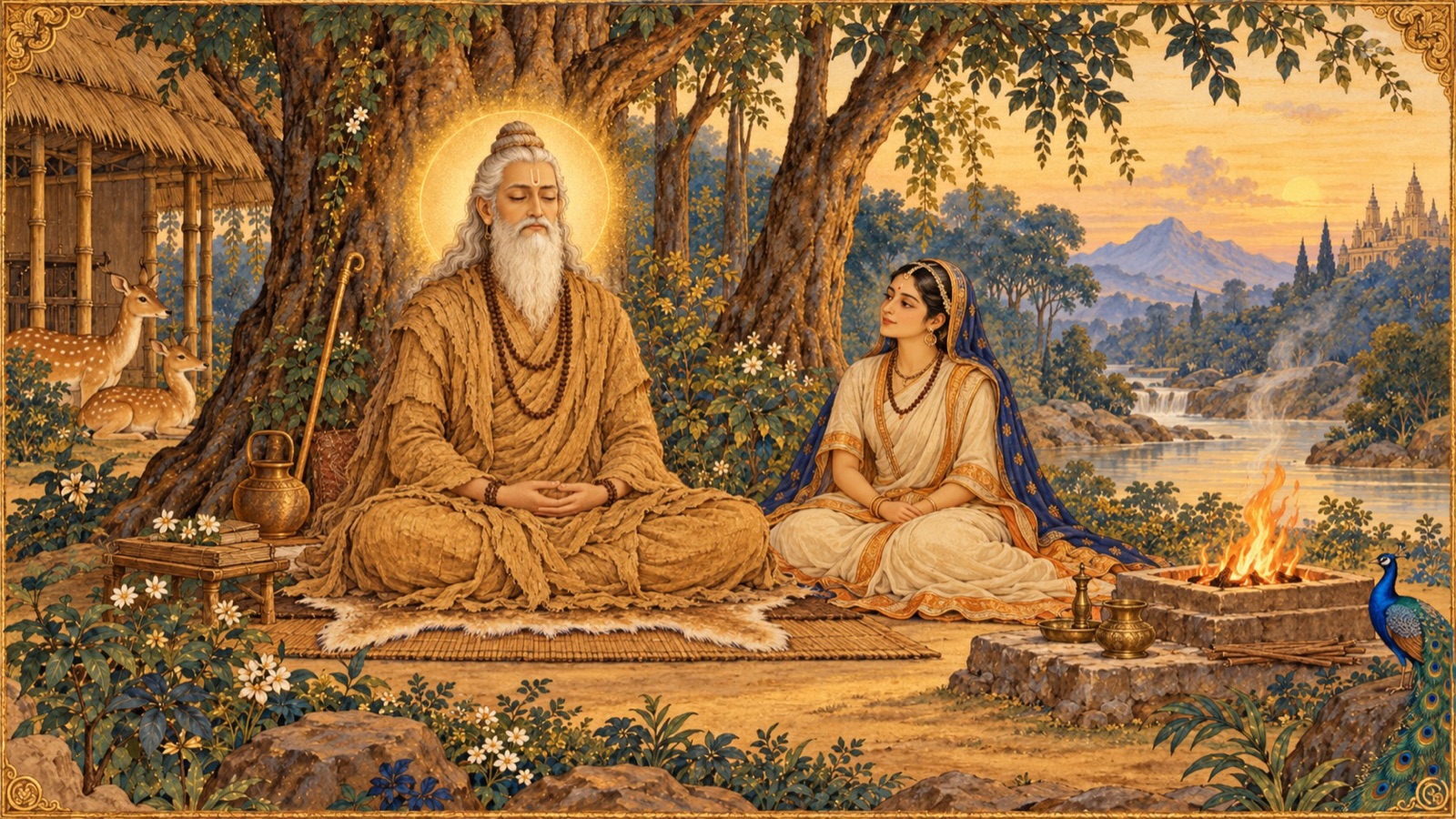
Having ruled long and righteously, King Prithu retires with his devoted queen to the forest, and there, in deep austerity and single-minded love, fixes his heart wholly upon the Supreme Lord.
Om Namo Bhagavate Vasudevaya.
Om Namo Bhagavate Vasudevaya.
Om Namo Bhagavate Vasudevaya.
Welcome to Srimad Bhagavatam Wisdom, a devotional journey through the sacred histories and teachings of the Srimad Bhagavat Mahapurana. In the previous chapter, the great King Prithu humbly received the wisdom of the four Kumaras and lived it out, unattached amid all his splendour, like the sun. This twenty-third chapter brings his noble life to its serene close. Having ruled long and righteously, Prithu in his later years entrusts his kingdom to his sons and retires with his devoted queen, Archi, to the forest. There he takes up a severe and single-minded austerity for the sole pleasure of the Lord, withdrawing his mind wholly from the world and fixing it upon the Supreme. At the end of his ascetic life, established in his own true self by the power of knowledge and detachment, he gives up his mortal body in perfect devotion and attains the supreme abode of the Lord; and his faithful queen, unable to live apart from him, follows him in death and in glory. Maitreya closes with the promise that whoever hears this holy story attains the very abode that Prithu attained. It is a chapter about a life completed in devotion, and a death that is not an end but a homecoming.
Chapter Information
- Scripture: Śrīmad Bhāgavata Mahāpurāṇa
- Canto: 4 (Book Four)
- Chapter: 23 (Discourse 23)
- Chapter title: King Prithu’s Asceticism and Departure to the Lord
- Principal speaker: The sage Maitreya, continuing his discourse to Vidura
- Principal listener: Vidura
- Main setting: The forest hermitage to which King Prithu and Queen Archi retire
- Central subject: Prithu’s retirement, his austerity and devotion, his departure to the Lord’s abode, and Archi’s following
- Principal verse range: Canto 4, Chapter 23, verses 1–39
- Primary edition: Gita Press Śrīmad Bhāgavata Mahāpurāṇa
Context from the Previous Chapter
Chapter 22 showed King Prithu receiving the instruction of the four Kumaras with deep humility, and living it out, remaining amid his imperial splendour unattached, like the sun. This twenty-third chapter shows the natural fruit of that detachment: in the fullness of time, Prithu turns from the world altogether and retires to the forest to seek the Lord.
Retirement to the Forest
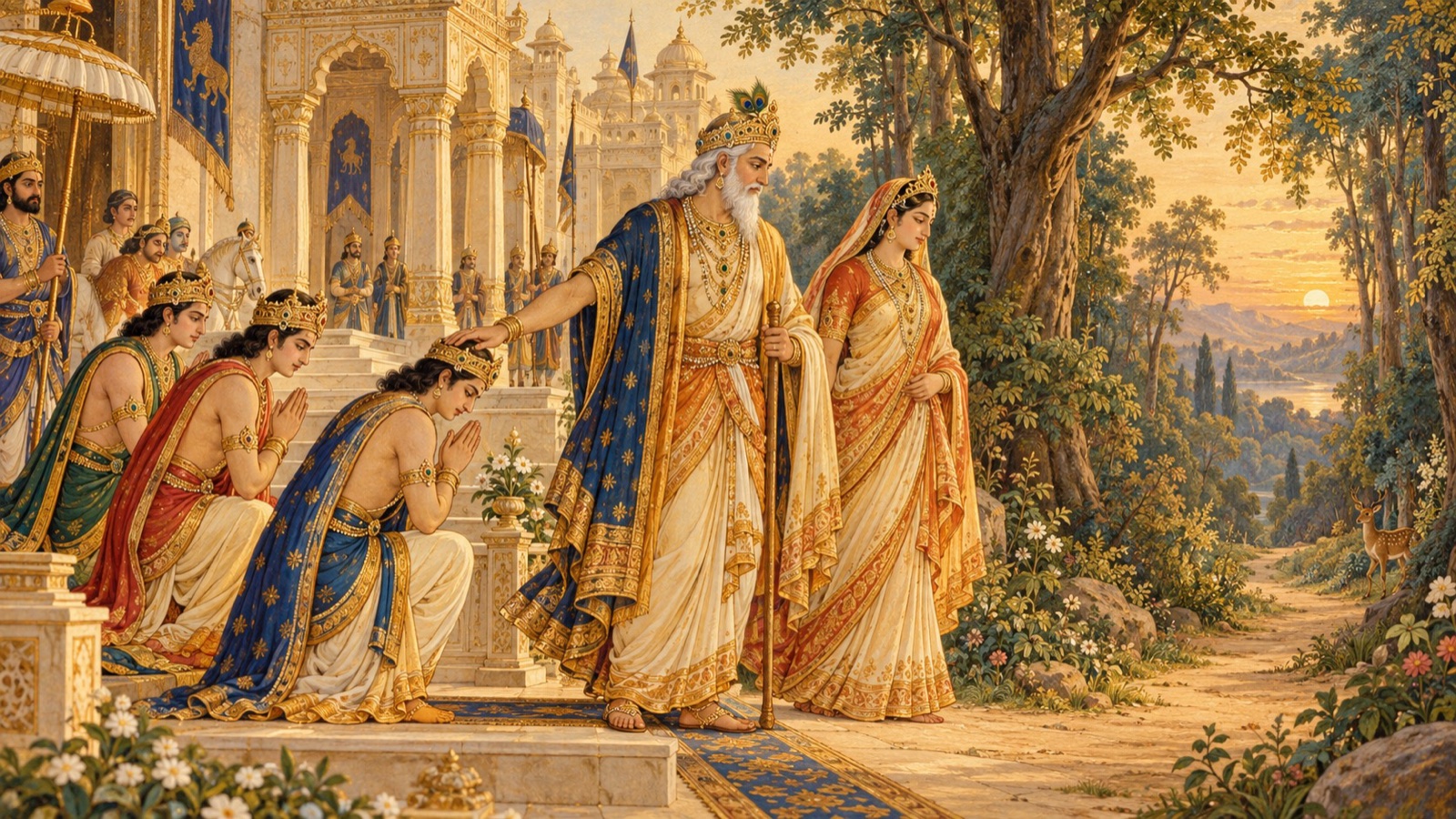
When Prithu had ruled long and righteously and saw that his life’s work was done, he entrusted his kingdom to his sons and, with his devoted queen Archi, withdrew from his capital to a forest hermitage, taking up the austere and simple life of one wholly given to the Lord.
There, forsaking the comforts of a great empire for the discipline of the forest, he lived at first on the roots and trunks of trees, then on fruit and dried leaves, then for a stretch on water alone, and at last on the breath alone, mastering his body ever more completely. In the summer he sat encircled by blazing fires beneath the full sun, in the rainy season he stood exposed to the falling torrents, and through the winter he stood in water up to his neck, sleeping only upon the bare earth — turning every hardship of the forest toward the one goal of his heart (verses 4–6).
The Highest Austerity
Forbearing, controlling his speech and his senses, celibate, mastering even the life-breath within him, Prithu practised the highest austerity — and all of it for one purpose only: to please Krishna, the Supreme Lord. He sought no heaven, no power, no reward, but only the satisfaction of the Lord he loved.
तितिक्षुर्यतवाग्दान्त ऊर्ध्वरेता जितानिल: । आरिराधयिषु: कृष्णमचरत्तप उत्तमम् ॥ ७ ॥
titikṣur yata-vāg dānta ūrdhva-retā jitānilaḥ ārirādhayiṣuḥ kṛṣṇam acarat tapa uttamam
Meaning: Forbearing, controlling his speech and senses, celibate, and mastering the life-breath, Prithu practised the highest austerity, longing only to please Krishna. (Canto 4, Chapter 23, verse 7)
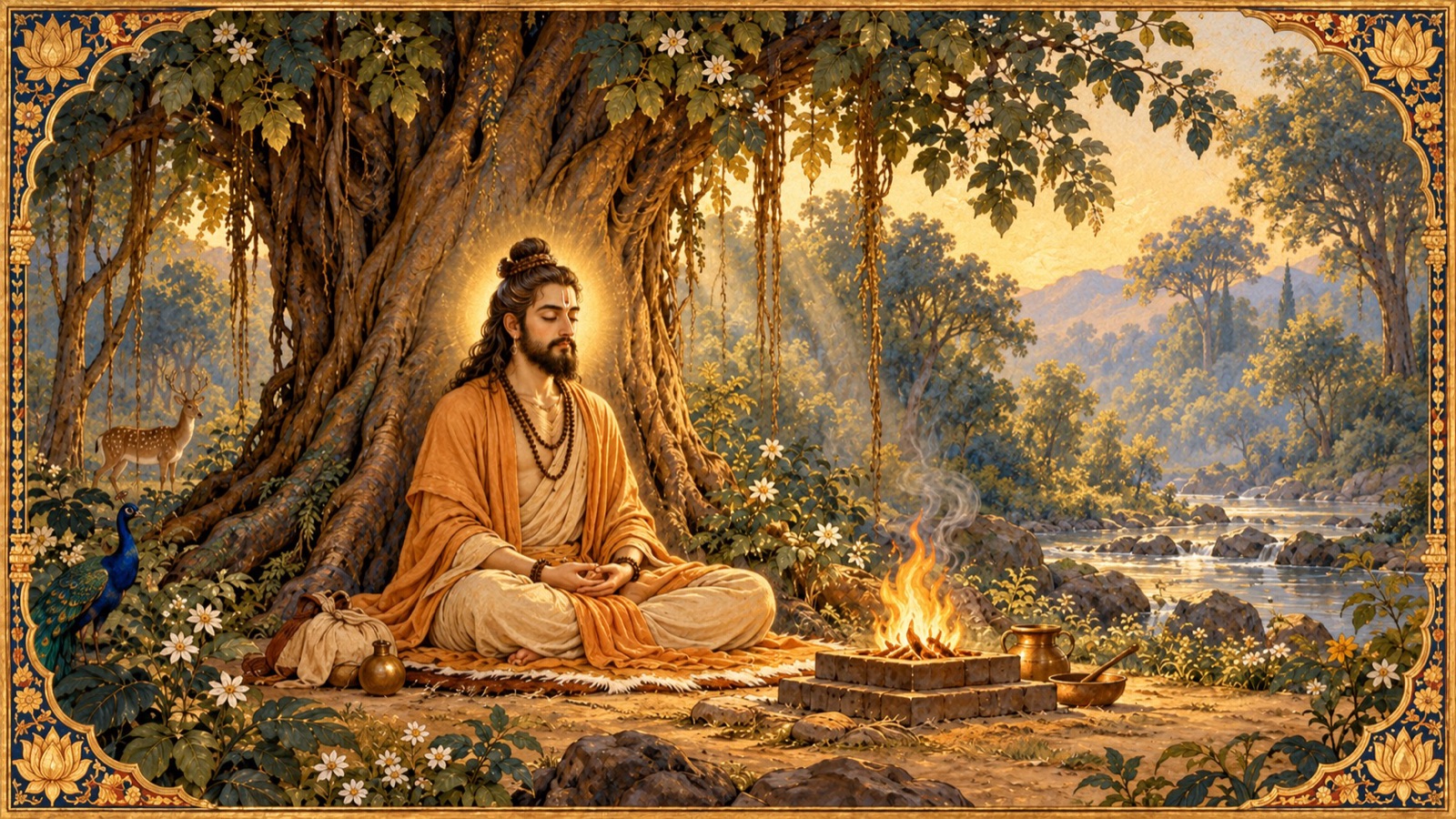
By such disciplined practice he purified his heart entirely, and his mind, drawn back from every object of the world, came to rest without wavering upon the Lord alone.
It is worth asking why the chapter dwells at such length on Prithu’s mastery of yogic technique, only to show him lay it aside. Maitreya makes the deeper point explicit: however far a seeker travels on the path of mystic yoga or philosophical knowledge, illusion is not actually dispelled until he develops a genuine taste for hearing and speaking of Krishna’s own glories. Prithu, though he had perfected control of body and breath, did not rest his liberation on that technique; his mind was already fixed, through devotion, upon the Lord’s feet, and he had grown disinterested in every fruit of yoga or learning except the Lord Himself. This is the chapter’s quiet teaching for every seeker: austerity and yoga sharpen the instrument, but only bhakti completes the work.
छिन्नान्यधीरधिगतात्मगतिर्निरीह- स्तत्तत्यजेऽच्छिनदिदं वयुनेन येन । तावन्न योगगतिभिर्यतिरप्रमत्तो यावद्गदाग्रजकथासु रतिं न कुर्यात् ॥ १२ ॥
chinnānya-dhīr adhigatātma-gatir nirīhas tat tatyaje ’cchinad idaṁ vayunena yena tāvan na yoga-gatibhir yatir apramatto yāvad gadāgraja-kathāsu ratiṁ na kuryāt
Meaning: With his mind cut free from every other object by the very knowledge of the self he had gained, and desiring nothing further, Prithu set aside the yogic disciplines that had brought him that knowledge — for, he understood, no seeker overcomes illusion, however careful his practice, until he develops a taste for the topics of the Lord. (Canto 4, Chapter 23, verse 12)
The Departure to the Lord
When his ascetic life reached its fulfilment, Prithu prepared to lay down his body. Through deep meditation he withdrew every covering of his existence — mind, senses, life-air, the very elements of which the body is composed — back into their cosmic source, releasing all claim of ownership over them, until nothing remained to him but his own eternal identity as the Lord’s servant. Then, as master of himself, he gave up his mortal frame in perfect peace, his heart wholly with the Lord.
तं सर्वगुणविन्यासं जीवे मायामये न्यधात् । तं चानुशयमात्मस्थमसावनुशयी पुमान् । ज्ञानवैराग्यवीर्येण स्वरूपस्थोऽजहात्प्रभु: ॥ १८ ॥
taṁ sarva-guṇa-vinyāsaṁ jīve māyāmaye nyadhāt taṁ cānuśayam ātma-stham asāv anuśayī pumān jñāna-vairāgya-vīryeṇa svarūpa-stho ’jahāt prabhuḥ
Meaning: He dissolved the whole array of material elements back into their source and, resting in the Self, no longer identified with them; then, by the power of knowledge and detachment, established in his own true nature, the master gave up his body. (Canto 4, Chapter 23, verse 18)
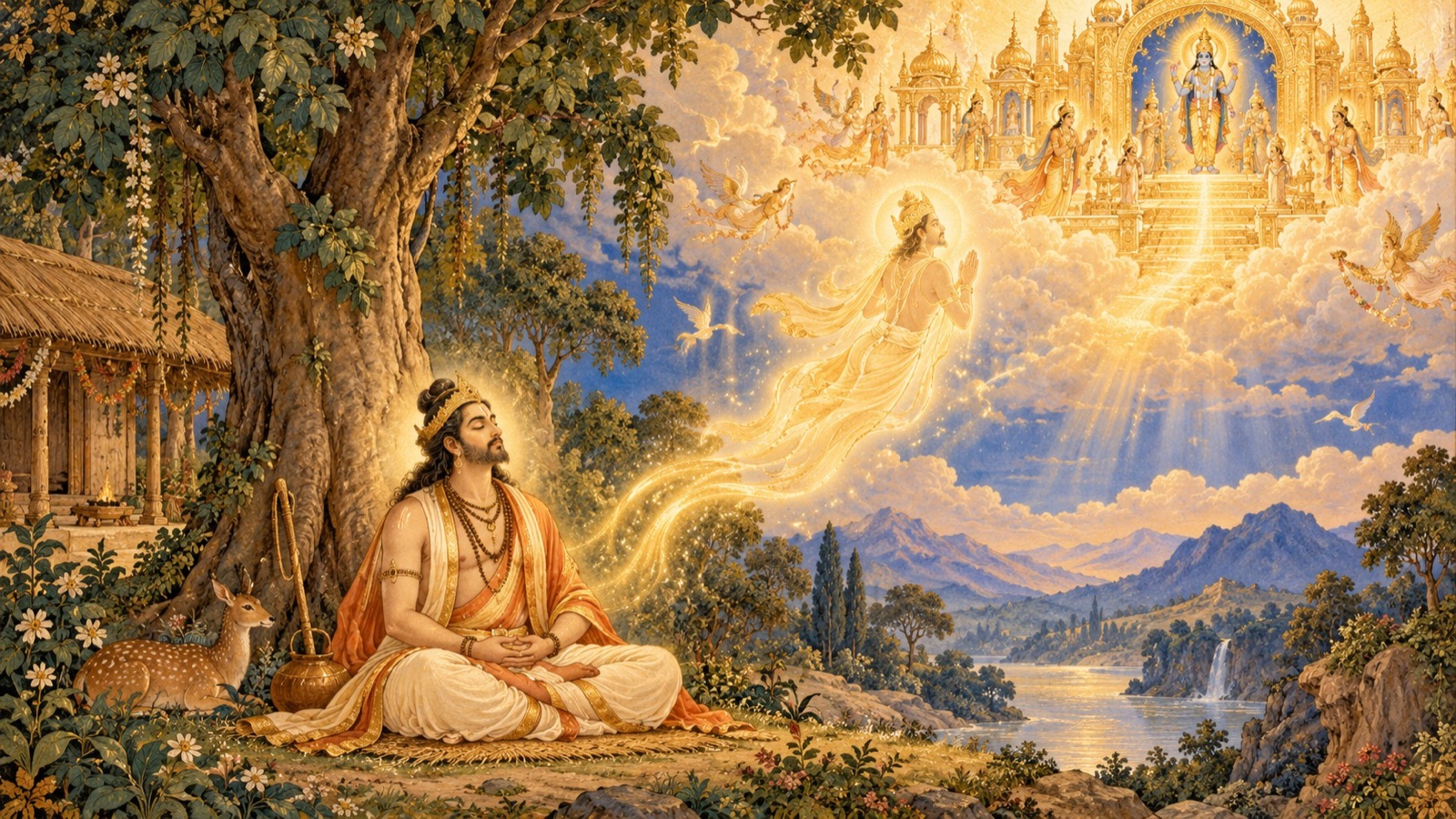
Thus the great king, the foremost of the Lord’s devotees, attained the supreme, imperishable abode of the Lord — the goal for which he had lived and striven and loved.
Queen Archi’s Devotion
His queen, Archi — herself a portion of the goddess of fortune — could not bear to remain in the world without her lord. Faithful to him in life and in death, she tended his body with reverence and then, fixing her mind upon him and upon the Lord they had served together, followed him from this world, ascending in glory to the same eternal abode, honoured by the gods and the sages. So the devoted pair, who had ruled and worshipped as one, were united forever at the feet of the Lord.
As Maitreya continued the story, he told Vidura how the wives of the demigods, watching Archi’s ascent, marvelled at such devotion and reflected on the folly of those who, having gained the rare human birth, squander it on the fleeting pleasures of the senses. For those mortals, they said, who — though their lives on earth are brief — attain the actionless peace of devotion and reach the abode of the Lord, what remains that could still be called hard to gain?
तेषां दुरापं किं त्वन्यन्मर्त्यानां भगवत्पदम् । भुवि लोलायुषो ये वै नैष्कर्म्यं साधयन्त्युत ॥ २७ ॥
teṣāṁ durāpaṁ kiṁ tv anyan martyānāṁ bhagavat-padam bhuvi lolāyuṣo ye vai naiṣkarmyaṁ sādhayanty uta
Meaning: For those mortals who, though of fleeting life on earth, attain actionlessness and reach the abode of the Lord — what else remains hard for them to gain? (Canto 4, Chapter 23, verse 27)
The wives of the demigods pressed the point further: anyone who is granted this rare human birth — itself a chance to be freed from misery — and yet spends it toiling only for the hard, fleeting rewards of sense pleasure has cheated himself, they said, as surely as one who works against his own good (verse 28). Set beside Prithu, who used his one human life for nothing but reaching the Lord, their words stand as a warning to every soul still bargaining with its own time.
The Glory of the Story
Maitreya then summed up the greatness of Prithu — the mightiest of the Lord’s devotees, of boundless and magnanimous character, whose story he had now recounted to Vidura.
इत्थम्भूतानुभावोऽसौ पृथु: स भगवत्तम: । कीर्तितं तस्य चरितमुद्दामचरितस्य ते ॥ ३० ॥
ittham-bhūtānubhāvo ’sau pṛthuḥ sa bhagavattamaḥ kīrtitaṁ tasya caritam uddāma-caritasya te
Meaning: Such was the glory of Prithu, the greatest of the Lord’s devotees, of boundless character; his story I have now recounted to you. (Canto 4, Chapter 23, verse 30)
And he closed with a promise for every listener: that anyone who takes up this sacred narration — reading it with devotion, having it read aloud, or simply hearing it — is carried to that same abode Prithu reached.
य इदं सुमहत्पुण्यं श्रद्धयावहित: पठेत् । श्रावयेच्छृणुयाद्वापि स पृथो: पदवीमियात् ॥ ३१ ॥
ya idaṁ sumahat puṇyaṁ śraddhayāvahitaḥ paṭhet śrāvayec chṛṇuyād vāpi sa pṛthoḥ padavīm iyāt
Meaning: Whoever, with faith and attention, reads this most sacred account, or has it heard, or hears it, attains the very abode that Prithu attained. (Canto 4, Chapter 23, verse 31)
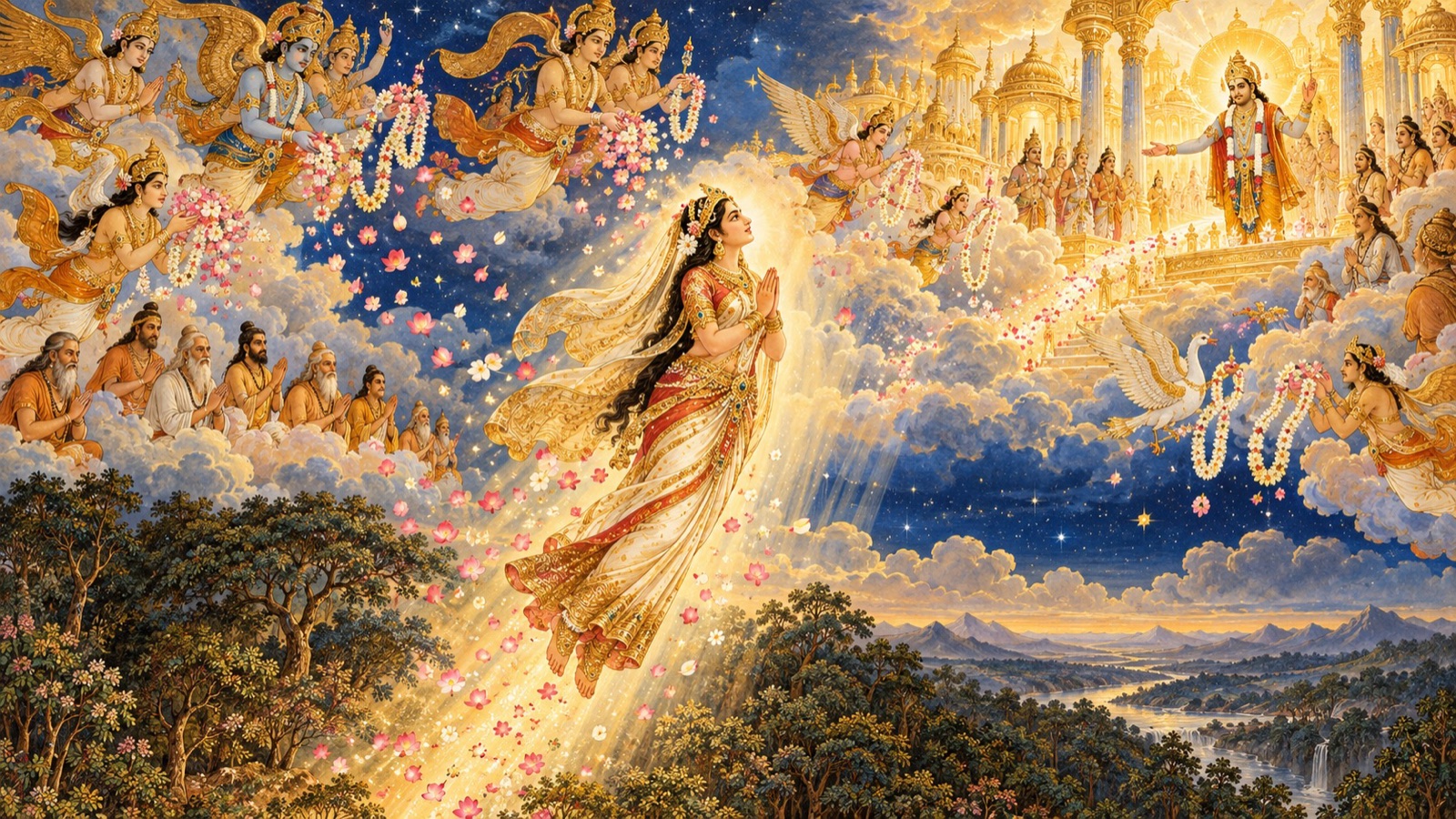
So the twenty-third discourse, and with it the whole shining history of King Prithu, comes to its close — a life begun as the descent of the Lord’s power to save a fallen world, and ended in the perfect devotion that carries a soul home. From here the narration turns to the next generation, and to the hymn of Lord Shiva taught to the Pracetas, which the following chapters will unfold.
Principal Teachings of This Chapter
1. A good life is crowned by a good ending. Prithu does not cling to his throne to the last; in due time he lays it down and turns wholly to the Lord. The final task of a well-lived life is to loosen our grip on the world and take hold of God (verses 1-3).
2. The highest austerity is done for the Lord’s pleasure alone. Prithu’s severe discipline seeks no heaven and no reward, “only to please Krishna.” Spiritual effort finds its purest form when its one aim is the satisfaction of the Lord (verse 7).
3. Death, for the devotee, is a homecoming. Established in his true self, Prithu gives up his body in peace and attains the Lord’s abode. For one whose heart is with God, the end of the body is not loss but arrival (verse 18).
4. Devotion attains what nothing else can. Those who reach the Lord’s abode find nothing left that is hard to gain. The one attainment of God contains within it every good the soul could seek (verse 27).
5. Hearing the story of a devotee carries us toward his destiny. Maitreya promises that whoever hears this account with faith attains Prithu’s own abode. The sacred story is not only about the path; it is itself a step upon it (verse 31).
A Devotional Reflection
There is a rare and beautiful completeness to the life of King Prithu, and this chapter is its quiet crown. He came into the world as a descent of the Lord’s own power to rescue a ruined earth; he ruled with justice, drew abundance from the land, offered a hundred sacrifices, forgave his enemy, saw the Lord face to face, taught his people and was in turn taught by the sages — and now, at the end, he simply lays it all down and walks into the forest to be alone with God. What is most moving is how natural his ending is. There is no clinging, no fear, no last grasping at the empire he built; having held everything “like the sun,” he can release everything like the sunset. He has been rehearsing this letting-go his whole life, in the detachment the Kumaras praised, and so when the final letting-go comes, it is not a wrench but a homecoming. And beside him stands Archi, whose love follows her lord past the very gates of death — a picture of a devotion so complete that not even mortality can part it from its object. Their story tells us that a life is not measured by how much it accumulates but by how completely it is given, and that death, for those who have truly loved God, is not the losing of everything but the finding of the One in whom everything is held.
A Daily Devotional Practice
Today, practise the art of letting go that crowns a devoted life. Choose one thing you have been holding too tightly — a possession, a role, a plan, a worry — and, in a small and deliberate way, loosen your grip on it, offering it to the Lord with the words “Om Namo Bhagavate Vasudevaya,” as Prithu laid down his empire. Let it be a rehearsal, in miniature, of the great letting-go we are all moving toward, so that when it comes it may be, as it was for Prithu, a homecoming rather than a loss. And take Maitreya’s promise to heart: spend a few minutes today reading or recalling the story of King Prithu — his rule, his devotion, his peaceful departure — trusting that in hearing the story of one who reached the Lord, you take a step toward the same abode.
Conclusion
The twenty-third discourse of Book Four brings the shining history of King Prithu to its serene close. Having reigned for long years in righteousness and taken to heart the wisdom of the Kumaras, Prithu hands his throne to his sons and withdraws with his devoted queen Archi into the forest. There he practises the highest austerity — controlling speech, senses, and breath — for one purpose only: to please the Lord. His heart wholly purified, he withdraws his mind from the world and, established in his own true self by knowledge and detachment, lays down his mortal frame in perfect devotion and reaches the Lord’s own supreme abode. His devoted queen, who cannot bear to remain behind, follows him out of this world to that same eternal abode. Maitreya sums up the greatness of Prithu, the foremost of devotees, and promises that anyone who takes up this holy story with faith is carried to that same abode Prithu reached. Thus a life that began as God’s own power descending to earth closes in the devotion that carries a soul home — showing us that for one who loves the Lord, death is not a loss but an arrival.
May the divine wisdom of Srimad Bhagavatam awaken pure devotion within our hearts.
Om Namo Bhagavate Vasudevaya.
Jay Shree Madhav.
References and Attribution
- Primary edition: Gita Press, Śrīmad Bhāgavata Mahāpurāṇa (English, complete), Book Four, Discourse 23.
- Series: Srimad Bhagavatam Wisdom · Biswa Sanatan Dharma Seva Trust.
- Presented following the spiritual guidance and recommendation of Pandit Dr. Shri Kashinath Mishra.
This is an original, faithful retelling in the writer’s own words, with brief quoted verses shown in Devanāgarī and transliteration and their meanings given as summaries. It is not a reproduction of any single publisher’s continuous translation or commentary. No affiliation with or endorsement by any publisher is implied.
Jay Shree Madhav