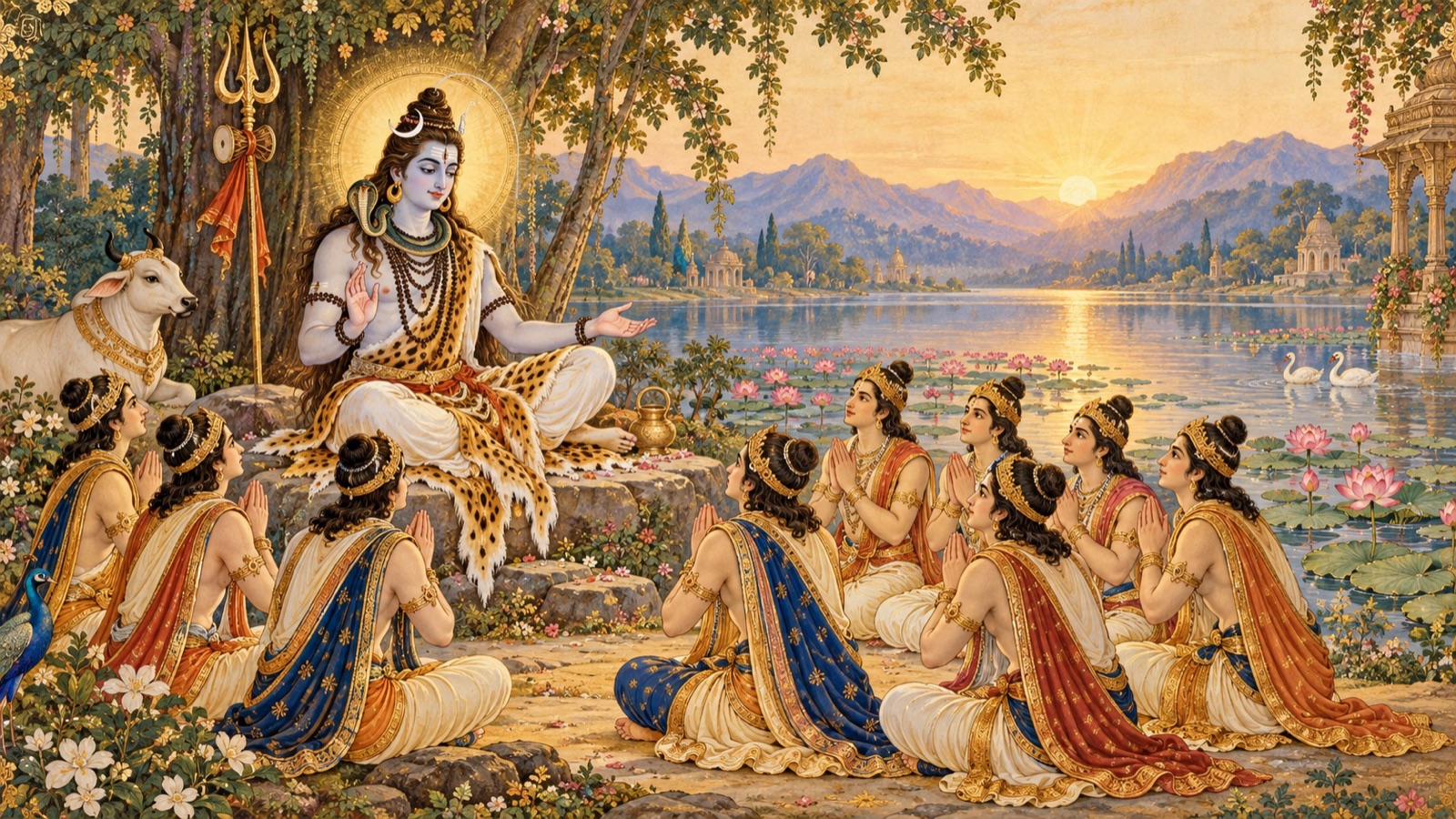
Pleased by the sincerity of the ten princely brothers, Lord Shiva graciously teaches them a sacred hymn of praise to the Supreme Lord, to carry them through their great austerity.
Om Namo Bhagavate Vasudevaya.
Om Namo Bhagavate Vasudevaya.
Om Namo Bhagavate Vasudevaya.
Welcome to Srimad Bhagavatam Wisdom, a devotional journey through the sacred histories and teachings of the Srimad Bhagavat Mahapurana. With the shining life of King Prithu now complete, Maitreya opens a new thread in the story of his line. This twenty-fourth chapter traces the lineage forward to the ten sons of King Prachinabarhi — the Pracetas — who, at their father’s direction, set out to perform austerities so that the royal line might continue. Along their journey Lord Shiva himself rises before them from the waters of a great lake, and finding them wholly surrendered to the Supreme, he teaches them the celebrated Rudra-gita to sanctify their penance. The Pracetas receive it with reverence and begin their long austerity, chanting it with concentrated minds. It is a chapter about the grace of the great toward the sincere, about the power of a sacred hymn to carry a soul through its trials, and about the tender truth that even Lord Shiva, whom the universe fears as the destroyer, is himself a devotee who bows to the Supreme.
Chapter Information
- Scripture: Śrīmad Bhāgavata Mahāpurāṇa
- Canto: 4 (Book Four)
- Chapter: 24 (Discourse 24)
- Chapter title: The Hymn of Lord Shiva Taught to the Pracetas
- Principal speaker: The sage Maitreya, continuing his discourse to Vidura (with the hymn of Lord Shiva quoted within)
- Principal listener: Vidura
- Main setting: The shore of a great lake, where the Pracetas meet Lord Shiva
- Central subject: The Pracetas set out for austerity, meet Lord Shiva, and receive from him a sacred hymn to the Supreme Lord
- Principal verse range: Canto 4, Chapter 24, verses 1–79
- Primary edition: Gita Press Śrīmad Bhāgavata Mahāpurāṇa
Context from the Previous Chapter
Chapter 23 completed the life of King Prithu with his departure to the Lord’s abode. This twenty-fourth chapter carries his line forward through several generations to King Prachinabarhi and his ten sons, the Pracetas, and turns to the great grace they receive from Lord Shiva as they set out upon their spiritual work.
The Pracetas Set Out for Austerity
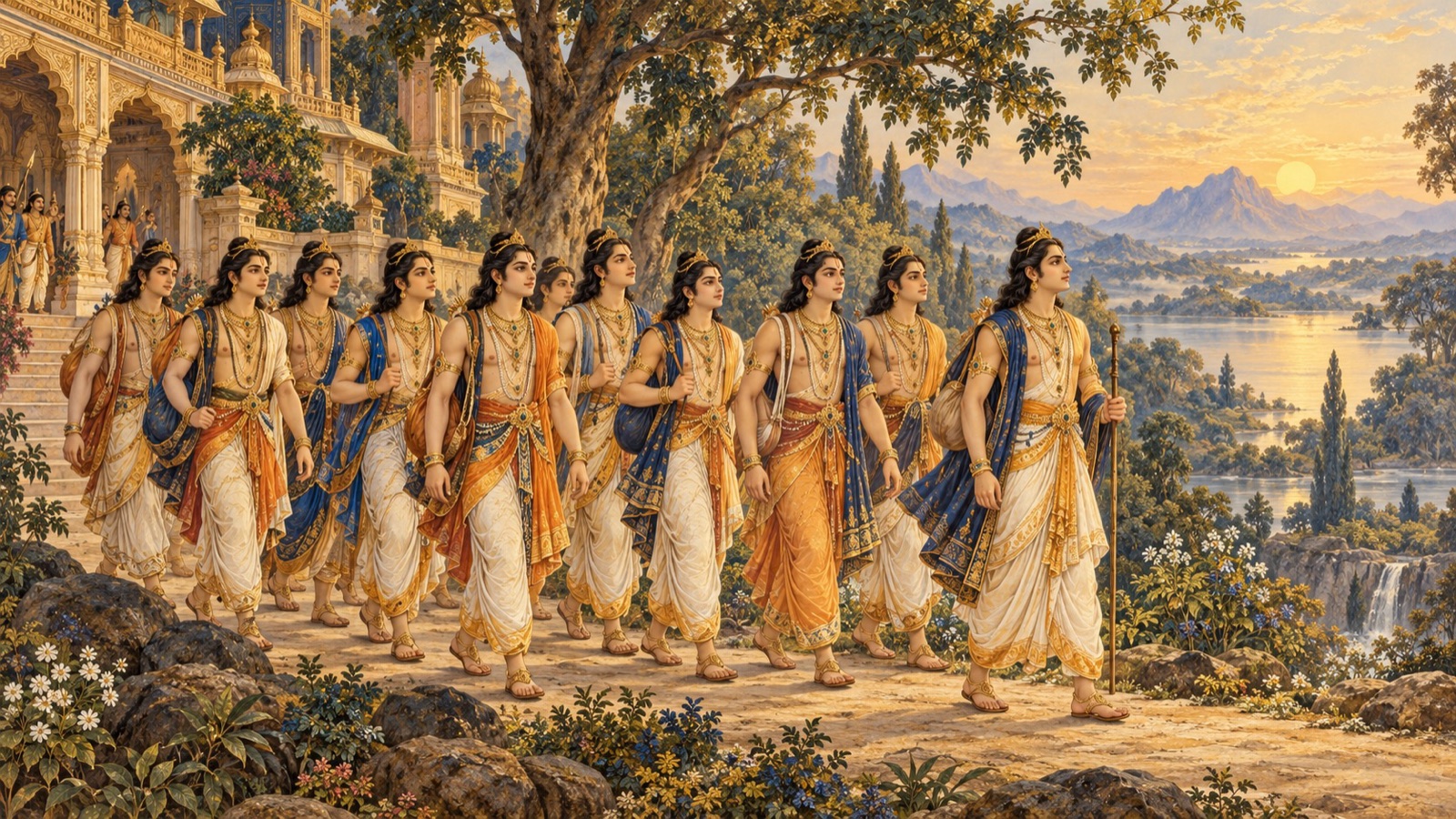
Maitreya traced the descendants of Prithu down to King Prachinabarhi, who had ten sons known together as the Pracetas. At their father’s direction — for the sake of continuing the line and pleasing the Lord — the ten brothers, of one mind and one purpose, set out from home to perform severe austerities. Journeying together, they came at last to the shore of a vast and beautiful lake, clear as the mind of a saint, where they meant to begin their penance.
The Meeting with Lord Shiva
As the Pracetas stood by the lake, resolved upon their long austerity, Lord Shiva himself, moved by their sincerity and pleased with their devotion, graciously appeared before them, rising radiant from the waters with his attendants, to bless and instruct them. The brothers bowed before him in wonder and reverence, and Shiva, well pleased, offered to give them what would carry them safely through their penance: a sacred hymn of praise to the Supreme Lord.
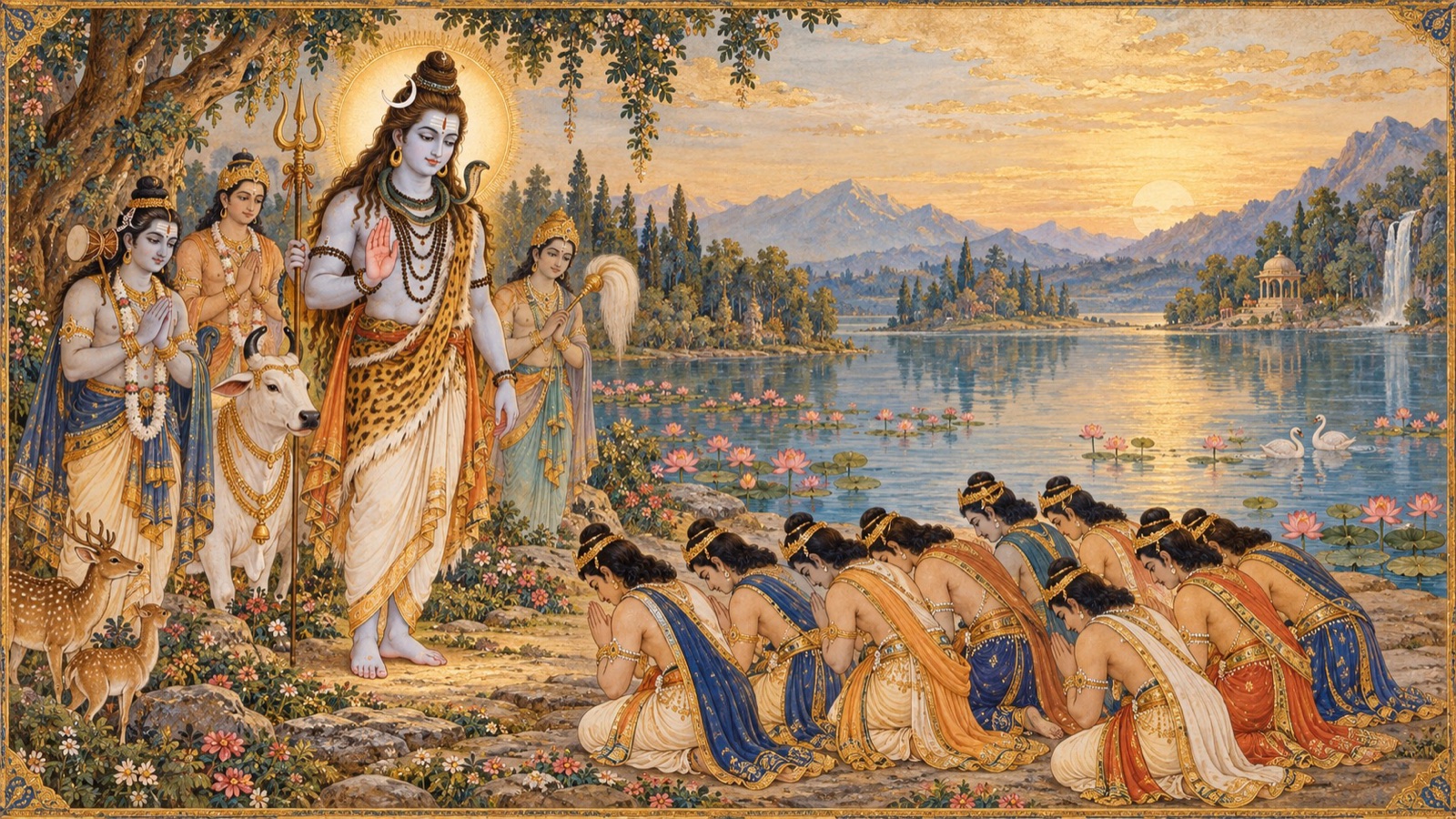
Before he began to sing, Shiva told the brothers plainly why their sincerity had moved him: he already knew what they meant to do, and that knowledge itself was reason enough for his grace (verse 27). Then he spoke the line that is the hidden key to this whole meeting.
यः परं रंहसः साक्षात् त्रिगुणाज्जीवसंज्ञितात् । भगवन्तं वासुदेवं प्रपन्न: स प्रियो हि मे ॥ २८ ॥
yaḥ paraṁ raṁhasaḥ sākṣāt tri-guṇāj jīva-saṁjñitāt bhagavantaṁ vāsudevaṁ prapannaḥ sa priyo hi me
Meaning: Whoever has surrendered directly to the Supreme Person, Vasudeva — who is beyond the three modes of nature and beyond the embodied soul alike — is truly dear to me. (Canto 4, Chapter 24, verse 28)
It is not their royal blood or their austerity that has won Shiva’s love, but the simple fact of where their hearts are surrendered. He goes further still: a soul who performs his duty faithfully for a hundred lifetimes may in due course reach the post of Brahma, and greater merit yet may carry him to Shiva’s own realm, but one who surrenders directly to Vishnu in unwavering devotion is carried at once into the spiritual world — a goal that Shiva and the other gods themselves attain only when this universe comes to its end (verse 29). So before a single note of the hymn is sung, Shiva has already given its deepest lesson: a devotee of the Supreme stands dearer to him than any worship of himself could ever make anyone.
The Hymn of Lord Shiva
Then Lord Shiva sang for them a beautiful hymn of praise to the Supreme Lord — the Rudra-gita. He began by offering all victory and worship to the Lord, the Self of all, declaring that every good is accomplished by His worship, and bowing to Him as the innermost Self of every being.
श्रीरुद्र उवाच जितं त आत्मविद्वर्यस्वस्तये स्वस्तिरस्तु मे । भवताराधसा राद्धं सर्वस्मा आत्मने नम: ॥ ३३ ॥
śrī-rudra uvāca jitaṁ ta ātma-vid-varya- svastaye svastir astu me bhavatārādhasā rāddhaṁ sarvasmā ātmane namaḥ
Meaning: Sri Rudra (Shiva) said: Victory is Yours, O foremost of the knowers of the Self; for the welfare of all who know You, may there be welfare; all good is accomplished by Your worship; to You, the Self of all, I bow. (Canto 4, Chapter 24, verse 33)
As the hymn unfolded, Shiva turned from praise to instruction, teaching why devotion alone secures what every other path only promises. Pure devotion is difficult to attain even for the liberated, he said, yet nothing besides it can truly satisfy the Lord; a single moment in a devotee’s company outweighs whatever ritual or philosophy can offer (verses 55-57). Of the many powers he named, none is more striking than this: time itself, before whom even universes crumble, dares not touch the soul who has taken shelter at the Lord’s feet.
यत्र निर्विष्टमरणं कृतान्तो नाभिमन्यते । विश्वं विध्वंसयन् वीर्यशौर्यविस्फूर्जितभ्रुवा ॥ ५६ ॥
yatra nirviṣṭam araṇaṁ kṛtānto nābhimanyate viśvaṁ vidhvaṁsayan vīrya- śaurya-visphūrjita-bhruvā
Meaning: Time personified, who with a mere motion of his brow can shatter the whole universe, does not dare approach the soul who has taken shelter at Your feet. (Canto 4, Chapter 24, verse 56)
Through the long and lovely hymn Shiva glorified the Supreme Lord as the source, sustainer, and goal of all — beyond the reach of the mind and senses, yet nearer than the heart to those who love Him. And in a verse of striking tenderness he confessed the deepest secret of his own being: that though the whole universe trembles in fear of Rudra, who at the end dissolves all things, the Supreme Lord is himself the one fearless refuge of the wise, in whom even the destroyer takes shelter.
अथ त्वमसि नो ब्रह्मन् परमात्मन् विपश्चिताम् । विश्वं रुद्रभयध्वस्तमकुतश्चिद्भया गति: ॥ ६८ ॥
atha tvam asi no brahman paramātman vipaścitām viśvaṁ rudra-bhaya-dhvastam akutaścid-bhayā gatiḥ
Meaning: You, O Brahman, Supersoul, are known to the wise as the goal; though the whole universe is undone by fear of Rudra, to Your devotees You are the fearless refuge. (Canto 4, Chapter 24, verse 68)
The Gift of the Hymn
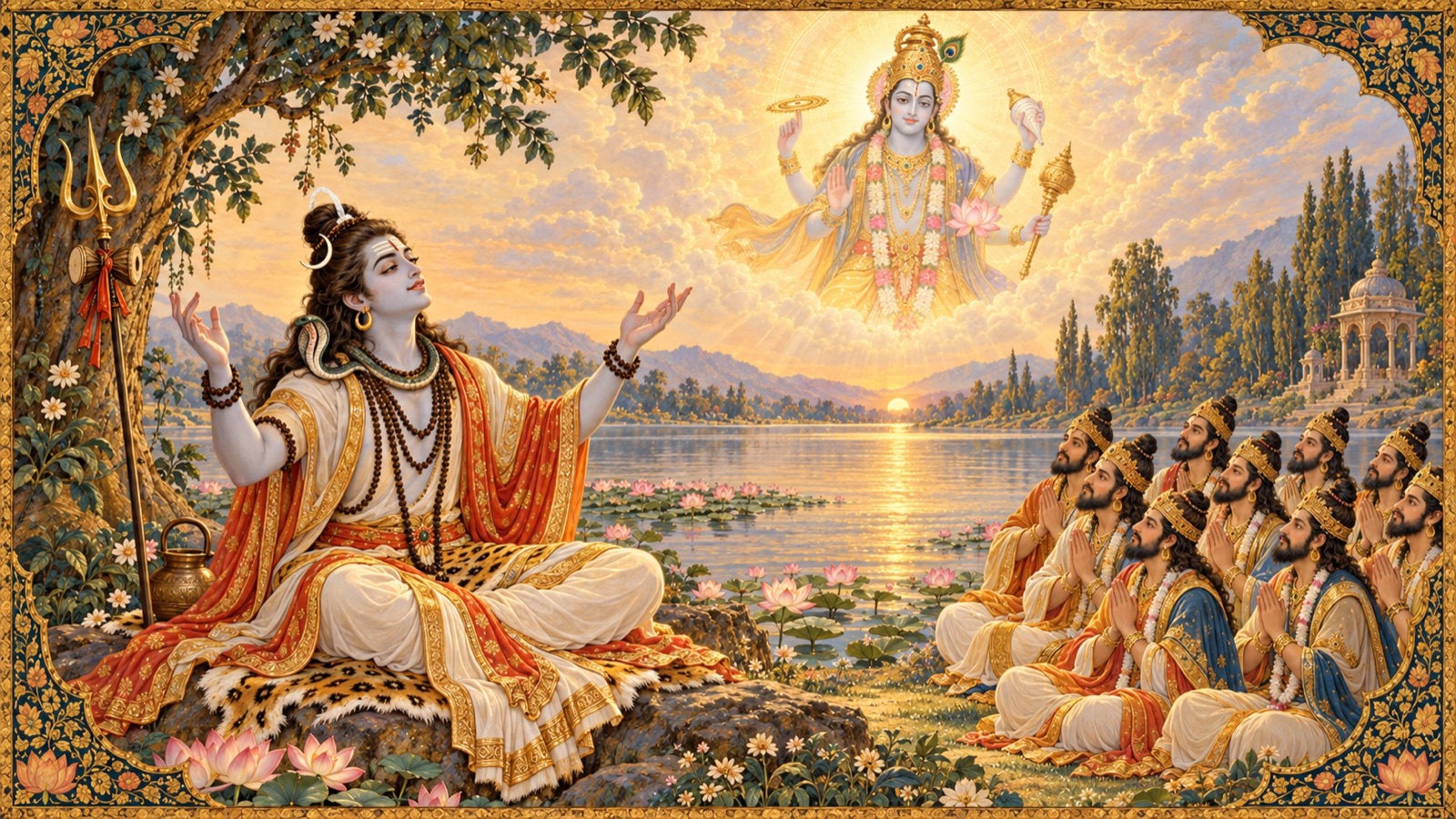
Having sung the whole hymn, Shiva then told the princes exactly what such devoted hearing and recitation could accomplish for anyone who took it up.
इदं य: कल्य उत्थाय प्राञ्जलि: श्रद्धयान्वित: । शृणुयाच्छ्रावयेन्मर्त्यो मुच्यते कर्मबन्धनै: ॥ ७८ ॥
idaṁ yaḥ kalya utthāya prāñjaliḥ śraddhayānvitaḥ śṛṇuyāc chrāvayen martyo mucyate karma-bandhanaiḥ
Meaning: The mortal who rises at dawn and, with folded hands and faith, hears or recites these prayers sung by Shiva is freed from the bondage of works. (Canto 4, Chapter 24, verse 78)
And he gave the ten brothers his blessing and command: chanting this hymn of the Supreme Person with concentrated minds, let them perform their great austerity — and in the end they would attain the desire of their hearts.
गीतं मयेदं नरदेवनन्दना: परस्य पुंस: परमात्मन: स्तवम् । जपन्त एकाग्रधियस्तपो महत् चरध्वमन्ते तत आप्स्यथेप्सितम् ॥ ७९ ॥
gītaṁ mayedaṁ naradeva-nandanāḥ parasya puṁsaḥ paramātmanaḥ stavam japanta ekāgra-dhiyas tapo mahat caradhvam ante tata āpsyathepsitam
Meaning: (Shiva said:) O sons of the king, chanting with concentrated minds this hymn of praise to the Supreme Person, the Supersoul, which I have sung, perform your great austerity; and in the end you will attain what you desire. (Canto 4, Chapter 24, verse 79)
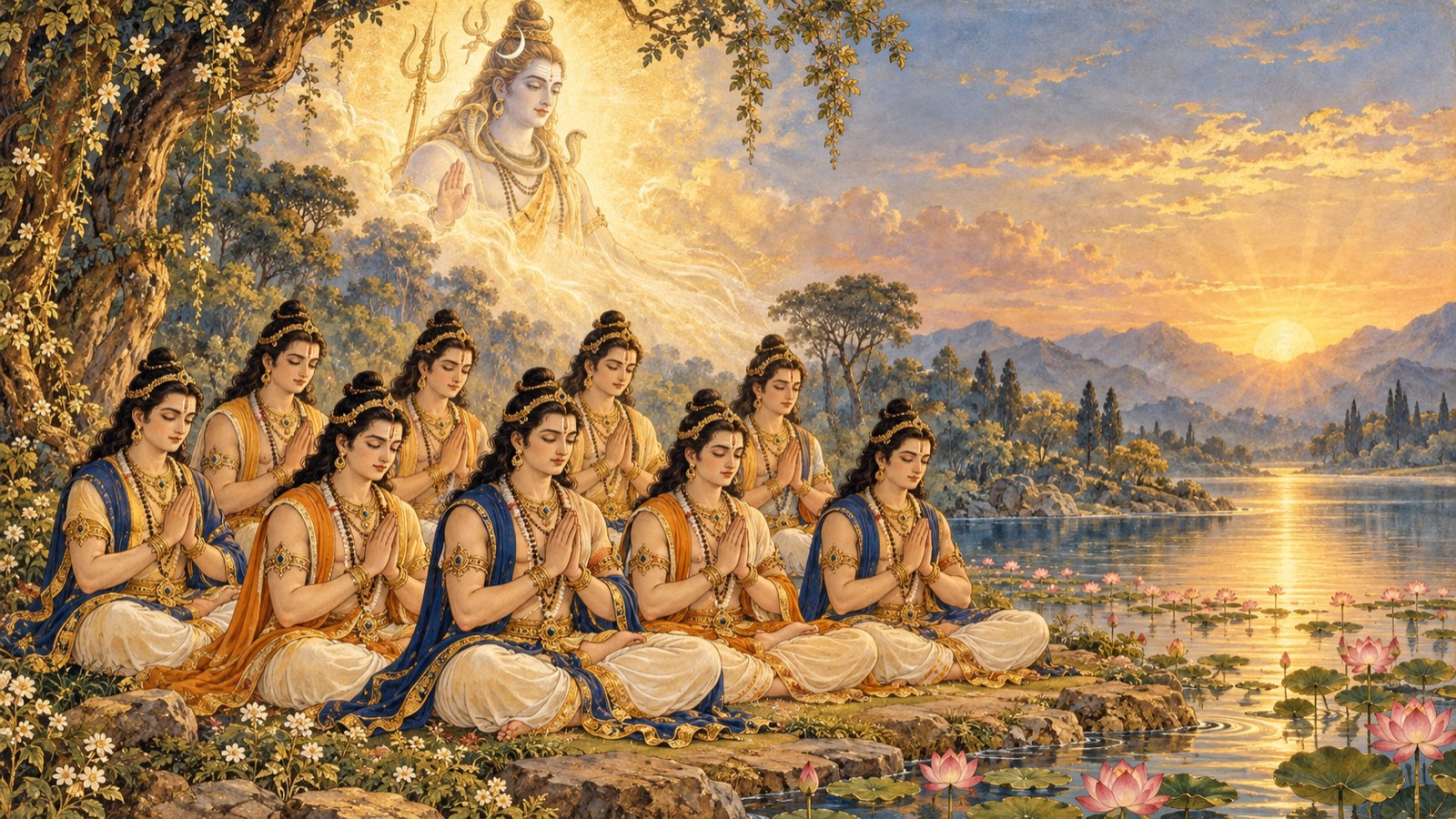
The Pracetas received the sacred hymn with bowed heads and grateful hearts, and, as Shiva blessed them and withdrew, they entered upon their long austerity, chanting the Rudra-gita with single-minded devotion. So the twenty-fourth discourse closes with the ten brothers set upon their penance, armed with a hymn given by Shiva himself — poised for the great teaching that the next chapters will bring, when the sage Narada unfolds to their father the parable of Puranjana.
Principal Teachings of This Chapter
1. Sincerity draws the grace of the great. Lord Shiva appears to the Pracetas not because they compelled him, but because their sincerity pleased him. Genuine earnestness in the spiritual life draws help we could never command (verses 24-25).
2. A sacred hymn is a companion through trial. Shiva does not remove the Pracetas’ austerity; he gives them a hymn to carry them through it. The Holy Name and holy words are not a shortcut past our trials but a strength within them (verse 79).
3. Even the greatest are devotees of the Supreme. Lord Shiva, whom the universe fears as the destroyer, bows in this hymn to the Supreme Lord as his own fearless refuge. The truly great do not claim ultimacy; they point beyond themselves to God (verse 68).
4. The Lord is the one fearless refuge. In a universe shadowed by the fear of destruction, the Supreme Lord alone is the shelter in whom there is no fear. To take refuge in Him is to find the one safe ground beneath all that passes away (verse 68).
5. Devoted hearing and reciting free the soul. Shiva promises that whoever hears or recites this hymn with faith is freed from the bondage of works. Sacred sound, received with devotion, loosens the very chains of karma (verse 78).
6. Direct surrender outranks the ladder of merit. Long ritual duty can eventually earn a soul promotion all the way up to Brahma or even Shiva’s own realm, yet Shiva declares that unwavering surrender to Vishnu carries a devotee past all of that in a single leap — for such a devotee, he says, is dearer to him than anyone else in creation (verses 28-29).
A Devotional Reflection
The most moving note in this chapter is a quiet confession hidden in the heart of Lord Shiva’s hymn. Here is Rudra, the mighty one at whose approach the whole universe trembles, the destroyer before whom even the gods grow afraid — and he lifts his voice not to be praised, but to praise; not to be taken as the final refuge, but to point beyond himself to One in whom even he takes shelter. “Though the whole universe is undone by fear of Rudra,” he sings, “to Your devotees You are the fearless refuge.” There is a deep humility here that reorders our whole sense of greatness. The very one we might be tempted to treat as ultimate turns and bows to the Supreme, and teaches ten young seekers to do the same. It tells us that the mark of true greatness, even at the highest reaches of the cosmos, is not to gather worship to oneself but to hand it on to God. And there is comfort as well as instruction in it. If the destroyer himself finds in the Lord a refuge without fear, then so may we — however much we tremble before the changes and endings of our own small lives. The chapter gently sets before us the same gift Shiva gave the Pracetas: a hymn to carry in the heart, a Name to rise with at dawn, and the assurance that the One it praises is the fearless ground beneath all our fears.
A Daily Devotional Practice
Today, take up the practice Shiva gave the Pracetas: begin your day with praise. When you rise, before the cares of the day crowd in, pause for a moment with folded hands and faith, and offer the Lord a word of praise — a verse, a Name, or simply “Om Namo Bhagavate Vasudevaya,” as the Pracetas began their austerity with the hymn Shiva taught them. Let it be the first thing your heart does, so that the whole day is carried upon it. And when fear rises in you — of loss, of change, of the endings that shadow every life — remember Shiva’s confession, and take your refuge where even the destroyer takes his: in the Supreme Lord, the one fearless ground. In beginning the day with praise and meeting fear with refuge, you walk in the footsteps of the Pracetas, armed with the hymn of Lord Shiva.
Conclusion
The twenty-fourth discourse of Book Four opens a new thread in the story of Prithu’s line. Traced forward through several generations, the narrative comes to the ten sons of King Prachinabarhi, the Pracetas, who at their father’s direction set out to perform severe austerities. Reaching the shore of a great lake, they find themselves before Lord Shiva, risen from the waters in his own radiant form, who declares that a soul surrendered to Vasudeva means more to him than anything else in creation, and who then teaches them a hymn of praise to that same Supreme Lord — the Rudra-gita. Through it he glorifies the Lord as the origin and goal of all existence, insists that only devotion secures what time itself cannot touch, and confesses that even Rudra the destroyer finds shelter nowhere but at those same feet. Reciting it with faith, he tells them, dissolves the grip of one’s past deeds; chanting it with one-pointed minds through their long penance, he promises, will bring them all they seek. The brothers accept the gift with bowed heads and enter upon their austerity. So the chapter teaches the grace of the great toward the sincere, the supremacy of surrender over every other path to God, and the tender truth that even the destroyer bows to the Supreme.
May the divine wisdom of Srimad Bhagavatam awaken pure devotion within our hearts.
Om Namo Bhagavate Vasudevaya.
Jay Shree Madhav.
References and Attribution
- Primary edition: Gita Press, Śrīmad Bhāgavata Mahāpurāṇa (English, complete), Book Four, Discourse 24.
- Series: Srimad Bhagavatam Wisdom · Biswa Sanatan Dharma Seva Trust.
- Presented following the spiritual guidance and recommendation of Pandit Dr. Shri Kashinath Mishra.
This is an original, faithful retelling in the writer’s own words, with brief quoted verses shown in Devanāgarī and transliteration and their meanings given as summaries. It is not a reproduction of any single publisher’s continuous translation or commentary. No affiliation with or endorsement by any publisher is implied.
Jay Shree Madhav