
Narada tells this parable to reveal how the soul, forgetting the eternal Friend within, becomes entangled in the world — the tale of the wandering King Puranjana and the nine-gated city he claimed for his own.
Om Namo Bhagavate Vasudevaya.
Om Namo Bhagavate Vasudevaya.
Om Namo Bhagavate Vasudevaya.
Welcome to Srimad Bhagavatam Wisdom, a devotional journey through the sacred histories and teachings of the Srimad Bhagavat Mahapurana. Having taught the Pracetas his sacred hymn, Lord Shiva vanished, and the ten brothers stood in the waters of a lake for ten thousand years, reciting it in deep devotion. Meanwhile, their father, King Prachinabarhi, remained absorbed in the fruitive sacrificial rites that promise heaven but keep the soul bound to the world. To awaken him to a higher understanding, the sage Narada came and gently admonished him, and — since deep truths are best carried in a story — began to tell him the celebrated parable of King Puranjana. This twenty-fifth chapter opens that parable: the tale of a king who wandered until he found a wondrous city of nine gates, met a beautiful woman who ruled it, and entered with her into a life of pleasure so absorbing that he forgot who he was. It is an allegory of every soul — of how we enter the body, are captivated by the senses, and become bound, little by little, to a world we were only passing through.
Chapter Information
- Scripture: Śrīmad Bhāgavata Mahāpurāṇa
- Canto: 4 (Book Four)
- Chapter: 25 (Discourse 25)
- Chapter title: The Parable of Puranjana Begins
- Principal speaker: The sage Narada, addressing King Prachinabarhi (within Maitreya’s discourse to Vidura)
- Principal listener: King Prachinabarhi (and Vidura)
- Main setting: The court of King Prachinabarhi, and the allegorical city of nine gates
- Central subject: Narada’s admonition of Prachinabarhi and the beginning of the parable of Puranjana
- Principal verse range: Canto 4, Chapter 25, verses 1–62
- Primary edition: Gita Press Śrīmad Bhāgavata Mahāpurāṇa
Context from the Previous Chapter
Chapter 24 told how Lord Shiva taught the Pracetas the Rudra-gita and blessed them to perform their austerity. This twenty-fifth chapter carries the thread on: the Pracetas take up their long penance, and the narrative turns to their father, King Prachinabarhi, whom the sage Narada now comes to instruct through a parable.
The Pracetas’ Long Austerity
Reciting the sacred hymn taught them by Lord Shiva, all the Pracetas performed a severe austerity, standing in the waters of the lake for ten thousand years, their minds fixed upon the Supreme Lord.
रुद्रगीतं भगवत: स्तोत्रं सर्वे प्रचेतस: । जपन्तस्ते तपस्तेपुर्वर्षाणामयुतं जले ॥ २ ॥
rudra-gītaṁ bhagavataḥ stotraṁ sarve pracetasaḥ japantas te tapas tepur varṣāṇām ayutaṁ jale
Meaning: Reciting the Rudra-gita, the hymn to the Lord, all the Pracetas performed austerity, standing in the water for ten thousand years. (Canto 4, Chapter 25, verse 2)

Narada Comes to King Prachinabarhi
Meanwhile their father, King Prachinabarhi, remained wholly absorbed in the elaborate sacrificial rites that promise the rewards of heaven, unaware that such fruitive works, however grand, only bind the soul more tightly to the wheel of birth and death. Out of compassion, the sage Narada came to him and gently asked what he truly hoped to gain, for the soul’s real welfare is not in fleeting reward but in freedom.
Then, by his own mystic power, Narada showed the king something more sobering still: the very animals slain in his many sacrifices, gathered in the sky and awaiting his own death. These creatures, he said, had not forgotten the violence done to them; once the king’s life here was finished, their long-checked anger would return upon him, and they would gore his fallen body with horns of iron. It was a fearsome sight, but a compassionate warning — not a rejection of sacrifice itself, only proof that ritual performed without mercy for the life offered settles no true account.
एते त्वां सम्प्रतीक्षन्ते स्मरन्तो वैशसं तव । सम्परेतम् अय:कूटैश्छिन्दन्त्युत्थितमन्यव: ॥ ८ ॥
ete tvāṁ sampratīkṣante smaranto vaiśasaṁ tava samparetam ayaḥ-kūṭaiś chindanty utthita-manyavaḥ
Meaning: All these creatures you have slain are waiting for your death, remembering the harm you did them; once you have left this life, their anger risen at last, they will gore your fallen body with horns of iron. (Canto 4, Chapter 25, verse 8)
Having shown him this, Narada then turned to open the king’s understanding by another path — an instructive parable. There once lived, he said, a king named Puranjana — “he who dwells in a city” — renowned for his deeds; and he had a friend called Avijnata, “the unrecognized one,” whose ways no one could ever comprehend.
आसीत्पुरञ्जनो नाम राजा राजन् बृहच्छ्रवा: । तस्याविज्ञातनामासीत्सखाविज्ञातचेष्टित: ॥ १० ॥
āsīt purañjano nāma rājā rājan bṛhac-chravāḥ tasyāvijñāta-nāmāsīt sakhāvijñāta-ceṣṭitaḥ
Meaning: O King, such a king named Puranjana once lived, celebrated for his great deeds; his companion, called Avijnata — meaning “the unrecognized one” — was one whose activities nobody could fathom. (Canto 4, Chapter 25, verse 10)
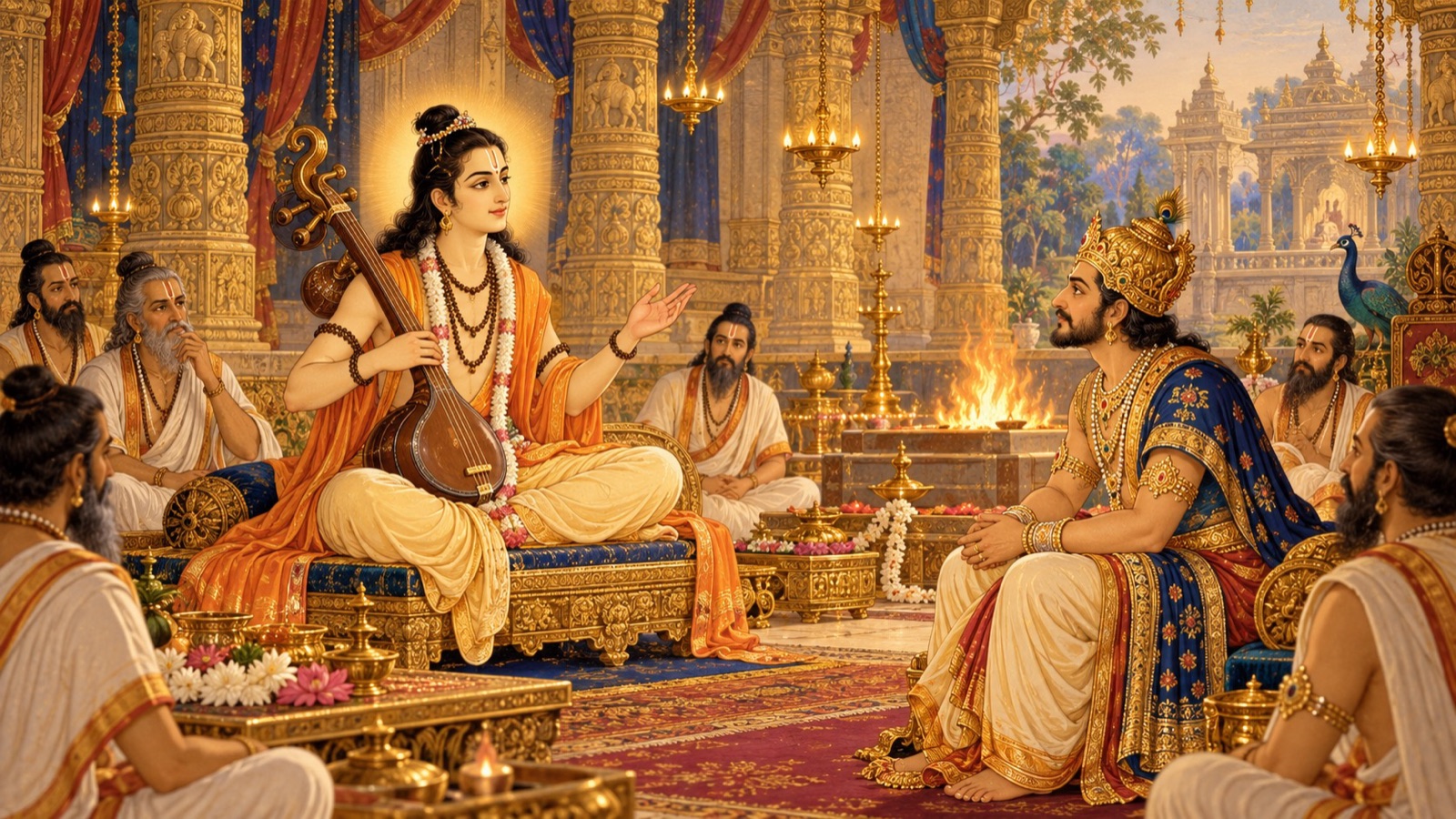
In this parable, Narada would later reveal, Puranjana is the soul, and his unknown friend, Avijnata, is the Supreme Lord within the heart — the constant, unseen companion whose ways the soul, absorbed in the world, forgets and fails to know.
The City of Nine Gates
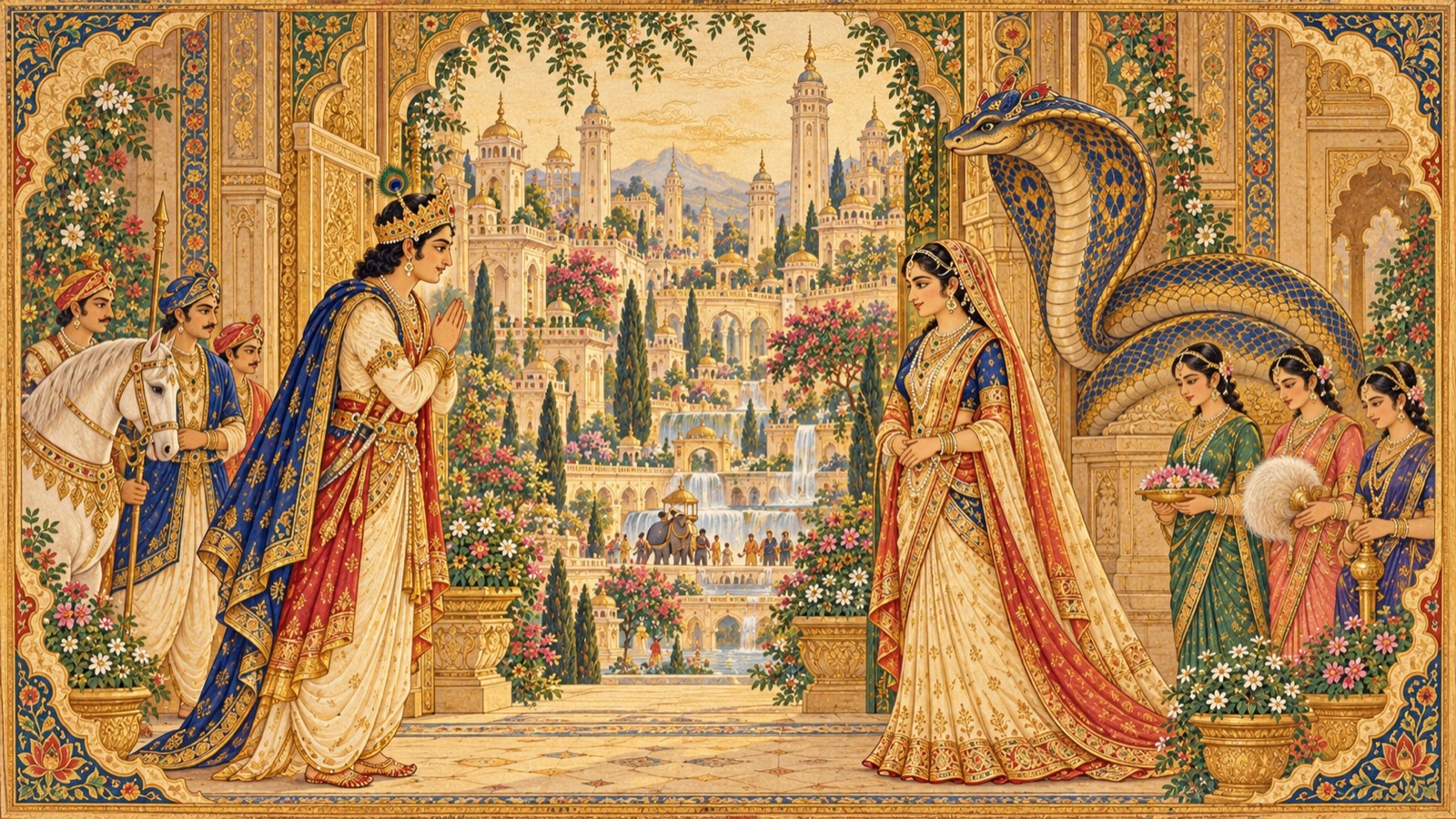
Puranjana, in search of a place to enjoy life, wandered far and wide until, on the southern slopes of the Himalayas, he came upon a wondrous city furnished with nine gates and adorned with every auspicious feature — a city, Narada would explain, that is the body itself, with its nine openings, in which the soul takes up its dwelling.
स एकदा हिमवतो दक्षिणेष्वथ सानुषु । ददर्श नवभिर्द्वार्भि: पुरं लक्षितलक्षणाम् ॥ १३ ॥
sa ekadā himavato dakṣiṇeṣv atha sānuṣu dadarśa navabhir dvārbhiḥ puraṁ lakṣita-lakṣaṇām
Meaning: Once, wandering, he saw on the southern slopes of the Himalayas a city furnished with nine gates and marked by every auspicious feature. (Canto 4, Chapter 25, verse 13)
The Woman and the Life of Pleasure
At the gates of the city Puranjana met a beautiful and dignified woman, attended by companions and guarded by a great serpent, and he was at once captivated by her. When he asked who she was and offered to remain with her, she welcomed him and praised the householder life as a shelter beneficial to all — pleasing to the forefathers, the gods, the sages, every being, and to oneself.
पितृदेवर्षिमर्त्यानां भूतानामात्मनश्च ह । क्षेम्यं वदन्ति शरणं भवेऽस्मिन् यद्गृहाश्रम: ॥ ४० ॥
pitṛ-devarṣi-martyānāṁ bhūtānām ātmanaś ca ha kṣemyaṁ vadanti śaraṇaṁ bhave ’smin yad gṛhāśramaḥ
Meaning: (The woman said:) The wise call the household life a shelter beneficial in this world — pleasing to the forefathers, the gods, the sages, all beings, and to oneself. (Canto 4, Chapter 25, verse 40)
So Puranjana entered the city and lived with her in a life of every pleasure. Year by year he grew more entangled, until at last he was wholly in her power — deceived and cheated in his whole existence, and, even against his own better wish, following her lead helplessly, like a tame animal made to dance to its keeper’s will.
विप्रलब्धो महिष्यैवं सर्वप्रकृतिवञ्चित: । नेच्छन्ननुकरोत्यज्ञ: क्लैब्यात्क्रीडामृगो यथा ॥ ६२ ॥
vipralabdho mahiṣyaivaṁ sarva-prakṛti-vañcitaḥ necchann anukaroty ajñaḥ klaibyāt krīḍā-mṛgo yathā
Meaning: Thus deceived by his queen and cheated in his whole existence, the foolish Puranjana, even against his will, followed her lead helplessly, like a tame animal dancing to its keeper. (Canto 4, Chapter 25, verse 62)
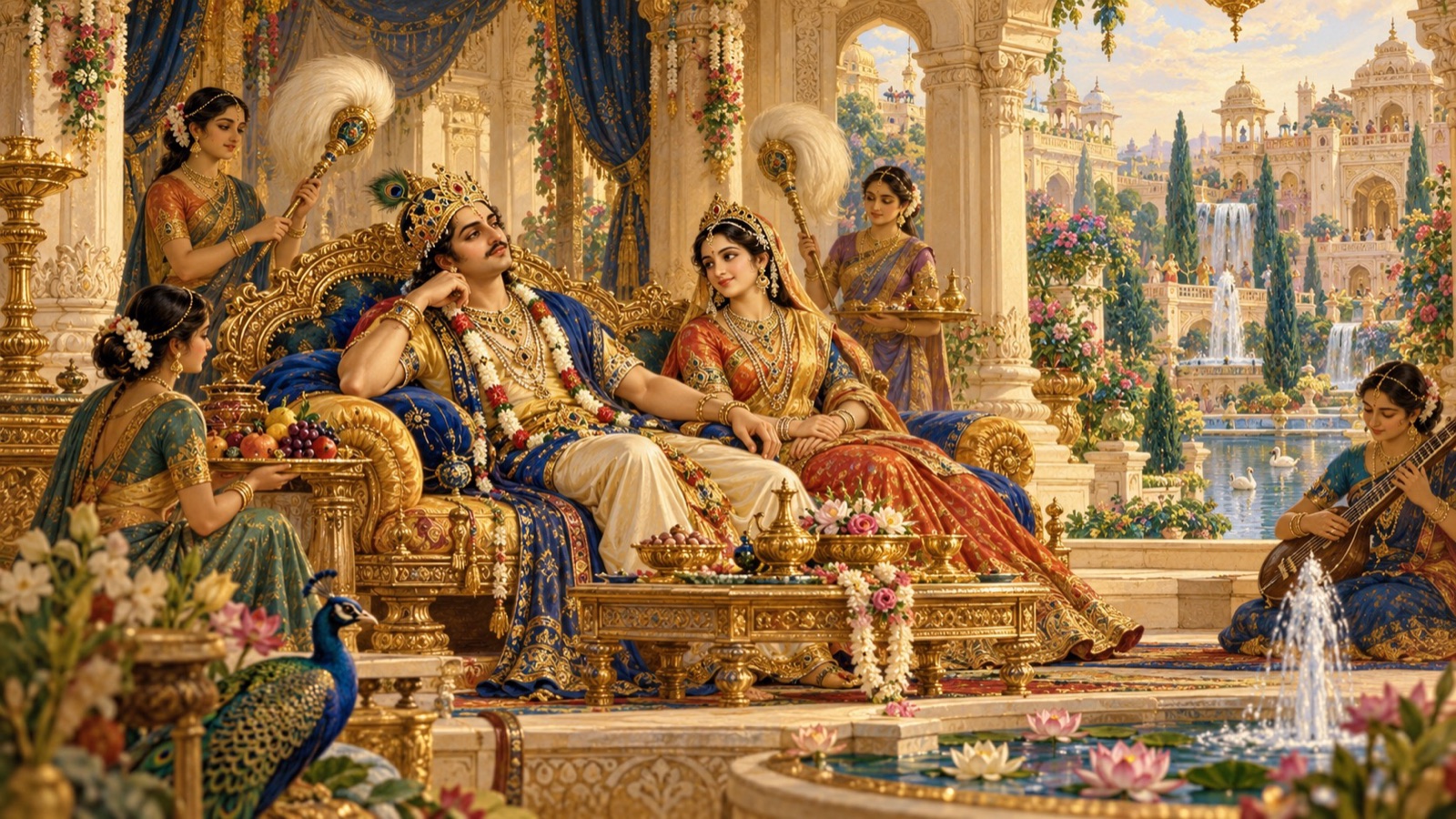
So the twenty-fifth discourse closes with the soul, pictured as Puranjana, deeply entangled in the body and its enjoyments and captivated by the senses — poised for the turns of the parable that the next chapters will bring, as this bondage deepens and, in time, the way of escape appears.
Principal Teachings of This Chapter
1. Deep truths are best carried in a story. Narada does not lecture Prachinabarhi; he tells him a parable. The Bhagavatam teaches that a well-told story can open a heart that argument cannot (verses 9-10).
2. Fruitive works, however grand, still bind. Prachinabarhi’s elaborate sacrifices promise heaven but keep him bound to the world; the goal he actually wants — freedom from misery — cannot be reached by such works at all (verses 4-6).
3. Violence hidden in ritual is never without consequence. Narada shows the king, by his mystic vision, the very animals slain in his sacrifices waiting in the sky to avenge themselves after his death. Killing done without compassion is not simply erased by calling it a ceremony (verse 8).
4. The soul enters the body as into a city. Puranjana takes up dwelling in the nine-gated city; so the soul takes up residence in the body. We are, the parable says, guests in a dwelling we mistake for ourselves (verse 13).
5. The Lord is the unknown friend within. Avijnata, the companion whose ways none can comprehend, is the Supreme Lord seated in the heart. He is always with us, even when, absorbed in the world, we have wholly forgotten Him (verse 10).
6. Absorbed in pleasure, the soul forgets itself and is bound. Captivated by the woman and the life of enjoyment, Puranjana is cheated of his whole existence and led helplessly. So the senses, ungoverned, make masters of what should have been our servants (verse 62).
7. The bondage is chosen, never forced. Puranjana is not driven into the nine-gated city against his will — he searches the whole world for a place to rule and enjoy, and it is he who approaches the woman and asks to remain with her (verses 11, 20-29). Nothing here is imposed on him from outside; every step of his entanglement is his own desire, turned away from his unknown Friend. This is the deeper reason Narada teaches by parable rather than command: since the soul binds itself by its own wish to be a “prabhu,” ruler of its senses’ city, only that same desire, turned back toward the Lord, can set it free again.
A Devotional Reflection
This gentle, strange parable holds up a mirror to a life most of us are living without quite noticing. We arrive, as Puranjana did, in a wondrous “city of nine gates” — this body, with its eyes and ears and all its openings onto the world — and we set out, quite naturally, to enjoy what it offers. And little by little, almost without deciding to, we are captivated: by our senses, our pleasures, our attachments, until the things that were meant to serve us come to rule us, and we find ourselves, like Puranjana, dancing to a tune we never chose. What makes the parable so poignant is the detail of the “unknown friend.” All the while Puranjana wanders and is captivated and forgets himself, his true friend Avijnata — the Lord within the heart — is with him still, unseen and unconsulted, his ways never understood. That is the quiet tragedy the parable names: not that we are evil, but that we are forgetful; that the one Companion who never leaves us is the one we least attend to, precisely because we are so busy with the city and its queen. And yet the very fact that Narada tells this story is itself the beginning of remembrance. To see ourselves in Puranjana is already to start waking from his dream — to remember that we are the traveller and not the city, and that the friend we forgot is nearer than the gates through which we gaze.
A Daily Devotional Practice
Today, remember your “unknown friend.” At some quiet moment, place your attention gently within, and recall that the Supreme Lord dwells in your own heart as Puranjana’s forgotten companion dwelt with him — always present, whether or not you have noticed. Greet Him there with the words “Om Namo Bhagavate Vasudevaya,” turning, if only for a few minutes, from the busy “city” of your senses to the Friend within it. And as you go through your day, notice one place where the senses have quietly become your master rather than your servant — a habit, a craving, a distraction that leads you “against your will” — and, remembering Puranjana, gently take back the reins, offering that small freedom to the Lord. In turning inward to the Friend you had forgotten, you begin to wake from the parable’s long dream.
Conclusion
The twenty-fifth discourse of Book Four begins the celebrated parable of Puranjana. Having taught the Pracetas his hymn, Lord Shiva vanished, and the brothers stood in the water for ten thousand years reciting it. Their father, King Prachinabarhi, remained absorbed in fruitive sacrifices; Narada first warned him, by a startling mystic vision, that the animals slain without mercy await their revenge, then turned to instruct him further through parable. Its hero is Puranjana, a king with an unrecognized friend named Avijnata, whose ways none can comprehend. Journeying the earth in search of a place to rule and enjoy, he settles at last in a splendid nine-gated capital ruled by a beautiful woman, and their shared life together so absorbs him that — by his own choice, step by step — he ends up cheated of his whole existence, led about as helplessly as a tame animal on a leash. As Narada would reveal, Puranjana is the soul, his unrecognized friend the Lord within, and the nine-gated city the body — the parable a mirror of how the soul entangles itself in the world of its own accord. So the chapter sets the stage for the deepening of that self-made bondage, and, in time, the appearing of the way home.
May the divine wisdom of Srimad Bhagavatam awaken pure devotion within our hearts.
Om Namo Bhagavate Vasudevaya.
Jay Shree Madhav.
References and Attribution
- Primary edition: Gita Press, Śrīmad Bhāgavata Mahāpurāṇa (English, complete), Book Four, Discourse 25.
- Series: Srimad Bhagavatam Wisdom · Biswa Sanatan Dharma Seva Trust.
- Presented following the spiritual guidance and recommendation of Pandit Dr. Shri Kashinath Mishra.
This is an original, faithful retelling in the writer’s own words, with brief quoted verses shown in Devanāgarī and transliteration and their meanings given as summaries. It is not a reproduction of any single publisher’s continuous translation or commentary. No affiliation with or endorsement by any publisher is implied.
Jay Shree Madhav