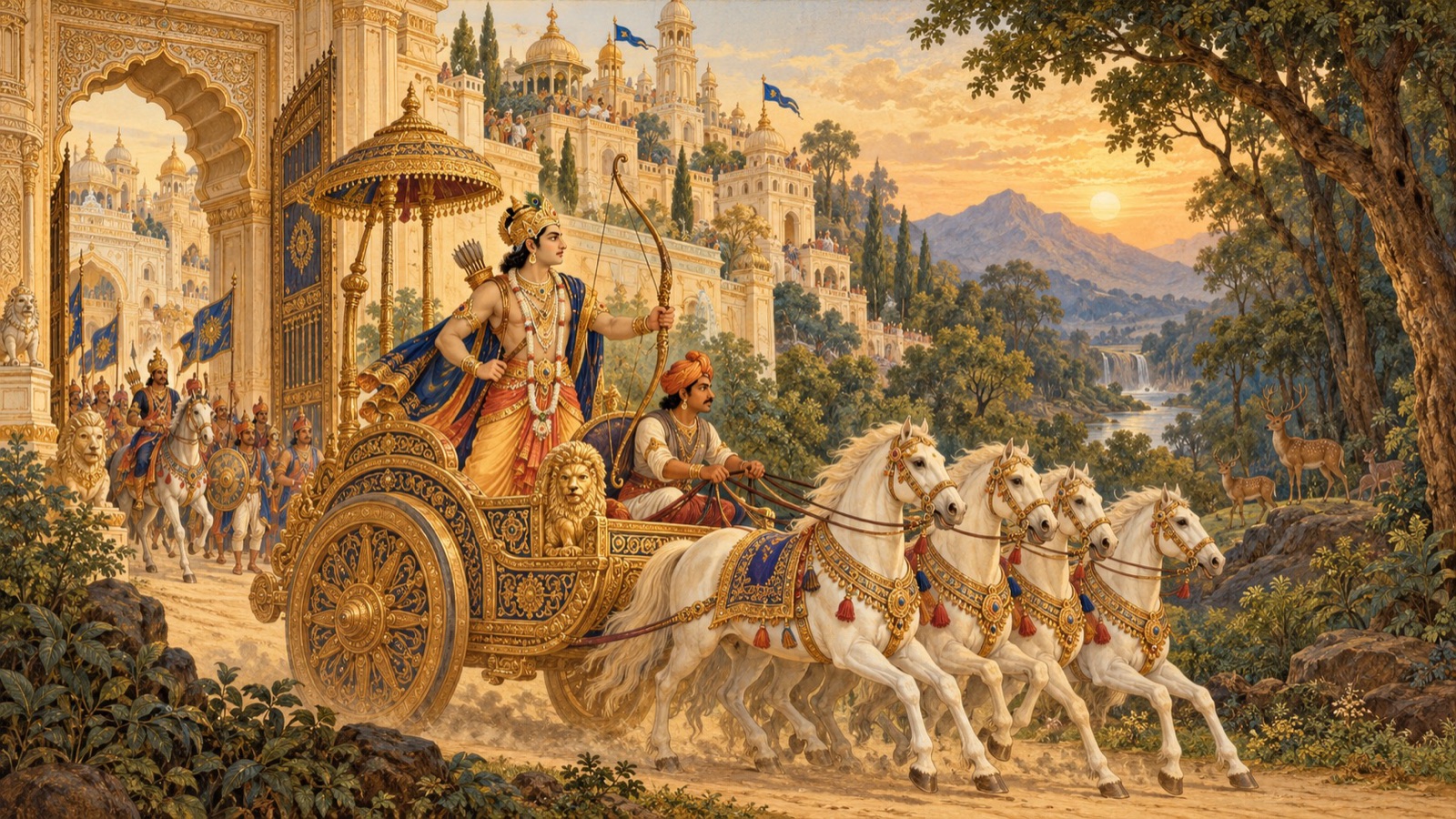
In the parable Narada tells, King Puranjana, seized by a passion for the chase, takes up his bow and rides out to hunt in the forest, leaving behind the queen he could scarcely bear to part from.
Om Namo Bhagavate Vasudevaya.
Om Namo Bhagavate Vasudevaya.
Om Namo Bhagavate Vasudevaya.
Welcome to Srimad Bhagavatam Wisdom, a devotional journey through the sacred histories and teachings of the Srimad Bhagavat Mahapurana. In the previous chapter, the sage Narada began the parable of Puranjana — the soul who enters a city of nine gates (the body), is captivated by its queen (the mind and senses), and forgets his unknown friend, the Lord within. This twenty-sixth chapter continues that instructive story-within-a-story. Settled in his splendid city and rarely able to leave his queen’s side, Puranjana is one day seized by a passion for the hunt. Armed and adorned, he rides out to the forest, delighting in the chase and slaying many creatures — a slaughter that grieves the merciful. But his long absence wounds his queen, and when he returns he finds her lying dejected and angry at being neglected. With tender and coaxing words he pacifies her, and resumes his life of pleasure. Throughout, it remains an evidently allegorical tale, and its meaning is plain: the soul, absorbed in restless enjoyment, neglects its own better nature, and lives in a cycle of craving, guilt, and appeasement.
Chapter Information
- Scripture: Śrīmad Bhāgavata Mahāpurāṇa
- Canto: 4 (Book Four)
- Chapter: 26 (Discourse 26)
- Chapter title: Puranjana’s Hunt and the Queen’s Anger
- Principal speaker: The sage Narada, continuing his parable to King Prachinabarhi (within Maitreya’s discourse to Vidura)
- Principal listener: King Prachinabarhi (and Vidura)
- Main setting: The city of Puranjana and the forest of the hunt (within the parable)
- Central subject: Puranjana’s hunt, the grief it causes, the queen’s anger, and his pacifying of her
- Principal verse range: Canto 4, Chapter 26, verses 1–26
- Primary edition: Gita Press Śrīmad Bhāgavata Mahāpurāṇa
Context from the Previous Chapter
Chapter 25 began Narada’s parable: Puranjana, the soul, entered the nine-gated city, met the woman who ruled it, and became so absorbed in a life of pleasure that he was led helplessly, forgetting his true friend within. This twenty-sixth chapter carries the story forward, showing the restless pattern of that enthralled life — its cravings, its neglect of what matters, and its rounds of quarrel and appeasement.
Puranjana Rides Out to Hunt
Narada first lingers over the chariot itself, for it is not mere decoration in the telling. Fitted with golden armor and drawn by five swift horses, guided by eleven commanders and marked above by three flags, it carried Puranjana toward the forest called Panca-prastha. Across these opening verses it becomes a picture of the body itself: the chariot is the very frame we ride in, the three flags are the three modes of material nature flying over it, the five horses are the five senses racing after their objects, and the eleven commanders are the ten working senses and the restless mind that drives them. Seated within, as though its master, rides the soul — carried wherever this borrowed vehicle goes.
स एकदा महेष्वासो रथं पञ्चाश्वमाशुगम् । द्वीषं द्विचक्रमेकाक्षं त्रिवेणुं पञ्चबन्धुरम् ॥ १ ॥
sa ekadā maheṣvāso rathaṁ pañcāśvam āśu-gam dvīṣaṁ dvi-cakram ekākṣaṁ tri-veṇuṁ pañca-bandhuram
Meaning: Once, the great archer Puranjana mounted his chariot — drawn by five swift horses, bearing two explosive missiles, resting on two wheels and a single axle, and marked by three flags and five bindings. (Canto 4, Chapter 26, verse 1)
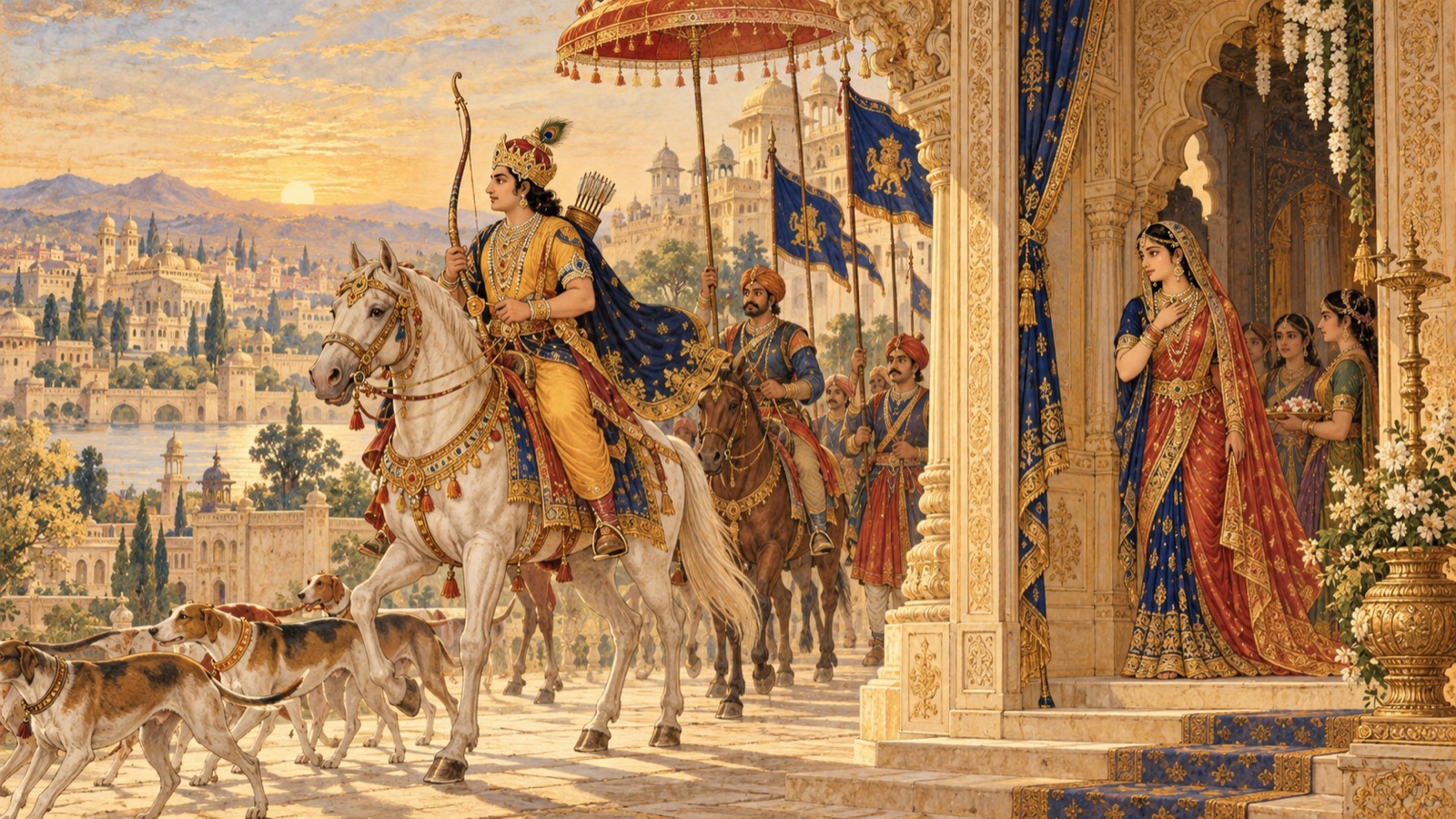
Though Puranjana could scarcely bear to leave his queen’s side even for a moment, one day he was seized by a passion for the hunt. Taking up his bow and arrows with pride, and adorned for the chase, he rode out to the forest, leaving behind the wife he ought not to have abandoned.
चचार मृगयां तत्र दृप्त आत्तेषुकार्मुक: । विहाय जायामतदर्हां मृगव्यसनलालस: ॥ ४ ॥
cacāra mṛgayāṁ tatra dṛpta ātteṣu-kārmukaḥ vihāya jāyām atad-arhāṁ mṛga-vyasana-lālasaḥ
Meaning: Seized with a passion for the hunt, taking up his bow and arrows with pride, Puranjana went hunting in the forest, leaving behind his queen, whom he ought not to have abandoned. (Canto 4, Chapter 26, verse 4)
The Grief of the Hunt
In the forest Puranjana pursued the chase with reckless delight, and many creatures fell, their bodies pierced by his sharp, feathered arrows. So ghastly was the slaughter that those of a merciful heart could not bear to look upon the suffering he caused.
तत्र निर्भिन्नगात्राणां चित्रवाजै: शिलीमुखै: । विप्लवोऽभूद्दु:खितानां दु:सह: करुणात्मनाम् ॥ ९ ॥
tatra nirbhinna-gātrāṇāṁ citra-vājaiḥ śilīmukhaiḥ viplavo ’bhūd duḥkhitānāṁ duḥsahaḥ karuṇātmanām
Meaning: As many creatures fell there, their bodies pierced by his feathered arrows, the sight of their suffering was unbearable to those of a merciful heart. (Canto 4, Chapter 26, verse 9)
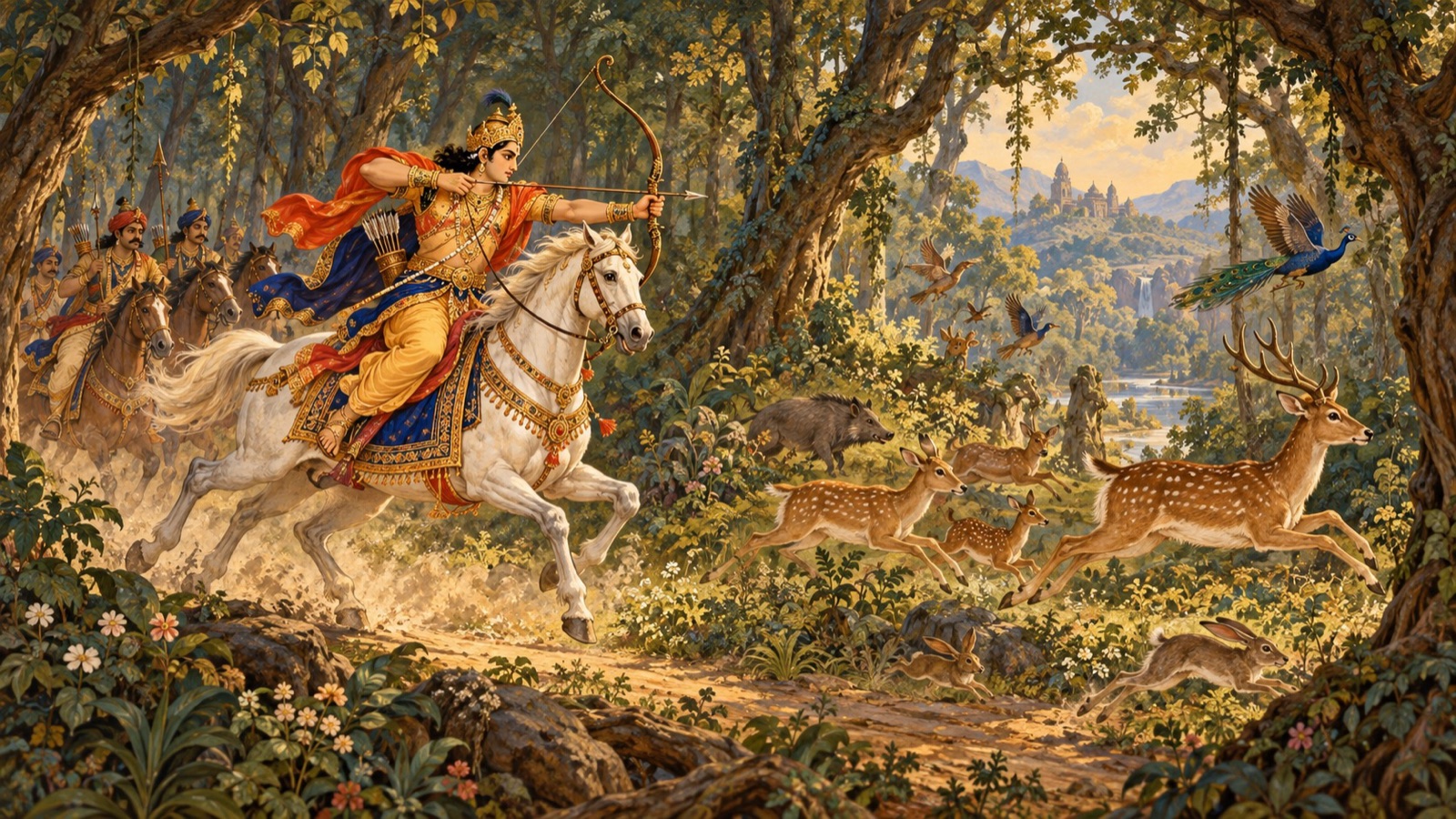
Wearied at last of the hunt, and remembering his queen, Puranjana turned homeward — his mind, as always, running ahead to the pleasures of the city.
Narada pauses here to make a deeper point. The scriptures do permit certain regulated hunting and sacrifice for those whose desires are not yet purified, but such permission is a fence, not a license — meant to restrain appetite, never to sanction it without limit. One who instead acts on personal whim, disregarding what the scriptures direct, attains neither perfection nor happiness nor the highest goal; he is simply carried further into the three modes of nature, his real intelligence lost, wandering the cycle of birth and death until he again submits to guidance beyond his own desire. Puranjana’s hunt is exactly this — not forbidden by its outward form, but sought for its own sake, whim wearing the mask of sport (verses 6-8).
The Queen’s Anger
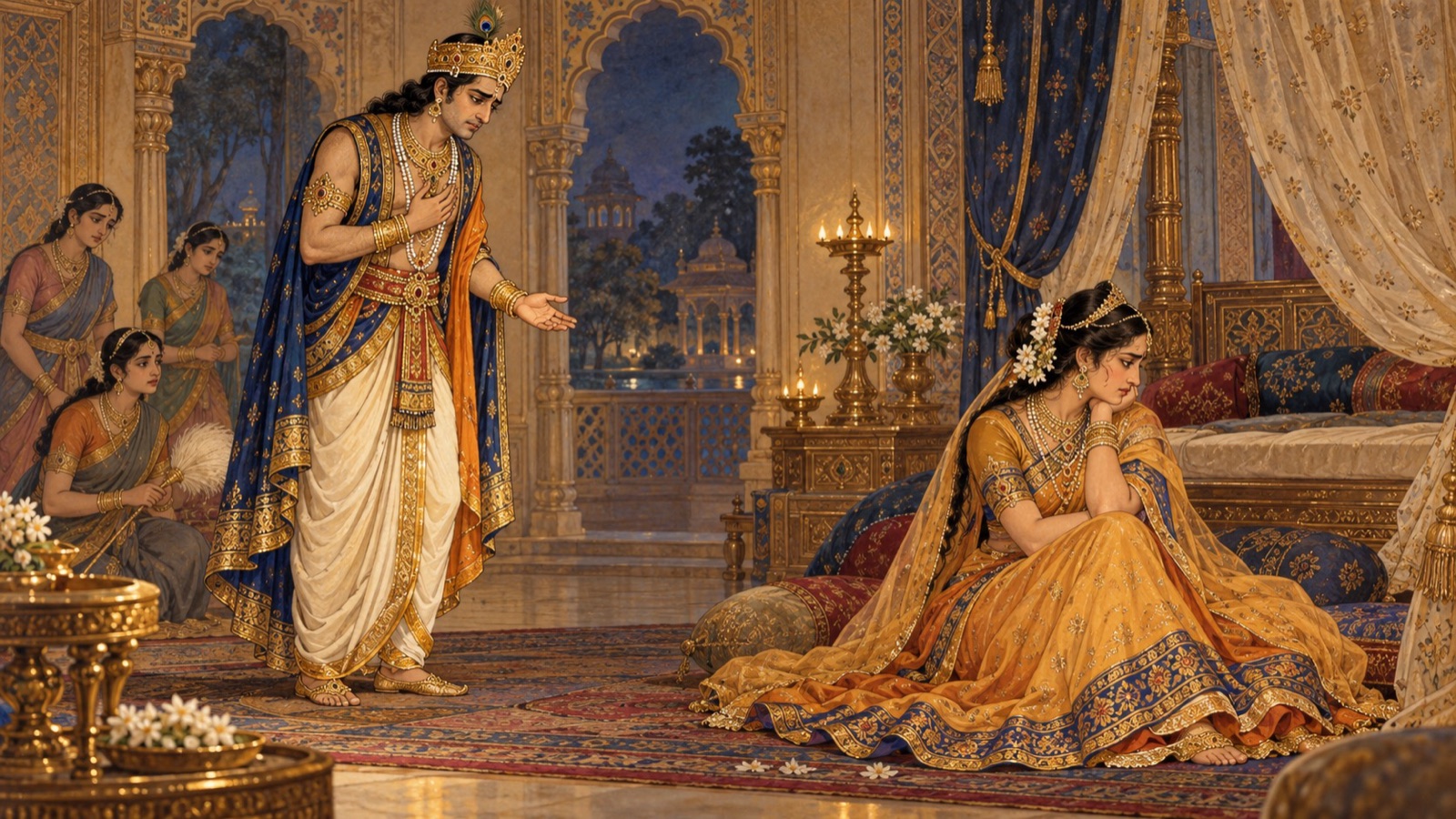
But he returned to find his queen wounded by his neglect. Seeing her lying dejected upon the ground, disheveled and angry at having been left behind, Puranjana — his understanding unsettled by his very attachment to her — fell into deep distress.
नारद उवाच पुरञ्जन: स्वमहिषीं निरीक्ष्यावधुतां भुवि । तत्सङ्गोन्मथितज्ञानो वैक्लव्यं परमं ययौ ॥ १८ ॥
nārada uvāca purañjanaḥ sva-mahiṣīṁ nirīkṣyāvadhutāṁ bhuvi tat-saṅgonmathita-jñāno vaiklavyaṁ paramaṁ yayau
Meaning: Narada said: Seeing his queen lying dejected upon the ground, Puranjana, his understanding unsettled by his attachment to her, fell into deep distress. (Canto 4, Chapter 26, verse 18)
The Pacifying of the Queen
Then Puranjana set himself to soothe her. With tender, coaxing words he lamented how deeply his neglect had changed her radiant countenance, and begged her to grieve no more.
वक्त्रं न ते वितिलकं मलिनं विहर्षं संरम्भभीममविमृष्टमपेतरागम् । पश्ये स्तनावपि शुचोपहतौ सुजातौ बिम्बाधरं विगतकुङ्कुमपङ्करागम् ॥ २५ ॥
vaktraṁ na te vitilakaṁ malinaṁ viharṣaṁ saṁrambha-bhīmam avimṛṣṭam apeta-rāgam paśye stanāv api śucopahatau sujātau bimbādharaṁ vigata-kuṅkuma-paṅka-rāgam
Meaning: (Puranjana said:) I see your face without its auspicious mark, dulled and joyless, fierce with anger and its sweetness withdrawn, and your beauty dimmed with sorrow. (Canto 4, Chapter 26, verse 25)
And he pressed his plea for reconciliation, addressing her as his dearest friend and admitting the fault of his impulsive departure, trusting that no loving wife could long refuse a husband who returns to her humbled and yearning.
तन्मे प्रसीद सुहृद: कृतकिल्बिषस्य स्वैरं गतस्य मृगयां व्यसनातुरस्य । का देवरं वशगतं कुसुमास्त्रवेग- विस्रस्तपौंस्नमुशती न भजेत कृत्ये ॥ २६ ॥
tan me prasīda suhṛdaḥ kṛta-kilbiṣasya svairaṁ gatasya mṛgayāṁ vyasanāturasya kā devaraṁ vaśa-gataṁ kusumāstra-vega- visrasta-pauṁsnam uśatī na bhajeta kṛtye
Meaning: (Puranjana said:) So be gracious to me, your friend, who erred in going off to hunt at will; what loving wife would not accept her devoted husband when he comes to her, subdued and weakened by the arrows of love? (Canto 4, Chapter 26, verse 26)
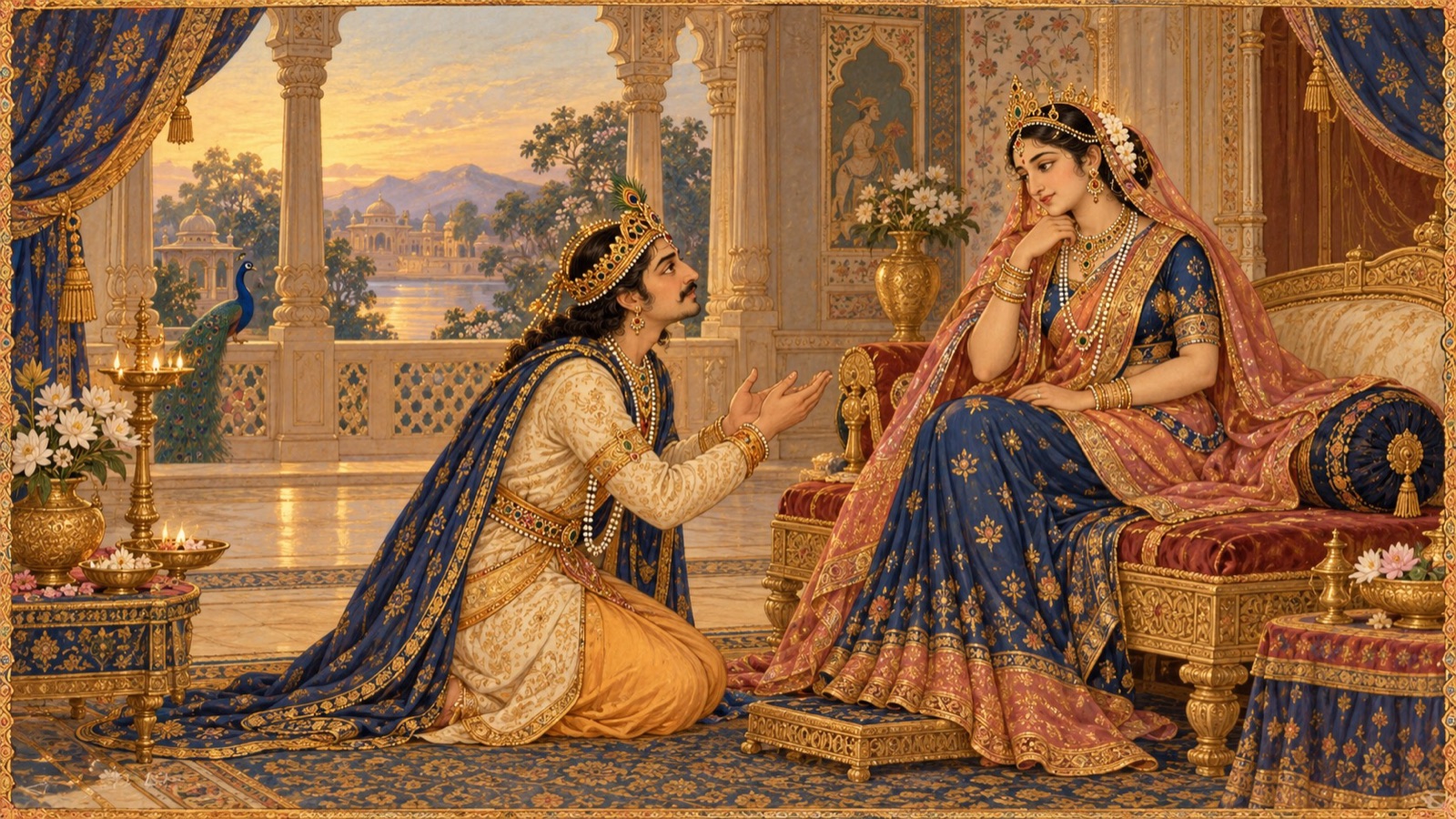
So, appeased by his coaxing, the queen was reconciled, and Puranjana resumed his round of enjoyment as before. With this the twenty-sixth discourse closes — the soul caught in the restless cycle of craving, neglect, quarrel, and appeasement — poised for the darker turn of the parable in the next chapter, when the forces of time will lay siege to the city.
Principal Teachings of This Chapter
1. Restless craving pulls us from what matters. Though Puranjana could barely leave his queen, a sudden passion for the hunt drew him away. Our cravings are fickle masters, forever pulling us toward the next pleasure and away from our own good (verse 4).
2. Heedless pleasure causes real harm. Puranjana’s hunt is no innocent sport; it fills the forest with suffering that the merciful cannot bear. Our appetites, indulged without care, leave a trail of harm we would rather not see (verse 9).
3. Attachment unsettles the understanding. Seeing his queen displeased, Puranjana loses his composure entirely — not from love’s strength but from attachment’s bondage. The more we cling, the more easily our peace is overturned (verse 18).
4. The enthralled soul lives in a cycle of quarrel and appeasement. Puranjana neglects, the queen sulks, he coaxes, and the round begins again. A life ruled by the senses is not steady joy but this restless see-saw of craving and repair (verses 18-26).
5. The allegory is a mirror, not a romance. Narada tells this as a picture of the soul and the mind, not as a love story to admire. Read rightly, it holds up to us the very pattern of our own entangled days (verses 1-26).
A Devotional Reflection
Beneath its old and courtly surface, this little chapter describes a rhythm most of us know intimately. Puranjana can hardly bear to be away from the pleasures of his city — and yet the moment a new craving seizes him, off he goes, heedless of the harm he does and the love he neglects. And when he returns to find that his neglect has cost him, he is thrown into distress, and must spend himself soothing and coaxing his way back to peace, only to begin the whole cycle again. This is the see-saw of a life run by the senses: we chase the next pleasure, we neglect what truly matters, we feel the ache of that neglect, we patch things up, and round we go. What the parable quietly exposes is that this is not freedom at all, though it wears the costume of a king enjoying his realm. Puranjana is not the master of his pleasures; he is their servant, dragged from craving to guilt to appeasement, never at rest. The Bhagavatam is not scolding us for being human; it is holding up a mirror so that we might notice the treadmill and long to step off it. And the way off is not to hate the city or the queen — the body and the mind are not our enemies — but to remember the one thing Puranjana has forgotten: the unknown friend within, in whose presence alone the restless heart can finally be still.
A Daily Devotional Practice
Today, watch for the see-saw and step off it, if only once. Notice a single moment when a craving pulls you away from something that matters — a distraction that draws you from a duty, an indulgence that neglects a person you love — and, before you follow it, pause and offer the impulse to the Lord with the words “Om Namo Bhagavate Vasudevaya.” You need not condemn the desire; simply do not let it drag you like Puranjana’s passion for the hunt. And if you find yourself, later, in the familiar work of “appeasing” some consequence of your own heedlessness — smoothing over a neglect, repairing a small harm — do it humbly, and let it remind you to seek your rest not in the endless round of craving and repair, but in the still presence of the Friend within, where alone the restless heart grows quiet.
Conclusion
The twenty-sixth discourse of Book Four continues Narada’s parable of Puranjana with a scene of restless enjoyment. Though he can scarcely leave his queen, Puranjana is seized by a passion for the hunt and rides out to the forest, slaying many creatures in a slaughter that grieves the merciful. Returning, he finds his queen wounded by his neglect, lying dejected and angry; and, his understanding unsettled by his very attachment to her, he falls into distress and must pacify her with tender, coaxing words, at last reconciling and resuming his life of pleasure. As Narada intends, this is a mirror of the enthralled soul: pulled by fickle cravings from what matters, causing harm it will not see, and caught in an endless see-saw of neglect, quarrel, and appeasement — never at rest. So the chapter exposes the restless bondage that masquerades as a king’s enjoyment, and sets the stage for the darker turn to come, when the forces of time besiege the city.
May the divine wisdom of Srimad Bhagavatam awaken pure devotion within our hearts.
Om Namo Bhagavate Vasudevaya.
Jay Shree Madhav.
References and Attribution
- Primary edition: Gita Press, Śrīmad Bhāgavata Mahāpurāṇa (English, complete), Book Four, Discourse 26.
- Series: Srimad Bhagavatam Wisdom · Biswa Sanatan Dharma Seva Trust.
- Presented following the spiritual guidance and recommendation of Pandit Dr. Shri Kashinath Mishra.
This is an original, faithful retelling in the writer’s own words, with brief quoted verses shown in Devanāgarī and transliteration and their meanings given as summaries. It is not a reproduction of any single publisher’s continuous translation or commentary. No affiliation with or endorsement by any publisher is implied.
Jay Shree Madhav