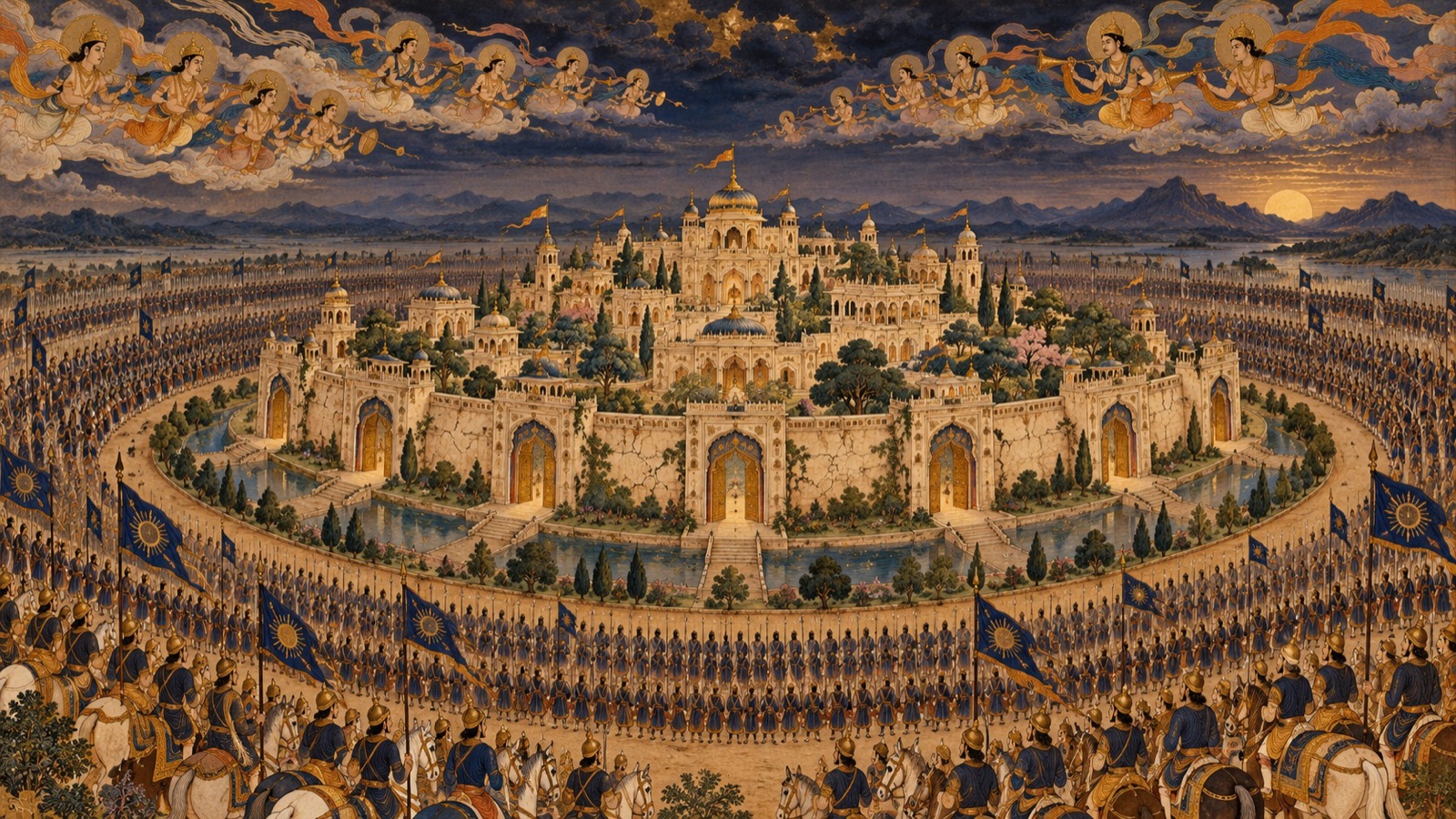
In Narada’s parable, the forces of Chandavega — the ceaseless passage of the years — at last lay siege to Puranjana’s city of nine gates, and its weary defenses can no longer hold.
Om Namo Bhagavate Vasudevaya.
Om Namo Bhagavate Vasudevaya.
Om Namo Bhagavate Vasudevaya.
Welcome to Srimad Bhagavatam Wisdom, a devotional journey through the sacred histories and teachings of the Srimad Bhagavat Mahapurana. In the previous chapter, King Puranjana, the soul enthralled by the senses, pursued his pleasures and pacified his queen, living out the restless round of enjoyment. This twenty-seventh chapter turns the parable toward its solemn truth. Reconciled with his queen, Puranjana begets many children and grows ever more entangled in his household — while, unnoticed, the years slip by. Then comes Kalakanya, “the daughter of Time” — old age — who, spurned everywhere and refused a place, allies herself with the fearsome king of the Yavanas (fear and death) and his brother Prajvara (fever); and the Gandharva king Chandavega, the ceaseless march of days and nights, lays siege to Puranjana’s city. Its one faithful defender — the serpent of the life-breath — fights alone against overwhelming numbers and grows weak, and the city is worn down. It is a chapter about the quiet, universal siege that time lays against every body, and a summons, while the walls yet stand, to remember the Lord.
Chapter Information
- Scripture: Śrīmad Bhāgavata Mahāpurāṇa
- Canto: 4 (Book Four)
- Chapter: 27 (Discourse 27)
- Chapter title: Puranjana’s city besieged, and the tale of Kalakanya
- Principal speaker: The sage Narada, continuing his parable to King Prachinabarhi (within Maitreya’s discourse to Vidura)
- Principal listener: King Prachinabarhi (and Vidura)
- Main setting: The city of Puranjana, besieged (within the parable)
- Central subject: Puranjana’s growing family, the coming of Kalakanya (old age), her alliance with the king of the Yavanas, and the siege of the city by Chandavega
- Principal verse range: Canto 4, Chapter 27, verses 1–30
- Primary edition: Gita Press Śrīmad Bhāgavata Mahāpurāṇa
Context from the Previous Chapter
Chapter 26 showed Puranjana’s restless round of pleasure — his hunt, his queen’s anger, and his coaxing reconciliation. This twenty-seventh chapter carries the parable forward through the years, as the soul’s entanglement deepens with family and possessions, and time itself, personified, begins its slow and certain siege.
The Growing Household
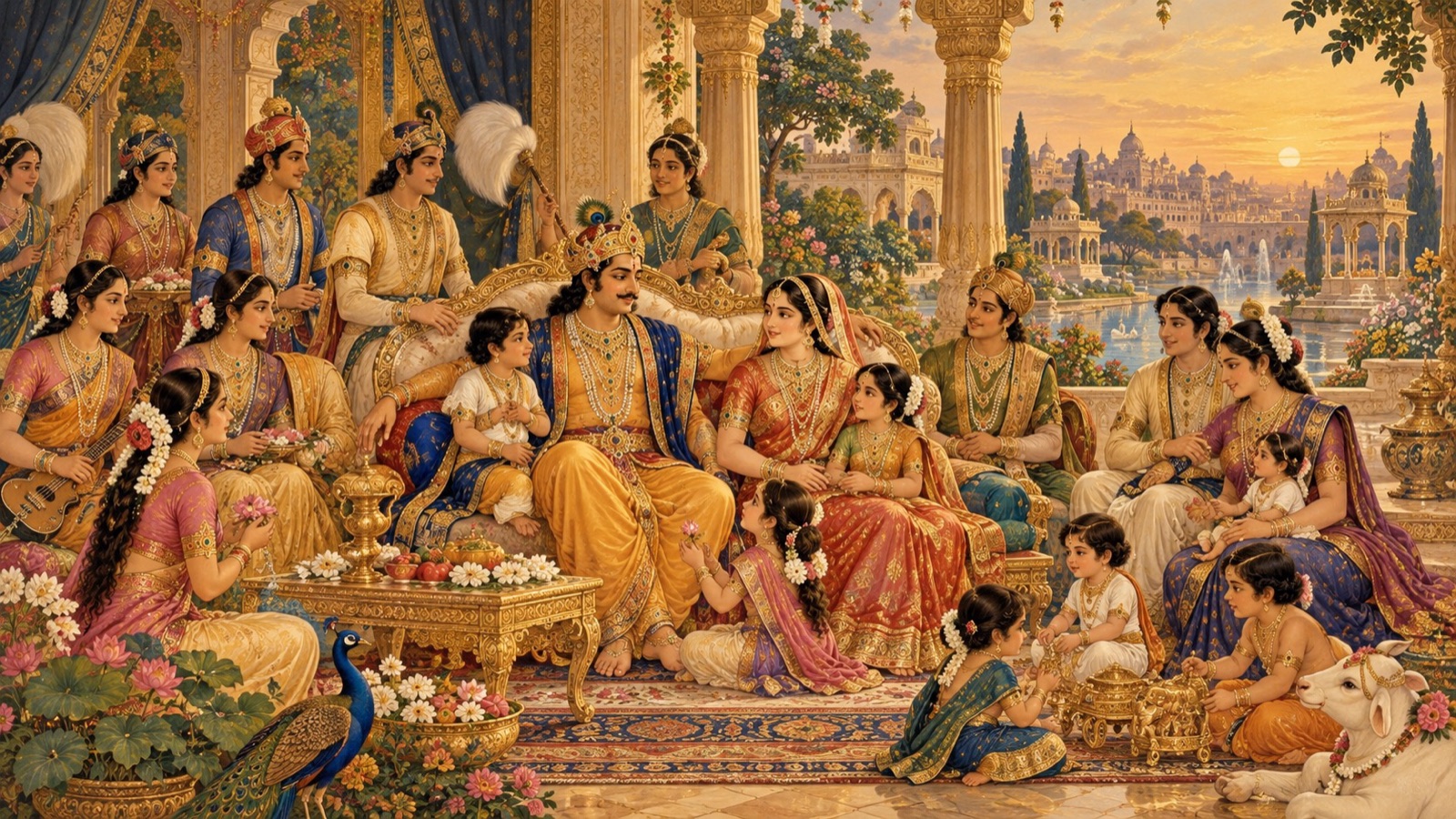
Reconciled with his queen, Puranjana welcomed her — freshly bathed, lovely of face, content and adorned with auspicious rites — and resumed his life with her.
स राजा महिषीं राजन् सुस्नातां रुचिराननाम् । कृतस्वस्त्ययनां तृप्तामभ्यनन्ददुपागताम् ॥ २ ॥
sa rājā mahiṣīṁ rājan susnātāṁ rucirānanām kṛta-svastyayanāṁ tṛptām abhyanandad upāgatām
Meaning: The king welcomed his queen, O king, freshly bathed and lovely of face, content and adorned with auspicious rites, as she came to him. (Canto 4, Chapter 27, verse 2)
Held in her embrace, his own arm about her shoulders, Puranjana lingered with her in a private place, trading playful words — and in that captivation his good sense slipped away entirely. So taken was he with his queen that he stopped noticing what every day and night was quietly doing: spending, without any return, the very span of life he had been given.
तयोपगूढ: परिरब्धकन्धरो रहोऽनुमन्त्रैरपकृष्टचेतन: । न कालरंहो बुबुधे दुरत्ययं दिवा निशेति प्रमदापरिग्रह: ॥ ३ ॥
tayopagūḍhaḥ parirabdha-kandharo raho ’numantrair apakṛṣṭa-cetanaḥ na kāla-raṁho bubudhe duratyayaṁ divā niśeti pramadā-parigrahaḥ
Meaning: Embraced by her, his arm around her shoulders, exchanging private words, Puranjana’s mind was carried away — so absorbed in his wife that he never marked the irresistible passing of time in the days and nights slipping by. (Canto 4, Chapter 27, verse 3)
Over the long years, Puranjana begot many sons and a hundred and ten daughters, all endowed with good character, generosity, and every virtue, who brought glory to their parents. He married them off, gained grandchildren beyond counting, and so wove himself ever more tightly into the web of household ties, forgetting more and more the friend within and the passing of his days.
दुहितृर्दशोत्तरशतं पितृमातृयशस्करी: । शीलौदार्यगुणोपेता: पौरञ्जन्य: प्रजापते ॥ ७ ॥
duhitṝr daśottara-śataṁ pitṛ-mātṛ-yaśaskarīḥ śīlaudārya-guṇopetāḥ paurañjanyaḥ prajā-pate
Meaning: O Prajapati, Puranjana begot a hundred and ten daughters, who brought glory to their parents, endowed with good character, generosity, and every virtue. (Canto 4, Chapter 27, verse 7)
The Story Turns Toward the King
At this point Narada does something remarkable: he lets his listener see whose story this really is. Addressing King Prachinabarhi directly, he says that Puranjana, driven by that same tangle of desires, also performed elaborate rites for the gods, the ancestors, and the guardian spirits — rites made grim because they called for the killing of animals. In the very same breath, Narada names the king: it is your own story, O King, being retold. This is why the sage has spent so long weaving an elaborate tale instead of simply rebuking his listener — King Prachinabarhi was, at that very time, absorbed in a great sacrifice involving the slaughter of many animals, certain that such rites were his highest duty. Narada’s compassion here is exact: he does not condemn the king outright but holds up a mirror shaped like a story, gently enough that the king can recognize himself in Puranjana’s forgetfulness before the sage ever says so in plain words. The teaching cuts to the heart of the matter — ritual performed for the sake of family, position, and continuance, however sanctioned it may appear, is not itself devotion, and when it requires violence against other creatures it is no religion at all; it is one more thread in the very entanglement this chapter has been describing.
ईजे च क्रतुभिर्घोरैर्दीक्षित: पशुमारकै: । देवान् पितृन् भूतपतीन्नानाकामो यथा भवान् ॥ ११ ॥
īje ca kratubhir ghorair dīkṣitaḥ paśu-mārakaiḥ devān pitṝn bhūta-patīn nānā-kāmo yathā bhavān
Meaning: Driven, like you yourself, O King, by many desires, Puranjana too was consecrated for grim sacrifices that required the slaughter of animals, and so worshiped the gods, the ancestors, and the guardian spirits. (Canto 4, Chapter 27, verse 11)
The Coming of Kalakanya
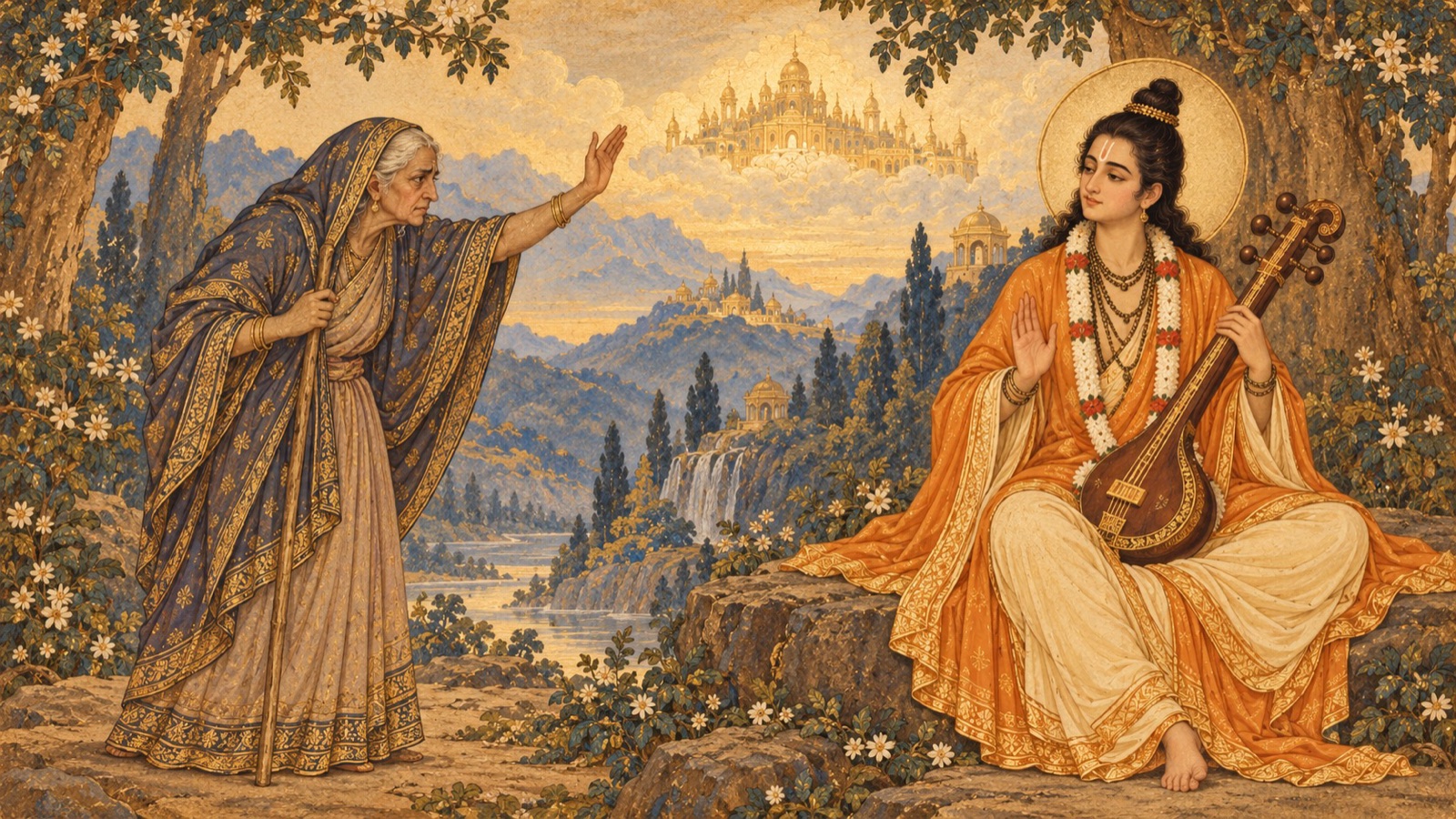
Then Narada told of Kalakanya — “the daughter of Time,” who is old age. Seeking a husband, she was spurned wherever she went, for none would willingly embrace her. She had once approached even Narada himself; and when he declined her request, she grew angry and laid a curse upon him — that he should never be able to remain long in any one place.
मयि संरभ्य विपुलमदाच्छापं सुदु:सहम् । स्थातुमर्हसि नैकत्र मद्याच्ञाविमुखो मुने ॥ २२ ॥
mayi saṁrabhya vipula- madāc chāpaṁ suduḥsaham sthātum arhasi naikatra mad-yācñā-vimukho mune
Meaning: (Kalakanya, angered, said:) Because you, O sage, have turned away from my request, you shall not be able to remain in any one place. (Canto 4, Chapter 27, verse 22)
The Alliance of Old Age, Fear, and Fever
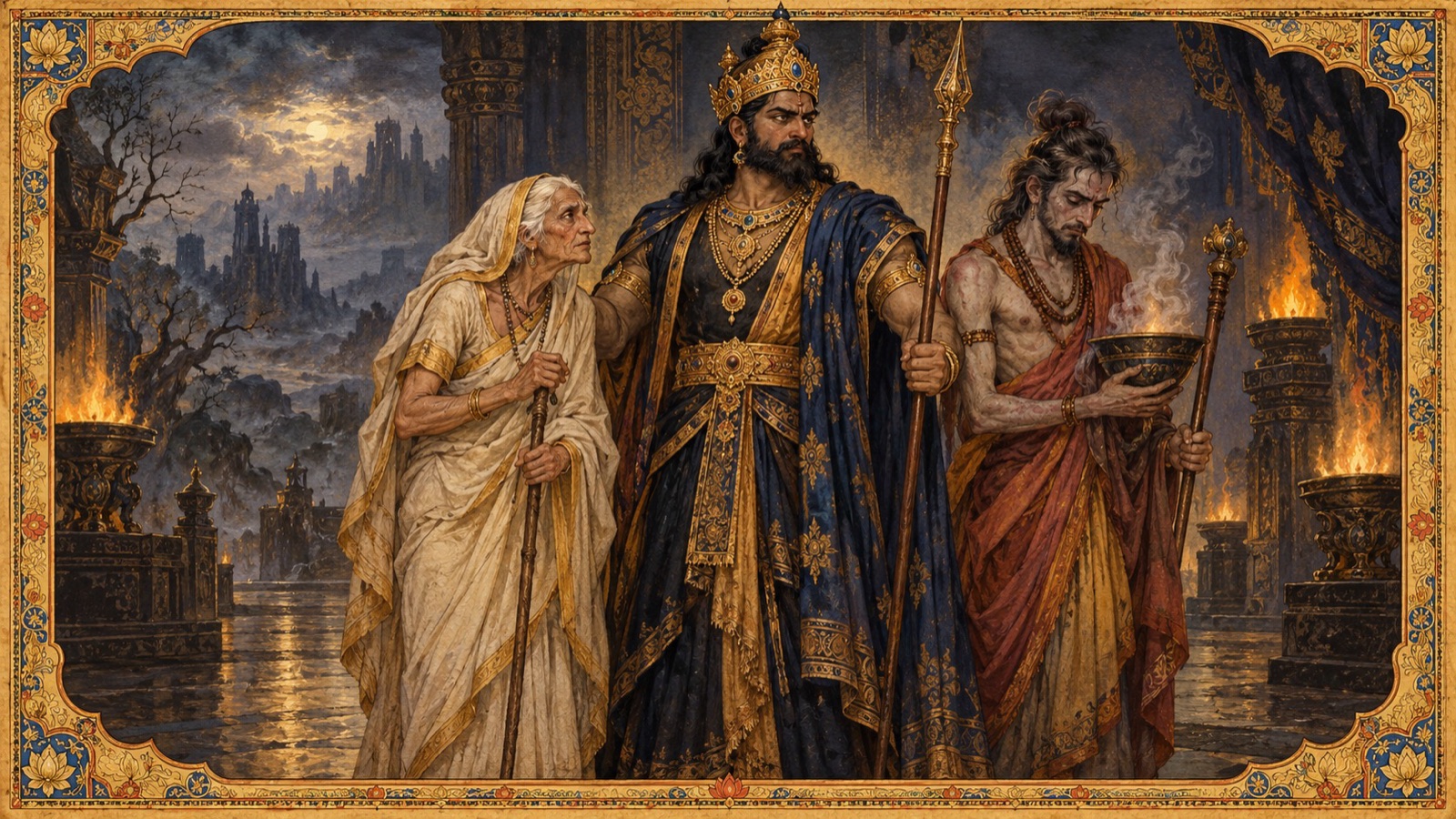
Refused everywhere, Kalakanya at last found her place. The fearsome king of the Yavanas — who is Fear itself, the harbinger of death — accepted her, and welcomed her not as a wife but as a sister, presenting his own brother, Prajvara, who is Fever. Together, he declared, with Kalakanya and Prajvara and his dread, unseen soldiers, he would move through this world imperceptibly, wearing down every creature in his own hidden time.
प्रज्वारोऽयं मम भ्राता त्वं च मे भगिनी भव । चराम्युभाभ्यां लोकेऽस्मिन्नव्यक्तो भीमसैनिक: ॥ ३० ॥
prajvāro ’yaṁ mama bhrātā tvaṁ ca me bhaginī bhava carāmy ubhābhyāṁ loke ’sminn avyakto bhīma-sainikaḥ
Meaning: (The king of the Yavanas said:) Here is my brother Prajvara; be you my sister; with you both and my dread soldiers, I shall roam unseen through this world. (Canto 4, Chapter 27, verse 30)
The Siege of the City
And so, unnoticed at first, the siege began. The Gandharva king Chandavega — the ceaseless passage of the years, with his three hundred and sixty warriors, the days and nights that circle without rest — advanced upon Puranjana’s city of nine gates. The city’s one faithful defender, the five-hooded serpent that was the life-breath, fought bravely; but alone against so many, and worn by the long assault, he grew weaker and weaker. Seeing his most intimate companion failing, Puranjana, with all his realm and city and kin, was seized with deep anxiety and distress.
क्षीयमाणे स्वसम्बन्धे एकस्मिन् बहुभिर्युधा । चिन्तां परां जगामार्त: सराष्ट्रपुरबान्धव: ॥ १७ ॥
kṣīyamāṇe sva-sambandhe ekasmin bahubhir yudhā cintāṁ parāṁ jagāmārtaḥ sa-rāṣṭra-pura-bāndhavaḥ
Meaning: As his one intimate companion, fighting alone against so many, grew weak, Puranjana, with his realm and city and kin, fell into deep anxiety and distress. (Canto 4, Chapter 27, verse 17)
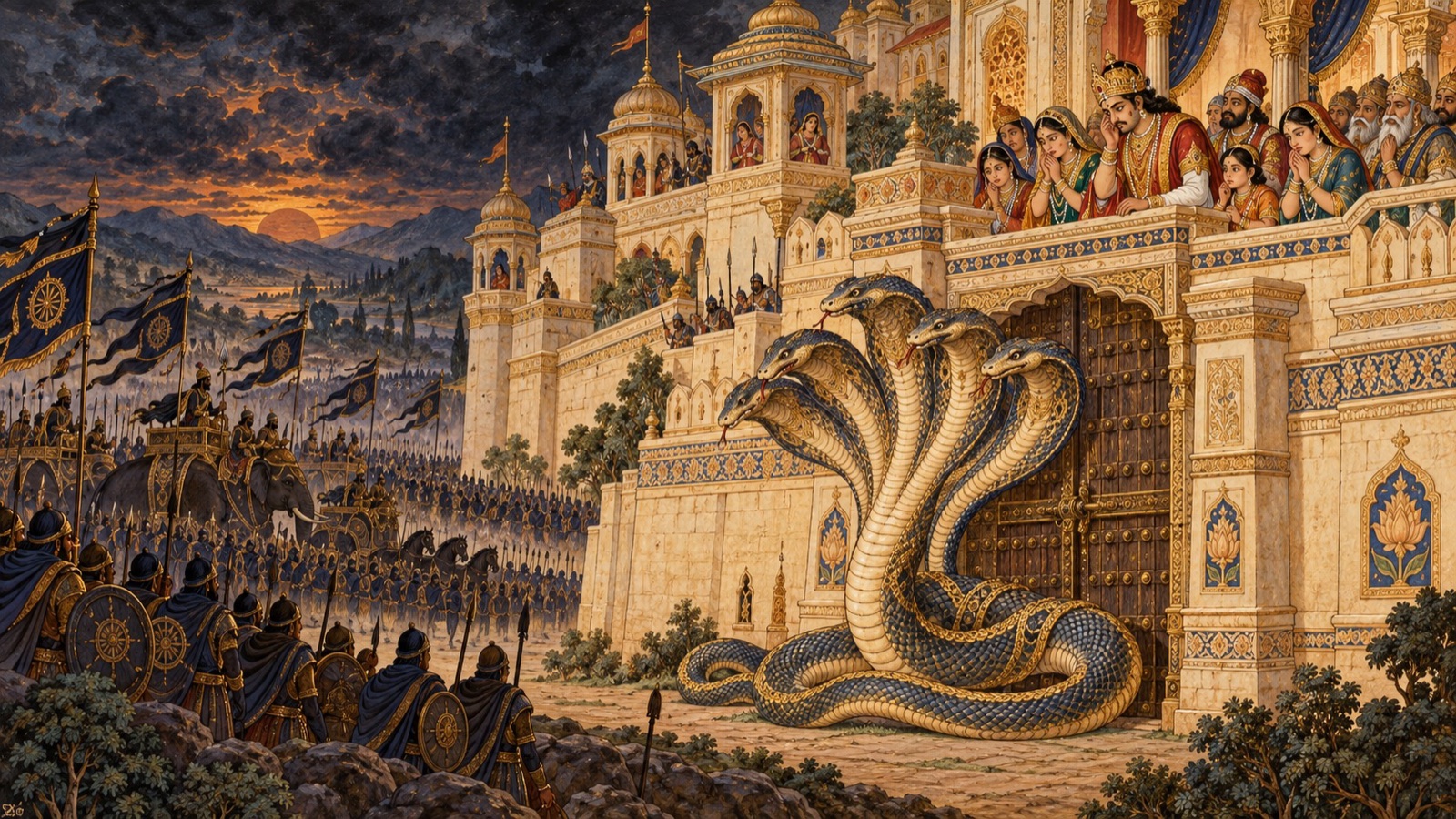
So the twenty-seventh discourse closes with the city of the body worn down by the slow, unstoppable siege of time, old age, fear, and fever — the soul, still absorbed in its household, at last brought face to face with what it had so long forgotten. The next chapter will tell how this siege ends, and how, through the mercy of the unknown friend, the way of liberation at last appears.
Principal Teachings of This Chapter
1. Entanglement deepens with what we love. Puranjana’s sons, daughters, and grandchildren bind him ever more tightly to the world. The very ties that gladden us also enmesh us; love of the world grows the more we have to love (verses 1-9).
2. This story is really about the one listening. By revealing “like you,” Narada shows that Puranjana is King Prachinabarhi himself — and that elaborate rites performed for family and status, when they require killing animals, are not devotion but one more strand of the same entanglement (verse 11).
3. Time comes for everyone, unbidden and unwelcome. Kalakanya, old age, is spurned by all, yet she cannot be turned away forever. What no one wishes to embrace embraces us all in the end (verses 19-24).
4. Old age, fear, and fever move together and unseen. The alliance of Kalakanya, the king of the Yavanas, and Prajvara pictures how age, the fear of death, and disease work quietly within us, “imperceptibly,” long before we notice (verse 30).
5. The body’s defenses cannot hold forever. The faithful serpent of the life-breath fights alone and steadily weakens. However we guard our health and strength, the long siege of the years cannot in the end be repelled (verse 17).
6. The siege is a summons, not only a sorrow. The whole point of Narada’s grim picture is to wake the soul while there is time. Time’s approach is meant to turn us, at last, toward the one Friend who does not fail (verses 25-30).
A Devotional Reflection
This is the chapter where the parable stops being merely a story about a distracted king and becomes, unmistakably, a portrait of every one of us. We build our households, we delight in our children and their children, we guard our health and gather our possessions — and all the while, quite unnoticed, the years are advancing on the city we call our life. The Bhagavatam personifies this so vividly that we cannot look away: old age as a spurned woman no one wants but no one can finally refuse; fear and fever as her allies, moving “imperceptibly” within us; the days and nights themselves as an army circling the walls without rest. It is a sobering picture, and it is meant to be. But its purpose is not to frighten us into despair; it is to wake us before the walls fall. Puranjana’s tragedy is not that time comes for him — time comes for all — but that it finds him still asleep, still absorbed in his household, still forgetful of the friend within who could have made him unafraid. The mercy hidden in this hard chapter is simply that we are being shown the siege now, while the walls yet stand. And the response it invites is not panic but remembrance: to turn, today, while there is time, toward the one Companion whom no siege can touch, so that when our own city is at last worn down, we are found not clinging to the walls, but resting in Him.
A Daily Devotional Practice
Today, let the passing of time turn you toward the Lord. Take a quiet moment to acknowledge, without fear, the plain truth the parable tells: that your days are numbered and the years are advancing, as they advance on us all. Rather than pushing the thought away, offer it to the Lord with the words “Om Namo Bhagavate Vasudevaya,” letting the reminder of time’s siege become a summons to remember Him now, while you can. Then do one thing today that you would want to have done had you known the walls were nearer than you thought — a word of love spoken, a wrong forgiven, a prayer offered, a step taken toward God. In letting the thought of time awaken devotion rather than dread, you answer the siege as Narada meant it to be answered: by turning, while there is still time, toward the Friend within who does not fail.
Conclusion
Book Four’s twenty-seventh discourse carries Puranjana’s parable into its most sobering stretch. Held fast in his queen’s embrace, he loses all track of the years passing, and season after season adds sons, daughters, and grandchildren to his house — even as Narada quietly discloses that this is no mere tale: the king listening, absorbed in his own animal-sacrifice-laden rites, is Puranjana himself. Nothing, however, halts what follows. Kalakanya, the unwanted daughter of Time, is turned away everywhere until the King of the Yavanas, fear’s own emissary, takes her in as a sister alongside his brother Prajvara, fever, and pledges to move through the world unseen. Then the Gandharva king Chandavega — the tireless procession of days and nights — closes in on Puranjana’s nine-gated city, and its one guardian, the serpent of the life-breath, wears down fighting alone until the whole household is thrown into dread. In laying out this long, patient siege, the discourse is not asking us to despair; it is asking us, while our own walls still stand, to recognize ourselves in the story and turn toward the Friend who does not fail.
May the divine wisdom of Srimad Bhagavatam awaken pure devotion within our hearts.
Om Namo Bhagavate Vasudevaya.
Jay Shree Madhav.
References and Attribution
- Primary edition: Gita Press, Śrīmad Bhāgavata Mahāpurāṇa (English, complete), Book Four, Discourse 27.
- Series: Srimad Bhagavatam Wisdom · Biswa Sanatan Dharma Seva Trust.
- Presented following the spiritual guidance and recommendation of Pandit Dr. Shri Kashinath Mishra.
This is an original, faithful retelling in the writer’s own words, with brief quoted verses shown in Devanāgarī and transliteration and their meanings given as summaries. It is not a reproduction of any single publisher’s continuous translation or commentary. No affiliation with or endorsement by any publisher is implied.
Jay Shree Madhav