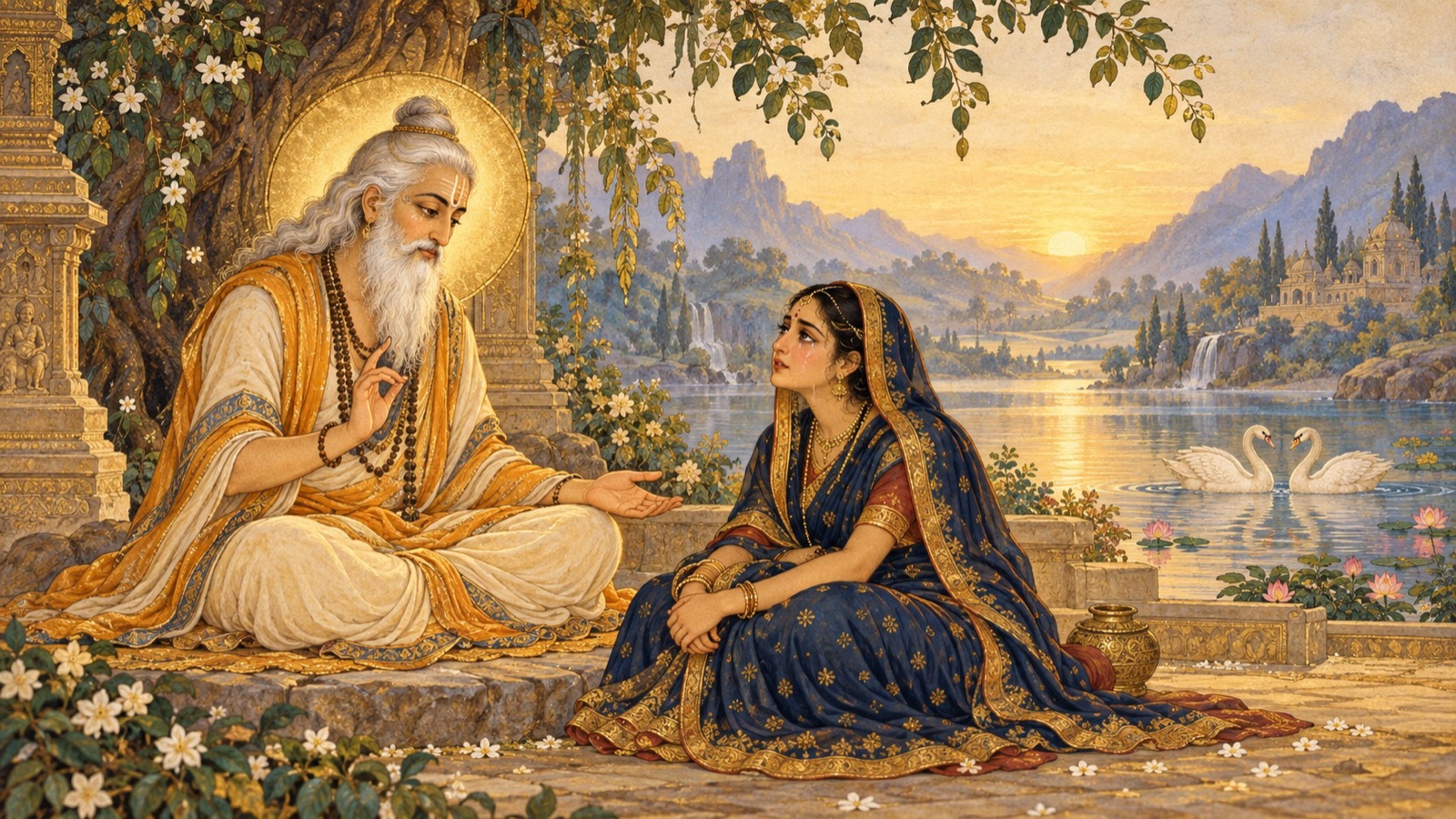
At last the forgotten friend appears: the wise brahmana — the Lord within, the second of the two swans of the heart — comes to the grieving soul and awakens it to the memory of who it truly is.
Om Namo Bhagavate Vasudevaya.
Om Namo Bhagavate Vasudevaya.
Om Namo Bhagavate Vasudevaya.
Welcome to Srimad Bhagavatam Wisdom, a devotional journey through the sacred histories and teachings of the Srimad Bhagavat Mahapurana. In the previous chapter, the forces of time — old age, fear, and fever — laid siege to Puranjana’s city of nine gates, and its defenses could no longer hold. This twenty-eighth chapter brings the parable of Puranjana to its profound close. Overwhelmed at last, Puranjana loses everything, and at the moment of death he thinks not of the Lord but of his wife and children — and that final attachment shapes his next birth: he is reborn as a woman. In that life, too, she is bound in love and loss, until, grieving beside her husband’s pyre, she is met by an old friend she had entirely forgotten — a wise brahmana who is none other than her unknown companion, the Lord seated within as the witnessing Self. He gently unveils the whole allegory, reveals their eternal identity as two swans dwelling together in the heart, and awakens the soul to the memory it had lost. So the parable ends in liberation, and Narada turns from the story to counsel King Prachinabarhi directly. It is a chapter about the shaping power of our last thought, and the mercy of the friend who never left us, who waits to wake us to who we are.
Chapter Information
- Scripture: Śrīmad Bhāgavata Mahāpurāṇa
- Canto: 4 (Book Four)
- Chapter: 28 (Discourse 28)
- Chapter title: Puranjana Reborn, and Awakened by His Unknown Friend
- Principal speaker: The sage Narada, concluding his parable to King Prachinabarhi (within Maitreya’s discourse to Vidura)
- Principal listener: King Prachinabarhi (and Vidura)
- Main setting: The end of Puranjana’s city, his next birth, and the awakening beside the pyre (within the parable)
- Central subject: Puranjana’s death and rebirth, and his awakening to self-knowledge by the unknown friend
- Principal verse range: Canto 4, Chapter 28, verses 1–65
- Primary edition: Gita Press Śrīmad Bhāgavata Mahāpurāṇa
Context from the Previous Chapter
Chapter 27 told how the forces of time besieged Puranjana’s city, how old age (Kalakanya) joined with fear and fever, and how the serpent of the life-breath weakened. This twenty-eighth chapter completes the siege and follows the soul beyond death — through a new birth and, at last, to the awakening the whole parable was leading toward.
The Fall of Puranjana
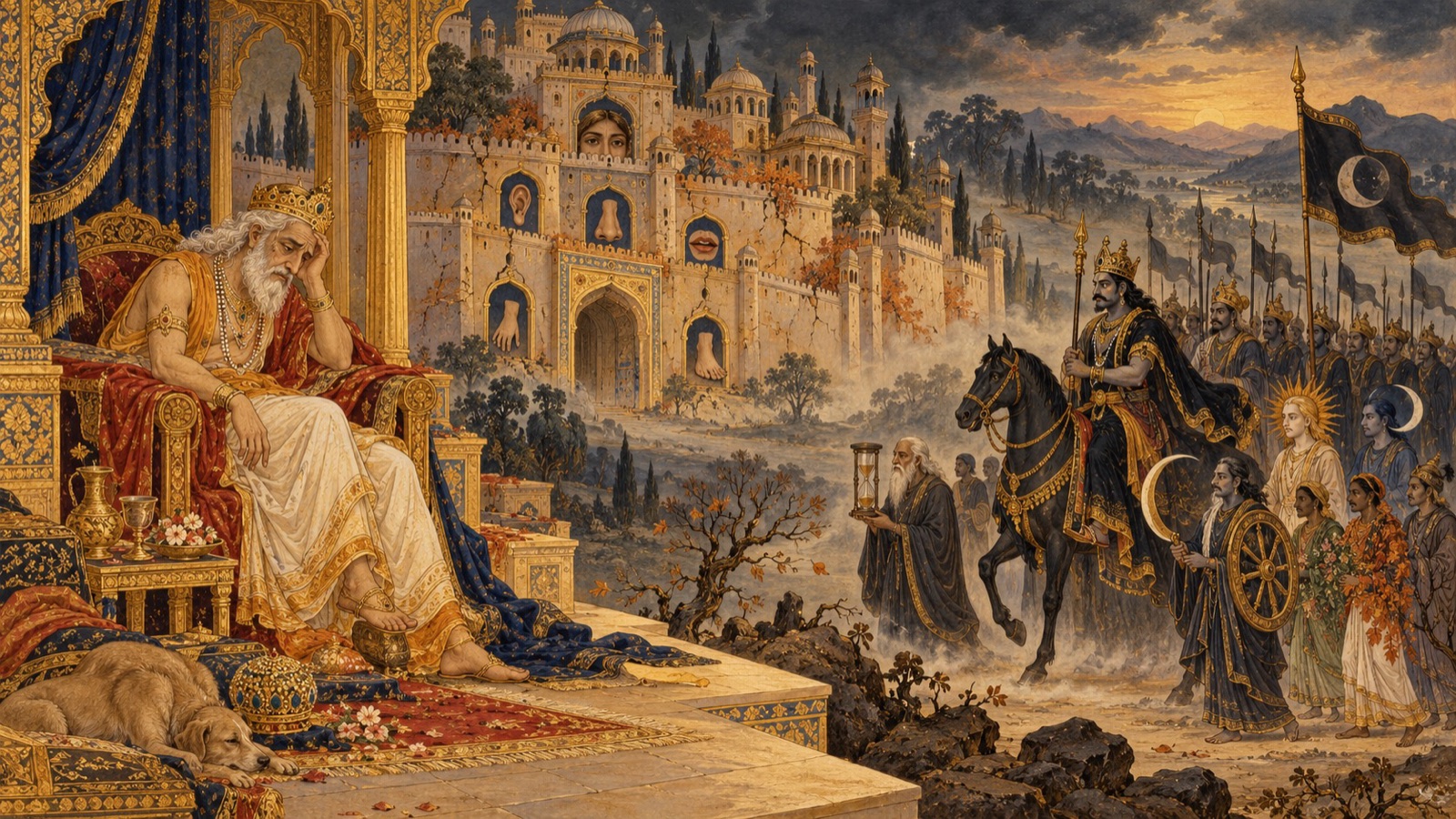
Embraced by Kalakanya, old age, Puranjana lost all his beauty; wretched and given over to sense-pleasure, his wisdom gone and his opulence stripped away, he was at last overpowered by force by the Gandharvas and the Yavanas. His city burned, his defenders fell, and everything he had gathered slipped from his hands.
कन्योपगूढो नष्टश्री: कृपणो विषयात्मक: । नष्टप्रज्ञो हृतैश्वर्यो गन्धर्वयवनैर्बलात् ॥ ६ ॥
kanyopagūḍho naṣṭa-śrīḥ kṛpaṇo viṣayātmakaḥ naṣṭa-prajño hṛtaiśvaryo gandharva-yavanair balāt
Meaning: Old age had stripped him of his good looks, left his mind ruled by craving for sense-objects, ruined his judgment, and emptied his treasury — until the Gandharvas and Yavanas together broke him by sheer force. (Canto 4, Chapter 28, verse 6)
The Last Thought and the New Birth
Even as death closed in, Puranjana did not turn his mind to the Lord. Instead, with a miserly and grieving heart, he lamented over the wife and children he was leaving — the very attachments that had bound him. And as he grieved over what he ought not to have grieved, the Yavana king named Fear drew near to seize him.
एवं कृपणया बुद्ध्या शोचन्तमतदर्हणम् । ग्रहीतुं कृतधीरेनं भयनामाभ्यपद्यत ॥ २२ ॥
evaṁ kṛpaṇayā buddhyā śocantam atad-arhaṇam grahītuṁ kṛta-dhīr enaṁ bhaya-nāmābhyapadyata
Meaning: Mourning in this narrow, self-pitying way over what no wise soul should mourn, he found the Yavana king called Fear already resolved and closing in to take him. (Canto 4, Chapter 28, verse 22)
Because his last thought was of his wife, and not of the Lord, that final attachment shaped his next birth. Puranjana was born again — this time as a woman, a princess in the kingdom of Vidarbha — and in due course was married to a righteous king, Malayadhvaja. In that life, too, she loved and served her husband and bore his children.
Yet even a devoted householder’s story does not end at home. When his sons were grown, Malayadhvaja divided his kingdom among them and withdrew alone to a solitary forest called Kulachala to worship the Lord without distraction. There he bathed daily in its sacred rivers, lived on nothing but roots, bulbs, fruit, and leaves, and grew lean through long austerity, steadily mastering the dualities of heat and cold, hunger and thirst, pleasure and pain, until none of them could shake him. Purified in this way, he came at last to see the Supersoul seated beside his own soul within the heart, distinct from the body and distinct even from himself — and the Lord Himself began to instruct him directly, as his very guru, lighting his understanding on every side.
साक्षाद्भगवतोक्तेन गुरुणा हरिणा नृप । विशुद्धज्ञानदीपेन स्फुरता विश्वतोमुखम् ॥ ४१ ॥
sākṣād bhagavatoktena guruṇā hariṇā nṛpa viśuddha-jñāna-dīpena sphuratā viśvato-mukham
Meaning: Purified by his austerity, Malayadhvaja was taught directly by Lord Hari Himself, who appeared to him as guru and lit his understanding from every side with the lamp of unclouded knowledge. (Canto 4, Chapter 28, verse 41)
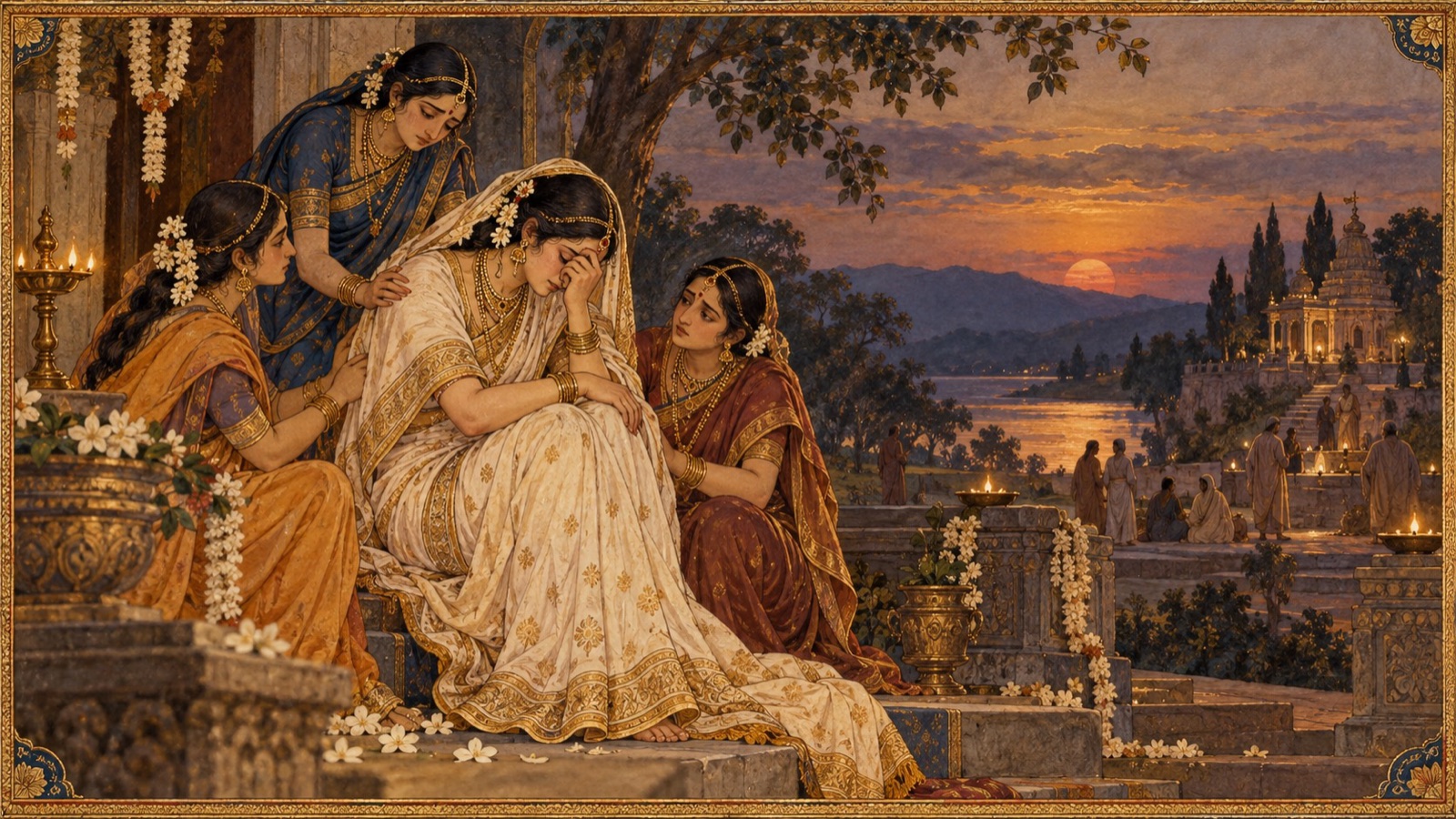
Queen Vaidarbhi had followed her husband into that forest and served him through his austerities without complaint, and it was while massaging his feet one day that she found them no longer warm and understood that he had already left the body. Left alone, she wept beside his pyre, refusing to be consoled, prepared to follow him in death.
The Unknown Friend Appears
Then, into that grief, came an old friend — one whom the soul had known long before and entirely forgotten. A wise and self-possessed brahmana approached the weeping woman and began to console her with sweet and gentle words. This was none other than Avijnata, the unknown companion of the parable’s beginning: the Lord seated within the heart as the witnessing Self, who had been with the soul through all its wanderings, unseen.
तत्र पूर्वतर: कश्चित्सखा ब्राह्मण आत्मवान् । सान्त्वयन् वल्गुना साम्ना तामाह रुदतीं प्रभो ॥ ५१ ॥
tatra pūrvataraḥ kaścit sakhā brāhmaṇa ātmavān sāntvayan valgunā sāmnā tām āha rudatīṁ prabho
Meaning: Then, O king, a certain brahmana, a self-possessed old friend from before, came there and, consoling the weeping woman with sweet and gentle words, spoke to her. (Canto 4, Chapter 28, verse 51)
The Unveiling of the Allegory
The friend gently reminded the grieving soul of who they truly were — two swans, friends from beyond all beginning, who had dwelt together and then been parted when one wandered away into the world. And he unveiled the whole meaning of the parable at last: the city of nine gates was the body; its gardens the objects of the senses; its guardian the life-breath; its chambers the elements of fire, water, and earth; its family the mind and the five senses.
पञ्चेन्द्रियार्था आरामा द्वार: प्राणा नव प्रभो । तेजोऽबन्नानि कोष्ठानि कुलमिन्द्रियसङ्ग्रह: ॥ ५७ ॥
pañcendriyārthā ārāmā dvāraḥ prāṇā nava prabho tejo-’b-annāni koṣṭhāni kulam indriya-saṅgrahaḥ
Meaning: (The friend explained:) The five gardens are the five objects of the senses; the gates are the nine openings; the life-airs their guardian; the three chambers are fire, water, and earth; and the family is the aggregate of the mind and the senses. (Canto 4, Chapter 28, verse 57)
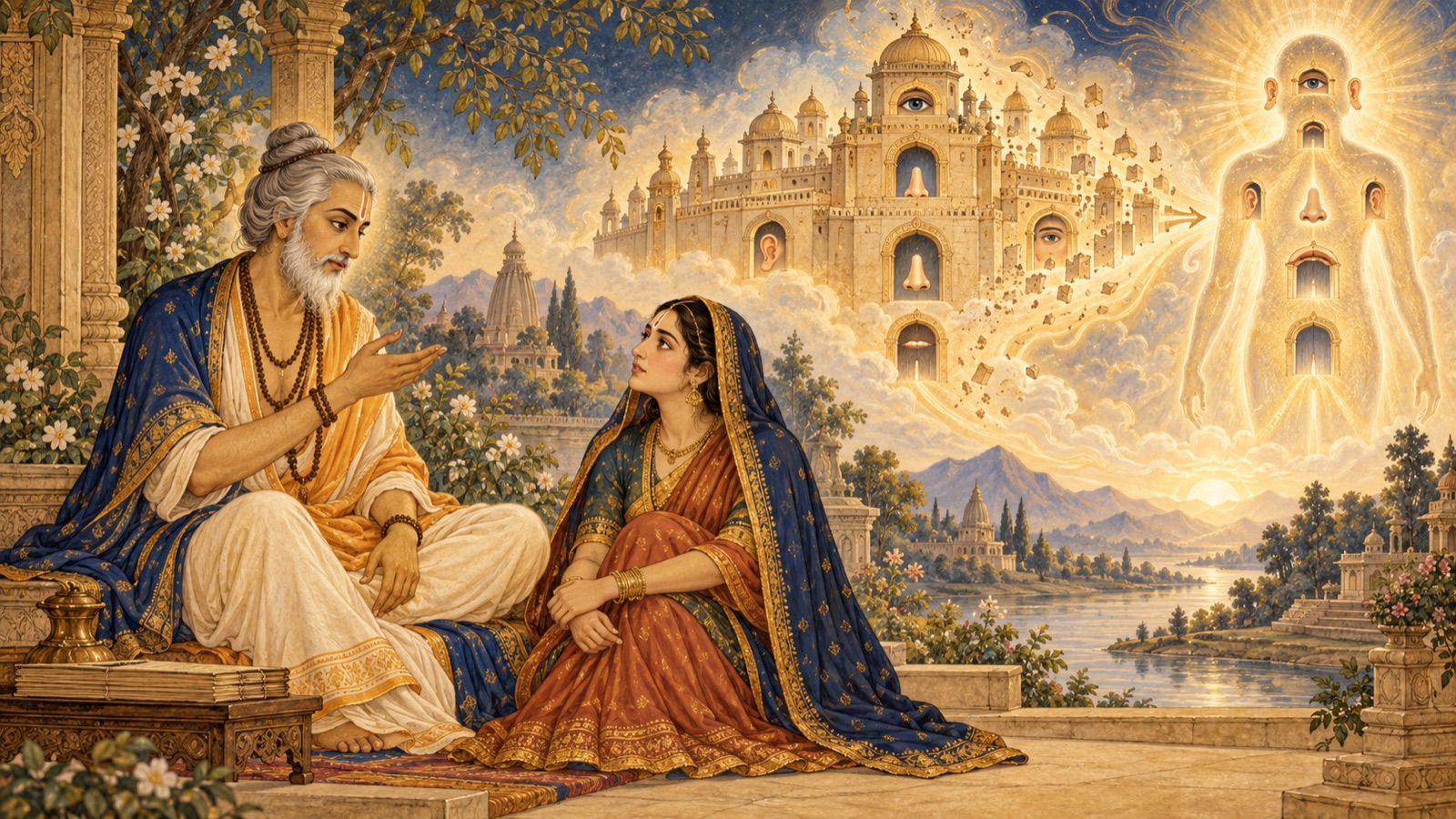
This is the deepest point the friend makes, and it is easy to pass over. He does not say the soul and the Lord are simply identical; he says they are one in quality, spirit through and through, yet never one in measure — the Lord complete and all-pervading, the soul His infinitesimal part.
यथा पुरुष आत्मानमेकमादर्शचक्षुषो: । द्विधाभूतमवेक्षेत तथैवान्तरमावयो: ॥ ६३ ॥
yathā puruṣa ātmānam ekam ādarśa-cakṣuṣoḥ dvidhābhūtam avekṣeta tathaivāntaram āvayoḥ
Meaning: As a man looks into a mirror and takes his own reflection to be one with himself, though anyone standing beside him plainly sees two bodies, so it is between the two of us: alike in quality, and yet, my friend, forever distinct. (Canto 4, Chapter 28, verse 63)
This is why the whole tragedy of Puranjana was possible in the first place: not that the soul is unreal, but that it forgot it was ever the Lord’s companion and servant, never His replacement, and so it tried to rule the city of the body alone.
The Awakening
As the soul listened, the truth broke upon it like dawn. The swan of the individual self, awakened by the other swan — the Lord — came at last to rest in its own true nature, and regained the memory it had lost through all its long straying into matter. The forgetting was ended; the soul knew itself, and its friend, once more.
एवं स मानसो हंसो हंसेन प्रतिबोधित: । स्वस्थस्तद्वयभिचारेण नष्टामाप पुन: स्मृतिम् ॥ ६४ ॥
evaṁ sa mānaso haṁso haṁsena pratibodhitaḥ sva-sthas tad-vyabhicāreṇa naṣṭām āpa punaḥ smṛtim
Meaning: Thus the swan of the mind, the individual soul, awakened by the other swan, came to rest in its true self, and regained the memory it had lost through its straying into matter. (Canto 4, Chapter 28, verse 64)

So the long parable of Puranjana ends not in the burning city but in liberation — the soul, through the mercy of the friend it had forgotten, restored to itself. With this Narada closed the story, and turned to speak to King Prachinabarhi directly, as the next chapter will continue.
Principal Teachings of This Chapter
1. Our last thought shapes what comes next. Puranjana dies absorbed in his wife, not the Lord, and that final attachment forms his next birth. What we cling to at the end is where our heart carries us; therefore the wise practise remembering the Lord now (verse 22).
2. Attachment reaches even beyond death. The very ties Puranjana grieved to leave return to bind him: seized and dragged away like a captive animal, his grieving followers forced to go after him, he crosses death’s threshold still wearing the very chains he refused to loosen (verses 22-23).
3. The Lord within never abandons the soul. Through every wandering, birth, and forgetting, the unknown friend — the Lord in the heart — remains with the soul, waiting. We are never truly alone, however far we stray (verse 51).
4. Liberation is remembrance, not acquisition. The soul is not given something new; it regains the memory it had lost. Freedom is waking up to who we always were — the swan beside the swan, the self beside the Lord (verse 64).
5. The whole world is an allegory to be read. The friend unveils the city, the gardens, the gates as body, senses, and openings. Rightly understood, our whole life is a parable, meant to lead us back to the One within (verse 57).
6. Nearness to the Lord is not sameness with Him. Like a reflection in a mirror, the soul and the Supersoul seem to be one when seen from within, yet remain, as the friend says, forever two. Devotion lives exactly in that space — a closeness that never claims equality (verse 63).
A Devotional Reflection
This is the chapter the whole parable was moving toward, and its beauty is quiet and immense. For chapters we have watched the soul, as Puranjana, wander and forget — captivated by the senses, entangled in its household, besieged by time, and at last dying still clutching the very attachments that bound it, so that it is carried helplessly into yet another bound life. It is a sobering picture of how deep the forgetting goes, and how far it can carry us. And then, into the deepest grief, the friend appears. Not a new savior arriving from outside, but the old companion who was there all along — the Lord seated in the heart, the second of the two swans, who never left even when the soul had utterly forgotten Him. And what He gives is not a reward earned but a memory restored: He simply reminds the soul of who it always was. That is the astonishing tenderness at the center of this teaching. Our liberation is not the achievement of something we lack, but the awakening to something we already are and have only forgotten — that we are the swan beside the swan, the deathless self forever accompanied by the deathless Lord. And the friend who wakes us is the one we least noticed while we chased the city and its queen, the one who waited, patient and unseen, through every wandering, for the moment our grief would finally turn us toward Him.
A Daily Devotional Practice
Today, practise for your last thought by tending your present one. The parable turns on where Puranjana’s mind rested at the end — and the end is only the sum of countless present moments. So, several times today, gently return your attention to the Lord within, the unknown friend, with the words “Om Namo Bhagavate Vasudevaya,” training your heart to remember Him amid your own “city” of duties and attachments. And take a quiet moment to recall the parable’s deepest comfort: that whatever you have forgotten, and however far you have wandered, the Friend has never left the heart, and waits only to remind you who you are. Rest there, even briefly — not striving to become something, but remembering what you already are, the self beside the Lord. In tending your present thought toward Him, you prepare, gently and daily, for the awakening the whole parable promises.
Conclusion
The twenty-eighth discourse of Book Four brings the parable of Puranjana to its profound close. Overwhelmed by the forces of time, Puranjana loses everything, and at death, grieving over his wife and children rather than remembering the Lord, he is seized by Fear — and that final attachment shapes his next birth as a woman. In that life too she loves and loses, until, weeping beside her husband’s pyre, she is met by an old, forgotten friend: a wise brahmana who is none other than Avijnata, the Lord within as the witnessing Self. He unveils the whole allegory — the city as the body, its gates and gardens as the senses — reveals their eternal identity as two swans dwelling in the heart, and awakens the soul, which regains the memory it had lost. So the parable ends in liberation, and Narada turns to counsel Prachinabarhi directly. The chapter teaches the shaping power of our last thought, the reach of attachment beyond death, and, above all, the mercy of the friend who never left us — whose awakening is not a reward acquired but a memory restored: the remembrance of who we have always been, the self beside the Lord.
May the divine wisdom of Srimad Bhagavatam awaken pure devotion within our hearts.
Om Namo Bhagavate Vasudevaya.
Jay Shree Madhav.
References and Attribution
- Primary edition: Gita Press, Śrīmad Bhāgavata Mahāpurāṇa (English, complete), Book Four, Discourse 28.
- Series: Srimad Bhagavatam Wisdom · Biswa Sanatan Dharma Seva Trust.
- Presented following the spiritual guidance and recommendation of Pandit Dr. Shri Kashinath Mishra.
This is an original, faithful retelling in the writer’s own words, with brief quoted verses shown in Devanāgarī and transliteration and their meanings given as summaries. It is not a reproduction of any single publisher’s continuous translation or commentary. No affiliation with or endorsement by any publisher is implied.
Jay Shree Madhav