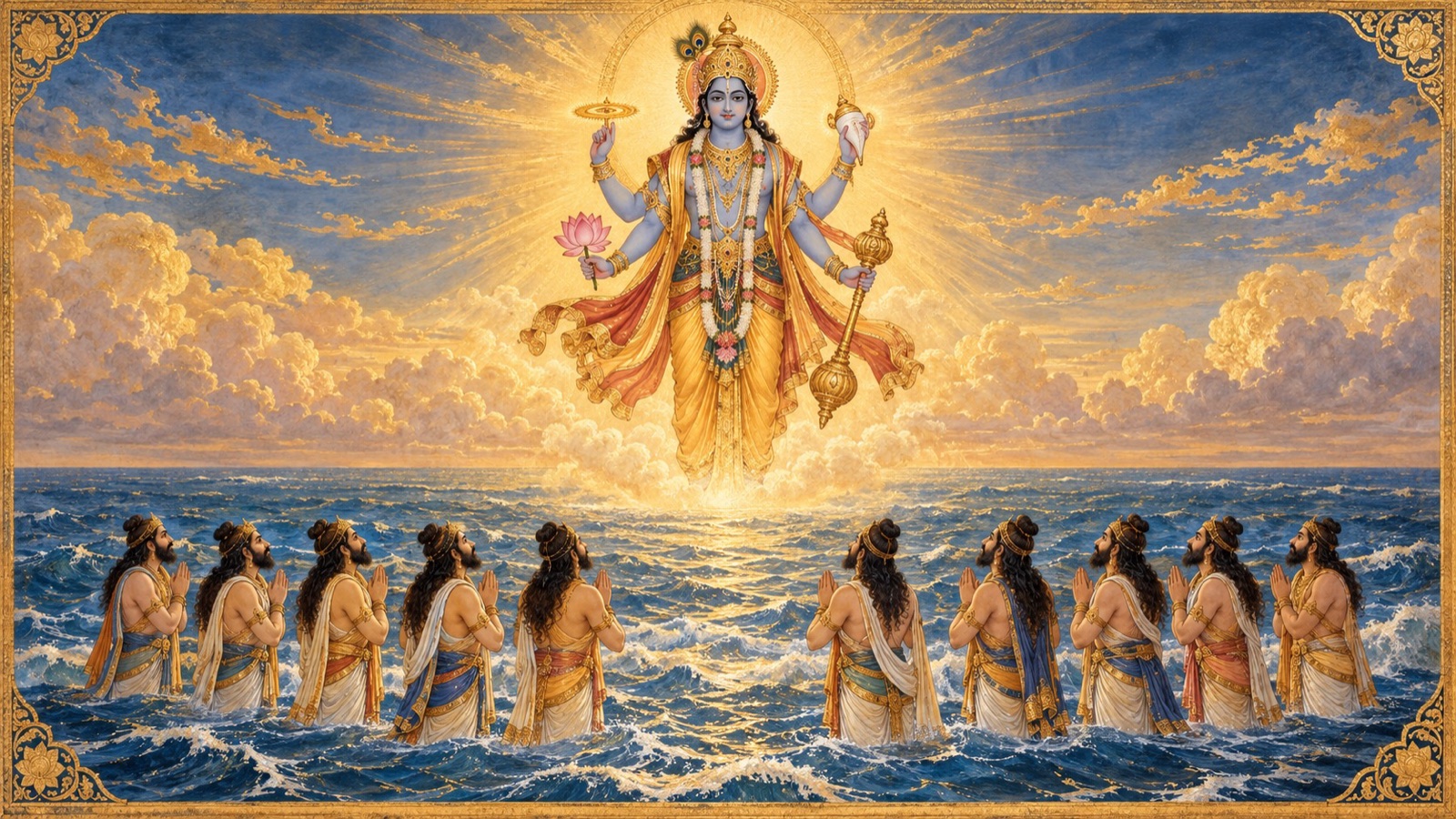
After ten thousand years of austerity in the ocean, the eternal Supreme Lord appears before the Pracetas in His pleasing form, His tranquil radiance dissolving every trace of their long penance.
Om Namo Bhagavate Vasudevaya.
Om Namo Bhagavate Vasudevaya.
Om Namo Bhagavate Vasudevaya.
Welcome to Srimad Bhagavatam Wisdom, a devotional journey through the sacred histories and teachings of the Srimad Bhagavat Mahapurana. In the earlier chapters, the ten Pracetas received a sacred hymn from Lord Shiva and gave themselves to a long austerity in the ocean, while their father, King Prachinabarhi, was awakened by Narada’s parable of Puranjana. This thirtieth chapter returns to the Pracetas and their reward. Vidura asks Maitreya what fruit their long penance and devotion bore; and Maitreya tells how, after ten thousand years, the Supreme Lord himself appeared before them and granted them a boon. Filled with His grace, the Pracetas declare that a single moment’s company of the Lord’s devotees is worth more than all heaven or liberation, and they are gently directed to fulfil their worldly duty for a time before their final freedom. Returning home, they find the earth overgrown with trees, and, angered, are about to burn them — until Lord Brahma calms them with wise counsel and the trees offer them a beautiful maiden, Marisha, their foster-daughter whom the moon-god Soma had once nourished as a child, whom the Pracetas marry and take as their queen. It is a chapter about the reward of devotion, the supreme worth of holy company, and grace bringing peace even out of anger.
Chapter Information
- Scripture: Śrīmad Bhāgavata Mahāpurāṇa
- Canto: 4 (Book Four)
- Chapter: 30 (Discourse 30)
- Chapter title: The Lord’s Boon to the Pracetas, and Their Marriage
- Principal speaker: The sage Maitreya, resuming his discourse to Vidura (with the words of the Pracetas quoted within)
- Principal listener: Vidura
- Main setting: The ocean of the Pracetas’ austerity, and their kingdom on their return
- Central subject: The Lord’s appearance and boon to the Pracetas, their realization, and their marriage to Marisha
- Principal verse range: Canto 4, Chapter 30, verses 1–51
- Primary edition: Gita Press Śrīmad Bhāgavata Mahāpurāṇa
Context from the Previous Chapters
Chapter 24 told how Lord Shiva taught the Pracetas his hymn; Chapter 25 showed them beginning their long austerity in the ocean; and Chapters 26–29 followed their father’s awakening through Narada’s parable. This thirtieth chapter now returns to the Pracetas themselves, as Vidura asks Maitreya what reward their devotion earned.
The Reward of Long Austerity
Within the depths of the ocean, carrying out their father’s command, the Pracetas satisfied the Supreme Lord — the indwelling Person — by the chanting of His hymn, by worship, and by severe austerity.
मैत्रेय उवाच प्रचेतसोऽन्तरुदधौ पितुरादेशकारिण: । जपयज्ञेन तपसा पुरञ्जनमतोषयन् ॥ ३ ॥
maitreya uvāca pracetaso ’ntar udadhau pitur ādeśa-kāriṇaḥ japa-yajñena tapasā purañjanam atoṣayan
Meaning: Maitreya said: The Pracetas, within the ocean, carrying out their father’s command, satisfied the Lord — the indwelling Person — by chanting, worship, and austerity. (Canto 4, Chapter 30, verse 3)
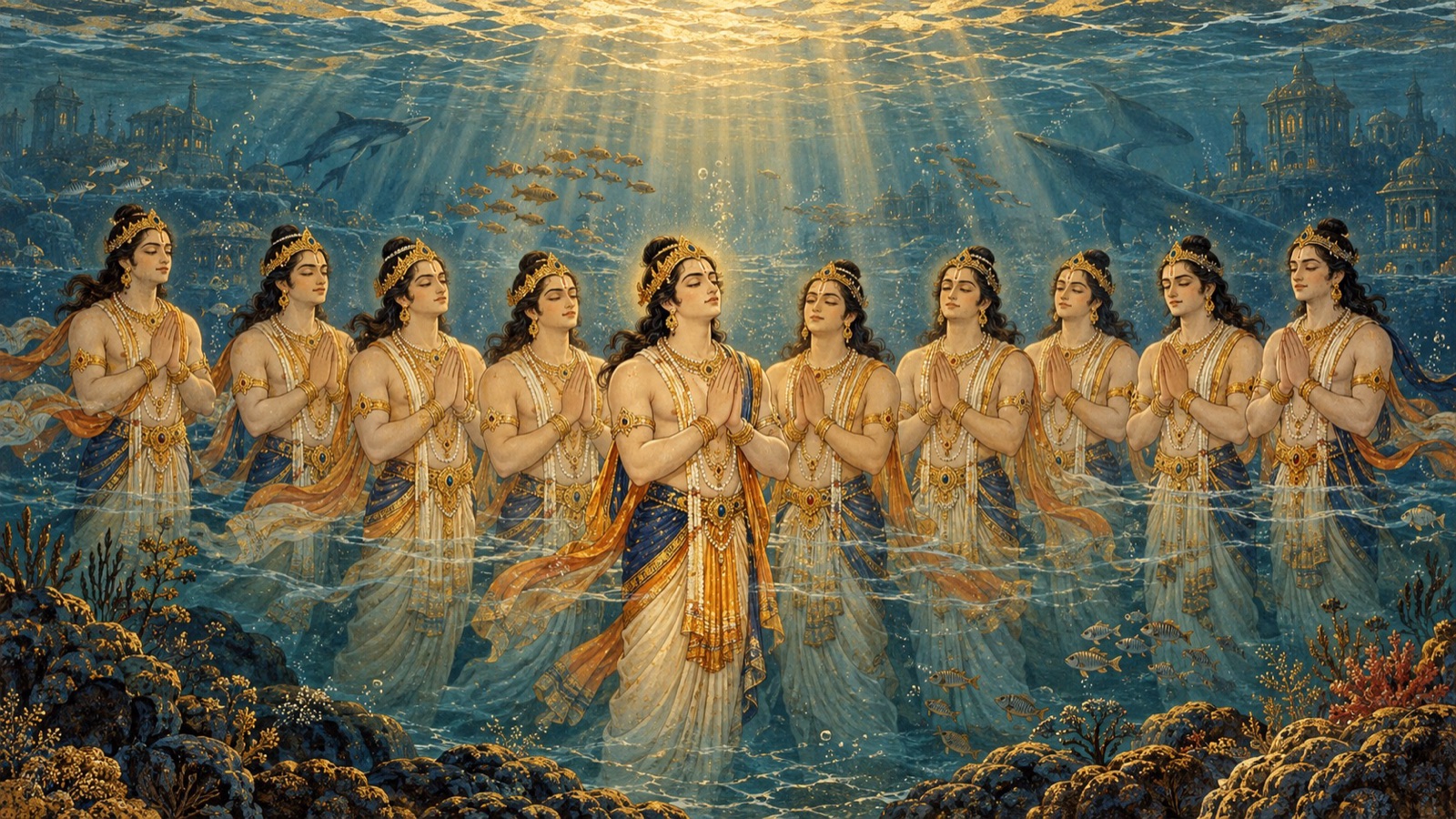
The Lord Appears
At the end of ten thousand years of their austerity, the eternal Supreme Person appeared before them in His most pleasing form, and the serene radiance of His presence calmed and rewarded all the labour of their long penance.
दशवर्षसहस्रान्ते पुरुषस्तु सनातन: । तेषामाविरभूत्कृच्छ्रं शान्तेन शमयन् रुचा ॥ ४ ॥
daśa-varṣa-sahasrānte puruṣas tu sanātanaḥ teṣām āvirabhūt kṛcchraṁ śāntena śamayan rucā
Meaning: At the end of ten thousand years of austerity, the eternal Supreme Person appeared before them, calming the labour of their penance with His serene radiance. (Canto 4, Chapter 30, verse 4)
He came seated upon Garuda, His form like a monsoon cloud resting on the peak of Meru, clothed in yellow silk, the Kaustubha jewel at His throat and a forest garland falling to His knees; eight arms held His weapons, and His face, crowned with a shining helm, shone with an effulgence that dispelled every shadow in the universe (verses 5–7). With a glance of mercy and a voice like thunder, He told the ten brothers how pleased He was that, though separate souls, they moved as one in their devotion and their love for one another — and, though they had asked Him nothing, He bid them name a boon (verses 8–9). Then, before a word of request had left their lips, He granted it Himself: for a full million celestial years they would enjoy, without hindrance and with unfailing strength, every facility of this world and the higher worlds; only afterward would their devotion for Him ripen to purity and free them from all attachment, so that at the end of that vast span they would return to His own abode (verses 17–18). Whatever they did in the world in the meantime, He told them, if offered up to Him, would leave them untouched by its results (verse 19). In the same breath He spoke of a maiden — the daughter of the sage Kandu and the heavenly Pramlocha, left as an infant to the keeping of the forest trees — whom, at their father’s wish, they were destined to marry and through whom to raise children who would fill the three worlds (verses 12–16).
The Supreme Worth of Holy Company
Only then, moved by all He had already given them unasked, did the Pracetas break into their extended hymn of realization. It first bows to the Lord as Vasudeva, present equally within every heart and every atom of creation, without favour for a friend or enmity toward a foe (verses 24, 42). Then, though invited long before to ask any benediction they wished, they seek nothing for themselves in this world or the next: only that, birth after birth, in whatever body or world they come to occupy, they be given the company of those who speak of His glories (verse 33). For, as the Lord Himself has taught elsewhere, He does not truly reside even in His own Vaikuntha or in the meditation of the yogi, but wherever His devotees gather to sing of Him (verses 35–36) — so to seek their company is, in truth, to seek Him.
Overwhelmed by His grace, the Pracetas gave voice to a realization that is among the most treasured in all the Bhagavatam. They declared that they would not weigh even a single moment’s company of the Lord’s devotees against the attainment of heaven or even of liberation itself — how much less against the fleeting blessings that mortals crave.
तुलयाम लवेनापि न स्वर्गं नापुनर्भवम् । भगवत्सङ्गिसङ्गस्य मर्त्यानां किमुताशिष: ॥ ३४ ॥
tulayāma lavenāpi na svargaṁ nāpunar-bhavam bhagavat-saṅgi-saṅgasya martyānāṁ kim utāśiṣaḥ
Meaning: We would not weigh even a moment’s company of a devotee of the Lord against heaven or against liberation itself — how much less against the blessings that mortals crave. (Canto 4, Chapter 30, verse 34)
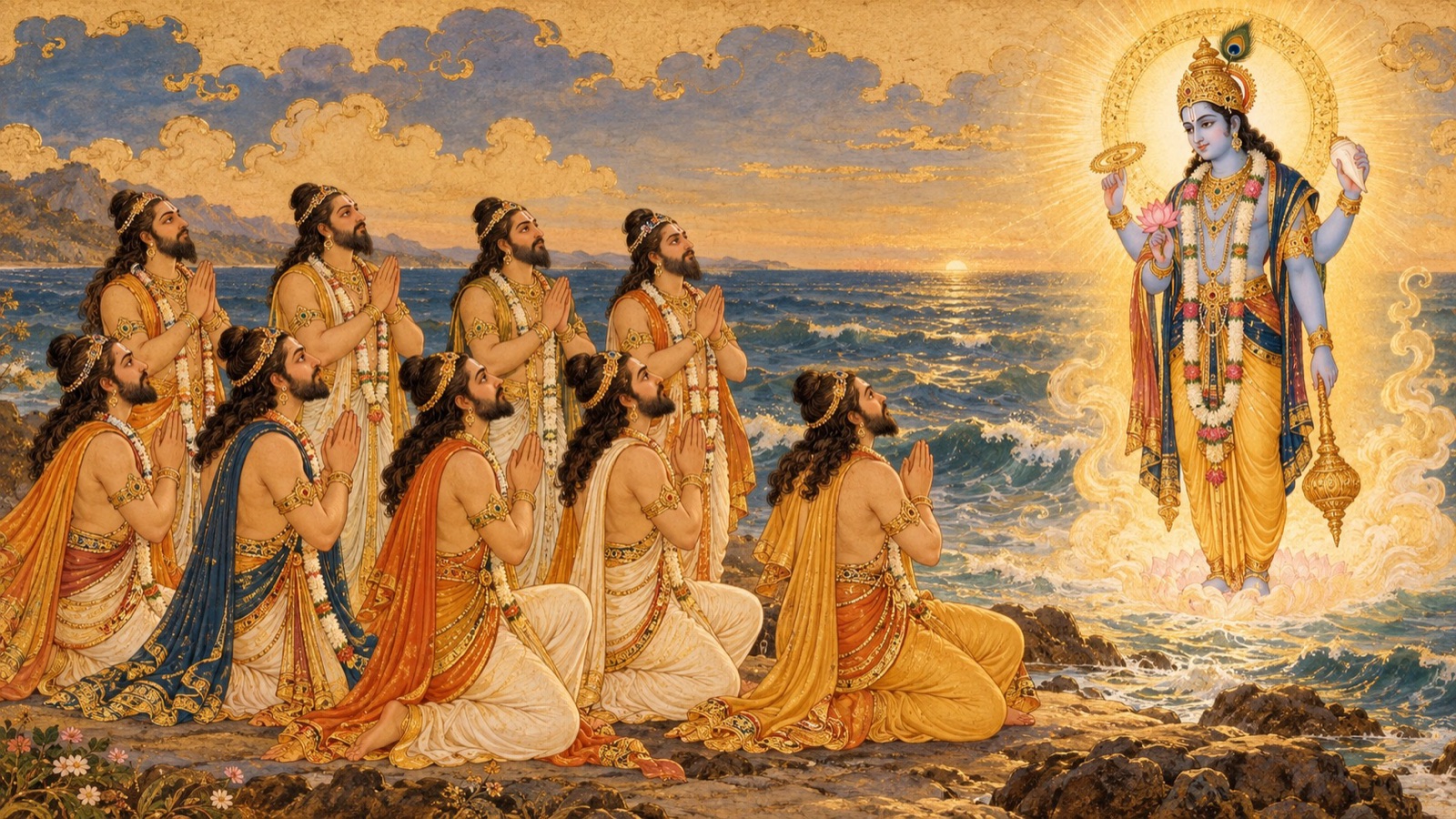
Having granted every benediction they could ask, the Lord then did something the Pracetas had not expected: He simply departed. Maitreya tells us they were unwilling to be parted from Him, for they had not yet beheld Him to their heart’s full content — yet He withdrew all the same (verse 43). This too is instruction. However close the Lord draws to a devotee in a moment of grace, He is never possessed or detained by that devotee alone; His readiness to leave one embrace is itself the sign of a mercy at that very moment being poured out, unasked, upon countless other devotees across creation. The Pracetas’ longing was not refused — it was simply reminded that love for God is measured not by how long a vision lasts, but by how completely the heart is remade by having had it.
The Return and the Anger at the Trees
Blessed and directed by the Lord, the Pracetas emerged at last from the ocean waters. But in the long ages of their absence, the trees had grown so tall and thick that they covered the whole face of the earth, as if to block the very path to heaven; and, seeing this, the Pracetas grew angry.
अथ निर्याय सलिलात्प्रचेतस उदन्वत: । वीक्ष्याकुप्यन्द्रुमैश्छन्नां गां गां रोद्धुमिवोच्छ्रितै: ॥ ४४ ॥
atha niryāya salilāt pracetasa udanvataḥ vīkṣyākupyan drumaiś channāṁ gāṁ gāṁ roddhum ivocchritaiḥ
Meaning: Then the Pracetas emerged from the ocean waters and, seeing the whole earth covered by trees grown so tall as if to block the path to heaven, they grew angry. (Canto 4, Chapter 30, verse 44)

In their anger they began to bring forth fire and wind, as Lord Shiva does at the hour of universal dissolution, to burn the forests away. Seeing the trees reduced to ashes, Lord Brahma himself came before them and, with words of gentle reasoning, calmed their fury (verse 46); at his counsel, the surviving trees, trembling with fear, brought forward a beautiful maiden to be their bride, as a token of peace (verse 47).
Marisha, the Foster-Daughter of the Trees
This maiden was Marisha, the foster-daughter of the trees. When she had been left, as a child, to the care of the trees, and cried in her hunger, the compassionate Soma had placed within her mouth his own nectar-pouring finger, and so had nourished and raised her.
क्षुत्क्षामाया मुखे राजा सोम: पीयूषवर्षिणीम् । देशिनीं रोदमानाया निदधे स दयान्वित: ॥ १४ ॥
kṣut-kṣāmāyā mukhe rājā somaḥ pīyūṣa-varṣiṇīm deśinīṁ rodamānāyā nidadhe sa dayānvitaḥ
Meaning: As the child, left to the care of the trees, cried in hunger, the moon-king Soma, out of compassion, placed within her mouth his nectar-pouring finger, and so she was nourished. (Canto 4, Chapter 30, verse 14)
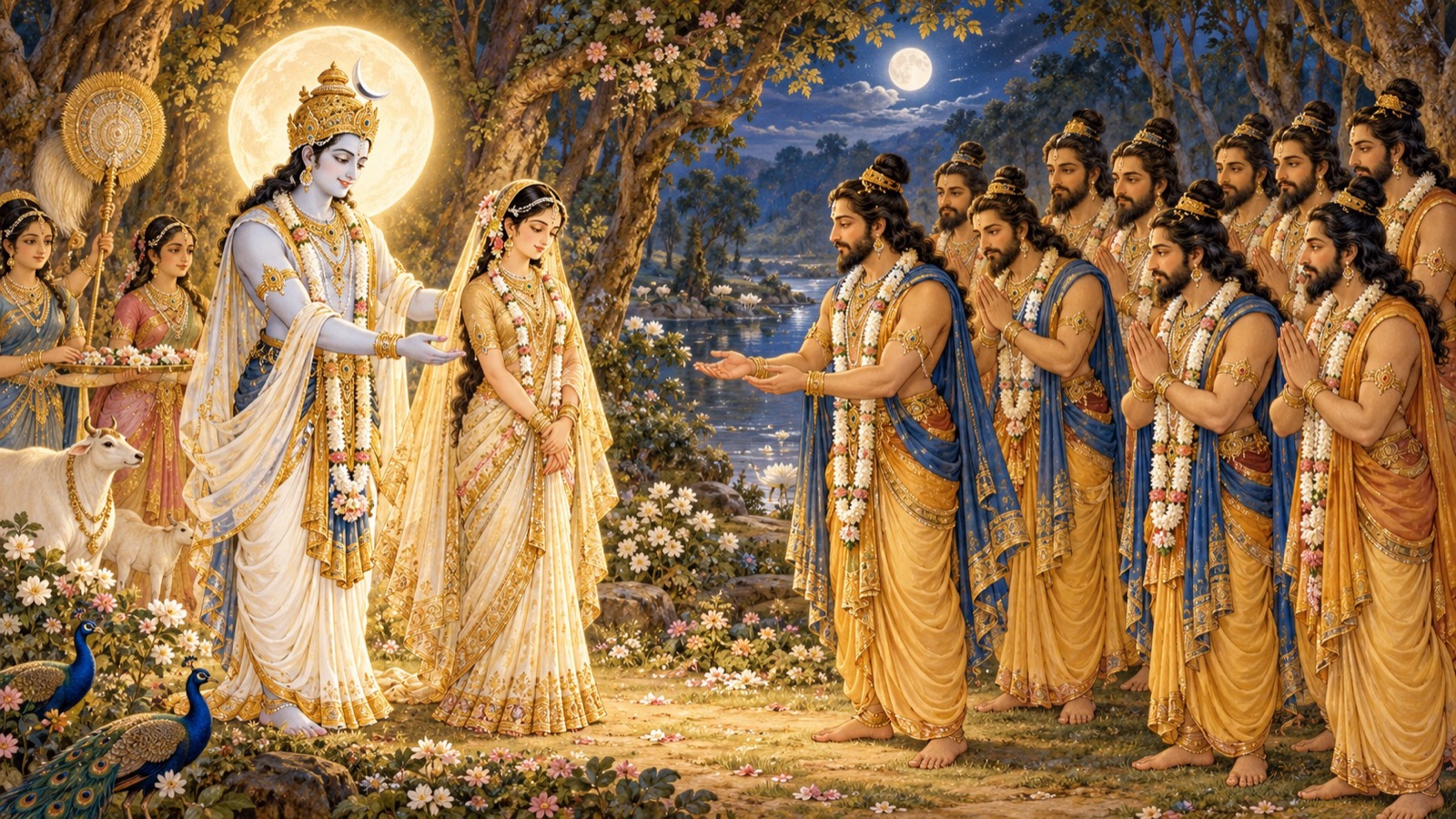
Their anger soothed by Lord Brahma’s counsel, the Pracetas accepted the maiden the trees now offered, married her, and took her home as their queen, settling once more into their city.
Their marriage bore an unexpected fruit. From Marisha’s womb was born Daksha, who would become one of the great progenitors of created beings — yet Maitreya explains this was no ordinary birth. In an earlier life Daksha had disrespected Lord Shiva, the Supreme Lord’s own dearest devotee, and for that offence he was made to take birth again from a woman’s womb, through the seed of the Pracetas: even Brahma’s own son was not exempt from the reckoning owed to a great Vaishnava (verses 48–49). Grace tempered the correction all the same. Reborn with his radiance undiminished, Daksha was appointed by Lord Brahma to the sacred work of generating and protecting living beings, and in time he commissioned other great sages as fellow progenitors, so that through him the population of the universe multiplied (verses 50–51).
So the thirtieth discourse closes with devotion rewarded and peace restored — the ten brothers blessed by the Lord, established with their bride, father in due course to Daksha, and ready for the continuation of their story in the next chapter.
Principal Teachings of This Chapter
1. Sincere, sustained devotion draws the Lord Himself. Ten thousand years of the Pracetas’ austerity are crowned by the personal appearance of the Supreme Lord. What is offered wholeheartedly to Him is never in vain (verse 4).
2. Devotion and worldly duty can go together. The Lord grants that the Pracetas may fulfil their appointed duties for a time without losing their devotion, and reach Him in the end. We need not abandon our place in the world to keep our hearts fixed on God (verses 17–19).
3. The company of devotees is the highest of all gifts. The Pracetas would not trade a moment with the Lord’s devotees for heaven or liberation. Holy company, in which the Lord is remembered and loved, is worth more than any other attainment (verse 34).
4. Even righteous anger must yield to wise counsel. The Pracetas, provoked by the wild growth of the trees, are ready to destroy them — until Lord Brahma’s calm reasoning turns them. The truly great let their anger be softened, even mid-flame (verses 44-47).
5. Grace brings gifts even out of conflict. What began in anger ends in a marriage and a blessing: from the very trees the Pracetas would have burned comes their queen, and from their marriage comes Daksha, one of the great progenitors of the universe. The Lord’s grace can draw good even out of our conflicts (verses 47–51).
A Devotional Reflection
At the heart of this chapter is a single verse that has been cherished by devotees for ages: that the Pracetas would not weigh even a moment’s company of the Lord’s devotees against heaven or even liberation. It is a startling scale of values. Most of the world measures gain by wealth, comfort, or long life; the more spiritually minded may aim higher, at heaven or at release from rebirth. But the Pracetas, having just seen the Lord face to face, place above all of these something quieter and more available: the company of those who love God. There is a deep and practical wisdom in this. We may not be able to command a vision of the Lord, or to storm the gates of liberation by our own effort; but we can, most of us, seek out the company of the holy — the friend who loves God, the gathering where His name is sung, the words of a saint in a book. And that company, the Pracetas tell us, is not a lesser good but the highest, because in it the Lord is present, remembered, and loved. The chapter also leaves us a gentler lesson in its close. The mighty Pracetas, fresh from beholding God, still flare into anger at the overgrown trees — a reminder that even great souls must govern their tempers — and it is Lord Brahma’s calm counsel that turns them, so that the very object of their anger becomes a gift. Grace, the chapter shows, is patient with our anger and generous beyond it, ready to hand us a blessing where we expected only a battle.
A Daily Devotional Practice
Today, seek and treasure holy company, as the Pracetas treasured it above heaven itself. Find some form of the company of devotees — a friend who loves the Lord, a gathering where His name is chanted, or simply the words of a saint or scripture read with attention — and give it a few minutes of your day, receiving it not as a small thing but as the highest of gifts. As you do, offer thanks with the words “Om Namo Bhagavate Vasudevaya,” remembering that in such company the Lord is truly present. And take the chapter’s gentler lesson too: the next time anger rises in you at some obstacle, pause as the Pracetas paused at Lord Brahma’s counsel, and let wisdom soften your fire, trusting that grace may turn even what angers you into a gift. In prizing holy company and letting mercy temper your anger, you walk in the footsteps of the blessed Pracetas.
Conclusion
The thirtieth discourse of Book Four tells the reward of the Pracetas’ long devotion. After ten thousand years of austerity in the ocean, satisfying the Lord by the hymn Shiva taught them, the Supreme Person appears before them in His pleasing form and grants them a boon: that they may fulfil their worldly duty for a time without losing their devotion, and attain Him in the end. Moved by that grace, they proclaim that no heavenly reward or even liberation itself can equal a single moment spent with those who love the Lord. Returning from the ocean, they find the earth overrun with trees and, in their anger, prepare to set the forests ablaze — but Lord Brahma calms them with reasoned counsel, and the trees, at his advice, offer as a token of peace the maiden Marisha, their foster-daughter, whom the moon-god Soma had nourished as a child. Their anger soothed, they marry her and settle in their city, in time becoming father to Daksha, one of the great progenitors of the universe. So the chapter teaches the reward of sincere devotion, the supreme worth of holy company, and the mercy that turns anger into a gift and brings peace even out of conflict.
May the divine wisdom of Srimad Bhagavatam awaken pure devotion within our hearts.
Om Namo Bhagavate Vasudevaya.
Jay Shree Madhav.
References and Attribution
- Primary edition: Gita Press, Śrīmad Bhāgavata Mahāpurāṇa (English, complete), Book Four, Discourse 30.
- Series: Srimad Bhagavatam Wisdom · Biswa Sanatan Dharma Seva Trust.
- Presented following the spiritual guidance and recommendation of Pandit Dr. Shri Kashinath Mishra.
This is an original, faithful retelling in the writer’s own words, with brief quoted verses shown in Devanāgarī and transliteration and their meanings given as summaries. It is not a reproduction of any single publisher’s continuous translation or commentary. No affiliation with or endorsement by any publisher is implied.
Jay Shree Madhav