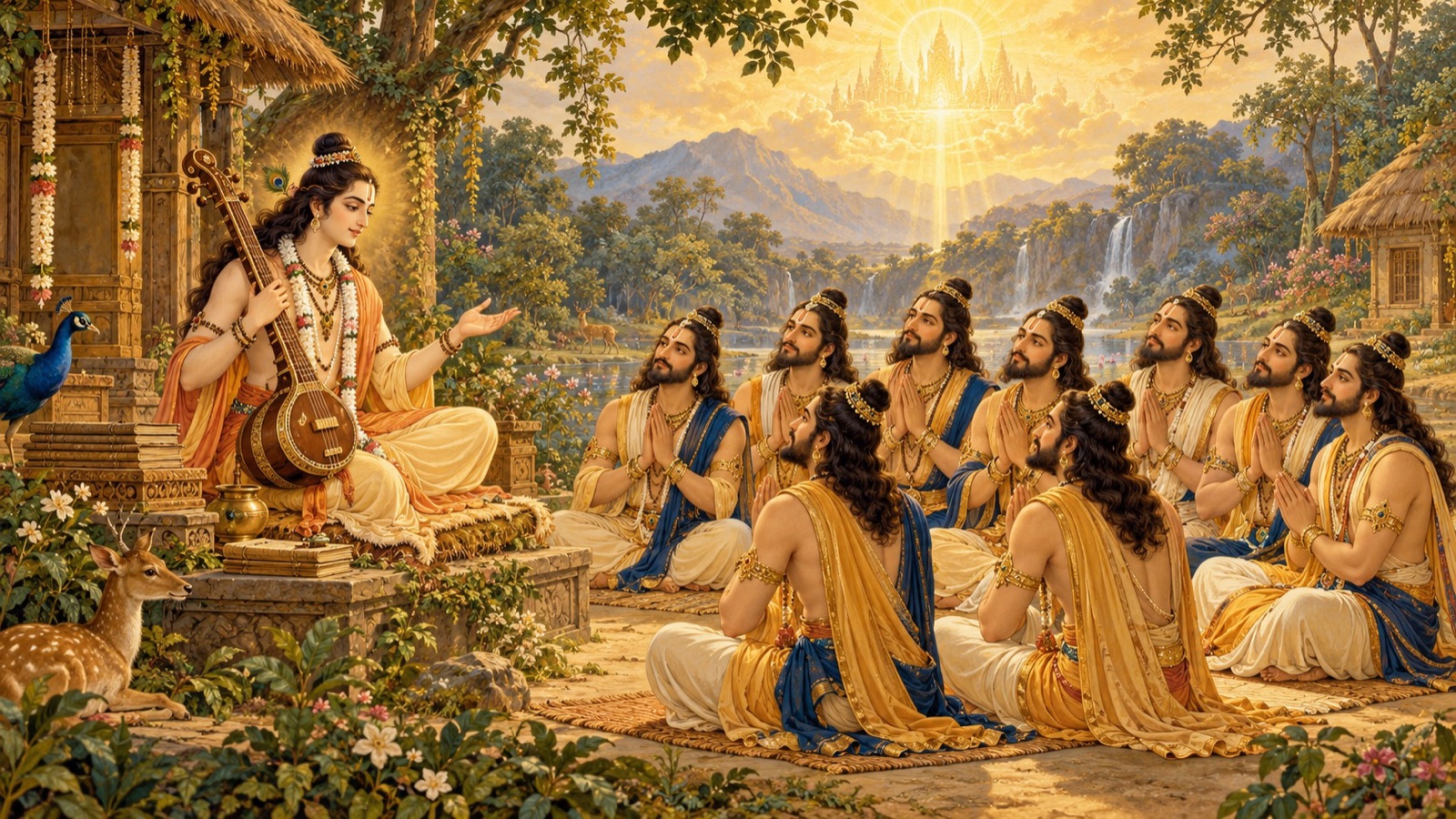
In the closing chapter of the Fourth Canto, the sage Narada teaches the Pracetas the one truth that crowns the whole book — that a life is worthwhile only by the loving service of the Lord.
Om Namo Bhagavate Vasudevaya.
Om Namo Bhagavate Vasudevaya.
Om Namo Bhagavate Vasudevaya.
Welcome to Srimad Bhagavatam Wisdom, a devotional journey through the sacred histories and teachings of the Srimad Bhagavat Mahapurana. This thirty-first chapter is the last of the Fourth Canto, and it brings the long story of the Pracetas — and with it the whole discourse of the sage Maitreya to Vidura — to its fulfilment. After a long life with their queen Marisha, in which they begot Daksha (born again from a former birth) and other offspring, wisdom dawns upon the Pracetas as they recall the earlier promise of the Lord, and of their own resolve they leave home and kingdom for a hermitage by the western sea. There the sage Narada finds them established in deep meditation upon the Supreme, and teaches them the one truth toward which the whole Canto has been moving: that a birth, a lifetime, and all our deeds are worthwhile only insofar as they serve the Lord, the Self of all; and that by worshipping Him, as by watering the root of a tree, everything else is nourished at once. Their devotion now deepened beyond measure, the Pracetas meditate on His lotus feet and, in time, attain the Lord Himself. And the great discourse itself comes to rest, as Vidura, his heart at peace, takes leave of Maitreya. It is a chapter of fulfilment, completing the lineage from Svayambhuva Manu through Daksha, Dhruva, Prithu, and the Pracetas — and closing the Canto on the one counsel that answers every story it has told: worship the Lord.
Chapter Information
- Scripture: Śrīmad Bhāgavata Mahāpurāṇa
- Canto: 4 (Book Four)
- Chapter: 31 (Discourse 31), the final chapter of the Canto
- Principal speaker: The sage Maitreya, concluding his discourse to Vidura (with the words of Narada quoted within, and the outer frame of Suta/Suka)
- Principal listener: Vidura
- Main setting: The hermitage of the Pracetas, and the close of the Maitreya–Vidura dialogue
- Central subject: Narada’s final teaching to the Pracetas, their renunciation and attainment, and the conclusion of the Canto
- Principal verse range: Canto 4, Chapter 31, verses 1–31
- Primary edition: Gita Press Śrīmad Bhāgavata Mahāpurāṇa
Context from the Previous Chapter
Chapter 30 told how the Lord appeared to the Pracetas and granted them a boon, and how, returning home, they married Marisha, the foster-daughter of the trees. This thirty-first chapter completes their story: after a full life in the world, wisdom dawns and they renounce it of their own accord, Narada instructs them further in devotion, and in time they attain the Lord — and the whole Canto comes to its close.
Wisdom Dawns, and Narada Comes
After a long and full life with Marisha, from whom the Pracetas begot Daksha and other children who would people the world, perfect knowledge at last dawned upon them: the memory of the Lord’s own promise, once recalled, was enough. Without waiting for any teacher to prompt them, they resolved to go.
मैत्रेय उवाच तत उत्पन्नविज्ञाना आश्वधोक्षजभाषितम् । स्मरन्त आत्मजे भार्यां विसृज्य प्राव्रजन् गृहात् ॥ १ ॥
maitreya uvāca tata utpanna-vijñānā āśv adhokṣaja-bhāṣitam smaranta ātmaje bhāryāṁ visṛjya prāvrajan gṛhāt
Meaning: Maitreya continued: In time, perfect knowledge dawned upon the Pracetas; remembering the Lord’s own words, they entrusted their wife to the care of their son and set out from home as renunciants. (Canto 4, Chapter 31, verse 1)
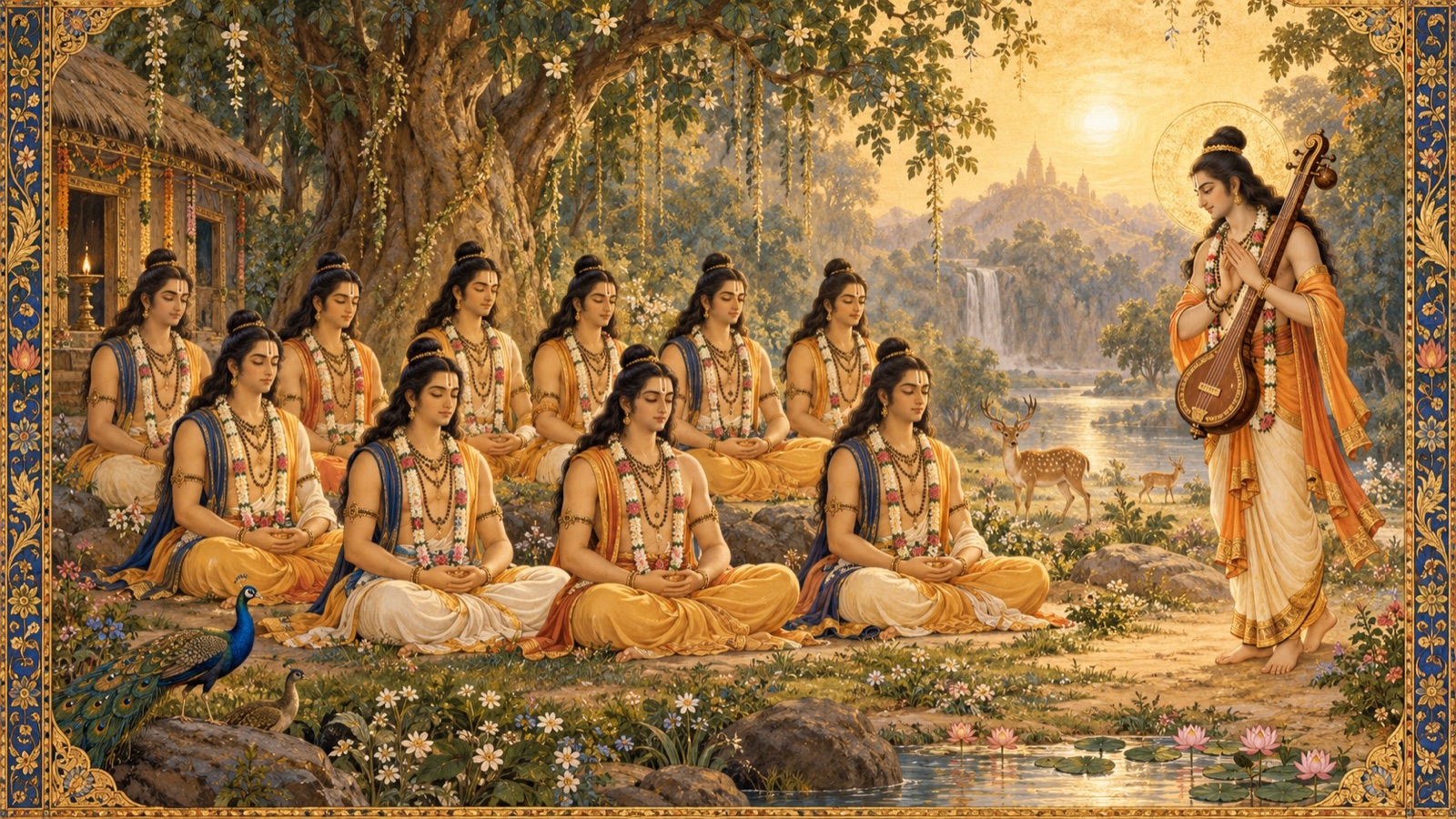
They travelled on to the western seashore, to the hermitage of the great liberated sage Jajali, and there, cultivating the vision that beholds every creature with equal eyes, they perfected their own realization of the Supreme (verse 2). There, deep in yogic absorption — breath, mind, speech and sight subdued, seated motionless, body and senses stilled — they fixed their souls upon the one flawless, supreme Brahman. It was in this state that the sage Narada, honoured equally by gods and demons, came upon them.
तान्निर्जितप्राणमनोवचोदृशो जितासनान् शान्तसमानविग्रहान् । परेऽमले ब्रह्मणि योजितात्मन: सुरासुरेड्यो ददृशे स्म नारद: ॥ ३ ॥
tān nirjita-prāṇa-mano-vaco-dṛśo jitāsanān śānta-samāna-vigrahān pare ’male brahmaṇi yojitātmanaḥ surāsureḍyo dadṛśe sma nāradaḥ
Meaning: Narada, revered by gods and demons alike, saw the Pracetas — who had conquered breath, mind, speech, and sight, mastered their posture, stilled their bodies, and joined their souls to the supreme, spotless Brahman. (Canto 4, Chapter 31, verse 3)
The One Truth: A Life Worthwhile Only in the Lord
Narada then gave them the teaching that crowns the whole Canto. That birth, he said, those deeds, that span of life, that mind, and that speech of a human being are truly worthwhile only insofar as they serve Sri Hari, the Lord and Self of all — everything else, however grand, is spent in vain.
नारद उवाच तज्जन्म तानि कर्माणि तदायुस्तन्मनो वच: । नृणां येन हि विश्वात्मा सेव्यते हरिरीश्वर: ॥ ९ ॥
nārada uvāca taj janma tāni karmāṇi tad āyus tan mano vacaḥ nṛṇāṁ yena hi viśvātmā sevyate harir īśvaraḥ
Meaning: Narada said: That birth, those deeds, that lifespan, that mind, and that speech of men are truly worthwhile by which Sri Hari, the Lord and Self of all, is served. (Canto 4, Chapter 31, verse 9)
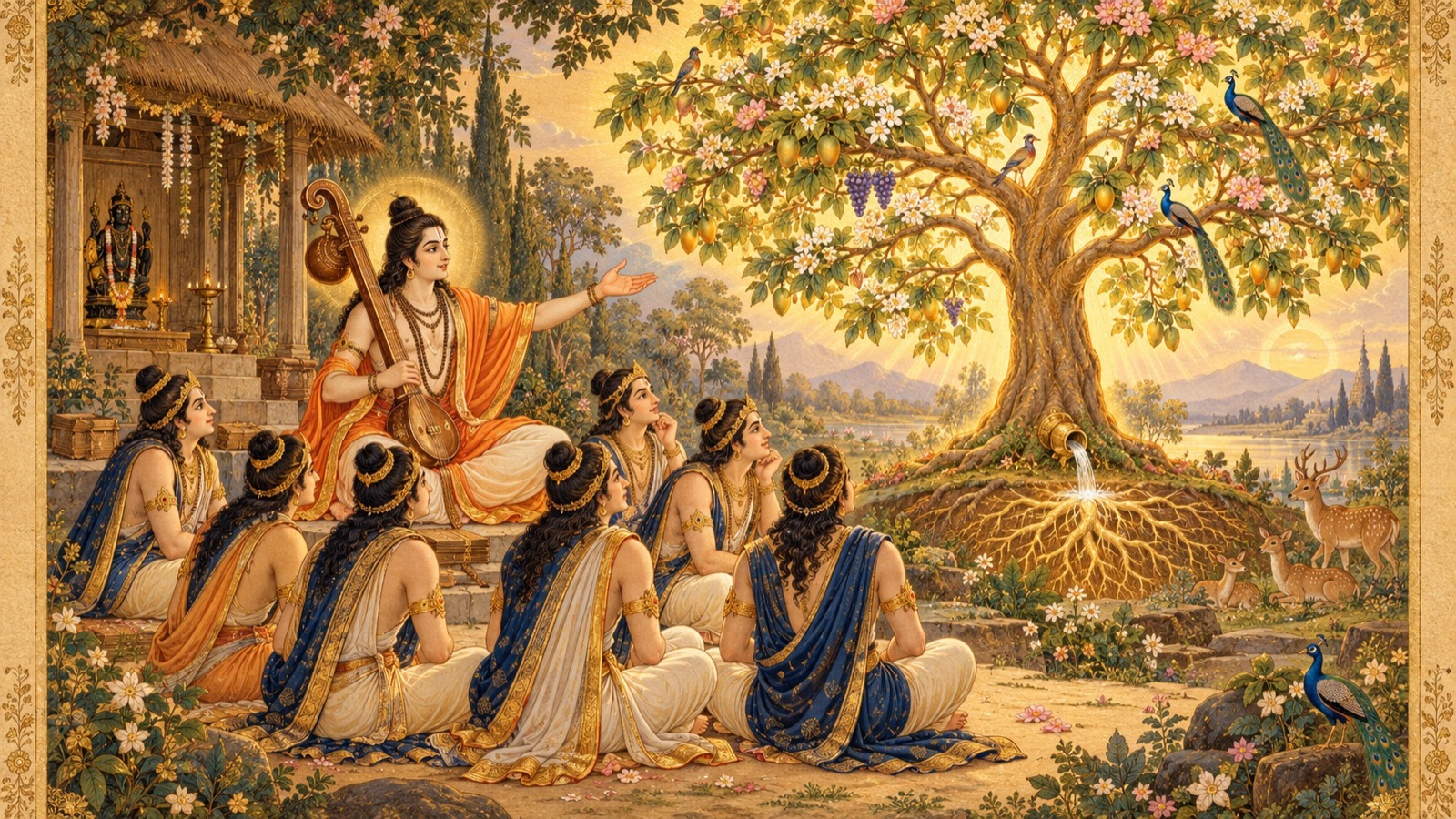
And he gave the beautiful image that has guided devotees ever since: pour water on a tree’s root, and its trunk, limbs, and every leaf draw nourishment together; supply the body’s vital breath, and every sense shares in it at once. Just so, he said, worship offered to the Lord alone reaches and fulfils everything and everyone else.
यथा तरोर्मूलनिषेचनेन तृप्यन्ति तत्स्कन्धभुजोपशाखा: । प्राणोपहाराच्च यथेन्द्रियाणां तथैव सर्वार्हणमच्युतेज्या ॥ १४ ॥
yathā taror mūla-niṣecanena tṛpyanti tat-skandha-bhujopaśākhāḥ prāṇopahārāc ca yathendriyāṇāṁ tathaiva sarvārhaṇam acyutejyā
Meaning: As by watering the root of a tree its trunk, branches, and twigs are nourished, and as by feeding the life-breath all the senses are satisfied, so by the worship of Achyuta, the Lord, everything is worshipped. (Canto 4, Chapter 31, verse 14)
Why should worship of the Lord alone be enough for everything? Narada went on to explain the reason: this cosmic world is never truly separate from Him. As the rain that rises on the sun’s heat falls to earth and is in due course drawn back into the sun, and as every creature springs from the earth and returns to it as dust, so this whole universe issues from the Supreme Personality of Godhead and, in its season, dissolves back into Him (verse 15). Creation is thus never something apart from its source.
एतत्पदं तज्जगदात्मन: परं सकृद्विभातं सवितुर्यथा प्रभा । यथासवो जाग्रति सुप्तशक्तयो द्रव्यक्रियाज्ञानभिदाभ्रमात्यय: ॥ १६ ॥
etat padaṁ taj jagad-ātmanaḥ paraṁ sakṛd vibhātaṁ savitur yathā prabhā yathāsavo jāgrati supta-śaktayo dravya-kriyā-jñāna-bhidā-bhramātyayaḥ
Meaning: Just as sunlight, though it fills the whole sky, is never different from the sun itself, this entire cosmic manifestation is never different from the one Supreme Person who is its ultimate ground; and just as the senses seem to vanish in sleep yet remain part of the same body, ready to awaken, so creation only seems to appear and disappear, while its source is unchanged and ever the same. (Canto 4, Chapter 31, verse 16)
This is the reasoning beneath the tree and the root: devotion to the Lord is never one duty owed among many others — to family, to society, to the gods — but the single root beneath them all, for everyone and everything lives by His light. Learning, mystic yoga, and even the sternest austerity, pursued without this touch of loving service, never by themselves reach their goal (verses 11-13).
The Lord Who Loves His Servants
Narada praised the Lord’s own tender greatness. He is self-fulfilled and dependent on none; the goddess of fortune herself follows Him, and the lords of men and the gods court her favour in vain — yet He gives His heart not to her but to His devotees, bound by love to His own servants. How then, Narada asked, could any grateful soul ever forsake such a Lord?
श्रियमनुचरतीं तदर्थिनश्च द्विपदपतीन् विबुधांश्च यत्स्वपूर्ण: । न भजति निजभृत्यवर्गतन्त्र: कथममुमुद्विसृजेत्पुमान् कृतज्ञ: ॥ २२ ॥
śriyam anucaratīṁ tad-arthinaś ca dvipada-patīn vibudhāṁś ca yat sva-pūrṇaḥ na bhajati nija-bhṛtya-varga-tantraḥ katham amum udvisṛjet pumān kṛta-jñaḥ
Meaning: The Lord, self-fulfilled and needing none, does not court even the goddess of fortune who follows Him, nor the lords of men and gods who seek her, for He is bound by love to His own servants; how then could a grateful soul ever forsake Him? (Canto 4, Chapter 31, verse 22)
The Pracetas Depart, and the Discourse Rests
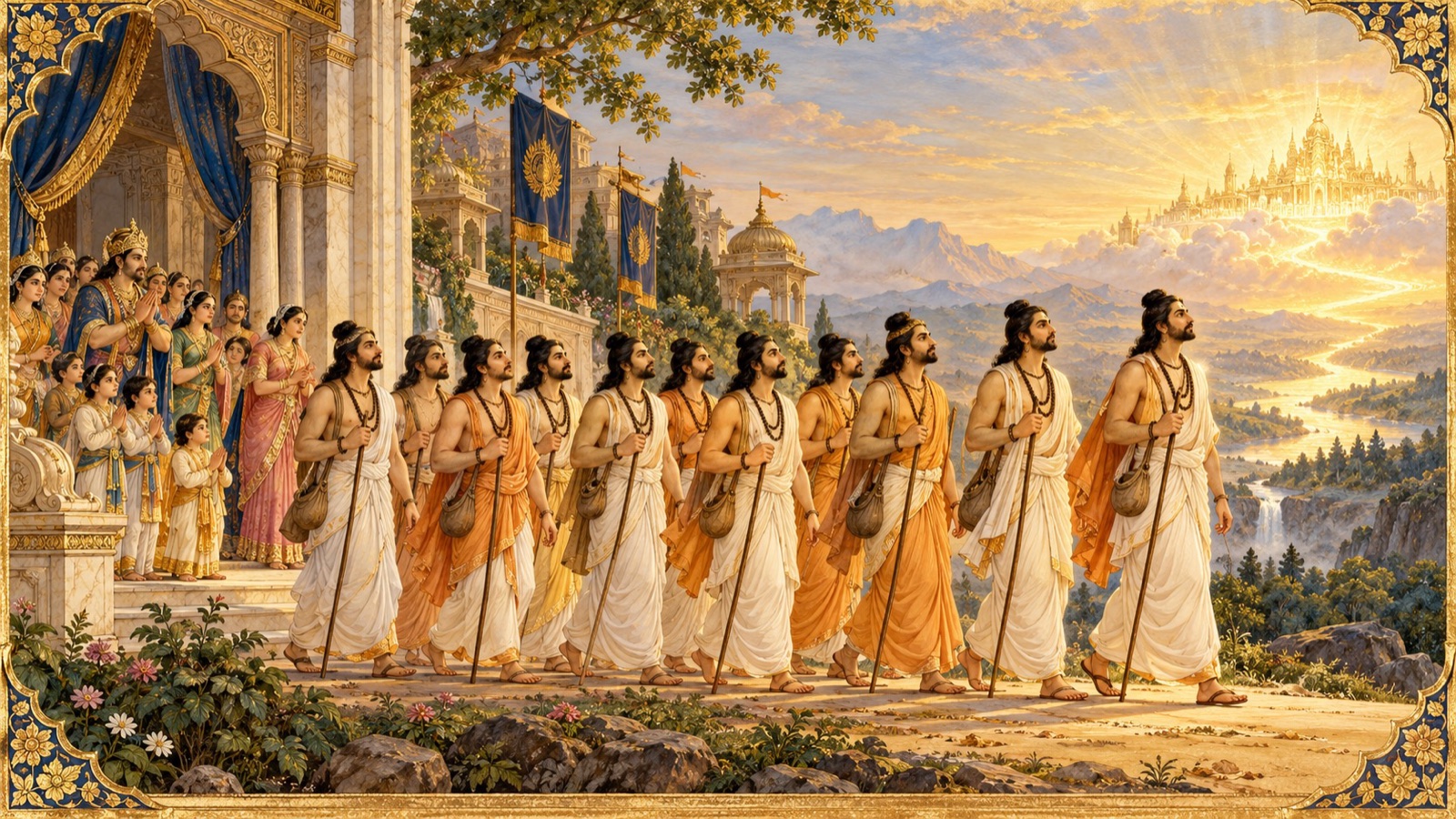
Moved to the depths by this teaching, the Pracetas’ devotion only deepened further. His instruction complete, Narada took his leave and returned to Brahmaloka (verse 23); and the Pracetas, meditating now without cease on the Lord’s lotus feet, in due course attained Him — the very goal toward which their whole life of renunciation and inquiry into the Self had been aimed (verse 24). And with the completion of their story, the whole great discourse of Maitreya to Vidura — which has carried us through the histories of Daksha and Sati, Dhruva, Prithu, and the Pracetas — came at last to its rest. Vidura, his heart wholly at peace, bowed to Maitreya, took his leave, and set out to see his own kinsmen. And the narration closes with a promise for all who hear it: to hear of these kings who offered their very souls to Sri Hari is itself to gain a long life, wealth, fame, well-being, a blessed end, and true prosperity.
एतद्य: शृणुयाद्राजन् राज्ञां हर्यर्पितात्मनाम् । आयुर्धनं यश: स्वस्ति गतिमैश्वर्यमाप्नुयात् ॥ ३१ ॥
etad yaḥ śṛṇuyād rājan rājñāṁ hary-arpitātmanām āyur dhanaṁ yaśaḥ svasti gatim aiśvaryam āpnuyāt
Meaning: Whoever hears this account of the kings who offered their souls to Sri Hari, O king, attains long life, wealth, fame, welfare, a blessed destination, and prosperity. (Canto 4, Chapter 31, verse 31)
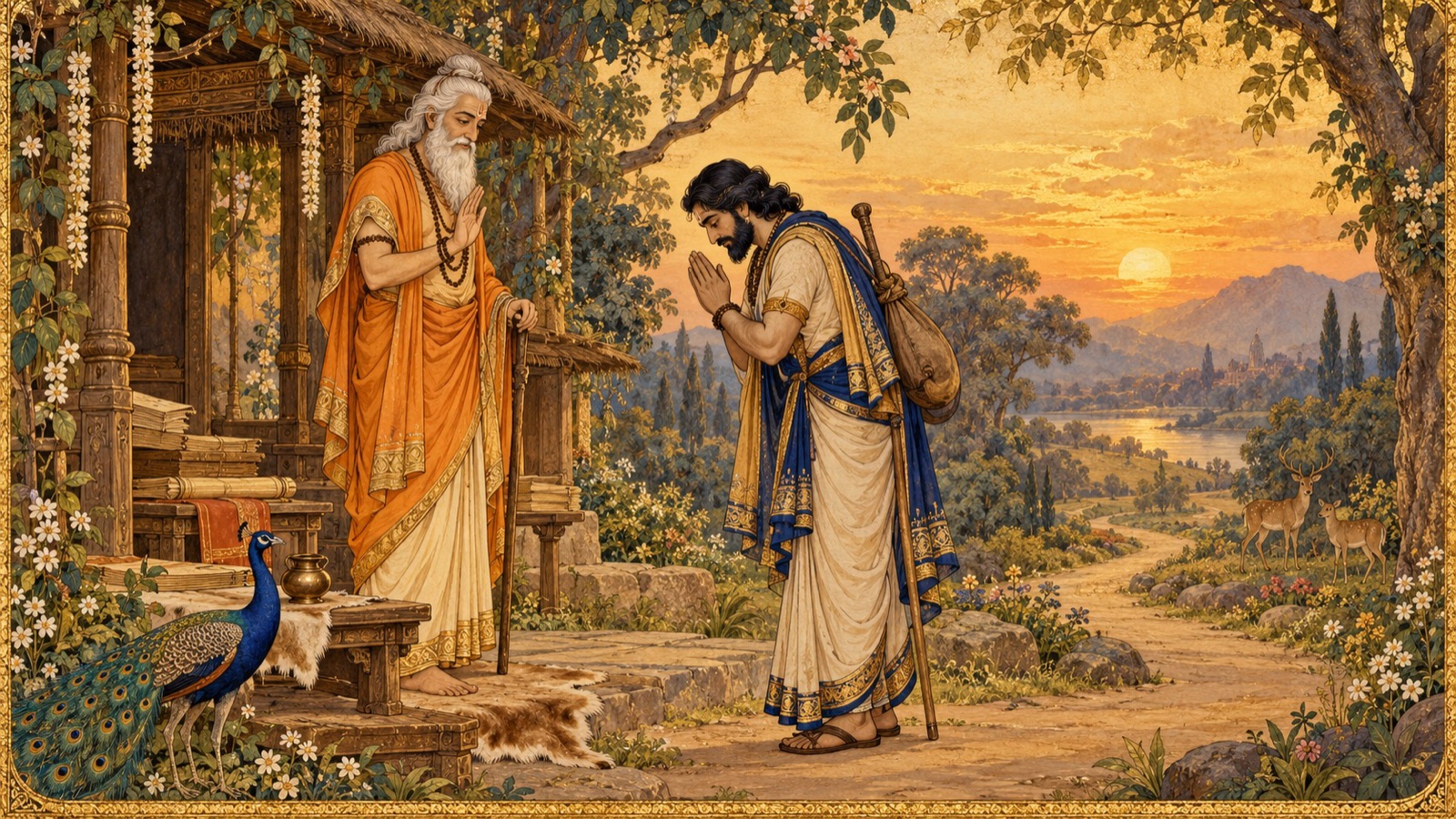
So the thirty-first discourse, and with it the whole Fourth Canto, comes to its close — the long lineage from the daughters of Svayambhuva Manu, through Daksha, Dhruva, Prithu, and the Pracetas, completed at last in the fulfilment of devotion. The narrative will continue in the Fifth Canto with the activities of Maharaja Priyavrata.
Principal Teachings of This Chapter
1. A life is measured by whether it serves the Lord. Narada declares that birth, deeds, lifespan, mind, and speech are worthwhile only as they serve Sri Hari. The value of a life is not its length or grandeur but its devotion (verse 9).
2. Worship of the Lord nourishes everything at once. As watering the root feeds the whole tree, so serving the Lord fulfils every duty and blesses every relation. Devotion is not one activity among many but the root of all good (verse 14).
3. The Lord is bound by love to His devotees. Self-fulfilled and needing nothing, He gives His heart to His servants rather than to fortune or the great. His greatness is His tenderness toward those who love Him (verse 22).
4. When wisdom ripens, the heart lets go of the world of its own accord. The Pracetas did not wait to be told to renounce: remembering the Lord’s promise was enough to make them leave home and kingdom before any teacher had come to them, and hearing Narada afterward only deepened that resolve until they attained the Lord Himself (verses 1-2, 24).
5. Hearing these holy histories bears rich fruit. Sukadeva promises that whoever takes in this account of kings who offered their souls to Sri Hari gains long life, wealth, good name, well-being, and the highest destination in return. The sacred story is itself a means of grace (verse 31).
A Devotional Reflection
As the Fourth Canto comes to its close, it gathers all its many stories into a single, simple counsel, spoken by Narada to the Pracetas: that a life is worthwhile only insofar as it serves the Lord. Look back over all we have followed — the pride and reconciliation of Daksha, the child-devotion of Dhruva, the just rule and final surrender of Prithu, the long allegory of Puranjana, the austerity of the Pracetas — and see how every thread comes to rest here. The kings who tried to make their lives about themselves — Daksha in his pride, Vena in his blasphemy, Puranjana in his pleasures — found only bondage and grief; and those who gave their lives to the Lord — Dhruva, Prithu, the Pracetas — found freedom and joy. Narada’s image of the tree is the whole teaching in a picture: we spend so much of our effort tending the branches and leaves of our lives, our comforts and duties and relationships, one by one, and wondering why the tree still withers; and the Bhagavatam says, quietly, water the root. Give your love to the Lord, the Self of all, and every branch of your life is nourished at once. It is a teaching of extraordinary mercy, for it means that the highest thing and the most practical thing are the same: that to love God is not to neglect our duties but to fulfil them all at their source. And the Canto ends, fittingly, not with a doctrine but with a departure into devotion, and a promise that even to hear these stories with faith is itself a step toward the same blessed end.
A Daily Devotional Practice
Today, water the root. Amid all the branches of your life that clamour for attention — your work, your worries, your relationships, your many duties — take a few minutes to tend, instead, the one root from which they all draw life: your love of the Lord. Sit quietly and offer Him your whole heart with the words “Om Namo Bhagavate Vasudevaya,” trusting Narada’s promise that by watering this root, every branch is nourished at once. And in the spirit of the Fourth Canto’s close, let one ordinary duty of your day be done consciously for the Lord, as an act of service to the Self of all, so that even your work becomes worship. To turn the whole of your life, however simply, toward serving Him is to answer, in your own small way, the one counsel in which this entire Canto comes to rest.
Conclusion
The thirty-first and final discourse of Book Four completes the story of the Pracetas and the whole discourse of Maitreya to Vidura. After a long life with Marisha, from whom they begot Daksha and others, the Pracetas renounce home and kingdom of their own ripened resolve, and in a hermitage by the western sea, Narada finds them absorbed in meditation on the Supreme. He gives them the teaching this whole Canto has been building toward: that a birth, a life, and all our deeds have worth only insofar as they serve Sri Hari, and that worshipping Him nourishes everything else at once, as water poured on a root feeds every branch. He also shows why this is so — that all creation is never separate from its Source, as sunlight is never separate from the sun — and praises the Lord who, self-fulfilled, is yet bound by love to His servants. So moved, the Pracetas meditate on His feet until they attain Him; and the great discourse comes to rest as Vidura, at peace, takes leave of Maitreya. The Canto closes with the promise that hearing this account of God-devoted kings brings its own rich reward: to water the root of our lives with love for the Lord is to nourish, at a single stroke, every branch of them.
May the divine wisdom of Srimad Bhagavatam awaken pure devotion within our hearts.
Om Namo Bhagavate Vasudevaya.
Jay Shree Madhav.
References and Attribution
- Primary edition: Gita Press, Śrīmad Bhāgavata Mahāpurāṇa (English, complete), Book Four, Discourse 31 (the final discourse of the Fourth Canto).
- Series: Srimad Bhagavatam Wisdom · Biswa Sanatan Dharma Seva Trust.
- Presented following the spiritual guidance and recommendation of Pandit Dr. Shri Kashinath Mishra.
This is an original, faithful retelling in the writer’s own words, with brief quoted verses shown in Devanāgarī and transliteration and their meanings given as summaries. It is not a reproduction of any single publisher’s continuous translation or commentary. No affiliation with or endorsement by any publisher is implied.
Jay Shree Madhav