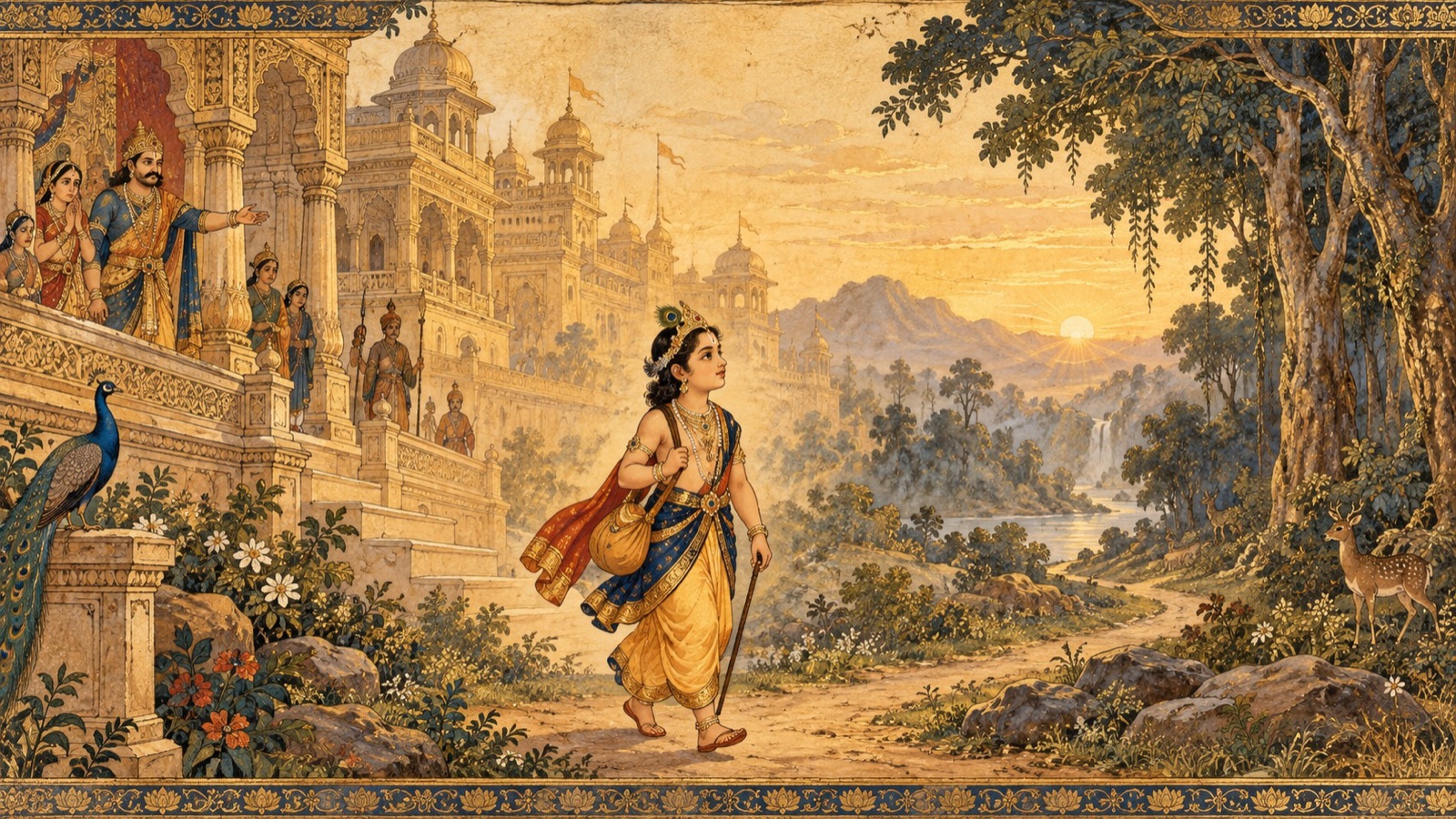
Wounded by an unkind word yet lifted by his mother’s counsel, the child Dhruva turns his back on the palace and sets out alone for the forest, resolved to seek the Lord who is the refuge of all.
Om Namo Bhagavate Vasudevaya.
Om Namo Bhagavate Vasudevaya.
Om Namo Bhagavate Vasudevaya.
Welcome to Srimad Bhagavatam Wisdom, a devotional journey through the sacred histories and teachings of the Srimad Bhagavat Mahapurana. With the story of Daksha and Sati now complete, the sage Maitreya turns to one of the most beloved histories in all the scriptures — the story of the child-devotee Dhruva. It is a story that begins with a small boy’s tears and rises to the highest heaven. Slighted by his proud stepmother and told he could never claim his father’s lap or throne, little Dhruva does not sink into resentment. Guided by his gentle mother Suniti and then by the sage Narada, he transforms his hurt into holy resolve, leaves the comfort of the palace, and walks alone into the forest to find the one refuge that no one can take from him — the Supreme Lord himself. This eighth chapter is the chapter of that departure: the wound, the counsel, the meeting with Narada, the sacred twelve-syllable mantra, and the beginning of an austerity so intense that it shakes the worlds.
Chapter Information
- Scripture: Śrīmad Bhāgavata Mahāpurāṇa
- Canto: 4 (Book Four)
- Chapter: 8 (Discourse 8)
- Chapter title: Dhruva’s Departure for the Forest
- Principal speaker: The sage Maitreya, continuing his discourse to Vidura (with the words of Suruchi, Suniti, Narada, and the Lord quoted within)
- Principal listener: Vidura
- Main setting: The palace of King Uttanapada, and the forest of Madhuvana on the bank of the Yamuna
- Central subject: The slighting of the child Dhruva, his mother’s counsel, his meeting with Narada, and his departure for the forest to seek the Lord
- Principal verse range: Canto 4, Chapter 8, verses 1–82
- Primary edition: Gita Press Śrīmad Bhāgavata Mahāpurāṇa
Context from the Previous Chapter
Chapter 7 closed the long history of Daksha and Sati with grace and reunion — Lord Shiva restored, the sacrifice completed, and Sati reborn to rejoin her lord. Now Maitreya turns to the descendants of Svayambhuva Manu. Of the sons of Brahma, the great sages Sanaka and his brothers, Narada, and others remained lifelong celibates devoted to the Lord. But others accepted household life, and through this line came the two sons of Svayambhuva Manu — Uttanapada and Priyavrata. It is with King Uttanapada and his household that the story of Dhruva begins.
A Wound in the Palace
King Uttanapada had two queens, Suniti and Suruchi. Though Suniti was the elder and the mother of the elder son, the king’s heart was captivated by the younger queen, Suruchi, and her son Uttama, while Suniti and her boy Dhruva were neglected. One day the king was fondling little Uttama upon his lap. Seeing this, the child Dhruva also came, wishing to climb up beside his father — but the king did not welcome him.
एकदा सुरुचे: पुत्रमङ्कमारोप्य लालयन् । उत्तमं नारुरुक्षन्तं ध्रुवं राजाभ्यनन्दत ॥ ९ ॥
ekadā suruceḥ putram aṅkam āropya lālayan uttamaṁ nārurukṣantaṁ dhruvaṁ rājābhyanandata
Meaning: Once, as King Uttanapada was fondling Suruchi’s son Uttama upon his lap, the little Dhruva came and tried to climb up too — but the king did not welcome him. (Canto 4, Chapter 8, verse 9)
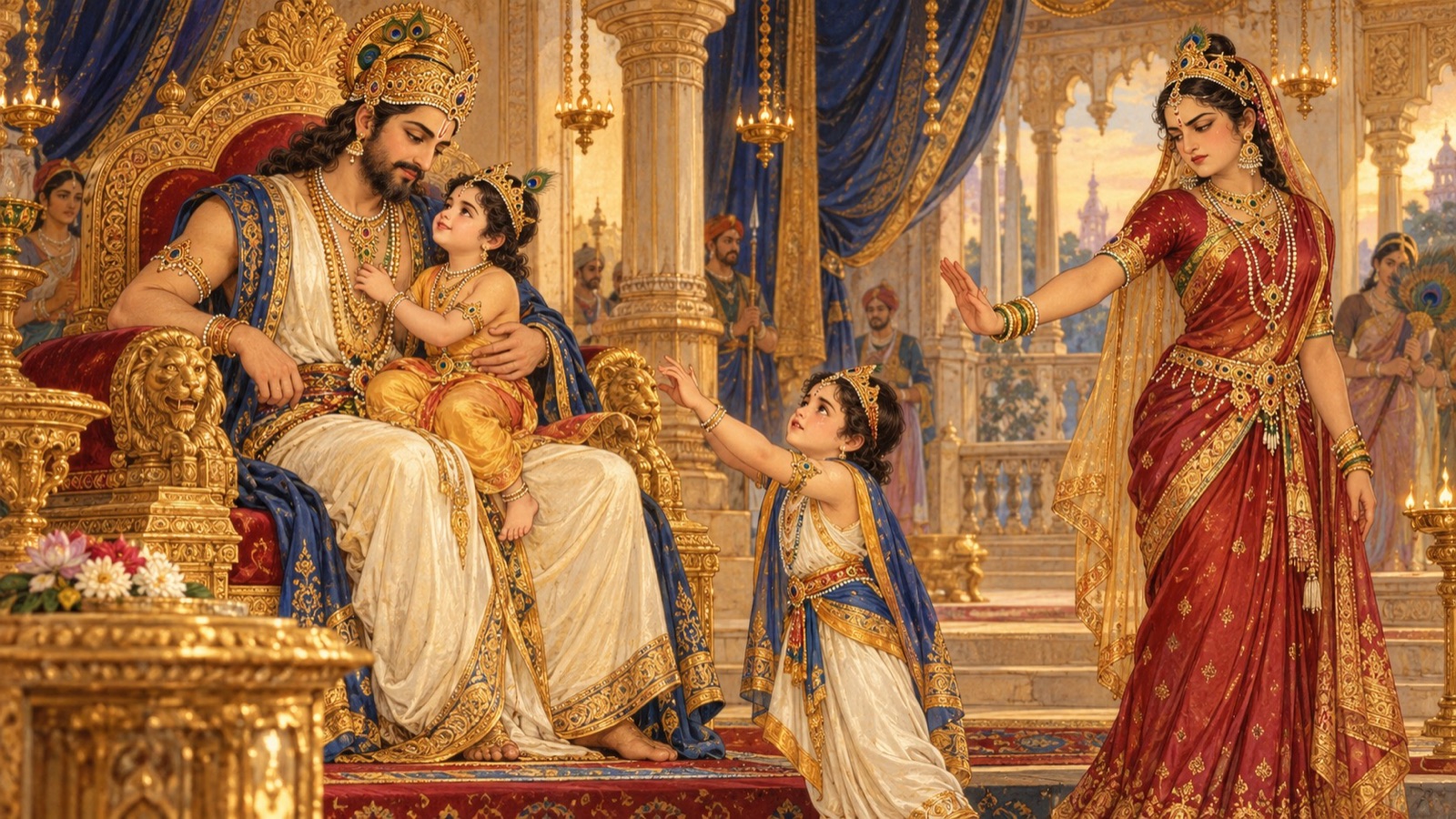
Seeing the boy’s longing, the proud Suruchi spoke words that cut like a blade. She told Dhruva that he could not sit upon the king’s lap or aspire to the throne, for he had not been born of her womb; though he was the king’s son, he was not fit for such fortune. If he truly desired the throne, she said, then let him worship the Supreme Person by austerity, and by the Lord’s grace take his next birth from her own womb.
तपसाराध्य पुरुषं तस्यैवानुग्रहेण मे । गर्भे त्वं साधयात्मानं यदीच्छसि नृपासनम् ॥ १३ ॥
tapasārādhya puruṣaṁ tasyaivānugraheṇa me garbhe tvaṁ sādhayātmānaṁ yadīcchasi nṛpāsanam
Meaning: If you desire the throne of the king, then worship the Supreme Person through austerity, and by His grace take your next birth from my womb. (Canto 4, Chapter 8, verse 13)
Stung by his stepmother’s harsh words, and seeing his father silent, the little boy breathed hard like a wounded serpent and ran weeping to his mother.
A Mother’s Counsel
When Suniti heard from her attendants what had befallen her son and the words her co-wife had spoken, she was overcome. Unable to bear it, she lamented like a tender creeper caught in a forest fire, and her lotus-like face was wet with tears.
सोत्सृज्य धैर्यं विललाप शोक- दावाग्निना दावलतेव बाला । वाक्यं सपत्न्या: स्मरती सरोज- श्रिया दृशा बाष्पकलामुवाह ॥ १६ ॥
sotsṛjya dhairyaṁ vilalāpa śoka- dāvāgninā dāva-lateva bālā vākyaṁ sapatnyāḥ smaratī saroja- śriyā dṛśā bāṣpa-kalām uvāha
Meaning: Losing her composure, Suniti lamented like a slender creeper scorched by a forest fire; remembering her co-wife’s words, her lotus-lovely eyes brimmed with tears. (Canto 4, Chapter 8, verse 16)
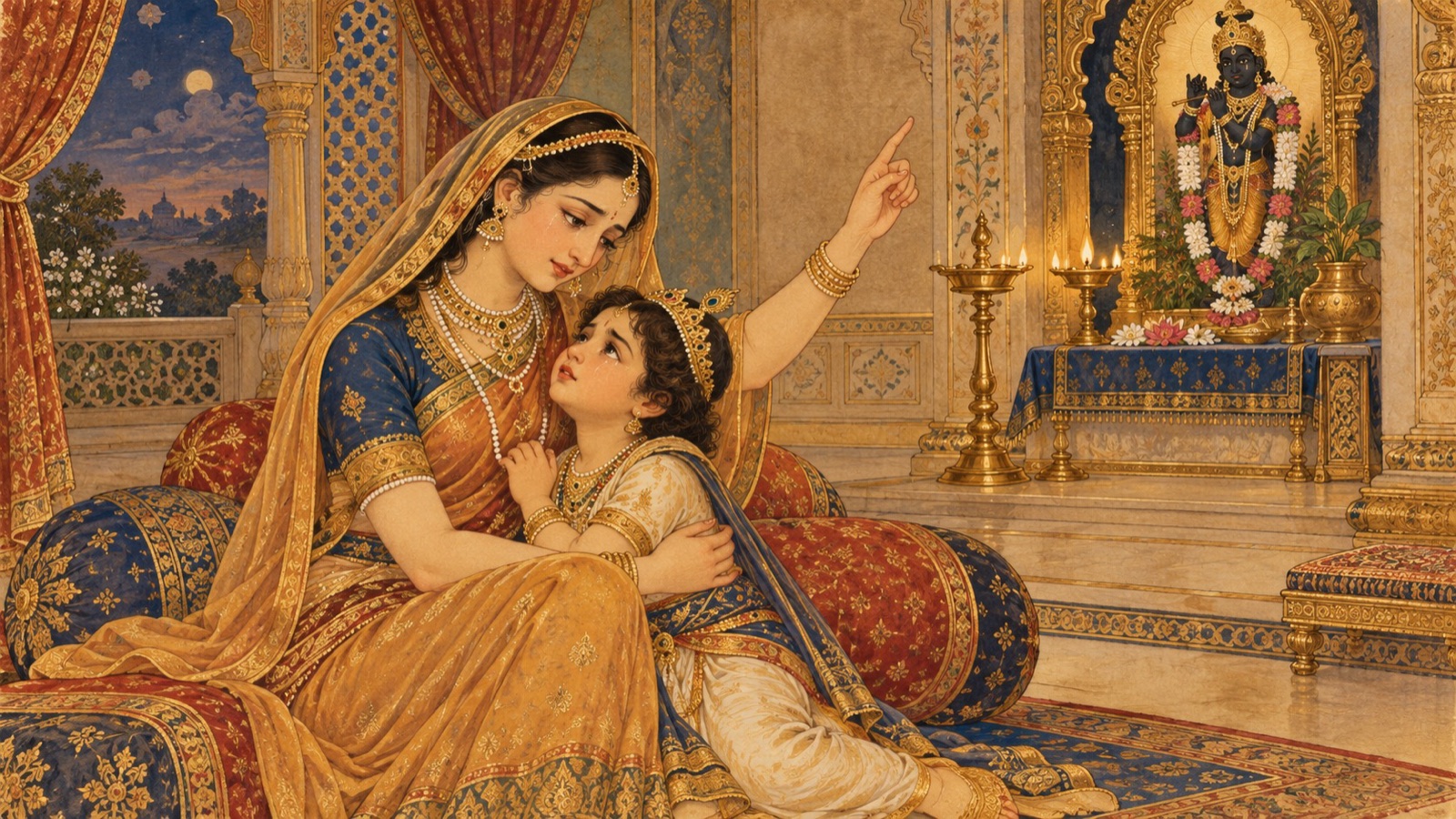
Yet Suniti did not answer insult with insult. Mastering her grief, she spoke to her son as a true mother of the spirit. She acknowledged that Suruchi’s words, though cruel, were not wholly untrue, for their family fortune did indeed rest with the king’s beloved queen. But then she lifted the boy’s gaze higher than any throne. Do not, she said, harbour ill will toward anyone; whatever sorrow has touched you is the fruit of your own past. And she pointed him to the only sure refuge: let him worship the lotus feet of the Supreme Lord, the same Lord whom even Brahma and the great ones adore, upon whom Suruchi herself had unknowingly bid him rely. Her own great-grandfather’s father, Brahma, had attained his exalted seat by worshipping that Lord; let Dhruva too seek Him, for He is the friend of the friendless and the one true shelter of all who take refuge in Him.
Resolve, and the Meeting with Narada
The counsel meant to console instead kindled a flame. Dhruva took his mother’s words to heart, and with a resolve remarkable in one so young, he made up his mind: he would seek out the Supreme Lord himself. Composing his mind, he left his father’s city and set out alone toward the forest.
The great sage Narada, wandering through the heavens, came to hear of the child’s intention, and knowing the boy’s firm resolve, he was struck with wonder that such determination should dwell in so small a frame. Approaching Dhruva, he touched the boy’s head with his all-purifying hand and spoke.
नारदस्तदुपाकर्ण्य ज्ञात्वा तस्य चिकीर्षितम् । स्पृष्ट्वा मूर्धन्यघघ्नेन पाणिना प्राह विस्मित: ॥ २५ ॥
nāradas tad upākarṇya jñātvā tasya cikīrṣitam spṛṣṭvā mūrdhany agha-ghnena pāṇinā prāha vismitaḥ
Meaning: Hearing of this and understanding the child’s resolve, Narada was filled with wonder; touching Dhruva’s head with his sin-destroying hand, he spoke. (Canto 4, Chapter 8, verse 25)
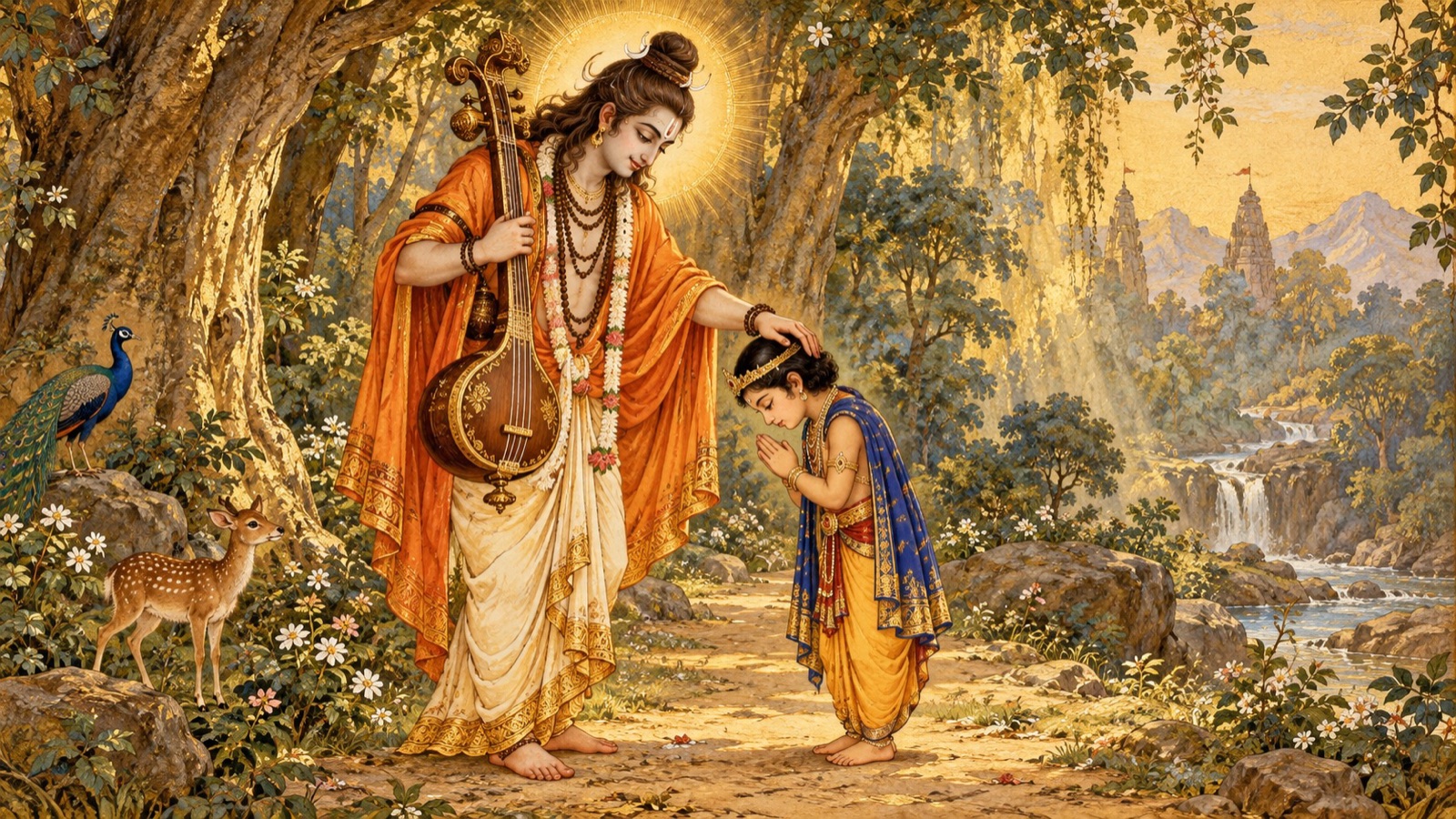
At first Narada, as a loving guide, tested the boy’s determination. He spoke gently of how hard austerity is, how children are drawn to play, and how the honour and dishonour of the world are but the fruit of one’s own past deeds, which a wise soul learns to bear with an even mind, greeting the more accomplished with joy, the less fortunate with compassion, and an equal with friendship; better, perhaps, to wait for a riper age. But Dhruva was not to be turned aside. He answered frankly, as a kshatriya’s son, that the consolations Narada offered could not reach a heart pierced as his was, and that he longed for a station higher than any his father or even his great-grandfather Brahma had attained — one that only the Supreme Lord could grant.
Narada might easily have refused so extravagant a wish, or told the boy to first master the very equanimity he could not yet feel. He did neither. Moved with compassion, he explained that whatever the soul rightly seeks — duty well performed, prosperity, the satisfaction of desire, or freedom from this world altogether — has one cause and no other: loving service at the Lord’s own lotus feet.
धर्मार्थकाममोक्षाख्यं य इच्छेच्छ्रेय आत्मन: । एकं ह्येव हरेस्तत्र कारणं पादसेवनम् ॥ ४१ ॥
dharmārtha-kāma-mokṣākhyaṁ ya icchec chreya ātmanaḥ ekaṁ hy eva hares tatra kāraṇaṁ pāda-sevanam
Meaning: Whatever a soul rightly seeks — duty, prosperity, the fulfilment of desire, or liberation — comes by one cause alone: devoted service at the feet of Sri Hari. (Canto 4, Chapter 8, verse 41)
A heart still burning with a boyish wound and a boyish ambition was, by this teaching, no obstacle to the Lord’s path; it needed only to be turned toward Him undivided. So Narada did not send the child home to grow older and calmer first. Delighted by such faith, he accepted Dhruva then and there as his spiritual guide, and gave him the very practice that would carry his hurt into worship.
The sage then gave Dhruva the priceless instruction he had come for. Let him go, said Narada, to the sacred grove of Madhuvana on the bank of the Yamuna, where the Lord is ever present; there let him bathe, control his senses, and meditate within his heart upon the beautiful form of the Supreme Lord — his serene lotus face, his four arms bearing conch, disc, mace, and lotus, his form dark as a rain-cloud and gracious to all who remember him. And Narada gave him the sacred twelve-syllable mantra by which the Lord is worshipped.
ॐ नमो भगवते वासुदेवाय । मन्त्रेणानेन देवस्य कुर्याद् द्रव्यमयीं बुध: । सपर्यां विविधैर्द्रव्यैर्देशकालविभागवित् ॥ ५४ ॥
oṁ namo bhagavate vāsudevāya mantreṇānena devasya kuryād dravyamayīṁ budhaḥ saparyāṁ vividhair dravyair deśa-kāla-vibhāgavit
Meaning: “Om Namo Bhagavate Vasudevaya.” With this mantra, said Narada, let the wise devotee worship the Lord, offering various articles of worship in keeping with time and place. (Canto 4, Chapter 8, verse 54)
This is the very mantra that opens every chapter of our journey — the salutation to Lord Vasudeva, the indwelling Lord of all. Narada taught the boy how to hold the Lord’s form in his mind, how to offer worship, and how, with this mantra upon his lips and this vision in his heart, to give himself wholly to the Supreme.
Departure for Madhuvana
Thus instructed, Dhruva reverently circumambulated the sage and bowed at his feet, and then set out for the holy forest of Madhuvana, ever marked by the lotus footprints of Sri Hari.
इत्युक्तस्तं परिक्रम्य प्रणम्य च नृपार्भक: । ययौ मधुवनं पुण्यं हरेश्चरणचर्चितम् ॥ ६२ ॥
ity uktas taṁ parikramya praṇamya ca nṛpārbhakaḥ yayau madhuvanaṁ puṇyaṁ hareś caraṇa-carcitam
Meaning: Thus instructed, the young prince circumambulated Narada and bowed to him, and departed for the holy Madhuvana, hallowed by the footprints of Sri Hari. (Canto 4, Chapter 8, verse 62)
Meanwhile the sage Narada went to the palace and gently consoled the grieving King Uttanapada, who had begun to repent of driving his little son into the forest. Narada assured the king that the boy was protected by the Lord and would return crowned with glory, and bade him not to grieve.
The Austerity that Shook the Worlds
Arriving at Madhuvana, Dhruva bathed in the Yamuna, and following Narada’s instruction he began his worship with fasting, steadfast concentration, and the chanting of the sacred mantra.
तत्राभिषिक्त: प्रयतस्तामुपोष्य विभावरीम् । समाहित: पर्यचरदृष्यादेशेन पूरुषम् ॥ ७१ ॥
tatrābhiṣiktaḥ prayatas tām upoṣya vibhāvarīm samāhitaḥ paryacarad ṛṣy-ādeśena pūruṣam
Meaning: Having bathed there and observed a night’s fast, the pure-hearted Dhruva, with a concentrated mind, worshipped the Supreme Person as the sage had directed. (Canto 4, Chapter 8, verse 71)
Month by month the child deepened his penance, until his concentration grew so intense that the very breathing of the universe seemed to falter. The demigods, unable to breathe, took fright and hurried to the Supreme Lord for shelter. The Lord reassured them with tender words, revealing that the disturbance was caused by no enemy, but by a little boy — the son of Uttanapada — utterly absorbed in Him.
श्रीभगवानुवाच मा भैष्ट बालं तपसो दुरत्यया- न्निवर्तयिष्ये प्रतियात स्वधाम । यतो हि व: प्राणनिरोध आसी- दौत्तानपादिर्मयि सङ्गतात्मा ॥ ८२ ॥
śrī-bhagavān uvāca mā bhaiṣṭa bālaṁ tapaso duratyayān nivartayiṣye pratiyāta sva-dhāma yato hi vaḥ prāṇa-nirodha āsīd auttānapādir mayi saṅgatātmā
Meaning: The Lord said: Do not fear. The obstruction to your breath is caused by the boy, the son of Uttanapada, whose heart is wholly absorbed in Me through severe austerity. I shall turn him back from these fierce penances; return in peace to your own abodes. (Canto 4, Chapter 8, verse 82)
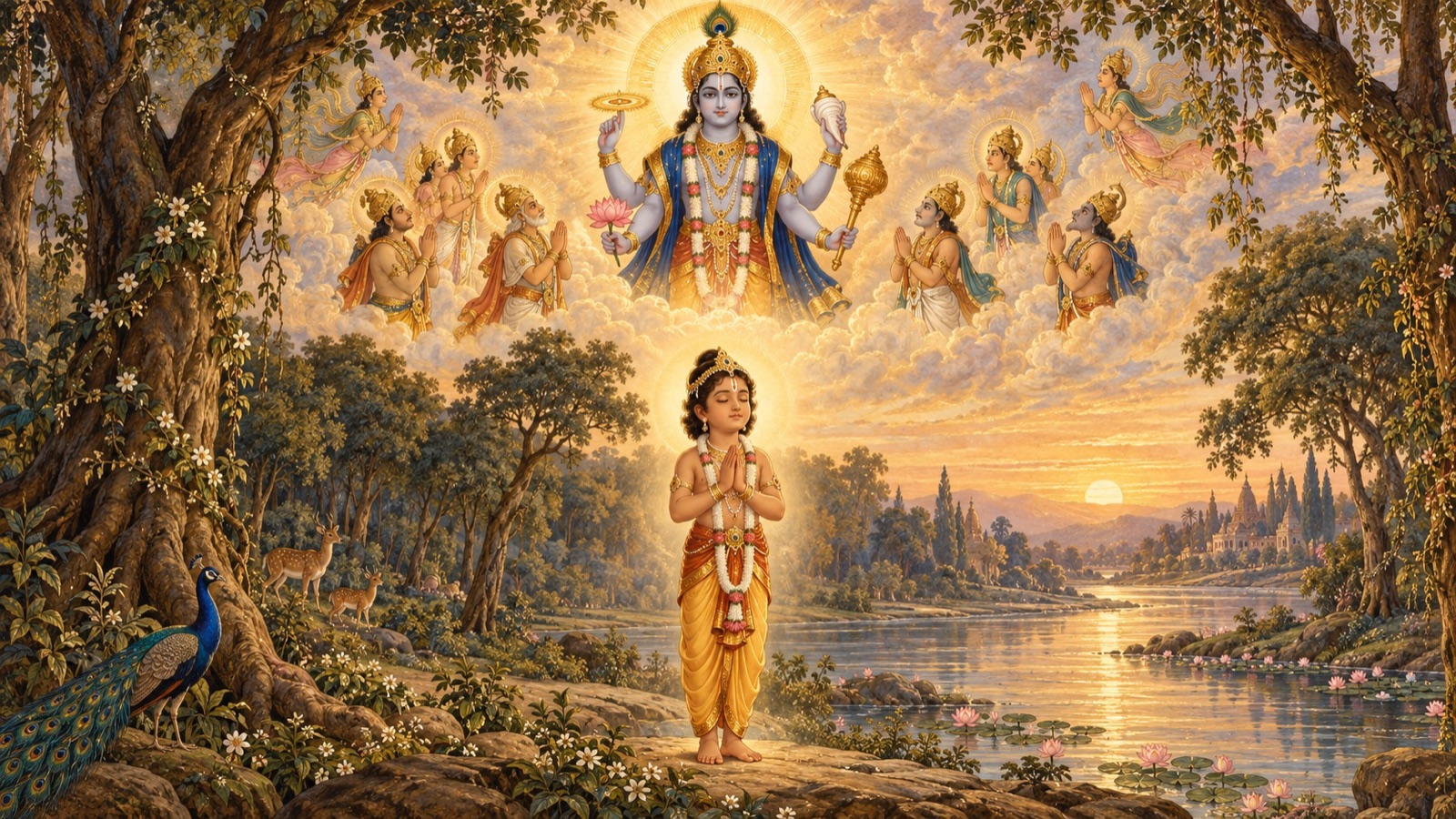
With that gracious word the eighth discourse closes — poised on the threshold of the Lord’s own coming to His child devotee, which the next chapter will unfold.
Principal Teachings of This Chapter
1. A wound can become a doorway. Told plainly that another woman’s son, not he, belonged on the throne and in his father’s lap, and met besides with his own father’s silence, Dhruva’s pain at Suruchi’s words did not harden into hatred; guided by his mother, it became the very force that drove him to seek a shelter no one could ever again deny him. What breaks us can be the door through which grace enters (verses 9-24).
2. True counsel points beyond the world. Suniti could have fed her son’s grievance; instead, even while weeping her own tears, she lifted his eyes above the throne to the feet of the Lord. She taught him that no sorrow touches us but by the fruit of our own past deeds, that ill will toward none is the mark of wisdom, and that the very worship which raised great Brahma to his exalted seat lies open to any sincere soul, however small (verses 16-24).
3. Sincere resolve draws the guide. The moment Dhruva set out with a pure heart, Narada came to him. When the seeker is ready, the teacher appears, and lays a purifying hand upon the head bowed in earnest (verse 25).
4. Bhakti asks no prior qualification. Dhruva could not feign the sage’s own equanimity; he openly confessed that his heart, pierced by an unkind word, would not settle, and that he wanted a throne beyond even Brahma’s. Narada turned him away neither for wanting so much nor for admitting he still burned inside. He taught instead that whoever seeks anything at all — duty, prosperity, pleasure or liberation — finds it by no other means than service at the Lord’s lotus feet; devotion is not reserved for the desireless or the already pure, but is the one door open to every sincere heart, wound and ambition included (verses 35-41).
5. The Name is the treasure. The whole of Dhruva’s path is contained in the twelve-syllable mantra Narada gave him — Om Namo Bhagavate Vasudevaya — the same salutation that opens every reading of the Bhagavatam. The Holy Name is the child’s, and every devotee’s, surest wealth (verse 54).
6. Wholehearted devotion moves heaven. Month by month Dhruva’s austerity deepened — fruit every third day, then dry leaves, then water alone, then breath alone, until he stood balanced on a single leg — his one-pointed absorption growing so complete that the worlds trembled and the demigods themselves lost their breath in fear, until the Lord himself had to reassure them. Age and strength are nothing; single-minded love for God is everything (verses 71-82).
A Devotional Reflection
There is a reason the story of Dhruva has been loved by so many generations. It begins with something every heart knows — the sting of being passed over, the ache of not being chosen — and it shows us what to do with that ache. Dhruva does not nurse his wound, nor does his mother teach him to. She turns his gaze from the lap he was denied to the feet that never turn anyone away. And the little boy, too young to reason it out but old enough to love, simply walks toward God with his whole being. We often imagine that devotion requires strength, maturity, learning, the right conditions. Dhruva had none of these — only a bruised heart and a fixed resolve — and heaven itself bent toward him. His story tells us that the Lord measures not our age or our advantages but the wholeness of our turning toward Him. The very hurt we wish had never come may be, in the Lord’s hands, the beginning of our seeking.
A Daily Devotional Practice
Today, take up the treasure that Narada placed in Dhruva’s hands. Sit quietly for a few minutes, steady your breath, and gently chant the twelve-syllable mantra given in this chapter — “Om Namo Bhagavate Vasudevaya.” As you chant, let the picture of the child Dhruva rise in your mind: turning from the palace, walking into the forest, giving his whole small heart to the Lord. If some slight or sorrow is weighing on you, offer it up in this chant as Dhruva offered his — not clutched as a grievance, but surrendered as a doorway to God. In that simple turning, you walk a few steps beside the child devotee on his path to the Lord.
Conclusion
The eighth discourse of Book Four opens one of the most cherished histories in the Srimad Bhagavatam — the story of the child Dhruva. Wounded by Suruchi’s proud refusal and by his own father’s silence, the little boy runs weeping to his mother Suniti, who turns his hurt into holy counsel and points him to the lotus feet of the Supreme Lord. With a resolve beyond his years, Dhruva leaves the palace for the forest, where the sage Narada, marvelling at his determination, becomes his guide, teaches him to meditate upon the Lord’s beautiful form, and gives him the sacred twelve-syllable mantra, Om Namo Bhagavate Vasudevaya. At holy Madhuvana the child gives himself to an austerity so intense that the worlds are shaken and the Lord himself takes notice, reassuring the anxious demigods that He will come to His little devotee. So the chapter closes on the threshold of grace, as the departure that began in a wound draws near to its reward.
May the divine wisdom of Srimad Bhagavatam awaken pure devotion within our hearts.
Om Namo Bhagavate Vasudevaya.
Jay Shree Madhav.
References and Attribution
- Primary edition: Gita Press, Śrīmad Bhāgavata Mahāpurāṇa (English, complete), Book Four, Discourse 8.
- Series: Srimad Bhagavatam Wisdom · Biswa Sanatan Dharma Seva Trust.
- Presented following the spiritual guidance and recommendation of Pandit Dr. Shri Kashinath Mishra.
This is an original, faithful retelling in the writer’s own words, with brief quoted verses shown in Devanāgarī and transliteration and their meanings given as summaries. It is not a reproduction of any single publisher’s continuous translation or commentary. No affiliation with or endorsement by any publisher is implied.
Jay Shree Madhav