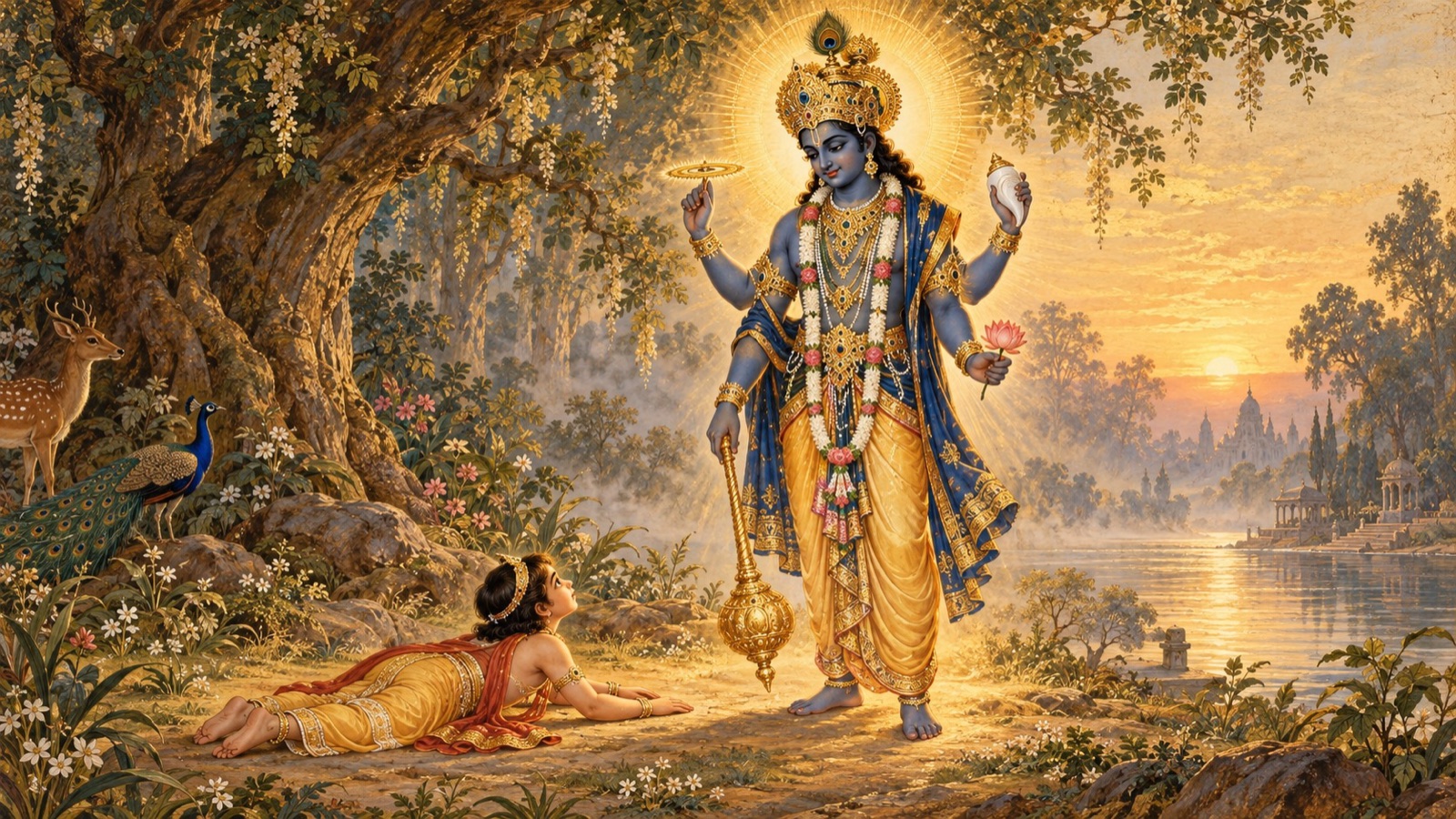
The austerity of the child devotee bears its fruit: the Supreme Lord, whom Dhruva had held within his heart, now stands before his very eyes, and the little boy falls to the earth in wonder and love.
Om Namo Bhagavate Vasudevaya.
Om Namo Bhagavate Vasudevaya.
Om Namo Bhagavate Vasudevaya.
Welcome to Srimad Bhagavatam Wisdom, a devotional journey through the sacred histories and teachings of the Srimad Bhagavat Mahapurana. In the previous chapter the child Dhruva, wounded by an unkind word and lifted by his mother’s counsel, left the palace for the forest, received the sacred twelve-syllable mantra from the sage Narada, and gave himself to an austerity so intense that the very worlds were stirred. This ninth chapter is the reward of that seeking. The Lord whom the little boy had held within his heart now appears before his eyes; He touches the child’s cheek with His conch and loosens his tongue for praise; and, moved by Dhruva’s heartfelt hymn, He grants him a boon greater than any throne — an imperishable, ever-shining abode above the seven sages, from which none returns. Then Dhruva goes home, to be received with joy and repentance by the father who had once turned away, and in time to be crowned king. It is the chapter where a bruised child’s love is answered by the mercy of God.
Chapter Information
- Scripture: Śrīmad Bhāgavata Mahāpurāṇa
- Canto: 4 (Book Four)
- Chapter: 9 (Discourse 9)
- Chapter title: Dhruva Returns Home with a Boon from the Lord
- Principal speaker: The sage Maitreya, continuing his discourse to Vidura (with the words of Dhruva and the Lord quoted within)
- Principal listener: Vidura
- Main setting: The forest of Madhuvana on the bank of the Yamuna, and the capital of King Uttanapada
- Central subject: The Lord’s appearance to Dhruva, Dhruva’s hymn, the granting of the imperishable abode, and his joyful homecoming
- Principal verse range: Canto 4, Chapter 9, verses 1–67
- Primary edition: Gita Press Śrīmad Bhāgavata Mahāpurāṇa
Context from the Previous Chapter
Chapter 8 left the child Dhruva deep in the forest of Madhuvana, absorbed in a penance so complete that the breathing of the universe seemed to falter and the demigods took fright. The Supreme Lord reassured them that the disturbance was caused by no enemy, but by a little boy wholly given over to Him, and promised to go to His young devotee. This ninth chapter opens at that very moment — with the Lord’s coming.
The Vision Fades and the Lord Appears
As Dhruva meditated with a matured and concentrated mind, the radiant form of the Lord — brilliant as lightning — shone within the lotus of his heart. Then, all at once, that inner vision vanished. Startled, the boy opened his eyes — and there before him stood the very same form he had been beholding within.
स वै धिया योगविपाकतीव्रया हृत्पद्मकोशे स्फुरितं तडित्प्रभम् । तिरोहितं सहसैवोपलक्ष्य बहि:स्थितं तदवस्थं ददर्श ॥ २ ॥
sa vai dhiyā yoga-vipāka-tīvrayā hṛt-padma-kośe sphuritaṁ taḍit-prabham tirohitaṁ sahasaivopalakṣya bahiḥ-sthitaṁ tad-avasthaṁ dadarśa
Meaning: As the form of the Lord, bright as lightning, that had shone in the lotus of his heart through his intense meditation suddenly vanished, Dhruva opened his eyes and saw that very same form now standing outside, before him. (Canto 4, Chapter 9, verse 2)
Overwhelmed, the boy fell to the ground like a rod, offering his obeisance, and gazed upon the Lord as though drinking Him in with his eyes, kissing Him with his mind, embracing Him with his arms.
The Touch of the Conch
Dhruva longed to offer fitting praise, but he was only a child and did not know how to begin. The Lord, seated in the heart of every being, understood the boy’s wish, and out of pure mercy touched His conch to the child’s cheek.
स तं विवक्षन्तमतद्विदं हरि- र्ज्ञात्वास्य सर्वस्य च हृद्यवस्थित: । कृताञ्जलिं ब्रह्ममयेन कम्बुना पस्पर्श बालं कृपया कपोले ॥ ४ ॥
sa taṁ vivakṣantam atad-vidaṁ harir jñātvāsya sarvasya ca hṛdy avasthitaḥ kṛtāñjaliṁ brahmamayena kambunā pasparśa bālaṁ kṛpayā kapole
Meaning: Knowing that the boy, standing with folded hands, wished to praise Him but did not know how, Sri Hari — who dwells in the heart of all — mercifully touched the child’s cheek with His sacred conch. (Canto 4, Chapter 9, verse 4)
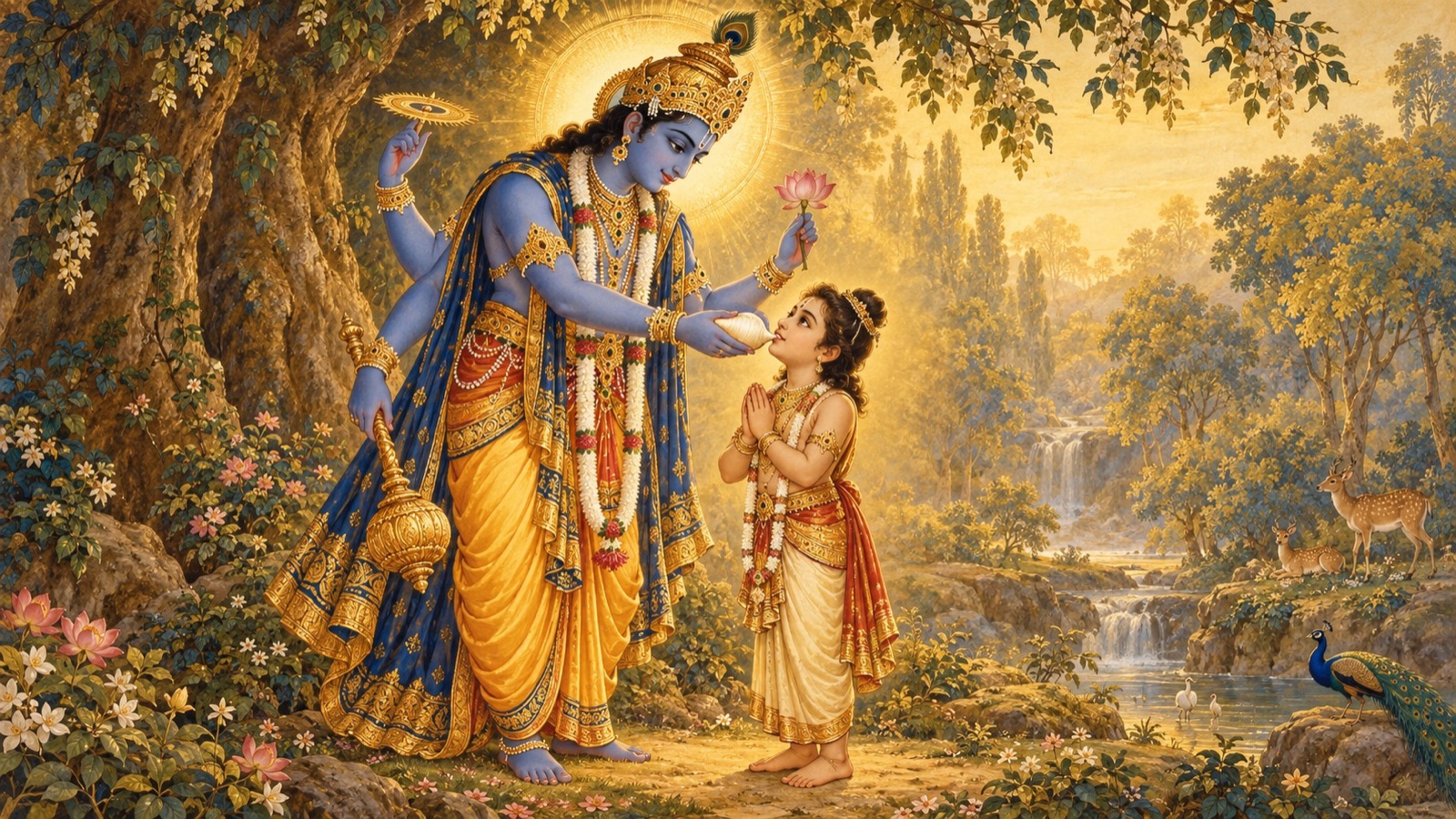
At that sacred touch, transcendental knowledge and eloquence awoke in the boy, and he offered a hymn of remarkable depth. He praised the Lord as the one Supreme Being who, through His own inconceivable energy called Maya, creates the whole universe, enters within it as the indwelling Self, and yet shines undivided through all its varied forms — as a single fire blazes differently through logs of different shapes.
एकस्त्वमेव भगवन्निदमात्मशक्त्या मायाख्ययोरुगुणया महदाद्यशेषम् । सृष्ट्वानुविश्य पुरुषस्तदसद्गुणेषु नानेव दारुषु विभावसुवद्विभासि ॥ ७ ॥
ekas tvam eva bhagavann idam ātma-śaktyā māyākhyayoru-guṇayā mahad-ādy-aśeṣam sṛṣṭvānuviśya puruṣas tad-asad-guṇeṣu nāneva dāruṣu vibhāvasuvad vibhāsi
Meaning: You alone, O Lord, by Your own potency called Maya, create this entire universe from the cosmic principles, and entering within it as the Supreme Person, You shine variously through its qualities — as one fire glows in many shapes through different pieces of wood. (Canto 4, Chapter 9, verse 7)
Dhruva went on to confess that he had come at first seeking only a station higher than his forefathers’, but having now beheld the Lord himself, he no longer cared for any such thing; the vision of the Lord was sweeter than all the boons of heaven, and he prayed only for the company of the Lord’s devotees, in whose midst the ocean of the world is easily crossed.
The Imperishable Boon
The Lord was pleased with the boy’s pure and unselfish praise. He said that He already knew the desire hidden in Dhruva’s heart, and though it was hard to attain, He would grant it.
श्रीभगवानुवाच वेदाहं ते व्यवसितं हृदि राजन्यबालक । तत्प्रयच्छामि भद्रं ते दुरापमपि सुव्रत ॥ १९ ॥
śrī-bhagavān uvāca vedāhaṁ te vyavasitaṁ hṛdi rājanya-bālaka tat prayacchāmi bhadraṁ te durāpam api suvrata
Meaning: The Lord said: O prince, O boy of firm vows, I know the resolve within your heart; though it is hard to attain, I grant it to you. Blessings be upon you. (Canto 4, Chapter 9, verse 19)
The Lord then unfolded the whole glory that awaited him. Dhruva would receive a radiant, self-luminous seat — the polar station around which the stars, planets, and even the great sages ceaselessly revolve, a fixed point above them all. He would rule the earth for many thousands of years with unimpaired vigour; he would perform great sacrifices and charities, enjoy every rightful blessing, and at the end remember the Lord. The Lord also spoke a sobering word about the years ahead: in time Dhruva’s brother Uttama would lose his life while hunting in the forest, and their stepmother Suruci, maddened with grief in her search for him, would perish in a forest fire — the cost, it is said, of the insult she had once offered a devotee of the Lord (verse 23). And then he would go to that supreme abode, honoured by all the worlds, set above the seven sages — the place from which no one ever returns.
ततो गन्तासि मत्स्थानं सर्वलोकनमस्कृतम् । उपरिष्टादृषिभ्यस्त्वं यतो नावर्तते गत: ॥ २५ ॥
tato gantāsi mat-sthānaṁ sarva-loka-namaskṛtam upariṣṭād ṛṣibhyas tvaṁ yato nāvartate gataḥ
Meaning: Then you shall go to My abode, revered by all the worlds and set above the seven sages; having reached it, you will never again return to this world. (Canto 4, Chapter 9, verse 25)
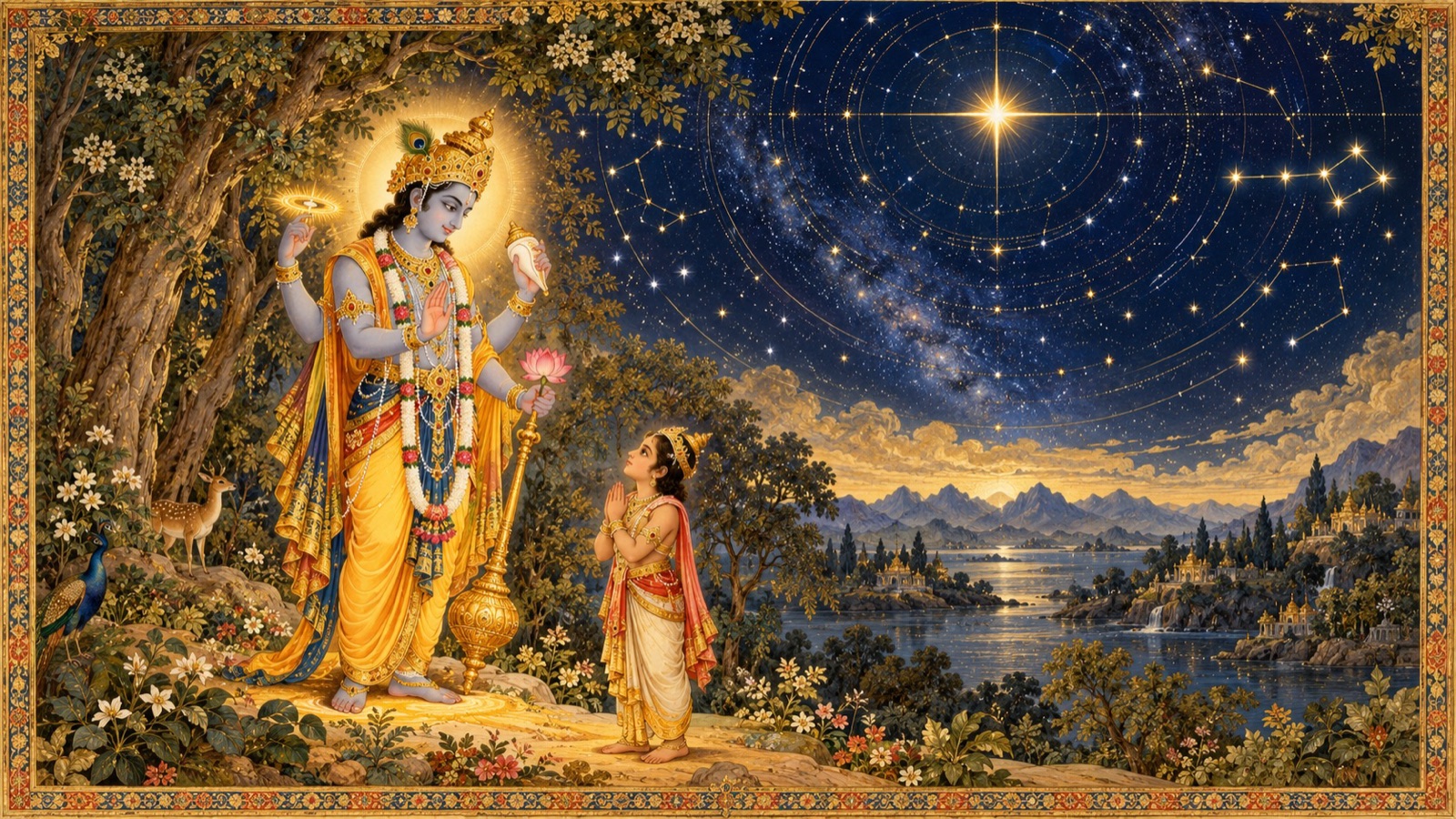
Having granted this, the Lord, worshipped by Dhruva, departed for His own abode as the boy watched. Yet Dhruva was not wholly glad.
When Dhruva reached home, Vidura, hearing this part of the story from Maitreya, asked how a boy who had won so exalted a goal in a single lifetime could return anything but overjoyed. Maitreya’s reply became Dhruva’s own confession: reflecting on his prayer, Dhruva grieved that he had stood before the very Lord who alone can cut the knot of birth and death, and yet, still smarting from his stepmother’s old insult, had begged only for a kingdom that must one day perish (verses 27-34).
स्वाराज्यं यच्छतो मौढ्यान्मानो मे भिक्षितो बत । ईश्वरात्क्षीणपुण्येन फलीकारानिवाधन: ॥ ३५ ॥
svārājyaṁ yacchato mauḍhyān māno me bhikṣito bata īśvarāt kṣīṇa-puṇyena phalī-kārān ivādhanaḥ
Meaning: Out of pure foolishness, when the Lord — Himself the very fullness of self-mastery — stood ready to grant me devotion at His own feet, I begged instead for worldly rank and renown; I was like a pauper who, given leave to ask a mighty king for anything at all, asked only for a few scraps of husk. (Canto 4, Chapter 9, verse 35)
Maitreya drew the lesson plainly for Vidura: a devotee who is truly surrendered asks the Lord for nothing at all, content simply to serve Him; whatever else the Lord bestows is pure grace, never the price or the measure of devotion (verse 36).
The Joyful Homecoming
Dhruva returned to his father’s city. King Uttanapada, who had heard from Narada that his lost son was protected and glorious, went out to meet him with a heart full of joy and repentance. Overcome, he lifted the boy, embraced him again and again, and bathed him with tears, at last receiving the child he had once let go. His mother Suniti, too, held to her heart the son whose exile had cost her so many tears. Dhruva and his younger brother Uttama were seated upon a she-elephant, and the king, praised by all his people, entered the capital in festival.
लाल्यमानं जनैरेवं ध्रुवं सभ्रातरं नृप: । आरोप्य करिणीं हृष्ट: स्तूयमानोऽविशत्पुरम् ॥ ५३ ॥
lālyamānaṁ janair evaṁ dhruvaṁ sabhrātaraṁ nṛpaḥ āropya kariṇīṁ hṛṣṭaḥ stūyamāno ’viśat puram
Meaning: As the people fondly welcomed Dhruva, the delighted king seated him and his brother upon a she-elephant, and, extolled on all sides, entered his capital. (Canto 4, Chapter 9, verse 53)
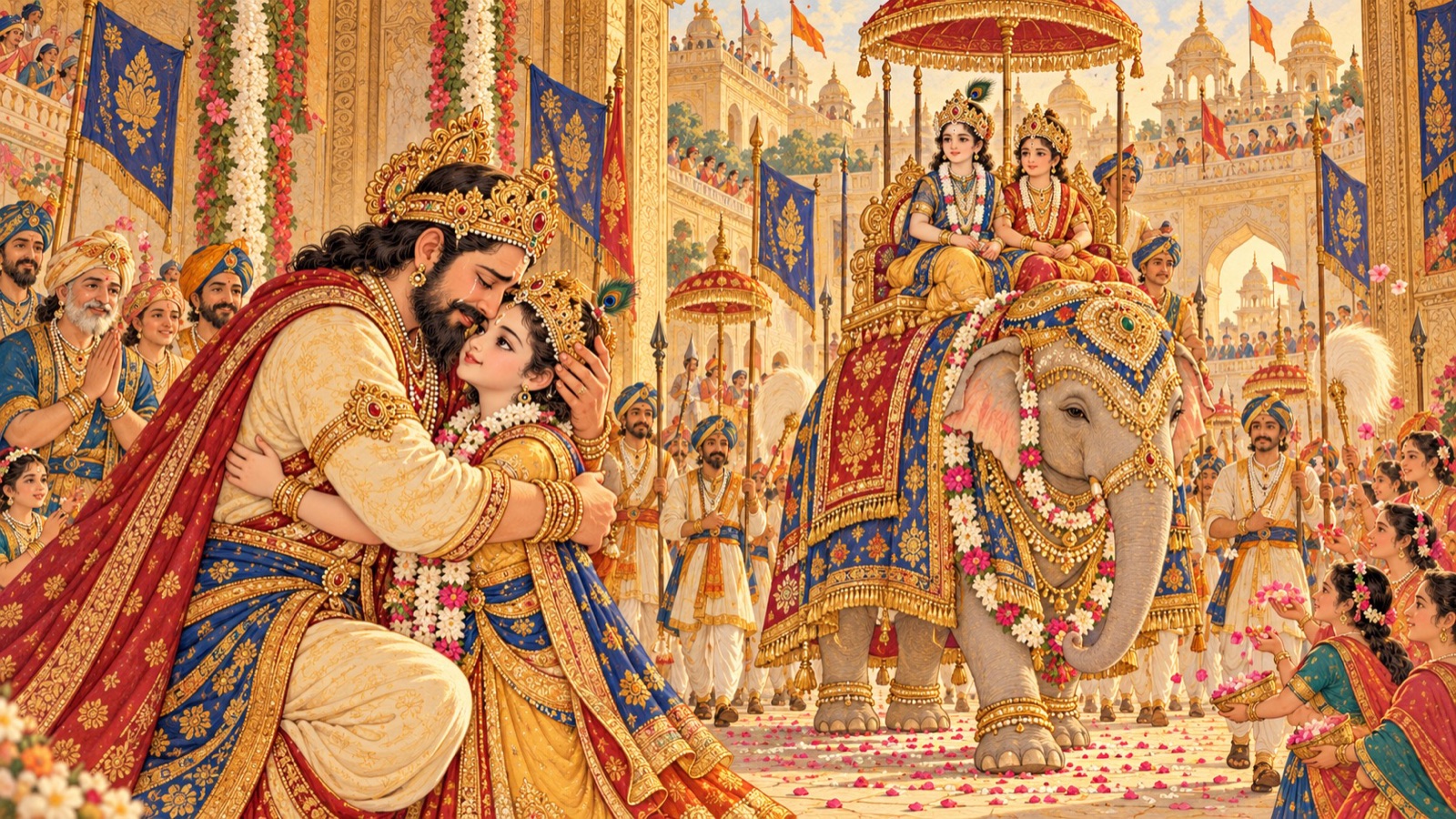
In the fullness of time, considering his advancing years and turning his mind to the welfare of his soul, King Uttanapada installed the worthy Dhruva upon the throne and withdrew to the forest to seek the goal of the spirit.
आत्मानं च प्रवयसमाकलय्य विशाम्पति: । वनं विरक्त: प्रातिष्ठद्विमृशन्नात्मनो गतिम् ॥ ६७ ॥
ātmānaṁ ca pravayasam ākalayya viśāmpatiḥ vanaṁ viraktaḥ prātiṣṭhad vimṛśann ātmano gatim
Meaning: Considering his advanced age, King Uttanapada grew detached, and reflecting on the goal of the soul, he departed for the forest. (Canto 4, Chapter 9, verse 67)
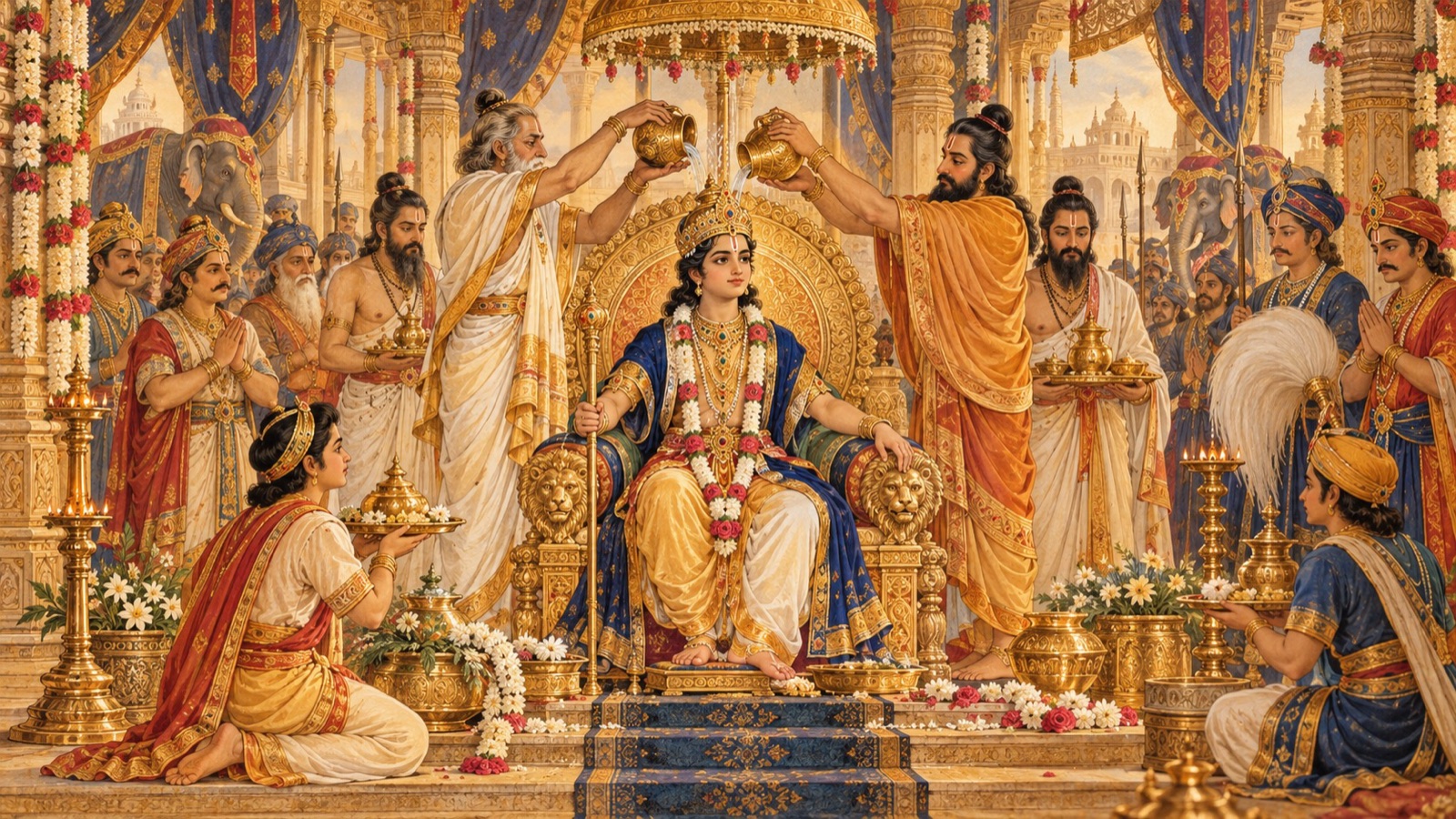
So the chapter closes with the child who was once denied his father’s lap now honoured by his father, his mother, his people, and the Lord himself — an outcast turned into a king, and a king destined for an imperishable throne in the sky.
Principal Teachings of This Chapter
1. The Lord comes to the heart that truly seeks Him. The form Dhruva held within his heart stepped out to stand before his eyes. When devotion is whole, the inner vision becomes a living presence (verse 2).
2. Grace supplies what we lack. The boy did not know how to praise, so the Lord himself touched his cheek and gave him the words. What we cannot do for ourselves, the Lord’s mercy accomplishes in us (verse 4).
3. To see God is to outgrow lesser wishes. Dhruva came for a throne higher than his forefathers’; having seen the Lord, he no longer wanted it, and asked only for the company of devotees. The vision of God reorders every desire (verses 7-11).
4. The Lord grants even what is hard to attain. Dhruva received a seat above the seven sages, imperishable and self-luminous — a boon beyond any earthly reward, given freely to a child’s pure love (verses 19-25).
5. Love answered heals old wounds. The father who turned Dhruva away now embraces him with tears; exile ends in honour. Devotion to the Lord mends the very bonds that pride once broke (verses 42-53).
A Devotional Reflection
The most touching turn in this chapter is not the granting of the imperishable throne, astonishing as that is. It is the small, tender confession Dhruva made afterward — his own admission that a boy who had just won an imperishable throne could still feel he had asked too little, and aimed too low, when the Lord of all the worlds stood before him. He had walked into the forest carrying a child’s wounded ambition — to be higher than those who had slighted him — and he walked out having forgotten it entirely, because he had found something incomparably greater. This is the quiet alchemy of true devotion: it does not so much fulfil our smaller desires as dissolve them in the light of a larger love. We often come to God, as Dhruva did, with a bundle of hurts and wants clutched in our hands. The mercy of the Lord is that He receives us just so — touches our cheek, loosens our tongue, and then gives us Himself, until the very things we came asking for grow small and fall away. The boon that mattered most to Dhruva in the end was simply that he had been allowed to see.
A Daily Devotional Practice
Today, let your prayer follow Dhruva’s from wanting to beholding. Sit quietly, chant “Om Namo Bhagavate Vasudevaya,” and bring to the Lord, honestly, whatever you have been asking Him for — a need, a worry, a longing. Name it before Him without shame, as Dhruva named his. Then, having offered it, let it rest, and ask instead only for the grace to remember Him and to keep the company of those who love Him. As you close, recall that the Lord who touched a child’s cheek in the forest is seated no less near to your own heart, ready to supply the words you cannot find and the love you cannot muster on your own.
Conclusion
The ninth discourse of Book Four is the reward of Dhruva’s seeking. As the boy meditated, the radiant form within his heart suddenly vanished, and he opened his eyes to find the Lord standing before him. Unable to frame his praise, he was helped by the Lord’s own mercy — a touch of the conch upon his cheek — and poured out an inspired hymn, confessing that the vision of God had made every lesser wish grow small. Pleased, the Lord granted him a boon hard to attain: an imperishable, self-luminous abode above the seven sages, a long and glorious reign, and a place from which none returns. Dhruva returned home to a father overcome with joy and repentance, was welcomed by his mother and people, and in time was enthroned as king while Uttanapada withdrew to the forest. So the once-slighted child is honoured by all, his wounded ambition transformed into the pure love that beholds the Lord.
May the divine wisdom of Srimad Bhagavatam awaken pure devotion within our hearts.
Om Namo Bhagavate Vasudevaya.
Jay Shree Madhav.
References and Attribution
- Primary edition: Gita Press, Śrīmad Bhāgavata Mahāpurāṇa (English, complete), Book Four, Discourse 9.
- Series: Srimad Bhagavatam Wisdom · Biswa Sanatan Dharma Seva Trust.
- Presented following the spiritual guidance and recommendation of Pandit Dr. Shri Kashinath Mishra.
This is an original, faithful retelling in the writer’s own words, with brief quoted verses shown in Devanāgarī and transliteration and their meanings given as summaries. It is not a reproduction of any single publisher’s continuous translation or commentary. No affiliation with or endorsement by any publisher is implied.
Jay Shree Madhav