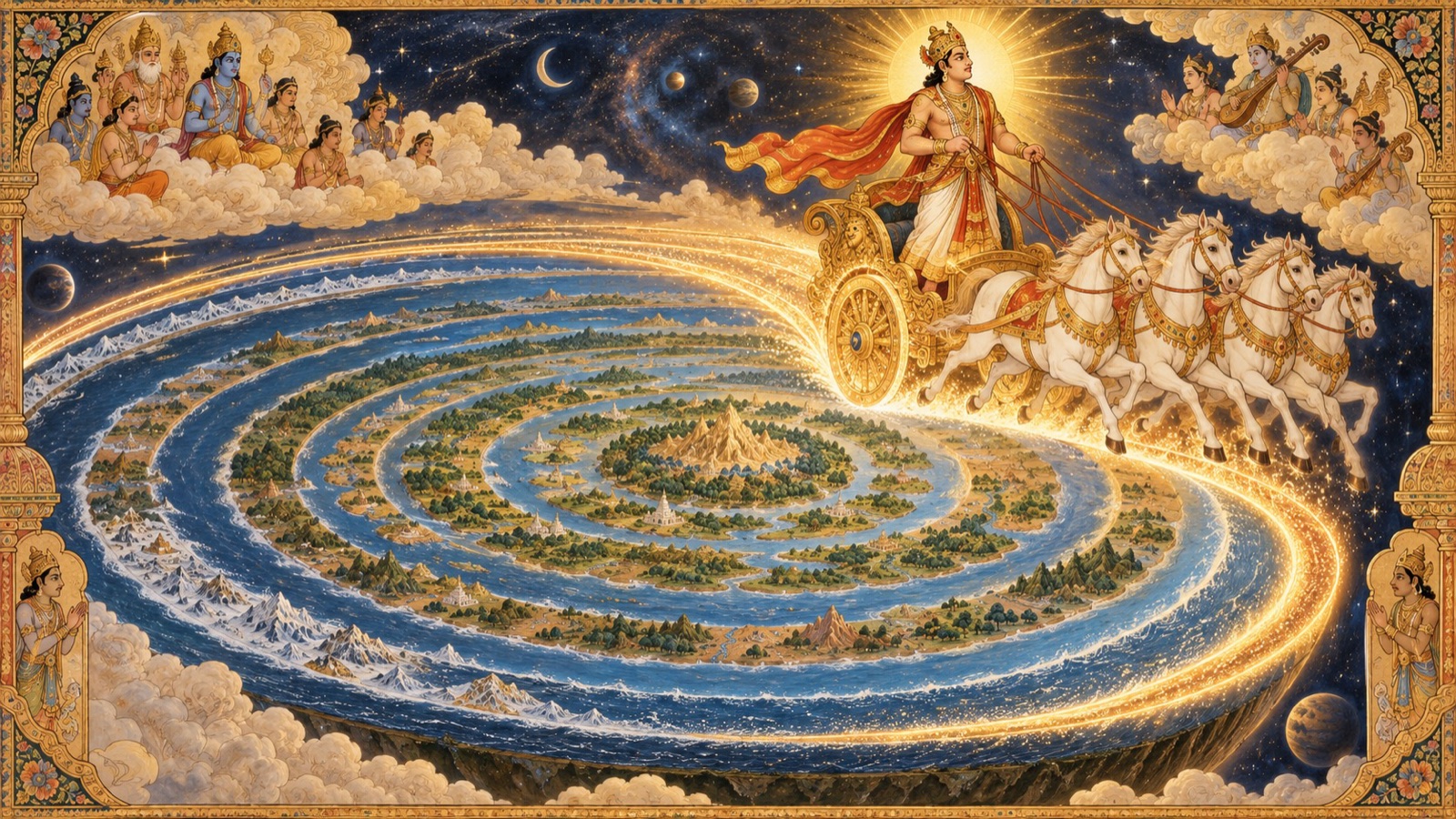
Blazing like a second sun, King Priyavrata drives his chariot around the earth to turn night into day — and the tracks sunk by his wheels become the seven great oceans, dividing the world into its seven islands.
Om Namo Bhagavate Vasudevaya.
Om Namo Bhagavate Vasudevaya.
Om Namo Bhagavate Vasudevaya.
Welcome to Srimad Bhagavatam Wisdom, a devotional journey through the sacred histories and teachings of the Srimad Bhagavat Mahapurana. With this chapter we step across another threshold: the Fourth Canto has closed, and the Fifth Canto begins. Where the earlier Cantos have unfolded the Lord’s creation, His descents, and the lineages of His devotees, the Fifth Canto now turns to the great kings of the earth — and, through them, to the very shape of the created world itself. It opens with the towering figure of Priyavrata, the elder son of Swayambhuva Manu: a soul so absorbed in the Self that he wished only to renounce the world, yet who was called by the Creator himself to rule it. This first chapter tells how a perfected devotee took up a kingdom without ever becoming bound by it, how his blazing chariot carved the seven oceans, how he divided the earth among his sons, and how at last he laid the whole empire down like a corpse and walked back into the freedom he had never truly left.
Chapter Information
- Scripture: Śrīmad Bhāgavata Mahāpurāṇa
- Canto: 5 (Book Five)
- Chapter: 1 (Discourse 1)
- Chapter title: The Story of King Priyavrata
- Principal speaker: Sukadeva Gosvami, narrating to King Parikshit
- Principal listener: King Parikshit — the whole discourse related in turn by Suta Gosvami to the sage Saunaka and the assembly of sages gathered at Naimisaranya
- Main setting: The court of Swayambhuva Manu and the valley of Mount Gandhamadana, where Brahma descends; and, at cosmic scale, the whole of the earthly sphere (Bhu-mandala) circled by Priyavrata’s chariot
- Central subject: How the self-realized prince Priyavrata accepted the burden of ruling the earth at the command of Brahma, governed it without attachment for many ages, shaped its seven oceans and seven islands, and finally renounced all to resume the path of devotion
- Principal verse range: Canto 5, Chapter 1, verses 1–41
- Primary edition: Gita Press Śrīmad Bhāgavata Mahāpurāṇa
A King’s Honest Doubt
The Fifth Canto opens not with a narration but with a question — and a very human one. King Parikshit, listening at the feet of Sukadeva, is troubled. He has heard that Priyavrata was a bhagavata, a great devotee, and atmarama, one who takes his pleasure entirely within the Self. How, then, the king asks, could such a soul have remained in household life at all? For family life, Parikshit reasons, is the very root of the bondage of karma and the great obscurer of one’s true nature. It does not seem fitting that a man free from attachment should tie himself to home, wife, and children in that way. This is the doubt the whole chapter is written to answer.
राजोवाच प्रियव्रतो भागवत आत्माराम: कथं मुने । गृहेऽरमत यन्मूल: कर्मबन्ध: पराभव: ॥ १ ॥
rājovāca priyavrato bhāgavata ātmārāmaḥ kathaṁ mune gṛhe ’ramata yan-mūlaḥ karma-bandhaḥ parābhavaḥ
Meaning: The king said: O sage, Priyavrata was a great devotee of the Lord who took his delight in the Self. How, then, did he rejoice in household life, which is the very root of the bondage of action and the ruin of one’s higher purpose? (Canto 5, Chapter 1, verse 1)
Sukadeva’s reply is gentle and precise. What Parikshit says is quite right, he agrees — and yet those whose minds are already immersed in the honey of the Lord’s lotus feet do not, in fact, abandon the blessed habit of hearing His glories, even when some obstacle temporarily stands in the way. In other words, outward circumstances do not decide a devotee’s inner freedom.
श्रीशुक उवाच बाढमुक्तं भगवत उत्तमश्लोकस्य श्रीमच्चरणारविन्दमकरन्दरस आवेशितचेतसो भागवतपरमहंस दयितकथां किञ्चिदन्तरायविहतां स्वां शिवतमां पदवीं न प्रायेण हिन्वन्ति ॥ ५ ॥
śrī-śuka uvāca bāḍham uktaṁ bhagavata uttamaślokasya śrīmac-caraṇāravinda-makaranda-rasa āveśita-cetaso bhāgavata-paramahaṁsa-dayita-kathāṁ kiñcid antarāya-vihatāṁ svāṁ śivatamāṁ padavīṁ na prāyeṇa hinvanti
Meaning: Sri Sukadeva Gosvami said: What you have said is correct. And yet, hearts steeped in the nectar pooling at the feet of the Lord, who is praised in the choicest verses, and given over to the tales so cherished by devotees and liberated souls, do not, as a rule, relinquish that most auspicious path merely because some hindrance crosses it for a while. (Canto 5, Chapter 1, verse 5)
There is a deeper reason this answer meets the King’s doubt so completely. The very “hindrance” Sukadeva names — the household life that seemed to swallow Priyavrata’s contemplative vow — turns out, as the chapter unfolds, to be no hindrance at all but the Lord’s own arrangement working through it. Brahma will shortly tell Priyavrata that no one, from Brahma himself down to the smallest creature, can act apart from what the Supreme Lord has ordained (verses 11–13); the very household duty that seemed to threaten Priyavrata’s devotion was itself allotted to him by that same ordinance. This is the chapter’s deepest teaching: an obstacle the Lord Himself places on a devotee’s path is never a fall from grace but a further unfolding of it, and a soul once fixed at those lotus feet cannot be dislodged by anything the Lord chooses to send it — not even a throne (verses 5, 11–13).
Priyavrata, Sukadeva explains, had learned the highest truth easily through his devotion to the feet of the sage Narada, and was preparing to take up a lifelong vow of contemplation on the Spirit, when his father, Swayambhuva Manu, called upon him to rule the earth. Priyavrata did not welcome the command. He feared that taking up government would draw his self back into contact with the non-self — even though the non-self, he well knew, has no ultimate reality.
Brahma Descends to Settle the Matter
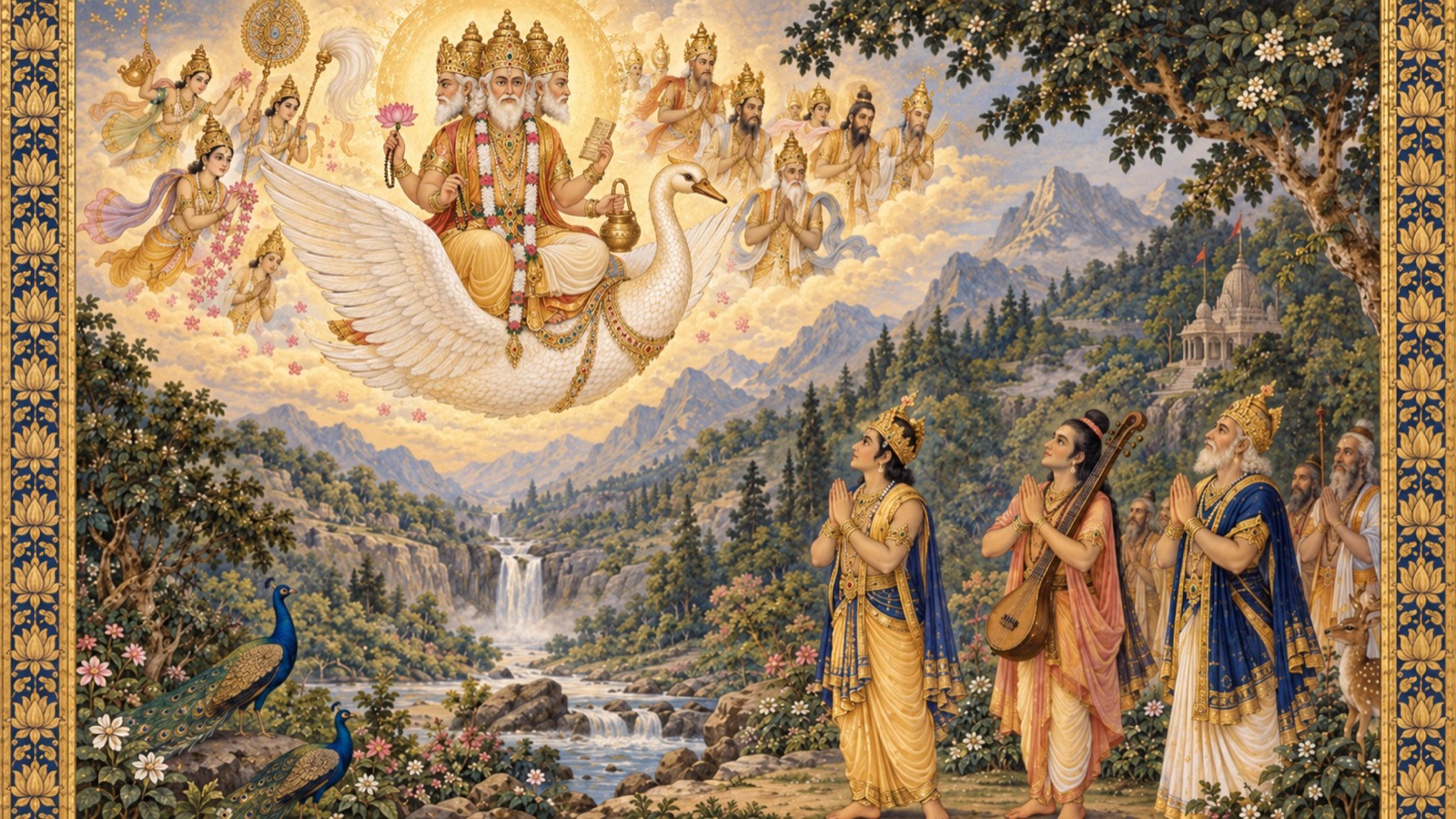
Into this quiet crisis of duty the Creator himself arrives. Brahma, the self-born, first among the gods, ever occupied with the ordering of the worlds, comes down from his own abode surrounded by the four Vedas in visible form and attended by his retinue of sages. Shining like the moon, worshipped along his path through the heavens by gods riding their aerial cars and glorified by troops of Siddhas, Gandharvas, Sadhyas, Caranas, and sages, he descends into the valley of Mount Gandhamadana and approaches the prince. Recognizing his father Brahma by his swan-mount, Narada rises at once, and together with Manu and Priyavrata worships him with joined palms.
The Counsel of Brahma
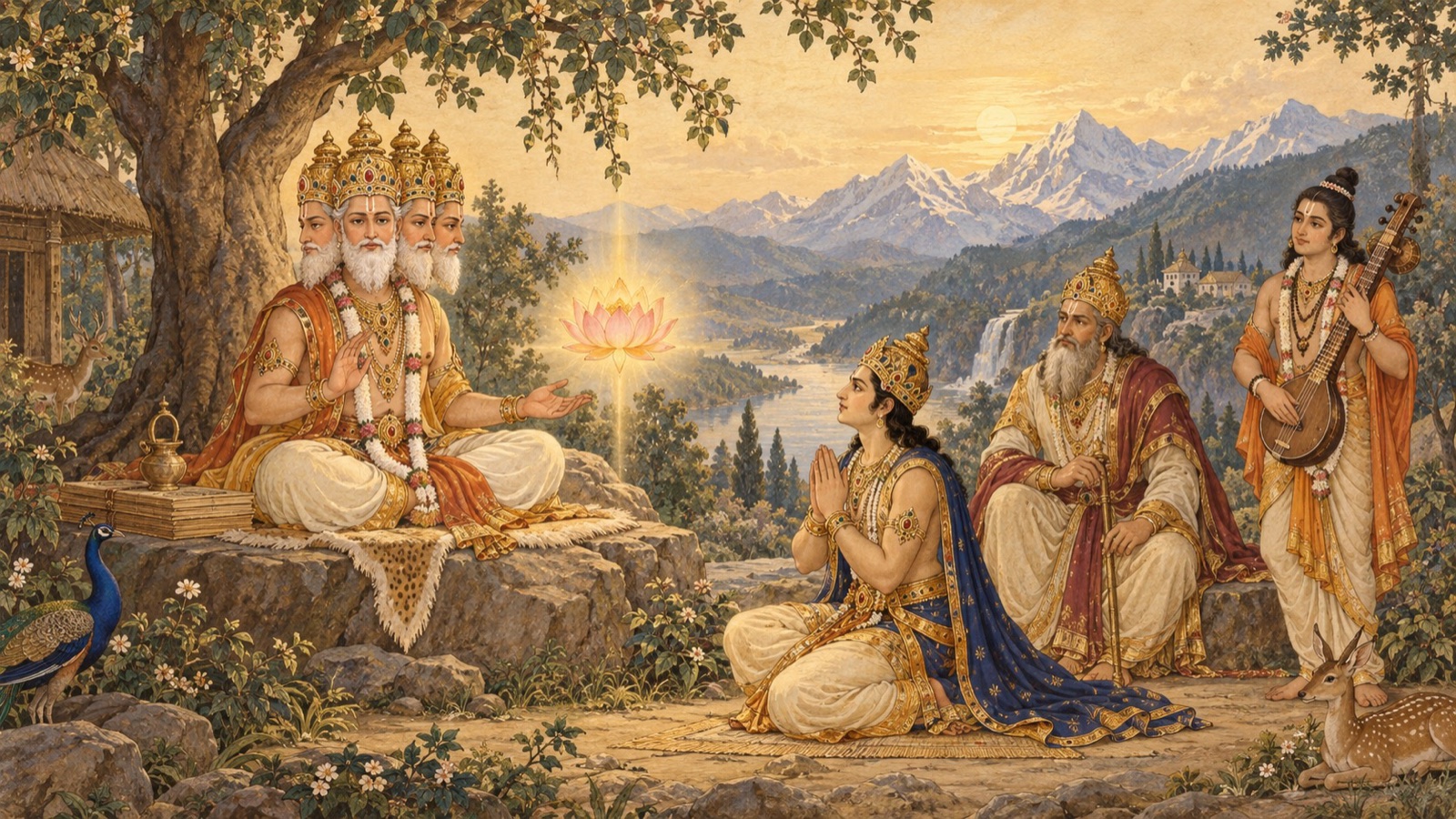
Then Brahma speaks — and his words are among the most important teachings of the chapter. He tells Priyavrata plainly: do not find fault with the Lord, whose command all of us obey without exception, from Brahma himself and Lord Shiva down to Manu and even the great sage Narada. No embodied being, he says, can undo what the Lord has ordained — not by penance, not by learning, not by yogic power, wealth, or merit, whether alone or with another’s help. Living beings are bound to their bodies by the Lord for the sake of experience — birth and death, grief and delusion, joy and sorrow — and for the doing of work. Fastened by the cords of the three gunas to the great rope of divine ordinance, we all bear our appointed loads, Brahma says, like oxen led by a string through the nose.
But then comes the heart of the counsel, and it directly answers Parikshit’s opening doubt. A liberated soul, Brahma explains, may go on carrying out his destined role in the world without ever identifying with the body — just as a person newly awakened still remembers a dream without being caught in it. The real danger is not the home but the unconquered senses: a man who has not subdued the six inner enemies carries them with him even from forest to forest, while a man who has subdued them and delights in the Self takes no harm from home at all. Best of all, Brahma tells him, is to conquer those enemies first from within the stronghold of home, taking shelter at the lotus feet of the Lord whose own navel bears a lotus. Enjoy, then, the blessings the Supreme Person has appointed for you, and afterward, wholly free of attachment, rest in the Self.
त्वं त्वब्जनाभाङ्घ्रिसरोजकोश- दुर्गाश्रितो निर्जितषट्सपत्न: । भुङ्क्ष्वेह भोगान् पुरुषातिदिष्टान् विमुक्तसङ्ग: प्रकृतिं भजस्व ॥ १९ ॥
tvaṁ tv abja-nābhāṅghri-saroja-kośa- durgāśrito nirjita-ṣaṭ-sapatnaḥ bhuṅkṣveha bhogān puruṣātidiṣṭān vimukta-saṅgaḥ prakṛtiṁ bhajasva
Meaning: Taking shelter within the fortress of the lotus feet of the Lord, whose navel is the seat of a lotus, you have already conquered the six enemies. Therefore enjoy on this earth the blessings appointed for you by the Supreme Person, and, wholly freed from attachment, remain established in the Self. (Canto 5, Chapter 1, verse 19)
Priyavrata Accepts the Throne
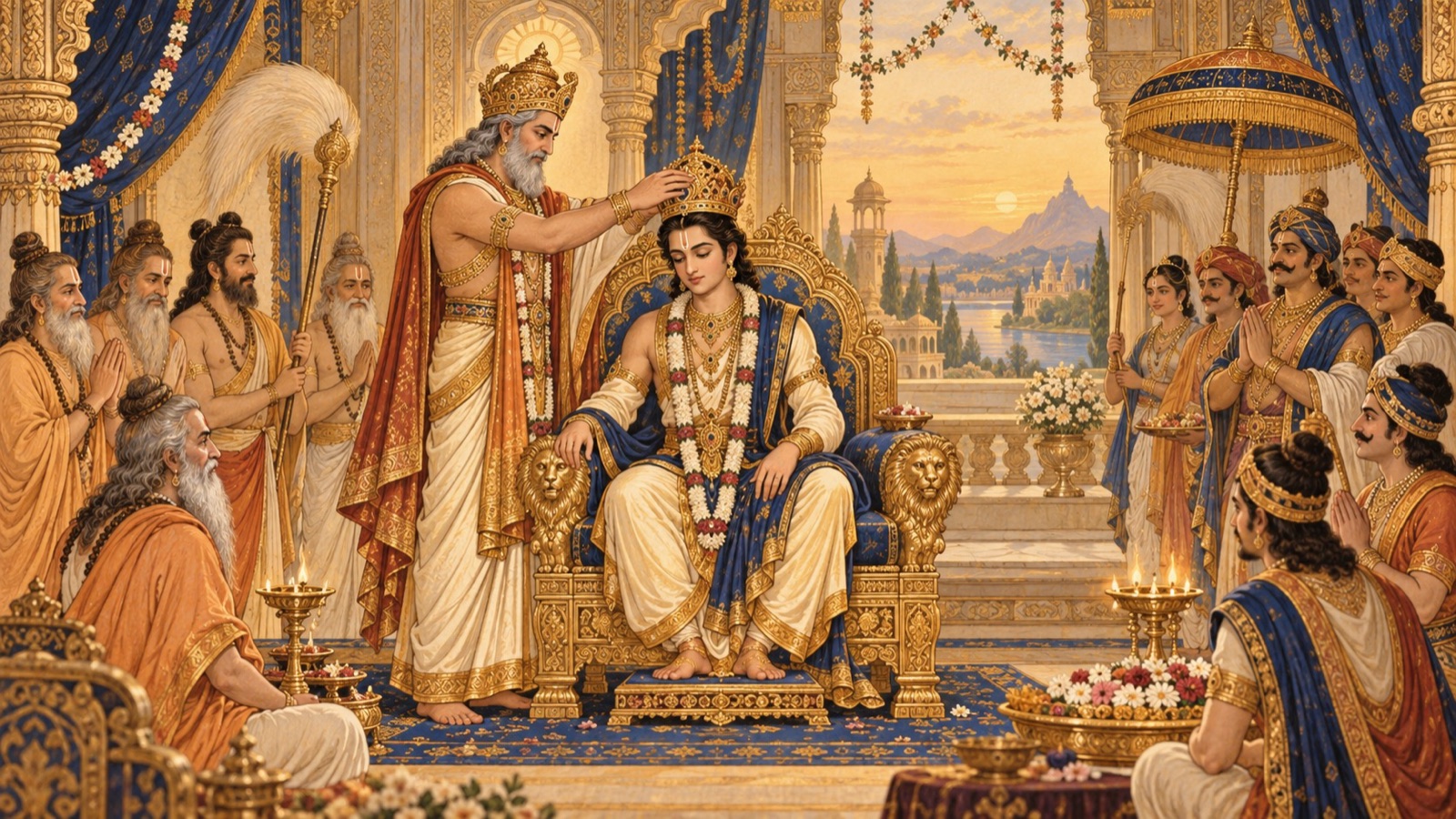
Thus instructed, Priyavrata bows his head low as a token of humility and accepts Brahma’s command with the simple words, “Very well.” Honoured by Manu, Brahma then returns to his own abode, contemplating the supreme Reality that lies beyond speech and mind, while Priyavrata and Narada gaze after him with serene hearts. Manu, his own wish now fulfilled — to hand the kingdom to his son and retire to the woods for worship — installs Priyavrata as ruler of the earth and gives up forever the desire for household enjoyment, which the text likens to a fearful lake full of poisonous water. Made utterly pure by his constant meditation on the feet of the most ancient Person, the emperor rules the world, the sage tells us, chiefly to honour the command of the exalted.
Priyavrata then marries Barhismati, daughter of Vishvakarma, the architect of the gods, and through her begets ten sons — each as great as their father in character, virtue, beauty, and prowess — along with a daughter, Urjasvati, the youngest of all. The ten sons all bear the names of aspects of the fire-god: Agnidhra, Idhmajihva, Yajnabahu, Mahavira, Hiranyareta, Ghritaprishtha, Savana, Medhatithi, Vitihotra, and Kavi. Three of them — Kavi, Mahavira, and Savana — became lifelong celibates, taking up the study of Self-knowledge from infancy and eventually entering the order of recluses, attaining through unbroken devotion to Bhagavan Vasudeva the highest realization within the heart. By another wife, Priyavrata also had three sons — Uttama, Tamasa, and Raivata — each of whom later presided over an age of Manu.
The Chariot That Carved the Oceans
For an almost unimaginable span — the text gives it as eleven arbudas of years (1,10,00,00,000; an arbuda is ten crore) — Priyavrata ruled the earth, so strong that the very twang of his bowstring scattered the enemies of righteousness. Yet one thing displeased him. He observed that as the sun circles Mount Sumeru, it lights only one half of the earth at a time, leaving the other half shrouded in night. This he would not accept. His superhuman power heightened by his worship of the Lord, Priyavrata mounted a chariot as brilliant and swift as the sun itself and, like a second sun, made seven circuits of the earth behind the first, determined to turn night as well into day.
The deep tracks sunk by the fellies of his chariot’s wheels became the seven great oceans, and the lands they enclosed became the seven islands, or dwipas, of the world.
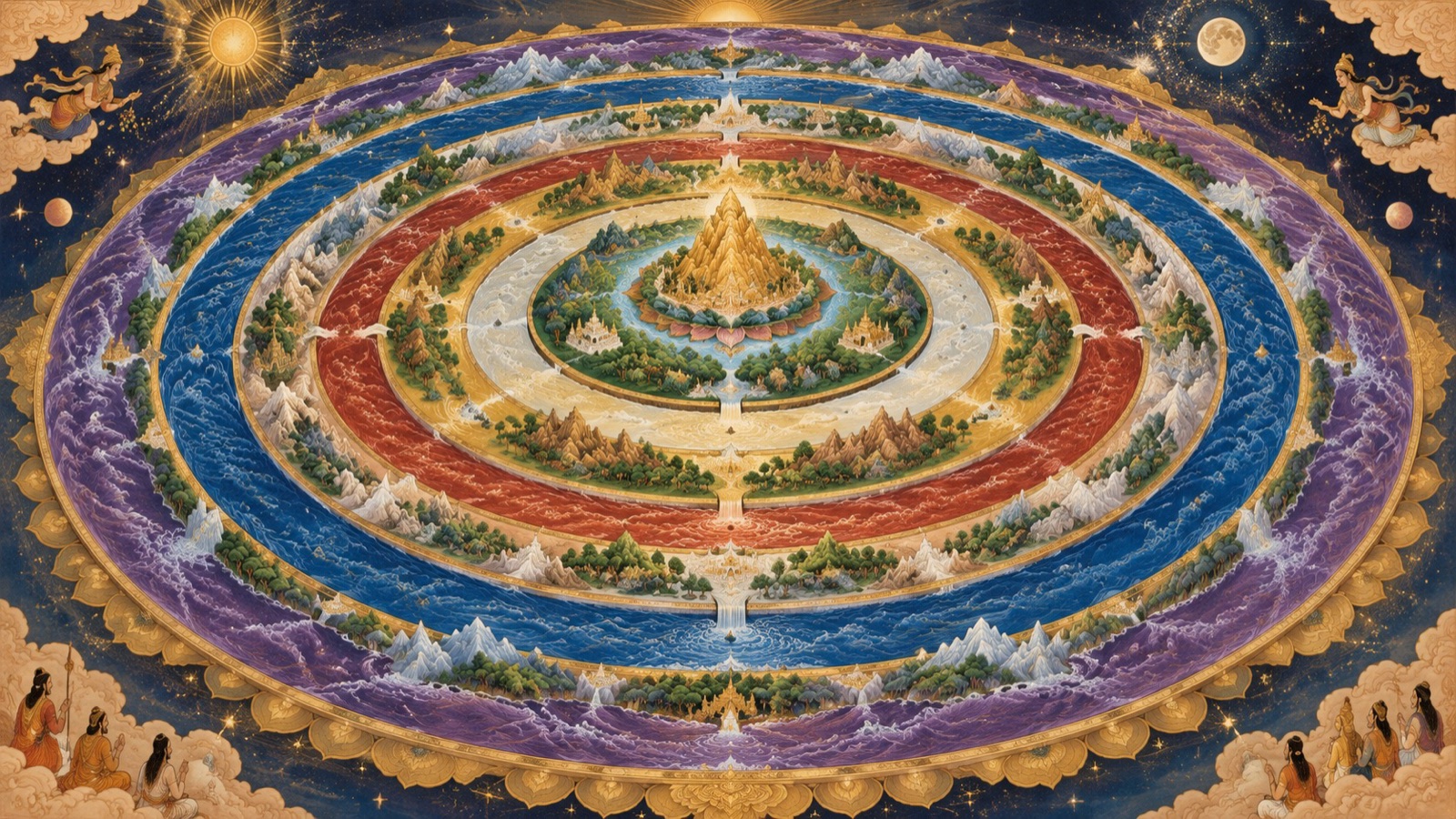
ये वा उ ह तद्रथचरणनेमिकृतपरिखातास्ते सप्त सिन्धव आसन् यत एव कृता: सप्त भुवो द्वीपा: ॥ ३१ ॥
ye vā u ha tad-ratha-caraṇa-nemi-kṛta-parikhātās te sapta sindhava āsan yata eva kṛtāḥ sapta bhuvo dvīpāḥ
Meaning: The furrows dug by the rims of the wheels of his chariot became the seven oceans, and by them the earth was divided into the seven islands. (Canto 5, Chapter 1, verse 31)
The seven islands are named Jambudwipa, Plakshadwipa, Salmalidwipa, Kushadwipa, Krauñchadwipa, Shakadwipa, and Pushkaradwipa, each twice as large as the one before it and each set beyond and encircling the last. The seven oceans that ring them hold, in turn, salt water, sugar-cane juice, wine, clarified butter, milk, fluid curds, and pure sweet water — each ocean serving as a moat around its island and equal to it in breadth. Priyavrata then appointed seven of his sons — Agnidhra, Idhmajihva, Yajnabahu, Hiranyareta, Ghritaprishtha, Medhatithi, and Vitihotra — each to rule one of these seven islands.
क्षारोदेक्षुरसोदसुरोदघृतोदक्षीरोददधिमण्डोदशुद्धोदा: सप्त जलधय: सप्त द्वीपपरिखा इवाभ्यन्तरद्वीपसमाना एकैकश्येन यथानुपूर्वं सप्तस्वपि बहिर्द्वीपेषु पृथक्परित उपकल्पितास्तेषु जम्ब्वादिषु बर्हिष्मतीपतिरनुव्रतानात्मजानाग्नीध्रेध्मजिह्वयज्ञबाहुहिरण्यरेतोघृतपृष्ठमेधातिथिवीतिहोत्रसंज्ञान् यथासंख्येनैकैकस्मिन्नेकमेवाधिपतिं विदधे ॥ ३३ ॥
kṣārodekṣu-rasoda-suroda-ghṛtoda-kṣīroda-dadhi-maṇḍoda-śuddhodāḥ sapta jaladhayaḥ sapta dvīpa-parikhā ivābhyantara-dvīpa-samānā ekaikaśyena yathānupūrvaṁ saptasv api bahir dvīpeṣu pṛthak parita upakalpitās teṣu jambv-ādiṣu barhiṣmatī-patir anuvratān ātmajān āgnīdhredhmajihva-yajñabāhu-hiraṇyareto-ghṛtapṛṣṭha-medhātithi-vītihotra-saṁjñān yathā-saṅkhyenaikaikasminn ekam evādhipatiṁ vidadhe
Meaning: Ringing each of the seven islands like a moat of matching width lie seven distinct waters — salty, sugarcane-sweet, wine, ghee, milk, whey of curds, and pure — one such water surrounding every island in turn, beginning with Jambudwipa. Over each of these lands the husband of Barhismati placed one of his own obedient sons as its sole ruler. (Canto 5, Chapter 1, verse 33)
His daughter Urjasvati he gave in marriage to Ushana, the sage Shukracharya, preceptor of the Asura kings; and of her was born the celebrated Devayani. Such achievements, Sukadeva remarks, are no wonder in a devotee of the Lord — for even a person of the lowest birth is freed from bondage the moment he sincerely utters the Lord’s Name but once.
Laying the Kingdom Down
Then, at the height of his immeasurable power, a change came over Priyavrata’s heart. Even after taking shelter at the feet of the divine sage Narada, he felt that his long contact with the world of the senses had left him unhappy, and he reproached himself: what a wrong he had done, he thought, in letting himself be flung by the senses into the deceptive pit of pleasures born of nescience. “Enough of these!” he said. “Fie upon me, a mere ape for the amusement of this woman.” In this light of returning wisdom, granted by the grace of the Supreme Lord, Priyavrata divided the earth among his devoted sons, abandoned his queen and his imperial fortune as one casts aside a dead body, and once more took up the path of renunciation that Narada had first shown him — his heart now filled with the glory of the Lord’s own pastimes.
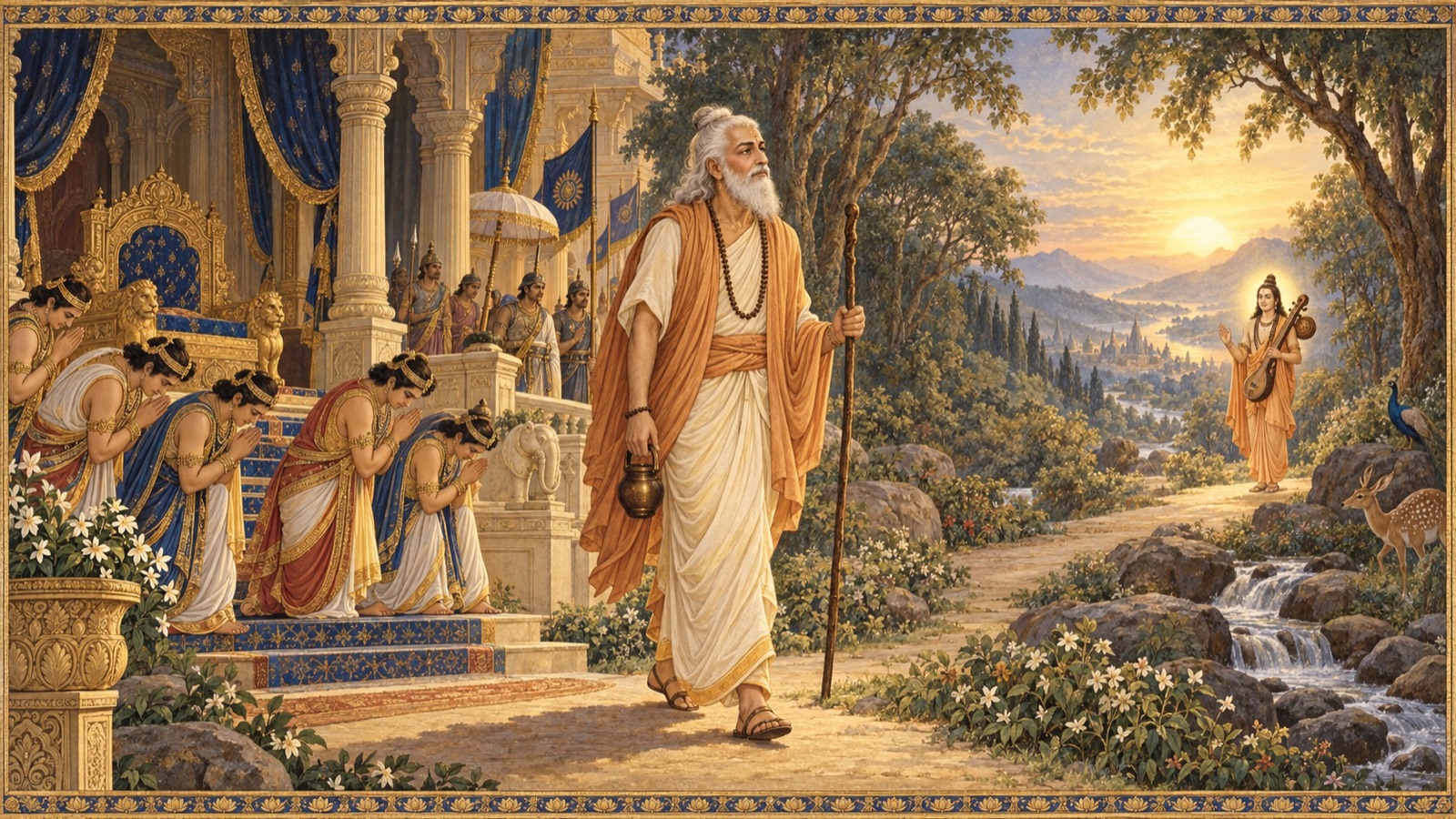
परदेवताप्रसादाधिगतात्मप्रत्यवमर्शेनानुप्रवृत्तेभ्य: पुत्रेभ्य इमां यथादायं विभज्य भुक्तभोगां च महिषीं मृतकमिव सह महाविभूतिमपहाय स्वयं निहितनिर्वेदो हृदि गृहीतहरिविहारानुभावो भगवतो नारदस्य पदवीं पुनरेवानुससार ॥ ३८ ॥
para-devatā-prasādādhigatātma-pratyavamarśenānupravṛttebhyaḥ putrebhya imāṁ yathā-dāyaṁ vibhajya bhukta-bhogāṁ ca mahiṣīṁ mṛtakam iva saha mahā-vibhūtim apahāya svayaṁ nihita-nirvedo hṛdi gṛhīta-hari-vihārānubhāvo bhagavato nāradasya padavīṁ punar evānusasāra
Meaning: By the grace of the Supreme Deity, having regained the discernment of the Self, Priyavrata divided this earth among his obedient sons as their inheritance, cast aside like a corpse his enjoyed queen along with his vast opulence, and — his heart now settled in detachment and holding within it the glory of Sri Hari’s pastimes — once again took to the path shown by the divine sage Narada. (Canto 5, Chapter 1, verse 38)
The chapter closes with the verses that the ancients sang in praise of Priyavrata: who but a devotee of the Lord could have done what he did — carving the seven oceans from his chariot-tracks, dividing the earth for the good of all living beings, and fixing the bounds of every island with its own rivers and mountains? And, devoted to the servants of the Supreme Person, he looked upon all the fortunes of the lower, heavenly, and earthly worlds — and even those won by action or by yoga — as no better than hell.
भौमं दिव्यं मानुषं च महित्वं कर्मयोगजम् । यश्चक्रे निरयौपम्यं पुरुषानुजनप्रिय: ॥ ४१ ॥
bhaumaṁ divyaṁ mānuṣaṁ ca mahitvaṁ karma-yogajam yaś cakre nirayaupamyaṁ puruṣānujana-priyaḥ
Meaning: Dear to the servants of the Supreme Person, he counted as no better than hell all greatness — earthly, heavenly, or human — won by action or by yogic power. (Canto 5, Chapter 1, verse 41)
Principal Teachings of This Chapter
1. Freedom is inward, not circumstantial. Parikshit’s doubt — that household life must bind even a devotee — is answered by Priyavrata’s whole life. Where the mind is fixed on the Lord, neither a throne nor a family can bind the soul (verses 1, 5-6).
2. The Lord’s command outranks even our spiritual preferences. Priyavrata longed only for contemplation, but Brahma showed him that no one — not Brahma, not Shiva, not even Narada — can set aside what the Lord has ordained, by any strength of penance, learning, or power (verses 11-13). Every body we wear, every joy and sorrow we meet, is His arrangement; we carry it exactly as a bull carries the rope run through its nose, going wherever it is pulled, content to be guided the way a blind man is guided by one who can see (verses 14-15). To accept the Lord’s appointed duty, offered through one’s elders, is itself the higher devotion (verses 11-19).
3. Conquer the inner enemies first. Brahma’s counsel is timeless: the six foes — the unbridled senses and mind — travel with us wherever we flee. Better to subdue them from within the “stronghold” of one’s present duties (verses 17-18).
4. Work performed as service purifies rather than binds. Priyavrata ruled for ages, married, and fathered kings, yet remained “extremely pure by virtue of constant meditation on the feet of the Lord” (verse 23).
5. Renunciation completes, but does not contradict, a life of duty. When his work was done, Priyavrata set the whole empire aside “like a corpse” and returned to Narada’s path — showing that true detachment ripens in its own time (verses 36-38).
A Devotional Reflection
There is a quiet reassurance hidden in this chapter for anyone who has ever felt that ordinary responsibilities are the enemy of a spiritual life. Priyavrata wanted nothing more than to sit in unbroken contemplation, and it must have seemed to him that ruling an empire could only pull him away from God. Yet the Creator himself came to tell him otherwise. The problem, Brahma said, was never the home or the throne — it was the unconquered senses, which a man carries into the forest as surely as into the palace. Priyavrata’s greatness lies not in escaping his duties but in performing colossal ones — governing the world, shaping its oceans, raising a family of saints and kings — while keeping his heart fixed at the Lord’s feet the entire time. And when the time came, he laid it all down — throne, wife, and fortune together — the way one sets aside a body already dead, holding on to nothing. His life tells us that the measure of our freedom is not how little the world asks of us, but how lightly we hold whatever it asks.
A Daily Devotional Practice
Today, choose one ordinary duty you tend to resent — a task at work, a responsibility at home, something that feels like it stands between you and the life you would rather be living. Before you begin it, pause and quietly offer it to the Lord, repeating: “Om Namo Bhagavate Vasudevaya.” Then carry it out as carefully as if it were worship, remembering Priyavrata, who ruled the whole earth without letting it touch his heart. Let the work be done for the Lord, and watch how the resentment loosens its grip.
Conclusion
The first chapter of the Fifth Canto answers a question that reaches far beyond the story of one ancient king. Can a soul truly devoted to God live fully in the world — take up power, raise a family, shoulder enormous responsibility — without losing that devotion? In Priyavrata the Bhagavatam gives a resounding yes. Called from the edge of lifelong renunciation to rule the earth, he obeyed, and made of that rule an act of worship: circling the world in his blazing chariot, carving its oceans, dividing its lands among worthy sons, and all the while regarding every earthly and even heavenly glory as no better than hell compared to the Lord’s service. Then, his duty complete, he walked away from it without a backward glance. His life stands at the head of the Fifth Canto as a living definition of the karma-yogi and the paramahamsa united in one person — and as a promise that the path back to God runs straight through, not around, the duties He has placed in our hands.
May the divine wisdom of Srimad Bhagavatam awaken pure devotion within our hearts.
Om Namo Bhagavate Vasudevaya.
Jay Shree Madhav.
References and Attribution
- Primary edition: Gita Press, Śrīmad Bhāgavata Mahāpurāṇa (English, complete), Book Five, Discourse 1, “The story of Priyavrata,” pages 439–444.
- Series: Srimad Bhagavatam Wisdom · Biswa Sanatan Dharma Seva Trust.
- Presented following the spiritual guidance and recommendation of Pandit Dr. Shri Kashinath Mishra.
This is an original, faithful retelling in the writer’s own words, with brief quoted verses shown in Devanāgarī and transliteration and their meanings given as summaries. It is not a reproduction of any single publisher’s continuous translation or commentary. No affiliation with or endorsement by any publisher is implied.
Jay Shree Madhav