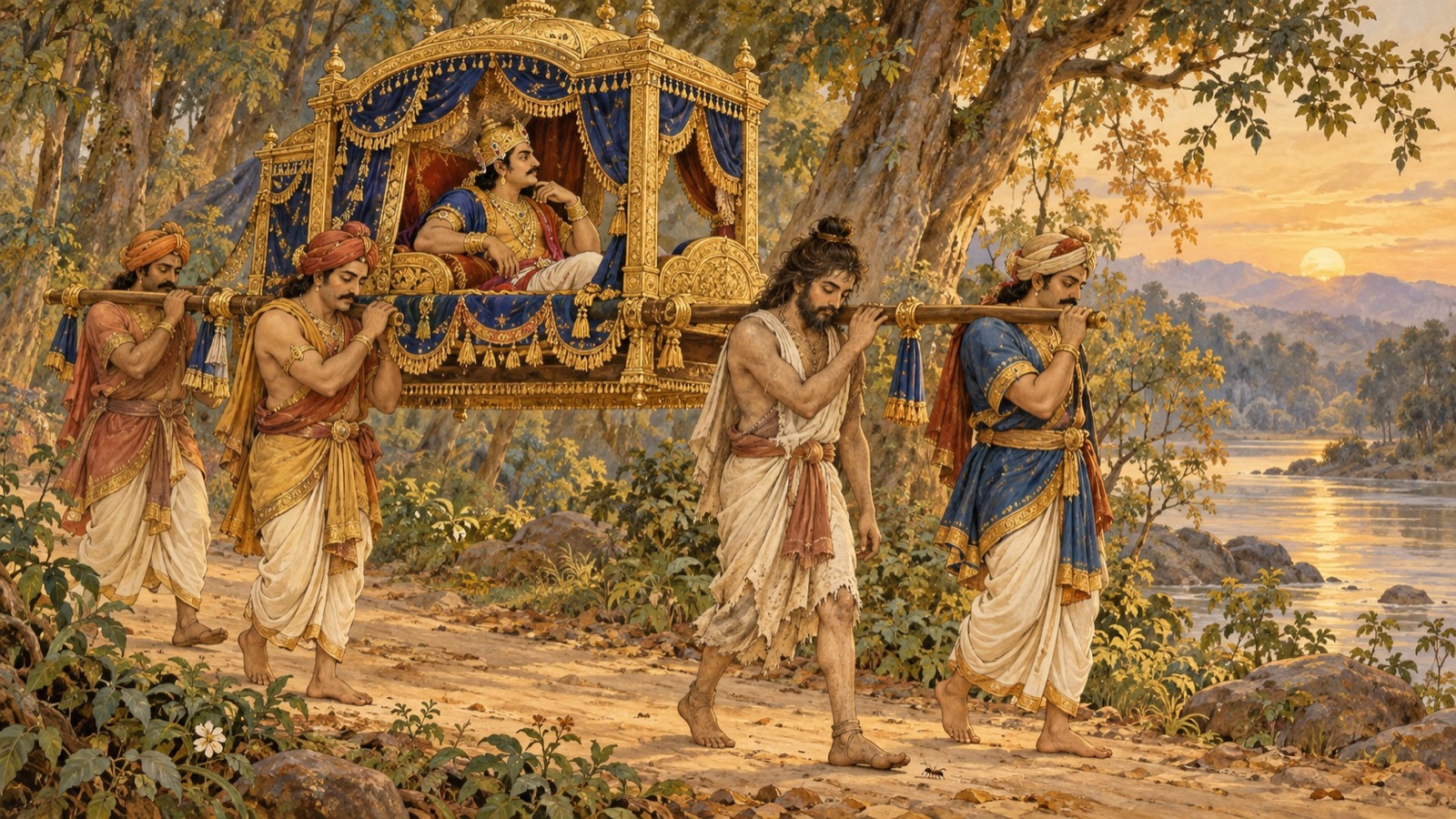
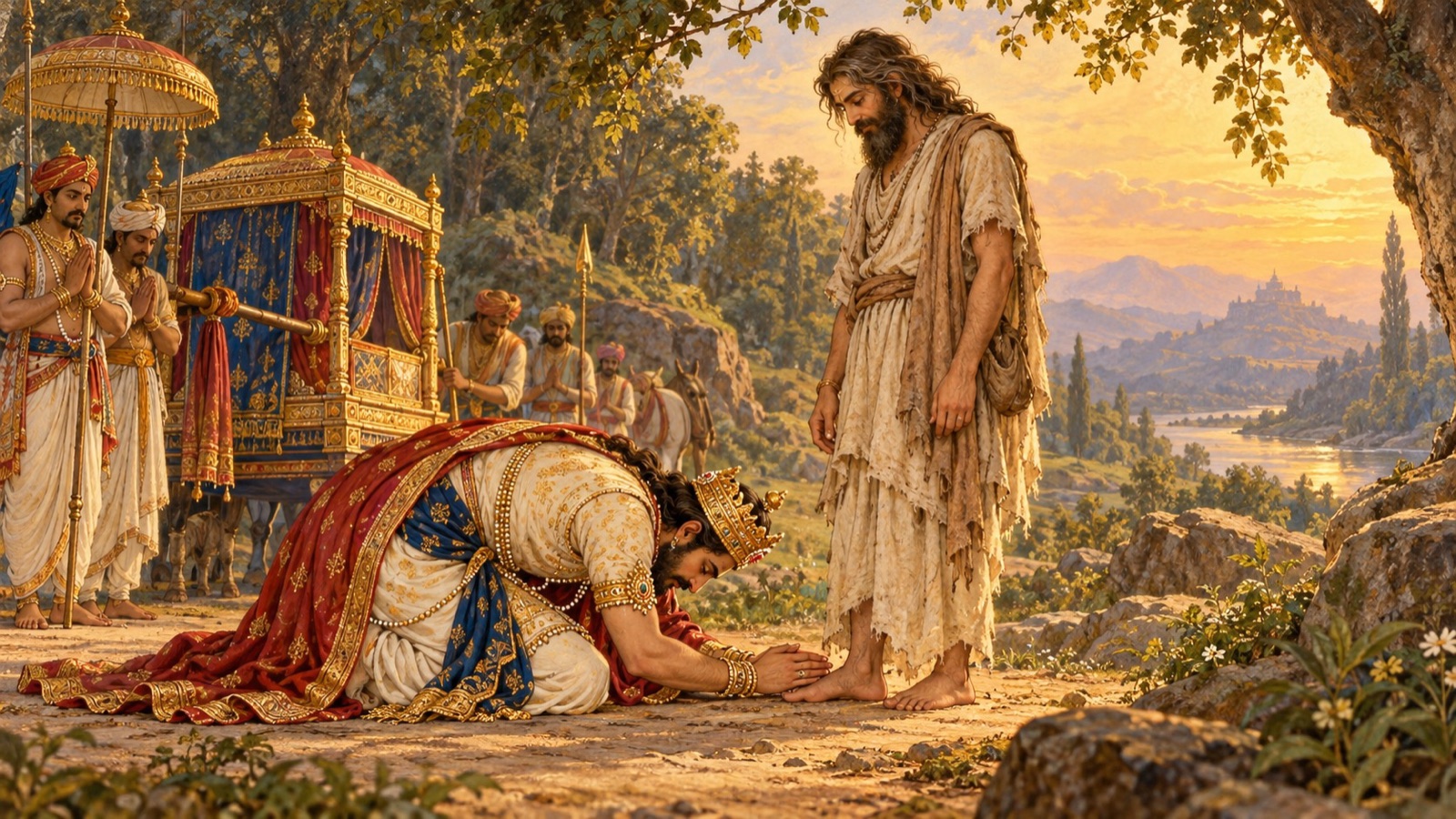
Forced to carry a king’s palanquin, the silent sage Jada Bharata walks slowly and with care, unwilling to harm the smallest creature — bearing the burden on his body while resting, unshaken, in the deathless Self within.
Om Namo Bhagavate Vasudevaya.
Om Namo Bhagavate Vasudevaya.
Om Namo Bhagavate Vasudevaya.
Welcome back to Srimad Bhagavatam Wisdom, a devotional journey through the sacred histories and teachings of the Srimad Bhagavat Mahapurana. In the previous chapter, the great sage was born as Jada Bharata, hiding his wisdom behind the guise of a dull madman and bearing the world’s contempt with perfect peace. This tenth chapter of Book Five gives us one of the most luminous dialogues in all the scripture. Pressed into service as a palanquin-bearer for King Rahugana, the silent sage walks so carefully — unwilling to tread on the smallest creature — that the king mocks and threatens him. And in reply, from beneath that dusty, despised exterior, pours a teaching of such depth that the proud monarch descends from his seat and bows his head at the sage’s feet.
Chapter Information
- Scripture: Śrīmad Bhāgavata Mahāpurāṇa
- Canto: 5 (Book Five)
- Chapter: 10 (Discourse 10)
- Chapter title: Jada Bharata and King Rahugana
- Principal speaker: Sukadeva Gosvami (Sri Suka), narrating to King Parikshit; within the narration, Jada Bharata speaks to King Rahugana
- Principal listener: King Parikshit — the discourse related in turn by Suta Gosvami to the sages gathered at Naimisaranya
- Main setting: The bank of the river Iksumati and the road along which King Rahugana travels by palanquin toward the sage Kapila
- Central subject: How Jada Bharata was forced to carry King Rahugana’s palanquin, was mocked for his slow and careful gait, and answered the king with a profound teaching on the difference between the deathless Self and the perishable body — moving the king to humble repentance
- Principal verse range: Canto 5, Chapter 10, verses 1–25
- Primary edition: Gita Press Śrīmad Bhāgavata Mahāpurāṇa
From the Previous Chapter
In the ninth discourse, the great devotee Bharata was reborn in a holy Brahmana family as Jada Bharata, deliberately concealing his wisdom to avoid all entanglement. He bore mockery and hard labor with unbroken equanimity, and when robbers seized him for sacrifice, the Lord’s own protective power rose to save him. This chapter continues his story on the open road, where his hidden greatness is drawn out at last — not by reverence, but by a king’s impatience.
Pressed into Service
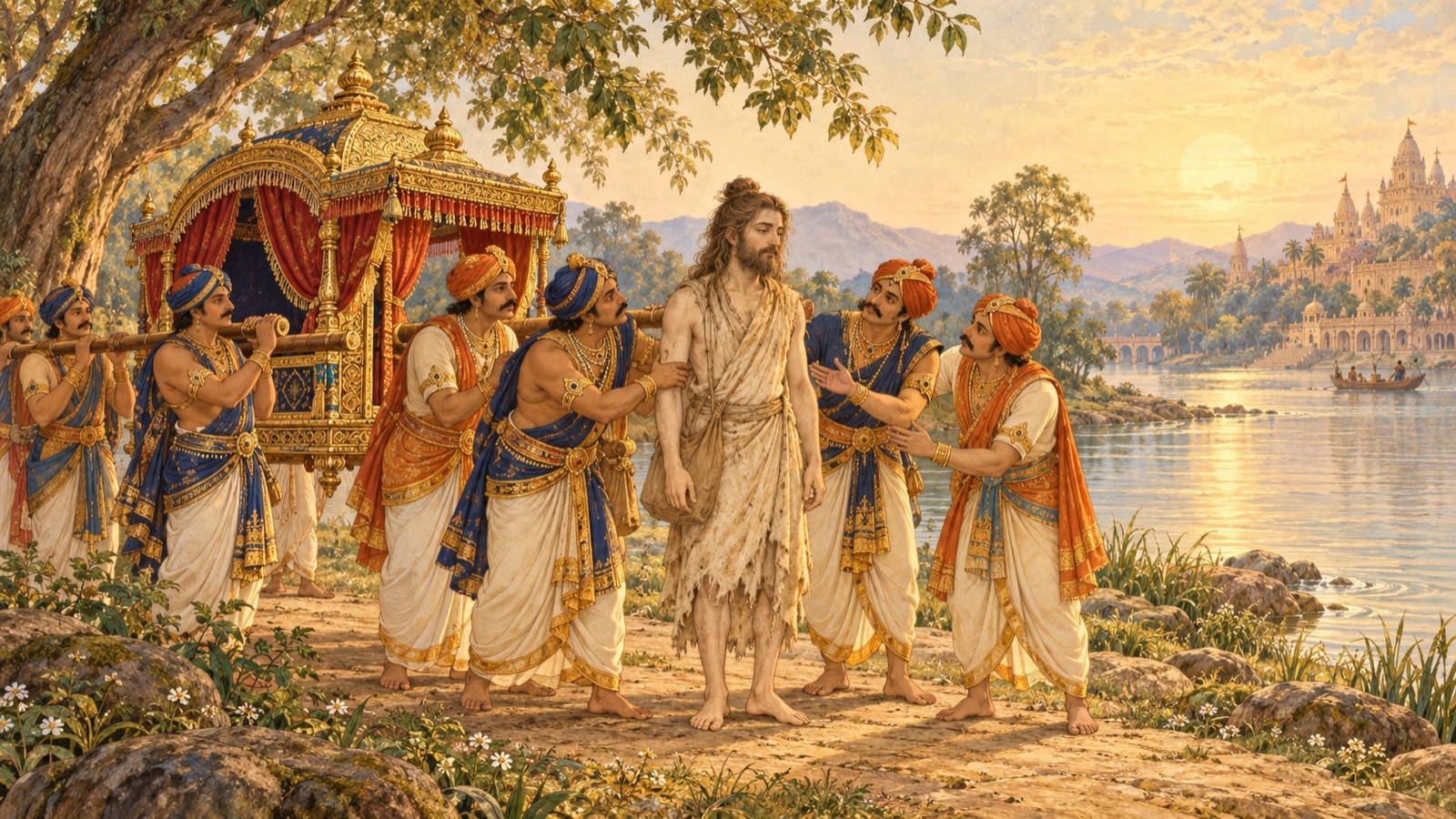
King Rahugana, ruler of the lands of Sindhu and Sauvira, was traveling by palanquin to receive spiritual instruction from the sage Kapila. On the bank of the river Iksumati, his bearers needed another man to share the load, and — as Providence arranged it — they came upon Jada Bharata. Seeing that he was young, sturdy and strong, fit (as they thought) to bear a burden like an ox, they seized him by force and set him to carry the palanquin without wage. And that great soul, who deserved no such treatment, took up the pole and bore it in silence.
श्रीशुक उवाच अथ सिन्धुसौवीरपते रहूगणस्य व्रजत इक्षुमत्यास्तटे तत्कुलपतिना शिबिकावाहपुरुषान्वेषणसमये दैवेनोपसादित: स द्विजवर उपलब्ध एष पीवा युवा संहननाङ्गो गोखरवद्धुरं वोढुमलमिति पूर्वविष्टिगृहीतै: सह गृहीत: प्रसभमतदर्ह उवाह शिबिकां स महानुभाव: ॥ १ ॥
śrī-śuka uvāca atha sindhu-sauvīra-pate rahūgaṇasya vrajata ikṣumatyās taṭe tat-kula-patinā śibikā-vāha-puruṣānveṣaṇa-samaye daivenopasāditaḥ sa dvija-vara upalabdha eṣa pīvā yuvā saṁhananāṅgo go-kharavad dhuraṁ voḍhum alam iti pūrva-viṣṭi-gṛhītaiḥ saha gṛhītaḥ prasabham atad-arha uvāha śibikāṁ sa mahānubhāvaḥ
Meaning: Sri Suka said: As King Rahugana, ruler of Sindhu and Sauvira, was traveling, and his chief bearer was searching on the bank of the Iksumati for another palanquin-carrier, by Providence he found this best of Brahmanas. Judging him young, stout and strong enough to bear a load like an ox or a donkey, they seized him along with others already pressed into unpaid service; and that great soul, though undeserving of it, bore the palanquin. (Canto 5, Chapter 10, verse 1)
A Careful Gait and a King’s Anger
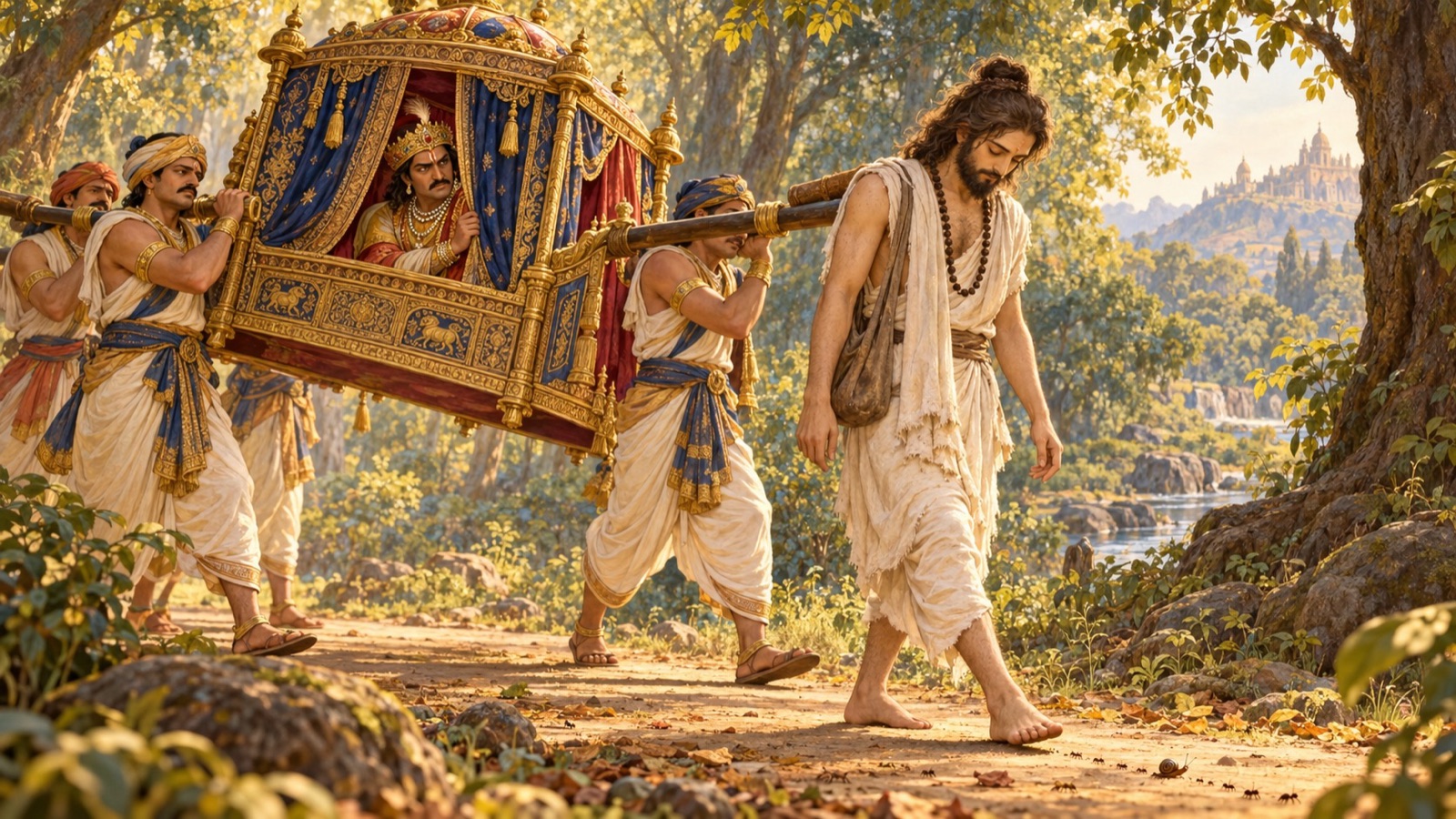
But Jada Bharata could not walk as the other bearers did. Ever mindful of harming no living thing, he would step forward only after surveying the ground about three feet ahead, so as not to tread on any small creature. His careful, halting pace threw the palanquin out of rhythm, and King Rahugana, jolted about, called out to the bearers to march properly. Fearing punishment, they explained that the new man could not keep pace.
Hearing this, the king’s kshatriya temper flared. Clouded by pride, he taunted the sage with heavy sarcasm — mocking him as tired and weak and old, unable to carry his share. Yet Jada Bharata, a self-realized soul who never for a moment thought of the body as “I” or “mine,” simply bore the palanquin as before, wholly undisturbed. When the palanquin lurched again, the king flew into a real rage and threatened to punish him as Yama, the lord of death, punishes the erring — to bring him, he said, back to his senses.
The Silent Sage Speaks
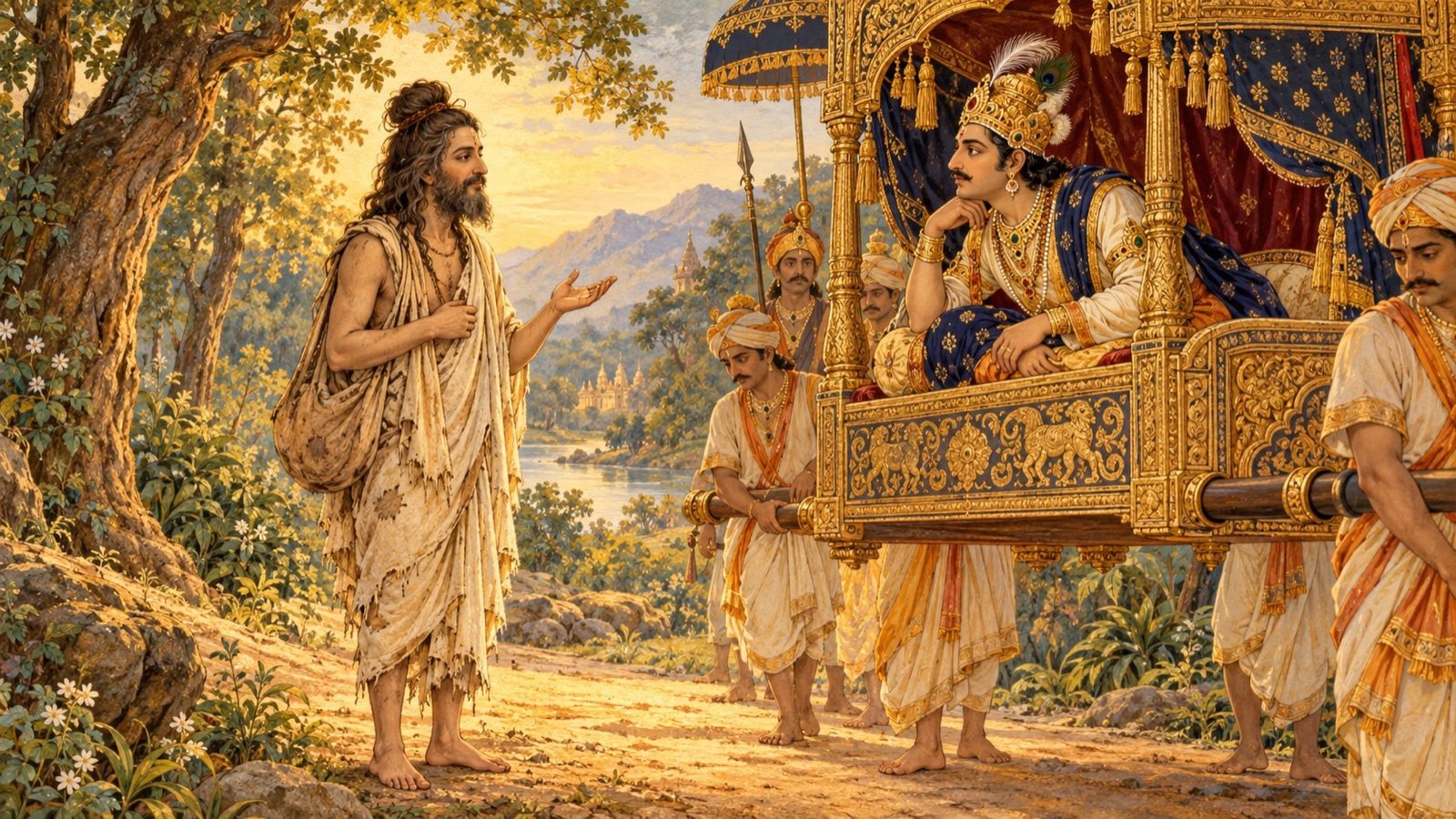
Then that worshipful Brahmana, a friend and the very Self of all beings, smiled — utterly free of pride — and spoke. What the king had said, he replied, was quite true and no reproach at all. The burden, he observed, rests upon the body that carries it, not upon the Self within, which bears nothing; the road and the destination belong to the moving body, not to the all-pervading Spirit. “Stout” and “lean,” he said, are words that apply to the body alone, never to the deathless Self.
ब्राह्मण उवाच त्वयोदितं व्यक्तमविप्रलब्धं भर्तु: स मे स्याद्यदि वीर भार: । गन्तुर्यदि स्यादधिगम्यमध्वा पीवेति राशौ न विदां प्रवाद: ॥ ९ ॥
brāhmaṇa uvāca tvayoditaṁ vyaktam avipralabdhaṁ bhartuḥ sa me syād yadi vīra bhāraḥ gantur yadi syād adhigamyam adhvā pīveti rāśau na vidāṁ pravādaḥ
Meaning: The Brahmana said: What you have said is plainly true and no reproach — if only the burden borne by the body were truly mine, O king, or if the goal and the road, which belong to the moving body, had reference to me; but “stout” is a term the wise apply to the body, never to the Self. (Canto 5, Chapter 10, verse 9)
Stoutness and leanness, sickness and worry, hunger and thirst, fear and quarrel, desire and old age, sleep and attachment, anger and vanity and grief — all these, he said, arise only in one who identifies with the body, and never in the pure Self.
स्थौल्यं कार्श्यं व्याधय आधयश्च क्षुत्तृड् भयं कलिरिच्छा जरा च । निद्रा रतिर्मन्युरहंमद: शुचो देहेन जातस्य हि मे न सन्ति ॥ १० ॥
sthaulyaṁ kārśyaṁ vyādhaya ādhayaś ca kṣut tṛḍ bhayaṁ kalir icchā jarā ca nidrā ratir manyur ahaṁ madaḥ śuco dehena jātasya hi me na santi
Meaning: Stoutness and leanness, bodily ailments and mental anxieties, hunger and thirst, fear and strife, desire and old age, sleep and attachment, anger, egotistic pride and grief — all these belong to one born with identification with the body, and are not found in me, the pure Self. (Canto 5, Chapter 10, verse 10)
Answering too the king’s earlier taunt that he seemed “dead though alive,” he observed that everything born of matter has its own beginning and its own end, so that charge holds true of every embodied being alike and is no special reproach to him (verse 11). The relation of master and servant, he continued, holds firm only where it is fixed and unchangeable; but fortunes turn, and today’s king may be tomorrow’s servant. Apart from mere convention, where is the real difference between ruler and ruled? And what, he asked gently, would the king truly gain by correcting one who behaves like a madman while established in his own Self — for to instruct such a one would be as futile as grinding flour that is already ground.
उन्मत्तमत्तजडवत्स्वसंस्थां गतस्य मे वीर चिकित्सितेन । अर्थ: कियान् भवता शिक्षितेन स्तब्धप्रमत्तस्य च पिष्टपेष: ॥ १३ ॥
unmatta-matta-jaḍavat sva-saṁsthāṁ gatasya me vīra cikitsitena arthaḥ kiyān bhavatā śikṣitena stabdha-pramattasya ca piṣṭapeṣaḥ
Meaning: O king, of what use is your correcting me — one who, established in his own Self, behaves like a madman, a drunkard or a dullard? To try to teach such a one, whether truly dull or only seeming so, would be as fruitless as grinding what is already ground. (Canto 5, Chapter 10, verse 13)
The King Bows Down
Having spoken these few plain words, the tranquil sage took up the palanquin once more, content to exhaust his remaining karma by simply reaping it. But the king had heard something that pierced the knot in his own heart. His genuine faith had made him fit to seek the truth, and now he quickly stepped down from his palanquin and fell full-length upon the ground, touching the sage’s feet with his head, his royal pride wholly dissolved.
Who are you, he asked in wonder — an avadhuta moving in disguise? He confessed that he feared no weapon of the gods — not Indra’s thunderbolt, not Shiva’s trident, not Yama’s rod — but that he dreaded, above all, the sin of disrespect toward a holy soul. Then, sensing that this hidden sage might be a direct representative of Kapila himself, come to enlighten him, he begged to be looked upon with kindness, so that he might be cleansed of the offense he had committed in his pride, and asked him to reveal the true refuge for a soul in this world.
Even as he bowed, King Rahugana could not help but test the teaching further, as a sincere seeker will. If bodily fatigue truly never touches the Self, he asked, why does the strain of this very labor seem to reach you as well? And though you say the world of roads, destinations and duties is not the ultimate truth, its effects are plainly felt — just as a pot of milk and rice set upon one fire is cooked through in its turn, so pleasure and pain surely pass from the body into the mind and, it would seem, into the soul. Nor, he pressed on, was his own harsh treatment without purpose: a king’s duty is to correct the erring, and one forced to his rightful work, however unwillingly, burns away the fruit of past misdeeds in the very labor of it. (verses 21–23)
Yet even while reasoning this way, the king’s own heart overtook his argument. Whatever he had said, he confessed, only entangled him further, for beneath the debate lay a graver truth: he had insulted a great soul, swollen with the false pride of ruling in a body that called itself a king. He begged for a single glance of the sage’s causeless mercy, that he might cross over this sin. Here the chapter reaches its deepest point, for the king went on to name the one fear that outweighed every other he had already confessed:
तन्मे भवान्नरदेवाभिमान- मदेन तुच्छीकृतसत्तमस्य । कृषीष्ट मैत्रीदृशमार्तबन्धो यथा तरे सदवध्यानमंह: ॥ २४ ॥
tan me bhavān nara-devābhimāna- madena tucchīkṛta-sattamasya kṛṣīṣṭa maitrī-dṛśam ārta-bandho yathā tare sad-avadhyānam aṁhaḥ
Meaning: O friend of the afflicted, he said, because I have belittled the best of the exalted, intoxicated by the false pride of a king who thinks himself a god among men, kindly cast upon me that same look of friendship, so that I may cross over this sin of despising a great soul. (Canto 5, Chapter 10, verse 24)
न विक्रिया विश्वसुहृत्सखस्य साम्येन वीताभिमतेस्तवापि । महद्विमानात् स्वकृताद्धि मादृङ् नङ्क्ष्यत्यदूरादपि शूलपाणि: ॥ २५ ॥
na vikriyā viśva-suhṛt-sakhasya sāmyena vītābhimates tavāpi mahad-vimānāt sva-kṛtād dhi mādṛṅ naṅkṣyaty adūrād api śūlapāṇiḥ
Meaning: You yourself remain unmoved by this, he said, for you are the friend of the Lord, who is Himself the well-wisher of every being, and by that same equal vision toward all you have given up every trace of self-regard; but one who commits an offense against a great soul, however mighty — even one bearing the trident of Shiva — is destroyed before long. (Canto 5, Chapter 10, verse 25)
This is the deepest lesson folded inside the king’s confession. Worse than any thunderbolt, trident or the rod of death — none of which he says he fears — is an offense committed at the feet of a soul who has taken shelter of the Lord. Jada Bharata could lose nothing by the king’s earlier insult, being established beyond all such change; the entire peril belonged to the one who gave the insult. It is this fear that every sincere seeker is asked to carry: a single act of disrespect toward a devotee of the Lord can undo years of one’s own spiritual labor, while a single act of humility before one, as King Rahugana now showed, opens the very door to grace.
Principal Teachings of This Chapter
The Self is not the body. The heart of Jada Bharata’s teaching is that all burdens, all pains, all the changes of stoutness and leanness, hunger and age, belong to the body alone. The true Self within is untouched, deathless, ever free. To know this even a little is to loosen the grip of every fear.
Reverence for all life is the mark of a saint. True holiness shows itself in an unwavering care not to harm even the smallest creature — a tenderness born of seeing the Lord present in every being, however humble.
Rank and status are conventions, not realities. Master and servant, king and bearer — these relations shift with the turning of fortune. The soul that sees this is freed from both the pride of the high and the fear of the low.
True greatness answers insult with peace. A soul established in the Self meets threat and taunt with no anger and nothing to defend; such quiet strength carries more power than any retort, and can humble even the proud.
Sincerity opens the door to wisdom. King Rahugana’s saving grace was his genuine faith, which made him able to recognize the truth when he heard it and to bow before it. However great our fault, an honest, humble heart can always turn and receive the teaching that sets it free.
No fear compares to the fear of offending a devotee. King Rahugana named thunderbolts, tridents and the rod of death, and declared none of them equal to the danger of disrespecting a soul devoted to the Lord. A devotee loses nothing by such an insult; the one who commits it stands to lose everything.
A Devotional Reflection
What moves us most in this chapter is the meeting of two men who could not have seemed more unequal — a mighty king enthroned on a palanquin, and a dusty, silent laborer bearing it on his shoulder — and the quiet reversal that follows, in which the true king turns out to be the one carrying the load. Jada Bharata teaches us that our worth has nothing to do with what others make us carry, or what names they call us, or where they seat us in the order of the world. All of that touches only the body. The Self within remains what it has always been: free, untouched, at peace. And yet the chapter does not end in cold detachment; it ends in tenderness — with a proud king prostrate at a laborer’s feet, and a sage who bears him no grudge at all. This is the beauty of true wisdom: it does not make us hard, but gentle; not distant, but the friend of every living being. When we begin to rest, even a little, in the deathless Self, we too can carry our burdens without bitterness and meet both insult and honor with the same unbroken peace.
A Daily Devotional Practice
Today, when some task feels heavy or some duty is thrust upon you unfairly, pause and quietly remind yourself, as Jada Bharata taught: the burden rests upon the body, not upon the Self within. Take up the task anyway, doing it as an offering to the Lord, and say inwardly: “Om Namo Bhagavate Vasudevaya.” And through the day, follow the sage’s gentle example in one small way — move through the world mindful not to harm even the least of creatures, seeing the Lord present in all. In this, you practice both the wisdom that frees the heart and the compassion that is its natural fruit.
Conclusion
The tenth discourse of Book Five leaves us with a single, luminous truth: real dignity lies not in rank, strength or the body’s fortunes, but in the peace of a soul that knows itself and rests in the shelter of the Lord. May Jada Bharata’s silent strength and King Rahugana’s humble surrender both find a home in our hearts — the courage to bear whatever life places on our shoulders without complaint, and the readiness to bow the moment truth is spoken to us, however it arrives, and from whomever it comes.
May the divine wisdom of Srimad Bhagavatam awaken pure devotion within our hearts.
Om Namo Bhagavate Vasudevaya.
Jay Shree Madhav.
References and Attribution
- Primary edition: Gita Press, Śrīmad Bhāgavata Mahāpurāṇa, Book Five, Discourse 10, “The meeting of Jadabharata with king Rahugana.”
- Series: Srimad Bhagavatam Wisdom · Biswa Sanatan Dharma Seva Trust.
- Presented following the spiritual guidance and recommendation of Pandit Dr. Shri Kashinath Mishra.
This is an original, faithful retelling in the writer’s own words, with brief quoted verses shown in Devanāgarī and transliteration and their meanings given as summaries. It is not a reproduction of any single publisher’s continuous translation or commentary. No affiliation with or endorsement by any publisher is implied.
Jay Shree Madhav