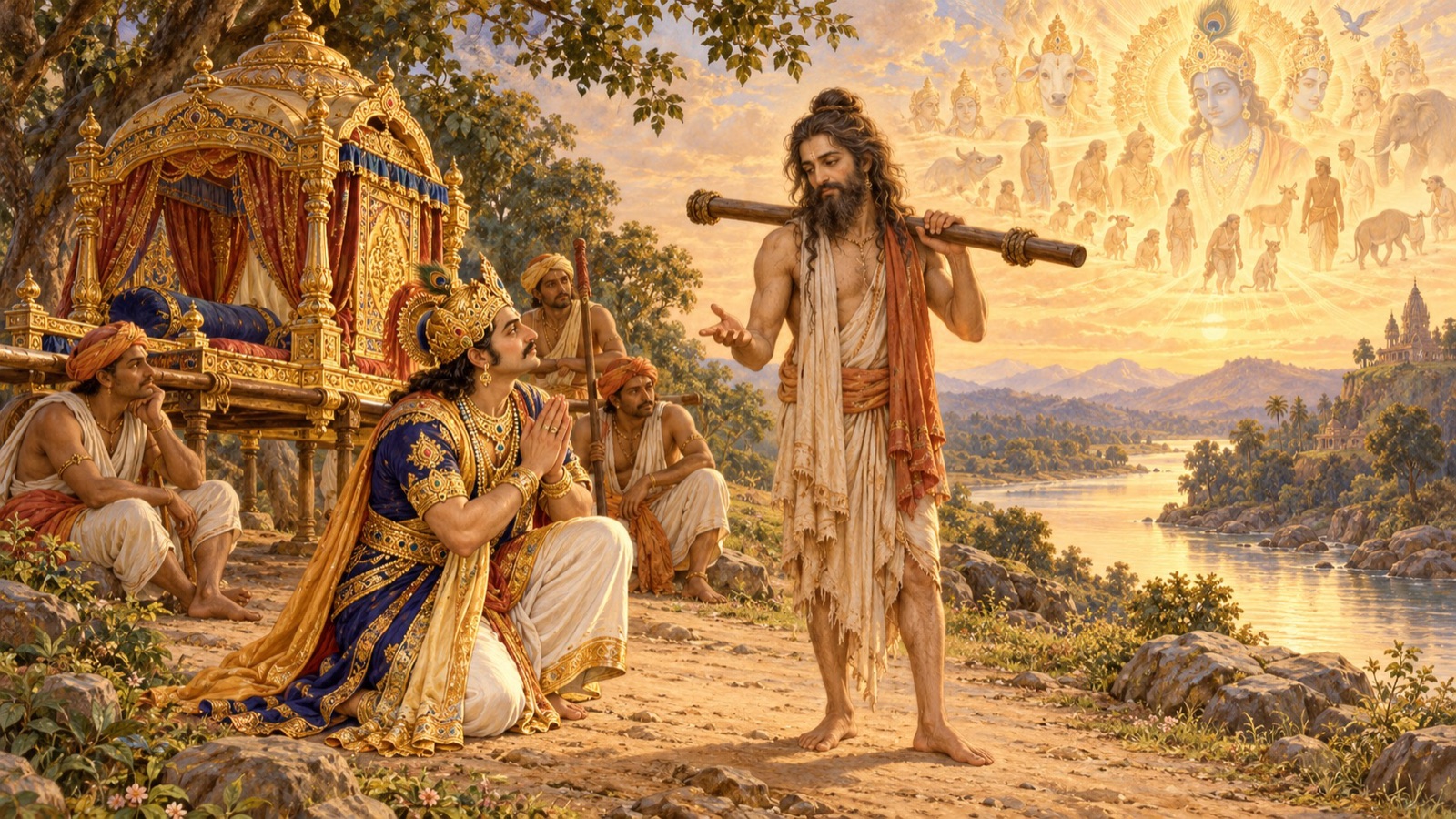
Still bearing the palanquin, the sage Jada Bharata unfolds for the humbled King Rahugana the great secret of the mind — the root of bondage and of liberation — and points him to the deathless Lord who dwells within every heart.
Om Namo Bhagavate Vasudevaya.
Om Namo Bhagavate Vasudevaya.
Om Namo Bhagavate Vasudevaya.
Welcome back to Srimad Bhagavatam Wisdom, a devotional journey through the sacred histories and teachings of the Srimad Bhagavat Mahapurana. In the previous chapter, the silent sage Jada Bharata, forced to bear King Rahugana’s palanquin, humbled the proud monarch with a few luminous words on the deathless Self. This eleventh chapter of Book Five carries that same dialogue into its deepest reaches. The king has bowed; his heart is open; and now the sage — a friend of all beings — unfolds for him the great secret of the mind: how, driven by the three modes of nature, it binds the soul upon the wheel of birth and death; how the Lord Vasudeva dwells within it as the silent witness of all; and how the whole knot of bondage may be cut at last by taking shelter at the feet of the Lord and the Guru.
Chapter Information
- Scripture: Śrīmad Bhāgavata Mahāpurāṇa
- Canto: 5 (Book Five)
- Chapter: 11 (Discourse 11)
- Chapter title: Jada Bharata’s Teaching to King Rahugana
- Principal speaker: Jada Bharata (the Brahmana sage), speaking to King Rahugana; the whole related by Sukadeva Gosvami (Sri Suka) to King Parikshit
- Principal listener: King Rahugana within the narration — and King Parikshit, the discourse related in turn by Suta Gosvami to the sages gathered at Naimisaranya
- Main setting: The road toward the sage Kapila, where Jada Bharata still bears the king’s palanquin upon his shoulder
- Central subject: Jada Bharata’s teaching on the mind — how, ruled by the three gunas, it becomes the root both of bondage and of liberation; its eleven functions; the Lord Vasudeva as the inner witness of every being; and the call to slay the mind’s illusion through worship of the Guru and the Lord
- Principal verse range: Canto 5, Chapter 11, verses 1–17
- Primary edition: Gita Press Śrīmad Bhāgavata Mahāpurāṇa
From the Previous Chapter
In the tenth discourse, King Rahugana, traveling to the sage Kapila, forced the silent Jada Bharata to carry his palanquin. Mocked for his slow and careful gait — which spared the smallest creature — the sage answered with a serene teaching: that all burdens and pains belong to the perishable body, while the Self within remains deathless and free, and that master and servant are but passing conventions. His words pierced the king’s pride, and the mighty Rahugana descended from his seat to bow at the laborer’s feet, begging forgiveness and asking the true refuge for a soul. This eleventh discourse continues that very conversation, as the sage — still bearing the load — unfolds for the humbled king the deeper mystery of the mind.
The Sage Answers the King
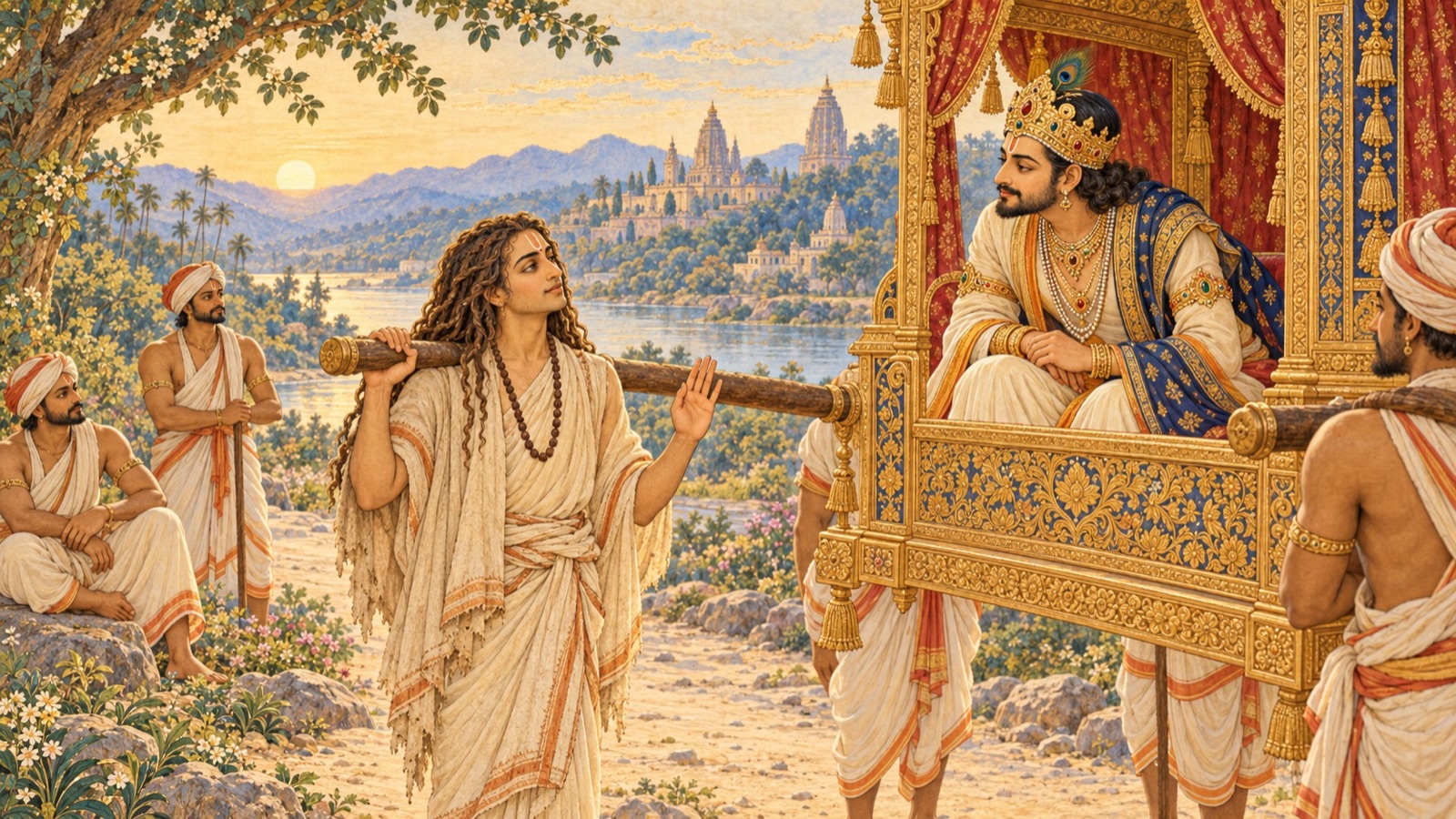
Still bearing the load upon his shoulder, the great soul turned to the king with the same untroubled gentleness. The king, he said, had spoken words that rang like the sayings of the wise; and yet, for all their polish, they were not the speech of one who has truly seen. For those who know Reality never fold the passing dealings of the world — this talk of master and servant, of the strong bearer and the weak — into their search for the Absolute; such distinctions have no place where the one Truth alone is sought.
ब्राह्मण उवाच अकोविद: कोविदवादवादान् वदस्यथो नातिविदां वरिष्ठ: । न सूरयो हि व्यवहारमेनं तत्त्वावमर्शेन सहामनन्ति ॥ १ ॥
brāhmaṇa uvāca akovidaḥ kovida-vāda-vādān vadasy atho nāti-vidāṁ variṣṭhaḥ na sūrayo hi vyavahāram enaṁ tattvāvamarśena sahāmananti
Meaning: The Brahmana said: Though unlearned, you speak words that ring like the rejoinders of the wise; yet you are not truly among the best of the knowing. For those who see the truth never weigh these worldly dealings — such as master and servant — as though they belonged to the enquiry into the Absolute Reality. (Canto 5, Chapter 11, verse 1)
He spoke then of the sacred paths themselves. Those Vedic texts that sing the praises of heaven and lay out the endless rites of household life, he observed, seldom let the pure and unclouded truth shine through, tangled as their promises are in reward and preference. And even the loftiest utterances of the Upanishads, the very crown of the Vedas, cannot reveal the Self directly to the one who has not yet learned to look upon the sweetness of home and heaven as he would upon a passing dream — a thing to be gladly set aside.
Here is the very hinge on which this whole teaching turns. Those who cling only to the Vedas’ promise of good birth, prosperity, or a home in heaven — what the wise call veda-vada, the ritualist’s reading of scripture — mistake the reward for the goal itself; and however vast that merit, it is spent the moment it is enjoyed, and the soul returns again to this world of birth and death. Only one who presses beyond such reward to tattva, the Reality behind the Vedas, and lays even his hard-won knowledge at the Lord’s feet, is not sent back in this way. This is why the sage, seventeen verses on, will not close with a further argument but with worship: no store of ritual or learning, however great, by itself carries a soul across the mind’s illusion — only surrender to Vasudeva does. (verses 2–3)
The Mind, the Root of Bondage and of Freedom
From the paths of the world the sage turned to their secret spring — the mind itself. So long as a man’s mind is ruled by passion, or by goodness, or by darkness, he said, it works on unchecked through the senses and the organs of action, gathering for him a harvest now of merit and now of sin.
यावन्मनो रजसा पूरुषस्य सत्त्वेन वा तमसा वानुरुद्धम् । चेतोभिराकूतिभिरातनोति निरङ्कुशं कुशलं चेतरं वा ॥ ४ ॥
yāvan mano rajasā pūruṣasya sattvena vā tamasā vānuruddham cetobhir ākūtibhir ātanoti niraṅkuśaṁ kuśalaṁ cetaraṁ vā
Meaning: So long as a man’s mind is swayed by the mode of passion, or of goodness, or of ignorance, it goes on unchecked, spreading itself through his powers of perception and action to yield him a harvest either of good or of ill. (Canto 5, Chapter 11, verse 4)
This mind, he went on, is a storehouse of old impressions, coloured by the very objects it craves and forever tossed upon the flood of the three gunas. It is the foremost of the sixteen parts of the subtle body, and, clothing itself again and again in new names and forms, it carries the soul into a higher birth or a lower one. Wrought by Maya and clinging close about the embodied soul, it draws that soul into the whirlpool of birth and death, dealing out in their season pleasure, pain, and that dull insensibility which is neither. For only so long as the mind endures do the shifting shows of waking and dream keep rising before the witnessing Self. And this is why the seers declare a wonderful thing: that this very mind is at once the cause of the soul’s bondage in the lower, conditioned state and the door to its highest liberation.
तावानयं व्यवहार: सदावि: क्षेत्रज्ञसाक्ष्यो भवति स्थूलसूक्ष्म: । तस्मान्मनो लिङ्गमदो वदन्ति गुणागुणत्वस्य परावरस्य ॥ ७ ॥
tāvān ayaṁ vyavahāraḥ sadāviḥ kṣetrajña-sākṣyo bhavati sthūla-sūkṣmaḥ tasmān mano liṅgam ado vadanti guṇāguṇatvasya parāvarasya
Meaning: So long as the mind endures, all this show — gross and subtle — keeps appearing before the witnessing Self, the knower of the field. It is for this reason that the wise call the mind the subtle sign of the soul’s lower, conditioned state and of its higher, liberated state alike. (Canto 5, Chapter 11, verse 7)
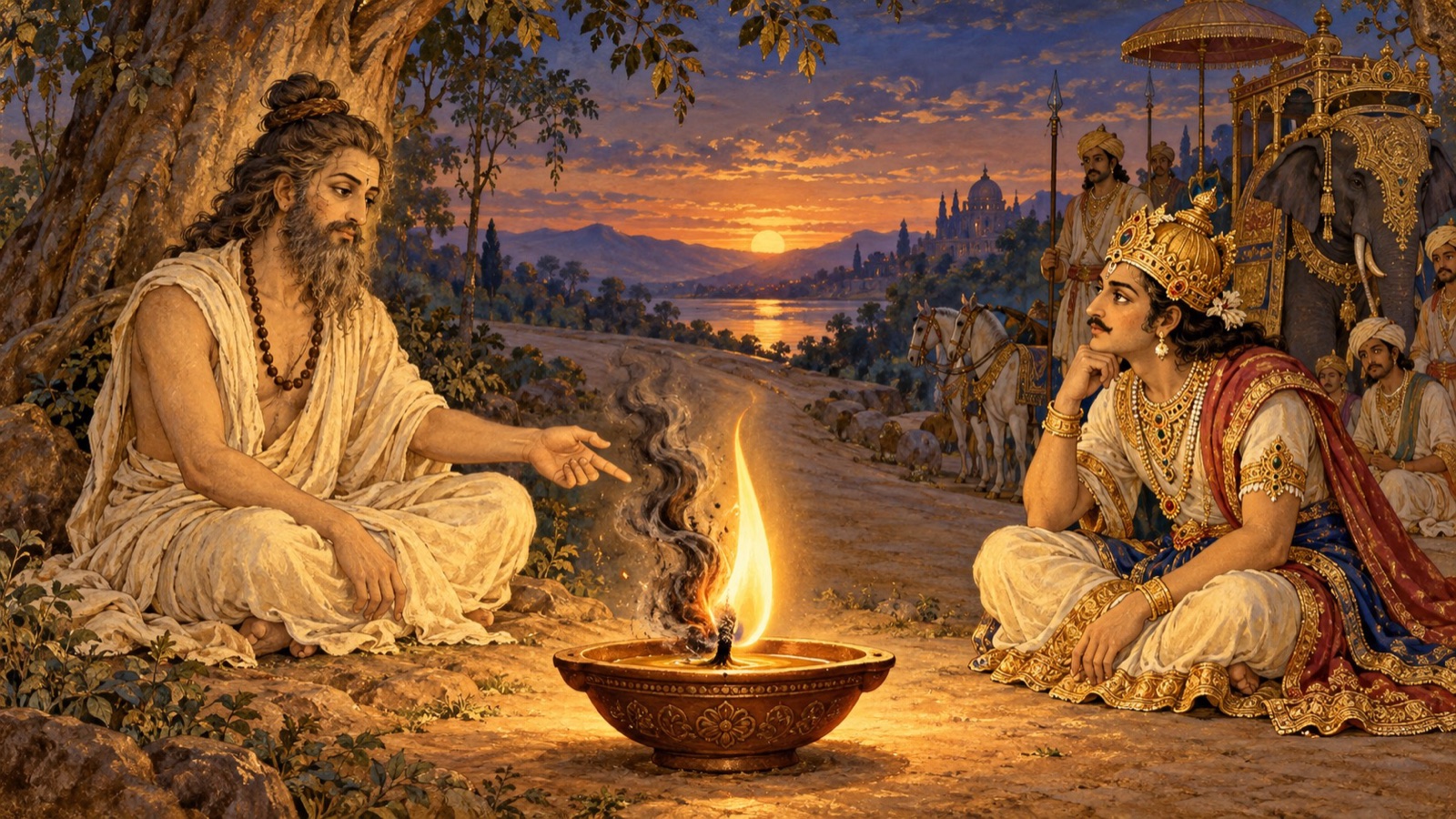
A mind that runs after the pleasures of sense, he said, leads a being into sorrow; a mind washed clean of them carries him toward final blessedness. And he gave a homely image for it: as a lamp, while it feeds upon a ghee-soaked wick, burns with a smoky, sooty flame, yet returns to its clear and unseen nature once the fuel is spent — so the mind, while it clings to the objects of sense and their works, flows out in troubled, darkened currents, and comes back to its own pure essence only when that clinging falls away.
The Eleven Streams of the Mind
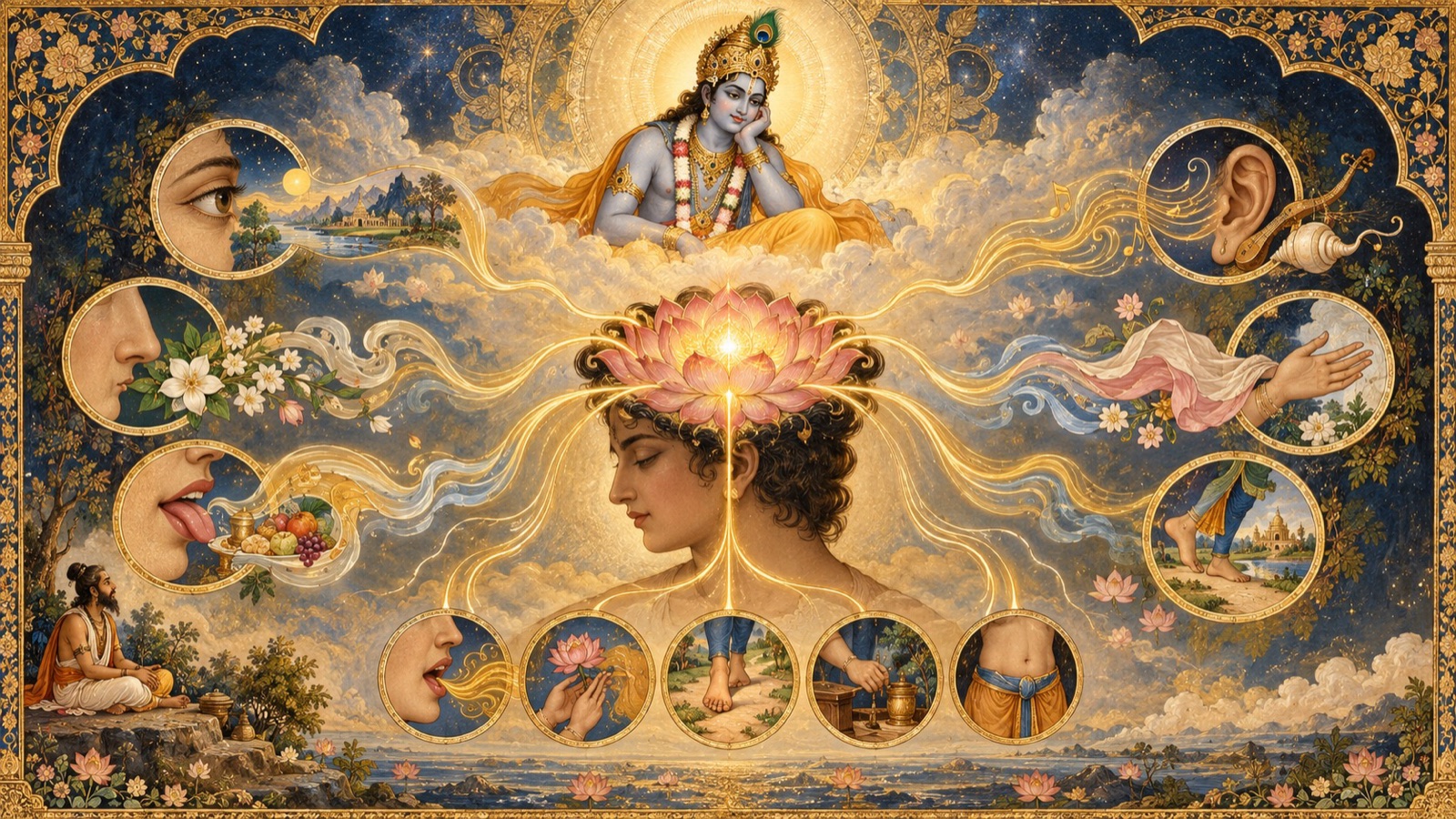
Then, for the king’s clearer understanding, the sage numbered the very channels through which the mind pours itself out into the world.
एकादशासन्मनसो हि वृत्तय आकूतय: पञ्च धियोऽभिमान: । मात्राणि कर्माणि पुरं च तासां वदन्ति हैकादश वीर भूमी: ॥ ९ ॥
ekādaśāsan manaso hi vṛttaya ākūtayaḥ pañca dhiyo ’bhimānaḥ mātrāṇi karmāṇi puraṁ ca tāsāṁ vadanti haikādaśa vīra bhūmīḥ
Meaning: The five organs of action, the five senses of perception, and the ego-sense — these are the eleven currents in which the mind flows out; and the wise, O valiant king, declare the five sense-objects, the five modes of activity, and the body itself to be the eleven fields into which those currents pour. (Canto 5, Chapter 11, verse 9)
Through these gates, he explained, the mind meets its objects: smell and form, touch and taste and sound are grasped by the five senses of perception; giving and taking, movement, speech, and the body’s natural functions flow through the five organs of action; and the ego, claiming the body as “mine,” is the eleventh. Multiplied by the endless variety of objects, by the nature of things, by old tendencies and deeds and the working of time, these eleven modifications branch out into hundreds, into thousands, into tens of millions. Yet not one of them stands upon its own, nor do they give rise to one another; they all proceed from God alone. And God, ever pure and unattached, does no more than look on — the silent witness of these countless waves of the mind, which rise and vanish, now shown and now hidden, upon the surface of the soul’s Maya-fashioned nature.
Lord Vasudeva, the Witness Within
Who, then, is this witness? The sage now named Him plainly, and his words rose into praise.
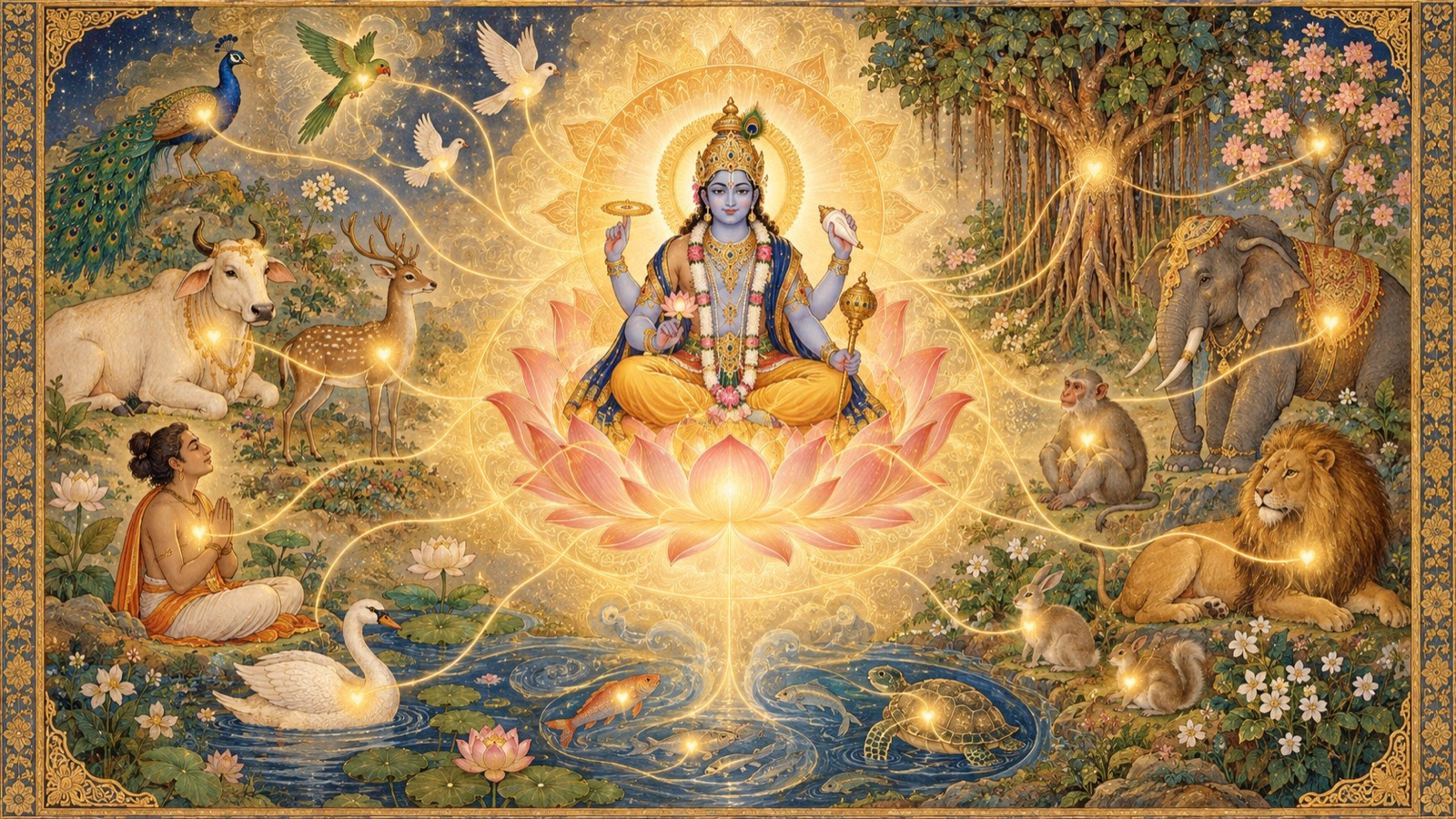
क्षेत्रज्ञ आत्मा पुरुष: पुराण: साक्षात्स्वयंज्योतिरज: परेश: । नारायणो भगवान् वासुदेव: स्वमाययाऽऽत्मन्यवधीयमान: ॥ १३ ॥ यथानिल: स्थावरजङ्गमाना- मात्मस्वरूपेण निविष्ट ईशेत् । एवं परो भगवान् वासुदेव: क्षेत्रज्ञ आत्मेदमनुप्रविष्ट: ॥ १४ ॥
kṣetrajña ātmā puruṣaḥ purāṇaḥ sākṣāt svayaṁ jyotir ajaḥ pareśaḥ nārāyaṇo bhagavān vāsudevaḥ sva-māyayātmany avadhīyamānaḥ yathānilaḥ sthāvara-jaṅgamānām ātma-svarūpeṇa niviṣṭa īśet evaṁ paro bhagavān vāsudevaḥ kṣetrajña ātmedam anupraviṣṭaḥ
Meaning: That witness is the Self, the knower of the field — the ancient Person, self-luminous and unborn, the supreme Ruler: Lord Narayana, the almighty Vasudeva, who by His own power abides within the heart. As the one air, entering all beings moving and unmoving as their very breath, upholds and governs them from within, so the supreme Lord Vasudeva has entered this whole universe as its innermost Self and all-witnessing Controller. (Canto 5, Chapter 11, verses 13-14)
He is all-pervading and most ancient, the sage said — the first cause of all, ever perfect and self-effulgent, free from birth and death, the Ruler even of the highest beings. By His own wondrous power He dwells hidden in every heart, nearer to each creature than its own breath, and yet untouched by all the mind’s unquiet motions.
Cut the Knot of the Mind
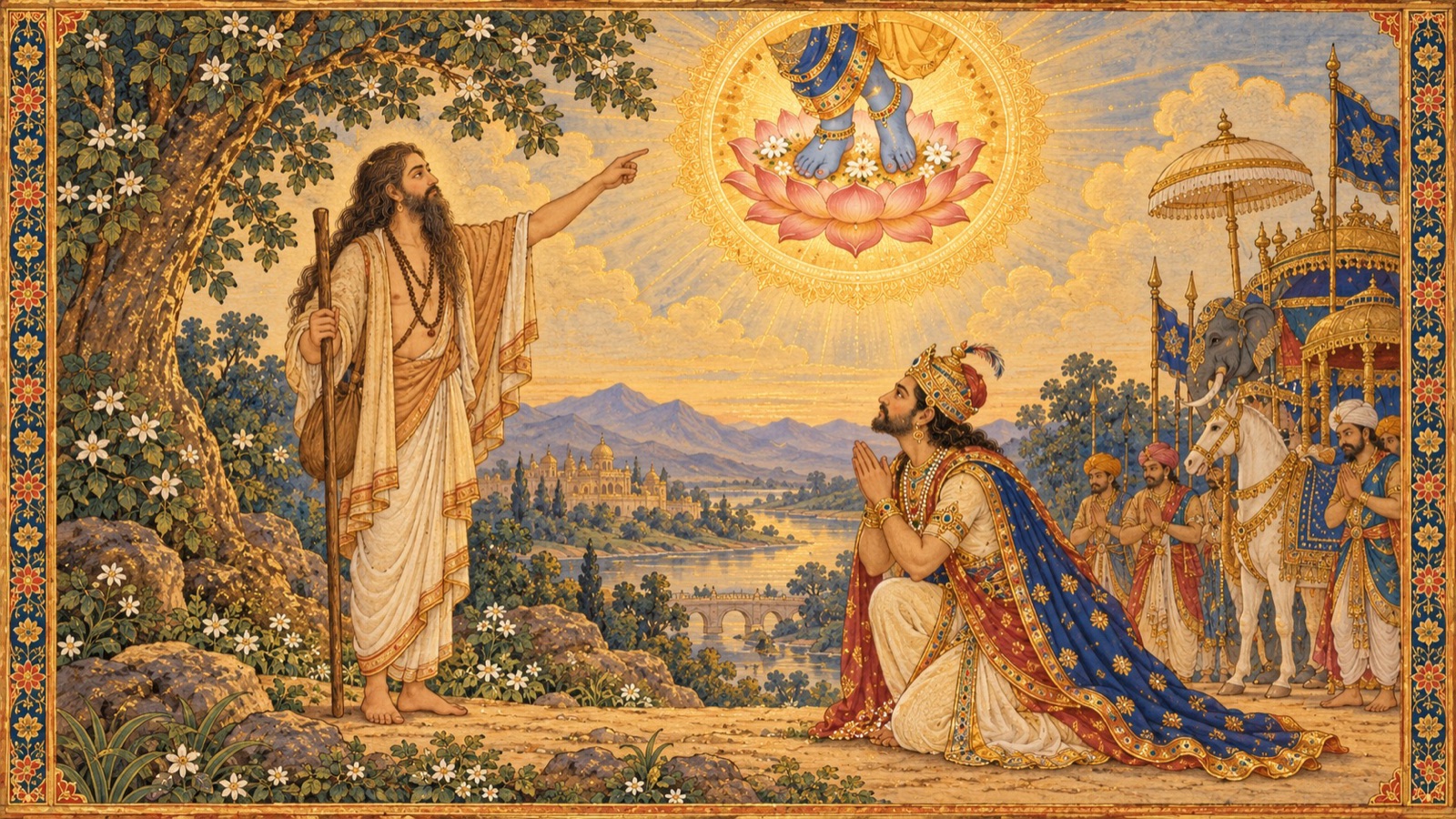
Having shown the king both the bondage of the soul and the Lord who dwells beyond it, the sage came at last to his loving command. So long, he said, as a man cannot shake off this Maya by the rising light of wisdom — cannot loosen his attachments and master the six inner foes of lust and anger, greed and delusion, pride and envy — he wanders on in the round of birth and death. And so long as he fails to see this mind for what it truly is — the soul’s own subtle sign, a fertile field sown thick with grief and delusion, with disease and craving and greed, with enmity and the ceaseless ache of “mine” — the agonies of birth and death keep springing up for him without end.
भ्रातृव्यमेनं तददभ्रवीर्य- मुपेक्षयाध्येधितमप्रमत्त: । गुरोर्हरेश्चरणोपासनास्त्रो जहि व्यलीकं स्वयमात्ममोषम् ॥ १७ ॥
bhrātṛvyam enaṁ tad adabhra-vīryam upekṣayādhyedhitam apramattaḥ guror hareś caraṇopāsanāstro jahi vyalīkaṁ svayam ātma-moṣam
Meaning: Therefore, ever watchful, and taking up as your weapon the worship of the lotus feet of Lord Sri Hari present in the form of your Guru, slay this powerful enemy — the mind — which has grown insolent through your own neglect, and which, though itself unreal, robs you of your very Self. (Canto 5, Chapter 11, verse 17)
Principal Teachings of This Chapter
The mind is the root of both bondage and liberation. Driven by the three modes of nature, the mind spins out the whole show of waking and dream and drags the soul through birth after birth. Yet that same mind, turned toward the truth, becomes the door to freedom. Where we set the mind decides everything.
Ritual done for reward cannot by itself reveal the truth. The Vedic paths that promise heaven, and even the loftiest words of scripture, do not open the Self to one who still clings to the sweetness of enjoyment. Only when we are willing to let go of that sweetness, as we let go of a dream, does the truth begin to shine.
Watch the eleven gates. The mind flows out through the senses, the organs of action, and the ego that calls the body “mine,” branching into countless cravings. Knowing these channels for what they are, we need no longer be swept helplessly along them.
The Lord Vasudeva is the witness within. As the one air breathes life through every creature, the Supreme Lord dwells in every heart as the innermost Self, ever pure, looking on at the mind’s restless waves and untouched by them. To remember Him within is to find the still centre of all our unrest.
Cut the knot with the sword of devotion. The mind grows strong and insolent only through our own neglect; though unreal, it robs us of our very Self. The one weapon that slays it is the loving worship of the Lord’s feet, honoured in the person of the Guru. Vigilance and devotion together set the soul free.
A Devotional Reflection
There is something wonderfully tender in this scene: a sage still carrying a king’s palanquin upon his shoulder, and, without a trace of resentment, pouring out for that same king the deepest wisdom of the soul. He does not lecture from a throne; he teaches from beneath a burden. And what he gives the king is not a rebuke but a key — the knowledge that the mind we so often blame our sorrows upon is neither our master nor our enemy by nature, but a servant that has forgotten its place. It binds us only while we feed it, and it grows quiet the moment we withdraw our craving and turn toward the Lord who has been the silent witness all along. How gently the Bhagavatam sets this before us: we are not asked to hate the mind or to wrestle it into submission by force, but to take up a sweeter weapon — the worship of the Lord’s feet, held before us in the living form of the Guru. When even a little of our attention flows there, the whole clamour of the eleven gates begins to fall still, and the soul remembers the freedom that was never truly lost.
A Daily Devotional Practice
Today, keep a gentle watch upon your own mind. When you notice it running out through the senses — reaching after something to see, to taste, to possess, to argue — do not fight it; simply draw it back with a single soft breath and offer that moment to the Lord within, saying inwardly: “Om Namo Bhagavate Vasudevaya.” Once in the day, sit quietly and remember that the same Lord Vasudeva who pervades all things dwells as the witness in your own heart, nearer than your breath. And let your worship of Him rest upon reverence for your teacher and the holy ones who point the way, honouring their guidance as Jada Bharata bade the king to do. In this the mind is not conquered by struggle, but won over by love.
Conclusion
The eleventh discourse of Book Five gives us the crown of Jada Bharata’s teaching to King Rahugana. Still bearing the palanquin, the sage lays open the mystery of the mind: how, ruled by the three modes of nature, it becomes a storehouse of impressions and drags the soul through birth and death — and how that very mind, turned from its cravings, becomes the door to liberation. He counts its eleven streams flowing out to the senses and their objects, and reveals that all of them arise from God alone, who looks on as the pure and silent witness. That witness, he declares, is the Lord Vasudeva Himself, the innermost Self of every being, pervading all as the one air pervades all breath. And he ends with a loving command: to slay the mind’s insolent illusion not by force but by devotion — by taking up the worship of the Lord’s lotus feet, present in the form of the Guru, as the one sure weapon that frees the soul. It is a teaching that turns the whole of our inner life toward God, and shows the humblest heart the way home.
May the divine wisdom of Srimad Bhagavatam awaken pure devotion within our hearts.
Om Namo Bhagavate Vasudevaya.
Jay Shree Madhav.
References and Attribution
- Primary edition: Gita Press, Śrīmad Bhāgavata Mahāpurāṇa, Book Five, Discourse 11, “Bharata’s teaching to king Rahugana.”
- Series: Srimad Bhagavatam Wisdom · Biswa Sanatan Dharma Seva Trust.
- Presented following the spiritual guidance and recommendation of Pandit Dr. Shri Kashinath Mishra.
This is an original, faithful retelling in the writer’s own words, with brief quoted verses shown in Devanāgarī and transliteration and their meanings given as summaries. It is not a reproduction of any single publisher’s continuous translation or commentary. No affiliation with or endorsement by any publisher is implied.
Jay Shree Madhav