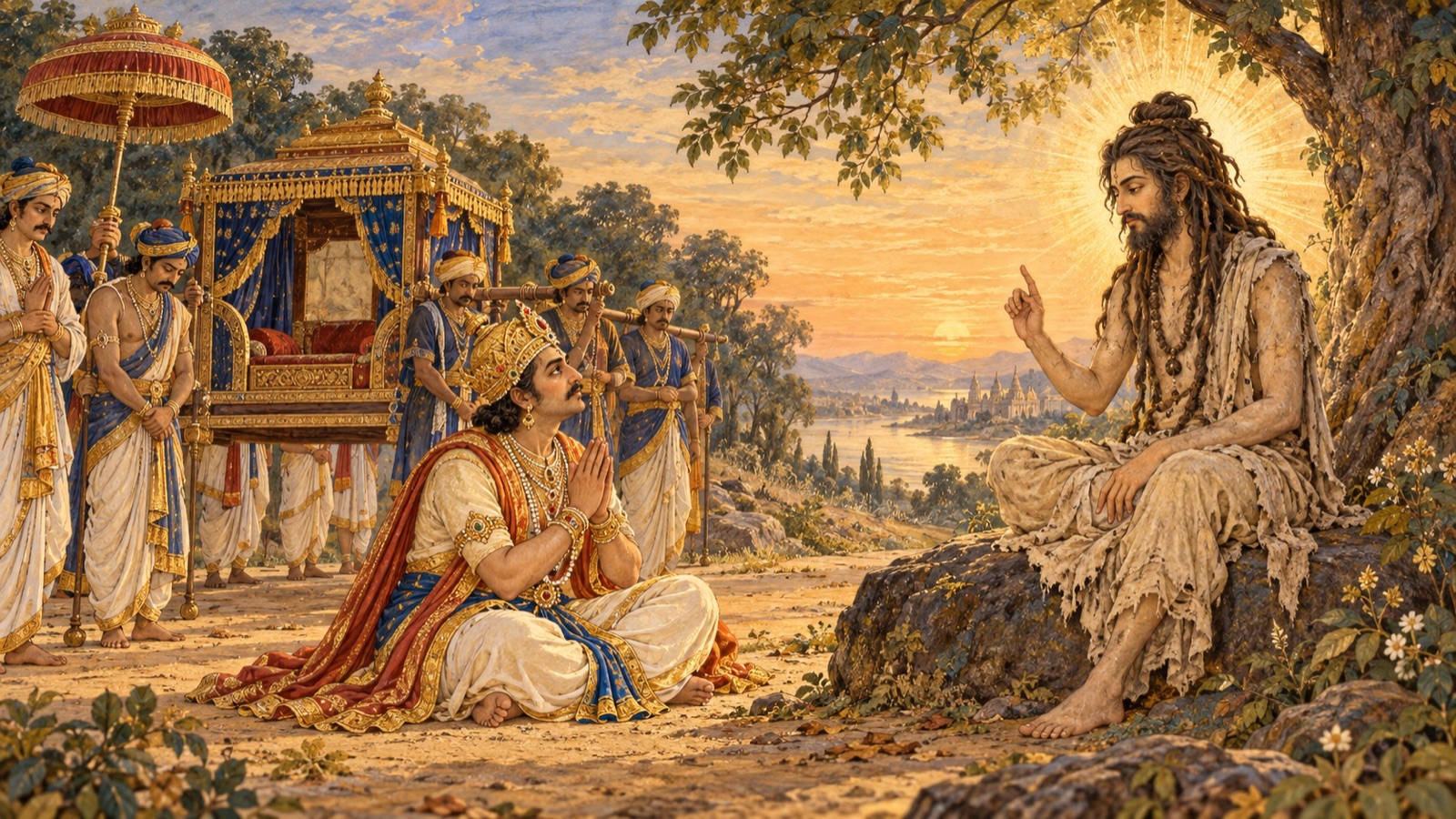
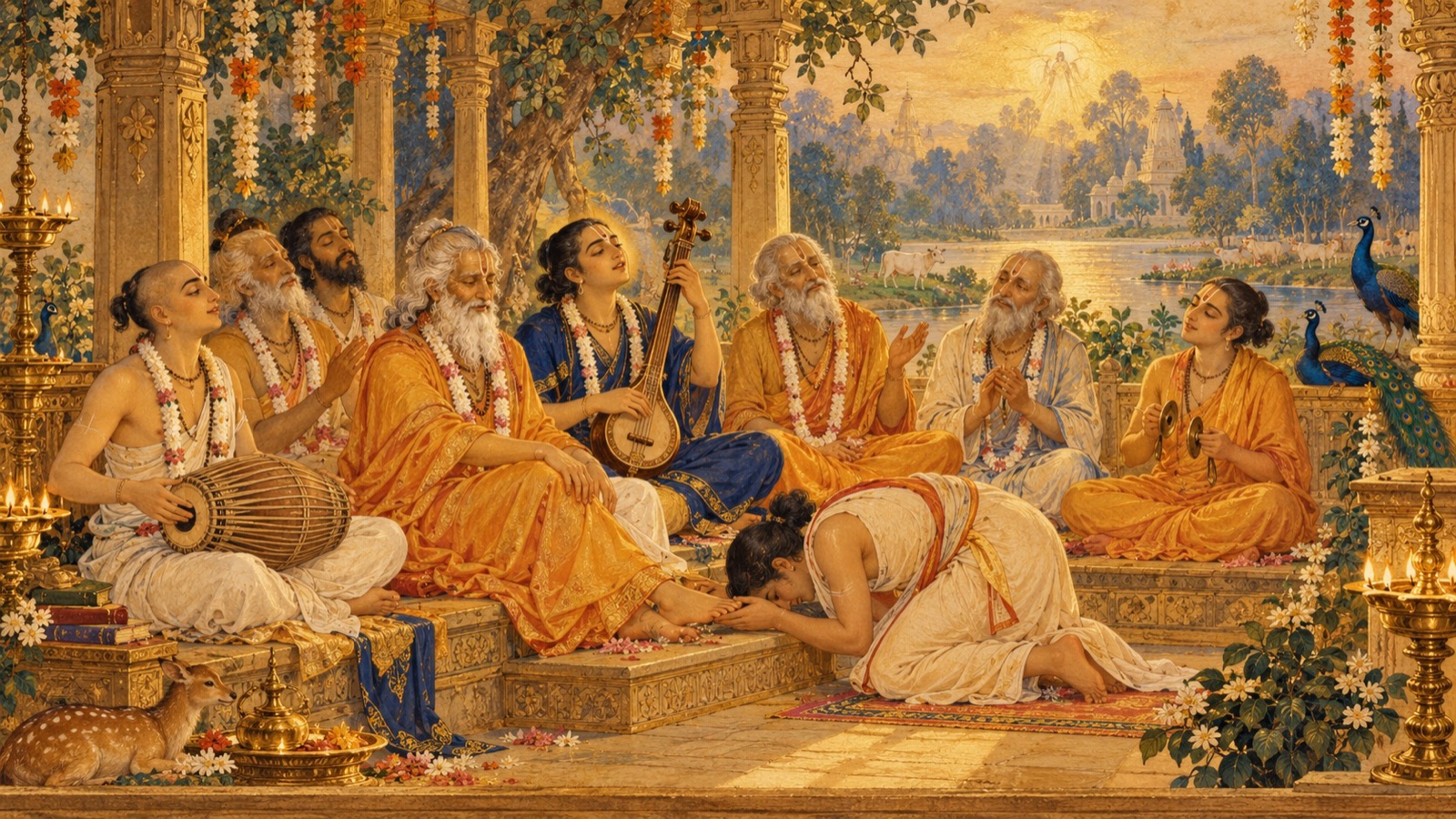
His pride melted away, King Rahugana sits with folded hands before the sage Jada Bharata, drinking in a teaching that lifts the whole world of names and forms into the light of the one changeless Reality, whom the wise call Vasudeva.
Om Namo Bhagavate Vasudevaya.
Om Namo Bhagavate Vasudevaya.
Om Namo Bhagavate Vasudevaya.
Welcome back to Srimad Bhagavatam Wisdom, a devotional journey through the sacred histories and teachings of the Srimad Bhagavat Mahapurana. In this twelfth chapter of Book Five, the mighty King Rahugana — who only a little while before had mocked and threatened the silent sage carrying his palanquin — now bows before him with folded hands, calling his words a nectar that has healed a heart poisoned by pride. And out of that humbled longing pours one of the most searching teachings in all the scripture. With gentle, unanswerable clarity, the sage takes apart the very idea of “king” and “bearer,” of stout and lean, of great and small, showing them all to be passing names upon a world spun from the Lord’s own energy — until only the one pure Consciousness remains, whom the wise call Vasudeva. And then, tenderly, he lifts his disguise and tells the king who he truly is.
Chapter Information
- Scripture: Śrīmad Bhāgavata Mahāpurāṇa
- Canto: 5 (Book Five)
- Chapter: 12 (Discourse 12)
- Chapter title: Jada Bharata’s Reply to King Rahugana
- Principal speaker: Sukadeva Gosvami (Sri Suka), narrating to King Parikshit; within the narration, the sage Jada Bharata (the Brahmana) speaks to King Rahugana, who questions him first
- Principal listener: King Parikshit — the discourse related in turn by Suta Gosvami to the sages gathered at Naimisaranya
- Main setting: The road along which King Rahugana travels by palanquin, where he has descended to sit humbly at the sage’s feet
- Central subject: King Rahugana’s grateful homage and question, and the sage’s reply — that all worldly distinctions are but names upon a creation of the Lord’s Maya, that pure Consciousness known as Vasudeva alone is real, that this is reached only through the dust of the feet of great devotees, and the sage’s revelation that he was once King Bharata
- Principal verse range: Canto 5, Chapter 12, verses 1–16
- Primary edition: Gita Press Śrīmad Bhāgavata Mahāpurāṇa
From the Previous Chapter
In the eleventh discourse, the sage — still bearing the palanquin — taught King Rahugana that the mind is the true root of both bondage and liberation. He described how the restless mind, driven by its many functions and the modes of nature, binds the soul to endless action and its fruits, while the Self remains only the silent witness within. And he urged the king to cut the strong knot of the mind by taking shelter of a genuine spiritual guide and the loving service of the Lord. Now, his heart pierced and softened, King Rahugana turns to the sage again — no longer to command, but to worship and to learn.
King Rahugana’s Homage
Where a moment before there had been a proud ruler upon his seat, now there was only a humbled seeker. King Rahugana bowed again and again before the sage, offering his obeisance to one who had taken this god-like form for the good of the world, and who, resting in the bliss of Self-realization, held his own body as a thing of no account. He greeted him as an avadhuta — a liberated soul wandering free — who had hidden his eternal, ever-present realization beneath the plain outward mark of a Brahmana whom the world thought worthless.
रहूगण उवाच नमो नम: कारणविग्रहाय स्वरूपतुच्छीकृतविग्रहाय । नमोऽवधूत द्विजबन्धुलिङ्ग- निगूढनित्यानुभवाय तुभ्यम् ॥ १ ॥
rahūgaṇa uvāca namo namaḥ kāraṇa-vigrahāya svarūpa-tucchīkṛta-vigrahāya namo ’vadhūta dvija-bandhu-liṅga- nigūḍha-nityānubhavāya tubhyam
Meaning: Rahugana said: Obeisance again and again to you, who have taken this god-like form for the world’s good and who, absorbed in the bliss of the Self, hold your own body as nothing. O avadhuta, obeisance to you, who have concealed your eternal, ever-present realization beneath the outward mark of an unworthy Brahmana. (Canto 5, Chapter 12, verse 1)
The king confessed how the sage’s words had reached him. Like a wholesome medicine to one burning with fever, like cool water to one scorched by the sun, that teaching had proved a nectar-like remedy to him — to him whose very sight had been warped, as if bitten by a serpent, by his identification with this perishable body. He begged the sage to set aside, for the moment, the doubt he would raise later, and to explain to him now, plainly and clearly, that teaching so laden with deep spiritual meaning; for his mind was still bewildered by the words that actions and their visible effects, though not unreal, could not stand the test of a searching enquiry into truth.
The Body Is But a Modification of Earth
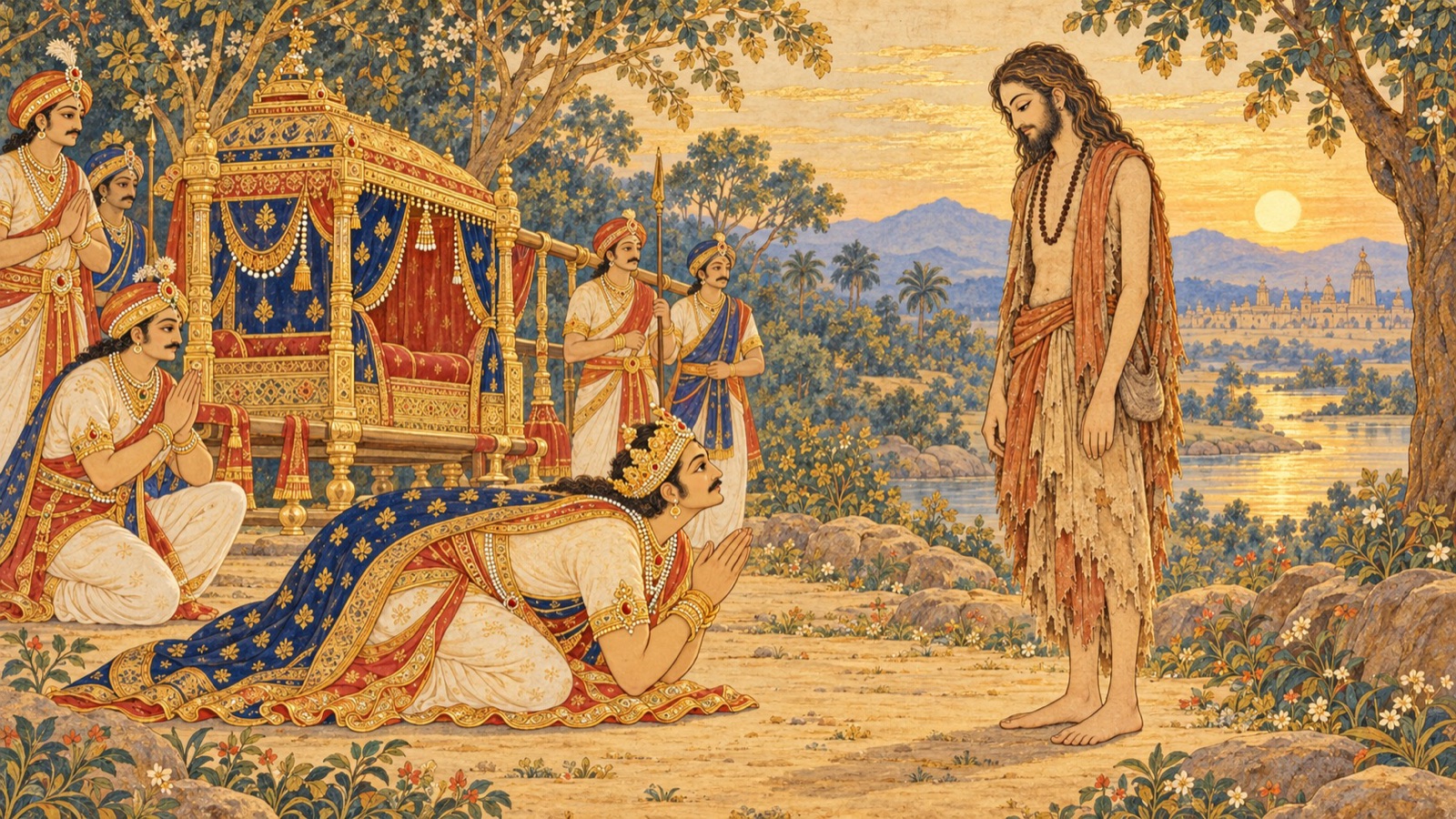
Then the Brahmana began his reply, and with the first words he loosened the ground beneath the king’s every assumption. That thing which moves about upon the earth, he said, is itself only a transformation of earth, and for one reason or another it comes to be called “a man” — the very bearer of the palanquin. Above its feet stand the ankles and shanks, the knees and thighs, the waist and chest, the neck and the two shoulders. And upon one of those shoulders rests the wooden palanquin, in which sits yet another transformation of earth that men have given the title “king of Sauvira.” Having identified himself with that little heap of earth, the sage said gently, the king fancied “I am the ruler of the Sindhus,” blinded by an empty and destructive pride.
ब्राह्मण उवाच अयं जनो नाम चलन् पृथिव्यां य: पार्थिव: पार्थिव कस्य हेतो: । तस्यापि चाङ्घ्र्योयोरधि गुल्फजङ्घा- जानूरुमध्योरशिरोधरांसा: ॥ ५ ॥ अंसेऽधि दार्वी शिबिका च यस्यां सौवीरराजेत्यपदेश आस्ते । यस्मिन् भवान् रूढनिजाभिमानो राजास्मि सिन्धुष्विति दुर्मदान्ध: ॥ ६ ॥
brāhmaṇa uvāca ayaṁ jano nāma calan pṛthivyāṁ yaḥ pārthivaḥ pārthiva kasya hetoḥ tasyāpi cāṅghryor adhi gulpha-jaṅghā- jānūru-madhyora-śirodharāṁsāḥ aṁse ’dhi dārvī śibikā ca yasyāṁ sauvīra-rājety apadeśa āste yasmin bhavān rūḍha-nijābhimāno rājāsmi sindhuṣv iti durmadāndhaḥ
Meaning: The Brahmana said: This being that moves upon the earth, O king, is itself but a transformation of earth, and for some reason comes to be called “a man.” Above its feet are the ankles, shanks, knees and thighs, the waist, the chest, the neck and the two shoulders; and upon one shoulder rests the wooden palanquin, in which sits another transformation of earth bearing the title “king of Sauvira.” Identifying yourself with that, you imagine, “I am the ruler of the Sindhus,” blinded by vain pride. (Canto 5, Chapter 12, verses 5-6)
Nor did the sage spare the king’s conscience. Those poor people whom he had constrained to labour for him without wage, he said — people already crushed by misery and deserving of pity — were witnesses to his heartlessness; and when he boasted that he was their guardian and protector, he only made himself a sorry figure in the eyes of the wise.
All Distinctions Are but Names
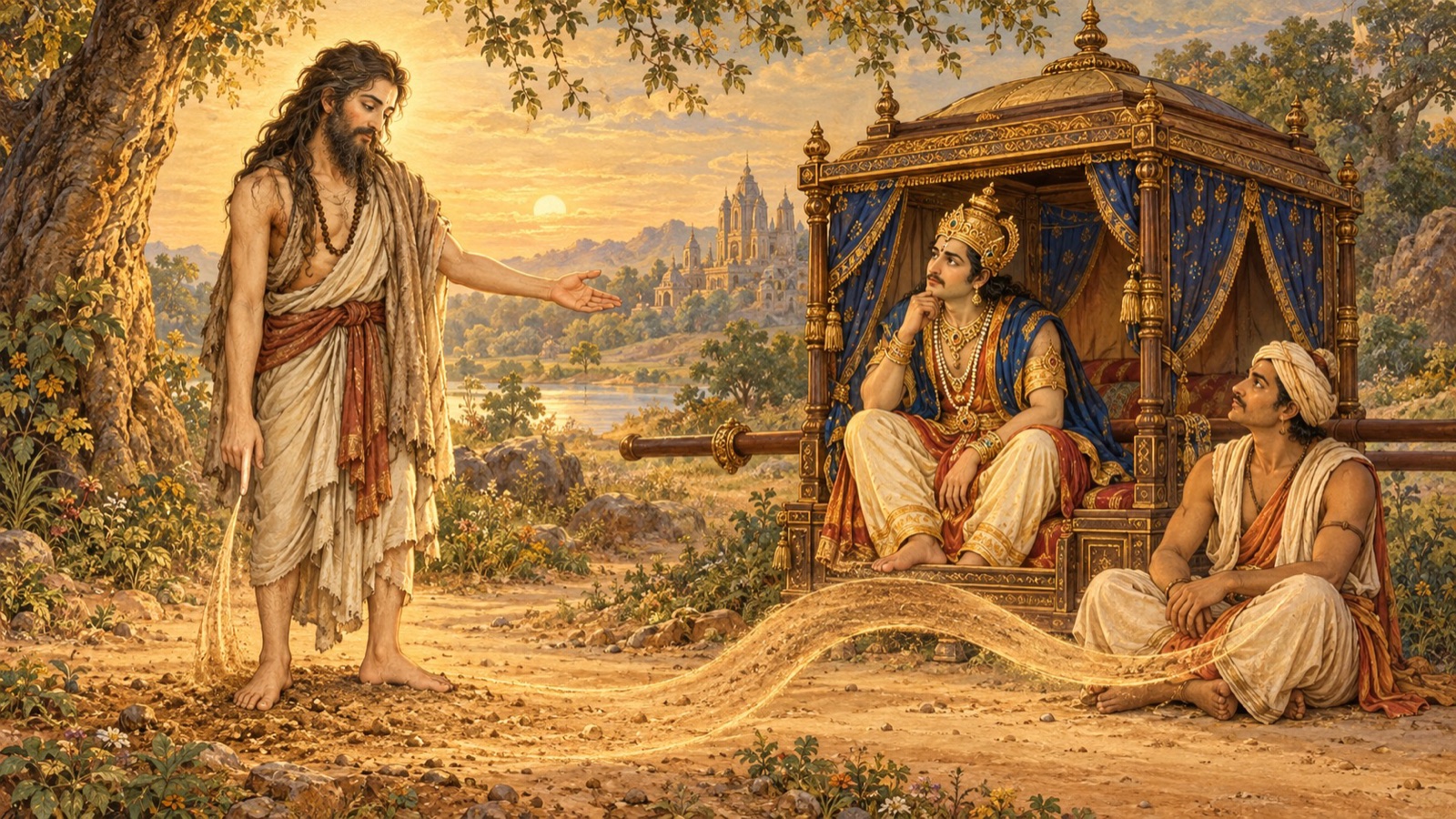
Having shown that both palanquin-bearer and king are alike shaped of earth, the sage pressed the question to its root. Since we plainly see that this whole world of moving and unmoving things forever rises out of the earth and dissolves back into it, he asked, what real ground is there for all our dealings — for master and servant, ruler and subject — apart from the mere names we give to passing forms of clay?
यदा क्षितावेव चराचरस्य विदाम निष्ठां प्रभवं च नित्यम् । तन्नामतोऽन्यद् व्यवहारमूलं निरूप्यतां सत् क्रिययानुमेयम् ॥ ८ ॥
yadā kṣitāv eva carācarasya vidāma niṣṭhāṁ prabhavaṁ ca nityam tan nāmato ’nyad vyavahāra-mūlaṁ nirūpyatāṁ sat-kriyayānumeyam
Meaning: When we know that this whole world of moving and unmoving beings forever springs from the earth and is dissolved back into it, tell me — apart from mere names, is there any real ground beneath our dealings that can be shown to be true by the work we take from it? (Canto 5, Chapter 12, verse 8)
And even that word “earth,” he continued, does not stand as something ultimately solid. It too resolves, on enquiry, into its finest particles; and those atoms themselves, by whose supposed combination the element called earth is said to arise, are only postulated by the mind through ignorance. So it is, he said, with everything else that appears to us — lean or stout, small or great, cause or effect, living or lifeless. All of it is to be known as a creation of Maya, the Lord’s own beginningless power, which men label with many names: substance and nature, disposition and the Time-Spirit and destiny. These are the shifting names of a dream; they are not the waking truth.
The One Reality, Whom the Wise Call Vasudeva
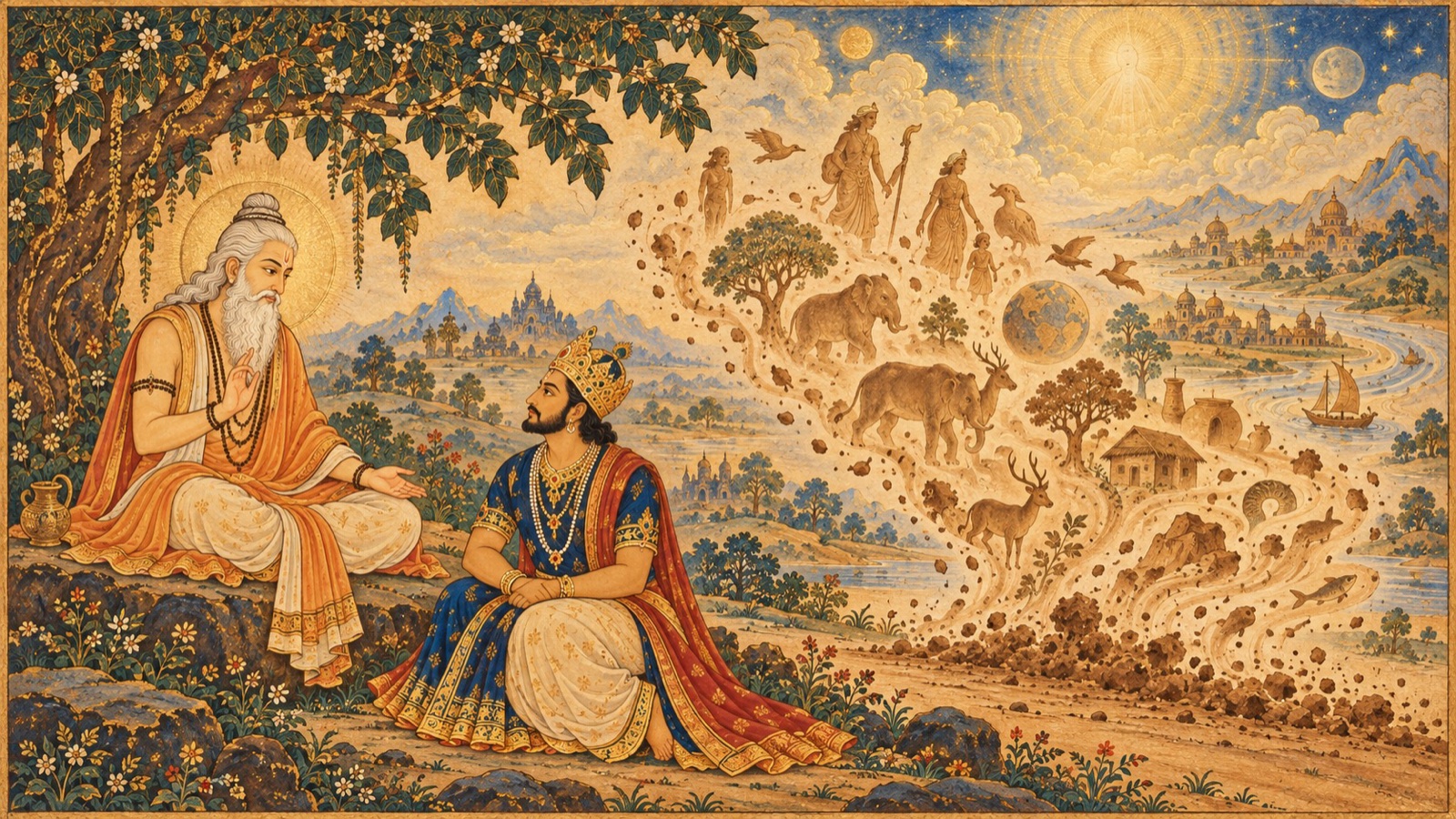
Where, then, is the truth that does not pass away? Having emptied the world of every false solidity, the sage now lifted the king’s gaze to the one thing that abides. Consciousness alone is real, he said — Consciousness that is perfectly pure, supreme, one without a second, having neither an inside nor an outside, complete in itself, turned wholly toward the Self, and forever changeless. This is what is meant by the word Bhagavan, the almighty and all-glorious Lord; and this, the seers declare, is Vasudeva, the resting-place and refuge of all beings.
ज्ञानं विशुद्धं परमार्थमेक- मनन्तरं त्वबहिर्ब्रह्म सत्यम् । प्रत्यक् प्रशान्तं भगवच्छब्दसंज्ञं यद्वासुदेवं कवयो वदन्ति ॥ ११ ॥
jñānaṁ viśuddhaṁ paramārtham ekam anantaraṁ tv abahir brahma satyam pratyak praśāntaṁ bhagavac-chabda-saṁjñaṁ yad vāsudevaṁ kavayo vadanti
Meaning: Consciousness alone is true — Consciousness that is pure, supreme, one without a second, having neither inside nor outside, all-perfect, turned toward the Self and changeless; this is what is named by the word Bhagavan, whom the seers call Vasudeva, the abode of all beings. (Canto 5, Chapter 12, verse 11)
There is a reason the sage frames this as three ascending stages rather than a single flat statement. The very knowledge he describes is first glimpsed as Brahman — the featureless, all-pervading light of the Self, won by those who simply negate the world of names. Yogis who press further, seeking that same truth as a living Presence within the heart, know it as Paramatma, the indwelling Supersoul. But the sage insists that neither stopping point is the end: the same one Reality, known completely, is Bhagavan — the Lord possessed of infinite qualities, form and pastimes, whom the wise call Vasudeva. This is why King Rahugana’s proud negation of “king” and “bearer” was only the first step; the sage does not leave him resting in an empty, impersonal truth, but leads him all the way to the Person who is that truth’s living fullness. (verse 11)
The Dust of the Feet of the Devotees
But how is this pure Reality to be reached? Here the sage revealed the tender secret at the very heart of his teaching, and it was not what a king might expect. This Consciousness, he said, is not won by austerities, nor by sacrifices, nor by giving away food and wealth in charity, nor by the faithful discharge of household duties, nor by the study of the Vedas, nor even by the worship of water, fire and the sun — by none of these alone. It is gained by one thing: bathing oneself in the dust of the feet of the great souls, the pure devotees of the Lord.
रहूगणैतत्तपसा न याति न चेज्यया निर्वपणाद् गृहाद्वा । नच्छन्दसा नैव जलाग्निसूर्यै- र्विना महत्पादरजोऽभिषेकम् ॥ १२ ॥
rahūgaṇaitat tapasā na yāti na cejyayā nirvapaṇād gṛhād vā na cchandasā naiva jalāgni-sūryair vinā mahat-pāda-rajo-’bhiṣekam
Meaning: O Rahugana, no penance, ritual offering, gift of wealth, householder’s routine, Vedic recitation, or reverence paid to water, fire and sun can carry a soul there — that ground is reached only when one lets the dust from a great soul’s feet fall upon one’s own head. (Canto 5, Chapter 12, verse 12)
For it is in the company of such holy souls, the sage explained, that the glories and excellences of the Lord are sung and heard. Their gatherings shut out all the empty chatter of worldly pleasures; and those sacred discourses, listened to day after day, gently draw the purified mind of the seeker of liberation to rest wholly upon Lord Vasudeva.
The Sage Reveals He Was Once King Bharata
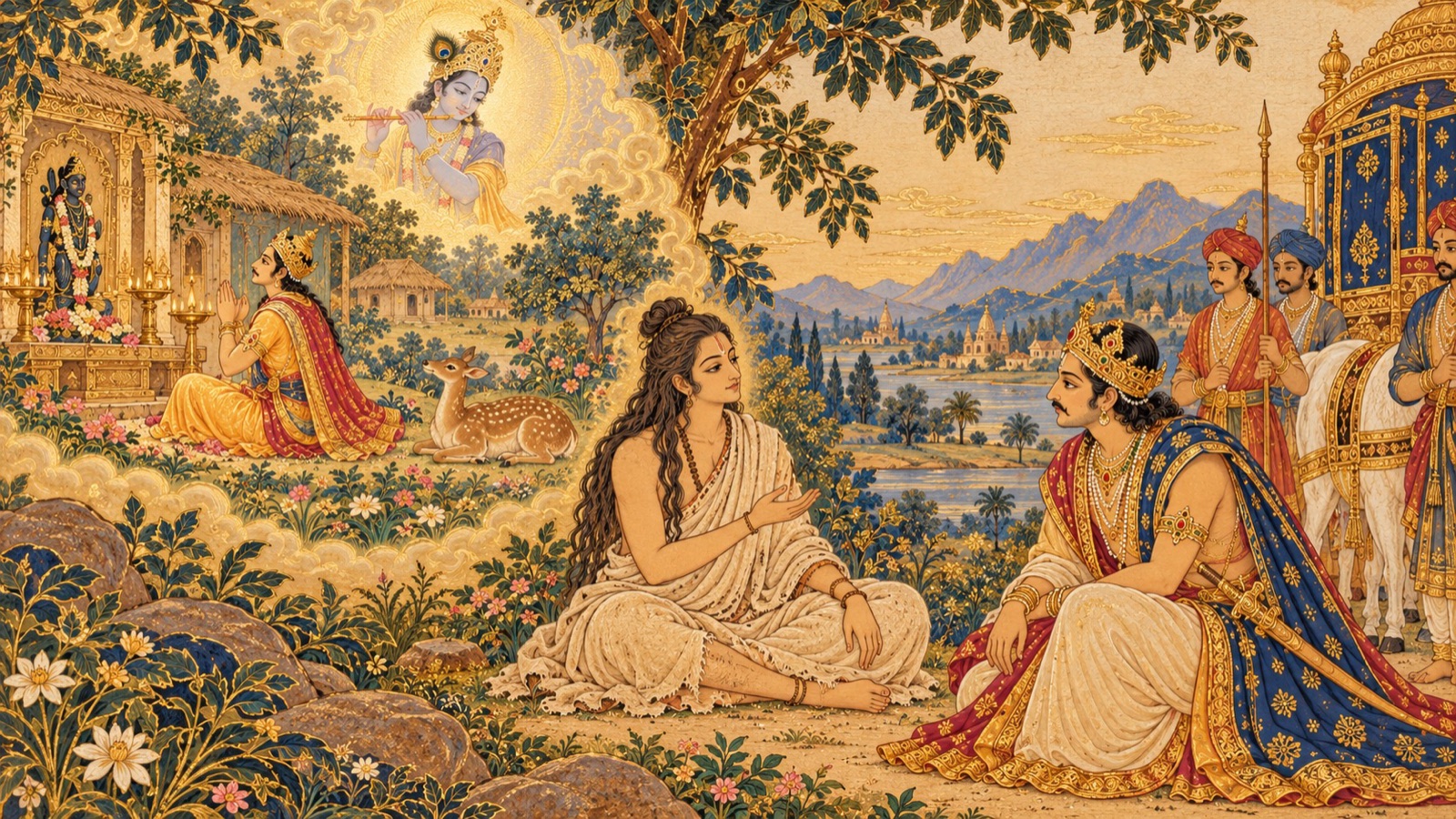
And now, having lifted the king from pride to longing, the sage lifted his own disguise. He had not always worn this dust and this silence, he said. Once he too had been a king — Bharata by name — who had cut himself free from every bond of attachment to the pleasures seen in this world or promised in the next, and had striven with his whole heart to worship the Lord. Yet through a single tender attachment — his love for an orphaned deer — he had been reborn as a deer himself, and so for a time had lost the very goal he had sought.
अहं पुरा भरतो नाम राजा विमुक्तदृष्टश्रुतसङ्गबन्ध: । आराधनं भगवत ईहमानो मृगोऽभवं मृगसङ्गाद्धतार्थ: ॥ १४ ॥
ahaṁ purā bharato nāma rājā vimukta-dṛṣṭa-śruta-saṅga-bandhaḥ ārādhanaṁ bhagavata īhamāno mṛgo ’bhavaṁ mṛga-saṅgād dhatārthaḥ
Meaning: I was formerly a king named Bharata, freed from every bond of attachment to what is seen here or heard of hereafter. Striving to worship the Lord, I yet became a deer through attachment to a deer, and so lost my aim. (Canto 5, Chapter 12, verse 14)
Yet the Lord’s mercy had not failed him even then. The memory of his former life, awakened in him by the worship of Lord Sri Krishna, did not desert him even in that animal body. That is why, he told the king, he now moved through the world unknown and unattached, wary of the entangling company of men. And this, he said, is the way for every soul: having severed all the ties of infatuation with the sword of wisdom sharpened in the company of the holy, and having gained the constant remembrance of God by telling and hearing the stories of Sri Hari, a man crosses at last to the farthest shore of his long journey — and reaches the Lord Himself.
Principal Teachings of This Chapter
Worldly rank rests on nothing but a name. King and bearer, ruler and ruled — the sage shows that all such titles are given to passing forms of earth. When we see this even a little, the pride of high station and the shame of low station both lose their power over us.
The whole visible world is a play of Maya. Small and great, cause and effect, living and lifeless — every distinction we so anxiously defend is, the sage teaches, a creation of the Lord’s own energy, appearing under many names. It is real as a dream is real, and just as fleeting.
Consciousness alone is the truth, and its name is Vasudeva. Beneath and beyond the shifting world stands the one pure, changeless Reality — the Lord Himself, whom the sages call Vasudeva, the resting-place of all. To know Him is to find the ground that never gives way.
The surest path is the dust of the devotees’ feet. Not austerity, not ritual, not learning by itself opens the door, but the humble grace of the company of holy souls, where the glories of the Lord are sung and heard. Devotion carried on the words of the saints does what all our striving cannot.
Even a great fall cannot undo the Lord’s mercy. The sage’s own story — a devoted king reborn as a deer through one attachment, yet never abandoned by the Lord — teaches us both to guard the heart against small attachments and to trust that sincere worship is never lost.
A Devotional Reflection
What tenderness there is in this chapter, once we notice it. A king who had raised his hand to punish a labourer is now seated at that labourer’s feet, and the sage — who might have every right to a proud silence — answers him not with rebuke but with the highest gift he has: the truth. He does not humiliate the king; he frees him. He takes apart, brick by patient brick, the whole proud structure of “I am the ruler, and this is mine,” not to leave the king with nothing, but to lead him to the one thing that can never be taken away — the pure, changeless Reality that is the Lord Himself. And then, most movingly, the sage lays down his own disguise and confesses his fall, as if to say: I too once had far to travel; I too was saved not by my strength but by the Lord’s remembrance and the mercy of the holy. There is no coldness in this wisdom, only compassion. It tells us that the ground we stand on — our names, our ranks, our possessions — will all dissolve like clay in water, and it gently turns us toward the one refuge that will not: the feet of the Lord, and the dust of the feet of those who love Him.
A Daily Devotional Practice
Today, whenever you catch yourself leaning on a title, a role or a possession — “I am the one in charge,” “this is mine,” “I am important here” — pause and remember the sage’s quiet words: all of this is a passing name upon a form of earth. Loosen your grip, if only a little, and turn inward to the Lord who is your true and changeless ground, saying softly: “Om Namo Bhagavate Vasudevaya.” And take up the sage’s surest path in one small act — read or hear a little of the glories of Sri Hari today, or spend a few minutes in the company (in person or through their words) of those who love Him. In seeking the dust of the devotees’ feet, we walk the very road the sage marked out for the king.
Conclusion
The twelfth discourse of Book Five gives us the fruit of King Rahugana’s humbling. Bowing before the sage he had wronged, the king praises his words as a healing nectar and begs to be taught; and the sage answers with a teaching of rare depth. He shows that the bearer below and the king above are alike but transformations of earth, that all the world’s distinctions are mere names upon a creation of Maya, and that Consciousness alone is real — the Lord whom the wise call Vasudeva. This, he reveals, is not reached by austerity or ritual or learning, but only by the dust of the feet of great devotees, in whose company the glories of the Lord are heard. And then he lifts his disguise, telling how he was once King Bharata, fell through a single attachment into the body of a deer, and was carried through it all by the mercy of Sri Krishna. It is a chapter that empties our hands of every false support and fills them instead with the one refuge that endures.
May the divine wisdom of Srimad Bhagavatam awaken pure devotion within our hearts.
Om Namo Bhagavate Vasudevaya.
Jay Shree Madhav.
References and Attribution
- Primary edition: Gita Press, Śrīmad Bhāgavata Mahāpurāṇa, Book Five, Discourse 12, “Bharata answers the query of Rahugana.”
- Series: Srimad Bhagavatam Wisdom · Biswa Sanatan Dharma Seva Trust.
- Presented following the spiritual guidance and recommendation of Pandit Dr. Shri Kashinath Mishra.
This is an original, faithful retelling in the writer’s own words, with brief quoted verses shown in Devanāgarī and transliteration and their meanings given as summaries. It is not a reproduction of any single publisher’s continuous translation or commentary. No affiliation with or endorsement by any publisher is implied.
Jay Shree Madhav