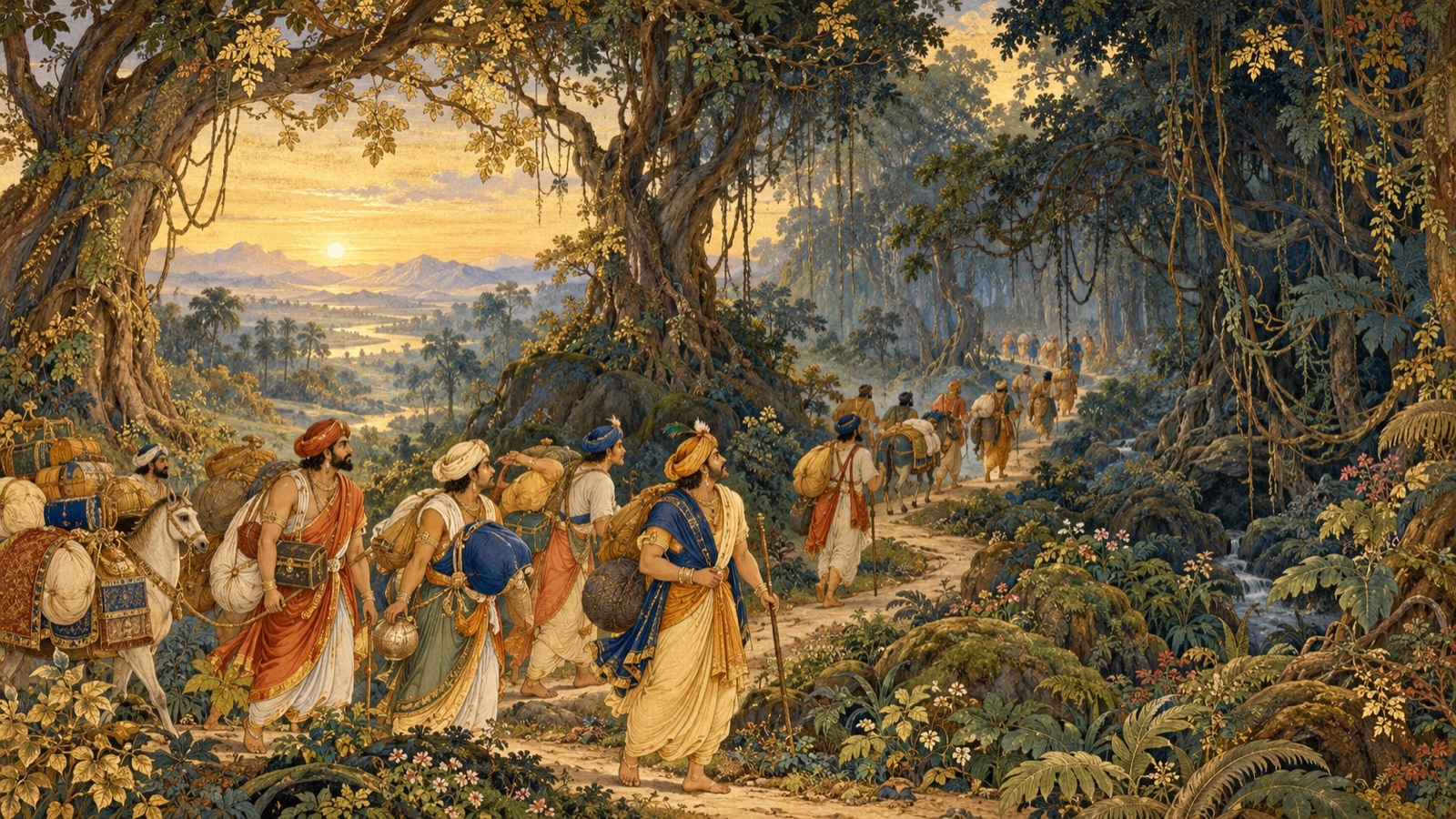
A great company of merchant-souls, laden with their goods and driven by the longing for gain, wanders into the vast, trackless forest of worldly existence — and nowhere in all its shadows do they find the happiness they seek.
Om Namo Bhagavate Vasudevaya.
Om Namo Bhagavate Vasudevaya.
Om Namo Bhagavate Vasudevaya.
Welcome back to Srimad Bhagavatam Wisdom, a devotional journey through the sacred histories and teachings of the Srimad Bhagavat Mahapurana. Seated by the roadside, the silent sage Jada Bharata unfolds for King Rahugana one of the most searching parables in all the scripture — the whole of our worldly wandering pictured as a great forest, and the soul as a lost merchant who enters it seeking wealth and finds only thorns, mirages and grief. Every scene the sage paints is a mirror; and when at last he lifts the sword of wisdom before the king’s eyes, the parable turns to grace, and Rahugana’s every doubt melts away at the dust of his feet.
Chapter Information
- Scripture: Śrīmad Bhāgavata Mahāpurāṇa
- Canto: 5 (Book Five)
- Chapter: 13 (Discourse 13)
- Chapter title: The Forest of Worldly Existence
- Principal speaker: Sukadeva Gosvami (Sri Suka), narrating to King Parikshit; within the narration, Jada Bharata — “the Brahmana” — speaks to King Rahugana, who in turn replies, and King Parikshit closes with a question
- Principal listener: King Parikshit — the discourse related in turn by Suta Gosvami to the sages gathered at Naimisaranya
- Main setting: The roadside where King Rahugana, having descended from his palanquin, sits at the feet of the sage Jada Bharata
- Central subject: Jada Bharata’s allegory of worldly existence as a dense forest through which a company of merchant-souls wanders, harried by robbers, mirages, beasts and fires; the counsel to take up the sword of wisdom and cross to the far shore; and the resolving of King Rahugana’s doubts
- Principal verse range: Canto 5, Chapter 13, verses 1–26
- Primary edition: Gita Press Śrīmad Bhāgavata Mahāpurāṇa
From the Previous Chapter
In the twelfth discourse, King Rahugana — humbled and awakened — set aside his royal pride and put his questions to the sage with folded hands. Jada Bharata answered him gently on the Self that stands wholly apart from the body, on the emptiness of worldly rank, and on the one sure path that opens for a soul touched by the dust of the feet of the Lord’s great devotees. Recalling even his own former births, the sage showed the king how far the true Self is from all that fortune gives or takes. It is to this softened, seeking heart that the sage now speaks again, unfolding the great parable of the forest.
Souls as Merchants in the Forest of the World
Taking up his teaching once more, the sage began to draw a picture the king could carry in his heart. Imagine, he said, a company of merchants set upon a long and difficult road by Maya, the beginningless deluding power of the Lord — a road whose far end is desperately hard to reach. Their vision divided by the three qualities of goodness, passion and darkness, and thinking only of gain, these traders press on into a vast forest of mundane existence; and nowhere in all its reaches do they find any lasting delight.
ब्राह्मण उवाच दुरत्ययेऽध्वन्यजया निवेशितो रजस्तम:सत्त्वविभक्तकर्मदृक् । स एष सार्थोऽर्थपर: परिभ्रमन् भवाटवीं याति न शर्म विन्दति ॥ १ ॥
brāhmaṇa uvāca duratyaye ’dhvany ajayā niveśito rajas-tamaḥ-sattva-vibhakta-karmadṛk sa eṣa sārtho ’rtha-paraḥ paribhraman bhavāṭavīṁ yāti na śarma vindati
Meaning: The Brahmana said: Set by beginningless Maya upon a path so hard to cross, seeing his works divided by the qualities of passion, darkness and goodness, and bent only upon gain, this company of merchant-souls wanders into the forest of worldly existence and finds no happiness there. (Canto 5, Chapter 13, verse 1)
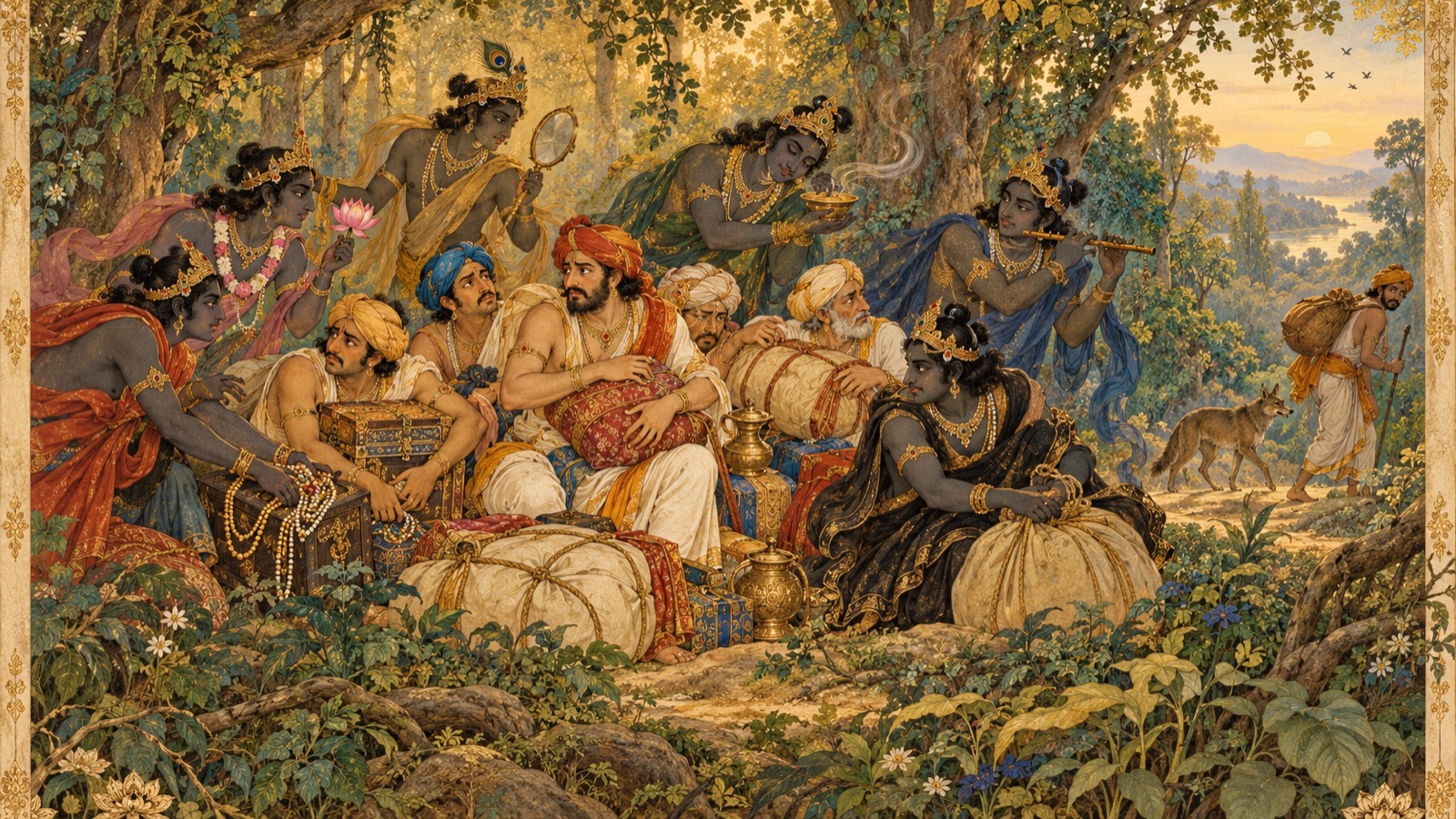
In that forest, the sage went on, six highwaymen lie in wait, falling upon the company led by an unworthy chief and stripping the travelers of all they carry. And when a member strays unwary, jackals steal in and drag him off, as wolves carry away a sheep that has wandered from the flock.
Mirages, Phantom Cities, and Deceiving Lights
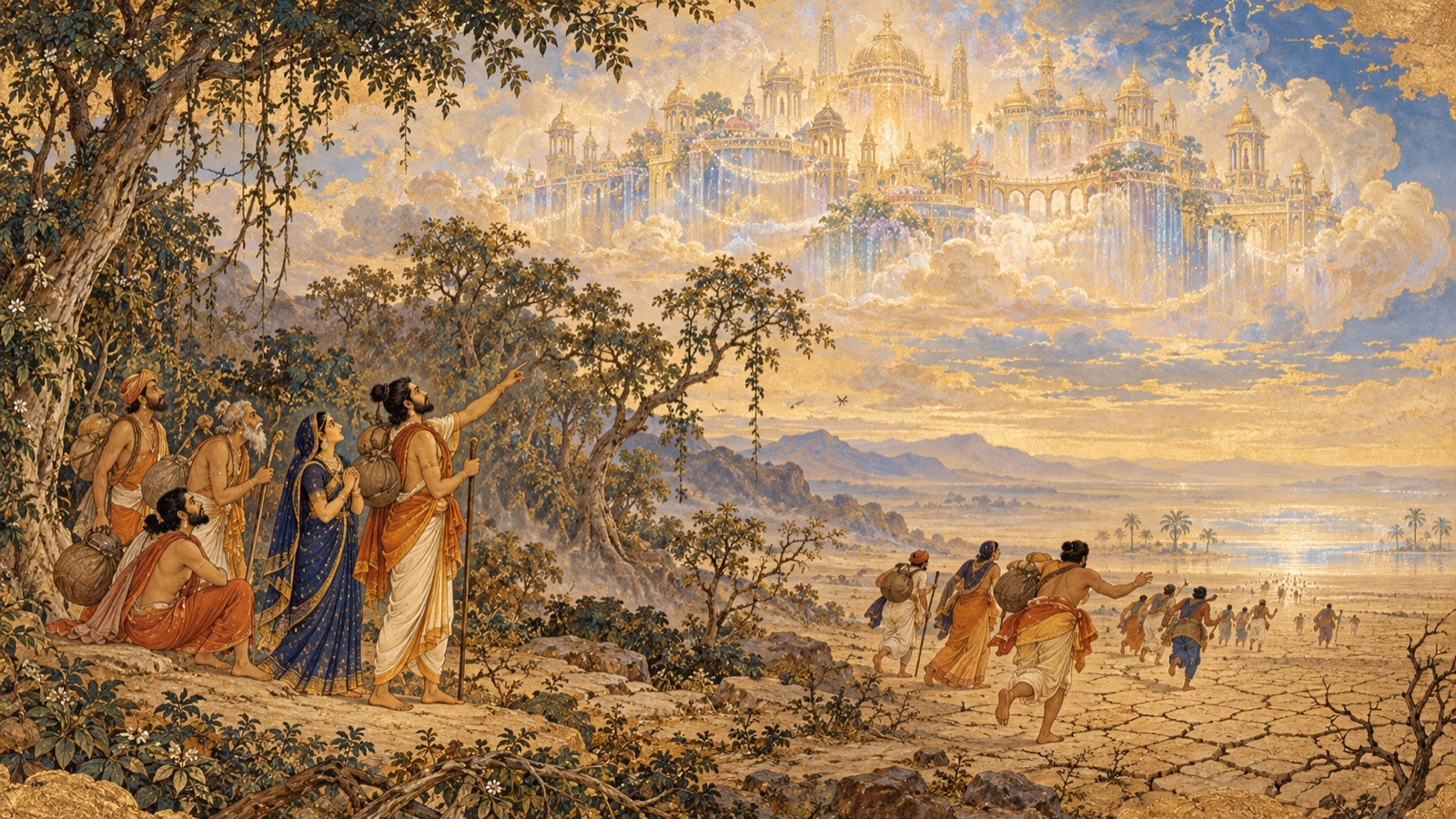
On the travelers press, and the forest turns ever more bewildering. Harried by cruel biting gnats and mosquitoes in a thicket dense with creepers and shrubs, they lift their eyes and behold in the sky a shining city that is not there at all — a phantom city of the Gandharvas; and elsewhere a fleeting, flickering shape like a whirling firebrand, gone before it can be named.
प्रभूतवीरुत्तृणगुल्मगह्वरे कठोरदंशैर्मशकैरुपद्रुत: । क्वचित्तु गन्धर्वपुरं प्रपश्यति क्वचित्क्वचिच्चाशुरयोल्मुकग्रहम् ॥ ३ ॥
prabhūta-vīrut-tṛṇa-gulma-gahvare kaṭhora-daṁśair maśakair upadrutaḥ kvacit tu gandharva-puraṁ prapaśyati kvacit kvacic cāśu-rayolmuka-graham
Meaning: Harassed by cruel gnats and mosquitoes in a thicket dense with creepers, grass and shrubs, here he beholds a phantom city of the Gandharvas in the sky, and there, again and again, a fleeting will-o’-the-wisp like a whirling firebrand. (Canto 5, Chapter 13, verse 3)
Taking dwelling, water and wealth to be their own, they run this way and that, sometimes so blinded by whirling dust that they cannot tell one direction from another. Parched with thirst, they chase a mirage and march toward streams that hold no water; starving, they beg food of one another; here a forest fire scorches them, and there they despair, about to be slain by fierce Yaksas. Robbed of their wealth by stronger men, they grieve and faint away — and then, stumbling into some new phantom city, they rejoice for an hour as though they had found happiness at last.
The Hunt for Honey and the Snatching of Gains
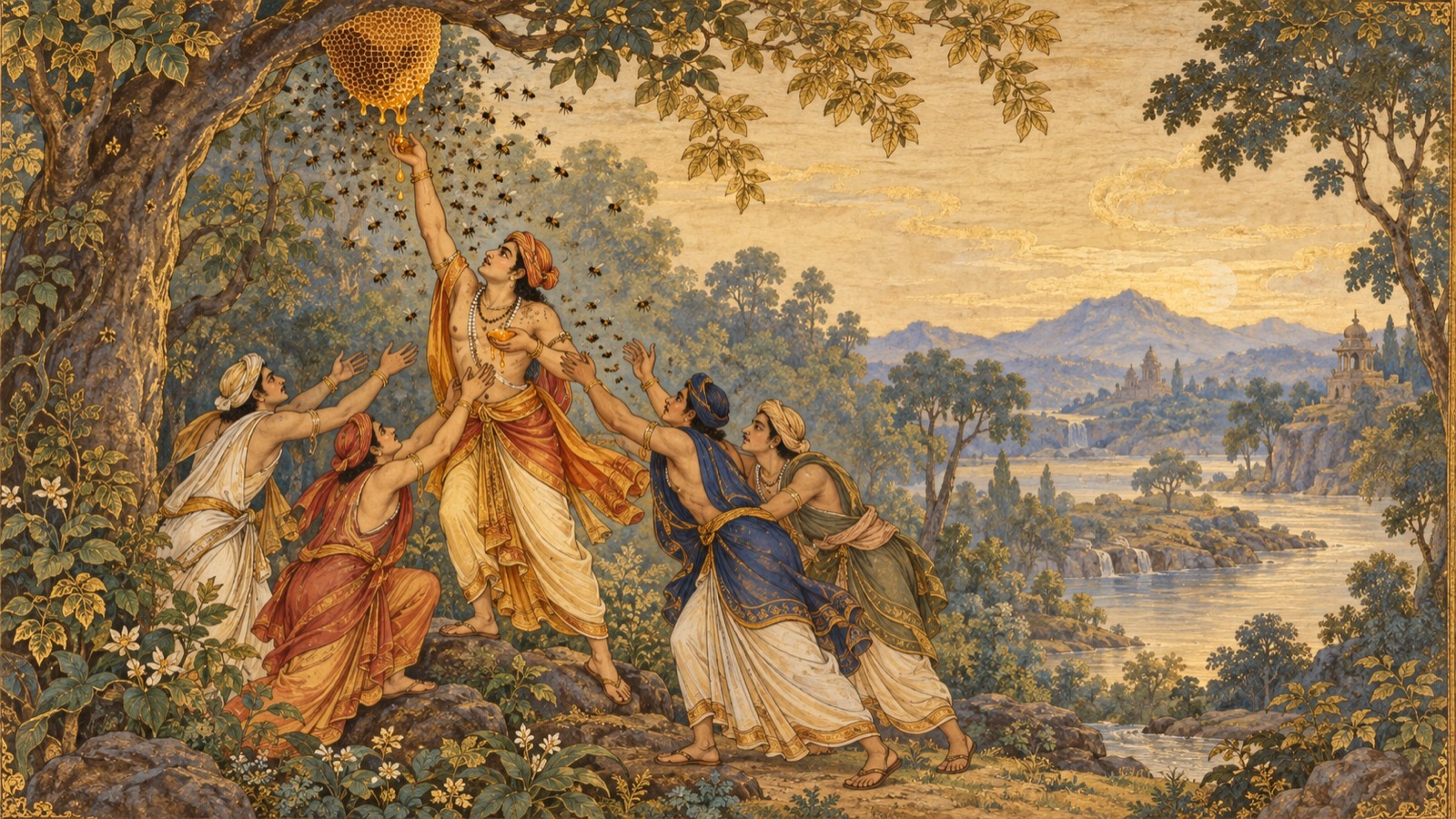
Still they struggle on. Longing to reach a hilltop, they set out, but their feet are torn by thorns and they sink down disheartened; burdened with a family they cannot support and gnawed by hunger, they turn in anger even upon their own people. A python swallows one and he lies senseless; another, bitten by poisonous creatures, tumbles into a covered, deceptive well and lies in darkness, robbed of his sight. And sometimes, hunting after little drops of honey, they are stung and tormented by the very bees that hoard it; and if with great pain they win a little sweetness, others plunder it by force, and still others snatch away whatever is left.
कर्हि स्म चित्क्षुद्ररसान् विचिन्वं- स्तन्मक्षिकाभिर्व्यथितो विमान: । तत्रातिकृच्छ्रात्प्रतिलब्धमानो बलाद्विलुम्पन्त्यथ तं ततोऽन्ये ॥ १० ॥
karhi sma cit kṣudra-rasān vicinvaṁs tan-makṣikābhir vyathito vimānaḥ tatrāti-kṛcchrāt pratilabdhamāno balād vilumpanty atha taṁ tato ’nye
Meaning: Sometimes, gathering tiny drops of sweetness, he is stung and tormented by the bees that guard it; and if with great hardship he does obtain a little, others forcibly plunder it, and still others snatch it away. (Canto 5, Chapter 13, verse 10)
At other times they find no shelter from cold, sun, wind and rain and sit down helpless; elsewhere they barter their few possessions and, through sheer greed, turn one another into enemies. Impoverished and lacking even a bed, a home or a carriage, they beg these things of others; and failing to obtain them, they cast a covetous eye upon what belongs to others and earn only disgrace.
Ties of the World and the Endless March
Even as their enmity grows sharper — inflamed by craving for one another’s wealth — the travelers enter into marriage ties, and are dragged down again and again by hardship, loss and calamity. At every stage they leave their dead behind and carry each new-born babe onward, and so the company marches on. Not one has ever returned from that journey; nor does anyone take up the Yoga that alone leads to the road’s far end. Even mighty heroes, who once subdued the great elephants guarding the eight quarters, at last bite the dust in battle, having made bitter war over the earth — and none of them reaches the goal won so easily by the recluse who has laid down all enmity.
Fear of the Tiger and the Creeper Over the Ravine
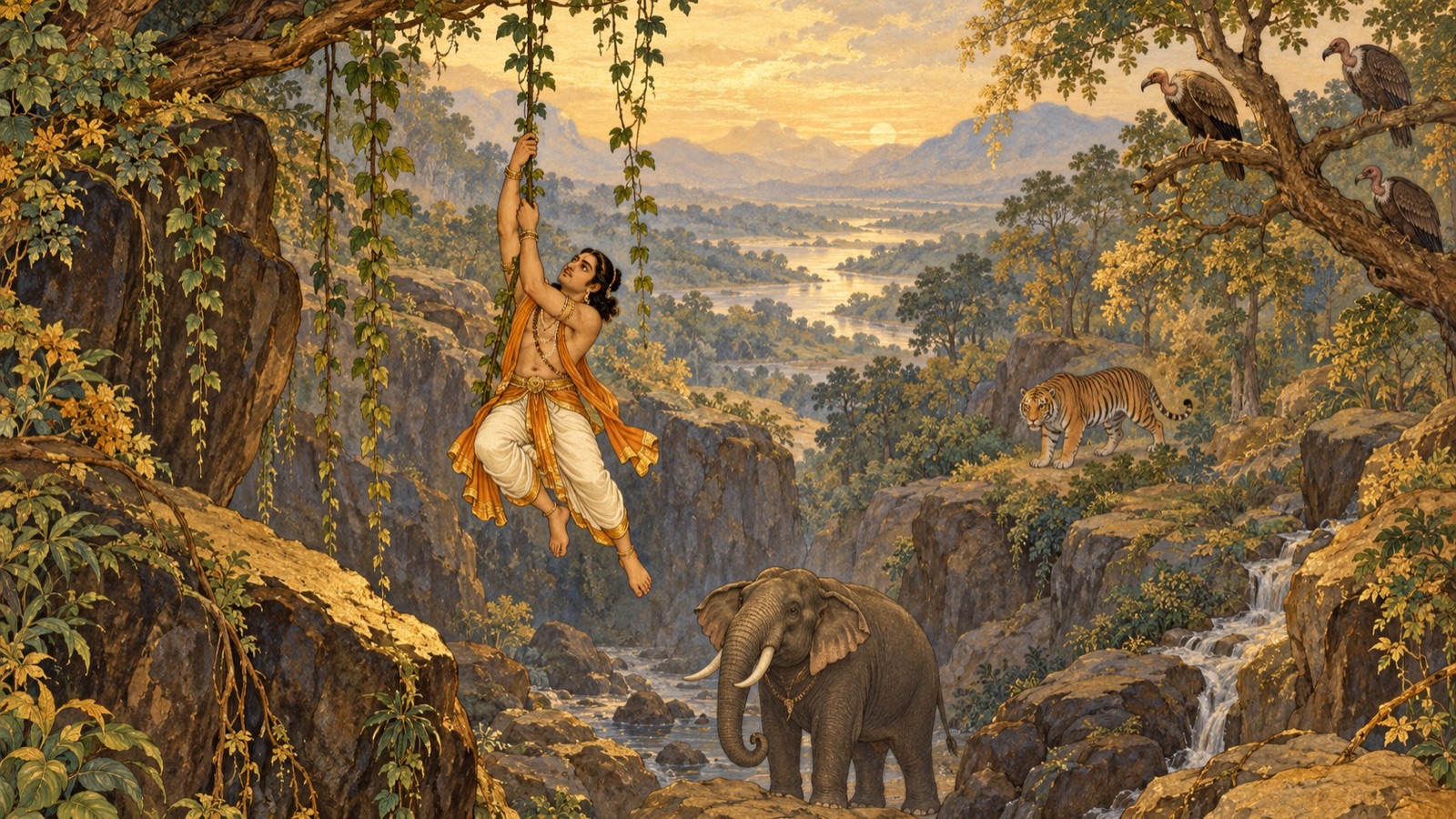
Somewhere along the way, the sage continued, a wanderer clings to the tender, arm-like shoots of a creeper, enchanted by the sweetly warbling birds sheltered in it, and grows bound to that one spot. And sometimes, trembling with fear of the tigers, he strikes up friendship with cranes, herons and vultures.
प्रसज्जति क्वापि लताभुजाश्रय- स्तदाश्रयाव्यक्तपदद्विजस्पृह: । क्वचित्कदाचिद्धरिचक्रतस्त्रसन् सख्यं विधत्ते बककङ्कगृध्रै: ॥ १६ ॥
prasajjati kvāpi latā-bhujāśrayas tad-āśrayāvyakta-pada-dvija-spṛhaḥ kvacit kadācid dhari-cakratas trasan sakhyaṁ vidhatte baka-kaṅka-gṛdhraiḥ
Meaning: Somewhere he clings to the arm-like shoots of a creeper, longing for the sweetly warbling birds that shelter there; and at times, afraid of the tigers, he makes friends with cranes, herons and vultures. (Canto 5, Chapter 13, verse 16)
Betrayed by them, he seeks the swans, and disliking their ways he joins the monkeys; and there, his senses gratified with idle sport, each pair grows so absorbed in gazing at the other’s face that they forget their fast-approaching death. Doting on sons and wife, powerless to loosen the knot of his bondage — and then, falling by mischance into a ravine, a straggler catches at a creeper and hangs suspended, terrified of the elephant below. Somehow scrambling free, he rejoins the company once more. And so it goes: no one set upon this track by beginningless Maya has, to this very day, grasped the supreme object of life.
The Sword of Wisdom
Then, with all the tenderness of a friend, the sage turned the whole parable toward the man before him. You too, O Rahugana, he said, have been set upon this very road. Lay down every kind of violence; make yourself the friend of all living beings; and taking up the sword of true wisdom — its edge whetted keen upon the loving service of Sri Hari — with a heart unattached to the senses, cut your way across to the far shore of this endless path.
रहूगण त्वमपि ह्यध्वनोऽस्य सन्न्यस्तदण्ड: कृतभूतमैत्र: । असज्जितात्मा हरिसेवया शितं ज्ञानासिमादाय तरातिपारम् ॥ २० ॥
rahūgaṇa tvam api hy adhvano ’sya sannyasta-daṇḍaḥ kṛta-bhūta-maitraḥ asaj-jitātmā hari-sevayā śitaṁ jñānāsim ādāya tarāti-pāram
Meaning: You too, O Rahugana, have been set upon this road. Laying down all violence, befriending every living being, and taking up the sword of wisdom whetted by the worship of Sri Hari, with a mind unattached, cross over to the far shore of this path. (Canto 5, Chapter 13, verse 20)
The King’s Doubts Are Resolved
At these words the king’s heart overflowed. Oh, cried Rahugana, this human birth is the highest of all births! What are even the loftiest births in heaven worth, where the blessed fellowship of exalted souls like you — whose minds are made pure by the glories of Lord Vishnu — cannot be had in abundance? Small wonder, he said, that unclouded love for the Lord who lies beyond the senses should awaken in a heart whose sins your lotus-dust has already swept away — for a single hour in your presence, he confessed, has uprooted the very ignorance that years of crooked reasoning had planted in him.
न ह्यद्भुतं त्वच्चरणाब्जरेणुभि- र्हतांहसो भक्तिरधोक्षजेऽमला । मौहूर्तिकाद्यस्य समागमाच्च मे दुस्तर्कमूलोऽपहतोऽविवेक: ॥ २२ ॥
na hy adbhutaṁ tvac-caraṇābja-reṇubhir hatāṁhaso bhaktir adhokṣaje ’malā mauhūrtikād yasya samāgamāc ca me dustarka-mūlo ’pahato ’vivekaḥ
Meaning: It is no wonder that spotless devotion to the Lord beyond the senses should arise in one whose sins have been washed away by the dust of your lotus feet, seeing that a single hour’s fellowship with you has rooted out my ignorance, which was grounded in false reasoning. (Canto 5, Chapter 13, verse 22)
Hail to the Brahmanas, cried the king — to the aged and the infants, to the young and to all — and may every ruler be blessed by those holy ones who wander the earth in the plain garb of ascetics, having shaken off all worldly ties.

Insulted as he had been — made to bear a king’s palanquin like a beast of burden — Jada Bharata let no resentment take root. Sukadeva explains why: whatever a great soul’s senses register when mistreated soon settles, for the truly realized are, by their very nature, tolerant, compassionate and the well-wisher of every embodied being, holding no one as friend or enemy (verse 24). It was this unconditional compassion, asking nothing in return and owed to no good behavior beforehand, that let him forgive Rahugana the instant the king begged pardon at his feet — and this, more than any external power, is why the mercy of a realized soul, once met, can undo in a single hour what a lifetime of one’s own striving cannot. And so, out of that boundless compassion, having taught the true nature of the Self to the very man who had insulted him, that glorious son of a Brahmana sage roamed the earth once more, serene as an ocean full on every side, the waves of his senses wholly at rest.
Rahugana, lord of Sauvira, having grasped from that saintly soul the true nature of the Supreme Spirit, cast off forever the ignorant notion that he was the body — and it is here that Sri Suka draws out the lesson directly for Parikshit.
सौवीरपतिरपि सुजनसमवगतपरमात्मसतत्त्व आत्मन्यविद्याध्यारोपितां च देहात्ममतिं विससर्ज । एवं हि नृप भगवदाश्रिताश्रितानुभाव: ॥ २५ ॥
sauvīra-patir api sujana-samavagata-paramātma-satattva ātmany avidyādhyāropitāṁ ca dehātma-matiṁ visasarja; evaṁ hi nṛpa bhagavad-āśritāśritānubhāvaḥ
Meaning: The lord of Sauvira, too, having learned the true nature of the Supreme Spirit from that saintly soul, cast off the notion, planted by ignorance, that he was the body — so great, O King, is the good fortune of one who takes shelter of the shelter of the Lord’s own devotee. (Canto 5, Chapter 13, verse 25)
Then King Parikshit, wishing its every hidden meaning to be laid open, asked Sukadeva to unfold, point by point, the inner sense of the great forest-allegory.
Principal Teachings of This Chapter
The world is a forest, and gain-seeking makes us its lost travelers. The soul bent only on acquiring — wealth, comfort, name — enters the tangled forest of worldly existence and finds no lasting peace anywhere in it.
Our senses are robbers, and a misled mind is an unworthy guide. The six highwaymen who plunder the company are the senses; the unworthy chief who leads them astray is the uncontrolled mind. Guarded by neither wisdom nor devotion, the traveler is stripped of all he gathers.
The pleasures of the world are mirages and phantom cities. The shining city in the sky, the waterless streams, the hour’s joy in an imaginary town — every worldly delight promises fullness and dissolves on approach. To chase them is to run after water that was never there.
The sword of wisdom, whetted by devotion, cuts the soul free. The sage’s remedy is not despair but action: renounce all violence, befriend every creature, worship Sri Hari, and let that loving service sharpen the blade of wisdom until it severs every bond. This alone leads to the road’s far end.
A single hour with a true devotee can undo a lifetime of delusion. The dust of a saint’s feet washes away sin, and one hour of holy company roots out the ignorance of years, as Rahugana himself discovered.
A pure devotee’s mercy is unconditional, and that is its power. Because the realized soul is tolerant, compassionate and the friend of all beings by nature, his forgiveness costs him nothing to extend, even to one who has wronged him — which is why shelter taken through the Lord’s own devotee, however humbly, carries a grace strong enough to dissolve a lifetime’s bodily conception.
A Devotional Reflection
There is something in this forest that we recognize at once, because we have walked in it. We too have chased the shining city that vanished as we neared it; we too have reached for a little honey and been stung, and had even that snatched from our hands; we too have clung to some trailing creeper of comfort while the ground fell away beneath us. Jada Bharata paints the forest not to frighten us but to wake us — the way a friend shakes a dreamer gently by the shoulder. And notice where his parable ends: not in the dark, but in the light of a sword, and then in the dust of a saint’s feet. The soul is not condemned to wander forever. There is a way across, nearer than we think — laying down our quarrels, befriending every living thing, and turning our love toward the Lord until it grows keen enough to cut every knot. Rahugana was a proud king lost in the same forest as we are, and one honest hour in holy company set him free. The same grace waits for every seeking heart.
A Daily Devotional Practice
Today, choose one “phantom city” you have been chasing — some possession, praise or pleasure you have told yourself will finally make you content — and gently set it down before the Lord, admitting that the peace you seek was never hidden inside it. Then take up, in its place, one small stroke of the sword of wisdom: make peace with someone, spare a small creature, or offer a kindness to a living being you would ordinarily overlook, doing it as worship of Sri Hari. As you do, say inwardly: “Om Namo Bhagavate Vasudevaya.” And if you can, spend even a few minutes today in the company or the words of a true devotee of the Lord — for as Jada Bharata promises, a single hour of such fellowship can begin to root out the delusion of years.
Conclusion
The thirteenth discourse of Book Five gives us Jada Bharata’s great parable of the forest of worldly existence. The soul, he teaches, is a merchant driven by Maya to seek gain along a road almost impossible to cross; entering the tangled forest of the world, he is robbed by the six senses, deceived by mirages and phantom cities, stung when he reaches for sweetness, and terrified by beasts and fires — marching on with the whole company of embodied souls, none of whom ever returns or reaches the goal by mere striving. Then the sage lifts the parable into hope: take up the sword of wisdom, whetted upon the loving service of Sri Hari, renounce all violence, befriend every creature, and cross to the far shore. The words pierce King Rahugana to the heart; his ignorance is torn out at the root, his false sense of being the body falls away, and he adores the sage’s feet — proof that even the servant of the Lord’s servant carries a grace strong enough to set a soul entirely free.
May the divine wisdom of Srimad Bhagavatam awaken pure devotion within our hearts.
Om Namo Bhagavate Vasudevaya.
Jay Shree Madhav.
References and Attribution
- Primary edition: Gita Press, Śrīmad Bhāgavata Mahāpurāṇa, Book Five, Discourse 13.
- Series: Srimad Bhagavatam Wisdom · Biswa Sanatan Dharma Seva Trust.
- Presented following the spiritual guidance and recommendation of Pandit Dr. Shri Kashinath Mishra.
This is an original, faithful retelling in the writer’s own words, with brief quoted verses shown in Devanāgarī and transliteration and their meanings given as summaries. It is not a reproduction of any single publisher’s continuous translation or commentary. No affiliation with or endorsement by any publisher is implied.
Jay Shree Madhav