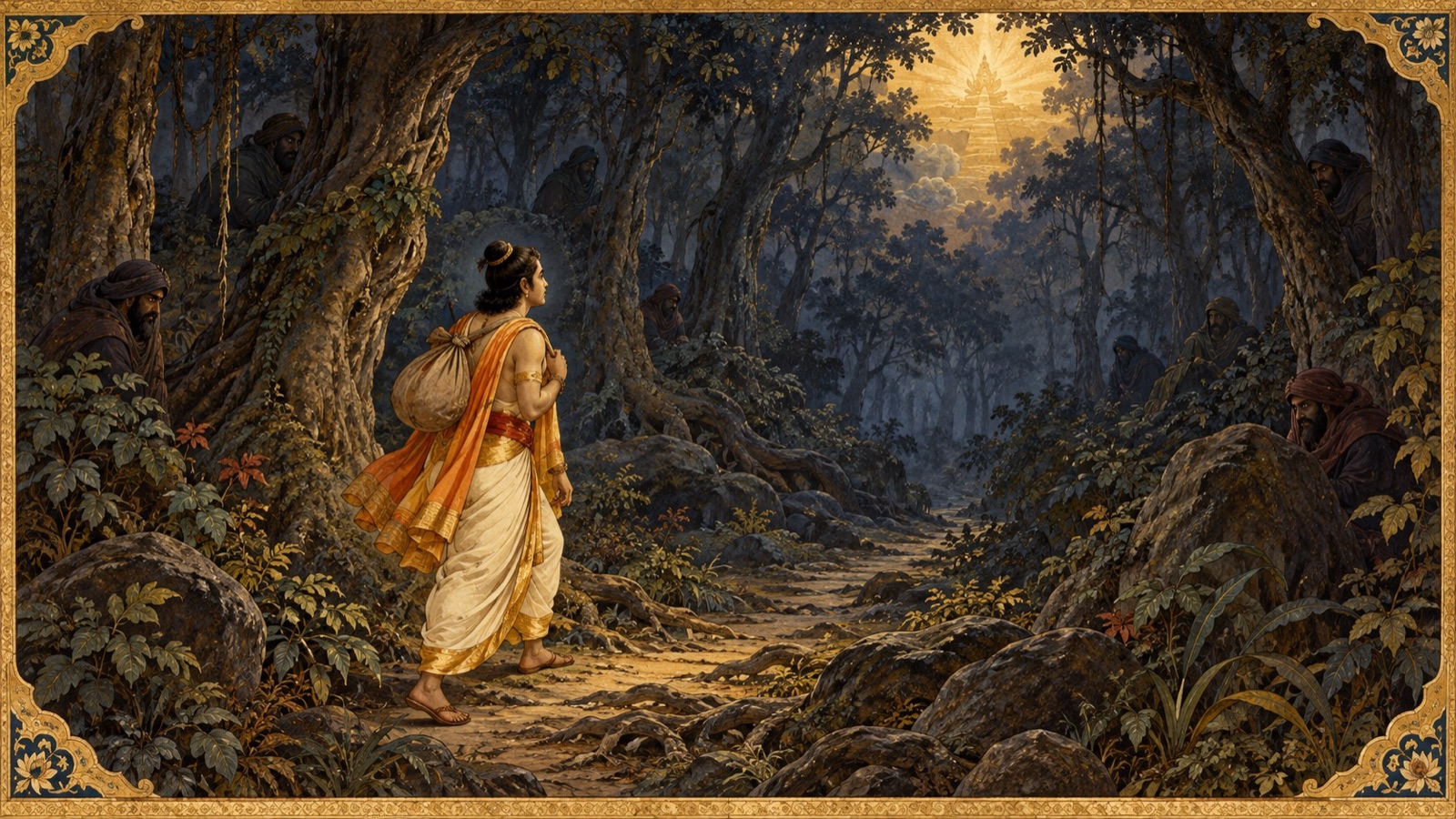
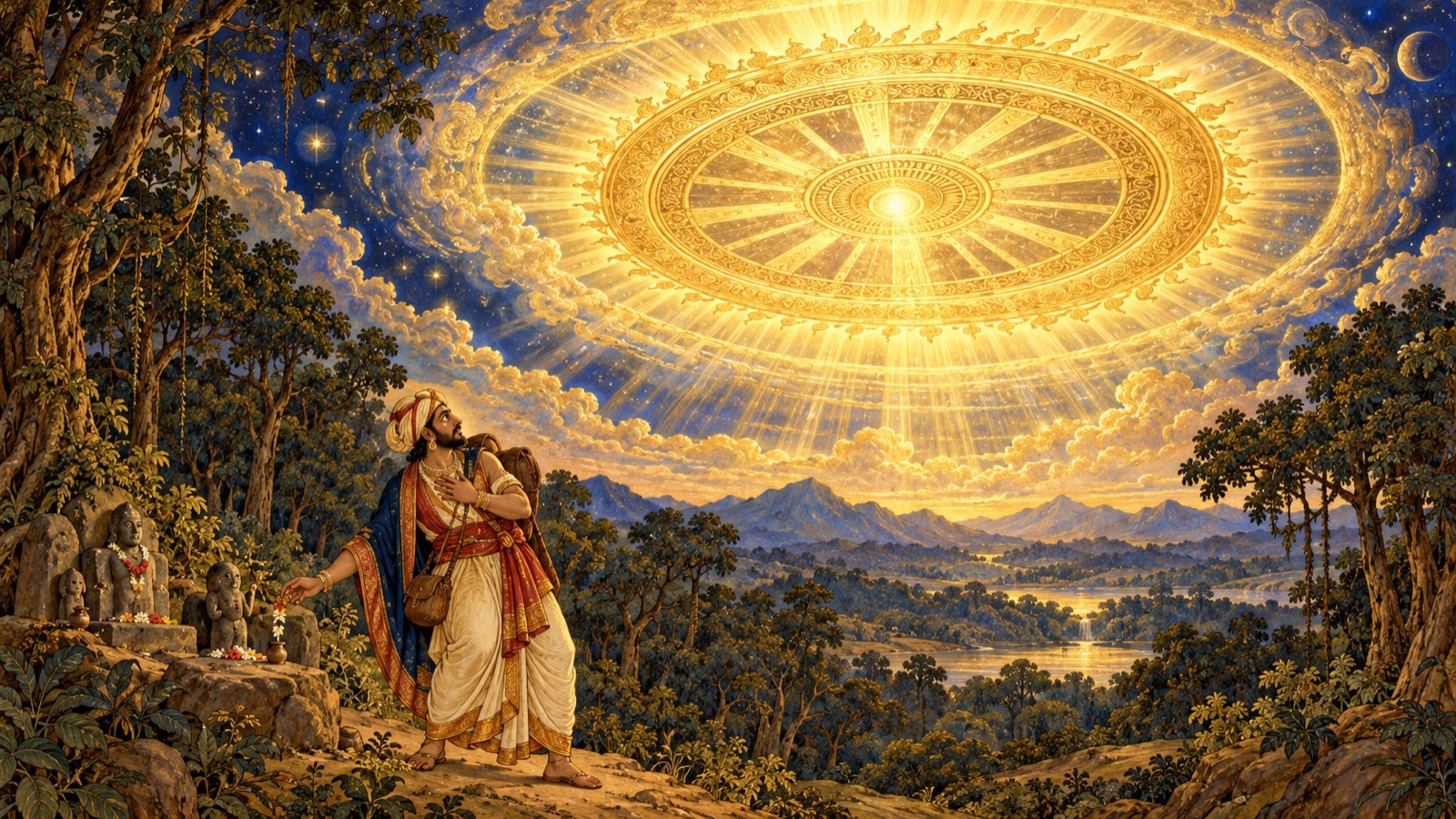
The embodied soul, a lone merchant bent on gain, wanders into the dark and trackless forest of material existence, where the six senses lie in wait like robbers — the great allegory that Sri Suka unfolds for King Parikshit.
Om Namo Bhagavate Vasudevaya.
Om Namo Bhagavate Vasudevaya.
Om Namo Bhagavate Vasudevaya.
Welcome back to Srimad Bhagavatam Wisdom, a devotional journey through the sacred histories and teachings of the Srimad Bhagavat Mahapurana. In the previous discourse the exalted sage Jada Bharata drew for King Rahugana a strange and beautiful picture — the whole of worldly life shown as a merchant caravan lost in a vast forest. Now Sri Suka lifts the veil on that picture for King Parikshit, showing us what each thing in the forest truly means. It is one of the most searching passages in all the Bhagavatam, a mirror in which we recognize, with a start, our own restless journey — and it closes not in despair but in glory, with the shining example of the royal sage Bharata, who walked free of the forest by giving his whole heart to the Lord.
Chapter Information
- Scripture: Śrīmad Bhāgavata Mahāpurāṇa
- Canto: 5 (Book Five)
- Chapter: 14 (Discourse 14)
- Chapter title: The Great Forest of Material Existence
- Principal speaker: Sukadeva Gosvami (Sri Suka), unfolding the meaning of Jada Bharata’s allegory to King Parikshit
- Principal listener: King Parikshit — the discourse related in turn by Suta Gosvami to the sages gathered at Naimisaranya
- Main setting: The teaching of Sri Suka, illumining the allegory of the forest of worldly existence given by Jada Bharata to King Rahugana
- Central subject: A point-by-point unfolding of the allegory of material life as a fearful forest — the soul as a merchant, the senses as robbers, family as wolves and jackals, wealth as a mirage, and the wheel of time as the Lord’s discus — crowned by the glory of the royal sage Bharata, who crossed beyond it through devotion
- Principal verse range: Canto 5, Chapter 14, verses 1–46
- Primary edition: Gita Press Śrīmad Bhāgavata Mahāpurāṇa
From the Previous Chapter
In the thirteenth discourse the sage Jada Bharata answered King Rahugana’s questions with a great allegory, likening our whole worldly existence to a forest through which a company of merchants wanders, beset on every side and losing their way. The king’s doubts were gently laid to rest by that sage’s words. Now the deeper meaning of each image in that forest is drawn out for us, so that what was given in figure may be understood in truth.
The Soul Enters the Great Forest
Sri Suka begins by naming the six who lead the soul astray — the five senses of perception together with the mind, their ruler. Because the embodied soul looks upon the body as its very self, these six become the doorway through which it passes, life after life, into a beginningless round of union and separation, pleasure and pain. Swayed by Maya, the Lord’s own deluding power that works only under the control of the all-powerful Vishnu, the multitude of souls sets out like a company of traders greedy for gain and enters the forest of worldly existence — a place as inauspicious as a crematorium, where each reaps only the fruit of deeds done with the body. And though their efforts are forever thwarted, they still do not find the one path that would end their sorrow — devoted surrender to the spiritual master in whom Sri Hari Himself is present, and through him to the Lord’s own feet.
स होवाच स एष देहात्ममानिनां … द्वारभूतेन षडिन्द्रियवर्गेण … जीवलोकोऽयं यथा वणिक्सार्थोऽर्थपर: … संसाराटव्यां गतो नाद्यापि … हरिगुरुचरणारविन्दमधुकरानुपदवीमवरुन्धे ॥ १ ॥
sa hovāca / sa eṣa dehātma-mānināṁ … dvāra-bhūtena ṣaḍ-indriya-vargeṇa … jīva-loko ’yaṁ yathā vaṇik-sārtho ’rtha-paraḥ … saṁsārāṭavyāṁ gato nādyāpi … hari-guru-caraṇāravinda-madhukarānupadavīm avarundhe
Meaning: He said: Because embodied souls take the body to be the self, the six senses become their doorway into a beginningless round of birth and death, through bodies shaped by good, bad and mixed deeds. Swayed by the Maya of the almighty Lord Vishnu, this multitude of souls, like a company of traders bent on wealth, wanders into the forest of worldly existence, inauspicious as a crematorium — and even now does not gain the sorrow-quelling path of those who resort, like the honey-bee to the lotus, to the feet of Sri Hari in the form of the preceptor. (Canto 5, Chapter 14, verse 1)
The Six Robbers and the Family That Plunders
Sri Suka goes on to tell us plainly what those six really are. Though they pass under the honourable name of senses, in their deeds they are nothing but robbers. Whatever fortune a person gathers with great toil is of worth only when it is spent upon Dharma — and true Dharma, the wise declare, is the worship of the Supreme Person Himself, the one thing that carries a soul toward happiness in the world beyond. But in one whose intellect is corrupted and whose mind is unsubdued — like a band of traders led by an unworthy chief — the senses seize that very wealth meant for virtue and squander it upon seeing, touching, hearing, tasting, and smelling the objects of enjoyment at home.
यस्यामु ह वा एते षडिन्द्रियनामान: कर्मणा दस्यव एव ते । … तद्धर्म्यं धनं … कुनाथस्याजितात्मनो यथा सार्थस्य विलुम्पन्ति ॥ २ ॥
yasyām u ha vā ete ṣaḍ-indriya-nāmānaḥ karmaṇā dasyava eva te … tad-dharmyaṁ dhanaṁ … kunāthasyājitātmano yathā sārthasya vilumpanti
Meaning: In that forest these six, who bear the name of senses, are by their action nothing but robbers. Just as bandits plunder a caravan led by an unworthy chief, so, in one whose mind is unsubdued, they plunder the very wealth that was fit to be spent on virtue, through the enjoyment of objects at home. (Canto 5, Chapter 14, verse 2)
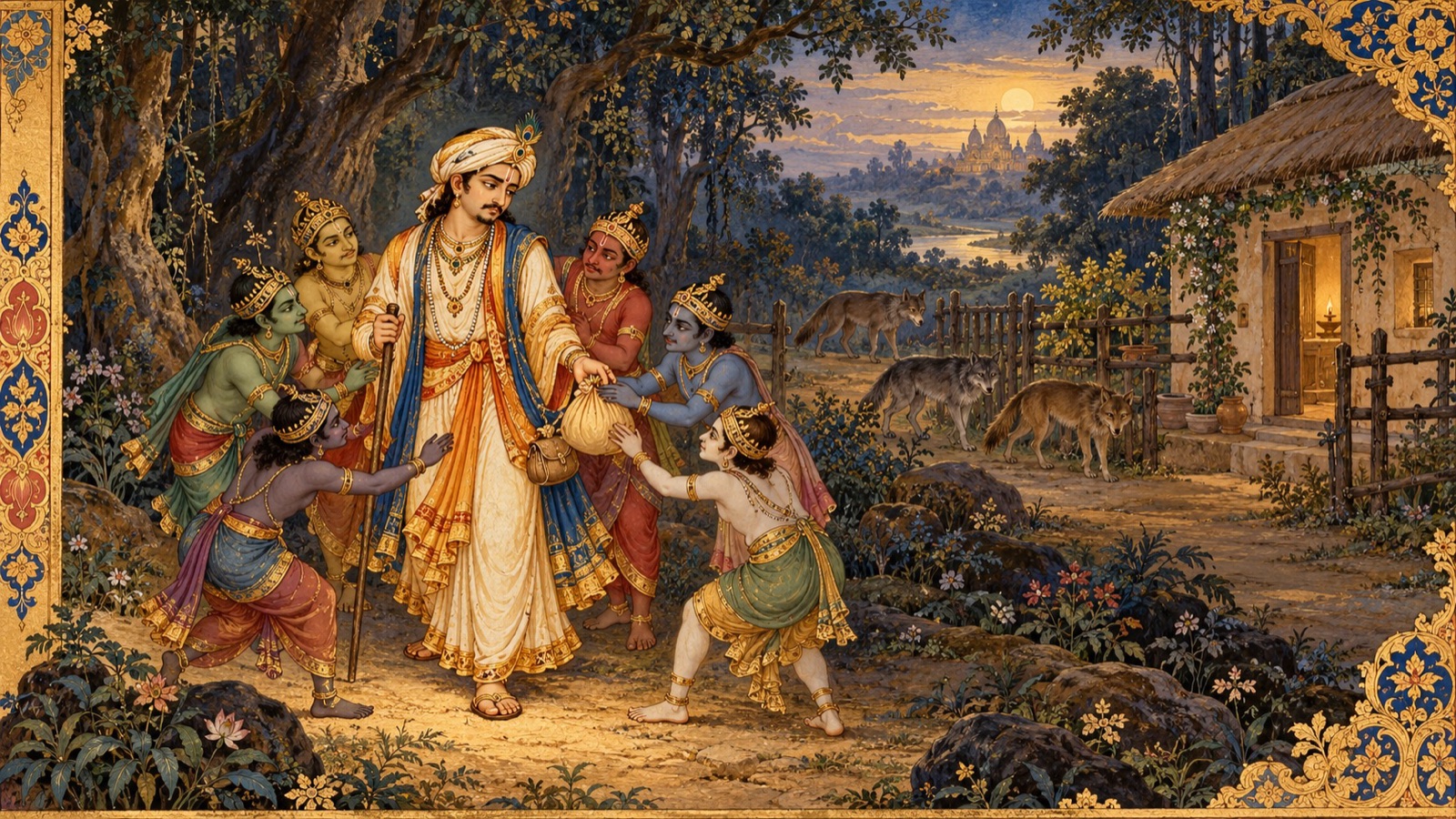
Nor are the robbers only within. In that same forest, Sri Suka says, the members of one’s own family — wife and children in name, but wolves and jackals in their deeds — snatch away before his very eyes the wealth that the stingy householder guards so jealously, as helplessly as a lamb carried off by shepherds. And the householder’s life itself is a field for sowing the seeds of action: however often it is ploughed, it springs up thick again with the weeds of fresh desire, for it is a very storehouse of longing, where work never comes to an end.
Mirage, Gold, and the Whirlwind of Delusion
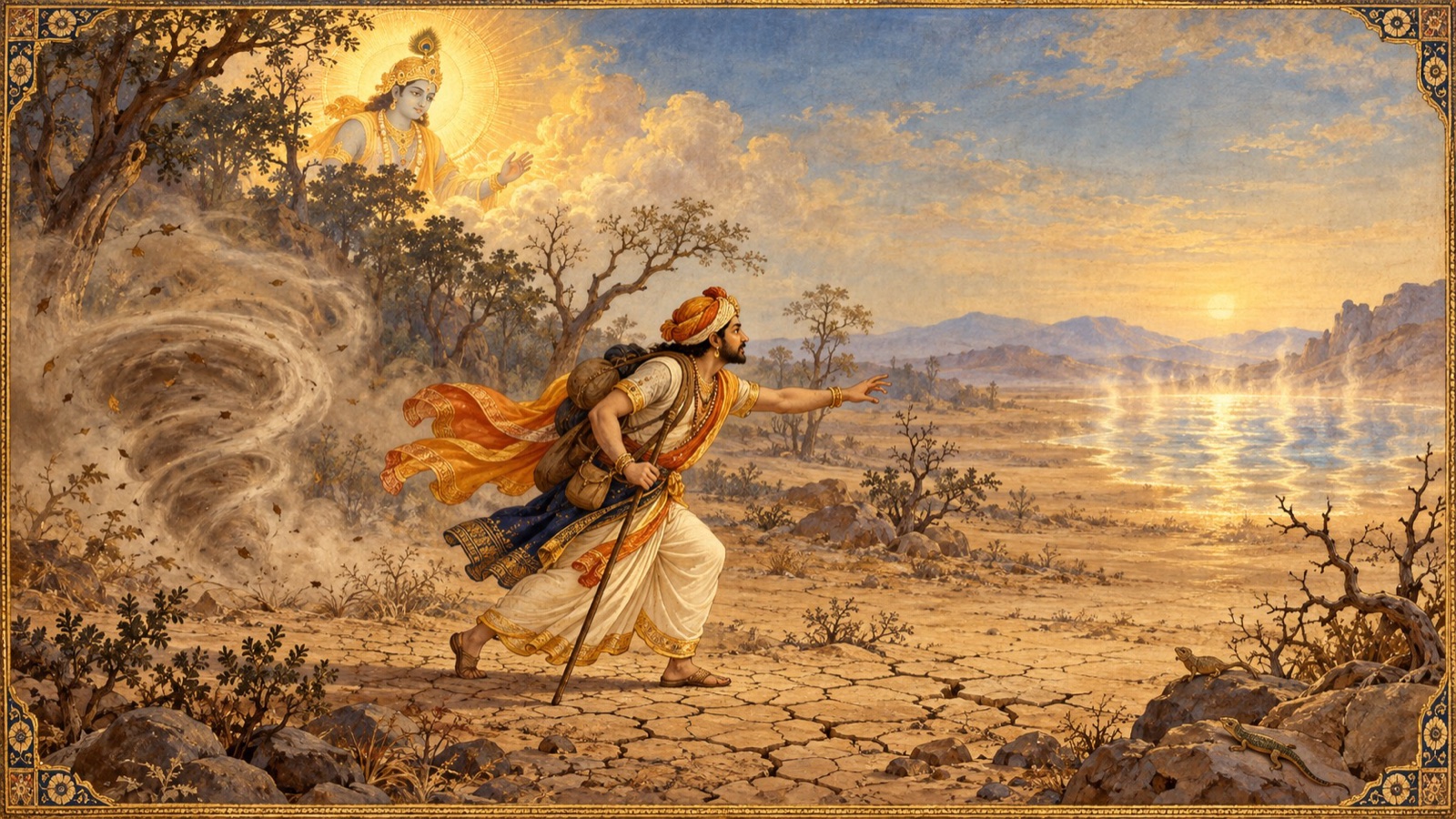
Sri Suka now leads us deeper along that road, where the wanderer’s little store is nibbled away by gnats and mosquitoes, by locusts and birds, by thieves and rats — the countless small demands of the world. His mind clouded by ignorance, desire and action, he takes this passing world, unreal as a city imagined in the sky, to be solid and lasting. He chases the mirage-pleasures of the senses, fondly enslaved to eating and drinking and the cravings of the flesh. Like a man crazed for fire running after a will-o’-the-wisp, he runs after gold — which the Bhagavatam calls the mere excreta of fire and the abode of every evil — his mind dyed by the passion of Rajas, which shares the very colour of gold.
Sometimes, seated on the lap of a beguiling woman who throws dust in his eyes like a sudden whirlwind, and steeped in the darkness of passion, he abandons the path of the virtuous altogether and no longer even perceives the guardian deities who witness all his deeds. Even in a rare clear moment, when the hollowness of sense-objects flashes upon him, his stubborn clinging to the body robs him of reason, and he turns back once more to chase those same mirage-like things. And on every side his ears and heart are tormented by threats — like the hooting of owls before him and the shrill cry of crickets behind.
The Endless Burdens of the Road
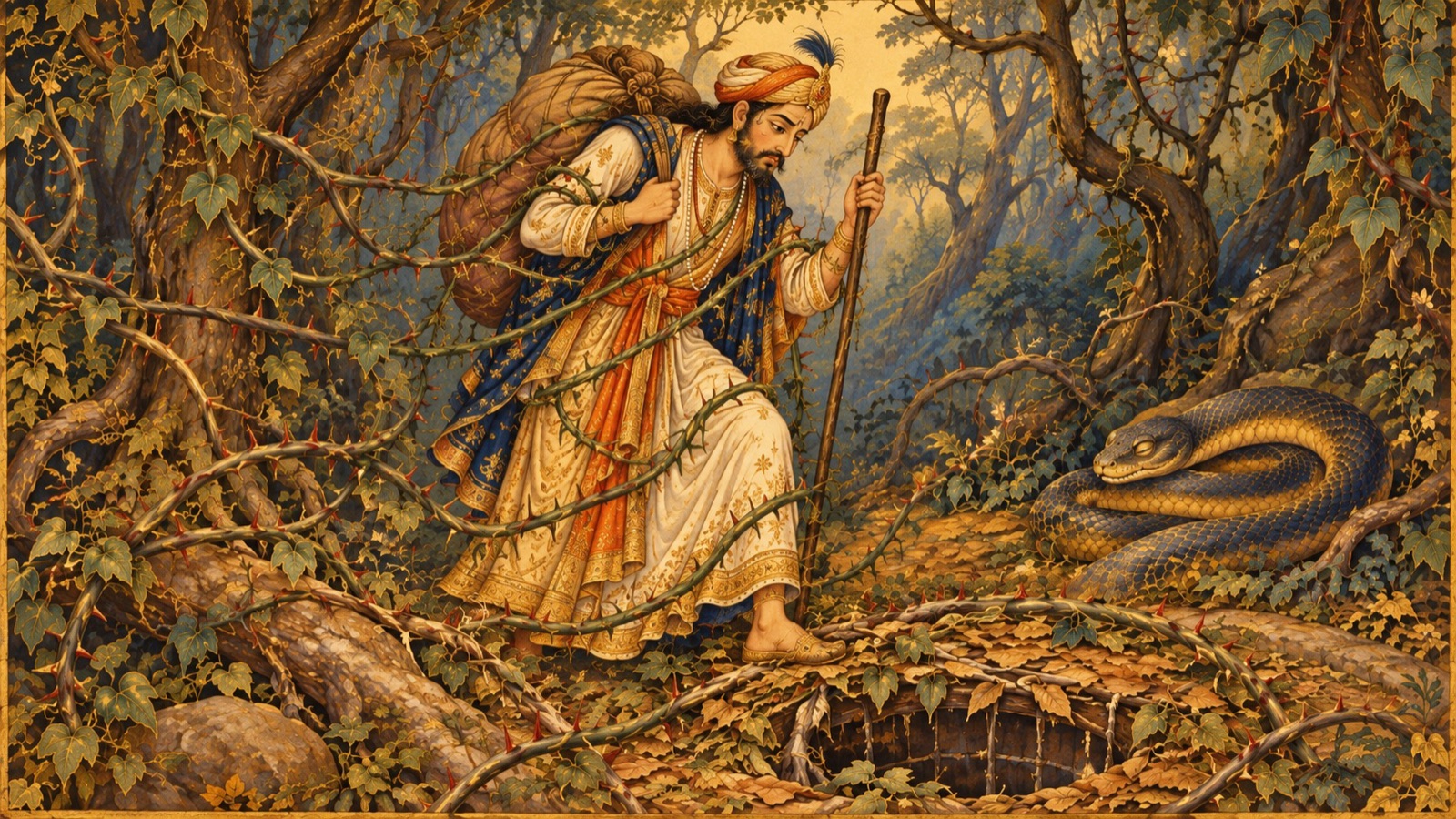
The weary tale of the road goes on, and Sri Suka spares us nothing of its hardship. When his store of past merit is spent and he is as good as dead though still breathing, the wanderer takes shelter of men whose wealth helps no one — barren as poisonous trees and wells of tainted water. Falling in with wrong company he may embrace a faithless creed and slip, as into the dry bed of a stream, into misery here and hereafter. Driven by hunger he turns even upon his own; reaching home stripped of comfort, he is scorched as by a forest fire of grief; he is caught in the boa-constrictor of sleep, cast down like a corpse in a lonely wood, and tumbles, like a blind man, into a hidden well.
What he grasps never stays with him — one man wrests it away, and from that man another takes it in turn. Cold winds from without and fever and worry from within leave him cast down with anxiety he cannot shake. On this path, Sri Suka tells us, lie joy and sorrow, fear and pride, delusion and grief, greed and envy, hunger and thirst, disease and old age and death — and, sweetest and most dangerous of all, the woman who is the Lord’s own deluding power, in whose creeper-like arms, lured by the fond words and glances of the children gathered around her, the man of uncontrolled mind hurls himself headlong into the dark.
The Discus of Time and the Forgotten Lord
Then comes the most awesome image of all. Above the whole forest turns the discus of the almighty Lord Vishnu, appearing as ever-wakeful Time — from the smallest atom of a moment to the two Parardhas that measure the lifespan of Brahma himself. That wheel sweeps away every created being, from Brahma down to the merest clump of grass, while they all look helplessly on. The wanderer’s heart is struck with terror at its turning; and yet — this is the great sorrow of it — he still ignores the very Lord who wields that wheel of time as His weapon, and runs instead to the false deities of the faithless, gods no better than buzzards and vultures, herons and quails, who can no more save him from death than a small bird can face a lion.
कदाचिदीश्वरस्य भगवतो विष्णोश्चक्रात् … आब्रह्मतृणस्तम्बादीनां भूतानाम … वित्रस्तहृदय … यज्ञपुरुषमनादृत्य … साङ्केत्येनाभिधत्ते ॥ २९ ॥
kadācid īśvarasya bhagavato viṣṇoś cakrāt … ābrahma-tṛṇa-stambādīnāṁ bhūtānām … vitrasta-hṛdaya … yajña-puruṣam anādṛtya … sāṅketyenābhidhatte
Meaning: Struck with terror at the discus of the almighty Lord Vishnu — manifested as Time, which sweeps away all beings from Brahma down to a blade of grass while they look on — he yet ignores that very Lord, the Deity of sacrifice who wields the wheel of time, and betakes himself instead to the deities of the faithless. (Canto 5, Chapter 14, verse 29)
Betrayed by such false shelters, Sri Suka relates, the wanderer drifts from one course of life to another, forgetting even the hour of his own death, living in constant dread of the elephant of death, making and breaking bonds as old tendencies dictate. Should a fellow-traveller fall by the wayside, the rest simply leave him where he lies and press on, carrying the new-born child along, weeping and quarrelling and singing by turns. Except for the pious souls, this whole company never once turns back to the source from which the road began — the Lord Himself, whom the wise call both the beginning and the end of the way. They will not take up the loving discipline of devotion; even mighty kings who conquered the four quarters would sooner die fighting for a scrap of earth. Clinging to the creeper of fresh action, escaping one torment only to fall into the next, they revert again and again to the wheel of birth.
It is worth pausing on why Sri Suka chooses these particular images. Nothing in this forest is exotic or rare — it is wife and children, a job, a house, sleep, a little gold, an evening’s anger. The teaching’s real edge is that samsara does not need great wickedness to hold a soul; the ordinary comforts of a respectable life are enough to keep it as lost as any criminal, wandering on as long as it takes the body for the self (verse 1). Nor is the remedy self-effort alone: even the soul who tastes, again and again, the futility of what it chases does not change by that taste, for memory fails him and he runs back to the same mirage (verse 10). The forest’s grip loosens only where grace is transmitted — through a bona fide guru in whom Sri Hari is present — never through cleverness, nor through renunciation attempted on one’s own strength (verse 41).
The Glory of the Royal Sage Bharata
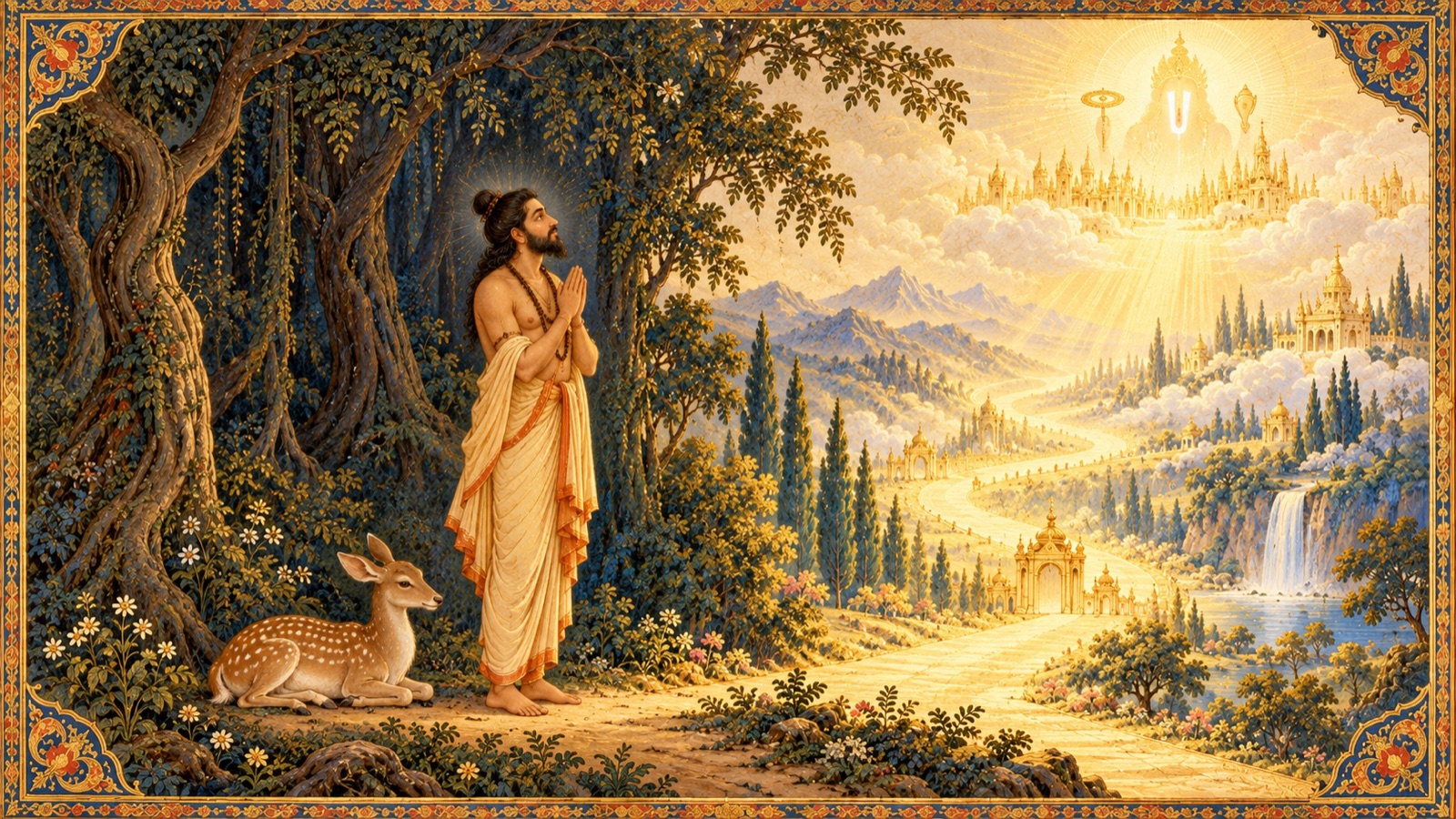
Having shown us the whole dark reach of the forest, Sri Suka turns at last to the one who walked clear out of it, and his voice becomes a song of praise. The seers sing that no king can follow, even in his mind, the path of the high-souled royal sage Bharata, the son of Lord Rsabha — any more than a fly could hope to match the speed of Garuda. While still young, his heart brimming with longing for the Lord of glorious renown, Bharata cast aside wife and sons, kinsmen and kingdom — things so hard for others to give up — as lightly as a man throws away refuse.
यो दुस्त्यजान् क्षितिसुतस्वजनार्थदारान् प्रार्थ्यां श्रियं सुरवरै: सदयावलोकाम् । नैच्छन्नृपस्तदुचितं महतां मधुद्विट- सेवानुरक्तमनसामभवोऽपि फल्गु: ॥ ४४ ॥
yo dustyajān kṣiti-suta-svajanārtha-dārān prārthyāṁ śriyaṁ sura-varaiḥ sadayāvalokām naicchan nṛpas tad-ucitaṁ mahatāṁ madhudviṭ- sevānurakta-manasām abhavo ‘pi phalguḥ
Meaning: That king did not long for the earth, sons, kinsfolk, wealth or wife, so hard to renounce — nor even for the goddess of fortune, coveted by the greatest gods, though she cast her gracious glance upon him. And this was only fitting; for to exalted souls whose minds are absorbed in the service of Lord Vishnu, the slayer of Madhu, even liberation itself is of little worth. (Canto 5, Chapter 14, verse 44)
So complete was his surrender that even in his last birth, wearing the body of a deer, he did not forget his Lord. With his whole being he offered up a final, radiant prayer of salutation, even before laying that animal form aside.
यज्ञाय धर्मपतये विधिनैपुणाय योगाय साङ्ख्यशिरसे प्रकृतीश्वराय । नारायणाय हरये नम इत्युदारं हास्यन्मृगत्वमपि य: समुदाजहार ॥ ४५ ॥
yajñāya dharma-pataye vidhi-naipuṇāya yogāya sāṅkhya-śirase prakṛtīśvarāya nārāyaṇāya haraye nama ity udāraṁ hāsyan mṛgatvam api yaḥ samudājahāra
Meaning: “Salutations to Lord Narayana, Sri Hari — who is Sacrifice itself and the Protector of righteousness, the master of all sacred injunction, the embodiment of Yoga, the crown of the Sankhya wisdom, the Lord of Prakrti and the Ruler of every living soul!” — thus, nobly and clearly, did Bharata pray, even as he was about to cast off the form of a deer. (Canto 5, Chapter 14, verse 45)
And Sri Suka seals the whole discourse with a promise to those who cherish this sacred history. Whoever hears, recites or delights in the story of the royal sage Bharata — a story extolled by the devotees of the Lord, and one that bestows good fortune, long life, wealth, renown, heavenly joy and final freedom — gains of himself every blessing he could wish, and need beg nothing from anyone.
य इदं भागवतसभाजितावदातगुणकर्मणो राजर्षेर्भरतस्यानुचरितं … वानुशृणोत्याख्यास्यत्यभिनन्दति च सर्वा एवाशिष आत्मन आशास्ते न काञ्चन परत इति ॥ ४६ ॥
ya idaṁ bhāgavata-sabhājitāvadāta-guṇa-karmaṇo rājarṣer bharatasyānucaritaṁ … vānuśṛṇoty ākhyāsyaty abhinandati ca sarvā evāśiṣa ātmana āśāste na kāñcana parata iti
Meaning: Whoever hears, recites or takes delight in this history of the royal sage Bharata — whose spotless virtues are praised by the devotees of the Lord — obtains of himself all the blessings he desires, and need seek nothing from anyone else. (Canto 5, Chapter 14, verse 46)
Principal Teachings of This Chapter
Worldly life is a forest we are already wandering in. The allegory is not about some distant traveller; it is about us. The moment the soul mistakes the body for the self, it steps into the forest, and every image in the story — the robbers, the mirage, the thorns — is drawn from a life we know. To recognize this is the first step toward the way out.
The senses are robbers when the mind is unruled. Called by an honourable name, the senses will yet plunder the whole treasure of a life if left to their own greed. Their proper use is to serve Dharma — the worship of the Supreme Person — and wealth itself is worthwhile only when it is turned to that end.
Time is the Lord’s own discus. Nothing in the forest escapes the turning wheel of Time, from Brahma to a blade of grass. Rightly seen, this is a summons rather than a terror: the very power that sweeps all things away belongs to the Lord, and the soul that shelters in Him has nothing left to fear.
False shelters cannot save. Running to the passing and the powerless only deepens the wandering. There is one refuge that ends the forest, and it is the lotus feet of Sri Hari.
Devotion is the one road out. Bharata crossed the whole forest not by strength or conquest but by giving his heart to the Lord, holding even liberation as trifling beside His service. His story shows that the way out is open to any soul willing to love God above all.
A Devotional Reflection
There is something almost frightening in how well this forest fits our own lives. We too have chased the glitter of gold and found it turn to ash; we too have taken the passing world for something solid, and been jolted awake by grief; we too have known the small robbers of worry and want nibbling away our days. The Bhagavatam does not paint this picture to make us despair, but to make us honest — to let us see, at last, that all our hurried gathering in the forest has never once brought us home. And then, just when the darkness feels total, it lifts a lamp: the figure of Bharata, walking free. He was not stronger than we are, nor did he escape by cleverness. He simply loved the Lord more than he loved the forest, and that single, whole-hearted turning was enough. His last breath as a deer was a prayer. That is the quiet promise held out to every one of us — that no matter how deep we have wandered, the road home opens the instant the heart turns, with love, toward Narayana. The forest is real; but so is the way out, and it is nearer than we think.
A Daily Devotional Practice
Today, notice one “mirage” in your own forest — one thing you are chasing as though your happiness depended on it — and gently set it down for a moment. In its place, do one small act that turns your wealth, time or attention toward the Lord: offer a coin or a meal in His name, speak a kind word to a living being, or simply pause and say, with your whole heart, “Om Namo Bhagavate Vasudevaya.” Then, remembering the royal sage Bharata, read or recite even a few lines of his story, so that its blessing may quietly take root in you. In this way you begin, even amid the forest, to walk the one path that leads out of it.
Conclusion
The fourteenth discourse of Book Five is Sri Suka’s luminous unfolding of the forest of material existence. Point by point he shows us the soul as a merchant lost among trees, the senses as robbers, the family as wolves and jackals, wealth as a mirage and gold as the excreta of fire, sleep as a serpent and delusion as a woman’s embrace — and, above it all, the wheel of Time turning as the discus of Lord Vishnu, sweeping away Brahma and a blade of grass alike. It is an unsparing mirror of the wandering life, in which every soul may recognize its own restless journey. Yet the discourse does not leave us in the dark. It ends in a song of praise for the royal sage Bharata, who renounced all that others cling to, held even liberation as trifling beside the Lord’s service, and offered his final prayer to Narayana even in the body of a deer. Here is the whole teaching in a single life: the forest is real, but devotion is the road that leads clear out of it, home to the feet of Sri Hari.
May the divine wisdom of Srimad Bhagavatam awaken pure devotion within our hearts.
Om Namo Bhagavate Vasudevaya.
Jay Shree Madhav.
References and Attribution
- Primary edition: Gita Press, Śrīmad Bhāgavata Mahāpurāṇa, Book Five, Discourse 14, “Jadabharata elucidated the meaning of the allegory.”
- Series: Srimad Bhagavatam Wisdom · Biswa Sanatan Dharma Seva Trust.
- Presented following the spiritual guidance and recommendation of Pandit Dr. Shri Kashinath Mishra.
This is an original, faithful retelling in the writer’s own words, with brief quoted verses shown in Devanāgarī and transliteration and their meanings given as summaries. It is not a reproduction of any single publisher’s continuous translation or commentary. No affiliation with or endorsement by any publisher is implied.
Jay Shree Madhav