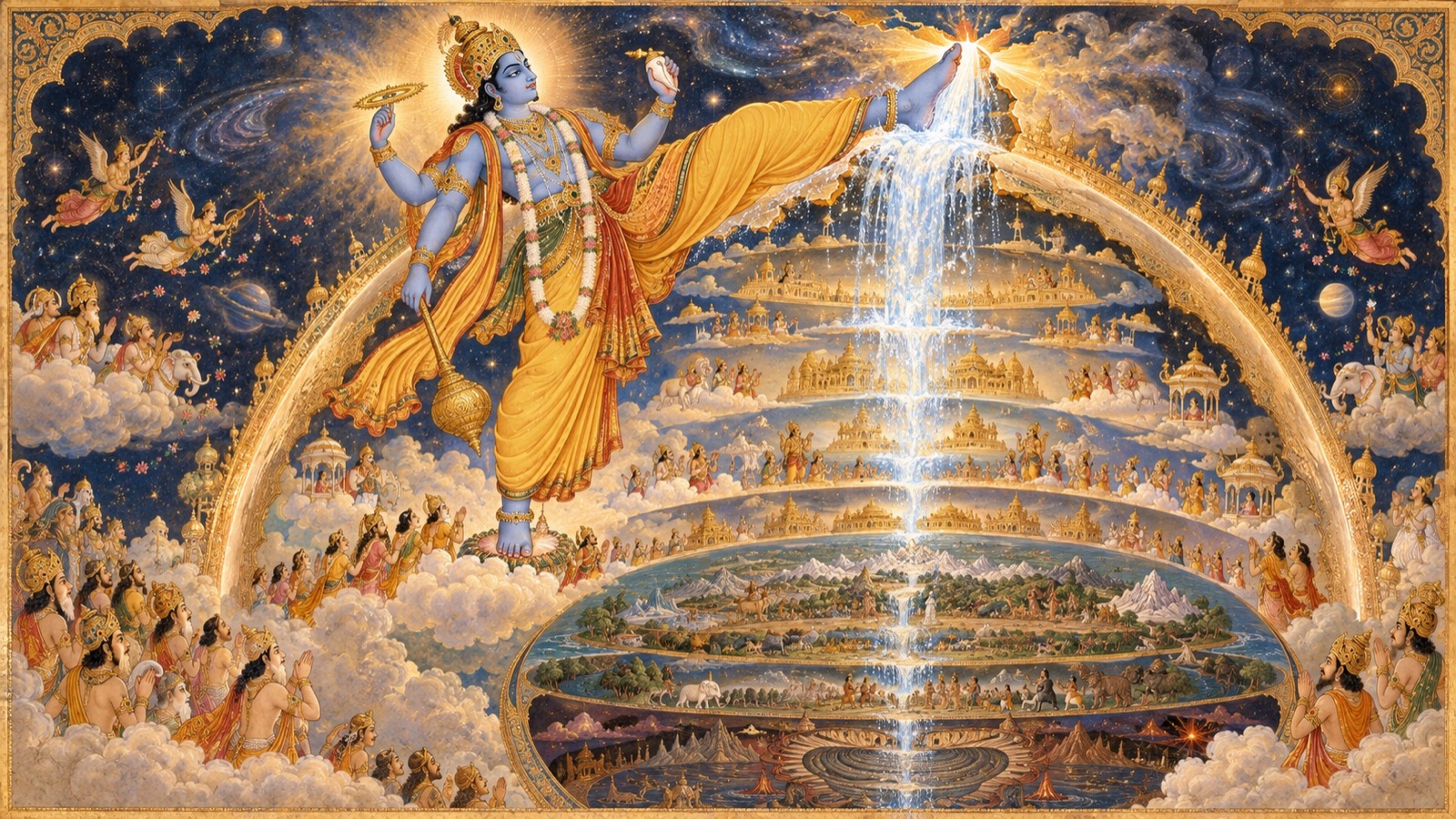
As the Lord strides across the worlds as Trivikrama and lifts His foot to the summit of the cosmos, the water beyond the universe streams in to bathe His lotus-foot and descends as the holy Ganga — the river born of the Lord’s own feet.
Om Namo Bhagavate Vasudevaya.
Om Namo Bhagavate Vasudevaya.
Om Namo Bhagavate Vasudevaya.
Welcome back to Srimad Bhagavatam Wisdom, a devotional journey through the sacred histories and teachings of the Srimad Bhagavat Mahapurana. Having shown us the vast island of Jambudvipa with golden Meru at its heart, Sri Suka now traces the most wonderful of all rivers — the Ganga — back to her true source, which is not any earthly mountain but the very lotus-foot of the Lord. We shall follow her as she springs into the cosmos, is borne with love upon Dhruva’s head, and blesses the lands of the world; and in the sacred land of Ilavrita we shall stand quietly beside Lord Shiva as he pours out a hymn of praise to Lord Sankarsana — a chapter of pure wonder, in which the whole creation rests, like a mustard seed, upon the Lord.
Chapter Information
- Scripture: Śrīmad Bhāgavata Mahāpurāṇa
- Canto: 5 (Book Five)
- Chapter: 17 (Discourse 17)
- Chapter title: The Ganga’s Descent from the Lord’s Foot, and Lord Shiva’s Prayer to Sankarsana
- Principal speaker: Sukadeva Gosvami (Sri Suka), narrating to King Parikshit; within the narration, Lord Shiva (Sankara) prays to Lord Sankarsana
- Principal listener: King Parikshit — the discourse related in turn by Suta Gosvami to the sages gathered at Naimisaranya
- Main setting: From the summit of the cosmos down through the realm of Dhruva to the city of Brahma upon Mount Meru, across the varshas of Jambudvipa, and into Ilavrita-varsha
- Central subject: How the Ganga descended from the Lord’s lotus-foot, divided into four rivers upon Mount Meru and blessed the lands of the earth; how Lord Narayana abides in every varsha; and how Lord Shiva worships Lord Sankarsana in Ilavrita
- Principal verse range: Canto 5, Chapter 17, verses 1–24
- Primary edition: Gita Press Śrīmad Bhāgavata Mahāpurāṇa
From the Previous Chapter
In the sixteenth discourse, Sri Suka described for King Parikshit the great island of Jambudvipa — its many varshas or regions, the golden Mount Meru rising at its center like the pericarp of a lotus, and the mighty mountain ranges, forests, lakes and gardens that adorn it. Having set before us this vast and glorious land, the sage now tells how the holiest of rivers came down upon it, and how the Lord Himself is worshipped throughout its regions.
The River that Springs from the Lord’s Foot
Sri Suka continued the wondrous account. Long ago, when Lord Vishnu Himself appeared as Trivikrama at the great offering of Bali and stretched His foot to the very summit of the heavens, His toenail tore open the outer covering of the egg-shaped cosmos. Through that narrow breach the pure water lying beyond the universe came rushing in and first bathed the Lord’s lotus-foot. Tinged reddish by the saffron-like dust upon that foot, it gained a marvellous power — to wash away the sins of the whole world while itself remaining forever untouched by sin. Because it flowed straight from the Lord’s own foot, it was named, above all its later names, Bhagavatpadi; and only after a vast passage of ages did it come to rest upon the shining realm of Dhruva, which the wise call Vishnupada.
श्रीशुक उवाच तत्र भगवत: साक्षाद्यज्ञलिङ्गस्य विष्णोर्विक्रमतो वामपादाङ्गुष्ठनखनिर्भिन्नोर्ध्वाण्डकटाहविवरेणान्त:प्रविष्टा या बाह्यजलधारा तच्चरणपङ्कजावनेजनारुणकिञ्जल्कोपरञ्जिताखिलजगदघमलापहोपस्पर्शनामला साक्षाद्भगवत्पदीत्यनुपलक्षितवचोऽभिधीयमानातिमहता कालेन युगसहस्रोपलक्षणेन दिवो मूर्धन्यवततार यत्तद्विष्णुपदमाहु: ॥ १ ॥
śrī-śuka uvāca tatra bhagavataḥ sākṣād yajña-liṅgasya viṣṇor vikramato vāma-pādāṅguṣṭha-nakha-nirbhinnordhvāṇḍa-kaṭāha-vivareṇāntaḥ-praviṣṭā yā bāhya-jala-dhārā tac-caraṇa-paṅkajāvanejanāruṇa-kiñjalkoparañjitākhila-jagad-agha-malāpahopasparśanāmalā … divo mūrdhany avatatāra yat tad viṣṇu-padam āhuḥ
Meaning: Sri Suka said: When Lord Vishnu, the embodiment of sacrifice, strode across the worlds and raised His foot, the nail of His big toe pierced the upper shell of the cosmic egg; through that breach the water lying outside the universe streamed in and bathed His lotus-foot. Tinged red by the pollen-like dust of that foot, it became able to wash away the sins of the whole world by its mere touch while remaining ever pure, and was directly named Bhagavatpadi. After an immense span of time it descended upon the realm of Dhruva, which they call Vishnupada. (Canto 5, Chapter 17, verse 1)
Borne on Dhruva’s Head, Hailed by the Seven Seers
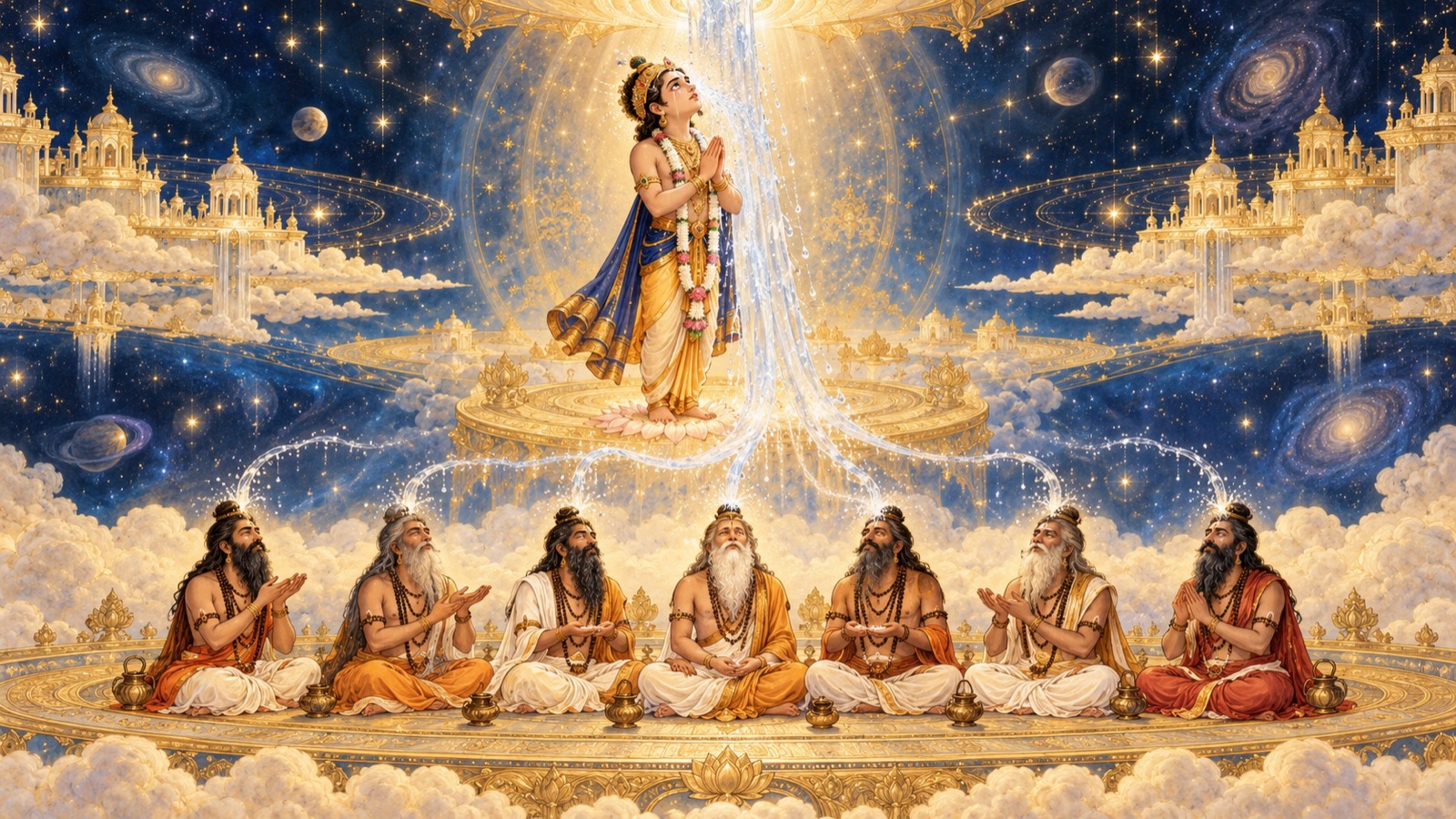
See now what love does with this sacred water. In that high realm Dhruva, the steadfast son of Uttanapada, bears the Bhagavatpadi upon his head to this very day with supreme reverence, remembering always that it has washed the lotus-foot of his beloved Lord; his heart is soaked in ever-growing devotion, tears of pure love in his half-closed eyes, and the hair upon his body standing on end in the rapture of remembrance. Descending further, the stream reaches the seven great seers, the Saptarshi, who receive it upon the tufts of their matted locks and cherish it as the supreme fruit of all their austerities, treasuring it exactly as a seeker of final liberation would treasure freedom itself.
ततः सप्त ऋषयस्तत्प्रभावाभिज्ञा यां ननु तपस आत्यन्तिकी सिद्धिरेतावती भगवति सर्वात्मनि वासुदेवेऽनुपरतभक्तियोगलाभेनैवोपेक्षितान्यार्थात्मगतयो मुक्तिमिवागतां मुमुक्षव इव सबहुमानमद्यापि जटाजूटैरुद्वहन्ति ॥ ३ ॥
tataḥ sapta ṛṣayas tat prabhāvābhijñā yāṁ nanu tapasa ātyantikī siddhir etāvatī bhagavati sarvātmani vāsudeve ‘nuparata-bhakti-yoga-lābhenaivopekṣitānyārthātma-gatayo muktim ivāgatāṁ mumukṣava iva sabahu-mānam adyāpi jaṭā-jūṭair udvahanti
Meaning: The seven great sages, well aware of this water’s power, still carry it upon their matted hair with deep reverence, honouring it as the highest fruit of all their austerities. Having attained unbroken devotional service to Lord Vasudeva, the Soul of all beings, they no longer look toward any other goal — not even liberation — for bhakti itself has already given them everything liberation promises, and more. (Canto 5, Chapter 17, verse 3)
This is a truth easy to read past, yet it is the deep teaching of this passage: for the great sages, loving service to the Lord is not a stepping-stone toward liberation but something greater than liberation itself. Liberation, however exalted, is the end of suffering; devotion is the beginning of a relationship — the soul’s return to loving the Lord face to face. The seven seers, having tasted that relationship, find that merging into the Lord’s impersonal glory would mean losing the very sweetness they have gained. This is why the great Vaishnava teachers say that bhakti is not a means to any further end; it is the end in itself. A devotee does not render devotional service in order to be liberated one day — devotional service, once attained, has already surpassed the very thing liberation was seeking (verse 3).
The Fourfold Descent upon Mount Meru
From there the holy river continues her wondrous journey. Passing through the heavens thronged with countless millions of shining aerial cars, she washes the sphere of the moon and comes down at last upon the city of Brahma, which crowns the summit of golden Mount Meru. And there she divides into four streams — Sita, Alakananda, Cakshu and Bhadra — that rush away toward the four quarters and pour themselves at last into the ocean.
तत्र चतुर्धा भिद्यमाना चतुर्भिर्नामभिश्चतुर्दिशमभिस्पन्दन्ती नदनदीपतिमेवाभिनिविशति सीतालकनन्दा चक्षुर्भद्रेति ॥ ५ ॥
tatra caturdhā bhidyamānā caturbhir nāmabhiś catur-diśam abhispandantī nada-nadī-patim evābhiniviśati sītālakanandā cakṣur bhadreti
Meaning: There, upon the summit of Brahma’s abode, the Bhagavatpadi divides into four streams that flow away in the four directions under four names — Sita, Alakananda, Cakshu and Bhadra — and at last enter the ocean. (Canto 5, Chapter 17, verse 5)

The Four Great Rivers and the Land of Action
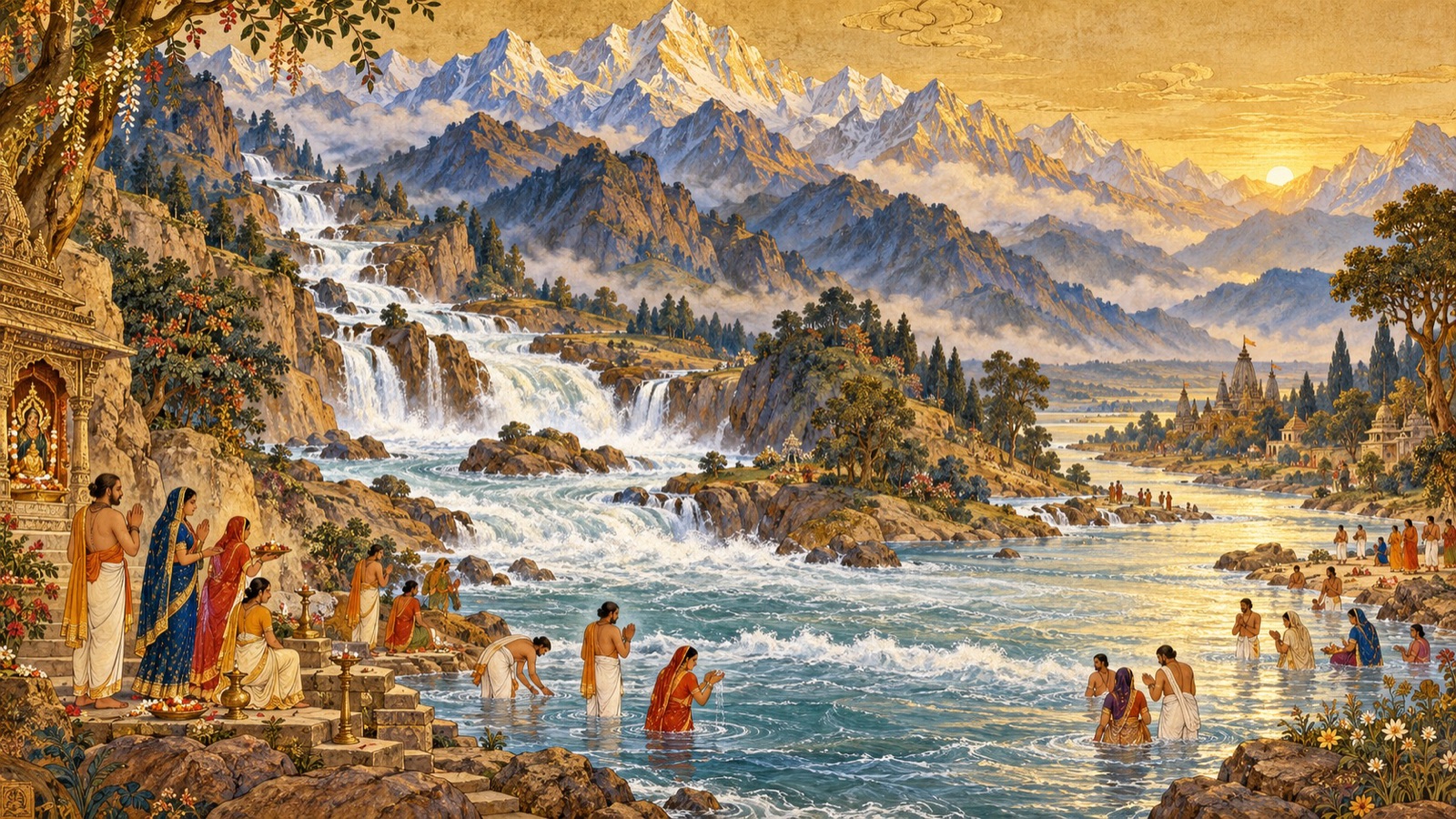
Sri Suka traced the courses of these four rivers. The Sita falls upon Mount Gandhamadana and courses eastward through Bhadrasva-varsha; the Cakshu descends upon Mount Malyavan and sweeps westward toward the land of Ketumala; and the Bhadra leaps northward from peak to peak, from the crest of Srngavan toward the northern Kurus. And the Alakananda flows to the south of Brahma’s city, reaches the range of Hemakuta, then rolls down with tremendous speed to the Himalaya, and courses through Bharatavarsha before entering the southern ocean. For anyone who goes forth to bathe in her sacred waters, Sri Suka tells us, the great reward of the Ashwamedha, the Rajasuya and other mighty sacrifices is won easily at every single step.
तथैवालकनन्दा दक्षिणेन ब्रह्मसदनाद्बहूनि गिरिकूटान्यतिक्रम्य हेमकूटाद्धैमकूटान्यतिरभसतररंहसा लुठयन्ती भारतमभिवर्षं दक्षिणस्यां दिशि जलधिमभिप्रविशति यस्यां स्नानार्थं चागच्छत: पुंस: पदे पदेऽश्वमेधराजसूयादीनां फलं न दुर्लभमिति ॥ ९ ॥
tathaivālakanandā dakṣiṇena brahma-sadanād bahūni giri-kūṭāny atikramya hemakūṭād dhaimakūṭāny ati-rabhasatara-raṁhasā luṭhayantī bhāratam abhivarṣaṁ dakṣiṇasyāṁ diśi jaladhim abhipraviśati yasyāṁ snānārthaṁ cāgacchataḥ puṁsaḥ pade pade ’śvamedha-rājasūyādīnāṁ phalaṁ na durlabham iti
Meaning: In the same way the Alakananda flows southward from Brahma’s city, rolls down from Hemakuta to the Himalaya, and coursing through Bharatavarsha enters the southern ocean; and for one who goes to bathe in her, the reward of the Ashwamedha, Rajasuya and other great sacrifices is won at every step. (Canto 5, Chapter 17, verse 9)
Besides these four, hundreds of other rivers great and small flow in every varsha, all born from Meru and the other mountains. And of all these regions, the learned declare Bharatavarsha alone the land of action — the sacred field where a soul may shape its own destiny by its deeds. The other eight, they say, are the places where those who have earned heaven come to enjoy the remainder of their merit; they are, as it were, the celestial gardens of the earth.
The Blessed Varshas and the Ever-Present Lord
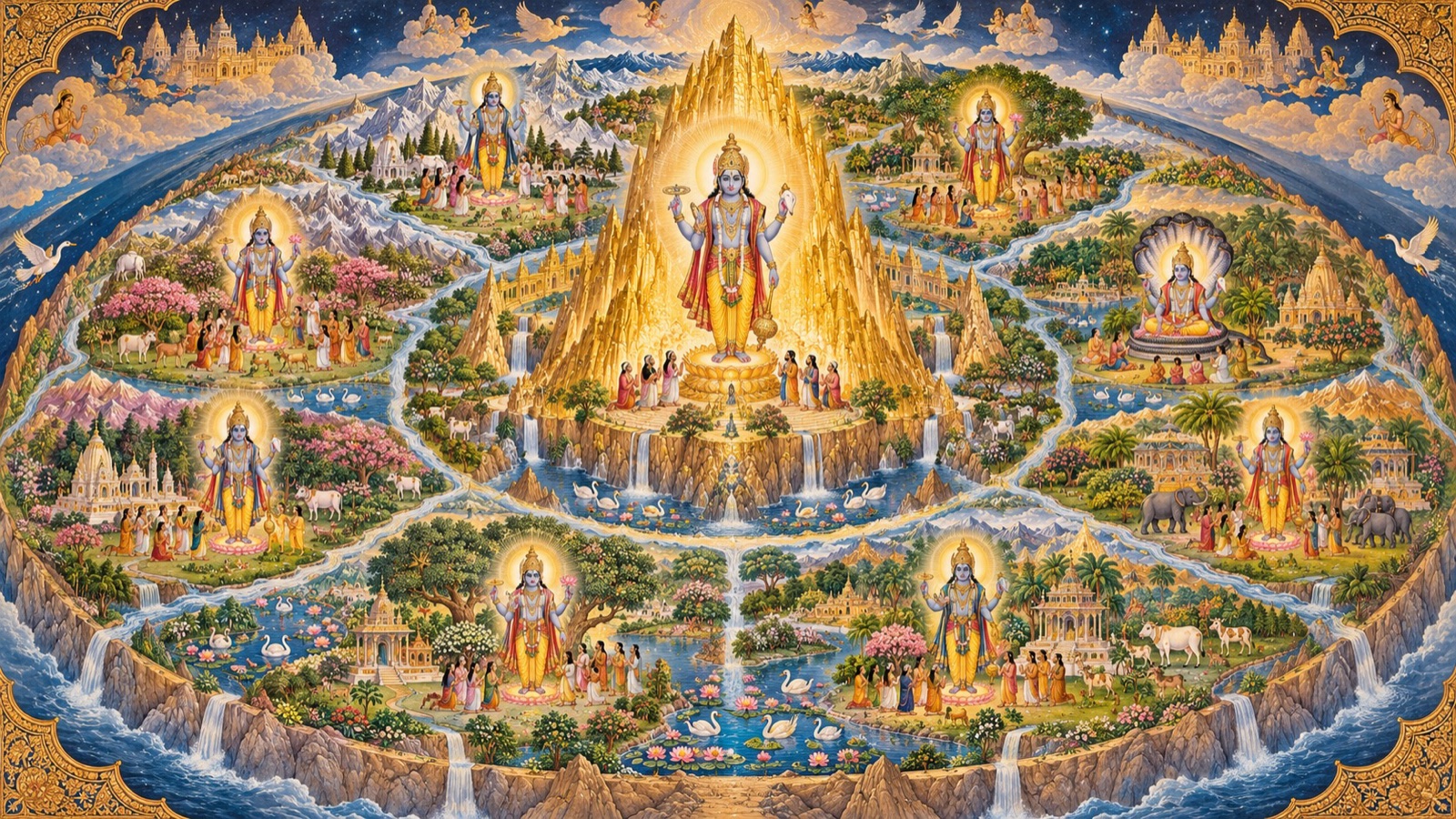
Sri Suka lingered lovingly upon the blessedness of these lands. The god-like men who dwell in them live for ten thousand years, with the strength of ten thousand elephants and frames firm as the thunderbolt, their youth unfading; and in the valleys the lords of the gods delight in gentle sport amid woodlands heavy with flowers and lakes musical with swans. Yet the true glory of these lands is not their beauty but their guest — for in all nine varshas the Supreme Person, Lord Narayana Himself, remains personally present even now in His many manifestations, to shower His grace upon His devotees.
नवस्वपि वर्षेषु भगवान्नारायणो महापुरुष: पुरुषाणां तदनुग्रहायात्मतत्त्वव्यूहेनात्मनाद्यापि सन्निधीयते ॥ १४ ॥
navasv api varṣeṣu bhagavān nārāyaṇo mahā-puruṣaḥ puruṣāṇāṁ tad-anugrahāyātma-tattva-vyūhenātmanādyāpi sannidhīyate
Meaning: In all these nine varshas the Supreme Person, Lord Narayana, remains present even now in His diverse manifestations, out of grace, to bless His devotees. (Canto 5, Chapter 17, verse 14)
Lord Shiva’s Worship of Sankarsana in Ilavrita
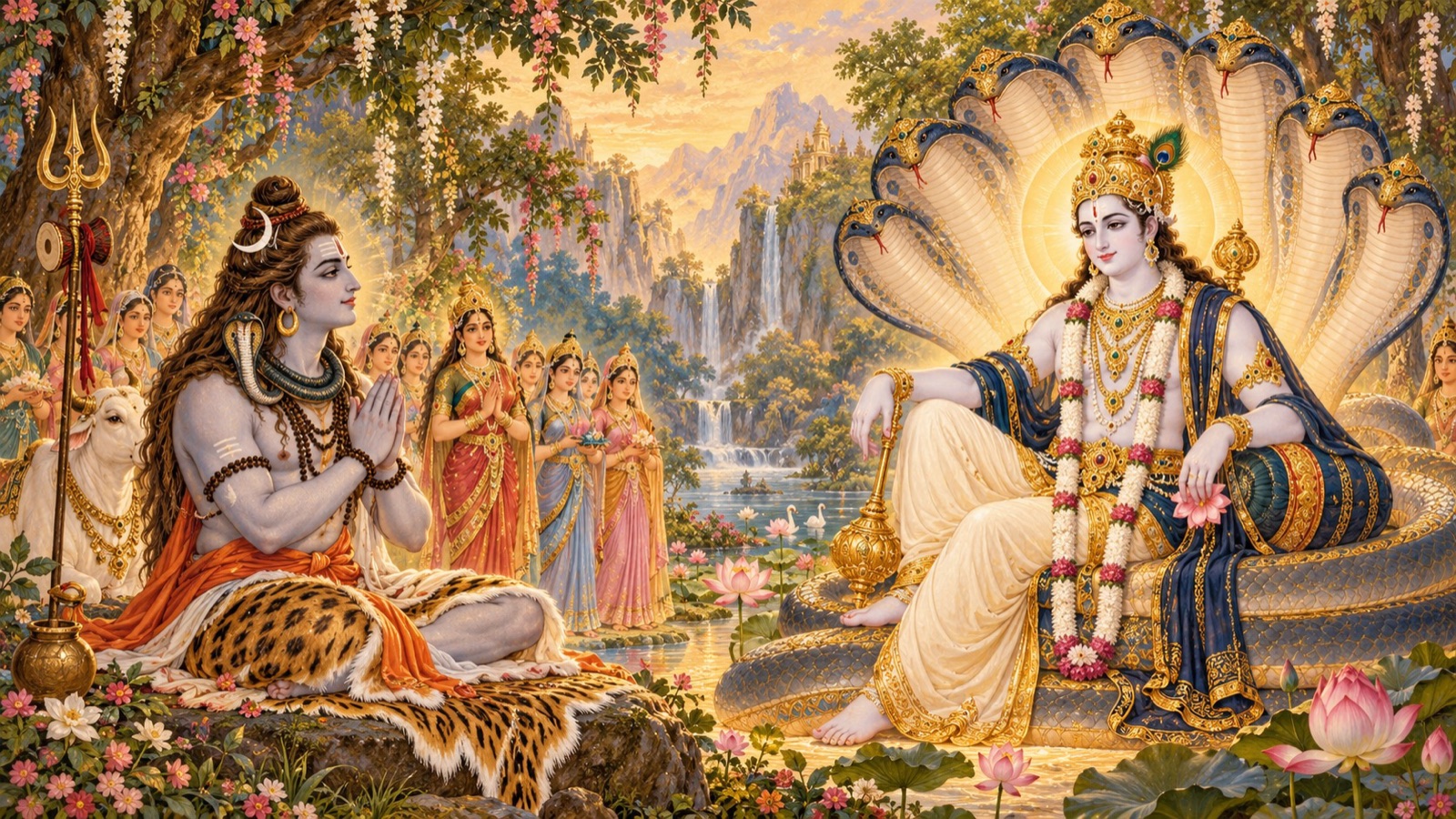
Then Sri Suka came to the sacred region of Ilavrita, and to its single, solitary Lord. In that land no man may set foot but one — Lord Sankara, the great Shiva — for a curse rests upon the place, that any male who enters is turned into a woman; and Sri Suka promised to tell the story of that curse in its proper place. There, waited upon by the countless women who form the retinue of Goddess Parvati, Lord Shiva dwells in ceaseless worship. And whom does the great Lord worship? He adores his own source — the fourth of the Lord’s manifestations, the form presiding over dissolution and known as Sankarsana; for the Supreme Person appears as Vasudeva, Pradyumna, Aniruddha and Sankarsana. Fixing that luminous form within his heart, Lord Shiva utters this prayer.
श्रीभगवानुवाच ॐ नमो भगवते महापुरुषाय सर्वगुणसङ्ख्यानायानन्तायाव्यक्ताय नम इति ॥ १७ ॥
śrī-bhagavān uvāca oṁ namo bhagavate mahā-puruṣāya sarva-guṇa-saṅkhyānāyānantāyāvyaktāya nama iti
Meaning: Lord Shiva prayed: Om. Obeisance to the Supreme Person, Lord Vishnu — the abode of all excellences, the infinite and unmanifest one. (Canto 5, Chapter 17, verse 17)
Verse by verse, Lord Shiva’s praise rises higher. He adores the Lord whose lotus-feet are the shelter of all, who reveals His protecting form to His devotees and ends their rebirth, while for those who turn away the round of worldly existence continues. He marvels that the Lord’s vision is never coloured by the objects of the senses, though He witnesses everything — unlike his own eyes, which have never fully mastered the force of anger. Whoever truly wishes to conquer the senses, Lord Shiva teaches, must take shelter at those same untouched lotus feet, for the senses yield to nothing less than the Lord’s own grace (verse 19). He tells how the Vedas name the Lord the source of creation, sustenance and dissolution, though He Himself is eternal and beyond them; upon the base of His thousand serpent-hoods the whole terrestrial globe rests like a single mustard seed, so lightly that the Lord does not even feel it. His own power to create, Shiva confesses, is itself only a gift, and he and all the powers of creation are held by the Lord like birds tied to a string, evolving this world by His grace alone. And he ends where all true prayer must end — in surrender.
यन्निर्मितां कर्ह्यपि कर्मपर्वणींमायां जनोऽयं गुणसर्गमोहित: । न वेद निस्तारणयोगमञ्जसातस्मै नमस्ते विलयोदयात्मने ॥ २४ ॥
yan-nirmitāṁ karhy api karma-parvaṇīṁ māyāṁ jano ’yaṁ guṇa-sarga-mohitaḥ na veda nistāraṇa-yogam añjasā tasmai namas te vilayodayātmane
Meaning: Deluded by the play of the three modes, this embodied soul can never of itself know the Maya You have fashioned, which binds it to the knots of action, still less the means to cross beyond it. And since the creation and dissolution of all worlds are nothing apart from You, obeisance to You, in whom all things arise and dissolve. (Canto 5, Chapter 17, verse 24)
Principal Teachings of This Chapter
The Ganga is holy because she flows from the Lord. Her power to purify comes not from her waters but from the lotus-foot she first bathed. This is why she is called Bhagavatpadi — and why the touch of what has touched the Lord can cleanse the whole world.
Love treasures whatever the Lord has touched. Dhruva bears the sacred stream on his head, and the seven seers on their matted locks, not for its own sake but because it washed the Lord’s foot. The devotee’s heart clings to every trace of the Beloved.
Pure devotion is not a path toward liberation — it surpasses liberation. The seven sages, having tasted unbroken love for Lord Vasudeva, no longer seek release from the world, for devotion has already given them what liberation could only promise: nearness to the Lord Himself.
Bharatavarsha is the precious land of action. Among all the blessed varshas, ours alone is the field where the soul may shape its destiny and turn toward liberation — the very difficulty of this life being its hidden gift.
The Lord is present everywhere, to give grace. In all nine varshas Narayana abides, and for one purpose only — to bless those who love Him.
Even the greatest bow before the Supreme. Lord Shiva, worshipped by all the worlds, spends his days in humble worship of Lord Sankarsana, confessing that his own power to create is a borrowed gift. True greatness is measured by the depth of one’s surrender.
A Devotional Reflection
There is something overwhelming in the picture Sri Suka paints for us here — a river that begins not in a mountain but at the foot of God, and yet is carried with trembling tenderness upon the head of a single devotee. It tells us that holiness is not a thing in itself; it is nearness to the Lord. The water became sacred by touching His foot; our own hearts grow pure by the same simple contact — by touching, in love and memory, the feet of the Lord. And then we are given the most humbling sight of all: Lord Shiva, whom the whole universe adores, standing with folded heart before Lord Sankarsana and calling himself a creature held on a string, unable even to know the Lord’s Maya without His grace. If the great Shiva bows so low, what pride can we hold onto? We are left wanting only what the sacred river wants — to fall at the Lord’s feet, to be coloured by His touch, and to carry that blessing, as Dhruva does, forever upon our head.
A Daily Devotional Practice
Today, remember the holy Ganga and where she truly begins. When you bathe, or drink water, or simply wash your hands, pause for a single breath, let the water remind you of the river that flows from the Lord’s own foot, and say inwardly: “Om Namo Bhagavate Vasudevaya.” And once in the day, in imitation of Lord Shiva, bow your head — in your heart if not in body — before the Supreme Lord, offering Him your smallest work and your largest worry alike. In this way even a cup of water and a bowed head become acts of pure devotion.
Conclusion
The seventeenth discourse of Book Five lifts our eyes to the wonders of the Lord’s creation and, higher still, to the Lord Himself. Sri Suka traced the descent of the holy Ganga from the lotus-foot of Trivikrama, her loving reception by Dhruva and the seven seers, her fourfold parting upon Mount Meru into the Sita, Alakananda, Cakshu and Bhadra, and her passage through the lands of the world — with Bharatavarsha honoured as the one true field of action. In every varsha the Supreme Lord Narayana abides to bless His devotees; and at last, in Ilavrita, the great Lord Shiva keeps ceaseless worship of Lord Sankarsana, ending in a hymn of surrender before the One in whom all worlds arise and dissolve. It is a chapter that dissolves every trace of pride and leaves the heart longing only to fall, like the sacred river, at the feet of the Lord.
May the divine wisdom of Srimad Bhagavatam awaken pure devotion within our hearts.
Om Namo Bhagavate Vasudevaya.
Jay Shree Madhav.
References and Attribution
- Primary edition: Gita Press, Śrīmad Bhāgavata Mahāpurāṇa, Book Five, Discourse 17, “An account of the descent of the holy Ganga and a song of praise to Lord Sankarsana by the divine Sankara.”
- Series: Srimad Bhagavatam Wisdom · Biswa Sanatan Dharma Seva Trust.
- Presented following the spiritual guidance and recommendation of Pandit Dr. Shri Kashinath Mishra.
This is an original, faithful retelling in the writer’s own words, with brief quoted verses shown in Devanāgarī and transliteration and their meanings given as summaries. It is not a reproduction of any single publisher’s continuous translation or commentary. No affiliation with or endorsement by any publisher is implied.
Jay Shree Madhav