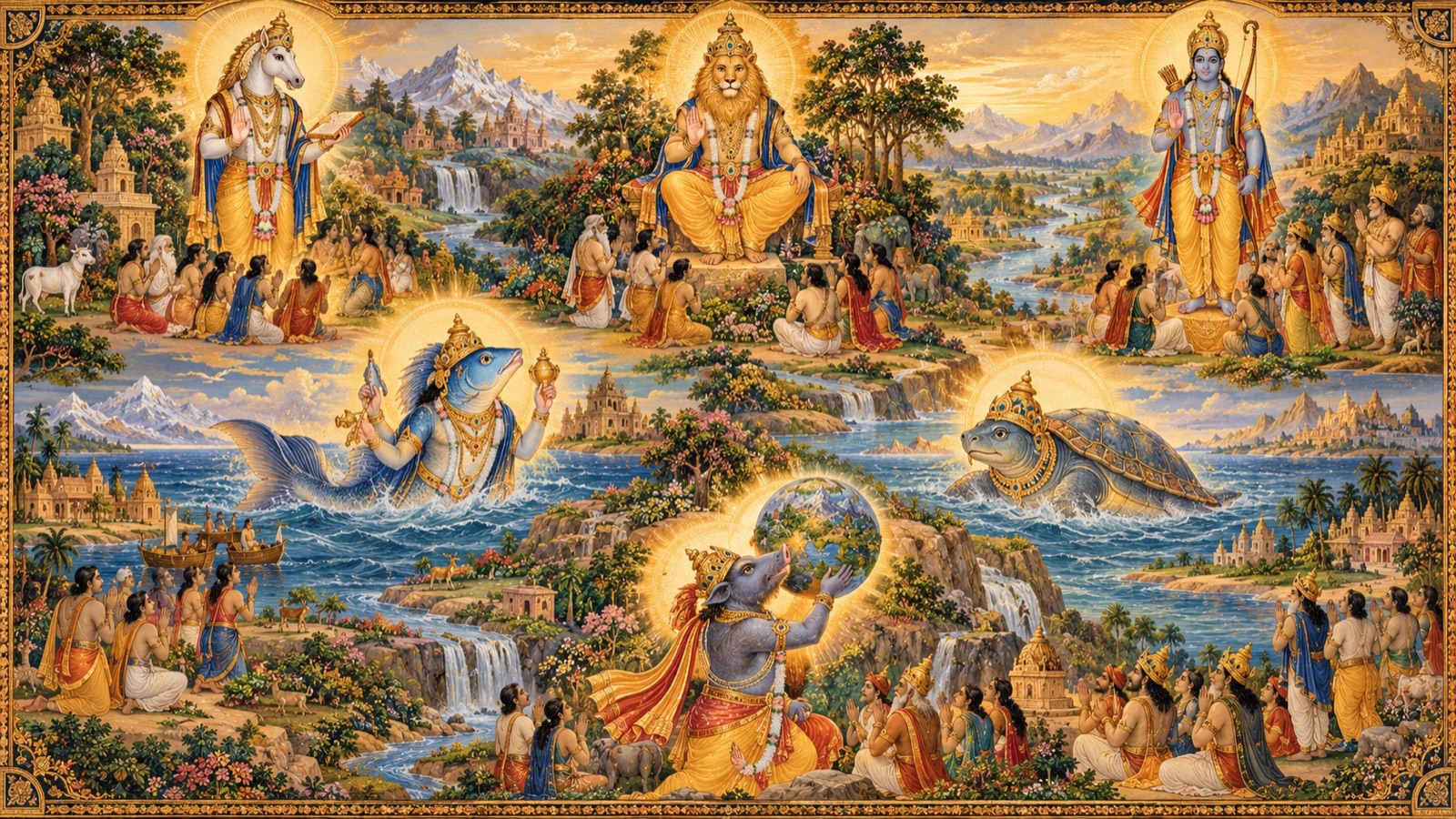
In region after region of the sacred earth, the ruler-devotees of the varshas gather their people and lift folded hands to the Lord, who dwells among them in a beloved divine form — Hayagriva, Nrsimha, Pradyumna, Matsya, Kurma and Varaha — each region’s heart pouring out its own hymn of adoration.
Om Namo Bhagavate Vasudevaya.
Om Namo Bhagavate Vasudevaya.
Om Namo Bhagavate Vasudevaya.
Welcome back to Srimad Bhagavatam Wisdom, a devotional journey through the sacred histories and teachings of the Srimad Bhagavat Mahapurana. Sri Suka now lifts our eyes from the rivers and mountains of the earth to the worship rising from it. In region after region of this vast terrestrial world, the Bhagavatam tells us, the Lord Himself abides in a particular, beloved form, and the ruler of that land, gathering all his people, adores that form with unbroken love. This eighteenth chapter of Book Five is a garland of six radiant hymns — to Hayagriva and Nrsimha, to Pradyumna and Matsya, to Kurma and Varaha — sung by great devotees whose names we cherish: Bhadrasrava and Prahlada, Goddess Lakshmi and holy Manu, Aryama and Mother Earth herself. To read them is to walk the whole earth and find it singing.
Chapter Information
- Scripture: Śrīmad Bhāgavata Mahāpurāṇa
- Canto: 5 (Book Five)
- Chapter: 18 (Discourse 18)
- Chapter title: Prayers to the Lord’s Divine Forms in the Varshas
- Principal speaker: Sukadeva Gosvami (Sri Suka), narrating to King Parikshit; within the narration, the ruler-devotees of six varshas each offer a hymn
- Principal listener: King Parikshit — the discourse related in turn by Suta Gosvami to the sages gathered at Naimisaranya
- Main setting: The varshas (regions) of the terrestrial world — Bhadrasva, Hari-varsha, Ketumala, Ramyaka, Hiranmaya and the land of the northern Kurus
- Central subject: How the Lord dwells in each region in a particular divine form, and the hymns of adoration offered to Him there by that region’s foremost devotee and people
- Principal verse range: Canto 5, Chapter 18, verses 1–39
- Primary edition: Gita Press Śrīmad Bhāgavata Mahāpurāṇa
From the Previous Chapter
In the seventeenth discourse, Sri Suka told how the holy Ganga descended from the lotus feet of the Lord, was borne long upon the head of Lord Shiva, and then fell upon the summit of Mount Meru to divide into four sacred streams that flow through the varshas of the earth. He related, too, the devout hymn that Lord Shiva offers to Lord Sankarshana in Ilavrita-varsha. From that vision of sacred waters and praise flowing across the world, the narration now turns to the many forms in which the Lord is worshipped, region by region.
Bhadrasva-varsha and the Prayer to Lord Hayagriva
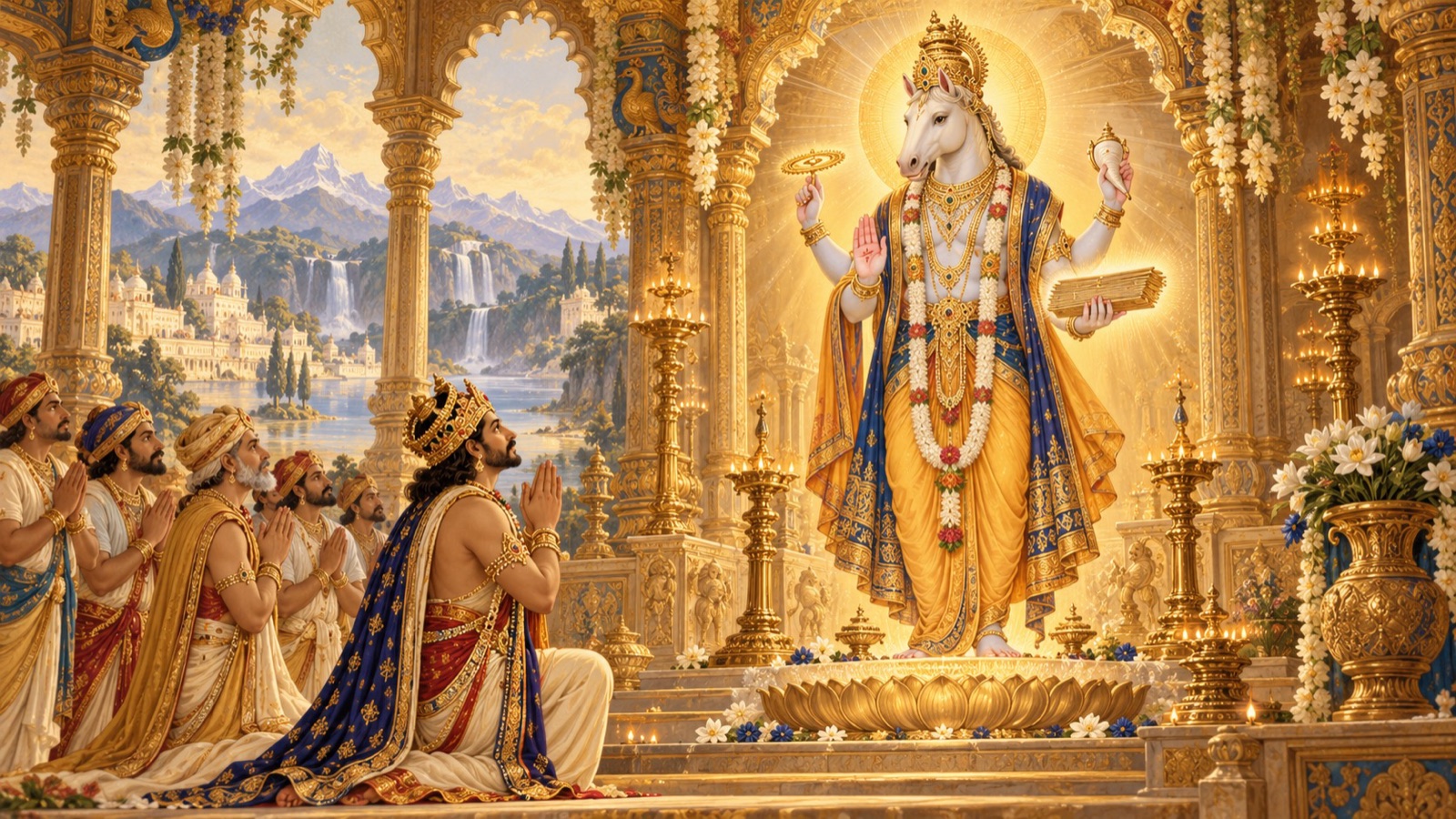
In the land of Bhadrasva, Sri Suka relates, its ruler Bhadrasrava — a son of Dharma, the deity of righteousness — together with the leading men of his people, adores a form most dear to Lord Vasudeva: Hayagriva, the Lord with a horse’s head, who is piety itself made visible. Fixing their minds in deep concentration and feeling His living presence among them, they lift their voices in praise. They hail the Lord as Dharma, denoted by the sacred syllable OM, who purifies the heart of all who turn to Him. They marvel at His wondrous Maya, by which the embodied soul, though it cremates its own elders and children, still fails to see death standing near, and plots fresh deeds to enjoy fleeting pleasures. The wise, they sing, know this world to be perishable; yet people are bewildered by His illusion — and to that birthless Lord, whose ways are so marvellous, they bow again and again.
Then their hymn rises to its crown, recalling the great deed by which Hayagriva blessed all the worlds.
वेदान् युगान्ते तमसा तिरस्कृतान् रसातलाद्यो नृतुरङ्गविग्रह: । प्रत्याददे वै कवयेऽभियाचते तस्मै नमस्तेऽवितथेहिताय इति ॥ ६ ॥
vedān yugānte tamasā tiraskṛtān rasātalād yo nṛ-turaṅga-vigrahaḥ pratyādade vai kavaye ’bhiyācate tasmai namas te ’vitathehitāya iti
Meaning: It was You, appearing as the man-horse, who at the close of the age brought back from the depths of the nether waters the Vedas that darkness had carried off, and restored them to Brahma, the first seer, when he prayed for them. Obeisance to You, whose every purpose is fulfilled without fail. (Canto 5, Chapter 18, verse 6)
Hari-varsha and the Prayer of Prahlada to Lord Nrsimha
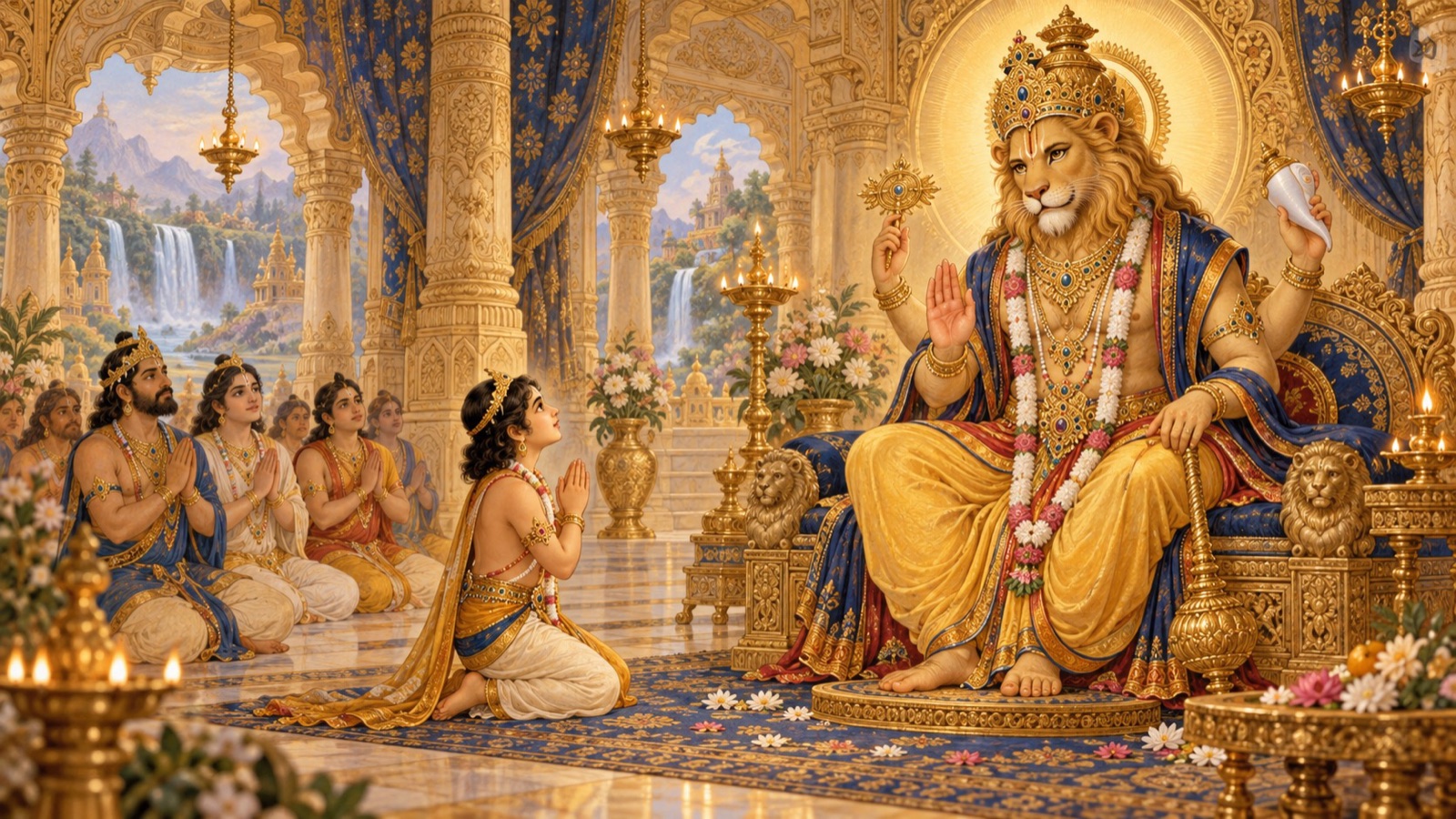
In Hari-varsha the Lord abides in the form of Narahari, the man-lion — the very form He assumed for the sake of His beloved child. There the great devotee Prahlada, whose spotless virtue and conduct brought sanctity even to the race of the Daityas, adores this dear form through unbroken and undivided devotion, and with all the people of that region he pours out his heart.
ॐ नमो भगवते नरसिंहाय नमस्तेजस्तेजसे आविराविर्भव वज्रनख वज्रदंष्ट्र कर्माशयान् रन्धय रन्धय तमो ग्रस ग्रस ॐ स्वाहा । अभयमभयमात्मनि भूयिष्ठा ॐ क्ष्रौम् ॥ ८ ॥
oṁ namo bhagavate narasiṁhāya namas tejas-tejase āvir-āvirbhava vajra-nakha vajra-daṁṣṭra karmāśayān randhaya randhaya tamo grasa grasa om svāhā; abhayam abhayam ātmani bhūyiṣṭhā oṁ kṣraum.
Meaning: Om, obeisance to Lord Narasimha; obeisance to the Light of all lights. O Lord with adamantine claws and adamantine teeth, reveal Yourself fully; burn away, burn away the seeds of our latent desires; devour, devour the darkness of ignorance. We offer our worship — arise within our hearts and make us wholly fearless. Om, ksraum. (Canto 5, Chapter 18, verse 8)
Prahlada’s love does not stay within his own heart but reaches out to embrace every living being. His prayer widens from his own trial to the whole of creation:
स्वस्त्यस्तु विश्वस्य खल: प्रसीदतां ध्यायन्तु भूतानि शिवं मिथो धिया । मनश्च भद्रं भजतादधोक्षजे आवेश्यतां नो मतिरप्यहैतुकी ॥ ९ ॥
svasty astu viśvasya khalaḥ prasīdatāṁ dhyāyantu bhūtāni śivaṁ mitho dhiyā manaś ca bhadraṁ bhajatād adhokṣaje āveśyatāṁ no matir apy ahaitukī
Meaning: May the whole universe know good fortune, and may even the wicked find peace of heart; may every living being think of the other’s welfare, and may every mind, without any selfish motive, turn and rest upon the Lord. (Canto 5, Chapter 18, verse 9)
If there is to be any attachment in the heart, let it be for the loving devotees of the Lord, and never for house, wife, children, wealth or kinsmen — for the contented and self-possessed soul soon finds blessedness, while the lover of the senses does not. Those who again and again hear the purifying stories of the Lord in the company of devotees find the birthless Lord entering their hearts through their ears and washing away every impurity. In the heart of such a devotee all the gods and all their virtues come to dwell. As water is the very life of the fish, so Lord Hari is the soul of every embodied being; and therefore, renouncing the home that is the root of craving, grief, anger and fear, Prahlada bids us take refuge at the feet of Lord Nrsimha, the one and only safe retreat.
Ketumala-varsha and the Prayer of Goddess Lakshmi to Lord Pradyumna
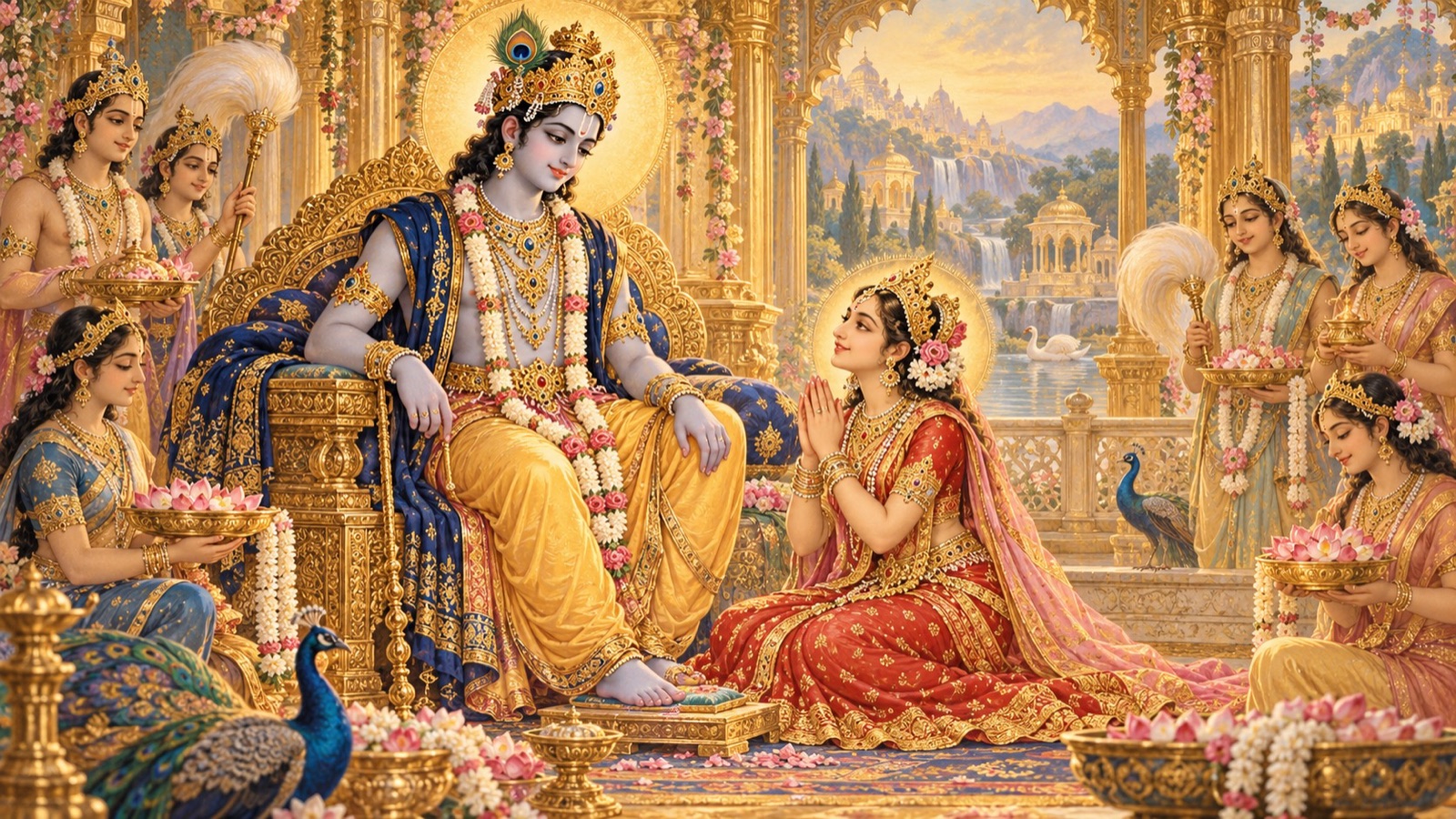
In Ketumala-varsha the Lord dwells in the form of Kamadeva — Pradyumna — to bring joy to Goddess Lakshmi, His own divine consort, and to the daughters and sons of Samvatsara, the presiding deities of nights and days, who number thirty-six thousand. By the grace of His lotus face, its brows lightly arched above a playful, tender glance and a winsome smile, He delights the heart of Goddess Rama and gladdens His own senses. Waiting upon Him with all her heart, the Goddess lifts her hymn of love.
ॐ ह्रां ह्रीं ह्रूं ॐ नमो भगवते हृषीकेशाय सर्वगुणविशेषैर्विलक्षितात्मने आकूतीनां चित्तीनां चेतसां विशेषाणां चाधिपतये षोडशकलायच्छन्दोमयायान्नमयायामृतमयाय सर्वमयाय सहसे ओजसे बलाय कान्ताय कामाय नमस्ते उभयत्र भूयात् ॥ १८ ॥
om hrāṁ hrīṁ hrūṁ oṁ namo bhagavate hṛṣīkeśāya sarva-guṇa-viśeṣair vilakṣitātmane ākūtīnāṁ cittīnāṁ cetasāṁ viśeṣāṇāṁ cādhipataye ṣoḍaśa-kalāya cchando-mayāyānna-mayāyāmṛta-mayāya sarva-mayāya sahase ojase balāya kāntāya kāmāya namas te ubhayatra bhūyāt.
Meaning: Om, hram hrim hrum. Obeisance to Lord Hrsikesa, master of the senses, marked out by every excellence — Lord of all the powers of action and perception and of the inner faculties, manifest in the sixteen parts of the subtle body, who is the Veda embodied, who as food sustains the body, who is immortality itself and the very source of all vigour of mind, sense and body. Obeisance to You, my beloved Lord, Love personified, here and hereafter. (Canto 5, Chapter 18, verse 18)
Goddess Lakshmi’s prayer is a meditation on true refuge. Women in this world, she sings, take sacred vows to win a husband, longing for one who will guard their children, their wealth and their life; yet such husbands, being themselves dependent, can protect nothing. He alone is a true master who fears nothing from any quarter and can shelter on every side the one who is afraid — and only the Lord, whose joy rests wholly in His own blissful nature, answers to that name. She who longs only to serve His lotus feet obtains all she could desire; while one who worships Him merely to gain some passing boon receives that boon alone, and grieves when it fades. Even Brahma, Lord Shiva, and the hosts of gods and demons practise severe austerities to win the Goddess’s grace, yet fail — for her heart is fixed upon the Lord alone. And so she prays that He place upon her head that adorable lotus hand He has so often laid upon His devotees.
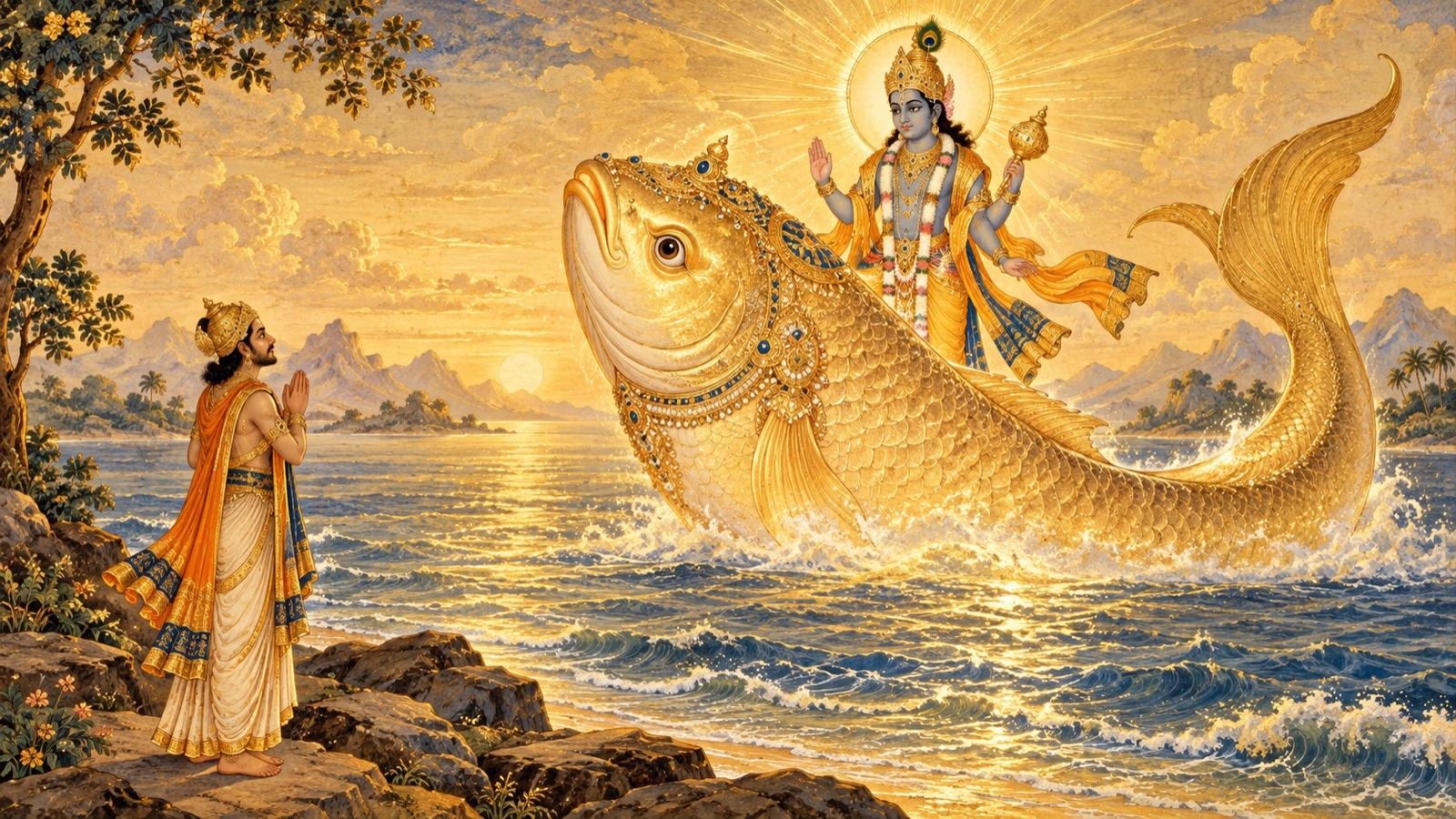
Ramyaka-varsha and the Prayer of Manu to Lord Matsya
In Ramyaka-varsha the present Manu — Sraddhadeva, who was known as Satyavrata in an earlier age — reveres above all the form of the Divine Fish that once appeared to him when the three worlds were drowned beneath the flood. With an unceasing flow of great devotion he adores that most beloved form and sings his praise.
ॐ नमो भगवते मुख्यतमाय नम: सत्त्वाय प्राणायौजसे सहसे बलाय महामत्स्याय नम इति ॥ २५ ॥
oṁ namo bhagavate mukhyatamāya namaḥ sattvāya prāṇāyaujase sahase balāya mahā-matsyāya nama iti.
Meaning: Om, obeisance to the foremost Lord; obeisance to Him who is pure being, the life-breath, vitality, energy and strength. Obeisance to the great Divine Fish. (Canto 5, Chapter 18, verse 25)
Though the Lord’s true form remains hidden from Brahma and all the guardians of the spheres, Manu sings, He moves within every being as the vital airs and without as the atmosphere, sounding aloud through the Vedas and thereby proclaiming His presence; and He governs the whole universe by His holy ordinances as a showman moves a puppet. When the guardians of the worlds, worn by jealousy, strove severally and together, they could not protect a single creature — moving or unmoving, biped or quadruped — without Him, the life-giving principle. And holding this earth, its plants and creepers, and Satyavrata himself upon its surface, the birthless Lord sported with great vigour through the tossing ocean of universal dissolution. To that Lord, the inner ruler of all beings, Manu bows.
Hiranmaya-varsha and the Prayer of Aryama to Lord Kurma
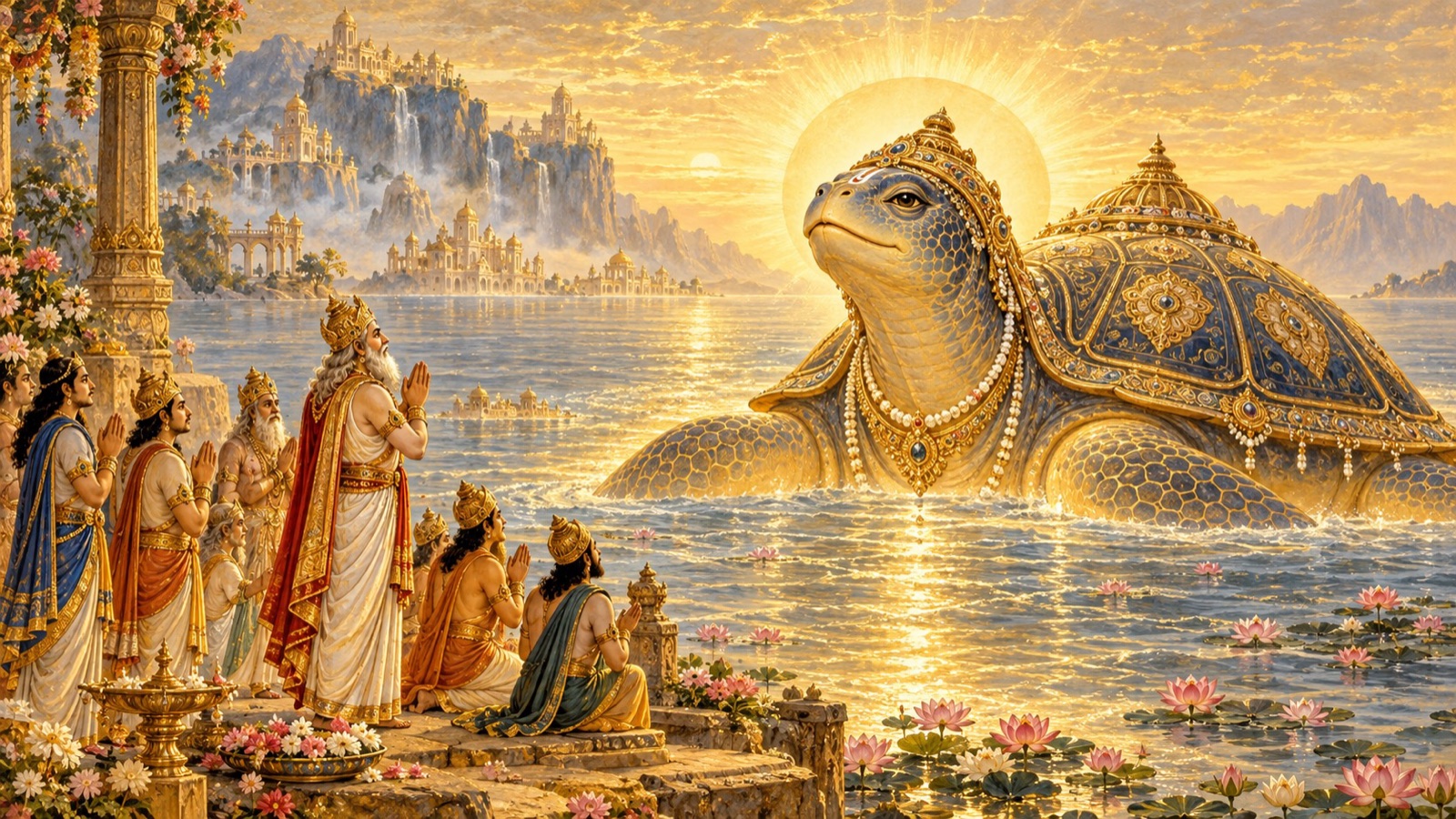
In Hiranmaya-varsha the Lord resides in the form of the Divine Tortoise. There Aryama, lord of the hosts of the manes, together with all the denizens of that region, adores this most beloved manifestation and offers his prayer.
ॐ नमो भगवते अकूपाराय सर्वसत्त्वगुणविशेषणायानुपलक्षितस्थानाय नमो वर्ष्मणे नमो भूम्ने नमो नमोऽवस्थानाय नमस्ते ॥ ३० ॥
oṁ namo bhagavate akūpārāya sarva-sattva-guṇa-viśeṣaṇāyānu-palakṣita-sthānāya namo varṣmaṇe namo bhūmne namo namo ’vasthānāya namas te.
Meaning: Om, obeisance to the Lord in the form of the Divine Tortoise, whose being is wholly of pure goodness, whose station cannot be perceived. Obeisance to the most ancient One, obeisance to the all-pervading Lord, obeisance again and again to the Support of all. (Canto 5, Chapter 18, verse 30)
This whole objective world, Aryama sings, spread out by the Lord’s own creative energy and seen in countless forms whose true extent none can measure, is nothing other than His own manifestation; yet His essential form can never be captured in words — and to that Lord he bows. It is He alone who is called by every name: mammal and creature born of moisture, bird and plant, the moving and the unmoving, god and seer and mane, the worlds of sense and heaven and sky, earth and mountain, river and ocean, island and planet and star. Though His names and forms are numberless, the seers assume within Him a fixed count of categories; and the very knowledge by which that plurality is set aside is none other than the Lord Himself, who is true wisdom embodied.
The Land of the Northern Kurus and the Prayer of Goddess Earth to Lord Varaha
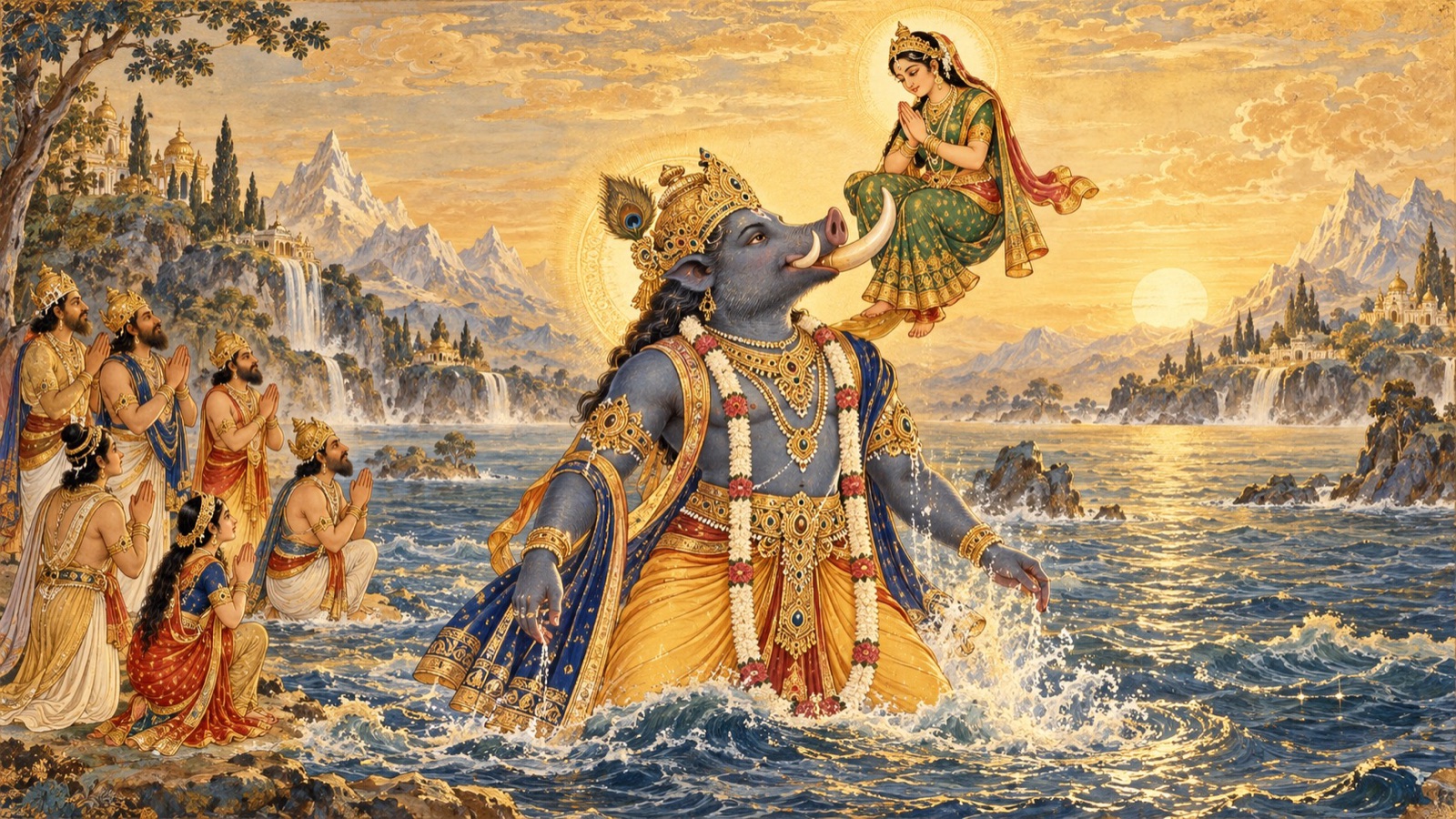
In the land of the northern Kurus the Lord who presides over all sacrifices is worshipped in the form of the Divine Boar. There Goddess Earth herself — the very ground that bears us — together with the Kurus, adores Him through an incessant flow of unfaltering devotion and offers a most sacred prayer. She hails the Boar, denoted by OM and truly known only through the sacred Mantras, the deity of every sacrifice, whose divine Body is composed of the great sacrifices themselves. As those skilled in ritual churn out the hidden fire from the sacrificial wood, so the wise, longing to perceive His reality, seek Him within the discipline of their body and senses by the light of a discerning mind. To the intellect made keen through reflection and the limbs of Yoga, He is directly perceived, the Supreme Self standing beyond the attributes of Maya. And as a piece of iron turns and moves toward a loadstone, so His Maya carries on through the three Gunas the creation, preservation and dissolution of the universe, while He remains only the witness of it all. Then Mother Earth recalls the great deed for which she loves Him most.
प्रमथ्य दैत्यं प्रतिवारणं मृधे यो मां रसाया जगदादिसूकर: । कृत्वाग्रदंष्ट्रे निरगादुदन्वत: क्रीडन्निवेभ: प्रणतास्मि तं विभुमिति ॥ ३९ ॥
pramathya daityaṁ prativāraṇaṁ mṛdhe yo māṁ rasāyā jagad-ādi-sūkaraḥ kṛtvāgra-daṁṣṭre niragād udanvataḥ krīḍann ivebhaḥ praṇatāsmi taṁ vibhum iti
Meaning: Having slain in battle the demon who stood against Him like a rival elephant, the primeval Boar, the source of the universe, set me upon the tip of His tusk and rose up through the whole depth of the flood-waters, sporting as an elephant sports. To that almighty Lord I bow. (Canto 5, Chapter 18, verse 39)
Principal Teachings of This Chapter
The one Lord is worshipped in many beloved forms. Across the whole earth the same Supreme Lord dwells and is adored — as Hayagriva and Nrsimha, as Pradyumna and Matsya, as Kurma and Varaha. His forms are countless, yet He is ever one, and every hymn rises to the same Person.
The Lord descends to protect and to save. Each hymn remembers a saving deed — the Vedas rescued, the fearless refuge given, the earth and its people borne safely through the flood. The Lord’s forms are not distant marvels but acts of tender rescue for His devotees.
A devotee’s greatness is measured by freedom from self-interest. When Prahlada prays, after all he suffered at his own father’s hands, that the wicked themselves find peace and every mind turn to the Lord without private motive (verse 9), and when Lakshmi later confesses that even Brahma and Shiva’s austerities cannot win her favour while the soul who wants only to serve receives everything (verses 21–22), the Bhagavatam is teaching the same lesson through its two most exalted worshippers: the Lord does not measure devotion by power gained or opulence won, but by how completely the heart has let go of wanting anything for itself. This, more than any single wonder recounted here, is why these two prayers are remembered above the rest.
Fearlessness is found only in Him. Prahlada prays to be made fearless, and Lakshmi sings that He alone, who fears nothing, can shelter the fearful on every side. To take refuge in the Lord is to step out of the reach of all dread.
True refuge is His feet, not the world. Again and again the hymns turn us from house, wealth and passing boons toward the Lord’s lotus feet and the company of His devotees — the only shelter that does not fade.
He is both beyond words and nearer than all. The Tortoise-hymn and the Boar-hymn confess that His essential form cannot be described, yet He is the soul within every being and the witness of every work — utterly transcendent, and utterly present.
A Devotional Reflection
There is something deeply moving in the picture this chapter gives us of the whole earth at prayer. We are shown region after region, and in each one the Lord has not remained aloof but has come to live among His people in the very form their hearts can love — the horse-headed rescuer of wisdom, the fearless man-lion, the enchanting Pradyumna, the great Fish, the patient Tortoise, the mighty Boar. And in each region the response is the same: a devotee lifts folded hands and pours out love, and the people join their voices. It teaches us that devotion is not the private treasure of one soul in one place, but the native language of all creation. Mother Earth herself is a devotee; the lord of the ancestors is a devotee; Goddess Lakshmi, seated beside the Lord, still sings His praise. When we feel small or alone in our own prayer, this chapter reminds us that we are joining a hymn already rising from every corner of the world. To fold our hands and say His name is to take our place in that vast and ancient chorus, and to find, as these great ones found, that the Lord is already near — waiting, in the form our own heart most loves, to make us fearless and to lift us gently from the waters.
A Daily Devotional Practice
Today, choose one of the Lord’s forms remembered in this chapter — perhaps Nrsimha, who makes the heart fearless, or Varaha, who lifts the fallen from the depths — and hold it quietly before your mind. Offer this simple prayer as these great devotees did: “O Lord, burn away my fear and my craving; be present in my heart and make me fearless; let my only refuge be Your feet.” Then, through the day, whenever a worry rises, gently return to that form and repeat inwardly: “Om Namo Bhagavate Vasudevaya.” In this way you join the hymn of the varshas, and let the same Lord who saved the Vedas and bore the earth carry your own small burdens as well.
Conclusion
The eighteenth discourse of Book Five lifts our gaze to the worship rising from the whole terrestrial world. In Bhadrasva, Bhadrasrava and his people adore Lord Hayagriva, who restored the stolen Vedas to Brahma. In Hari-varsha, the great devotee Prahlada praises Lord Nrsimha and prays to be made fearless and to rest at His feet. In Ketumala, Goddess Lakshmi sings to the Lord as Pradyumna, seeking to serve His feet above every boon. In Ramyaka, the Manu adores the Divine Fish who bore the earth through the flood; in Hiranmaya, Aryama bows to the ancient Tortoise, beyond all names yet the soul of all; and in the land of the northern Kurus, Mother Earth herself adores the Divine Boar who lifted her upon His tusk from the deluge. Six regions, six forms, six hymns — and one Lord, worshipped everywhere as the only refuge, the only fearlessness, the only truth. It is a chapter that turns the whole earth into a temple and every faithful heart into a singer within it.
May the divine wisdom of Srimad Bhagavatam awaken pure devotion within our hearts.
Om Namo Bhagavate Vasudevaya.
Jay Shree Madhav.
References and Attribution
- Primary edition: Gita Press, Śrīmad Bhāgavata Mahāpurāṇa, Book Five, Discourse 18, “A description of (the various Varsas) of the terrestrial globe continued.”
- Series: Srimad Bhagavatam Wisdom · Biswa Sanatan Dharma Seva Trust.
- Presented following the spiritual guidance and recommendation of Pandit Dr. Shri Kashinath Mishra.
This is an original, faithful retelling in the writer’s own words, with brief quoted verses shown in Devanāgarī and transliteration and their meanings given as summaries. It is not a reproduction of any single publisher’s continuous translation or commentary. No affiliation with or endorsement by any publisher is implied.
Jay Shree Madhav