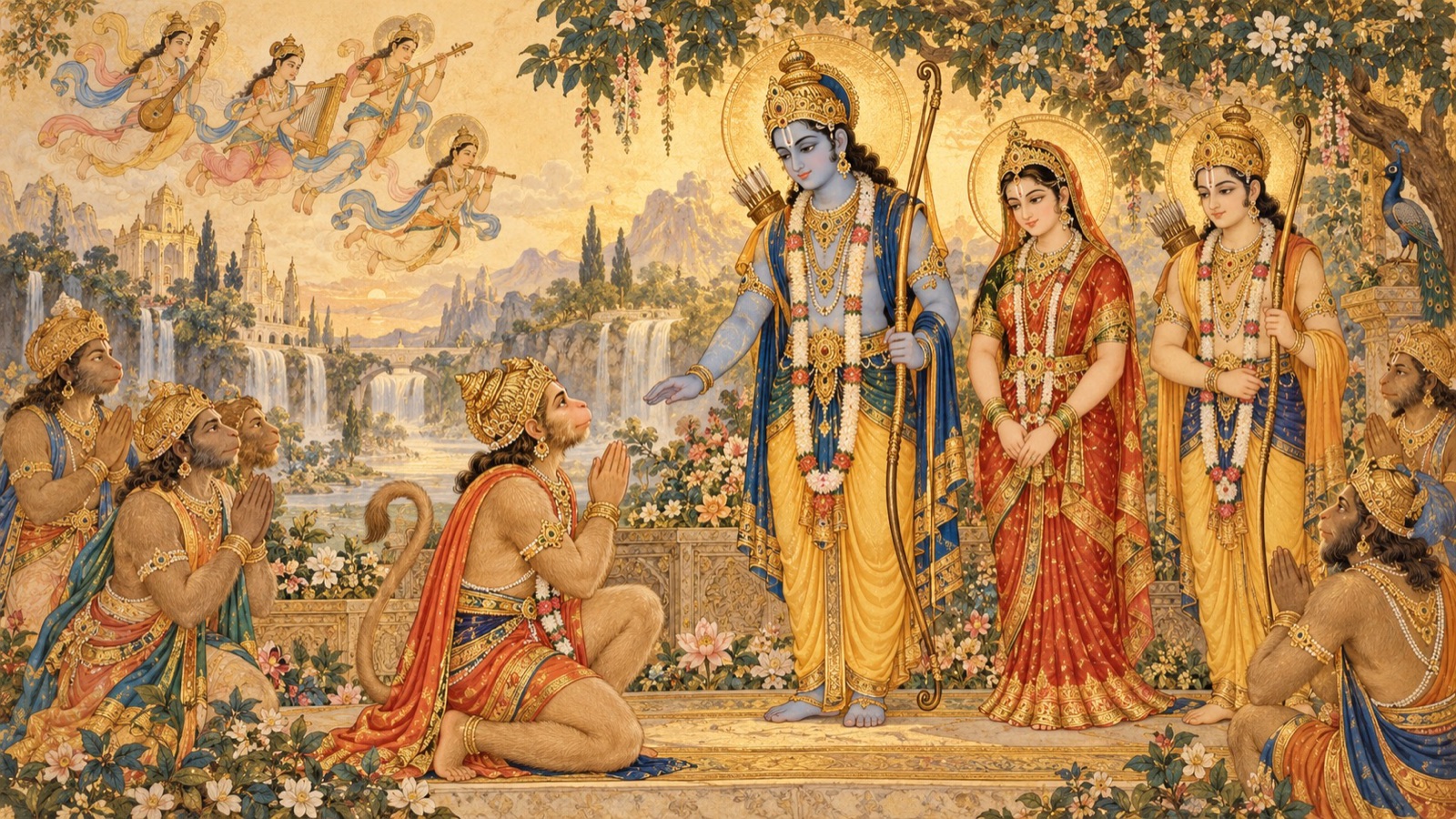
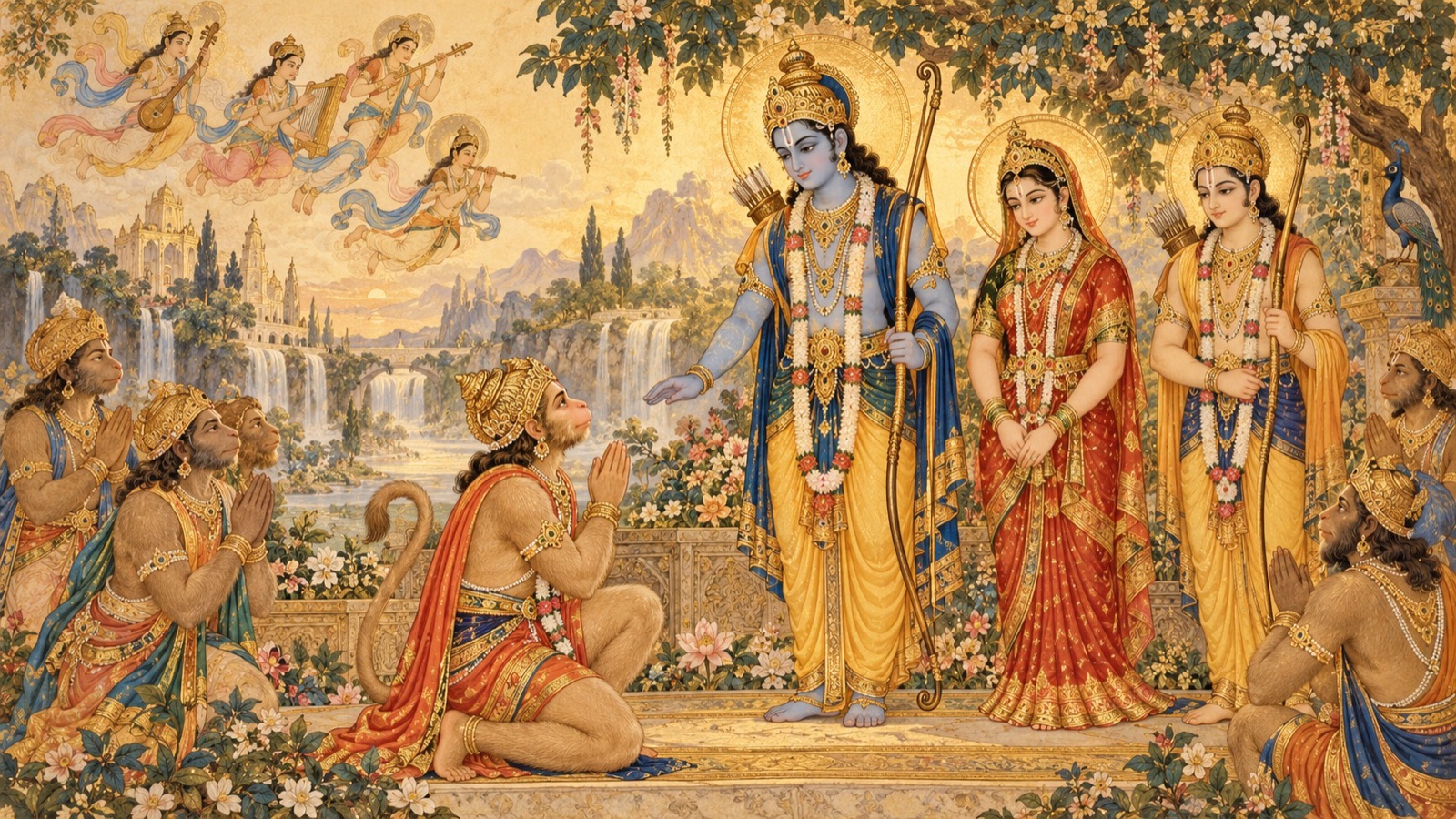
In Kimpurusha-varsha, the foremost of devotees, Sri Hanuman, kneels with folded hands before Sri Ramachandra — dear to Sita and honoured by Lakshmana as an elder brother — and, together with the Kimpurushas, worships Him with unremitting devotion.
Om Namo Bhagavate Vasudevaya.
Om Namo Bhagavate Vasudevaya.
Om Namo Bhagavate Vasudevaya.
Welcome back to Srimad Bhagavatam Wisdom, a devotional journey through the sacred histories and teachings of the Srimad Bhagavat Mahapurana. Having led us in wonder across the golden divisions of Jambudvipa, Sri Suka now brings his description of that great island-land to its close — and he saves its most tender jewels for the very end. We are taken to Kimpurusha-varsha, where Sri Hanuman adores Sri Rama with a hymn born of pure love; then to Bharata-varsha, where the Lord as Nara-Narayana performs endless austerities and the sage Narada worships Him with devotion. And we hear the most heartening truth of all: that birth in this holy land of Bharata is a treasure coveted even by the gods.
Chapter Information
- Scripture: Śrīmad Bhāgavata Mahāpurāṇa
- Canto: 5 (Book Five)
- Chapter: 19 (Discourse 19)
- Chapter title: Hanuman’s Hymn to Rama and the Glory of Bharata-varsha
- Principal speaker: Sukadeva Gosvami (Sri Suka), narrating to King Parikshit; within the narration are set the hymn of Sri Hanuman to Lord Rama and the hymn of the sage Narada to Nara-Narayana
- Principal listener: King Parikshit — the discourse related in turn by Suta Gosvami to the sages gathered at Naimisaranya
- Main setting: Kimpurusha-varsha, where Hanuman worships Sri Rama; and Bharata-varsha, with its holy retreat of Badarikashrama, its mountains and rivers, and its eight minor islands within Jambudvipa
- Central subject: The worship of Lord Rama by Hanuman in Kimpurusha-varsha; the austerities of Nara-Narayana and the devotion of Narada in Bharata-varsha; the sacred mountains and rivers of Bharata; the surpassing glory of a human birth in this land, sung even by the gods; and the eight sub-islands of Jambudvipa
- Principal verse range: Canto 5, Chapter 19, verses 1–31
- Primary edition: Gita Press Śrīmad Bhāgavata Mahāpurāṇa
From the Previous Chapter
In the eighteenth discourse, Sri Suka carried us through the varshas of Jambudvipa and let us hear the hymns with which their presiding personalities adore the Lord in His many forms — Hayagriva, Nrsimha worshipped by Prahlada, Kamadeva worshipped by the goddess Lakshmi, Matsya adored by Manu, Kurma honoured by Aryama, and the divine Boar worshipped by mother Earth. Each land offered its own prayer, and each prayer sang of the same Supreme Lord who upholds all beings. That same current of adoration now flows onward into Kimpurusha-varsha and Bharata-varsha, where devotion reaches its most beloved and most hopeful expression.
The Worship of Sri Rama in Kimpurusha-varsha
In Kimpurusha-varsha lives that foremost of devotees, Sri Hanuman, who takes his whole delight in remaining forever at the feet of his Lord. Together with the Kimpurushas, the dwellers of that land, he adores with unbroken devotion the most ancient Person, present there in the form of Lord Sri Rama — the elder brother of Lakshmana and the delight of Sita. In the company of Arstisena, a foremost dweller of that region, Hanuman listens with rapt love to the all-auspicious story of his divine Lord as it is sung by the Gandharvas, and then, his heart overflowing, he himself takes up the same praise.
ॐ नमो भगवते उत्तमश्लोकाय नम आर्यलक्षणशीलव्रताय नम उपशिक्षितात्मन उपासितलोकाय नम: साधुवादनिकषणाय नमो ब्रह्मण्यदेवाय महापुरुषाय महाराजाय नम इति ॥ ३ ॥
oṁ namo bhagavate uttamaślokāya nama ārya-lakṣaṇa-śīla-vratāya nama upaśikṣitātmana upāsita-lokāya namaḥ sādhu-vāda-nikaṣaṇāya namo brahmaṇya-devāya mahā-puruṣāya mahā-rājāya nama iti
Meaning: Om! Obeisance to the glorious Lord who is sung by the noblest verses; obeisance to Him whose marks, character and vows are those of the truly noble; obeisance to Him who has fully mastered His own self and who honoured the wishes of His people; obeisance to Him who is the very touchstone by which goodness is proved; obeisance to the Lord devoted to the Brahmanas, to the Supreme Person, to the great King — obeisance, again and again. (Canto 5, Chapter 19, verse 3)
Hanuman’s praise then turns to the deepest mystery of his Lord. He resorts to Him who is pure Consciousness itself, the one true Being, who by His own divine energy holds His deluding potency of Maya far off, who is beyond this world of objects, perfectly serene, realized only by the pure of heart, past all names and forms. The Lord’s descent in human form, Hanuman sings, was meant to teach mankind the ways of the great, and not merely to destroy the demon race — for how else could the Soul of the universe, ever revelling in His own bliss, seem to grieve at separation from Sita, except to show the world how the noble bear their duty?
Here lies the deeper reason for that seeming sorrow. Sri Rama lacks nothing and is never truly bereaved, yet He let Himself appear to suffer so as to leave mortal beings with two lessons. First, that happiness built around a wife and household, however dearly cherished, is never free of grief — a caution to any soul that would seek its whole joy there. Second, that whoever does accept a wife must guard her with total, unwavering devotion, whatever the cost to himself; hence Sri Rama crossed the ocean and destroyed Ravana’s entire clan rather than fail Sita for a moment. Even in apparent pain, then, the Lord was silently instructing both the renounced and the householder in their true duty (verses 5–6).
Neither high birth, nor beauty, nor eloquence, nor keen intellect wins the Lord’s grace; for Sri Rama took to His friendship even the forest monkeys, who possessed none of these. Therefore, Hanuman declares, whether one be a god or a demon, a monkey or a man, whatever one may be, one should with all one’s being take refuge in the noble Sri Rama — Sri Hari Himself in human form — who never forgets a service done to Him and who, at the close of His earthly pastime, led all the people of northern Kosala to the higher worlds.
The Penance of Nara-Narayana in Bharata-varsha
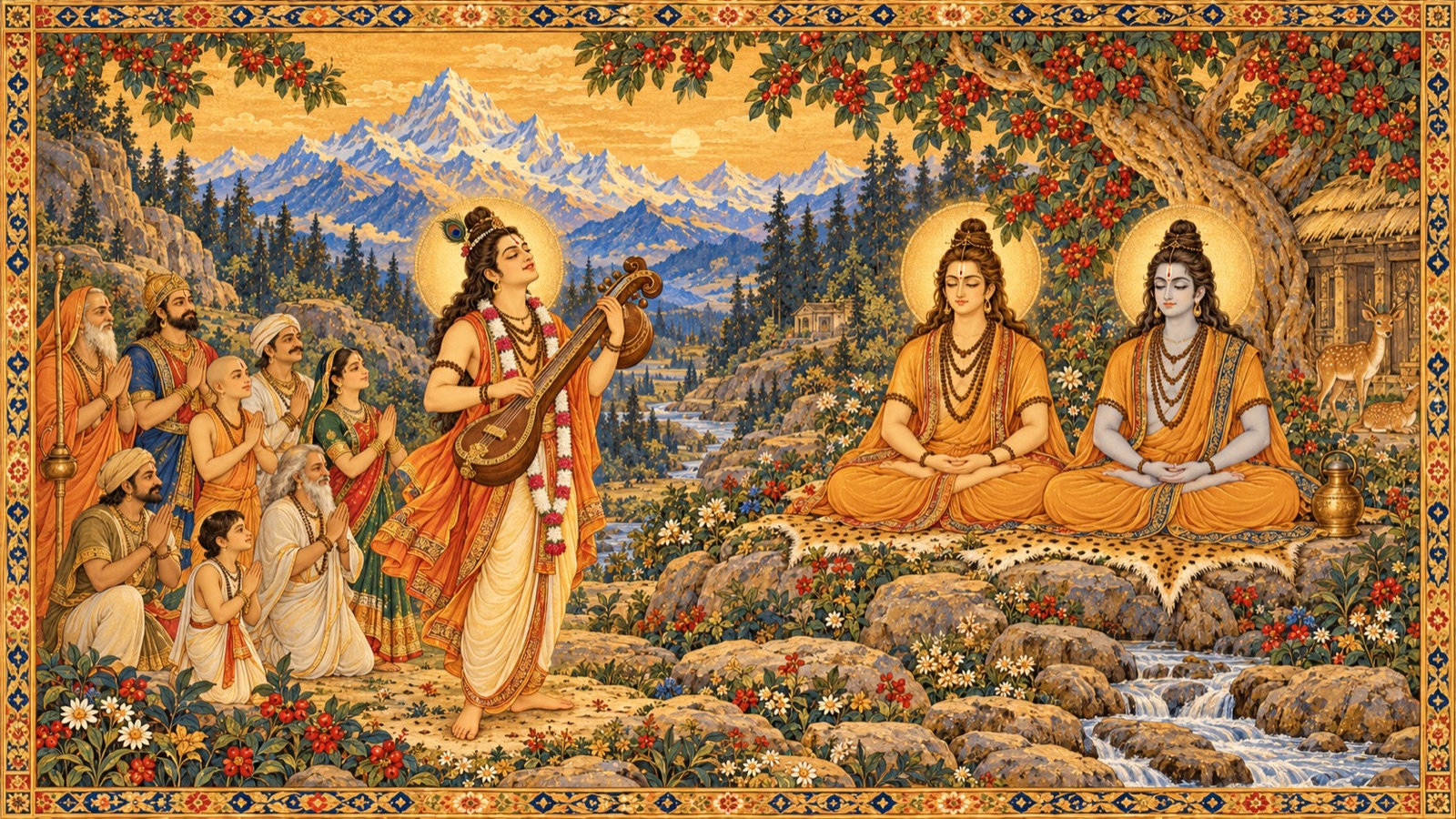
From that land of loving song, Sri Suka turns our gaze to Bharata-varsha, the field where works bear their fruit. Here the Supreme Lord Himself, under the name of Nara-Narayana, dwells in the holy retreat of Badarikashrama and practises austerities that will continue until the very end of the Kalpa. His movements pass unseen by the world, and He undertakes this penance out of pure compassion — to shower His grace upon those who have subdued their minds, and to set before them a noble example. Such austerity, the Bhagavatam tells us, increases righteousness, spiritual knowledge, dispassion, mystic power, tranquillity and self-restraint, and leads at last to the direct vision of the Self.
भारतेऽपि वर्षे भगवान्नरनारायणाख्य आकल्पान्तमुपचितधर्मज्ञानवैराग्यैश्वर्योपशमोपरमात्मोपलम्भनमनुग्रहायात्मवतामनुकम्पया तपोऽव्यक्तगतिश्चरति ॥ ९ ॥
bhārate ’pi varṣe bhagavān nara-nārāyaṇākhya ākalpāntam upacita-dharma-jñāna-vairāgyaiśvaryopaśamoparamātmopalambhanam anugrahāyātmavatām anukampayā tapo ’vyakta-gatiś carati
Meaning: In the land of Bharata-varsha as well, the Supreme Lord, under the name of Nara-Narayana, performs austerities until the end of the Kalpa, His course of movement unperceived — out of compassion and to grace those who have mastered themselves — austerities that increase righteousness, knowledge, dispassion, divine power, tranquillity and self-restraint, and lead at last to the realization of the Self. (Canto 5, Chapter 19, verse 9)
Narada’s Hymn of Devotion
Intending to instruct Savarni — one of the Manus who is to preside over a coming age — in the wisdom of the Pancaratra, and in the Sankhya and Yoga taught by the Lord Himself in the Bhagavad-gita, the glorious sage Narada comes before Nara-Narayana. Together with the people of Bharata-varsha, who order their lives by the sacred divisions of varna and ashrama, Narada adores the Lord with a feeling of supreme devotion and takes up this hymn of praise.
ॐ नमो भगवते उपशमशीलायोपरतानात्म्याय नमोऽकिञ्चनवित्ताय ऋषिऋषभाय नरनारायणाय परमहंसपरमगुरवे आत्मारामाधिपतये नमो नम इति ॥ ११ ॥
oṁ namo bhagavate upaśama-śīlāyoparatānātmyāya namo ’kiñcana-vittāya ṛṣi-ṛṣabhāya nara-nārāyaṇāya paramahaṁsa-parama-gurave ātmārāmādhipataye namo nama iti
Meaning: Om! Obeisance to the Lord whose very nature is serenity, who has ceased from all false identification with the non-Self; obeisance to Him who is the only wealth of those who own nothing, the foremost of sages, Nara-Narayana, the supreme preceptor of the paramahamsas and the Lord of those who delight in the Self — obeisance, and obeisance again. (Canto 5, Chapter 19, verse 11)
Narada sings on. He bows to the Lord who, though the Maker of this whole universe, is never bound by the work of creation; who, though clothed in a body, is untouched by the body’s hungers; who, though He sees all things, is never stained by the qualities of what He sees — in a word, the wholly unattached, ever-pure Witness of all. Herein, Narada says, lies the very perfection of Yoga which the great Brahma once revealed: that a soul, letting go of all identification with the body, should fix the mind upon the Lord who is beyond all the modes of Nature, and hold Him there at the final moment through a devotion nourished from birth. All striving after mere learning, he adds, is fruitless labour for one who, however well-read, still trembles for his frail and perishable body, no better than the ignorant man enslaved to the pleasures of this world and the next, forever anxious over children, wife and wealth. And so Narada prays for the one true remedy — that the Lord bestow upon His devotees loving devotion to Himself, by which they may quickly cast off the grip of “I” and “mine” upon this poor body, a delusion so hard to shed, arising as it does from the Lord’s own Maya.
The Sacred Rivers and Mountains of Bharata-varsha
Sri Suka then unfolds the sacred face of Bharata-varsha itself, this land so dear to the Lord and so blessed for those born upon it. He tells of its many great mountains and of the countless rivers that pour down from their slopes — waters so holy that they cleanse the people who touch them by the very sound of their names.
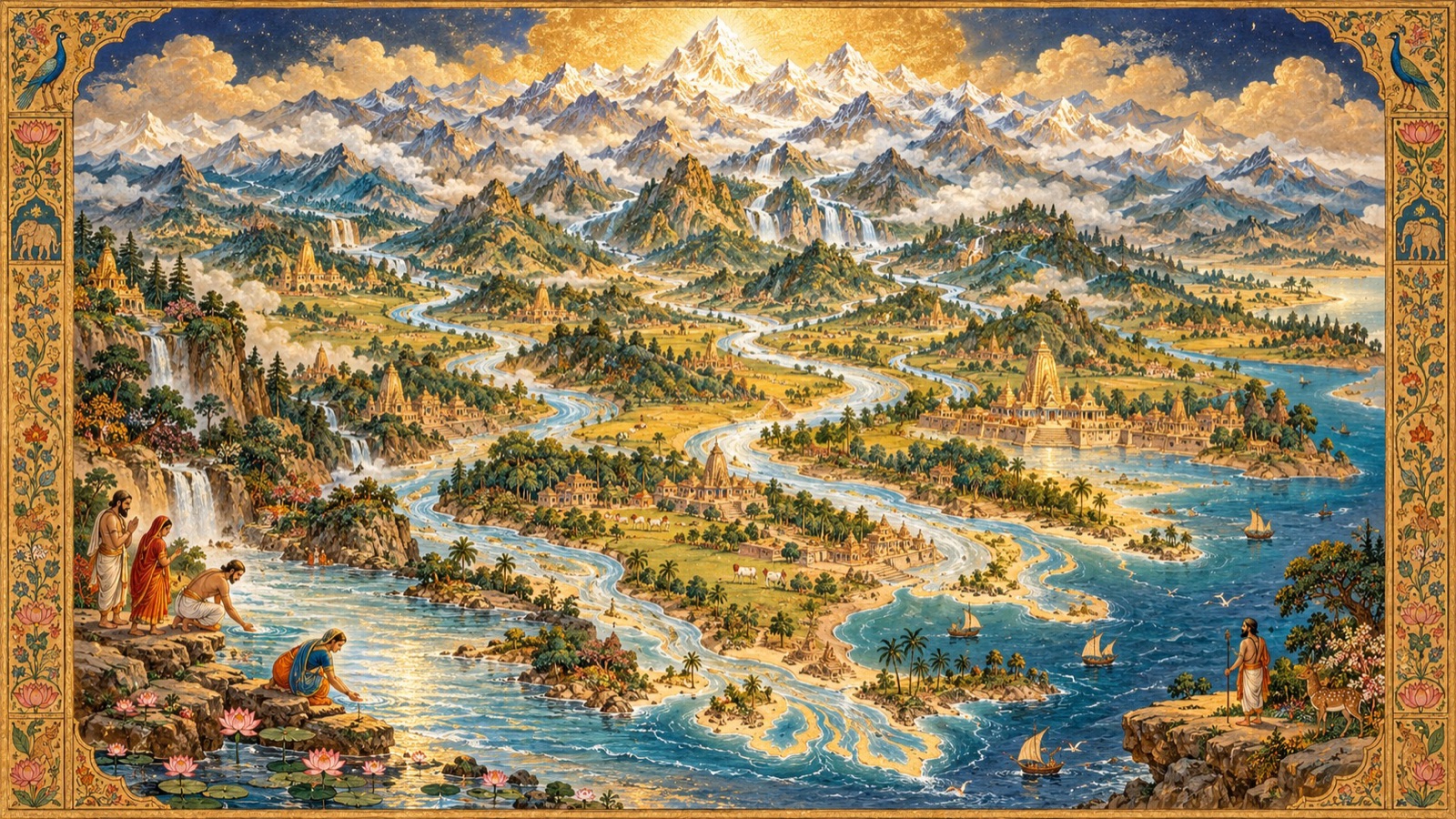
भारतेऽप्यस्मिन्वर्षे सरिच्छैला: सन्ति बहवो मलयो मङ्गलप्रस्थो मैनाकस्त्रिकूट ऋषभ: कूटक: कोल्लक: सह्यो देवगिरिऋर्ष्यमूक: श्रीशैलो वेङ्कटो महेन्द्रो वारिधारो विन्ध्य: शुक्तिमानृक्षगिरि: पारियात्रो द्रोणश्चित्रकूटो गोवर्धनो रैवतक: ककुभो नीलो गोकामुख इन्द्रकील: कामगिरिरिति चान्ये च शतसहस्रश: शैलास्तेषां नितम्बप्रभवा नदा नद्यश्च सन्त्यसङ्ख्याता: ॥ १६ ॥
bhārate ’py asmin varṣe saric-chailāḥ santi bahavo malayo maṅgala-prastho mainākas trikūṭa ṛṣabhaḥ kūṭakaḥ kollakaḥ sahyo devagirir ṛṣyamūkaḥ śrī-śailo veṅkaṭo mahendro vāridhāro vindhyaḥ śuktimān ṛkṣagiriḥ pāriyātro droṇaś citrakūṭo govardhano raivatakaḥ kakubho nīlo gokāmukha indrakīlaḥ kāmagirir iti cānye ca śata-sahasraśaḥ śailās teṣāṁ nitamba-prabhavā nadā nadyaś ca santy asaṅkhyātāḥ
Meaning: In this land of Bharata-varsha too there are many mountains — Malaya, Mangalaprastha, Mainaka, Trikuta, Rsabha, Kutaka, Kollaka, Sahya, Devagiri, Rsyamuka, Srisaila, Venkata, Mahendra, Varidhara, Vindhya, Suktiman, Rksagiri, Pariyatra, Drona, Citrakuta, Govardhana, Raivataka, Kakubha, Nila, Gokamukha, Indrakila and Kamagiri — and hundreds and thousands of others besides; and from their slopes flow rivers, great and small, beyond all counting. (Canto 5, Chapter 19, verse 16)
Among those sacred waters Sri Suka names the Candravasa and the Tamraparni, the Krtamala and the Kaveri, the Tungabhadra, the Krsna and the Godavari, the Narmada and the Sindhu, the mighty Brahmaputra and the Sona, the Yamuna and the Saraswati, the Gomati and the Sarayu, the Satadru, the Candrabhaga and many more — all of them holy, all of them cleansing. And upon this blessed soil, Sri Suka reveals, the souls born as men earn for themselves every kind of destiny — heavenly, human or hellish — through their own actions in the modes of goodness, passion and darkness. Yet here alone the highest good may also be won: the ceaseless, motiveless flow of loving devotion to Lord Vasudeva, the inner Ruler of all beings. That supreme attainment comes only through the rare blessing of loving company with the servants of Lord Vishnu — a company granted only after the fruit of many, many births of pious deeds has ripened — and it is that very company which at last cuts through the hard knot of ignorance binding the heart, opening the way to devotion.
The Glory of Birth in Bharata-varsha
Now Sri Suka shares with King Parikshit a marvel that lifts the heart: the very gods in heaven envy those who are born as human beings upon this land of Bharata. For here, in a mortal frame and a fleeting life, the soul is given the one opportunity most precious in all creation — the chance to serve Sri Hari and to win His fearless abode.
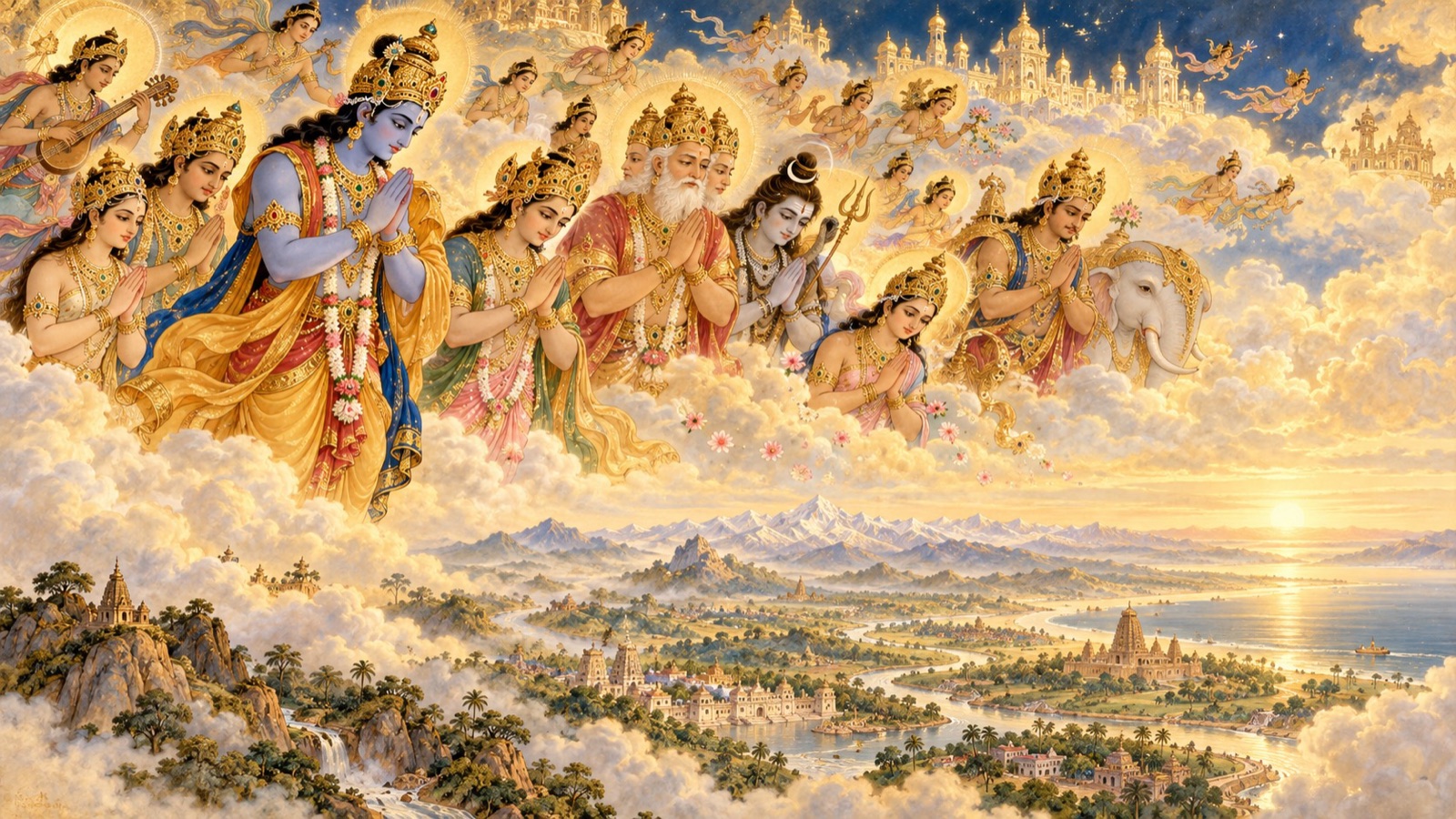
एतदेव हि देवा गायन्ति— अहो अमीषां किमकारि शोभनं प्रसन्न एषां स्विदुत स्वयं हरि: । यैर्जन्म लब्धं नृषु भारताजिरे मुकुन्दसेवौपयिकं स्पृहा हि न: ॥ २१ ॥
etad eva hi devā gāyanti — aho amīṣāṁ kim akāri śobhanaṁ prasanna eṣāṁ svid uta svayaṁ hariḥ yair janma labdhaṁ nṛṣu bhāratājire mukunda-sevaupayikaṁ spṛhā hi naḥ
Meaning: The gods sing: Ah, what auspicious deed did these souls perform, or was it that Sri Hari of His own accord was pleased with them, that they have won a birth among human beings in the land of Bharata — a birth fit for the loving service of Mukunda, a birth for which even we long! (Canto 5, Chapter 19, verse 21)
What, the gods ask, have they truly gained by all their sacrifices, austerities, vows and charities, or even by the heaven those merits win, where the constant gratification of the senses leaves no room to remember Bhagavan Narayana? Better by far, they sing, is a short human life in Bharata than a whole Kalpa’s reign in the loftiest heavenly spheres that still end in rebirth — for the wise in this land, offering to the Lord even the deeds of a single passing moment, attain the fearless abode of Sri Hari. No region should be sought after, they declare, not even the abode of Brahma himself, where the nectarean streams of the Lord’s stories do not flow and His loving devotees are not found. Yet those souls who, even after gaining a human birth fully equipped for liberation, do not strive to be free of rebirth, fall once more into bondage — like birds that slip the fowler’s net only to sport again on the very tree where they were snared.
The Lord Who Accepts All Worship
Sri Suka reveals a further grace hidden within the sacrifices of Bharata’s people. Though they invoke the Lord under many names — Indra, Agni and the rest — it is the one Supreme Lord, perfect in every way and the giver of all blessings, who Himself gladly accepts each oblation poured with reverence into the sacred fire. He grants men the boons they beg of Him; yet such boons are not the true gift, for the one who prays for them soon returns to pray again. But to those who worship Him seeking nothing at all, He reveals of His own accord His own lotus feet, which satisfy every longing of the heart for all time. And so the wise pray that if any merit still remains to their credit after the pleasures of heaven, they may be blessed with a birth in this Bharata, with the clear consciousness that Sri Hari alone is worthy of adoration.
The Eight Sub-islands of Jambudvipa
At last Sri Suka brings his account of Jambudvipa to its close by speaking of eight smaller islands that lie within its bounds.
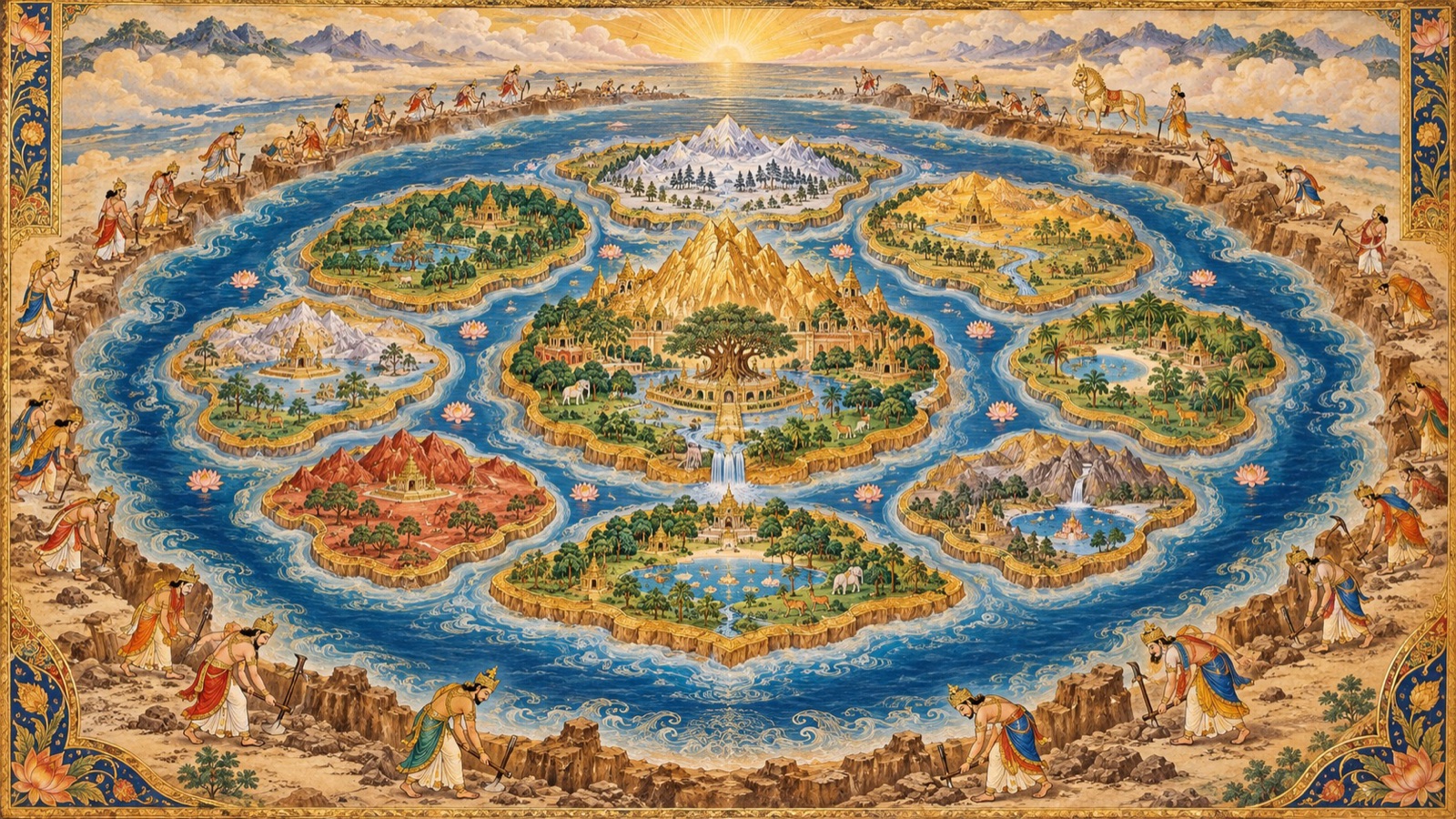
श्रीशुक उवाच जम्बूद्वीपस्य च राजन्नुपद्वीपानष्टौ हैक उपदिशन्ति सगरात्मजैरश्वान्वेषण इमां महीं परितो निखनद्भिरुपकल्पितान् ॥ २९ ॥ तद्यथा स्वर्णप्रस्थश्चन्द्रशुक्ल आवर्तनो रमणको मन्दरहरिण: पाञ्चजन्य: सिंहलो लङ्केति ॥ ३० ॥
śrī-śuka uvāca jambūdvīpasya ca rājann upadvīpān aṣṭau haika upadiśanti sagarātmajair aśvānveṣaṇa imāṁ mahīṁ parito nikhanadbhir upakalpitān tad yathā svarṇaprasthaś candraśukla āvartano ramaṇako mandarahariṇaḥ pāñcajanyaḥ siṁhalo laṅketi
Meaning: Sri Suka said: Some wise men, O King, also speak of eight minor islands within Jambudvipa, brought into being when the sons of King Sagara dug up this earth on every side in their search for the sacrificial horse. They are known as Swarnaprastha, Candrasukla, Avartana, Ramanaka, Mandara-harina, Pancajanya, Simhala and Lanka. (Canto 5, Chapter 19, verses 29-30)
Thus, Sri Suka tells the king, has the division of Jambudvipa into its several varshas been fully described, even as he himself received it from his own preceptor — and with these words the loving account of that great island-land comes to rest.
Principal Teachings of This Discourse
The Lord’s descent teaches the world. Hanuman sings that Sri Rama came in human form not merely to slay the wicked, but to show all people the ways of the great. The Lord’s every act — even His seeming grief for Sita — is a lesson for us, offered by One who is ever untouched and ever at peace within.
Refuge is open to all, whatever their birth. Because Sri Rama took even the forest monkeys as His friends, Hanuman declares that no lineage, beauty or brilliance is needed to win the Lord’s love. God or man, high or low, whoever takes whole-hearted shelter in Him is received.
Devotion is the one true remedy. Narada’s hymn sets aside mere learning and mystic effort and prays for a single gift — loving devotion to the Lord — as the only power that can dissolve the delusion of “I” and “mine” that binds us to the perishable body.
This land of Bharata is supremely blessed. The gods themselves long for a human birth here, for this is the field where even a moment’s act offered to the Lord can win His fearless abode. What the heavens cannot give, a short and humble mortal life in this land can.
A human life is meant for liberation. To gain this rare birth, fully fit for God’s service, and yet not to strive for freedom, is to slip back into bondage like a freed bird returning to the snaring tree. The blessing of birth is fulfilled only in remembering and serving the Lord.
A Devotional Reflection
What lingers in the heart after hearing these verses is a great and gentle encouragement. Sri Suka has swept us across shining continents and unimaginable ages — and then he stoops to whisper the sweetest secret of all: that the gods in their splendour envy us. They, who drink nectar and reign for a Kalpa, would trade it all for what we so often overlook — a short human life in this holy land, where the Lord’s stories flow like rivers and His feet may be served with a single day’s devotion. Hanuman shows us the shape of that service: to delight in hearing the Lord’s glories and to sing them back to Him in love. Narada shows us its inmost prayer: not for wealth or heaven, but for devotion itself. We need not be highborn or learned or mighty; the forest monkeys were none of these, and yet Sri Rama called them friends. If today we spend even one passing moment in remembering Him, we hold in our hands the very treasure the gods desire.
A Daily Devotional Practice
Today, follow Hanuman’s example in one simple way: set aside a few quiet minutes to hear or read a portion of the Lord’s sacred story, and then, with folded hands, offer it back to Him as praise, saying inwardly: “Om Namo Bhagavate Vasudevaya.” And as you go about the day, remember the longing of the gods — that this very human life is the rare and precious chance to serve Sri Hari. Offer even one small act, one passing moment, wholly to Him, seeking nothing in return but His grace. In this way the blessing of birth in this sacred land is not wasted, but turned, moment by moment, toward the fearless abode of the Lord.
Conclusion
The nineteenth discourse of Book Five draws Sri Suka’s description of Jambudvipa to a close upon its most beloved notes. In Kimpurusha-varsha, the ever-faithful Hanuman worships Lord Sri Rama with a hymn of pure love, singing that the Lord descended in human form to teach the world, and that He receives all who take refuge in Him, whatever their birth. In Bharata-varsha, the Lord as Nara-Narayana performs endless austerities out of compassion, and the sage Narada adores Him, praying for loving devotion as the one remedy for all delusion. Sri Suka then unveils the sacred mountains and rivers of Bharata, and reveals the wonder that the gods themselves long for a human birth in this land, where even a fleeting act offered to the Lord wins His fearless abode. He closes with the eight minor islands of Jambudvipa, brought forth by the sons of Sagara. Through it all shines one radiant truth: that this precious human life is given to us for the loving service of the Lord.
May the divine wisdom of Srimad Bhagavatam awaken pure devotion within our hearts.
Om Namo Bhagavate Vasudevaya.
Jay Shree Madhav.
References and Attribution
- Primary edition: Gita Press, Śrīmad Bhāgavata Mahāpurāṇa, Book Five, Discourse 19, “The description of Jambudwipa concluded.”
- Series: Srimad Bhagavatam Wisdom · Biswa Sanatan Dharma Seva Trust.
- Presented following the spiritual guidance and recommendation of Pandit Dr. Shri Kashinath Mishra.
This is an original, faithful retelling in the writer’s own words, with brief quoted verses shown in Devanāgarī and transliteration and their meanings given as summaries. It is not a reproduction of any single publisher’s continuous translation or commentary. No affiliation with or endorsement by any publisher is implied.
Jay Shree Madhav