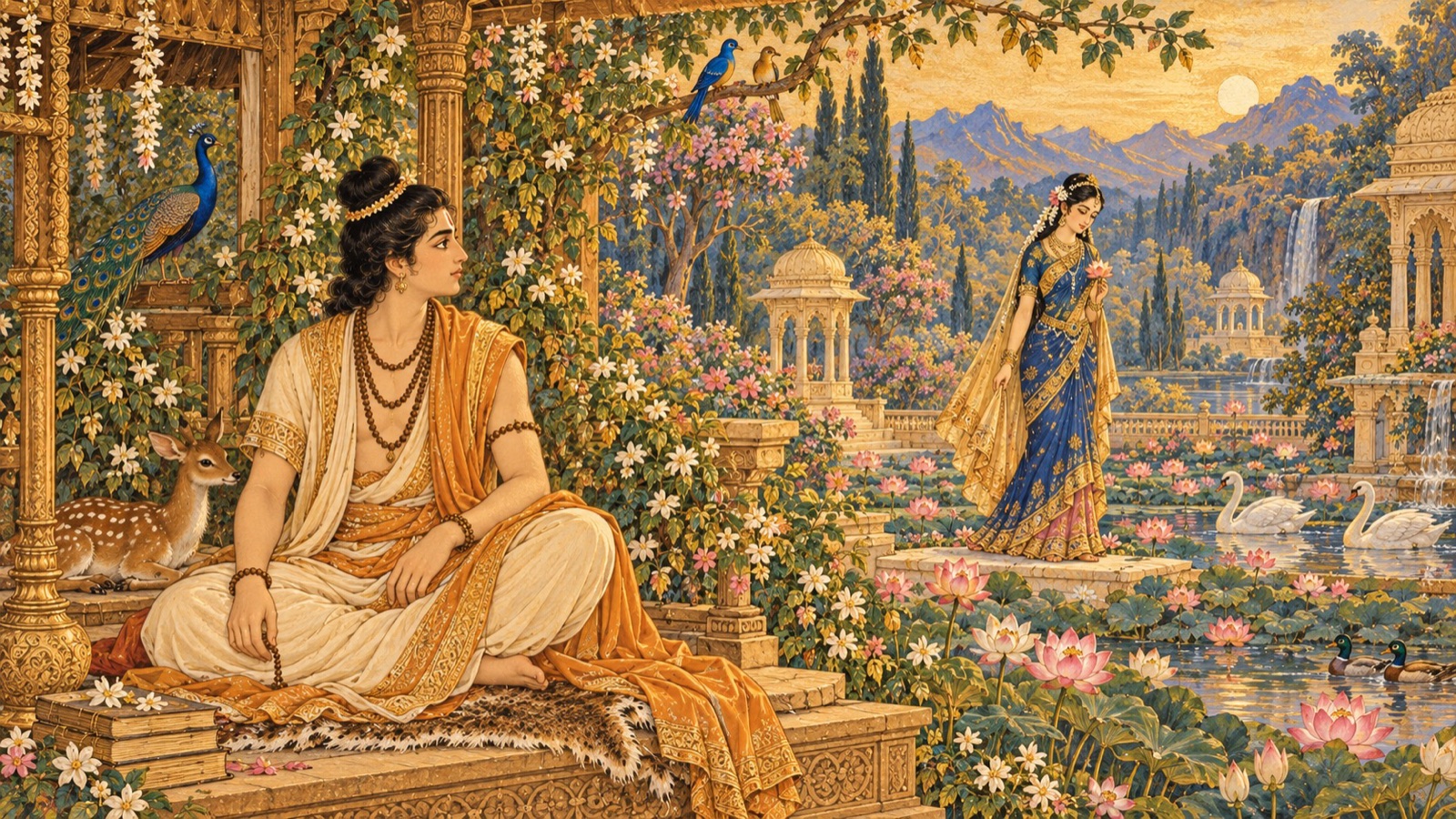
In the flowering garden of his hermitage, the meditating prince Agnidhra opens his eyes at the jingle of anklets — and beholds the celestial nymph Purvacitti, sent down by Brahma, wandering among the lotus ponds.
Om Namo Bhagavate Vasudevaya.
Om Namo Bhagavate Vasudevaya.
Om Namo Bhagavate Vasudevaya.
Welcome back to Srimad Bhagavatam Wisdom, a devotional journey through the sacred histories and teachings of the Srimad Bhagavat Mahapurana. In the opening chapter of the Fifth Canto we watched the great devotee-king Priyavrata rule the earth without attachment and then lay it down to return to the path of renunciation. This second chapter follows the thread of his lineage to his eldest son, Agnidhra, ruler of Jambudwipa — the central island of the earthly sphere. Here the scripture turns to a very different and very human theme: how even a good and dutiful king, absorbed in penance and longing for a worthy heir, can be swept away when the mind, through the senses, opens its door to desire. It is a chapter both tender and cautionary — an honest portrait of infatuation, told without judgement, and of the quiet cost of a heart that is never quite satisfied.
Chapter Information
- Scripture: Śrīmad Bhāgavata Mahāpurāṇa
- Canto: 5 (Book Five)
- Chapter: 2 (Discourse 2)
- Chapter title: The Story of King Agnidhra
- Principal speaker: Sukadeva Gosvami (Sri Suka), narrating to King Parikshit
- Principal listener: King Parikshit — the whole discourse related in turn by Suta Gosvami to the sage Saunaka and the assembly of sages gathered at Naimisaranya
- Main setting: The kingdom of Jambudwipa; a valley of Mount Mandara, where Agnidhra performs austerities; and the flowering garden of his hermitage
- Central subject: How King Agnidhra, praying to Brahma for a worthy son, was granted the celestial nymph Purvacitti; how he was overcome by desire and united with her; and how, through her, he fathered the nine sons who became the rulers of the divisions of Jambudwipa
- Principal verse range: Canto 5, Chapter 2, verses 1–23
- Primary edition: Gita Press Śrīmad Bhāgavata Mahāpurāṇa
From the Previous Chapter
In the first discourse of Book Five, the self-realized prince Priyavrata accepted Brahma’s command to rule the earth, circled it in his blazing chariot until the tracks of his wheels became the seven oceans, divided the world into seven islands, and installed seven of his sons as their rulers. The eldest, Agnidhra, received Jambudwipa, the innermost island. At the height of his own power Priyavrata renounced everything and withdrew into devotion. This second chapter takes up the story where his son now governs the land his father had shaped.
A Dutiful King in His Father’s Footsteps
With Priyavrata absorbed in the practice of devotion, the responsibility of rule passed to his son. Agnidhra, faithful to his father’s command, protected the people of Jambudwipa as though they were his own children, never taking his eye off dharma, the path of righteousness. The scripture is careful to establish his goodness before it tells of his fall: he was no tyrant and no fool, but a conscientious king who governed his subjects with a father’s care.
श्रीशुक उवाच एवं पितरि सम्प्रवृत्ते तदनुशासने वर्तमान आग्नीध्रो जम्बूद्वीपौकस: प्रजा औरसवद्धर्मावेक्षमाण: पर्यगोपायत् ॥ १ ॥
śrī-śuka uvāca evaṁ pitari sampravṛtte tad-anuśāsane vartamāna āgnīdhro jambūdvīpaukasaḥ prajā aurasavad dharmāvekṣamāṇaḥ paryagopāyat
Meaning: Sri Suka said: While his father was thus engaged in the practice of devotion, Agnidhra, abiding by his command, watched over the path of righteousness and protected the inhabitants of Jambudwipa as if they were his own children. (Canto 5, Chapter 2, verse 1)
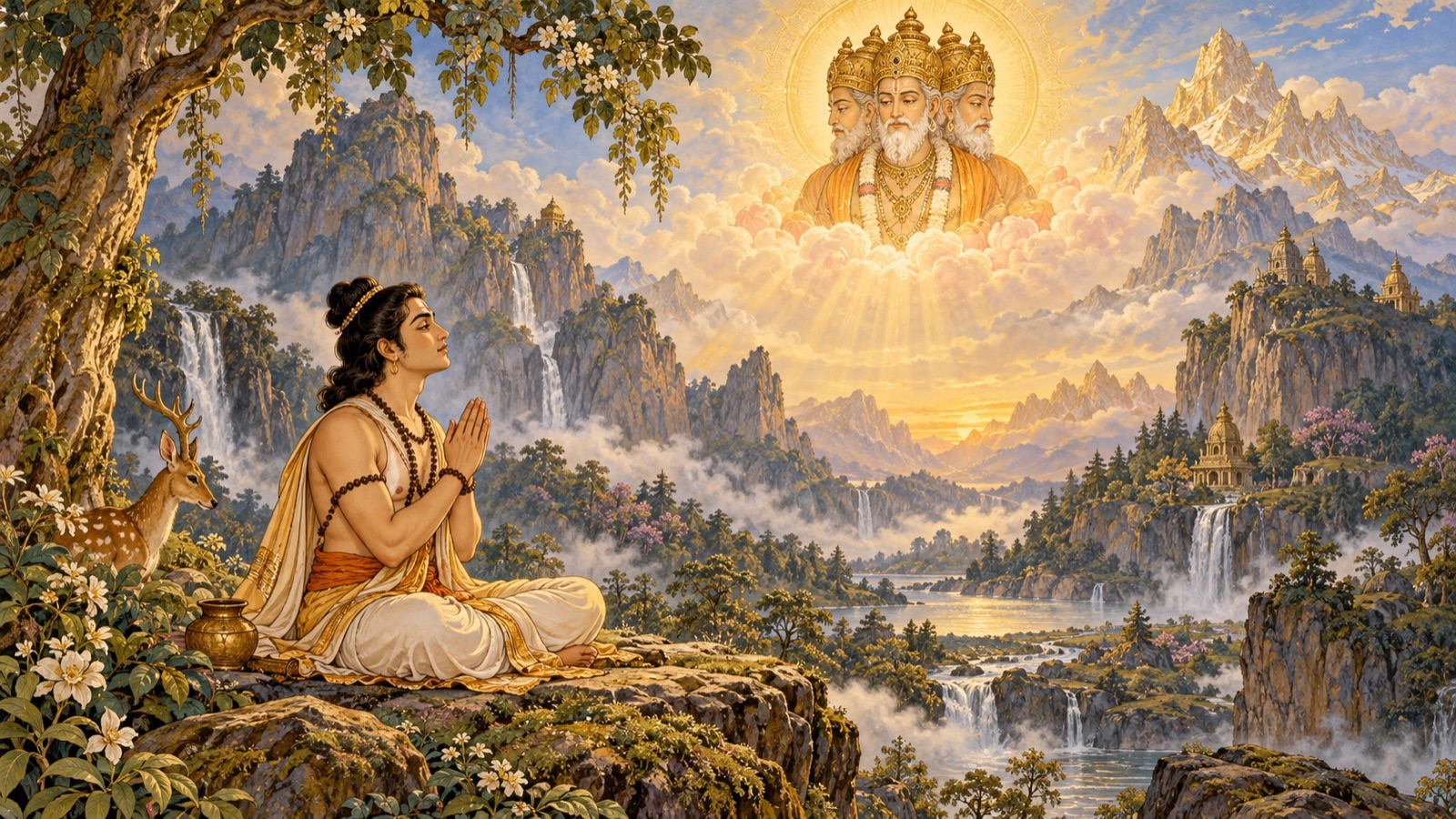
Wishing for a worthy son to continue his line — and for the blessing of an honoured place among the ancestors — Agnidhra gathered the requisites for worship and, with deep concentration and rigorous asceticism, adored the glorious Brahma, the ruler of all created beings. He chose for his penance a secluded valley of Mount Mandara, a mountain known as a haunt of celestial maidens.
स च कदाचित्पितृलोककाम: सुरवरवनिताक्रीडाचलद्रोण्यां भगवन्तं विश्वसृजां पतिमाभृतपरिचर्योपकरण आत्मैकाग्र्येण तपस्व्याराधयां बभूव ॥ २ ॥
sa ca kadācit pitṛloka-kāmaḥ sura-vara-vanitākrīḍācala-droṇyāṁ bhagavantaṁ viśva-sṛjāṁ patim ābhṛta-paricaryopakaraṇa ātmaikāgryeṇa tapasvy ārādhayāṁ babhūva
Meaning: Desiring both a worthy son and, through him, a home among the Pitrs, Agnidhra assembled every article of worship and, with a single-pointed mind and severe austerity, adored Brahma, the master of all created beings, in that valley of Mount Mandara where the loveliest daughters of the gods are wont to play. (Canto 5, Chapter 2, verse 2)
It is worth pausing over what Agnidhra actually asked for. He was the son of Priyavrata, one of the great devotee-kings of this scripture, yet his prayer here reaches not for shelter at the Lord’s own feet but for a worthy heir and a place in Pitraloka — the modest heaven of the ancestors, won by ritual offerings, rather than the eternal Vaikuntha that opens only to devotion (verse 2). The tradition’s commentators offer a reason: a child’s inward leanings are said to mirror the state of mind in which he was conceived, and Agnidhra, they note, was conceived in an hour when even saintly Priyavrata’s mind had not yet fully outgrown desire. Nothing here is spoken to blame father or son; it simply explains, gently and in advance, why a prince this disciplined could still pray for a lesser goal — and why the very austerity he is now performing will not, a few verses later, be strong enough to protect him.
The Nymph Sent from Heaven
Brahma, perceiving the king’s prayer, answered it in an unexpected way. Rather than granting a boon directly, he sent down from his own court a celestial singer — the Apsara Purvacitti — into the very region where Agnidhra sat in meditation. Attached to the king’s hermitage was a garden of rare beauty: ponds and lakes bright with lotus beds, resounding with the calls of swans, Karandava ducks and other waterfowl, all answering the songs of birds perched on golden creepers among the densely growing trees. Into this garden the celestial damsel came wandering.
At every graceful step the ornaments about her feet made a soft jingling sound. Hearing it, the prince — whose eyes, like a pair of lotus buds, had until then been closed in deep meditation — slightly opened them and saw her. In that glance the long discipline of his penance met its severest test.
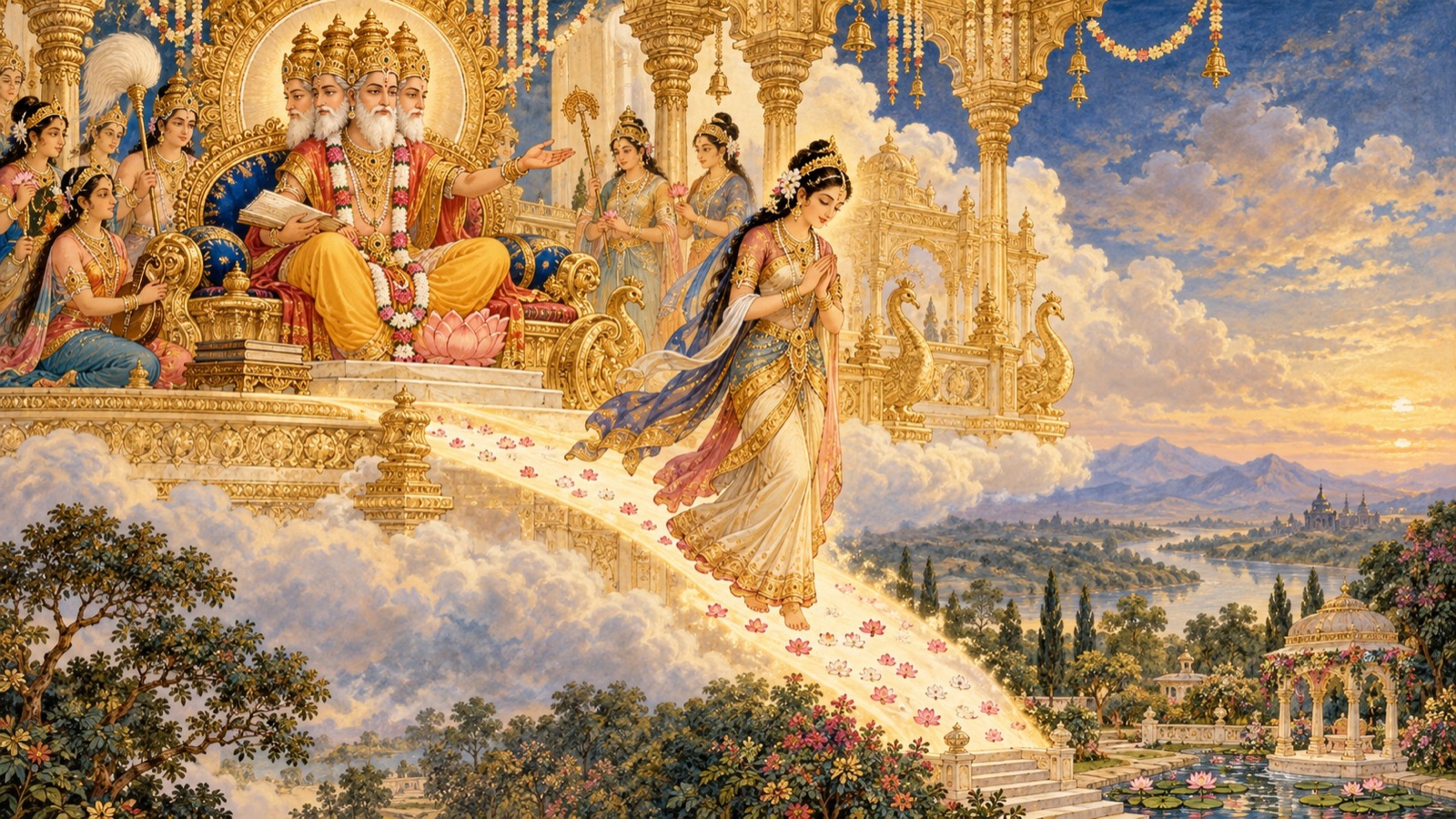
Moving near him like a honey-bee drawn to the fragrance of flowers, the celestial damsel — by her gait, her play, her modest sidelong glances, her musical voice and her graceful form — opened a passage for the god of Love straight into the human heart. Cupid, the “crocodile-bannered” one, finding the door of the prince’s mind flung open the moment he saw her, took command of him completely, and Agnidhra, his composure gone, began to speak to her like a bewildered simpleton.
तामेवाविदूरे मधुकरीमिव सुमनस उपजिघ्रन्तीं … भगवतो मकरध्वजस्य वशमुपनीतो जडवदिति होवाच ॥ ६ ॥
tām evāvidūre madhukarīm iva sumanasa upajighrantīṁ … bhagavato makara-dhvajasya vaśam upanīto jaḍavad iti hovāca
Meaning: As the celestial damsel, like a honey-bee, savoured the fragrance of the flowers not far from him — captivating the minds and eyes of gods and men alike by her graceful movements, her play, her bashful glances, her sweet speech and her lovely form — she opened within men’s hearts a passage for Cupid. Brought thus under the sway of the crocodile-bannered god of Love, who had found his opening, the prince addressed her like one bereft of sense. (Canto 5, Chapter 2, verse 6)
Words of a Bewildered Heart
What follows is one of the most vivid passages in Book Five. Agnidhra, so overcome that he could not tell a heavenly courtesan from a holy ascetic, mistook Purvacitti for a great sage performing austerities in the forest — and read every feature of her body as the sacred emblem of a renunciate. Her arched eyebrows, he imagined, were a pair of stringless bows; her sidelong glances, arrows winged with lotus petals, gentle yet piercing. The bees humming around her he took for disciples chanting the hymns of the Samaveda and the Upanishads in praise of the Lord. The jingling of her anklets became, to his ear, the notes of partridges hidden in the cages of her feet.
His confusion mounts into open wonder as he praises her face, mistaking her ornaments and features for signs of divinity itself.
का वाऽऽत्मवृत्तिरदनाद्धविरङ्ग वाति विष्णो: कलास्यनिमिषोन्मकरौ च कर्णौ । उद्विग्नमीनयुगलं द्विजपङ्क्तिशोचि- रासन्नभृङ्गनिकरं सर इन्मुखं ते ॥ १३ ॥
kā vātma-vṛttir adanād dhavir aṅga vāti viṣṇoḥ kalāsy animiṣonmakarau ca karṇau udvigna-mīna-yugalaṁ dvija-paṅkti-śocir āsanna-bhṛṅga-nikaraṁ sara in mukhaṁ te
Meaning: What is the food you live on, dear one, that from your mouth there breathes a fragrance like that of oblations offered in the sacred fire? Surely you are a ray of Lord Vishnu, for your ears are adorned with brilliant rings like two unwinking alligators; and your face is like a lake — its restless eyes two leaping fish, its rows of teeth white as swans, and its curling hair a swarm of hovering bees. (Canto 5, Chapter 2, verse 13)
He goes on to marvel at the “scarlet, fragrant paste” upon her, at the ball she strikes with her lotus-like hand that sets his eyes and mind whirling, and at the playful breeze disturbing her garment. Whatever austerity won her such a form, he says, it has wrecked the austerities of others — and he wonders aloud whether Brahma himself has sent her to be his wife. At last he vows he will never let her go: his mind and his eyes are fastened upon her, and he begs the “fair-bosomed sage” to take him, her servant, wherever she pleases, with his companions following behind. The whole speech is at once comic and poignant — the language of a wise man’s intelligence turned entirely to the service of desire.
Union, and Nine Sons
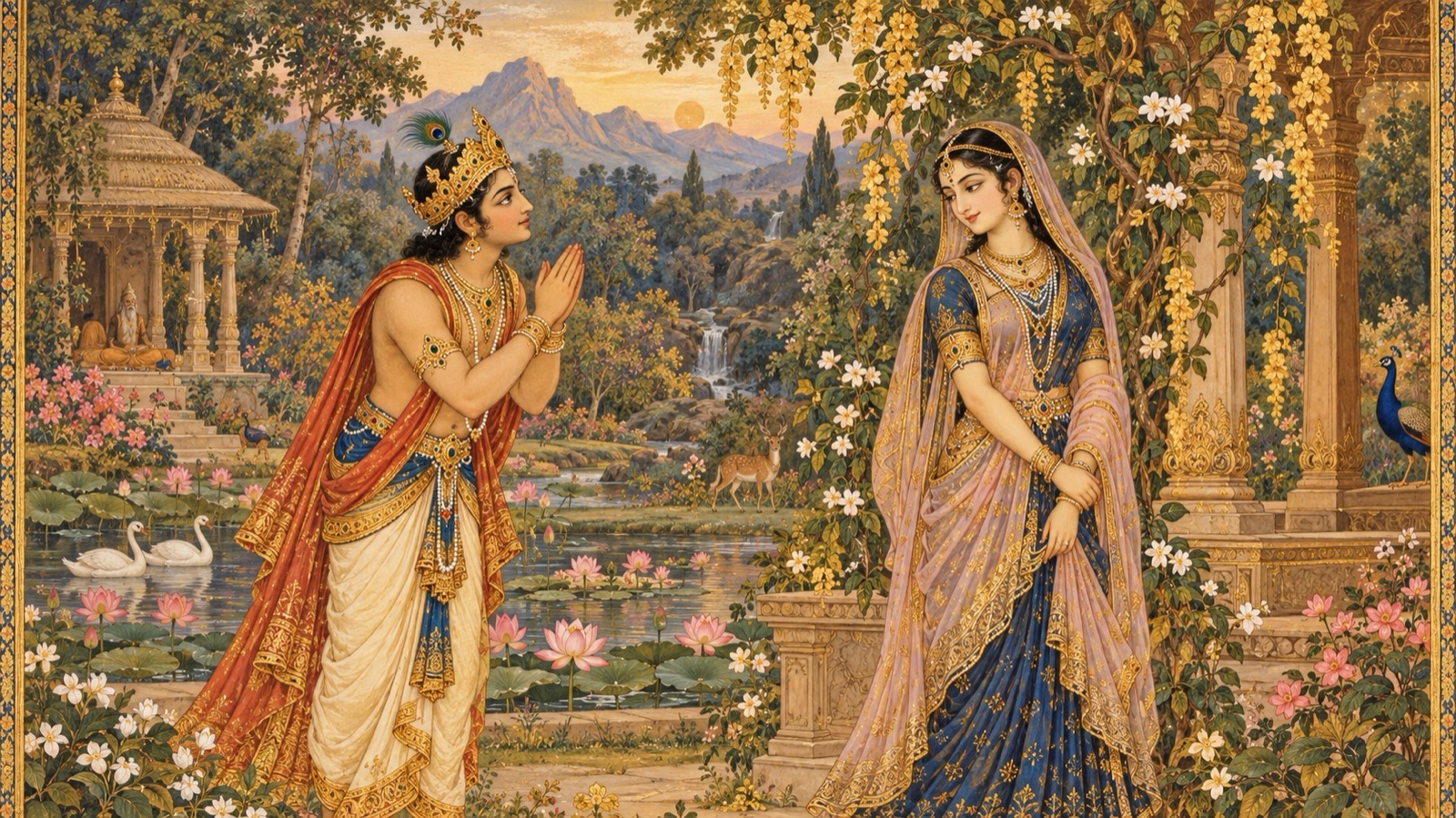
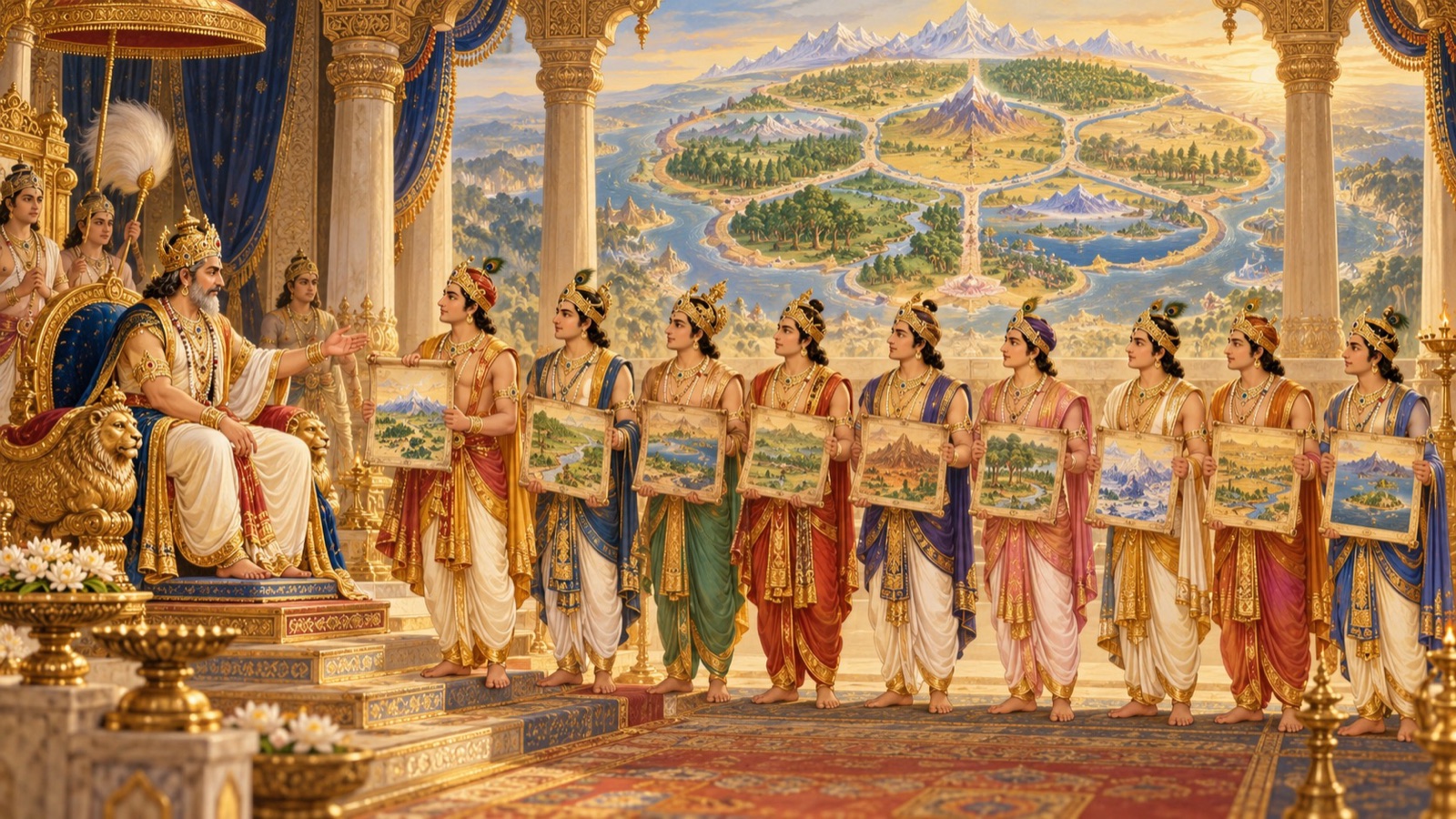
By this clever, sensuous speech — for Agnidhra possessed the intelligence of the gods and was skilled in the ways of winning a woman’s regard — he won the celestial damsel over, showing her great honour. She too was captivated by his intelligence, his gentleness, his beauty, his youth, his splendour and his nobility; and she remained with that lord of Jambudwipa, sharing with him both earthly and heavenly enjoyments for a period of ten crore years. Through her, King Agnidhra fathered nine sons.
तस्यामु ह वा आत्मजान् स राजवर आग्नीध्रो नाभिकिम्पुरुषहरिवर्षेलावृतरम्यकहिरण्मयकुरुभद्राश्वकेतुमालसंज्ञान्नव पुत्रानजनयत् ॥ १९ ॥
tasyām u ha vā ātmajān sa rāja-vara āgnīdhro nābhi-kimpuruṣa-harivarṣelāvṛta-ramyaka-hiraṇmaya-kuru-bhadrāśva-ketumāla-saṁjñān nava putrān ajanayat
Meaning: Through her that best of kings, Agnidhra, begot nine sons, named Nabhi, Kimpurusa, Harivarsa, Ilavrta, Ramyaka, Hiranmaya, Kuru, Bhadraswa and Ketumala. (Canto 5, Chapter 2, verse 19)
Having borne these nine sons — one in each of nine years — and having left them all in Agnidhra’s house, Purvacitti returned once more to the service of Brahma from whom she had come. The sons, strong and well-formed through the grace of their celestial mother, were each given a due share of the kingdom by their father, and they ruled over the nine divisions of Jambudwipa, which came to be named after them.
The King Who Was Never Satisfied
The chapter closes on a quiet, sober note. Even after all these years and all these joys, King Agnidhra was still not sated with the pleasures of the senses. He continued to think of the celestial nymph as the highest of all goods; and by the merit of the sacrifices and rites enjoined in the Vedas he secured, after death, a place in the same heaven of the ancestors where she dwelt in delight. His longing shaped even his afterlife — a gentle warning that desire, however refined, tends only to renew itself. When their father had passed on, his nine sons married the nine daughters of Meru, the deity of the great mountain.
सम्परेते पितरि नव भ्रातरो मेरुदुहितृर्मेरुदेवीं प्रतिरूपामुग्रदंष्ट्रीं लतां रम्यां श्यामां नारीं भद्रां देववीतिमितिसंज्ञा नवोदवहन् ॥ २३ ॥
samparete pitari nava bhrātaro meru-duhitṝr merudevīṁ pratirūpām ugradaṁṣṭrīṁ latāṁ ramyāṁ śyāmāṁ nārīṁ bhadrāṁ devavītim iti saṁjñā navodavahan
Meaning: When their father had passed away, the nine brothers married the nine daughters of Meru — Merudevi, Pratirupa, Ugradamstri, Lata, Ramya, Syama, Nari, Bhadra and Devaviti. (Canto 5, Chapter 2, verse 23)
Among these unions is one of quiet significance for the chapters to come: the eldest son, Nabhi, wedded Merudevi — and their line will carry the story of Book Five forward into the descent of Lord Rsabha.
Principal Teachings of This Chapter
The senses are the mind’s open door. Agnidhra’s fall does not begin with wickedness; it begins with a single glance, taken while his eyes were meant to be closed in meditation. The scripture shows how swiftly a mind, unguarded at even one sense-gate, can be entered and captured by desire. Vigilance over the senses is not a minor discipline but the very frontier of the spiritual life.
Intelligence without self-mastery becomes desire’s servant. Agnidhra “possessed the intelligence of the gods,” yet that brilliance is spent entirely on winning the nymph. The chapter quietly teaches that talent, cleverness and even great merit are not the same as freedom; without control of the heart, our finest gifts can be conscripted into the service of craving.
Desire, once fed, is never satisfied. Even after ten crore years of enjoyment and nine sons, Agnidhra “was not sated with sense-delights.” Here is the Bhagavata’s recurring insight, embodied in a single life: pleasure does not exhaust longing but inflames it, and a heart set on the objects of the senses only enlarges its own hunger.
Our longings shape our destiny. Because the king’s mind dwelt constantly on the celestial nymph, his very afterlife was determined by that attachment — he attained the heaven where she lived. What we cherish inwardly, the scripture warns, quietly becomes the direction of our onward journey. This is why the devotee is counselled to fix the heart, instead, upon the Lord.
Even a good king needs grace. Agnidhra is dutiful, devout and self-controlled enough to perform severe penance — and still he falls. The chapter thus prepares us to value all the more the earlier example of his father Priyavrata, whose freedom came not from his own strength but from shelter at the feet of the Lord.
A Devotional Reflection
There is a great tenderness in the way the Bhagavata tells this story. It does not mock Agnidhra, nor does it excuse him. It simply lets us watch a sincere man — a good king, a devoted son, a seeker of blessings — be undone by a longing he never learned to see through. His mistake is one we all recognize: to imagine that the next enjoyment will finally be enough. And so the chapter becomes a mirror. We too keep our eyes closed in outward discipline while some inner door stands quietly open. We too are clever, and spend our cleverness chasing what cannot satisfy. The remedy the scripture offers is not contempt for the world’s beauty but a deeper love that reorders all the rest — the honey of the Lord’s lotus feet, of which the previous chapter spoke, which alone leaves the heart truly content. To read of Agnidhra is to be gently asked where our own longing is fixed, and whether it is leading us toward freedom or only toward another birth.
A Daily Devotional Practice
Choose one sense-gate today — the eyes, or the ears — and keep it, for a single hour, turned gently toward the Lord: rest the gaze on His image, or fill the ears with His name and glories. When some other pull arises, do not fight it harshly; simply notice the open door, and turn the heart back, as Agnidhra could not, toward the one object that satisfies. In this small, repeated act lies the whole difference between bondage and freedom.
Conclusion
The second discourse of Book Five is the story of King Agnidhra: a righteous ruler of Jambudwipa who, praying for a worthy heir, was sent the celestial nymph Purvacitti by Brahma, and who — his mind captured through a single glance — was swept into desire, united with her, and fathered the nine sons who became the rulers of Jambudwipa’s nine divisions. Even after ages of enjoyment he remained unsatisfied, and his lifelong attachment shaped his very destiny beyond death. Told without harshness, his life stands as a luminous caution: that the senses are the mind’s open door, that intelligence unguarded becomes desire’s servant, and that the heart finds rest not in the endless pursuit of enjoyment but in the shelter of the Lord. As the story now passes to his devoted son Nabhi and Queen Merudevi, we are drawn onward toward the sacred descent that Book Five is preparing to unfold.
May the divine wisdom of Srimad Bhagavatam awaken pure devotion within our hearts.
Om Namo Bhagavate Vasudevaya.
Jay Shree Madhav.
References and Attribution
- Primary edition: Gita Press, Śrīmad Bhāgavata Mahāpurāṇa (English, complete), Book Five, Discourse 2, “An account of Agnidhra,” pages 445–448.
- Series: Srimad Bhagavatam Wisdom · Biswa Sanatan Dharma Seva Trust.
- Presented following the spiritual guidance and recommendation of Pandit Dr. Shri Kashinath Mishra.
This is an original, faithful retelling in the writer’s own words, with brief quoted verses shown in Devanāgarī and transliteration and their meanings given as summaries. It is not a reproduction of any single publisher’s continuous translation or commentary. No affiliation with or endorsement by any publisher is implied.
Jay Shree Madhav