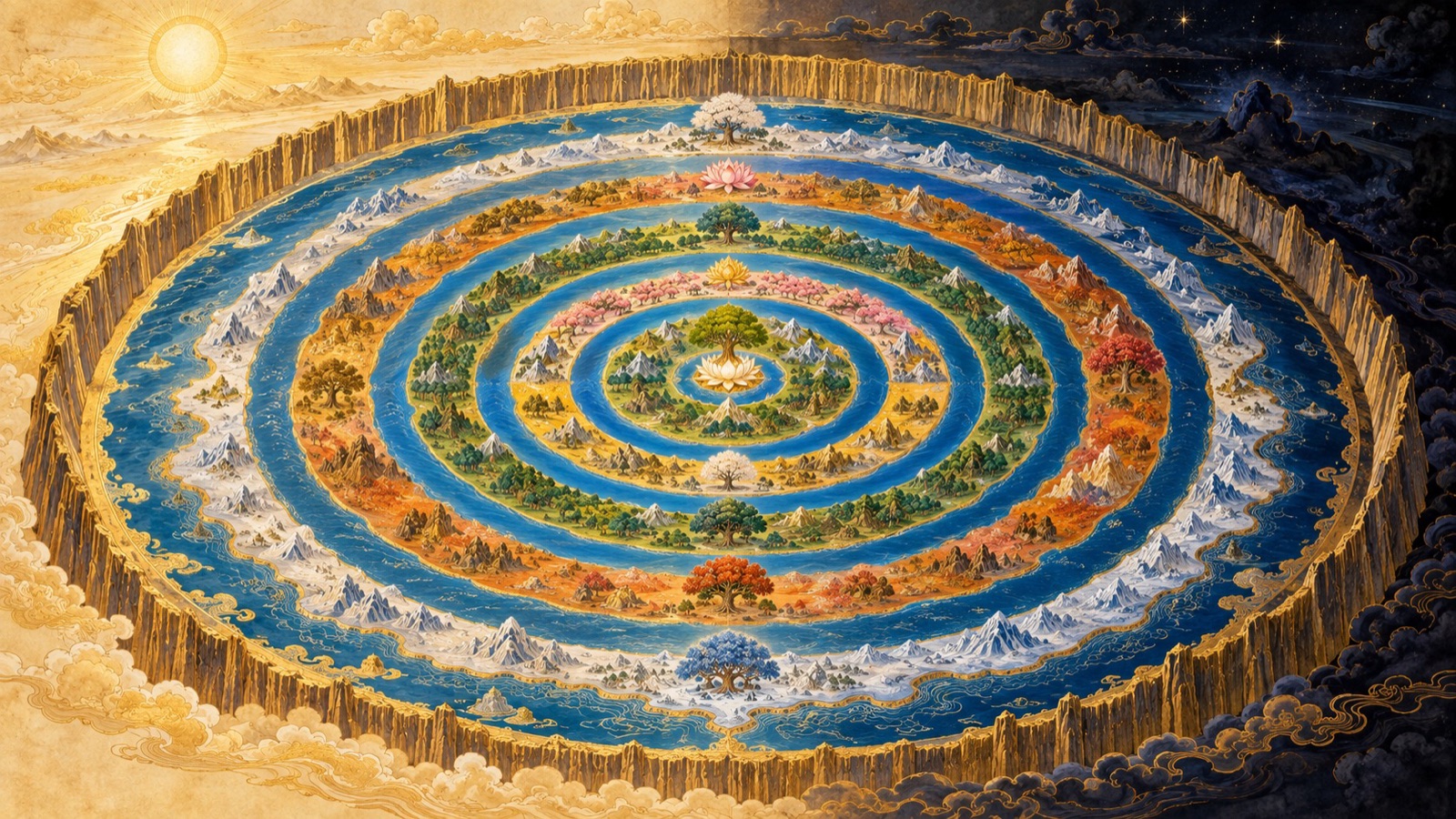
Ring upon ring, the six island-continents beyond Jambudvipa spread across the face of creation — each girdled by its own shining ocean, each crowned by a great tree, and all held at last within the vast rampart of Lokaloka, the mountain that divides the world of light from the world of darkness.
Om Namo Bhagavate Vasudevaya.
Om Namo Bhagavate Vasudevaya.
Om Namo Bhagavate Vasudevaya.
Welcome back to Srimad Bhagavatam Wisdom, a devotional journey through the sacred histories and teachings of the Srimad Bhagavat Mahapurana. Having walked with Sri Suka through the varied lands of Jambudvipa, we are now carried far outward — across ocean after ocean of sweetness and light — to behold the six great island-continents that ring the earth, and beyond them the golden boundary of all lighted space. Yet this is no mere map of far places. In every one of these worlds the Bhagavatam shows us the same beating heart: countless blessed beings lifting up their hands in worship, each adoring the one Lord under a different face of light — now the blazing sun, now the gentle moon, now fire, water, wind and the lotus-throned Brahma. Let us receive this vision with wonder, as the endless creation of the Lord, and with love, seeing His face shining out through every gate.
Chapter Information
- Scripture: Śrīmad Bhāgavata Mahāpurāṇa
- Canto: 5 (Book Five)
- Chapter: 20 (Discourse 20)
- Chapter title: The Six Dvipas and the Lokaloka Mountain
- Principal speaker: Sukadeva Gosvami (Sri Suka), narrating to King Parikshit
- Principal listener: King Parikshit — the discourse related in turn by Suta Gosvami to the sages gathered at Naimisaranya
- Main setting: The cosmic expanse of the terrestrial world — the six Dvipas beyond Jambudvipa, their encircling oceans, and the ring-mountain Lokaloka
- Central subject: A vision of Plaksa, Salmala, Kusa, Krauñca, Saka and Puskara Dvipas with their oceans, rulers and peoples and the form of the Lord worshipped in each; then the mountain Lokaloka, the four world-elephants, the Lord’s presence there with Vishvaksena, and the place of the sun in the cosmic egg
- Principal verse range: Canto 5, Chapter 20, verses 1–46
- Primary edition: Gita Press Śrīmad Bhāgavata Mahāpurāṇa
From the Previous Chapter
In the nineteenth discourse, Sri Suka completed his loving portrait of Jambudvipa. He told of Hanuman’s ceaseless worship of Lord Rama in the land of Kimpurusha-varsha, and of the sage Narada teaching the divine method of devotion in Bharata-varsha, where Nara-Narayana is adored. Above all he sang the surpassing glory of Bharata-varsha, this very land of works and worship, whose good fortune is longed for even by the gods in heaven — for here alone the human birth may be spent in the service of the Lord. With that praise of Bharata-varsha still in our hearts, the vision now widens outward to the worlds beyond.
Plaksadwipa and the Worship of the Sun
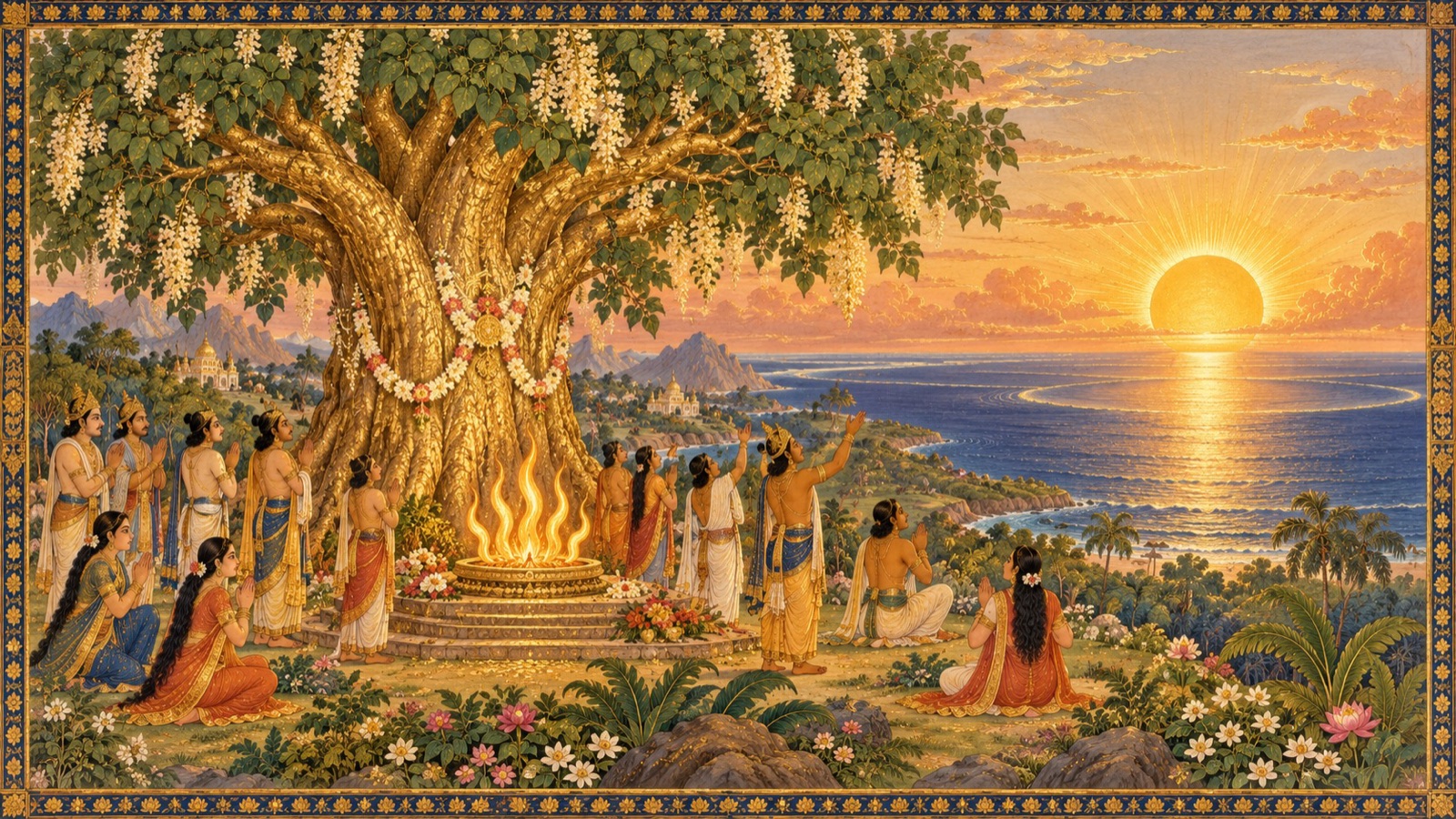
Sri Suka resumes his account, now describing the remaining Dvipas by their extent, their character and their form. Even as Jambudvipa surrounds Mount Meru and is ringed by the salt ocean of equal breadth, so that salt ocean is itself enclosed by Plaksadwipa, twice as wide — two lakh yojanas across — as a moat is bordered by an outer garden. Upon it rises a shining Plaksa tree, as vast as the rose-apple tree of Jambudvipa, giving the Dvipa its name; and at its foot dwells the god of fire with seven tongues. Its first ruler, Idhmajihva, the second son of Emperor Priyavrata, divided the land into seven Varsas among his seven sons and then, releasing all things, became one with the Supreme Spirit.
There the four orders of people — bearing the names Hamsa, Patanga, Urdhvayana and Satyanga — bathe in the seven sacred rivers, shake off the darkness of passion and dullness, and live for a thousand years in bodies bright as the gods’. And with the rituals of the three Vedas they worship the Lord in the form of the sun-god, the very gateway of heaven and the living embodiment of the three Vedas. This is the prayer upon their lips:
प्रत्नस्य विष्णो रूपं यत्सत्यस्यर्तस्य ब्रह्मण: । अमृतस्य च मृत्योश्च सूर्यमात्मानमीमहीति ॥ ५ ॥
pratnasya viṣṇo rūpaṁ yat satyasyartasya brahmaṇaḥ amṛtasya ca mṛtyoś ca sūryam ātmānam īmahīti
Meaning: We seek refuge in the sun-god — the visible form of the most ancient Lord Vishnu, the very Self of Truth and of cosmic order, of the Veda, and of all that is deathless and all that dies. (Canto 5, Chapter 20, verse 5)
And Sri Suka adds a tender note of grace: in these five Dvipas beginning with Plaksa, long life, keen senses, strength of body and mind, intelligence and courage are the natural birthright of every soul alike, given freely and without distinction.
Salmaladwipa and the Worship of the Moon
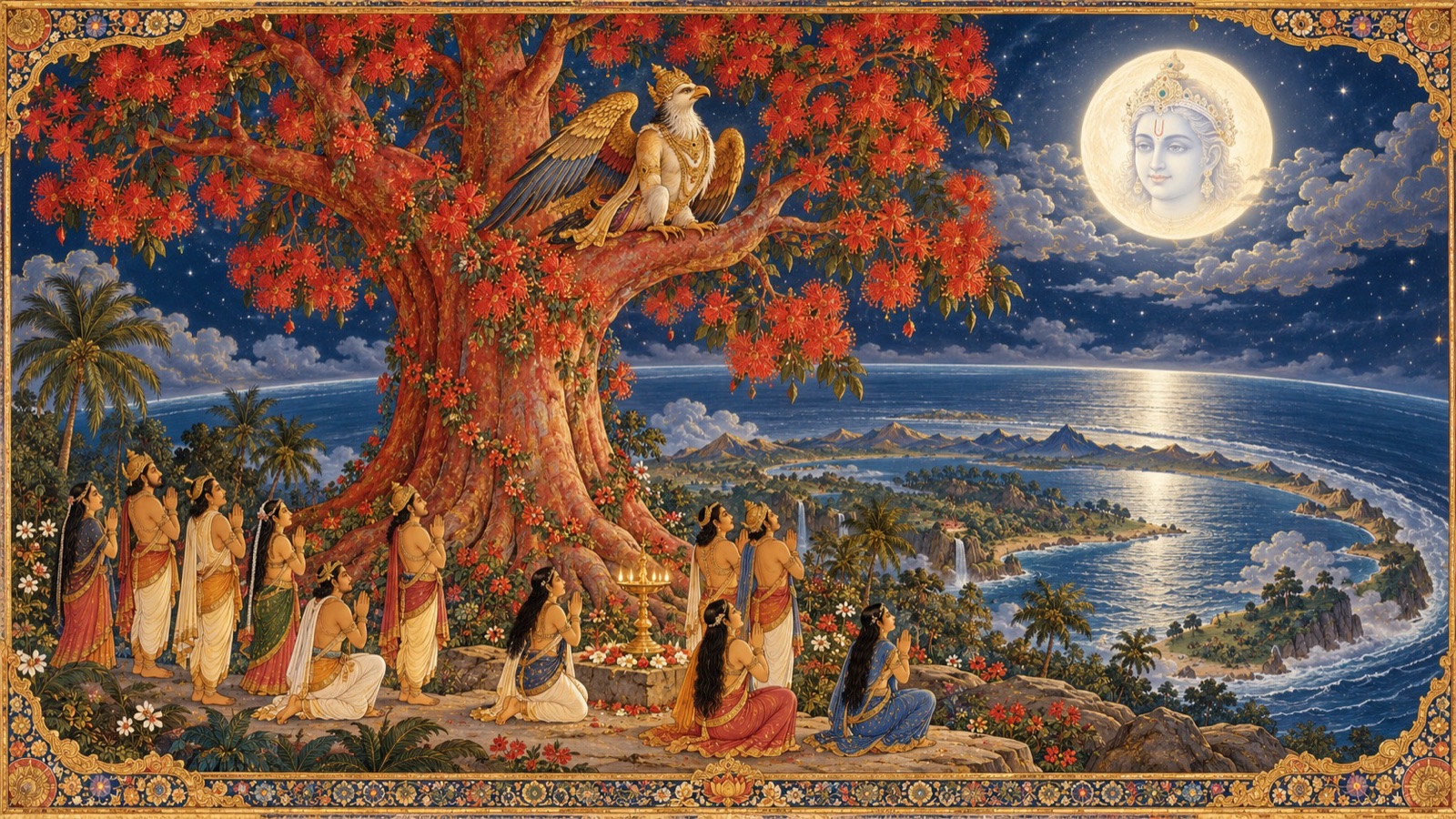
Just as Plaksadwipa is girdled by an ocean of sweet sugar-cane juice, so beyond it shines Salmaladwipa, double in width, enclosed on its far side by an ocean of wine. Upon this Dvipa stands the great Salmali, the silk-cotton tree, as vast as the Plaksa, and upon it the learned say dwells the glorious Garuda, king of birds, who glorifies the Lord with the Vedic hymns that are his very limbs. From this tree the Dvipa takes its name. Its first ruler was Yajnabahu, the third son of Priyavrata, who shared out its seven Varsas among his seven sons.
The people there — known as Srutadhara, Viryadhara, Vasundhara and Isandhara — worship with Vedic hymns the Lord who is the Soul of all, appearing in the form of the moon-god, the Veda made manifest. Their prayer rises softly, like moonlight itself:
स्वगोभि: पितृदेवेभ्यो विभजन् कृष्णशुक्लयो: । प्रजानां सर्वासां राजान्ध: सोमो न आस्त्विति ॥ १२ ॥
sva-gobhiḥ pitṛ-devebhyo vibhajan kṛṣṇa-śuklayoḥ prajānāṁ sarvāsāṁ rājā- ndhaḥ somo na āstv iti
Meaning: May the moon-god — who through the dark and bright fortnights apportions with his rays the nourishing food of the manes, the gods and every living being — be our king and protector. (Canto 5, Chapter 20, verse 12)
Kusadwipa and the Worship of the Sacred Fire
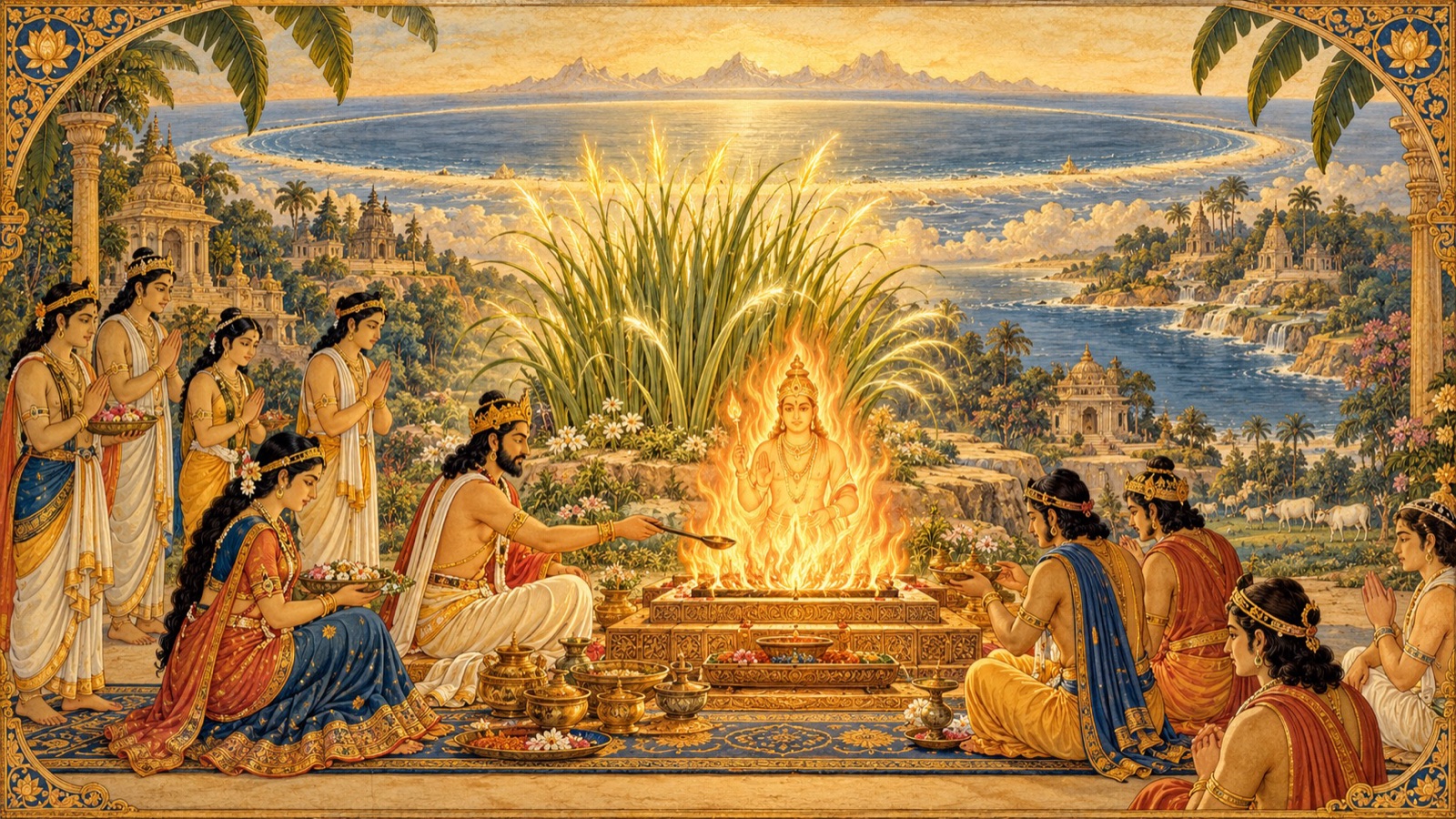
Beyond the ocean of wine, and twice as wide, lies Kusadwipa, ringed on its outer shore by an ocean of clarified butter. Here grows a clump of sacred Kusa grass, brought into being by the Lord Himself, which gives the Dvipa its name and, like a second flame that gives light without heat, brightens all the quarters with the soft radiance of its tender shoots. Its first ruler, O Parikshit — as Sri Suka tells the king — was Hiranyareta, the fourth son of Priyavrata, who divided the Dvipa fairly among his seven sons and then gave himself to holy austerities.
The people of this land — Kusala, Kovida, Abhiyukta and Kulaka — purified by their rivers, worship the Lord in the form of the God of fire through their mastery of sacred rites, singing:
परस्य ब्रह्मण: साक्षाज्जातवेदोऽसि हव्यवाट् । देवानां पुरुषाङ्गानां यज्ञेन पुरुषं यजेति ॥ १७ ॥
parasya brahmaṇaḥ sākṣāj jāta-vedo ’si havyavāṭ devānāṁ puruṣāṅgānāṁ yajñena puruṣaṁ yajeti
Meaning: O Fire-god, you are the very carrier of oblations to the Supreme Brahman Himself; through the sacrifice offered to the gods, who are the limbs of the Supreme Person, may we worship that Supreme Person, Sri Hari. (Canto 5, Chapter 20, verse 17)
Krauncadwipa and the Worship of the Waters
Beyond the ocean of clarified butter, twice as wide again, lies Krauncadwipa, encircled by an ocean of milk. Here stands the king of mountains, Krauñca, from which the Dvipa is named. Though its slopes and glades were once riven by the weapon of Guha — the valiant son of Lord Shiva — the mountain became free of all fear, forever bathed by the spray of the milk-ocean and lovingly guarded on every side by Varuna, the god of the waters. Its ruler, Ghrtaprstha, the fifth son of Priyavrata, carved out seven Varsas for his sons and then, enlightened, took shelter at the lotus-feet of Sri Hari, his own inmost Self.
The people of these lands — Purusa, Rsabha, Dravina and Devaka — wait upon the Deity in the form of water, their joined palms brimming, and pray:
आप: पुरुषवीर्या: स्थ पुनन्तीर्भूर्भुव:सुव: । ता न: पुनीतामीवघ्नी: स्पृशतामात्मना भुव इति ॥ २३ ॥
āpaḥ puruṣa-vīryāḥ stha punantīr bhūr-bhuvaḥ-suvaḥ tā naḥ punītāmīva-ghnīḥ spṛśatām ātmanā bhuva iti
Meaning: O waters, you hold the very potency of the Supreme Person and purify the three worlds; O destroyers of sin, purify our bodies as we touch you. (Canto 5, Chapter 20, verse 23)
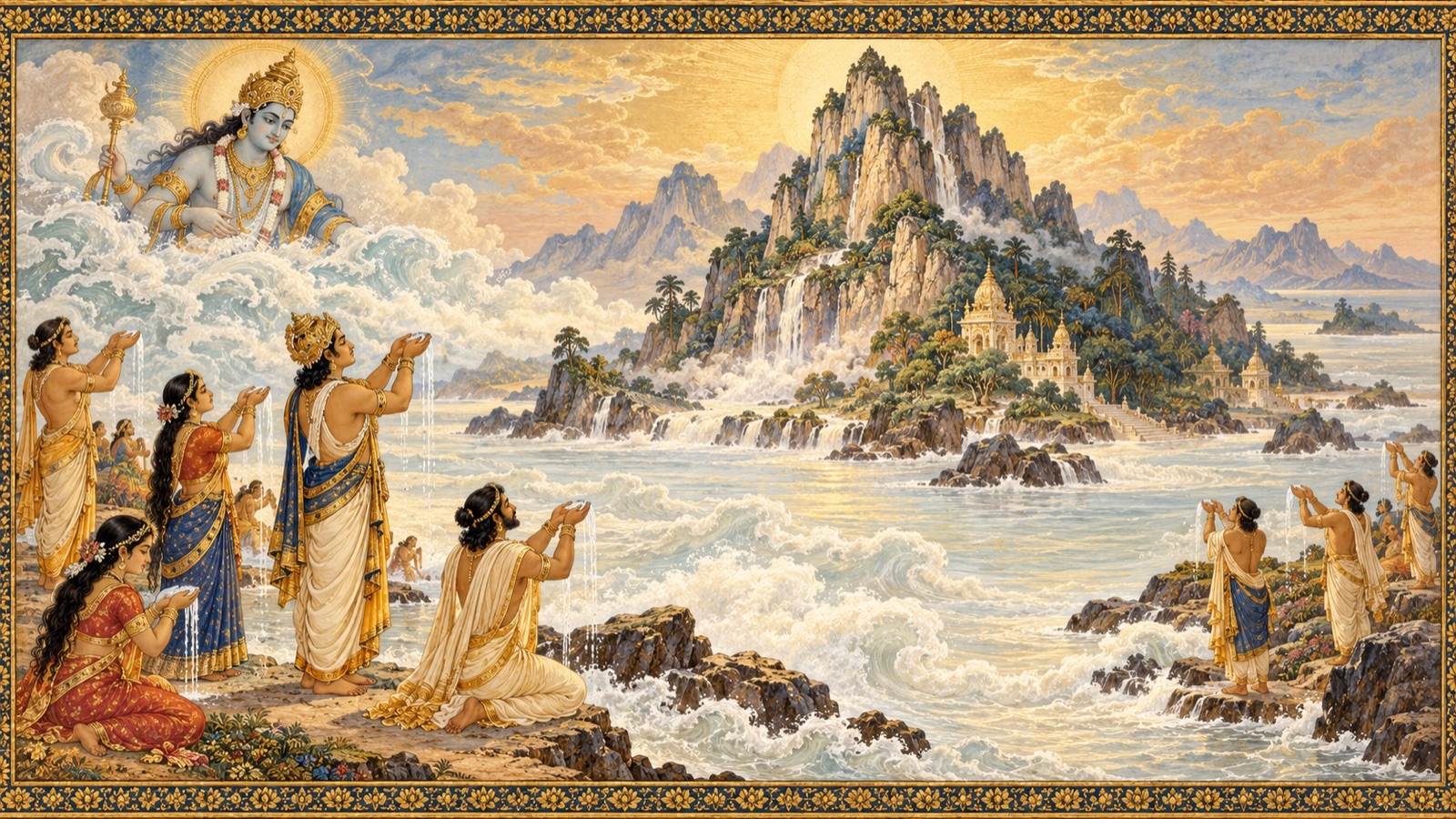
Sakadwipa and the Worship of the Life-Breath
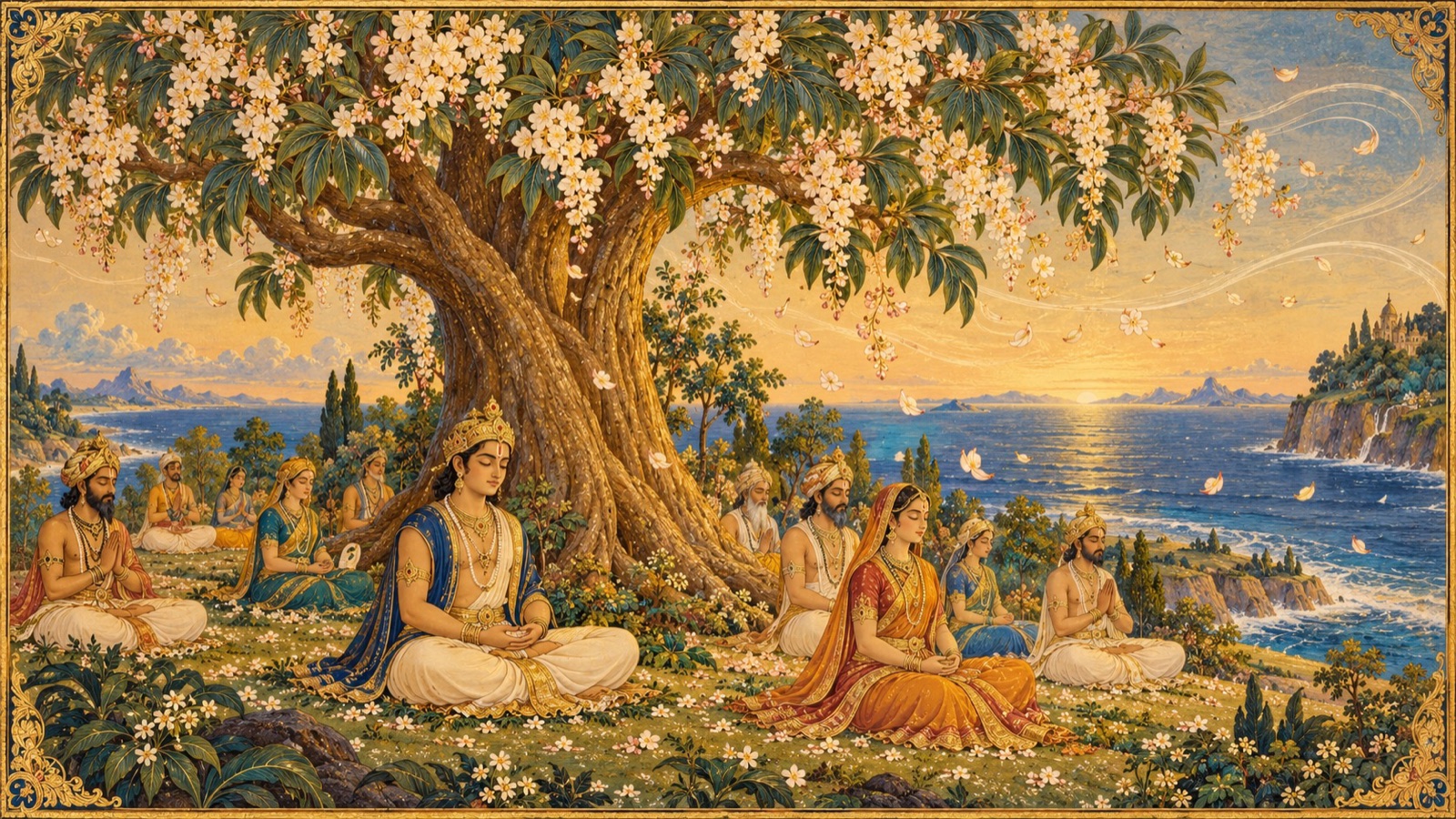
Beyond the ocean of milk lies Sakadwipa, thirty-two lakh yojanas wide, surrounded by an ocean of liquid curds. Upon it stands the Saka tree that names the Dvipa, whose fragrance is so sweet that it is said to perfume the whole land. Its first ruler too was a son of Priyavrata — Medhatithi, the sixth — who established his seven sons over its seven Varsas and then withdrew to a forest of austerity, his mind wholly given to Lord Ananta.
The four orders of that Dvipa — Rtavrata, Satyavrata, Danavrata and Anuvrata — having stilled passion and dullness by the practice of breath-control, worship in deepest concentration the Lord in the form of the wind-god, and pray:
अन्त:प्रविश्य भूतानि यो बिभर्त्यात्मकेतुभि: । अन्तर्यामीश्वर: साक्षात्पातु नो यद्वशे स्फुटम् ॥ २८ ॥
antaḥ-praviśya bhūtāni yo bibharty ātma-ketubhiḥ antaryāmīśvaraḥ sākṣāt pātu no yad-vaśe sphuṭam
Meaning: May the Lord, the inner Controller — under whose sway this whole visible world exists, and who, having entered into all beings, sustains them by the signs of His own presence, the vital airs — protect us. (Canto 5, Chapter 20, verse 28)
Puskaradwipa and the Worship of Brahma
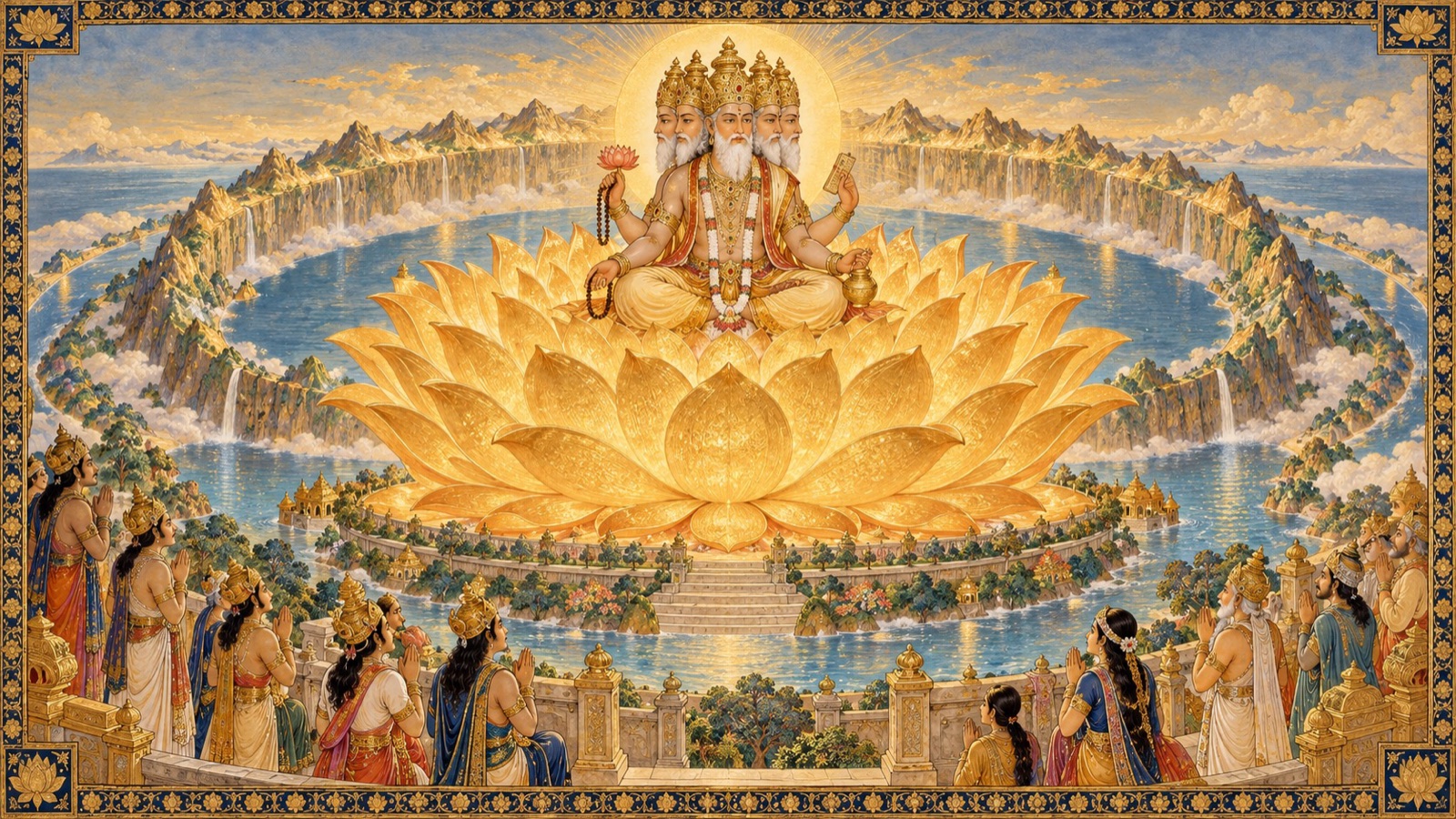
Beyond the ocean of liquid curds lies the last of these lands, Puskaradwipa, double in width, surrounded on its far side by an ocean of sweet fresh water. Here blooms a gigantic lotus with hundreds of millions of golden petals, bright as the flames of a blazing fire — the very seat appointed for the glorious Brahma. In the middle of the Dvipa rises a single mountain-range, Manasottara, ten thousand yojanas in height and breadth, dividing the inner and outer Varsas. Upon it, in the four quarters, stand the four cities of Indra and the other guardians of the world; and over it wheels the year-circle of the sun’s chariot as it rounds Mount Meru through a day and a night of the gods. Its ruler, Vitihotra, the seventh son of Priyavrata, appointed his two sons Ramanaka and Dhataki over its two Varsas and, like his elder brothers, gave himself wholly to the worship of the Lord.
The people of these two lands worship the Lord in the form of Brahma the Creator, and sing:
यत्तत्कर्ममयं लिङ्गं ब्रह्मलिङ्गं जनोऽर्चयेत् । एकान्तमद्वयं शान्तं तस्मै भगवते नम इति ॥ ३३ ॥
yat tat karmamayaṁ liṅgaṁ brahma-liṅgaṁ jano ’rcayet ekāntam advayaṁ śāntaṁ tasmai bhagavate nama iti
Meaning: We bow to that tranquil and glorious form of the Lord — born of sacred action, the sign by which Brahman is known, which people worship, which is utterly one without a second and has the one supreme Reality alone for its goal. (Canto 5, Chapter 20, verse 33)
The Mountain of Lokaloka and the Land Beyond
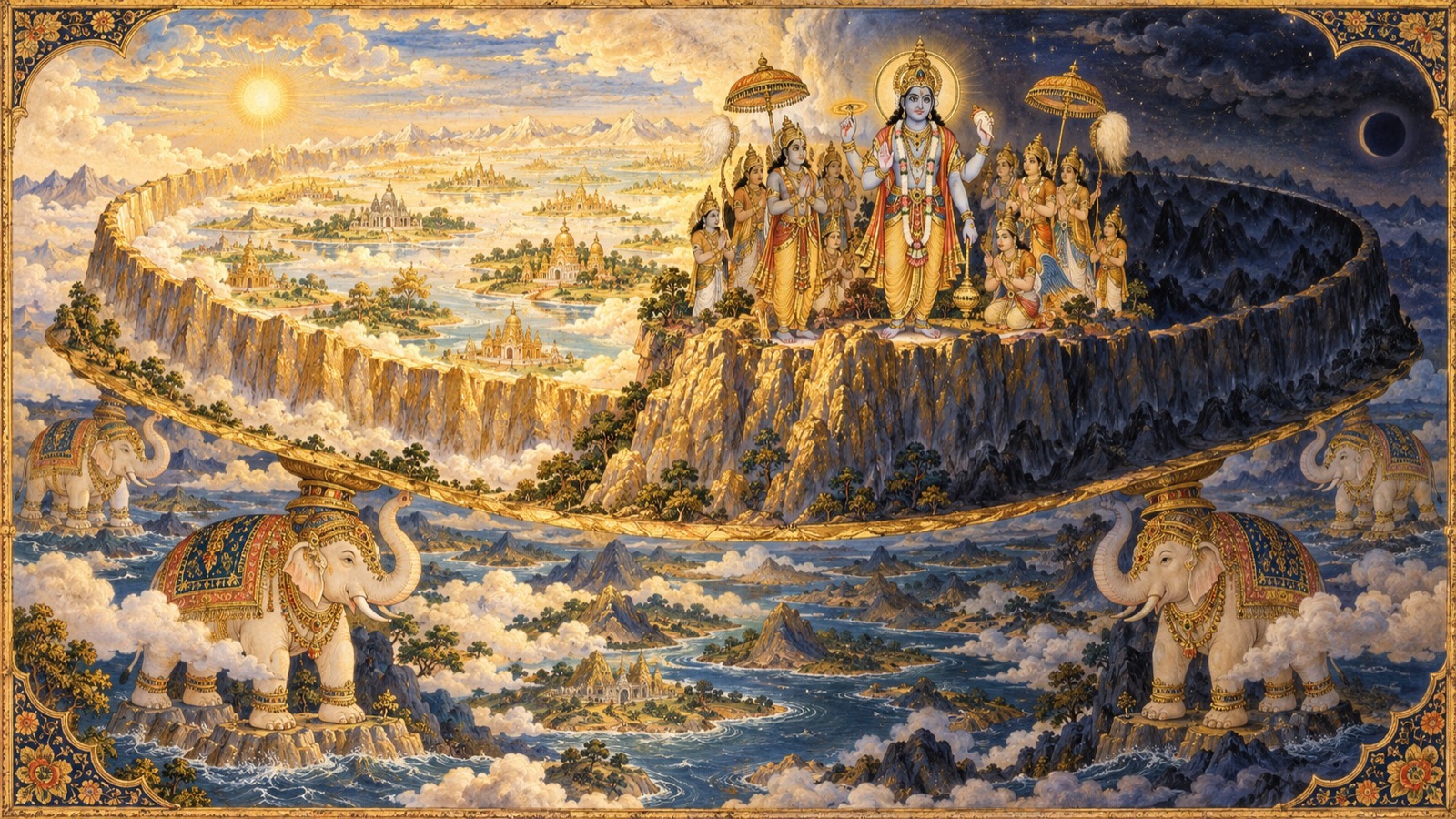
The sage now carries our gaze to the very edge of the lighted world. Beyond the ocean of fresh water, he relates, stands in the form of a ring the mountain Lokaloka, the boundary that divides the region touched by the sun’s light from the region that lies forever in darkness. A stretch of land as wide as that between Manasottara and Meru extends beyond the ocean; and past it lies another tract with a surface of pure gold, gleaming like a sheet of mirror, where anything dropped can never be found again — so that it is shunned by every form of life.
Rightly is the mountain called Lokaloka, for it holds apart Loka, the world of light, and Aloka, the world beyond the sun’s reach. The almighty Lord has set it past the three worlds as an all-surrounding wall, so vast and so high that the rays of all the shining bodies from the sun to the pole-star, which flood the three worlds on this side, can never cross to the other. The whole region from Mount Sumeru to Lokaloka spans a quarter of the diameter of the terrestrial world, reckoned by the wise at fifty crore yojanas.
The Four Elephants and the Lord Who Sustains All Worlds
Beyond that great mountain dwell the four mighty elephants — Rsabha, Puskaracuda, Vamana and Aparajita — stationed in the four quarters by the self-born Brahma, adored of all the universe, and charged with holding the vast globe in balance. And here the vision reaches its holy summit. To strengthen these elephants and the guardians of the world, who are partial expressions of His own glory, and for the welfare of every world, the almighty Lord Himself — the supreme Person, the Possessor of highest glory, the Inner Controller of all — dwells upon that mountain on every side, surrounded by Vishvaksena and His foremost attendants. There He manifests His divine form of unmixed goodness, marked by perfect virtue, all-knowledge, dispassion and sovereign power and the eight great mystic perfections, His four strong arms adorned with His own conch, discus and other weapons.
This form, Sri Suka tells us, the Lord has assumed for the loving maintenance of all the worlds evolved by His own Yogamaya, His wonderful creative power. The extent of Aloka, the unlit region on the far side of Lokaloka, is said to equal the lighted expanse on this side; and beyond even Aloka the wise declare the sacred realm that only the great masters of yoga may reach.
The Sun in the Heart of the Cosmic Egg
Sri Suka closes with the majesty of the sun. Its orb rests in the very middle of the cosmic egg of the universe, at the centre of the space between its upper and lower shells; and the distance from the sun’s orb to the outer shell on every side is twenty-five crore yojanas. Because the sun-god appeared as the Cosmic Being within this lifeless egg, he has ever since been called Martanda; and because he is as the embryo within the golden egg of the universe, he is also called Hiranyagarbha.
By the sun alone are the quarters and the heavens, the earth and all its divisions, the worlds of enjoyment and of final bliss, the hells and the subterranean regions clearly set apart. And of gods and human beings, of beasts and reptiles and the whole world of plants — of every living being without exception — the sun-god is the very Self, the animating spirit, and the deity who presides over the gift of sight. So does the account of the terrestrial world come to its radiant close.
Principal Teachings of This Chapter
The demigods are the Lord’s own parts, not rival gods. A question rises naturally from this chapter: if each Dvipa bows before a different power — sun, fire, moon, Brahma — are these truly different gods? Sri Suka’s own hymns answer from within the prayers themselves. The sun is invoked only as Vishnu’s “visible form” (verse 5); the fire-god is asked merely to carry the offering onward, since it is Sri Hari alone who is thereby worshipped (verse 17); and Brahma, vast as his glory is, is bowed to only as the sign by which the one Lord is known, in duality, a servant and never an equal (verse 33). The demigods, the Bhagavatam is quietly teaching us, are the Lord’s own parts and entrusted stewards, not rival powers; whatever reaches them is carried onward to Him, the true and final enjoyer. This is why a chapter ranging across six worlds keeps returning, prayer after prayer, to a single face.
The one Lord is worshipped through every form. Across six vast worlds the peoples adore the sun, the moon, the fire, the waters, the life-breath and the lotus-born Brahma — yet each is a gateway to the same Supreme Lord. The Bhagavatam teaches us that behind every luminous power we revere stands the one Vishnu, the Soul of all.
All of creation is the Lord’s, and all of it turns toward Him. Ocean beyond ocean, tree beyond tree, world beyond world — the sheer immensity of the cosmos is here unveiled not to overwhelm us, but to lift the heart in wonder at the Creator whose glory fills it all.
Renunciation crowns even the greatest rule. Each ruler of these Dvipas — the sons of Priyavrata — divided his kingdom among his heirs and then turned wholly to the Lord, whether by austerity, by taking the Lord’s shelter, or by lifelong worship. Earthly dominion, however grand, is fulfilled only when it is laid at the Lord’s feet.
The Lord Himself upholds the worlds. Upon Lokaloka the Supreme Person dwells with Vishvaksena and His attendants, strengthening the elephants and guardians who hold the globe in balance. Creation does not sustain itself; it rests, at every moment, upon the loving power of the Lord.
The sun is a window to the Supreme. As the Self of all beings and the giver of sight, dividing the very directions and worlds, the sun reveals in visible splendor the presence of the invisible Lord who dwells within all.
A Devotional Reflection
There is a quiet joy in this chapter that steals over us as the vision widens. World after world unfolds, each with its shining ocean and its great tree, each filled with beings we shall never meet — and yet in every one of them the same thing is happening. Hands are being lifted in prayer; the one Lord is being loved. Whether it is the sun that is adored, or the moon, the fire, the waters, the wind, or Brahma upon his golden lotus, the heart of every world is worship. And that tender truth reaches quietly across all the oceans to us. For we, too, live upon an island of the Lord’s making, under a sun that is a window to His face, breathing an air that is His own inner presence sustaining us from within. This cosmic vision is given not to make us feel small, but to make us feel held — to show us that the whole immeasurable creation is one great temple, and that our own small prayer joins a chorus that fills the universe. To gaze upon so vast a world and find, at its very center and its very edge, the same beloved Lord, is itself a kind of worship. Let us take our humble place in that endless song.
A Daily Devotional Practice
Today, step outside and look up at the sun, and remember what the Bhagavatam has shown you: that its light is a visible form of the most ancient Lord Vishnu, the Self of all that lives, the very giver of your sight. As you feel its warmth, or breathe the air that is His inner presence sustaining you, offer a simple word of gratitude and say inwardly: “Om Namo Bhagavate Vasudevaya.” Let one ordinary element of creation — sunlight, water, breath, or flame upon your lamp — become for you a gateway to the Lord who dwells behind it. In this way the whole world becomes, as it is for the blessed peoples of every Dvipa, a place of worship.
Conclusion
The twentieth discourse of Book Five opens for us a vision of astonishing breadth. Sri Suka carries King Parikshit — and us — outward across the six great Dvipas beyond Jambudvipa: Plaksa, Salmala, Kusa, Krauñca, Saka and Puskara, each ringed by its own ocean of sweetness, each crowned by a mighty tree, each ruled by a son of Priyavrata who in time gave all to the Lord. And in every one of these worlds the peoples bow to that same Supreme Lord in radiant disguise: sun-god here, moon-god there, and elsewhere fire, the sacred waters, the living breath, or four-faced Brahma. Beyond them all rises Lokaloka, the ring-mountain dividing light from darkness, where the four elephants uphold the globe and the Lord Himself dwells with Vishvaksena for the welfare of every world; and at the center of the cosmic egg shines the sun, the Self and the eye of all beings. What remains with us is not the vastness of the map, but the tenderness at its heart: that in a creation beyond all measure, the one beloved Lord is present everywhere, worshipped in every world, sustaining all.
May the divine wisdom of Srimad Bhagavatam awaken pure devotion within our hearts.
Om Namo Bhagavate Vasudevaya.
Jay Shree Madhav.
References and Attribution
- Primary edition: Gita Press, Śrīmad Bhāgavata Mahāpurāṇa, Book Five, Discourse 20 (see the Chapter-title note above for the publisher’s original English rendering of the title).
- Series: Srimad Bhagavatam Wisdom · Biswa Sanatan Dharma Seva Trust.
- Presented following the spiritual guidance and recommendation of Pandit Dr. Shri Kashinath Mishra.
This is an original, faithful retelling in the writer’s own words, with brief quoted verses shown in Devanāgarī and transliteration and their meanings given as summaries. It is not a reproduction of any single publisher’s continuous translation or commentary. No affiliation with or endorsement by any publisher is implied.
Jay Shree Madhav