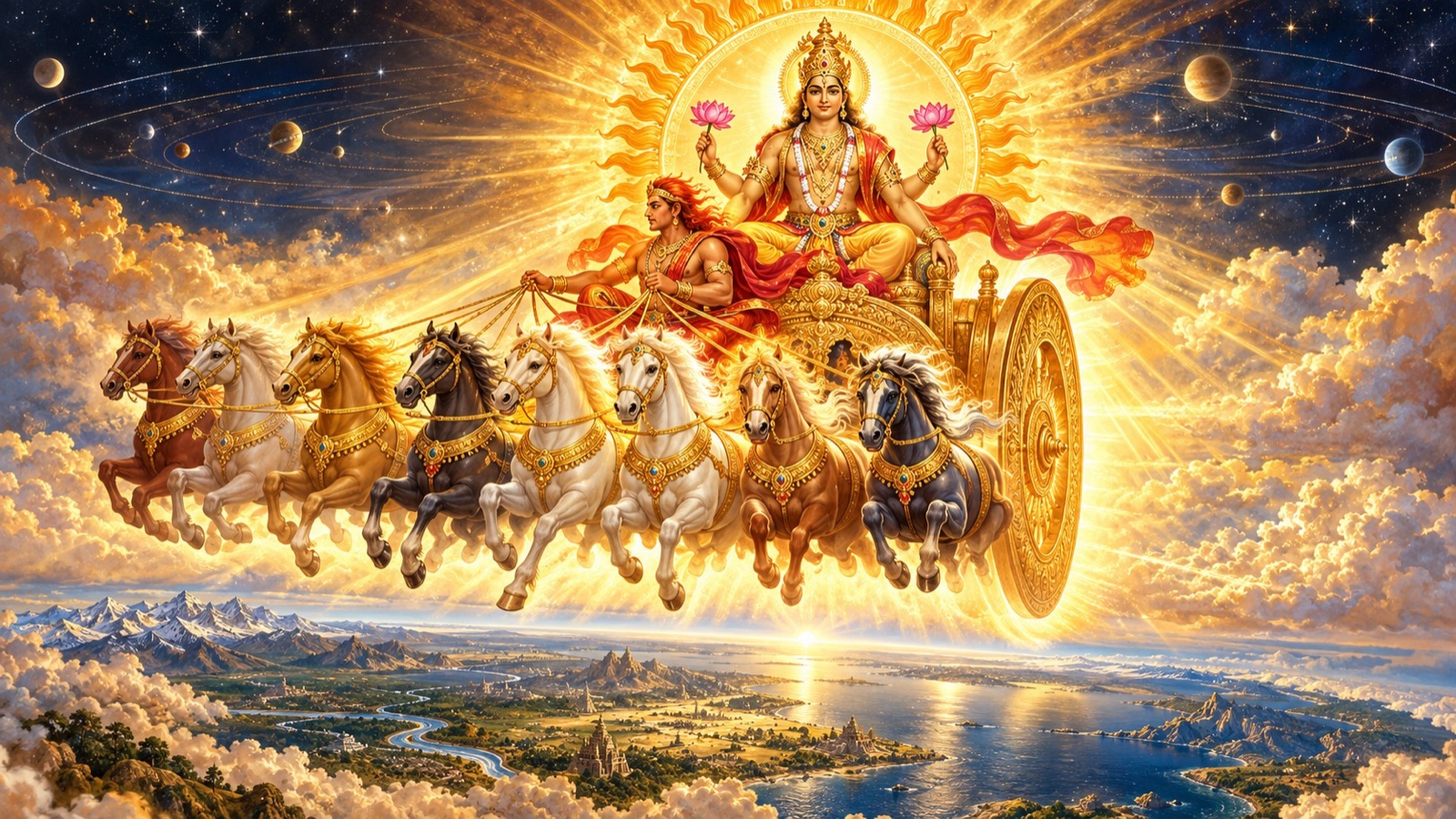
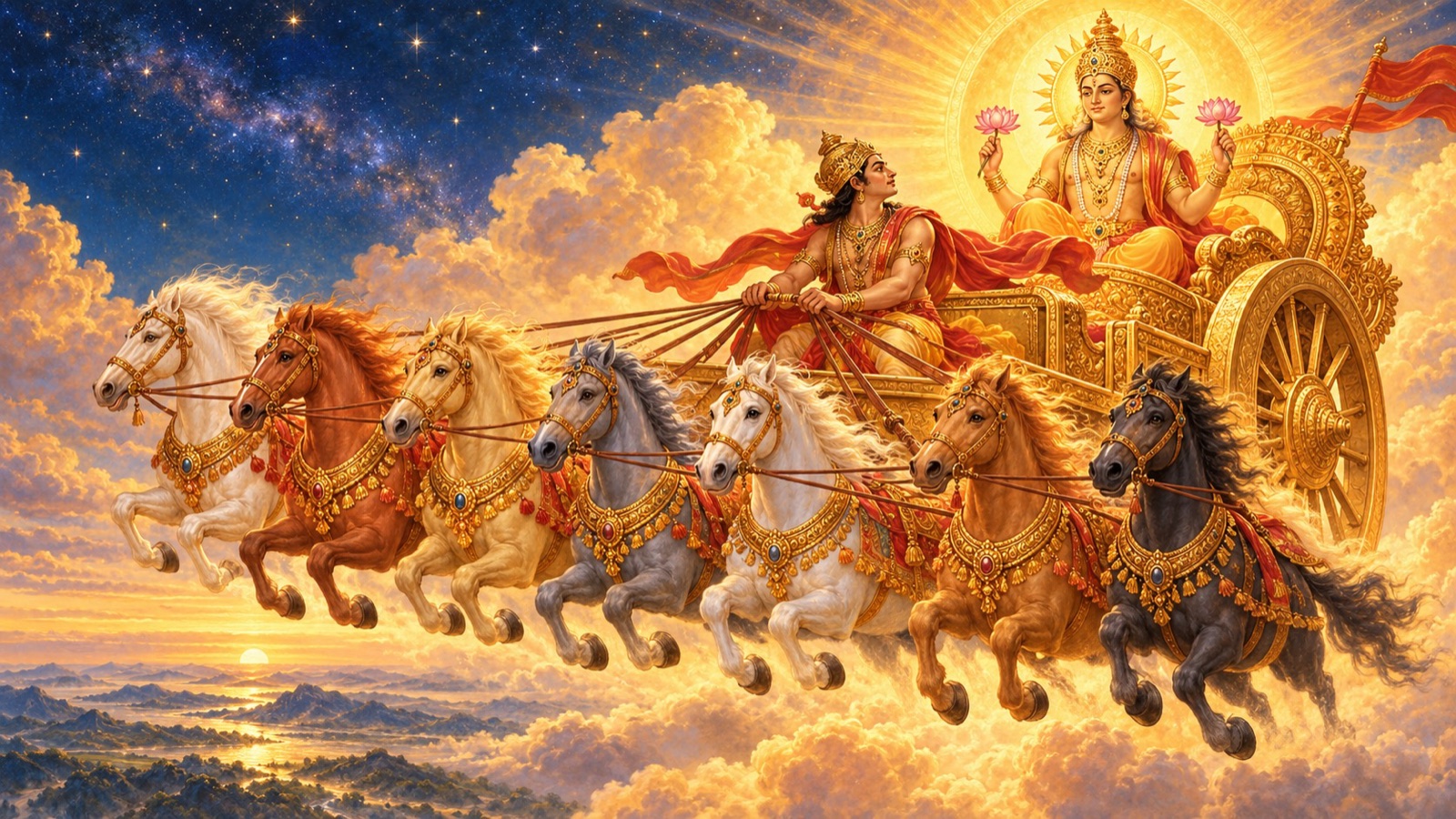
Placed at the very heart of the sky, the radiant sun-god rides his single-wheeled golden chariot, warming and illumining the three worlds — the Lord’s own eye through which He measures out day and night for every living being.
Om Namo Bhagavate Vasudevaya.
Om Namo Bhagavate Vasudevaya.
Om Namo Bhagavate Vasudevaya.
Welcome back to Srimad Bhagavatam Wisdom, a devotional journey through the sacred histories and teachings of the Srimad Bhagavat Mahapurana. Having led us across the great islands and oceans of the earthly plane, Sri Suka now lifts our gaze upward, into the shining sphere of the heavens. Here he shows us the glorious sun set like a lamp at the very centre of the sky, and the wondrous chariot upon which the sun-god rides — a chariot whose single wheel is the year itself, drawn by seven horses named for the Vedic metres, guided by Aruna, and praised without pause by sixty thousand tiny sages. To hear it is to marvel at how tenderly the Lord arranges the rising and setting of each day for the good of all beings.
Chapter Information
- Scripture: Śrīmad Bhāgavata Mahāpurāṇa
- Canto: 5 (Book Five)
- Chapter: 21 (Discourse 21)
- Chapter title: The Sun-God’s Chariot and the Wheel of the Year
- Principal speaker: Sukadeva Gosvami (Sri Suka), continuing his reply to King Parikshit
- Principal listener: King Parikshit — the discourse related in turn by Suta Gosvami to the sages gathered at Naimisaranya
- Main setting: The stellar sphere above the earth — the sun’s circling path over the ring of Mount Manasottara, around Mount Meru
- Central subject: The place of the sun at the centre of the sky and its ordering of day and night; the four cities of the guardian deities upon Manasottara; and the chariot of the sun-god with its single wheel of the year, seven Vedic horses, the charioteer Aruna, and the retinue of sages and celestial beings who worship him month by month
- Principal verse range: Canto 5, Chapter 21, verses 1–19
- Primary edition: Gita Press Śrīmad Bhāgavata Mahāpurāṇa
From the Previous Chapter
In the twentieth discourse, Sri Suka described the six outer islands that ring the earthly plane, each encircled by its own vast ocean, each governed by its appointed ruler, and in each the Supreme Lord worshipped under a form dear to its people. Beyond them all he named the great Lokaloka mountain, the wall that bounds the region of light from the darkness beyond. Having mapped the breadth of the earth below, the sage now turns his gaze upward to reveal the course of the sun that lights this whole creation.
The Sun at the Heart of the Heavens
Sri Suka began again, telling the king that in describing the extent of the earthly plane the wise have, in the same breath, made known the extent of the heavenly sphere as well — for as the measure of one half of a split pea reveals the measure of the other, so the two answer to each other, with the open sky spread between them, joined to the world above and the world below.
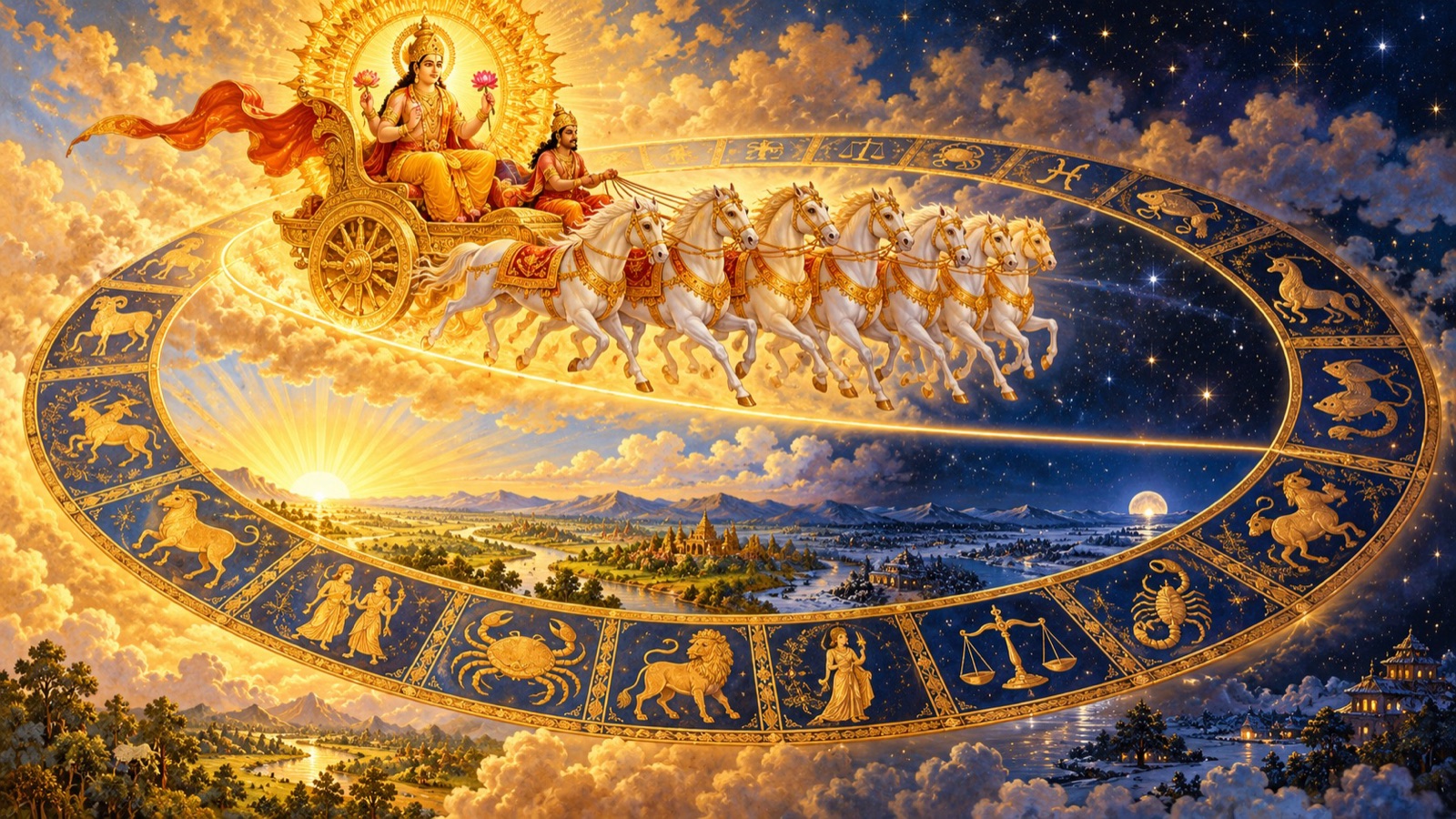
And there, poised at the very centre of that sky, shines the glorious sun, lord of all the luminaries, warming and illumining all three worlds at once. Moving by turns slow, swift and even — the northward march, the southward march, and the level crossing at the equinox — rising, sinking and holding the mean as the divine law appoints, the sun passes through the signs of the zodiac and, beginning from Makara, lengthens the days while shortening the nights, then reverses their measure, and at the appointed places makes them equal.
यन्मध्यगतो भगवांस्तपतां पतिस्तपन आतपेन त्रिलोकीं प्रतपत्यवभासयत्यात्मभासा स एष उदगयनदक्षिणायनवैषुवतसंज्ञाभिर्मान्द्यशैघ्य्रसमानाभिर्गतिभिरारोहणावरोहणसमानस्थानेषु यथासवनमभिपद्यमानो मकरादिषु राशिष्वहोरात्राणि दीर्घह्रस्वसमानानि विधत्ते ॥ ३ ॥
yan-madhya-gato bhagavāṁs tapatāṁ patis tapana ātapena tri-lokīṁ pratapaty avabhāsayaty ātma-bhāsā sa eṣa udagayana-dakṣiṇāyana-vaiṣuvata-saṁjñābhir māndya-śaighrya-samānābhir gatibhir ārohaṇāvarohaṇa-samāna-sthāneṣu yathā-savanam abhipadyamāno makarādiṣu rāśiṣv aho-rātrāṇi dīrgha-hrasva-samānāni vidhatte
Meaning: Placed at the centre of the sky, the glorious sun, lord of the luminaries, warms and illumines all three worlds; and by its slow, swift and even courses — the northward march, the southward march and the equinoctial crossing — passing through the signs of the zodiac from Makara onward, it lengthens and shortens the days and nights and makes them equal. (Canto 5, Chapter 21, verse 3)
The Lengthening and Shortening of the Days
The sage told the king how gently this measuring-out unfolds. When the sun travels through the signs of Mesa and Tula, day and night stand equal, poised like a balance. As it moves through the five signs beginning from Vrsabha, the days grow longer and the nights shrink, month by month, by nearly half a Ghatika; and as it passes through the five signs beginning from Vrscika, the order reverses. So the days keep growing until the sun turns to its southern course, and the nights keep growing until it turns back to the north. In all this rising and waning of the light we behold nothing less than the Lord’s own hand, apportioning to each creature its time for labour and its time for rest.
The Ring of Manasottara and the Four Cities of the Guardians
The learned, Sri Suka said, declare the distance covered by the revolution of the sun upon the summit of the circular Manasottara mountain to be nine crore and fifty-one lakh Yojanas. And upon that lofty ring stand four shining cities of the guardian deities, set about Mount Meru at the four quarters: to the east, the city of Indra, called Devadhani; to the south, the city of Yama, called Samyamani; to the west, the city of Varuna, called Nimlocani; and to the north, the city of Soma the moon-god, called Vibhavari. As the sun enters each city in turn, there is sunrise, midday, sunset and midnight upon the four sides of Meru — and these become for all living beings the very occasions of their waking and their sleep, their beginning of work and their laying of it down.
एवं नव कोटय एकपञ्चाशल्लक्षाणि योजनानां मानसोत्तरगिरिपरिवर्तनस्योपदिशन्ति तस्मिन्नैन्द्रीं पुरीं पूर्वस्मान्मेरोर्देवधानीं नाम दक्षिणतो याम्यां संयमनीं नाम पश्चाद्वारुणीं निम्लोचनीं नाम उत्तरत: सौम्यां विभावरीं नाम तासूदयमध्याह्नास्तमयनिशीथानीति भूतानां प्रवृत्तिनिवृत्तिनिमित्तानि समयविशेषेण मेरोश्चतुर्दिशम् ॥ ७ ॥
evaṁ nava koṭaya eka-pañcāśal-lakṣāṇi yojanānāṁ mānasottara-giri-parivartanasyopadiśanti tasminn aindrīṁ purīṁ pūrvasmān meror devadhānīṁ nāma dakṣiṇato yāmyāṁ saṁyamanīṁ nāma paścād vāruṇīṁ nimlocanīṁ nāma uttarataḥ saumyāṁ vibhāvarīṁ nāma tāsūdaya-madhyāhnāstamaya-niśīthānīti bhūtānāṁ pravṛtti-nivṛtti-nimittāni samaya-viśeṣeṇa meroś catur-diśam
Meaning: The revolution of the sun over the Manasottara mountain measures nine crore and fifty-one lakh Yojanas. Upon it stand Devadhani, the city of Indra, to the east of Meru; Samyamani, the city of Yama, to the south; Nimlocani, the city of Varuna, to the west; and Vibhavari, the city of Soma, to the north. As the sun reaches each in turn there come sunrise, midday, sunset and midnight on the four sides of Meru, setting living beings to their activity and their rest. (Canto 5, Chapter 21, verse 7)
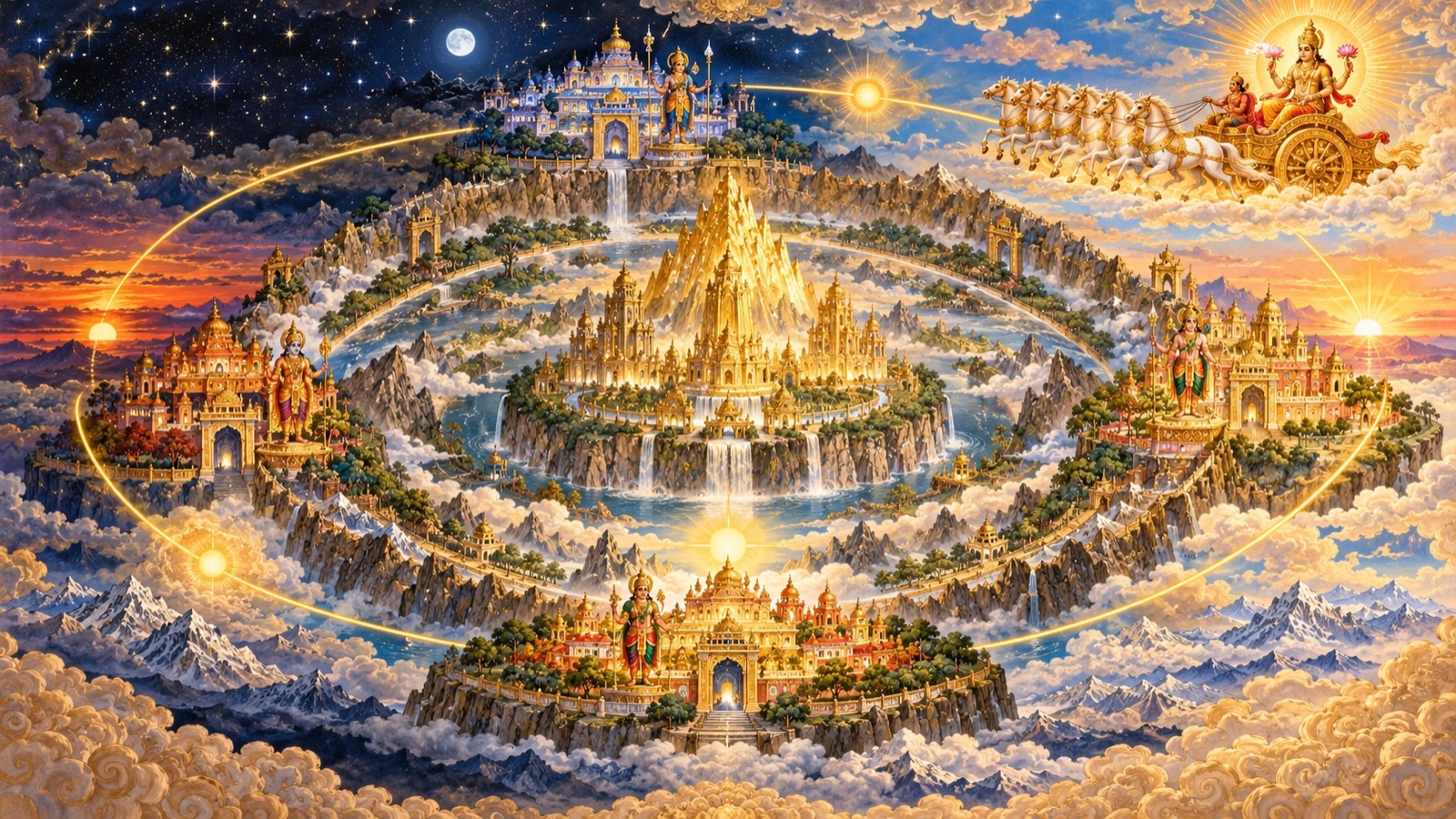
For those who dwell upon Meru itself, Sri Suka told the king, the sun ever shines as at midday. And though it truly moves eastward, keeping Meru upon its left, it appears to us to move westward — for the whole stellar sphere is carried along by the mighty wind called Pravaha. Where it rises to our sight, there on the far side it sets; and where it torments the earth with its noonday heat, there on the opposite side it lays the world to rest in the deep sleep of midnight.
The Sun’s Unresting Course Through the Quarters
Sri Suka went on to tell how swiftly this great luminary moves along its circling path. From the city of Indra to the city of Yama, in fifteen Ghatikas, the sun traverses two crore, thirty-seven lakh and seventy-five thousand Yojanas — a full quarter of its orbit — and in the same measure it passes on to Varuna’s city, then to Soma’s, and back again to Indra’s, the four cities standing equally apart; and along with it the moon and the other planets rise and set with the lunar mansions. Covering thirty-four lakh and eight hundred Yojanas in but two Ghatikas, the chariot of the sun-god — the very chariot that embodies the three Vedas — never ceases its journey through the four cities in unbroken order.
The Chariot with the Single Wheel of the Year
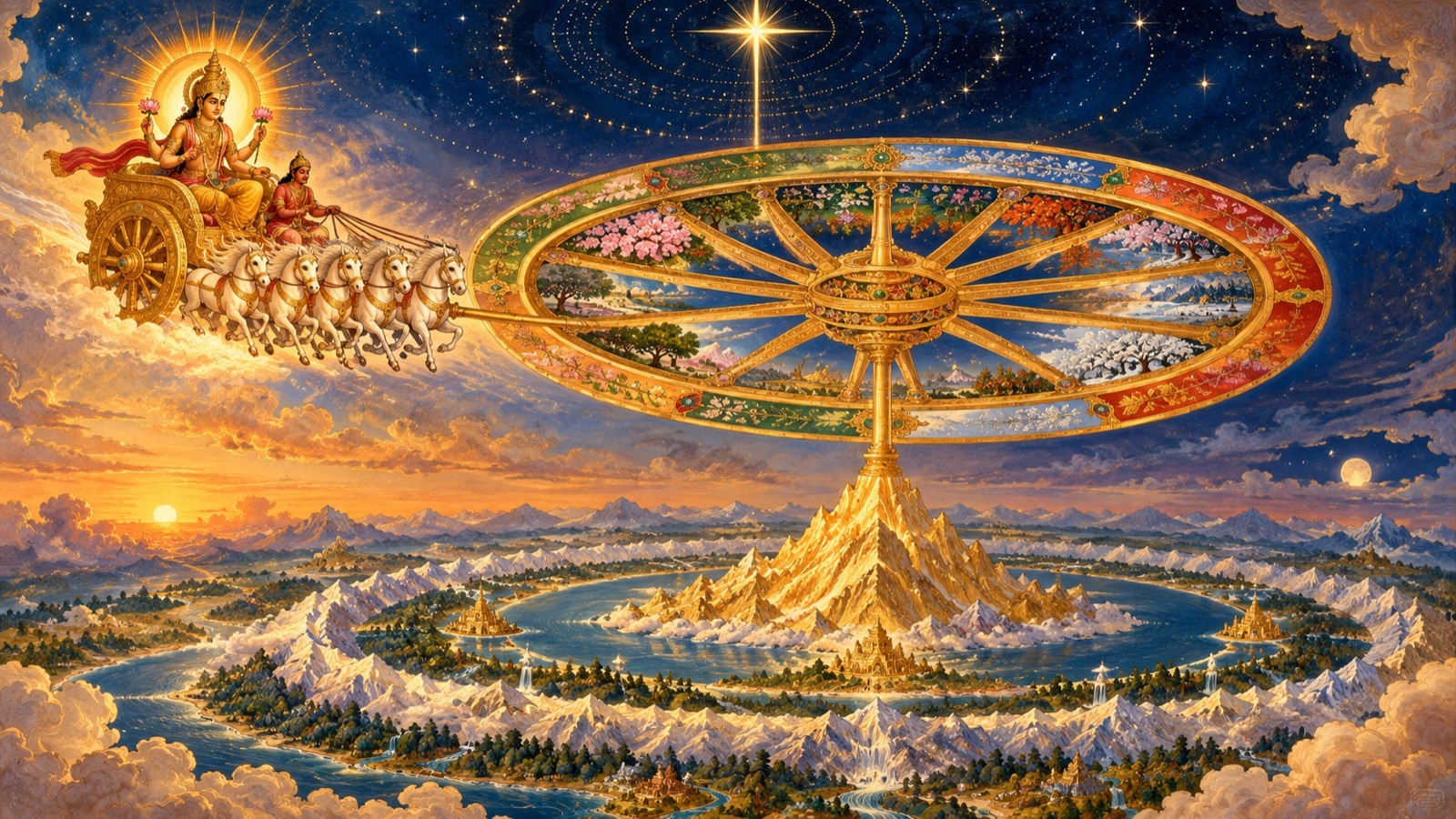
Then Sri Suka unveiled the wonder of the chariot itself. Its one wheel, the wise declare, is the very year, fashioned with twelve spokes for the twelve months, a rim of six segments for the six seasons, and a hub of three pieces for the three parts of four months each. Its axle is fixed at one end upon the summit of Mount Meru and at the other upon the ring of Manasottara; and fixed there, turning as the wheel of an oil-press turns, the chariot’s wheel revolves along the whole length of that mountain. A second axle, one-fourth the length of the first, has its lower end joined to the great axle and its upper end bound with an aerial cord to the pole-star, so that the entire wheel of days and months and seasons turns steadily about that changeless northern point.
यस्यैकं चक्रं द्वादशारं षण्नेमि त्रिणाभि संवत्सरात्मकं समामनन्ति तस्याक्षो मेरोर्मूर्धनि कृतो मानसोत्तरे कृतेतरभागो यत्र प्रोतं रविरथचक्रं तैलयन्त्रचक्रवद् भ्रमन्मानसोत्तरगिरौ परिभ्रमति ॥ १३ ॥
yasyaikaṁ cakraṁ dvādaśāraṁ ṣaṇ-nemi tri-ṇābhi saṁvatsarātmakaṁ samāmananti tasyākṣo meror mūrdhani kṛto mānasottare kṛtetara-bhāgo yatra protaṁ ravi-ratha-cakraṁ taila-yantra-cakravad bhraman mānasottara-girau paribhramati
Meaning: Its single wheel, the wise declare, is the year itself, with twelve spokes for the months, a rim of six segments for the seasons and a hub of three parts; its axle, fixed upon the summit of Meru at one end and upon Manasottara at the other, turns like the wheel of an oil-press, and so the wheel of the sun-god’s chariot revolves over the Manasottara mountain. (Canto 5, Chapter 21, verse 13)
Aruna the Charioteer and the Seven Vedic Horses
The interior of that chariot, Sri Suka said, is thirty-six lakh Yojanas in length and a quarter of that in breadth, and its yoke stretches nine lakh Yojanas, of the very same extent. To this yoke, harnessed by Aruna the charioteer, seven horses are joined, each bearing the name of one of the seven Vedic metres — Gayatri, Brhati, Usnik, Jagati, Tristubh, Anustubh and Pankti — and these bear the sun-god onward upon his endless course. Aruna himself, though seated before the sun-god to drive the chariot, keeps his face turned back toward his master, lest by turning his back he should show the Lord of light the least disrespect.
रथनीडस्तु षट्त्रिंशल्लक्षयोजनायतस्तत्तुरीयभागविशालस्तावान् रविरथयुगो यत्र हयाश्छन्दोनामान: सप्तारुणयोजिता वहन्ति देवमादित्यम् ॥ १५ ॥
ratha-nīḍas tu ṣaṭ-triṁśal-lakṣa-yojanāyatas tat-turīya-bhāga-viśālas tāvān ravi-ratha-yugo yatra hayāś chando-nāmānaḥ saptāruṇa-yojitā vahanti devam ādityam
Meaning: The chariot’s body measures thirty-six lakh Yojanas end to end and a quarter of that across, and Aruna fastens to it a yoke of that same narrower measure; seven horses, each named for a Vedic metre, are bound there and draw the sun-god forward. (Canto 5, Chapter 21, verse 15)
The Sixty Thousand Valakhilyas and the Worship of the Sun-God
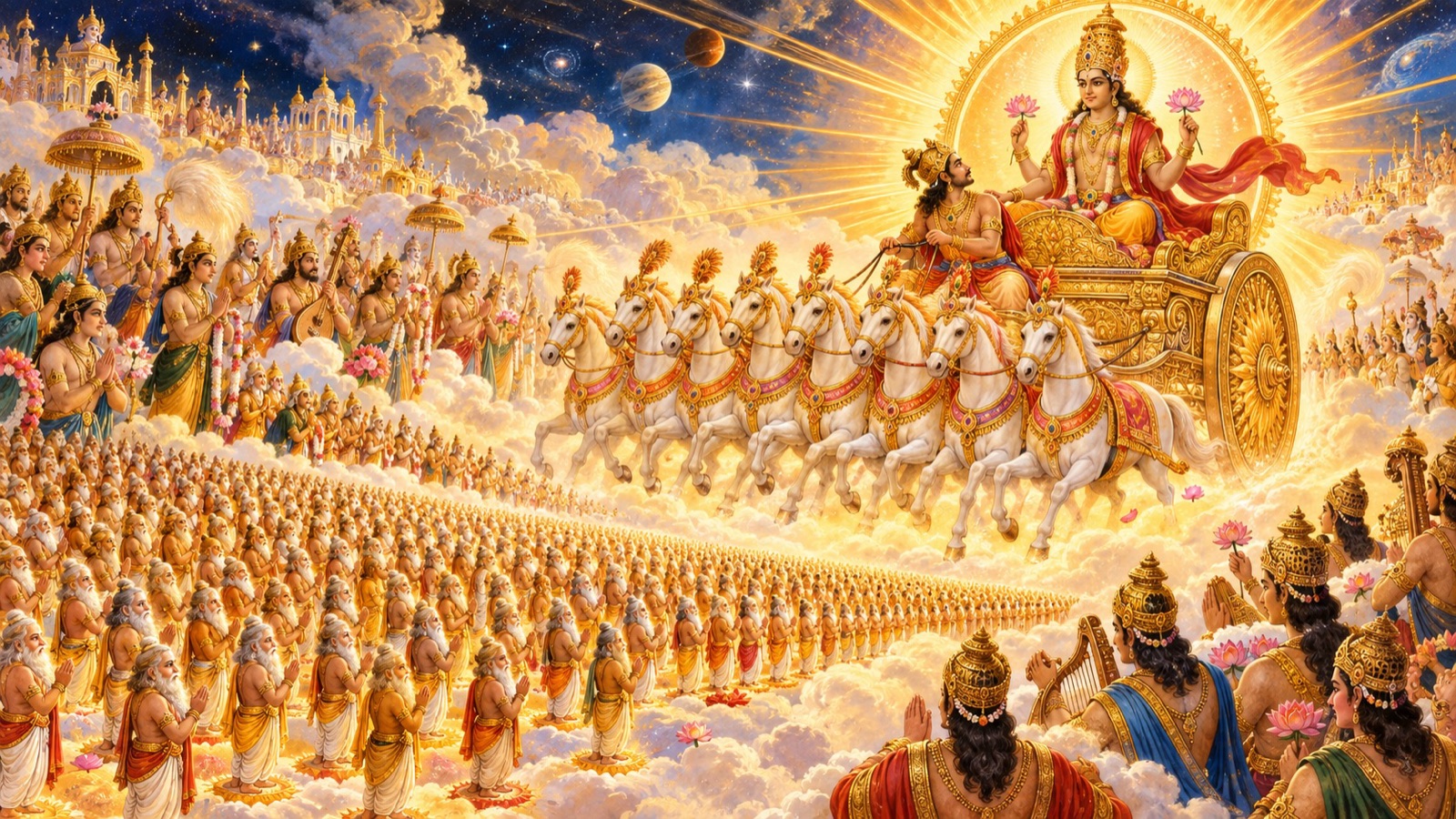
And now Sri Suka told the king of the smallest and most tireless of the sun-god’s worshippers. Seated before him and charged with singing his praises are the Valakhilya sages, sixty thousand in number, each no larger than the forepart of a thumb, who extol the Lord of light without pause in a single glorious chorus. Around them, other sages, Gandharvas and Apsaras, Nagas and Yaksas, Yatudhanas and gods — fourteen in all, forming seven pairs and bearing many names — wait upon the Supreme Lord present as the sun-god, each group taking up its service in its own appointed month, so that through all the turning year the Lord in the form of the sun is never left unworshipped.
तथा वालिखिल्या ऋषयोऽङ्गुष्ठपर्वमात्रा: षष्टिसहस्राणि पुरत: सूर्यं सूक्तवाकाय नियुक्ता: संस्तुवन्ति ॥ १७ ॥
tathā vālikhilyā ṛṣayo ’ṅguṣṭha-parva-mātrāḥ ṣaṣṭi-sahasrāṇi purataḥ sūryaṁ sūkta-vākāya niyuktāḥ saṁstuvanti
Meaning: So too the Valakhilya sages, sixty thousand in number and each the size of the forepart of a thumb, appointed to the utterance of hymns, stand before the sun-god and glorify him in chorus. (Canto 5, Chapter 21, verse 17)
At the last, Sri Suka named the whole compass of that circling path: the belt of the terrestrial plane at the Manasottara measures nine crore and fifty-one lakh Yojanas, and of this immense round the sun covers two thousand and two Yojanas in a single moment — so swiftly, and so faithfully, does the Lord of light keep the appointed measure of our days.
लक्षोत्तरं सार्धनवकोटियोजनपरिमण्डलं भूवलयस्य क्षणेन सगव्यूत्युत्तरं द्विसहस्रयोजनानि स भुङ्क्ते ॥ १९ ॥
lakṣottaraṁ sārdha-nava-koṭi-yojana-parimaṇḍalaṁ bhū-valayasya kṣaṇena sagavyūty-uttaraṁ dvi-sahasra-yojanāni sa bhuṅkte
Meaning: The full girth of the Bhu-mandala measured at Manasottara comes to nine crore and fifty-one lakh Yojanas, and the sun-god crosses two thousand and two of those Yojanas in the space of a single instant. (Canto 5, Chapter 21, verse 19)
Principal Teachings of This Chapter
The sun is the eye of the Lord, ordering our time. Set at the centre of the sky, the sun does not merely burn of itself; it is the appointed instrument by which the Supreme measures out day and night, season and year, for the welfare of every creature. To watch a sunrise is to behold the Lord’s own arrangement of our life.
All time is fashioned like a sacred wheel. The single wheel of the chariot, whose spokes are the months and whose rim is the seasons, teaches us that the passing of time is not blind or empty but shaped and purposeful — a wheel forever turning about the changeless pole, as our changing days turn about the changeless Lord.
The whole creation moves at His bidding. The horses named for the Vedic metres, the wind Pravaha that carries the stars, the axle bound to the pole-star — all move in perfect, effortless order under the divine law. Nothing in the heavens is left to chance, and nothing in our own lives is beyond His care.
Even the smallest may render the greatest service. The Valakhilyas, each no bigger than a thumb-joint, are entrusted with the ceaseless praise of the sun-god. Greatness in devotion is measured not by size or station but by the constancy of a heart fixed on glorifying the Lord.
Reverence belongs in every act of service. Though placed in front to hold the reins, Aruna will not let his back face the one he serves, and so sits angled toward the sun-god throughout the drive — a small and beautiful sign that true service is offered not only with the hands but with unbroken reverence.
A Devotional Reflection
There is a particular sweetness in hearing the heavens described this way, not as cold machinery but as a living act of divine love. We so easily take the sunrise for granted, as though it simply happens; and here Sri Suka opens the curtain and shows us the golden chariot behind it, the reverent charioteer, the tiny sages singing without pause, the great wheel of the year turning steadily upon the mountains. Suddenly the ordinary round of our days — waking, working, resting, waking again — is revealed as something the Lord Himself has arranged with tenderness and exactness, so that no creature is left without its measure of light and its measure of rest. When we begin to see time this way, the hours stop being a burden and become a gift, each dawn a fresh mercy. And if even the thumb-sized Valakhilyas can spend their whole existence simply praising the Lord of light, then surely we, given so much more, can learn to greet each new day with a word of gratitude and a heart turned, like Aruna’s face, always back toward our Master.
A Daily Devotional Practice
Tomorrow at dawn, before the day’s tasks crowd in, pause at the first light and receive it consciously as a gift from the Lord who arranges the rising and setting of the sun for your good. With folded hands or simply a quiet heart, offer the sacred words: “Om Namo Bhagavate Vasudevaya.” Then, through the day, let the turning of the hours remind you of the great wheel of the year turning faithfully at His command, and each time you notice the changing light, breathe an inward thanks. In this small practice we join, in our own way, the endless chorus of the Valakhilyas.
Conclusion
The twenty-first discourse of Book Five lifts our eyes from the earth to the shining sphere of the heavens, where Sri Suka reveals the sun set like a lamp at the centre of the sky, warming and illumining the three worlds and measuring out the lengthening and shortening of our days as it moves through the signs of the zodiac. He shows us the ring of Manasottara with its four cities of the guardians; the marvellous chariot whose single wheel is the year, turning about the pole-star; the seven horses named for the Vedic metres, harnessed by the reverent Aruna; and the sixty thousand thumb-sized Valakhilyas who praise the Lord of light without ceasing, joined by the sages and celestial beings who worship him month by month. In all of it we behold one truth: that the whole ordering of time is the loving handiwork of the Supreme Lord, and that to contemplate the heavens is to worship Him who moves them.
May the divine wisdom of Srimad Bhagavatam awaken pure devotion within our hearts.
Om Namo Bhagavate Vasudevaya.
Jay Shree Madhav.
References and Attribution
- Primary edition: Gita Press, Śrīmad Bhāgavata Mahāpurāṇa, Book Five, Discourse 21.
- Series: Srimad Bhagavatam Wisdom · Biswa Sanatan Dharma Seva Trust.
- Presented following the spiritual guidance and recommendation of Pandit Dr. Shri Kashinath Mishra.
This is an original, faithful retelling in the writer’s own words, with brief quoted verses shown in Devanāgarī and transliteration and their meanings given as summaries. It is not a reproduction of any single publisher’s continuous translation or commentary. No affiliation with or endorsement by any publisher is implied.
Jay Shree Madhav