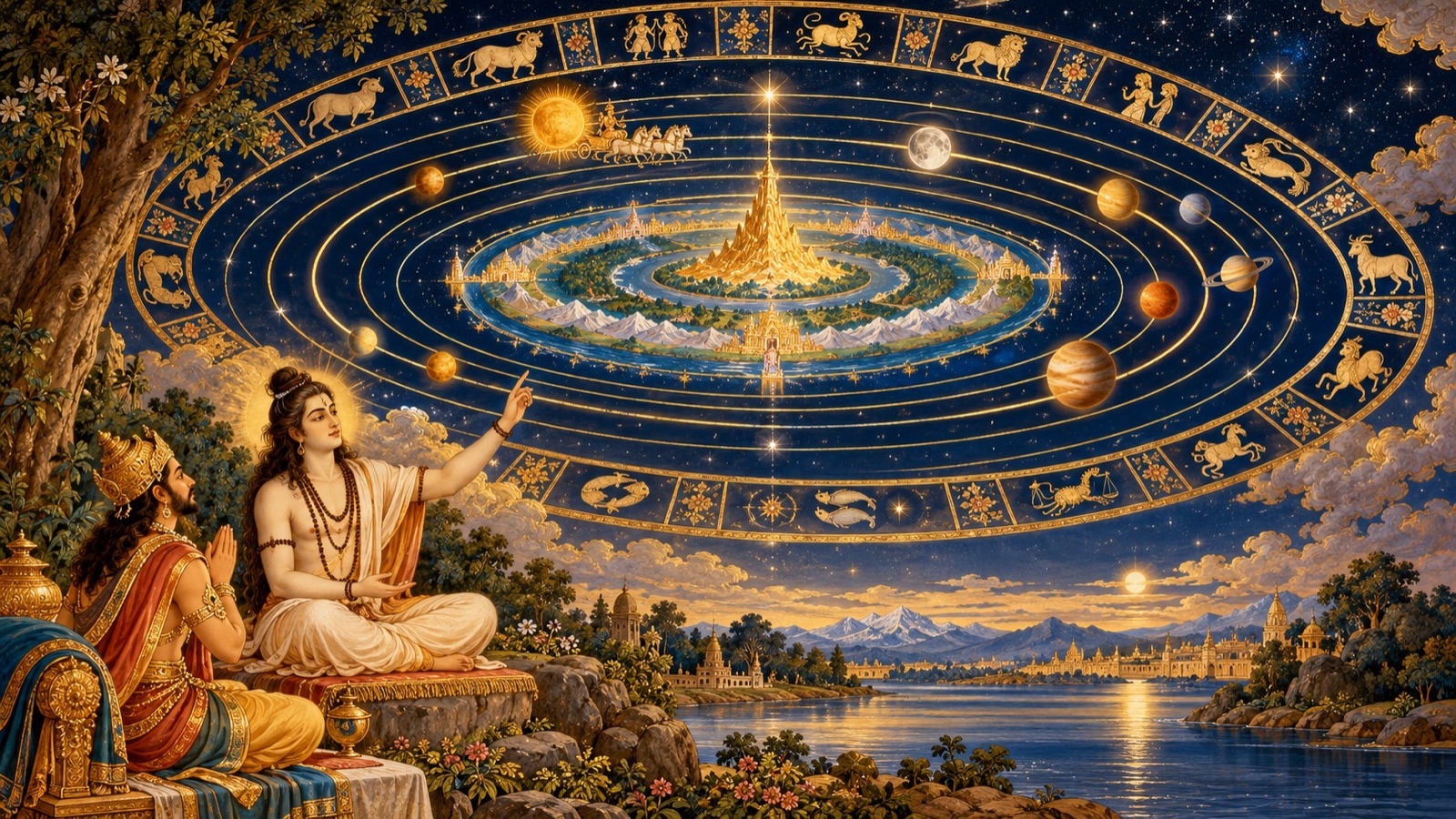
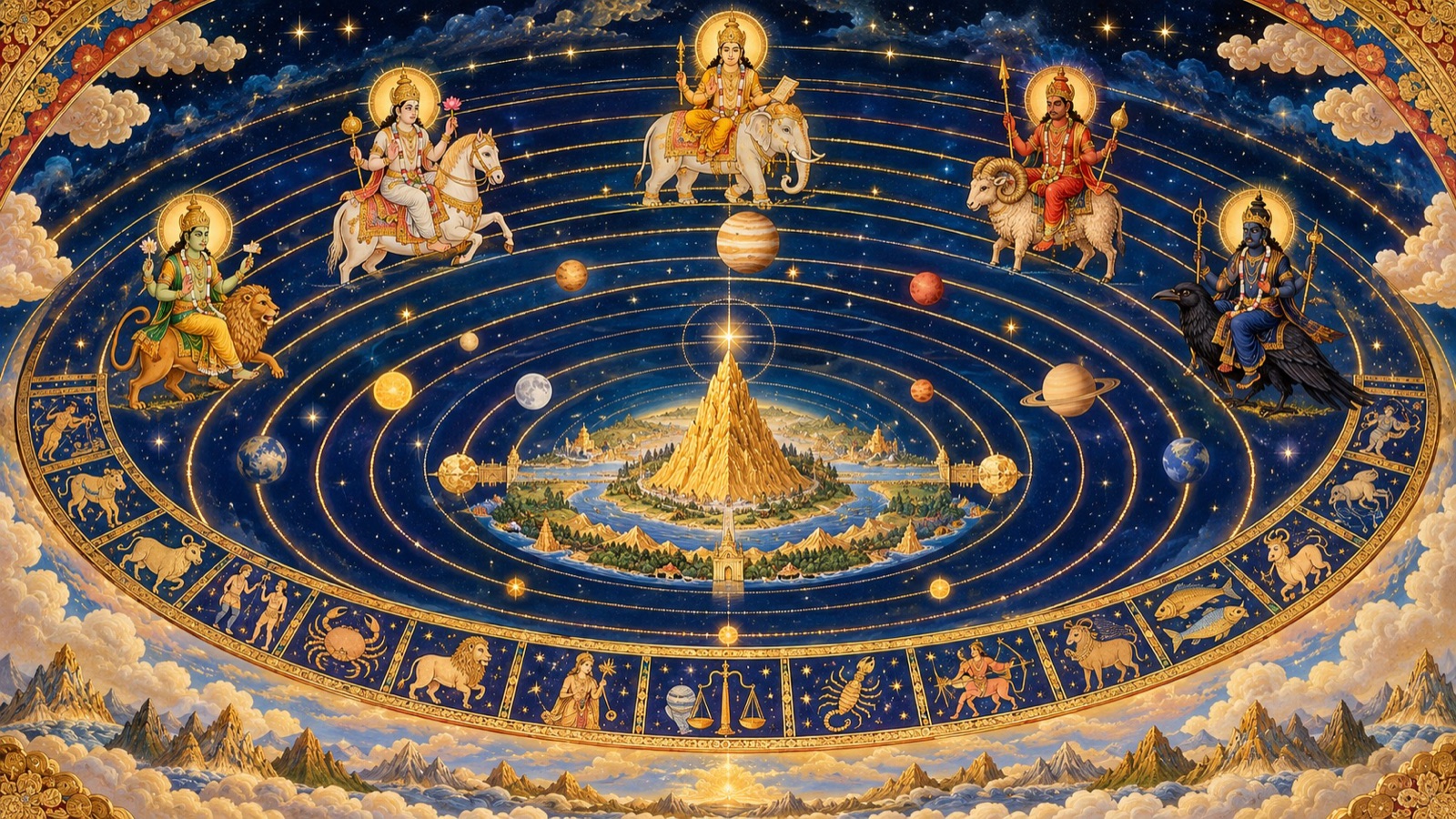
Seated before King Parikshit, Sri Suka unfolds the great wheel of Time — the sun, the moon and the planets wheeling in their appointed rounds about Mount Meru and the pole-star, all held and moved by the Lord who is the soul of all.
Om Namo Bhagavate Vasudevaya.
Om Namo Bhagavate Vasudevaya.
Om Namo Bhagavate Vasudevaya.
Welcome back to Srimad Bhagavatam Wisdom, a devotional journey through the sacred histories and teachings of the Srimad Bhagavat Mahapurana. In this twenty-second chapter of Book Five, the sky itself becomes a scripture. King Parikshit, having heard of the sun’s yearly journey, asks a gentle, wondering question — how can the sun seem to move one way and yet truly move another? And Sri Suka answers not with cold measurement but with adoration, showing us that every wheeling light in the heavens turns at the Lord’s own bidding. The sun ordering the seasons, the moon pouring out its nectar for gods and ancestors and green growing things, the constellations and the wandering planets each keeping their appointed round, and the seven sages forever circling the abode of Lord Vishnu — all of it is the Supreme Person quietly measuring out time for the good of every living being.
Chapter Information
- Scripture: Śrīmad Bhāgavata Mahāpurāṇa
- Canto: 5 (Book Five)
- Chapter: 22 (Discourse 22)
- Chapter title: The Movements of the Sun, Moon, and Planets
- Principal speaker: Sukadeva Gosvami (Sri Suka), answering King Parikshit
- Principal listener: King Parikshit — the discourse related in turn by Suta Gosvami to the sages gathered at Naimisaranya
- Main setting: The banks of the Ganga at Hastinapura, where Sri Suka instructs the king, unfolding the order of the great stellar sphere
- Central subject: How the sun appears to move one way while truly moving another; the Lord as Time dividing the year into months and seasons; the moon as the embodiment of nectar and the nourisher of all beings; and the stars and the orbits of Venus, Mercury, Mars, Jupiter, Saturn and the Seven Sages, all held to the wheel of Time by the Lord
- Principal verse range: Canto 5, Chapter 22, verses 1–17
- Primary edition: Gita Press Śrīmad Bhāgavata Mahāpurāṇa
From the Previous Chapter
In the twenty-first discourse, Sri Suka described the sun’s yearly course through the sky and told of Mount Manasottara, upon whose four sides stand the cities of the guardians of the quarters. He spoke of the sun-god’s radiant, single-wheeled chariot, drawn by its seven horses, with Aruna seated before, and of the sages, Gandharvas and other celestial beings who travel with it and worship the Lord in the form of the sun. That account of the sun’s great journey leads naturally into the king’s question here, about how the sun and the other lights truly move.
The King’s Wondering Question
Having heard how the sun journeys through the heavens, King Parikshit turned to his master with a doubt born of wonder. Two things had both been affirmed of the sun’s course, and to the king’s mind they seemed impossible to hold together at once. With the humility of a true seeker, he asked how such an apparent contradiction could rightly be understood.
राजोवाच यदेतद्भगवत आदित्यस्य मेरुं ध्रुवं च प्रदक्षिणेन परिक्रामतो राशीनामभिमुखं प्रचलितं चाप्रदक्षिणं भगवतोपवर्णितममुष्य वयं कथमनुमिमीमहीति ॥ १ ॥
rājovāca yad etad bhagavata ādityasya meruṁ dhruvaṁ ca pradakṣiṇena parikrāmato rāśīnām abhimukhaṁ pracalitaṁ cāpradakṣiṇaṁ bhagavatopavarṇitam amuṣya vayaṁ katham anumimīmahīti.
Meaning: The king said: You have described the glorious sun as appearing to revolve about Mount Meru and the pole-star while keeping both on its right, and yet as truly moving, facing the lunar mansions, with Meru and the pole-star on its left. How are we to understand and accept this? (Canto 5, Chapter 22, verse 1)
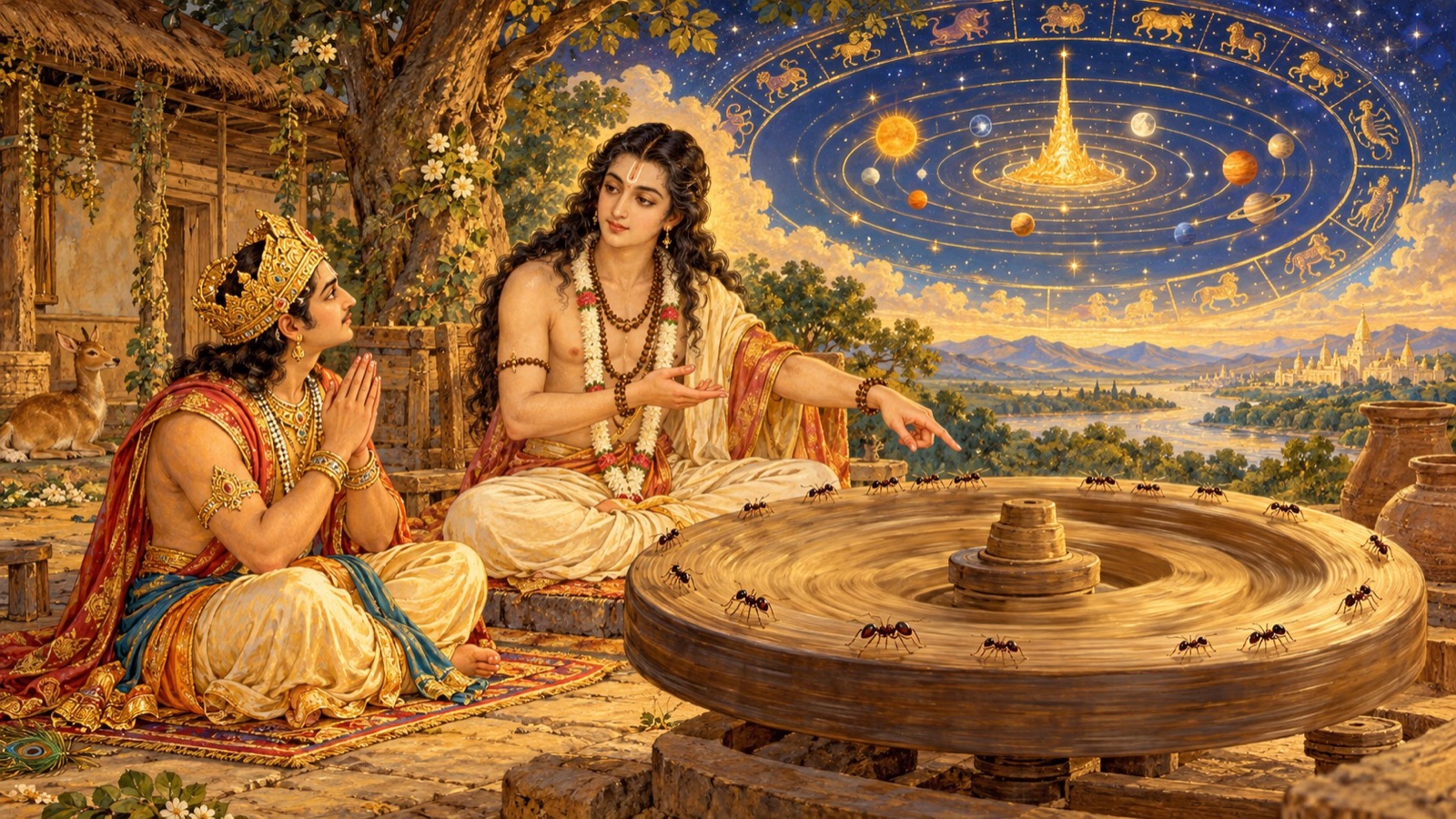
Sri Suka received the question with joy, for it opened the way to speak of the Lord’s ordering of time. He answered with a homely and beautiful image. Consider, he said, the ants crawling upon a potter’s wheel as it spins. The ants are carried round with the wheel, and yet they have a motion all their own, for they are seen now at one place upon it and now at another. Just so, the sun and the other planets are set upon the great wheel of Time, marked out by the constellations and the signs of the zodiac; they are swept round the pole-star and Mount Meru along with that wheel, and yet each keeps its own distinct course — as we know, because they are seen joined now with one constellation and sign, now with another.
स होवाच यथा कुलालचक्रेण भ्रमता सह भ्रमतां तदाश्रयाणां पिपीलिकादीनां गतिरन्यैव प्रदेशान्तरेष्वप्युपलभ्यमानत्वादेवं नक्षत्रराशिभिरुपलक्षितेन कालचक्रेण ध्रुवं मेरुं च प्रदक्षिणेन परिधावता सह परिधावमानानां तदाश्रयाणां सूर्यादीनां ग्रहाणां गतिरन्यैव नक्षत्रान्तरे राश्यन्तरे चोपलभ्यमानत्वात् ॥ २ ॥
sa hovāca yathā kulāla-cakreṇa bhramatā saha bhramatāṁ tad-āśrayāṇāṁ pipīlikādīnāṁ gatir anyaiva pradeśāntareṣv apy upalabhyamānatvād evaṁ nakṣatra-rāśibhir upalakṣitena kāla-cakreṇa dhruvaṁ meruṁ ca pradakṣiṇena paridhāvatā saha paridhāvamānānāṁ tad-āśrayāṇāṁ sūryādīnāṁ grahāṇāṁ gatir anyaiva nakṣatrāntare rāśy-antare copalabhyamānatvāt.
Meaning: Sri Suka said: As the ants crawling upon a spinning potter’s wheel are carried round with it and yet have a course of their own — for they are seen at different spots upon it — so the sun and the other planets, resting upon the wheel of Time that is marked by the constellations and the signs of the zodiac and revolving with it round the pole-star and Mount Meru, keep a distinct course of their own, as is clear from their being seen conjoined now with one constellation and sign and now with another. (Canto 5, Chapter 22, verse 2)
The Lord as Time, Ordering the Year
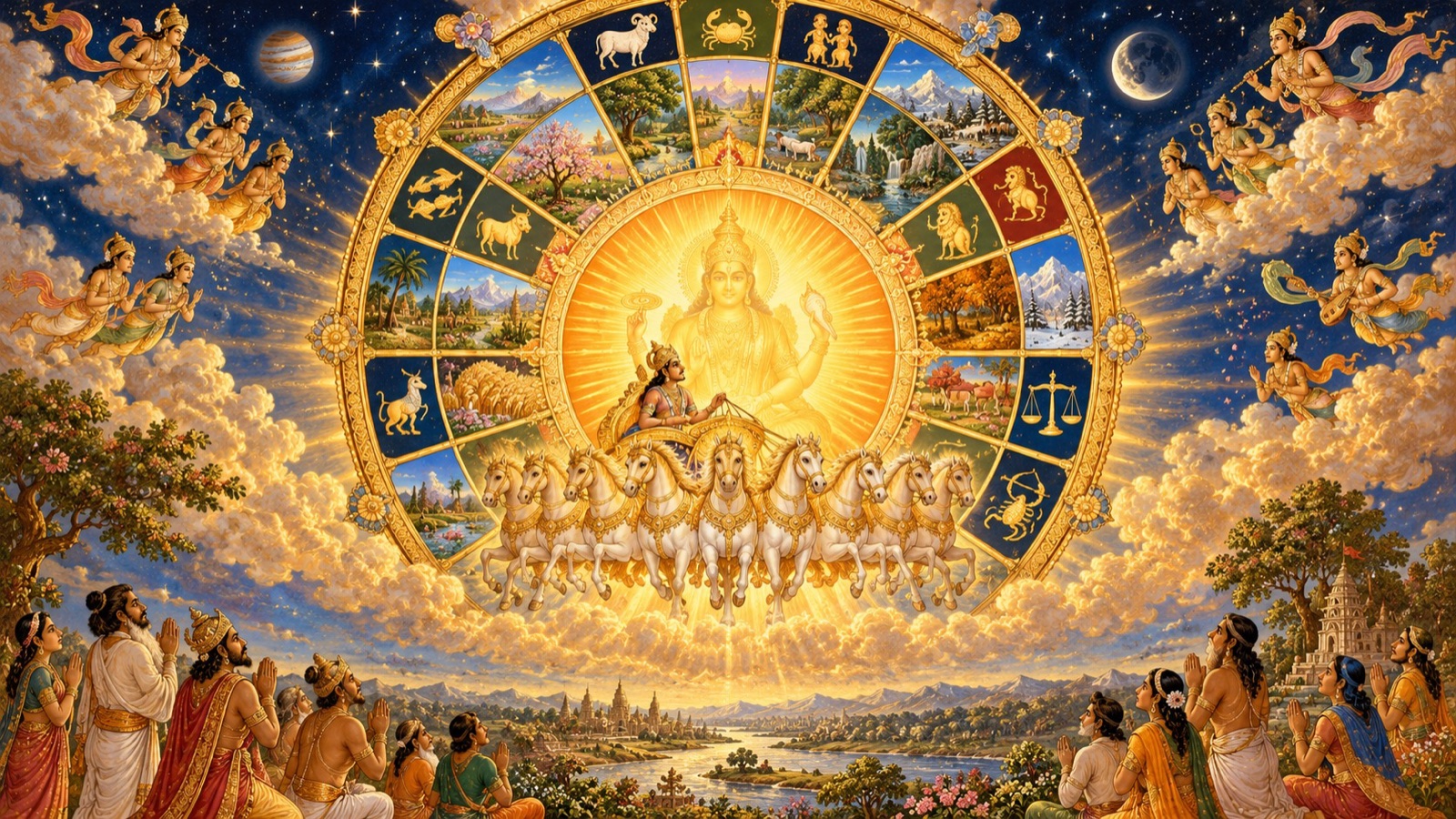
Then Sri Suka lifted the king’s gaze from the turning wheel to the One who turns it. This sun, this measured march of days and seasons, is no blind machinery. It is the glorious Lord Narayana Himself, the most ancient Person, the very One whom the Vedas and the wise so earnestly seek. For the welfare of all living beings He divides His own body — appearing as Time, the theme of the three Vedas and the ground of every timely rite — into twelve parts, the twelve months, and through the six seasons He brings forth in turn their own characters of heat and cold, rain and wind, so that every soul may reap in season the fruit of its past deeds.
Sri Suka is careful to show that the sun did not simply come to be — it was given, in answer to prayer. Great sages, versed in the Vedas and seeking the good of the worlds, once turned their hearts toward Narayana in worship; and He, moved by their devotion, entered this creation in the very form of the sun, for two purposes joined as one — to sustain and benefit all the planets, and to purify the fruitive works of every soul, burning away the accumulated taint of past deeds as sunlight burns away darkness. The sun’s daily rising is thus no accident of nature but a still-unfolding answer to that ancient prayer, the Lord keeping His word to the sages by warming and cleansing all creation, morning after morning, for our sake (verse 3).
And so, Sri Suka continued, those who worship this Lord — through the sacred rituals, high and low, taught in the three Vedas, and through the disciplines of Yoga by which the heart draws near to the Supreme Person — following the path marked out for the orders and stages of life, duly and easily attain the blessings they seek, whether the happiness of the higher worlds or the final freedom of the soul. Entering as the sun into the wheel of Time set in the firmament between heaven and earth, the Lord who is the soul of all passes through the twelve months named for the signs of the zodiac. A month, the wise declare, is a pair of fortnights, one bright and one dark; the fraction in which He covers a sixth part of His path is a season, a Rtu; the time to cross one half of the heavens is a half-year, an Ayana; and the full round of the sky, traversed in slow, swift or moderate march, is the year in its several reckonings — Samvatsara, Parivatsara, Idavatsara, Anuvatsara and Vatsara.
The Moon, the Nectar That Nourishes All
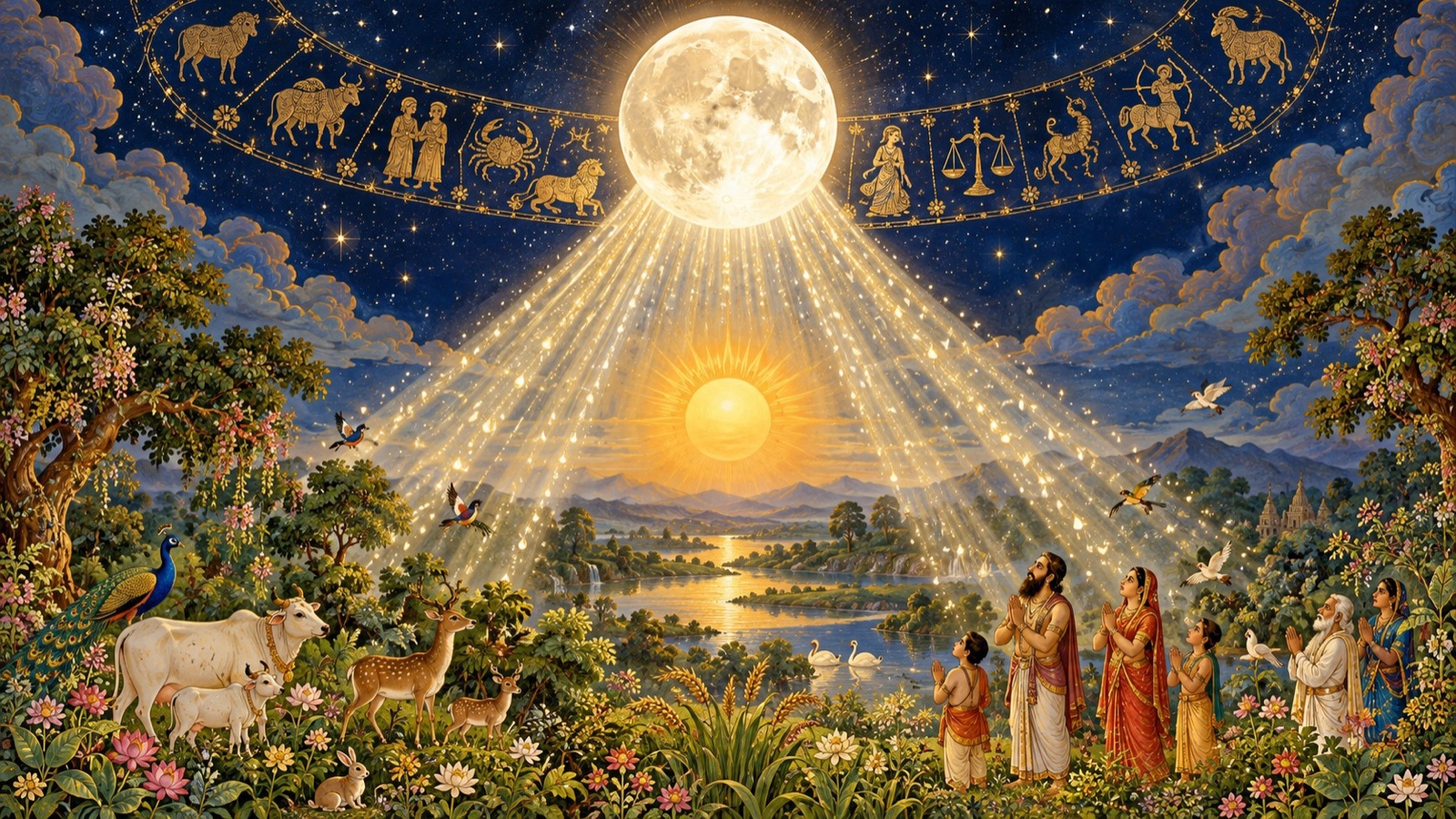
Sri Suka then raised his gaze higher, to the gentle moon. A hundred thousand yojanas above the orb of the sun the moon is seen, and swifter than the sun it goes, leading all the constellations. What the sun accomplishes in a whole year the moon completes in a single month; what the sun covers in a month the moon covers in a little more than two days; and what the sun covers in a fortnight the moon covers in one day.
एवं चन्द्रमा अर्कगभस्तिभ्य उपरिष्टाल्लक्षयोजनत उपलभ्यमानोऽर्कस्य संवत्सरभुक्तिं पक्षाभ्यां मासभुक्तिं सपादर्क्षाभ्यां दिनेनैव पक्षभुक्तिमग्रचारी द्रुततरगमनो भुङ्क्ते ॥ ८ ॥
evaṁ candramā arka-gabhastibhya upariṣṭāl lakṣa-yojanata upalabhyamāno ’rkasya saṁvatsara-bhuktiṁ pakṣābhyāṁ māsa-bhuktiṁ sapādarkṣābhyāṁ dinenaiva pakṣa-bhuktim agracārī drutatara-gamano bhuṅkte.
Meaning: Thus the moon, seen a hundred thousand yojanas above the rays of the sun and moving more swiftly, goes ahead of the sun; the circuit the sun makes in a year it completes in two fortnights, what the sun covers in a month it covers in a little over two days, and what the sun covers in a fortnight it covers in a single day. (Canto 5, Chapter 22, verse 8)
By its waxing splendour in the bright fortnight and its waning in the dark, the moon marks out the day and night of the gods and the ancestors, and, being the very life and sustainer of all the species of living beings, it passes through each constellation in the course of thirty muhurtas. Sri Suka pauses here to unveil something more than a beautiful body of light in the sky: within that gentle radiance dwells the Lord Himself, and each of his many names simply points to one more gift he freely gives — to the mind, to the crops of the field, to every order of creature that draws breath.
य एष षोडशकल: पुरुषो भगवान्मनोमयोऽन्नमयोऽमृतमयो देवपितृमनुष्यभूतपशुपक्षिसरीसृपवीरुधां प्राणाप्यायनशीलत्वात्सर्वमय इति वर्णयन्ति ॥ १० ॥
ya eṣa ṣoḍaśa-kalaḥ puruṣo bhagavān manomayo ’nnamayo ’mṛtamayo deva-pitṛ-manuṣya-bhūta-paśu-pakṣi-sarīsṛpa-vīrudhāṁ prāṇāpy āyana-śīlatvāt sarvamaya iti varṇayanti.
Meaning: This glorious being who appears as the moon, of sixteen digits, is the deity presiding over the mind, the food of all living beings and the embodiment of nectar; being by nature the nourisher of the life of gods and ancestors, human beings and spirits, beasts and birds, reptiles and plants, he is one with all — so the wise declare. (Canto 5, Chapter 22, verse 10)
The Constellations and the Wandering Planets
Higher still, far above the moon’s path, Sri Suka turned the king’s eye to the great ring of stars that measures out the lunar calendar — twenty-eight in number, crowned by Abhijit, each one a fixed point on the Lord’s own wheel rather than a wanderer choosing its way. Mount Meru stays ever on their right as they are carried round by that turning.
तत उपरिष्टाद् द्विलक्षयोजनतो नक्षत्राणि मेरुं दक्षिणेनैव कालायन ईश्वरयोजितानि सहाभिजिताष्टाविंशति: ॥ ११ ॥
tata upariṣṭād dvi-lakṣa-yojanato nakṣatrāṇi meruṁ dakṣiṇenaiva kālāyana īśvara-yojitāni sahābhijitāṣṭā-viṁśatiḥ.
Meaning: High above the moon are the twenty-eight lunar mansions, inclusive of Abhijit, fixed by the Lord to the wheel of Time; having no separate course of their own, they revolve with Mount Meru on their right alone. (Canto 5, Chapter 22, verse 11)
Beyond the constellations, each set high above the one before, Sri Suka named the wandering planets in their order. There is Usana, Venus, moving like the sun in swift, slow and moderate marches — now going before, now following, now keeping pace — almost always the bringer of rain, ever kindly to living beings, and held to soften the influence of those planets that would hold back the showers. Beyond Venus is Budha, Mercury, an offspring of the moon, gentle and beneficent for the most part; yet when it outstrips the sun it forebodes storm and cloud and drought. Beyond Mercury is Angaraka, Mars, which passes through a sign of the zodiac in three fortnights unless it turns retrograde, and which is reckoned an inauspicious planet, often portending trouble. Beyond Mars is the glorious Brhaspati, Jupiter, passing through one sign in a whole year unless retrograde, and generally propitious to the Brahmanas. And beyond Jupiter is Sanaiscara, Saturn, the slow-moving one, who tarries thirty months in each sign and so is mostly a cause of anxiety to all.
The Seven Sages Around the Abode of Vishnu
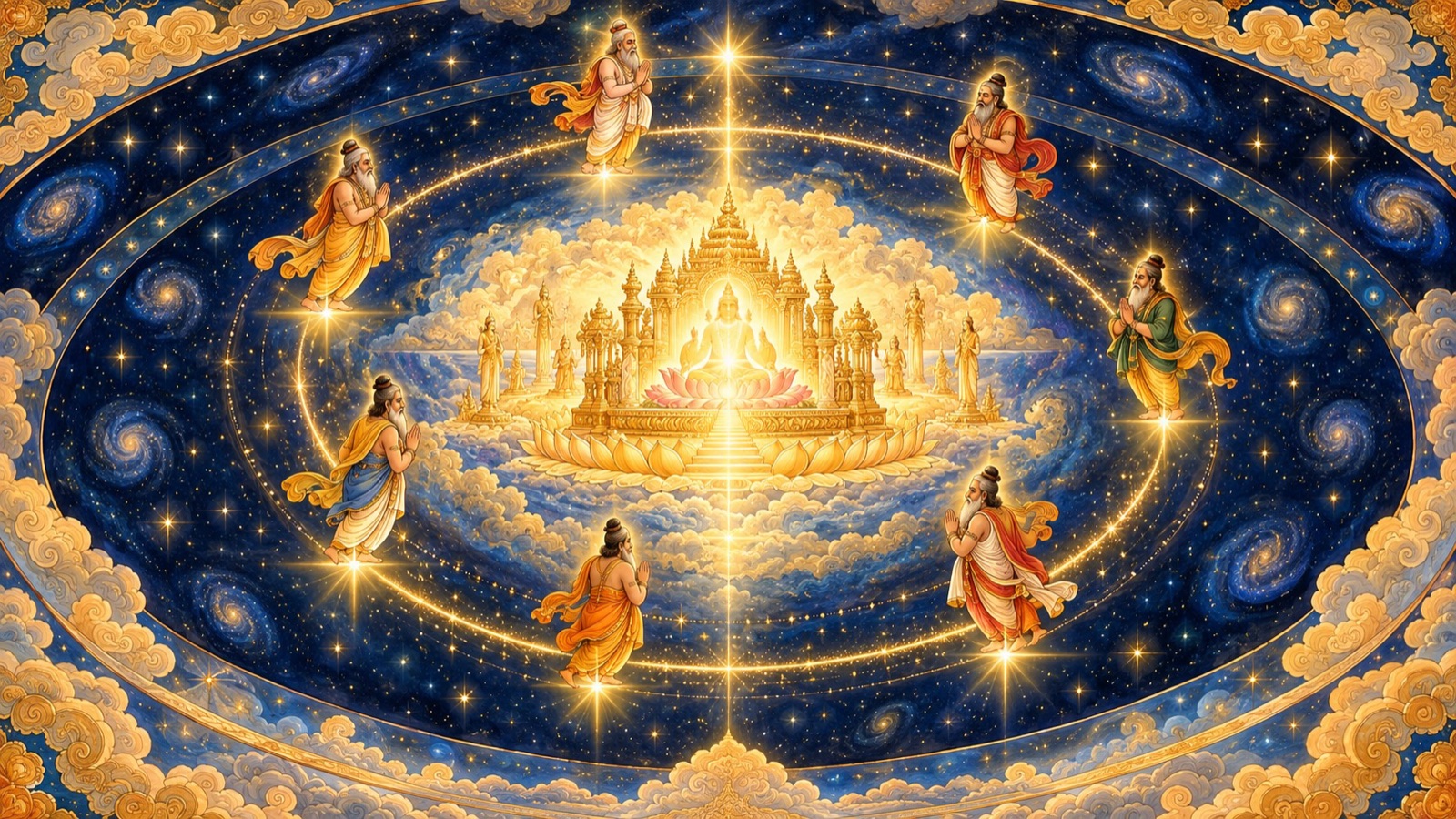
At the summit of this great ascent, far above even Saturn, Sri Suka placed the seven Rsis, the seven bright stars we behold together in the heavens. Ever mindful of every creature’s welfare, they trace their unceasing rounds about the one still point in all the sky, where Lord Vishnu Himself is enthroned as Dhruvaloka, the pole-star that never wavers while everything else turns.
तत उत्तरस्मादृषय एकादशलक्षयोजनान्तर उपलभ्यन्ते य एव लोकानां शमनुभावयन्तो भगवतो विष्णोर्यत्परमं पदं प्रदक्षिणं प्रक्रमन्ति ॥ १७ ॥
tata uttarasmād ṛṣaya ekādaśa-lakṣa-yojanāntara upalabhyante ya eva lokānāṁ śam anubhāvayanto bhagavato viṣṇor yat paramaṁ padaṁ pradakṣiṇaṁ prakramanti.
Meaning: Eleven lakh yojanas above Saturn are seen the seven sages, who, ever contemplating the good of all living beings, move in circumambulation round the supreme abode of Lord Vishnu — the pole-star, Dhruvaloka. (Canto 5, Chapter 22, verse 17)
So the whole shining order of the heavens is shown to us at last as one great act of worship — the sages themselves forever circling the Lord’s own abode, and drawing all the wheeling lights below them into that same silent reverence.
Principal Teachings of This Chapter
All time is the Lord’s own body. The turning of the year, the twelve months, the six seasons — these are not empty measures but the very form of Lord Narayana, divided for the welfare of every soul. To watch the seasons turn is to behold the Lord quietly at work.
What seems and what is are not always the same. The sun appears to move one way and truly moves another; the potter’s wheel bears its ants round even as they crawl their own path. Sri Suka teaches us to look past appearances to the deeper order held by the Lord.
The moon is a stream of the Lord’s nectar. The soft light that ripens the plants, sustains the ancestors and gladdens every creature is shown to be the embodiment of nectar, one with all life. The mercy of God reaches even the smallest green growing thing.
Every light keeps its appointed place. From the swift moon to slow Saturn, each planet moves in the measure set for it, fixed by the Lord to the wheel of Time. There is order and care in the heavens, and nothing wanders at random.
All creation circles the abode of the Lord. The seven sages forever go round Dhruvaloka, the supreme seat of Vishnu, contemplating the good of all. The highest wisdom, the scripture shows, is unending circumambulation of the Lord.
A Devotional Reflection
There is a rare and tender peace in this chapter. We are so used to thinking of the night sky as vast and cold and indifferent, but Sri Suka lifts our eyes and shows us something wholly different — a sky that is warm with the presence of God. The sun that measures our days, the moon that pours its nectar over field and forest, the planets moving in their patient rounds, the sages circling the still pole-star in ceaseless worship — all of it is one living order, held and turned by the Lord who is the soul of all. Nothing is left out of His care; the moon nourishes not only the gods but the beasts and the birds and the humble plants. When we learn to see the heavens this way, our own small round of days is transfigured too. The turning of our seasons, the passing of our years, the ordinary sunrise — these become the touch of the same hand that steadies the pole-star. To live within such an order is not to be a speck lost in emptiness, but a child held within a Father’s house, where even the stars keep their vigil of praise. We have only to join them, turning our own hearts, as they turn, toward the Lord.
A Daily Devotional Practice
Today, step outside at dawn or under the night sky and simply look up for a few quiet moments. As you behold the sun, the moon or the stars, remember Sri Suka’s teaching — that each of them turns at the bidding of the Lord, who is the soul of all, and that the very time in which you live is His own body given for your welfare. Then, seeing the seven sages of the wise forever circling the Lord’s abode, let your own heart make one small circumambulation of Him, saying inwardly: “Om Namo Bhagavate Vasudevaya.” In this way, an ordinary glance at the sky becomes a moment of worship, and the whole turning heaven becomes your teacher in devotion.
Conclusion
The twenty-second discourse of Book Five turns the whole sky into a hymn of praise. Answering King Parikshit’s wondering question about the sun’s seeming and its true motion, Sri Suka unfolds the great order of the heavens: the Lord Narayana Himself dividing His body into the months and seasons for the welfare of all; the moon, swifter than the sun, marking the days of gods and ancestors and pouring out its nectar upon every living thing; the constellations fixed to the wheel of Time; the planets Venus, Mercury, Mars, Jupiter and Saturn each keeping their appointed round; and, at the summit, the seven sages circling the supreme abode of Lord Vishnu in unending worship. What might have been a mere account of the stellar sphere becomes, in the sage’s telling, a revelation of the Lord’s tender ordering of time and space for the good of every soul. To hear it is to look upward with new eyes and to know ourselves held within a creation that is, from its smallest plant to its highest star, one great act of devotion.
May the divine wisdom of Srimad Bhagavatam awaken pure devotion within our hearts.
Om Namo Bhagavate Vasudevaya.
Jay Shree Madhav.
References and Attribution
- Primary edition: Gita Press, Śrīmad Bhāgavata Mahāpurāṇa, Book Five, Discourse 22, “The relative position of the planets and their movements.”
- Series: Srimad Bhagavatam Wisdom · Biswa Sanatan Dharma Seva Trust.
- Presented following the spiritual guidance and recommendation of Pandit Dr. Shri Kashinath Mishra.
This is an original, faithful retelling in the writer’s own words, with brief quoted verses shown in Devanāgarī and transliteration and their meanings given as summaries. It is not a reproduction of any single publisher’s continuous translation or commentary. No affiliation with or endorsement by any publisher is implied.
Jay Shree Madhav