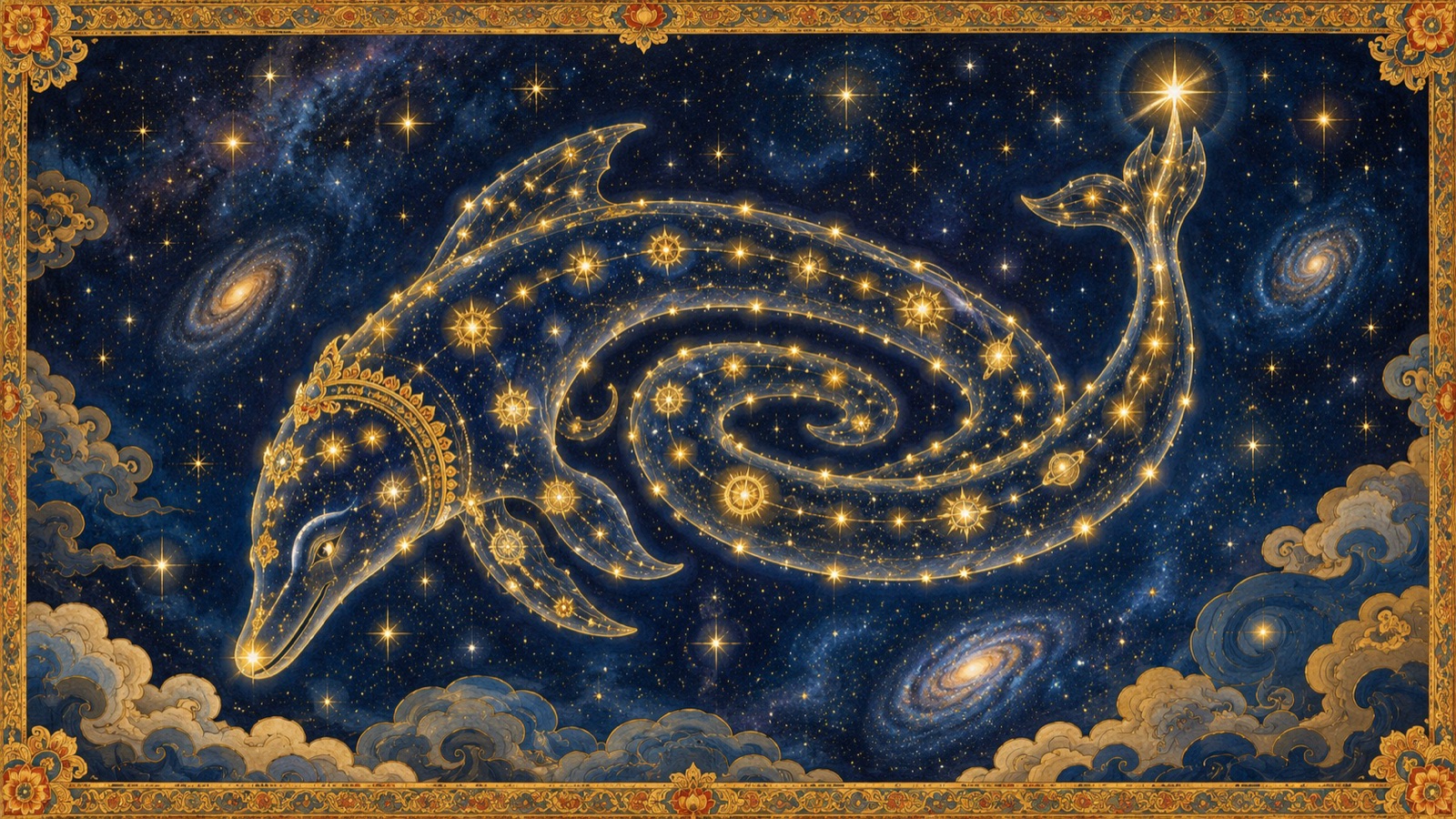
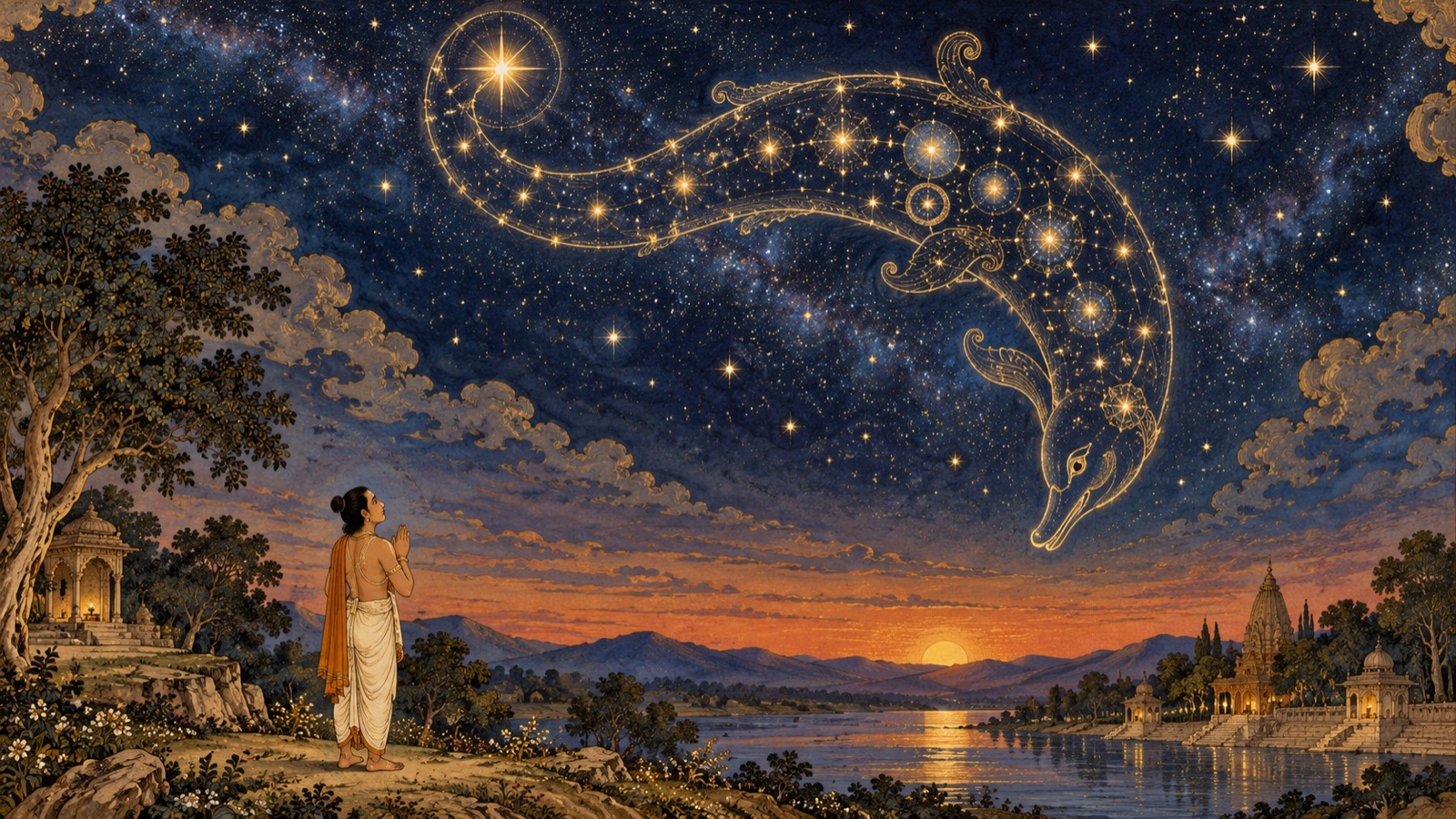
High in the midnight sky the whole host of stars is beheld in meditation as the Sisumara — the coiled, dolphin-like form of Lord Vasudeva — with the great devotee Dhruva shining at the tip of its tail and the gods and planets set upon its every limb.
Om Namo Bhagavate Vasudevaya.
Om Namo Bhagavate Vasudevaya.
Om Namo Bhagavate Vasudevaya.
Welcome back to Srimad Bhagavatam Wisdom, a devotional journey through the sacred histories and teachings of the Srimad Bhagavat Mahapurana. Lifting our eyes now to the highest reaches of the sky, Sri Suka shows us a wonder that turns the whole starry night into worship. Far above the seven seers shines the pole-star, the steadfast Dhruva, fixed by the Lord like a post around which the entire wheel of the heavens turns. And the devotees of old, gazing upward in deep meditation, beheld all those countless luminaries gathered into a single living shape — the Sisumara, the dolphin-like form of Lord Vasudeva Himself, coiled across the sky with the gods and planets resting upon its limbs. This radiant chapter teaches us to look up at the evening stars and see there not cold and distant fires, but the very body of the Lord, and to greet that form each dusk with a simple, cleansing prayer.
Chapter Information
- Scripture: Śrīmad Bhāgavata Mahāpurāṇa
- Canto: 5 (Book Five)
- Chapter: 23 (Discourse 23)
- Chapter title: The Sisumara, the Lord’s Form in the Heavens
- Principal speaker: Sukadeva Gosvami (Sri Suka), narrating to King Parikshit
- Principal listener: King Parikshit — the discourse related in turn by Suta Gosvami to the sages gathered at Naimisaranya
- Main setting: The highest reaches of the starry heavens, at the pole-star far above the Great Bear, and the whole revolving sphere of the luminaries
- Central subject: How the great devotee Dhruva shines as the fixed pole of the heavens, around whom all the planets and stars revolve like oxen about a threshing post; how the entire starry host is beheld in meditation as the Sisumara, the dolphin-like form of Lord Vasudeva, with the gods and planets placed upon its limbs; and the evening prayer offered to that sacred form
- Principal verse range: Canto 5, Chapter 23, verses 1–9
- Primary edition: Gita Press Śrīmad Bhāgavata Mahāpurāṇa
From the Previous Chapter
In the twenty-second discourse, Sri Suka described the ordered movement of the sun through the belt of the zodiac, dividing the seasons and measuring out our days; the moon as a vessel of the Lord’s own nectar, from which the gods, the ancestors and all growing things are nourished in their season; and the great orbits of the planets and stars, each moving in its appointed sphere. This chapter now lifts our gaze higher still — to the fixed pole around which that whole moving heaven turns, and to the divine form in which the wise behold it.
Dhruva, the Fixed Pole of the Heavens
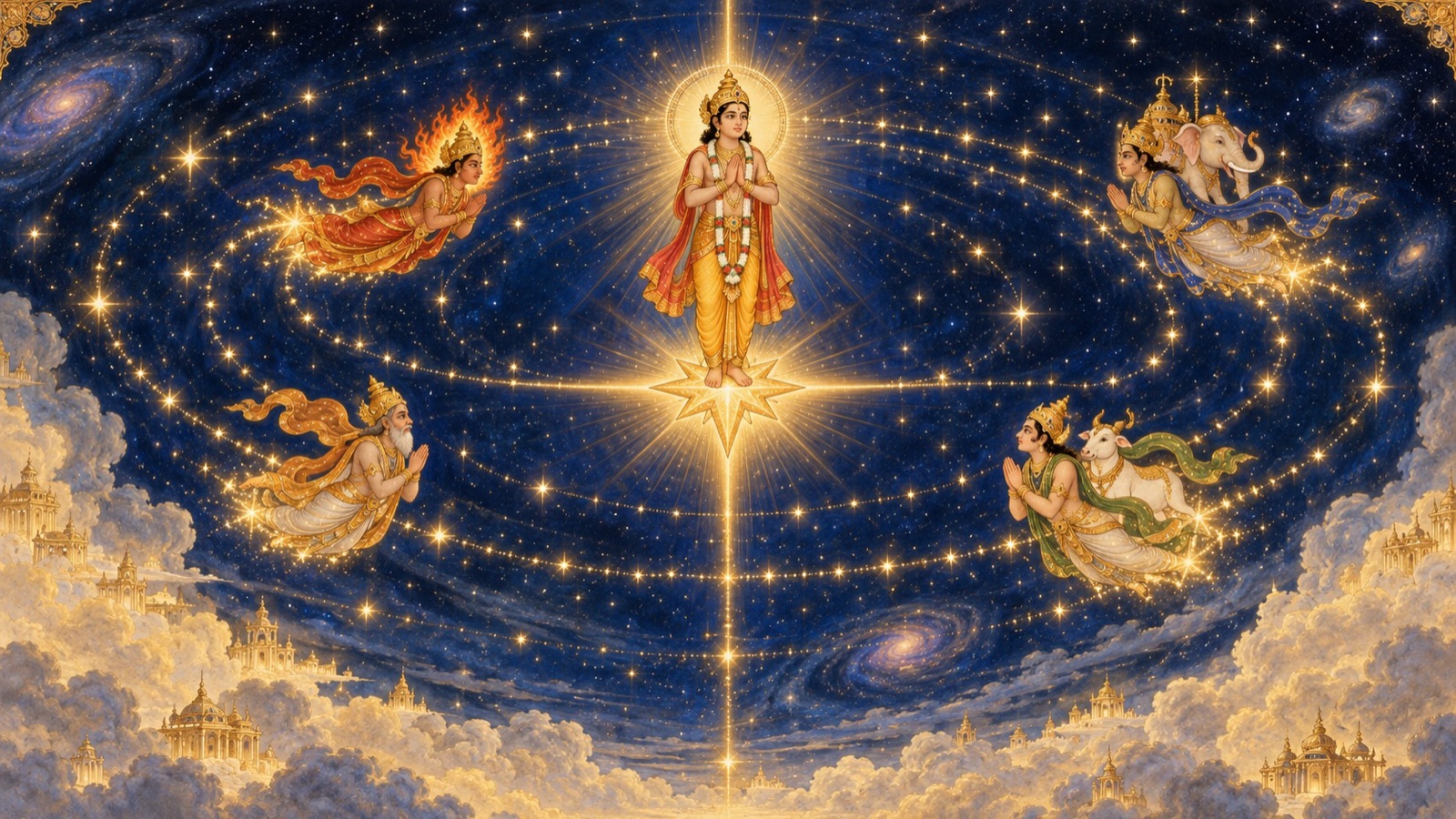
Far above the shining seven seers, Sri Suka tells us, at a great height beyond them, lies what the knowers of truth call the supreme abode of Lord Vishnu. There abides the great devotee Dhruva, the son of Uttanapada — that same steadfast child whose story the Bhagavatam has already sung in the Fourth Book, who by his unwavering devotion won an eternal, unshakable seat. Even now he is honored without ceasing: Agni the god of fire, Indra the chief of the gods, Kasyapa the lord of created beings, and Dharma the god of virtue all circle him reverently, keeping him ever to their right, moving together as stars around his fixed light. And he is the very mainstay of all the beings who endure even to the hour of dissolution.
श्रीशुक उवाच अथ तस्मात्परतस्त्रयोदशलक्षयोजनान्तरतो यत्तद्विष्णो: परमं पदमभिवदन्ति यत्र ह महाभागवतो ध्रुव औत्तानपादिरग्निनेन्द्रेण प्रजापतिना कश्यपेन धर्मेण च समकालयुग्भि: सबहुमानं दक्षिणत: क्रियमाण इदानीमपि कल्पजीविनामाजीव्य उपास्ते तस्येहानुभाव उपवर्णित: ॥ १ ॥
śrī-śuka uvāca atha tasmāt paratas trayodaśa-lakṣa-yojanāntarato yat tad viṣṇoḥ paramaṁ padam abhivadanti yatra ha mahā-bhāgavato dhruva auttānapādir agninendreṇa prajāpatinā kaśyapena dharmeṇa ca samakāla-yugbhiḥ sabahu-mānaṁ dakṣiṇataḥ kriyamāṇa idānīm api kalpa-jīvinām ājīvya upāste tasyehānubhāva upavarṇitaḥ
Meaning: Sri Suka continued: Far beyond the seven seers lies what the wise call the supreme abode of Lord Vishnu, where the great devotee Dhruva, son of Uttanapada, abides. Even now he is reverently circumambulated, kept ever to the right, by Agni, Indra, Kasyapa the lord of creatures, and Dharma, all moving together as stars; and he is the resort of all beings who live even until the dissolution of the worlds. His glory has already been told in an earlier book. (Canto 5, Chapter 23, verse 1)
Fixed there by the will of God like a firm post, Dhruva shines on eternally, holding together all the great multitudes of luminaries — the planets and the lunar mansions alike — that the all-powerful, ever-wakeful Time keeps turning with a speed beyond our understanding. Sri Suka states this plainly: Dhruva’s world stands as the changeless post around which the never-sleeping, invisible motion of Time drives every planet and star, set there by the ordaining will of the Lord Himself.
स हि सर्वेषां ज्योतिर्गणानां ग्रहनक्षत्रादीनामनिमिषेणाव्यक्तरंहसा भगवता कालेन भ्राम्यमाणानां स्थाणुरिवावष्टम्भ ईश्वरेण विहित: शश्वदवभासते ॥ २ ॥
sa hi sarveṣāṁ jyotir-gaṇānāṁ graha-nakṣatrādīnām animiṣeṇāvyakta-raṁhasā bhagavatā kālena bhrāmyamāṇānāṁ sthāṇur ivāvaṣṭambha īśvareṇa vihitaḥ śaśvad avabhāsate
Meaning: He, Dhruva, shines forever as the fixed support around which all the luminaries — the planets, the stars and the rest — are made to revolve by the unsleeping, invisible motion of Time, who is the Supreme Lord Himself; so has the Lord ordained it. (Canto 5, Chapter 23, verse 2)
Here Sri Suka quietly gives the reason this whole heaven of moving lights holds together: not chance, and not some blind law working by itself, but the ordaining will of the Lord, extended to Dhruva out of pure love for his devotion. Because Dhruva’s love was unwavering even as a small, wounded child, the Lord set the mightiest wheel of the universe — the very passage of Time that drives every star and planet — to turn around Dhruva’s fixed seat, honoring him above the great regents of fire, virtue and creation who now circle him. This vision is also a quiet answer to any who would explain the wheeling heavens as mere impersonal law: what moves the stars is the personal love and ordaining will of the Supreme Lord, who delights in exalting one who has surrendered wholly to Him. (verses 2–3)
The Turning Wheel of the Stars
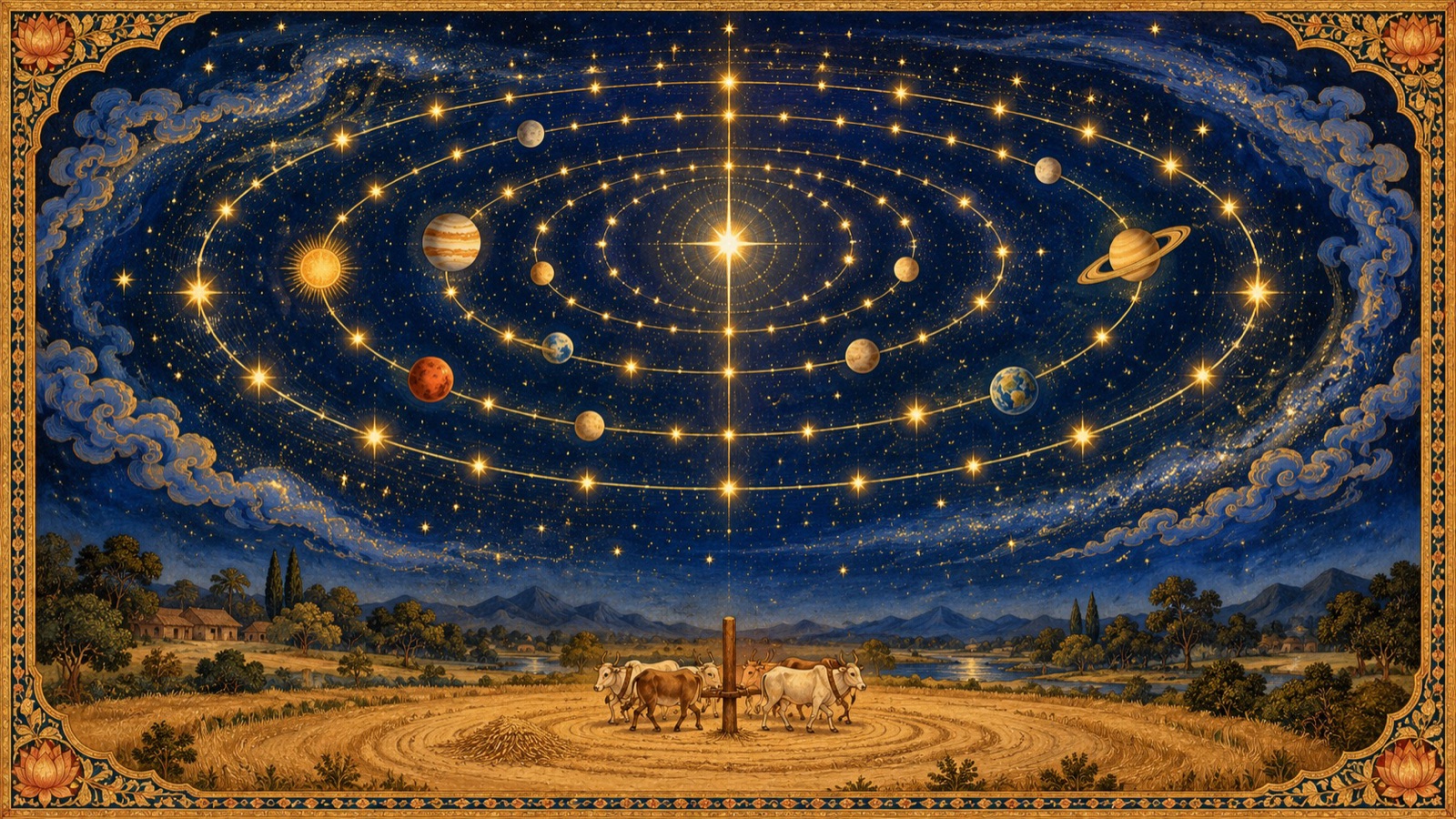
To help us picture this wonder, Sri Suka gives us a homely image drawn from the village threshing-floor. Just as oxen yoked to a post in the center tread the grain, walking round and round in their several rings — some nearer the post, some farther out — so all the hosts of luminaries, the planets and stars, are bound to the great wheel of Time. Driven along by the cosmic wind and holding to the pole-star as their pivot, they circle round and round until the very end of the age, each keeping to its own appointed course. And lest we wonder how such vast lights hang in the empty sky without falling, he gives a second gentle image: as clouds and birds such as the hawk float and move through the air, upheld by the wind and by their own destiny, so these shining hosts, brought into being by the union of matter and spirit and moving according to the fruit of their past deeds, never fall to the ground.
यथा मेढीस्तम्भ आक्रमणपशव: संयोजितास्त्रिभिस्त्रिभि: सवनैर्यथास्थानं मण्डलानि चरन्त्येवं भगणा ग्रहादय एतस्मिन्नन्तर्बहिर्योगेन कालचक्र आयोजिता ध्रुवमेवावलम्ब्य वायुनोदीर्यमाणा आकल्पान्तं परिचङ्क्रमन्ति नभसि यथा मेघा: श्येनादयो वायुवशा: कर्मसारथय: परिवर्तन्ते एवं ज्योतिर्गणा: प्रकृतिपुरुषसंयोगानुगृहीता: कर्मनिर्मितगतयो भुवि न पतन्ति ॥ ३ ॥
yathā meḍhīstambha ākramaṇa-paśavaḥ saṁyojitās tribhis tribhiḥ savanair yathā-sthānaṁ maṇḍalāni caranty evaṁ bhagaṇā grahādaya etasminn antar-bahir-yogena kāla-cakra āyojitā dhruvam evāvalambya vāyunodīryamāṇā ākalpāntaṁ paricaṅ kramanti nabhasi yathā meghāḥ śyenādayo vāyu-vaśāḥ karma-sārathayaḥ parivartante evaṁ jyotirgaṇāḥ prakṛti-puruṣa-saṁyogānugṛhītāḥ karma-nirmita-gatayo bhuvi na patanti
Meaning: As oxen tied to a central post tread the threshing-floor, walking in their several circles, some in the inner ring and some in the outer, so the hosts of luminaries — the planets and the stars — fastened to the wheel of Time and driven onward by the wind, revolve round the pole-star as their pivot until the end of the age, each in its own course. And as clouds and birds such as the hawk move about the sky, upheld by the air, so these luminaries, born of the union of matter and spirit and moving by the fruit of their past actions, do not fall to the ground. (Canto 5, Chapter 23, verse 3)
The Sisumara: The Lord’s Form in the Sky
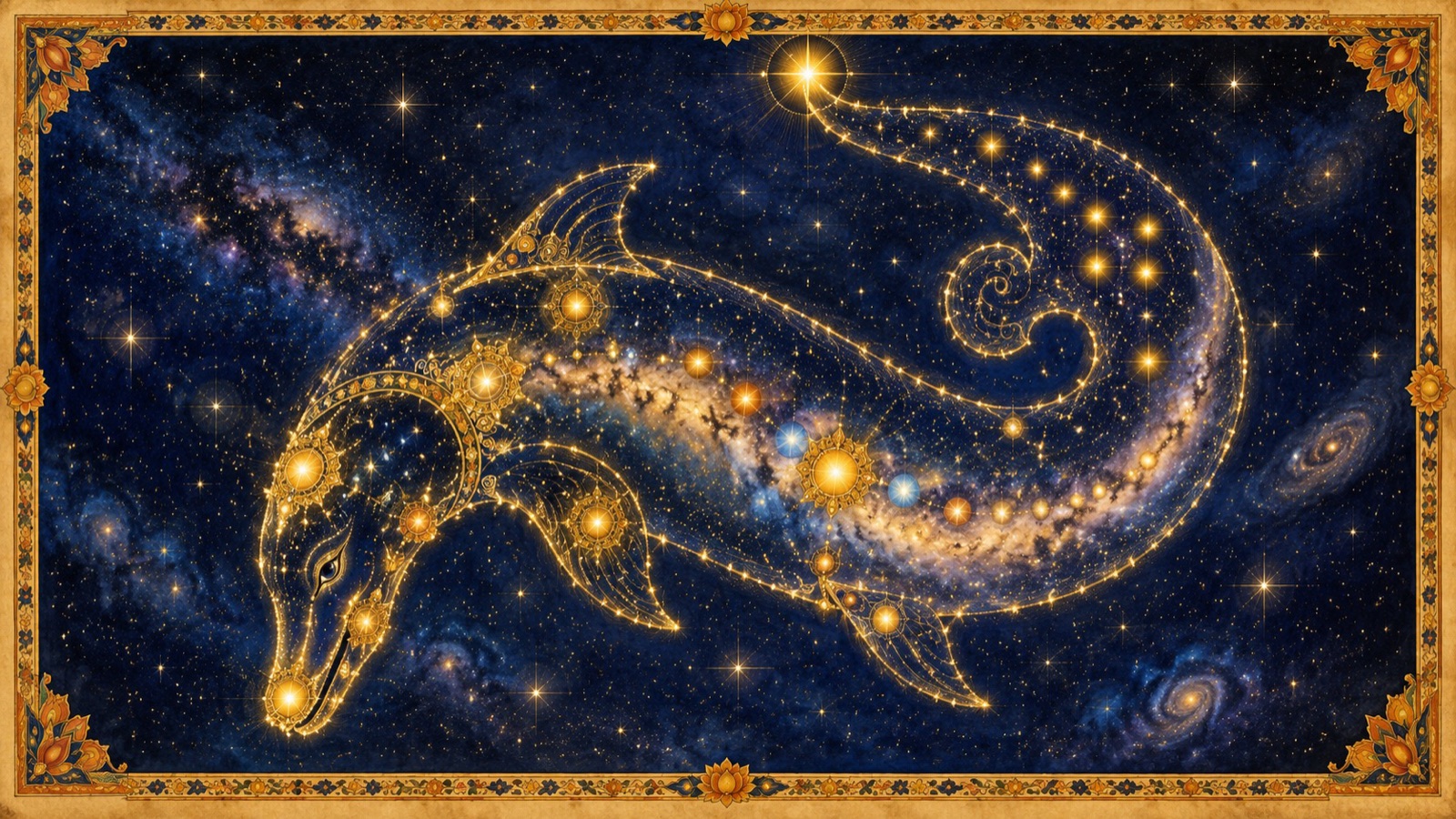
Now Sri Suka reveals the heart of this chapter — a way of seeing that transforms the whole night sky into an object of loving worship. There are seers, he tells us, who for the sake of deep meditation describe this entire host of luminaries as the very form of Lord Vasudeva, shaped in the sky like a great dolphin, the Sisumara.
केचनैतज्ज्योतिरनीकं शिशुमारसंस्थानेन भगवतो वासुदेवस्य योगधारणायामनुवर्णयन्ति ॥ ४ ॥
kecanaitaj jyotir-anīkaṁ śiśumāra-saṁsthānena bhagavato vāsudevasya yoga-dhāraṇāyām anuvarṇayanti
Meaning: Some describe this whole host of luminaries, for the sake of steady meditation, as the very form of Lord Vasudeva, existing in the sky in the shape of a dolphin. (Canto 5, Chapter 23, verse 4)
With tender care Sri Suka then traces that vast, coiled body limb by limb, so that the meditating heart may hold it whole. The dolphin lies with its head bent downward and its body curled in rings. At the very tip of its tail shines Dhruva himself; along the tail, one after another, are set Prajapati, Agni, Indra and Dharma; at the root of the tail, Dhata and Vidhata; and at the hip, the seven seers of the Great Bear. Along the right side of the coiled body lie the constellations of the northern course, and along the left side those of the southern course, the two sides evenly matched. Upon its back rests the group of stars called Ajaviithi, and along its belly flows the shining band of the Milky Way, the celestial Ganga.
Limb by limb the placing continues, until not a part of that great form is left unhallowed. Punarvasu and Pushya rest at the loins, Ardra and Aslesha at the hind legs, Abhijit and Uttarashadha at the nostrils, Sravana and Purvashadha at the eyes, Dhanishtha and Mula at the ears; the constellations from Magha onward lie along the ribs of one side and those from Mrgashirsha onward along the ribs of the other, with Satabhisha and Jyeshtha set upon the shoulders. And upon the head, the face and the very organs of that divine dolphin the great lights are enthroned.
उत्तराहनावगस्तिरधराहनौ यमो मुखेषु चाङ्गारक: शनैश्चर उपस्थे बृहस्पति: ककुदि वक्षस्यादित्यो हृदये नारायणो मनसि चन्द्रो नाभ्यामुशना स्तनयोरश्विनौ बुध: प्राणापानयो राहुर्गले केतव: सर्वाङ्गेषु रोमसु सर्वे तारागणा: ॥ ७ ॥
uttarā-hanāv agastir adharā-hanau yamo mukheṣu cāṅgārakaḥ śanaiścara upasthe bṛhaspatiḥ kakudi vakṣasy ādityo hṛdaye nārāyaṇo manasi candro nābhyām uśanā stanayor aśvinau budhaḥ prāṇāpānayo rāhur gale ketavaḥ sarvāṅgeṣu romasu sarve tārā-gaṇāḥ
Meaning: Upon this form, the sage Agastya is set at the upper jaw and Yama at the lower jaw; Mars is its mouth, Saturn its organ of generation, Jupiter its hump, the Sun its chest; Narayana abides at its heart, the Moon in its mind, and Venus at its navel; the two Asvinis rest at its breasts, Mercury in its incoming and outgoing breaths, Rahu at its neck, the comets over all its body, and all the remaining hosts of stars in its hairs. (Canto 5, Chapter 23, verse 7)
The Evening Prayer to the Lord of Time
Having unfolded this shining form for us, Sri Suka tells us what to do with such a vision — not merely to admire it, but to worship. Every evening, at the sacred twilight when day gives way to night, one who is self-controlled and silent should turn his eyes toward this all-encompassing shape of Lord Vishnu, built of every god and luminary, and wait upon it with a devoted, concentrated heart, offering this prayer within.
एतदु हैव भगवतो विष्णो: सर्वदेवतामयं रूपमहरह: सन्ध्यायां प्रयतो वाग्यतो निरीक्षमाण उपतिष्ठेत नमो ज्योतिर्लोकाय कालायनायानिमिषां पतये महापुरुषायाभिधीमहीति ॥ ८ ॥
etad u haiva bhagavato viṣṇoḥ sarva-devatāmayaṁ rūpam aharahaḥ sandhyāyāṁ prayato vāgyato nirīkṣamāṇa upatiṣṭheta namo jyotir-lokāya kālāyanāyānimiṣāṁ pataye mahā-puruṣāyābhidhīmahīti
Meaning: Fixing one’s gaze upon this very form of Lord Vishnu, which is made of all the gods, one should worship it every evening at twilight, self-controlled and silent, waiting upon it with this prayer: “Obeisance to the abode of light, to Him who is the very course of Time, the Lord of all the gods — upon Him we meditate.” (Canto 5, Chapter 23, verse 8)
And Sri Suka does not leave us wondering what such worship brings. This same shape of the Lord, built from every planet, star and lunar mansion, cleanses the sins of those who offer this prayer with faith at the three junctions of each day. Indeed, for one who bows to this form, or even calls it to mind three times a day, the very sin newly committed is dissolved at once.
ग्रहर्क्षतारामयमाधिदैविकं पापापहं मन्त्रकृतां त्रिकालम् । नमस्यत: स्मरतो वा त्रिकालं नश्येत तत्कालजमाशु पापम् ॥ ९ ॥
graharkṣatārāmayam ādhidaivikaṁ pāpāpahaṁ mantra-kṛtāṁ tri-kālam namasyataḥ smarato vā tri-kālaṁ naśyeta tat-kālajam āśu pāpam
Meaning: This presiding form of the Lord, composed of the planets, the lunar mansions and the stars, destroys the sins of those who recite this prayer at the three junctions of the day; and for one who bows to it or even remembers it three times, the sin of that very hour is swiftly destroyed. (Canto 5, Chapter 23, verse 9)
Principal Teachings of This Chapter
The whole heaven is the Lord’s own form. The deepest gift of this chapter is a way of seeing. The night sky is not a scattering of distant fires but a single living shape — the Sisumara, the form of Lord Vasudeva, with every star and planet resting upon His limbs. To look up in this way is to remember that there is nowhere the Lord is not, and nothing that is not held within Him.
Steadfast devotion wins an unshakable place. Dhruva shines at the summit of the sky, fixed by God like a post, the still center around which all the moving worlds turn. His constancy in devotion, told in an earlier book, has become the very image of what unwavering love of the Lord attains — a peace that even the dissolution of the worlds cannot disturb.
All motion rests upon the Lord. Like oxen bound to a central post, like clouds and birds upheld by the air, the vast luminaries move and yet do not fall, held in their courses by the power of Time, which is the Lord Himself. Nothing wanders on its own; everything is upheld, guided and sustained by Him.
Worship can be as near as the evening sky. We are given no elaborate rite here, but a simple, tender practice: at dusk, grow quiet, look up, and offer a short prayer to the Lord who is the course of Time. Devotion asks only a stilled tongue, a fixed gaze and a loving heart.
Remembrance cleanses the heart. The prayer to this form is said to wash away sin for those who offer it at the junctions of the day, and even a moment’s bowing or remembrance dissolves the fault of the hour. The turning to the Lord, however brief, is never without grace.
A Devotional Reflection
There is a rare sweetness in this chapter, for it takes the very thing that can make us feel small and lost — the immense, silent sky — and turns it into an intimate meeting with the Lord. We have all stood beneath the stars and felt how vast and far they are, how tiny our own lives against them. Sri Suka gently overturns that feeling. Those distant lights, he tells us, are not strangers; they are the limbs of the Lord’s own body, and at their steadfast center shines a devotee who was once a small, grieving child and is now the fixed pole of the heavens. What tenderness there is in that — that constancy in love should be honored so highly that the whole sky is made to circle round it. And what tenderness, too, in the practice the chapter leaves us: no long austerity, only to pause at evening, lift our eyes, and greet the Lord who holds all those turning worlds. When we begin to see the heavens this way, the night itself becomes a temple. The wheeling stars become a silent worship in which we are invited to join, and even our smallest evening prayer takes its place among the movements of the whole creation, all of it turning, in love, around the Lord.
A Daily Devotional Practice
Tonight, when the sky darkens and the first stars appear, step outside for a moment and follow the practice this chapter gives us. Grow quiet, still your tongue, and lift your gaze to the evening heavens, remembering that all those lights are held within the Lord’s own form. Then, with a concentrated and loving heart, offer this prayer as the seers of old have offered it: “Obeisance to the abode of light, to Him who is the very course of Time, the Lord of all the gods — upon Him we meditate.” And add the name that is dearest of all: “Om Namo Bhagavate Vasudevaya.” Done faithfully at dusk, even for a minute, this small act draws the heart upward, out of its narrow cares and into the vast, quiet worship that the whole sky is already offering.
Conclusion
The twenty-third discourse of Book Five lifts our eyes to the highest heavens and teaches us to see them with the eyes of devotion. Far above the seven seers, the steadfast Dhruva shines as the fixed pole of the sky, honored by the gods and holding all the luminaries in their courses, fixed by the Lord like a firm post. Around him the countless orbs and luminaries wheel as oxen tread a threshing floor, borne like clouds and birds upon the air, never falling, ever driven by the power of Time. And the wise, gazing upward in meditation, behold that whole starry host as one living form — the Sisumara, the dolphin-shape of Lord Vasudeva, with Dhruva at its tail, the seven seers at its hip, and the gods and planets enthroned upon its every limb. To this form we are taught to bow each evening with a simple, cleansing prayer to the Lord who is the very course of Time. It is a chapter that gives back to us the wonder of the night sky, transformed into worship, and reminds us that the Lord is not only within the heart but arrayed in glory across the whole of heaven.
May the divine wisdom of Srimad Bhagavatam awaken pure devotion within our hearts.
Om Namo Bhagavate Vasudevaya.
Jay Shree Madhav.
References and Attribution
- Primary edition: Gita Press, Śrīmad Bhāgavata Mahāpurāṇa, Book Five, Discourse 23.
- Series: Srimad Bhagavatam Wisdom · Biswa Sanatan Dharma Seva Trust.
- Presented following the spiritual guidance and recommendation of Pandit Dr. Shri Kashinath Mishra.
This is an original, faithful retelling in the writer’s own words, with brief quoted verses shown in Devanāgarī and transliteration and their meanings given as summaries. It is not a reproduction of any single publisher’s continuous translation or commentary. No affiliation with or endorsement by any publisher is implied.
Jay Shree Madhav