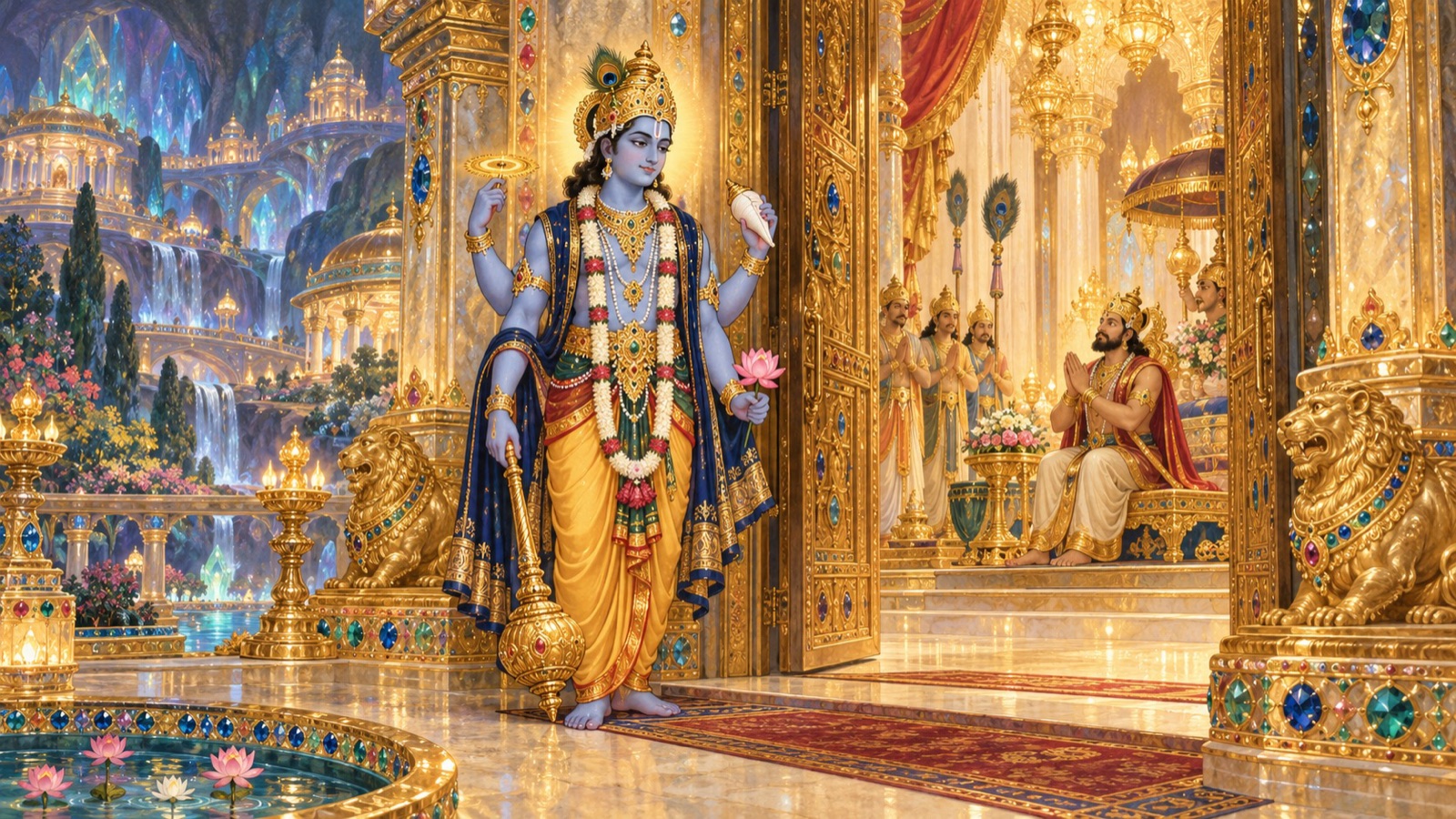
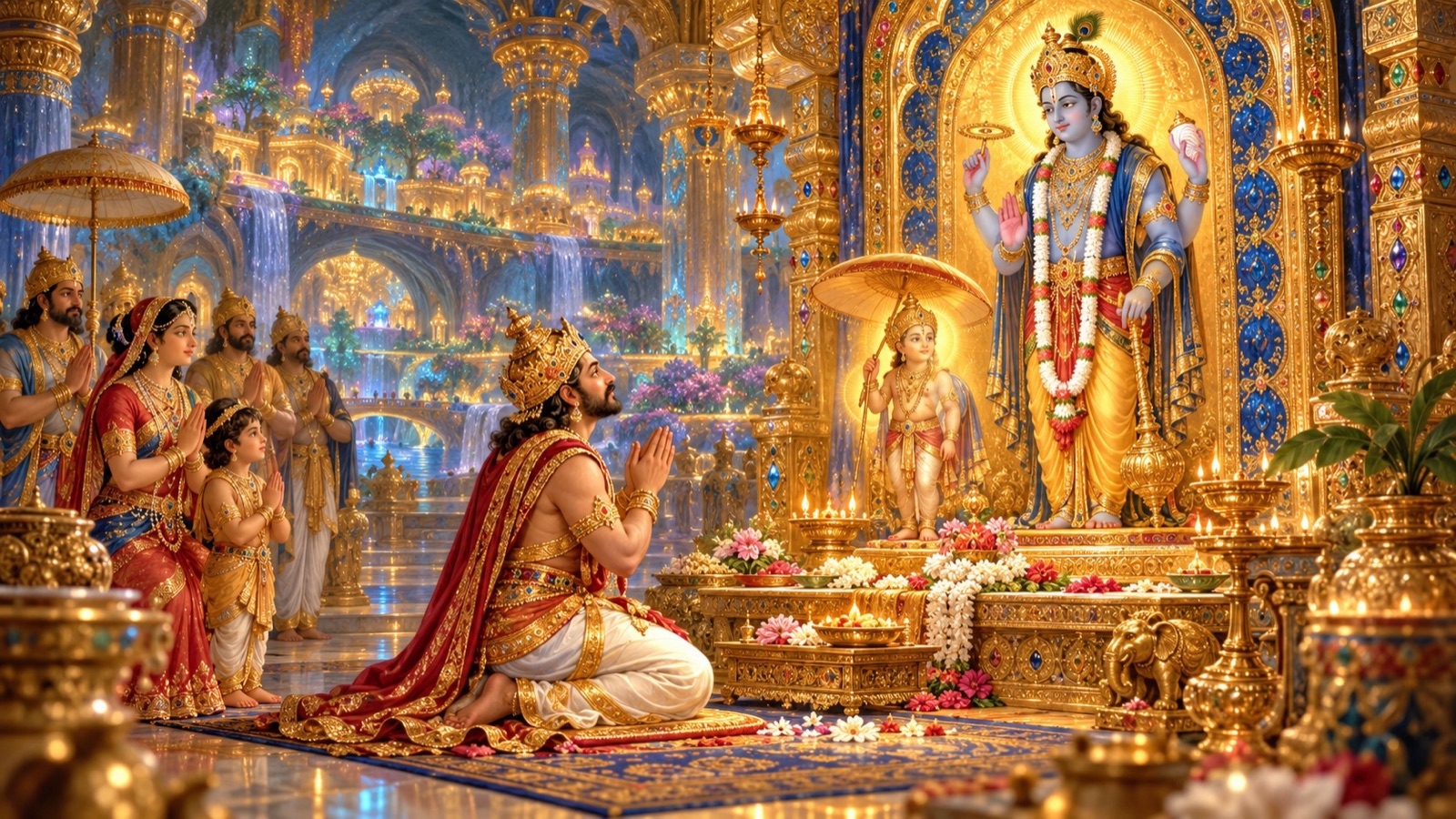
In the luminous realm of Sutala, the great devotee King Bali dwells in peace — for the Supreme Lord Narayana Himself, mace in hand, stands as guardian at his door, His heart full of tenderness for the one who gave Him everything.
Om Namo Bhagavate Vasudevaya.
Om Namo Bhagavate Vasudevaya.
Om Namo Bhagavate Vasudevaya.
Welcome back to Srimad Bhagavatam Wisdom, a devotional journey through the sacred histories and teachings of the Srimad Bhagavat Mahapurana. In this twenty-fourth chapter of Book Five, Sri Sukadeva Gosvami leads King Parikshit downward through the wonders of creation — first to the shadow-planet Rahu, held at bay by the whirling disc of the Lord, and then, region by region, into the seven subterranean worlds beneath the earth. These are not places of gloom, but realms of jewelled palaces and gardens sweeter than heaven’s own — and at their heart dwells the great devotee King Bali, whom the Lord loves so dearly that He keeps watch at his very gate. Let us descend gently, in wonder, and behold His mercy in every world He has made.
Chapter Information
- Scripture: Śrīmad Bhāgavata Mahāpurāṇa
- Canto: 5 (Book Five)
- Chapter: 24 (Discourse 24)
- Chapter title: Rahu and the Heavenlike Subterranean Realms
- Principal speaker: Sukadeva Gosvami (Sri Suka), narrating to King Parikshit
- Principal listener: King Parikshit — the discourse related in turn by Suta Gosvami to the sages gathered at Naimisaranya
- Main setting: The regions below the sun — the planet Rahu, the aerial realms, and the seven subterranean worlds beneath the earth
- Central subject: The position of Rahu and the Lord’s guarding discus, and the seven luminous subterranean regions with their rulers — chief among them the devotee King Bali in Sutala, at whose door the Lord Himself stands guard
- Principal verse range: Canto 5, Chapter 24, verses 1–31
- Primary edition: Gita Press Śrīmad Bhāgavata Mahāpurāṇa
From the Previous Chapter
In the twenty-third discourse, Sri Suka described the pole-star Dhruva, around whom the whole company of the heavens is made to turn, and the vast Sisumara — the dolphin-like form of the Lord traced among the stars, upon which the wise meditate — with the evening prayer by which the devout take shelter in the Lord who upholds the wheeling of the worlds. From those shining heights the narration now turns downward, to the realms below the sun.
Rahu Below the Sun and the Guarding Disc
Sri Suka related that those versed in the Puranas declare that ten thousand yojanas below the sun moves the planet Rahu, coursing like a lunar mansion. Its presiding deity was by birth a lowly demon, born of Simhika; yet by the Lord’s grace he attained immortality and the rank of a planet, though unworthy of it — a quiet marvel of His mercy.
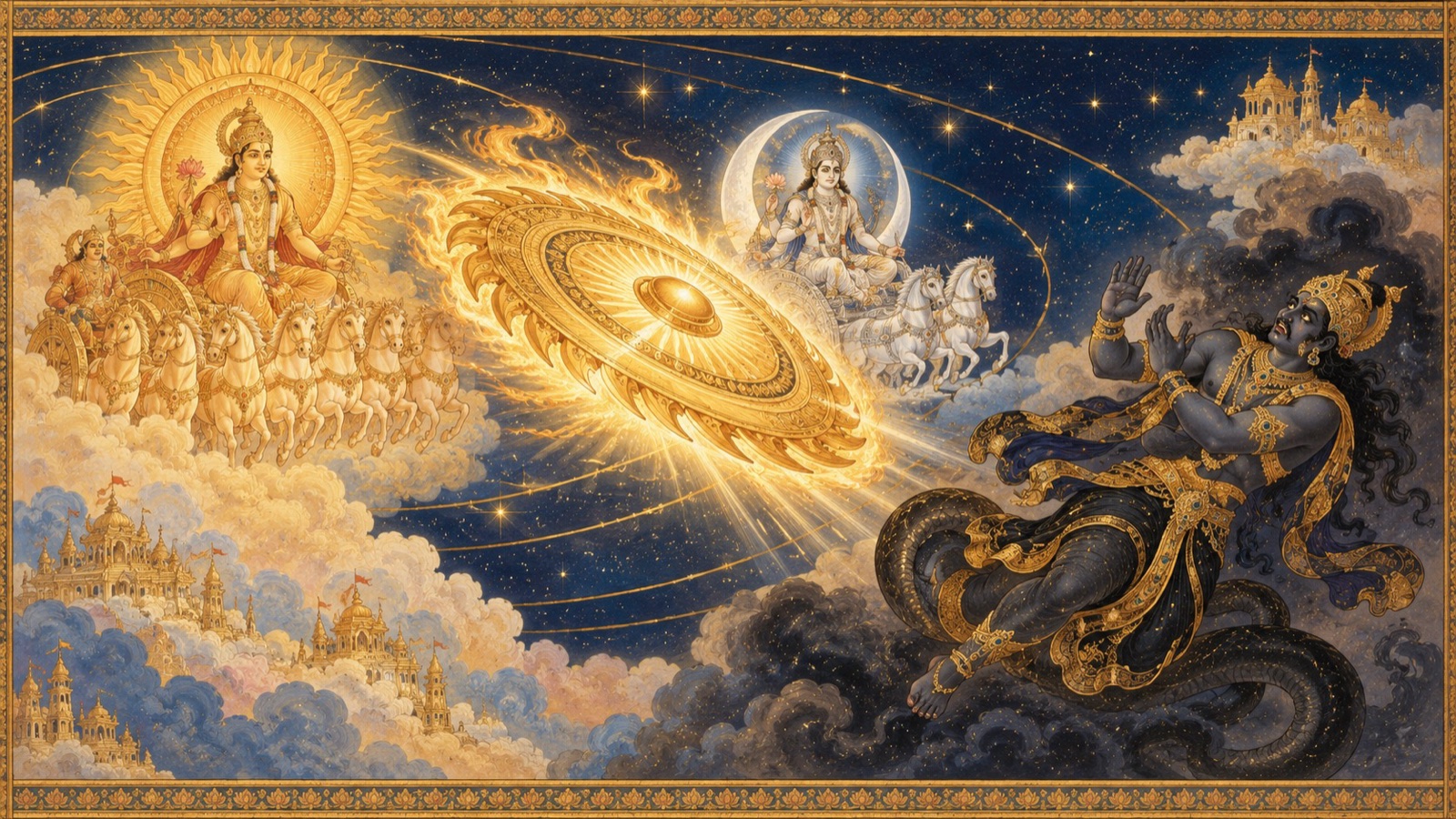
The blazing orb of the sun, Sri Suka told the king, spans ten thousand yojanas, the moon twelve thousand, and Rahu thirteen thousand. Ever since the churning of the nectar, when the sun-god and moon-god exposed his disguise, Rahu has nursed a grudge and rushes upon the two whenever they draw near.
यददस्तरणेर्मण्डलं प्रतपतस्तद्विस्तरतो योजनायुतमाचक्षते द्वादशसहस्रं सोमस्य त्रयोदशसहस्रं राहोर्य: पर्वणि तद्व्यवधानकृद्वैरानुबन्ध: सूर्याचन्द्रमसावभिधावति ॥ २ ॥
yad adas taraṇer maṇḍalaṁ pratapatas tad vistarato yojanāyutam ācakṣate dvādaśa-sahasraṁ somasya trayodaśa-sahasraṁ rāhor yaḥ parvaṇi tad-vyavadhāna-kṛd vairānubandhaḥ sūryā-candramasāv abhidhāvati
Meaning: The disc of the burning sun is reckoned at ten thousand yojanas, the moon at twelve thousand, and Rahu’s at thirteen thousand; nursing his old enmity, Rahu rushes upon the sun and the moon at the times of their conjunction and opposition. (Canto 5, Chapter 24, verse 2)
But he never prevails. For the Lord has set beside the two planets His own discus, Sudarsana, formidable and ever revolving, to protect them. Beholding that fiery wheel, Rahu stands facing it for about a muhurta, trembling, then flees from afar. This alone, Sri Suka said, is what people call an eclipse — not a victory of darkness, but the terror of a demon before the guardian weapon of Sri Hari.
The Realms Between: Siddhas, Yakshas, and the Earth
As many yojanas below Rahu, Sri Suka continued, lie the realms of the Siddhas, Caranas and Vidyadharas — beings of mystic power, celestial bards and heavenly artistes. Below them stretches the aerial region, the sporting-ground of the Yaksas, Raksasas, Pisacas, Pretas and Bhutas, as high as the wind and clouds reach. And a hundred yojanas below that lies this earth of ours, reaching upward as far as the swans, vultures, hawks and eagles can soar.
The Seven Subterranean Regions
Below the earth, Sri Suka told King Parikshit, lie seven great hollows — the subterranean regions — each set ten thousand yojanas apart from the next, and each ten thousand yojanas in length and breadth. He named them in order.
उपवर्णितं भूमेर्यथासन्निवेशावस्थानमवनेरप्यधस्तात् सप्त भूविवरा एकैकशो योजनायुतान्तरेणायामविस्तारेणोपक्लृप्ता अतलं वितलं सुतलं तलातलं महातलं रसातलं पातालमिति ॥ ७ ॥
upavarṇitaṁ bhūmer yathā-sanniveśāvasthānam avaner apy adhastāt sapta bhū-vivarā ekaikaśo yojanāyutāntareṇāyāma-vistāreṇopakḷptā atalaṁ vitalaṁ sutalaṁ talātalaṁ mahātalaṁ rasātalaṁ pātālam iti
Meaning: Below the earth lie seven subterranean regions, each ten thousand yojanas apart and of equal length and breadth: Atala, Vitala, Sutala, Talatala, Mahatala, Rasatala and Patala. (Canto 5, Chapter 24, verse 7)
Lovelier Than Heaven
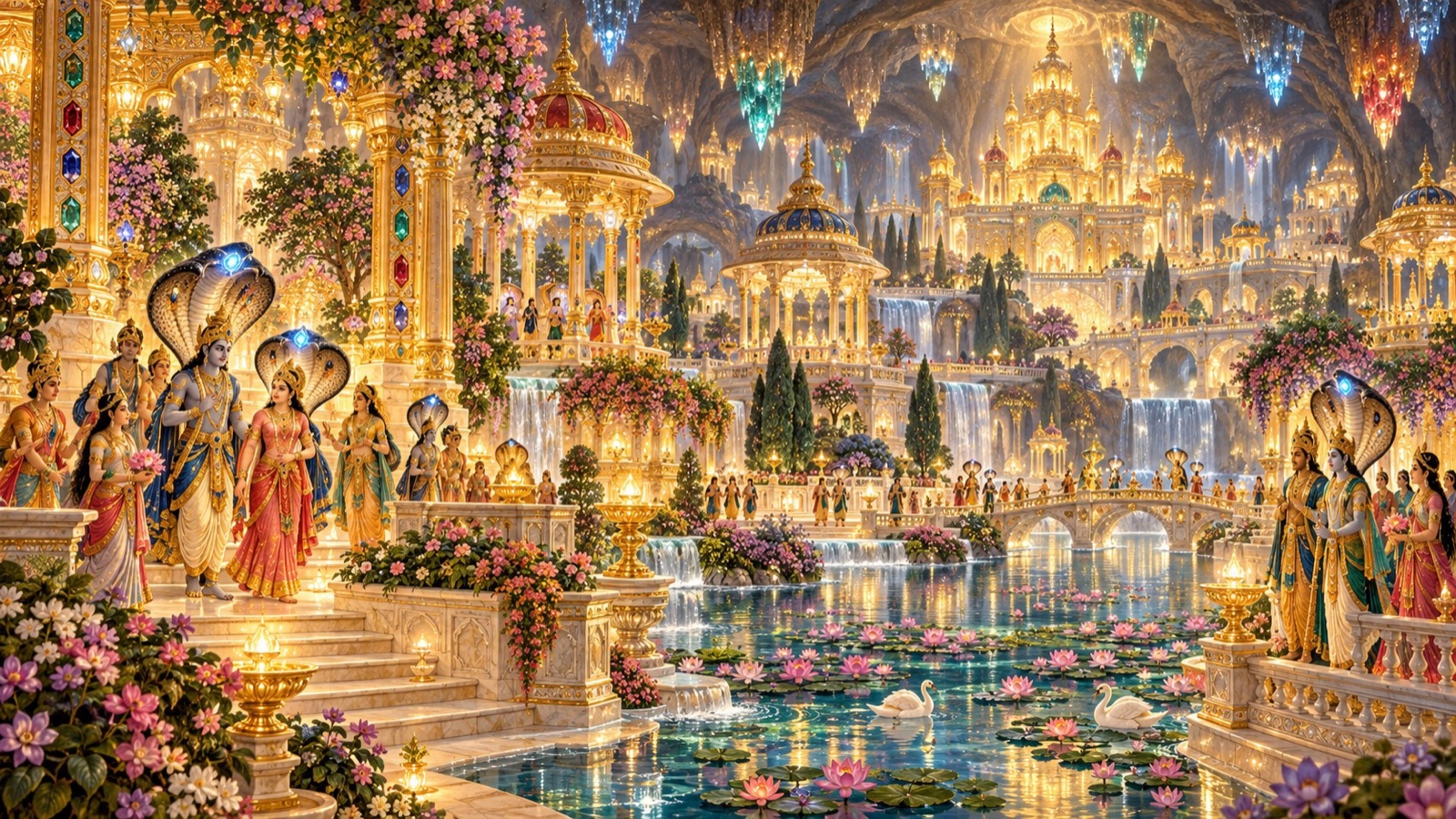
We might imagine such underworlds as dark and dreadful, but the Bhagavatam tells us the opposite. There, as householders, live the Daityas and Danavas and the serpents born of Kadru, in houses and pleasure-grounds so rich that they surpass even the joys of heaven. There shine cities raised by the wondrous architect Maya, with gem-built mansions and halls, and gardens that dim the glory of heaven, their lakes alive with lotuses and the sweet notes of birds.
No fear born of the divisions of time troubles the dwellers, for the sun and moon do not shine there; instead the great jewels upon the serpents’ hoods drive away all darkness, and no ailment or old age afflicts them, nourished as they are by miraculous herbs and elixirs. Death comes to those blessed beings from no cause save one — the Lord’s discus, Sudarsana; and the moment that wheel enters, the very embryos of the Asura women slip from the womb in fear of it. Even in these shining depths, the Lord’s presence is the one power before which all else must bow.
Atala: The Realm of Bala
In Atala dwells the demon Bala, son of Maya, from whom, they say, were released ninety-six kinds of conjuring, some practised by magicians even today. From his mouth, as once he yawned, sprang three classes of women who, by an elixir called Hataka, make a man entering that region feel himself all-powerful — filled with the strength of ten thousand elephants, so that he boasts like one intoxicated — a realm of illusion’s own arts, and a reminder of how easily the mind is drawn away by its own imagined power.
Vitala: Lord Hatakesvara
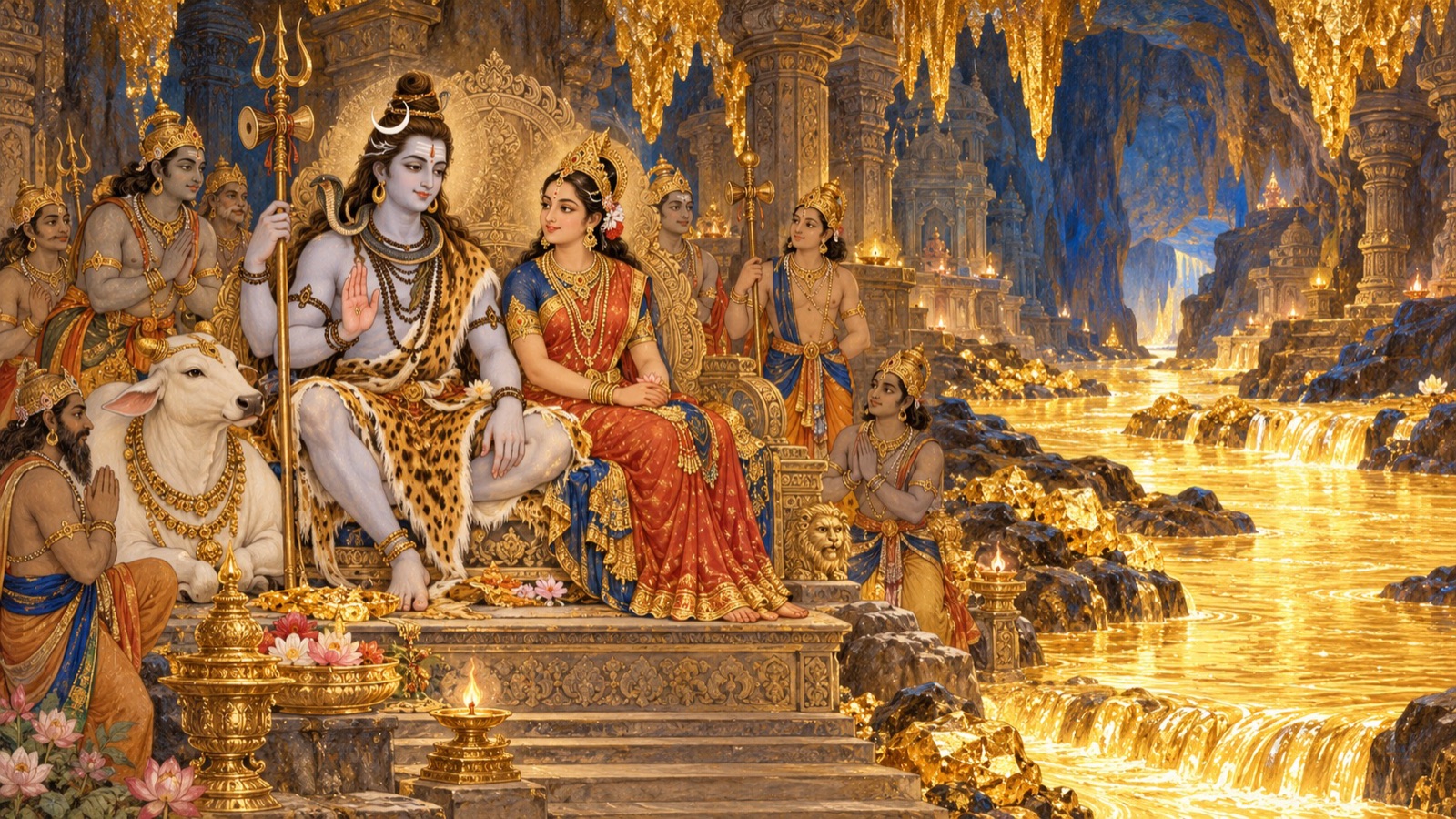
Below Atala, in Vitala, dwells Lord Siva himself, known there as Hatakesvara, surrounded by his hosts and united with the Goddess under the name of Bhava, for the furthering of Brahma’s creation. From him issues the great river Hataki; and where the wind kindles fire upon its waters, the fire drinks the river and casts it out again as gold — the gold called Hataka, which the Asuras of those realms wear as ornaments.
Sutala: King Bali and the Mercy of the Lord
And now we come to the very heart of this chapter — to Sutala, and to a soul so dear to the Lord that his story shines out from among all these wonders. Below Vitala, free from all fear even to this day, dwells the illustrious and sacredly renowned King Bali, son of Virocana. Once he ruled all three worlds; then the Lord, to please Indra, descended through Aditi and came before Bali as a celibate dwarf boy — Vamana — and by begging three paces of land took the three worlds back. Yet this was no punishment. By that very grace the Lord admitted Bali into Sutala and endowed him with wealth beyond even Indra’s, and there Bali worships that same adorable Lord through the faithful discharge of his duty.
ततोऽधस्तात्सुतले उदारश्रवा: पुण्यश्लोको विरोचनात्मजो बलिर्भगवता महेन्द्रस्य प्रियं चिकीर्षमाणेनादितेर्लब्धकायो भूत्वा वटुवामनरूपेण पराक्षिप्तलोकत्रयो भगवदनुकम्पयैव पुन: प्रवेशित … आस्तेऽधुनापि ॥ १८ ॥
tato ’dhastāt sutale udāra-śravāḥ puṇya-śloko virocanātmajo balir bhagavatā mahendrasya priyaṁ cikīrṣamāṇenāditer labdha-kāyo bhūtvā vaṭu-vāmana-rūpeṇa parākṣipta-loka-trayo bhagavad-anukampayaiva punaḥ praveśita … āste ’dhunāpi
Meaning: Below Vitala, in Sutala, dwells even now, free of all fear, the illustrious and sacredly renowned Bali, son of Virocana. Robbed of the three worlds by the Lord — who, to please Indra, took birth from Aditi and appeared as a celibate dwarf — he was by that same Lord’s grace admitted here once more and blessed with wealth beyond Indra’s … and he abides there still. (Canto 5, Chapter 24, verse 18)
The great fortune Bali enjoys, Sri Suka explained, is not the mere reward of the land he gave away. It flowered because that gift was offered with supreme piety to Lord Vasudeva Himself — the Soul of every being, come before him in person; such a gift leads directly to liberation. So tender is the Lord toward His own Name that even its faintest utterance works wonders.
यस्य ह वाव क्षुतपतनप्रस्खलनादिषु विवश: सकृन्नामाभिगृणन् पुरुष: कर्मबन्धनमञ्जसा विधुनोति यस्य हैव प्रतिबाधनं मुमुक्षवोऽन्यथैवोपलभन्ते ॥ २० ॥
yasya ha vāva kṣuta-patana-praskhalanādiṣu vivaśaḥ sakṛn nāmābhigṛṇan puruṣaḥ karma-bandhanam añjasā vidhunoti yasya haiva pratibādhanaṁ mumukṣavo ’nyathaivopalabhante
Meaning: A man who, helpless while sneezing, falling or stumbling, but once utters His Name, readily shakes off the bondage of karma — that very release which seekers of liberation pursue by far more difficult means. (Canto 5, Chapter 24, verse 20)
Yet Sri Suka added a further nuance to this mercy, so its wonder is not mistaken for the ordinary reward of charity. The Lord commonly keeps a devotee’s material advancement modest, since ease and wealth tend to make the mind forget Him — a hidden kindness disguised as scarcity. Bali’s fortune in Sutala belongs to a different order altogether: it was granted him not to gratify the senses nor as karma’s fruit, but solely so that his loving service might continue unhindered, free of any shadow of illusion. What looks outwardly like opulence is, for a devotee of Bali’s maturity, simply the Lord arranging the very conditions of unbroken service — never the aim of that service itself (verse 22).
Sri Suka recalled, too, the memorable words Bali once spoke. When the Lord, having taken all three worlds, had bound him with Varuna’s cords in a mountain cave, Bali did not lament his lost kingdom. He grieved instead that Indra, though counselled by Brhaspati, had asked through Vamana only for the three worlds and not for the priceless service of the Lord — worlds that change hands at the close of a mere Manvantara. He remembered his grandfather Prahlada, who begged only for the Lord’s service and not for a throne, and humbly wondered how one like himself could ever hope to walk in that noble soul’s footsteps. Such is the vision of a true devotee, who counts the sovereignty of all the worlds as nothing beside the chance to serve the Lord.
Indeed, Bali named the very source of his own conviction. Remembering his grandfather, he said:
यस्यानुदास्यमेवास्मत्पितामह: किल वव्रे न तु स्वपित्र्यं यदुताकुतोभयं पदं दीयमानं भगवत: परमिति भगवतोपरते खलु स्वपितरि ॥ २५ ॥
yasyānudāsyam evāsmat-pitāmahaḥ kila vavre na tu sva-pitryaṁ yad utākutobhayaṁ padaṁ dīyamānaṁ bhagavataḥ param iti bhagavatoparate khalu sva-pitari
Meaning: When his own father died, my grandfather Prahlada was offered by the Lord Himself both his father’s throne and the boon of fearless liberation — yet he set both aside and chose only the service of the Lord’s own servants. (Canto 5, Chapter 24, verse 25)
Bali’s full narrative, Sri Suka promised, would be told at length another time. And then he revealed the wonder that crowns this chapter — the reason Bali dwells in Sutala free of every fear.
तस्यानुचरितमुपरिष्टाद्विस्तरिष्यते यस्य भगवान् स्वयमखिलजगद्गुरुर्नारायणो द्वारि गदापाणिरवतिष्ठते निजजनानुकम्पितहृदयो … ॥ २७ ॥
tasyānucaritam upariṣṭād vistariṣyate yasya bhagavān svayam akhila-jagad-gurur nārāyaṇo dvāri gadā-pāṇir avatiṣṭhate nija-janānukampita-hṛdayo …
Meaning: His story will be told more fully hereafter — Bali, at whose door the Supreme Lord Himself, Narayana, the teacher of all the worlds, stands with mace in hand, His heart moved with compassion for His own devotees … (Canto 5, Chapter 24, verse 27)
The Lord of all the worlds — He by whose very toe the ten-headed Ravana was once hurled ten thousand times ten thousand yojanas away — takes His stand as guardian at the door of a devotee who gave Him everything. Here is the whole sweetness of bhakti in a single image: the Master becomes the servant of His servant.
Talatala: Maya Danava
Below Sutala, in Talatala, dwells the demon chief Maya, lord of three cities that were once burned to ashes by Lord Siva for the welfare of the worlds, yet who afterward secured his place there by that same Lord’s grace. Teacher of all who are skilled in conjuring, guarded on every side by the great Lord Siva, he remains immune from the fear of Sudarsana and is held in high honour.
Mahatala: The Serpent Races
Below Talatala, in Mahatala, lives a many-headed brood of serpents born of Kadru, the Krodhavasas, with Kuhaka, Taksaka, Kaliya and Susena foremost among them. Gigantic though they are, they live in constant dread of Garuda, who carries Lord Visnu upon his back; yet they sport freely with their kinsmen — held even in fear within the Lord’s order.
Rasatala and Patala: The Nagas and Vasuki
Below Mahatala, in Rasatala, dwell the sons of Diti and Danu, called the Panis, in three classes — the Nivatakavacas, the Kaleyas, and the denizens of Hiranyapura. Natural enemies of the gods, powerful and daring by birth, their pride is quelled only by the discus of Sri Hari; and through the Vedic threats of Sarama, the messenger of Indra, they live in terror of that ruler of the gods.
And below all, in the nethermost region of Patala, dwell the lords of the Naga realm, with Vasuki foremost among them.
ततोऽधस्तात्पाताले नागलोकपतयो वासुकिप्रमुखा: शङ्खकुलिकमहाशङ्खश्वेतधनञ्जयधृतराष्ट्रशङ्खचूडकम्बलाश्वतरदेवदत्तादयो महाभोगिनो महामर्षा निवसन्ति येषामु ह वै पञ्चसप्तदशशतसहस्रशीर्षाणां फणासु विरचिता महामणयो रोचिष्णव: पातालविवरतिमिरनिकरं स्वरोचिषा विधमन्ति ॥ ३१ ॥
tato ’dhastāt pātāle nāga-loka-patayo vāsuki-pramukhāḥ śaṅkha-kulika-mahāśaṅkha-śveta-dhanañjaya-dhṛtarāṣṭra-śaṅkhacūḍa-kambalāśvatara-devadattādayo mahā-bhogino mahāmarṣā nivasanti yeṣām u ha vai pañca-sapta-daśa-śata-sahasra-śīrṣāṇāṁ phaṇāsu viracitā mahā-maṇayo rociṣṇavaḥ pātāla-vivara-timira-nikaraṁ sva-rociṣā vidhamanti
Meaning: Below all, in Patala, dwell the lords of the Naga realm led by Vasuki — Sankha, Kulika, Mahasankha, Sveta, Dhananjaya, Dhrtarastra, Sankhacuda, Kambala, Asvatara, Devadatta and others — great-hooded and fierce; and the shining gems upon their hoods, on serpents of five, seven, ten, a hundred, even a thousand heads, drive away by their radiance all the darkness of Patala. (Canto 5, Chapter 24, verse 31)
So the great descent comes to rest in a glow of light, the Lord’s radiance reaching even to the lowest of the worlds.
Principal Teachings of This Chapter
The Lord guards His creation at every level. From the Sudarsana disc that holds Rahu back from the sun and moon to the fear of that same discus in the deepest realms, one power upholds all the worlds — the protective grace of the Lord, present from the heights to the depths.
No world is beyond the reach of His mercy. The subterranean regions shine with jewelled beauty and freedom from disease and age, and even a demon born of Simhika was raised to the rank of a planet. Wherever we are, His compassion can reach us.
The Lord becomes the servant of His devotee. The crowning glory of this chapter is Narayana Himself standing mace in hand at King Bali’s door — the Master of all the worlds guarding the one who gave Him everything, the perfect measure of how bhakti binds the Lord to those who love Him.
His service is worth more than all the worlds. Bali grieved not for his lost kingdom but that Indra had asked for the three worlds instead of the Lord’s service. Rule that passes away with a Manvantara is nothing beside the treasure of devotion.
The Holy Name works at once. A single utterance of the Lord’s Name, even helplessly while stumbling, loosens the bondage of karma that seekers labour to undo by far harder paths — the easiest and mightiest of all shelters.
A Devotional Reflection
There is something deeply comforting in this journey through the worlds beneath us. We might have expected the underworlds to be places of gloom; instead we are shown gardens brighter than heaven, palaces of gems, and beings who know neither disease nor decay — and at the centre of it all, the tender image of the Lord keeping watch at His devotee’s door. The map of creation is not a ladder of reward and dread, but a single field flooded everywhere with the mercy of God. King Bali lost a kingdom and gained the Lord as his gatekeeper, and counted himself the richer for it. That is the strange arithmetic of devotion: what the world calls loss, the heart that loves the Lord may find to be its greatest gain. When we too learn to treasure His service above the sovereignties we chase, we find that no place is truly low where the Lord consents to stand at the door.
A Daily Devotional Practice
Today, take to heart the simplest and most powerful teaching of this chapter: the surpassing worth of the Holy Name. Whenever the Name of the Lord rises to your lips — deliberately in prayer, or even involuntarily in a moment of surprise or stumbling — let it be a conscious offering. Say, with a grateful heart, “Om Namo Bhagavate Vasudevaya,” remembering that this Name is dearer to the Lord than the gift of all three worlds. And when some loss weighs on you, recall King Bali, who lost a kingdom and found the Lord standing at his gate, and offer that loss too at His feet.
Conclusion
The twenty-fourth discourse of Book Five carries us on a wondrous descent — from the shadow-planet Rahu, held back by the disc of the Lord, down through the aerial realms and the face of the earth, into the seven luminous subterranean worlds with their rulers, from Bala in Atala to Vasuki and the thousand-hooded Nagas in Patala. Yet the heart of it all is Sutala, where the great devotee King Bali dwells free of every fear, for the Supreme Lord Narayana Himself stands guard at his door. In that single image the whole chapter is gathered: the Lord of all the worlds becomes the loving guardian of one who gave Him everything — showing that His mercy reaches even to the deepest of the worlds, and to the humblest of hearts that turn to Him.
May the divine wisdom of Srimad Bhagavatam awaken pure devotion within our hearts.
Om Namo Bhagavate Vasudevaya.
Jay Shree Madhav.
References and Attribution
- Primary edition: Gita Press, Śrīmad Bhāgavata Mahāpurāṇa, Book Five, Discourse 24, “The position of Rahu etc., and the limits of the heavenlike subterranean regions.”
- Series: Srimad Bhagavatam Wisdom · Biswa Sanatan Dharma Seva Trust.
- Presented following the spiritual guidance and recommendation of Pandit Dr. Shri Kashinath Mishra.
This is an original, faithful retelling in the writer’s own words, with brief quoted verses shown in Devanāgarī and transliteration and their meanings given as summaries. It is not a reproduction of any single publisher’s continuous translation or commentary. No affiliation with or endorsement by any publisher is implied.
Jay Shree Madhav