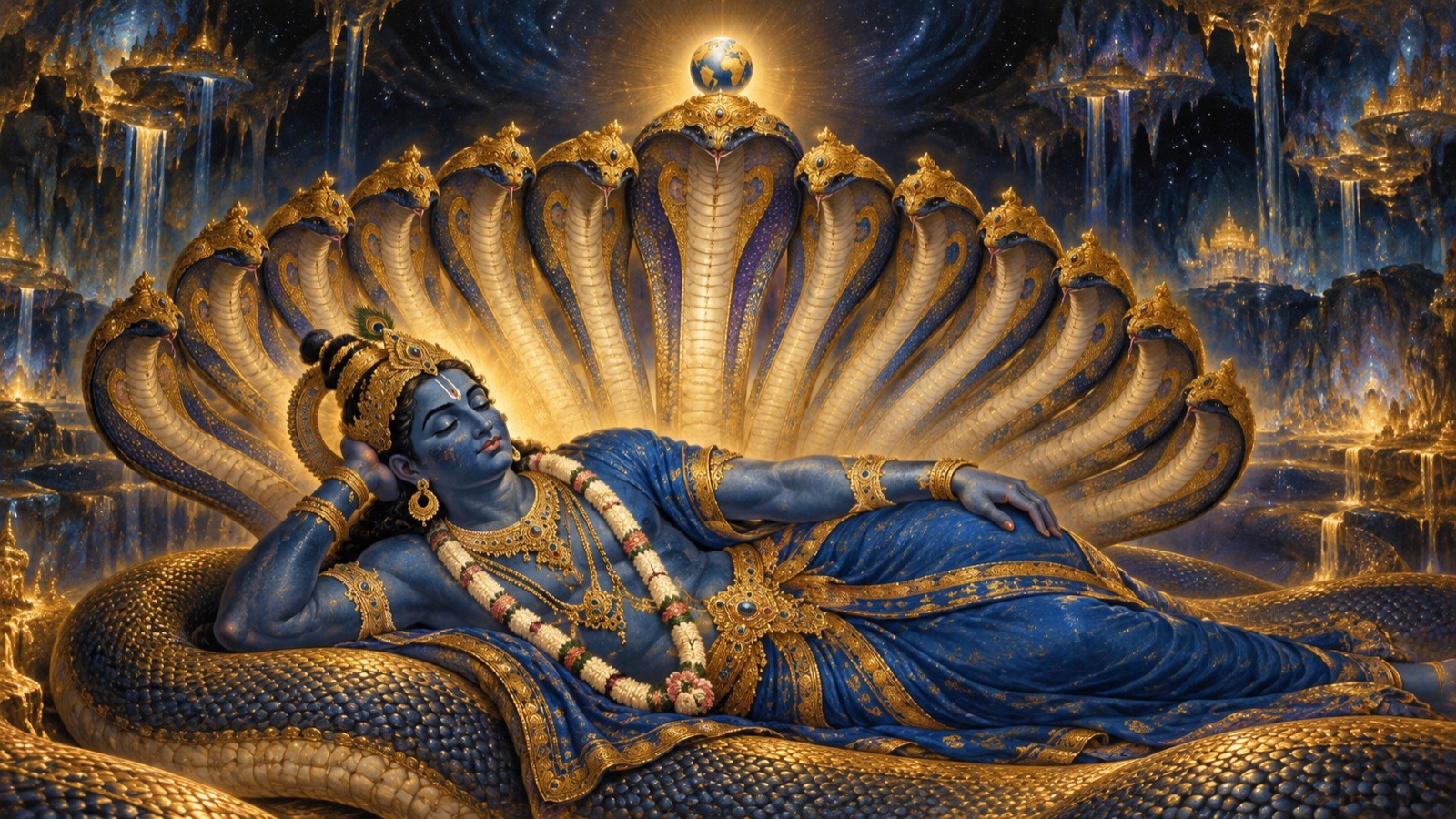
Far below the seven subterranean worlds, upon a single one of His thousand serpent-hoods, Lord Ananta bears the whole earth as lightly as a mustard seed — dark-blue, serene, and boundless in His mercy.
Om Namo Bhagavate Vasudevaya.
Om Namo Bhagavate Vasudevaya.
Om Namo Bhagavate Vasudevaya.
Welcome back to Srimad Bhagavatam Wisdom, a devotional journey through the sacred histories and teachings of the Srimad Bhagavat Mahapurana. Having led us down through the shining subterranean worlds, Sri Suka now lowers his gaze to the very foundation of all things — to the region far beneath even Patala, where the Lord Himself upholds the whole creation in the form of Ananta, the endless one. This short and radiant chapter is pure praise: the thousand-hooded Lord who carries the earth like a mustard seed, His dark-blue beauty and single earring, the serpent-kings who worship at His feet, and the song that the celestial sage Narada once sang of His glories in the court of Brahma. It closes the survey of the worlds not with a map, but with a hymn.
Chapter Information
- Scripture: Śrīmad Bhāgavata Mahāpurāṇa
- Canto: 5 (Book Five)
- Chapter: 25 (Discourse 25)
- Chapter title: The Glories of Lord Ananta
- Principal speaker: Sukadeva Gosvami (Sri Suka), narrating to King Parikshit; within the narration, the sage Narada’s own song of praise (verses 9–13) is quoted
- Principal listener: King Parikshit — the discourse related in turn by Suta Gosvami to the sages gathered at Naimisaranya
- Main setting: The region far below Patala, at the base of the created worlds, where Lord Ananta (Sankarsana) resides; and, within Narada’s song, the court of Brahma
- Central subject: The glories of Lord Ananta (Sankarsana), who upholds the earth upon a single one of His thousand hoods, from whose wrath the Rudra of dissolution arises, who is worshipped by the serpent-lords, and whose mercy saves all who hear of Him
- Principal verse range: Canto 5, Chapter 25, verses 1–15
- Primary edition: Gita Press Śrīmad Bhāgavata Mahāpurāṇa
From the Previous Chapter
In the twenty-fourth discourse, Sri Suka described Rahu and the movements of the Sudarshana disc, and then led us through the seven luminous subterranean regions below the earth. Loveliest among them is Sutala, the blessed realm where the great devotee Bali dwells, and where the Lord Himself, out of love, remains ever near as his guardian. From those bright underworlds the narration now descends to their very foundation, to sing of the Lord who bears them all.
Below Patala, the Lord Who Upholds the Worlds
Thirty thousand yojanas below the region of Patala, Sri Suka tells us, dwells that part-manifestation of the Lord which presides over the work of dissolution — the deity known as Lord Ananta, “the endless one.” The devotees of the Satvata tradition lovingly call Him Sankarsana, “the one who draws all together,” for it is He who unites the seer and the seen, presiding over the very sense of “I” by which every soul knows itself. He is no distant abstraction, but the tender ground beneath all that is.
श्रीशुक उवाच तस्य मूलदेशे त्रिंशद्योजनसहस्रान्तर आस्ते या वै कला भगवतस्तामसी समाख्यातानन्त इति सात्वतीया द्रष्टृदृश्ययो: सङ्कर्षणमहमित्यभिमानलक्षणं यं सङ्कर्षणमित्याचक्षते ॥ १ ॥
śrī-śuka uvāca tasya mūla-deśe triṁśad-yojana-sahasrāntara āste yā vai kalā bhagavatas tāmasī samākhyātānanta iti sātvatīyā draṣṭṛ-dṛśyayoḥ saṅkarṣaṇam aham ity abhimāna-lakṣaṇaṁ yaṁ saṅkarṣaṇam ity ācakṣate.
Meaning: Sri Sukadeva Gosvami said: Thirty thousand yojanas beneath Patala dwells that portion of the Lord which the Satvatas call Ananta, the presiding deity of the mode of ignorance; because He governs the very sense of “I, the enjoyer” by which the seer mistakes himself for something apart from the seen, He is known as Sankarsana. (Canto 5, Chapter 25, verse 1)
This is a sobering word before the hymn of praise begins. The thought “I am the enjoyer, and this world exists for me” — the very thought by which a soul forgets its place, and sometimes even dares to claim identity with God Himself — is not, Sri Suka tells us, the soul’s own private error; it is Sankarsana’s own arrangement, a shadow He casts across the conditioned mind. This is why the impersonalist’s cry “I am Brahman,” spoken outside of loving surrender, is no liberation but only this same illusion wearing a subtler garment. The rest of this chapter quietly offers the true remedy: not the false claim to be God, but the humble hearing of His name and glories, which alone unties the knot that Sankarsana himself ties.
And what does He hold? Upon a single one of His thousand serpent-hoods rests this whole vast globe — with all its mountains and seas and teeming lives — and there it looks no larger than a tiny mustard seed.
यस्येदं क्षितिमण्डलं भगवतोऽनन्तमूर्ते: सहस्रशिरस एकस्मिन्नेव शीर्षणि ध्रियमाणं सिद्धार्थ इव लक्ष्यते ॥ २ ॥
yasyedaṁ kṣiti-maṇḍalaṁ bhagavato ’nanta-mūrteḥ sahasra-śirasa ekasminn eva śīrṣaṇi dhriyamāṇaṁ siddhārtha iva lakṣyate.
Meaning: This whole terrestrial globe, held upon but one of the thousand heads of the Lord who appears in the form of Ananta, looks no larger than a mustard seed. (Canto 5, Chapter 25, verse 2)
The Rudra Born of His Anger
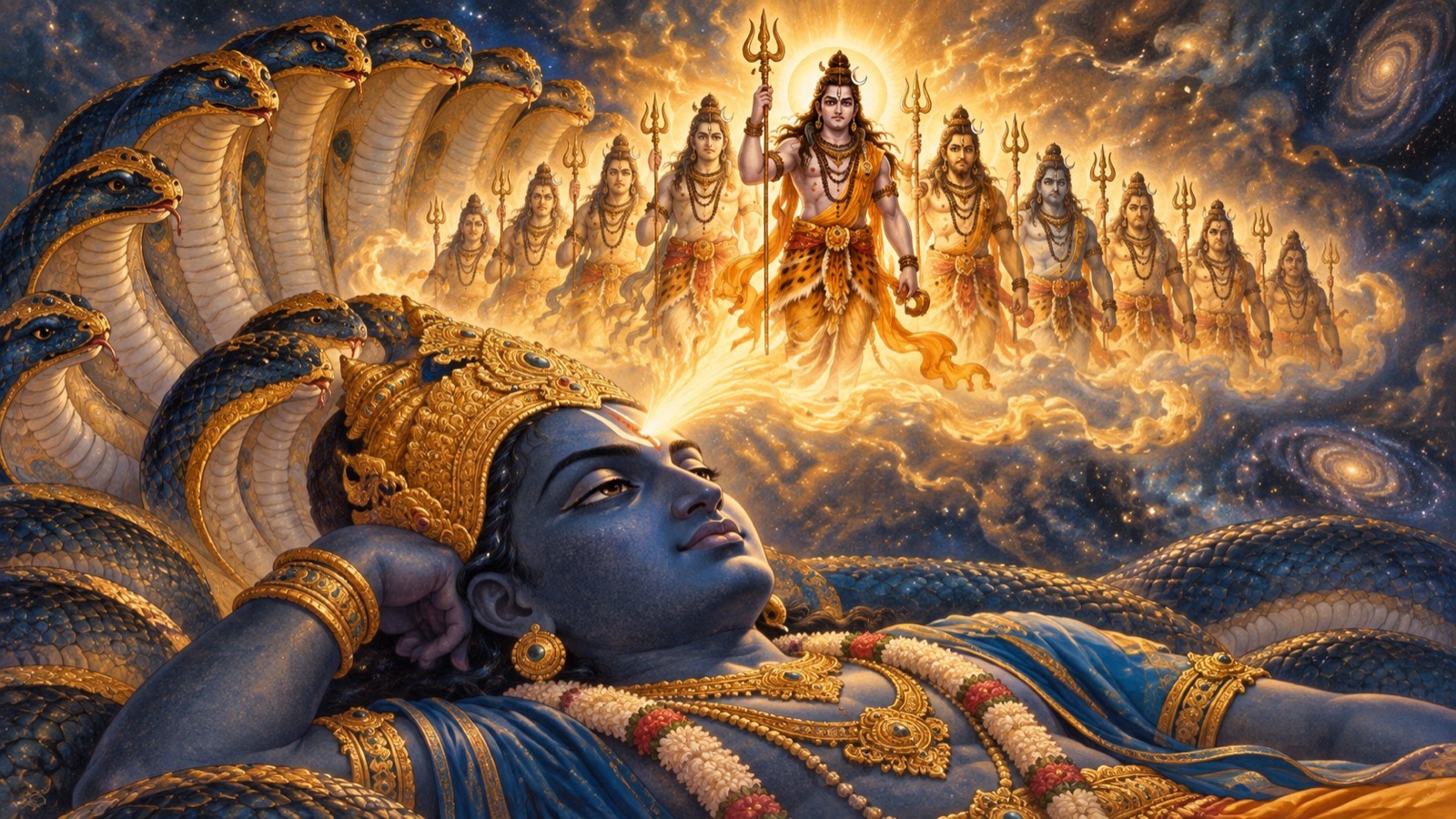
Yet the same Lord who so gently carries the worlds also holds within Himself the power that one day withdraws them. When the appointed time for dissolution arrives and He resolves to draw the universe back into Himself, a wondrous and terrible thing appears. From the space between His lovely eyebrows — knit now in a beautiful, majestic wrath — there springs forth the eleven-fold Rudra of dissolution, three-eyed and bearing his trident aloft, whom the wise call Sankarsana.
यस्य ह वा इदं कालेनोपसञ्जिहीर्षतोऽमर्षविरचितरुचिरभ्रमद्भ्रुवोरन्तरेण साङ्कर्षणो नाम रुद्र एकादशव्यूहस्त्र्यक्षस्त्रिशिखं शूलमुत्तम्भयन्नुदतिष्ठत् ॥ ३ ॥
yasya ha vā idaṁ kālenopasañjihīrṣato ’marṣa-viracita-rucira-bhramad-bhruvor antareṇa sāṅkarṣaṇo nāma rudra ekādaśa-vyūhas try-akṣas tri-śikhaṁ śūlam uttambhayann udatiṣṭhat.
Meaning: When, in due course of time, He desires to withdraw this universe, from between His eyebrows — knit in a wrath that is yet full of beauty — there springs up the lord of destruction named Sankarsana, manifest in eleven forms, three-eyed, holding aloft his trident. (Canto 5, Chapter 25, verse 3)
The Serpent-Lords at His Lotus-Feet
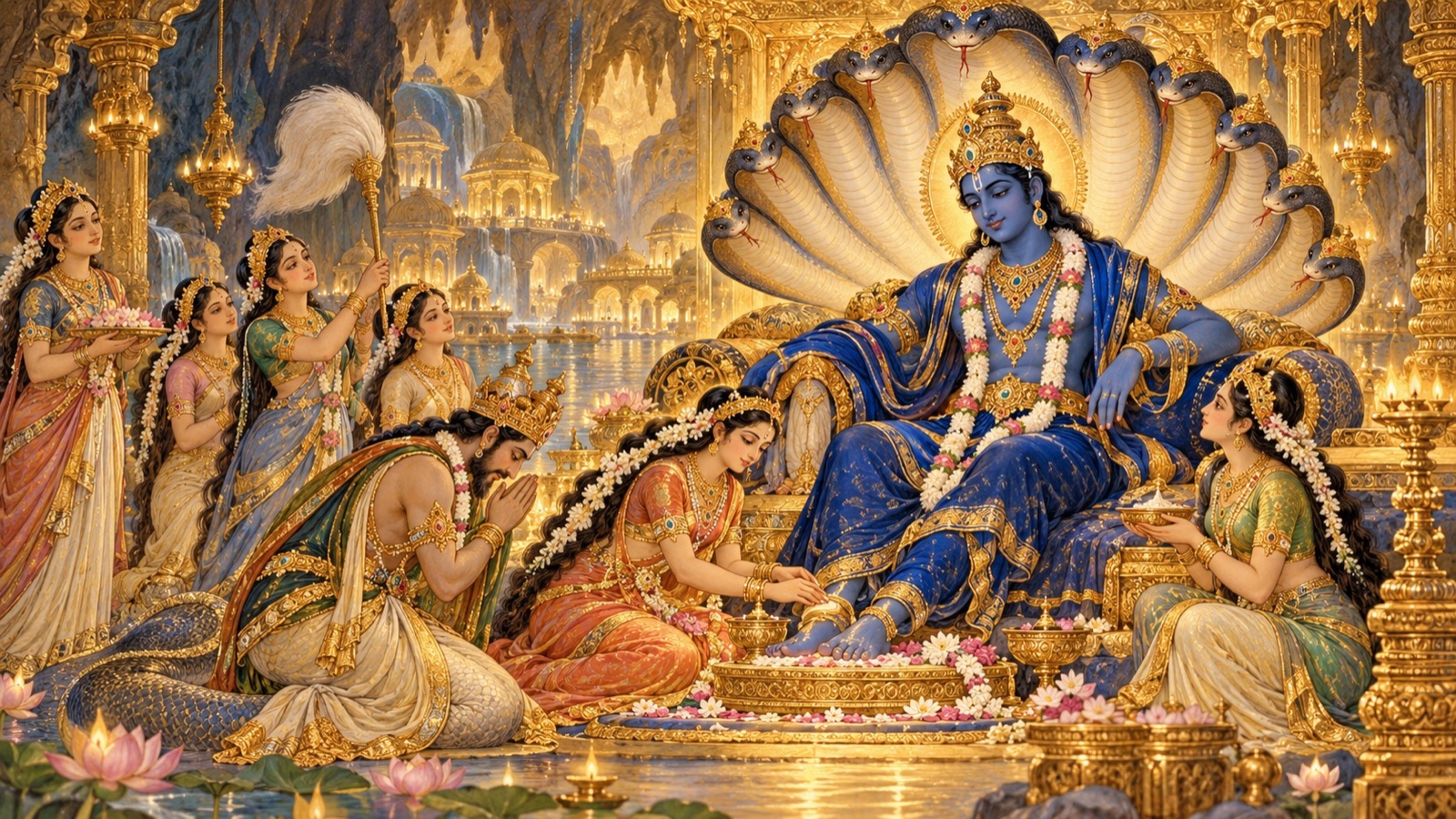
But dissolution is not His mood today; today He is worshipped, and adored, and loved. Bowing at His feet along with the foremost of devotees, in exclusive and heartfelt devotion, the lord of the serpents gazes into the ruby-bright, curving nails of the Lord’s lotus-feet — and there, as in polished mirrors, he sees the happy faces of the worshippers reflected, their cheeks lit by the glow of their brilliant earrings, a sight that floods every heart with rapture.
Near Him too come the unmarried princesses of the serpent race, anointing His long, snow-white arms with fragrant paste of aloe-wood, sandalwood and saffron, and seeking His blessing; bashful and full of love, they gaze up at His lotus face, while His own reddened eyes, tender and half-closed, cast a merciful look upon them. And so that same Lord Ananta — an ocean of endless virtues, the most ancient of deities — dwells there for the welfare of all the worlds, holding back, for now, the great force of that wrath which belongs only to the hour of dissolution.
Clad in Blue, Bearing the Plough
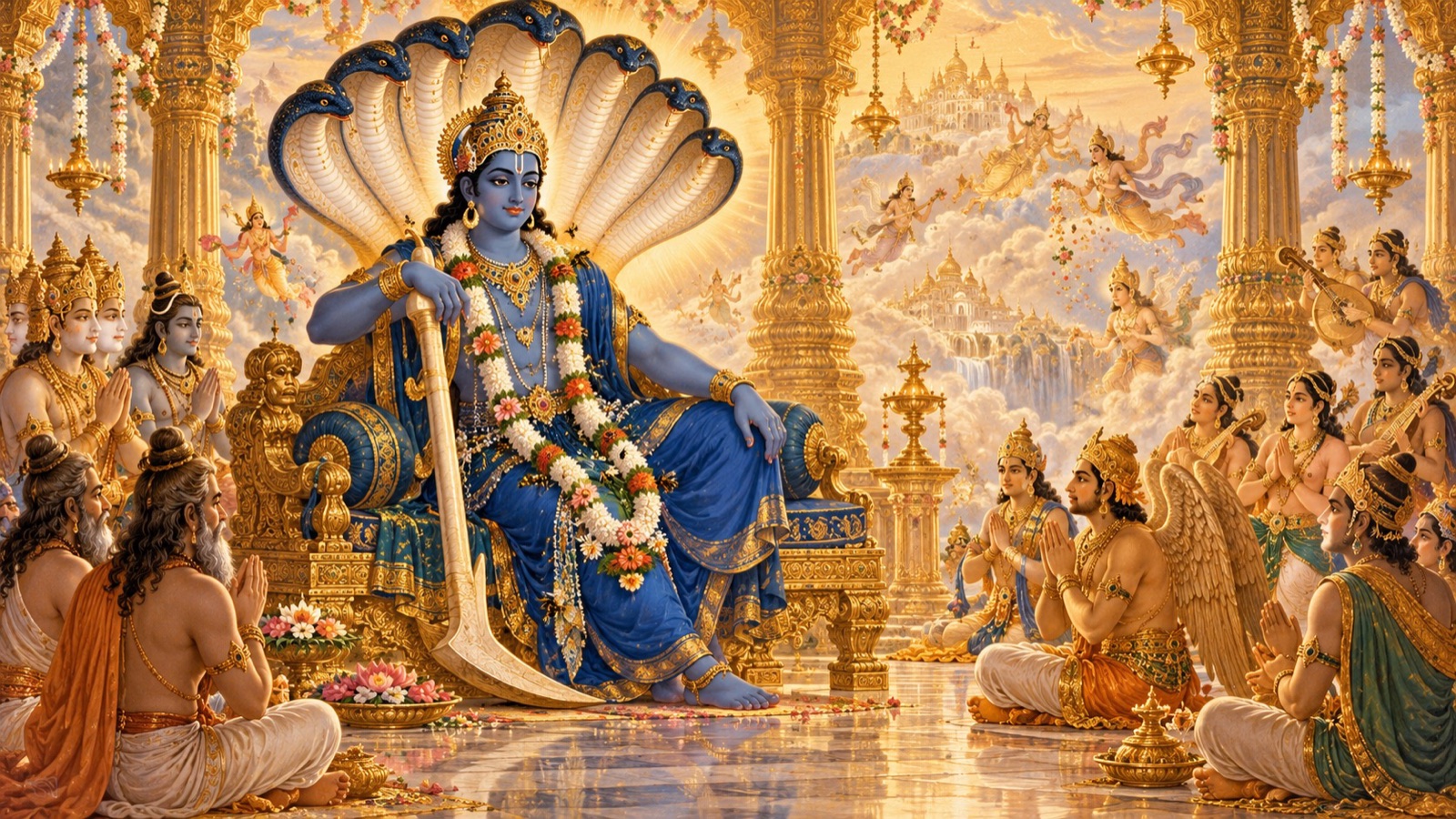
How shall a devotee picture Him? Sri Suka gives us His very form. Hosts of gods and demons, Nagas and Siddhas, Gandharvas, Vidyadharas and sages meditate upon Him without cease. Ever glad, His eyes rolling as though with the sweetness of a divine intoxication, He delights His own companions and the chiefs of the heavenly hosts with the nectar of His charming, gracious words. Clad in garments of blue, wearing a single earring in one ear, He rests one beautiful hand upon the top of His plough — and about His shoulders, as the mighty elephant of Indra wears its golden girth, He wears His own sylvan garland, the Vaijayanti, whose loveliness is made lovelier still by the humming of bees drunk on the honey of ever-fresh, never-fading Tulasi blossoms.
ध्यायमान: सुरासुरोरगसिद्धगन्धर्वविद्याधरमुनिगणैरनवरतमदमुदितविकृतविह्वललोचन: सुललितमुखरिकामृतेनाप्यायमान: स्वपार्षदविबुधयूथपतीनपरिम्लानरागनवतुलसिकामोदमध्वासवेन माद्यन्मधुकरव्रातमधुरगीतश्रियं वैजयन्तीं स्वां वनमालां नीलवासा एककुण्डलो हलककुदि कृतसुभगसुन्दरभुजो भगवान्महेन्द्रो वारणेन्द्र इव काञ्चनीं कक्षामुदारलीलो बिभर्ति ॥ ७ ॥
dhyāyamānaḥ surāsuroraga-siddha-gandharva-vidyādhara-muni-gaṇair anavarata-mada-mudita-vikṛta-vihvala-locanaḥ sulalita-mukharikāmṛtenāpyāyamānaḥ sva-pārṣada-vibudha-yūtha-patīn aparimlāna-rāga-nava-tulasikāmoda-madhv-āsavena mādyan madhukara-vrāta-madhura-gīta-śriyaṁ vaijayantīṁ svāṁ vanamālāṁ nīla-vāsā eka-kuṇḍalo hala-kakudi kṛta-subhaga-sundara-bhujo bhagavān mahendro vāraṇendra iva kāñcanīṁ kakṣām udāra-līlo bibharti.
Meaning: Meditated upon without ceasing by gods and demons, Nagas, Siddhas, Gandharvas, Vidyadharas and sages, ever glad with His eyes rolling as if in sweet intoxication, He gladdens His attendants and the leaders of the celestial hosts with the nectar of His gracious speech. Clad in blue and wearing a single earring, He rests a graceful hand upon His plough and — like Indra’s great elephant wearing its girth of gold — wears His own forest garland, the Vaijayanti, humming with bees drunk on the honey of ever-fresh Tulasi blossoms. (Canto 5, Chapter 25, verse 7)
He Enters the Heart, and Narada Sings His Praise
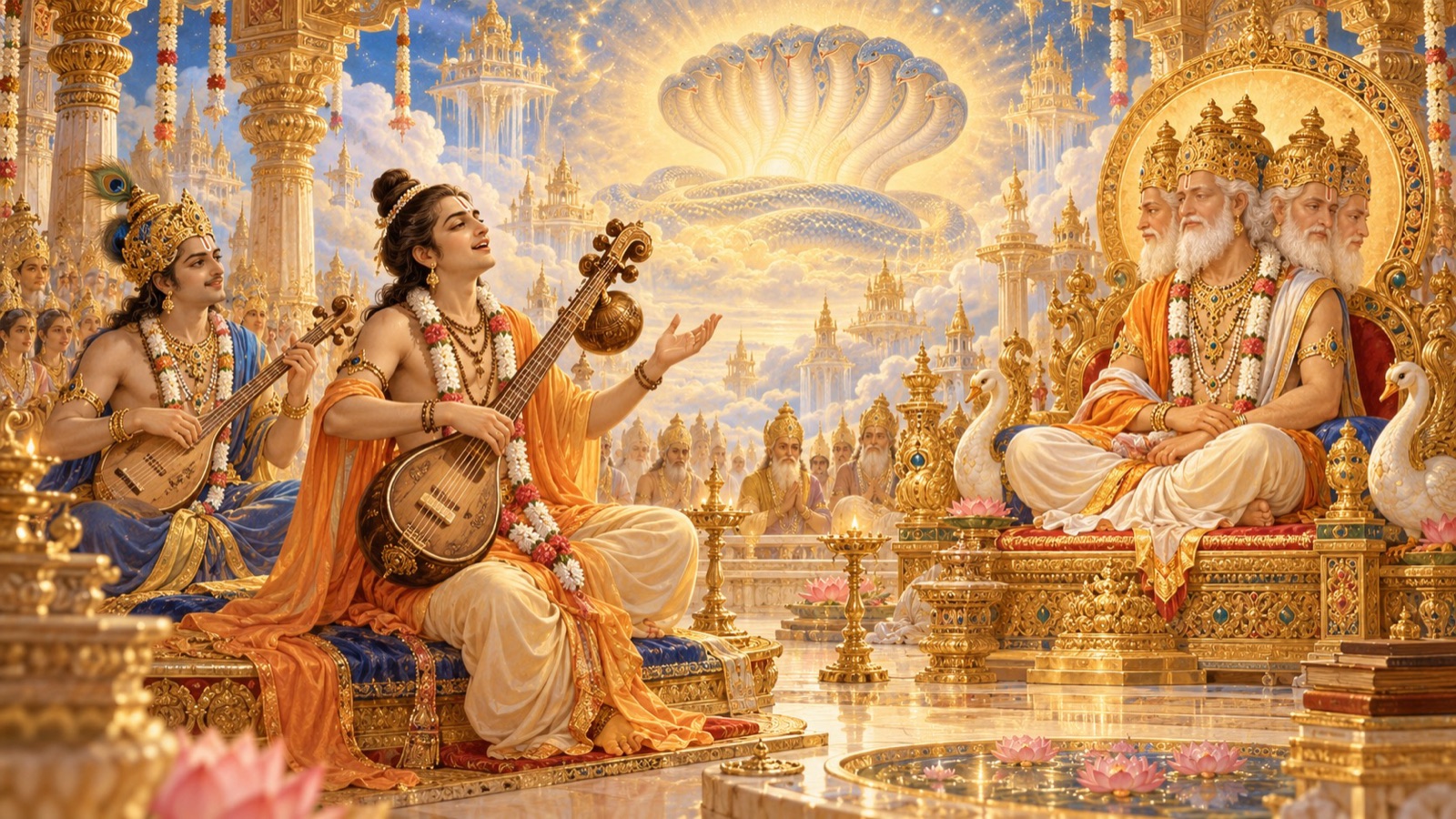
This is the Lord who does not remain far below us, but comes near. Heard of from the lips of a true teacher and held in loving contemplation, Sankarsana enters the heart of those who long for liberation and swiftly cuts asunder the hard knot of ignorance there — that knot tied by beginningless tendencies to action and woven of the three modes, Sattva, Rajas and Tamas. To speak of His glories is itself a purifying joy. And so Sri Suka recalls for us how the glorious Narada, son of the self-born Brahma, once stood with Tumburu the Gandharva in the court of Brahma and lifted up his voice to sing the praises of this very Lord.
Narada’s Song of Praise
Narada begins in wonder, confessing that the ways of the Supreme cannot be fully known: how could anyone truly fathom that Reality by whose mere glance the modes of Nature — Sattva and the rest, which bring about creation, preservation and dissolution — are set in motion, whose being is eternal and uncaused, and who, though one alone, bore within Himself this whole manifold universe? And yet, the sage sings, out of boundless compassion for us that same Reality assumed a form of pure, unmixed goodness, and by it enacts His flawless pastimes, to draw and captivate the hearts of His devotees.
Then Narada gives voice to the tenderest truth of all — that the mercy of this Lord is nearer than we dare to hope.
यन्नाम श्रुतमनुकीर्तयेदकस्मा- दार्तो वा यदि पतित: प्रलम्भनाद्वा । हन्त्यंह: सपदि नृणामशेषमन्यं कं शेषाद्भगवत आश्रयेन्मुमुक्षु: ॥ ११ ॥
yan-nāma śrutam anukīrtayed akasmād ārto vā yadi patitaḥ pralambhanād vā hanty aṁhaḥ sapadi nṛṇām aśeṣam anyaṁ kaṁ śeṣād bhagavata āśrayen mumukṣuḥ
Meaning: If even a fallen, suffering man should utter His name — whether learned from a teacher, spoken by mere chance, or even uttered in mockery — it destroys at once all the sins of men. Whom, then, other than Lord Sesa should a seeker of liberation take shelter of? (Canto 5, Chapter 25, verse 11)
His praise then turns to the Lord’s immeasurable greatness, marvelling that the same infinite one who upholds all things cannot Himself be counted or contained.
मूर्धन्यर्पितमणुवत्सहस्रमूर्ध्नो भूगोलं सगिरिसरित्समुद्रसत्त्वम् । आनन्त्यादनिमितविक्रमस्य भूम्न: को वीर्याण्यधिगणयेत्सहस्रजिह्व: ॥ १२ ॥
mūrdhany arpitam aṇuvat sahasra-mūrdhno bhū-golaṁ sagiri-sarit-samudra-sattvam ānantyād animita-vikramasya bhūmnaḥ ko vīryāṇy adhi gaṇayet sahasra-jihvaḥ
Meaning: Who, even with a thousand tongues, could count the mighty deeds of that boundless Lord, whose valour has no measure, and upon a single one of whose thousand heads this globe — with its mountains, rivers, oceans and living beings — has been placed like a mere atom? (Canto 5, Chapter 25, verse 12)
And Narada’s song comes to rest on the wonder with which it began: that the Lord bears the whole weight of creation in effortless play, needing no support but His own Self.
एवम्प्रभावो भगवाननन्तो दुरन्तवीर्योरुगुणानुभाव: । मूले रसाया: स्थित आत्मतन्त्रो यो लीलया क्ष्मां स्थितये बिभर्ति ॥ १३ ॥
evam-prabhāvo bhagavān ananto duranta-vīryoru-guṇānubhāvaḥ mūle rasāyāḥ sthita ātma-tantro yo līlayā kṣmāṁ sthitaye bibharti
Meaning: Such is the majesty of Lord Ananta, of unfathomable power and countless virtues, who — resting at the base of the worlds and supported by none but His own Self — upholds the earth in mere play, for the sustaining of all creation. (Canto 5, Chapter 25, verse 13)
Sri Suka’s Closing Word
With Narada’s hymn still ringing, Sri Suka gently turns back to King Parikshit and draws his long account of the worlds to its close. These regions, high and low, are the only destinations to which souls are led in this universe, each according to its own actions, all fashioned by the Lord; and he has described them, he says, just as he himself was taught by his revered father and preceptor, Vedavyasa. He has answered the king’s questions fully, tracing the diverse destinies — lofty and lowly — that ripen from a life of action. What more, he asks with the peace of one who has given everything, is there now to say?
Principal Teachings of This Chapter
The Lord Himself is the foundation of everything. Beneath every world, beneath every support we can name, there is Lord Ananta, holding all things upon a single hood and needing no support but His own Self. When we feel that the ground is slipping beneath us, this chapter quietly reminds us Who is truly holding us up.
His power is boundless, yet His touch is gentle. The whole earth, with all its mountains and seas, rests on Him like a mustard seed, like a single atom. Such unimaginable strength, and yet He bears it not with strain but in play — a picture of how effortlessly the Divine sustains the lives we find so heavy to carry.
Even His wrath serves the good of the worlds. From His knitted brows the Rudra of dissolution arises, and yet Sri Suka tells us He restrains that force, holding it back until its proper hour. The same Lord who will one day withdraw the universe keeps it lovingly now — reminding us that even endings, in His hands, are acts of care.
His holy name saves even the fallen. Narada sings the most hope-filled truth of all: that His name, uttered even by a suffering, fallen soul — by chance, or even in mockery — wipes away all sin in an instant. No one is beyond the reach of that mercy; the door of refuge stands open to everyone.
To hear of Him is itself grace. Heard from a true teacher and held in the heart, the Lord enters within and cuts the knot of ignorance. We do not have to be perfect to begin — we have only to listen, to remember, and to praise, and He does the rest.
A Devotional Reflection
There is a special sweetness in the way the Fifth Canto ends its long journey through the worlds. Sri Suka has measured out islands and oceans, heavens and underworlds, mountains beyond counting — and then, at the very bottom of it all, he finds not emptiness but a Person: dark-blue, garlanded, gentle-eyed, bearing the whole immensity of creation as lightly as a seed. And what does He ask of us in return for so vast a labour of love? Nothing but that we hear of Him, take His name upon our lips, and let Him near. Narada, who has wandered every realm, spends his song not on the wonders he has seen but on this one wonder — that such a Lord should be so easily pleased, so quick to save. When our own burdens feel too great, it is healing to remember that the earth itself is a mustard seed upon His head, and that the same hand which upholds the worlds is reaching, always, toward us.
A Daily Devotional Practice
Today, take up the practice that Narada praises so highly: the loving remembrance of the Lord’s holy name. Whatever weight you are carrying — a worry, a duty, a fear — set it down for a moment and softly chant, “Om Namo Bhagavate Vasudevaya.” As you do, call to mind the image this chapter gives us: the whole earth, with all its cares, resting no heavier than a mustard seed upon the hood of Lord Ananta. Let your burden rest there too. And if you can, share one line of His glory with another soul today, for to hear of Him and to speak of Him is itself the beginning of His mercy.
Conclusion
The twenty-fifth discourse of Book Five closes the survey of the worlds with a hymn to Lord Ananta, the endless one who dwells far below Patala and upholds the whole earth upon a single one of His thousand hoods, where it appears no larger than a mustard seed. From His wrathful brows arises the Rudra of dissolution, whom He holds in check for the welfare of the worlds; at His lotus-feet the serpent-lords and their maidens bow in loving worship; and, clad in blue with a single earring and His plough, He is meditated upon by gods and sages without cease. Entering the hearts of those who hear of Him, He cuts the knot of ignorance — and in the court of Brahma, the sage Narada sang that His very name, uttered even by the fallen, destroys all sin, and that He bears the earth in effortless play, self-supported and supreme. So the long journey through the worlds ends where all things rest: upon the boundless mercy of the Lord.
May the divine wisdom of Srimad Bhagavatam awaken pure devotion within our hearts.
Om Namo Bhagavate Vasudevaya.
Jay Shree Madhav.
References and Attribution
- Primary edition: Gita Press, Śrīmad Bhāgavata Mahāpurāṇa, Book Five, Discourse 25, “A supplement to the description of the subterranean system.”
- Series: Srimad Bhagavatam Wisdom · Biswa Sanatan Dharma Seva Trust.
- Presented following the spiritual guidance and recommendation of Pandit Dr. Shri Kashinath Mishra.
This is an original, faithful retelling in the writer’s own words, with brief quoted verses shown in Devanāgarī and transliteration and their meanings given as summaries. It is not a reproduction of any single publisher’s continuous translation or commentary. No affiliation with or endorsement by any publisher is implied.
Jay Shree Madhav