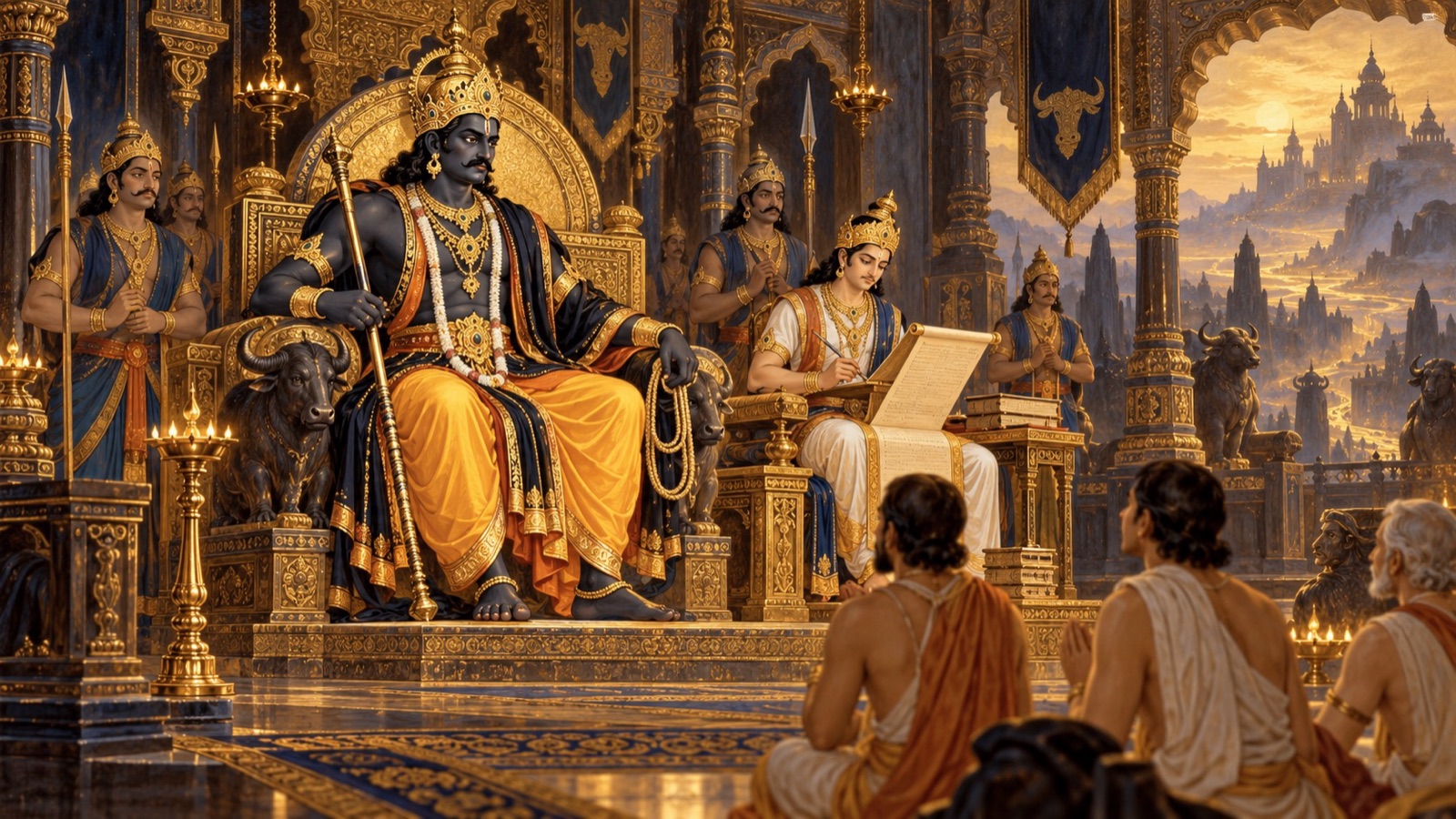
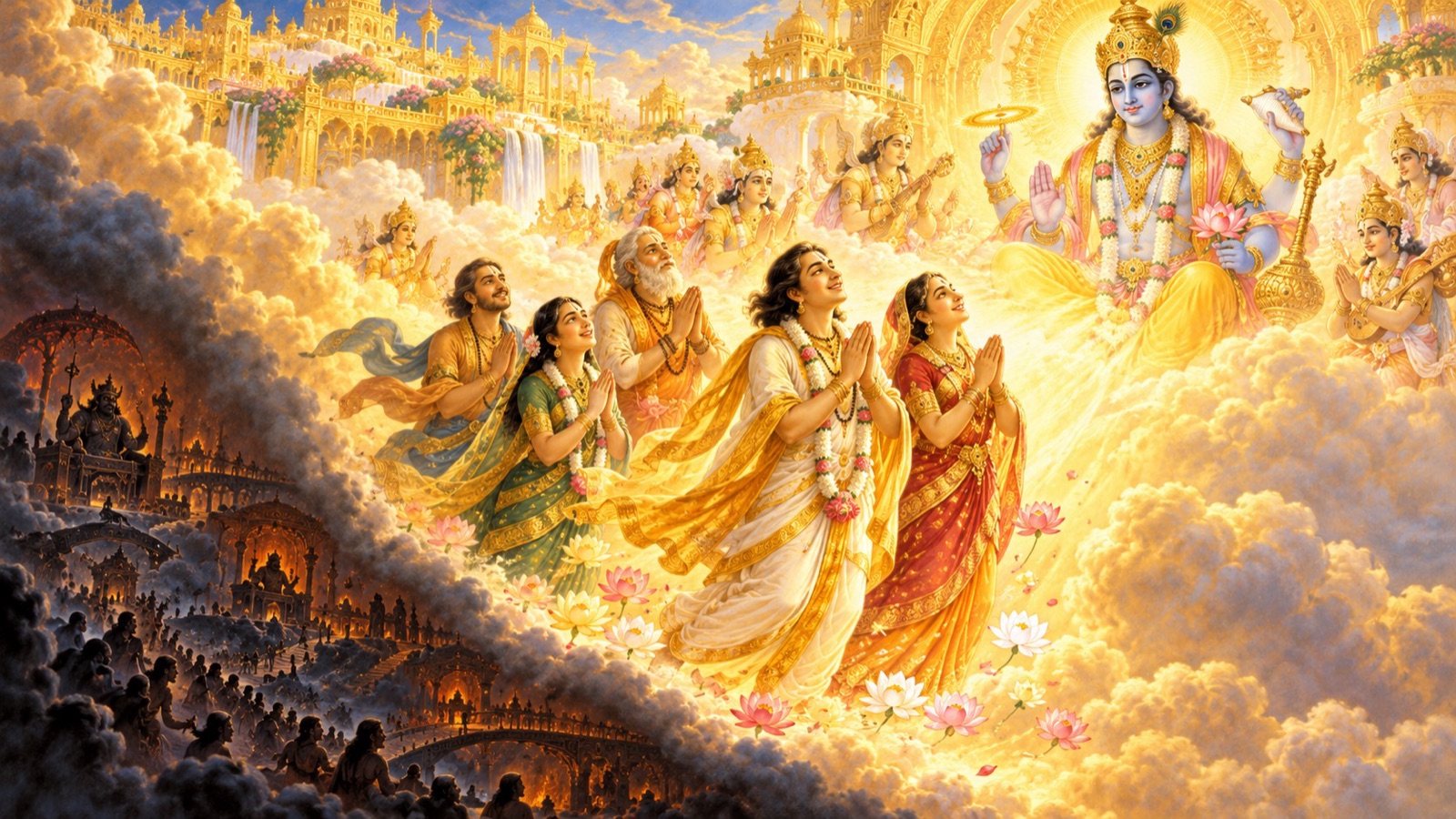
In the southern quarter below the earth, the glorious Yama, ruler of the departed, sits as a solemn crowned judge with his recorder beside him, measuring to each soul a correction exactly matched to its deeds — never overstepping the command of the almighty Lord.
Om Namo Bhagavate Vasudevaya.
Om Namo Bhagavate Vasudevaya.
Om Namo Bhagavate Vasudevaya.
Welcome back to Srimad Bhagavatam Wisdom, a devotional journey through the sacred histories and teachings of the Srimad Bhagavat Mahapurana. This twenty-sixth chapter is the last of Book Five, and in it Sri Suka completes his great map of creation. Having shown King Parikshit the earth and the realms above and below, he now turns, with a physician’s plain compassion, to the destinations that await the soul after death — the threefold fruit of the three modes, the southern realm where the departed are judged, and the many regions of reckoning through which the unrighteous pass. He tells all of this not to frighten, but to turn the heart homeward; and he closes the whole Canto by revealing that this vast universe is itself the gross form of the Lord Narayana, and that those who take shelter in Him are carried beyond all of it.
Chapter Information
- Scripture: Śrīmad Bhāgavata Mahāpurāṇa
- Canto: 5 (Book Five)
- Chapter: 26 (Discourse 26) — the final chapter of Book Five
- Chapter title: The Fruits of Karma and the Regions of Reckoning
- Principal speaker: Sukadeva Gosvami (Sri Suka), answering King Parikshit; within the outer frame, the discourse is related by Suta Gosvami to the sages gathered at Naimisaranya
- Principal listener: King Parikshit
- Main setting: The recounting of the cosmos — here, the southern quarter within the universe, below the earth and above the water, the abode of Yama and the manes
- Central subject: How the destinies of souls vary with the three modes and with faith; the southern realm where Yama judges the departed; the twenty-eight regions of reckoning and the deeds that lead to each; and the closing vision of the universe as the Lord’s own gross form, from which His devotees are wholly freed
- Principal verse range: Canto 5, Chapter 26, verses 1–40
- Primary edition: Gita Press Śrīmad Bhāgavata Mahāpurāṇa
From the Previous Chapter
In the twenty-fifth discourse, Sri Suka glorified Lord Ananta, the Supreme in His form as Sankarsana, who dwells far below the subterranean region of Patala and bears the whole earth like a grain of dust upon one of His countless hoods. He recounted the sage Narada’s loving hymn to that boundless Lord, whose glories no words can measure. Having led the king through the realms beneath the earth and the majesty of the Lord who upholds them, Sri Suka now brings his account of creation to its close.
The King’s Question
Gazing upon the vast and varied order Sri Suka had unfolded, King Parikshit asked how such heterogeneity in the world — the endless variety of conditions and destinies that beings meet — is to be accounted for. It is the question every thoughtful heart asks: why do the paths of living beings diverge so widely, some rising and some falling?
राजोवाच महर्ष एतद्वैचित्र्यं लोकस्य कथमिति ॥ १ ॥
rājovāca maharṣa etad vaicitryaṁ lokasya katham iti.
Meaning: The king said: O great sage, how is this endless variety in the world to be accounted for? (Canto 5, Chapter 26, verse 1)
The Threefold Fruit of the Three Modes
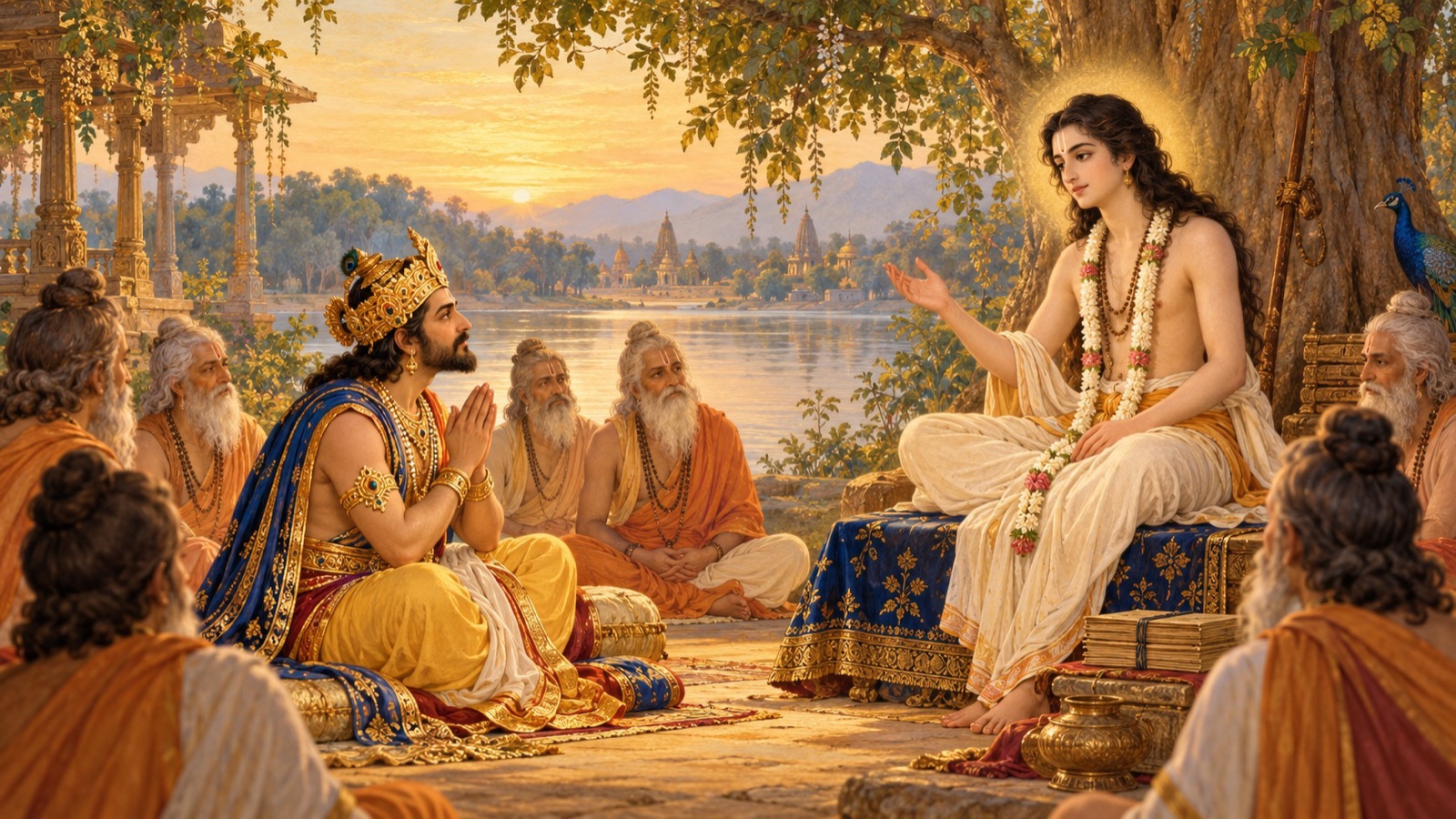
Sri Suka answered that a doer is always swayed by one or another of the three modes of Nature, and that his faith too is of three kinds — pure, passionate or dark — according to the mode that governs it. Because of this, the destinies reached through action differ from person to person, and in truth every soul tastes all of them, more and less, at different times; and just so, the fruit of a forbidden deed varies with the faith behind it. He would therefore describe the more prominent of the thousands of such conditions, ordained by the Lord, that arise from the sins of those who chase their desires under the spell of a beginningless ignorance.
ऋषिरुवाच त्रिगुणत्वात्कर्तु: श्रद्धया कर्मगतय: पृथग्विधा: सर्वा एव सर्वस्य तारतम्येन भवन्ति ॥ २ ॥
ṛṣir uvāca tri-guṇatvāt kartuḥ śraddhayā karma-gatayaḥ pṛthag-vidhāḥ sarvā eva sarvasya tāratamyena bhavanti.
Meaning: The sage said: Because the doer is swayed by the three modes, and because his faith accords with them, the destinies reached through action are of many kinds; and all of these are attained, in greater or lesser measure, by everyone. (Canto 5, Chapter 26, verse 2)
The Southern Realm and the Court of Yama
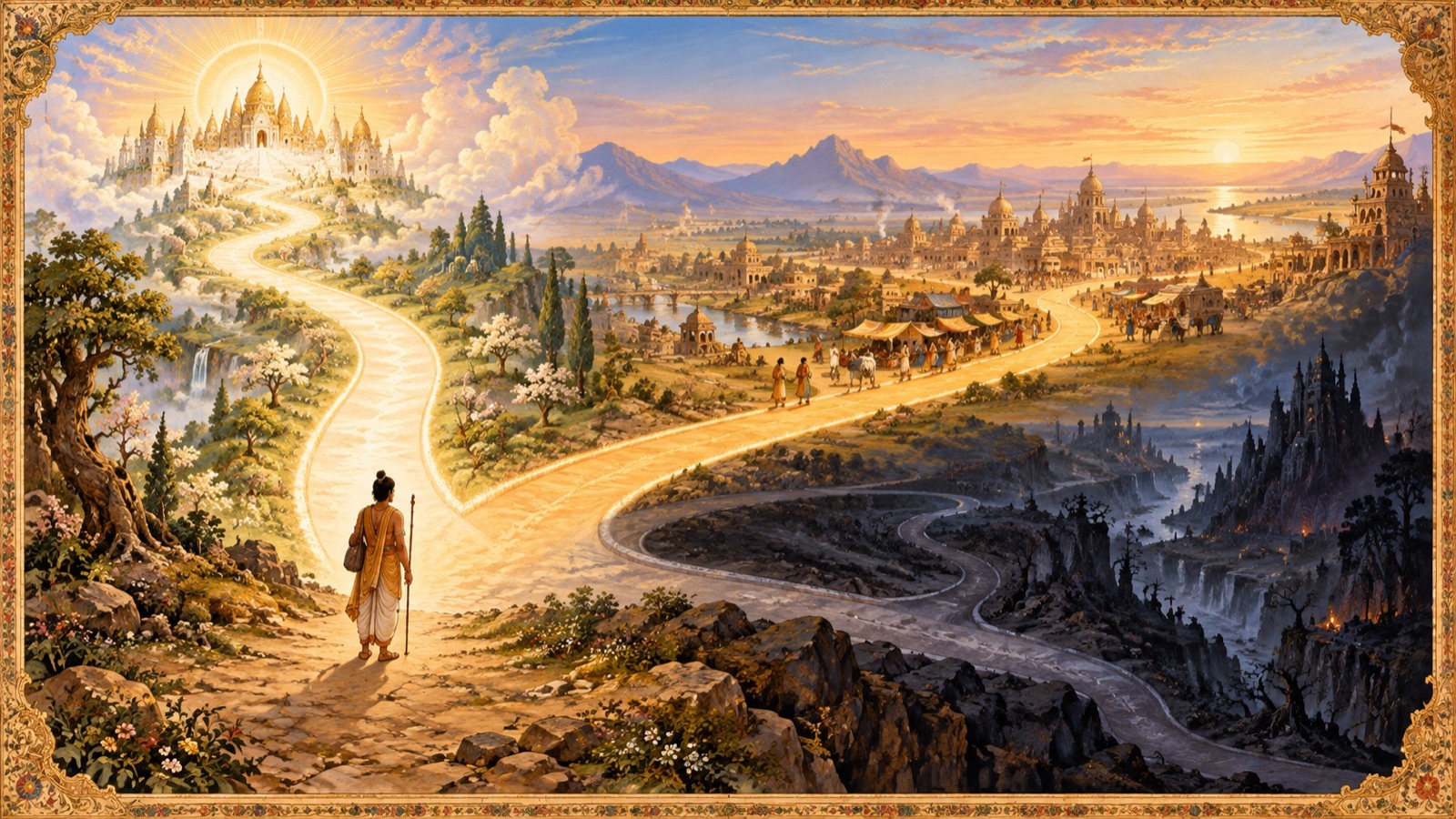
Then Parikshit asked whether these regions of suffering are particular spots upon the earth, or lie outside the shell of the universe, or somewhere within it. Sri Suka replied that they lie within this very universe, below the earth and above the water, on the southern side. There dwell the groups of the manes — the Agnisvattas and the rest — who contemplate the Lord and invoke only true blessings upon their descendants on the earth. And there resides the glorious Yama, son of the sun-god and ruler of the departed, who with his attendants receives the souls brought to his realm and measures to each a correction exactly proportioned to its deeds. He is no tyrant; he never favours the wicked nor lays on more than is deserved, and he never oversteps the command of the almighty Lord.
यत्र ह वाव भगवान् पितृराजो वैवस्वत: स्वविषयं प्रापितेषु स्वपुरुषैर्जन्तुषु सम्परेतेषु यथाकर्मावद्यं दोषमेवानुल्लङ्घितभगवच्छासन: सगणो दमं धारयति ॥ ६ ॥
yatra ha vāva bhagavān pitṛ-rājo vaivasvataḥ sva-viṣayaṁ prāpiteṣu sva-puruṣair jantuṣu sampareteṣu yathā-karmāvadyaṁ doṣam evānullaṅghita-bhagavac-chāsanaḥ sagaṇo damaṁ dhārayati.
Meaning: There the glorious Yama, ruler of the manes and son of the sun-god, together with his attendants, awards to the departed souls brought before him a correction exactly according to their deeds, never transgressing the command of the almighty Lord. (Canto 5, Chapter 26, verse 6)
It would be a mistake to read Yama’s court as vengeance running apart from the Lord’s mercy. Sri Suka is careful to show that Yama’s own authority is bound: he administers each correction under a law he did not make (verse 6), for the good of conditioned souls, not out of personal will. Every chastisement to come is therefore not divine anger but divine correction, meant to jolt the forgetful soul back toward the Lord. Yet Sri Suka’s telling carries a quiet warning: bound by the three modes and by faith itself (verse 2), the same soul, once punished and returned to earth, is prone to take up the same sins again (verse 37) — proof that chastisement alone cannot purify a heart that has not turned. This is why the chapter is finally not about fearing Yama, but about the easier path of surrendering to the Lord before correction becomes necessary.
The Twenty-Eight Regions of Reckoning
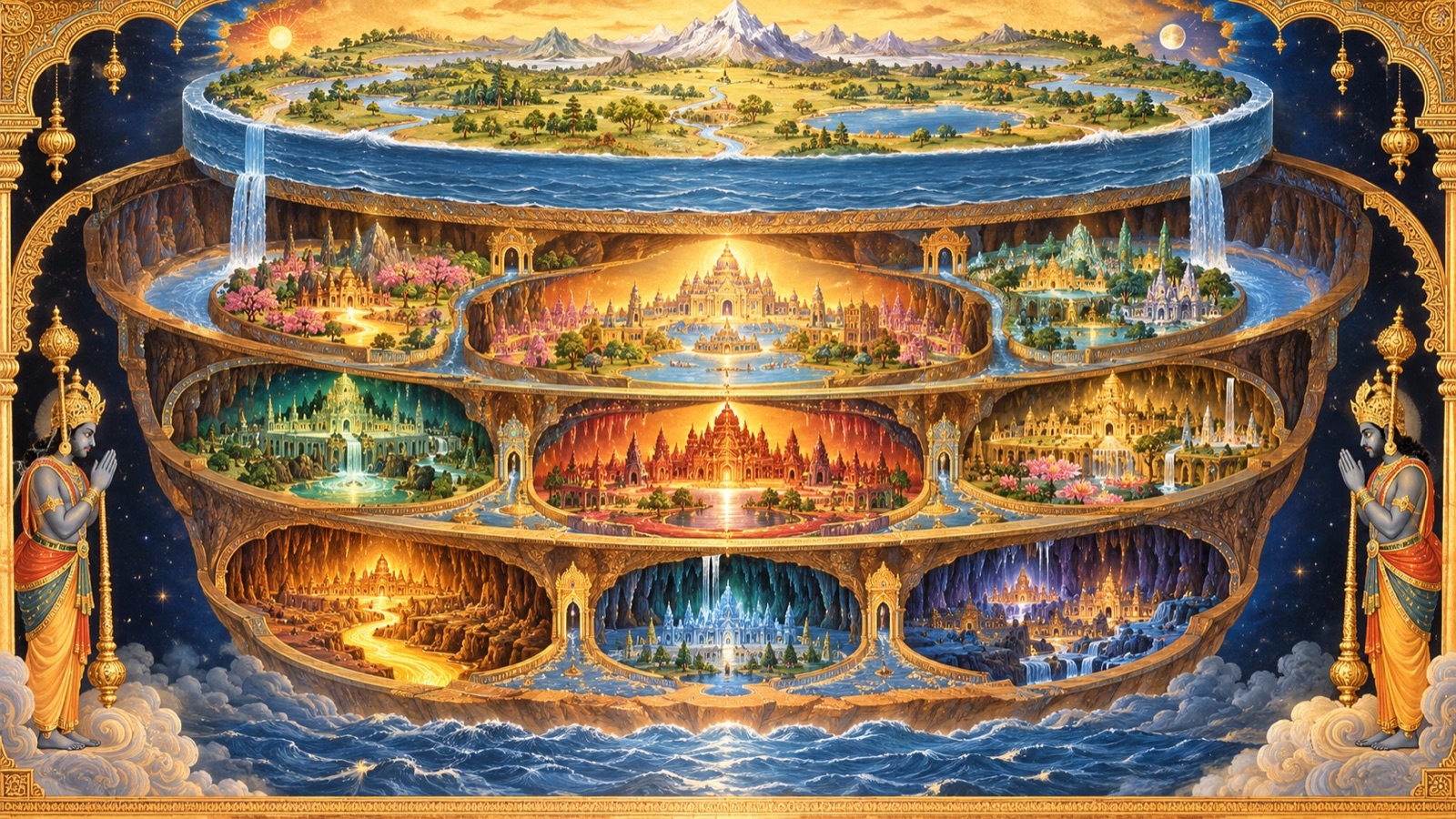
Some learned men, Sri Suka said, count the regions of Yama’s realm as twenty-one; and he would name them for the king in order, by their name, their nature and the deeds that lead to each. He named them one after another — Tamisra, Andhatamisra, Raurava, Maharaurava, Kumbhipaka, Kalasutra, Asipatravana, Sukaramukha, Andhakupa, Krimibhojana, Sandamsa, Taptasurmi, Vajrakantaka-salmali, Vaitarani, Puyoda, Pranarodha, Visasana, Lalabhaksa, Sarameyadana, Avici and Ayahpana — and, adding seven more, Ksarakardama, Raksogana-bhojana, Sulaprota, Dandasuka, Avata-nirodhana, Paryavartana and Sucimukha, he made the whole number twenty-eight.
तत्र हैके नरकानेकविंशतिं गणयन्ति अथ तांस्ते राजन्नामरूपलक्षणतोऽनुक्रमिष्यामस्तामिस्रोऽन्धतामिस्रो रौरवो महारौरव: कुम्भीपाक: कालसूत्रमसिपत्रवनं सूकरमुखमन्धकूप: कृमिभोजन: सन्दंशस्तप्तसूर्मिर्वज्रकण्टकशाल्मली वैतरणी पूयोद: प्राणरोधो विशसनं लालाभक्ष: सारमेयादनमवीचिरय:पानमिति । किञ्च क्षारकर्दमो रक्षोगणभोजन: शूलप्रोतो दन्दशूकोऽवटनिरोधन: पर्यावर्तन: सूचीमुखमित्यष्टाविंशतिर्नरका विविधयातनाभूमय: ॥ ७ ॥
tatra haike narakān eka-viṁśatiṁ gaṇayanti atha tāṁs te rājan nāma-rūpa-lakṣaṇato ’nukramiṣyāmas tāmisro ’ndhatāmisro rauravo mahārauravaḥ kumbhīpākaḥ kālasūtram asipatravanaṁ sūkaramukham andhakūpaḥ kṛmibhojanaḥ sandaṁśas taptasūrmir vajrakaṇṭaka-śālmalī vaitaraṇī pūyodaḥ prāṇarodho viśasanaṁ lālābhakṣaḥ sārameyādanam avīcir ayaḥpānam iti; kiñca kṣārakardamo rakṣogaṇa-bhojanaḥ śūlaproto dandaśūko ’vaṭa-nirodhanaḥ paryāvartanaḥ sūcīmukham ity aṣṭā-viṁśatir narakā vividha-yātanā-bhūmayaḥ.
Meaning: Some reckon the infernal regions as twenty-one; but, O king, I shall recount them in order by name, form and character — beginning with Tamisra and Andhatamisra — and, counting seven more beyond that first number, they are twenty-eight regions in all, places where various sufferings are undergone. (Canto 5, Chapter 26, verse 7)
The Deeds That Lead There
With grave tenderness, Sri Suka then showed which deeds carry a soul to each region — for the Bhagavatam names these places only that we might learn to shun the deeds behind them. One who takes away by force or fraud another’s wealth, child or wife is led to Tamisra; and he who enjoys another’s wife by deceiving her husband falls into Andhatamisra, the region of blinding darkness. He who feeds his own family alone through hostility to other creatures, taking the body for the self, comes to Raurava, where the very beings he harmed turn upon him; and he who nourishes only his own body while hating others reaches Maharaurava. One so cruel as to cook beasts and birds alive is cast into Kumbhipaka, and he who is hostile to his father, to a Brahmana, or to the Vedas descends to Kalasutra.
He who forsakes the path marked out by scripture, save in true emergency, and takes up a false creed comes to Asipatravana, the grove of sword-leaved trees; a king or officer who punishes the innocent or lays corporal punishment on a Brahmana falls to Sukaramukha. He who torments the small creatures whose lives the Lord Himself has ordained is led to Andhakupa, and he who eats without first sharing with guest and dependant and without offering the five daily sacrifices is born a worm in Krimibhojana. One who steals the gold or jewels of a Brahmana reaches Sandamsa; those who join unlawfully with one unworthy of such approach are brought to Taptasurmi; and he who gives himself to wholly indiscriminate lust comes to Vajrakantaka-salmali.
Further Regions and Their Causes
Sri Suka went on. Rulers and officers who, still professing the Vedic religion, yet trample its restraints, fall on death into the river Vaitarani that borders the regions of reckoning. He who abandons all purity and lives shamelessly like a beast is brought to Puyoda; and those who, keeping dogs and donkeys, delight in the chase and slay animals against the ordinance of scripture come to Pranarodha. Hypocrites who slaughter creatures in sacrifices performed for mere show reach Visasana, and the twice-born man who, blinded by passion, degrades his own wife is cast into Lalabhaksa. Robbers, or kings and soldiers, who by fire and poison plunder villages and travelling merchants are given to Sarameyadana, where the hounds that are Yama’s own messengers fall upon them; and he who tells a lie while giving evidence, in trade, or in the making of a gift is hurled into Avici, whose rocky surface only seems to be water.
A Brahmana, his wife, or one under a sacred vow who drinks wine, and the Kshatriya or Vaishya who wrongly drinks the soma extract, are led to Ayahpana. One of humble standing who through mere self-esteem refuses to honour those above him in learning, austerity and pious conduct comes to Ksarakardama. Those who offer human beings in sacrifice to Bhadrakali or Bhairava, and the women who share in such deeds, reach Raksogana-bhojana; those who, for cruel sport, torture and transfix innocent creatures are brought to Sulaprota; and those fierce as serpents, who molest other living beings, come to Dandasuka. Those who shut living beings up in dark holes, granaries and caves are confined in Avata-nirodhana; the wrathful householder who looks upon his guests with a burning, malicious eye is led to Paryavartana; and he who, proud of his wealth and full of egotism, distrusts all and guards his hoard like a demon, sinning to earn and keep it, comes at last to Sucimukha. In each, the fruit answers precisely to the deed — the Lord’s justice never erring, and never cruel.
Both Paths Return to Bharatavarsa
There are, Sri Suka said, hundreds and thousands of such spots in the abode of Yama; and all who walk the path of unrighteousness — whether Sri Suka named them or left them unspoken — pass through them, each in his turn. Just so, those who follow the path of virtue rise into the heavenly regions. Yet neither destination is the end: when the greater part of the fruit is reaped, both the virtuous and the sinful, carried by the residue of their deeds, return once more to this land of Bharatavarsa, the field of rebirth. Heaven and its opposite are alike passing; only the shelter of the Lord carries the soul beyond return.
एवंविधा नरका यमालये सन्ति शतश: सहस्रशस्तेषु सर्वेषु च सर्व एवाधर्मवर्तिनो ये केचिदिहोदिता अनुदिताश्चावनिपते पर्यायेण विशन्ति तथैव धर्मानुवर्तिन इतरत्र इह तु पुनर्भवे त उभयशेषाभ्यां निविशन्ति ॥ ३७ ॥
evaṁ-vidhā narakā yamālaye santi śataśaḥ sahasraśas teṣu sarveṣu ca sarva evādharma-vartino ye kecid ihoditā anuditāś cāvani-pate paryāyeṇa viśanti tathaiva dharmānuvartina itaratra iha tu punar-bhave ta ubhaya-śeṣābhyāṁ niviśanti.
Meaning: My dear King, there are hundreds and thousands of such regions in Yama’s domain, and every unrighteous soul — whether named here or left unspoken — passes through them in turn; the righteous, in the same way, rise to the higher worlds. Yet when the greater part of the fruit is spent, both the virtuous and the sinful return once more to this earth, carried by what remains of their deeds. (Canto 5, Chapter 26, verse 37)
The Universe as the Lord’s Own Form
Sri Suka then lifted the whole account to its true height. The path of Nivrtti — the turning away from worldly activity that leads to final freedom — he had described earlier. All that he had unfolded, from the shining spheres to the regions below, is only the extent of the egg-shaped universe, which the Puranas depict as fourteen spheres. And this whole universe, he revealed, is nothing other than the grossest, most well-known form of the Supreme Person, Bhagavan Narayana Himself, woven of the three modes of His own Maya. One who, full of reverence, reads this account, or hears it, or recites it to another, has his mind purified by faith and devotion, and comes to know even the subtle, incomprehensible aspect of the Supreme Spirit that is the theme of the Upanishads.
निवृत्तिलक्षणमार्ग आदावेव व्याख्यात: । एतावानेवाण्डकोशो यश्चतुर्दशधा पुराणेषु विकल्पित उपगीयते यत्तद्भगवतो नारायणस्य साक्षान्महापुरुषस्य स्थविष्ठं रूपमात्ममायागुणमयमनुवर्णितमादृत: पठति शृणोति श्रावयति स उपगेयं भगवत: परमात्मनोऽग्राह्यमपि श्रद्धाभक्तिविशुद्धबुद्धिर्वेद ॥ ३८ ॥
nivṛtti-lakṣaṇa-mārga ādāv eva vyākhyātaḥ; etāvān evāṇḍa-kośo yaś caturdaśadhā purāṇeṣu vikalpita upagīyate yat tad bhagavato nārāyaṇasya sākṣān mahā-puruṣasya sthaviṣṭhaṁ rūpam ātmamāyā-guṇamayam anuvarṇitam ādṛtaḥ paṭhati śṛṇoti śrāvayati sa upageyaṁ bhagavataḥ paramātmano ’grāhyam api śraddhā-bhakti-viśuddha-buddhir veda.
Meaning: This egg-shaped universe of fourteen spheres, as sung in the Puranas, is the grossest well-known form of Bhagavan Narayana, the Supreme Person, made of the modes of His own Maya. One who reverently reads, hears or recites this account — his mind purified by faith and devotion — comes to know even the subtle, otherwise ungraspable aspect of the Supreme Lord. (Canto 5, Chapter 26, verse 38)

Having heard of both the gross and the subtle aspects of the Lord, Sri Suka said, the seeker should first steady his mind upon the gross, and then, with a subtler understanding, rest it gently upon the subtle. And so he drew his great discourse to a close, declaring that he had now described for the king the whole ordered cosmos as the wonderful gross Body of the almighty Lord, the dwelling-place of every living being.
भूद्वीपवर्षसरिदद्रिनभ:समुद्र- पातालदिङ्नरकभागणलोकसंस्था । गीता मया तव नृपाद्भुतमीश्वरस्य स्थूलं वपु: सकलजीवनिकायधाम ॥ ४० ॥
bhū-dvīpa-varṣa-sarid-adri-nabhaḥ-samudra- pātāla-diṅ-naraka-bhāgaṇa-loka-saṁsthā gītā mayā tava nṛpādbhutam īśvarasya sthūlaṁ vapuḥ sakala-jīva-nikāya-dhāma
Meaning: O king, I have described to you the disposition of the earth and its lands, the rivers and mountains, the sky, the oceans, the subterranean regions, the quarters, the regions of reckoning, and the luminaries and spheres — the wonderful gross Body of the Lord, the abode of all living beings. (Canto 5, Chapter 26, verse 40)
Principal Teachings of This Chapter
Our destiny follows the mode and the faith that move us. The variety of the world is no accident: the soul is drawn along the mode of Nature that governs its heart, and its faith takes the same colour. To purify our faith by devotion is to change the very direction of our journey.
The Lord’s justice is exact, never cruel. Yama gives neither more nor less than a deed deserves, and never oversteps the Lord’s command. Behind the whole order of reckoning stands not a tyrant but a perfect, impartial law — one we walk free of the moment we turn toward the Lord.
This teaching is given out of compassion, as a warning. The Bhagavatam names the regions of suffering and the deeds that lead there so that we may recognise and forsake them — cruelty, deceit, theft, faithlessness, greed and pride. It is a lamp held up on a dark road, not to terrify us, but to guide our steps.
Heaven and its opposite are both passing. Virtue lifts the soul to higher regions and vice casts it down, yet both, their fruit once spent, return to the field of rebirth. Only the shelter of the Lord ends the endless round.
The whole universe is the Lord’s own form, and hearing of it purifies. The vast cosmos, from the highest sphere to the lowest region, is the gross Body of Narayana. To hear or recite this sacred account with faith cleanses the mind and opens the heart to His deathless presence.
A Devotional Reflection
It would be easy to read a chapter like this and feel only fear, but that is not the spirit in which Sri Suka speaks. He is like a loving physician who names each danger plainly, not to wound us, but because he wants us well. Every region he describes is the shadow of a single mistake — forgetting the Lord and living for the narrow self, unkind to the creatures around us, grasping at what is not ours. And every one of them can be escaped by the same simple turning of the heart: taking shelter in Narayana, remembering Him, seeing Him in all beings. What moves us most is where the chapter finally rests. After the long roll of reckoning, Sri Suka lifts our eyes to the whole universe and shows that it is the very Body of the Lord, and that to hear of it with devotion is itself purifying — the mercy of the Bhagavatam, whose sternest warning is only another way of calling us home.
A Daily Devotional Practice
Today, let the heart of this chapter shape one gentle resolve: to live in a way that harms no creature and clings to nothing that is not truly ours. Choose one small act of kindness toward a living being — a bird, an animal, a person in need — and offer it to the Lord. And once, in stillness, read or softly recite this closing truth of the Fifth Canto: that the whole universe is the form of Narayana, and that His devotees are carried beyond every region of reckoning. As you do, say inwardly: “Om Namo Bhagavate Vasudevaya.” In this the very hearing of the chapter becomes, as Sri Suka promised, a cleansing of the mind and a turning of the soul toward the Lord.
Conclusion
The twenty-sixth discourse brings Book Five to its close and completes Sri Suka’s great vision of creation. Answering King Parikshit, he explained how the destinies of souls diverge with the three modes and with faith, and how, on the southern side within the universe, the glorious Yama judges the departed with a justice exactly measured to their deeds and wholly bound to the will of the Lord. He named the twenty-eight regions of reckoning and, out of compassion, the deeds that lead to each — that we might learn to forsake cruelty, deceit and greed. He reminded us that even heaven is passing, and that virtuous and sinful alike return to be reborn, until the soul takes lasting shelter in the Lord. And he lifted the whole account to its summit, revealing that this entire universe is the gross form of Bhagavan Narayana, and that whoever hears or recites this sacred description with faith is purified and drawn toward the Lord’s deathless presence. So the Fifth Canto ends where all true wisdom ends — in the shelter of the Supreme, beyond every path of return.
May the divine wisdom of Srimad Bhagavatam awaken pure devotion within our hearts.
Om Namo Bhagavate Vasudevaya.
Jay Shree Madhav.
References and Attribution
- Primary edition: Gita Press, Śrīmad Bhāgavata Mahāpurāṇa, Book Five, Discourse 26, “A description of the infernal regions.”
- Series: Srimad Bhagavatam Wisdom · Biswa Sanatan Dharma Seva Trust.
- Presented following the spiritual guidance and recommendation of Pandit Dr. Shri Kashinath Mishra.
This is an original, faithful retelling in the writer’s own words, with brief quoted verses shown in Devanāgarī and transliteration and their meanings given as summaries. It is not a reproduction of any single publisher’s continuous translation or commentary. No affiliation with or endorsement by any publisher is implied.
Jay Shree Madhav