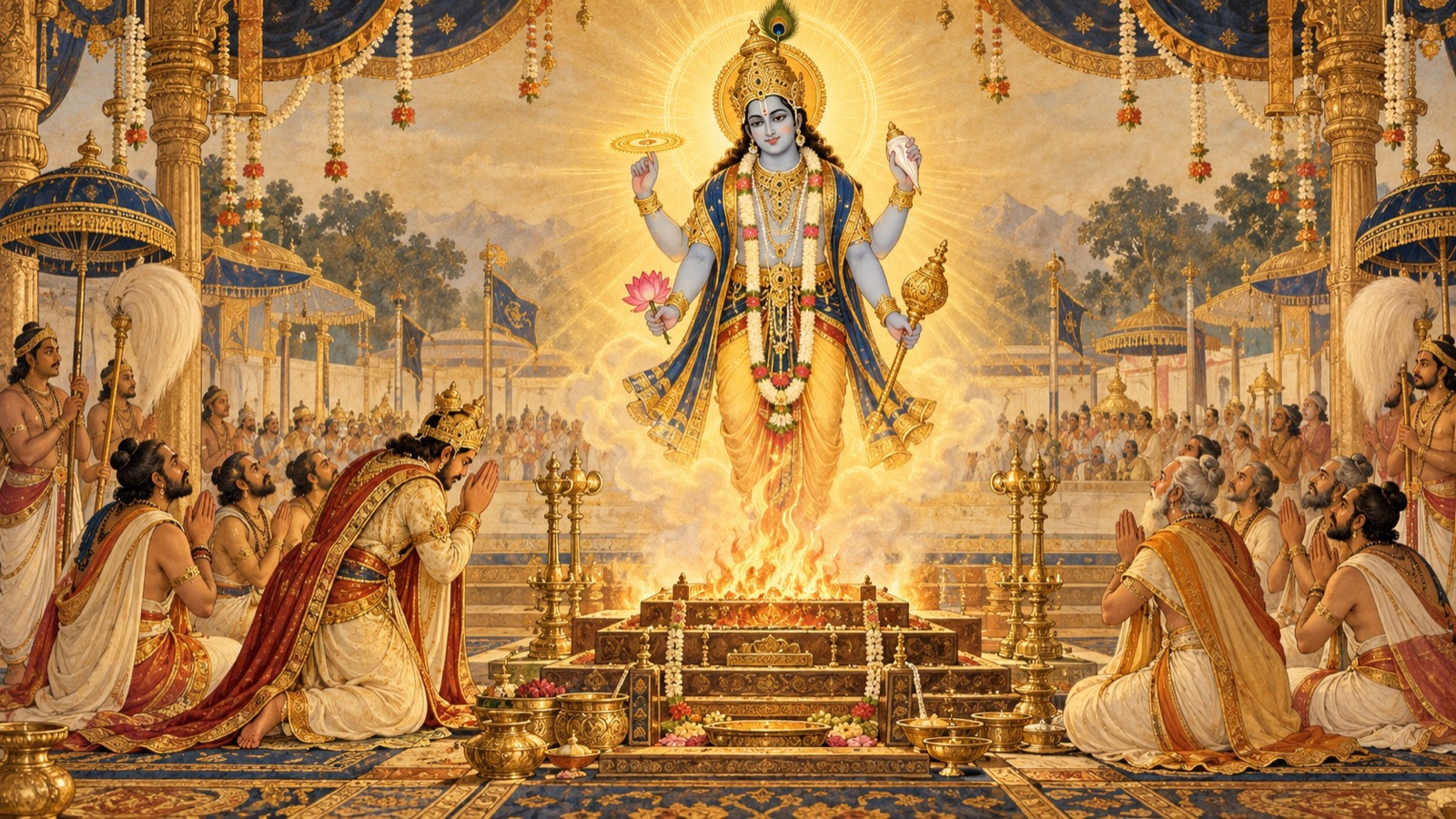
At the sacrifice of the pious King Nabhi, the Lord of sacrifices reveals His own most enchanting form — golden, four-armed, bearing conch, discus, lotus and mace — and the priests receive Him as penniless men receive a sudden treasure.
Om Namo Bhagavate Vasudevaya.
Om Namo Bhagavate Vasudevaya.
Om Namo Bhagavate Vasudevaya.
Welcome back to Srimad Bhagavatam Wisdom, a devotional journey through the sacred histories and teachings of the Srimad Bhagavat Mahapurana. In the previous chapter we followed the line of King Agnidhra down to his eldest son, Nabhi, who married the noble Merudevi. This third chapter of Book Five now tells one of the most tender and exalted episodes of the whole Canto: how the childless King Nabhi, longing for a worthy son, worshipped Lord Vishnu with a pure and concentrated heart — and how the Lord, moved by affection for His devotee, appeared in person at the sacrifice, accepted the loving hymn of the priests, and then made an astonishing promise: finding no one anywhere equal to Himself, He would descend as Nabhi’s own son. This is the sacred prelude to the advent of Lord Rsabhadeva, the great teacher of renunciation whose story unfolds through the chapters to come.
Chapter Information
- Scripture: Śrīmad Bhāgavata Mahāpurāṇa
- Canto: 5 (Book Five)
- Chapter: 3 (Discourse 3)
- Chapter title: The Descent of Lord Rsabhadeva
- Principal speaker: Sukadeva Gosvami (Sri Suka), narrating to King Parikshit
- Principal listener: King Parikshit — the whole discourse related in turn by Suta Gosvami to the sage Saunaka and the assembly of sages gathered at Naimisaranya
- Main setting: The sacrificial arena of King Nabhi, where the Pravargya rites are being performed, and the inner apartments of Queen Merudevi
- Central subject: How King Nabhi and Queen Merudevi, praying for a son, worshipped Lord Vishnu; how the Lord revealed His enchanting form and was extolled by the officiating priests; how, finding none equal to Himself, He promised to descend through Nabhi; and how He appeared as Lord Rsabhadeva in the womb of Merudevi
- Principal verse range: Canto 5, Chapter 3, verses 1–20
- Primary edition: Gita Press Śrīmad Bhāgavata Mahāpurāṇa
From the Previous Chapter
The second discourse of Book Five closed with the passing of King Agnidhra and the marriage of his nine sons to the nine daughters of Meru. Among these unions, the eldest son, Nabhi, wedded Merudevi. It is with this royal couple that the present chapter opens. Nabhi has inherited his father’s dominion and his father’s piety, but not yet a son to carry the line forward. And so, like his forefathers before him, he turns to worship — but here the worship draws down a grace far greater than any he had asked for.
A King’s Prayer for a Son
King Nabhi longed for offspring. His queen, Merudevi, was as yet childless, and together the royal couple set their hearts on a single desire: a worthy heir to continue their sacred line. To this end Nabhi undertook the worship of Lord Vishnu, the Deity who presides over all sacrifices, adoring Him with a mind wholly concentrated and a heart free of distraction.
श्रीशुक उवाच नाभिरपत्यकामोऽप्रजया मेरुदेव्या भगवन्तं यज्ञपुरुषमवहितात्मायजत ॥ १ ॥
śrī-śuka uvāca nābhir apatya-kāmo ’prajayā merudevyā bhagavantaṁ yajña-puruṣam avahitātmāyajata
Meaning: Sri Suka said: King Nabhi, longing for offspring, together with his childless queen Merudevi, worshipped with a wholly concentrated mind Lord Vishnu, the Supreme Person who presides over all sacrifices. (Canto 5, Chapter 3, verse 1)
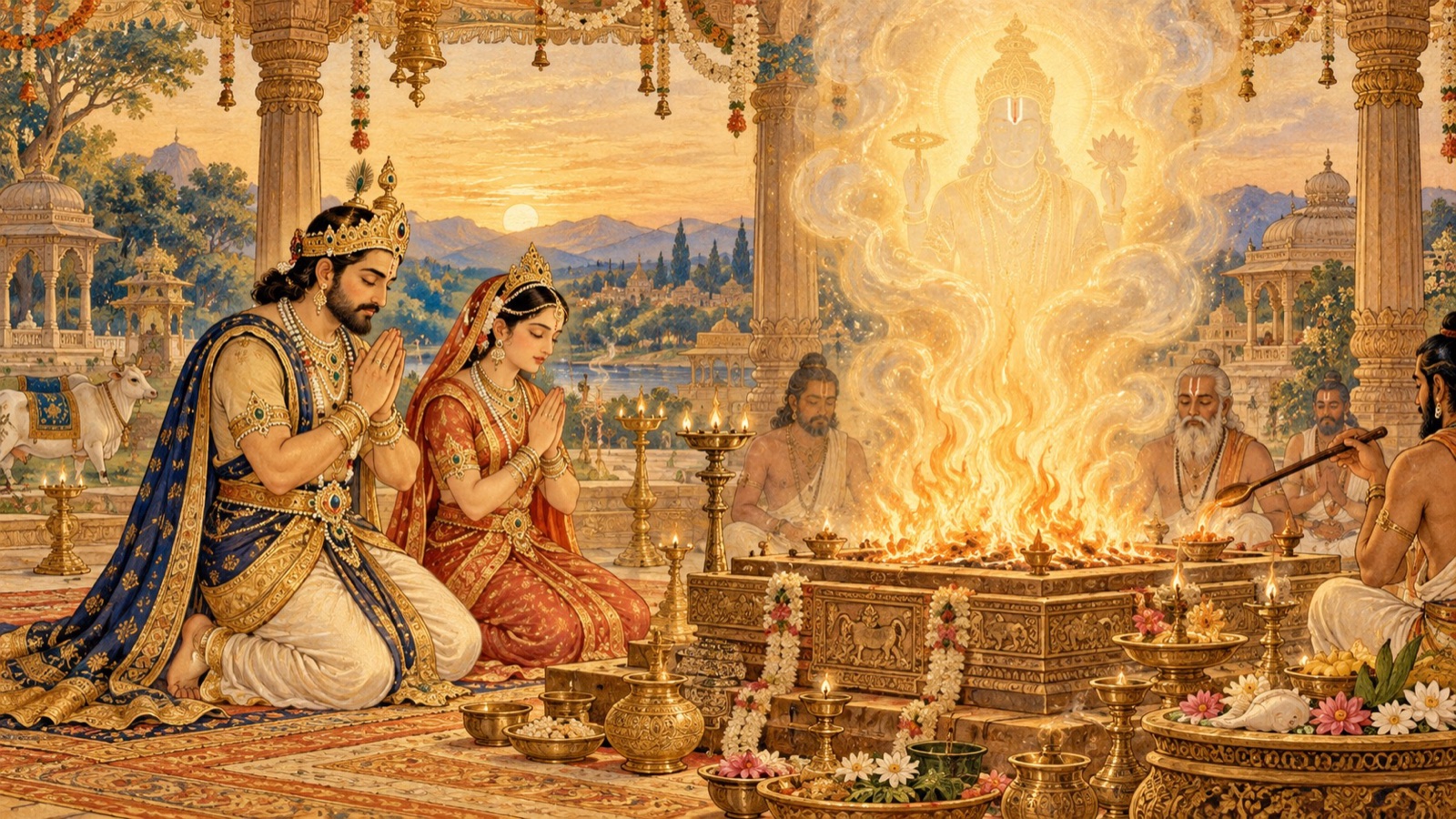
The Lord who is thus worshipped, the scripture reminds us, is difficult to attain even when every requisite of sacrifice — the offerings, the proper place and time, the sacred hymns, the qualified priests and their fees — is faultlessly arranged. He is not compelled by ritual machinery. And yet, because Nabhi worshipped Him with faith and a pure heart while the Pravargya rites were proceeding, the Lord — out of sheer affection for His devotees, and longing to fulfil His servant’s desire — chose to reveal His own most captivating, self-sufficient form, ravishing to the mind and delightful to the eyes.
The Lord Reveals His Enchanting Form
Then, at the sacrificial ground, the Lord appeared in a form of pure radiance. He manifested with two pairs of arms and a body like glowing gold, clad in tawny silk, the sacred Srivatsa mark upon His breast. In His hands He bore the conch, the lotus, a garland of sylvan flowers, the discus, the Kaustubha gem and the mace; He was adorned with a brilliant crown, gleaming earrings, bracelets, a jewelled girdle, necklace, armlets and anklets. Beholding this treasure of beauty, the officiating priests, the directors of the rite and the institutor of the sacrifice bowed their heads low and waited upon Him with worshipful offerings — like penniless men who, without warning, come upon untold wealth.
अथ ह तमाविष्कृतभुजयुगलद्वयं हिरण्मयं पुरुषविशेषं … ऋत्विक् सदस्यगृहपतयोऽधना इवोत्तमधनमुपलभ्य सबहुमानमर्हणेनावनतशीर्षाण उपतस्थु: ॥ ३ ॥
atha ha tam āviṣkṛta-bhuja-yugala-dvayaṁ hiraṇmayaṁ puruṣa-viśeṣaṁ … ṛtvik-sadasya-gṛha-patayo ’dhanā ivottama-dhanam upalabhya sabahu-mānam arhaṇenāvanata-śīrṣāṇa upatasthuḥ
Meaning: Then the Lord revealed a transcendent, golden form with two pairs of arms, clad in tawny silk and marked on His breast with the Srivatsa, bearing conch, lotus, forest-flower garland, discus, Kaustubha gem, mace and other emblems, and adorned with a radiant crown, earrings, bracelets, girdle, necklace, armlets and anklets. The priests, the members of the assembly and the institutor of the sacrifice, like penniless men obtaining great wealth, bowed their heads and worshipped Him with reverent offerings. (Canto 5, Chapter 3, verse 3)
The Hymn of the Priests
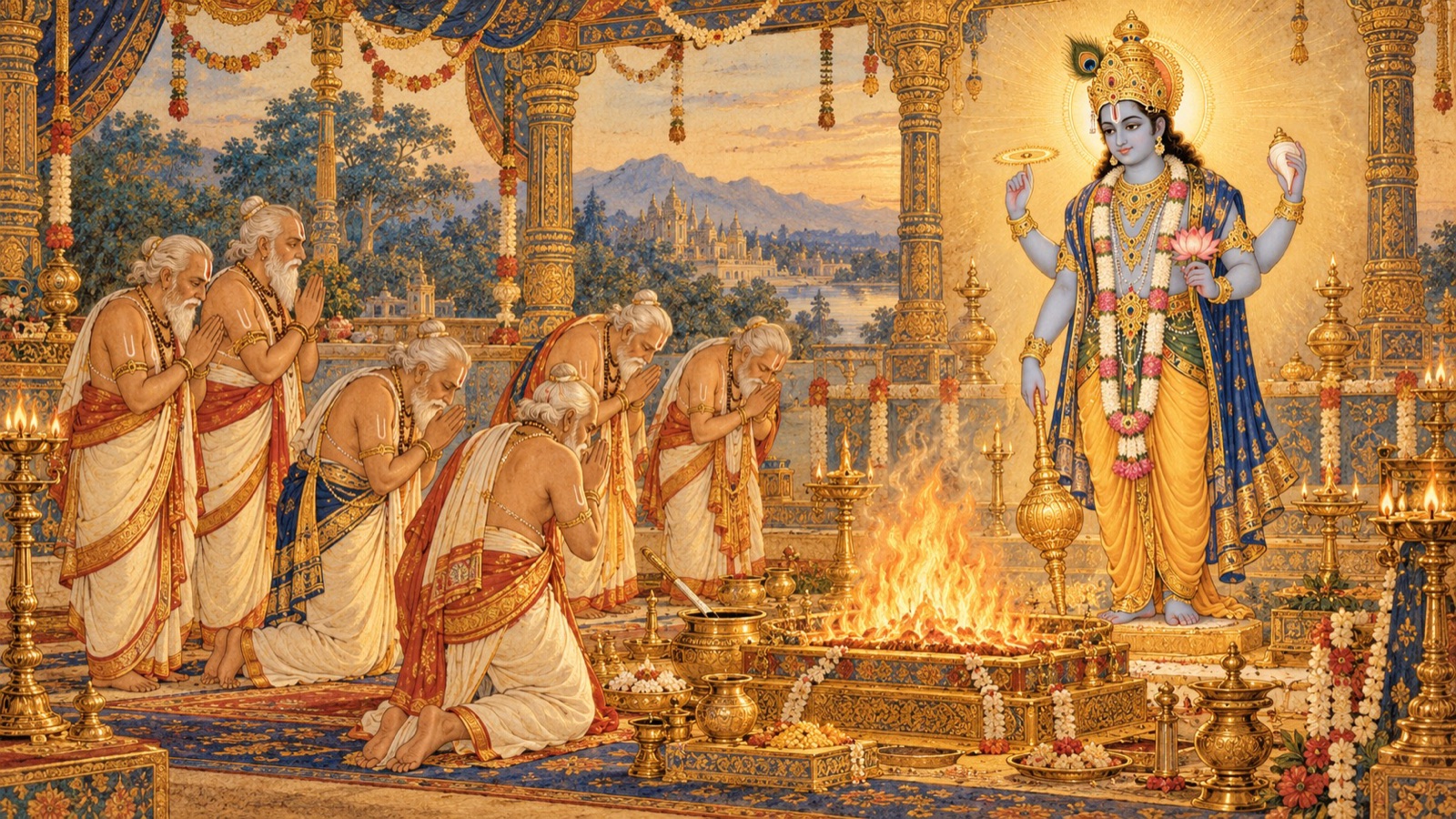
Overwhelmed by grace, the officiating priests broke into a hymn of praise, couched not in metre but in flowing prose. Their prayer is one of the loveliest confessions of humility in the Bhagavata. They begin by admitting that they are wholly unequal to the task of extolling Him: no worldly person, whose intelligence is entangled in the interplay of the material qualities, can possibly determine the true nature of the Supreme Lord — who stands beyond both Prakriti and Purusa — through the names, colours and forms of this created universe. The most anyone can do, they say, is to recount a small portion of His auspicious glories, and even that small recital washes away the sins of all beings.
Then comes a verse that has comforted devotees for ages — the reassurance that the Lord is won not by grandeur but by love:
परिजनानुरागविरचितशबलसंशब्दसलिलसितकिसलयतुलसिकादूर्वाङ्कुरैरपि सम्भृतया सपर्यया किल परम परितुष्यसि ॥ ६ ॥
parijanānurāga-viracita-śabala-saṁśabda-salila-sita-kisalaya-tulasikā-dūrvāṅkurair api sambhṛtayā saparyayā kila parama parituṣyasi
Meaning: O Supreme One, You are surely satisfied even by a simple worship offered by Your loving servants in a faltering voice — with only pure water, fresh undefiled leaves, tulasi and blades of grass gathered in devotion. (Canto 5, Chapter 3, verse 6)
The priests confess further that this elaborate sacrifice can add nothing to Him: He is Himself the very embodiment of all four aims of human life, and every opulence they might offer is already, unceasingly, His own. Such arrangements exist only for the worshipper’s sake, not the Lord’s — a truth they press further when they say that even His presence here answers no need of His own. He has come, they say, only as a compassionate teacher goes to the unlearned: not to receive anything, but so that eyes too clouded to perceive Him in His true glory may nonetheless behold Him, and be blessed by that sight alone. Even the greatest sages, who have burned away every trace of worldly desire in the fire of knowledge and find their joy simply in chanting His names, encounter His personal presence only rarely; how much greater, then, is the grace shown here to ordinary priests at Nabhi’s sacrifice (verses 7–11). It is this same mercy that will carry forward when the Lord descends as Rsabhadeva — not because the world’s ascetics need His example, but because His example is itself a gift, freely given for the world’s sake.
At the heart of their hymn is a prayer not for wealth or heaven, but for remembrance — that the Lord’s holy names might rise unbidden to their lips in the very moments when they are least able to call on Him:
अथ कथञ्चित्स्खलनक्षुत्पतनजृम्भणदुरवस्थानादिषु विवशानां न: स्मरणाय ज्वरमरणदशायामपि सकलकश्मलनिरसनानि तव गुणकृतनामधेयानि वचनगोचराणि भवन्तु ॥ १२ ॥
atha kathañcit skhalana-kṣut-patana-jṛmbhaṇa-duravasthānādiṣu vivaśānāṁ naḥ smaraṇāya jvara-maraṇa-daśāyām api sakala-kaśmala-nirasanāni tava guṇa-kṛta-nāmadheyāni vacana-gocarāṇi bhavantu
Meaning: May Your sin-destroying names, born of Your divine qualities, come of themselves upon our tongues — even when, helpless, we stumble, are hungry, fall, yawn or lie in distress, and even in the agony of fever and at the hour of death — so that we may remember You. (Canto 5, Chapter 3, verse 12)
Finally, with disarming honesty, the priests turn to the reason for the sacrifice. This royal sage Nabhi, longing for a son, has taken shelter of the Lord who can grant even heaven and liberation — hoping for a son like Him, as a pauper might approach Kubera, the treasurer of the gods, hoping for a mere handful of husk. Unless one takes shelter of the feet of the Lord’s great devotees, the priests confess, one is bound to be swept away by this invincible Maya — for who on earth has not been carried off by the poisoned waves of material enjoyment, whose workings no one can trace or resist unaided? And so they beg the Lord, in His perfect impartiality, to overlook the impropriety of ignorant people who prize offspring above all else, and who have summoned the Supreme Deity Himself for so small a purpose.
The Lord’s Gracious Reply
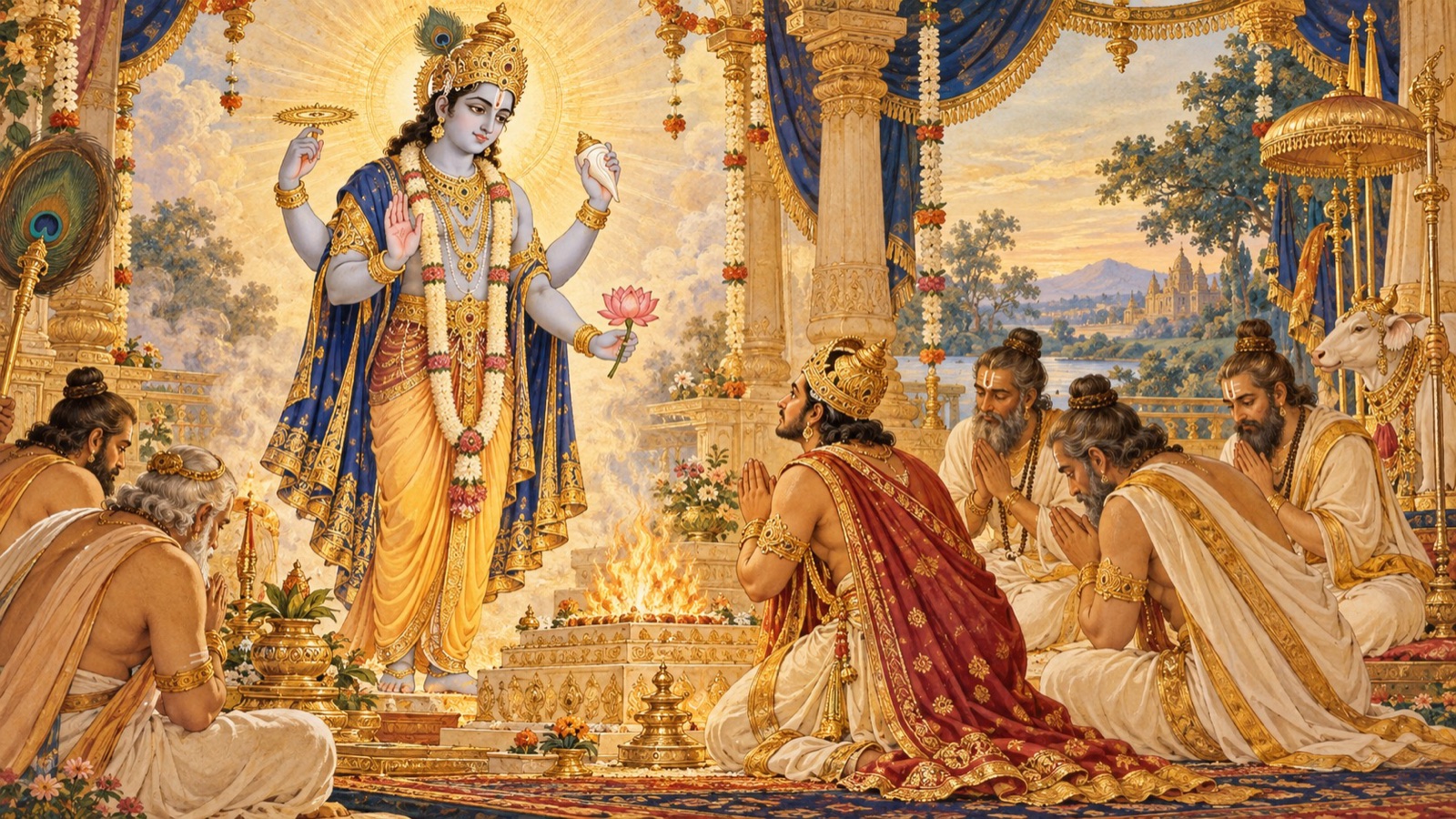
When the Lord had been thus extolled through their hymn in prose, and the priests stood bowing at His feet, He graciously replied. His answer is at once a gentle correction and an extraordinary promise.
श्रीभगवानुवाच अहो बताहमृषयो भवद्भिरवितथगीर्भिर्वरमसुलभमभियाचितो यदमुष्यात्मजो मया सदृशो भूयादिति ममाहमेवाभिरूप: कैवल्यादथापि ब्रह्मवादो न मृषा भवितुमर्हति ममैव हि मुखं यद् द्विजदेवकुलम् ॥ १७ ॥
śrī-bhagavān uvāca aho batāham ṛṣayo bhavadbhir avitatha-gīrbhir varam asulabham abhiyācito yad amuṣyātmajo mayā sadṛśo bhūyād iti mamāham evābhirūpaḥ kaivalyād athāpi brahma-vādo na mṛṣā bhavitum arhati mamaiva hi mukhaṁ yad dvija-deva-kulam
Meaning: The Lord said: O sages, whose words never prove false, you have begged of Me a rare and difficult boon — that a son equal to Me be born to this royal sage. But since I am matchless and one without a second, I alone am My own equal; there is none like Me. Yet the word of the Brahmanas must never prove untrue, for the community of Brahmanas is My very own mouth. (Canto 5, Chapter 3, verse 17)
Because no equal to Himself could be found anywhere, and because the words of the Brahmanas must be honoured, the Lord resolved the difficulty in the only way possible: He would come Himself. He would descend upon the earth through Nabhi, the son of Agnidhra, manifesting a portion of His own being.
The Descent of Lord Rsabhadeva
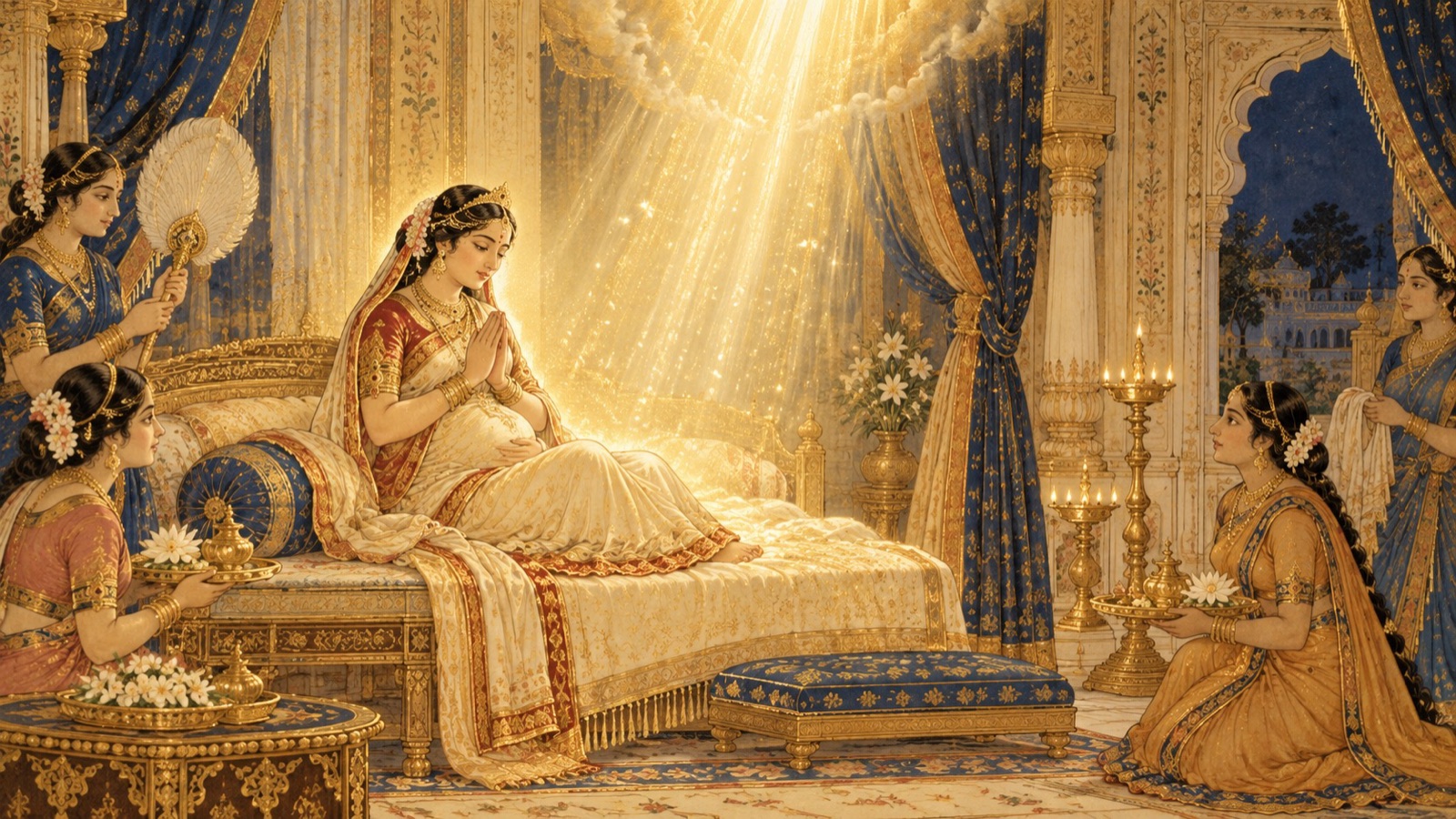
Having spoken these words within the hearing of Merudevi, the consort of the royal couple, the Lord vanished from sight. Then, propitiated at that very sacrifice by the great seers, and wishing to do a kindness to His devotee King Nabhi, the Lord descended in the inner apartments of Queen Merudevi, in a form of pure goodness. He came not only to fulfil a father’s longing but to teach the whole world by His own example — to demonstrate the sacred vows kept by ascetic sages who go clothed only by the open air, who lead lives of severe austerity, and who are pledged to lifelong celibacy.
बर्हिषि तस्मिन्नेव विष्णुदत्त भगवान् परमर्षिभि: प्रसादितो नाभे: प्रियचिकीर्षया तदवरोधायने मेरुदेव्यां धर्मान्दर्शयितुकामो वातरशनानां श्रमणानामृषीणामूर्ध्वमन्थिनां शुक्लया तनुवावततार ॥ २० ॥
barhiṣi tasminn eva viṣṇudatta bhagavān paramarṣibhiḥ prasādito nābheḥ priya-cikīrṣayā tad-avarodhāyane merudevyāṁ dharmān darśayitu-kāmo vāta-raśanānāṁ śramaṇānām ṛṣīṇām ūrdhva-manthināṁ śuklayā tanuvāvatatāra
Meaning: O Vishnudatta (Parikshit), propitiated at that very sacrifice by the great seers, the Lord — wishing to do good to King Nabhi — descended in the inner apartments of Queen Merudevi in a form of pure goodness, desiring also to teach the world, by His own example, the sacred vows observed by ascetic sages who go clothed only by the air, lead lives of austerity, and are pledged to perpetual celibacy. (Canto 5, Chapter 3, verse 20)
Thus concludes the sacred prelude. The child conceived in Merudevi’s womb is Lord Rsabhadeva — counted among the manifestations of the Lord named in the very first Canto — whose sovereignty, teachings and renunciation Book Five will unfold in the discourses that follow.
Principal Teachings of This Chapter
The Lord is drawn by love, not compelled by ritual. Though He is “difficult to attain even when every requisite of sacrifice is faultlessly arranged,” the Lord reveals Himself to Nabhi because of the king’s faith and pure heart. The chapter teaches that no machinery of worship can force His hand; it is sincere affection, offered even with simple water, leaves and tulasi, that wins Him.
Humility is the true language of prayer. The priests, though learned enough to conduct the greatest of sacrifices, confess that they can no more measure the Lord than the powerless can grasp the boundless. Their hymn shows that the highest reverence begins in admitting our smallness before Him — and that even our best praise touches only a fraction of His glory.
Ask for remembrance above all else. The most beautiful prayer of the chapter is not for a son, or heaven, or wealth, but that the Lord’s holy names might rise to the tongue even in helplessness, in illness, and at the hour of death. To seek the grace of remembrance is to ask for the one gift that carries the soul safely across every crisis.
The word of the Brahmanas must not fail. When the sages ask for a son equal to the Lord — a boon that, strictly, is impossible, for He has no equal — He honours their words nonetheless by coming Himself. The chapter reveals both the sanctity the Lord attaches to the speech of His devotees and the boundless lengths of His grace.
The Lord descends to teach by example. Rsabhadeva comes not only to answer a prayer but to demonstrate, in His own life, the path of austerity and renunciation for the instruction of the world. The advent of the Lord is always, at heart, an act of compassionate teaching.
A Devotional Reflection
There is something deeply moving in the way this chapter unfolds. A childless king asks only for a son, and the Lord of all sacrifices — whom the wisest sages cannot describe — appears before him in person and promises to become that son Himself. The distance between what Nabhi asks and what he receives is the very measure of divine grace: we come to the Lord with our small, human longings, and He answers with the gift of His own presence. The priests understood this. That is why, standing before the object of every possible boon, they prayed above all for remembrance — knowing that to keep His name upon the tongue is worth more than every kingdom heaven could grant. Their prayer can become ours. In our own stumbling, in our fevers and our forgetfulness, we too may ask that His name rise of itself within us. For the Lord who came into Merudevi’s womb out of love for a devotee is the same Lord who draws near to every sincere heart, still asking only for our affection, and still giving, in return, immeasurably more than we know how to seek.
A Daily Devotional Practice
Following the priests’ most tender prayer, take up the practice of remembrance. Choose one holy name of the Lord — “Vasudeva,” “Vishnu,” “Madhava” — and let it accompany you quietly through the day: at waking, before meals, in moments of difficulty, and as you fall asleep. Do not wait for a grand occasion. As the sages prayed that the Lord’s name might come to them even in helplessness, train the heart now, in small and ordinary moments, so that the name becomes a familiar friend — one that will not desert you when you most need it.
Conclusion
The third discourse of Book Five is the sacred prelude to the advent of Lord Rsabhadeva. The childless King Nabhi, with his queen Merudevi, worships Lord Vishnu with a pure and concentrated heart; and the Lord, moved by affection, appears in His enchanting golden form at the sacrifice. The officiating priests extol Him in a hymn of profound humility, confessing that He is won by love rather than ritual, and praying that His holy names may live upon their tongues even in their most helpless hours. When they beg for a son equal to the Lord, He answers that He alone is His own equal — and, unwilling to let the words of the Brahmanas prove false, He resolves to descend Himself. Vanishing from the sacrifice, He appears in a form of pure goodness in the womb of Merudevi, coming to fulfil a devotee’s longing and to teach the world the path of renunciation. As Book Five now turns to the life and sovereignty of Lord Rsabhadeva, we carry forward the chapter’s abiding lesson: that the Lord gives Himself to those who love Him.
May the divine wisdom of Srimad Bhagavatam awaken pure devotion within our hearts.
Om Namo Bhagavate Vasudevaya.
Jay Shree Madhav.
References and Attribution
- Primary edition: Gita Press, Śrīmad Bhāgavata Mahāpurāṇa (English, complete), Book Five, Discourse 3, “The descent of Lord Rsabha,” pages 448–451.
- Series: Srimad Bhagavatam Wisdom · Biswa Sanatan Dharma Seva Trust.
- Presented following the spiritual guidance and recommendation of Pandit Dr. Shri Kashinath Mishra.
This is an original, faithful retelling in the writer’s own words, with brief quoted verses shown in Devanāgarī and transliteration and their meanings given as summaries. It is not a reproduction of any single publisher’s continuous translation or commentary. No affiliation with or endorsement by any publisher is implied.
Jay Shree Madhav