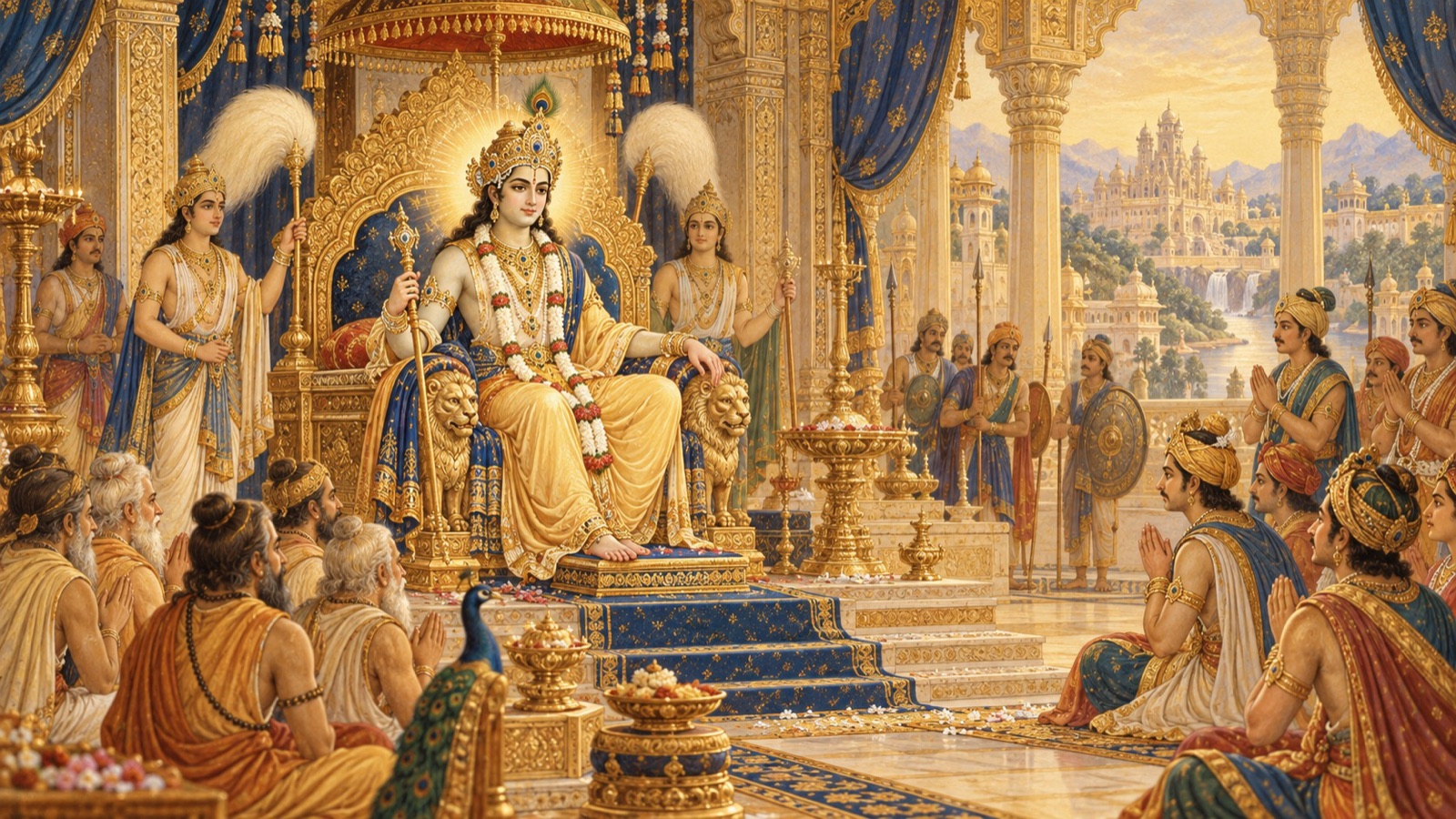
Bearing the marks of divinity from His very birth, Lord Rsabhadeva reigns over the earth in radiant majesty — the Supreme Lord Himself, ruling as a mortal to teach the world the path of righteousness by His own example.
Om Namo Bhagavate Vasudevaya.
Om Namo Bhagavate Vasudevaya.
Om Namo Bhagavate Vasudevaya.
Welcome back to Srimad Bhagavatam Wisdom, a devotional journey through the sacred histories and teachings of the Srimad Bhagavat Mahapurana. In the previous chapter, the childless King Nabhi worshipped Lord Vishnu for a worthy son, and the Lord — finding none equal to Himself — descended in person into the womb of Queen Merudevi. This fourth chapter of Book Five tells what followed: the wondrous glory of that divine child, Lord Rsabhadeva. From His very birth He bore the unmistakable marks of Godhead; His father named Him “the foremost,” He humbled the pride of Indra by sending down rains through His own power, He fathered a hundred noble sons — the eldest of whom, Bharata, would give this very land its name — and He reigned as the perfect king, though He was the Supreme Lord Himself, acting like an ordinary mortal only to teach the world by His own example. This chapter is a portrait of divinity clothed in human duty.
Chapter Information
- Scripture: Śrīmad Bhāgavata Mahāpurāṇa
- Canto: 5 (Book Five)
- Chapter: 4 (Discourse 4)
- Chapter title: The Divine Glory of Lord Rsabhadeva
- Principal speaker: Sukadeva Gosvami (Sri Suka), narrating to King Parikshit
- Principal listener: King Parikshit — the whole discourse related in turn by Suta Gosvami to the sage Saunaka and the assembly of sages gathered at Naimisaranya
- Main setting: The realm of King Nabhi (Ajanabha, later called Bharatavarsa), and Brahmavarta, where Lord Rsabhadeva rules and addresses His sons
- Central subject: The divine marks and glory of Lord Rsabhadeva; His naming; His humbling of Indra by sending rains; King Nabhi’s joy and his retirement to Badarikasrama; the hundred sons headed by Bharata; and Rsabhadeva’s ideal reign as the Supreme Lord teaching righteousness by His own example
- Principal verse range: Canto 5, Chapter 4, verses 1–19
- Primary edition: Gita Press Śrīmad Bhāgavata Mahāpurāṇa
From the Previous Chapter
The third discourse of Book Five closed with the descent of the Lord into the inner apartments of Queen Merudevi. In answer to King Nabhi’s sacrifice and the priests’ humble hymn, and unwilling to let the words of the Brahmanas prove false, the Supreme Lord had resolved to become Nabhi’s son Himself, appearing in a form of pure goodness to teach the world the path of renunciation. That divine child is Lord Rsabhadeva. This chapter now opens upon His childhood and His reign, unfolding the glory of the God who had consented to be born as a devotee’s son.
Marks of Divinity from Birth
From the very moment of His birth, Lord Rsabhadeva bore the unmistakable signs of Godhead. His nature shone with equanimity, mastery of the inner and outer senses, freedom from craving, universal dominion and perfection in all things — and this glory increased with every passing day. Seeing it, the ministers, the citizens, the Brahmanas and even the gods eagerly longed that He should rule over the earth. Considering His exquisite personality — His majesty, strength, splendour, glory, commanding influence and energy — His father, King Nabhi, gave Him the name Rsabha, “the foremost.”
तस्य ह वा इत्थं वर्ष्मणा वरीयसा बृहच्छ्लोकेन चौजसा बलेन श्रिया यशसा वीर्यशौर्याभ्यां च पिता ऋषभ इतीदं नाम चकार ॥ २ ॥
tasya ha vā itthaṁ varṣmaṇā varīyasā bṛhac-chlokena caujasā balena śriyā yaśasā vīrya-śauryābhyāṁ ca pitā ṛṣabha itīdaṁ nāma cakāra
Meaning: Considering His towering personality, His fame celebrated in noble verse, His energy, strength, majesty, glory, valour and heroism, His father gave Him the name Rsabha — “the foremost.” (Canto 5, Chapter 4, verse 2)
The Lord Who Commanded the Rains
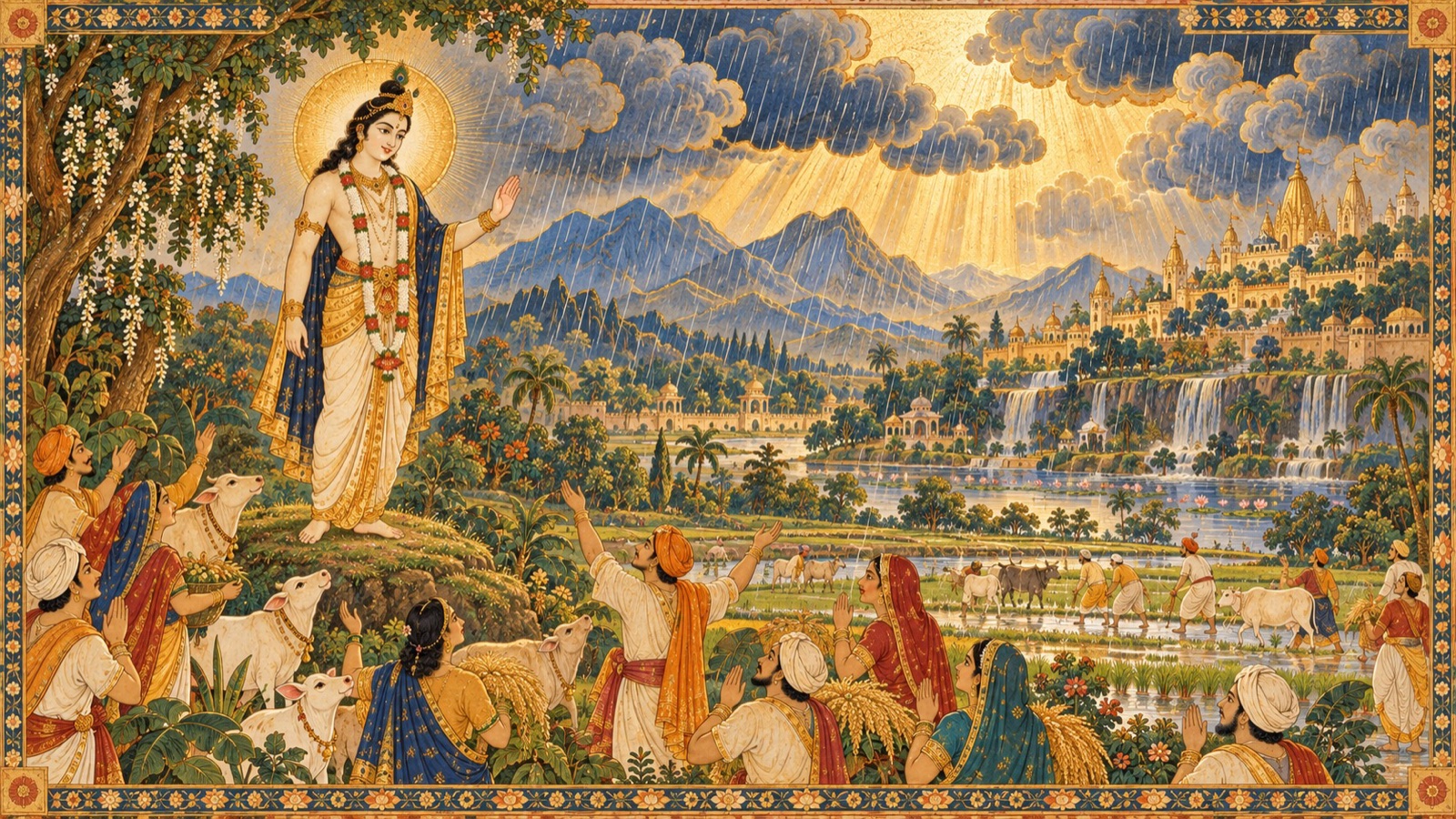
The greatness of the child did not go unchallenged. Envying Him, the mighty Indra, king of the gods, withheld the rains from His land. But nothing is hidden from the Lord of Yoga. Knowing what Indra had done, Rsabhadeva only laughed — and by His own divine potency, His Yogamaya, He sent abundant showers falling across the whole of His realm, the land then known as Ajanabha. The pride of the storm-king was answered not with anger but with an effortless smile, for the One who sustains all worlds has no need to beg the clouds for water.
यस्य हीन्द्र: स्पर्धमानो भगवान् वर्षे न ववर्ष तदवधार्य भगवानृषभदेवो योगेश्वर: प्रहस्यात्मयोगमायया स्ववर्षमजनाभं नामाभ्यवर्षत् ॥ ३ ॥
yasya hīndraḥ spardhamāno bhagavān varṣe na vavarṣa tad avadhārya bhagavān ṛṣabhadevo yogeśvaraḥ prahasyātma-yogamāyayā sva-varṣam ajanābhaṁ nāmābhyavarṣat
Meaning: When the mighty Indra, contending with Him, withheld rain from His land, Lord Rsabhadeva, the Master of Yoga, understood it, and laughing, by His own Yogamaya sent down showers throughout His realm, known as Ajanabha. (Canto 5, Chapter 4, verse 3)
Beneath the drama of this contest lies the chapter’s deeper meaning about the Lord’s own nature. Indra rules the rains only as an appointed steward of the Supreme; Rsabhadeva is Himself the yajna-pati, the very Lord of sacrifice, for whose satisfaction every oblation and every fall of rain ultimately exists. Because He is the source and never a dependent, He had no need to beg, bargain or retaliate — He simply supplied what His land required, unasked, the moment Indra’s stewardship faltered. The same truth reaches every age: when the elaborate sacrifices of Rsabhadeva’s time grow difficult to perform, as in our own, the same Lord of sacrifice remains reachable through the humbler offering of sankirtana, the congregational chanting of His holy names. A smile, not a curse, is how the Supreme answers envy — for one who already possesses everything has nothing to prove and no one to punish. (verse 3)
A Father’s Joy and Renunciation
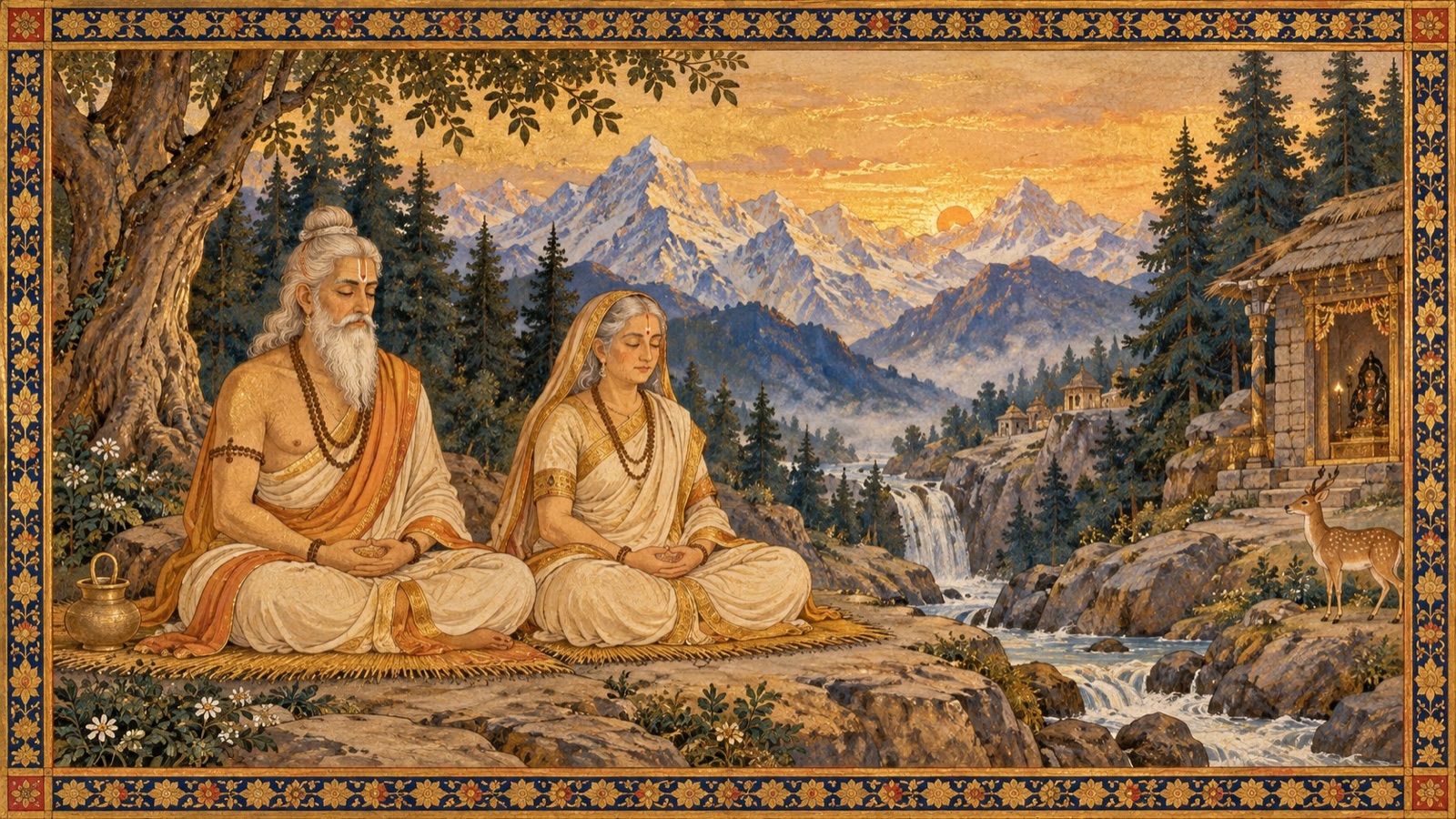
For King Nabhi, the birth of such a son was joy beyond measuring. Blessed with the very heir he had prayed for, he was overwhelmed with tenderness, fondly caressing the divine Child and calling Him in a faltering voice, “my child, my darling” — his loving heart so charmed by the Lord’s own Maya that he beheld the most ancient Person, who had assumed a human form of His own will, simply as his own dear son. In time, knowing how beloved his son was to ministers and citizens alike, Nabhi installed Rsabhadeva upon the throne for the protection of righteousness and entrusted Him to the guidance of the Brahmanas. Then the pious king, his duty fulfilled, withdrew with Queen Merudevi to the holy retreat of Visala — Badarikasrama — where, worshipping Lord Vasudeva as Nara and Narayana through gentle austerities and deep meditation, he in time attained oneness with the Lord.
विदितानुरागमापौरप्रकृति जनपदो राजा नाभिरात्मजं समयसेतुरक्षायामभिषिच्य ब्राह्मणेषूपनिधाय सह मेरुदेव्या विशालायां प्रसन्ननिपुणेन तपसा समाधियोगेन नरनारायणाख्यं भगवन्तं वासुदेवमुपासीन: कालेन तन्महिमानमवाप ॥ ५ ॥
viditānurāgam āpaura-prakṛti jana-pado rājā nābhir ātmajaṁ samaya-setu-rakṣāyām abhiṣicya brāhmaṇeṣūpanidhāya saha merudevyā viśālāyāṁ prasanna-nipuṇena tapasā samādhi-yogena nara-nārāyaṇākhyaṁ bhagavantaṁ vāsudevam upāsīnaḥ kālena tan-mahimānam avāpa
Meaning: Knowing his son beloved of the citizens and the people, King Nabhi installed Him on the throne for the preservation of moral law, entrusted Him to the Brahmanas, and, retiring with Queen Merudevi to Visala (Badarikasrama), worshipped Lord Vasudeva as Nara and Narayana through gracious austerity and deep meditation, in time attaining His glorious state. (Canto 5, Chapter 4, verse 5)
The Praise of King Nabhi
So extraordinary was Nabhi’s devotion that people came to sing his glory in two celebrated couplets. What other man, they ask, could ever equal the deeds of the royal sage Nabhi — for the Lord Himself, drawn by his pure and pious acts, consented to become his son? And where could one find a greater lover of the Brahmanas than Nabhi, by whose generous sacrificial gifts the Brahmanas, through their sacred hymns, caused the very Lord of sacrifices to appear before their eyes?
को नु तत्कर्म राजर्षेर्नाभेरन्वाचरेत्पुमान् । अपत्यतामगाद्यस्य हरि: शुद्धेन कर्मणा ॥ ६ ॥ ब्रह्मण्योऽन्य: कुतो नाभेर्विप्रा मङ्गलपूजिता: । यस्य बर्हिषि यज्ञेशं दर्शयामासुरोजसा ॥ ७ ॥
ko nu tat karma rājarṣer nābher anv ācaret pumān apatyatām agād yasya hariḥ śuddhena karmaṇā brahmaṇyo ’nyaḥ kuto nābher viprā maṅgala-pūjitāḥ yasya barhiṣi yajñeśaṁ darśayām āsur ojasā
Meaning: What man could imitate the deeds of the royal sage Nabhi, whom, drawn by his pure acts, Sri Hari came to serve as a son? And where could there be a greater devotee of the Brahmanas than Nabhi, honoured by whose worship the Brahmanas, by the power of their hymns, made the Lord of sacrifices manifest at the altar? (Canto 5, Chapter 4, verses 6-7)
A Hundred Sons and the Land of Bharata
Lord Rsabhadeva, knowing His realm to be a field of righteous action, first showed the world, by His own example, how a student should live in the home of his preceptor. Then, permitted by His teachers to enter householder life, and teaching the sacred duties of the householder, He married Jayanti, bestowed on Him by Indra, and through her begot a hundred sons, each resembling Himself. The eldest and most gifted among them was Bharata, a great master of Yoga — and it is after this Bharata that this very land is called Bharatavarsa.
येषां खलु महायोगी भरतो ज्येष्ठ: श्रेष्ठगुण आसीद्येनेदं वर्षं भारतमिति व्यपदिशन्ति ॥ ९ ॥
yeṣāṁ khalu mahā-yogī bharato jyeṣṭhaḥ śreṣṭha-guṇa āsīd yenedaṁ varṣaṁ bhāratam iti vyapadiśanti
Meaning: Among these sons the eldest was Bharata, a great yogi endowed with the highest qualities, after whom this land is called Bharatavarsa. (Canto 5, Chapter 4, verse 9)
Nine of the sons — Kusavarta, Ilavarta, Brahmavarta, Malaya, Ketu, Bhadrasena, Indrasprk, Vidarbha and Kikata — led the remaining ninety. Nine others — Kavi, Havi, Antariksa, Prabuddha, Pippalayana, Avirhotra, Drumila, Camasa and Karabhajana — became eminent devotees who taught the world the conduct of the Lord’s votaries; their sacred story is told later, in Book Eleven, as a dialogue between Vasudeva and the sage Narada. The remaining eighty-one, younger and deeply devoted to their father, grew modest, learned in the Vedas and ever engaged in sacrifice, and by their pure conduct came to be regarded as Brahmanas.
The Lord Who Taught by Example
Here the chapter pauses to reveal the deepest truth of Rsabhadeva’s reign. He was God Himself — utterly independent, eternally free from every evil, ever immersed in absolute bliss. He needed nothing. And yet, He acted in every way like an ordinary man, performing worldly duties so that He might teach, by His own conduct, the sacred obligations that people had forgotten with the passage of time. Remaining always equipoised, calm, self-controlled, friendly and full of compassion, He guided His subjects into a wholesome household life — one in which righteousness, honest livelihood, good repute, family, and even the enjoyments of the senses all led at last toward liberation.
भगवानृषभसंज्ञ आत्मतन्त्र: स्वयं नित्यनिवृत्तानर्थपरम्पर: केवलानन्दानुभव ईश्वर एव विपरीतवत्कर्माण्यारभमाण: कालेनानुगतं धर्ममाचरणेनोपशिक्षयन्नतद्विदां सम उपशान्तो मैत्र: कारुणिको धर्मार्थयश: प्रजानन्दामृतावरोधेन गृहेषु लोकं नियमयत् ॥ १४ ॥
bhagavān ṛṣabha-saṁjña ātma-tantraḥ svayaṁ nitya-nivṛttānartha-paramparaḥ kevalānandānubhava īśvara eva viparītavat karmāṇy ārabhamāṇaḥ kālenānugataṁ dharmam ācaraṇenopaśikṣayann atad-vidāṁ sama upaśānto maitraḥ kāruṇiko dharmārtha-yaśaḥ-prajānandāmṛtāvarodhena gṛheṣu lokaṁ niyamayat
Meaning: The Lord named Rsabha — self-dependent, ever beyond the whole chain of material miseries, the very experience of unmixed bliss, the Supreme Controller — nonetheless engaged in works like an ordinary being, teaching by His own conduct the righteous duties forgotten in the course of time; equipoised, serene, friendly and compassionate, He guided the people in household life toward merit, honest gain, fame, progeny and the nectar of liberation. (Canto 5, Chapter 4, verse 14)
The reason He did so is given in the very next verse:
यद्यच्छीर्ष्ण्याचरितं तत्तदनुवर्तते लोकः ॥ १५ ॥
yad yac chīrṣṇy ācaritaṁ tat tad anuvartate lokaḥ
Meaning: Whatever a person of the highest standing does, the rest of the world follows in his footsteps. (Canto 5, Chapter 4, verse 15)
Though He Himself knew the innermost secrets of the Vedas, the essence of all righteousness, He governed His people in the ordinary way, following the counsel of the Brahmanas; and He worshipped the Lord through every kind of sacrifice, performed a hundred times over with all their proper requisites, to honour the various gods. Under His reign, the land flourished in a way scarcely imaginable: no person ever coveted anything belonging to another, nor sought for himself what was not his — for the hearts of all were filled instead with an ever-deepening love for their Ruler.
भगवतर्षभेण परिरक्ष्यमाण एतस्मिन् वर्षे न कश्चन पुरुषो वाञ्छत्यविद्यमानमिवात्मनोऽन्यस्मात्कथञ्चन किमपि कर्हिचिदवेक्षते भर्तर्यनुसवनं विजृम्भितस्नेहातिशयमन्तरेण ॥ १८ ॥
bhagavatarṣabheṇa parirakṣyamāṇa etasmin varṣe na kaścana puruṣo vāñchaty avidyamānam ivātmano ’nyasmāt kathañcana kimapi karhicid avekṣate bhartary anusavanaṁ vijṛmbhita-snehātiśayam antareṇa
Meaning: In this land, guarded by Lord Rsabha, no one ever desired anything from another for himself — as one would not seek a thing that does not exist — nor did anyone ever cast a covetous glance on another’s property; the only thing that ever grew in every heart was an ever-increasing love for their Ruler. (Canto 5, Chapter 4, verse 18)
The Assembly at Brahmavarta
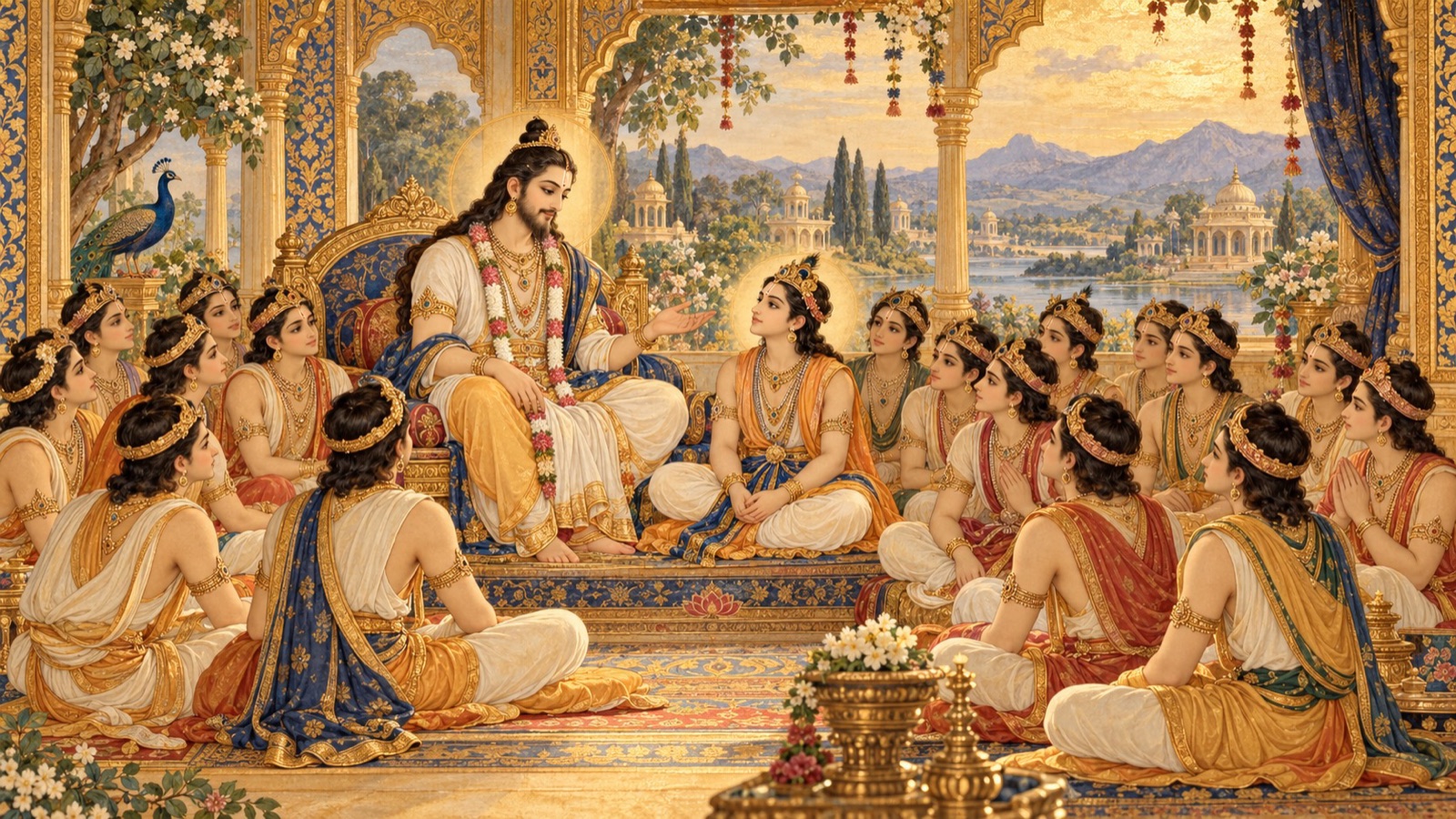
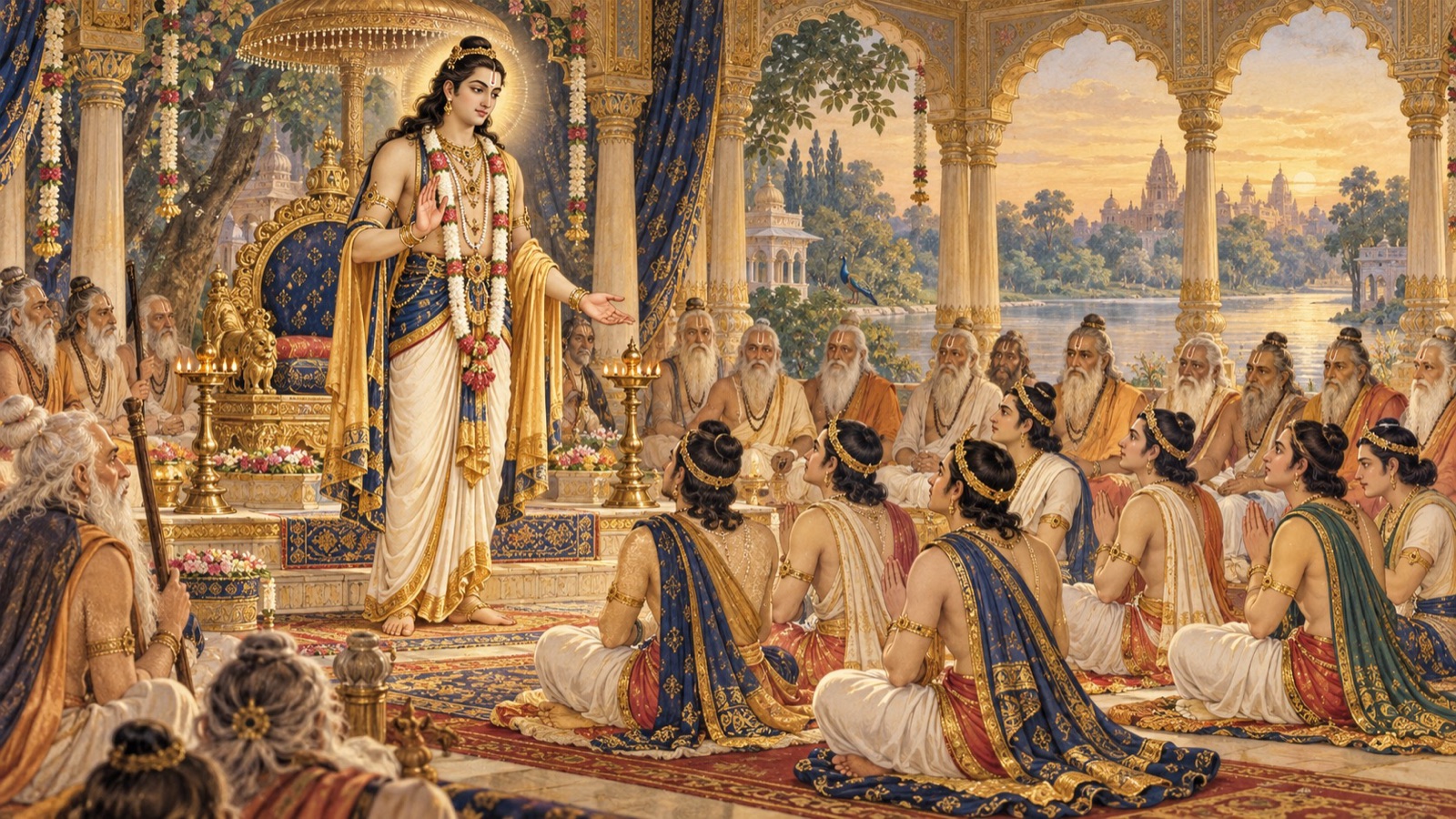
At last, while touring His kingdom, Lord Rsabhadeva came to Brahmavarta. There, in an assembly of the foremost Brahmana sages and within the hearing of His subjects, He turned to His own sons — who, though already self-controlled and refined by their modesty and devotion, He wished to instruct for the good of all — and began to speak. Those words of counsel, the great teaching of Lord Rsabhadeva to his sons, form the sacred subject of the discourse that follows.
स कदाचिदटमानो भगवानृषभो ब्रह्मावर्तगतो ब्रह्मर्षिप्रवरसभायां प्रजानां निशामयन्तीनामात्मजानवहितात्मन: प्रश्रयप्रणयभरसुयन्त्रितानप्युपशिक्षयन्निति होवाच ॥ १९ ॥
sa kadācid aṭamāno bhagavān ṛṣabho brahmāvarta-gato brahmarṣi-pravara-sabhāyāṁ prajānāṁ niśāmayantīnām ātmajān avahitātmanaḥ praśraya-praṇaya-bhara-suyantritān apy upaśikṣayann iti hovāca
Meaning: Once, while touring, Lord Rsabha came to Brahmavarta, and in an assembly of the foremost Brahmana sages, within the hearing of His subjects, He addressed His attentive sons — self-controlled though they already were through their humility and loving devotion — in order to instruct them, and thus He spoke. (Canto 5, Chapter 4, verse 19)
Principal Teachings of This Chapter
The Supreme Lord acts to teach, not from need. Rsabhadeva is God Himself — self-sufficient, ever blissful, needing nothing. Yet He performs every ordinary duty, “engaging in works like an ordinary being,” solely to teach the world the righteousness people had forgotten. His whole life is a lesson offered out of compassion.
Leaders set the pattern the world follows. “The world follows whatever the great among men do.” The chapter reminds us that those in positions of influence shape the conduct of countless others. Rsabhadeva’s flawless example is the ideal: leadership as service, and greatness as responsibility.
An ideal society is bound by love, not greed. Under Rsabhadeva’s reign no one coveted another’s possessions; the only thing that grew was love for their Ruler. Where hearts are filled with devotion, envy and greed simply have no room to live.
Divine power needs no display of anger. When Indra withheld the rains out of envy, the Lord of Yoga answered not with wrath but with a smile, quietly restoring the showers by His own power. True strength is serene, never anxious, never vengeful.
Do your duty, then turn wholly to God. King Nabhi, having raised a worthy son and secured his kingdom, retired with his queen to Badarikasrama to worship the Lord in meditation until he attained Him. His life models the sacred sequence: fulfil your responsibilities faithfully, then give your remaining days entirely to the Lord.
A Devotional Reflection
There is a quiet wonder in the thought of God learning to walk, being cradled and called “my darling” by a doting father, ruling a kingdom, marrying, raising children — and doing all of it not because He must, but because we need to see it done rightly. Rsabhadeva did not descend to escape the world’s duties but to sanctify them. He shows us that ordinary life — work, family, service, worship — is not an obstacle to holiness but a field in which holiness can grow. And His reign paints a picture our restless hearts long for: a whole people freed from envy, wanting nothing that is not theirs, their hearts filled instead with love. That vision begins not with the reform of nations but with the reform of a single heart. When love for the Lord takes root in us, the endless grasping quiets of its own accord. We begin to want less and love more. The same Lord who ruled Ajanabha in perfect peace still offers to reign within us — if only we will make room for His presence.
A Daily Devotional Practice
Take one duty you would rather avoid today — a task at work, a kindness owed to family, an obligation you have been postponing — and perform it carefully and cheerfully, offering it inwardly to the Lord, in imitation of Rsabhadeva, who did every ordinary thing well for the sake of others. As you work, let a single thought accompany you: I do this not for reward, but as an offering. In this small way, like the Lord who taught by His own example, you turn an ordinary act into an act of devotion — and slowly train the heart to seek God within its daily duties.
Conclusion
The fourth discourse of Book Five unveils the glory of Lord Rsabhadeva. Born with the very marks of Godhead, He grew in majesty until gods and men alike longed for Him to rule; His father named Him “the foremost.” He humbled Indra’s envy with a smile and a shower of rain, delighted King Nabhi as a beloved son, and — when Nabhi retired to Badarikasrama to seek the Lord in meditation — reigned over the land in perfect righteousness. He fathered a hundred noble sons, chief among them Bharata, who gave this land its name. Though He was the Supreme Lord, needing nothing, He lived and labored like an ordinary man to teach the world its forgotten duties, ruling a realm so filled with love that no heart coveted another’s goods. And at Brahmavarta, gathering His sons before the sages, He prepared to give the great teaching that Book Five will next unfold. His life leaves us one shining lesson: that the highest divinity expresses itself as the humblest, most faithful service.
May the divine wisdom of Srimad Bhagavatam awaken pure devotion within our hearts.
Om Namo Bhagavate Vasudevaya.
Jay Shree Madhav.
References and Attribution
- Primary edition: Gita Press, Śrīmad Bhāgavata Mahāpurāṇa (English, complete), Book Five, Discourse 4, “The sovereignty of Rsabha,” pages 451–453.
- Series: Srimad Bhagavatam Wisdom · Biswa Sanatan Dharma Seva Trust.
- Presented following the spiritual guidance and recommendation of Pandit Dr. Shri Kashinath Mishra.
This is an original, faithful retelling in the writer’s own words, with brief quoted verses shown in Devanāgarī and transliteration and their meanings given as summaries. It is not a reproduction of any single publisher’s continuous translation or commentary. No affiliation with or endorsement by any publisher is implied.
Jay Shree Madhav