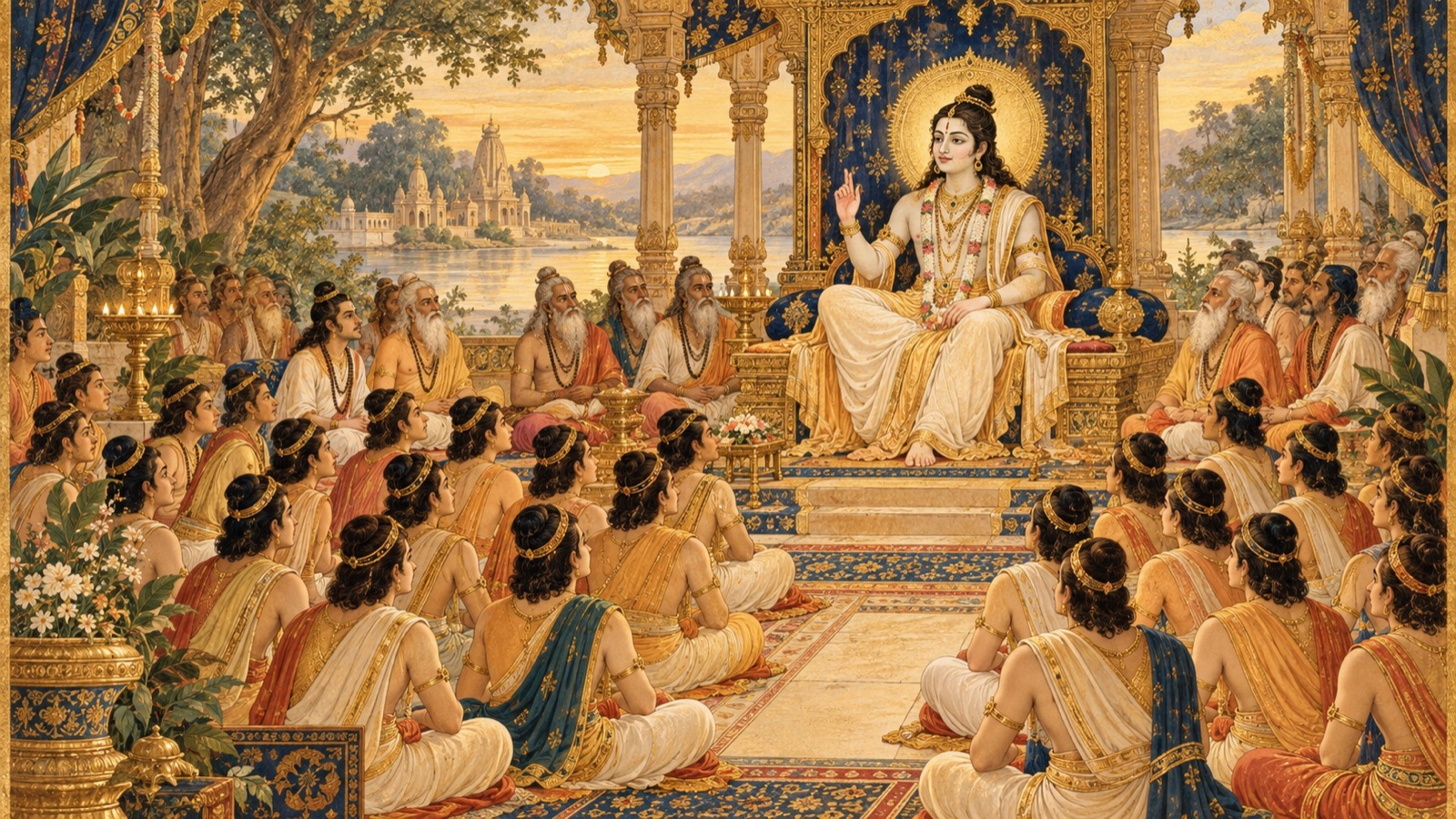
Radiant with the wisdom of the Self, Lord Rsabhadeva turns to His hundred sons and unveils the highest teaching — that this human life is not for fleeting pleasure, but for the austerity and devotion that open the gate to lasting bliss.
Om Namo Bhagavate Vasudevaya.
Om Namo Bhagavate Vasudevaya.
Om Namo Bhagavate Vasudevaya.
Welcome back to Srimad Bhagavatam Wisdom, a devotional journey through the sacred histories and teachings of the Srimad Bhagavat Mahapurana. In the previous chapter we beheld the glory of Lord Rsabhadeva — the Supreme Lord Himself, born as the son of King Nabhi, ruling the earth with perfect righteousness and gathering His hundred sons before the sages at Brahmavarta. This fifth chapter of Book Five gives us the words He spoke there. It is one of the most treasured discourses in all the Bhagavata: a father who is also God, teaching His children — and through them the whole world — what the human body is truly for, how the soul is bound, and how it may be set free. Then, having taught by word, Rsabhadeva teaches by deed: He installs His eldest son Bharata upon the throne and Himself takes up the life of a wandering ascetic, renouncing everything for the sake of showing the way.
Chapter Information
- Scripture: Śrīmad Bhāgavata Mahāpurāṇa
- Canto: 5 (Book Five)
- Chapter: 5 (Discourse 5)
- Chapter title: The Teachings of Lord Rsabhadeva to His Sons
- Principal speaker: Lord Rsabhadeva, instructing His sons; the narration framed by Sukadeva Gosvami (Sri Suka), speaking to King Parikshit
- Principal listener: The hundred sons of Rsabhadeva, headed by Bharata, in the hearing of His subjects — the whole discourse related in turn by Suta Gosvami to the sages gathered at Naimisaranya
- Main setting: Brahmavarta, in an assembly of the foremost Brahmana sages; and thereafter the towns, villages and wildernesses of the earth, through which the renounced Lord wanders
- Central subject: Rsabhadeva’s teaching on the true purpose of human life, the bondage of the soul through karma and attachment, the path of devotion and self-control that leads to liberation, the glory of the Brahmanas and devotees, and His own renunciation of the world as an ascetic
- Principal verse range: Canto 5, Chapter 5, verses 1–35
- Primary edition: Gita Press Śrīmad Bhāgavata Mahāpurāṇa
From the Previous Chapter
The fourth discourse of Book Five unveiled the glory of Lord Rsabhadeva — how He was born bearing the marks of Godhead, was named “the foremost,” humbled Indra’s envy with a smile, fathered a hundred noble sons, and reigned as the Supreme Lord ruling like a mortal to teach the world by His own example. That chapter closed as He came, while touring His kingdom, to Brahmavarta, and there, in a gathering of the foremost Brahmana sages and within the hearing of His subjects, turned to His sons to instruct them. This chapter records the great teaching that followed.
This Body Is Not Meant for Sense Enjoyment
Lord Rsabhadeva began with a truth that overturns the ordinary aim of life. This human body, He told His beloved sons, is not to be squandered in the pursuit of sensuous pleasures — pleasures that are a source of misery, and that even swine, dogs and lowly animals enjoy. Rather, the rare gift of human birth is worthy of being devoted to sublime austerities, by which the mind is purified; and from purity of mind follows the unending bliss of absorption in the Absolute.
नायं देहो देहभाजां नृलोके कष्टान् कामानर्हते विड्भुजां ये । तपो दिव्यं पुत्रका येन सत्त्वं शुद्ध्येद्यस्माद् ब्रह्मसौख्यं त्वनन्तम् ॥ १ ॥
nāyaṁ deho deha-bhājāṁ nṛloke kaṣṭān kāmān arhate viḍ-bhujāṁ ye tapo divyaṁ putrakā yena sattvaṁ śuddhyed yasmād brahma-saukhyaṁ tv anantam
Meaning: In this human society, no one who has taken a body need labor after the very pleasures that even stool-eating creatures win with ease; this body exists, My sons, for sacred austerity, by which one’s inner nature grows pure and the boundless joy of the Absolute is reached. (Canto 5, Chapter 5, verse 1)
Service rendered to exalted souls, He said, is an open gate to liberation, while attachment to those enslaved by lust is the door that opens into hell.
Truly great, He taught, are those who are even-minded, exceptionally calm, free from anger, kind-hearted and compassionate — and above all those who accept love offered to Him as the one true goal of human life. Such a soul takes no delight in the endless labor of feeding the body, nor in mere household comforts, and keeps for the body only what its bare maintenance requires. The one who forgets this, oblivious of his real self-interest, mistakes the restless play of the senses for his own nature, and so, seeking a home built around sexual enjoyment, suffers there torments of every kind.
यदा न पश्यत्ययथा गुणेहां स्वार्थे प्रमत्त: सहसा विपश्चित् । गतस्मृतिर्विन्दति तत्र तापा- नासाद्य मैथुन्यमगारमज्ञ: ॥ ७ ॥
yadā na paśyaty ayathā guṇehāṁ svārthe pramattaḥ sahasā vipaścit gata-smṛtir vindati tatra tāpān āsādya maithunyam agāram ajñaḥ
Meaning: So long as a person, however learned, fails to see the activity of the senses as unreal and remains heedless of his true self-interest, he forgets his own essential nature; and that foolish soul, taking shelter in a home centred on sexual pleasure, meets with torments there. (Canto 5, Chapter 5, verse 7)
The Knot of the Heart
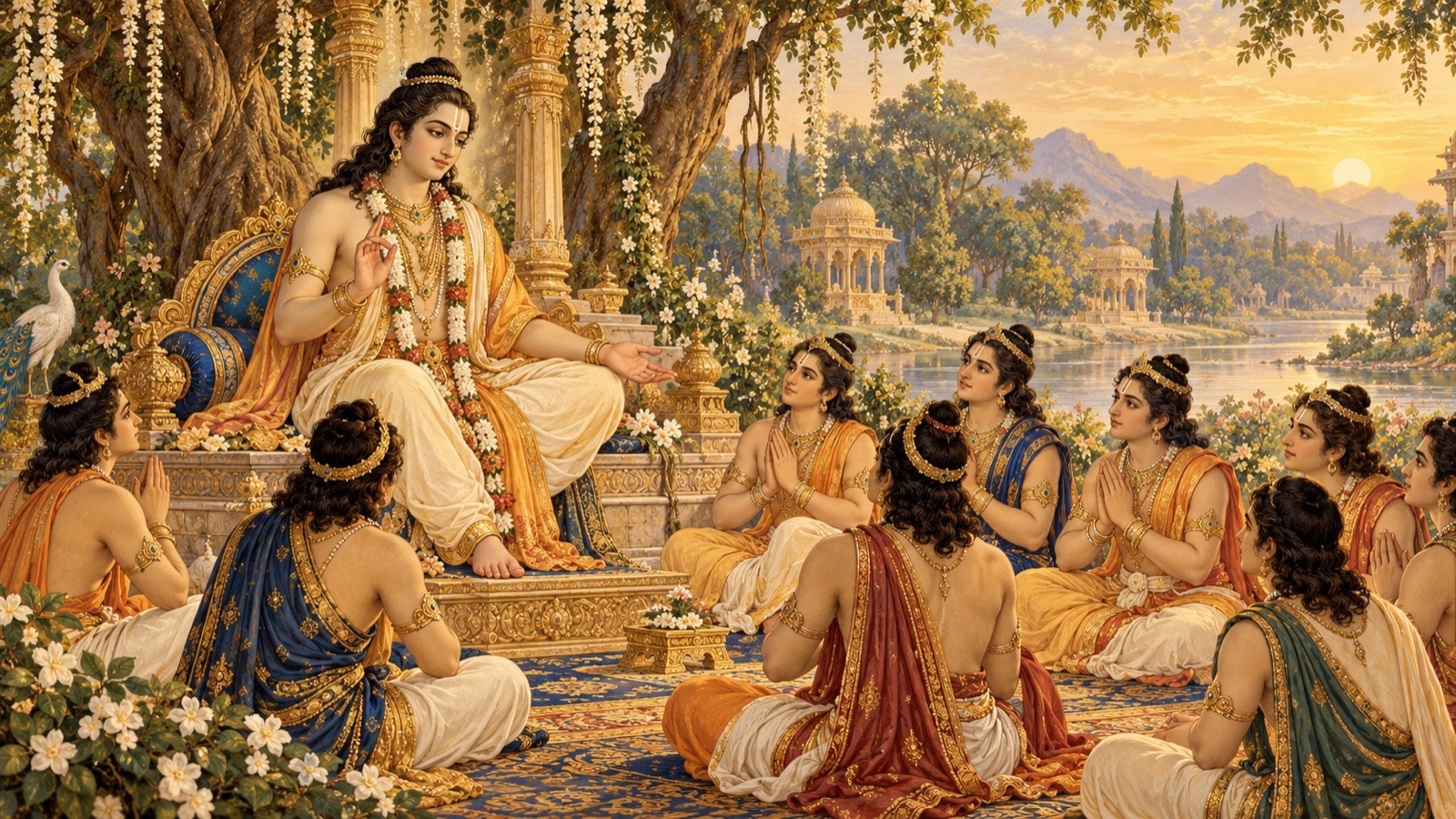
Rsabhadeva then explained how the soul comes to be bound. An erring soul, He said, incurs sin only when it strives to gratify the senses; and the actions born of that striving produce this very body, which, though ultimately unreal, becomes a source of misery for the living being. So long as the Jiva does not enquire into the truth of the Spirit, its own real nature stays hidden by ignorance; so long as it keeps acting from selfish motive, the mind remains restless; and so long as there is no love for Him, Lord Vasudeva, the soul cannot shed its false identification with the body.
The union of a man and woman as husband and wife, He taught, the wise call a further knot binding heart to heart — over and above the subtle knot of bodily identification that already lies within each. It is because of this knot that a person comes to regard house and fields, children, kinsmen and wealth as his very self or his own. But when the hard knot of the mind, tied by past actions, at last loosens, the soul turns away from this bondage, sheds its ego, and, freed from every fetter, reaches the Supreme.
The Path That Leads to Freedom
How, then, is the knot to be untied? Here Rsabhadeva laid out the whole path in a single sweeping instruction. By worshipping Him, the pure Self and Preceptor of all, and depending on Him alone; by freedom from thirst for enjoyment and by patiently enduring the pairs of opposites; by recognizing that a living being meets with calamity everywhere; through earnest enquiry into truth, through austerity, and by giving up self-interested action; through work done for His sake and through daily hearing of His glories; through the fellowship of His devotees and the singing of His praises; through even-mindedness, tranquillity and freedom from enmity; through the study of scriptures of the Spirit, through solitude, and through control of breath, senses and mind; through faith in the saints, through continence and vigilance, through mastery of the tongue, and through wisdom illumined by the vision of His presence everywhere — by all these means, equipped with firmness and discretion, a wise person should tear apart the veil that is the ego. Then, remaining ever watchful, he should shake off entirely the knot of egotism in the heart, the storehouse of all the latent tendencies of karma; and at last he should give up even this endeavor itself.
हंसे गुरौ मयि भक्त्यानुवृत्या वितृष्णया द्वन्द्वतितिक्षया च । सर्वत्र जन्तोर्व्यसनावगत्या जिज्ञासया तपसेहानिवृत्त्या ॥ १० ॥
haṁse gurau mayi bhaktyānuvṛtyā vitṛṣṇayā dvandva-titikṣayā ca sarvatra jantor vyasanāvagatyā jijñāsayā tapasehā-nivṛttyā
Meaning: This is the path in outline: taking shelter of a liberated soul as one’s guide and of Me as the final refuge; losing all taste for sense enjoyment and learning to bear pleasure and pain alike; seeing that every embodied being meets trouble at every step; searching earnestly for the truth, undergoing austerity, and giving up the pursuit of one’s own desires; offering every act to Me and hearing constantly of My glories; keeping company with devotees and singing My praise; being free of enmity, equal-minded and at peace; giving up the false sense of “I” and “mine” tied to body and home; studying the scriptures of the Self, living apart, and mastering breath, senses and mind; holding faith in the sacred teachings, observing lifelong continence, staying vigilant, and governing speech; and seeing Me present everywhere, wisdom joined to realization. (Canto 5, Chapter 5, verses 10–13)
A ruler, a father or a teacher who aspires to reach His abode, Rsabhadeva said, should teach his subjects, sons or pupils in just this way, and should never drive them toward selfish, fruitive action — for to push a fellow being deeper into such blindness is to hurl him into the abyss of repeated birth and death. Men who crave the objects of the senses are themselves blind to their own true good; deluded, they fall into enmity with one another over mere crumbs of pleasure, never seeing the endless sorrow that lies in store. A wise and compassionate soul, aware of the goal, would no more urge them back into that darkness than he would send a blind man further down a wrong road.
A True Guardian Sets the Soul Free
From this came one of the most piercing verses of the discourse. The measure of a guardian, Rsabhadeva declared, is whether he can free those in his care from the cycle of death.
गुरुर्न स स्यात्स्वजनो न स स्यात् पिता न स स्याज्जननी न सा स्यात् । दैवं न तत्स्यान्न पतिश्च स स्या- न्न मोचयेद्य: समुपेतमृत्युम् ॥ १८ ॥
gurur na sa syāt sva-jano na sa syāt pitā na sa syāj jananī na sā syāt daivaṁ na tat syān na patiś ca sa syān na mocayed yaḥ samupeta-mṛtyum
Meaning: He is no true guru, no true kinsman, no true father, no true mother, no true deity, and no true husband, who cannot deliver those dependent on him from the onrushing cycle of birth and death. (Canto 5, Chapter 5, verse 18)
Why the Worthy Call Me Rsabha
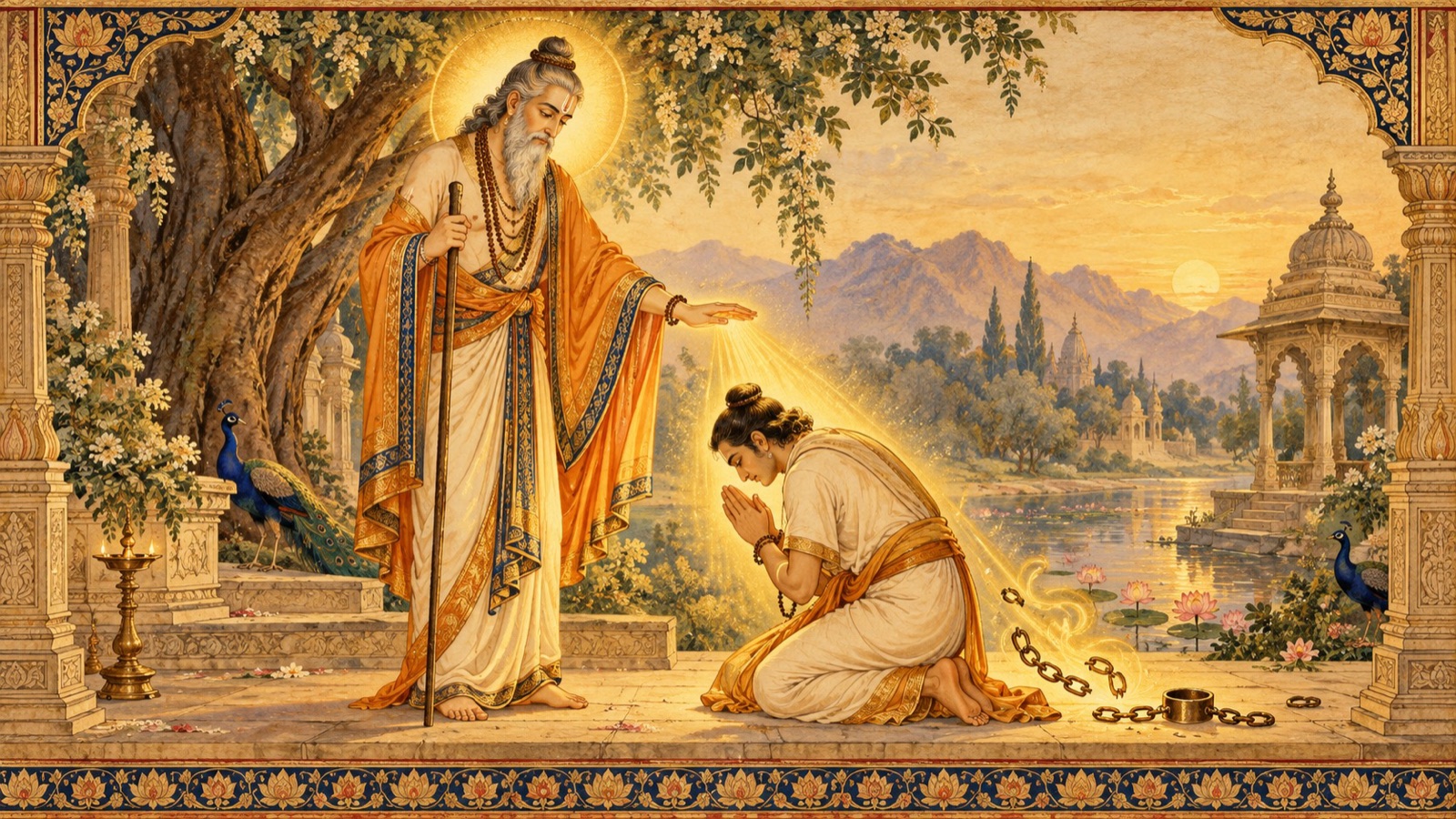
Then the Lord unveiled the secret of His own descent. This human form of His, He said, is not easily understood, for it is not born of matter at all: pure goodness itself is His heart, and there dwells all righteousness, while every trace of unrighteousness has been left far behind. It is for this reason, He told them, that worthy souls call Him Rsabha — the foremost, the best.
इदं शरीरं मम दुर्विभाव्यं सत्त्वं हि मे हृदयं यत्र धर्म: । पृष्ठे कृतो मे यदधर्म आराद् अतो हि मामृषभं प्राहुरार्या: ॥ १९ ॥
idaṁ śarīraṁ mama durvibhāvyaṁ sattvaṁ hi me hṛdayaṁ yatra dharmaḥ pṛṣṭhe kṛto me yad adharma ārād ato hi mām ṛṣabhaṁ prāhur āryāḥ
Meaning: This body of Mine is hard to comprehend; pure goodness is My very heart, wherein all righteousness abides, and unrighteousness has been cast far behind Me. It is for this reason that noble souls call Me Rsabha, the foremost. (Canto 5, Chapter 5, verse 19)
Because His sons had sprung from that heart of pure goodness, Rsabhadeva urged them to wait, free of envy, upon their noble brother Bharata; to serve him, He said, would be as good as serving Himself and caring for all the people. He then set before them the great ladder of created beings — from plants to moving creatures, from beasts to human beings, and upward through the Pramathas, Gandharvas, Siddhas and attendants of the gods, to the Asuras, and higher still the gods led by Indra, and beyond them the mind-born sons of Brahma such as Daksa, and above them Lord Siva, and then Brahma himself. Higher even than Brahma, He said, is the Supreme Lord — yet the Brahmanas, the pure and devoted, He holds worthy of worship even by Himself.
The Glory of the Selfless Devotee
Rsabhadeva then honored the Brahmanas and His devotees with striking praise. It is through the Brahmana, He said, that His own eternal body in the form of the Vedas is preserved on earth, and in him are found goodness, self-control, truthfulness, compassion, austerity, endurance and wisdom. And of His devotees He spoke a truth that turns worldly values upside down: those who are rich in devotion to Him, though they possess nothing at all in this world, have nothing left to seek — not even from Him, the infinite Lord and giver of both heaven and liberation.
मत्तोऽप्यनन्तात्परत: परस्मात् स्वर्गापवर्गाधिपतेर्न किञ्चित् । येषां किमु स्यादितरेण तेषा- मकिञ्चनानां मयि भक्तिभाजाम् ॥ २५ ॥
matto ’py anantāt parataḥ parasmāt svargāpavargādhipater na kiñcit yeṣāṁ kim u syād itareṇa teṣām akiñcanānāṁ mayi bhakti-bhājām
Meaning: Those who are devoted to Me, though possessing nothing, seek nothing even from Me — the infinite One, higher than the highest, the Lord of both heaven and liberation. What, then, could they have to seek from anything else? (Canto 5, Chapter 5, verse 25)
See All Beings as My Abodes
The Lord then gave His sons a teaching that would transform how they saw the whole world. With a pure and ungrudging heart, He said, they should honor every living being — moving and unmoving alike — at every step, as so many dwelling-places of the Lord Himself. That, and that alone, would be His true worship at their hands.
सर्वाणि मद्धिष्ण्यतया भवद्भि- श्चराणि भूतानि सुता ध्रुवाणि । सम्भावितव्यानि पदे पदे वो विविक्तदृग्भिस्तदु हार्हणं मे ॥ २६ ॥
sarvāṇi mad-dhiṣṇyatayā bhavadbhiś carāṇi bhūtāni sutā dhruvāṇi sambhāvitavyāni pade pade vo vivikta-dṛgbhis tad u hārhaṇaṁ me
Meaning: My sons, with clear and undivided vision you should regard all beings, moving and unmoving, as abodes of Mine, and honor them at every step; that indeed is true worship offered to Me. (Canto 5, Chapter 5, verse 26)
For this alone, He said, is the real fruit of all the striving of mind, speech, sight and the other senses: to win His grace. Without propitiating Him, no one can ever escape the terrible, bewildering noose of death.
मनोवचोदृक्करणेहितस्य साक्षात्कृतं मे परिबर्हणं हि । विना पुमान् येन महाविमोहात् कृतान्तपाशान्न विमोक्तुमीशेत् ॥ २७ ॥
mano-vaco-dṛk-karaṇehitasya sākṣāt-kṛtaṁ me paribarhaṇaṁ hi vinā pumān yena mahā-vimohāt kṛtānta-pāśān na vimoktum īśet
Meaning: The true reward of all the activity of mind, speech, sight and the senses is My propitiation; for without it no one can be freed from the greatly bewildering noose of Death. (Canto 5, Chapter 5, verse 27)
The Lord Renounces the World
Here Sukadeva Gosvami, who hands down this whole history, adds a detail that reveals why the teaching was given at all. Rsabhadeva’s sons, he says, were already perfectly cultured and wise — in no real want of instruction. The Lord spoke to them, then, not to fill some lack in them, but to set a living example: of how a father, before he retires from household life, should first see his children firmly established in the highest truth. And the lesson reaches further still, Sukadeva adds, meant above all for sannyasis — for every soul who takes up the search for God after home and family are left behind. It is, in other words, Rsabhadeva Himself living out the very standard He had just declared: that no guardian deserves the name who cannot free those in his care from death. Before He could renounce the world, He made certain His own sons stood safely on the path home. (verse 28)
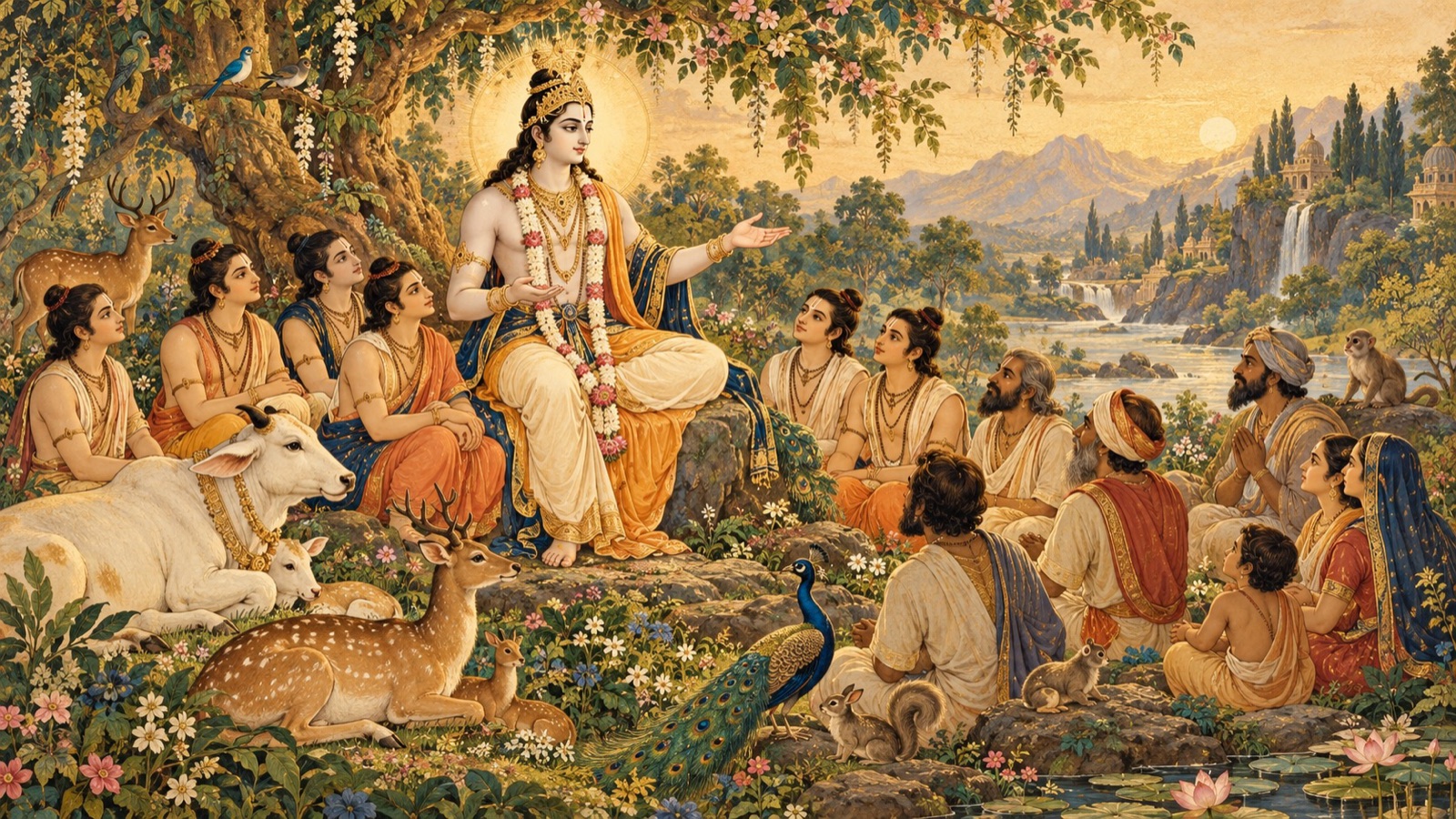
Having thus instructed His disciplined sons for the good of the world, the most glorious Rsabhadeva — their greatest friend and well-wisher — installed the eldest, Bharata, a great devotee of the Lord and of His servants, upon the throne for the protection of the earth. Then, to exemplify in His own person the life of the true recluse — marked by devotion, self-realization and freedom from the pull of the senses — He renounced, even while still at home, everything but the body that remained His only possession. Absorbing the sacrificial fires within Himself, He departed from Brahmavarta as though mad, with dishevelled hair and the open sky His only garment.
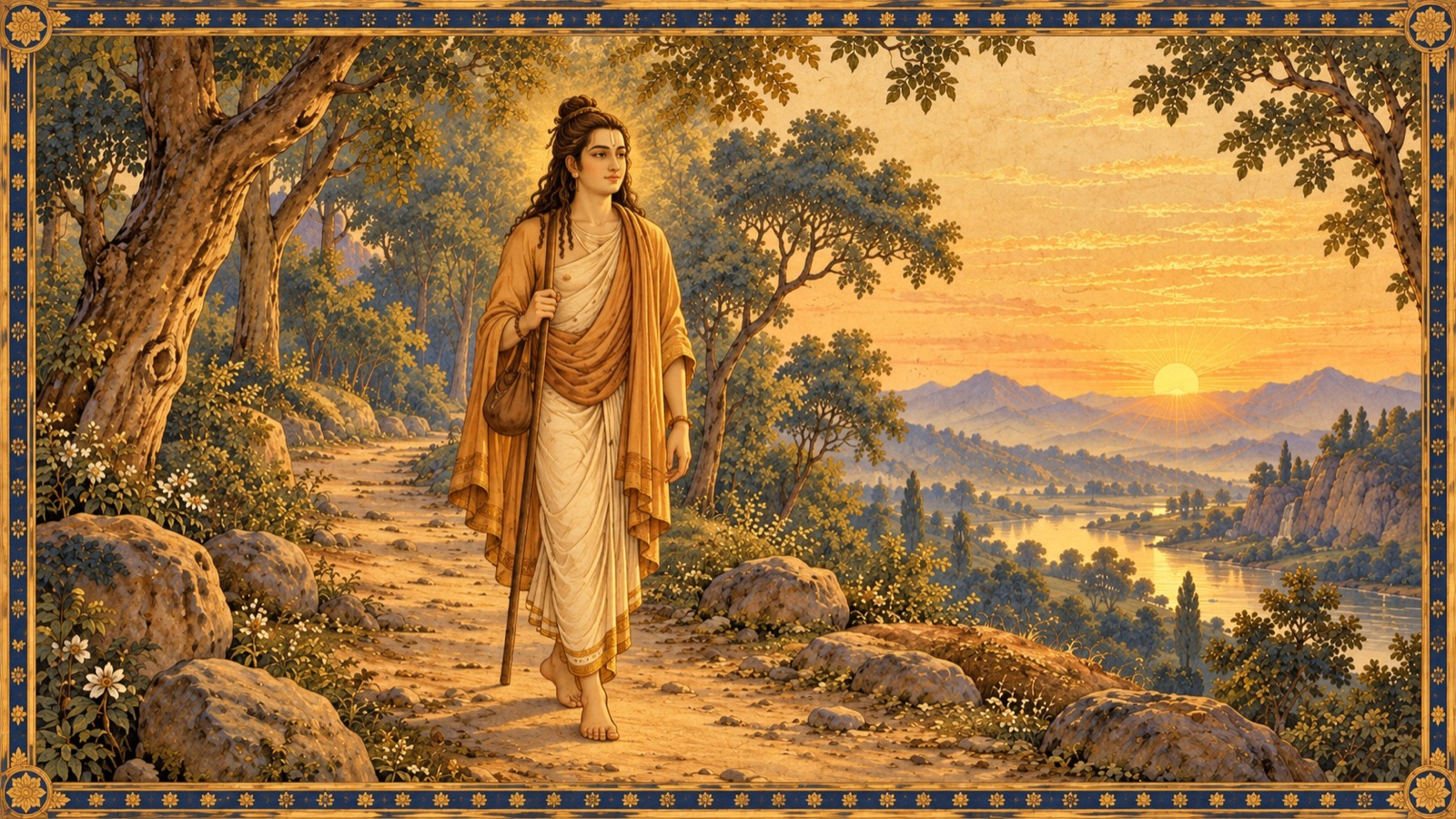
Behaving like one who had lost all sense of the body, He took a vow of silence and moved across the earth. In towns and villages, in mines and hamlets, gardens and encampments, hills and forests and hermitages, wherever He went, He was insulted along the roads by vile men — threatened, beaten, spat upon, pelted with stones and dust — even as a wild elephant is set upon by bees. Yet He heeded none of it, for He never regarded this illusory bodily dwelling as His own self. Established in His own glory, aware of both being and non-being, He wandered the earth alone, His mind undistracted and serene.
So beautiful was His form — soft-limbed, with long rounded arms, a lovely face lit by a spontaneous smile and eyes like the petals of a fresh-blown lotus — that though His body went uncared-for and unclean and His auburn hair hung matted about His face, He seemed like one possessed, kindling wonder wherever He passed. Adopting in turn the ways of a python, a bull, a deer and a crow, He set an example for yogis striving to overcome every obstacle on the path. And though the powers of yoga came to Him unsought — the ability to travel through the air, to move with the swiftness of thought, to become invisible, to enter another’s body, to see and hear across great distances — the Lord, who was already one with Vasudeva, the Soul of all beings, and perfect in every attainment, did not welcome them in His heart.
इति नानायोगचर्याचरणो भगवान् कैवल्यपतिऋर्षभोऽविरतपरममहानन्दानुभव आत्मनि सर्वेषां भूतानामात्मभूते भगवति वासुदेव आत्मनोऽव्यवधानानन्तरोदरभावेन सिद्धसमस्तार्थपरिपूर्णो योगैश्वर्याणि वैहायसमनोजवान्तर्धानपरकायप्रवेशदूरग्रहणादीनि यदृच्छयोपगतानि नाञ्जसा नृप हृदयेनाभ्यनन्दत् ॥ ३५ ॥
iti nānā-yoga-caryācaraṇo bhagavān kaivalya-patir ṛṣabho ’virata-parama-mahānandānubhava ātmani sarveṣāṁ bhūtānām ātma-bhūte bhagavati vāsudeva ātmano ’vyavadhānānanta-rodara-bhāvena siddha-samastārtha-paripūrṇo yogaiśvaryāṇi vaihāyasa-mano-javāntardhāna-parakāya-praveśa-dūra-grahaṇādīni yadṛcchayopagatāni nāñjasā nṛpa hṛdayenābhyanandat
Meaning: Thus practising these various modes of yogic life, the Lord Rsabha, master of liberation, ever immersed in supreme bliss and perfect in all attainments — being one, without any intervening veil, with Lord Vasudeva, the Soul of all beings — did not, O king, welcome in His heart the powers of yoga that came to Him unsought. (Canto 5, Chapter 5, verse 35)
Principal Teachings of This Chapter
Human life has a higher purpose than pleasure. Rsabhadeva’s opening words draw a sharp line: the body is not for the enjoyments that even animals share, but for the austerity that purifies the heart and opens the way to lasting bliss. To grasp this is to reorder one’s whole life around what truly endures.
The soul is bound by attachment and freed by love. The knots of the heart — bodily identification and the bonds of family and possession — are tied by self-interested action and untied only when love for the Lord takes their place. Devotion, not mere effort, is what finally loosens the knot.
True authority is measured by the power to liberate. A guru, parent or ruler who cannot help those in his care toward freedom from death, the Lord says, is no true guardian at all. Real responsibility is spiritual; the highest gift we can give another is a step toward God.
Worship God by honoring every living being. To see all creatures as dwelling-places of the Lord, and to treat each with a pure and ungrudging heart, is itself the truest worship. Reverence for life is reverence for its indwelling Lord.
The greatest teaching is a life. Having taught by word, Rsabhadeva taught by deed — renouncing His throne and His comfort, enduring every insult in silence, refusing even the powers of yoga. His whole life becomes the lesson: detachment, humility and unbroken absorption in God.
A Devotional Reflection
It is a startling thing that God Himself, having ruled a kingdom in perfect peace, would walk away from the throne to be spat upon and stoned along the roads of the world — and would bear it all without a flicker of resentment. Rsabhadeva did not need to renounce anything; He was already free, already blissful, already one with the Soul of all. He did it for us, to leave a footprint we could follow. His teaching to his sons and his silent wandering are two halves of a single message: that the human birth is precious beyond measure, and that its whole purpose is to loosen the heart’s knots and turn toward the Lord. We need not abandon our homes as He did; most of us are called to serve God within our duties, as His father Nabhi did. But we are all called to want less, to love more, and to see the Lord dwelling in every person we meet. When even a little of that vision takes root, the roads that once seemed hostile become the very path home, and the insults of the world lose their power to disturb a heart already resting in God.
A Daily Devotional Practice
Today, choose one living being you would ordinarily overlook or find difficult — a stranger, a coworker, someone who has wronged you, even an animal — and consciously regard that being, as Rsabhadeva taught, as a dwelling-place of the Lord. Offer them a small, unforced kindness or a silent blessing, and inwardly remember: the Lord abides here too. Let this be your worship for the day. In training the eye to see God in others, you slowly untie one of the heart’s oldest knots — and turn an ordinary encounter into an act of true devotion.
Important Verse
Among the many jewels of this discourse, one verse holds the essence of the whole: Rsabhadeva’s revelation of why the wise call Him “the foremost” — because His very heart is pure goodness, the dwelling of all righteousness. That verse, given above (Canto 5, Chapter 5, verse 19), is the still center of the chapter: God descends in a form of unmixed goodness so that, by following Him, His children may cross beyond every knot of bondage.
Conclusion
The fifth discourse of Book Five is the great teaching of Lord Rsabhadeva to His sons. He tells them that the human body is not for the pleasures that even beasts enjoy but for the austerity that purifies the heart; He shows how the soul is bound by karma and attachment, and how, through devotion, self-control, the company of the holy and the hearing of His glories, the knot of egotism in the heart may be cut. He declares that no guru, parent or protector is worthy of the name who cannot lead his charge beyond death; He reveals that pure goodness is His very heart, and that this is why the worthy call Him Rsabha, the foremost. He honors the selfless devotee who, possessing nothing, needs nothing, and He commands His sons to worship Him by revering every living being as His abode. Then, teaching by example as He always did, He crowns Bharata, renounces the world, and wanders the earth in silence, enduring every hardship, unmoved even by the powers of yoga. His life leaves us a single luminous truth: that the whole purpose of our precious human birth is to loosen the heart and turn, wholly and forever, toward the Lord.
May the divine wisdom of Srimad Bhagavatam awaken pure devotion within our hearts.
Om Namo Bhagavate Vasudevaya.
Jay Shree Madhav.
References and Attribution
- Primary edition: Gita Press, Śrīmad Bhāgavata Mahāpurāṇa (English, complete), Book Five, Discourse 5, pages 454–459.
- Series: Srimad Bhagavatam Wisdom · Biswa Sanatan Dharma Seva Trust.
- Presented following the spiritual guidance and recommendation of Pandit Dr. Shri Kashinath Mishra.
This is an original, faithful retelling in the writer’s own words, with brief quoted verses shown in Devanāgarī and transliteration and their meanings given as summaries. It is not a reproduction of any single publisher’s continuous translation or commentary. No affiliation with or endorsement by any publisher is implied.
Jay Shree Madhav