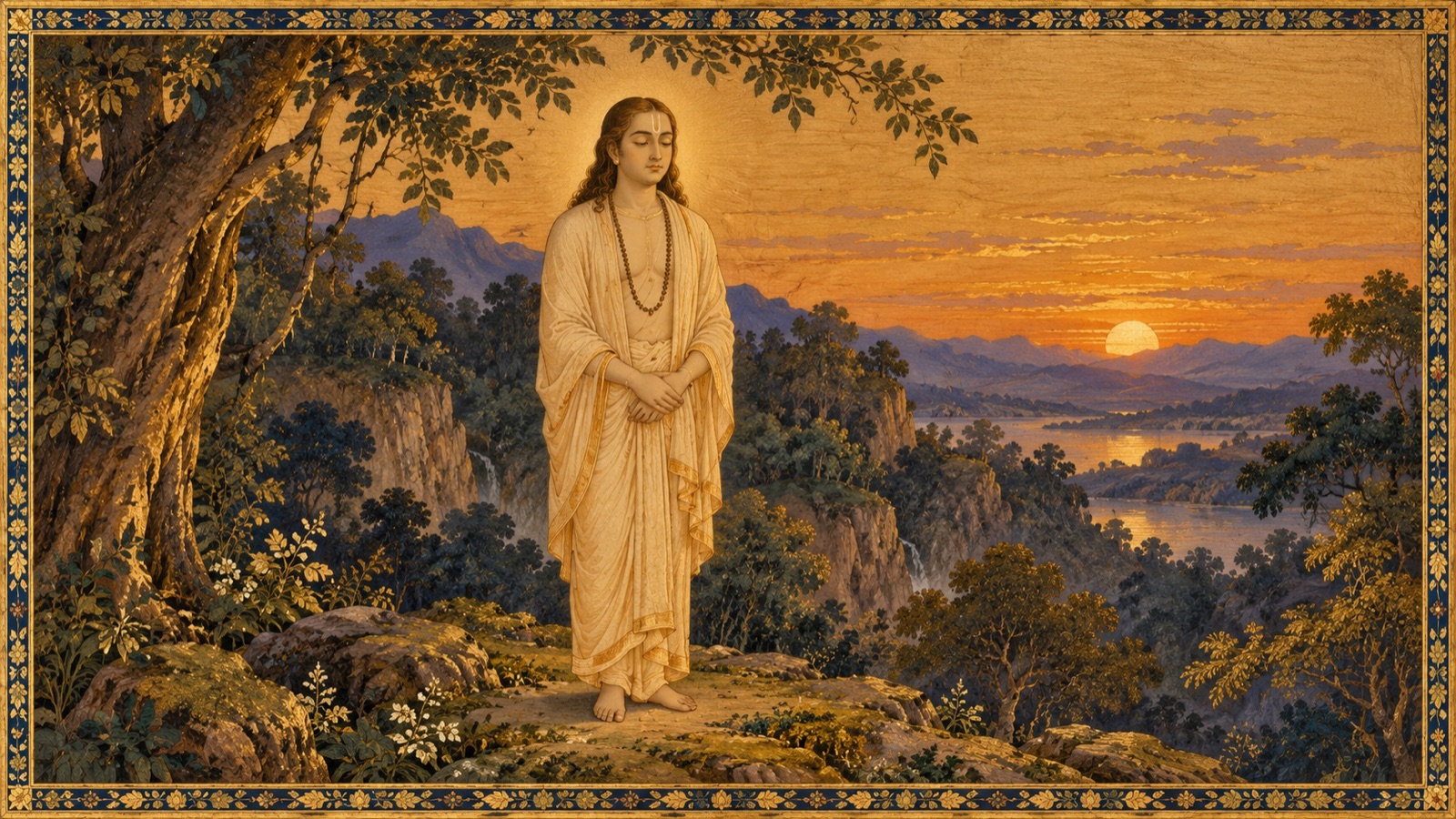
Wholly absorbed in the Supreme Self, Lord Rsabhadeva wanders the southern forests as a silent recluse and, teaching yogis the very art of leaving the body, gives up His mortal frame — His glory hidden, His peace unbroken.
Om Namo Bhagavate Vasudevaya.
Om Namo Bhagavate Vasudevaya.
Om Namo Bhagavate Vasudevaya.
Welcome back to Srimad Bhagavatam Wisdom, a devotional journey through the sacred histories and teachings of the Srimad Bhagavat Mahapurana. In the previous chapter, Lord Rsabhadeva gave His sons the great teaching on the purpose of human life, crowned His son Bharata, and took to the road as a silent wandering ascetic. This sixth chapter of Book Five brings His earthly story to its close. It opens with a searching question from King Parikshit — why the Lord, though beyond all need, would not accept the mystic powers that came to Him — and through Sukadeva’s answer unfolds a profound warning about the treacherous mind, the account of how the Lord gave up His body while wandering the southern lands, and finally the singing of His glories and the incomparable blessing of hearing His sacred story.
Chapter Information
- Scripture: Śrīmad Bhāgavata Mahāpurāṇa
- Canto: 5 (Book Five)
- Chapter: 6 (Discourse 6)
- Chapter title: The Departure of Lord Rsabhadeva
- Principal speaker: Sukadeva Gosvami (Sri Suka), answering and narrating to King Parikshit
- Principal listener: King Parikshit — the whole discourse related in turn by Suta Gosvami to the sages gathered at Naimisaranya
- Main setting: The Konka, Vehka, Kutaka and Karnataka regions of the south, and the forest of the Kutaka mountain, where the Lord wanders and gives up His body
- Central subject: Why the Lord did not accept unsolicited mystic powers; the danger of trusting the restless mind; how Lord Rsabhadeva gave up His body to teach yogis; a warning about the age of Kali; the glory of Bharatavarsa and the line of Priyavrata; and the blessing of hearing His story
- Principal verse range: Canto 5, Chapter 6, verses 1–19
- Primary edition: Gita Press Śrīmad Bhāgavata Mahāpurāṇa
From the Previous Chapter
The fifth discourse of Book Five recorded Lord Rsabhadeva’s great teaching to His sons — that the human body is meant not for pleasure but for the austerity and devotion that free the soul. Having taught them, He installed His eldest son Bharata upon the throne, renounced the world even while at home, and departed Brahmavarta as a silent avadhuta, wandering the earth unmoved by every insult, and refusing to welcome in His heart the powers of yoga that came to Him unsought. This chapter takes up the story from there, beginning with the very question that His indifference to those powers naturally raises.
King Parikshit’s Question
King Parikshit put the question that had risen in his heart. Surely, he said, for those who revel in the Self and have burned up the very seeds of future action — likes and dislikes — through the fire of wisdom strengthened by yoga, the mystic powers that come unsolicited could never again become a source of evil. Why, then, did Lord Rsabhadeva not accept them?
Why the Wise Never Trust the Mind
Sukadeva’s reply reveals a truth every seeker must take to heart. What you have observed is quite true, he said; and yet there are discreet souls who would never feel entirely confident about their own fickle mind — no more than a skilled hunter would trust a deer he has trapped. For confidence placed in the restless mind has broken even the austere vows of great and self-controlled beings. The mind of a yogi who has made a friend of it stays ever ready to fling the gates open to lust and the other enemies that follow — anger, greed and the rest — just as a faithless wife might admit her lovers to destroy her own household. What wise person, then, would ever grant trust to the mind, which is the very root of lust, anger, vanity, greed, sorrow, infatuation and fear, and which binds the soul to endless action?
कामो मन्युर्मदो लोभ: शोकमोहभयादय: । कर्मबन्धश्च यन्मूल: स्वीकुर्यात्को नु तद् बुध: ॥ ५ ॥
kāmo manyur mado lobhaḥ śoka-moha-bhayādayaḥ karma-bandhaś ca yan-mūlaḥ svīkuryāt ko nu tad budhaḥ
Meaning: Lust, anger, vanity, greed, sorrow, infatuation and fear, and the very bondage of action, all have the mind for their root. What wise person, then, would place his trust in it? (Canto 5, Chapter 6, verse 5)
It was for this reason, teaching by His own example even in this, that the Lord — who had every power at His command — declined to give the restless mind even the smallest foothold by welcoming the perfections of yoga.
The Lord Gives Up His Body
Lord Rsabhadeva was the very ornament of the guardians of the world, yet His divine glory could not be perceived, veiled as it was by the strange appearance, speech and conduct He had adopted as one who had renounced every worldly tie. Now, to teach the yogis the very art of giving up the body, He turned His mind wholly to the Supreme Spirit present within Him, ceased to think of His body at all, and gave up even His identification with the subtle body.
Beneath that guise, however, the Lord never actually departed from His true nature. Though He seemed, to any onlooker, as dull and confined as an ordinary bound soul, He remained inwardly untouched, ever established in oneness with the very Supreme Self He appeared to be seeking. And in this lies a promise as much as a farewell: whoever, following the very method Lord Rsabhadeva showed here, learns to give up their hold on the subtle body — the seat of the mind and the false sense of “I” and “mine” — need never again be forced to take up a body of matter. His going was not only an ending; it was also a doorway He held open for every soul still bound to that false sense of self.
अथैवमखिललोकपालललामोऽपि विलक्षणैर्जडवदवधूतवेषभाषाचरितैरविलक्षितभगवत्प्रभावो योगिनां साम्परायविधिमनुशिक्षयन् स्वकलेवरं जिहासुरात्मन्यात्मानमसंव्यवहितमनर्थान्तरभावेनान्वीक्षमाण उपरतानुवृत्तिरुपरराम ॥ ६ ॥
athaivam akhila-loka-pāla-lalāmo ‘pi vilakṣaṇair jaḍavad avadhūta-veṣa-bhāṣā-caritair avilakṣita-bhagavat-prabhāvo yogināṁ sāmparāya-vidhim anuśikṣayan sva-kalevaraṁ jihāsur ātmany ātmānam asaṁvyavahitam anarthāntara-bhāvenānvīkṣamāṇa uparatānuvṛttir upararāma
Meaning: Though He was foremost among all who protect the worlds, He wore in this guise such an unusual dress, speech and bearing that people took Him for a dull, ordinary being, and none could perceive the divinity within Him; yet He never departed from His identity with the true Self, and it was solely to instruct the yogis in the practice of passing beyond the body that, having ceased all worldly dealings, He relinquished His visible form. (Canto 5, Chapter 6, verse 6)
Though He was thus inwardly free, His visible form continued to wander the earth, carried along by the lingering play of Yogamaya. Guided by Providence, He passed through the southern lands of Konka, Vehka, Kutaka and Karnataka, and traversed the forest of the Kutaka mountain as a naked recluse, like a madman, with dishevelled hair and a piece of stone held in His mouth.
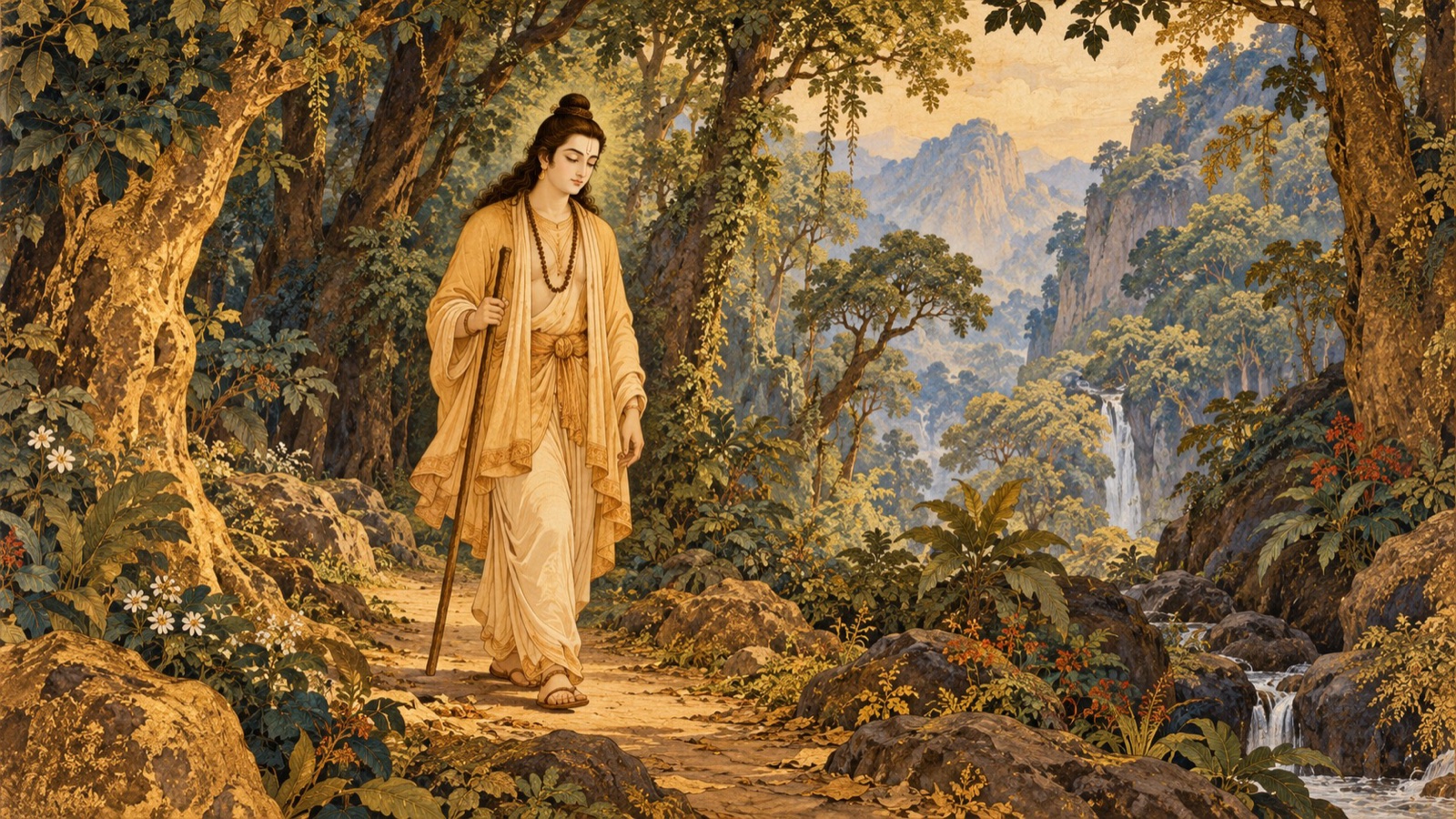
Then, as bamboos rubbed together in the driving wind, a fierce fire broke out and, spreading through the forest on every side, consumed the body of Lord Rsabhadeva along with the forest itself. So, in serene detachment, the Lord let fall the mortal frame He had never regarded as His own.

A Warning for the Age of Kali
Sukadeva then gave a solemn warning. In the age of Kali, when unrighteousness would be on the rise, a foolish ruler of those same southern territories, Arhat by name, hearing of the Lord’s strange outward ways and imitating them without understanding, and deluded by what was destined to unfold, would abandon the safe path of his own prescribed duty and propagate, according to his own whims, a mistaken and heretical creed. Led by him and bewildered by the Lord’s own deluding potency, many an unfortunate soul would fall from the standards of purity and good conduct laid down in scripture. Taking up, of their own will, impure practices — neglecting cleanliness, abandoning sacred observances — they would, with judgment warped by the age, come to condemn the Vedas, the Brahmanas, Lord Vishnu and His devotees. Assured of their own salvation by an arbitrary way of life unsupported by the Vedas and followed blindly, as one blind man follows another, they would descend by their own choice into darkness. The warning stands not as a condemnation of any people, but as a caution: to imitate the outward form of a saint without His inner realization is to lose the way entirely.
The Purpose of His Descent
This descent of the Lord, Sukadeva explained, was intended above all to teach the art of self-liberation to those steeped in the mode of passion — to show, in a form they could see, that even a life immersed in activity can be turned wholly toward freedom.
The Glory of Bharatavarsa and the Line of Priyavrata
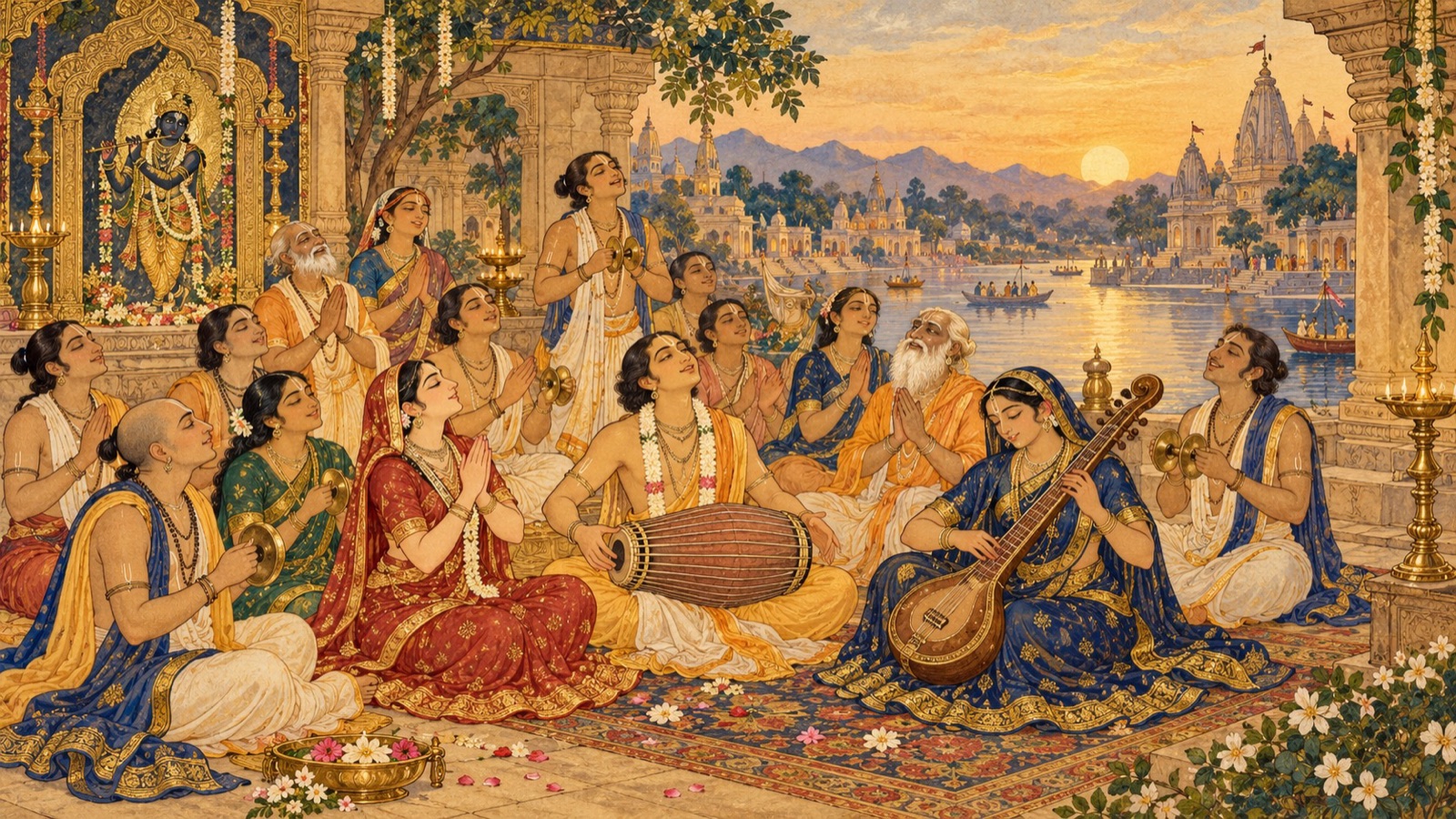
In keeping with this, Sukadeva said, people sing verses in praise of the Lord’s descent. Of all the islands and regions of the earth, girt by its seven oceans, this land — Bharatavarsa — is supremely holy, for here its people celebrate the blessed deeds of Lord Vishnu, the slayer of the demon Mura, as revealed through His many descents.
अहो भुव: सप्तसमुद्रवत्या द्वीपेषु वर्षेष्वधिपुण्यमेतत् । गायन्ति यत्रत्यजना मुरारे: कर्माणि भद्राण्यवतारवन्ति ॥ १३ ॥
aho bhuvaḥ sapta-samudravatyā dvīpeṣu varṣeṣv adhipuṇyam etat gāyanti yatratya-janā murāreḥ karmāṇi bhadrāṇy avatāravanti
Meaning: Oh, of all the islands and regions of this earth, girdled by its seven oceans, this land is supremely holy, for its people sing the blessed deeds of Murari (the Lord), performed in His many descents. (Canto 5, Chapter 6, verse 13)
And blessed above all, the verse continues, is the line of Priyavrata, radiant with glory — for it was descending in this very line that the most ancient Person, Bhagavan Narayana Himself, the Inner Controller and Cause of all causes, took birth and practised the sacred vows that lead to liberation.
अहो नु वंशो यशसावदात: प्रैयव्रतो यत्र पुमान् पुराण: । कृतावतार: पुरुष: स आद्य- श्चचार धर्मं यदकर्महेतुम् ॥ १४ ॥
aho nu vaṁśo yaśasāvadātaḥ praiyavrato yatra pumān purāṇaḥ kṛtāvatāraḥ puruṣaḥ sa ādyaś cacāra dharmaṁ yad akarma-hetum
Meaning: Oh, resplendent with glory is the line of Priyavrata, in which the most ancient Person Himself descended and practised the righteousness that leads beyond all action to liberation. (Canto 5, Chapter 6, verse 14)
The Footsteps None Can Follow
Then comes the answer that circles back to Parikshit’s opening question. What other yogi, the wise ask, could ever follow — even in his mind — the path of that birthless Lord, who spurned the very powers of yoga as illusory, though other seekers strive with all their might to attain them?
को न्वस्य काष्ठामपरोऽनुगच्छे- न्मनोरथेनाप्यभवस्य योगी । यो योगमाया: स्पृहयत्युदस्ता ह्यसत्तया येन कृतप्रयत्ना: ॥ १५ ॥
ko nv asya kāṣṭhām aparo ’nugacchen mano-rathenāpy abhavasya yogī yo yoga-māyāḥ spṛhayaty udastā hy asattayā yena kṛta-prayatnāḥ
Meaning: What other yogi could follow, even in thought, the path of that birthless Lord, who cast aside as unreal the very mystic powers that other seekers strive so hard to gain? (Canto 5, Chapter 6, verse 15)
The Blessing of Hearing His Story
Thus, Sukadeva said, has been narrated the pure and sacred story of the Lord who bears the name Rsabha — supremely adored by all the Vedas, the worlds, the gods, the Brahmanas and the cows — a story that washes away all the sins of those who hear or recite it, and is the very abode of the highest blessings. In the heart of one who listens to it, and of one who lovingly recites it to others, with ever-growing faith and a concentrated mind, there awakens exclusive devotion to Lord Vasudeva.
यस्यामेव कवय आत्मानमविरतं विविधवृजिनसंसारपरितापोपतप्यमानमनुसवनं स्नापयन्तस्तयैव परया निर्वृत्या ह्यपवर्गमात्यन्तिकं परमपुरुषार्थमपि स्वयमासादितं नो एवाद्रियन्ते भगवदीयत्वेनैव परिसमाप्तसर्वार्था: ॥ १७ ॥
yasyām eva kavaya ātmānam avirataṁ vividha-vṛjina-saṁsāra-paritāpopatapyamānam anusavanaṁ snāpayantas tayaiva parayā nirvṛtyā hy apavargam ātyantikaṁ parama-puruṣārtham api svayam āsāditaṁ no evādriyante bhagavadīyatvena eva parisamāpta-sarvārthāḥ
Meaning: In this very devotion the wise, ceaselessly bathing the soul that burns with the manifold torments of worldly existence, and finding in it a supreme joy, do not care even for final liberation — the highest object of human pursuit — though it come to them unsought; for, being wholly the Lord’s, they have already attained all their aims in devotion itself. (Canto 5, Chapter 6, verse 17)
Obeisance to Lord Rsabhadeva
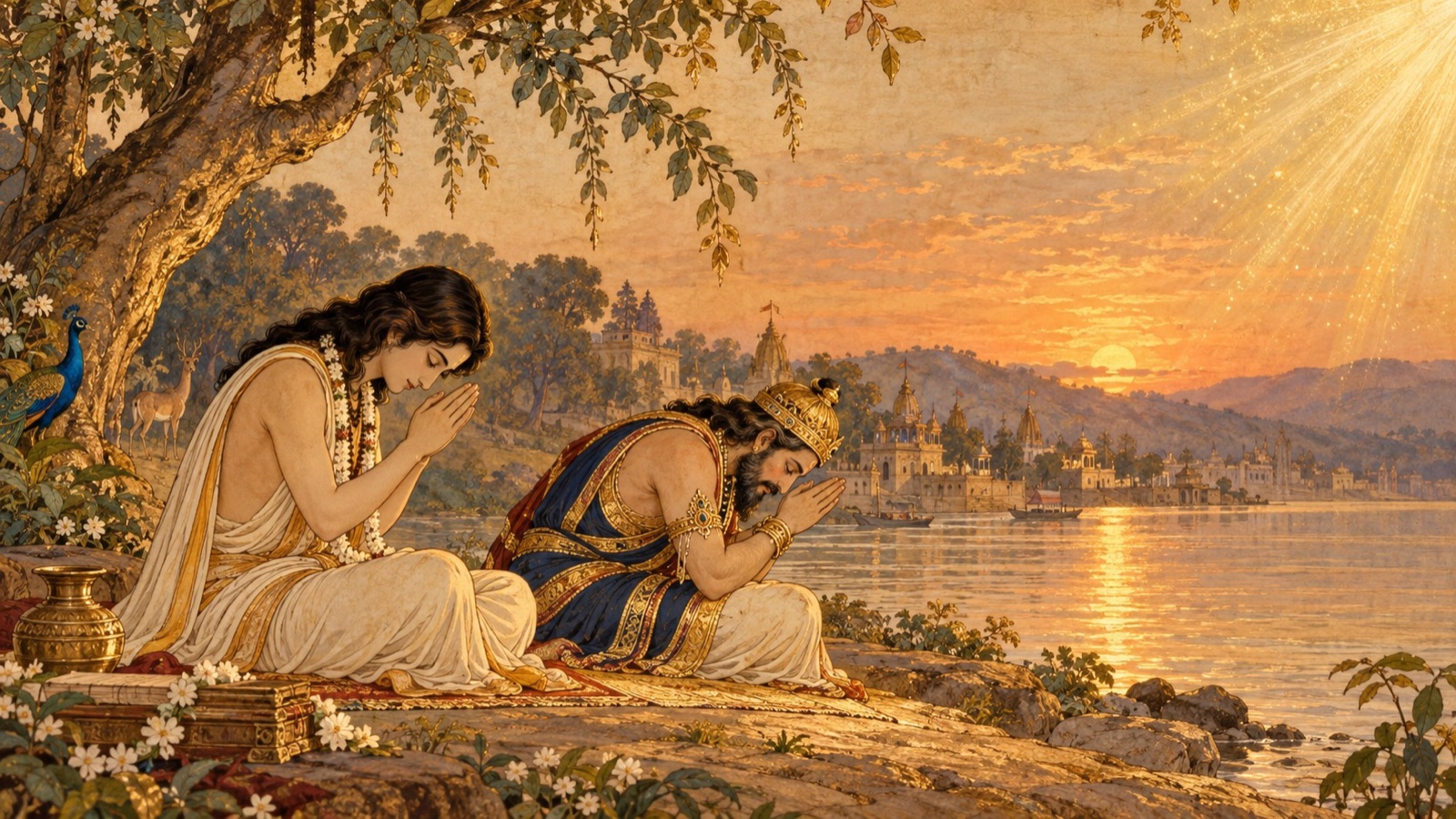
Sukadeva closed by reminding Parikshit of his own family’s fortune: Lord Sri Krishna Himself had been the protector, the preceptor, the worshipped deity, the beloved friend and the very head of the house of his grandfathers and of the Yadus — and had even, at times, served as their messenger. That same Lord bestows even final liberation upon those who worship Him, yet only rarely grants the still greater gift of loving devotion to His feet. And so the discourse ends with an obeisance: reverence to the glorious Lord Rsabhadeva, free from every craving, ever full in the realization of His own Self, who out of boundless compassion revealed the fearless, true nature of the Self to men whose minds had long been lost in the thought of the body and all that is other than the soul.
Principal Teachings of This Chapter
The mind is never to be blindly trusted. Even after long practice, the wise remain watchful of the restless mind, the root of lust, anger and every bondage. Vigilance, not complacency, keeps the seeker safe.
Detachment is truer strength than mystic power. Rsabhadeva refused the very perfections that others strive lifetimes to gain. To possess power and remain wholly indifferent to it is a greatness far beyond wielding it.
Imitating a saint’s outward form is not the path. The warning of the Kali age is that copying the external conduct of a realized soul, without His inner realization, leads only into darkness. The heart’s transformation, not the outer show, is what matters.
This land and this human birth are a rare blessing. The verses sing of Bharatavarsa as supremely holy because here the deeds of the Lord are remembered and sung. To be born where His name is glorified, and to join in that singing, is a fortune beyond measure.
Devotion is its own reward. The pure devotee, immersed in the joy of loving service, does not even reach for liberation when it is offered. Having given himself wholly to the Lord, he has already found everything.
A Devotional Reflection
There is something deeply tender in how the Lord’s earthly story ends — not in triumph on a throne, but in silence, in a forest, His body given up as quietly as a traveler sets down a burden. Rsabhadeva had already let go of His body inwardly long before the fire touched it; the flames only completed what His detachment had accomplished. This is the freedom the whole chapter points toward: to hold even our own bodies lightly, as something borrowed rather than owned, because we know ourselves to be the deathless soul within. And Sukadeva’s closing words gently redirect us. The point of the whole story is not admiration from a distance — for who could follow the path of that birthless Lord? — but the awakening of devotion in our own hearts through hearing and singing His glories. We cannot renounce the world as He did. But we can listen; we can remember; we can sing His name. And in that simple practice, the same peace that carried Him through the fire begins, quietly, to take root in us.
A Daily Devotional Practice
Today, set aside a few unhurried minutes to hear or read one sacred account of the Lord — a verse, a story, a passage of the Bhagavatam — and then, if you can, share it aloud with even one other person, or simply speak the Lord’s name gently to yourself. As you do, remember Sukadeva’s promise: that in the heart which listens and recites with faith, love for the Lord quietly awakens. Let this be your small offering for the day — not seeking any reward, but resting, like the pure devotee, in the joy of the remembrance itself.
Conclusion
The sixth discourse of Book Five brings the earthly story of Lord Rsabhadeva to its serene close. Answering King Parikshit, Sukadeva explains why the Lord refused the mystic powers that came to Him unsought: because the wise never trust the restless mind, the root of every bondage, and the Lord would teach even this by His own example. Then, to show the yogis the very art of leaving the body, Rsabhadeva turned wholly to the Supreme within, and, wandering the southern forests as a silent recluse, let His mortal frame be consumed by a forest fire without a trace of disturbance. Sukadeva warns that in the age of Kali some would imitate His outward ways without His inner realization and fall into darkness — a caution to seek the heart’s transformation, not the outward show. He sings the glory of Bharatavarsa and of Priyavrata’s line, in which the ancient Lord Himself descended, and declares that no other yogi could follow the path of that birthless One. And he ends with the sweetest assurance of all: that in the heart which hears and recites this sacred story with faith, pure devotion to the Lord awakens — a devotion so complete that the devotee does not reach even for liberation, having already found everything in the Lord.
May the divine wisdom of Srimad Bhagavatam awaken pure devotion within our hearts.
Om Namo Bhagavate Vasudevaya.
Jay Shree Madhav.
References and Attribution
- Primary edition: Gita Press, Śrīmad Bhāgavata Mahāpurāṇa (English, complete), Book Five, Discourse 6, “Lord Rsabha quits His body,” pages 460–462.
- Series: Srimad Bhagavatam Wisdom · Biswa Sanatan Dharma Seva Trust.
- Presented following the spiritual guidance and recommendation of Pandit Dr. Shri Kashinath Mishra.
This is an original, faithful retelling in the writer’s own words, with brief quoted verses shown in Devanāgarī and transliteration and their meanings given as summaries. It is not a reproduction of any single publisher’s continuous translation or commentary. No affiliation with or endorsement by any publisher is implied.
Jay Shree Madhav