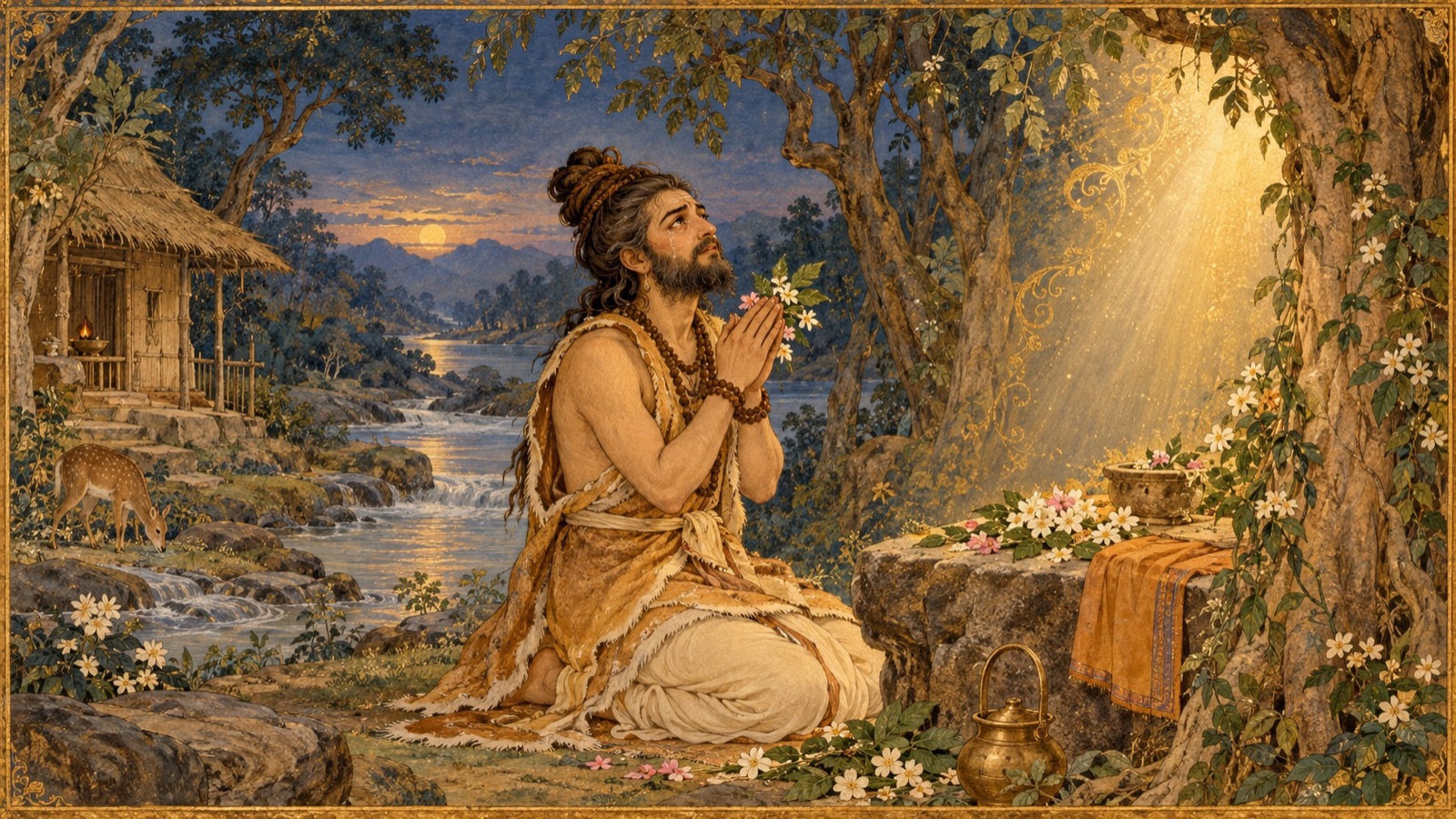
Having ruled the earth and offered its every fruit to the Lord, Emperor Bharata retires to the hermitage of Pulaha and worships the Supreme Person with a heart melting in love, tears streaming from his eyes.
Om Namo Bhagavate Vasudevaya.
Om Namo Bhagavate Vasudevaya.
Om Namo Bhagavate Vasudevaya.
Welcome back to Srimad Bhagavatam Wisdom, a devotional journey through the sacred histories and teachings of the Srimad Bhagavat Mahapurana. In the previous chapter, the earthly story of Lord Rsabhadeva came to its serene close. Now Sukadeva Gosvami turns to the life of Rsabhadeva’s eldest son, the great devotee Bharata — the emperor after whom this very land came to be called Bharatavarsa. This seventh chapter of Book Five tells how Bharata ruled the whole earth as a saint upon a throne, offering the fruit of every sacrifice to Lord Vasudeva; how, when his royal duty was fulfilled, he renounced everything and retired to a forest hermitage; and how, in that solitude, his love for the Lord grew so overwhelming that he wept in the joy of worship and forgot even the worship itself.
Chapter Information
- Scripture: Śrīmad Bhāgavata Mahāpurāṇa
- Canto: 5 (Book Five)
- Chapter: 7 (Discourse 7)
- Chapter title: The Story of Emperor Bharata
- Principal speaker: Sukadeva Gosvami (Sri Suka), narrating to King Parikshit
- Principal listener: King Parikshit — the discourse related in turn by Suta Gosvami to the sages gathered at Naimisaranya
- Main setting: The kingdom of Bharatavarsa, and afterward the hermitage of the sage Pulaha at Salagrama, on the bank of the river Gandaki
- Central subject: How Emperor Bharata ruled and worshipped the Lord through sacrifice, renounced the throne when his duty was done, retired to Pulaha’s hermitage, and worshipped the Supreme Person with ever-growing, ecstatic devotion
- Principal verse range: Canto 5, Chapter 7, verses 1–14
- Primary edition: Gita Press Śrīmad Bhāgavata Mahāpurāṇa
From the Previous Chapter
The sixth discourse of Book Five brought the story of Lord Rsabhadeva to its close, telling how the Lord, wholly absorbed in the Supreme within, gave up His body while wandering the southern forests, and how Sukadeva sang the glory of the land where the Lord had descended. Before He retired to the woods, Rsabhadeva had installed His eldest son, the great devotee Bharata, upon the throne. This chapter takes up Bharata’s own story — the emperor whose devotion was so complete that the whole of this land, once called Ajanabha, came to bear his name.
Bharata Ascends the Throne
When Bharata, that great devotee of the Lord, was appointed by Lord Rsabhadeva to the rulership of the earth, he took up the charge intent above all on obeying his father’s command, and married Pancajani, the daughter of Viswarupa.
श्रीशुक उवाच भरतस्तु महाभागवतो यदा भगवतावनितलपरिपालनाय सञ्चिन्तितस्तदनुशासनपर: पञ्चजनीं विश्वरूपदुहितरमुपयेमे ॥ १ ॥
śrī-śuka uvāca bharatas tu mahā-bhāgavato yadā bhagavatāvani-tala-paripālanāya sañcintitas tad-anuśāsana-paraḥ pañcajanīṁ viśvarūpa-duhitaram upayeme
Meaning: Sri Suka said: Bharata, the great devotee, when he was appointed by the Lord to the protection of the earth, married Pancajani, the daughter of Viswarupa, being intent on carrying out the Lord’s command. (Canto 5, Chapter 7, verse 1)
Through her, even as the principle of ego gives rise to the five subtle elements, he begot five sons, entirely like himself — Sumati, Rastrabhrt, Sudarsana, Avarana and Dhumraketu. And it was from his time onward that this Varsa, until then known as Ajanabha, came to be called Bharata, after the emperor himself.
A King Who Ruled as a Saint
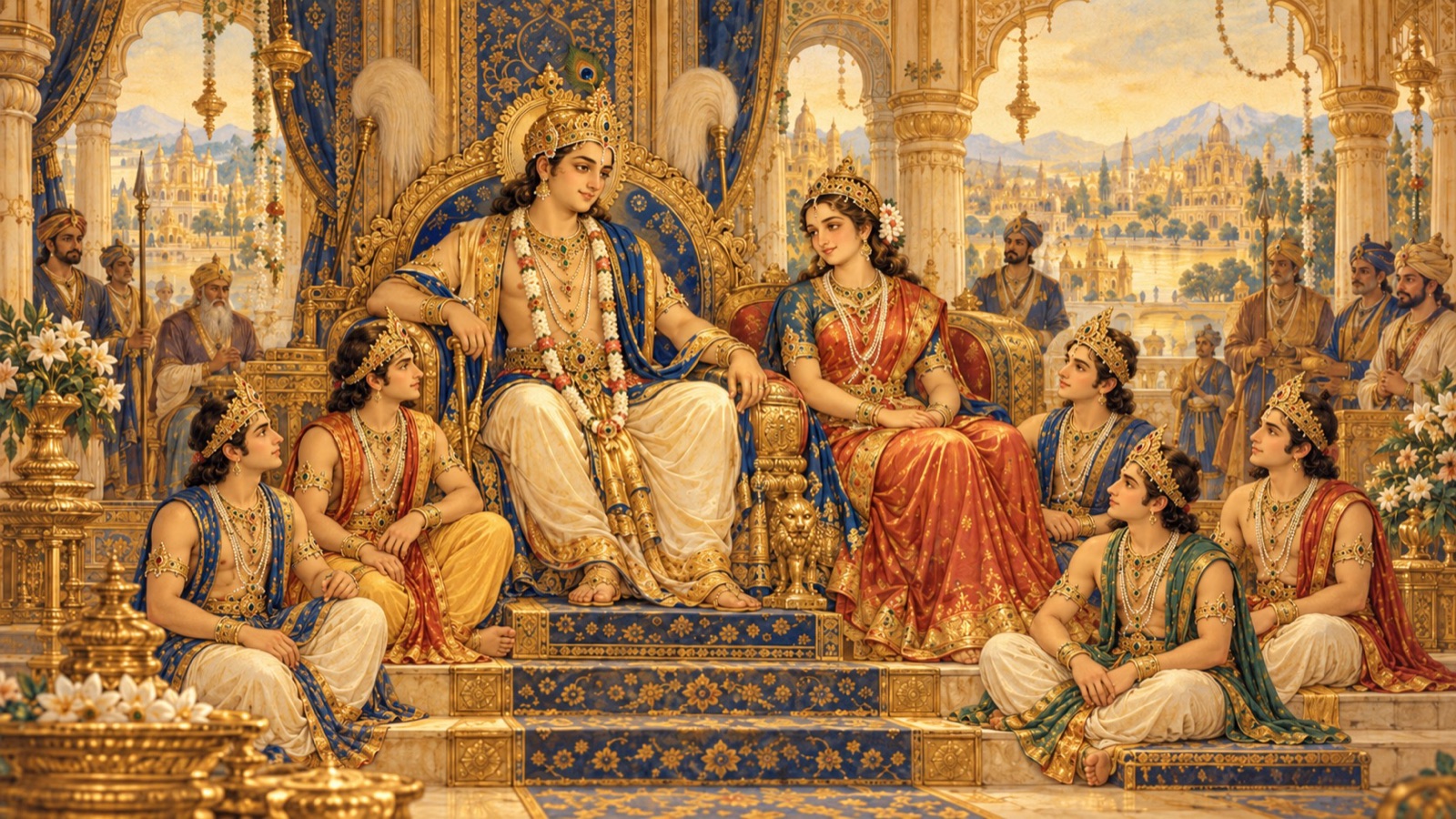
Remaining devoted to his duty like his father Rsabha and his grandfather King Nabhi, Bharata — a monarch of vast wisdom and boundless affection for his subjects — protected his people, each of whom kept faithfully to his own prescribed duty. At the appointed hours he worshipped the Lord who appears in the form of sacrifice, performing sacred rites both great and small, complete in every detail, under proper authority and with the help of qualified priests.
Yet what set his worship apart was the spirit within it. When the oblations were about to be offered into the sacred fire, Emperor Bharata would mentally surrender the very reward he might have claimed — every fruit of merit — wholly to Lord Vasudeva, the transcendent Reality who is the Soul of all sacrifice and its true doer. His likes and dislikes worn thin by this wisdom, as the priests raised each offering he beheld, in his mind’s eye, not many separate powers but the single body of the Supreme Person behind them — Indra as His arm, the sun-god Surya as His eye — so that whichever deity a given rite named, the oblation reached Vasudeva alone (verses 5–6).
सम्प्रचरत्सु नानायागेषु विरचिताङ्गक्रियेष्वपूर्वं यत्तत्क्रियाफलं धर्माख्यं परे ब्रह्मणि यज्ञपुरुषे सर्वदेवतालिङ्गानां मन्त्राणामर्थनियामकतया साक्षात्कर्तरि परदेवतायां भगवति वासुदेव एव भावयमान आत्मनैपुण्यमृदितकषायो हवि:ष्वध्वर्युभिर्गृह्यमाणेषु स यजमानो यज्ञभाजो देवांस्तान् पुरुषावयवेष्वभ्यध्यायत् ॥ ६ ॥
sampracaratsu nānā-yāgeṣu viracitāṅga-kriyeṣv apūrvaṁ yat tat kriyā-phalaṁ dharmākhyaṁ pare brahmaṇi yajña-puruṣe sarva-devatā-liṅgānāṁ mantrāṇām artha-niyāma-katayā sākṣāt-kartari para-devatāyāṁ bhagavati vāsudeva eva bhāvayamāna ātma-naipuṇya-mṛdita-kaṣāyo haviḥṣv adhvaryubhir gṛhyamāṇeṣu sa yajamāno yajña-bhājo devāṁs tān puruṣāvayaveṣv abhyadhyāyat
Meaning: While the many sacrifices proceeded through their appointed rites, Bharata fixed his mind on the truth that their unseen fruit, called religious duty, belongs to none but the transcendent Vasudeva, the Person of sacrifice who alone gives meaning and direction to every Vedic hymn and every deity it names; his impurities worn away by this understanding, he, the sacrificer, beheld the very gods who shared the oblations as limbs of that one Supreme Person. (Canto 5, Chapter 7, verse 6)
A question naturally arises here: if Bharata was already a pure devotee, why did he trouble himself with the elaborate machinery of Vedic sacrifice at all? This chapter’s quiet answer is that surrender, not withdrawal, is the mark of devotion. Bharata performed every rite because it was the duty appointed to a king, and he offered it whole, holding back no portion for himself. Just as watering the root of a tree nourishes every branch and leaf without watering each one separately, worship directed to Vasudeva as the source automatically satisfies every deity who is but His limb; done in this understanding, action no longer binds its doer to a fruit he never claimed. A rite that looked, on the surface, like ordinary ritualism became, in Bharata’s hands, a doorway to freedom rather than another link in the chain of karma.
Devotion Awakens in His Heart
As his mind was thus purified through the utter purity of his actions, there arose in his heart a loving devotion to Lord Vasudeva — a devotion that grew more intense with every passing day. He beheld the Supreme Person within the space of his own heart, marked by the sign of Srivatsa and the Kaustubha gem, wearing a garland of sylvan flowers and bearing the discus and mace, shining there like a portrait painted in the heart of His devotee.
एवं कर्मविशुद्ध्या विशुद्धसत्त्वस्यान्तर्हृदयाकाशशरीरे ब्रह्मणि भगवति वासुदेवे महापुरुषरूपोपलक्षणे श्रीवत्सकौस्तुभवनमालारिदरगदादिभिरुपलक्षिते निजपुरुषहृल्लिखितेनात्मनि पुरुषरूपेण विरोचमान उच्चैस्तरां भक्तिरनुदिनमेधमानरयाजायत ॥ ७ ॥
evaṁ karma-viśuddhyā viśuddha-sattvasyāntar-hṛdayākāśa-śarīre brahmaṇi bhagavati vāsudeve mahā-puruṣa-rūpopalakṣaṇe śrīvatsa-kaustubha-vana-mālāri-dara-gadādibhir upalakṣite nija-puruṣa-hṛl-likhitenātmani puruṣa-rūpeṇa virocamāna uccaistarāṁ bhaktir anudinam edhamāna-rayājāyata
Meaning: Thus, through the purity of his actions, in the heart of Bharata, now wholly pure, there arose toward Lord Vasudeva — the Supreme Person marked by Srivatsa, the Kaustubha, the garland of forest flowers, the conch, discus and mace, shining within like an image painted in the devotee’s heart — a devotion that grew mightier day by day. (Canto 5, Chapter 7, verse 7)
Bharata Renounces the Throne
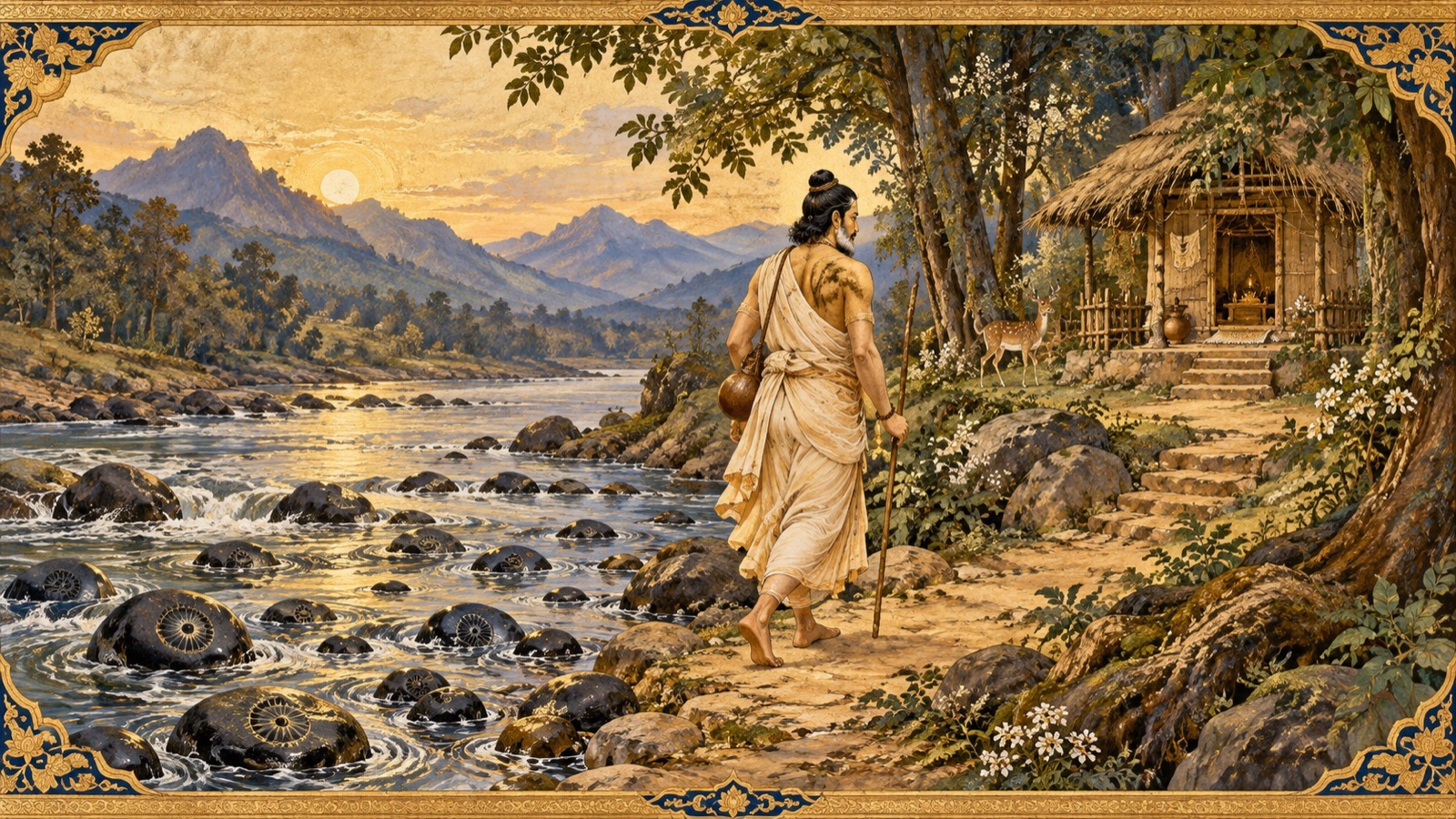
After ruling for ten million years, Bharata concluded that the store of merit which had brought him his royal fortune must by then have been fully enjoyed. So he divided the hereditary kingdom fairly among his sons and, leaving his palace — that abode of every prosperity — retired as a recluse to the hermitage of the sage Pulaha, on the bank of the river Gandaki, a place known as Salagrama.
It is said that in that very hermitage, drawn by His paternal love for the devotees who dwell there, Lord Sri Hari reveals Himself even today in the form each devotee longs to see. The holy Gandaki river hallows the place on every side, its waters rolling with the sacred wheel-marked stones — the Salagrama stones — that bear the emblem of Lord Vishnu.
यत्र ह वाव भगवान् हरिरद्यापि तत्रत्यानां निजजनानां वात्सल्येन सन्निधाप्यत इच्छारूपेण ॥ ९ ॥
yatra ha vāva bhagavān harir adyāpi tatratyānāṁ nija-janānāṁ vātsalyena sannidhāpyata icchā-rūpeṇa
Meaning: In that hermitage the Lord Sri Hari, out of tender affection for His own devotees who dwell there, makes Himself present even to this day in the form they desire to behold. (Canto 5, Chapter 7, verse 9)
Worship in the Solitude of the Forest
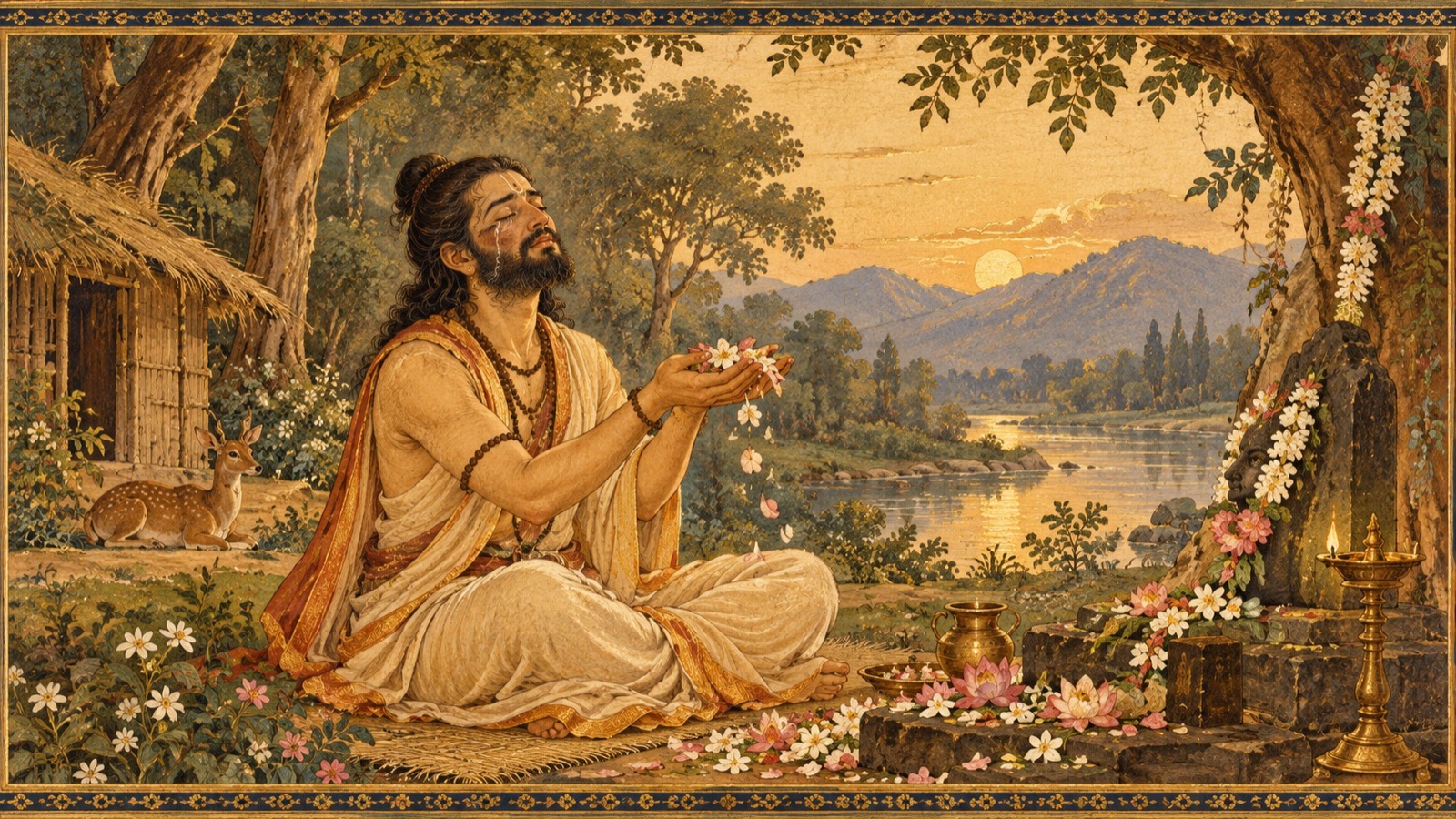
In a lonely retreat within that grove, Bharata worshipped the Lord entirely alone, offering flowers and tender leaves of many kinds — especially the leaves of the holy Tulasi — along with water, and simple forest fare of bulbs, roots and fruits. Freed of all craving for the pleasures of the senses, he grew wonderfully tranquil and drew from his worship a supreme and quiet joy.
Day by day his love deepened until, under the pressure of that ever-increasing devotion, his heart seemed to melt. The hair stood erect all over his body in the thrill of delight; his eyes brimmed with tears of longing to behold the Lord; and his awareness sank into the deep lake of his own heart, brimming over with the bliss of loving remembrance of the Lord’s lotus-red feet — until, lost in that felicity, he forgot even the very worship his hands were performing.
तयेत्थमविरतपुरुषपरिचर्यया भगवति प्रवर्धमानानुरागभरद्रुतहृदयशैथिल्य: प्रहर्षवेगेनात्मन्युद्भिद्यमानरोमपुलककुलक औत्कण्ठ्यप्रवृत्तप्रणयबाष्पनिरुद्धावलोकनयन एवं निजरमणारुणचरणारविन्दानुध्यानपरिचितभक्तियोगेन परिप्लुतपरमाह्लादगम्भीरहृदयह्रदावगाढधिषणस्तामपि क्रियमाणां भगवत्सपर्यां न सस्मार ॥ १२ ॥
tayettham avirata-puruṣa-paricaryayā bhagavati pravardhamānānurāga-bhara-druta-hṛdaya-śaithilyaḥ praharṣa-vegenātmany udbhidyamāna-roma-pulaka-kulaka autkaṇṭhya-pravṛtta-praṇaya-bāṣpa-niruddhāvaloka-nayana evaṁ nija-ramaṇāruṇa-caraṇāravindānudhyāna-paricita-bhakti-yogena paripluta-paramāhlāda-gambhīra-hṛdaya-hradāvagāḍha-dhiṣaṇas tām api kriyamāṇāṁ bhagavat-saparyāṁ na sasmāra
Meaning: By this ceaseless worship of the Supreme Person his heart, overwhelmed by ever-growing love, melted and grew soft; the hair of his body stood on end in the rush of joy, his eyes were so clouded by tears of loving longing that he could scarcely see, and his mind, plunged in the deep lake of his heart brimming with supreme bliss through constant meditation on the Lord’s rosy lotus-feet, forgot even the worship he was performing. (Canto 5, Chapter 7, verse 12)
The Prayer to the Supreme Light
Having taken up these sacred vows, clothed in deerskin, his tawny matted hair still wet from ablutions performed thrice each day, Bharata would wait upon the all-effulgent Lord Narayana as manifested in the orb of the rising sun, and offer this prayer to the Supreme Light:
परोरज: सवितुर्जातवेदो देवस्य भर्गो मनसेदं जजान । सुरेतसाद: पुनराविश्य चष्टे हंसं गृध्राणं नृषद्रिङ्गिरामिम: ॥ १४ ॥
paro-rajaḥ savitur jāta-vedo devasya bhargo manasedaṁ jajāna suretasādaḥ punar āviśya caṣṭe haṁsaṁ gṛdhrāṇaṁ nṛṣad-riṅgirām imaḥ
Meaning: The transcendent Light of the divine sun — beyond the mode of passion, the source of all knowledge — brought forth this universe by its mere thought and, entering it again as the Inner Controller, watches over every living being. We meditate upon that Light, which impels our understanding. (Canto 5, Chapter 7, verse 14)

Principal Teachings of This Chapter
Rule with the heart of a servant. Bharata governed a vast empire, yet inwardly he was a renunciate, offering the fruit of every act to the Lord. Position and duty need not bind us; performed as worship and surrendered in their results, they purify the heart.
Offer the fruit, not merely the act. The secret of Bharata’s worship was that he claimed nothing for himself, surrendering even the reward of his sacrifices to Lord Vasudeva. When the fruit is given to God, action itself becomes a path to freedom.
Know when duty is fulfilled, and let go. After long and faithful rule, Bharata recognized that his worldly account was complete, and he renounced without regret. There is a wisdom in knowing when to hold responsibility and when to lay it down.
Devotion grows by daily practice. Bharata’s love did not arrive all at once; it deepened “day by day” through steady, purified action and constant worship. Consistency, more than intensity, is what allows love for the Lord to mature.
The goal of worship is love itself. In the end Bharata was so absorbed in loving remembrance that he forgot even the ritual. The outward forms of devotion exist to awaken this inward love — and when love awakens, it is its own fulfillment.
A Devotional Reflection
There is a beautiful arc to Bharata’s life in this chapter — from throne to forest, from ruling the earth to forgetting even his own hands in the joy of worship. And what strikes the heart most is not his renunciation but the tenderness that renunciation uncovered. Here was a man who had held the whole world in his charge, and yet his greatest moment came when he stood weeping before the Lord, unable to see through his own tears, having lost track of the very ritual he was performing. That forgetfulness is not a lapse; it is the fruit of a love so full that it overflows every form meant to contain it. Most of us cannot renounce a kingdom, and we are not asked to. But we can learn Bharata’s inner posture: to do our work faithfully, to offer its fruit to the Lord rather than clutch it, and to let our daily remembrance deepen quietly until, one day, the remembrance itself becomes the sweetest thing we know.
A Daily Devotional Practice
Today, choose one ordinary duty — your work, a task at home, an act of service — and, before you begin, silently offer its result to the Lord, keeping nothing back for yourself. Then, as Bharata did each dawn, take a quiet moment to face the light of the morning and speak a short prayer of remembrance, repeating: “Om Namo Bhagavate Vasudevaya.” As you do, meditate on the Supreme Light that awakens all understanding within us. Let this small act join worship to work, so that even the simplest labor of the day becomes an offering laid gently at the Lord’s feet.
Conclusion
The seventh discourse of Book Five tells the luminous story of Emperor Bharata, the great devotee after whom this land is named. Appointed by his father Lord Rsabhadeva, he ruled the whole earth with wisdom and love, protecting his people and worshipping the Lord through sacrifice — yet always surrendering the fruit of his every act to Lord Vasudeva, the Soul of all sacrifice. As his heart grew pure, loving devotion arose within him and deepened day by day, until, his royal duty fulfilled, he divided his kingdom among his sons and retired to the hermitage of Pulaha by the sacred Gandaki. There, worshipping the Lord in solitude with flowers, leaves and simple offerings, his love swelled beyond all measure: he wept in the joy of remembrance and forgot even the worship his hands performed, and each dawn he prayed to the Supreme Light shining in the rising sun. In Bharata we are shown a soul who held the whole world and yet held nothing, whose true kingdom was the love of the Lord within his own heart.
May the divine wisdom of Srimad Bhagavatam awaken pure devotion within our hearts.
Om Namo Bhagavate Vasudevaya.
Jay Shree Madhav.
References and Attribution
- Primary edition: Gita Press, Śrīmad Bhāgavata Mahāpurāṇa, Book Five, Discourse 7, “The story of Bharata.”
- Series: Srimad Bhagavatam Wisdom · Biswa Sanatan Dharma Seva Trust.
- Presented following the spiritual guidance and recommendation of Pandit Dr. Shri Kashinath Mishra.
This is an original, faithful retelling in the writer’s own words, with brief quoted verses shown in Devanāgarī and transliteration and their meanings given as summaries. It is not a reproduction of any single publisher’s continuous translation or commentary. No affiliation with or endorsement by any publisher is implied.
Jay Shree Madhav