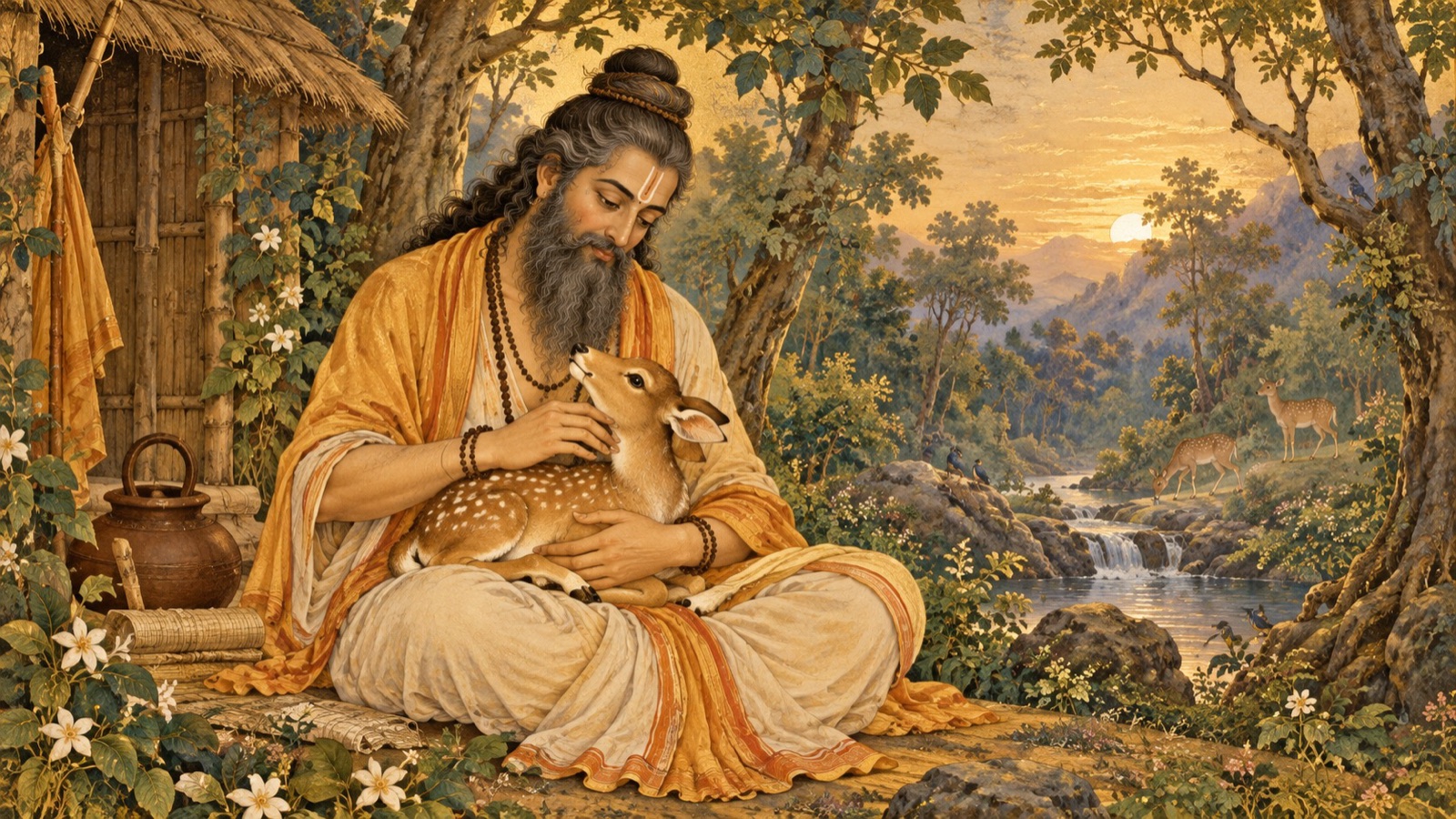
Moved by compassion for a motherless fawn, the sage-king Bharata takes it to his hermitage and cradles it with such tender love that his heart, once fixed wholly on the Lord, is slowly bound by a single small attachment.
Om Namo Bhagavate Vasudevaya.
Om Namo Bhagavate Vasudevaya.
Om Namo Bhagavate Vasudevaya.
Welcome back to Srimad Bhagavatam Wisdom, a devotional journey through the sacred histories and teachings of the Srimad Bhagavat Mahapurana. In the previous chapter, Emperor Bharata renounced his throne and retired to the hermitage of Pulaha, where his love for the Lord grew so deep that he wept in worship and forgot even the ritual itself. This eighth chapter of Book Five tells one of the most tender and sobering stories in all the Bhagavatam: how this same great soul, who had let go of a whole kingdom and his own beloved sons, came to be bound by attachment to a single orphaned fawn — and how that one attachment, born of compassion, so filled his heart at the hour of death that he was reborn in the body of a deer. It is a story that teaches, with heartbreaking gentleness, how carefully even the advanced seeker must guard the heart.
Chapter Information
- Scripture: Śrīmad Bhāgavata Mahāpurāṇa
- Canto: 5 (Book Five)
- Chapter: 8 (Discourse 8)
- Chapter title: Bharata and the Fawn
- Principal speaker: Sukadeva Gosvami (Sri Suka), narrating to King Parikshit
- Principal listener: King Parikshit — the discourse related in turn by Suta Gosvami to the sages gathered at Naimisaranya
- Main setting: The hermitage of Pulaha at Salagrama, on the bank of the river Gandaki
- Central subject: How Bharata rescued a motherless fawn out of compassion, grew attached to it, neglected his spiritual practice, and, thinking of the deer at the hour of death, was reborn as a deer — yet retained the memory of his past life and turned again toward liberation
- Principal verse range: Canto 5, Chapter 8, verses 1–31
- Primary edition: Gita Press Śrīmad Bhāgavata Mahāpurāṇa
From the Previous Chapter
In the seventh discourse, Emperor Bharata ruled the whole earth as a saint upon a throne, surrendering the fruit of every sacrifice to Lord Vasudeva. When his royal duty was fulfilled he divided his kingdom among his sons and retired to the hermitage of Pulaha by the sacred Gandaki, where he worshipped the Supreme Person with a love so overwhelming that he wept and forgot even the worship itself. This chapter continues his story in that same hermitage — and shows how even so exalted a devotee could stumble.
A Morning by the River
One day, having bathed in the great river Gandaki and completed his daily observances, Bharata sat down on the bank for the space of three muhurtas, softly repeating the sacred syllable Om.
श्रीशुक उवाच एकदा तु महानद्यां कृताभिषेकनैयमिकावश्यको ब्रह्माक्षरमभिगृणानो मुहूर्तत्रयमुदकान्त उपविवेश ॥ १ ॥
śrī-śuka uvāca ekadā tu mahā-nadyāṁ kṛtābhiṣeka-naiyamikāvaśyako brahmākṣaram abhigṛṇāno muhūrta-trayam udakānta upaviveśa
Meaning: Sri Suka said: One day, having bathed in the great river and finished his obligatory duties, Bharata sat down on the water’s edge for three muhurtas, softly chanting the sacred syllable Om (the imperishable Brahman). (Canto 5, Chapter 8, verse 1)
As he sat there, a doe heavy with young came to the same bank to drink. And just then, close by, a lion roared with a loud and terrible sound. The doe, timid by nature, was seized with fear; overcome and bewildered, she leapt across the stream in a single bound, her thirst still unquenched. In taking that desperate leap, the young in her womb slipped from her; the newborn fawn fell into the current of the river. Weakened by the sudden birth and the long leap, and strayed now from her herd, the doe sank down in a cave nearby and died.

Compassion Becomes a Bond
Bharata saw the tiny fawn, helpless and motherless, being swept along by the water. Moved with compassion, the royal sage lifted it out, and, knowing it had no mother, carried it to his hermitage and cared for it as a true friend.
From that day he thought constantly of the little creature — feeding it, guarding it from wolves and other beasts, stroking and soothing it with tender affection. And so, one by one, his own daily practices — his bathing, his disciplines, even his loving worship of the Lord — came to be neglected, and within a few days were quietly set aside altogether. He reasoned to himself that it would be heartless to abandon a helpless being that had taken refuge in him alone, knowing no one else in all the world; surely, he thought, the good and compassionate overlook their own great interests for the sake of the weak. Thus his heart, once knit wholly to the Lord, grew knit instead to the fawn — as he sat and as he slept, as he walked and stood and ate, his mind was never free of it.
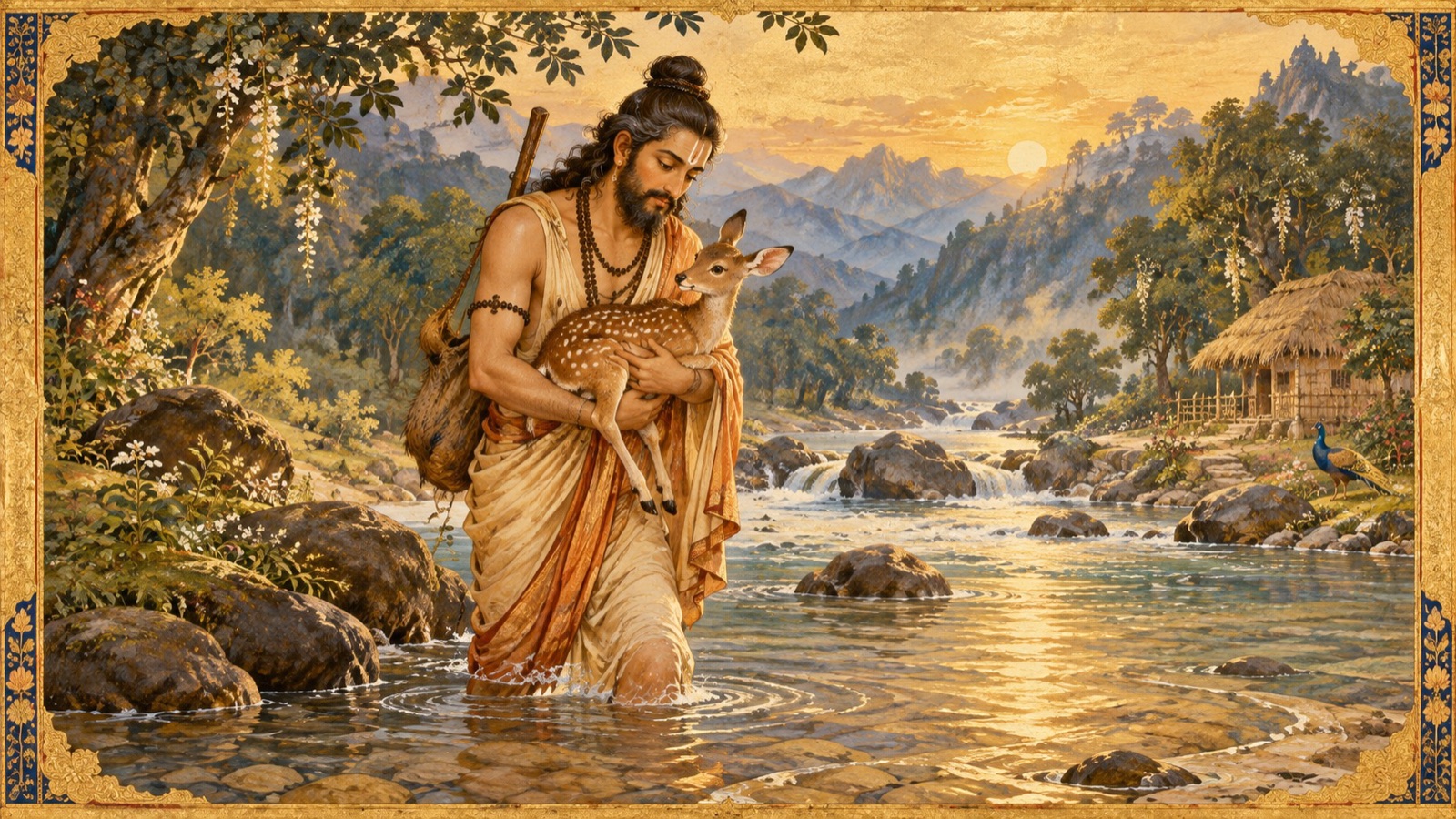
Whenever he went to gather kusa grass, flowers, firewood, fruits or water, he took the young deer along, fearing that wolves or dogs might harm it. If it grew tired on the path, he would lift it onto his shoulder and carry it, or set it on his lap and bosom, fondling it with a heart full of delight. Even in the middle of a sacred rite he would rise again and again to look at it, and, seeing it safe, would bless it tenderly: “May you be safe on every side, my darling.”
When the Fawn Strayed
And whenever the fawn wandered out of sight, Bharata was thrown into anguish, like a miser who has lost his treasure. He would grieve for it, pierced by the pain of separation, and cry out in his longing: Would the poor little orphan, trusting in him, return once more? Would he see it again, grazing in safety in the grove? Might a wolf or a tiger not have devoured it? The sun that gives light to all the world was setting — and still the little deer had not come back to him.
He would speak of the fawn as fondly as of a cherished child, wondering when its winsome, playful ways would return to comfort a heart already so wounded, and telling himself that he must have exhausted whatever merit he possessed, for surely a more fortunate man’s deer would have come home by now. Even while he sat feigning meditation, he could not forget how the little one used to circle him in a kind of loving petulance and touch him with the tender tips of its new horns; nor how, when it strayed onto the kusha grass he had spread for worship and fouled it with its restless mouth, he would gently drive it off, and it would crouch still and fearful, as obedient as a well-taught child. Rising even from his rites to search for it, he would find its small hoofprints upon the ground and praise them as a pilgrim praises a holy mark, declaring that this earth must have performed great penance to be blessed with so fair an imprint, and that wherever a deer’s footprints are seen, that ground becomes fit for the sacrifices of the wise (verses 20–23).
So consumed did he become that, gazing at the moon, he imagined its dark markings to be the shape of his own lost fawn, sheltered there from the lion’s dread, and felt its cool light fall upon him like a friend’s kindness poured over the burning fever of separation, and took comfort in the fancy.
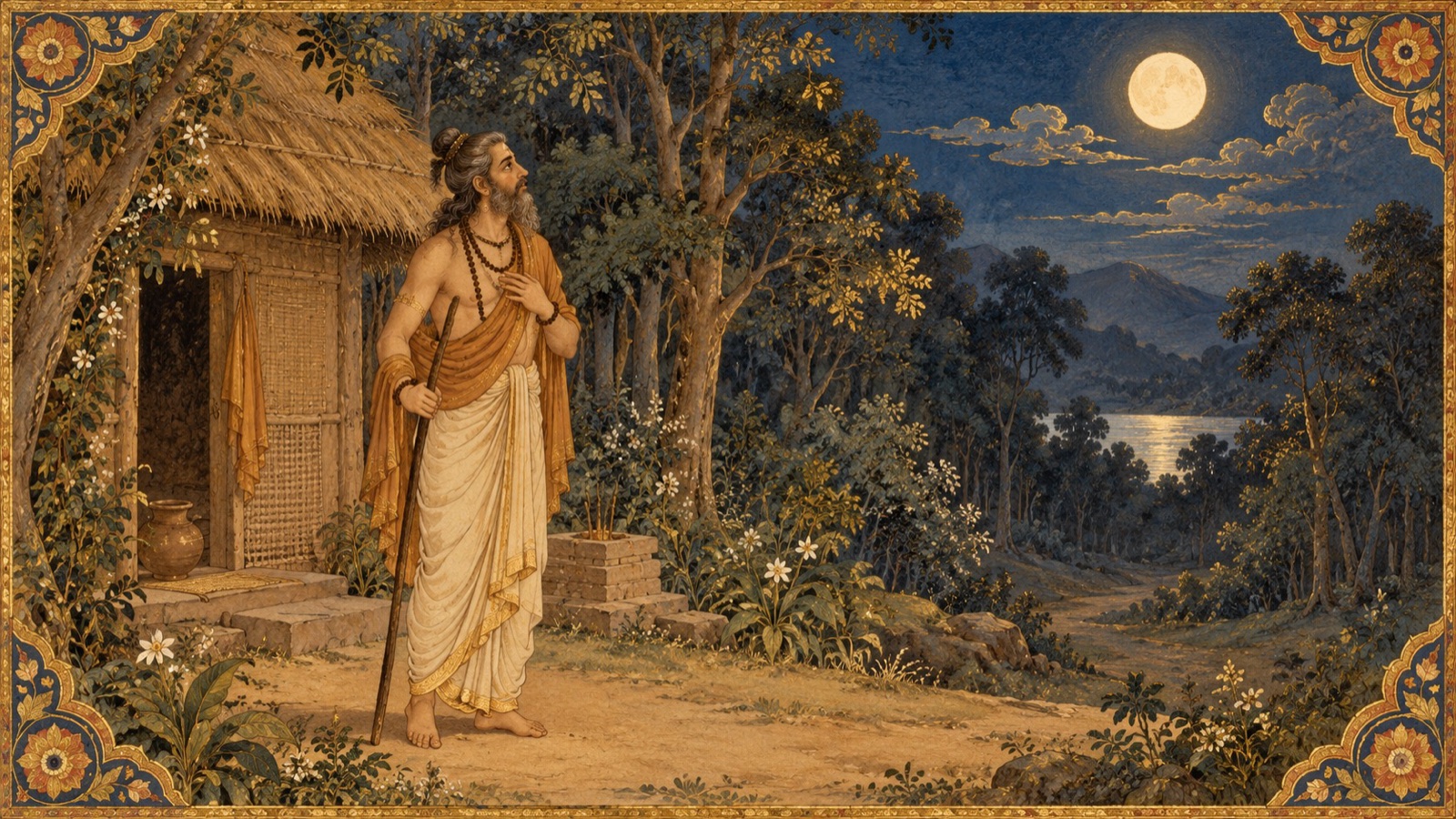
Troubled by such fantasies, the royal sage was drawn away from the very practices of devotion and yoga for which he had renounced the world. How strange, Sukadeva observed, that one who had been able to give up his own dear sons — a far harder parting — should now be so bound by a creature of another kind. This, indeed, was the working of an inscrutable destiny.
The Hour of Death
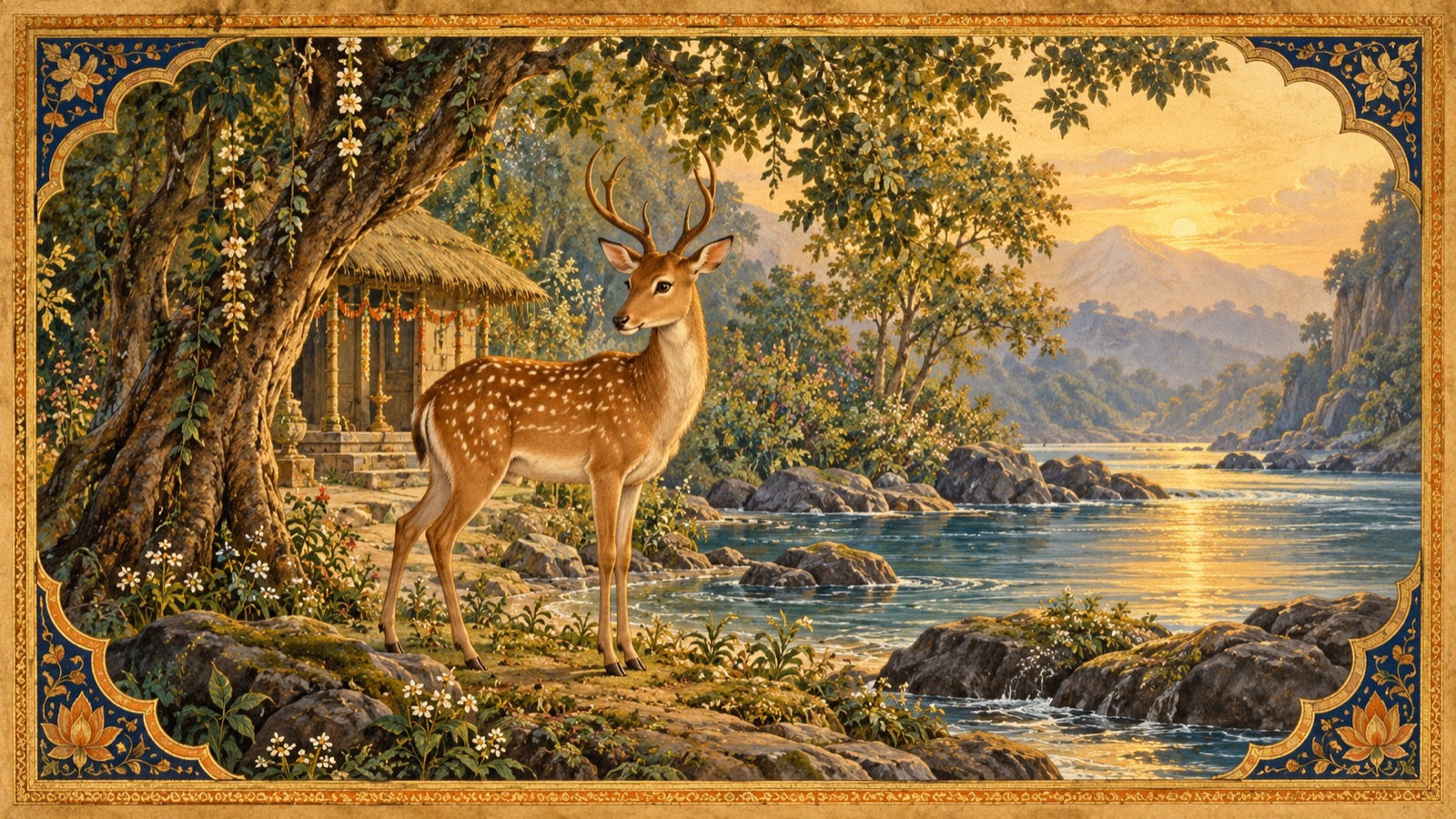
While Bharata was thus lost in the care of the deer, his yoga interrupted and his mind wholly absorbed in nourishing and protecting it, the hour of death approached — swift and impossible to escape, as a serpent glides toward the hole of a rat. And even in that final hour, the fawn stood beside him, grieving like a son, and Bharata could think of nothing else. Fixing his mind upon the deer alone, he gave up his body — and took, in his next birth, the body of a deer. Yet, because of his long endeavor in devotion, one thing did not leave him as the old body did: the memory of his past life.
तदानीमपि पार्श्ववर्तिनमात्मजमिवानुशोचन्तमभिवीक्षमाणो मृग एवाभिनिवेशितमना विसृज्य लोकमिमं सह मृगेण कलेवरं मृतमनु न मृतजन्मानुस्मृतिरितरवन्मृगशरीरमवाप ॥ २७ ॥
tadānīm api pārśva-vartinam ātmajam ivānuśocantam abhivīkṣamāṇo mṛga evābhiniveśita-manā visṛjya lokam imaṁ saha mṛgeṇa kalevaraṁ mṛtam anu na mṛta-janmānusmṛtir itaravan mṛga-śarīram avāpa
Meaning: Even at that hour, gazing on the deer that stood grieving by his side like a son, his mind fixed on it alone, Bharata left this world and, along with the deer, gave up his body; and he obtained the body of a deer, as any other would — yet the memory of his former birth did not perish with the body he had left. (Canto 5, Chapter 8, verse 27)
Repentance and Release
Born now as a deer, Bharata remembered — through the grace of his past devotion — the very cause of his fall, and he was filled with bitter remorse.
अहो कष्टं भ्रष्टोऽहमात्मवतामनुपथाद्यद्विमुक्तसमस्तसङ्गस्य विविक्तपुण्यारण्यशरणस्यात्मवत आत्मनि सर्वेषामात्मनां भगवति वासुदेवे तदनुश्रवणमननसङ्कीर्तनाराधनानुस्मरणाभियोगेनाशून्यसकलयामेन कालेन समावेशितं समाहितं कार्त्स्न्येन मनस्तत्तु पुनर्ममाबुधस्यारान्मृगसुतमनु परिसुस्राव ॥ २९ ॥
aho kaṣṭaṁ bhraṣṭo ’ham ātmavatām anupathād yad-vimukta-samasta-saṅgasya vivikta-puṇyāraṇya-śaraṇasyātmavata ātmani sarveṣām ātmanāṁ bhagavati vāsudeve tad-anuśravaṇa-manana-saṅkīrtanārādhanānusmaraṇābhiyogenāśūnya-sakala-yāmena kālena samāveśitaṁ samāhitaṁ kārtsnyena manas tat tu punar mamābudhasyārān mṛga-sutam anu parisusrāva
Meaning: “Alas, how I have fallen from the path of the self-controlled! Though I had renounced every attachment and taken shelter in a lonely and holy forest, and had fixed my mind wholly and without a moment’s lapse upon Lord Vasudeva, the Self of all selves — through hearing, reflecting, chanting, worshipping and remembering Him — that very mind of mine, fool that I was, slipped away in a moment after a young deer.” (Canto 5, Chapter 8, verse 29)
With this remorse held quietly within, the deer-Bharata forsook the doe that was now his mother and left his birthplace on the mountain of Kalanjara, returning once more to the sacred hermitage of Pulaha and Pulastya at Salagrama — that holy resort of self-controlled sages. There he lived all alone, dreading attachment above all, awaiting his death and subsisting only on dry leaves, blades of grass and low shrubs. And when at last the term of his life as a deer was exhausted, he gave up that bestial body in the waters of the holy Gandaki, his heart already turned again toward the Lord.
Principal Teachings of This Chapter
Even great souls must guard the heart. Bharata had renounced a kingdom and his own sons, yet a single small attachment undid his practice. No one is ever so advanced that vigilance may be set aside; the heart must be watched to the very end.
Compassion is holy — attachment is its subtle shadow. Bharata’s rescue of the fawn was a beautiful act of mercy. The danger lay not in the kindness but in the clinging that grew from it. We may serve and love all beings, yet keep the heart anchored in the Lord alone.
What fills the mind at death shapes what follows. The Bhagavatam shows plainly that the last thought carries great power. This is why remembrance of the Lord is cultivated all through life — so that, when the final hour comes, the heart turns naturally toward Him.
The Lord’s grace is not lost — even a fall is turned to mercy. Sukadeva makes clear that Bharata’s fatal attraction to the fawn was the fruit of a past deed finding its opening the moment his mind relaxed its hold on the Lord (verse 26). Yet for a soul who has walked so far in devotion, this reckoning was not left to run its ordinary course. Bharata was not simply punished and forgotten; he was given, swiftly, the very form his distracted mind had already fashioned for itself, so the debt could be cleared at once and his devotion resumed without delay. This is the chapter’s deeper comfort: for one who has truly turned to the Lord, even the correction of a fall is shaped by mercy, meant to hasten the return home rather than merely to punish it. Though Bharata fell, his years of devotion were not wasted: he was reborn with the memory of his past life intact, and so could turn back at once toward liberation. Sincere spiritual effort is never destroyed; it waits to lift us again.
Repentance is itself a turning toward God. The deer-Bharata’s honest sorrow, and his return to the holy place, were the first steps of his recovery. To recognize a fall clearly and turn back without despair is the beginning of the way home.
A Devotional Reflection
There is something almost unbearably tender in this chapter, and also something deeply reassuring. Bharata’s fall did not come through greed or pride or any obvious sin — it came through love, through pity for a helpless creature caught in a river. And that is precisely what makes the story so searching: the very softness of heart that made him a saint became, unguarded, the thread that bound him. We need not read this as a warning against compassion; the Bhagavatam never asks us to harden ourselves. Rather, it asks us to love wisely — to let our tenderness flow toward every creature while keeping the deepest current of the heart fixed on the Lord, who alone is never lost. And if we should stumble, as Bharata did, the chapter’s quiet promise is that no sincere devotion is ever wasted. He carried his memory across the gate of death; his effort waited for him on the other side and drew him back. Our own small efforts, too, are safe with the Lord, and will not be forgotten.
A Daily Devotional Practice
Today, notice one attachment that quietly occupies your mind — a person, a possession, a worry you return to again and again — and, without rejecting or resenting it, gently offer it to the Lord, saying inwardly: “Om Namo Bhagavate Vasudevaya.” Let your care for it remain, but place it in the Lord’s hands rather than clutching it in your own. Then, before you sleep, spend one quiet minute remembering Him, so that His name, and not any anxiety, is the last thought to rest in your heart. In this small daily turning, you practice the very art that Bharata’s story teaches — to love the world with an open hand, and to keep the Lord at the center of the heart.
Conclusion
The eighth discourse of Book Five tells the poignant story of how the great devotee Bharata, having renounced kingdom and family, was bound at last by love for a single orphaned fawn. Rescuing it from the river out of pure compassion, he grew so attached that his spiritual practice fell away, and at the hour of death, his mind fixed on the deer alone, he was reborn in a deer’s body. Yet the Lord’s grace did not abandon him: he kept the memory of his past life, repented deeply, and returned to the holy hermitage of Salagrama, where he lived in careful austerity until he gave up that body by the sacred Gandaki, his heart turned once more toward the Lord. His story is a gentle, unforgettable lesson for every seeker — that the heart must be guarded to the very end, that we may love all beings yet cling to none but God, and that no sincere devotion is ever truly lost.
May the divine wisdom of Srimad Bhagavatam awaken pure devotion within our hearts.
Om Namo Bhagavate Vasudevaya.
Jay Shree Madhav.
References and Attribution
- Primary edition: Gita Press, Śrīmad Bhāgavata Mahāpurāṇa, Book Five, Discourse 8 — the account of Bharata’s fall through attachment to a fawn.
- Series: Srimad Bhagavatam Wisdom · Biswa Sanatan Dharma Seva Trust.
- Presented following the spiritual guidance and recommendation of Pandit Dr. Shri Kashinath Mishra.
This is an original, faithful retelling in the writer’s own words, with brief quoted verses shown in Devanāgarī and transliteration and their meanings given as summaries. It is not a reproduction of any single publisher’s continuous translation or commentary. No affiliation with or endorsement by any publisher is implied.
Jay Shree Madhav