
Reborn in a Brahmana family and remembering all his past lives, the great soul Bharata hides his wisdom behind the mask of a dull, deaf madman — his heart clasping the Lord’s lotus-feet, untouched by honor or insult.
Om Namo Bhagavate Vasudevaya.
Om Namo Bhagavate Vasudevaya.
Om Namo Bhagavate Vasudevaya.
Welcome back to Srimad Bhagavatam Wisdom, a devotional journey through the sacred histories and teachings of the Srimad Bhagavat Mahapurana. In the previous chapter, the great devotee Bharata, bound by attachment to a fawn, was reborn as a deer — yet kept the memory of his past life and, giving up that body by the holy Gandaki, turned again toward the Lord. This ninth chapter of Book Five takes up his third and final birth: as the son of a Brahmana, a soul so wary of attachment that he deliberately hid his greatness behind the appearance of a dull, deaf madman. The world came to call him Jada Bharata — “Bharata the inert” — and mocked him; but within that still, silent form burned the undimmed glory of a perfected sage. The chapter closes with a startling scene in which the Lord’s own protective power rises to shield him from death.
Chapter Information
- Scripture: Śrīmad Bhāgavata Mahāpurāṇa
- Canto: 5 (Book Five)
- Chapter: 9 (Discourse 9)
- Chapter title: The Birth of Jada Bharata
- Principal speaker: Sukadeva Gosvami (Sri Suka), narrating to King Parikshit
- Principal listener: King Parikshit — the discourse related in turn by Suta Gosvami to the sages gathered at Naimisaranya
- Main setting: The home of a holy Brahmana of the line of the sage Angira, and the fields and shrine where the closing episode takes place
- Central subject: Bharata’s third birth as the son of a Brahmana; how he hid his wisdom behind the guise of a dull madman to avoid attachment; his perfect equanimity amid mockery and hardship; and how the Lord’s protective power, in the form of the Goddess, saved him from being sacrificed by a band of robbers
- Principal verse range: Canto 5, Chapter 9, verses 1–20
- Primary edition: Gita Press Śrīmad Bhāgavata Mahāpurāṇa
From the Previous Chapter
In the eighth discourse, the great devotee Bharata, having grown attached to an orphaned fawn, thought of it at the hour of death and was reborn as a deer. Yet by the Lord’s grace he retained the memory of his past life, repented, and, living in careful austerity at the holy Salagrama, gave up his deer’s body in the waters of the Gandaki with his heart fixed on the Lord. This chapter tells what became of him next — his third birth, and how the hard lesson of the fawn had taught him to guard his heart with extraordinary care.
A Third Birth, and a Hidden Wisdom
In due course, Sukadeva said, Bharata was born again — this time in the family of a saintly Brahmana descended from the great sage Angira, a householder rich in asceticism, Vedic learning, self-control and every virtue. Among the children of that home, one of a pair of twins was that same supreme devotee and foremost of royal sages, Bharata, who, having cast off his deer’s body, had now attained birth as a Brahmana.
Remembering, by the Lord’s grace, the whole series of his past lives — and above all the fall that a single attachment had caused — he was terribly afraid of ever again becoming entangled with people and their affairs. So he resolved to give the world no reason to draw him in. Clasping firmly within his mind the lotus-feet of the Lord — those feet that snap the fetters of karma for all who hear of them, remember them, or sing their praises — he showed himself to everyone as an insane, dull, blind and deaf fellow.
तत्रापि स्वजनसङ्गाच्च भृशमुद्विजमानो भगवत: कर्मबन्धविध्वंसनश्रवणस्मरणगुणविवरणचरणारविन्दयुगलं मनसा विदधदात्मन: प्रतिघातमाशङ्कमानो भगवदनुग्रहेणानुस्मृतस्वपूर्वजन्मावलिरात्मानमुन्मत्तजडान्धबधिरस्वरूपेण दर्शयामास लोकस्य ॥ ३ ॥
tatrāpi svajana-saṅgāc ca bhṛśam udvijamāno bhagavataḥ karma-bandha-vidhvaṁsana-śravaṇa-smaraṇa-guṇa-vivaraṇa-caraṇāravinda-yugalaṁ manasā vidadhad ātmanaḥ pratighātam āśaṅkamāno bhagavad-anugraheṇānusmṛta-sva-pūrva-janmāvalir ātmānam unmatta-jaḍāndha-badhira-svarūpeṇa darśayām āsa lokasya
Meaning: In that birth too, dreading all contact with kinsfolk and afraid of a fresh fall, and remembering by the Lord’s grace the whole succession of his past lives, he held fast within his mind to the Lord’s lotus-feet — which destroy the bondage of karma for those who hear, remember and glorify them — and showed himself to the world in the form of a madman, dull, blind and deaf. (Canto 5, Chapter 9, verse 3)
The Father’s Devotion, and the Boy’s Disguise
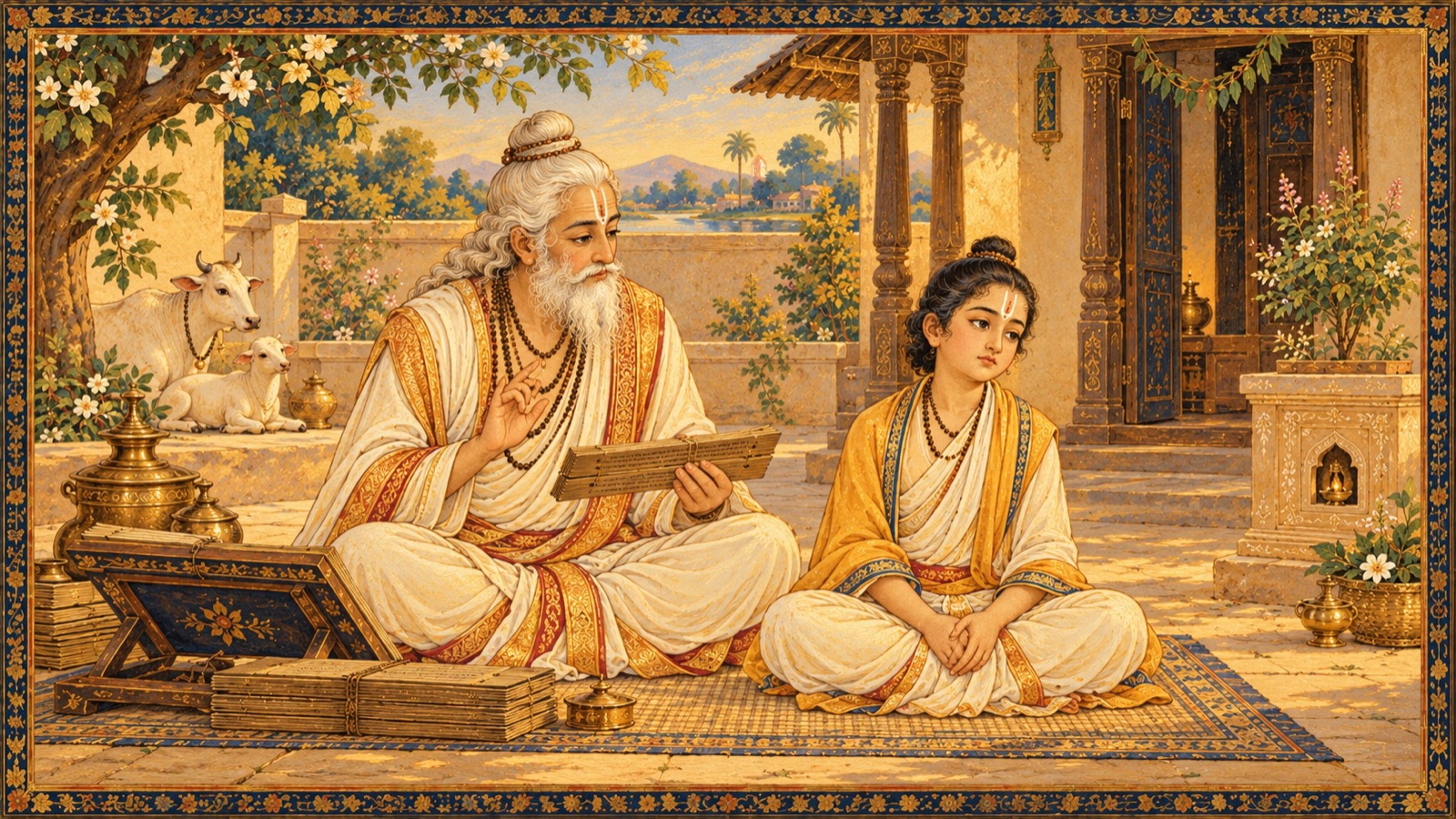
The Brahmana, his heart bound to the child by parental love, performed all the sacred purificatory rites for him and, after investing him with the sacred thread, tried to teach him the rules of cleanliness and conduct, believing a father must instruct his son. But the boy did everything backwards, as it were, in his father’s very presence. Though the Brahmana labored for months to teach him, he could impart only the sacred Gayatri and the syllable Om — and even that the boy would repeat only in a broken, faltering way. Before the father’s hope of seeing his son a learned man could be fulfilled, he was carried away by death; and his wife, entrusting her twins to her co-wife, followed her husband in death. On the father’s passing, the boy’s elder half-brothers, judging him a hopeless dunce, gave up all thought of teaching him.
There is a deeper teaching hidden in this quiet failure. Every discipline a father might pass to a son — cleanliness, ritual, the sacred syllables of the Gayatri — exists only to awaken the soul’s attraction to the Lord; that is the sole purpose duty serves. Jada Bharata, across three consecutive lives of unbroken devotion, had already reached the very attraction that such training aims to produce. He was not obstinate for lack of intelligence; he simply had nothing further to gain from repeating what he had already fulfilled. His father’s love was real and his labor sincere, yet the boy’s silence was the silence of one already arrived, not one refusing to begin (verse 4).
The Saint Whom the World Despised
Now free of even that gentle pressure, Bharata lived wholly as he wished within. When people — those “two-footed animals,” as the scripture wryly calls the unperceiving — called him a lunatic, an idiot, a deaf-mute, he simply spoke and behaved as befit the description. He would do whatever work others forced upon him, and eat whatever came his way — got by labor or by begging, given freely or grudgingly, plentiful or scanty, tasty or spoiled — but never for the pleasure of his tongue. For he had realized his oneness with the all-blissful Self, ever-conscious and self-luminous, and no longer identified with the body in the pleasure and pain that come from honor and insult and every pair of opposites.
स च प्राकृतैर्द्विपदपशुभिरुन्मत्तजडबधिरमूकेत्यभिभाष्यमाणो यदा तदनुरूपाणि प्रभाषते कर्माणि च कार्यमाण: परेच्छया करोति विष्टितो वेतनतो वा याच्ञया यदृच्छया वोपसादितमल्पं बहु मृष्टं कदन्नं वाभ्यवहरति परं नेन्द्रियप्रीतिनिमित्तम् । नित्यनिवृत्तनिमित्तस्वसिद्धविशुद्धानुभवानन्दस्वात्मलाभाधिगम: सुखदु:खयोर्द्वन्द्वनिमित्तयोरसम्भावितदेहाभिमान: ॥ ९ ॥ शीतोष्णवातवर्षेषु वृष इवानावृताङ्ग: पीन: संहननाङ्ग: स्थण्डिलसंवेशनानुन्मर्दनामज्जनरजसा महामणिरिवानभिव्यक्तब्रह्मवर्चस: कुपटावृतकटिरुपवीतेनोरुमषिणा द्विजातिरिति ब्रह्मबन्धुरिति संज्ञयातज्ज्ञजनावमतो विचचार ॥ १० ॥
sa ca prākṛtair dvipada-paśubhir unmatta-jaḍa-badhira-mūkety abhibhāṣyamāṇo yadā tad-anurūpāṇi prabhāṣate karmāṇi ca kāryamāṇaḥ parecchayā karoti viṣṭito vetanato vā yācñayā yadṛcchayā vopasāditam alpaṁ bahu mṛṣṭaṁ kadannaṁ vābhyavaharati paraṁ nendriya-prīti-nimittam nitya-nivṛtta-nimitta-sva-siddha-viśuddhānubhavānanda-svātma-lābhādhigamaḥ sukha-duḥkhayor dvandva-nimittayor asambhāvita-dehābhimānaḥ śītoṣṇa-vāta-varṣeṣu vṛṣa ivānāvṛtāṅgaḥ pīnaḥ saṁhananāṅgaḥ sthaṇḍila-saṁveśanānunmardanāmajjana-rajasā mahāmaṇir ivānabhivyakta-brahma-varcasaḥ kupaṭāvṛta-kaṭir upavītenoru-maṣiṇā dvijātir iti brahma-bandhur iti saṁjñayātaj-jña-janāvamato vicacāra
Meaning: Called a madman, a dullard or a deaf-mute by ordinary, unperceiving people, he spoke and acted as befit such names; he did whatever work was forced upon him, and ate whatever came — by wage or begging, freely given or not, little or much, good or spoiled — never for the pleasure of the senses, for he had attained the pure, self-evident bliss of his own Self and no longer identified with the body amid the dualities of joy and sorrow. Bare-bodied in heat and cold, wind and rain like a bull, sturdy of limb, his skin coated with dust from sleeping on the ground and never bathing, his inner glory hidden like a great jewel dulled by grime, a dirty rag about his loins and a soiled thread on his body, he was despised by those ignorant of his worth, who called him a mere “twice-born” and “Brahmana in name only,” and thus he wandered. (Canto 5, Chapter 9, verses 9-10)

His brothers, ignorant of his greatness, set him to watch and till the fields; and he did as he was told, indifferent to whether the ground was even or rough, whether he did much or little, eating even broken rice, husk and burnt scrapings as though they were ambrosia.
Seized for a Terrible Sacrifice
Then came a fearful turn. A chieftain of a band of robbers, longing for a son, resolved to offer a human victim in sacrifice to the Goddess Bhadrakali. But the man they had chosen escaped in the night, and the robbers, searching in the dark, came upon Jada Bharata as he sat guarding the fields against deer and boar. Finding him sound in every limb — and so, to their minds, a perfect victim — they bound the silent sage with ropes and led him away, their faces bright with cruel joy, to the shrine of the Goddess Candika.
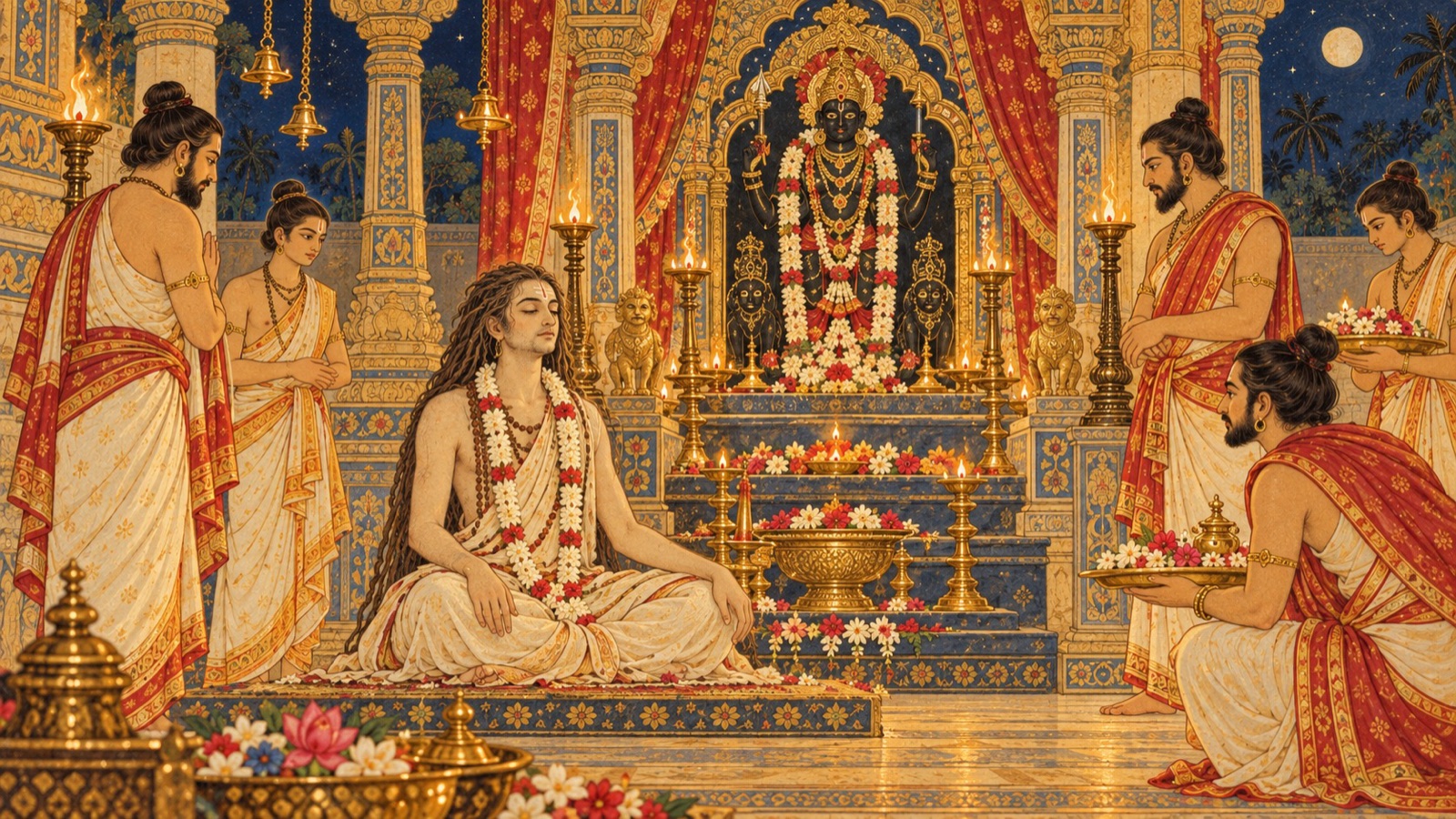
There they bathed him, dressed him in new cloth, adorned him with ornaments, sandal paste and garlands, and seated him before the image of Bhadrakali with all the rites of an offering, singing and sounding their drums. Then their officiating priest took up a consecrated sword, meaning to slay the sage. Through it all, Jada Bharata sat in perfect peace, without the least agitation, his refuge the feet of the Lord.
The Lord’s Protection
But such an act against a great soul — one who had become one with the Infinite, who bore enmity to none and was the friend of every living being — could not stand. The Goddess Bhadrakali could not bear it. Blazing with the unbearable spiritual glory of the saint, she suddenly burst forth from the image in a terrible form, and with the very sword the robbers had raised, she struck down those wicked men who had dared to threaten one sheltered at the Lord’s feet. Their violence recoiled entirely upon themselves.
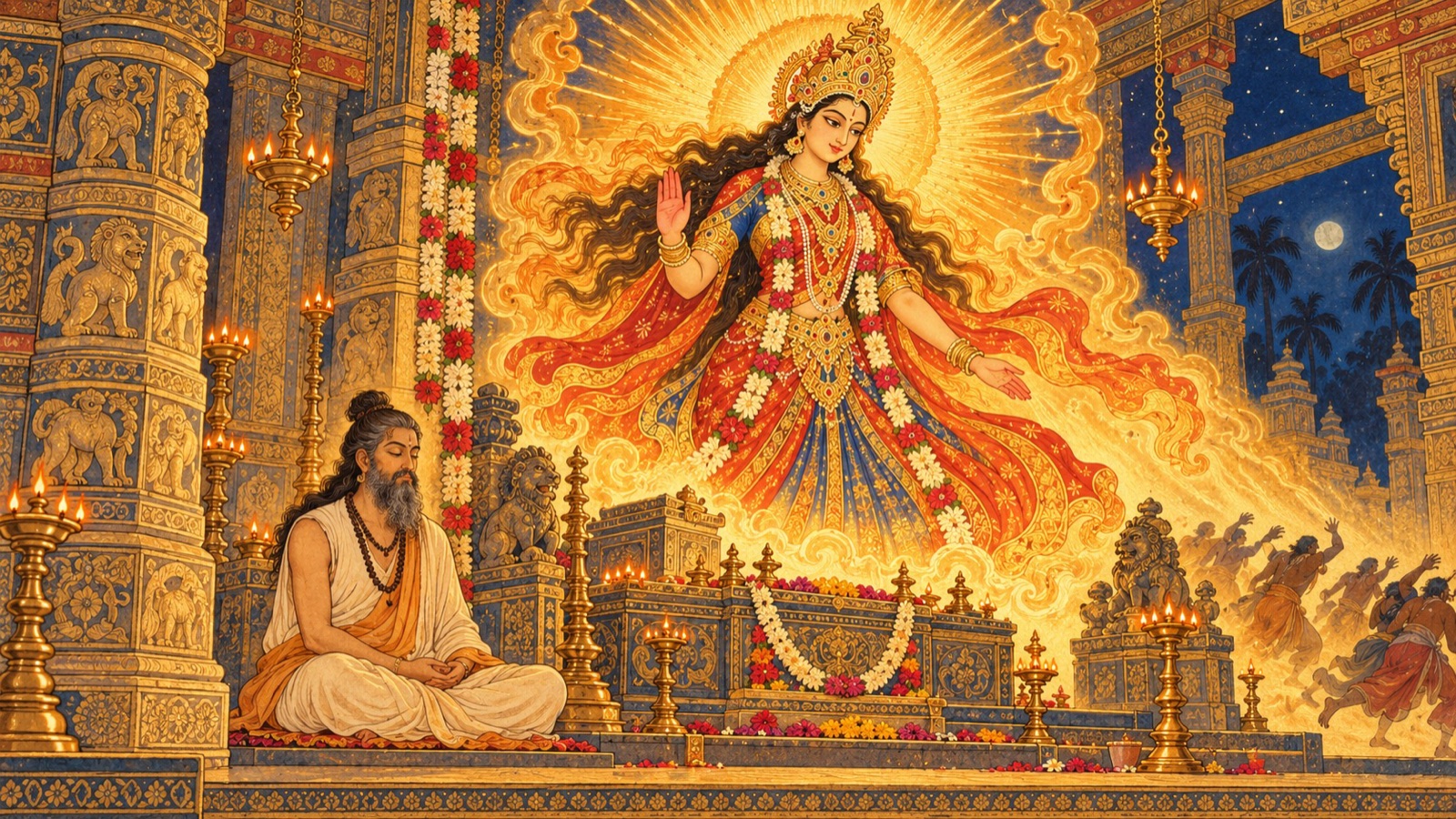
This, Sukadeva told King Parikshit, is no great wonder. Souls who have severed the deep-seated tendency to mistake the body for the Self, who regard every living being as a friend and as their own very Self, who harbor hatred toward none, and who have surrendered at the Lord’s feet — such souls are shielded on every side by the ever-watchful Lord Himself, wielding His unsleeping discus and manifesting through forms such as the Goddess. Where the Lord’s feet are one’s refuge, no fear can reach from any direction.
न वा एतद्विष्णुदत्त महदद्भुतं यदसम्भ्रम: स्वशिरश्छेदन आपतितेऽपि विमुक्तदेहाद्यात्मभावसुदृढहृदयग्रन्थीनां सर्वसत्त्वसुहृदात्मनां निर्वैराणां साक्षाद्भगवतानिमिषारिवरायुधेनाप्रमत्तेन तैस्तैर्भावै: परिरक्ष्यमाणानां तत्पादमूलमकुतश्चिद्भयमुपसृतानां भागवतपरमहंसानाम् ॥ २० ॥
na vā etad viṣṇudatta mahad-adbhutaṁ yad asambhramaḥ sva-śiraś-chedana āpatite ’pi vimukta-dehādy-ātma-bhāva-sudṛḍha-hṛdaya-granthīnāṁ sarva-sattva-suhṛd-ātmanāṁ nirvairāṇāṁ sākṣād bhagavatānimiṣāri-varāyudhenāpramattena tais tair bhāvaiḥ parirakṣyamāṇānāṁ tat-pāda-mūlam akutaścid-bhayam upasṛtānāṁ bhāgavata-paramahaṁsānām
Meaning: O Vishnudatta (Parikshit), it is no great wonder that even with a sword falling upon their necks such saints remain wholly unshaken — those who have loosened the tight knot of identifying the Self with the body, who are the friends and very Self of all beings, who bear enmity to none, and who, taking refuge at the Lord’s feet where no fear exists, are guarded on all sides by the ever-watchful Lord Himself with His supreme weapon. (Canto 5, Chapter 9, verse 20)
Principal Teachings of This Chapter
The hard lessons of the past can make us wise. Bharata’s fall through the fawn taught him such caution that, in his next birth, he took no chances with attachment at all. Our own past mistakes, honestly remembered, can become the very source of our future strength.
True greatness needs no recognition. Jada Bharata let the world call him a fool and never once defended himself. The soul secure in God has nothing to prove and nothing to protect; the opinion of others loses all power over it.
Equanimity is the mark of realization. Whether honored or insulted, fed well or poorly, set to hard labor or left alone, Jada Bharata remained the same. This unbroken evenness, rooted in knowing oneself as the deathless Self, is the fruit of genuine wisdom.
The devotee’s refuge is the Lord’s own feet. Facing the sword without a tremor, Jada Bharata was protected because he had taken shelter in God alone. Those who make the Lord their refuge are guarded by a power far greater than any danger they may face.
No harm meant to a saint truly succeeds. The violence raised against Jada Bharata fell back upon those who raised it. To injure a soul devoted to the Lord and friendly to all is to injure only oneself.
A Devotional Reflection
There is a strange freedom in Jada Bharata’s story that quietly challenges us. Almost everything we spend our lives defending — our reputation, our dignity, our right to be understood and respected — he simply let go. He allowed the world to think him a fool, wore its contempt like a dusty rag, and carried within, all the while, a peace that not even a raised sword could disturb. We are not asked to imitate his outward disguise; that was his own singular path, shaped by his own hard-won caution. But we are invited into his inner freedom — the freedom of a heart that has stopped needing the world’s approval because it has found its whole worth in the Lord. How much of our restlessness comes from managing what others think of us. Jada Bharata shows us another way to live: to set that burden down, to take our refuge in God, and to discover that when we no longer defend ourselves, something far stronger than us is already keeping us safe.
A Daily Devotional Practice
Today, choose to let one small slight or misunderstanding pass without defending yourself. When someone misjudges you, corrects you unfairly, or overlooks you, notice the urge to explain and protect your image — and gently release it, offering the moment to the Lord with the words: “Om Namo Bhagavate Vasudevaya.” As Jada Bharata did, let the world’s opinion rest where it falls, and turn your attention instead to the Self within, which no insult can touch. In that small act of surrender, you taste a little of the fearless freedom of the soul that has taken refuge at the Lord’s feet.
Conclusion
The ninth discourse of Book Five tells the birth of Jada Bharata — the great devotee’s third and final human life. Reborn in a holy Brahmana family and remembering every past life he had lived — chastened above all by how one attachment alone had once undone him — he hid his perfected wisdom behind the mask of a dull, deaf madman, so that the world would never draw him back into entanglement. He bore mockery and hard labor with unbroken equanimity, indifferent to honor and insult alike, his divine glory concealed like a jewel beneath dust. And when a band of robbers seized him to offer him in sacrifice, the Lord’s own protective power rose in the form of the Goddess to strike down his captors, for their violence recoiled upon themselves. His story reveals the fearless freedom of the soul that seeks no recognition and takes its whole refuge in God — a soul the Lord Himself guards on every side.
May the divine wisdom of Srimad Bhagavatam awaken pure devotion within our hearts.
Om Namo Bhagavate Vasudevaya.
Jay Shree Madhav.
References and Attribution
- Primary edition: Gita Press, Śrīmad Bhāgavata Mahāpurāṇa, Book Five, Discourse 9, “Bharata reborn for a second time in a Brahmana family.”
- Series: Srimad Bhagavatam Wisdom · Biswa Sanatan Dharma Seva Trust.
- Presented following the spiritual guidance and recommendation of Pandit Dr. Shri Kashinath Mishra.
This is an original, faithful retelling in the writer’s own words, with brief quoted verses shown in Devanāgarī and transliteration and their meanings given as summaries. It is not a reproduction of any single publisher’s continuous translation or commentary. No affiliation with or endorsement by any publisher is implied.
Jay Shree Madhav