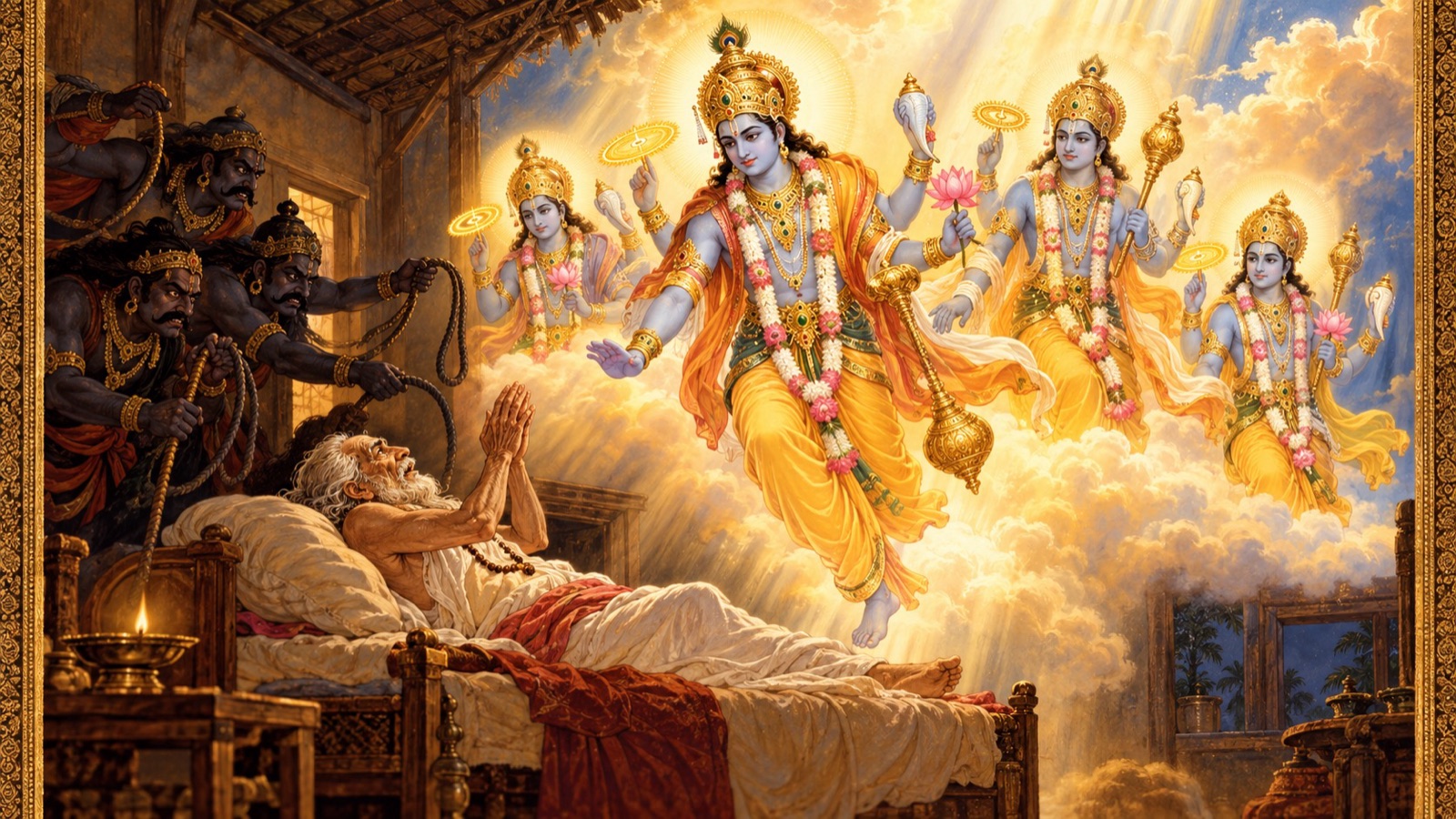
At the last breath of a fallen man, a single cry of a divine name — spoken only to summon a beloved son — brings the radiant, four-armed servants of the Lord rushing to his side. Canto Six opens with the astonishing mercy hidden inside the holy name.
Om Namo Bhagavate Vasudevaya.
Om Namo Bhagavate Vasudevaya.
Om Namo Bhagavate Vasudevaya.
Welcome to Srimad Bhagavatam Wisdom, a devotional journey through the sacred histories and teachings of the Srimad Bhagavat Mahapurana. With this chapter we open the Sixth Canto, a book largely concerned with a single, urgent question: how does a soul, weighed down by its own wrongdoing, find its way out of suffering and back to God? Canto Five closed with vivid descriptions of the hellish regions and the tortures that await the unrighteous. Hearing them, King Parikshit turns to his teacher with the natural cry of a compassionate heart: is there any escape? Sukadeva Gosvami answers first with the well-known remedies of atonement and self-discipline, but then reveals something far greater — that devotion to the Lord, and above all the chanting of His holy name, purifies more completely than any ritual penance. To prove it, he tells one of the most beloved stories in all the Bhagavata: the history of Ajamila, a fallen Brahmana who, at the moment of death, called out the name “Narayana” — and was saved.
Chapter Information
- Scripture: Śrīmad Bhāgavata Mahāpurāṇa
- Canto: 6 (Book Six)
- Chapter: 1 (Discourse 1)
- Chapter title: The History of Ajamila
- Principal speakers: Sukadeva Gosvami, answering King Parikshit; and, within the narrated story, Lord Vishnu’s own attendants confronting Yamaraja’s officers — all related by Suta Gosvami to the sages assembled at Naimisharanya
- Principal listener: King Parikshit, seated in fast beside the Ganga; and, at the outer frame, the sage Saunaka and the assembly of sages at Naimisharanya
- Main setting: The bank of the Ganga where Parikshit awaits death; within the story, the city of Kanyakubja (modern Kannauj) at the deathbed of the Brahmana Ajamila
- Central subject: Whether and how a soul can be freed from sin and hell — culminating in the revelation that a single utterance of the Lord’s name, even unconsciously, carries immense purifying power
- Principal verse range: Canto 6, Chapter 1, verses 1–68
- Primary edition: Gita Press Śrīmad Bhāgavata Mahāpurāṇa
A King’s Question: How Does One Escape Hell?
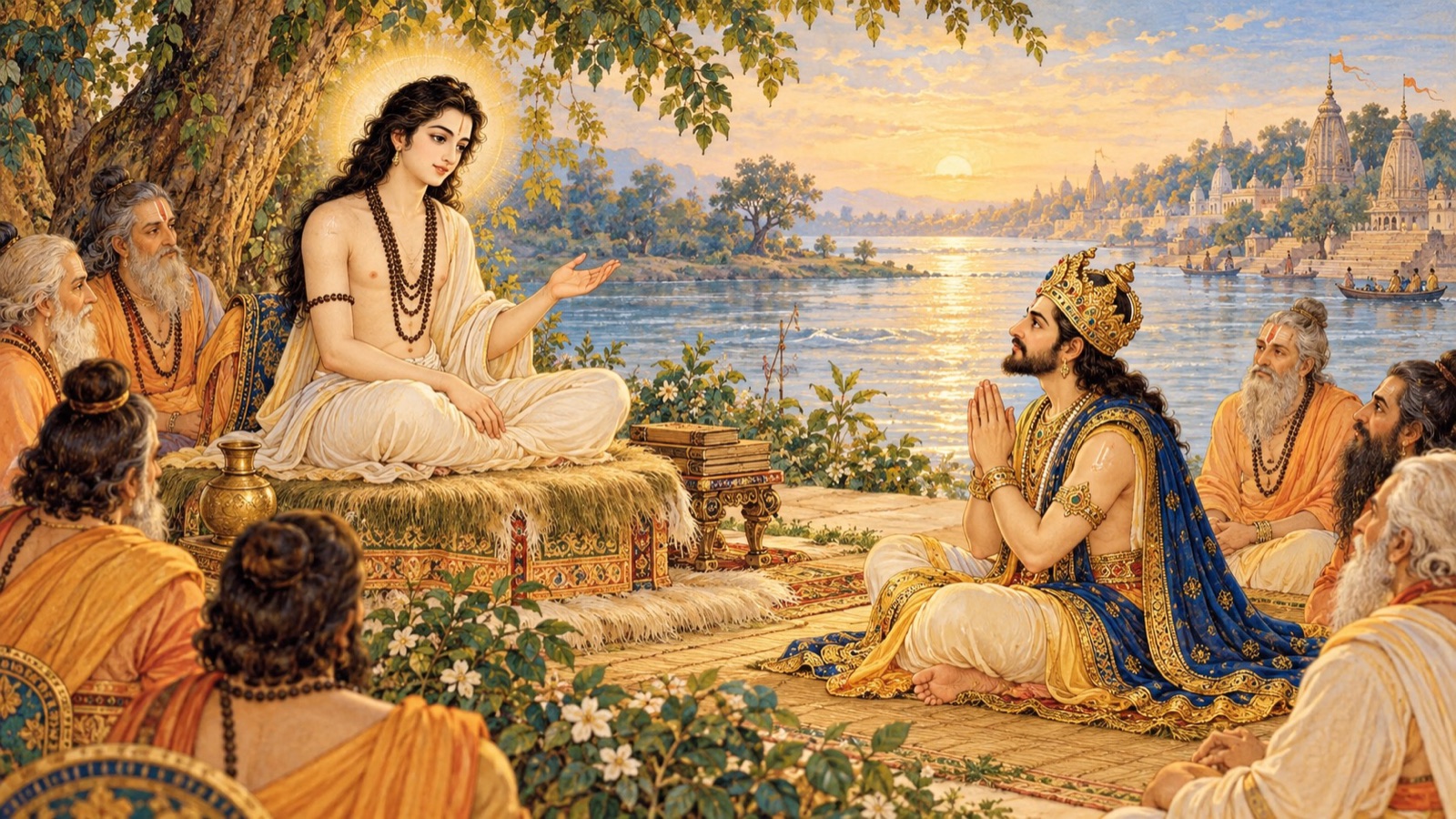
The Sixth Canto begins where the Fifth left off. Having heard Sukadeva describe both the path of nivritti (cessation from worldly activity, leading to liberation) and the path of pravritti (fruitful action, leading to repeated birth), and having heard as well the sobering account of the hellish regions, King Parikshit puts a direct and merciful question to his teacher. He does not ask for himself alone; he asks on behalf of all bewildered souls. “Be pleased to explain to me,” he says, “how a man in this world can escape from hell, which is full of various horrible tortures” (verse 6).
Atonement, Self-Knowledge, and the Highest Purifier
Sukadeva answers in stages, and the ascending order of his answer is itself the teaching. First, he explains the ordinary remedy: a person who has sinned with mind, speech, or body must atone in this very life, before death, according to the scriptures — just as a wise physician treats an illness promptly, weighing its gravity, before it becomes fatal (verses 7-8).
But Parikshit presses further with a penetrating objection. What is the use of atonement, he asks, if a man sins, atones, and then sins again — is such expiation not as pointless as the bath of an elephant, which throws dust over itself the moment it steps out of the water (verses 9-10)? Sukadeva agrees. Counteracting one action with another action is not a radical cure, for the root — ignorance and identification with the body — remains untouched. The true atonement, he says, is self-knowledge; and beyond even that lies austerity, celibacy, control of the senses, charity, truthfulness, and sacred vows, by which the wise burn away even great sins “as fire destroys a thicket of bamboos” (verses 11-14).
Then Sukadeva reveals the summit of his answer. A rare few, wholly devoted to Lord Vasudeva, destroy the entire stock of their sins — root and all — through pure devotion alone, as effortlessly as the sun disperses mist.
केचित्केवलया भक्त्या वासुदेवपरायणा: । अघं धुन्वन्ति कार्त्स्न्येन नीहारमिव भास्कर: ॥ १५ ॥
kecit kevalayā bhaktyā vāsudeva-parāyaṇāḥ aghaṁ dhunvanti kārtsnyena nīhāram iva bhāskaraḥ
Meaning: A few rarely blessed souls, wholly devoted to Lord Vasudeva, destroy their sins completely — with their very root — through pure devotion alone, just as the sun destroys mist in its entirety. (Canto 6, Chapter 1, verse 15)
Sukadeva then adds two further steps to this same teaching. Whoever serves a genuine devotee of the Lord, learning from him how to dedicate his very life to Krishna’s lotus feet, is purified completely — a purification that austerity, penance, and celibacy by themselves cannot achieve (verse 16). And the path walked by such pure devotees, well-behaved and endowed with every good quality, is the most auspicious path in this world: fearless, and fully sanctioned by the scriptures themselves (verse 17).
No number of ritual atonements, Sukadeva continues, can thoroughly purify a person who has turned his face away from Narayana, any more than a hundred rivers can purify a jar of wine (verse 18). But those who have even once fixed their mind upon the lotus-feet of Lord Krishna, drawn by love for His excellences, are so completely purified that they never behold Yama or his noose-bearing servants, even in a dream.
सकृन्मन: कृष्णपदारविन्दयो- र्निवेशितं तद्गुणरागि यैरिह । न ते यमं पाशभृतश्च तद्भटान् स्वप्नेऽपि पश्यन्ति हि चीर्णनिष्कृता: ॥ १९ ॥
sakṛn manaḥ kṛṣṇa-padāravindayor niveśitaṁ tad-guṇa-rāgi yair iha na te yamaṁ pāśa-bhṛtaś ca tad-bhaṭān svapne ‘pi paśyanti hi cīrṇa-niṣkṛtāḥ
Meaning: Those who have but once fixed on the lotus-feet of Lord Sri Krishna their mind — grown attached to His glories — never behold, even in a dream, Yama and his noose-bearing servants, for they have already performed all atonement. (Canto 6, Chapter 1, verse 19)

An Old Legend: The Brahmana Named Ajamila
To make this truth vivid, Sukadeva narrates an ancient account of a conversation between the messengers of Lord Vishnu and the messengers of Yama (verse 20). In the city of Kanyakubja, the modern Kannauj, there once lived a Brahmana named Ajamila. Born to a noble line and originally learned and virtuous, he fell into ruin through his attachment to a maid-servant of low class, and, polluted by that association, cast to the winds all the pious conduct expected of him. To maintain the woman and the family she bore him, he abandoned righteousness altogether, making his living by robbery, gambling, cheating, and theft (verses 21-22).
Eighty-eight years of his life passed in this degraded condition. Ajamila had ten sons by the woman, and the youngest, still a small child, he had named — as if by the quiet arrangement of providence — Narayana. The old man doted on this sweetly lisping infant, delighting in its every movement, feeding it as he ate and giving it water as he drank, so bound by affection that he did not notice the hour of his own death approaching (verses 23-26).

The Name Called at the Hour of Death
Then death arrived. Lying helpless, his mind fixed on his little son, Ajamila suddenly beheld three fearsome figures with twisted faces and hair standing on end, come to drag him away with nooses in their hands. Terrified, he did the only thing his frightened heart knew to do: he called out, loudly and in a drawn-out voice, for his child — crying the name “Narayana!”
स पाशहस्तांस्त्रीन्दृष्ट्वा पुरुषानतिदारुणान् । वक्रतुण्डानूर्ध्वरोम्ण आत्मानं नेतुमागतान् ॥ २८ ॥ दूरे क्रीडनकासक्तं पुत्रं नारायणाह्वयम् । प्लावितेन स्वरेणोच्चैराजुहावाकुलेन्द्रिय: ॥ २९ ॥
sa pāśa-hastāṁs trīn dṛṣṭvā puruṣān ati-dāruṇān vakra-tuṇḍān ūrdhva-romṇa ātmānaṁ netum āgatān dūre krīḍanakāsaktaṁ putraṁ nārāyaṇāhvayam plāvitena svareṇoccair ājuhāvākulendriyaḥ
Meaning: Seeing the three most terrible beings with twisted faces and bristling hair, who had come with nooses in hand to take him away, the terror-stricken Ajamila called out in a loud, drawn-out voice to his son, who was named Narayana and was busy at play some distance away. (Canto 6, Chapter 1, verses 28-29)
He meant only to call his boy. But the name he uttered was the Lord’s own name — and the name of the Lord, however it is spoken, is never spoken in vain. The instant the sound of “Narayana” left the dying man’s lips, the personal attendants of Bhagavan Narayana, hearing their Master’s name chanted, rushed to the spot at once.
निशम्य म्रियमाणस्य मुखतो हरिकीर्तनम् । भर्तुर्नाम महाराज पार्षदा: सहसापतन् ॥ ३० ॥
niśamya mriyamāṇasya mukhato hari-kīrtanam bhartur nāma mahārāja pārṣadāḥ sahasāpatan
Meaning: O great king, hearing from the mouth of the dying man the chanting of Sri Hari’s name — the name of their own Master — the attendants of the Lord suddenly descended upon the spot. (Canto 6, Chapter 1, verse 30)
Why should a name spoken only to call a child carry such power? The Bhagavata’s own teachers call this ajnata-sukriti — a pious result reaped without any conscious intention to earn it. Unlike an ordinary word, the holy name is never separate from the Lord Himself; its purifying force does not wait upon the speaker’s understanding, any more than fire waits to burn until the hand that touches it knows what fire is. This is why Ajamila’s accidental cry could summon Vishnu’s own attendants, and why Sukadeva treats it as real atonement rather than a technicality — the name acts by its own nature, wherever and however it is spoken (verses 25-26, 30).
The Servants of Vishnu Intervene
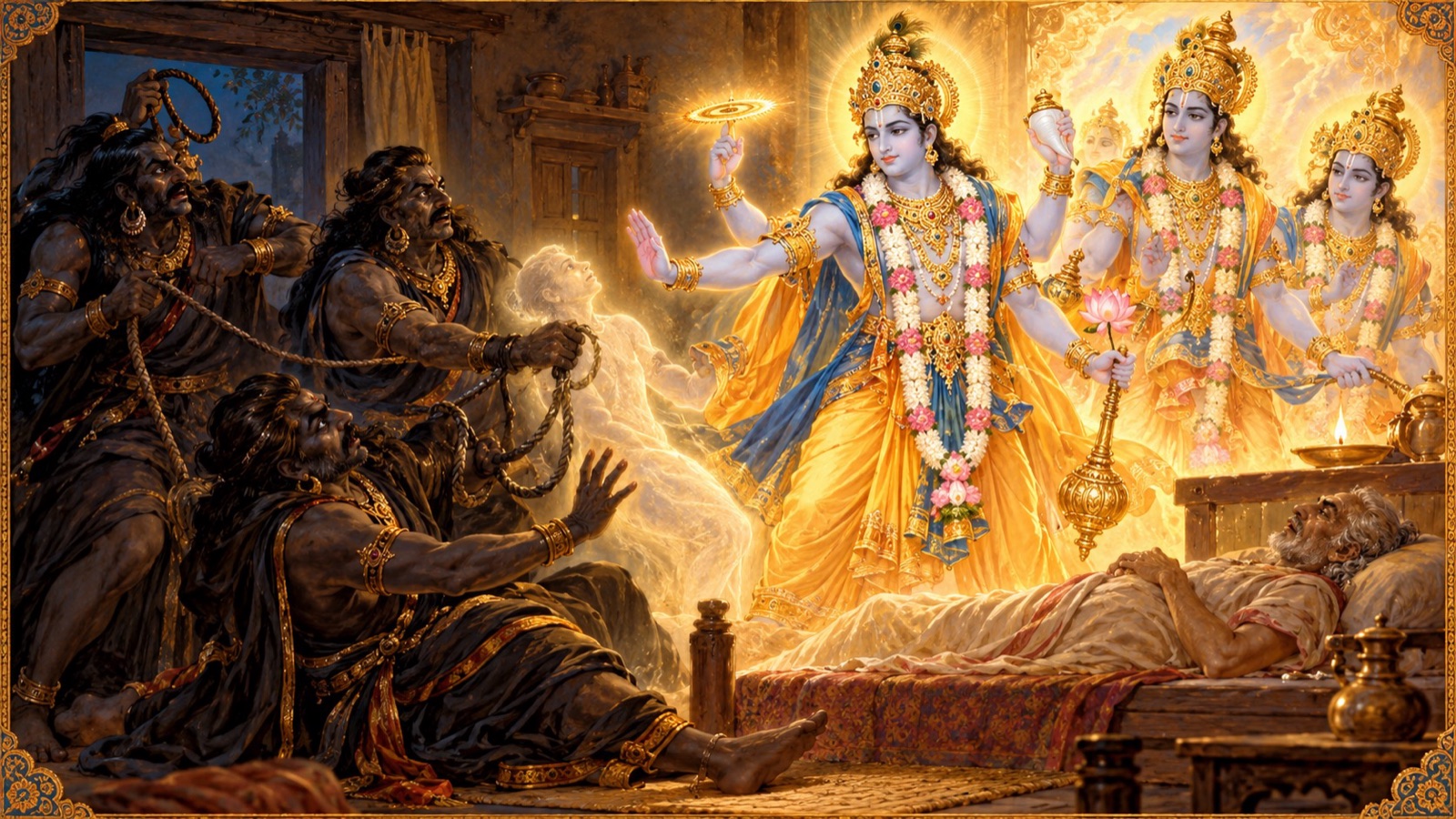
The messengers of Lord Vishnu found the servants of Yama already at work, forcibly dragging the soul of Ajamila out from within his heart, and they stopped them by force (verse 31). Astonished, the servants of Yama demanded to know who these newcomers were who dared interfere with the authority of Yama. They described what they saw with wonder: beings with eyes like lotus-petals, clad in yellow silk, adorned with crowns, earrings, and garlands of lotuses, in the full bloom of youth, each possessed of four graceful arms bearing bow, quiver, sword, mace, conch, discus, and lotus — beings whose splendour drove away the darkness and outshone every other light (verses 32-36).
What Is Dharma? A Question That Turns the Tables
Hearing the challenge, the servants of Lord Vasudeva laughed gently and replied in voices deep as thundering clouds (verse 37). If you are truly the servants of Yama, the god of righteousness, they said, then tell us: what is the true nature of dharma, and how is it determined? How is punishment administered, and upon whom? Are all who act subject to it, or only some (verses 38-39)?
The servants of Yama gave a careful and profound reply. Dharma, they said, is what the Veda enjoins, and adharma is what it forbids; and the Veda itself is none other than Bhagavan Narayana, self-manifested. It is by Narayana that all beings, composed of the three modes of nature, are brought into existence with their distinctive qualities, names, activities, and forms (verses 40-41). The sun, fire, sky, air, the senses, the moon, the twilights, day and night, the directions, water, earth, Time, and Dharma himself — all these stand as witnesses to the deeds of every embodied soul. By their testimony unrighteousness is established, and every doer, without exception, is liable to reap the fruit of his actions, for no embodied being can refrain from acting even for a moment (verses 42-44).
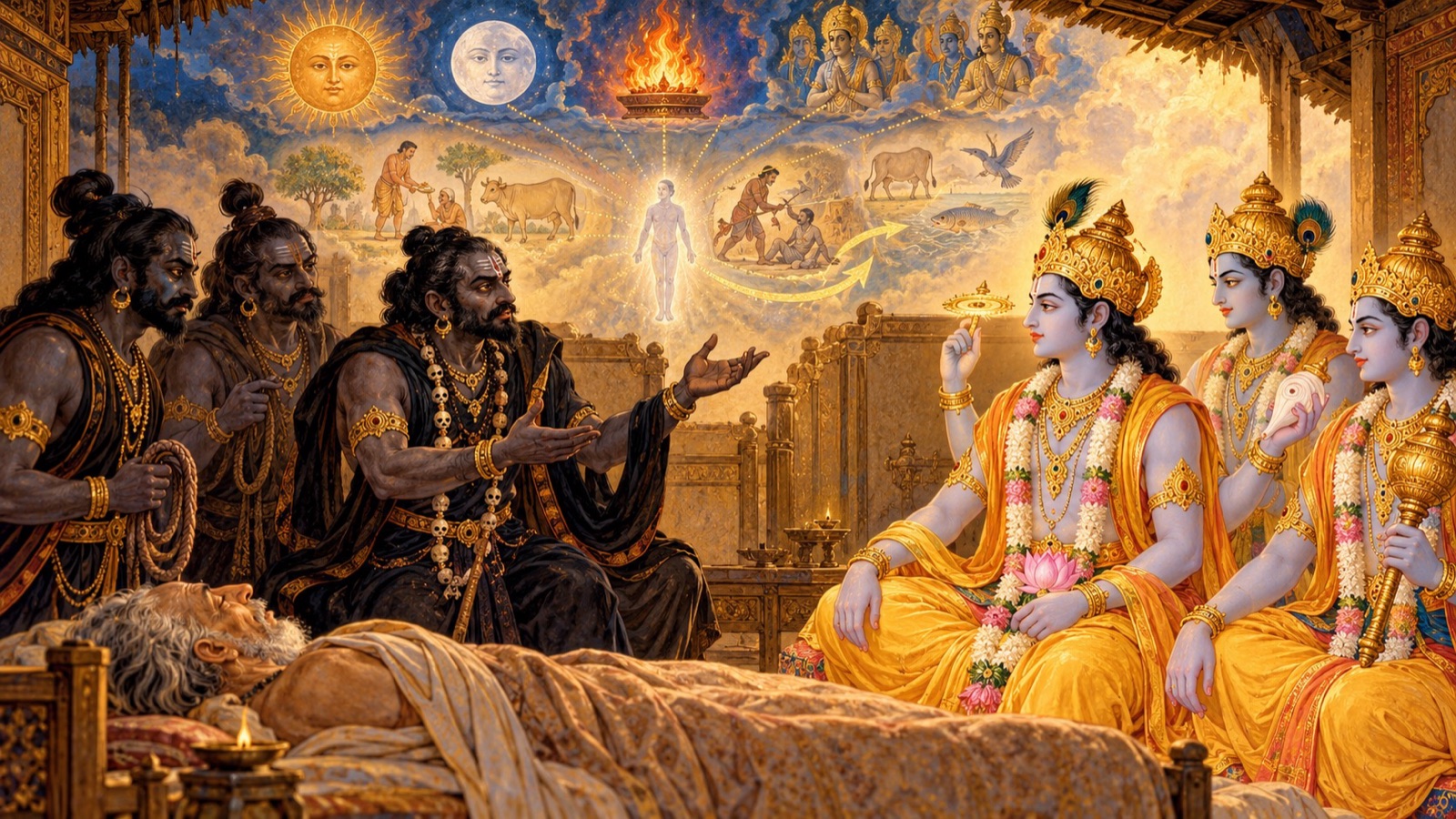
The servants of Yama then unfolded a searching teaching on the soul’s transmigration: how the current life reveals the merits and sins of past and future lives as surely as the present season reveals the character of seasons past and to come; how the all-knowing Yama perceives a departed soul’s former state and future destiny; and how the ignorant soul, like a dreamer who takes only the dream-body for himself, identifies with its present psycho-physical form alone, wrapped again and again in the cocoon of its own karma. This degeneration, they concluded, arises from the soul’s association with matter — and it “ceases before long through devotion to God, and by no other means” (verses 45-55).
The Story of a Ruined Life
To justify their claim upon Ajamila, the servants of Yama recounted his history. This same man, they said, had once been genuinely learned and good — an abode of amiability, self-controlled, gentle, truthful, and pure; a worshipper of the sacred fire, a servant of his teacher and elders, a friend to all living beings, free from pride (verses 56-57). One day, obeying his father’s command, he went to the forest to gather fruits, flowers, sacrificial fuel, and kusha grass. On his way home he came upon a shameless, intoxicated man of low class sporting openly with a woman of the same class. The sight ignited an uncontrollable passion in Ajamila’s heart. Though he struggled to steady his mind with reason and learning, he could not; possessed by desire, thinking of her alone, he deviated from all his duties (verses 58-63).

He squandered his father’s entire fortune to please her, abandoned his lawful and virtuous wife, and thereafter maintained the woman and her many children by fair means and foul. Because he had violated the scriptures, lived long in an impure state, and performed no atonement, the servants of Yama declared, they were justified in taking this sinner to their master, where he would be purified through punishment (verses 64-68).
With this claim ringing in the air, the first discourse of Book Six comes to a close — the two sets of messengers now standing face to face over a single dying man, and the great question of whether a name spoken in ignorance can outweigh a lifetime of sin left hanging until the chapter that follows.
Principal Teachings of This Chapter
1. Ritual atonement alone cannot uproot sin. Because expiation by action leaves ignorance untouched, a person may sin and atone endlessly, like an elephant bathing only to throw dust over itself again. Real freedom requires knowledge and, ultimately, devotion (verses 9-14).
2. Pure devotion is the most complete purifier. Devotion to Lord Vasudeva destroys sin root and all, “as the sun destroys mist,” accomplishing what a hundred rivers of ritual cannot (verses 15-18).
3. The holy name carries power beyond the speaker’s intention. Ajamila called “Narayana” meaning only his son, yet the Lord’s attendants came at once — showing that the name of God is potent in itself, even when uttered without conscious devotion (verses 28-30).
4. Every soul is under a just and witnessed law. The Yamadutas’ reply affirms that the cosmos is moral through and through: dharma is rooted in the Veda, which is the Lord Himself, and every deed is witnessed and answered for (verses 40-45).
5. Attachment can undo even the virtuous — and grace can reach even the fallen. Ajamila’s fall from a life of purity warns how swiftly desire can ruin a soul; his rescue promises that no one is beyond the reach of the Lord’s name (verses 56-66).
A Devotional Reflection
There is something almost scandalous about the mercy in this chapter. Ajamila is no saint. He is a thief, a cheat, a man who abandoned a faithful wife and squandered his inheritance on his own senses. When death comes for him, he is not thinking of God at all — he is thinking of his little boy. And yet, because that boy happened to be named Narayana, the mere sound of the divine name summons the servants of the Lord to his defence. We might ask: is that fair? But the chapter is not teaching us that God can be tricked. It is teaching us how astonishingly available the Lord makes Himself through His name. If a name called in ignorance carries such power, what might that same name carry when we call it knowingly, with love? The story does not lower the standard of righteousness; the Yamadutas’ long teaching on karma stands untouched. Rather, it opens a door beside that standard — the door of the holy name — and shows that this door has been left unlocked even for the worst among us. That is the hope with which Canto Six begins.
A Daily Devotional Practice
Today, let the holy name be on your lips at least once with full attention. Whatever your circumstances — busy, distracted, or burdened by things you regret — pause, breathe, and slowly say aloud: “Om Namo Bhagavate Vasudevaya.” Ajamila spoke the name almost by accident and it reached the Lord’s own servants; imagine, then, how it is received when you speak it on purpose, as an offering. Let this remembrance be your small daily rehearsal, so that the name is already familiar on your tongue when you need it most.
Conclusion
The first chapter of the Sixth Canto sets a question of universal concern — how can a soul escape the consequences of its own wrongdoing? — and answers it in a way no dry treatise ever could, through the arresting story of a ruined Brahmana rescued at the edge of hell. Sukadeva builds his teaching carefully, from ordinary atonement, to self-knowledge, to the supreme purifier of devotion, and then dramatizes that final truth in the person of Ajamila, whose dying cry of “Narayana” brings the servants of Vishnu to his side. The chapter closes with the two parties of messengers poised in confrontation, the outcome deferred — but the deeper message is already clear. The name of the Lord is not merely a word; it is His very presence, ever near, ever ready to answer the one who calls. May this be the seed of faith that carries us into the chapters ahead.
May the divine wisdom of Srimad Bhagavatam awaken pure devotion within our hearts.
Om Namo Bhagavate Vasudevaya.
Jay Shree Madhav.
References and Attribution
- Primary edition: Gita Press, Śrīmad Bhāgavata Mahāpurāṇa (English, complete), Book Six, Discourse 1.
- Series: Srimad Bhagavatam Wisdom · Biswa Sanatan Dharma Seva Trust.
- Presented following the spiritual guidance and recommendation of Pandit Dr. Shri Kashinath Mishra.
This is an original, faithful retelling in the writer’s own words, with brief quoted verses shown in Devanāgarī and transliteration and their meanings given as summaries. It is not a reproduction of any single publisher’s continuous translation or commentary. No affiliation with or endorsement by any publisher is implied.
Jay Shree Madhav