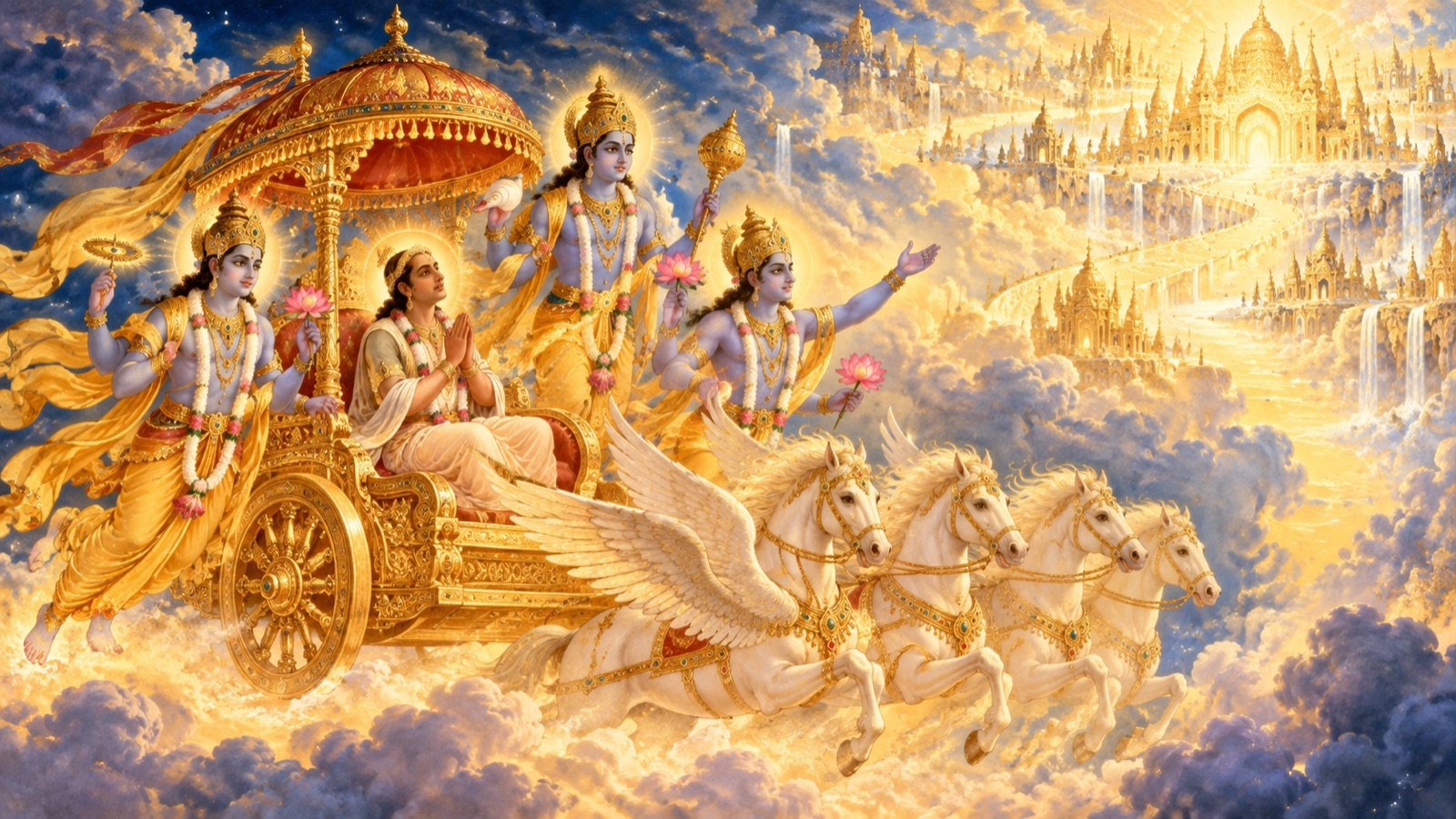
The man who wasted eighty-eight years in sin ends his story rising toward the eternal abode of the Lord in a chariot of gold — proof that no soul is beyond the reach of the holy name.
Om Namo Bhagavate Vasudevaya.
Om Namo Bhagavate Vasudevaya.
Om Namo Bhagavate Vasudevaya.
Welcome to Srimad Bhagavatam Wisdom, a devotional journey through the sacred histories and teachings of the Srimad Bhagavat Mahapurana. The first chapter of the Sixth Canto left us at a breathless standstill: the servants of Yama had seized the soul of the fallen Brahmana Ajamila, and the radiant servants of Lord Vishnu had stopped them, demanding to know the true nature of dharma. This second chapter is the reply — and it is one of the most important teachings in the entire Bhagavata on the power of the Lord’s name. The Vishnudutas explain, with irresistible logic, why a single utterance of “Narayana” — spoken even in ignorance, even to call a son — has already wiped away the sins of millions of lifetimes. Ajamila is released, awakens to profound repentance, renounces the world, and through devotion attains the supreme abode of the Lord. The chapter closes with Sukadeva’s ringing assurance that anyone who even hears this story with faith is freed from fear of hell.
Chapter Information
- Scripture: Śrīmad Bhāgavata Mahāpurāṇa
- Canto: 6 (Book Six)
- Chapter: 2 (Discourse 2)
- Chapter title: Ajamila Delivered by the Vishnudutas
- Principal speakers: The messengers of Lord Vishnu (expounding the glory of the holy name); Sukadeva Gosvami (narrating to King Parikshit); and Ajamila himself (in his soliloquy of repentance)
- Principal listener: The messengers of Yama; King Parikshit; and, at the outer frame, the sages of Naimisharanya
- Main setting: The deathbed of Ajamila in Kanyakubja; later Gangadwara (Haridwar) on the bank of the Ganga; the frame remains the bank of the Ganga where Parikshit listens
- Central subject: The supreme purifying power of the Lord’s name, the release and repentance of Ajamila, and his ascent to the abode of the Lord
- Principal verse range: Canto 6, Chapter 2, verses 1–49
- Primary edition: Gita Press Śrīmad Bhāgavata Mahāpurāṇa
The Vishnudutas’ Answer: The Glory of the Holy Name
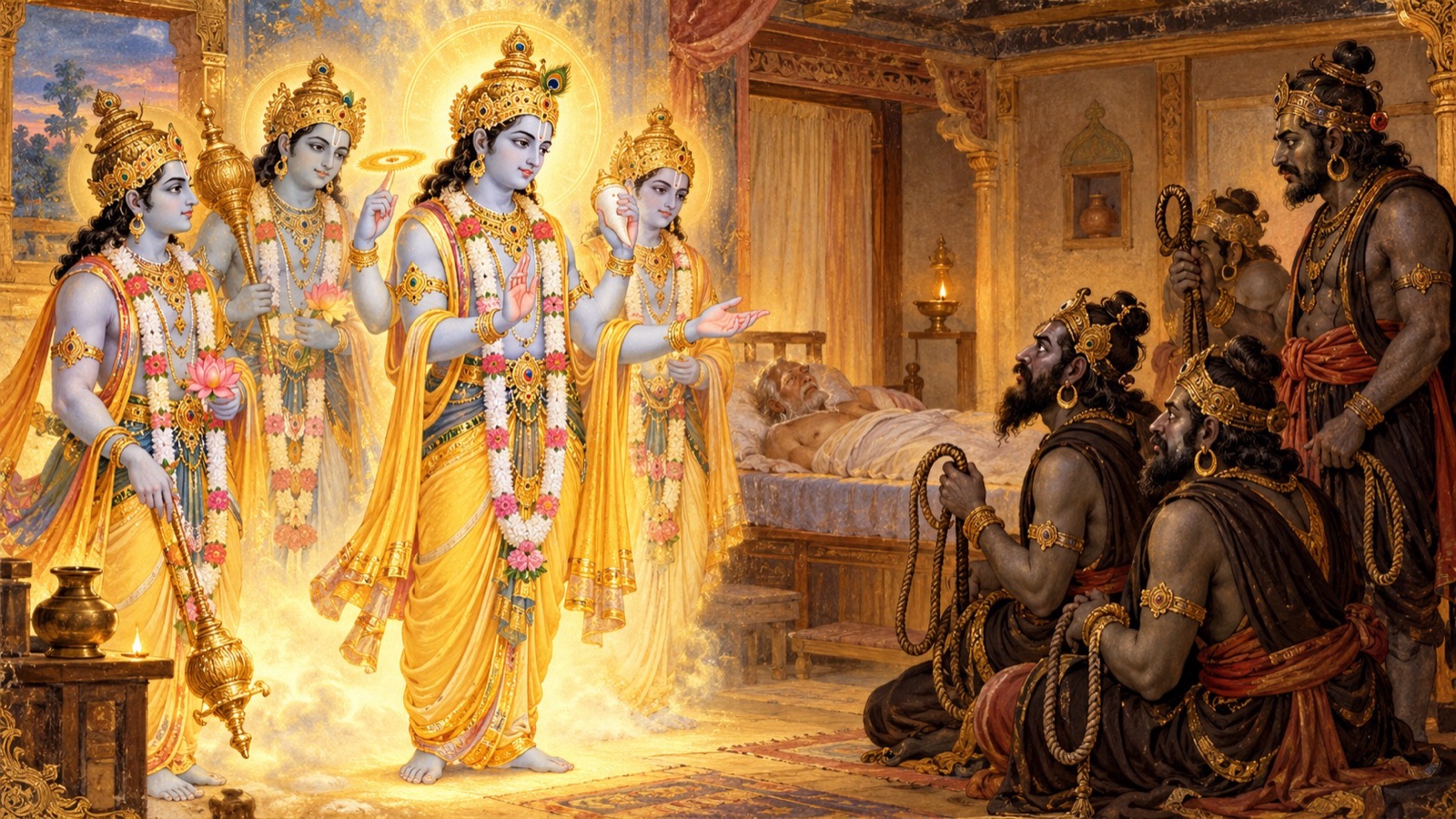
Having heard the Yamadutas’ careful teaching on dharma and karma, the servants of the Lord — themselves masters of the moral science — replied with a gentle but pointed rebuke. What a pity, they said, that unrighteousness should enter the very court of those who know dharma, where the knowers of virtue would inflict punishment on one who no longer deserves it. The ordinary citizen, they said, cannot himself distinguish dharma from adharma any better than an animal can — he simply sleeps in peace with his head on his master’s lap, trusting completely in a protection he has no power to secure for himself. If those who are the protectors and teachers of the people themselves err, to whom shall the trusting world turn for shelter (verses 1-6)?
Then they revealed the heart of the matter. This man, they declared, has already atoned — not only for the sins of this life, but for sins committed across millions of lifetimes — for at his moment of helplessness he uttered the name of Sri Hari. Yet the Vishnudutas are careful here not to turn mercy into a license. Ajamila’s chanting saved him precisely because it carried no offense: he never sinned again and again while counting on the name to erase the account afterward; he simply loved his son and, without knowing it, kept pronouncing the Lord’s own name in calling him. That is why his chanting — scattered across a lifetime of wrongdoing — could still be called whole and pure (verses 7-8). A soul who sins deliberately while presuming the name will always wipe the slate clean offends the very name he invokes; the mercy shown to Ajamila answers an accidentally innocent heart, not a calculated one. The wonder of his rescue, then, is not that the name is careless about sin, but that the Lord’s mercy notices a pure intention faster than the sinner himself ever could. And the name of the Lord, they explained, purifies every kind of sinner, without exception.
स्तेन: सुरापो मित्रध्रुग् ब्रह्महा गुरुतल्पग: । स्त्रीराजपितृगोहन्ता ये च पातकिनोऽपरे ॥ ९ ॥ सर्वेषामप्यघवतामिदमेव सुनिष्कृतम् । नामव्याहरणं विष्णोर्यतस्तद्विषया मति: ॥ १० ॥
stenaḥ surā-po mitra-dhrug brahma-hā guru-talpa-gaḥ strī-rāja-pitṛ-go-hantā ye ca pātakino ‘pare sarveṣām apy aghavatām idam eva suniṣkṛtam nāma-vyāharaṇaṁ viṣṇor yatas tad-viṣayā matiḥ
Meaning: A thief, a drinker of liquor, a betrayer of a friend, a killer of a Brahmana, one who violates his teacher’s bed, a slayer of a woman, a king, a parent, or a cow — and any other sinner whatsoever — for all of them alike, the one true and complete atonement is the utterance of the name of Vishnu, because thereby the mind is turned toward Him. (Canto 6, Chapter 2, verses 9-10)
The Vishnudutas pressed the point still further. Ritual expiations such as fasting, charity, and muttered prayers, they said, can wipe out the visible sins, but not the subtle impressions those sins leave behind — impressions that are erased only through devotional service to the Lord’s feet (verse 17). And most astonishingly of all, the name works even when it is not spoken with devotion at all.
साङ्केत्यं पारिहास्यं वा स्तोभं हेलनमेव वा । वैकुण्ठनामग्रहणमशेषाघहरं विदु: ॥ १४ ॥
sāṅketyaṁ pārihāsyaṁ vā stobhaṁ helanam eva vā vaikuṇṭha-nāma-grahaṇam aśeṣāgha-haraṁ viduḥ
Meaning: The wise know that the chanting of the name of the Lord of Vaikuntha destroys all sin, even when it is uttered to indicate something else, or in jest, or as a musical interjection, or even neglectfully. (Canto 6, Chapter 2, verse 14)
They offered a homely and unforgettable simile: just as fire consumes fuel whether it is kindled by a knowing man or an unknowing child, so the Lord’s name destroys sins whether uttered knowingly or unknowingly; and just as a potent medicine cures even one who swallows it by chance, unaware of its power, so does the Lord’s name reveal its efficacy even in one who speaks it casually.
यथागदं वीर्यतममुपयुक्तं यदृच्छया । अजानतोऽप्यात्मगुणं कुर्यान्मन्त्रोऽप्युदाहृत: ॥ १९ ॥
yathāgadaṁ vīryatamam upayuktaṁ yadṛcchayā ajānato ‘py ātma-guṇaṁ kuryān mantro ‘py udāhṛtaḥ
Meaning: Just as the most potent medicine produces its effect even when taken by chance by one unaware of its power, so too the holy name of the Lord, though uttered without knowledge of its glory, accomplishes its purifying work. (Canto 6, Chapter 2, verse 19)
Ajamila Set Free
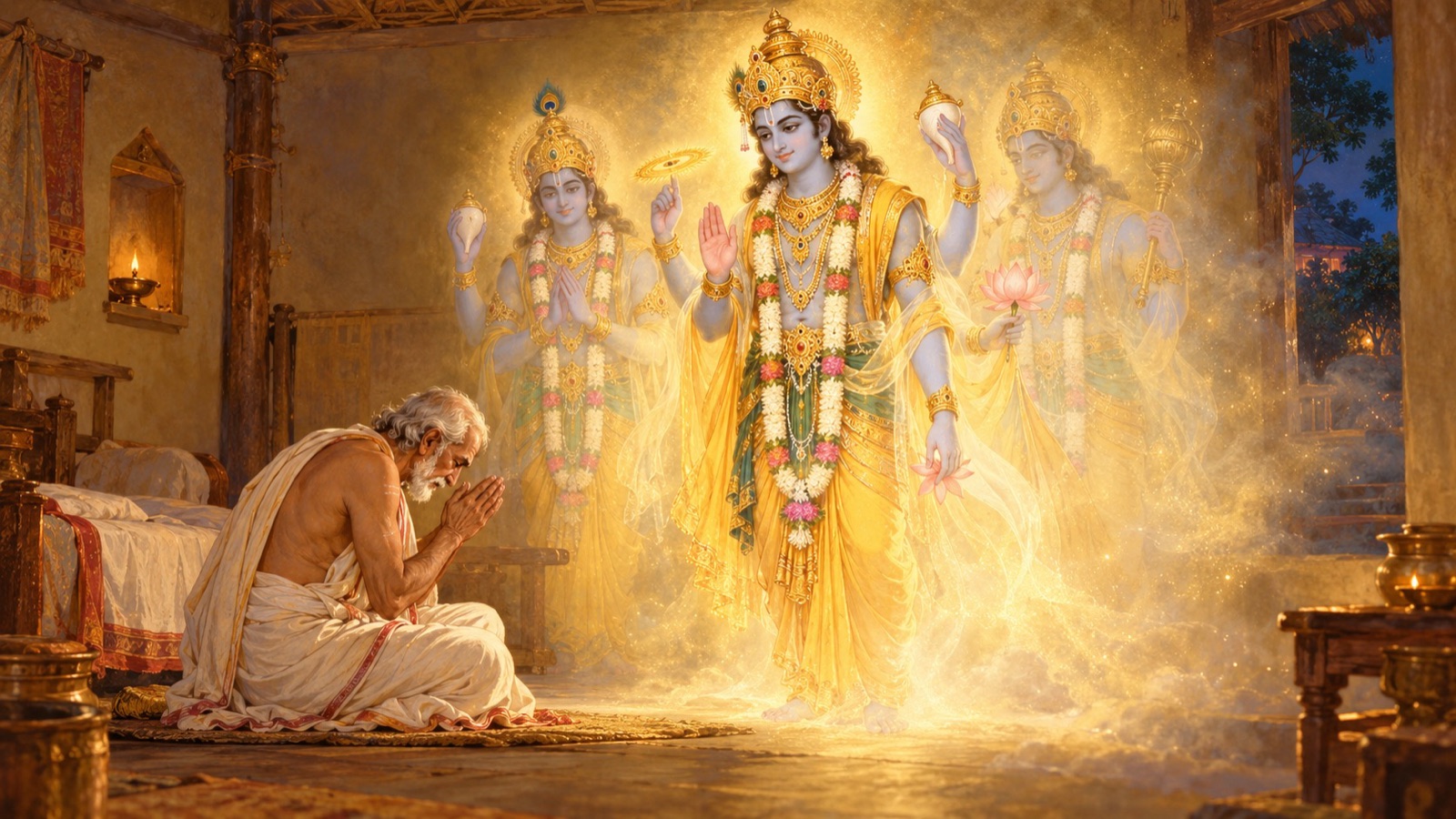
Having thus expounded the cult of devotion and the marvellous power of the divine name, the servants of Lord Vishnu released Ajamila from the noose of Yama and freed him from the grip of death (verse 20). Defeated in the argument by the Lord’s own messengers, the servants of Yama returned to their master and faithfully reported all that had happened (verse 21). Ajamila, disentangled from the noose and freed of all fear, became his former self again — healthy and calm — and, overjoyed at the sight of his rescuers, bowed his head to them. Perceiving that he wished to speak, the servants of Vishnu suddenly vanished before his eyes (verses 22-23).
The Awakening of Repentance
Having heard from both parties of messengers the exposition of pure devotion — untouched by the three modes of nature — Ajamila was flooded with faith and with sorrow for his past. He recollected his life with searing remorse. “What a tragedy,” he said to himself, “that I forfeited my Brahmanhood, unable to curb my lower nature. Fie upon my wicked self — the blot of my race — who kept an unchaste woman and abandoned a faithful young wife. My aged, helpless parents, who had no other support, I deserted like an ungrateful wretch” (verses 24-28). He saw clearly the hell that such a life had earned, and he marvelled at his deliverance: where had those terrible noose-bearers gone, and where the four beautiful beings who had saved him? Surely, he reflected, he must have earned some extraordinary merit in past lives, for otherwise his impure tongue could never have uttered the name of Vishnu at the very hour of death (verses 29-34).
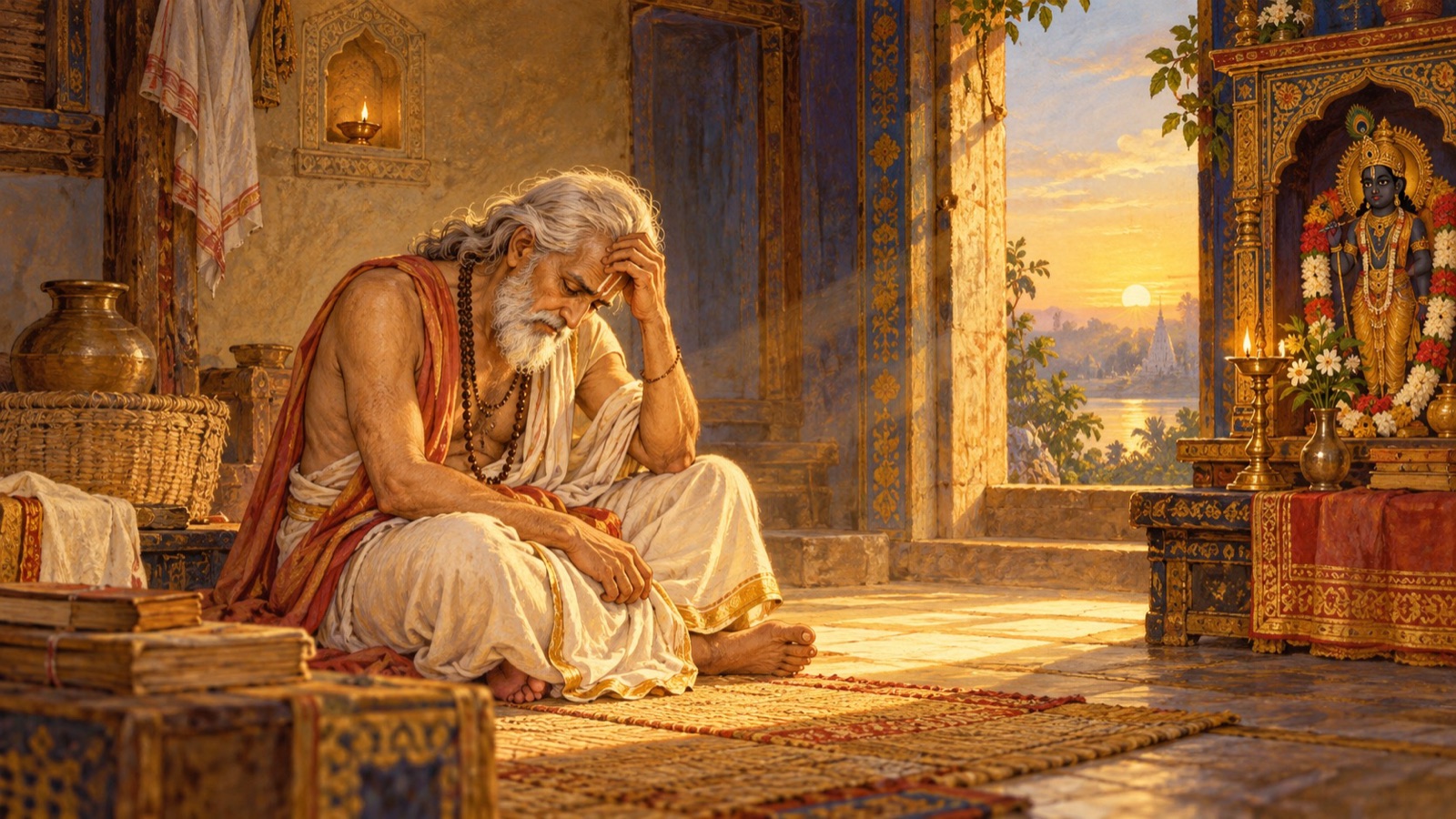
From that repentance rose a firm resolve. Having controlled his mind, senses, and breath, he vowed never again to sink into the blinding gloom of transmigration. Giving up all sense of “I” and “mine” toward the body and its relations, benevolent and compassionate toward all beings, free from craving, he would fix his purified mind upon the almighty Lord through the chanting of His names and glories (verses 35-38).
Tapas at Gangadwara and the Ascent to Vaikuntha
His aversion to sense pleasure now complete — the fruit of even a moment’s association with the Lord’s servants — Ajamila cast off every attachment to his mistress and children and retired to Gangadwara, the sacred place where the Ganga descends to the plains, known today as Haridwar (verse 39). Settling there, he took to the path of yoga, withdrew his senses from their objects, and fixed his mind on the Supreme Self. Dissociating his mind from the body through deep concentration, he devoted it wholly to the Lord, the essence of all consciousness (verses 40-41).

When his mind was irrevocably fixed on the Lord, the Brahmana beheld before him once again the same radiant beings he had seen at his deathbed. Recognizing them, he bowed his head. Then, quitting his earthly body at that holy place on the bank of the Ganga, he at once assumed a divine form like that of the Lord’s own attendants, mounted a golden aerial chariot, and ascended through the heavens to Vaikuntha, the abode where the divine consort of the goddess of fortune resides (verses 42-44).
Sukadeva’s Conclusion: What Wonder, Then?
Sukadeva drew the lesson plainly for King Parikshit. This Brahmana, who had broken every sacred vow and stood condemned to hell, was freed in an instant simply by uttering the divine name (verse 45). For those who seek liberation, he said, there is nothing more effective in cutting sin at its very root than chanting the name and glories of Lord Vishnu; other purificatory processes leave the mind still tainted, but the name keeps it from returning to sinful ways (verse 46). Whoever hears this most profound and secret legend with reverence, or repeats it with devotion, never goes to hell — the servants of Yama dare not even look at him — and however sinful he may have been, he is honoured hereafter in Vaikuntha (verses 47-48). And then Sukadeva sealed the teaching with a single, luminous verse.
म्रियमाणो हरेर्नाम गृणन् पुत्रोपचारितम् । अजामिलोऽप्यगाद्धाम किमुत श्रद्धया गृणन् ॥ ४९ ॥
mriyamāṇo harer nāma gṛṇan putropacāritam ajāmilo ‘py agād dhāma kim uta śraddhayā gṛṇan
Meaning: Even Ajamila, who while dying chanted the name of Hari — and that only as it referred to his son — attained the supreme abode of the Lord. What wonder, then, that one who chants the name with faith should attain Him? (Canto 6, Chapter 2, verse 49)
Principal Teachings of This Chapter
1. The holy name is the complete atonement for every sinner. No category of sin is excluded; the name of Vishnu turns the mind toward the Lord, and that is the true purification (verses 9-10).
2. The name works even when spoken imperfectly. Whether uttered to indicate something else, in jest, as a song’s refrain, or even neglectfully, the name still destroys sin — because the name is non-different from the Lord Himself (verse 14).
3. Ritual removes sins; devotion removes even their impressions. Fasting and charity wipe out visible sins, but the subtle seeds remain until dissolved by devotional service; the name alone keeps the mind from sinning again (verses 17, 46).
4. Grace awakens genuine repentance and renunciation. Ajamila’s rescue does not make him complacent; it fills him with sorrow for his past and with resolve to live for God alone (verses 24-38).
5. Sincere devotion carries the soul all the way home. Ajamila’s tapas at Gangadwara and his ascent to Vaikuntha show that the name is not only a rescue from hell but a doorway to the Lord’s eternal abode (verses 39-49).
A Devotional Reflection
The most quoted line of this chapter is its last: if even Ajamila, calling only for his son, reached the Lord’s abode, “what wonder, then, that one who chants with faith should attain Him?” It is worth noticing how the chapter guards this teaching from misuse. Ajamila is not left in his sins; the very power that saves him also breaks his heart open with repentance and sends him to Haridwar to spend the rest of his life in yoga and remembrance. The holy name did not excuse his past — it transformed his future. This is the balance the Bhagavata strikes so beautifully: the name is freely, almost recklessly merciful, reaching the worst of us in our most unworthy moment; and precisely because it is so merciful, it awakens in the rescued soul a longing to deserve, at last, the grace it has already received. We are not asked to earn the name before we call it. We are only asked, having once tasted its mercy, to keep calling it — now with love.
A Daily Devotional Practice
Today, let your remembrance of the Lord’s name carry a note of gratitude rather than bargaining. Sit quietly, and before chanting, recall one moment in your life when you were protected or spared in a way you did not earn. Then, holding that gratitude, chant slowly and with attention: “Om Namo Bhagavate Vasudevaya.” Let the name be, as it was for Ajamila after his rescue, not a magic formula but the beginning of a changed life — a small daily turning of the heart toward the One who has already turned toward you.
Conclusion
The second chapter of the Sixth Canto completes the story begun at Ajamila’s deathbed and delivers, through it, one of the Bhagavata’s central assurances: the name of the Lord is the supreme purifier, powerful beyond all ritual, merciful beyond all deserving. The Vishnudutas win their case not by denying the law of karma but by revealing something greater than karma — the Lord’s own eagerness to claim anyone who so much as turns toward Him in His name. Ajamila, freed, does not squander the gift; he repents, renounces, and through devotion ascends to Vaikuntha in a chariot of gold. And Sukadeva leaves King Parikshit — and us — with the tender logic of the name: if it saved a man who called it by accident, imagine what it will do for the one who calls it in love. Let that be our quiet confidence as the Canto continues.
May the divine wisdom of Srimad Bhagavatam awaken pure devotion within our hearts.
Om Namo Bhagavate Vasudevaya.
Jay Shree Madhav.
References and Attribution
- Primary edition: Gita Press, Śrīmad Bhāgavata Mahāpurāṇa (English, complete), Book Six, Discourse 2.
- Series: Srimad Bhagavatam Wisdom · Biswa Sanatan Dharma Seva Trust.
- Presented following the spiritual guidance and recommendation of Pandit Dr. Shri Kashinath Mishra.
This is an original, faithful retelling in the writer’s own words, with brief quoted verses shown in Devanāgarī and transliteration and their meanings given as summaries. It is not a reproduction of any single publisher’s continuous translation or commentary. No affiliation with or endorsement by any publisher is implied.
Jay Shree Madhav