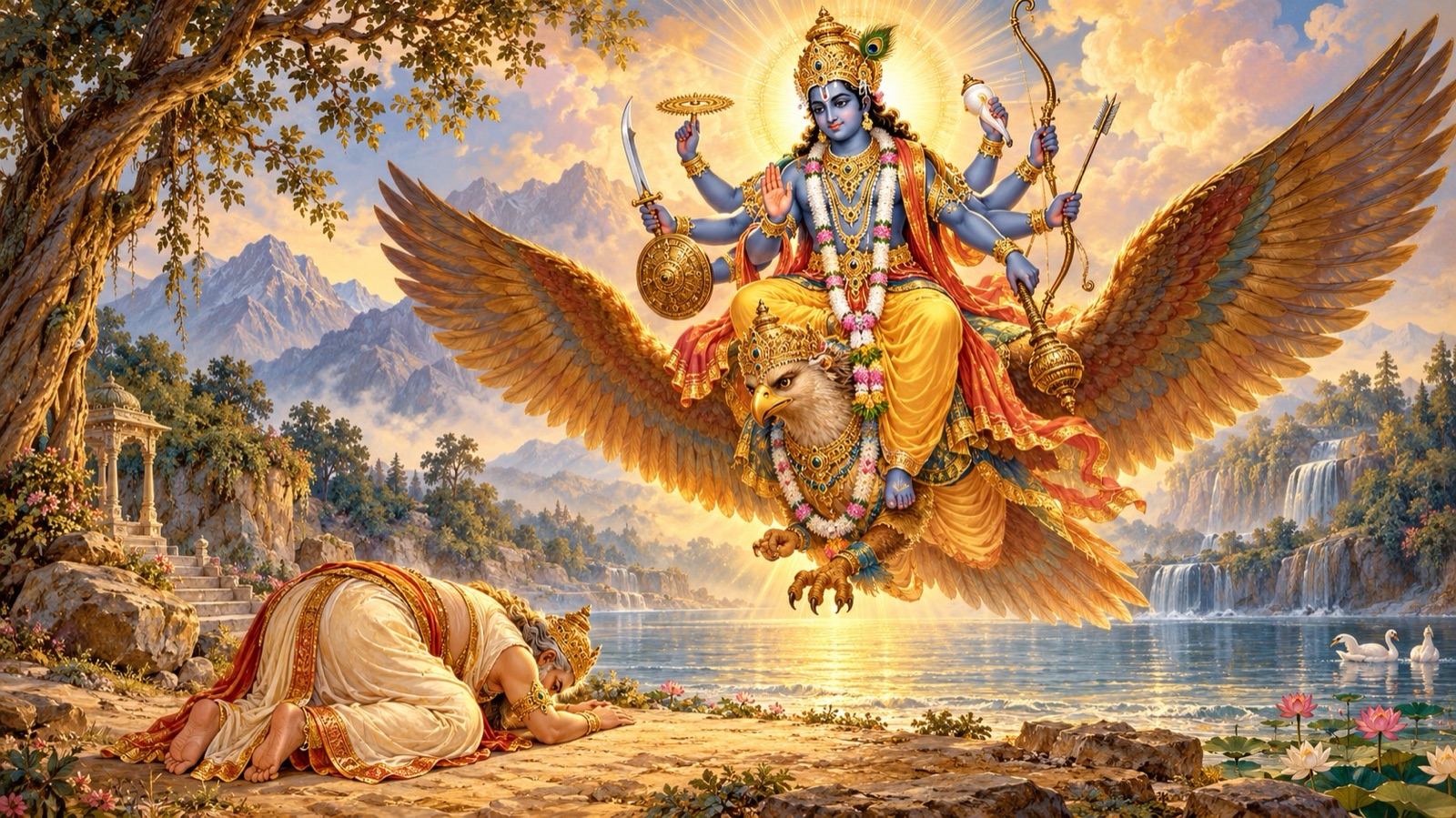
Pleased by the hidden hymn of a lonely ascetic, the Lord of the universe descends upon Garuda, radiant and eight-armed, to grant Prajapati Daksha the very wish of his heart.
Om Namo Bhagavate Vasudevaya.
Om Namo Bhagavate Vasudevaya.
Om Namo Bhagavate Vasudevaya.
Welcome to Srimad Bhagavatam Wisdom, a devotional journey through the sacred histories and teachings of the Srimad Bhagavat Mahapurana. The fourth chapter of the Sixth Canto turns from the deliverance of Ajamila to the mystery of creation itself. King Parikshit asks Sukadeva to describe in fuller detail how the manifold beings of the worlds came to be, and the sage answers by telling how Daksha, the son of the Pracetas, became a great progenitor. Along the way we hear how the fierce sons of Pracinabarhi were gently turned from anger by the moon-god, how Daksha withdrew to the hills to worship the Lord through a confidential hymn called the Hamsa-guhya, and how the Lord Himself appeared to bless him. Woven through the narrative is a teaching that never grows old: that the Supreme is nearer to us than our own senses, yet unknowable by them, and is won not by force or cleverness but by devotion.
Chapter Information
- Scripture: Śrīmad Bhāgavata Mahāpurāṇa
- Canto: 6 (Book Six)
- Chapter: 4 (Discourse 4)
- Chapter title: The Hamsa-guhya Prayers of Prajapati Daksha
- Principal speakers: Sukadeva Gosvami, narrating to King Parikshit; Soma the moon-god, Prajapati Daksha, and the Supreme Lord within the account
- Principal listener: King Parikshit; the sages of Naimisharanya at the outer frame
- Main setting: The bank of the Ganga where Parikshit listens; within the story, the earth after the great flood, and the holy lake Aghamarsana in the hills near the Vindhyas
- Central subject: The birth of Daksha the Pracetasa, his austerities and the Hamsa-guhya hymn, and the appearance of the Lord to bless him with progeny
- Principal verse range: Canto 6, Chapter 4, verses 1–54
- Primary edition: Gita Press Śrīmad Bhāgavata Mahāpurāṇa
Parikshit’s Question About Creation
The chapter opens with King Parikshit’s request. Earlier the creation of gods, demons, human beings, serpents, beasts, and birds in the age of Svayambhuva Manu had been described only in brief; now the king wishes to hear it in detail, and to understand by what power the Supreme Lord brought forth the subsequent creation (verses 1-2). Receiving this fine question, the great sage — narrated here through Suta Gosvami to the assembled seers — was delighted and began to speak (verse 3).
The Pracetas and the Burning of the Forests
Sukadeva takes the story back to the ten Pracetas, the sons of King Pracinabarhi. Emerging from a lake as vast as an ocean, where they had long performed penance, they found the earth overgrown with trees, for cultivation had ceased during their absence. Their anger inflamed by asceticism, they breathed out wind and fire from their mouths to burn the forests away (verses 4-5).
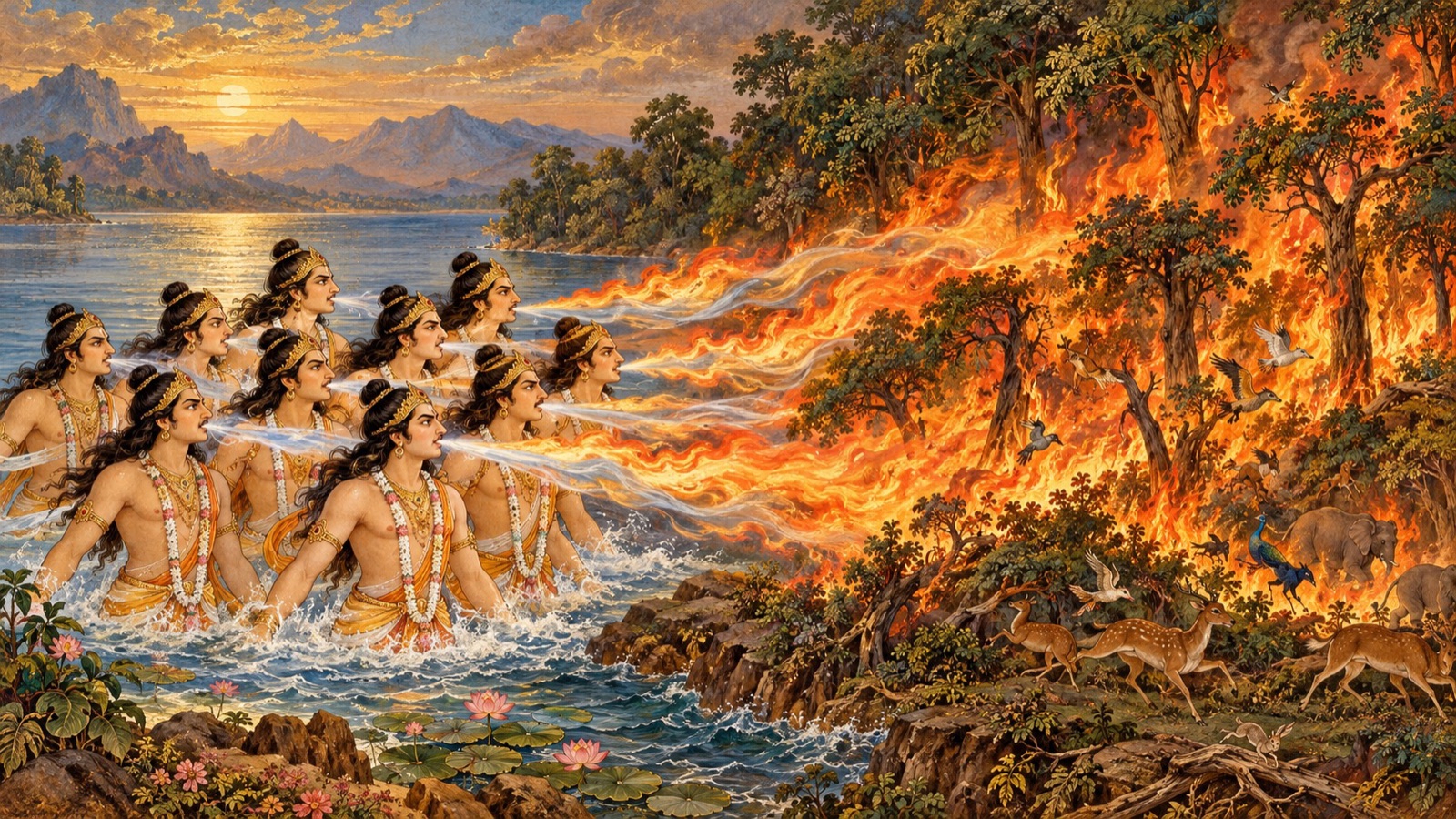
Seeing the trees consumed, Soma — the moon-god, ruler of the world of plants — intervened to calm them. It is not becoming of you, he said, to bear hostility to the helpless trees, for you are appointed to protect and increase all creatures, not to destroy them.
न द्रुमेभ्यो महाभागा दीनेभ्यो द्रोग्धुमर्हथ । विवर्धयिषवो यूयं प्रजानां पतय: स्मृता: ॥ ७ ॥
na drumebhyo mahā-bhāgā dīnebhyo drogdhum arhatha vivardhayiṣavo yūyaṁ prajānāṁ patayaḥ smṛtāḥ
Meaning: O greatly fortunate ones, it does not befit you to harm these poor, helpless trees, for you are known as protectors of created beings, appointed to foster their growth. (Canto 6, Chapter 4, verse 7)
Soma reminded them that Sri Hari had brought forth trees and plants as food for gods and forefathers, that the whole order of creatures lives by feeding on one another, and that they, commanded by their father and by the Lord to beget offspring, should not destroy what sustains life. Let them follow the path trodden by their forefathers and curb their anger; the wise, he said, are the friends of the ignorant, as parents are of children. Above all, he taught them to see the Lord Himself dwelling within every being as the indwelling Self.
अन्तर्देहेषु भूतानामात्मास्ते हरिरीश्वर: । सर्वं तद्धिष्ण्यमीक्षध्वमेवं वस्तोषितो ह्यसौ ॥ १३ ॥
antar deheṣu bhūtānām ātmāste harir īśvaraḥ sarvaṁ tad-dhiṣṇyam īkṣadhvam evaṁ vas toṣito hy asau
Meaning: The Lord Sri Hari, the supreme controller, dwells within the bodies of all beings as their innermost Self. Behold, therefore, the whole creation as His abode; in this way alone He is truly pleased with you. (Canto 6, Chapter 4, verse 13)
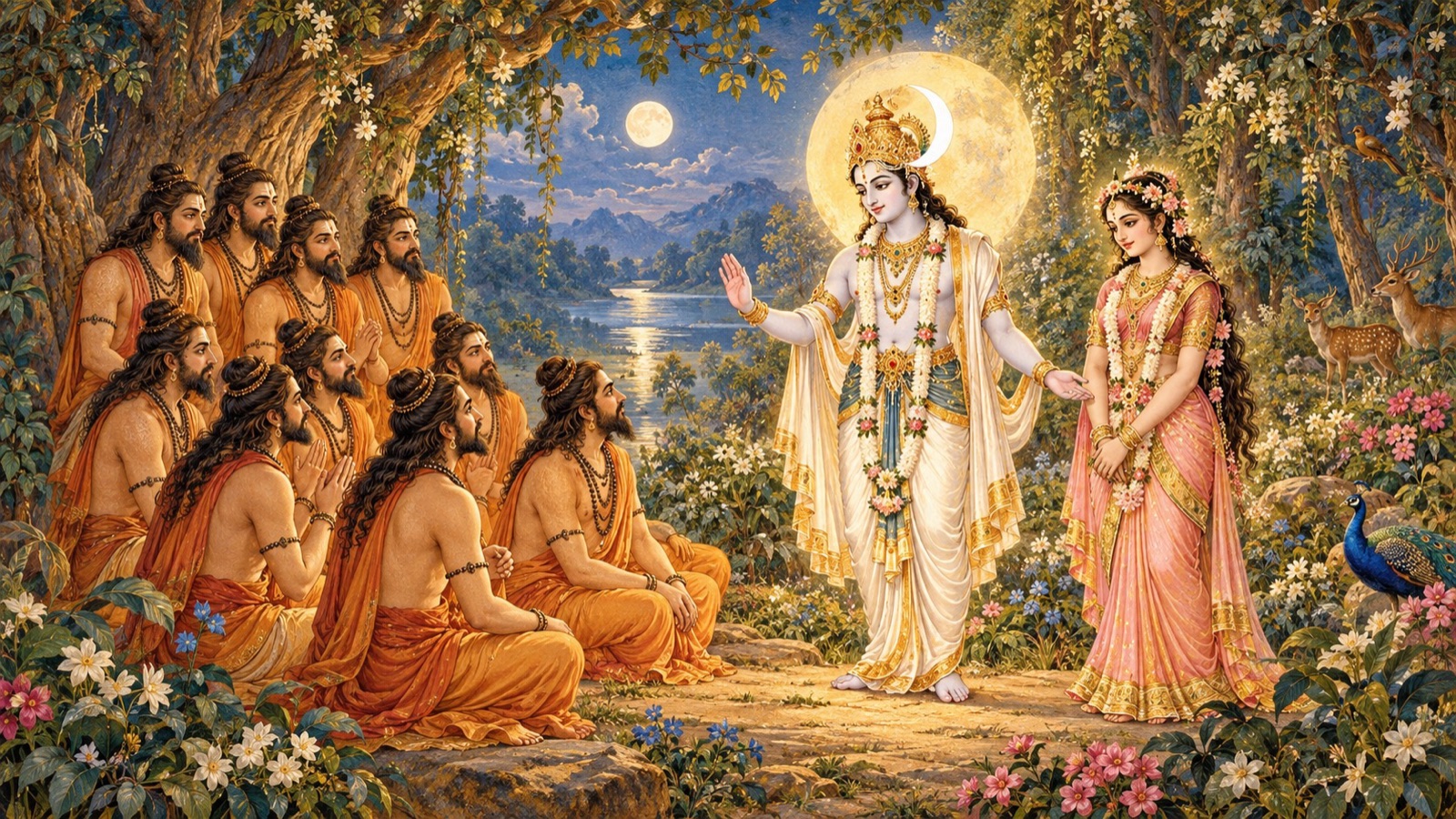
Pacified, the Pracetas restrained their anger and spared the remaining trees. Soma then gave them the beautiful maiden Marisha, daughter of the celestial nymph Pramloca and nurtured by the trees, and returned to his own abode. The Pracetas wedded her in accordance with virtue, and from them, through her, was born Daksha the Pracetasa — by whose progeny the three worlds would be filled on every side (verses 16-17).
Daksha’s Austerity and the Hamsa-guhya Hymn
Sukadeva now asks Parikshit to hear attentively how Daksha, devoted to his daughters, brought forth beings first by the power of his mind and then by procreation. At the outset he produced by thought alone the gods, demons, human beings, and creatures dwelling in the air, on land, and in the waters. But seeing that his race was not multiplying as he wished, the great progenitor withdrew to the hills near the Vindhya mountains and undertook austerities hard to perform. Bathing thrice each day in the sacred lake Aghamarsana — whose very name means the washer-away of sins — he propitiated Sri Hari, extolling Him through the confidential hymn known as the Hamsa-guhya (verses 18-22).
The prayer that follows is one of the great philosophical hymns of the Bhagavata. Daksha bows to the self-effulgent Supreme, whose true nature is hidden from those who take the objects of the senses to be real, and who lies beyond all the ordinary means of knowledge.
नम: परायावितथानुभूतये गुणत्रयाभासनिमित्तबन्धवे । अदृष्टधाम्ने गुणतत्त्वबुद्धिभि- र्निवृत्तमानाय दधे स्वयम्भुवे ॥ २३ ॥
namaḥ parāyāvitathānubhūtaye guṇa-trayābhāsa-nimitta-bandhave adṛṣṭa-dhāmne guṇa-tattva-buddhibhir nivṛtta-mānāya dadhe svayambhuve
Meaning: I offer my obeisance to the transcendent Lord of unfailing consciousness, the true friend and cause of the living being bound within the reflection of the three modes of nature, whose abode is unseen and who cannot be reached by minds fixed on the reality of the modes — to that self-existent Supreme I bow. (Canto 6, Chapter 4, verse 23)
In verse after verse Daksha unfolds the mystery of the Lord’s nearness and hiddenness. The Lord lives with the individual soul as its constant friend within the same body, yet the soul does not know Him — just as a visible object cannot perceive the light of the eye that reveals it. The body, the vital airs, and the senses know neither themselves nor the soul that animates them; the conscious soul knows all these and the modes of nature, yet cannot know the infinite, all-knowing Lord. He is realized only in a purified mind, when the play of names and forms grows still; the wise discover Him seated within the heart, veiled by His own manifold energies, as fire lies hidden in wood until it is drawn out by sacred chant. Whatever can be spoken in words, grasped by intellect, or perceived by the senses is not His essence, for all that belongs to the modes of nature, while He is indicated only by the arising and dissolving of the whole cosmos (verses 24-30).
Daksha then reaches the heart of his prayer. He observes that it is the Supreme Himself, seated within the very hearts of the philosophers who dispute about Him, who stirs them toward endless disagreement, so that argument alone could never settle who He is; yet the theist who seeks the indwelling Self through yoga and the analyst who reduces the world to its elements without accepting a person behind them are, without knowing it, circling the very same single Reality (verses 31-32). Doctrine and debate can point toward the Lord, but only surrender delivers Him — and that is exactly what this hymn is about to prove, for no feat of philosophy summoned the Lord to that lakeside; a single heart’s undivided love did.
May that infinite Supreme, Daksha prays, who out of grace assumes names and forms to shelter those who take refuge at His feet, be gracious to me (verses 33-34).

The Lord Appears and Grants the Boon
Thus extolled, the Lord — ever fond of His devotees — appeared in person on the strand of that holy lake, even as Daksha was still glorifying Him. He came borne upon Garuda, His feet resting on the shoulders of the king of birds, possessed of eight mighty arms bearing the discus, conch, sword, shield, arrow, bow, noose, and mace. Clad in yellow, dark as a rain-cloud, with a cheerful face and joy-filled eyes, He wore a garland of sylvan flowers, the mark of Srivatsa, and the Kaustubha gem, a great crown and shining ornaments. His form captivating all three worlds, He was surrounded by attendants such as Narada and Nanda and the chief of the gods, and praised in song by Siddhas, Gandharvas, and Charanas. Filled with awe and overflowing joy, Daksha fell prostrate on the ground, his senses flooded with delight like rivers swollen by mountain torrents, unable to speak a word (verses 35-41).
To that devoted progenitor, longing for progeny, Lord Vishnu — the knower of every heart — then spoke.
प्राचेतस महाभाग संसिद्धस्तपसा भवान् । यच्छ्रद्धया मत्परया मयि भावं परं गत: ॥ ४३ ॥
prācetasa mahā-bhāga saṁsiddhas tapasā bhavān yac chraddhayā mat-parayā mayi bhāvaṁ paraṁ gataḥ
Meaning: O greatly blessed son of the Pracetas, you have become perfect through your austerity, for by faith wholly fixed on Me you have attained the highest love for Me. (Canto 6, Chapter 4, verse 43)
The Lord declared Himself pleased, for Daksha’s penance served the growth of creation, which is the Lord’s own wish. Brahma, Shiva, Daksha himself, the Manus, and the chief gods, He said, are His glorious manifestations working for the prosperity of all beings. Austerity, He revealed, is His very heart; worship is His body; well-performed sacrifices are His limbs; and the gods are His vital airs. Before creation He alone existed, pure consciousness and unmanifest, until through Maya the cosmos of the three modes arose within Him, and Brahma appeared as its creator. Then the Lord bade Daksha accept as wife Asikni, the daughter of the progenitor Panchajana, and through her beget progeny in abundance, so that all beings thereafter might multiply and offer their worship to Him (verses 43-53).
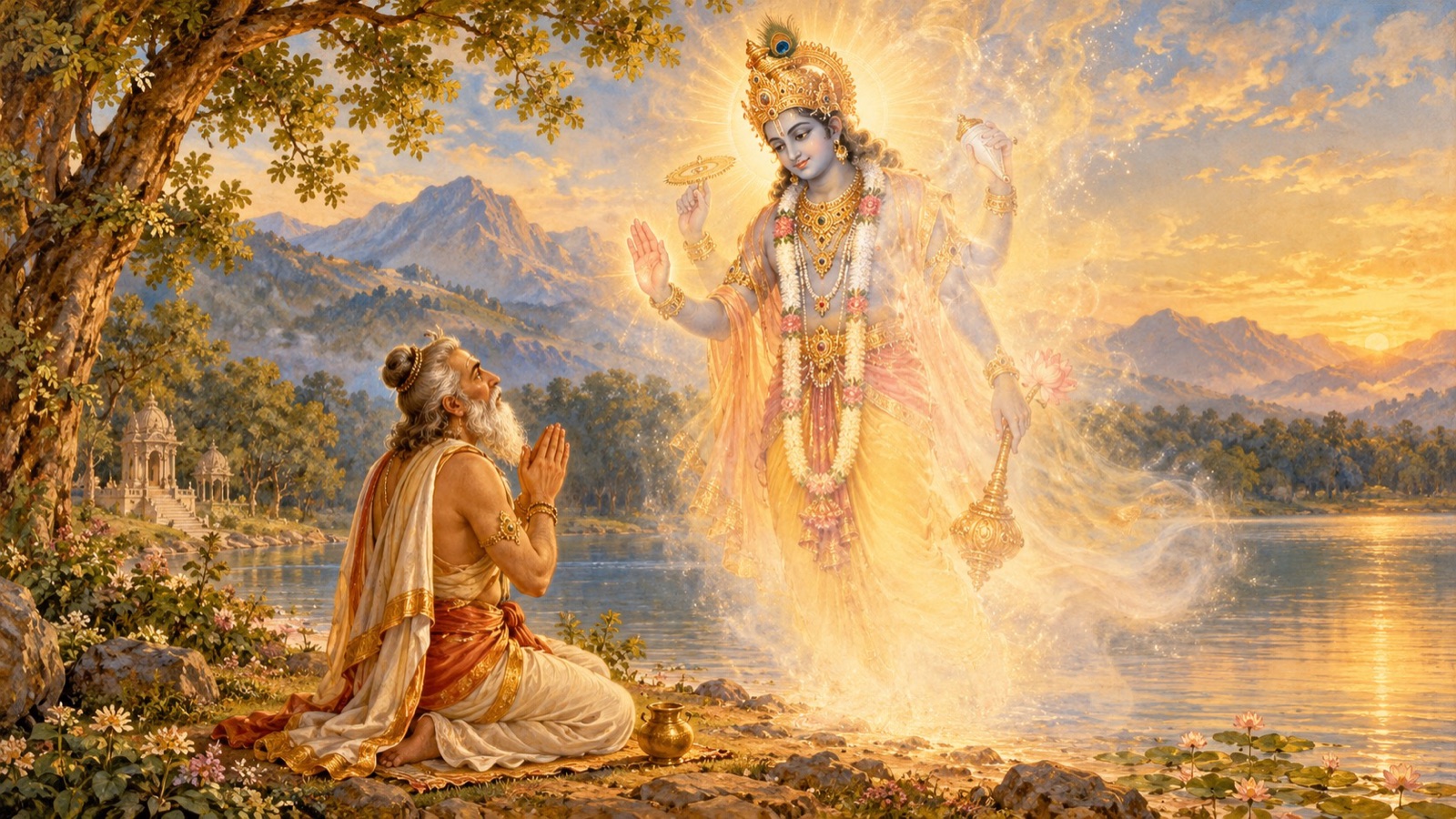
Having spoken thus, the Lord Sri Hari, the promoter of the universe, vanished on that very spot, like an object seen in a dream, even as Daksha looked on (verse 54).
Principal Teachings of This Chapter
1. Protectors must nourish, not destroy. Soma’s counsel to the Pracetas reframes power as service: those set over creatures are meant to foster life, and true worship of the Lord is to see Him dwelling within all beings (verses 7, 13).
2. The Supreme is nearer than the senses, yet beyond them. The Hamsa-guhya hymn teaches that the Lord accompanies the soul as its dearest friend within the very body, but cannot be grasped by senses, mind, or speech — He is known only in a purified heart (verses 23-27).
3. Nothing exists apart from the Supreme. Every action and cause has its root in Brahma, who existed before all and is the cause of all causes; the whole cosmos merely indicates Him (verses 29-30).
4. Devotion perfects austerity. Daksha’s long penance bears fruit not through its severity alone but because it ripened into loving faith fixed wholly on the Lord (verse 43).
5. Creation is the Lord’s own work and wish. The great progenitors are His manifestations, and offspring arise through His Maya; even the duty of creation is a form of surrender to Him (verses 44-45, 53).
A Devotional Reflection
There is a beautiful symmetry in this chapter. It begins with anger — the Pracetas scorching the forests — and ends with grace, the Lord descending to bless a humble worshipper. Between the two stands a single turning point: the choice to see the Supreme within all things rather than to impose one’s will upon them. Soma teaches this to the Pracetas in a sentence, and Daksha lives it out in years of penance beside a lonely lake. The Hamsa-guhya hymn is called “hidden” because it praises the One who hides within the seer of all, unreachable by the very faculties we trust most. And yet He is not far. He appears the moment devotion becomes pure, not because prayer compels Him but because love is the atmosphere in which He delights to show Himself. Daksha wanted only children; the Lord gave him that and, far more, the sight of His own face. So it often is: we come to God with our small requests, and He answers by giving us Himself.
A Daily Devotional Practice
Today, take a single teaching from the Hamsa-guhya hymn and let it shape your seeing. As Soma urged the Pracetas, look upon the people and creatures around you as dwelling-places of the Lord, who abides within each as the innermost Self. Before you act toward anyone in haste or anger, pause and quietly recall: the Lord Sri Hari lives within this being too. Let that remembrance soften your words and steady your heart, and offer the day’s smallest kindnesses as worship to the One who dwells in all.
Conclusion
The fourth chapter of the Sixth Canto lifts the account of creation into an act of devotion. Through the moon-god’s gentle counsel, the birth of Daksha, and above all the confidential Hamsa-guhya hymn, we learn that the Supreme Lord is the innermost friend of every soul, hidden from the senses yet won by pure love. Daksha’s austerities at the sacred lake, crowned by the Lord’s radiant appearance upon Garuda, show that penance finds its perfection in faith and that the Lord answers devotion by granting both the wish of the heart and the vision of Himself. As the Canto continues toward the great line of Daksha’s descendants, we carry with us the hymn’s abiding assurance: that He who cannot be reached by mind or speech draws near at once to the heart that loves Him.
May the divine wisdom of Srimad Bhagavatam awaken pure devotion within our hearts.
Om Namo Bhagavate Vasudevaya.
Jay Shree Madhav.
References and Attribution
- Primary edition: Gita Press, Śrīmad Bhāgavata Mahāpurāṇa (English, complete), Book Six, Discourse 4.
- Series: Srimad Bhagavatam Wisdom · Biswa Sanatan Dharma Seva Trust.
- Presented following the spiritual guidance and recommendation of Pandit Dr. Shri Kashinath Mishra.
This is an original, faithful retelling in the writer’s own words, with brief quoted verses shown in Devanāgarī and transliteration and their meanings given as summaries. It is not a reproduction of any single publisher’s continuous translation or commentary. No affiliation with or endorsement by any publisher is implied.
Jay Shree Madhav